Posted on Leave a comment

Fine Fermenting

I started drinking kombucha a few years ago. Maybe you’ve seen it in your nearest health food store. It’s a beverage fermented from black tea, sugar and a symbiotic culture of bacteria and yeast (SCOBY). I like the tart flavor and refreshing fizziness. The probiotics and nutrients are great, too. But the $4 a bottle price tag makes me cringe. A friend gave me a starter SCOBY (it looked like a flat mushroom cap) to brew my own, but I was too nervous. I’d heard rumors of people dying from bad homebrews.

That’s why I was excited to find Cultures for Health, a website headquartered in Sioux Falls with an abundance of fermentation information and products. Founder Julie Feickert became interested in healthy living after her first child was born.”I took a class on living sustainably and learned about eating a whole foods diet and the amazing number of fermented foods you could make at home,” Feickert says. She purged her cupboards of processed foods and started making her own yogurt, kombucha, kefir and sauerkraut. And the more she made, the more she realized the need for a website with quality instructions, recipes and starter cultures.

“Meanwhile, I was facing a decision to go back to work teaching at night,” Feickert says.”My son was still quite young, and I really didn’t want to leave him, so I was looking for a way to work from home.” In 2009 she built a simple website and stocked a few products.”It took off beyond anything I had ever imagined.”

Cultures for Health now offers over 350 products for at-home fermentation and has a staff of 20. Feickert moved her business headquarters and her family from Portland, Oregon, to Sioux Falls in 2012.”We needed to be more centrally located to better control the quality of shipping perishable products and keep shipping costs and transit times as low as possible for our customers,” Feickert says.”Sioux Falls had a great mix of excellent shipping conditions, affordable living and a safe place to raise our young children.”

I haven’t made my own kombucha yet, but I feel more confident to try. Feickert’s website has a wealth of “how-to” videos and articles and sells pH indicator strips for the squeamish to test when the beverage is ready. And besides kombucha, they have products for yogurt, kefir, sourdough, buttermilk, cheese and more to help people ferment confidently.
Posted on Leave a comment

In a Pickle

The spring showers that fell just enough to give our gardens promise turned to hot, dusty days of summer. Clouds that thunder but won’t rain and thermometers that threaten to combust from the never ending 100+ degree temperatures are our norm. We are forced into multiple daily waterings for our gardens as a means of life support.

I have harvested tomatoes, peppers, zucchini, peas, radishes, spinach, tomatillos, onions and lots of herbs. Most of my garden is doing reasonably well with the moisture of the soaker hose rehydrating the soil each night. However, I feel I am in a pickle with my cucumbers. I have picked 2 small fruits from their vines, but the plants really can’t even be called vines. They haven’t grown much from the small plant sets that I purchased at the greenhouse. Is it just the heat? Or am I missing some key element for vibrant yellow flowers producing prickly green cukes? What am I doing wrong?

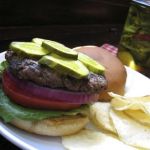
I want to make pickles. In the past, I have done a few pints of refrigerator pickles that were the perfect complement to grilled burgers and sandwiches, as well as great right from the jar. I want more of their slightly sweet, garlicky, sour crispness. I can’t do that without cucumbers. I hope the forecasted cool front helps my puny vines do their thing to remedy my pickle problem.


Refrigerator Pickles

Adapted from Alton Brown

1 onion, thinly sliced
4-5 medium cucumbers, thinly sliced
2-4 cloves garlic, peeled
2-4 small hot peppers
2-4 sprigs of dill
2 cups water
2 cups cider vinegar
3 cups sugar
1/2 teaspoon kosher salt
1/2 teaspoon turmeric
1/2 teaspoon celery seeds
1/2 teaspoon pickling spice

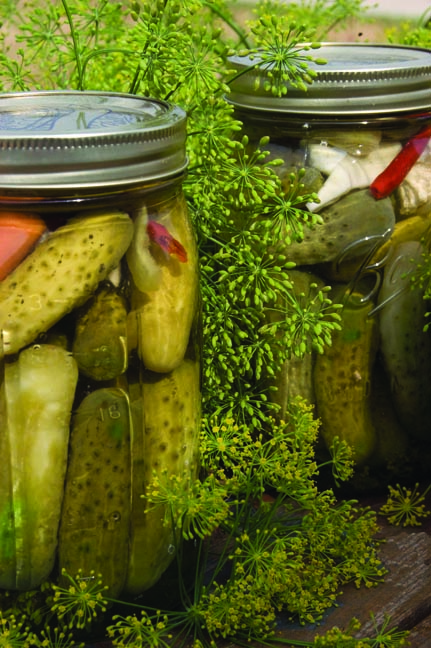
Drop a clove or 2 of garlic into each of 2 pint canning jars. (I use wide-mouth jars for ease of packing.) Layer onion and cucumber slices in jars, adding a couple small hot peppers and sprigs of dill between the layers. Combine the remaining ingredients in a non-reactive saucepan and bring to a boil. Simmer for 4 full minutes to meld the flavors. Slowly pour the hot pickling liquid over the onion and cucumber slices, completely filling the jar. Refrigerate for 24 hours before serving. Use within 2-3 months. Yield: 2 pints.

Fran Hill has been blogging about food at On My Plate since October of 2006. She, her husband and two dogs reside near Colome.


Posted on Leave a comment

Pickle Party

A tasty family recipe inspired Terry and Sam Grosz of Delmont to organize a pickle party and invite their entire community.

Pickle packing is more fun with the help of friends and neighbors. At least Sam and Terry Grosz thought so when they began the annual gathering in 1994.

Terry and Sam Grosz of Delmont host an annual Pickle Packin’ Party. The gathering began several years ago when the Groszes visited family in California to attend a pickle party hosted by Terry’s cousin. They loved the pickles so much they brought the secret recipe, along with a dozen jars of pickles, back home in a suitcase.

They tried a small batch in their kitchen the following summer, staying true to the family recipe except for adding some vegetables. The next summer they invited friends to help them pack pickles under a tent. After making 100 jars in 12 hours, a Delmont tradition was born.

Eleven years ago the summer heat and flies, plus an ever-growing group, persuaded the Groszes to move the party from a tent to the Delmont Community Center. They use the rear of the building for cleaning the cucumbers and the community room in front for packing and sealing the jars.

Local Hutterite colonies supply cucumbers by the truck full.

The group has grown to about 50 picklers, and the process is considerably more streamlined since that first yard party. They are on a strict schedule, starting at 8 a.m. on a Saturday in July. Forty-five minutes are scheduled for the potluck lunch and the canning and cleaning are finished by 5:30 p.m.

The Groszes purchase the cucumbers from nearby Hutterite colonies, since they grow enough to ensure a uniform size for the pickles. Invitations are mailed a few weeks before the party. Along with the usual date and time, the clever cucumber notes include an RSVP for how many quarts each partier wants to make. The Groszes order and purchase the pickle ingredients, but everyone brings their own jars, rings and lids and a potluck dish to share at noon. At the end of the day each person pays a per-jar price, based on the cost of the supplies.”It costs roughly $2 per jar,” Terry said.”That’s rent, gas, refreshments, everything.”

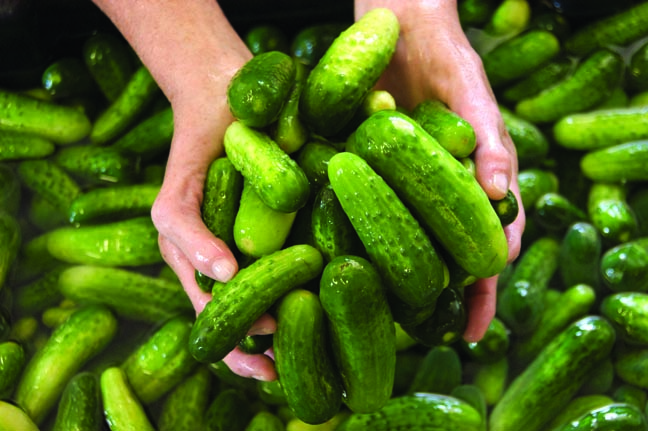
The first step to making pickles is prepping the cucumbers. Hundreds of cukes are dropped in a cattle tank filled with water where the stem and remaining leaves are removed by a group of workers. In 2008 Howard Knodel, from Nome, Alaska, was on stem duty. He was visiting relatives in the area when Terry gave him a jar of pickles to sample. Impressed by the taste and crispness, he decided to join the party.”Terry told me if I was around I should come to the pickle party,” Howard said.”I’ve ordered 16 jars so I can bring them back to Alaska for my wife and boys.”

Delmont’s pickle party is a community event, but the recipe remains top secret. Pickle partiers go home with as many jars as they want – for $2 each.

After being stripped of leaves and stems, the cucumbers are run through the rinse/spin cycle of a washing machine. Three to five gallons of cukes are placed in the washer at a time. Towels are positioned around the sides of the tub to buffer the cucumbers from breaking or bruising. Mike Grosz, Terry’s son, runs the machine.”I’ve been washing cucumbers for about 10 years,” he said.”I wouldn’t miss this for the world.”

The washed cucumbers are carried to the community room in tubs where an assembly line of chatting, smiling picklers stand waiting on both sides of long tables. A turkey cooker with a canner placed on top serves as the hot water bath for the jars. Peggy Grosz, Mike’s wife, pulls the jars from the hot water. Her PVC coated gloves demonstrate the potential hazard to tender skin.”I’m the hub of the wheel,” she said.”If I quit everybody has to stop.”

Each person on the line after Peggy has a designated task: packing cucumbers, dill, hot peppers, garlic or vegetables, adding alum and finally pouring in the brine and sealing the jars.

Terry won’t share the recipe for the crunchy, savory dill pickles.”When my cousin gave me the recipe years ago, he made me promise not to give it to anyone. He died a year and a half ago, but I’m still keeping my promise.”

He’ll share the pickles though, if you bring your own jars.

Editor’s Note: This story is revised from the May/June 2009 issue of South Dakota Magazine. To order a copy, or to subscribe, call 800-456-5117.