Posted on Leave a comment

Opening Day

Teenagers who help at Louise’s Cafe in Fairfax, population 115, are about to get a lesson in communications. That’s one of several side benefits to the hunting season for Gregory County, in the heart of pheasant country.

“I keep telling the kids that they’ll get better tips if they just learn to talk to the hunters a little bit,” says Louise Truax, who has been frying eggs on Fairfax’s Main Street for 30 years.”They joke with you and you joke back.'”

Louise’s Cafe, with its $6.50 breakfast special (eggs, bacon, potatoes, toast and coffee) spices the Gregory County ambiance, along with dozens of other small town restaurants, shops and lodges.

Marge LaFave has run the tiny and impeccably clean Hertz Motel in Bonesteel, population 100, for nearly 40 years. Even though most of the pheasants have migrated west of her little town, hunters still sleep there. Across the street is the historic TeePee Cafe, managed by Tami Jons who features Friday night steak specials, prime rib on Saturdays and Sunday breakfast buffets. The motel and cafe were built in the 1950s in anticipation of the lake traffic everybody thought would flood Highway 18 once Fort Randall Dam filled Lake Francis Case.

Walleye and anglers have taken to the lake, but ring-necked roosters take precedence in October when the sorghum heads turn red and the sumac even redder. Pheasants are a $250 million industry statewide. More than 170,000 hunters will be gunning for the birds this fall. That creates 4,500 jobs for guides, taxidermists, waiters, bartenders and lodge-keepers in the four very small towns (Fairfax, Herrick, Bonesteel and Dallas) and two small cities (Burke and Gregory) that comprise Gregory County. Churches hold bake sales to capitalize on the hunters, and the city of Gregory celebrates with a soup-tasting contest.

Opening Day has a fresh aura, especially in Gregory County where an autumn blue sky is beautifully framed by the muted, earthy colors of cornfields, grasslands and tree belts. Hunters regularly remark that they wouldn’t care if they never saw a pheasant, so lovely are the landscapes.

“It’s more about the relationships and the camaraderie,” says Mike Karbo, who bought the funeral home in Burke 20 years ago and moved from Sioux Falls because he loved the outdoors. He says deer, turkey and walleye are also big draws.

And did we mention pancakes?”I’ve been using the same mix forever,” says Louise, the Fairfax restaurateur.”It’s just milk and butter and the mix and you add water, but they sure like them.”

Then add syrup.”I always tell the kids that when the customer gets ready to pay, all you have to say is ‘have a good day,'” she says.”Some of them do and some don’t. But that’s ok, too.”

Who wouldn’t want to hunt in a place like this?

Editor’s Note: This story is revised from the September/October 2012 issue of South Dakota Magazine. To order a copy or to subscribe, call (800) 456-5117.

Posted on Leave a comment

Tale of Two Paths

You might know Gregory County because of its high school’s notorious mascot: the Gorillas. Or as the home of Elmer Karl, whose smiling face has appeared in advertisements for home appliances for over 50 years. But this county on the Missouri River — still affectionately described as part of Rosebud Country — is rich in history, culture and natural beauty.

Drivers from East River can cross into Gregory County via two main routes, and the area’s striking landscape is immediately evident no matter which is chosen. Highway 18 spans the Missouri River and Fort Randall Dam in the southern part of the county. The dam is named for historic Fort Randall, built in 1856 just below the present dam site. Fort Randall was an important link in a chain of forts protecting a trail along the Platte River and was the first in a line of forts stretching up the Missouri River. Soldiers stationed here were mostly charged with controlling the Lakota as homesteaders steadily trickled in from the East.

The remains of Fort Randall Chapel.

Fort Randall operated until 1892 but remnants still exist, include building foundations, a chalk rock chapel built in 1875 and the cemetery, where 138 soldiers, their wives and children were originally buried. Some bodies have been moved, but about 90 graves remain inside the white picket fence. A placard provides dates and causes of death — including disease, skirmishes with Indians and a lightning strike — for many who perished at Fort Randall.

Among the many soldiers stationed at Fort Randall included John Shaw Gregory, who worked as a trader for the Frost and Todd Trading Company. He was also a member of the territorial legislature in 1862, when Gregory County was created and named in his honor.

Just across the dam lies the Karl Mundt National Wildlife Refuge, home to one of the most important bald eagle roosts in the country. Between 100 and 300 bald eagles spend the winter there, fishing in the open waters of the Missouri River and roosting in the gnarled old cottonwoods. Birders are welcome, but the refuge itself is closed to visitors. A kiosk below the dam provides excellent eagle viewing.

Frank Day’s Bar caters to hunters in the fall.

All of Gregory County’s towns are situated along Highway 18. During the fall, that’s a well-traveled section of road because pheasant hunters descend upon the area. Local businesses like Louise’s CafÈ in Fairfax, or the TeePee CafÈ in Bonesteel offer hearty breakfasts and weekend specials to satisfy their hearty appetites. Guides, taxidermists and motel operators in those towns, plus Gregory, Herrick and Dallas are kept busy, as well.

Head north of Bonesteel to Whetstone Bay and search for prehistoric sea creatures on the banks of the Missouri River. Bonesteel’s Paul Neumiller has been hunting fossils since 1957. He’s discovered prehistoric lizards, elephants, mastodons and sea turtles that weighed two tons. He also found North America’s first hainosaurus — a giant sea lizard — in 2002.

Just beyond Bonesteel is the tiny community of St. Charles, where the Lakota culture remains alive and well. Gregory County was once part of the Great Sioux Reservation, which encompassed all of present-day West River South Dakota. The land was opened for settlement in 1904, but Lakota still live and work in the area. At Milk’s Camp, Marla Bull Bear leads a summer camp that was created a decade ago to combat a rash of youth suicides on the nearby Rosebud Reservation. Attendees learn about Lakota culture, music and traditions.

Attendees at Milk’s Camp learn hoop dancing under the guidance of Kevin Locke.

The next town along Highway 18 is Herrick. You can’t miss it because its bright red elevator has become a destination. Originally a working grain elevator, it was added to the National Register of Historic Places and has been renovated as a retreat center. The town also celebrates an annual Squeal Meal, which includes a pork barbecue, parade, dance and hog calling contest.

Burke is the county seat, but it’s known across South Dakota for the annual Stampede Rodeo. The event is really a community affair, with an expanded farmer’s market and a cattle drive down Main Street. The main event has all the hallmarks of a rodeo plus a singing contest and other special additions.

The largest town is Gregory, at just under 1,300 people. The citizenry loves Gorillas football games and a main street that features the flagship Karl’s store. For years the town held an Oscar Micheaux Festival to honor the African American filmmaker who originally homesteaded in Gregory County. On our most recent trip through Gregory, we stopped for a breakfast of eggs, homemade potatoes, toast and coffee at Sissy’s CafÈ and grabbed coffee at Dayspring Coffee Company.

The last town on 18 is Dallas, home to the iconic Frank Day’s Bar. When we visited 20 years ago, we found historic guns, hats, boots, saddles and photographs plastered to the walls inside the bar. Day, who has since passed away, was also a collector of stories, having recorded interviews with several old-timers. He told us the story of Tom McCrory, a rancher who had a hole in the palm of his hand”so big that you could see daylight through it,” Day said.”He claimed a bear had mauled him but another old-timer said the bear must have had a revolver.”

A cattle drive down Main Street of Burke precedes the summertime Stampede Rodeo.

If you enter Gregory County further north, you’ll cross the Missouri River on the Platte-Winner bridge. When workers built the bridge, the main stem dams had already been built on the river, so they had to build foundations in depths up to 180 feet. It was a lot of expense and work for a bridge that carries less than 1,000 vehicles a day, but few river crossings are as unspoiled and picturesque.

There are no towns in northern Gregory County, but it’s historic country nevertheless. The area around Lucas was headquarters for Jack Sully, a legendary cattle rustler who was gunned down by a posse in 1904. In the days of the open range, large cattle companies from southern states drove livestock into the Dakotas and allowed them to forage, leaving little for the cattle belonging to homesteaders. Many South Dakotans saw Sully’s antics as merely protecting their rights to their own land, but he found himself in jail on several occasions. He broke out of the Mitchell jail and evaded law enforcement until U.S. Marshals learned he had returned to his home in the Gregory County hills. They shot him as he tried to escape on horseback.

Sully’s antics are still the subject of debate, but that’s all part of the beauty and mystery of Gregory County.

Editor’s Note: This is the 14th installment in an ongoing series featuring South Dakota’s 66 counties. Click here for previous articles.

Posted on Leave a comment

England’s Lone Bull Rider


London, England’s only bull rider did all right at this month’s Burke Stampede Rodeo. He won a special award and did about as well as anyone when it came to staying on a bull for eight seconds.

England’s cowboy is Jamie McDonald, and truth be told he’s more actor than bull rider. He and a friend from New York are making a movie for the Sundance Film Festival, and for some unexplainable reason they decided it might be interesting to film a Londoner’s attempt to ride a bull.

The filmmakers set their sights on the Burke Stampede, and it was a lucky draw. The cowboys and cowgals in Gregory County welcomed them with open arms. Sure you can come film us! Sure you can ride a bull! Sure, we’ll show you how! Sure, you can enter the talent contest! Sure! Sure! Sure! You know how life is in a small town; you can hardly take a walk because everyone wants to give you a ride.

Burke is the epitome of a small town. All 600 people here are busy, because there are barely enough of them — even with a few hundred rural neighbors who help quite a lot — to run the churches, the schools, the picture-perfect Hillcrest Motel, the farmer’s market on Thursdays, the bank and the other essentials of life. Most of the 600 drive pickup trucks because when you live in the Rosebud Country you never know what you might have to haul home (a calf, a dog, a lawn chair made by the shop students at nearby Bonesteel High School, or maybe five bushels of sweet corn).

Bill and Renee Sutton are as busy as any of the 600. They are longtime promoters of the amateur rodeo, and they happily took the film-making blokes under their wings. First, they saddled McDonald on a horse so he could help drive a herd of longhorn cattle down Burke’s main street on Thursday afternoon. It was blistering hot for the cattle drive, but all went well with that.

The Englishman met the rest of the Burke community on Thursday night when he competed in the talent contest along with 18 other contestants for the privilege of singing at the Friday, Saturday and Sunday night rodeos.

Nobody expected McDonald to be a world-class bull rider but we didn’t know if he could sing. He can’t. Still, the crowd still loved his version of a country song tailored to Burke, and though they didn’t want to hear it three more times the judges did give him a special”Entertainer of the Year” award, hand-scribbled on white paper but an honor nevertheless.

So Thursday was a success, but Friday must have been a long day for our English friend. That morning the Suttons invited him to their ranch to practice bull riding. They tried to teach him the basics — how to use the bullrope, where to grip and even how to fall safely.

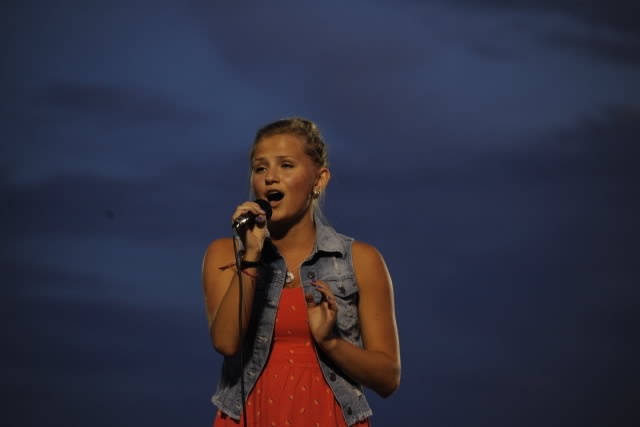
I don’t know if the minutes pass quickly or slowly on a day when you’re awaiting your first bull. Jamie McDonald looked fairly relaxed as the rodeo got underway with bronc riding and calf roping. Pretty young Katie Eliason, the teenaged winner of the previous night’s talent contest, came out on the catwalk to sing a country song.

Before we knew it, the time had come for bull riding, and readying himself in the first chute was McDonald, looking rather western in a black hat and black shirt. Without hesitation, he sat himself down on the one-ton white bull, gripped the bullrope like he’d done it a thousand times before, and gave a nod that he was ready. With that the cowboys opened the chute.

Perhaps never before did a Burke rodeo crowd watch with so much nervous apprehension. We all saw the menacing white bull leave the chute with the black-dressed cowboy sitting tall, awaiting the worst.

The bull came out of the chute, took four confident steps into the area and then froze. Yes, he stopped, dead in his tracks. He stood there silently, just switching his tail.

Remember, the biggest challenge for a bull rider isn’t style or form but just not getting bucked off for eight seconds. A second passed. Another second. Maybe even another second. Might the Englishman make eight seconds?

Of course not. Somebody in the arena moved. It might have been the clown, or one of the bull fighters there to save the rider from being kicked and gored. Somebody got the bull’s attention and he reacted as bullies always react; he kicked his hind legs high in the air and Jamie McDonald, England’s best bull rider, came thudding down into the thick soft concoction of dirt and sand in the Burke rodeo arena.

The bull fighters sprang into action and diverted the bull’s attention while Jamie scampered to his feet, a big smile on his face and his friend’s camera catching it all, and ran for the white steel fence and safety.

It was a good show and we figure the movie will be even better. Hopefully the busy people of Burke can find time to watch it.