Posted on Leave a comment

Yes, We Pe-Can

Nut trees can flourish in a sliver of South Dakota, but will their growers ever be more than hobbyists?

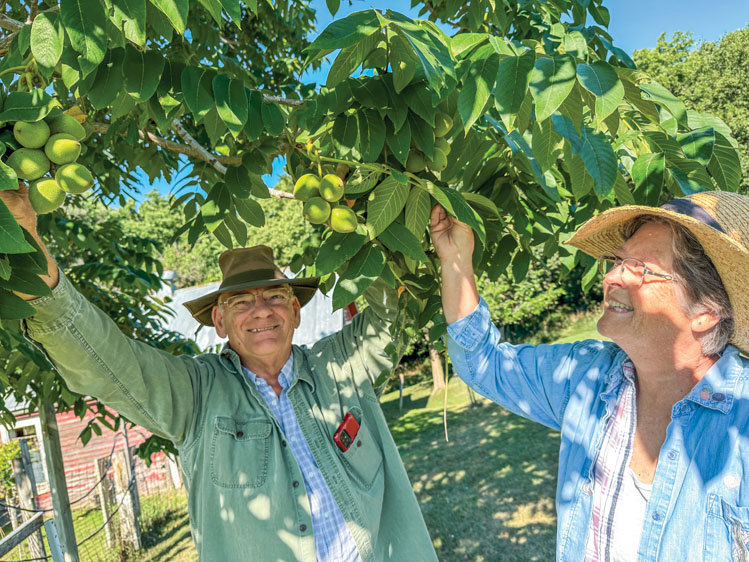
Darrell and Martha Ausborn have experimented with nut trees on their 10-acre farm west of Yankton since 2008.

By John Andrews

Dan DeBuhr was 6 years old in the early 1960s when his grandmother returned from a vacation in Texas with two pecan trees. She planted them in the backyard of her Elk Point home — the same patch of land where DeBuhr lives today — not knowing what to expect. “They told her they couldn’t guarantee that they would make it in South Dakota,” DeBuhr says. “And they would never bear fruit.”

Today, motorists passing by on Interstate 29 can easily spot them because they are the tallest trees in town. In fact, measurements taken last June confirm that they are the two biggest pecan trees in South Dakota, both supplanting a 61-foot pecan in Rapid City.

A severe thunderstorm pelted Elk Point with baseball sized hail early last summer, greatly diminishing the year’s pecan crop. But near the end of most Septembers, DeBuhr wages a daily battle with squirrels to collect the prized nuts. The little critters clearly collect their share, evidenced by the tiny trees that spring up from pecans buried around his yard.

We think of more temperate places when we think of pecans, but they have a history in South Dakota. Pecans — as well as hickory, chestnuts, heartnuts, butternuts, English walnuts and maybe even pine nuts — can indeed grow in certain parts of South Dakota, and experimenters are working to create the best varieties for our environment.

*****

South Dakota is not a robust nut-producing state. Black walnuts are the only nut trees considered native, but John Ball, a professor at South Dakota State University in Brookings, says you can find butternut, American chestnut, English walnut, Manchurian walnut and even pecan, though the growing season is not always long enough to produce nuts. Far southeastern South Dakota, however, is another story.

“It is an unusual part of the state,” says Ball, who is also an SDSU Extension forestry specialist and South Dakota Department of Agriculture and Natural Resources forest health specialist. “We should call it Western Iowa/Northern Nebraska, not South Dakota, and then it would fit. Growing pecans in those states would not be surprising, and southeastern South Dakota is kind of an extension of that. But it’s a rather abrupt line as we move out of there as to where something grows, where something’s a shrub and where something just never makes it at all.”

Our native black walnut provides a good example. “Black walnut is only native to eastern South Dakota, and really the southeast, though there is one population up in Codington County,” Ball says. “But it will even grow in Harding County. I’ve seen some trees out by Union Center and Bison. The difference is the ones down by Yankton and Vermillion can get a couple feet in diameter and 70 feet tall. The ones up in Bison get about 6 inches in diameter and maybe 20 feet tall. So while they can grow there, they grow very slowly. Down in the southeast, you can grow most of the nut trees that can grow out East, though not always as productively and not as quickly. And you have to really work at it. It doesn’t come easily.”

Any discussion of trees and plants and where they might succeed brings to mind the USDA Plant Hardiness Zone Map, the reference that many gardeners consult before planting. The map is based on a region’s annual average extreme minimum temperatures, with lower zone numbers coinciding with colder temperatures. Much of the northern half of South Dakota lies in Zone 4b (-25 degrees Fahrenheit to -20), though some pockets, including Aberdeen, fall in 4a (-30 to -25). The southern half is largely 5a (-20 to -15), with some areas of 5b (-15 to -10) west of Yankton and around the Black Hills, including Rapid City.

But the map may be irrelevant. Ball says the more important factor for nut trees is the number of frost-free days. “I recommend throwing the zone map out when you get to South Dakota,” Ball says. “The zone maps were first developed in Boston. They started drawing the lines back in about 1927, and they did it without ever coming to South Dakota. The real difficulty is it is based upon only one climatic factor: the annual average extreme temperature, or, essentially, how cold it could get in January. That doesn’t do well here, because what really affects our nut production is our early frost in the fall, late frost in the spring, that cold snap that occurs in April after it’s already been warm or a nice mild fall and then suddenly the temperatures fall to freezing.”

The native range of pecan trees stretches from east Texas and Louisiana up through Oklahoma and Arkansas into portions of Missouri, southern Illinois and southern Indiana. They tend to follow river valleys, extending as far north as the Iowa/Illinois line along the Mississippi River. Those areas are most likely to give pecan trees the minimum 140 frost-free days needed for nut production. In South Dakota, those conditions are most likely to be replicated in the southeast.

Perhaps that’s why the DeBuhr pecan trees have flourished in Elk Point. Three more pecans purchased from Gurney’s Seed and Nursery in Yankton in the mid-1940s tower over Rick Gray’s home just north of Dakota Valley High School near McCook Lake. And Ball knows of a few pecan trees in Sioux Falls that produce nuts every few years. “While we do define areas and which trees will grow and perform well there, no tree has ever read a book,” Ball says. “We always get the outlier, the tree that’s growing where it shouldn’t, yet performing better than anyone would ever expect. And that’s the fun of South Dakota. It’s not like trees grow everywhere, and you really appreciate it when they make it.”

*****

John Goeden is an agronomist and self-described “collector of cultivars.” When he’s not consulting on corn and soybean hybrids for Channel Seed, he’s tinkering with trees on his 1.8 acres just west of McCook Lake. “My dad was a carpenter, and he loved hardwood trees, particularly walnut,” Goeden says. “That’s probably where it all started. I helped him take out a grove of about 100 walnut trees that were going to get ripped out of the ground and farmed in the late ‘90s. So in some ways, I’m paying for the sins of my father — and myself.”

John Goeden is a self-described “collector of cultivars.” His grove at McCook Lake includes at 25 pecan varieties.

He is particularly interested in pecan and hickory trees. He believes hickories were a prominent part of the river valley landscape until homesteaders began flooding the Plains in the 1860s. “We had a huge mass migration of people from east to west, and they came in wagon trains made of wood and iron,” he says. “When they were making and repairing things, they were all looking for the straightest, hardest, most durable wood they could find, and hickory was it. That’s probably a reason why we don’t have a lot of hickory remnants left. It’s also the best firewood.”

Historically, the Lakota were familiar with hickory from their time living in eastern Minnesota, before they were pushed west. Similarly, many Great Plains tribes had a word for pecan. “That means that they were either trading in pecan or making trips to where they were plentiful, which would be eastern Iowa, Illinois and Missouri,” he says. “They knew pecan.”

Those species command most of his attention. By the summer of 2024, Goeden’s experiments with tree grafting had resulted in at least 25 different pecan cultivars, along with 15 hickory and four English walnut.

Grafting is a tricky process by which two trees are fused together. Scion wood from a donor tree is cut and attached to rootstock so that their corresponding layers of cambium — the main growth tissue located just beneath the bark — align. The graft is then tightly wrapped and kept moist until the tissues begin to grow together.

“We’re probably not going to extend the harvest to Timber Lake,” Ball says. “But they’re trying to improve the quality of the nut. The rule of thumb I always use is the better the nut, the less chance it has of growing here. You’ve really got to work to develop those qualities, and grafting is how we do it. Thank goodness for the hobbyists that are doing that work to help push the limits and extend the higher quality nuts to our area.”

It was a failed graft that led Goeden to learn about the process. “I had planted some English walnuts,” he says. “I had them in the ground nearly 20 years and they produced nuts. Well, if you look at the leaflets you can tell the difference between an English walnut and black walnut. Somewhere along the line — either before I got those trees or perhaps after — the graft died back, and the black walnut took over. That’s what I actually had.”

His interest in grafting led him to the Nebraska Nut Growers Association, an organization that since the early 1970s has worked on grafting nut trees and placing them in the northern landscape. Grafting is particularly beneficial when working with nut trees, because it can dramatically reduce the time it takes to bear fruit. Self-pollinated pecan, oak and walnut trees might not produce nuts for 15 to 20 years. A hickory might take 40 years. “But if you take wood from a pecan tree and attach it to a two-year seedling and it takes, chances are in eight to 10 years you can have a pecan in your hand,” Goeden says. “It takes the memory of that tree it was on and puts it on top of a seedling. It basically cuts the time in half.”

Grafting and selected cross pollination have resulted in dozens of pecan cultivars, each with different nut sizes, bearing times, percentage of nut meat within the shell and cracking ability. Goeden is growing several of them in his backyard. “My goal is to see what we can effectively grow here and what we can’t,” he says. “Pecans and hickories can grow here, and we’ll find out which ones will survive. I’m trying to get the biggest, best nut possible, and the way to do that is to look at a number of cultivars in your own environment.”

Several of Goeden’s grafted cultivars are growing on Darrell and Martha Ausborn’s 10 acres of land west of Yankton overlooking Lewis and Clark Lake. Ausborn is a retired forester who began in private industry in Florida and Alabama. He later transferred to the Bureau of Indian Affairs where he worked as a forester until retirement. 

 He and Martha, an Alabama native, chose the Yankton County acreage because, Martha says, “he needed a place to play.”

To stay busy in retirement, the couple set their sights on nut trees. In 2008 they planted a batch of grafted seedlings that included English walnut, black walnut, pecan, Chinese chestnut, heartnut and butternut. As they’ve experimented, the Ausborns have added cultivars from various nurseries as well as grafted cultivars from Goeden.

“For pecans, we’re about as far north as you can get,” Darrell says. “The trees do okay, but some years there aren’t enough summer heat days for the nuts to mature. Last year they did mature, and this year they are growing. We’ll see how far they make it into the fall. If we get a cool September or an early frost, the pecans won’t be there. But the rest of the nuts do produce.”

A visit to the Ausborns’ grove in early August found healthy hazelnut trees, the nuts still tightly wrapped within flower-like green husks. “You have to hunt for the hazelnuts,” Martha said as she searched the branches. “I like to pick them because it’s like looking for Easter eggs. They lay up underneath the leaves. The husk has to dry and turn brown, and the nut will be loose. When you can touch it and it will spin, usually the last week in August, that’s when you can harvest.”

Dan DeBuhr enjoys pecan trees his grandmother brought to Elk Point from Texas in the 1960s.

The Ausborns also boasted healthy crops of heartnuts, butternuts, English walnuts and Chinese chestnuts. A Korean pine nut tree looked somewhat out of place but seems to enjoy the Yankton County environment. “That was something out of pure curiosity, just to see if it would grow,” Ausborn says. “In about 30 years you might be able to taste a pine nut, so remember it’s here.”

*****

Nut harvests are modest. The Ausborns spend fall days using homemade equipment to gather, wash and shell their assortment of nuts. Goeden shares his pecans and other nuts with friends and family. They gather every winter with the Nebraska Nut Growers Association for an annual nut evaluation that measures each nut’s size, cracking ability, flavor and quality and quantity of nutmeat. The results help them determine what cultivars are working.

They are also willing to help others. “Without the knowledge and expertise of the Nebraska Nut Growers Association, Darrell and I wouldn’t have had the success that we’ve had,” Goeden says. “Grafting nut trees is an fading art that needs to be passed from one generation to the next in order to push yield potential.”

People like Goeden and the Ausborns will never grow rich from nut production. Ball says a commercial operation in South Dakota is likely not viable. Still, with the right trees, bags of South Dakota-grown hazelnuts or pecans could show up at farmers’ markets and craft fairs. “It’s kind of like farming has gone,” Ball says. “When I was a kid, a family of five could live on a 140-acre mixed farm. Now that’s a hobby farm. Nut production is the same way. It’s hard to get the scale to where you’re actually able to make a living out of it as opposed to supplementing your income. But for a supplement, yes, you can have a hobby that actually pays.”

Dan DeBuhr’s grandmother likely never thought of her tiny pecan trees as a profitable side hustle, but she loved all trees and encouraged her grandson to care for them long after she was gone. “My grandma told me, ‘I’ll never be able to see the pecans, but if you stay here long enough, you probably will,’” DeBuhr recalls. “‘Do me a favor,’ she said. ‘When the trees get big, take a chair on the hottest day, when there’s no wind, and go sit under the trees, because they’ll talk to you.’

“One day in July I was out here working, and it was so hot, no air. So I got a chair and put it right between those trees. All of sudden the leaves were just shaking. That’s what she meant by talking.”

Perhaps they were saying they belong here after all.

Editor’s Note: This story is revised from the November/December 2024 issue of South Dakota Magazine. To order a copy or to subscribe, call (800) 456-5117.

Posted on Leave a comment

Boating the Springfield Delta

The most claustrophobic experience on water

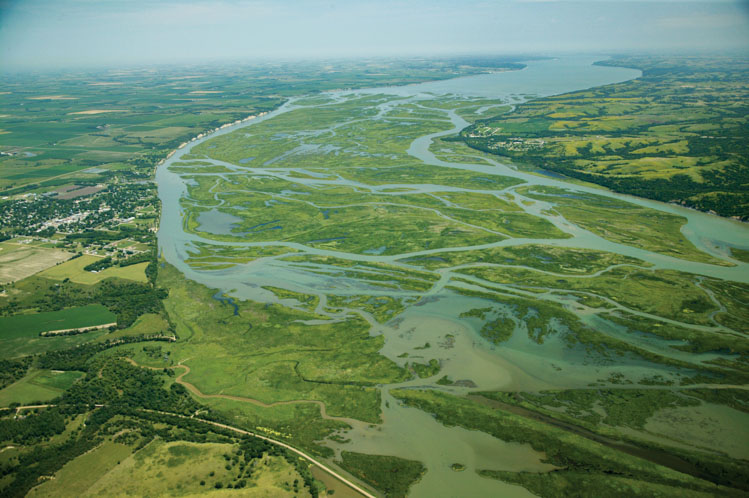
Yankton photographer Dave Tunge’s aerial view of the delta shows its complex web of channels.

By Katie Hunhoff

Boaters and adventurers often shy away from the shallow delta that is overtaking the Missouri River by Springfield in southeast South Dakota.

They worry about snags and stumps in the water. The ever-changing channel is confusing. Dozens of sandbars create a maze, and in many places the swamp grass is 10 feet high, making it impossible to see the hills of the shoreline that could provide bearings. Water depths vary from 12 feet to less than a foot.

Snakes, snapping turtles and other critters add to the mystique of a place like nowhere else in the American West.

We wouldn’t explore the delta with just anyone, but Greg Stockholm seemed reliable. Stockholm knows and loves the rivers of America. The tall, cheerful 67-year-old has boated much of the Missouri and Mississippi, as well as the Ohio and numerous other lakes and waterways.

But he’s especially at home on the delta. He boated the Missouri with his dad as a boy, when the reservoir known as Lewis and Clark Lake was sparkly new. Water then extended from shore to shore — more than a mile wide and deep enough for him and his friends to experiment with five-man pyramids on water skis. In 1977 he was skiing with a kite on Lake Poinsett when it sailed skyward and dropped him hard on the water. He was hospitalized for eight weeks, but he was back in a boat almost before his injuries healed.

As a youth, Stockholm watched his father, Alfred, build a 21-foot cabin cruiser. His earliest memories are of taking the wheel of the cruiser at age 4. In 2022 he began construction of a 72-foot sailboat that he hopes to launch near Sioux City, Iowa. His plan is to motor the boat to the ocean, raise its 80-foot mainsail and set off across the Atlantic.

Springfield river rat Greg Stockholm guided South Dakota Magazine publisher Katie Hunhoff through the delta.

Stockholm has operated a body shop for most of his adult life. In his spare time — between fixing cars and building the big sailboat — he still found time to restore a classic 1975 Tahiti jet boat with a 389-inch Pontiac engine.

“Half the boats around Springfield never get in the water here,” he says, because the owners are leery of the delta. We climb aboard the Tahiti at the boat docks on the east side of town. The big engine rattles to life, sending vibrations throughout the little black craft.

Just as we leave the docks and enter the delta, Stockholm points to the Eagle depth finder below the steering wheel of the Tahiti. It reads 6 feet.

“We’re in the main channel right here,” he says.

But then we enter a water alley between two sandbars and the big engine sputters. The propellor has hit sand. The Eagle says we are in a foot of water.

It’s not a problem. Stockholm shifts to “R” and we reverse into a few feet of water.

We’d imagined a delta of grassy sandbars with frogs, toads, crawdads, crabs, flying insects and patches of brackish mud. That’s not the South Dakota delta.

The water seems clean and fresh and there is little mud. It’s mostly sand below the water and on the islands or sandbars. Growing on nearly all the sand is a tall perennial grass called phragmites, an invasive species that is spreading to lakes and wetlands throughout eastern South Dakota. Unfortunately, it creates a dense, nearly impenetrable jungle that deer and other wildlife try to avoid. Phragmites even affects fish because the massive roots dry the marshland and reduce habitat for minnows, frogs and other small creatures.

Stockholm says the U.S. Corps of Engineers, overseer of the Missouri River valley, sends helicopters with herbicide sprayers to attack the phragmites infestation in the Springfield delta. Once the reeds die and turn white, the federal authorities sometimes burn the sandbars. Their goal is to eliminate all vegetation on the sandbars so the endangered piping plover will have better nesting conditions.

It would be nice if the herbicide, which has been approved for aquatic use by the EPA, would enable cattails, Russian olives and wild grasses to regain a foothold, but on our trip through the maze it appeared that the phragmites are winning the war with the Corps.

We saw few signs of wildlife. A lone deer peeked out of the reeds. A massive old snapping turtle, 2 feet in diameter, balanced on a stump in the water.

Stockholm says the river has quieted in his lifetime. “I remember lying awake in bed in our house in town and hearing the honking of geese all night long,” he says.

The throaty baritone of bullfrogs was a regular sound of summer. Beavers, muskrats and other wildlife added to the cacophony of the river. On our outing, there was nary a sound when Stockholm shut down the Pontiac engine.

Still, he says, this is a wild place. “The river is alive. You can never outguess it. It’s always changing, and it probably always will be.”

Two main channels of the old river can be found in the delta, one on the South Dakota side and another below the yellow chalkstone bluffs of Nebraska.

Stockholm sped up the Tahiti for a 7-mile zig-zag journey southwest on the river to the little fishing village of Running Water. Phragmites are there, too, lining the shore by the boat docks. Just beyond Running Water is the Standing Bear Bridge, a 3,000-foot crossing that gives motorists an expansive view of the delta.

West of Running Water is the town of Niobrara, Nebraska, and the mouth of the Niobrara River, which brings several million tons of sediment into Lewis and Clark Lake every year — creating the unusual delta that is slowly creeping eastward. Experts predict that the grassy delta — with its phragmites-laden sandbars — could reach Gavins Point Dam at Yankton if an affordable solution isn’t found.

The sediment is considered a scourge in South Dakota and Nebraska. Ironically, it is badly needed in the Gulf of Mexico where the coastline is disappearing due to erosion and rising sea levels. Before the six dams were built on the Missouri River in the 1940s and 1950s, sediment from the 2,341-mile Missouri — North America’s longest river — flowed unimpeded to the Gulf.

Now it lays above Gavins Point Dam.

Upon reaching the Standing Bear Bridge, Stockholm steered the Tahiti northeast and motored back toward Springfield. Moving with the current, the big motor had easy work. The sun was now at our backs and setting low over the delta. Blue herons began to show up along the shore. Sometimes, the graceful birds craned their long necks and stared. Just one other boat was on the water that night, so we were a rare sight. A curious crane took flight and followed us down the river.

The water widens just west of the Chief Standing Bear Bridge.

“Sometimes I think they want to race the boat,” grinned Stockholm.

Other waterfowl appeared at sunset. A small flock of Canada geese flew in formation from the east.

When we arrived at Springfield, where we’d begun, Stockholm asked if we wanted to see where the delta ends and “the lake begins.” Of course, we did.

So we traveled east just a few miles — past another fishing village known as Apple Tree. A flock of perhaps 50 big white pelicans sat on a shallow ledge.

Stockholm pointed to the Nebraska shoreline, about a mile and a half away, and said he’s quite sure we could walk there. “I doubt the water is more than waist high all the way across.”

If the sediment continues to fill the lake, scientists say the delta will extend all the way to the Yankton dam, 15 miles away. The tallgrass phragmites will surely follow.

We rounded a sandbar and there was open water as far as we could see to the east — a fresh sight after spending hours in the claustrophobic delta.

Editor’s Note: This story is revised from the March/April 2025 issue of South Dakota Magazine. To order a copy or to subscribe, call (800) 456-5117.

Posted on 1 Comment

Roaming the Tall Grass

By Christian Begeman

The May/June 2026 issue of South Dakota Magazine features a story on the few tall grass prairie remnants remaining east of the Missouri River. When I was asked to help illustrate the story, I was surprised by how many photos I have taken in and around these places.

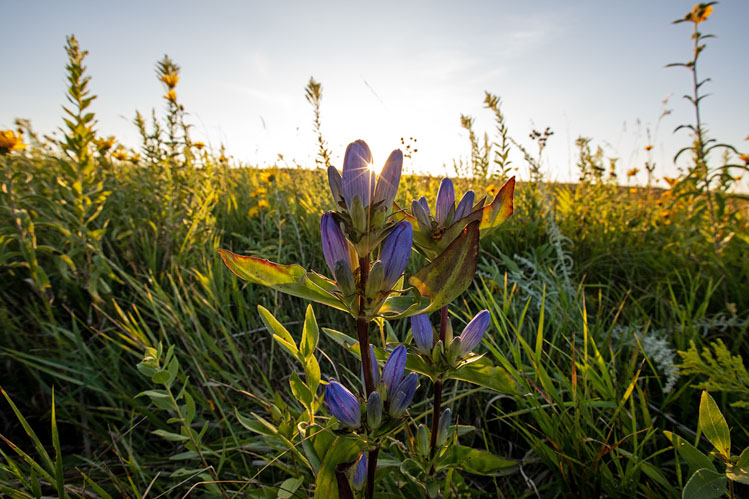
I grew up in short and mixed grass country along the Dewey and Ziebach county line west of the Missouri. Only in wet areas or in wet years did the grass get so high that you couldn’t see where your boot fell, which is an important thing in rattlesnake country. When I first began exploring the tall grass preserves with camera in hand, it was unnerving to not be able to see the ground below … and whatever sinister critters may be lurking. Turns out plenty of creatures call the tall grass home. My favorite are the colorful and elusive butterflies. From monarchs to tiny eastern-tailed blues, I have been known to spend hours on the trail seeking that perfect close-up shot.

I also discovered the beauty of the grass itself when peering through my macro lens at blooming sideoats grama florets at the Sioux Prairie Preserve near Colman. Big bluestem, cordgrass and many other tall grass regulars all flower during the summer and photographing them can be nearly impossible due to the wind that we regularly endure on the Northern Plains. To be honest though, a good breeze is welcome in that it keeps the gnats and mosquitos mostly at bay. Yep, it’s not all butterflies and flowers in tall grass country. Myriads of insects live there and a good breeze plus insect repellent is a must when exploring.

After gathering photos for the article, I was asked to gather again for a flyer promoting the new prairie grass area at Good Earth State Park. As I waded back into the archives, I noticed the crescendo of forays into tall grass preserves started slowly about 10 years ago and reached full throat when I was challenged to find and photograph the elusive green orchid. Until that point, I thought wild orchids only grew in exotic tropic locales. Thankfully, I was wrong. South Dakota is home to over 20 orchid species depending on who’s counting. The tall grass preserves are a haven for these beauties and their allies, all of which are a paradise for a camera guy with a macro lens.

Earlier this month, I was out finding the season’s first pasque flowers in the Coteau Hills overlooking Jacobson Fen in Deuel County. As I got up close to frame a few fuzzy portraits of our state flower, I got the idea to share these new photos along with a few other tall grass favorites I had gathered but did not make the final printed story. I hope they convey the sense of wonder and enjoyment I get while out roaming the tall grass remnants.

Christian Begeman grew up in Isabel and now lives in Sioux Falls. When he’s not working at Midco he is often on the road photographing South Dakota’s prettiest spots. Follow Begeman on his blog.

Posted on Leave a comment

Scoping the Missouri

Members of the South Dakota Ornithologists Union look for birds at Union Grove State Park between Beresford and Elk Point.

Roger Dietrich was scoping along the shore of Lake Yankton when a Rapid City woman approached him with a question about the tiny Ross’s gull, which had been sighted in the area.

“I’ve gone to Alaska twice and I didn’t see the bird there,” she said.”Is it still around?”

Dietrich pointed to a gull, sitting on ice in the middle of the lake.

The Missouri River is a bird-watching paradise. Hundreds of species of ducks, geese, gulls, loons and other birds congregate in parks, woodlands and farm fields that border its 443-mile corridor. But it still helps to know for what you’re looking.

Every habitat attracts different birds, says David Swanson, professor of biology at the University of South Dakota and author of Birder’s Guide to South Dakota, and habitats vary dramatically along the Missouri as it winds from Nebraska to North Dakota.

Following is a guide, from south to north, of habitat patches and the surprises that await birdwatchers, both the serious birders looking for the rarest”lifer” bird and those who are happy spotting sparrows and swallows.


The Adams Nature Preserve attracts wading birds such as blue herons.

Adams Nature Preserve

Southeastern South Dakota

The Adams Homestead and Nature Preserve near North Sioux City includes many trails.”It has a variety of habitats,” Swanson says.”It has an extensive cottonwood forest that borders the river, and there’s also a little lake called Mud Lake that’s attractive to waterfowl. The ring of trees surrounding Mud Lake can be good for woodland birds, too.”

Mud Lake is approximately a quarter mile from the Adams Homestead parking lot, so a brief hike is required to access it. Wooden observation blinds lie along the trail with a view of the lake.

“The other habitat at the park is a restored open prairie,” he says.”It’s one of the few sites in the southeastern part of the state where you can find Eastern meadowlarks. The common meadowlark in South Dakota is the Western meadowlark, but the Eastern meadowlark is expanding its range in the southeastern part of the state and Adams Homestead is one of the places where you can find those.”

Since first being sighted in 2017 by Swanson and his ornithology students, the Eastern meadowlark has made regular appearances in the open-prairie habitat, often with multiple birds singing among the scattered trees.

“I wasn’t aware at the time that Eastern meadowlarks had started to expand their range, and I heard these Eastern meadowlarks calling,” Swanson says.”I go, ‘That is very unusual.’ We kept walking and saw them and everybody in the ornithology class got to see me geek out over it.”

Though birdwatching at the Adams Homestead is enjoyable year-round, it’s best in spring, summer and fall.”Mostly, it’s hiking the trails during migration and seeing a variety of birds at that time,” Swanson says.”It’s lots of warblers and sparrows, so the migration periods are late April to mid-May. Then in the fall, from mid-to-late August into about mid-September is probably the peak for warblers and vireos, some of which migrate all the way down to Central and South America.”

Sparrows that migrate to the southern U.S. and Mexico slightly later in the year can typically be seen at the Adams Homestead from mid-September to mid-October. Along the river and at the lake, birdwatchers encounter ducks and geese, as well as wading birds like herons and egrets.

“In the cottonwood forest, there are Eastern whippoorwills,” Swanson says.”Those are birds that don’t really get too much out of the southeastern part of the state. Of course, they’re nocturnal, so they don’t start calling until it starts to get dark.”


Least terns can be found on sandbars below Gavins Point Dam.

Gavins Point Dam

West of Yankton

Gavins Point Dam, the southernmost project on the Missouri’s system of six dams, is surrounded by unique bird habitats.

During the summer, hundreds of American white pelicans can sometimes be seen near the dam, while on the river itself, there are piping plovers, still considered a threatened species in most of the U.S., and the least tern, North America’s tiniest tern, often seen flying low over the river and hovering before plunging for prey.

“One of the reasons I like birding is the idea that it would be so cool to fly, and least terns are just the best flyers,” says Roger Dietrich, a local authority on ornithology.”They’ll fly and they’ll see a minnow, and then they dive straight down in the water — and splash!”

In winter, the 2-mile-long earthen dam creates an unusual condition for birds and birders.”Some years, when it doesn’t freeze, like lately, there’s been lots of open water above the dam,” Dietrich says.”Some years, we get lucky and even the Lewis and Clark Marina doesn’t freeze over real early. So, that’s a popular spot where some grebes and loons will stop.”

Black scoters, surf scoters, white-winged scoters and long-tail ducks, which are mainly ocean birds, are known to visit the lake and river in winter.

“I tell people from other places that we have those birds here and they’re just not believing it, because they don’t think of the center of the United States as a place where these birds would show up,” Dietrich says.”And when I say they show up every year, usually, for a fairly long period of time, they just can’t believe that we’re so lucky.”

The common loon migrates through the area, as well as a number of gulls — including Sabine’s gulls, kittiwakes, black-legged kittiwakes and even the Ross’s gull, which is associated with the remote arctic. Crest Road, which passes over the dam, is a good place to observe such birds. It requires no special pass or permit.

“Scan for the birds with binoculars or a spotting scope and chances are, you’ll find something different,” Dietrich says.”Sometimes there are huge flocks, and you can spend hours just scoping the birds there,” he says.”So, if you see somebody there with their scope out or binoculars, stop and ask them what they’re seeing. I’d say 99 percent of the people will be glad to point things out to you, and maybe even let you look through their scope to see what they’re seeing.”

Several snowy owls hung out along the dam road a few years ago.”They were feeding on the flocks of coots that were there.” Wintertime also brings large flocks of lesser scaup, which birdwatchers will scan for specimens of greater scaup, a polar bird that tends to prefer saltwater and is rarely seen inland, Dietrich says.

“It’s the same with the big flocks of common goldeneye,” he says.”People try to scope out the Barrow’s goldeneye, which is another species. It’s more of a West Coast bird, but once in a while, we’ll get one here — always a highlight.”

Bald eagles frequent Gavins Point Dam and some now nest year-round in the tall cottonwoods that border the Missouri.”They’re used to a lot of people around and some of the trees they perch in are right along the local roads,” Dietrich says.”You can see them in action, swooping down and picking up fish. I’ve seen eight or nine at a time on the ice up above the dam, eating the dead snow geese they’ve picked off.”


A pair of Barrow’s Goldeneyes at Fort Randall.

Fort Randall

Pickstown

Fort Randall Dam also hosts a large congregation of bald eagles. Below the dam is the Karl E. Mundt National Wildlife Refuge, which provides habitat for the eagles.

Kelly Preheim, a kindergarten teacher in Armour and a well-known local birding enthusiast, especially likes the wooded area around the Fort Randall Dam.”We’re mostly on agricultural grassland in southeastern South Dakota,” she says.”But the dams have a lot of woodland, forested areas, and I enjoy walking on the trails.”

She found 71 bird species on a recent camping trip to Pickstown.”In the morning, oh my goodness, the singing,” she recalls.”My husband’s like, ‘I can’t get any sleep. It’s so loud here!'”

A hike to the tailrace, the channel below the dam that carries water away, will often be rewarded.”Fish that go through the dam come out somewhat stunned in the tailrace,” Preheim says.”Then, all these birds, like gulls and eagles and certain ducks, eat those fish.”

Like nearby Gavins Point, Fort Randall Dam is also home to many types of waterfowl in autumn and winter.”There are a lot of different ducks on the scene, hundreds and hundreds, if not thousands, of different ducks there at a time,” Preheim says.”I saw a brown pelican one time. That’s actually an ocean bird.”

Other surprise visitors at Fort Randall include a yellow-billed loon, typically associated with Alaska and America’s western coast, and a great black-backed gull, which is an Atlantic coastal bird, Preheim says.

Scarlet tanagers are often found in South Dakota but summer tanagers, a rare visitor, might also be seen around Fort Randall.


Pelicans near Big Bend.

Big Bend Dam

Fort Thompson

The best birdwatching at South Dakota’s northernmost dams — Big Bend and Oahe — occurs from April through May and from September to November, according to lifelong birdwatcher Ricky Olson, who lives at Fort Pierre.

Big Bend has fewer access roads and trail amenities than Oahe and the other dams, but it has its own charms. Ospreys nest below the dam and brown pelicans have been spotted.

“Once in a while, in the wintertime, you get a Brant goose at Big Bend,” a seacoast bird.”I run down to Big Bend at least every two weeks in the winter to see what’s there,” Olson says.

Big Bend also attracts smaller goose species, including snow geese and white-fronted geese, both of which are common to the area.”In the fall, it’s neater to go to Big Bend,” Olson says.”Also, the shad and minnow species will be in the shallows then, and you’ll get all kinds of cormorants and pelicans and hundreds of gulls in these frenzies where they’re all feeding, and the gulls are trying to steal from everybody.”


Canada geese along the Missouri River.

Oahe Dam

Central South Dakota

Ring-billed gulls, herring gulls and California gulls may be sighted at Oahe, as well as the arctic tern, a mega-find for birders.

A spectacle occurs during flooding when Oahe Dam’s hydraulic turbines are running.”It’s a feeding frenzy. You get thousands of gulls, maybe 20,000, below the tailrace in a half-mile stretch,” Olson says.”It’s like a snowstorm. Thousands of people come to watch the ‘gull snowfall.'”

Oahe also has cliff-dwellers.”In the sand layers in the cliffs, in the holes, there are barn owls nesting,” Olson says.”They dig their own holes, and often, they’re near where colonies of bank swallows have dug holes.”

In autumn, Sabine’s gull may be spotted.”It’s very pretty. It’s black and white with half a diamond on the wing,” Olson says.”We also get Bonapartes and Little gulls, which is a little gull, and we get some of the big ones. Once in a great while we get the great black-back, which is the biggest gull.”

Gulls breed on a few islands along Oahe, Olson says.”There are only a few places in South Dakota where that happens.”

Another rare visitor to Oahe, among the sea ducks like the scoters and the long tail duck, is the occasional coastal harlequin duck in the tailrace.

“We get loons,” Olson says.”Sometimes we get the Pacific or the yellow-billed or red-throated loon, which are rare for our state.”

Further north on Oahe, retired biology teacher Stan Mack says opportunities are available even in Mobridge’s city limits.”There’s a walking trail along the south side of town. Just follow Main Street to the river and walk west and you’ll see the ducks and geese and gulls that sit on the water.”

Mack says Indian Creek (east of Mobridge) and Indian Memorial (across the river to the west) offer trails and habitat.

Mack doesn’t walk well enough to explore like he once did, but the birds will come to him.”I’m doing a feeder watch for Cornell University. Right now, I’m looking at a collared dove — we never saw them before — and I see about 16 more picking up seeds on the ground.”

Editor’s Note: This story is revised from the March/April 2025 issue of South Dakota Magazine. To order a copy or to subscribe, call (800) 456-5117.

Posted on Leave a comment

If Our Trees Could Talk

A pair of oak trees known as the Twin Oaks are among the trees chronicled in Paul DeJong’s book on the Sioux Falls urban forest.

“Have you been here before?” asks Paul DeJong as we sit around a small conference table inside Touchmark at All Saints, a senior living community in one of Sioux Falls’ most historic buildings — the former All Saints School. The massive, four-story granite building in the heart of the city was finished in 1884 under the direction of William Hobart Hare, the first Episcopal bishop of South Dakota. The all-girls boarding school was designed to serve the daughters of missionaries who were serving the sparsely populated Dakota prairies.

But that’s not where this conversation is heading.”Some of the most majestic trees in the city are right outside,” DeJong says.”There’s a catalpa and a ginkgo tree on this property that were probably planted in the late 1800s or early 1900s.”

It stands to reason that the trees would be at least as old as the building itself, and of course DeJong would notice them. He worked at Landscape Garden Centers for more than 30 years, first as an employee and then its owner. He’s had a hand in selecting trees for nearly every neighborhood in Sioux Falls, an accomplishment made even more impressive considering the city’s rapid growth.

He seems to know every inch of soil beneath South Dakota’s sprawling metropolis. His quick and encyclopedic knowledge of trees allows him to tell you exactly why an American sycamore would thrive in one neighborhood but not another.

The book publishing team includes (from left) Jeremy Brown, Paul Schiller, Paul DeJong, Heather Kittelson and Mike Cooper.

The urban forest of Sioux Falls became his passion, and now, with help from friends, he’s finishing a book that he hopes will inspire future generations to appreciate the diversity of the city’s arbor culture. If Our Trees Could Talk: Discovering the Urban Forest of Sioux Falls is a 172-page coffee table book, completed in collaboration with the Mary Jo Wegner Arboretum, that traces the development of several historic Sioux Falls neighborhoods and the trees that give them life and character.

The idea for a book has been in the back of DeJong’s mind for at least 10 years, but it’s coming to fruition at perhaps the perfect moment. He was diagnosed with Parkinson’s Disease at age 53. He retired from ownership at Landscape Garden Centers in 2018, though he continued to work part-time until 2022. Eventually, he sold his home and moved to Touchmark.

The urgency of such a diagnosis led to the creation of a team to help make the book a reality. Heather Kittelson is the self-described”connector” of the team. She met DeJong in March of 2023, while both served on the board of directors for the Mary Jo Wegner Arboretum, a 155-acre greenspace tucked next to the Big Sioux River just off Highway 42 on the east side of the city. As she learned about DeJong’s health challenges (which included a serious car accident and a bite from a brown recluse spider earlier in life), she was inspired by his drive to persevere.

DeJong was equally impressed by Kittelson’s energy and positive attitude. She subsequently invited him to be a guest on her podcast called”Fortitude,” in which she interviews people who have overcome adversity. DeJong’s is among the most listened-to episodes.

After the podcast, Kittelson asked DeJong if he had any dreams he would like to see fulfilled. The answer was a book about the trees of Sioux Falls.”It really was a dream,” she says.”He just needed someone to help execute it. I love being resourceful and a connector, and I wanted to see Paul’s dream come to fruition.”

The rest of the team quickly formed. They include Mike Cooper, the arboretum’s executive director and a retired city planner for Sioux Falls; Jeremy Brown, the head of Throne Publishing; and well-known regional photographer Paul Schiller. Cooper and DeJong drove many miles around Sioux Falls, identifying neighborhoods and trees, and Schiller captured them throughout the year.

McKennan Park in spring.

DeJong wants the book to be an educational tool and hopes it will direct more attention to the arboretum. It could also be the culmination of a life devoted to the outdoors.

DeJong grew up on a farm between Sheldon and Hospers, Iowa. He got an associate degree in business and marketing from Northwest Iowa Community College and then headed to Sioux Falls, looking for opportunity. He stopped by Lakeland Nursery and noticed they were hiring.”Having grown up on the farm, I had a general knowledge of trees,” DeJong says.”They were taking applications and I needed money fast, so they said I could start working there the next day. I had no idea what I wanted to do, and in a couple weeks’ time I had found my passion working with trees, landscaping and outdoor living areas. You’re enhancing everybody’s opportunity to spend more time outdoors with their families as opposed to sitting in the house.”

He threw himself into the work, getting to know our native and non-native species and talking with both residential and commercial customers about the trees they wanted and the trees they needed — which were not always the same thing. DeJong is a huge advocate for tree diversity, and that can be challenging in South Dakota.”We can beat up on ourselves for not diversifying, but we are a prairie state with a mix of prairie grasses, so we’re limited in what species thrive here,” he says.”Trees weren’t necessarily by God’s hand meant to grow in South Dakota.”

An American larch in McKennan Park.

When settlers first arrived in Dakota, they would have seen a nearly treeless landscape, other than the occasional willow, elm, ash, box elder and the cottonwoods growing in the river valleys.”Cottonwoods are so towering and large, and they’ll grow in wet, boggy areas,” DeJong says.”They could be several miles away and see these stands of cottonwood trees in the distance and know that there was likely water nearby.”

As railroads moved into Dakota, it became easier for those settlers from Europe or bigger eastern cities to order the trees they knew and loved. Maybe that’s how the catalpa and ginkgo trees ended up in DeJong’s new backyard.”Ginkgos are a very slow growing tree, but this one’s probably 80 feet tall,” he says.”They originated in China and are disease and pest resistant. They’re actually prehistoric trees. They’ve got fan-shaped leaves, very distinctive. The catalpa has a large plate sized leaf. It largely remains silent except one week in June when it gets a hydrangea-like flower. That’s its one week of glory for the year.”

One of DeJong’s favorite neighborhoods is McKennan Park, which is filled with historic homes and majestic trees. Among them is a big bur oak planted after World War I to honor the returning soldiers. It’s also home to the largest silver maple in the state and a stand of American larch.”When I was a kid, they quite often planted windbreaks with American larch,” DeJong says.”I didn’t realize what they were at the time. In the winter all the needles were gone, so I thought they were dead. But they come back in the spring and turn a brilliant golden color in the fall. Then in the winter they go dormant again. They’re mysterious or haunted looking trees.”

The American sycamore in McKennan Park is an example of being in the right place.”There are microclimates in Sioux Falls, like McKennan Park and the Cathedral District,” he says.”There’s good soil; it’s not only cold hardiness. You get on the edge of town where the winds are more abrasive, you’ve got about two inches of black dirt and the rest is excavation clay, and you’re more limited in what species you can use. I would never recommend an American sycamore anywhere other than the core area of the city.”

Other trees stand out for different reasons, such as a concolor fir in the Riverview Heights district north of the Veterans Administration hospital.”I would say it’s 100 feet tall. The first time I viewed that tree, a deer and a turkey came running out at the same time. I bet the bottom branches spread 40 to 50 feet across.”

A stately cottonwood at 57th and Minnesota.

A cottonwood tree near Covell Lake is notable because its lowest branch is probably 50 feet off the ground. Another at the corner of 57th Street and Minnesota Avenue has been growing for more than 100 years and towers over other neighborhood trees. Black locusts in the Cathedral District shine in spring, when they blossom with droopy, lilac-colored flowers.

A stand of hackberries along South Cliff Avenue accents a neighborhood that began as a place for the city’s more affluent citizens to build second homes. A blue beech in the Maplewood District is rare for South Dakota.”It has very smooth bark and looks like an elephant’s leg because it flares out at the bottom. The smooth bark prevents insect infestation. If a tree has rough bark, it’s easier for insects to burrow into it, but the blue beech evolved over time. Trees are constantly under evolution. They’re just like human beings; they have to adapt.”

Everyone involved sees the book as a starting point that can lead to continuing education in K-12 classrooms and at the arboretum. DeJong envisions an”urban forest university” that encourages young people to get outdoors and learn about the trees surrounding them — not just because they might be pleasant to look at but because of their benefits for the environment and our health.”I spent a fair amount of time recovering from surgical procedures at the Mayo Clinic. I remember going through the gardens once I was able to get outside. The trees seemed to soothe my physical pain. It is true that trees reduce stress and promote physical and mental healing.”

Working with DeJong on the book has been rewarding for Cooper and Kittelson.”We’re all so busy going through life that we tend to forget how beautiful our surroundings are,” Kittelson says.”Paul has helped me to stop and be present and take in what’s around me.”

May we all slow down and learn to appreciate both the forest and the trees.

Editor’s Note: DeJong’s book is available from the Mary Jo Wegner Arboretum in Sioux Falls. This story is revised from the March/April 2024 issue of South Dakota Magazine. To order or to subscribe, call (800) 456-5117.

Posted on Leave a comment

Living with Lions

Mountain lions, found from Chile to the Yukon Territory, are the most widely distributed wild, terrestrial mammal in the Western Hemisphere. Researchers estimate that between 200 and 300 mountain lions live in the Black Hills, though their secretive nature makes sightings rare in the wild. Photo by Sam Stukel

REPORTS BEGAN COMING into Yankton police at 5:50 on a Monday morning in June of 2004. Two hours later, police and state Game, Fish and Parks Department officials had found a 115-pound mountain lion beneath a camper in a quiet neighborhood just east of the Yankton Middle School. Tranquilizing and relocating the big cat was not an option, so officers shot it in accordance with Game, Fish and Parks policy.

There was still a buzz about the mountain lion when we moved to town a year later. In fact, people talk about it today. Mountain lions live in the Black Hills, 400 miles away. One had never been seen in town. The only previous evidence of a lion nearby was a confirmed footprint found in Yankton County in 2002.

I thought about the excitement of that lion sighting when police congregated in my neighborhood in July of 2020. An officer said a mountain lion had been spotted just a few blocks away — captured on a home security camera sauntering between split-level homes — and was last seen heading east through a cornfield between the airport and my house.

Suddenly alert neighbors stood in driveways, hoping to catch a glimpse of our unusual visitor. I kept watch at the window for a flash of tan moving through the tall green cornstalks. But I think we all knew that the lion had slipped quietly into the country just as quickly as he had appeared.

Mountain lions still show up in Yankton, mostly on game cameras that are monitored by residents living along the forested river bluffs on the south edge of town. None have been shot since the 2004 incident.

Few animals in South Dakota seem to captivate us quite like the mountain lion. Fifteen years ago, Sam Stukel was hunting elk in the Black Hills when he suddenly noticed a young lion about 15 yards away. He captured a shaky video and posted it to YouTube, where the 75-second clip has amassed 232,000 views.”I still get email notifications every time someone comments on it,” says Stukel, who is also a photographer and a fisheries biologist at the Gavins Point National Fish Hatchery west of Yankton.”The variety of critiques is amusing. I’m an idiot for not being more afraid of the cat, or I’m a chicken for being so afraid of the cat. Everyone’s an expert on YouTube.”

Mountain lions are just as divisive offline. People like my Yankton neighbors are eager to someday see one in the wild, while others think one mountain lion is one too many. They are seen as both majestic creatures and vicious predators out to kill pets, livestock and maybe even humans. Reality is somewhere in the middle. Mountain lions lived in South Dakota long before people and have become an important part of our ecosystem. They are our neighbors, so we should get to know them.

*****

Jonathan Jenks and John Kanta are our state’s leading authorities on mountain lions. Jenks, a distinguished professor emeritus of wildlife science at South Dakota State University in Brookings, spent 17 years closely studying mountain lions in the Black Hills. Kanta is a terrestrial section chief for the South Dakota Department of Game, Fish and Parks based in Rapid City who has devoted nearly all of his 27 years with the agency to mountain lions.

Jenks began his research in 1998 when GF&P noticed an uptick in reports of mountain lion attacks. Livestock and horses on West River ranches and two mule deer within the Rapid City city limits were believed to have been killed by mountain lions. A year before, GF&P had estimated only 15 to 25 mountain lions lived in the Black Hills, but officials wanted to learn more. The agency partnered with SDSU and Jenks and his graduate students began capturing and radio collaring lions to establish a population estimate and learn about their lives, which date back millions of years on the continent.

The lions’ earliest ancestors likely migrated across the Bering land bridge into the Americas between 8 million and 8.5 million years ago. Mountain lions became recognizable as a distinct species about 400,000 years ago and roamed the continent alongside giant sloths, mammoths, dire wolves and saber-toothed lions.

Scientists believe the climate grew too cold for mountain lion populations to survive during the Pleistocene ice ages, but they later returned from more southern regions. They can be found from the southern tip of Chile to the Yukon Territory, making them the most widely distributed wild, terrestrial mammal in the Western Hemisphere.

As settlers populated the Upper Midwest in the 1800s, mountain lions became targeted as threats to livestock. The animals were hardly mentioned in the reconnaissance ahead of Lt. Col. George Custer’s 1874 expedition into the Black Hills. But the following year, Richard Irving Dodge, who had been with Custer’s men, accompanied geologist Walter Jenney back into the Hills. He noted mountain lion prints around their campsite.”He thought these lions were investigating the camp at night because they are nocturnal,” Jenks says.”They would approach the camp, probably mostly out of curiosity. As a result, Dodge called them cowards,” implying they wouldn’t come out when they could shoot them.

South Dakota State University professor Jonathan Jenks and Steve Griffin of the state Game, Fish and Parks Department (in the foreground) collect information on the age of a mountain lion.

In 1889 the South Dakota legislature placed a bounty on mountain lions, and by 1906 they were nearly extirpated. Sightings were scant for decades. A man named Earl Bedell killed one near the head of Stockade Creek in Wyoming in 1930. Ted Mann, who ranched near Dewey in southwestern Custer County, shot one in the early 1950s. Four were spotted in Wind Cave National Park in 1964 and 1965, and tracks were found west of Custer in 1965 and near Crow Peak in Lawrence County in 1968. No one could be sure if they lived in South Dakota or were transients. By 1978 all bounties were gone, and mountain lions were declared a state threatened species, which garnered legal protection.

That opened the door to recovery. Jenks and other researchers believe that lions from southeastern Wyoming followed northeasterly draws that effectively funneled them into the Hills.”That’s why when we first started studying them, it was easier to capture mountain lions in the southern Black Hills because there were potentially more of them there than in the northern Hills,” Jenks says.”It was right at the beginning of the recolonization of the Black Hills in the late 1990s.”

After a few years of research, Jenks and his team of graduate students estimated that 100 mountain lions lived in the Black Hills — far surpassing the GF&P estimate of 15 to 25 in the late 1990s. The animals were removed from the threatened species list and reclassified as a big game animal.

In 2005, GF&P announced the first experimental mountain lion hunting season with a limit of 12, no more than half female. It resulted in a lawsuit from the Mountain Lion Foundation of California and the Black Hills Mountain Lion Foundation, which sought an injunction to stop the harvest, arguing that there was still not enough known about the local population and that a hunting season could once again lead to regional extinction. A judge in Pierre ruled in favor of the state a week before the season was to open. A mountain lion season has continued every year beginning the day after Christmas and running through April. The season ends earlier if either 60 total mountain lions or 40 females have been harvested.

So began a delicate balance between those fascinated with the presence of mountain lions and those who want to hunt them. Kanta says between 3,000 and 5,000 licenses are sold for every season.”A lot of our mountain lion hunters are very dedicated and love that opportunity,” Kanta says.”I would also offer that there are a good number of folks who feel like this is a magnificent critter and would love that one-in-a-million chance to see a mountain lion out in the wild. They are intrigued by mountain lion tracks in the snow, or just knowing that they are out there.”

As mountain lions re-established themselves in the Black Hills, Jenks’ SDSU team and GF&P researchers like Kanta learned as much as they could. Adult males can be more than 8 feet long and weigh an average of 150 pounds. Adult females are around 6 Ω feet long and weigh 90 pounds. Adult males are generally solitary, while lions seen traveling together are usually a mother and her kittens, which stay together for 12 to 14 months.

Lions are solitary hunters that stalk their prey. They take advantage of thick vegetation or attack from upslope when they need a quick sprint. Lions have low endurance in chases, so targets that can run fast and long will likely escape. Older lions have better success rates because they learn the traits of other wildlife. Their preferred meal is deer, but Jenks learned that they are opportunistic, capturing whatever might be near, including rabbits and porcupines.

A capture crew including Jenks and SDSU graduate student Brian Jansen determines the weight of a male mountain lion in Custer State Park.

Mountain lions that show up East River and beyond most likely come from the Black Hills. Young males want to leave their home range and their mothers.”We did a lot of work on dispersal, trying to figure out where these cats were going,” Jenks says.”We followed them through North Dakota, northern Minnesota, the Niobrara River in Nebraska. There was one in Howard, one in Brookings. A 3- to 4-year-old male ended up about 8 miles south of Brookings, which was unusual to have a cat that age.”

In most instances — including the animals that wandered into Yankton — the mountain lions were simply passing through. They have no interest in interacting with people.”What they want to do is get away from you,” Jenks says.”It’s exciting to see them, and they are such an amazing animal, but they really just want to get away from you. In order for them to interact with you, there’s got to be some reason. A worst-case scenario might be standing on a hillside, and you slip into a den with kittens. In all the other situations that you can envision, lions are trying to avoid you. They might be climbing up a tree to let you go by, or running away from you, or staying quiet while you pass. That is borne out by looking at the number of negative interactions between people and mountain lions in the Black Hills. They are very few to nonexistent.”

As their familiarity with lions increased, it grew challenging to deal with public perceptions, which seem to be black and white.”There are two sides of the coin with mountain lions, and that’s what makes them interesting,” Jenks says.”You’ve got people who love them to death and people who hate their guts, and you’re trying to weave between the two to make everyone happy.”

That divide has a long history. The Cougar Hunt is a 1920s silent film created by the United States Department of Agriculture in which mountain lions are nature’s scourge slayed by noble hunters.”Predators of the range,” reads the opening slide before showing a lion lounging in a tree.”Uncontrolled predators exact a heavy annual toll of livestock and game,” reads the next slide, before shots of grazing cattle and sheep. Then, a group of men walking through the woods encounter an animal carcass covered with debris,”The work of that prince of predatory cats — the American lion, or cougar.” The film ends with a hunter shooting a treed lion. As it falls, the final slide reads”a ëgood’ lion at last.”

Others have admired the big cats. A mountain lion from Arizona named Josephine became the mascot of Theodore Roosevelt’s Rough Riders during the Spanish-American War. Roosevelt clearly respected lions.”It is itself a more skillful hunter than any human rival,” he said.”Ö It is a beast of stealth and rapine; its great velvet paws never make a sound, and it is always on watch whether for prey or for enemies, while it rarely leaves shelter even when it thinks itself safe.”

A student once asked Jenks if she could raise two cute mountain lion kittens In her home.”What happens when you’ve got a 150-pound mountain lion in your living room with your two small kids?” he asked.

During a GF&P commission meeting, after Jenks testified about the number of lions in the Black Hills, a local resident objected, saying there were many more and their numbers should be reduced. He believed he had seen the same mountain lion three different times near Hill City, and suggested lions were decimating the deer population.”It’s really tough to get by those perceptions, because mountain lions do kill deer,” Jenks says.”If you have a mountain lion, it has to be killing deer, and that’s the real simplistic vision of people with predators and prey. But there are a lot of other things going on in the Black Hills. Harvest, predators and disease make species management difficult, and mountain lions bear perhaps an unfair burden.”

Fear might even lie in the animal’s very name. Because of their wide dispersal and interactions with different subsets of American culture, they have assumed many monikers. In Florida they are panthers, in New England catamounts, for cat-of-the-mountain. Elsewhere, they are cougars or pumas. In South Dakota, they are lions, which conjures a very specific image.”When people hear lion,” Jenks says,”they think African lion.”

*****

Mountain lion numbers in the Black Hills ebb and flow. The GF&P’s current population objective is between 200 and 300, as established in the South Dakota Mountain Lion Action Plan, first written in 2010 and updated every five to 10 years. Kanta recalls one year when numbers surged, and his office fielded multiple reports of mountain lion sightings.”Anything that flashed by was a mountain lion and people would call us,” Kanta says.”Ninety percent of them were not legitimate, so you’d start to get a little complacent.”

One day he responded to a report of a mountain lion living in a garage. When he arrived, he found the garage door open about a foot. The homeowner explained that he had housecats and left food for them in the garage.”I’m standing right in front of this door, and I told him to go inside and push the button and let me take a look. As he opens it, a full-grown mountain lion comes running out and almost bumps into me. It turned out that the lion had been going inside the garage in pursuit of those cats.”

Information collected on radio-collared mountain lions has confirmed dispersal from the Black Hills to Minnesota, Oklahoma, Nebraska, Wyoming and Saskatchewan. DNA from lions captured in the Black Hills has been linked to cats that have traveled to the Chicago area and central Connecticut.

Mountain lions will take domestic animals. It’s one thing Jenks and Kanta want the public to know about living with big cats as neighbors.”If you have small children, you need to keep them close,” Jenks says.”If you have livestock or pets, you need to have them close. You need to watch if deer are spending a lot of time in your yard, because of the potential for drawing a cat in. And you need to know how to act if you encounter a cat. Act big. Don’t run. Yell at them. Show them that you’re not afraid of them and don’t act like prey, because there’s a chance that you might get attacked.

ìWe do need to learn to live with mountain lions, and that means people in South Dakota and the Black Hills have to take an active role in learning how to react when you see a mountain lion or if you’re going to recreate or live in mountain lion habitat.”

That may take time. Jenks is many years removed from actively working with mountain lions, but friends and neighbors in Brookings still call when they find suspicious tracks.”I never say that I don’t want to go out and look at it, because it very well could be a cat, and I’d be really interested if it was,” Jenks says.”People get excited.”

One recent winter, he was called to an area along Western Avenue on the west side of the city to examine tracks in the snow. He quickly realized it was something entirely different.”If you look at dog tracks, eventually you will find one that does not have nails and you can’t see the hind pad, so it looks like a lion print. I didn’t want to say this to the guy, but the reason he thought it was a cat print is because he was afraid of cats. And it was really just a dog that was walking along Western Avenue.”

Mountain lions are not fuzzy like bison (which can still be dangerous, as several visitors to South Dakota have discovered). They don’t have trophy antlers like elk and deer, or the uncanny ability to scale sheer rock faces like mountain goats or bighorn sheep. Yet they are mysterious, charismatic and — no matter if you’ve never seen one or have spent decades studying them — always captivating.

Editor’s Note: This story is revised from the January/February 2025 issue of South Dakota Magazine. To order a copy or to subscribe, call (800) 456-5117.

Posted on Leave a comment

What’s in the Water at Wallace?

Wallace artists Adam and Madison Grimm are both federal duck stamp champions. Adam has won the Federal Duck Stamp Contest three times. Madison has three wins in the junior contest.

THERE AREN’T MANY ducks in Elyria, Ohio. It’s only 6 miles south of Lake Erie, but the second smallest of the five Great Lakes is hardly a South Dakota prairie pothole.

When Adam Grimm began hunting waterfowl, he and his dad drove an hour from their home in that far-western suburb of Cleveland to a public hunting area where the birds were often few and far between. It was no place to live for an outdoorsman, hunter and burgeoning wildlife artist.

Several years later, when he was married and had a daughter named Madison, he suggested moving to South Dakota, a place he’d visited as a child and had never forgotten. He spoke so glowingly of the state that his wife Janet, who’d never stepped foot within its borders, agreed to come check it out. Though it rained for five days straight, the young family was smitten and made the move.

They are now a family of six and firmly settled in Wallace, a town of 91 people in northwestern Codington County famous for being the birthplace of Hubert H. Humphrey, Minneapolis mayor, U.S. Senator and the nation’s vice president from 1965 to 1969. But the town could also rightly claim both Grimm and 17-year-old Madison among its favorite sons and daughters. They are both federal duck stamp champions, achieving success that the national art competition has never seen.

*****

Drawing was Adam Grimm’s first passion. He drew his favorite cartoons and other things he saw on television until one day Bob Ross appeared on the screen. His long-running PBS show The Joy of Painting captivated artists and non-artists alike, and Grimm began imagining life as an artist.”That Christmas I asked for oil paints,” he says.”I ended up not painting the way Bob Ross does, with the putty knife and three-inch brush, but I started to develop my own way. I achieved the look I was trying to get, and it just started to snowball.”

He sold his first drawing at age 11. His grandfather realized Grimm’s potential and Insisted on paying $20 for it.”He always had that confidence that I was going to be able to do this as a living. I remember him telling my sisters, ‘Your brother will probably never have to have a real job.’ He just had such belief in me, and I think that had a lot to do with my own thought process and thinking that I could actually do this. If I won something, he would call everyone he knew and tell them.”

Adam grew up in Ohio, where he worked at the dining room table on his early wildlife paintings.

The next year he was invited to exhibit his work at a local craft show. He sold every item he brought and went home with nearly 40 orders for drawings. He started following other artists and became encouraged that he could make a living drawing and painting.

At the same time, his passion for the outdoors blossomed after a trip to South Dakota. Grimm first became acquainted with the state through his grandfather, an avid collector of Native American artifacts. Then his father began making annual hunting trips, and when Grimm was old enough, he came along. The country was unlike anything he’d ever seen.”I didn’t know anywhere like this even existed. I think people in South Dakota take South Dakota for granted. They don’t realize that it’s not like this everywhere else. The people, the nature, it’s not this way.”

His Interests In wildlife and art finally married when he saw his first federal duck stamp, a pair of canvasbacks by Minnesota artist Bruce Miller that appeared on the 1993-94 stamp. Still a teenager, he began submitting artwork to the junior duck stamp contest, open to students in kindergarten through 12th grade. He never won, but he gained valuable experience.

Grimm enrolled at the Columbus College of Art and Design in Columbus, Ohio, though he struggled to fit in. His professors urged him to experiment in a variety of art genres, but he had a plan.”I was doing realism and wildlife art, and I told them that I would like to win the federal duck stamp one day,” he says.”No one at the college had ever really heard of it. It was like, ‘Who cares if you get a painting on some stamp?’ I remember telling them, ‘Well, it’s kind of a big deal if you win.'”

He began entering the contest as soon as he was eligible. In his first year, he submitted a painting of a mottled duck that took 16th place. The next year, his green-winged teal won eighth place. In 1999, the two species eligible for submissions were the black scoter, an ocean bird typically found in Alaska and along the Atlantic coast, and the mottled duck. He chose the mottled duck and pushed his own creative limits.

He thought back to a scene on a marsh near Timber Lake.”I had snuck up on this little water area and there were blue-winged teal out there,” he says.”The hen is pretty drab in color, but so is a mottled duck. She raised up and flapped her wings on the water, and the sunlight was shining through her feathers. That was so beautiful. If I could paint that, but with this other duck, that could win, because it would be more about the lighting on the bird than the bird itself. But I needed the reference. I was painting this in Ohio.”

Adam’s painting of a mottled duck stretching its wings won the 1999 Federal Duck Stamp Contest. He was 21, making him the youngest winner in the contest’s history.

Grimm contacted a biologist in Texas who was doing a banding project on mottled ducks and requested photos. Then, a friend sent him a mottled duck that he had shot (again, there aren’t many ducks in northern Ohio).”I would thaw the bird out the night before because I wanted that early morning lighting,” he recalls.”First thing in the morning I would run outside with this dead duck and hold it up and stretch the wings out. Then I would run back in and try to capture the colors I had just seen.

“I wonder how many of my parents’ neighbors were watching this crazy kid with a dead duck,” he laughs.”You do what you have to do in life, and there was no other way to do what I was planning on doing.”

Say what you will about his methods, his painting of a mottled duck stretching its wings in the soft sunlight of early morning finished first. At 21, Grimm became the youngest person to ever win the federal duck stamp contest.

What followed were several months of travel and delivering speeches about his artwork, which now appeared on a stamp that would be in hunters’ wallets and collections worldwide.”It’s almost like if you won American Idol,” he says.”You can go from being a nobody to being launched into the limelight. Everyone knows who you are. It’s a crazy thing.”

*****

Such a life-changing competition had humble beginnings that can be traced to legislation that another South Dakotan shepherded through Congress nearly 100 years ago. Waterfowl depletion on the Upper Plains was beginning to be a serious issue in the early 20th century. The federal government issued numerous protections, but it became clear that sustained recovery hinged on habitat protection.

South Dakota Sen. Peter Norbeck, who had already worked to establish wildlife preserves in western South Dakota and was the major force behind creating Custer State Park, became a champion of the Migratory Bird Conservation Act, a piece of legislation that had advanced in fits and starts during the 1920s. By 1929, he had a version that successfully passed through Congress. It created the Migratory Bird Conservation Commission, which approved the purchase or rental of wetlands upon the recommendation of the Secretary of the Interior. The only thing it lacked was a permanent funding source.

That came in 1934 with passage of the Migratory Bird Hunting Stamp Act, which required hunters to purchase a $1 stamp before hunting waterfowl. Ninety-eight percent of the proceeds from their sale go the Migratory Bird Conservation Fund for wetlands preservation.

President Franklin Roosevelt asked Jay”Ding” Darling to design the first stamp, which featured two mallards landing on a pond. Darling was an American cartoonist and two-time Pulitzer Prize winner who was serving as director of the Bureau of Biological Survey, the forerunner to today’s U.S. Fish and Wildlife Service. He had grown up in Sioux City, Iowa, where he developed an appreciation for the outdoors. After a year at Yankton College, he transferred to Beloit College in Wisconsin and had a successful career as an editorial cartoonist. He also founded the National Wildlife Federation in 1936.

Other artists were invited to contribute until 1949, when a contest was opened to the public. Rules, including that year’s eligible species, are released in the spring. Entries are taken from June 1 through August 15 and the winner is announced in September. A panel of five art, waterfowl and stamp experts judge the entries based on their anatomical accuracy, artistic composition and ability to be reproduced on a stamp. The winning design is featured on stamps that are valid from the following July 1 through June 30. Winners receive no compensation, but can sell prints of their work, which are highly collectible.

Today, federal duck stamps sell for $25. They are required for waterfowl hunters, and philatelists around the world are always eager to add them to their collection. The program raises about $40 million annually to conserve waterfowl habitat and, since its inception in 1934, has raised more than $1.2 billion to purchase more than 6 million acres of wetlands.

*****

With the big win under his belt, Grimm left school and became a full-time artist. Other accolades and milestones followed. In 2005, his painting of a wood duck won the competition to illustrate the Ohio Wetland Habitat stamp. Later that year, he and Janet were married.

Not long after the nuptials, the conversation turned to South Dakota.”I didn’t know if she would even want to move someplace like South Dakota,” Grimm says.”For people who enjoy nature, hunting and fishing, this area is so great. And for raising a family, this area offers so much more of the kind of life I want my kids to have. The place where I grew up just isn’t the same as it once was.”

Madison was a little girl when Adam began bringing her into the field to gather reference photographs for future paintings.

The couple and their new daughter Madison found a farm near Burbank in southeastern South Dakota and moved in 2006. Grimm quickly began taking advantage of his new surroundings. Searching for reference material in Ohio had always been a burden, but now he was surrounded by waterfowl aplenty. Donning a full ghillie suit, he began sitting in marshes and sloughs with his camera, spending hours photographing ducks in the early morning light.

They also began to notice Madison’s interest in art. Grimm recalls a particularly realistic drawing she did on a chalkboard at 2 years old.”Is that normal for 2?” he wondered.”She was our first child, and we weren’t around other kids her age, so I didn’t know what was normal for a 2-year-old. My sister is a speech pathologist and works with kids on certain benchmarks, and she said kids don’t normally do what Madison had done until much later.”

When Madison was 5, she asked if she could try to do a painting like Daddy. She found a photo of a canvasback from Grimm’s collection and began working in his studio.”She could enter the junior duck stamp contest,” Grimm said.”It’s a great contest for kids and there are a lot of prizes. I thought that would be a fun thing for her to try.”

The junior duck stamp program was launched in 1989, and the first national contest was held in 1993. Students from kindergarten through 12th grade are divided into four groups. States choose a best of show each year, and the winner is then entered into the national contest.

As Madison spent hours working on the painting, her parents worried she might not make the submission deadline. She was not dawdling. After years of watching her father, she was struggling to achieve the same realism.”I remember her crying, not because we were making her do this painting, but she was striving to reach the level where I was, and she couldn’t get there because she didn’t have the experience. She knew she wasn’t getting there, and it was upsetting her.”

Madison remembers the struggle, too.”I remember being really frustrated that it wasn’t going faster. I wanted it to be done,” she says.”I remember working on it for hours and losing total track of time. I would just get totally absorbed in the painting. Mom would come get me for supper and I’d realize that I had been in the studio the whole day.”

Adam and Madison each painted canvasbacks for their national duck stamp wins in 2013.

With her father’s encouragement, Madison finished the painting. She entered the state contest and won Best in Show.”She’s only 6,” Grimm says, his voice still reflecting the astonishment he felt 11 years ago.”I thought she did a nice job, but she’s only 6. I kept trying to rationalize it in my mind.”

Figuring Madison’s chances were slim in the national contest, the family went about their farm work on the day of judging.”It was being livestreamed, but we weren’t even watching it. I was working out in the garden,” Grimm says.”Then I got a phone call from a friend of ours and she said, ‘Madison’s doing really well. She’s at least fourth place.” So I ran in, and we had dial-up internet, so it was slow. By the time we pulled it up, she said, ‘I think Madison won.'”

With her victory, Madison became the youngest person to ever win the junior duck stamp contest, echoing her father’s achievement 14 years earlier and making them the first parent/child duo to win their respective contests. 2013 got even better for the family when Adam’s painting of a pair of canvasbacks standing on a shoreline that he entitled King’s Realm, won the federal duck stamp contest, giving him his second national win.

Madison won the junior contest again in 2020 as a 13-year-old, with a painting of a wood duck. The rules require junior winners to sit out a year after a victory, so her next entry came in 2022. She won for the third time with a painting of a green-winged teal.

*****

The Grimm family ó which has grown to include Hannah, Jonas and James ó relocated to Wallace six years ago. Adam and Madison’s shared art studio occupies the top floor of a guest house across the street from their home. The first floor accommodates hunters who come from out of state. It’s decorated with Grimm originals, including a painting that appeared on the cover of Ducks Unlimited magazine (he has twice been named the Ducks Unlimited Artist of the Year).

Madison goes photographing with her father to the sloughs and marshes around Wallace, though many of her photos are taken in the aviary that they built after her second junior duck stamp win. It houses 17 species of ducks, some bobwhite quail and a red golden pheasant that spends most of its time trying to impress the hens. In fact, the drake pintail that both of them painted for their most recent duck stamp entries lives in the aviary. Adam and Madison both finished second nationally.”You know what this means,” Grimm joked.”We’re going to have to eat that bird. Clearly, he’s not a first-place bird.”

Grimm says the wonderful people of the tiny town on the Coteau des Prairie welcomed them with open arms. Not long after they arrived, he was helping coach youth baseball and had joined the volunteer fire department. The kids have friends in town that they can see daily. And they are surrounded by ducks.”I used to drive 45 minutes to an hour away just to get to a marsh where I could try to photograph birds,” Grimm says.”Now, I can walk down the street. Even our yard has wood ducks and hooded mergansers flying through and trying to nest in our trees. Sometimes I think maybe it would have been easier to just get a regular job. But I really love what I do, painting these beautiful creatures in their natural habitat and having the inspiration right out our back door. It’s everything I want.”

Editor’s Note: This story is revised from the July/August 2024 issue of South Dakota Magazine. To order a copy or to subscribe, call (800) 456-5117.

Posted on Leave a comment

Beautiful Delusions of Autumn

Drivers experience an autumn smorgasbord along Palmer Creek Road, which winds through thick aspen forests and broad meadows.

A SOLITARY COTTONWOOD tree on the lonesome prairie, when bejeweled with golden yellow leaves, emanates as much beauty as the human eye can absorb — especially when the sun slips southward, leaving the September sky bluer than blue.

Yet, who looks for a single tree in autumn? We tell ourselves we must see mountains and hillsides and river valleys with their forests full of leaves, each one hanging precariously by a stem, fluttering unworriedly as if winter was a thousand years away.

So yes, of course, go forth this autumn and fool yourself into believing that this glittering season is not just a cruel trick of chlorophyll. Life will always be so good. Calamity can never follow such serenity. South Dakota is paradise eternal.

Certain places in our big state are especially guilty of contributing to the delusions of autumn, beautiful though they may be. Traffic jams can occur on Highway 14 in Spearfish Canyon during peak leaf-peeking days. Sica Hollow’s oaks are almost as beguiling for people who live in the northeast. Our urban forests are resplendent in different ways because city parks and boulevards feature a gloriously unnatural mix of planned and planted trees. The McKennan Park neighborhood in Sioux Falls is an exceptional example.

We asked our chief photographer, Chad Coppess, if he knew of some lesser-known fall foliage tours. He suggested the three that follow. Interestingly, one that he chose is at South Dakota’s very lowest elevation while another is near the highest. Chad’s diplomatic third choice lies in between, along the Missouri River.

These routes won’t have bumper-to-bumper traffic in September and October when our leaves change color, but that is part of their allure. Autumn is even more striking when you escape the crowds.


PALMER CREEK

Pennington County

The graveled Palmer Creek Road is less than 4 miles long yet offers more than its weight in gold leaves between two spectacularly located campground resorts. Horse Thief Campground and Resort lies on the southwest end of the road and the Mount Rushmore KOA at Palmer Gulch Resort on the northeast. Both campgrounds have funky little stores that offer snacks and refreshments.

Midway along the road, an engineer had some fun by designing a double crisscrossing section with an over-under bridge and a cut through a rock that delivers a jaw-dropping view of Black Elk Peak no matter which way you are traveling. The road winds through beautiful aspen groves and, at times, offers a panoramic view of the entire gulch.

Little-known fact: Along the road is a parking area for Palmer Creek Trailhead, where you can trek to the top of Black Elk Peak (South Dakota’s highest point) and beyond.


PLATTE-WINNER BRIDGE

Gregory and Charles Mix counties

Those who prefer to venture off the interstates know that Highway 44, a main artery across the southern third of South Dakota, crosses the Missouri River via the Platte-Winner Bridge.

The stretch between Platte and Winner is 53 miles. The most scenic area features bluffs that drop into the river valley where you’ll discover two state recreation areas — Snake Creek on the east side and Buryanek on the west.

Lewis and Clark traveled here in 1804 and 1806, at one point losing a member of their party for several days. The Shannon Hiking Trail in Snake Creek Recreation Area commemorates the lost explorer and gives expansive views of the river and autumn colors.

Little-known fact: Unless you live in the neighborhood, you may not have heard that the mile-long Platte-Winner Bridge is about to be replaced. Construction on a new bridge may begin in 2025.


BIG STONE LAKE

Grant and Roberts counties

State Highway 109 runs up the South Dakota side of Big Stone Lake in the northeast corner of the state with a view across the lake into Minnesota. We recommend the 15-mile stretch from Big Stone City to Hartford Beach State Park with frequent stops at access points to the water. The route offers a variety of vegetation and colors for leaf peepers. Hartford Beach is one of the oldest South Dakota state parks and is popular with campers, boaters and fishermen. The log cabin trading post of Solomon Robar, along with Native American burial mounds and pioneer graves, are found along the hiking trails in the park.

Little-known fact: The shoreline of Big Stone Lake (elevation 965 feet) is the lowest spot in South Dakota.

Editor’s Note: This story is revised from the September/October 2023 issue of South Dakota Magazine. To order a copy or to subscribe, call (800) 456-5117.

Posted on Leave a comment

Bird Signs at Bear Butte

Bear Butte, an ancient volcano in Meade County, is a sacred place for Native tribes.

GRANDMA USED TO SAY that her father shouldn’t have been a farmer, though he made do. Besides wearing overalls, the man liked to dance and take photographs and had a deep, bellowing laugh. During the summer, he’d come in for lunch, turn on the radio and lay down on the cool kitchen floor, listening to voices discuss grain prices. His wife did all the farm thinking, bought livestock and paid the bills. That was before they had children, and then she delegated most of the management to her two oldest sons while the younger sisters drove the grain truck with their father.

My grandmother was born in Gary in 1927. Back then, people not only watched, but looked for birds — and believed in them — as signals. Cardinals came in spring, an owl was a ghost, a red-tailed hawk was good luck (three of them worth a harvest) and an eagle was a sign of greatness.

Each Sunday, our family would visit Grammy in the nursing home, and she’d tell stories; how her mother had premonitions, signs of things to come, like when a glass was broken in the kitchen on the same afternoon an ornery hog trampled a farmhand and bit off the tip of his thumb. As she spoke, she would turn her attention to each audience member and then let her eyes drift off to the horizon.

Four months before she passed away in October 2021, Grammy took a road trip to Bear Butte, a place she had always wanted to visit. She saw the buffalo pasture, fell asleep at the lake and stayed at the Hotel Sturgis, closer to Rapid City for an evening dinner with her sister. It was left unsaid that it would probably be her last trip back to South Dakota. To give Mom, Grammy and her sister some time alone, I decided to hike Bear Butte.

*****

NORTHEAST OF THE STURGIS”Hollywood” sign, the hillside rises into a thicket of pine trees, a brief territory that expands roughly 2,000 feet and encompasses prime land for cabin plots. From a bird’s eye view, ripples of igneous rock run parallel to Highway 34, eventually disappearing into a plain of county highway, foothills and hay country. The air is clear, and you can smell the sweet oil from miles of prairie grass that can grow as high as a buffalo, pitched with a wind that makes the fields appear to roll like the Atlantic Ocean. From a distance, the saddle of an isolated hill forms two small, furry bumps, the shoulders and rear haunches of something gargantuan. It looks as if some beast might be sleeping on the wide prairie.

As you approach on a wide-bending county road, signs mark the beginning of Bear Butte National Wildlife Refuge. The lake appears on your left with a burgundy sign for the Centennial Trail head and then another sign showing you through the buffalo pasture at the base of the butte.

Bear Butte is Mato Paha to the Lakota Nation, or Bear Mountain. People don’t agree on whether the geographer’s standard appropriately rules-in the formation as a butte or just a lonesome hill, deep with rocky crags.

For hundreds of years, the mountain has been an active ceremonial site, with indigenous tribes utilizing it for a variety of spiritual experiences. The mountain has also served as a destination waypoint for travelers across the Great Plains long before the creation of an iPhone, Wi-Fi or Google Maps. As the ancient volcano rises 900 feet abruptly into the sky, the rocky laccolith is considered a bridge from this world to the next, a place to communicate with, interpret, signal and understand a world beyond the physical one we experience.

I started early, just as the middle of night began to shrug off. At sunrise, I watched light pour into the creek valley. The reflection looked like a golden Colossus, a giant with arms reaching toward the sky. With each step up the trail, light expanded across the horizon, warming the back of my ears. Immersed in the cozy scent of pine, I felt a force, a great spirit, as if it might lift me off the Earth.

Thousands of people ascend Bear Butte every year, some seeking spiritual clarity.

From the lodge at the base of the mountain, the trail furrowed through the forest. I saw trees filled with sacred offerings: articles of cloth tied into pouches with tobacco, peppermint and other prairie herbs, each offering knotted around branches of cedar and pine. The cloths flapped in the quickening wind, the number of offerings so great that the bundles looked like people in a caravan toward the top. The scene reminded me that I wasn’t alone.

Approaching the trailhead, I saw two mule deer and they saw me. They turned to stone, the white button of each tail tufted into the dark air, their ears turned flat in my direction. Stepping forward, my heel crunched the gravel. They moved 10 or 15 feet and then looked back again with the same curiosity. They moved off further. I moved and they moved, turning to look back one last time before pelting off down the slope of the mountain.

Closer to the summit, I saw a shirtless man meditating off the trail on the eastern face of the rock, the boundless wind lifting his long, braided ponytail into the sky. He seemed to be inviting the sun onto the mountain. He must have started his journey earlier than me — or he was there all night. He gently tied a knotted piece of cloth to the outer branch of a young pine, careful not to cause a change in the growth of the stripling. The article is offered to the elements: the Great Sky, the Sun, the Earth, eternally blessed by the spirit of the morning light.

The man stopped at each promontory on his travel down the mountain. As the switchbacks slither up and down through the jagged slopes, these portions triangulate, leveling off to cradle valuable lookout points where the soil is amenable enough for yucca to grow.

At each nest of rocks, the man paused. He cupped his hands to his mouth, but there was no noise at first. Then I heard a flickering whistle.

Weet, weet, weet.

The warble of a bird, as if a meadowlark shadowed him up the mountain. He continued this ritual until I could no longer see him in the folds at the base valley. I descended the trail feeling better than when I began, my mind quiet and more connected, thinking of ways to take this sacred mountain with me wherever I go.

*****

AFTER MY GRANDMOTHER’S death, I returned to Bear Butte in January wanting to reconnect, looking for a sign. I thought of my grandparents, and how they made their home into ours when we moved to Nebraska from the East Coast. How they sheltered us from the storms in life. How they showed us good and believed in enduring altruism. I carried these spirits as well as a promise to look for something great, like an eagle. Incredibly, I saw one as I left Lincoln, Nebraska, for the Sandhills. It was a good sign and a rare sight for the capital city. I knew it would be a wonderful trip.

From the Sandhills I traveled through Pine Ridge, Rapid City and then Sturgis, arriving just as the sun pushed the horizon. The blue daylight turned an orange cream, like the inside of a Cadbury egg. The stores in town still slept, and there was no place to eat besides the gas station. I filled up on coffee and bottled water before heading out to Highway 34.

The temperature started in the teens. The wind was festive, always present and nipping before the 900-foot ascension. Sunrise on January 16 was at 7:26 a.m. I plowed into the mountain, feeling the furnace on the horizon beginning to brighten.

Prayer cloths and bundles, found along the trail to Bear Butte’s summit, are left as offerings to higher spirits.

Halfway up I saw a couple farther along the trail, perched on the slope 75 feet above. The wind unexpectedly rushed, brushing off my stocking cap and making me teary-eyed. Heavy clouds in the distance indicated that a weather system was sprinting towards the butte. The couple appeared, then disappeared before emerging again on the trail before me. The man carried a plastic bag and a bone-pipe flute. I suddenly realized they wore blue jeans, sneakers, stocking caps and thin cotton gloves, the kind you’d use to detassel corn. I felt empathetically cold, dressed in coveralls, hiking boots and insulated gloves.

It began to snow. With this wind, the flakes bit at my cheeks, sharper than glass.

ìDid the weather scare you off?” the woman asked as she pulled the hood of her windbreaker around her chin.

ìSomething like that,” I replied.

The man told me that they had to reach the top of Bear Butte for their ceremony; a sacred rite, part of which requires summiting the mountain under any circumstances and depositing their offerings at the top. The objects to be offered were in the plastic bag — an umbilical cord and placenta. These pieces were bound in clothing and tied into the trees. Some were placed underneath the yucca. He described it as a blessing. For their children. For better education, opportunities, wealth and beyond that — a home. So that no matter what happens, they will never be lost, they will always have a home, a place they can always return to on Bear Butte.

We exchanged a warm wave and they departed.

ìHave a good day,” the man said.

ìSafe travels,” I replied.

I watched them travel down the mountain, stopping at the next promontory 50 feet below. He held the flute to his lips. I could hear it, the notes sounding tiny in the wind, the high-pitched air fluttering through the bone tube towards the sun. The warble of a meadowlark. To the west the sky was dark, hiding a range of rock behind low clouds southwest of the mountain. In the east, the glowing sun peacefully climbed.

That’s when I saw two mule deer, perhaps the same pair that I met during the summer. They stared like they knew me, perhaps carrying the spirits of what was. I thought of the eagle, and my promise to look for something great, and I was reminded here on Bear Butte, no one is lost. Wherever life takes us, there is always a place, if only sometimes a feeling, that we can call home.

I listen.

Weet, weet, weet.

I thought of my grandparents, loved ones, lost or not, imagining them as part of the caravan of colored cloth traveling through trees.

Alex Zappala is a writer and musician living in Lincoln, Nebraska.

Editor’s Note: This story is revised from the July/August 2022 issue of South Dakota Magazine. To order a copy or to subscribe, call (800) 456-5117.

Posted on Leave a comment

Milkweed Champs

Sydney Kreutzmann, a biology technician in the Olson-Manning Laboratory at Augustana University in Sioux Falls, leads experiments on the ability of South Dakota’s milkweed species to absorb moisture.

Woe is the ancient milkweed. South Dakotans have hoed, chopped, sprayed and cussed it for one hundred years.

Milkweed finally gained respect when nature-lovers learned that the flashy monarch butterfly nests only in it. But the butterfly chews on its leaves, defoliating the poor plant sometimes to the point of death. Where’s a milkweed to turn for love?

That would be Augustana University in Sioux Falls, where a team of young scientists and students are studying the intriguing plant.

“Whenever I’m wearing one of my milkweed t-shirts at the airport, someone always comes up to me and says that they love the milkweeds,” says Steven Matzner, an Augustana biology professor.”Usually it’s because they like the monarchs.”

He and Carrie Olson-Manning, an associate professor of biology, were looking for a local plant system to study in 2017 when she found a blurb in a Plants of the Prairie guidebook that said two major species of milkweed — the showy and the common — hybridize only along a strip of land that includes the very center of South Dakota.

“I ran down the hall and showed it to Steve,” she recalls.”Based on his knowledge of our state, he knew that the hybridization was around the 100th meridian.”

The two Augustana teachers and their students have been studying the plant ever since. Last year, Olson-Manning won a $1.2 million National Science Foundation award given to promising young scientists, so the milkweed project is ramping up.

South Dakota is the ideal place to study milkweeds because of the 100th meridian, the longitudinal line that is considered the border between the arid West and the more humid East. The invisible boundary crosses north-to-south in the very center of South Dakota.

Olson-Manning says there are 130 species of milkweed in North America, but two varieties cover much of the continental United States. Common milkweed (Asclepias syriaca) grows from the Atlantic Coast to the 100th meridian. Showy milkweed (Asclepias speciosa) grows from the Pacific Coast to the 100th meridian.

Neither species has encroached naturally past that boundary, and the two have not intermingled or hybridized anywhere else in the wild.

Milkweed plants are crucial in the life cycle of monarch butterflies. Female monarchs lay their eggs only on milkweed leaves.

Milkweeds are an ancient plant, possibly dating back 2 million years. The two Augustana colleagues believe that the species they are studying were likely separated during the Ice Age and then began to reconnect and hybridize sometime after the last glaciers melted about 10,000 years ago.

Why don’t the hybridized species grow beyond that swath along the 100th meridian? Why doesn’t the common milkweed grow west of it, and why doesn’t the showy grow to the east? What can we learn from the plants that might be useful to other plants or humans? And why are milkweed species disappearing from rural landscapes? Those are some of the questions being asked.

As the research project literally took root on the Augustana campus — where milkweeds are now nurtured near the front steps of the glass-and-brick Froiland Science Center and indoors in a sunny laboratory greenhouse — the public became aware that the eastern monarch butterfly is also in trouble.

The demise of the milkweed relates to the well-being of the monarch. Female monarchs lay their eggs only on milkweed leaves. The hatched larva eats on the leaves for about two weeks before the caterpillar forms a cocoon, or pupa.

In another 8 to 12 days, the pupa blossoms into the beautiful monarch, which then seeks nectar and thus serves a valuable purpose in farm country as a pollinator.

The monarch caterpillar absorbs a toxin from the milkweed that tastes bitter and can be poisonous to vertebrates. When it morphs into a butterfly, its colorful markings act as the opposite of camouflage. The orange and black signal”danger” to birds, snakes and rodents who might otherwise consider it a tasty treat.

Wildlife enthusiasts are enchanted by the monarch’s amazing annual migration from Canada and the northern United States to the Sierra Madre Mountains of central Mexico, 2,000 miles from South Dakota. It is the only butterfly that makes a two-way migration. Other species winter as larva or pupa, but monarchs cannot tolerate the cold Dakota winters.

Dr. Steven Matzner, like most farmers’ sons, grew up believing milkweeds were to be chopped or sprayed to death.

Increased use of pesticides and insecticides has severely damaged monarch and milkweed populations. Changing weather patterns have also had a negative effect.

Nobody seemed to care about the lowly milkweed until the monarch, its colorful pest, was reported to be in decline. Scientists say the monarch population has dwindled as much as 80 percent in the last 20 years.

Fascination for the intermingled species was apparent last August when faculty and student researchers from across the state met at the University of South Dakota campus in Vermillion for the annual BRIN (Biomedical Research Infrastructure Network) convocation.

Matzner spoke about Augustana’s milkweed project in a lecture hall with 25 young scientists who listened raptly about the plant’s peculiar hybridization habits.”They don’t move past each other,” he said,”but they seem to be stuck in a transition zone that seems to be several hundred miles wide.”

He explained that the hybridization extends throughout both Dakotas and southerly through Nebraska and Kansas. He noted that he and Olson-Manning are especially interested in how the common milkweed and the showy milkweed differ in their water-related traits.

The audience of teachers and students had many questions.

“Is there a difference in drought tolerance?”

Matzner said students at Augustana have weighed pots for months to measure the two plants’ ability to extract water.”We thought the showy milkweed would be more drought tolerant, but when we did the experiments the two species were similar. That left us with the question of how the showy milkweed lives in the drier part of the state when it is not more drought tolerant.”

He says part of the answer is that it is constrained to wet places within the drier western part of South Dakota; it avoids drought by growing where the land is wet.

Another audience member asked,”What is the role of the milkweed in the ecosystem?”

Dr. Carrie Olson-Manning grows milkweed near the front steps of her Augustana University research lab.

“So,” answered Matzner,”have you heard the phrase, ‘Nature abhors a vacuum?’ Milkweed is one of those species that is good at colonizing after a disturbance. Like when a river floods and creates bare ground. It is one of the weedy spaces that fills in the holes or gaps created by disturbances. Interestingly, many of our crop species also evolved from these same types of weedy plants. When humans started plowing the prairie, we likely increased the habitats available for plants like milkweed, and so farming was probably initially good for milkweed abundance. Ironically, we now have gotten so good at killing the ‘weeds’ that intensive agriculture has decreased milkweed abundance.”

“Do you have any contact with the monarch butterfly people?” asked a young teacher.

Matzner answered,”We have a lot of people who love monarchs who come by the fields.”

He noted that Olson-Manning knows many monarch scientists. She is planning experiments this summer with butterfly researchers. Together they’ll study how the caterpillars are able to survive and grow on the two milkweed species and their hybrids.

After the conference, Olson-Manning further explained that the Augustana team is now recruiting teachers to plant gardens in local schools,”so they can learn about climate change and biodiversity from this beautiful system.”

Matzner and Olson-Manning hope to convince 10 school districts to collaborate by planting milkweed gardens.”We are recruiting K-12 teachers to create curriculums around the two species — the monarchs and the milkweed. We’re leaving it up to the creativity of the teachers to decide what their projects should be,” she says. They expect that the teachers and students will participate for love of the monarch rather than the milkweed, but they’ve come to welcome the symbiosis.

The Augustana profs have already established large research gardens at the state Game, Fish and Parks’ Outdoor Campus sites in Rapid City and Sioux Falls. They also intend to start a garden at Custer in the southern Black Hills.

Never in South Dakota history has the lowly milkweed garnered so much love and attention, and Matzner and Olson-Manning are the perfect persons to lead the research.

Olson-Manning’s father was a northern Minnesota farmer who had an interest in native plants and mentored young agriculture students on the importance of working with nature. She remembers watching caterpillars and butterflies on milkweeds, picking pods and scattering their wispy fluff.

After her father died two years ago, she came across a picture he’d taken long ago of a milkweed on their farm. It now sits in her office at the Froiland Science Center.

Matzner also grew up on a farm. His father is retired from decades of staving off milkweeds on the family fields near Stickney, southwest of Mitchell.”Dad keeps asking me why I study milkweeds,” says the professor.”He is a good Christian fellow, so I ask him, ‘Isn’t the milkweed one of God’s creations?'”

Yes, God created the monarch and the milkweed. Who else could conceive such an unlikely alliance?

Editor’s Note: This story is revised from the May/June 2024 issue of South Dakota Magazine. To order a copy or to subscribe, call (800) 456-5117.