Posted on Leave a comment

Beautiful Delusions of Autumn

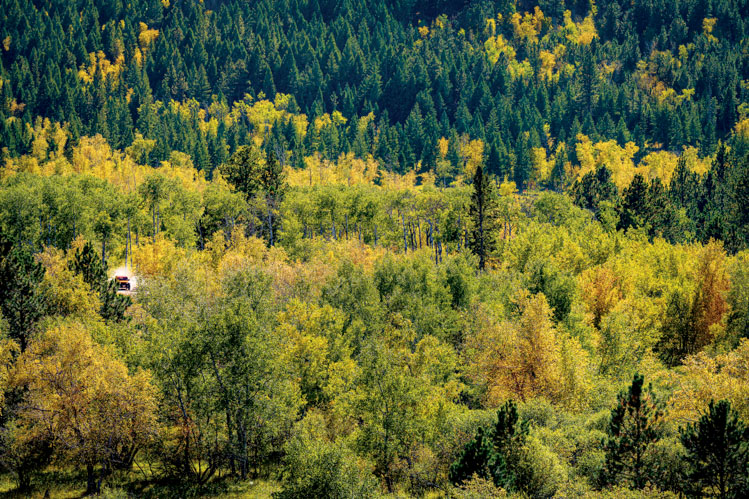
Drivers experience an autumn smorgasbord along Palmer Creek Road, which winds through thick aspen forests and broad meadows.

A SOLITARY COTTONWOOD tree on the lonesome prairie, when bejeweled with golden yellow leaves, emanates as much beauty as the human eye can absorb — especially when the sun slips southward, leaving the September sky bluer than blue.

Yet, who looks for a single tree in autumn? We tell ourselves we must see mountains and hillsides and river valleys with their forests full of leaves, each one hanging precariously by a stem, fluttering unworriedly as if winter was a thousand years away.

So yes, of course, go forth this autumn and fool yourself into believing that this glittering season is not just a cruel trick of chlorophyll. Life will always be so good. Calamity can never follow such serenity. South Dakota is paradise eternal.

Certain places in our big state are especially guilty of contributing to the delusions of autumn, beautiful though they may be. Traffic jams can occur on Highway 14 in Spearfish Canyon during peak leaf-peeking days. Sica Hollow’s oaks are almost as beguiling for people who live in the northeast. Our urban forests are resplendent in different ways because city parks and boulevards feature a gloriously unnatural mix of planned and planted trees. The McKennan Park neighborhood in Sioux Falls is an exceptional example.

We asked our chief photographer, Chad Coppess, if he knew of some lesser-known fall foliage tours. He suggested the three that follow. Interestingly, one that he chose is at South Dakota’s very lowest elevation while another is near the highest. Chad’s diplomatic third choice lies in between, along the Missouri River.

These routes won’t have bumper-to-bumper traffic in September and October when our leaves change color, but that is part of their allure. Autumn is even more striking when you escape the crowds.


PALMER CREEK

Pennington County

The graveled Palmer Creek Road is less than 4 miles long yet offers more than its weight in gold leaves between two spectacularly located campground resorts. Horse Thief Campground and Resort lies on the southwest end of the road and the Mount Rushmore KOA at Palmer Gulch Resort on the northeast. Both campgrounds have funky little stores that offer snacks and refreshments.

Midway along the road, an engineer had some fun by designing a double crisscrossing section with an over-under bridge and a cut through a rock that delivers a jaw-dropping view of Black Elk Peak no matter which way you are traveling. The road winds through beautiful aspen groves and, at times, offers a panoramic view of the entire gulch.

Little-known fact: Along the road is a parking area for Palmer Creek Trailhead, where you can trek to the top of Black Elk Peak (South Dakota’s highest point) and beyond.


PLATTE-WINNER BRIDGE

Gregory and Charles Mix counties

Those who prefer to venture off the interstates know that Highway 44, a main artery across the southern third of South Dakota, crosses the Missouri River via the Platte-Winner Bridge.

The stretch between Platte and Winner is 53 miles. The most scenic area features bluffs that drop into the river valley where you’ll discover two state recreation areas — Snake Creek on the east side and Buryanek on the west.

Lewis and Clark traveled here in 1804 and 1806, at one point losing a member of their party for several days. The Shannon Hiking Trail in Snake Creek Recreation Area commemorates the lost explorer and gives expansive views of the river and autumn colors.

Little-known fact: Unless you live in the neighborhood, you may not have heard that the mile-long Platte-Winner Bridge is about to be replaced. Construction on a new bridge may begin in 2025.


BIG STONE LAKE

Grant and Roberts counties

State Highway 109 runs up the South Dakota side of Big Stone Lake in the northeast corner of the state with a view across the lake into Minnesota. We recommend the 15-mile stretch from Big Stone City to Hartford Beach State Park with frequent stops at access points to the water. The route offers a variety of vegetation and colors for leaf peepers. Hartford Beach is one of the oldest South Dakota state parks and is popular with campers, boaters and fishermen. The log cabin trading post of Solomon Robar, along with Native American burial mounds and pioneer graves, are found along the hiking trails in the park.

Little-known fact: The shoreline of Big Stone Lake (elevation 965 feet) is the lowest spot in South Dakota.

Editor’s Note: This story is revised from the September/October 2023 issue of South Dakota Magazine. To order a copy or to subscribe, call (800) 456-5117.

Posted on Leave a comment

Stopping the Green Glacier

Cedar tree encroachment is becoming a problem in the Missouri River valley, choking out native species and reducing available forage for cattle.

WE STOOD HIGH ATOP a ridge on Rich and Sara Grim’s ranch in Gregory County. The Missouri River below looked like a wide blue ribbon stretching from horizon to horizon. A gentle northwest breeze made the afternoon’s 91 degrees feel like 75. Cattle stood on a point along the river munching prairie grass, surrounded by the remnants of a thick grove of cedar trees.

“My nemesis,” Sara Grim said as she grabbed the soft branch of a cedar and began picking at its prickly needles.

She’s not the only rancher who’s grown to despise these hardy trees. Landowners along the Missouri River — especially in the four south central counties of Gregory, Charles Mix, Lyman and Brule — have slowly watched valuable pastureland succumb to eastern redcedars, which have fruitfully multiplied for decades, marching steadily north from Texas, through Oklahoma, Kansas and Nebraska, and now South Dakota. Farmers and ranchers in those southern states have long fought a losing battle against cedars, but many experts see South Dakota as the cedar frontier, the place where maybe the encroachment can finally be stopped. But to do so, landowners are having to get out of their comfort zones and reclaim acres through a force we’ve all been taught to fear — fire.

*****

HOMESTEADERS WHO POPULATED the central Plains in the 1800s were awestruck by the lack of trees. But in ravines and other protected areas stood eastern redcedars. A member of the juniper family, eastern redcedars are native to much of the eastern United States. In poor soil, they may never grow larger than a bush, but under ideal conditions they can reach 30 or 40 feet.

Sara Grim has become a staunch supporter of prescribed burning to control cedar tree encroachment.

They are drought tolerant and among the most important windbreak species on the Plains, qualities that eventually made cedars ideal for planting in shelterbelts. They can also reproduce prolifically, thanks to the birds and other small animals that ingest the tiny blue berries that sprout from a cedar’s branches. Studies have shown that the seeds pass through a bird’s digestive tract in 30 minutes, leading trees to sprout near their parent trees or along fence lines where birds might perch. Years of unchecked reproduction have led to cedar groves with canopies so thick that no vegetation can grow beneath. That decrease in forage worries cattle ranchers.

Sean Kelly, a South Dakota State University Extension Range Management Field Specialist based in Winner, says that every 1 percent increase in tree cover leads to a 1 percent loss in forage production.”It’s just a slow green glacier moving north,” Kelly says.”You see one or two out there in your pasture, and then five years later it’s 15 or 20. Before you know it, you’re trying to catch up and stay ahead of the curve. It’s hard for a rancher to stay in business very long if all they have is cedar forest and no grazing opportunities. And it can really start to snowball. If you’re not adjusting your stocking rates accordingly, it starts to spiral.”

Landowners began to act in 2011 when Doug Feltman asked the Natural Resources Conservation Service to survey his ranch south of Chamberlain to determine the impact of cedar trees. Using a series of five photographs of a north facing slope taken between 1981 and 2011, researchers determined that an area that once supported 10 cows could now barely support three. Feltman’s productive potential had decreased 70 percent due to cedar encroachment.

The NRCS then looked at neighboring Gregory County. Through aerial photography, maps, GPS and field work, researchers confirmed that 30 percent of the county was covered with a heavy to medium encroachment of cedar trees, judging by average trunk diameters.

A survey of 109 Gregory County landowners revealed that 80 percent were concerned about cedar encroachment. It also indicated that they were interested in learning more about prescribed burning.”Fire is the most economical way of controlling cedars, especially if you don’t have thick encroachment yet,” Kelly says.”When it was Native Americans and buffalo out here, natural wildfires kept invasive species like this at bay. Without that element of fire, they’ve been able to take over and keep spreading. That’s why we’re trying to reintroduce prescribed fire.”

Members of the Mid-Missouri River Prescribed Burn Association create a fire line to help keep a burn under control.

After a series of meetings that began in the spring of 2012, the Mid-Missouri River Prescribed Burn Association (MMRPBA) was officially incorporated in 2016. The organization is landowner-driven and governed by a seven-member board, all of whom own land within its four-county coverage area. Integrating guidelines from several government agencies and university experts, the association established a lengthy and detailed protocol that dictates precisely when and how they will initiate a burn.

“It’s a 15-page burn plan,” says Kelly, who also serves as vice president of the MMRPBA.”On a new burn unit, it’s easily a yearlong process.”

Every burn begins with an initial meeting between one or two board members and the landowner, who also must join the association and attend a prescribed burn on another member’s property before receiving burn services on his or her ranch. The group conducts four or five field visits throughout the year to determine the severity of cedar encroachment and identify other factors that will affect a potential burn: Where can they create fire breaks? Is any shearing needed? Are there hazards, such as power lines? Can safe escape routes be planned?

Once those questions are answered, work begins on the ignition plan. They determine how large the crew should be and what equipment will be needed. If possible, they try to incorporate one or two other landowners to utilize natural fire breaks. If a burn is planned all the way to the river, they work with the Department of Game, Fish and Parks and the U.S. Army Corps of Engineers.

Then it’s a matter of waiting for the right weather. Kelly says they generally follow the 80-20-20 rule, which calls for temperatures no hotter than 80 degrees, at least 20 percent humidity and wind under 20 miles an hour. Those parameters mean that March, April and May are prime burning months, followed by a few opportunities in the fall.

After years of preparing, perfect weather arrived in April of 2016. The association was ready for its first prescribed burn on the Grim ranch.

*****

SARA GRIM WAS A girl on horseback, helping her father move cattle through the river breaks of the family ranch. When they came to a grove of cedars, she got off and led the horse through. That’s when a cedar branch caught on the saddle horn and broke the latigo.

“Now that’s a memory,” she laughs.”I haven’t thought about that in years. I don’t remember how he dealt with that. We had bad cedar trees back then and the cattle would get in them. It was hard to get them out; we had to crawl or lead the horse through. My father was noticing a problem with cedar trees, but nobody knew what to do. We all hoped it would just go away on its own, but it didn’t.”

An aerial photograph shows the darkened patches of the Grim ranch treated by prescribed burn in May of 2023.

Grim’s grandfather, William Sutton, arrived on this patch of land in 1929. He was working for the Yeoman Mutual Life Insurance Company, which had ended up with the ranch after its original owners, the Jackson brothers (also owners of the vast Mulehead Ranch), went under. Sutton came from Iowa and within a couple years purchased the ranch from the insurance company. His ranch brand became the Y-S, for Yeoman and Sutton.

When Grim’s father Billie Sutton, a popular local politician, died in a farm accident in 1982, Grim and her brother came home to help their mother manage the ranch. Eventually they decided to split it in half. Grim and her husband work about 3,600 acres of rough river break country mostly dedicated to cattle that have slowly seen their grass get choked out by cedars.

About 10 years ago, the Grims began working with David Steffen, a retired NRCS employee living in Burke, on a Conservation Stewardship Program that focused on grassland management. The program included the idea of cedar control through burning.

Grim was still working in the county treasurer’s office, where she spent 27 years.”One day, Dave came into the courthouse and said, ëSara, what are we going to do about this green glacier?'” she recalls. He had brought an overlay showing the cedar encroachment in Gregory County. The Grims had helped develop the county landowner survey along with Steffen and were interested in prescribed burning, so they got involved.

They quickly learned that education is paramount.”I’ve talked to so many people who are just unaware. They look at those trees growing in the river hills, and they think it’s beautiful, but there’s nothing growing underneath. There’s no grass, no feed, and we’re losing ground.”

The association identified a section of the Grim ranch and formulated a burn plan. The Grims participated in a few controlled burns with local fire departments to prepare.”They were small experimental burns, and we were scared out of our minds,” she says.”I didn’t sleep for a week. It was very scary. For years if anyone saw a fire you put it out.”

But when they dropped the match on that April day, the association was in complete control. Flames roared and smoke billowed high into the sky. When it was all over, 340 acres of thick cedar forest had burned. Just as importantly, the blaze sparked confidence in the volunteers who were learning to manage such a destructive force.”You have to respect it, but you don’t have to fear it like you used to,” Grim says.

*****

PETE BAUMAN HAS been helping people get comfortable with fire for nearly 25 years. When he began, the focus was on using fire to help manage land enrolled in the Conservation Reserve Program. After he started working for SDSU in 2012, his efforts shifted to working with multiple organizations on creating classes where landowners could be introduced to fire.

Cedars produce thousands of berries that are dispersed by birds and other animals.

“There was just this general idea that South Dakotans had a fear of fire,” Bauman says.”But over the years, it became very clear that people didn’t have a fear of fire, they had a disconnect with fire. There was no innate fear. It was more like we forgot how to understand it.”

Bauman says the prairie evolved with three things: fire, grazing and climate. Indigenous people recognized the value of fires and ignited them to stimulate the regrowth of native grasses that would, in turn, attract the great bison herds.”It’s nature’s wonderful reset button,” Bauman says.”Healthy prairies really are not damaged by fire at any time of the year because native plants come back. Fire stimulates native plant growth, it recycles nutrients, it definitely stimulates total production, seed production and seed viability. Pollinator plants thrive post-fire, which then creates insect habitat. They utilize that smorgasbord of nectar that’s been created. When that all functions well, you’ve got the foraging animals. Those benefits just build up the line. It’s when we throw exotic species into the mix that makes the timing of fire so much more important.”

He says the goals of fire today are to control, reduce or eliminate exotic species like brome, bluegrass, Canada thistle and sweet clover.”Now we have to look at fire as a specific tool that has to do with timing, intensity and duration, very much like grazing. We have to apply fire not as a hammer but sometimes as a scalpel and understand what the objective is of each individual fire, and that’s different than it would have been 250 years ago.”

For the past three years, landowners have received hands-on training at fire schools that Bauman has supervised throughout eastern South Dakota. Bauman serves as the”burn boss” while attendees assume other leadership roles that a prescribed burn would require.”The coolest thing about prescribed fire is we’re in control,” he says.”We don’t ever have to drop the match. From the moment we start to the moment we stop, it’s about control, control, control, which makes the fire the tool. The tail doesn’t wag the dog. Our mantra is that we want you to be bored on your fire. If you’re bored, your fire is doing exactly what it should do. We don’t want the amped up, excited chaos associated with fire response. We want clear thinking, well planned, well executed, boring fires.”

However, Bauman says a boring fire isn’t enough for cedar infestations.”What those folks need to do to save their ranches requires a higher level of risk and coordination and fire intensity,” Bauman says.”The schools that we do help lay the foundation for those folks to build their skills, because it’s a different kind of fire. If you have a boring fire trying to kill cedar trees, you’re probably not going to kill many trees.”

*****

WE SPENT TWO HOURS traversing the vast Grim ranch by UTV. The gray skeletons of cedars burned in that first fire in 2016 are finally beginning to fall. Charred trunks and trees that sport splashes of brown amongst the green branches show evidence of the 530-acre burn they held on their West River pasture in May of 2023.

Native plants such as snow-on-the-mountain have begun to re-emerge on patches of land treated by prescribed fire.

“Oh, look at that switchgrass,” Sara Grim said, stopping the side-by-side so we could examine the new shoots already emerging, just three months after their most recent burn. Big bluestem waved in the breeze. The white flowers of snow-on-the-mountain contrasted against the blackened trunks of cedars that will eventually topple over.

That spring burn had been planned for seven years. In the meantime, the MMRPBA has kept busy with other fires. The group burned 688 acres in 2017, 271 acres in 2018 and 314 acres in 2020. Covid, drought and other hiccups put a hold on burning for a few years, but in 2023 they rebounded by burning roughly 6,000 acres. There are 10,940 acres on the books for prescribed burning in 2024.

Grim’s ranch is very near the heart of South Dakota’s cedar encroachment, but Kelly says the spread is evident, especially along the Little White River in Todd and Mellette counties and the Cheyenne and James River valleys. Its leading edge seems to be along Interstate 90, where groups are already experimenting with prescribed burns and working to form burn associations.

Sheldon Fletcher, with the Lower Brule Sioux Tribe’s Environmental Protection Office, has begun holding meetings and oversaw a 30-acre prescribed burn after traveling to watch the MMRPBA in action. Rod Voss, a Rangeland Management Specialist for NRCS based out of Mitchell, has helped with two prescribed burns along the James River.”We’re at a stage here where it would be fairly easy to stop if we can just get our people educated,” Voss says.”A lot of people are recognizing the production impacts, but it’s a hard thing to educate people that a tree can be a bad thing. Out here on the prairie, people like their trees, but a tree in the wrong place is simply a weed.”

That’s something the ranchers of south central South Dakota know all too well. Kelly hopes people in other parts of the state begin to see the benefits of fighting with fire.”It’s not an easy sell, especially in some of these areas where the encroachment is just starting and they’re not really sure if it’s a problem that’s worth spending any time on yet,” he says.”I can understand that, but if you don’t believe me come down and take a look at Gregory County, because this is what you might look like in 40 or 50 years. We’ve got a real opportunity to stop it.”

If they succeed, then South Dakota can be something that Texas, Oklahoma, Kansas and Nebraska could not: the cedar’s final frontier.

Editor’s Note: This story is revised from the November/December 2023 issue of South Dakota Magazine. To order a copy or to subscribe, call (800) 456-5117.

Posted on Leave a comment

Some Things Never Change in S.D.

South Dakotans have patiently awaited the joyful harbingers of spring: a tree beginning to bud, a flash of color from a tulip, grass slowly changing hue from brown to green. But the first sign of spring we received this year was not so welcome. March brought flooding to parts of East River, mixed with a statewide blizzard.

The mid-March storm was no surprise to most of us. We’ve endured our share of spring setbacks. In fact, our March/April issue — published just as the recent storms were gathering — includes a story on the awful historic winter and spring of 1952.

Our longtime writer Paul Higbee began the article with a line that could have made a headline this month:”It was a demon of a blizzard that melted into a monster of a flood.” The January storm of’52 especially hit the Rosebud region of south-central South Dakota. Mission, White River, Winner, Philip, Murdo, Gregory and Pierre were hammered the hardest but the storm swept over the entire state, delivering severe winds and snow from Rapid City to Watertown.

Snowmelt in the spring brought more disaster. High water along the Missouri River valley and its tributaries drove 7,748 people in 17 counties from their homes. Miraculously, there were no fatalities. But 45 houses were destroyed and 584 damaged.

The Rosebud disaster wasn’t the most tragic storm in state history, but it’s one that captured the state’s imagination in part thanks to Laura Hellmann of Millboro, a tiny ranching community in Tripp County. After the storm, she asked 66 writers to quickly submit their survival stories before memories were dulled by time or forgotten. The stories collectively show the tragedy, despair and helplessness that weather can inflict.

Hellmann eventually published the memories in a small book, which she titled Blizzard Strikes the Rosebud. The stories are captivating. A Gregory cafe became home to 32 people for two days; they played cards, listened to the radio and slept in booths. Mildred Benson kept her students at Eden School entertained by organizing a folk dance that went on for two days.

Thor Fosheim, a 75-year-old rancher, rode off on horseback to save his cattle and never returned. Murdo rancher Noel”Pete” Judd went with his nephew to bring his daughters home from school. When their Jeep stalled, the four started walking. Funeral services for all four were held eight days later in Winner.

Most farmers and ranchers didn’t drive four-wheel-drive pickups in the early 1950s, and they didn’t have 100-horsepower tractors with heated cabs and snow blowers. Some of the rescue work was accomplished by foot and on horseback.

However, one thing has remained constant from 1952 to 2019. When times get tough, neighbors and even strangers band together to help one another. Much has changed in South Dakota since 1952. Roads and bridges are better. Dams and levees have been constructed to control flooding. Equipment is better and safer.

But good neighbors are still the greatest blessing when the snow is blowing and the water is rising. It was true in’52 and true in’19.

Posted on Leave a comment

Opening Day

Teenagers who help at Louise’s Cafe in Fairfax, population 115, are about to get a lesson in communications. That’s one of several side benefits to the hunting season for Gregory County, in the heart of pheasant country.

“I keep telling the kids that they’ll get better tips if they just learn to talk to the hunters a little bit,” says Louise Truax, who has been frying eggs on Fairfax’s Main Street for 30 years.”They joke with you and you joke back.'”

Louise’s Cafe, with its $6.50 breakfast special (eggs, bacon, potatoes, toast and coffee) spices the Gregory County ambiance, along with dozens of other small town restaurants, shops and lodges.

Marge LaFave has run the tiny and impeccably clean Hertz Motel in Bonesteel, population 100, for nearly 40 years. Even though most of the pheasants have migrated west of her little town, hunters still sleep there. Across the street is the historic TeePee Cafe, managed by Tami Jons who features Friday night steak specials, prime rib on Saturdays and Sunday breakfast buffets. The motel and cafe were built in the 1950s in anticipation of the lake traffic everybody thought would flood Highway 18 once Fort Randall Dam filled Lake Francis Case.

Walleye and anglers have taken to the lake, but ring-necked roosters take precedence in October when the sorghum heads turn red and the sumac even redder. Pheasants are a $250 million industry statewide. More than 170,000 hunters will be gunning for the birds this fall. That creates 4,500 jobs for guides, taxidermists, waiters, bartenders and lodge-keepers in the four very small towns (Fairfax, Herrick, Bonesteel and Dallas) and two small cities (Burke and Gregory) that comprise Gregory County. Churches hold bake sales to capitalize on the hunters, and the city of Gregory celebrates with a soup-tasting contest.

Opening Day has a fresh aura, especially in Gregory County where an autumn blue sky is beautifully framed by the muted, earthy colors of cornfields, grasslands and tree belts. Hunters regularly remark that they wouldn’t care if they never saw a pheasant, so lovely are the landscapes.

“It’s more about the relationships and the camaraderie,” says Mike Karbo, who bought the funeral home in Burke 20 years ago and moved from Sioux Falls because he loved the outdoors. He says deer, turkey and walleye are also big draws.

And did we mention pancakes?”I’ve been using the same mix forever,” says Louise, the Fairfax restaurateur.”It’s just milk and butter and the mix and you add water, but they sure like them.”

Then add syrup.”I always tell the kids that when the customer gets ready to pay, all you have to say is ‘have a good day,'” she says.”Some of them do and some don’t. But that’s ok, too.”

Who wouldn’t want to hunt in a place like this?

Editor’s Note: This story is revised from the September/October 2012 issue of South Dakota Magazine. To order a copy or to subscribe, call (800) 456-5117.

Posted on Leave a comment

Tale of Two Paths

You might know Gregory County because of its high school’s notorious mascot: the Gorillas. Or as the home of Elmer Karl, whose smiling face has appeared in advertisements for home appliances for over 50 years. But this county on the Missouri River — still affectionately described as part of Rosebud Country — is rich in history, culture and natural beauty.

Drivers from East River can cross into Gregory County via two main routes, and the area’s striking landscape is immediately evident no matter which is chosen. Highway 18 spans the Missouri River and Fort Randall Dam in the southern part of the county. The dam is named for historic Fort Randall, built in 1856 just below the present dam site. Fort Randall was an important link in a chain of forts protecting a trail along the Platte River and was the first in a line of forts stretching up the Missouri River. Soldiers stationed here were mostly charged with controlling the Lakota as homesteaders steadily trickled in from the East.

The remains of Fort Randall Chapel.

Fort Randall operated until 1892 but remnants still exist, include building foundations, a chalk rock chapel built in 1875 and the cemetery, where 138 soldiers, their wives and children were originally buried. Some bodies have been moved, but about 90 graves remain inside the white picket fence. A placard provides dates and causes of death — including disease, skirmishes with Indians and a lightning strike — for many who perished at Fort Randall.

Among the many soldiers stationed at Fort Randall included John Shaw Gregory, who worked as a trader for the Frost and Todd Trading Company. He was also a member of the territorial legislature in 1862, when Gregory County was created and named in his honor.

Just across the dam lies the Karl Mundt National Wildlife Refuge, home to one of the most important bald eagle roosts in the country. Between 100 and 300 bald eagles spend the winter there, fishing in the open waters of the Missouri River and roosting in the gnarled old cottonwoods. Birders are welcome, but the refuge itself is closed to visitors. A kiosk below the dam provides excellent eagle viewing.

Frank Day’s Bar caters to hunters in the fall.

All of Gregory County’s towns are situated along Highway 18. During the fall, that’s a well-traveled section of road because pheasant hunters descend upon the area. Local businesses like Louise’s CafÈ in Fairfax, or the TeePee CafÈ in Bonesteel offer hearty breakfasts and weekend specials to satisfy their hearty appetites. Guides, taxidermists and motel operators in those towns, plus Gregory, Herrick and Dallas are kept busy, as well.

Head north of Bonesteel to Whetstone Bay and search for prehistoric sea creatures on the banks of the Missouri River. Bonesteel’s Paul Neumiller has been hunting fossils since 1957. He’s discovered prehistoric lizards, elephants, mastodons and sea turtles that weighed two tons. He also found North America’s first hainosaurus — a giant sea lizard — in 2002.

Just beyond Bonesteel is the tiny community of St. Charles, where the Lakota culture remains alive and well. Gregory County was once part of the Great Sioux Reservation, which encompassed all of present-day West River South Dakota. The land was opened for settlement in 1904, but Lakota still live and work in the area. At Milk’s Camp, Marla Bull Bear leads a summer camp that was created a decade ago to combat a rash of youth suicides on the nearby Rosebud Reservation. Attendees learn about Lakota culture, music and traditions.

Attendees at Milk’s Camp learn hoop dancing under the guidance of Kevin Locke.

The next town along Highway 18 is Herrick. You can’t miss it because its bright red elevator has become a destination. Originally a working grain elevator, it was added to the National Register of Historic Places and has been renovated as a retreat center. The town also celebrates an annual Squeal Meal, which includes a pork barbecue, parade, dance and hog calling contest.

Burke is the county seat, but it’s known across South Dakota for the annual Stampede Rodeo. The event is really a community affair, with an expanded farmer’s market and a cattle drive down Main Street. The main event has all the hallmarks of a rodeo plus a singing contest and other special additions.

The largest town is Gregory, at just under 1,300 people. The citizenry loves Gorillas football games and a main street that features the flagship Karl’s store. For years the town held an Oscar Micheaux Festival to honor the African American filmmaker who originally homesteaded in Gregory County. On our most recent trip through Gregory, we stopped for a breakfast of eggs, homemade potatoes, toast and coffee at Sissy’s CafÈ and grabbed coffee at Dayspring Coffee Company.

The last town on 18 is Dallas, home to the iconic Frank Day’s Bar. When we visited 20 years ago, we found historic guns, hats, boots, saddles and photographs plastered to the walls inside the bar. Day, who has since passed away, was also a collector of stories, having recorded interviews with several old-timers. He told us the story of Tom McCrory, a rancher who had a hole in the palm of his hand”so big that you could see daylight through it,” Day said.”He claimed a bear had mauled him but another old-timer said the bear must have had a revolver.”

A cattle drive down Main Street of Burke precedes the summertime Stampede Rodeo.

If you enter Gregory County further north, you’ll cross the Missouri River on the Platte-Winner bridge. When workers built the bridge, the main stem dams had already been built on the river, so they had to build foundations in depths up to 180 feet. It was a lot of expense and work for a bridge that carries less than 1,000 vehicles a day, but few river crossings are as unspoiled and picturesque.

There are no towns in northern Gregory County, but it’s historic country nevertheless. The area around Lucas was headquarters for Jack Sully, a legendary cattle rustler who was gunned down by a posse in 1904. In the days of the open range, large cattle companies from southern states drove livestock into the Dakotas and allowed them to forage, leaving little for the cattle belonging to homesteaders. Many South Dakotans saw Sully’s antics as merely protecting their rights to their own land, but he found himself in jail on several occasions. He broke out of the Mitchell jail and evaded law enforcement until U.S. Marshals learned he had returned to his home in the Gregory County hills. They shot him as he tried to escape on horseback.

Sully’s antics are still the subject of debate, but that’s all part of the beauty and mystery of Gregory County.

Editor’s Note: This is the 14th installment in an ongoing series featuring South Dakota’s 66 counties. Click here for previous articles.

Posted on Leave a comment

Colombe’s Colome

Reed Petersek, a steer wrestler on the South Dakota rodeo circuit, and his wife Erin live in Colome.

An apple a day keeps the doctor away, and a good steak a week keeps an entire town happy. At least, that’s true for Colome, a cowboy enclave surviving nicely on the Tripp County prairie sea of grass and corn.

About 150 diners gather in a green metal building known as the Thayer-Waters American Legion Club every Thursday night for steaks, salads and neighborly talk. Steak Night, as it’s called, has grown to become an unusual community tradition.

Colome is in south central South Dakota, a half hour’s drive north of the Nebraska border. A dozen businesses operate there, and their names tell something about the town: Frontier Bar, Feed Mill (the local cafÈ), the Sign Inn and Scott’s Welding, for examples.

Anchoring Main Street is the stately Veterans Memorial Stadium, built to honor local World War II soldiers, where teens practice basketball. North of the big gray gym is the Legion Club, where the aforementioned steaks are fried.

Statuary welcomes guests to St. Isidore Catholic Church. Isidore is the paton saint of farmers.

“Steak night is an institution,” says Fran Hill, a local rancher, writer and food blogger who has helped with the event.”It’s almost all volunteer, only the cook and the bartender and a barmaid are paid.” The helpers bring salads, wait tables and wash dishes.

Alan Armstrong, the Colome school superintendent, says his children plan their trips back home to coincide with steak night.”And we try not to schedule school events on Thursdays because we can’t compete with that, and we don’t want to.”

Armstrong says the street is full of cars by 5:30,”and usually it’s families coming together.” Profits from the feed are mostly donated to local youth and school activities, including upkeep on the auditorium. Roger Hauf, a former mayor and owner of Hauf Floor Covering and Hardware, says Colome’s citizenry, while few, are generous to a fault.

Hauf wanted a new roadside sign when the town celebrated its centennial in 2008, and he had little trouble selling bricks 400 personalized bricks to cover the $20,000 cost. Just last year, Colome raised $700 to help buy a digital projector for the Pix Theater in Winner, even though the two towns have been rivals through the years.

And people from Winner, Gregory and other neighboring towns reciprocate by attending Steak Night — proof that the town has mellowed from wild beginnings. There might not even be a town called Colome if Chris Colombe, the town’s namesake, hadn’t survived a bloody barn dance brawl in 1894.

An 1890s-era photo of the George Pete ranch shows the barn where Chris Colombe courted and fought for his bride.

Colombe was the dashing, dark grandson of Pierre Dorion, a fur trader and friend of the Yankton Sioux who interpreted for Lewis and Clark when they pushed up the Missouri River valley in 1804.

The young cowboy was taken with a beautiful girl, Emma Brughier, and promised to meet her at a barn dance at the George Pete ranch. He brought along some buddies, because he suspected that Emma’s family and friends might not approve. Sure enough, a big fight broke out, with fists, knifes and guns. Before it was over, Colombe rode away,”with the girl in his arms and there was no one on Pete’s creek who dared to follow,” according to an historical account in the Rapid City Journal.

Colombe and Brughier married, raised three children and became successful cattle ranchers. When the Rosebud region was opened to homesteaders in 1908, they sold land to the railroad for a town to be called Winona. As soon as the lots were purchased, the name was changed to Colome. Apparently, the bloody barn dance was forgiven if not forgotten.

Colome lies in the heart of South Dakota pheasant country. Larger towns of Gregory and Winner sit to the east and west, but the little town has a competitive streak. It scored a big victory five years ago when the Wood-Witten school board agreed to a consolidation agreement, even though they were closer to Winner.

That gives the school almost 300 students. Armstrong, the superintendent, takes pride in his veteran faculty.”We have people who came here out of college and are here 30 years later. That really makes a difference.”

Richard Papousek is known throughout Gregory County for his creative remodels.

The town has 300 residents today, about half the population that it boasted in 1935 when Chris Colombe died. But there’s a thriving commercial community, and hunting services have added a new industry in the recent years. Most of the lodges are located on farms outside town but several years ago an old brick hardware store on Main Street was renovated into lodging.

The lodge’s roof collapsed due to a major drainage problem, and it was about to be bulldozed when Richard Papousek, a talented Colome carpenter, stepped forward and offered to buy it for a dollar.”Nobody else was going to save it, and the price was right,” he says.

Papousek, famous locally for his creative remodeling projects, redid the lodge and decorated it with a huge collection of old commercial signs. He calls it the Sign Inn and rents rooms for $40 a night to traveling workers and hunters.

They couldn’t find a friendlier town, or a better steak on Thursday nights.

Editor’s Note: This story is revised from the March/April 2013 issue of South Dakota Magazine. To order a copy or to subscribe, call (800) 456-5117.

Posted on Leave a comment

The Rush is Over

Editor’s Note: This story is revised from the March/April 2009 issue of South Dakota Magazine. The businesses featured remain open, though some are under new ownership. To order a copy or to subscribe, call (800) 456-5117.

Ed Jons and his grandson, Chase, pedal past Bonesteel’s quiet downtown.

As you cross the Missouri River westward over Fort Randall Dam, Highway 18 wiggles past small farms and cedar hills. Cornfields are suddenly triangular and rectangular because the once-straight road was rerouted to reach the dam. Tight barbed wire rims many of the fields so farmers can”turn out” their cows in the stalks after the harvest.

Gregory County, which sits on the Nebraska border, still has about 600 farmers — more than most West River counties. Seven small towns are spaced nicely along Highway 18, and every town has a few leaders trying to find new reasons for their community to exist other than just to serve farmers who, even here, are thinning in number.

At Herrick, the old grain elevator has been converted to an art center. Gregory hosts a summer film festival. Burke, the county seat, has become a rodeo town and tiny Dallas, pop. 140, has the legendary Frank Day’s Bar, a veritable museum of cowboy pictures and memorabilia.

Bonesteel has the river and Lake Francis Case, just a few minutes away by car or truck. The lake covers over 77,000 acres of bottomland. Only a farmer who has plowed or cultivated an acre at a time can understand that much ground; a farmer, perhaps, and also a fisherman looking for walleye in a 16-foot boat with a 25-horse Johnson.

Members of Bonesteel’s Over 50 Club meet for coffee and cards.

Most West River towns of 300 or fewer seem sleepy when you drive past on the highway, and Bonesteel is the same. Tip your hat if you see five or more cars going the same direction because that’s probably the beginning of a funeral procession.

“We do have too many funerals,” says Marge LaFave, proprietor of the Hertz Motel for the past 36 years. Like most of rural South Dakota, the average age of the citizenry is getting older.

But spend some time in town — whether you’re there for a funeral or fishing or just passing through — and you’ll soon discover people doing interesting things. For example, Paul Neumiller hunts for ancient sea monsters. He scouts the west shore of the Missouri, near a spot where explorers Lewis and Clark found the bones of”a prehistoric fish” in 1804.

When Neumiller isn’t practicing archeology, he fishes the Missouri for walleye and catfish, or saddles up to help local ranchers”work” cattle. He also gathers with neighbors for coffee at the Over Fifty Club.

Neumiller could be the poster boy for Bonesteel and other towns near the Missouri River that offer hunting, fishing, water recreation and a laid-back atmosphere.”Gregory County is slowly becoming well known for its outdoor lifestyle,” says Joe Duling, a realtor from Gregory.”We’re just close enough to cities like Sioux Falls and Sioux City and Omaha and just far enough away.

Paul Neumiller found his first petrified fish in 1957. Today he searches the Missouri River banks for the bones of other fossilized sea creatures.

Bonesteel is also close to boat ramps and camping spots on the Missouri, and surrounded by thousands of acres of state and federal”open hunting” land. Lake Francis Case, South Dakota’s second largest body of water, stretches 107 miles from Pickstown to Fort Thompson.

Like most towns of 300 people, Bonesteel has only a few retail shops. But there is a grocery and hardware store, cafe, bar, motel, gift shop with pheasant feather arrangements and one of the best-kept old-style banks in the West.

The Lillibridge family has owned the brick bank for five generations. Tom Lillibridge and his wife, Cindy, lived in the bank’s basement for many years, but they recently built a stylish home across the street on commercial lots once owned by Tom’s father, Louis.

Before Tom and Cindy could dig a foundation, they had to buy the lots his father had given the city after he’d cleared them of old buildings and debris. That was Louis’ style, says Mark Knutson, who manages the Bonesteel bank for the Lillibridges.”If any buildings in town were vacant, Louis would purchase them and if they were any good the first thing he would do is put on a roof because he said without a roof you didn’t have anything.” Buildings beyond repair were torn down.

The son’s spectacular brick home is the type you expect to see on the 18th hole of a Sioux Falls country club rather than in the middle of a little farming town. Probably the message was unintentional but, standing on Mellette Street in downtown Bonesteel, the home clearly advertises the Lillibridge family’s confidence in the Rosebud country.‚Ä®”I came to Bonesteel from Burke in 1974 and Cindy grew up on a ranch southwest of town where her great-grandfather Julius Thoene homesteaded,” said Lillibridge.”We think Bonesteel is one of the cleanest small towns you’ll find. But the number of young people is fewer all the time. Many of our farmers are going to retire soon, and the big question is whether they’ll retire here or want to be closer to a hospital or pharmacy.”

The Lillibridge family has run banks for three generations, including the Bonesteel bank.

As mayor several years ago, Lillibridge had the idea of promoting Bonesteel at Ellsworth Air Force Base. He thought the area’s outdoor charm and small-town lifestyle might appeal to airmen. He never started an organized campaign, but it may be a good idea; retirees are buying houses in town or building in the Missouri foothills. Just walk around the town, and you’ll hear numerous explanations on why Bonesteel citizens like the area — either as a vacation spot or a permanent residence.

“We live in a place where you don’t pay to park and you don’t wait in lines,” explained Kathy Divine, who runs a concrete delivery and fabrication company with her husband, John. The size of the company might surprise people –“24 employees and 240 wheels turning” — but Divine says there’s no reason you can’t succeed in a town of 300.

“The Internet has done a lot to change that,” she says.”It’s endless opportunities here today. Maybe those opportunities are hidden but we found one. I think it’s ‘find a need and fill it.'” Along with routine concrete work, the Divines also manufacture unusual specialties, like tornado storm shelters.

Ed Jons, a partner in Bonesteel Oil Co., also found a need. He felt it was shameful that senior citizens had to leave Bonesteel when they couldn’t live on their own so he started the Haisch Haus, an assisted living center. The Haisch name is part of local lore. Curley Haisch bought the famous Mulehead Ranch in 1932 when he was just 20 years old, and then romanced Rose Riley for 25 years.”I didn’t want to marry her until I could afford her,” he later explained.

A 1958 truck accident re-arranged his priorities, and they finally wed.”Affording Rose was not a problem,” says Duling, the local realtor who is a part owner of the ranch today.”She was the solution. Working as a team, Rose and Curley built one of the most beautiful and prosperous ranches in the state of South Dakota.”

When Jons decided to build his assisted living center in the 1990s, the Haischs agreed to finance it. They became residents of the home in 2003, and lived there until Rose died in 2007. Curley died in January 2009 in nearby Burke.

Bonesteel is attractive for seniors, says Divine.”They can sell their house somewhere else for six figures and buy a nice home here for peanuts and get a steak dinner at the Teepee for $6 or $7.”

The Lillibridges built a grand house in Bonesteel, conveying confidence in the future of Gregory County.

The Teepee, like the Hertz Motel, opened when the dam was built and became a fixture on Highway 18. Proprietors John and Sue Zebro met while working in the kitchen of a South Dakota pheasant lodge. John is a Seattle native who studied at the Culinary Institute of America, the nation’s premier chef school. Sue is a native of Herrick, a 10-mile drive from Bonesteel.

They added a dash of big-city cuisine to the legendary restaurant’s meat and potatoes menu. Customers can still order a Teepee Hog Burger (charbroiled with ham, bacon, hamburger and cheese) and homemade fries are just 75 cents extra. But the Zebros also make a pepper jelly sauce for their grilled meats (“We learned it from a woman who helped at the lodge,” says John) and mix their own salad dressings. The blue cheese and other dressings are so popular that some regular customers buy them”by the jar.”

Other Bonesteel businesses also have character. Bonesteel Grocery and Hardware sells a pre-cooked beef and pork bologna made locally, along with”Bonesteel: Best Little City in America” sweatshirts. The Lillibridge bank has local historian Adeline Gnirk’s eight history books for sale at $8 each, and Knutson, the bank manager, displays his snowman collection in the lobby during the holidays.

Brands are burned into the ceiling of Mary Vogt’s gift shop. She sold craft items at fairs until she tired of the road and opened Wood”N” Stuff in a former western clothing store (thus the brands). Now she offers jewelry, crafts and gift items from 70 cents to $70 — including handcrafted pheasant and deer antler art and her own flower arrangements.

Historic photos hang on the walls of the Over Fifty Club, a non-profit founded in 1974 as a place for seniors to meet for coffee and cards. With money raised from bingo games, dances and other parties, the group bought a building and a coffee pot. Small-stake dice and card games mix with local conversation. Did you know that lightning could travel 10 miles and hit your fishing rod? Did you hear about the mountain lion that tried to crawl up an archery hunter’s deer stand by Gregory? How many years ago was the Payloader fire that burned Harry’s face and arms? Those topics and more were covered in just one afternoon session. The men sit at one big table, the women at another. Birthdays are celebrated with a cake, but usually it’s just coffee, cards and conversation.

Deer are thick in the hills around Bonesteel, and impressive whitetail mounts are everywhere; a five-point buck overlooks the grocery store. Big buck racks are also at the Teepee Cafe, Joe Laber’s insurance office, and the Over Fifty Club.

“We have some of the best walk-in hunting in the state,” says Zebro, the local chef.”Deer hunting and fishing already have a huge impact on the area and it’s only going to grow. I was down at the river today and I was thinking, ‘Why don’t we call ourselves the Gateway to Whetstone Bay?'”

The bay, buried 6 miles north of town in the Missouri River breaks, has a park, boat ramps, picnic shelters and camping spots. Eagles and hawks circle overhead, while campers share the cedars with the big whitetails and turkey.

Peace is the best adjective to describe this corner of Gregory County, whether you are in downtown Bonesteel, in the countryside or in a boat on Lake Francis Case. But it wasn’t always that way.

Businesswoman Kathy Divine still has her grandfather’s cash register. He was a pioneer merchant.

Bonesteel’s first buildings were constructed in 1892, but the town was nameless until 1893 when H.E. Bonesteel, a local merchant, offered $100 for a school if the town took his name. The town was still tiny in 1904 when the Rosebud Sioux Reservation was opened to homesteaders. Nearly 100,000 people came to enter their names in the big land rush — including future president Harry Truman. About a third of the hopefuls departed the train at Bonesteel.

Most applicants got no land (only 2,500 parcels were available), and many were hustled by gamblers, outlaws and greedy merchants. When fights and arguments ensued, a group of vigilantes rounded up the complaining out-of-towners and paraded them before a local judge, who charged them with vagrancy and ordered them out of town on the next train.

Bonesteel has never seen another maddening crowd. Basketball and football games, the Powder River Mellerdrammer and those inevitable funerals sometimes draw a hundred or more people, but on most days peace and quiet rivals white-tail and walleye as the town’s trademarks. The Divines hired a comedian to entertain at their company’s Christmas party a few years ago.”He was so amazed by the charm of the Hertz Motel that he devoted his entire routine to it,” Kathy says. He thought it was hilarious that you get a real key at the Hertz, and you can’t use your credit card. If Marge is at the Over Fifty coffee shop when you arrive to check in, regulars just grab a key and register later.

Homesteaders built Bonesteel, but its future now rests with hunters, fishermen and retirees who like a place with tasty $5 meals, clean $31 motel rooms and a welcoming atmosphere. Bonesteel has learned how to treat its guests since the days of the maddening land-rush crowds of 1904.

Posted on Leave a comment

What’s Pho Lunch?

Last week, Laura Johnson Andrews from South Dakota Magazine visited my neck of the woods. It was a trip we had spoken of since our first meeting, and finally the stars aligned properly to make it a reality. I was excited, to say the least, to share some regional highlights, a few of my favorite places and even explore new areas with a friend that is as enthusiastic as I am about the variety and uniqueness of South Dakota.

Small towns often get a bad rap for having little or nothing of interest, but it wasn’t difficult for me to put together an entertaining tour of my small portion of south central South Dakota. Taking tips from the Mayoral Likes feature in the July/August issue, throwing in a few other distinct spots, and counting on the unwavering hospitality of our population, it was a great day for a south central South Dakota adventure.

Among other stops, we toured The Sign Inn, an early hardware store repurposed into a hunting lodge and loaded with local history; the Gregory Buttes Observation Park for breathtaking views of the prairie; Craftsman Creek Furniture, where the owner, Travis, coaxes the beauty and nuances of the wood grain from every handmade piece of furniture he creates; the thousands of photos lining the walls of Frank Day’s Bar; and stood on the stars at Oscar Micheaux Park. Of course, we made it a point to snap photos with area water towers and share them on social media. (Have YOU posted a water tower selfie to South Dakota Magazine’s Facebook page?) At Dayspring Coffee, the barista chatted freely with us about her favorite locales, and after sampling the”Self Serve, Self Pay, Pop & Ice Cream” at the Carlock Ballroom we were treated to an exceptional private tour of the dance hall by the owner.

Early in the day, Laura asked if I was making lunch, but we had other plans for our adventuring tummies. Pho Quynh, in Sioux Falls, may be an old favorite of the South Dakota Magazine staff, but out here on the prairie, The Homesteader boasts its own Vietnamese soup. It isn’t on the menu and is only available at lunch time, but locals love these big, steaming bowls of flavorful broth, beef, seafood and rice noodles served beside plates of shaved cabbage, herbs and lime wedges. Squirt on some Sriracha, and dig in.

Pho, and all Vietnamese soups, vary from region to region. Traditionally, oxtails and other bones are slowly simmered to create a savory broth seasoned with cinnamon sticks and star anise. The marrow richens the soup deliciously. While I am not privy to either the recipes of Pho Quynh or The Homesteader, I suspect their versions benefit from this traditional method. At home, my version is a bit simpler, but still satisfies that pho-ish craving if I miss the uniquely local lunchtime offering of The Homesteader.


Simple Pho-ish Soup

(adapted from The Food Network)

8 ounces rice noodles

12 ounces lean beef sirloin, fat trimmed

Kosher salt and freshly ground pepper

1 large onion, halved

1 4-inch piece fresh ginger, unpeeled, halved

3 cups beef broth

5 star anise pods (Hubs prefers when I cut back on the star anise to about 3 pods.)

1 cinnamon stick

4 green onions

2 jalapeno peppers

1/2 cup fresh cilantro

2 to 4 tablespoons fish sauce

1 cup fresh bean sprouts

1 lime, cut into 4 wedges

Prepare the rice noodles as directed on package.

Meanwhile, heat a large stockpot. Tenderize the steak by piercing with a fork multiple times; season with salt and pepper. Sear the meat until charred but still VERY rare; transfer to a plate. Add onion and ginger to the pot; cook a few minutes to brown the edges. Add the broth, 3 cups water, star anise and cinnamon, reduce heat and simmer about 20 minutes. Thinly slice the green onions and jalapenos (remove seeds for less heat) and tear cilantro. Thinly slice the meat against the grain. Drain the noodles.

Add fish sauce to the broth and boil 5 minutes. Discard the ginger, star anise and cinnamon stick. Remove and slice the onion. Divide the noodles among 4 bowls; top with the broth, beef, scallions, cilantro, bean sprouts, jalapenos and onion. (Serves 4)

Fran Hill has been blogging about food at On My Plate since October of 2006. She, her husband and their two dogs ranch near Colome.

Posted on Leave a comment

Name That Film

Jamie McDonald, British actor and part-time cowboy.


Editor’s Note: Below is a short interview with Jamie McDonald, England’s lone bull rider, conducted after the main event. Click here to watch a short video of McDonald’s trip to Burke.


What do you call a movie about a brand new cowboy making his first bull ride? Jamie McDonald, the British newbie at the Burke Stampede Rodeo, is looking for ideas.”Please ask your readers to write in with suggestions and we’ll credit any winners in the film,” he says. We asked him a few questions in the hopes that his answers might stir your creative juices.

1. What does it feel like to get that first bull ride behind you?

I felt riding a bull for the first time was much like meeting your girlfriend’s parents for the first time: potentially dangerous, never as bad as you think and you’re very glad when it’s over.

2. What was the name of the bull, by the way?

I never found out the name of the bull but retrospectively I think I’ll call him Alex, someone I was at school with. He was also big and hairy and gave me a hard time.

3. What brought you to Burke?

We chose Burke because of the Suttons and their incredible hospitality. Zach spoke with several people about where to go and it was Billie’s kindness and willingness to help our project that made us pick Burke. And we’re sure pleased we did — what a reception.

4. What surprised you most about the weekend rodeo and the town?

We were blown away by the level of hospitality we received, not just from the Suttons but all over. Riders, new and old, were more than willing to help us out and extend some words of wisdom about bull riding. Justin Hathaway in particular was a great find for us and he helped us an enormous amount.

I was also surprised how beautiful South Dakota is; maybe it’s your intention to keep it a secret, but you should advertise that more. It’s stunning countryside.

On the flip side, I was amazed how bad I was at singing. I thought I was good until then.

5. Any advice for someone who’s never been to a rodeo?

For those riding for the first time, like many things, it’s so much mind over matter. If you are too scared, you hold on too loosely and you will get thrown around harder. The stronger you are, the easier it is, so be strong. Also, when you are thrown off, don’t hang around. Run.

Also, if you go to South Dakota, never ask a ranch owner how many cattle he has. It’s not exactly good bovine etiquette.


When McDonald is not riding bulls, he’s busy thinking up new adventures. (He’ll take suggestions on that, too.)”Right now I’m in Alaska typing this from a tiny plane heading into the wilderness to try and see some grizzly bears — so right now I’m all about bulls and bears. It’s almost like I’m working in finance,” McDonald says.

Posted on Leave a comment

England’s Lone Bull Rider


London, England’s only bull rider did all right at this month’s Burke Stampede Rodeo. He won a special award and did about as well as anyone when it came to staying on a bull for eight seconds.

England’s cowboy is Jamie McDonald, and truth be told he’s more actor than bull rider. He and a friend from New York are making a movie for the Sundance Film Festival, and for some unexplainable reason they decided it might be interesting to film a Londoner’s attempt to ride a bull.

The filmmakers set their sights on the Burke Stampede, and it was a lucky draw. The cowboys and cowgals in Gregory County welcomed them with open arms. Sure you can come film us! Sure you can ride a bull! Sure, we’ll show you how! Sure, you can enter the talent contest! Sure! Sure! Sure! You know how life is in a small town; you can hardly take a walk because everyone wants to give you a ride.

Burke is the epitome of a small town. All 600 people here are busy, because there are barely enough of them — even with a few hundred rural neighbors who help quite a lot — to run the churches, the schools, the picture-perfect Hillcrest Motel, the farmer’s market on Thursdays, the bank and the other essentials of life. Most of the 600 drive pickup trucks because when you live in the Rosebud Country you never know what you might have to haul home (a calf, a dog, a lawn chair made by the shop students at nearby Bonesteel High School, or maybe five bushels of sweet corn).

Bill and Renee Sutton are as busy as any of the 600. They are longtime promoters of the amateur rodeo, and they happily took the film-making blokes under their wings. First, they saddled McDonald on a horse so he could help drive a herd of longhorn cattle down Burke’s main street on Thursday afternoon. It was blistering hot for the cattle drive, but all went well with that.

The Englishman met the rest of the Burke community on Thursday night when he competed in the talent contest along with 18 other contestants for the privilege of singing at the Friday, Saturday and Sunday night rodeos.

Nobody expected McDonald to be a world-class bull rider but we didn’t know if he could sing. He can’t. Still, the crowd still loved his version of a country song tailored to Burke, and though they didn’t want to hear it three more times the judges did give him a special”Entertainer of the Year” award, hand-scribbled on white paper but an honor nevertheless.

So Thursday was a success, but Friday must have been a long day for our English friend. That morning the Suttons invited him to their ranch to practice bull riding. They tried to teach him the basics — how to use the bullrope, where to grip and even how to fall safely.

I don’t know if the minutes pass quickly or slowly on a day when you’re awaiting your first bull. Jamie McDonald looked fairly relaxed as the rodeo got underway with bronc riding and calf roping. Pretty young Katie Eliason, the teenaged winner of the previous night’s talent contest, came out on the catwalk to sing a country song.

Before we knew it, the time had come for bull riding, and readying himself in the first chute was McDonald, looking rather western in a black hat and black shirt. Without hesitation, he sat himself down on the one-ton white bull, gripped the bullrope like he’d done it a thousand times before, and gave a nod that he was ready. With that the cowboys opened the chute.

Perhaps never before did a Burke rodeo crowd watch with so much nervous apprehension. We all saw the menacing white bull leave the chute with the black-dressed cowboy sitting tall, awaiting the worst.

The bull came out of the chute, took four confident steps into the area and then froze. Yes, he stopped, dead in his tracks. He stood there silently, just switching his tail.

Remember, the biggest challenge for a bull rider isn’t style or form but just not getting bucked off for eight seconds. A second passed. Another second. Maybe even another second. Might the Englishman make eight seconds?

Of course not. Somebody in the arena moved. It might have been the clown, or one of the bull fighters there to save the rider from being kicked and gored. Somebody got the bull’s attention and he reacted as bullies always react; he kicked his hind legs high in the air and Jamie McDonald, England’s best bull rider, came thudding down into the thick soft concoction of dirt and sand in the Burke rodeo arena.

The bull fighters sprang into action and diverted the bull’s attention while Jamie scampered to his feet, a big smile on his face and his friend’s camera catching it all, and ran for the white steel fence and safety.

It was a good show and we figure the movie will be even better. Hopefully the busy people of Burke can find time to watch it.