
 |
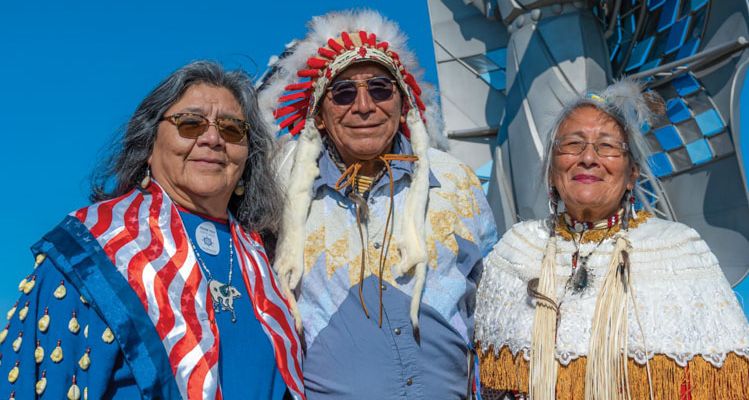
| Native American leaders from across the state, including (from left) Cecilia Fire Thunder, Arvol Looking Horse and Belinda Joe, attended a Women Take Back Honor event at the Dignity of Earth and Sky statue near Chamberlain. |
FORT THOMPSON IS A complicated place with a tragic history, but the tribal community’s residents are finding hope in grandmothers like Belinda Rencountre Joe, a scholar and dancer with a vision for action.
Joe is among the organizers of Women Take Back Honor, a four-year initiative to restore the leadership role of the woman in Native American culture. The effort began a year ago with a day-long event at the Dignity of Earth and Sky statue near Chamberlain.
Grandmothers empowering girls is an intriguing concept, so we telephoned Joe to ask if we could come to Fort Thompson to learn more about her efforts.
“Can you hear me?” she answered.”I am standing outside on my porch looking at the full moon.”
Yes, we heard her loud and clear.
When told that the success of the Women Take Back Honor event prompted our call, she laughed and said it was a coincidence that she was looking at the moon.
“The full moon symbolizes the woman,” she explained.”It symbolizes the woman’s gift to meditate and pray and then get things done. The full moon is when we are at our strongest.”
She said her own activism took hold in 1999 when she and her aunt, the late Stella Pretty Sounding Flute, represented Crow Creek at World Peace Day in San Juan, Costa Rica.”A message was given to me there, a seed was planted, that the grandmothers — Native and non-Native — have a role that must be renewed. It felt like a message from our Creator, Him or Her? I don’t know.”
She says the participants prayed on a mountain for four days, and on the last day several Indigenous grandmothers called her over to them, gave her gifts, and then asked her to”keep the light going within our women in North America, and they would do the same in South America.”
She admitted that she felt unsure that a Dakota girl from Buffalo County could bring that Indigenous message to fruition.
*****
A FEW DAYS LATER, we drove to Fort Thompson on a hot summer day to meet Belinda Joe and learn more about her mission to empower women.
We exited Interstate 90, South Dakota’s principal east-west highway, at Chamberlain. The road from there to Fort Thompson parallels the Missouri River and winds past prairie foothills covered with wild grasses and occasional herds of cows and horses.
 |
| Belinda Joe walks along the Missouri River at a park known as The Old Fort with Hillary Hyde, a local youth. |
Fort Thompson, with a population of more than 1,200, is the largest community in Buffalo County and the Crow Creek Reservation. The name Thompson is a constant reminder of its tragic history. Clark W. Thompson of Minnesota was serving as Superintendent of Indian Affairs in Abraham Lincoln’s administration when bloody battles and skirmishes broke out that are now referred to as the U.S./Dakota War of 1862. The hostilities between the Dakota and pioneer families were sparked by broken treaties, poor administration of government programs and the brutal winter of 1861 that led to starvation and frustration.
More than 400 settlers and soldiers were killed in the war. Historians didn’t document how many Dakota died, but 303 Dakota warriors were sentenced to death by a military court. Episcopalian Bishop Henry Whipple asked Lincoln to intercede, arguing that they were prisoners of war. Even though the president was overwhelmed with the Civil War, he took time to review each case and cut the number to 38, who were hanged in Mankato, Minnesota, on Dec. 26, 1862. It still stands as the largest mass execution in American history, and probably always will.
In the spring, Congress abolished the Dakotas’ Minnesota reservation, nullified the treaties, crowded 1,300 men, women and children onto steamboats and exiled them to live on the eastern shore of the Missouri River in Dakota Territory. A federal order mandated that the Dakota race,”be annihilated or forever pushed from the boundaries of Minnesota.” A $200 bounty was placed on every Dakota Indian, causing many of them to be hunted for years. Others died of disease, malnutrition and despair.
The story of the war and the infamous date of the hanging is well-known to all residents of Crow Creek today, many of whom are descended from the executed or of the hundreds of Dakota who were incarcerated as prisoners of war.
The descendants created communities in the forested bottomlands of the Missouri River by building homes, churches, stores and schools. And despite federal efforts of forced assimilation, some of their culture was preserved in the shade of the cottonwood trees.
Then in 1963 the federal government finished Big Bend Dam and flooded 56,000 acres, including many small communities of the Dakota. Families moved to higher ground, and that is when many came to live at Fort Thompson.
Ironically, the 3-mile earthen dam was completed exactly 100 years after the beleaguered Dakota arrived on the river. Hardships at Crow Creek remain today, but Belinda Joe and others like her promise that there is reason for hope, and their hopefulness lies in the cultural strengths that their Dakota ancestors brought with them on steamboats from Minnesota and somehow kept alive in that cottonwood forest.
*****
BELINDA JOE MET US at the Lode Star Casino, a windowless coliseum of glitz in an otherwise humble town that has few private businesses other than three convenience stores. There are four churches and myriad tribal government buildings. The casino has the town’s only restaurant, so it often hums with a lively mix of ranchers, local families and visiting gamblers, including many who come to fish for walleye on the nearby river.
Joe is 69 years old with striking white hair. She is tall, gracious and articulate, though she was easier to interview that moonlit night on the telephone because at the casino she had a 5-year-old grandson, Oaklynd, in tow. Altogether, she has three children, 14 grandchildren and four great-grandchildren. While at the casino, she was also trying to arrange a trip to Chamberlain to gather some clothing and bedding for a family in need. In fact, everyone she met at the restaurant had a question or a request.
We ordered sandwiches, but she soon asked for a to-go box because she hardly took a bite between phone calls, table visits and telling her story to us. Life was simpler when she was Oaklynd’s age, she laughed.
“We lived off the land,” she recalled of her childhood in the 1960s.”We ate wild game, which our dad and male relatives brought home. We fished and picked wild fruits. We grew our own potatoes. In the summer we walked down to the river and swam all day and then walked home.”
She says the family home, on the east side of Fort Thompson, was a hub for young relatives.”They would help us bag potatoes, and we would play a neighborhood game of softball, tag and make-believe.”
Her father, Whitney Rencountre, was a paratrooper in the Korean War who later worked as a tribal policeman and road worker. He hunted and cured mink pelts to buy groceries.”We grew up poor, but we didn’t see it as poor because we had everything we needed and the mainstay of that was our family. We were very close.”
She remembers her father as a good man who was always present. He and other relatives sang around a drum during warm evenings, and it was there that Belinda learned the songs and dances of the Dakota. The drum group, the Hunkpati Singers, still performs today.
Her mother, Thelma Black Tongue Rencountre, was the backbone of the family.”She was a petite woman who could do whatever it took to survive. She grew up as a Lakota girl in Promise, South Dakota, and was sent to the Pierre Indian Learning Center and the Stephan Mission when it was a harsh boarding school.” She spoke Lakota, English and Dakota.
Her father ran away from boarding school as a sixth grader, and her mom’s education was hampered by cruelties and illnesses. However, Belinda found refuge in books and became a voracious reader of stories that took her around the world. When she was a sophomore at Gann Valley High School, an encouraging teacher told her she had the talent to go anywhere she wished, and she taught Belinda to speed read.
“But I was scared to leave the reservation,” she recalls. A few years later, a young man on leave from the Vietnam War went to her father and asked if he could marry her — without asking her.
Her father’s answer was,”No, she’s going to college.”
Belinda remembers feeling relieved that he said no, but also thinking that she didn’t want to go to college because she wanted to see the world and she believed the only options for women were to be a nurse or teacher. Instead, she went to Denver and studied to become a court reporter. After working for the Navajo Tribe and the Bureau of Indian Affairs, she eventually gravitated home to Crow Creek. There was no work for a court reporter so she went back to school and earned degrees in education, determined that she would not discourage her students from learning about their own heritage.
Combining her mother’s fortitude and her relatives’ cultural teachings, Joe soon became an instrument of change at Crow Creek. She incorporated Dakota and Lakota songs, stories, dances and identity into her elementary curriculum and encouraged the students to use their voices to empower other youth.
She brought her young dancers to the dedication of Dale Lamphere’s Dignity statue in 2016. Lamphere’s 50-foot stainless steel sculpture of a Native woman wrapped in a star quilt immediately became an inspiring symbol of feminine empowerment. Jane Murphy, the sculptor’s wife, says several dozen Native and non-Native people are working on a vision that fits the art and the times.
 |
| Dignity, by artist Dale Lamphere, honors the cultures of the Lakota and Dakota people. |
“Belinda did a blessing of the ground at Dignity before the ground was broken,” Murphy says,”and she is so connected to the Native culture and the people of her community, so she needs to be a part of this.”
Joe says she wasn’t really looking for another role, but the opportunity to build an initiative around Dignity seemed like a path to the calling she felt in Costa Rica.
Three years after the Dignity dedication, Joe accompanied Native Korean War veterans to Seoul, South Korea, where she represented her father and other veterans. At a banquet, she sang the Lakota Brother Song to honor the warriors.
While in Seoul, she learned of the”Comfort Women” who were taken from their homes in Korea during World War II and forced into sexual slavery by the Japanese military. Some of the victims are still alive, and they recently received apologies from Japanese grandmothers as well as the Japanese government after decades of official denials.
Joe says their story reinforced her commitment to honor the women of all nations.”Perhaps someday we Native and non-Native women will receive apologies for the harm we have endured and recovered from,” she says.”A legacy of love and honor is what I pray for in my lifetime, for we are the life-givers of our families, communities and nations.
“Our language and our culture are our lifelines to the past, to today and to the future,” she says.”Too many of our youth are struggling with addictions, drugs and alcohol. I believe we are targeted because we are vulnerable. We are targets because of our poverty, targeted by the dealers and even by some of our own people. It’s an easy way to make money. They groom you and pull you in because there aren’t many jobs here for young people.”
Along with her teaching career and community activism, Joe also serves as the prison liaison for the Crow Creek Sioux Tribe, visiting young men and women in the state prisons at Pierre and Sioux Falls during their spiritual conferences. Some of the young inmates are former students. Some are relatives.
“Most of our young males and females are in there for crimes involving meth — ingesting, using, selling, transporting,” she says.”A young grandson went in two weeks ago. In our Indian ways, they are all our grandsons and granddaughters, and we have an obligation to guide them and correct them and help them.”
Prior to one of her first prison visits, inmates warned her that her life was in danger. A threat was made by an inmate who was enraged that she’d reported a case of child abuse. Because Joe is a teacher, she is a mandatory reporter.
“At this point in my life, I wasn’t going to stop the visits,” she says.”My legs were shaking but I went anyway.”
When she arrived, the grateful inmates welcomed her warmly and promised they would see to her safety.”Come in and light up the darkness,” said one man. They presented her with a star quilt and beaded medicine wheel crafted by an inmate who worked all night to have it ready.
*****
THE TRIBAL HEADQUARTERS at Fort Thompson, a modest, metal gymnasium-style building, is a beehive of activity. People are constantly coming and going, asking about utility problems, stray dogs, vandalism and all the things that are talked about at city halls across the United States. Meanwhile, a half-dozen youth are shooting baskets while others visit on the bleachers.
At the center of it all is Peter Lengkeek, the 48-year-old tribal chairman who stands as straight and tall as he did when he served in the Marine Corps despite some service-related back injuries that cause him to work today from a stand-up desk.
He lowered the desk to normal height and sat down to visit with us about Joe’s work to empower the women.
“I think it’s beautiful,” he said.”It has to happen. The woman thinks from the heart,” he said, holding his hand to his heart,”while us men, we are from here” (pointing to his head).”Our culture was traditionally more matriarchal, but we were forced into a patriarchal society. It is unnatural for us, and it is not working for us.”
Though Lengkeek says the Marines were his only”college,” he speaks like a studied philosopher and historian when he reflects on his Dakota culture. He maintains that the rightful place of the women of the Dakota and other Native American tribes was diminished in the 19th century because”the government would only recognize men as leaders.” Wars, diseases, poverty and forced assimilation further reduced the traditional role of the woman in Dakota society.
Lengkeek says restoration of women’s rightful role will strengthen the entire culture, both at Crow Creek and other tribes.”We need healthy relationships, healthy communications and healthy boundary settings. Our young people must learn how to regulate your emotions, how to control your anger. That is something our language and culture teaches us. It teaches us how we address the physical, the spiritual, the mental and the emotional on a daily basis. Today, too often, we seem to care only about the physical. Our patriarchal society teaches us to put the emotions down and to not show weakness, compassion, tenderness, and love.”
Lengkeek says young people must have a good concept of healthy masculinity and healthy femininity.”The work of Belinda and others like her give me hope. Our aunties have a special obligation to teach. I’ve seen our women teaching our culture and traditions, teaching us how to pray. They are giving us hope.”
The tribal chair says he experienced the lack of culture in his own childhood at Crow Creek.”Many of my generation were not raised with the language and the culture, but when we hear it, we connect with it, and we want to learn more. My mother was raised in a boarding school. She could talk Dakota, but she never spoke it around us.
“On her deathbed, she was talking in her native language, and I was listening to her without her knowing I was there. Then she realized I was holding her hand and she stopped.
“Mom,” I said,”why did you not teach us this beautiful language?”
Lengkeek says his mother began to cry, and then she said,”I didn’t want you to go through what I had to go through.” She’d been so traumatized at boarding school by assimilation-minded teachers that she couldn’t bring herself to speak Dakota to her children.
Yet, Lengkeek says the language still has a powerful impact on Dakota youth.”A lot of study has been done on cellular memory, and it is recognized today as something real. Our people suffered historic trauma, but they also have a cultural or cellular memory that goes back to the early days of time. They did their best to take our culture and our language from us, but it is still here. They did their best to dehumanize us, but we are still here. All it did was make us stronger, make us more resilient. Yes, we are one of the poorest counties in the United States — but we are also one of the richest because we still have our culture.”
As the tribal chairman talked to us, Belinda was mingling with youth in the gymnasium. She wanted us to meet them, beginning with Keith Heth III, a 16-year-old who loves to skateboard, play the guitar and learn his native Lakota language.”My people went through 100 years of depression,” he says.”I love staying true to the culture and tradition.”
Jayton Pease, 19, is studying business management at Presentation College in Aberdeen. He hopes to return to the reservation to start some businesses, perhaps a barber shop and an arcade.”The younger guys look up to us older guys. It’s pretty cool but it brings a responsibility to set a good example,” he says.”I have a cousin who ended up in a dark place, but his young daughter helped him come back in the light.”
Hillary Hyde, 20, was shooting baskets. She says she worries about many of her friends.”Whenever I see police cars on the road, lights flashing, I pray for them. I wish I could change the world. They just need help, somebody to talk to. A family member or a friend. I saved a little cousin from drowning in a pool in Rapid City. Now I want to save him from drugs the same way, protect them all.”
Perhaps Joe took us to the gymnasium to show us there are others like her working for change. Or maybe she just wanted to occupy us while she returned phone calls to arrange for the clothing assistance.
As we talked with Hillary, Joe dialed a number and said,”I was supposed to be there at 3 to pick up the clothes. Will you still be there if I get there at 3:30?”
She handed her uneaten sandwich to one of the youth who hadn’t had lunch, then she rushed for her car, which she calls her”white pony.”
“Call me later,” she said.”I’ve got to go.”
Editor’s Note: This story is revised from the September/October 2022 issue of South Dakota Magazine. To order a copy or to subscribe, call (800) 456-5117.


