Posted on Leave a comment

Scoping the Missouri

Members of the South Dakota Ornithologists Union look for birds at Union Grove State Park between Beresford and Elk Point.

Roger Dietrich was scoping along the shore of Lake Yankton when a Rapid City woman approached him with a question about the tiny Ross’s gull, which had been sighted in the area.

“I’ve gone to Alaska twice and I didn’t see the bird there,” she said.”Is it still around?”

Dietrich pointed to a gull, sitting on ice in the middle of the lake.

The Missouri River is a bird-watching paradise. Hundreds of species of ducks, geese, gulls, loons and other birds congregate in parks, woodlands and farm fields that border its 443-mile corridor. But it still helps to know for what you’re looking.

Every habitat attracts different birds, says David Swanson, professor of biology at the University of South Dakota and author of Birder’s Guide to South Dakota, and habitats vary dramatically along the Missouri as it winds from Nebraska to North Dakota.

Following is a guide, from south to north, of habitat patches and the surprises that await birdwatchers, both the serious birders looking for the rarest”lifer” bird and those who are happy spotting sparrows and swallows.


The Adams Nature Preserve attracts wading birds such as blue herons.

Adams Nature Preserve

Southeastern South Dakota

The Adams Homestead and Nature Preserve near North Sioux City includes many trails.”It has a variety of habitats,” Swanson says.”It has an extensive cottonwood forest that borders the river, and there’s also a little lake called Mud Lake that’s attractive to waterfowl. The ring of trees surrounding Mud Lake can be good for woodland birds, too.”

Mud Lake is approximately a quarter mile from the Adams Homestead parking lot, so a brief hike is required to access it. Wooden observation blinds lie along the trail with a view of the lake.

“The other habitat at the park is a restored open prairie,” he says.”It’s one of the few sites in the southeastern part of the state where you can find Eastern meadowlarks. The common meadowlark in South Dakota is the Western meadowlark, but the Eastern meadowlark is expanding its range in the southeastern part of the state and Adams Homestead is one of the places where you can find those.”

Since first being sighted in 2017 by Swanson and his ornithology students, the Eastern meadowlark has made regular appearances in the open-prairie habitat, often with multiple birds singing among the scattered trees.

“I wasn’t aware at the time that Eastern meadowlarks had started to expand their range, and I heard these Eastern meadowlarks calling,” Swanson says.”I go, ‘That is very unusual.’ We kept walking and saw them and everybody in the ornithology class got to see me geek out over it.”

Though birdwatching at the Adams Homestead is enjoyable year-round, it’s best in spring, summer and fall.”Mostly, it’s hiking the trails during migration and seeing a variety of birds at that time,” Swanson says.”It’s lots of warblers and sparrows, so the migration periods are late April to mid-May. Then in the fall, from mid-to-late August into about mid-September is probably the peak for warblers and vireos, some of which migrate all the way down to Central and South America.”

Sparrows that migrate to the southern U.S. and Mexico slightly later in the year can typically be seen at the Adams Homestead from mid-September to mid-October. Along the river and at the lake, birdwatchers encounter ducks and geese, as well as wading birds like herons and egrets.

“In the cottonwood forest, there are Eastern whippoorwills,” Swanson says.”Those are birds that don’t really get too much out of the southeastern part of the state. Of course, they’re nocturnal, so they don’t start calling until it starts to get dark.”


Least terns can be found on sandbars below Gavins Point Dam.

Gavins Point Dam

West of Yankton

Gavins Point Dam, the southernmost project on the Missouri’s system of six dams, is surrounded by unique bird habitats.

During the summer, hundreds of American white pelicans can sometimes be seen near the dam, while on the river itself, there are piping plovers, still considered a threatened species in most of the U.S., and the least tern, North America’s tiniest tern, often seen flying low over the river and hovering before plunging for prey.

“One of the reasons I like birding is the idea that it would be so cool to fly, and least terns are just the best flyers,” says Roger Dietrich, a local authority on ornithology.”They’ll fly and they’ll see a minnow, and then they dive straight down in the water — and splash!”

In winter, the 2-mile-long earthen dam creates an unusual condition for birds and birders.”Some years, when it doesn’t freeze, like lately, there’s been lots of open water above the dam,” Dietrich says.”Some years, we get lucky and even the Lewis and Clark Marina doesn’t freeze over real early. So, that’s a popular spot where some grebes and loons will stop.”

Black scoters, surf scoters, white-winged scoters and long-tail ducks, which are mainly ocean birds, are known to visit the lake and river in winter.

“I tell people from other places that we have those birds here and they’re just not believing it, because they don’t think of the center of the United States as a place where these birds would show up,” Dietrich says.”And when I say they show up every year, usually, for a fairly long period of time, they just can’t believe that we’re so lucky.”

The common loon migrates through the area, as well as a number of gulls — including Sabine’s gulls, kittiwakes, black-legged kittiwakes and even the Ross’s gull, which is associated with the remote arctic. Crest Road, which passes over the dam, is a good place to observe such birds. It requires no special pass or permit.

“Scan for the birds with binoculars or a spotting scope and chances are, you’ll find something different,” Dietrich says.”Sometimes there are huge flocks, and you can spend hours just scoping the birds there,” he says.”So, if you see somebody there with their scope out or binoculars, stop and ask them what they’re seeing. I’d say 99 percent of the people will be glad to point things out to you, and maybe even let you look through their scope to see what they’re seeing.”

Several snowy owls hung out along the dam road a few years ago.”They were feeding on the flocks of coots that were there.” Wintertime also brings large flocks of lesser scaup, which birdwatchers will scan for specimens of greater scaup, a polar bird that tends to prefer saltwater and is rarely seen inland, Dietrich says.

“It’s the same with the big flocks of common goldeneye,” he says.”People try to scope out the Barrow’s goldeneye, which is another species. It’s more of a West Coast bird, but once in a while, we’ll get one here — always a highlight.”

Bald eagles frequent Gavins Point Dam and some now nest year-round in the tall cottonwoods that border the Missouri.”They’re used to a lot of people around and some of the trees they perch in are right along the local roads,” Dietrich says.”You can see them in action, swooping down and picking up fish. I’ve seen eight or nine at a time on the ice up above the dam, eating the dead snow geese they’ve picked off.”


A pair of Barrow’s Goldeneyes at Fort Randall.

Fort Randall

Pickstown

Fort Randall Dam also hosts a large congregation of bald eagles. Below the dam is the Karl E. Mundt National Wildlife Refuge, which provides habitat for the eagles.

Kelly Preheim, a kindergarten teacher in Armour and a well-known local birding enthusiast, especially likes the wooded area around the Fort Randall Dam.”We’re mostly on agricultural grassland in southeastern South Dakota,” she says.”But the dams have a lot of woodland, forested areas, and I enjoy walking on the trails.”

She found 71 bird species on a recent camping trip to Pickstown.”In the morning, oh my goodness, the singing,” she recalls.”My husband’s like, ‘I can’t get any sleep. It’s so loud here!'”

A hike to the tailrace, the channel below the dam that carries water away, will often be rewarded.”Fish that go through the dam come out somewhat stunned in the tailrace,” Preheim says.”Then, all these birds, like gulls and eagles and certain ducks, eat those fish.”

Like nearby Gavins Point, Fort Randall Dam is also home to many types of waterfowl in autumn and winter.”There are a lot of different ducks on the scene, hundreds and hundreds, if not thousands, of different ducks there at a time,” Preheim says.”I saw a brown pelican one time. That’s actually an ocean bird.”

Other surprise visitors at Fort Randall include a yellow-billed loon, typically associated with Alaska and America’s western coast, and a great black-backed gull, which is an Atlantic coastal bird, Preheim says.

Scarlet tanagers are often found in South Dakota but summer tanagers, a rare visitor, might also be seen around Fort Randall.


Pelicans near Big Bend.

Big Bend Dam

Fort Thompson

The best birdwatching at South Dakota’s northernmost dams — Big Bend and Oahe — occurs from April through May and from September to November, according to lifelong birdwatcher Ricky Olson, who lives at Fort Pierre.

Big Bend has fewer access roads and trail amenities than Oahe and the other dams, but it has its own charms. Ospreys nest below the dam and brown pelicans have been spotted.

“Once in a while, in the wintertime, you get a Brant goose at Big Bend,” a seacoast bird.”I run down to Big Bend at least every two weeks in the winter to see what’s there,” Olson says.

Big Bend also attracts smaller goose species, including snow geese and white-fronted geese, both of which are common to the area.”In the fall, it’s neater to go to Big Bend,” Olson says.”Also, the shad and minnow species will be in the shallows then, and you’ll get all kinds of cormorants and pelicans and hundreds of gulls in these frenzies where they’re all feeding, and the gulls are trying to steal from everybody.”


Canada geese along the Missouri River.

Oahe Dam

Central South Dakota

Ring-billed gulls, herring gulls and California gulls may be sighted at Oahe, as well as the arctic tern, a mega-find for birders.

A spectacle occurs during flooding when Oahe Dam’s hydraulic turbines are running.”It’s a feeding frenzy. You get thousands of gulls, maybe 20,000, below the tailrace in a half-mile stretch,” Olson says.”It’s like a snowstorm. Thousands of people come to watch the ‘gull snowfall.'”

Oahe also has cliff-dwellers.”In the sand layers in the cliffs, in the holes, there are barn owls nesting,” Olson says.”They dig their own holes, and often, they’re near where colonies of bank swallows have dug holes.”

In autumn, Sabine’s gull may be spotted.”It’s very pretty. It’s black and white with half a diamond on the wing,” Olson says.”We also get Bonapartes and Little gulls, which is a little gull, and we get some of the big ones. Once in a great while we get the great black-back, which is the biggest gull.”

Gulls breed on a few islands along Oahe, Olson says.”There are only a few places in South Dakota where that happens.”

Another rare visitor to Oahe, among the sea ducks like the scoters and the long tail duck, is the occasional coastal harlequin duck in the tailrace.

“We get loons,” Olson says.”Sometimes we get the Pacific or the yellow-billed or red-throated loon, which are rare for our state.”

Further north on Oahe, retired biology teacher Stan Mack says opportunities are available even in Mobridge’s city limits.”There’s a walking trail along the south side of town. Just follow Main Street to the river and walk west and you’ll see the ducks and geese and gulls that sit on the water.”

Mack says Indian Creek (east of Mobridge) and Indian Memorial (across the river to the west) offer trails and habitat.

Mack doesn’t walk well enough to explore like he once did, but the birds will come to him.”I’m doing a feeder watch for Cornell University. Right now, I’m looking at a collared dove — we never saw them before — and I see about 16 more picking up seeds on the ground.”

Editor’s Note: This story is revised from the March/April 2025 issue of South Dakota Magazine. To order a copy or to subscribe, call (800) 456-5117.
Posted on Leave a comment

Grandmother Power

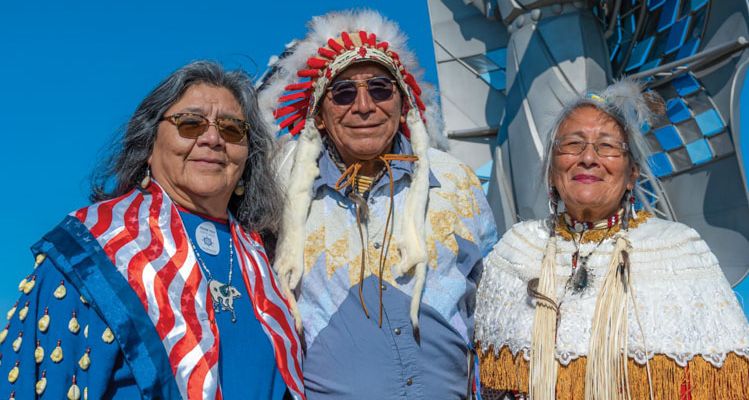
Native American leaders from across the state, including (from left) Cecilia Fire Thunder, Arvol Looking Horse and Belinda Joe, attended a Women Take Back Honor event at the Dignity of Earth and Sky statue near Chamberlain.

FORT THOMPSON IS A complicated place with a tragic history, but the tribal community’s residents are finding hope in grandmothers like Belinda Rencountre Joe, a scholar and dancer with a vision for action.

Joe is among the organizers of Women Take Back Honor, a four-year initiative to restore the leadership role of the woman in Native American culture. The effort began a year ago with a day-long event at the Dignity of Earth and Sky statue near Chamberlain.

Grandmothers empowering girls is an intriguing concept, so we telephoned Joe to ask if we could come to Fort Thompson to learn more about her efforts.

“Can you hear me?” she answered.”I am standing outside on my porch looking at the full moon.”

Yes, we heard her loud and clear.

When told that the success of the Women Take Back Honor event prompted our call, she laughed and said it was a coincidence that she was looking at the moon.

“The full moon symbolizes the woman,” she explained.”It symbolizes the woman’s gift to meditate and pray and then get things done. The full moon is when we are at our strongest.”

She said her own activism took hold in 1999 when she and her aunt, the late Stella Pretty Sounding Flute, represented Crow Creek at World Peace Day in San Juan, Costa Rica.”A message was given to me there, a seed was planted, that the grandmothers — Native and non-Native — have a role that must be renewed. It felt like a message from our Creator, Him or Her? I don’t know.”

She says the participants prayed on a mountain for four days, and on the last day several Indigenous grandmothers called her over to them, gave her gifts, and then asked her to”keep the light going within our women in North America, and they would do the same in South America.”

She admitted that she felt unsure that a Dakota girl from Buffalo County could bring that Indigenous message to fruition.

*****

A FEW DAYS LATER, we drove to Fort Thompson on a hot summer day to meet Belinda Joe and learn more about her mission to empower women.

We exited Interstate 90, South Dakota’s principal east-west highway, at Chamberlain. The road from there to Fort Thompson parallels the Missouri River and winds past prairie foothills covered with wild grasses and occasional herds of cows and horses.

Belinda Joe walks along the Missouri River at a park known as The Old Fort with Hillary Hyde, a local youth.

Fort Thompson, with a population of more than 1,200, is the largest community in Buffalo County and the Crow Creek Reservation. The name Thompson is a constant reminder of its tragic history. Clark W. Thompson of Minnesota was serving as Superintendent of Indian Affairs in Abraham Lincoln’s administration when bloody battles and skirmishes broke out that are now referred to as the U.S./Dakota War of 1862. The hostilities between the Dakota and pioneer families were sparked by broken treaties, poor administration of government programs and the brutal winter of 1861 that led to starvation and frustration.

More than 400 settlers and soldiers were killed in the war. Historians didn’t document how many Dakota died, but 303 Dakota warriors were sentenced to death by a military court. Episcopalian Bishop Henry Whipple asked Lincoln to intercede, arguing that they were prisoners of war. Even though the president was overwhelmed with the Civil War, he took time to review each case and cut the number to 38, who were hanged in Mankato, Minnesota, on Dec. 26, 1862. It still stands as the largest mass execution in American history, and probably always will.

In the spring, Congress abolished the Dakotas’ Minnesota reservation, nullified the treaties, crowded 1,300 men, women and children onto steamboats and exiled them to live on the eastern shore of the Missouri River in Dakota Territory. A federal order mandated that the Dakota race,”be annihilated or forever pushed from the boundaries of Minnesota.” A $200 bounty was placed on every Dakota Indian, causing many of them to be hunted for years. Others died of disease, malnutrition and despair.

The story of the war and the infamous date of the hanging is well-known to all residents of Crow Creek today, many of whom are descended from the executed or of the hundreds of Dakota who were incarcerated as prisoners of war.

The descendants created communities in the forested bottomlands of the Missouri River by building homes, churches, stores and schools. And despite federal efforts of forced assimilation, some of their culture was preserved in the shade of the cottonwood trees.

Then in 1963 the federal government finished Big Bend Dam and flooded 56,000 acres, including many small communities of the Dakota. Families moved to higher ground, and that is when many came to live at Fort Thompson.

Ironically, the 3-mile earthen dam was completed exactly 100 years after the beleaguered Dakota arrived on the river. Hardships at Crow Creek remain today, but Belinda Joe and others like her promise that there is reason for hope, and their hopefulness lies in the cultural strengths that their Dakota ancestors brought with them on steamboats from Minnesota and somehow kept alive in that cottonwood forest.

*****

BELINDA JOE MET US at the Lode Star Casino, a windowless coliseum of glitz in an otherwise humble town that has few private businesses other than three convenience stores. There are four churches and myriad tribal government buildings. The casino has the town’s only restaurant, so it often hums with a lively mix of ranchers, local families and visiting gamblers, including many who come to fish for walleye on the nearby river.

Joe is 69 years old with striking white hair. She is tall, gracious and articulate, though she was easier to interview that moonlit night on the telephone because at the casino she had a 5-year-old grandson, Oaklynd, in tow. Altogether, she has three children, 14 grandchildren and four great-grandchildren. While at the casino, she was also trying to arrange a trip to Chamberlain to gather some clothing and bedding for a family in need. In fact, everyone she met at the restaurant had a question or a request.

We ordered sandwiches, but she soon asked for a to-go box because she hardly took a bite between phone calls, table visits and telling her story to us. Life was simpler when she was Oaklynd’s age, she laughed.

“We lived off the land,” she recalled of her childhood in the 1960s.”We ate wild game, which our dad and male relatives brought home. We fished and picked wild fruits. We grew our own potatoes. In the summer we walked down to the river and swam all day and then walked home.”

She says the family home, on the east side of Fort Thompson, was a hub for young relatives.”They would help us bag potatoes, and we would play a neighborhood game of softball, tag and make-believe.”

Her father, Whitney Rencountre, was a paratrooper in the Korean War who later worked as a tribal policeman and road worker. He hunted and cured mink pelts to buy groceries.”We grew up poor, but we didn’t see it as poor because we had everything we needed and the mainstay of that was our family. We were very close.”

She remembers her father as a good man who was always present. He and other relatives sang around a drum during warm evenings, and it was there that Belinda learned the songs and dances of the Dakota. The drum group, the Hunkpati Singers, still performs today.

Her mother, Thelma Black Tongue Rencountre, was the backbone of the family.”She was a petite woman who could do whatever it took to survive. She grew up as a Lakota girl in Promise, South Dakota, and was sent to the Pierre Indian Learning Center and the Stephan Mission when it was a harsh boarding school.” She spoke Lakota, English and Dakota.

Her father ran away from boarding school as a sixth grader, and her mom’s education was hampered by cruelties and illnesses. However, Belinda found refuge in books and became a voracious reader of stories that took her around the world. When she was a sophomore at Gann Valley High School, an encouraging teacher told her she had the talent to go anywhere she wished, and she taught Belinda to speed read.

“But I was scared to leave the reservation,” she recalls. A few years later, a young man on leave from the Vietnam War went to her father and asked if he could marry her — without asking her.

Her father’s answer was,”No, she’s going to college.”

Belinda remembers feeling relieved that he said no, but also thinking that she didn’t want to go to college because she wanted to see the world and she believed the only options for women were to be a nurse or teacher. Instead, she went to Denver and studied to become a court reporter. After working for the Navajo Tribe and the Bureau of Indian Affairs, she eventually gravitated home to Crow Creek. There was no work for a court reporter so she went back to school and earned degrees in education, determined that she would not discourage her students from learning about their own heritage.

Combining her mother’s fortitude and her relatives’ cultural teachings, Joe soon became an instrument of change at Crow Creek. She incorporated Dakota and Lakota songs, stories, dances and identity into her elementary curriculum and encouraged the students to use their voices to empower other youth.

She brought her young dancers to the dedication of Dale Lamphere’s Dignity statue in 2016. Lamphere’s 50-foot stainless steel sculpture of a Native woman wrapped in a star quilt immediately became an inspiring symbol of feminine empowerment. Jane Murphy, the sculptor’s wife, says several dozen Native and non-Native people are working on a vision that fits the art and the times.

Dignity, by artist Dale Lamphere, honors the cultures of the Lakota and Dakota people.

“Belinda did a blessing of the ground at Dignity before the ground was broken,” Murphy says,”and she is so connected to the Native culture and the people of her community, so she needs to be a part of this.”

Joe says she wasn’t really looking for another role, but the opportunity to build an initiative around Dignity seemed like a path to the calling she felt in Costa Rica.

Three years after the Dignity dedication, Joe accompanied Native Korean War veterans to Seoul, South Korea, where she represented her father and other veterans. At a banquet, she sang the Lakota Brother Song to honor the warriors.

While in Seoul, she learned of the”Comfort Women” who were taken from their homes in Korea during World War II and forced into sexual slavery by the Japanese military. Some of the victims are still alive, and they recently received apologies from Japanese grandmothers as well as the Japanese government after decades of official denials.

Joe says their story reinforced her commitment to honor the women of all nations.”Perhaps someday we Native and non-Native women will receive apologies for the harm we have endured and recovered from,” she says.”A legacy of love and honor is what I pray for in my lifetime, for we are the life-givers of our families, communities and nations.

“Our language and our culture are our lifelines to the past, to today and to the future,” she says.”Too many of our youth are struggling with addictions, drugs and alcohol. I believe we are targeted because we are vulnerable. We are targets because of our poverty, targeted by the dealers and even by some of our own people. It’s an easy way to make money. They groom you and pull you in because there aren’t many jobs here for young people.”

Along with her teaching career and community activism, Joe also serves as the prison liaison for the Crow Creek Sioux Tribe, visiting young men and women in the state prisons at Pierre and Sioux Falls during their spiritual conferences. Some of the young inmates are former students. Some are relatives.

“Most of our young males and females are in there for crimes involving meth — ingesting, using, selling, transporting,” she says.”A young grandson went in two weeks ago. In our Indian ways, they are all our grandsons and granddaughters, and we have an obligation to guide them and correct them and help them.”

Prior to one of her first prison visits, inmates warned her that her life was in danger. A threat was made by an inmate who was enraged that she’d reported a case of child abuse. Because Joe is a teacher, she is a mandatory reporter.

“At this point in my life, I wasn’t going to stop the visits,” she says.”My legs were shaking but I went anyway.”

When she arrived, the grateful inmates welcomed her warmly and promised they would see to her safety.”Come in and light up the darkness,” said one man. They presented her with a star quilt and beaded medicine wheel crafted by an inmate who worked all night to have it ready.

*****

THE TRIBAL HEADQUARTERS at Fort Thompson, a modest, metal gymnasium-style building, is a beehive of activity. People are constantly coming and going, asking about utility problems, stray dogs, vandalism and all the things that are talked about at city halls across the United States. Meanwhile, a half-dozen youth are shooting baskets while others visit on the bleachers.

At the center of it all is Peter Lengkeek, the 48-year-old tribal chairman who stands as straight and tall as he did when he served in the Marine Corps despite some service-related back injuries that cause him to work today from a stand-up desk.

He lowered the desk to normal height and sat down to visit with us about Joe’s work to empower the women.

“I think it’s beautiful,” he said.”It has to happen. The woman thinks from the heart,” he said, holding his hand to his heart,”while us men, we are from here” (pointing to his head).”Our culture was traditionally more matriarchal, but we were forced into a patriarchal society. It is unnatural for us, and it is not working for us.”

Though Lengkeek says the Marines were his only”college,” he speaks like a studied philosopher and historian when he reflects on his Dakota culture. He maintains that the rightful place of the women of the Dakota and other Native American tribes was diminished in the 19th century because”the government would only recognize men as leaders.” Wars, diseases, poverty and forced assimilation further reduced the traditional role of the woman in Dakota society.

Lengkeek says restoration of women’s rightful role will strengthen the entire culture, both at Crow Creek and other tribes.”We need healthy relationships, healthy communications and healthy boundary settings. Our young people must learn how to regulate your emotions, how to control your anger. That is something our language and culture teaches us. It teaches us how we address the physical, the spiritual, the mental and the emotional on a daily basis. Today, too often, we seem to care only about the physical. Our patriarchal society teaches us to put the emotions down and to not show weakness, compassion, tenderness, and love.”

Lengkeek says young people must have a good concept of healthy masculinity and healthy femininity.”The work of Belinda and others like her give me hope. Our aunties have a special obligation to teach. I’ve seen our women teaching our culture and traditions, teaching us how to pray. They are giving us hope.”

The tribal chair says he experienced the lack of culture in his own childhood at Crow Creek.”Many of my generation were not raised with the language and the culture, but when we hear it, we connect with it, and we want to learn more. My mother was raised in a boarding school. She could talk Dakota, but she never spoke it around us.

“On her deathbed, she was talking in her native language, and I was listening to her without her knowing I was there. Then she realized I was holding her hand and she stopped.

“Mom,” I said,”why did you not teach us this beautiful language?”

Lengkeek says his mother began to cry, and then she said,”I didn’t want you to go through what I had to go through.” She’d been so traumatized at boarding school by assimilation-minded teachers that she couldn’t bring herself to speak Dakota to her children.

Yet, Lengkeek says the language still has a powerful impact on Dakota youth.”A lot of study has been done on cellular memory, and it is recognized today as something real. Our people suffered historic trauma, but they also have a cultural or cellular memory that goes back to the early days of time. They did their best to take our culture and our language from us, but it is still here. They did their best to dehumanize us, but we are still here. All it did was make us stronger, make us more resilient. Yes, we are one of the poorest counties in the United States — but we are also one of the richest because we still have our culture.”

As the tribal chairman talked to us, Belinda was mingling with youth in the gymnasium. She wanted us to meet them, beginning with Keith Heth III, a 16-year-old who loves to skateboard, play the guitar and learn his native Lakota language.”My people went through 100 years of depression,” he says.”I love staying true to the culture and tradition.”

Jayton Pease, 19, is studying business management at Presentation College in Aberdeen. He hopes to return to the reservation to start some businesses, perhaps a barber shop and an arcade.”The younger guys look up to us older guys. It’s pretty cool but it brings a responsibility to set a good example,” he says.”I have a cousin who ended up in a dark place, but his young daughter helped him come back in the light.”

Hillary Hyde, 20, was shooting baskets. She says she worries about many of her friends.”Whenever I see police cars on the road, lights flashing, I pray for them. I wish I could change the world. They just need help, somebody to talk to. A family member or a friend. I saved a little cousin from drowning in a pool in Rapid City. Now I want to save him from drugs the same way, protect them all.”

Perhaps Joe took us to the gymnasium to show us there are others like her working for change. Or maybe she just wanted to occupy us while she returned phone calls to arrange for the clothing assistance.

As we talked with Hillary, Joe dialed a number and said,”I was supposed to be there at 3 to pick up the clothes. Will you still be there if I get there at 3:30?”

She handed her uneaten sandwich to one of the youth who hadn’t had lunch, then she rushed for her car, which she calls her”white pony.”

“Call me later,” she said.”I’ve got to go.”

Editor’s Note: This story is revised from the September/October 2022 issue of South Dakota Magazine. To order a copy or to subscribe, call (800) 456-5117.

Posted on Leave a comment

We Winter With Eagles


Eagles were a rare sight in South Dakota just decades ago. The pesticide DDT got in their food (fish) chain and decreased the birds’ fertility. Then, 522,000 acres of their favorite habitat along the Missouri River was flooded by the Corps of Engineers’ six big dams. Eagle sightings became rare.

I was working for the Madison Daily Leader in 1975 when a bald eagle showed up on a sunny morning and perched in a tall tree near Lake Madison, just east of town. Word spread, and by midday there was a steady parade of cars to the tree, where the big baldy patiently sat tall like a kindly king on a wooden throne.

That was just a few years after DDT was banned. As the eagles repopulated they discovered that the tailwaters of those big Missouri River dams were excellent places to winter because the constant discharges kept the water open even on the coldest days of January and February.

While eagles might be seen in any of our 66 counties, as winter deepens and most rivers and lakes freeze they now concentrate along those downstream waters. They roost in the tallest cottonwood trees, sunning themselves on brisk mornings and enjoying the surroundings.

As the sun warms the air, they will leave their perches to”float” on the thermals that develop. While it may appear that they are just at play in the sunshine, it’s likely they are also keeping watch for fish doing the very same thing in the river below.

Watch as they drop into a slow and deliberate glide to the river’s surface, talons outstretched like the wheels of an airplane. Usually they grab the fish in a graceful swoop, but no species is perfect; sometimes they take on too big of a fish and the ascent is less graceful. A few years ago, some Yanktonians were confused to find a large carp lying on a sidewalk a few blocks from the river. Apparently, one of the local eagles tackled a fish bigger than he could carry and dropped it on the sidewalk.

The noble birds are adapting to living near humans. Particularly in Yankton and Pierre, they roost in cottonwoods or other large trees in parks along the river, watching parka-clad pedestrians on the paths below. Still, it’s best to keep your distance. They may be napping or fishing, and it’s not nice to interrupt in either case.

Here are tips on eagle watching along South Dakota’s four dams, from south to north.

Gavins Point at Yankton — Eagles now nest here year-around, but 100 or so”snowbirds” arrive every December. As other waters freeze, they concentrate along the river from the dam and into the city of Yankton where they can be seen on treetops in Riverside Park. Grab lunch or a hot chocolate at several diners near Levee Street and then walk along the river or across the Meridian Bridge. If the birds aren’t in town, head west on Highway 52 and take any of the roads south to the river. Sisters Grove, a nature area just below Chalkstone Hill, is a good place to see deer. The forested areas just east of the dam are particularly good spots to look.

Fort Randall Dam by Pickstown — A top spot is the campground and recreation area on the west side of the dam. A 780-acre eagle refuge, created decades ago when the birds were on the endangered species list, is closed to the public. A few years ago, a strange carp kill caused a smorgasbord of carp for the eagles (see the unique photo by Michael Zimny). Generally, the”baldies” have to work harder for their lunch. Check out the remains of the old chalkstone chapel and the historic fort cemetery, all within a mile or so of the river.

Big Bend at Fort Thompson — Visit an area locals call”the Teardrop,” a recreation and campground complex on the west side of the dam. But like other tailwaters, the birds might be found anywhere. You might also find the Crow Creek tribe’s buffalo herd grazing a few miles north of Fort Thompson on Highway 47.

Oahe Dam above Pierre — Oahe Downstream, the campground area just below our biggest dam, is an excellent spot. However, the big birds also like to visit our state capitol in winter. Take a walk in Steamboat Park, which borders the Missouri, stroll forested LaFramboise Island or cross the river to old Fort Pierre and look for the birds in Fischer’s Lily Park, at the mouth of the Bad River. The park marks the spot where explorers Lewis & Clark had their first encounter with the Lakota people.

Posted on Leave a comment

County of Extremes

Buffalo County is the answer to a lot of South Dakota trivia questions: Where is the nation’s smallest county seat? Where did South Dakota’s tallest sheriff serve? Where was the highest temperature ever recorded in the state? But none of that is to say that Buffalo County is trivial. That’s because its the home of the Crow Creek Indian Reservation, and has been a settlement site for North American tribes for centuries. The dynamic between those ancient tribes and, more recently, between Natives and non-Natives in this county along the Missouri River, have led to tragedies and sadness that can’t be ignored, but hopefully South Dakotans a better understanding of life in this culturally diverse state.

First, the light-hearted facts about Buffalo County, which was established in 1873 and named for the enormous herds of American bison that roamed the prairies. With a population of just 14, Gann Valley is indeed the smallest county seat in the nation. Several years ago, when we wrote a story about places to visit in every county, we directed readers to the Gann Valley courthouse, where Elaine Wulff was serving as Buffalo County’s register of deeds and auditor. The names of wartime soldiers are painted in calligraphy on huge signs inside the courthouse. The dead are remembered in red. There are no restaurants in Gann Valley, but locals gather for mid-morning coffee at the community center.

Gann Valley was also home to August Klindt, who at 7-feet, 3-inches was the tallest man ever to serve as a county sheriff in South Dakota (we’re not sure if that is an actual statistical record, but we feel pretty good about making the claim). Klindt was sheriff for six years in the 1940s and made a lasting impression on those who caught a glimpse of him.

August Klindt, also known as the Gann Valley Giant, stood 7 feet, 3 inches tall. He is pictured with a man and woman each said to have been nearly 6 feet tall.

Retired Brookings newspaperman Chuck Cecil was a boy growing up in Wessington Springs in the 1940s. He recalled seeing the”Gann Valley Giant” on Saturday night in downtown Springs.”We were all packed into the parked Model A with Mom, waiting for Dad to complete his Saturday ritual in the saloon just down the street … and here comes the Gann Valley Giant, cutting a wide swath through the crowd. He was a good egg crate taller than anyone else on the street — like a stalk of rogue corn in a lush Dakota field. He wore the biggest bib overalls you ever saw. The legs had been elongated with extra material that didn’t match, and the suspenders had been over-suspended and were over-taxed.”

The museum in Wessington Springs has a collection of Klindt’s belongings, including his big felt hat and a ring. The curator claims a 50-cent piece fits inside.

Finally, the highest temperature ever recorded in South Dakota came from Gann Valley, where the mercury reached 120 degrees on July 5, 1936. The record came in the midst of a sweltering heat wave that pushed temperatures above 100 degrees across much of the country. In July of 2006, a cattle rancher near Usta, northwest of Faith, who also supplies readings to the National Weather Service, reported 120 degrees, tying the long-held Gann Valley record.

A passing photographer found a group of kids playing basketball at a home along Highway 50.

But Buffalo County has also been the source of serious study. In the late 1970s and early 1980s, archaeologists from the University of South Dakota examined a site along the banks of the Missouri River where centuries earlier hundreds of Native people were massacred. The Crow Creek Site is a National Historic Landmark and is still studied in an attempt to learn more about the lives and movements of early American tribes.

The investigative team discovered the remains of 486 people buried beneath a thin layer of river bottom clay. Evidence suggests the group was vastly outnumbered and that their attackers inflicted particular vengeance. Bodies were scalped, decapitated and dismembered. The massacre is believed to have occurred sometime around the year 1325, and while no definite cause has been determined, it was likely due to tribes competing for available land.

Today that land is home to the Crow Creek Indian Reservation, where the strained relations between Natives and non-Natives were discussed in one of the most talked-about stories to ever appear in South Dakota Magazine. Ray Deloria and Alfred St. John were star basketball players attending high school at Fort Thompson. When the school closed in 1954, they moved to Gann Valley, where they played for coach Quentin C. Miles. The introduction of two Native players caused a rift among the largely non-Native Gann Valley Buffaloes basketball team and their coach.

Gann Valley won its first game 68-53 over Pukwana, with Deloria doing most of the scoring. After the game, player Marvin Speck handed in his uniform.”If this is the way it’s going to be, I quit,” he said.

Crow Creek youth bundle up for the annual cold weather cookout, part of a celebration that concludes the Christmas season.

Because Deloria stayed with the Miles family during the week, others in the community accused the coach of untoward behavior. He received a note one day from the father of one of his players.”I know you get paid to have them living with you,” the note said.”I wouldn’t be surprised if you had a girlfriend out on the reservation somewhere.”

The Buffaloes had talent and advanced to the state tournament. Unfortunately they lost in the first round, and for Deloria the story went downhill from there. He quit school and later joined the Army. He showed up sporadically at the Miles house asking for money until one day, Miles refused.”You never were much of a coach anyway,” Deloria said before shuffling away.

It’s no secret that Indian reservations are among the most impoverished places in America. Buffalo County ranks as the fifth poorest in South Dakota. But the Crow Creek tribe chooses to focus on positivity, especially in early January when they Little Christmas, one of the most unique holiday celebrations in the state.

The Lode Star Casino in Fort Thompson buys toys and clothes for children. St. Joseph Catholic Church provides meat for a Christmas potluck at the church hall, and the local Senior Center hosts a Christmas week banquet.

Maybe the most unusual component is a cold weather cookout. Children stage an outdoor program, no matter the temperature, followed by a hot dog and marshmallow roast. It could even be the answer to another Buffalo County trivia question.

Editor’s Note: This is the 20th installment in an ongoing series featuring South Dakota’s 66 counties. Click here for previous articles.

Posted on Leave a comment

Eagle Season

A bald eagle built a nest near the old Meridian Bridge in Yankton two years ago, and then perched on a nearby cottonwood branch and posed for pedestrians, who were at eye level to the big bird when they were on the bridge’s upper deck.

The eagle eventually abandoned that nest. Maybe it was a tad too close to civilization for her comfort. But more eagles than ever are wintering on the open water of the Missouri River in Yankton, and they often glide slowly over the walking bridge that extends into the city’s old downtown.

Eagles were following the Dodo bird to extinction a scant 50 years ago. Illegal hunting, habitat destruction and a poison known as DDT were killing the species. In 1963, only 487 nesting pairs could be found in the United States.

But the Endangered Species Act banned DDT in 1972, and the eagles gradually adapted to a changing prairie landscape. Today, the state Game, Fish & Parks Department estimates that there may be as many as 300 nesting pairs just in South Dakota.

Most South Dakota eagles can be found wintering below the Missouri River dams, where massive old cottonwood trees provide a barky foundation for their large, heavy nests. Open water below the river’s dams provides easy fishing. Eagles also nest in the Black Hills near the Deerfield Reservoir, and it’s not surprising to find them in any part of the state.

Eagles build their nests by mid-February and begin laying eggs in late February. The birds mate for life, and use the same nests from year to year, adding twigs each year. Their nests are among the largest of any North American bird. One big nest measured 13 feet deep by 8 feet wide.

The majestic bald eagle was chosen as our national emblem in 1787, partly because it was native to North America. The fierce appearance of its curved beak, regal white head and piercing eyes were also factors. In the emblem, drawn in 1782, a bald eagle is displayed with an olive branch in one claw and 12 arrows clutched in the other, representing both peace and war.

Benjamin Franklin famously opposed putting the bald eagle on the nation’s emblem. He favored the wild turkey, which he claimed was, “A much more respectable bird and a true native of America.” He said the turkey was a bird of courage that “would not hesitate to attack a grenadier of the British guards who should presume to invade his farm yard with a red coat on.”

It seems Franklin was also put off with the bald eagle’s habit of eating carrion. They often steal food from smaller birds by intimidating them into dropping their prey. They also feed on dead fish and crippled birds. “He is a bird of bad moral character,” wrote Franklin. “He does not get his living honestly. You may have seen him perched in some dead tree where, too lazy to fish for himself, he watches the labor of the fishing hawk and, when that diligent bird has at length taken a fish and is bearing it to his nest for his young ones, the bald eagle pursues him and takes the fish.”

It seems unpatriotic to dredge up Franklin’s comments. After all, the eagle is just doing what comes naturally. Go eagle watching this spring and you will instantly be reminded of why our founding fathers chose this regal bird to represent our nation. Your best chance to see some soaring is to visit the Missouri below the dams at Yankton, Pickstown, Fort Thompson and Pierre. In Yankton, a few eagles can often be found in the big trees that lie south of Riverside ballpark.