Posted on Leave a comment

Grandmother Power

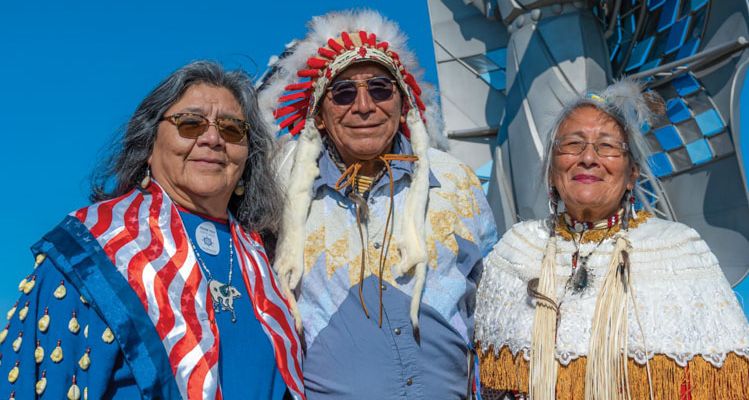
Native American leaders from across the state, including (from left) Cecilia Fire Thunder, Arvol Looking Horse and Belinda Joe, attended a Women Take Back Honor event at the Dignity of Earth and Sky statue near Chamberlain.

FORT THOMPSON IS A complicated place with a tragic history, but the tribal community’s residents are finding hope in grandmothers like Belinda Rencountre Joe, a scholar and dancer with a vision for action.

Joe is among the organizers of Women Take Back Honor, a four-year initiative to restore the leadership role of the woman in Native American culture. The effort began a year ago with a day-long event at the Dignity of Earth and Sky statue near Chamberlain.

Grandmothers empowering girls is an intriguing concept, so we telephoned Joe to ask if we could come to Fort Thompson to learn more about her efforts.

“Can you hear me?” she answered.”I am standing outside on my porch looking at the full moon.”

Yes, we heard her loud and clear.

When told that the success of the Women Take Back Honor event prompted our call, she laughed and said it was a coincidence that she was looking at the moon.

“The full moon symbolizes the woman,” she explained.”It symbolizes the woman’s gift to meditate and pray and then get things done. The full moon is when we are at our strongest.”

She said her own activism took hold in 1999 when she and her aunt, the late Stella Pretty Sounding Flute, represented Crow Creek at World Peace Day in San Juan, Costa Rica.”A message was given to me there, a seed was planted, that the grandmothers — Native and non-Native — have a role that must be renewed. It felt like a message from our Creator, Him or Her? I don’t know.”

She says the participants prayed on a mountain for four days, and on the last day several Indigenous grandmothers called her over to them, gave her gifts, and then asked her to”keep the light going within our women in North America, and they would do the same in South America.”

She admitted that she felt unsure that a Dakota girl from Buffalo County could bring that Indigenous message to fruition.

*****

A FEW DAYS LATER, we drove to Fort Thompson on a hot summer day to meet Belinda Joe and learn more about her mission to empower women.

We exited Interstate 90, South Dakota’s principal east-west highway, at Chamberlain. The road from there to Fort Thompson parallels the Missouri River and winds past prairie foothills covered with wild grasses and occasional herds of cows and horses.

Belinda Joe walks along the Missouri River at a park known as The Old Fort with Hillary Hyde, a local youth.

Fort Thompson, with a population of more than 1,200, is the largest community in Buffalo County and the Crow Creek Reservation. The name Thompson is a constant reminder of its tragic history. Clark W. Thompson of Minnesota was serving as Superintendent of Indian Affairs in Abraham Lincoln’s administration when bloody battles and skirmishes broke out that are now referred to as the U.S./Dakota War of 1862. The hostilities between the Dakota and pioneer families were sparked by broken treaties, poor administration of government programs and the brutal winter of 1861 that led to starvation and frustration.

More than 400 settlers and soldiers were killed in the war. Historians didn’t document how many Dakota died, but 303 Dakota warriors were sentenced to death by a military court. Episcopalian Bishop Henry Whipple asked Lincoln to intercede, arguing that they were prisoners of war. Even though the president was overwhelmed with the Civil War, he took time to review each case and cut the number to 38, who were hanged in Mankato, Minnesota, on Dec. 26, 1862. It still stands as the largest mass execution in American history, and probably always will.

In the spring, Congress abolished the Dakotas’ Minnesota reservation, nullified the treaties, crowded 1,300 men, women and children onto steamboats and exiled them to live on the eastern shore of the Missouri River in Dakota Territory. A federal order mandated that the Dakota race,”be annihilated or forever pushed from the boundaries of Minnesota.” A $200 bounty was placed on every Dakota Indian, causing many of them to be hunted for years. Others died of disease, malnutrition and despair.

The story of the war and the infamous date of the hanging is well-known to all residents of Crow Creek today, many of whom are descended from the executed or of the hundreds of Dakota who were incarcerated as prisoners of war.

The descendants created communities in the forested bottomlands of the Missouri River by building homes, churches, stores and schools. And despite federal efforts of forced assimilation, some of their culture was preserved in the shade of the cottonwood trees.

Then in 1963 the federal government finished Big Bend Dam and flooded 56,000 acres, including many small communities of the Dakota. Families moved to higher ground, and that is when many came to live at Fort Thompson.

Ironically, the 3-mile earthen dam was completed exactly 100 years after the beleaguered Dakota arrived on the river. Hardships at Crow Creek remain today, but Belinda Joe and others like her promise that there is reason for hope, and their hopefulness lies in the cultural strengths that their Dakota ancestors brought with them on steamboats from Minnesota and somehow kept alive in that cottonwood forest.

*****

BELINDA JOE MET US at the Lode Star Casino, a windowless coliseum of glitz in an otherwise humble town that has few private businesses other than three convenience stores. There are four churches and myriad tribal government buildings. The casino has the town’s only restaurant, so it often hums with a lively mix of ranchers, local families and visiting gamblers, including many who come to fish for walleye on the nearby river.

Joe is 69 years old with striking white hair. She is tall, gracious and articulate, though she was easier to interview that moonlit night on the telephone because at the casino she had a 5-year-old grandson, Oaklynd, in tow. Altogether, she has three children, 14 grandchildren and four great-grandchildren. While at the casino, she was also trying to arrange a trip to Chamberlain to gather some clothing and bedding for a family in need. In fact, everyone she met at the restaurant had a question or a request.

We ordered sandwiches, but she soon asked for a to-go box because she hardly took a bite between phone calls, table visits and telling her story to us. Life was simpler when she was Oaklynd’s age, she laughed.

“We lived off the land,” she recalled of her childhood in the 1960s.”We ate wild game, which our dad and male relatives brought home. We fished and picked wild fruits. We grew our own potatoes. In the summer we walked down to the river and swam all day and then walked home.”

She says the family home, on the east side of Fort Thompson, was a hub for young relatives.”They would help us bag potatoes, and we would play a neighborhood game of softball, tag and make-believe.”

Her father, Whitney Rencountre, was a paratrooper in the Korean War who later worked as a tribal policeman and road worker. He hunted and cured mink pelts to buy groceries.”We grew up poor, but we didn’t see it as poor because we had everything we needed and the mainstay of that was our family. We were very close.”

She remembers her father as a good man who was always present. He and other relatives sang around a drum during warm evenings, and it was there that Belinda learned the songs and dances of the Dakota. The drum group, the Hunkpati Singers, still performs today.

Her mother, Thelma Black Tongue Rencountre, was the backbone of the family.”She was a petite woman who could do whatever it took to survive. She grew up as a Lakota girl in Promise, South Dakota, and was sent to the Pierre Indian Learning Center and the Stephan Mission when it was a harsh boarding school.” She spoke Lakota, English and Dakota.

Her father ran away from boarding school as a sixth grader, and her mom’s education was hampered by cruelties and illnesses. However, Belinda found refuge in books and became a voracious reader of stories that took her around the world. When she was a sophomore at Gann Valley High School, an encouraging teacher told her she had the talent to go anywhere she wished, and she taught Belinda to speed read.

“But I was scared to leave the reservation,” she recalls. A few years later, a young man on leave from the Vietnam War went to her father and asked if he could marry her — without asking her.

Her father’s answer was,”No, she’s going to college.”

Belinda remembers feeling relieved that he said no, but also thinking that she didn’t want to go to college because she wanted to see the world and she believed the only options for women were to be a nurse or teacher. Instead, she went to Denver and studied to become a court reporter. After working for the Navajo Tribe and the Bureau of Indian Affairs, she eventually gravitated home to Crow Creek. There was no work for a court reporter so she went back to school and earned degrees in education, determined that she would not discourage her students from learning about their own heritage.

Combining her mother’s fortitude and her relatives’ cultural teachings, Joe soon became an instrument of change at Crow Creek. She incorporated Dakota and Lakota songs, stories, dances and identity into her elementary curriculum and encouraged the students to use their voices to empower other youth.

She brought her young dancers to the dedication of Dale Lamphere’s Dignity statue in 2016. Lamphere’s 50-foot stainless steel sculpture of a Native woman wrapped in a star quilt immediately became an inspiring symbol of feminine empowerment. Jane Murphy, the sculptor’s wife, says several dozen Native and non-Native people are working on a vision that fits the art and the times.

Dignity, by artist Dale Lamphere, honors the cultures of the Lakota and Dakota people.

“Belinda did a blessing of the ground at Dignity before the ground was broken,” Murphy says,”and she is so connected to the Native culture and the people of her community, so she needs to be a part of this.”

Joe says she wasn’t really looking for another role, but the opportunity to build an initiative around Dignity seemed like a path to the calling she felt in Costa Rica.

Three years after the Dignity dedication, Joe accompanied Native Korean War veterans to Seoul, South Korea, where she represented her father and other veterans. At a banquet, she sang the Lakota Brother Song to honor the warriors.

While in Seoul, she learned of the”Comfort Women” who were taken from their homes in Korea during World War II and forced into sexual slavery by the Japanese military. Some of the victims are still alive, and they recently received apologies from Japanese grandmothers as well as the Japanese government after decades of official denials.

Joe says their story reinforced her commitment to honor the women of all nations.”Perhaps someday we Native and non-Native women will receive apologies for the harm we have endured and recovered from,” she says.”A legacy of love and honor is what I pray for in my lifetime, for we are the life-givers of our families, communities and nations.

“Our language and our culture are our lifelines to the past, to today and to the future,” she says.”Too many of our youth are struggling with addictions, drugs and alcohol. I believe we are targeted because we are vulnerable. We are targets because of our poverty, targeted by the dealers and even by some of our own people. It’s an easy way to make money. They groom you and pull you in because there aren’t many jobs here for young people.”

Along with her teaching career and community activism, Joe also serves as the prison liaison for the Crow Creek Sioux Tribe, visiting young men and women in the state prisons at Pierre and Sioux Falls during their spiritual conferences. Some of the young inmates are former students. Some are relatives.

“Most of our young males and females are in there for crimes involving meth — ingesting, using, selling, transporting,” she says.”A young grandson went in two weeks ago. In our Indian ways, they are all our grandsons and granddaughters, and we have an obligation to guide them and correct them and help them.”

Prior to one of her first prison visits, inmates warned her that her life was in danger. A threat was made by an inmate who was enraged that she’d reported a case of child abuse. Because Joe is a teacher, she is a mandatory reporter.

“At this point in my life, I wasn’t going to stop the visits,” she says.”My legs were shaking but I went anyway.”

When she arrived, the grateful inmates welcomed her warmly and promised they would see to her safety.”Come in and light up the darkness,” said one man. They presented her with a star quilt and beaded medicine wheel crafted by an inmate who worked all night to have it ready.

*****

THE TRIBAL HEADQUARTERS at Fort Thompson, a modest, metal gymnasium-style building, is a beehive of activity. People are constantly coming and going, asking about utility problems, stray dogs, vandalism and all the things that are talked about at city halls across the United States. Meanwhile, a half-dozen youth are shooting baskets while others visit on the bleachers.

At the center of it all is Peter Lengkeek, the 48-year-old tribal chairman who stands as straight and tall as he did when he served in the Marine Corps despite some service-related back injuries that cause him to work today from a stand-up desk.

He lowered the desk to normal height and sat down to visit with us about Joe’s work to empower the women.

“I think it’s beautiful,” he said.”It has to happen. The woman thinks from the heart,” he said, holding his hand to his heart,”while us men, we are from here” (pointing to his head).”Our culture was traditionally more matriarchal, but we were forced into a patriarchal society. It is unnatural for us, and it is not working for us.”

Though Lengkeek says the Marines were his only”college,” he speaks like a studied philosopher and historian when he reflects on his Dakota culture. He maintains that the rightful place of the women of the Dakota and other Native American tribes was diminished in the 19th century because”the government would only recognize men as leaders.” Wars, diseases, poverty and forced assimilation further reduced the traditional role of the woman in Dakota society.

Lengkeek says restoration of women’s rightful role will strengthen the entire culture, both at Crow Creek and other tribes.”We need healthy relationships, healthy communications and healthy boundary settings. Our young people must learn how to regulate your emotions, how to control your anger. That is something our language and culture teaches us. It teaches us how we address the physical, the spiritual, the mental and the emotional on a daily basis. Today, too often, we seem to care only about the physical. Our patriarchal society teaches us to put the emotions down and to not show weakness, compassion, tenderness, and love.”

Lengkeek says young people must have a good concept of healthy masculinity and healthy femininity.”The work of Belinda and others like her give me hope. Our aunties have a special obligation to teach. I’ve seen our women teaching our culture and traditions, teaching us how to pray. They are giving us hope.”

The tribal chair says he experienced the lack of culture in his own childhood at Crow Creek.”Many of my generation were not raised with the language and the culture, but when we hear it, we connect with it, and we want to learn more. My mother was raised in a boarding school. She could talk Dakota, but she never spoke it around us.

“On her deathbed, she was talking in her native language, and I was listening to her without her knowing I was there. Then she realized I was holding her hand and she stopped.

“Mom,” I said,”why did you not teach us this beautiful language?”

Lengkeek says his mother began to cry, and then she said,”I didn’t want you to go through what I had to go through.” She’d been so traumatized at boarding school by assimilation-minded teachers that she couldn’t bring herself to speak Dakota to her children.

Yet, Lengkeek says the language still has a powerful impact on Dakota youth.”A lot of study has been done on cellular memory, and it is recognized today as something real. Our people suffered historic trauma, but they also have a cultural or cellular memory that goes back to the early days of time. They did their best to take our culture and our language from us, but it is still here. They did their best to dehumanize us, but we are still here. All it did was make us stronger, make us more resilient. Yes, we are one of the poorest counties in the United States — but we are also one of the richest because we still have our culture.”

As the tribal chairman talked to us, Belinda was mingling with youth in the gymnasium. She wanted us to meet them, beginning with Keith Heth III, a 16-year-old who loves to skateboard, play the guitar and learn his native Lakota language.”My people went through 100 years of depression,” he says.”I love staying true to the culture and tradition.”

Jayton Pease, 19, is studying business management at Presentation College in Aberdeen. He hopes to return to the reservation to start some businesses, perhaps a barber shop and an arcade.”The younger guys look up to us older guys. It’s pretty cool but it brings a responsibility to set a good example,” he says.”I have a cousin who ended up in a dark place, but his young daughter helped him come back in the light.”

Hillary Hyde, 20, was shooting baskets. She says she worries about many of her friends.”Whenever I see police cars on the road, lights flashing, I pray for them. I wish I could change the world. They just need help, somebody to talk to. A family member or a friend. I saved a little cousin from drowning in a pool in Rapid City. Now I want to save him from drugs the same way, protect them all.”

Perhaps Joe took us to the gymnasium to show us there are others like her working for change. Or maybe she just wanted to occupy us while she returned phone calls to arrange for the clothing assistance.

As we talked with Hillary, Joe dialed a number and said,”I was supposed to be there at 3 to pick up the clothes. Will you still be there if I get there at 3:30?”

She handed her uneaten sandwich to one of the youth who hadn’t had lunch, then she rushed for her car, which she calls her”white pony.”

“Call me later,” she said.”I’ve got to go.”

Editor’s Note: This story is revised from the September/October 2022 issue of South Dakota Magazine. To order a copy or to subscribe, call (800) 456-5117.

Posted on Leave a comment

Larger Than Life

Buffalo County farmer August Klindt was photographed on a Colorado main street while performing with the circus.

“How tall are you?” was a question August Klindt probably was asked a hundred times a year.”Six feet, 14 inches,” he sometimes answered, or”five feet, 26 inches.” He probably had a dozen such quips depending on the day and the inquirer, because he was a practiced politician and performer. He left South Dakota in the 1920s and 1930s to perform in circuses with sword swallowers, tattooed ladies and a three-legged woman. But he tired of the freak shows and came home to farm and run for elected office before eventually retiring to Wessington Springs.

“I remember him walking the streets when I was a little boy,” says Craig Wenzel, Wessington Springs’ retired newspaper editor.”I was a kid and he was 7 feet, 2 inches, and when I looked up at him he seemed as big as the sky itself. He wore a 10-gallon hat, like a Hoss Cartwright hat, and he liked to take it off and place it on our heads. It landed on my shoulders and the hat itself never touched my head.”

That hat now hangs in the Wessington Springs museum, along with other memorabilia from the Gann Valley Giant, including a ring he wore (a 50-cent piece, which measures nearly an inch in diameter, fits inside).

South Dakota has spawned other tall men who’ve achieved celebrity status. Mitchell native Mike Miller (6-foot-8) played NBA basketball for 17 years and is now an assistant coach at the University of Memphis. Mitchell Olson, a Vermillion farmer’s son, grew to 7 feet and parlayed his height into a spot on the 2001 Survivor: The Australian Outback reality TV series. He’s now a singer, songwriter and entertainer based in Sioux Falls.

Nate Brown Bull is lesser-known but even taller. He grew to a height of 7-feet-1 on the Pine Ridge Reservation and was a star basketball player for Little Wound High School, graduating in 2015. Foot injuries have interrupted his efforts to launch a college hoops career but he’s still hopeful.

The Gann Valley Giant always had time for children. In about 1940, he posed with Dennis Younie, who grew up to become a popular auctioneer in Buffalo and Jerauld counties.

Who knows what the future might hold for these modern-day giants of South Dakota life? It’s unlikely that they’ll join a circus or run for sheriff but — like all of us, short and tall and in between — may they be remembered with the same fondness that the people of Jerauld and Buffalo counties still share for their Gann Valley Giant.

A baby named August was born March 23, 1894 to Henry and Anna Klindt. His parents were of average height, as were his sisters, Lydia and Hazel. A brother, Henry Jr. (later called Prince) was tall but he never reached August’s legendary height or weight.

Mr. Klindt was born in Germany in 1850 and studied to be a doctor, but his education didn’t qualify him for the medical profession in the United States so he immigrated to Dakota Territory. He settled by Elm Creek in Buffalo County, about 3 miles west of the tiny community of Gann Valley.

Little is known about the young giant’s childhood. As he grew (and grew and grew) to adulthood, he stayed on the farm until he eventually succumbed to invitations to join the circus as one of the”freaks” in the traveling shows popularized by P.T. Barnum in the 19th century.

Klindt traveled and performed with a three-legged woman, a two-headed man, a tattooed woman, a sword swallower and others with unusual appearances or talents. To earn extra cash, he hawked 25-cent rings that fit his big fingers. Klindt told the Sioux City Journal in March of 1930 that he liked the work, except for trips to the South where he said malaria”gave him the shakes.”

However, that quasi-positive response may just have been the story of a polished performer. Klindt’s niece, Rosemary Hof, remembers hearing that her Uncle August wasn’t fond of being on display, though there’s little doubt that he got along famously with fellow performers and curious spectators.”He was a very friendly man who always had a big smile,” says Hof, who now lives in Walla Walla, Washington.

Klindt worked for the Sells Floto and the John Robinson circuses in the 1920s and 1930s, good work at a time when Buffalo County and all of South Dakota were mired in drought and depression. He parlayed his show business contacts into a short stint as doorman at Grauman’s Chinese Theater, a Hollywood movie palace still operating today.

Klindt eventually quit show business because of his personal distaste for the exploitation of people with unusual features or physiques, as well as the mistreatment of elephants and other beasts. Later generations came to share this opinion, which led to the demise of such circuses.

Klindt never left Buffalo County for long. He soon utilized his people skills to launch a hometown political career. In 1928, a year after his father was killed in a farm accident, he ran for county judge. The Evening Huronite plugged his candidacy in an article that began,”If size adds prestige to a judge on the bench, August Klindt, Gann Valley, reputed to be the largest South Dakotan, should speak with authority …”

The newspaper described Klindt as,”a single man, 35 years old, 7 feet tall, weighs 350 pounds, wears size 16 shoes [and has] a 22-inch collar. He has toured the country with well-known circus troupes and has played roles in Hollywood film studios.” It’s unlikely that the newspaper editor revealed the heights and weights of the other candidates.

Klindt lost that race, but 10 years later he ran for sheriff, seeking to succeed Morris Nelson, who stood just 5 feet tall and weighed only 125 pounds. As often happens in politics, voters went from one extreme to the other and elected Klindt, who stood at least 26 inches taller and weighed nearly three times as much as Nelson.

August’s destiny as a tall man became obvious at an early age. Family photos show him quickly outgrowing his brother, Henry Jr.

“Law breakers will want to watch out for a man measuring 7 feet, 2 1/2 inches, and that weighs 325 pounds when they are trying to escape the law in Buffalo County,” read another article in the Nov. 24, 1935 Evening Huronite. But the giant’s law enforcement career was uneventful. He was a model of Sheriff Andy Griffith, 20 years before there was a Mayberry. Nobody can recall any stories of confrontation during his tenure.

Klindt was re-elected to a second term in 1942 and served until 1945, when he hung up his badge at the age of 51 and returned to full-time farming.

Jim Keyser remembers the Klindt farm as a simple place in a simpler time.”He farmed a little, not really too much,” says Keyser, who now lives in Wessington Springs.”To begin with he had a team of horses and a wagon and an F-20 Farmall tractor. He raised a couple of pigs and some chickens. He never had electricity in his house. He had a wood-burning stove and a kerosene lantern.”

While that may seem like extreme rural poverty today, Keyser said it wasn’t unusual in the 1950s.”When I was little, maybe 6 or 7 years old, I used to walk over to his house to see what he was doing. We’d sit and talk. Sometimes he would let me help him put straw around his rhubarb plants or clean out the chicken house.”

He recalls the giant as a patient man.”Not too many kids know how to put straw around rhubarb, but he taught me,” he says.”I probably walked over there three or four times a week. If he wanted to take a nap, he’d tell me, ëIt’s time for you to go, now.'”

Keyser says Klindt kept a tidy house and yard, and he was not a hermit.”I think he liked the solitude of the farm but he also liked people. He used to ride into town with us on Saturday nights. I remember one time he asked if I had my allowance, and then he reached in his pocket and took out some pennies and filled my two hands. I’ll never forget the size of his big hand covering both of mine.”

Other neighbors also remember giving the giant rides to Wessington Springs.”He had me figured out,” laughs Fred Knight.”We lived 3 miles north of his farm and he could see my car’s cloud of dust from far away so he would be standing by the mailbox looking for a ride. I had a ’55 Plymouth and the car would tip toward the ditch when he got in. His knees were up higher than the dash. I don’t remember him ever owning a vehicle, he just hitched rides.”

Knight says the giant dwarfed his little red Farmall tractor.”I went by his place one day and all I could see was this man going up and down the field. You couldn’t see the tractor because the corn was too high but you could see August gliding over the corn.”

“People liked him,” Knight says.”He was just a big cowboy who wore a big Stetson hat and these big bib overalls. When he got to town, he talked to everybody walking down the street.”

August Klindt posed for pictures on a rock levee near the family farm. His father died from injuries suffered while building the dam in 1927.

Brookings journalist Chuck Cecil, who was raised in Wessington Springs, says he and other youth always hoped for a sighting of the giant on Saturday nights. He says Klindt cut a”wide swath through the crowd.”

“He wore the biggest bib overalls you ever saw. The legs had been elongated with material that didn’t match and the suspenders had been over-suspended and were over-taxed. We all got awfully quiet when he walked by. We hoped he wouldn’t see us and maybe step on our car.” The giant drove his tractor short distances from the farm, perhaps to Gann Valley or to the Ray Etbauer ranch where he filled water bottles because his own well water was not fit to drink.

Kenneth Wulff, the Buffalo County highway superintendent and proprietor of a little gas station and store in Gann Valley, says everybody liked August Klindt. “When I knew him he never had a car. He drove an old Farmall Regular tractor. Maybe getting in and out of a car was too hard for him. He would drive over to have a visit with us and get some eggs and milk, maybe, and have a meal. He survived with what he had. Nobody had much in those days.”

Klindt made some spending money by occasionally helping neighbors on their farms. One family remembers that he slept on a bed with a chair at the foot to hold his feet. He gathered with the family every evening to sing songs and tell stories.

Storekeepers at Habicht & Habicht in Huron helped dress the giant. They ordered the largest overalls they could find, but even then Klindt needed several inches of material sewn to the bottom of the pant legs, resulting in a cuffed look.

Eventually, the giant left his farm for the comforts of Wessington Springs, where he rented a room in the Hotel Pheasant and often ate his meals at Aggie’s Cafe.

“It was a big hotel, a wooden structure on Main Street, and sort of a retirement place for old guys,” says Wenzel, the newspaperman.”They had a room at the hotel and would sit on their rockers on the front porch at night and watch the street.”

Rosemary Hof, the giant’s niece, also remembers her uncle’s stay at the Pheasant.”He was my mother’s brother, and they stayed close. As a small child, he would always reach out to shake our hand and as a little kid his hand was five times the size of mine. It was kind of a scary feeling, having your hand enclosed in his but he was also very gentle.”

Hof’s family still owns property in Buffalo County.”I try to go back once a year to visit Wessington Springs, my hometown. In our travels, sometimes we run into other South Dakotans who don’t know much about my home area unless you mention the Gann Valley Giant. They’ve heard of him.”

The Gann Valley Giant had several titles. The Sioux City Journal billed him as the Biggest Farmer in South Dakota and the Tallest Mason in a 1927 story. In the circus he was simply called The Large Man.

A contemporary of Klindt, Johan”John” Aasen of Sheyenne, North Dakota, was billed as the tallest man in the world. One report listed him as 8-feet-9, although his actual height was never officially determined. Aasen profited from his physique much more than Klindt; he played a role in the Todd Browning cult classic Freaks in 1932, and also performed in Charlie Chan at the Circus. However, he lost his wealth with the stock market collapse of 1929 and then suffered numerous health issues before succumbing to an infection in 1938. To pay medical bills, Aasen had willed his body to Dr. Charles Humberd of Barnard, Missouri, who later hung the skeleton from his living room ceiling.

Klindt and Aasen lived in an era when Americans were the tallest people in the world. However, as childhood health care and nutrition improved around the globe, people from other countries did more than catch us: today Americans rank 40th in height. People in the Netherlands, Latvia, Estonia and Denmark are tallest.

Today, the average American male stands 5 feet 9 1/2 inches tall, shorter than a century ago. Experts blame our height stagnation on fast food, lack of health care for poor families and overall wealth inequality.

Klindt was never wealthy, not even by Buffalo County standards. Still, he reached the age of 73 before dying in June of 1967 while visiting his brother, Prince, in Aurora, Oregon. His remains were returned to South Dakota and buried alongside his parents at Spring Hill Cemetery near Gann Valley.

There’ll come a day in the not-so-distant future when he’ll be forgotten — like most of us — but 51 years after his death he remains a gentle giant and a country celebrity to everyone who ever stared at him on the streets of Wessington Springs.

Editor’s Note: This story is revised from the July/August 2018 issue of South Dakota Magazine. To order a copy or to subscribe, call (800) 456-5117.

Posted on Leave a comment

County of Extremes

Buffalo County is the answer to a lot of South Dakota trivia questions: Where is the nation’s smallest county seat? Where did South Dakota’s tallest sheriff serve? Where was the highest temperature ever recorded in the state? But none of that is to say that Buffalo County is trivial. That’s because its the home of the Crow Creek Indian Reservation, and has been a settlement site for North American tribes for centuries. The dynamic between those ancient tribes and, more recently, between Natives and non-Natives in this county along the Missouri River, have led to tragedies and sadness that can’t be ignored, but hopefully South Dakotans a better understanding of life in this culturally diverse state.

First, the light-hearted facts about Buffalo County, which was established in 1873 and named for the enormous herds of American bison that roamed the prairies. With a population of just 14, Gann Valley is indeed the smallest county seat in the nation. Several years ago, when we wrote a story about places to visit in every county, we directed readers to the Gann Valley courthouse, where Elaine Wulff was serving as Buffalo County’s register of deeds and auditor. The names of wartime soldiers are painted in calligraphy on huge signs inside the courthouse. The dead are remembered in red. There are no restaurants in Gann Valley, but locals gather for mid-morning coffee at the community center.

Gann Valley was also home to August Klindt, who at 7-feet, 3-inches was the tallest man ever to serve as a county sheriff in South Dakota (we’re not sure if that is an actual statistical record, but we feel pretty good about making the claim). Klindt was sheriff for six years in the 1940s and made a lasting impression on those who caught a glimpse of him.

August Klindt, also known as the Gann Valley Giant, stood 7 feet, 3 inches tall. He is pictured with a man and woman each said to have been nearly 6 feet tall.

Retired Brookings newspaperman Chuck Cecil was a boy growing up in Wessington Springs in the 1940s. He recalled seeing the”Gann Valley Giant” on Saturday night in downtown Springs.”We were all packed into the parked Model A with Mom, waiting for Dad to complete his Saturday ritual in the saloon just down the street … and here comes the Gann Valley Giant, cutting a wide swath through the crowd. He was a good egg crate taller than anyone else on the street — like a stalk of rogue corn in a lush Dakota field. He wore the biggest bib overalls you ever saw. The legs had been elongated with extra material that didn’t match, and the suspenders had been over-suspended and were over-taxed.”

The museum in Wessington Springs has a collection of Klindt’s belongings, including his big felt hat and a ring. The curator claims a 50-cent piece fits inside.

Finally, the highest temperature ever recorded in South Dakota came from Gann Valley, where the mercury reached 120 degrees on July 5, 1936. The record came in the midst of a sweltering heat wave that pushed temperatures above 100 degrees across much of the country. In July of 2006, a cattle rancher near Usta, northwest of Faith, who also supplies readings to the National Weather Service, reported 120 degrees, tying the long-held Gann Valley record.

A passing photographer found a group of kids playing basketball at a home along Highway 50.

But Buffalo County has also been the source of serious study. In the late 1970s and early 1980s, archaeologists from the University of South Dakota examined a site along the banks of the Missouri River where centuries earlier hundreds of Native people were massacred. The Crow Creek Site is a National Historic Landmark and is still studied in an attempt to learn more about the lives and movements of early American tribes.

The investigative team discovered the remains of 486 people buried beneath a thin layer of river bottom clay. Evidence suggests the group was vastly outnumbered and that their attackers inflicted particular vengeance. Bodies were scalped, decapitated and dismembered. The massacre is believed to have occurred sometime around the year 1325, and while no definite cause has been determined, it was likely due to tribes competing for available land.

Today that land is home to the Crow Creek Indian Reservation, where the strained relations between Natives and non-Natives were discussed in one of the most talked-about stories to ever appear in South Dakota Magazine. Ray Deloria and Alfred St. John were star basketball players attending high school at Fort Thompson. When the school closed in 1954, they moved to Gann Valley, where they played for coach Quentin C. Miles. The introduction of two Native players caused a rift among the largely non-Native Gann Valley Buffaloes basketball team and their coach.

Gann Valley won its first game 68-53 over Pukwana, with Deloria doing most of the scoring. After the game, player Marvin Speck handed in his uniform.”If this is the way it’s going to be, I quit,” he said.

Crow Creek youth bundle up for the annual cold weather cookout, part of a celebration that concludes the Christmas season.

Because Deloria stayed with the Miles family during the week, others in the community accused the coach of untoward behavior. He received a note one day from the father of one of his players.”I know you get paid to have them living with you,” the note said.”I wouldn’t be surprised if you had a girlfriend out on the reservation somewhere.”

The Buffaloes had talent and advanced to the state tournament. Unfortunately they lost in the first round, and for Deloria the story went downhill from there. He quit school and later joined the Army. He showed up sporadically at the Miles house asking for money until one day, Miles refused.”You never were much of a coach anyway,” Deloria said before shuffling away.

It’s no secret that Indian reservations are among the most impoverished places in America. Buffalo County ranks as the fifth poorest in South Dakota. But the Crow Creek tribe chooses to focus on positivity, especially in early January when they Little Christmas, one of the most unique holiday celebrations in the state.

The Lode Star Casino in Fort Thompson buys toys and clothes for children. St. Joseph Catholic Church provides meat for a Christmas potluck at the church hall, and the local Senior Center hosts a Christmas week banquet.

Maybe the most unusual component is a cold weather cookout. Children stage an outdoor program, no matter the temperature, followed by a hot dog and marshmallow roast. It could even be the answer to another Buffalo County trivia question.

Editor’s Note: This is the 20th installment in an ongoing series featuring South Dakota’s 66 counties. Click here for previous articles.

Posted on Leave a comment

What’s the Limit on a Bishop Hunt?

My neighbor claims to have started his own church: SOW, which stands for Saints of the Outdoor World. His collection plates aren’t real great, but attendance spikes on Sundays in the fall — about the time of the duck and pheasant openers. In our neighborhood, we understand that hunting is a religious experience.

For Catholics in eastern South Dakota, hunting is embedded in our faith. Seriously. There is a stained glass window in St. Joseph’s Cathedral that depicts a hunter. The bishops assigned to this diocese have embraced the relationship. It’s not likely that there are many dioceses in America where funds are raised for seminarian education by arming the faithful and sending them out in the field to put wings and lead in the air. But in South Dakota, it makes perfect sense. This past month, the 17th Bishop’s Annual Charity Hunt was held at the Horseshoe K Ranch near Gann Valley.

HISTORY and LOCATION

The hunt was started in 1996 by Miller businessmen Jim Hart and Dr. Wayne Carr. In the early years there were a few dozen hunters at Carr Farms, under the spiritual — if not hunting — direction of then Bishop Robert Carlson. Bishop Carlson took up pheasant hunting later in life, when his papal assignment landed him in South Dakota. He became an avid hunter — at one point threatening (tongue in cheek) to put his Bishop’s Hunt head-to-head against Bill Janklow’s Governor’s Hunt for want of an invitation to that South Dakota ritual.

Over time, as the hunt grew, its location moved to venues that could accommodate larger and larger groups. Korzan’s near Kimball were gracious hosts for several years. Most recently, the Grohs family has extended their hospitality to the event at their Horseshoe K Ranch.

“BE SAFE OUT THERE”

In 2006 Bishop Paul Swain took over the reins of the Sioux Falls diocese, coming from Madison, Wisconsin. Bishop Swain was a former military officer, practicing attorney, and advisor to a governor — but never a hunter. His first experience with pheasant hunting was to host and participate in the hunt that he inherited with the office.

Now for your average non-South Dakotan, the concept of a pheasant hunt is more than a little strange. Think about it. You tell them that they can be a”blocker” or a”walker.” The walkers will carry their shotguns and start at one end of the field — walking towards the blockers. When a pheasant gets up, which it will between the blockers and the walkers, they are told to shoot it. To the uninitiated, at first blush it seems that they are being told — unbelievably — to shoot at each other. After appropriate inquiry, their worst fears are confirmed — they will be shooting at and be shot at by the rest of the group! But they are instructed to find solace in the part of the safety lecture where the hunters are all told to be careful to not shoot anybody as they put 240 pellets into the air with each pull of the trigger on their 12 gauge.

The Bishop’s Hunt starts with a Mass each morning of the two-day hunt. No hunter ever prayed as fervently as Bishop Swain that first morning of his first Bishop’s Hunt. For those fans of the old TV show Hill Street Blues, Sergeant Phil’s admonition to his officers at the end of the morning briefing to”be safe out there” had nothing on the passionate”God Bless You” that came from the lips of Bishop Swain that day — at what surely must have seemed like a pre-emptive dispensing of the Last Rites.

PURPOSE — THE SERIOUS SIDE

Through the sponsorship of organizations like Avera, Tessier’s and Muth Electric, the hunter’s registration fees and proceeds of the banquet auction, the Bishop’s Hunt generates funds. Initially the funds went to the support of the Catholic elementary school in Huron, and later the general mission of the Catholic Foundation. More recently, the funds have had a more focused purpose.

Bishop Swain came from a military background and South Dakota had many families affected by military deployment when Bishop Swain arrived here. Understanding the helplessness of a family crisis for a soldier deployed a half a globe away, he created the St. Raphael’s Fund to meet any needs of soldiers or their families — without red tape or reservations. If a soldier found out that his wife was in turmoil because a fridge had died in the home back in South Dakota, with no way to pay for it, then without regard to denomination, the fund paid for it. From the tragic to the mundane, St Raphael’s Fund is there to step in and help the families of soldiers. The hunt was so successful, within a few years the fund accumulated more money than it could spend — and the hunt took up a new mission.

Educating seminarians is a blessing — but an expensive one. For the last two years, the hunt’s goal has been to raise enough funds each year to pay for the education of one seminarian for one year.

TIES THAT BIND

Every hunt we partake in generates memories and relationships that survive and transcend that one day in the field. What hunters understand is that the hunt isn’t about killing. It is about camaraderie, it’s about an experience. Lives in houses and hallways and highways don’t create that personal bonding experience that Mother Nature presents as an opportunity out in the fields enjoying all the smells and tests and contours she has to offer. The hunt is about working with dogs and people, and facing the surprises the good Lord has created for us out there on the land. You get to know people on a hunt.

Tom Walsh would be a character in any crowd, but armed and given a field for a stage he rises to the part. Bishop Swain has recorded one pheasant kill. This writer was there to see it. The bird rose in front of the walkers, the bishop’s gun went off, the bird fell — and Tom Walsh yelled,”Nice shot, Bishop!” To this day the Bishop wonders about the smile on Tom’s face and the twinkle in his eye (and maybe the smoke from his barrel), but the seal of the confessional is absolute … so,”nice shot, Bishop.”

Major Martin Yost was leading forces in the Middle East when Bishop Swain started the St. Raphael’s Fund. On two separate tours his service there coincided with the Bishop’s Hunt, and Captain Yost got up at 2 a.m. to appear by Skype at the hunt banquet, providing the gathered with insights into the lives of our South Dakota soldiers serving in those desert stations. Last year Major Yost, now home in South Dakota and serving full time with the Army Guard, was a guest of Bishop Swain at the hunt. This year Major Yost was last seen late at night by the bonfire, plotting with a dozen other new hunter friends on how an Occupy Blue Cloud movement had real possibilities to succeed with the right strategic deployments.

Dick Muth is one of those unassuming, polite guys that isn’t prone to talking about his accomplishments in life, which are many. Dick has been a team leader and catalyst of the hunt for many years. But in those times you get to spend with new friends around the banquet table you learn things. There was a hunter that had just returned from serving in Iraq, and Dick walked up to thank him for his service. As you listened, you heard this hunt leader relate how he understood the challenges because — right out of a small town in South Dakota — he had found himself in the jungles of Vietnam, relying on his rifle for survival. You’d never imagine that surviving that experience unquestionably shaped the work ethic and drive of a young boy that returned home to South Dakota a man. Hunts provide the opportunity to learn about the people that are about us.

A LASTING REWARD — TAKE TO THE FIELDS

So this fall, take part in the hunt. Spend time afield with friends and family. Learn something about them, your state and yourself. If you get lucky, be a part of making your hunting experience a lasting reward for some bigger purpose. Take a young person out and mentor them. Take a disabled vet out and make a down payment on repaying them. Go to a charity hunt, as you will unquestionably be blessed with more than you give. While — if you’re a hunter — you can hunt any time and save the coin, you don’t always get the opportunity to make a difference in the lives of others you share this earth with. A charity hunt is an opportunity to reap and share the bounty we have been so richly blessed with here in South Dakota.

There is one other charity hunt that my buddies and I take in each year — the Mother of God Monastery Charity Pheasant Hunt at Oak Tree Lodge near Clark. We refer to it as the”Nun Hunt,” but that’s a story for another dayÖ.

Lee Schoenbeck grew up in Webster, practices law in Watertown, and is a freelance writer for the South Dakota Magazine website.