Posted on Leave a comment

Good on the Bad

Nemo painter Mark Zimmerman’s exploration of the anything-but-square Bad River valley

By Bernie Hunhoff

Wild landscapes inspire Black Hills artist Mark Zimmerman, so imagine his delight when he discovered the Bad River, which pigtails 161 miles from Fort Pierre to Philip in western South Dakota.

The river valley is a picturesque and sparsely populated stretch of ghost towns, grasslands and big ranches. Zimmerman researched, explored, photographed and sketched the region. Now he is creating art that he hopes will convey his love for a land most Americans consider flyover country.

Open spaces provide his greatest inspiration, but artist Mark Zimmerman’s home and studio are deep in the forest near Nemo.

“I want people to love it the way I do,” he says. “Of course, I know that doesn’t happen just from looking at a picture. I hope I can capture the feel of the space. If you are a child of the prairie, it’s in your soul, and if you are not then you might look at it and still see it as empty.”

Zimmerman is that child. He was born in Greeley, Colorado, east of the Rockies, and raised in Kansas and North Dakota. As a graduate student at Illinois State University, he discovered that he missed the wild prairie. He felt claustrophobic when surrounded by industrial landscapes. Even the Illinois farm fields were too square, too civilized — too straight.

A sculptor from Chicago once assessed Zimmerman’s paintings and told him that something was missing. Zimmerman remembers the critique: “He said, ‘That’s all great, but where is the other stuff? Where is the stuff you don’t like?’”

The painter never forgot the sculptor’s question. “I know what I don’t like about the land I love,” he says. “I don’t like the squares.” So, he began to insert squares in his paintings — jarring interlopers to otherwise natural shapes.

He returned to North Dakota and was working at The Arts Center in Jamestown when he met Mary Wipf, a visiting artist from the Black Hills. She told him that she lived on a small ranch in South Dakota. He imagined a windswept and treeless prairie homestead, which only added to her allure. They married and he moved to South Dakota in 1997.

As it turns out, the ranch is in the forested Black Hills, just a few miles from the tiny town of Nemo, but that hasn’t hindered their relationship or his art career; Mary looks for lichens and fungi in the lowlands, while he prefers to hike the ridgetops.

However, he still seeks opportunities to explore the open prairie. In autumn of 2001 he was awarded a state Arts Council grant to visit Harding County, which he once called “the last best corner” of South Dakota. He spent his days teaching art at the rural schools, and then he drove the backroads, shooting photographs of scenery that has inspired his art ever since.

Zimmerman seldom references his photos as he paints because the prairie is embedded in his imaginative mind. As he developed the Harding County series, his style changed from abstract to expressive landscapes that reflect his affinity for the land of barbed wire, native grasslands and dirt roads.

He also respects the ranching families. He remembers the fifth grader who drove herself to Painter School in a big truck, and the youngsters who spent recess catching garter snakes in a creek. “That was a long time ago and I’m still painting memories of that place.”

Twenty years after Harding County, Zimmerman became interested in the Bad River when he was invited to participate in a 2023 project called “Navigating Narratives: The Corps of Discovery in Titonwan Territory.” Craig Howe, the project’s curator, asked artists and writers to produce a work based on Lewis and Clark’s journal entries from late September of 1804.

Zimmerman chose September 25, a day when the explorers had a tense confrontation with the Lakota at the intersection of the Bad and Missouri rivers in today’s Fort Pierre. Even then, the waterway was known as the Bad River (wakpa sica) by Native Americans because of a major flood in 1738 that killed many people. Lewis and Clark called it the Teton River because of their confrontation with the Teton Sioux, but the original name has survived.

“I read and reread everything I could find from the journals about that day and then I forgot everything and just started to draw and paint landscapes,” Zimmerman says. “I drew circles for the sun and the moon and stars, and intrusive squares. While I was imagining the mouth of the Bad River, I got the idea to paint it like I did Harding County.”

He proposed another plan to the South Dakota Arts Council, and before long he was back in open country. “The first time I ever saw it, I was driving north of the little town of Midland on the Bad River Road,” he recalls. “My first impression was from high above the foothills, and it wasn’t what I had in mind. Then you drop into the valley, past Capa and Van Metre, and I said, ‘Yeah, this is what I like!’”

He took notes and photographs, and he soon wrote a poem of his travels that includes these lines:

Head out, up the Bad River Road,

A stranger in a rangeland,

Steer the gravelly ruts, dust billowing.

Step into wildly surging winds,

Rattling in dancing autumn cottonwoods,

Hissing in sparse, brassy grasses.

Wheel round wriggling rattlesnakes,

Squint into a blazing sun,

Taste gritty dirt

Sweeping the spaciousness.

He wrote of the Capa School (“gone are the laughing children … the forgotten dreams”) and of driving the Capa and Van Metre trails (“where gravel eventually tapers to wandering twin tire tracks, roads named for disappearing places”).

Zimmerman wandered the Bad River for four days. Cattle ranches dominate the valley. Cows and calves share grasslands with deer, pronghorns, eagles and a plethora of other wildlife. On the southern edge of the valley is Ted Turner’s 141,000-acre Bad River buffalo ranch.

In the evenings, Zimmerman retreated to the Farr House, a historic bed and breakfast in nearby Pierre that was once the residence of Governor Peter Norbeck. He sorted his digital photos and notes and did sketches that are now taking shape on canvasses at the studio he shares with Mary near their home, which is buried in the pine forest a few miles south of Nemo.

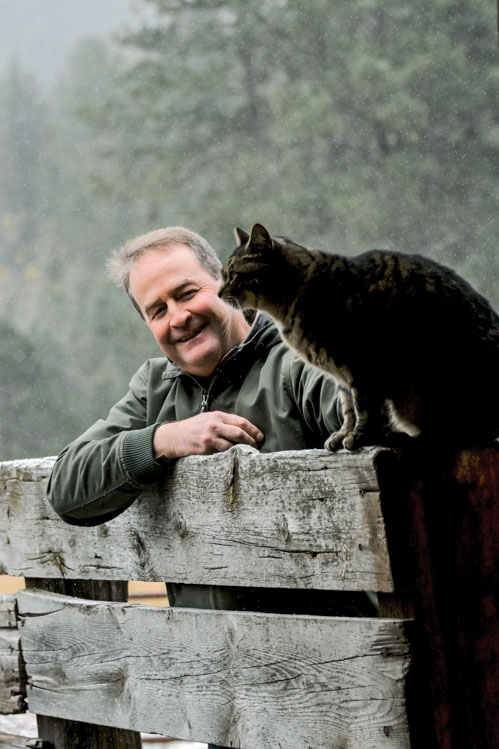
Nemo, he notes, is a Latin word for nobody, so it is a good place to contemplate his Bad River experience and convert it to art. The spacious studio, which they call Green Ink Gallery, is a remodeled horse barn. There are stalls for their two horses and hay mounds for a big tabby cat that shares the ranch with them, along with a German Shepherd they call Echo.

Most of the people who will see his paintings have never driven the Bad River Valley. He hopes to show them its natural shapes and curves, and its wild nature. “Sadly, there are subdivisions and cornfields and roads coming for it,” he says.

“We live on a sphere, and we’ve decided to cut it into squares. I view it as an imperiled landscape. Most of our prairie is already cut into squares, which seems like a crazy way of dealing with a landscape that’s anything but square.”

Editor’s Note: This story is revised from the May/June 2024 issue of South Dakota Magazine. To order a copy or to subscribe, call (800) 456-5117.

Posted on Leave a comment

The Nemo Life

The view from atop Nemo Mountain, also called The Big Hill by old-timers, illustrates how the old logging town is buried in the Black Hills National Forest. Photo by Stephen Gassman.

Troy Saye was already growing weary of Las Vegas when he saw the player piano in storage at the Excalibur. He’d spent years on The Strip, building stage sets for big shows like Siegfried & Roy and King Arthur’s Tournament. But the crowds and the traffic were becoming too much for a man who’d grown up on a ranch in rural Montana, the son of a rodeo calf roper.

“Eventually Dad got too old for rodeo so he moved us to Las Vegas when I was 10,” says Saye, adding that it seems like a long time ago.”I was there 42 years one weekend!”

He was stage manager at the Stardust, and then became a fixture at the theater department of the University of Nevada-Las Vegas. He was working as the”head of props” at the Excalibur when he first saw the unusual old piano that had been relegated to storage. He learned that it had once been part of the dÈcor for a German-themed restaurant.

The coin-operated attraction wasn’t just another player piano with a keyboard. It featured an entire orchestra — drums, cymbals, flutes, a horn and tambourine all playing in unison and glowing in colored lights. Saye had an itch to buy it, though he had no idea for what, and the casino management didn’t know if they wanted to sell. Then, suddenly, the unusual piano was listed on an employee auction site. Saye was busy on auction day, but he quickly offered $350 and asked a friend to keep an eye on the bidding. Soon, someone upped it to $500.

“Pay whatever it takes,” Saye told his friend. Then he worried all day about whether his friend was successful, and if so, what the piano was going to cost him — and what he would do with it if he got it.

Troy and Willie Saye, proprietors of the Guest Ranch, are determined to preserve Nemo’s history. “That’s what people seem to like,” Troy says.

Long before the piano auction, Saye and his wife, Willie, had been looking for a simpler place to live. They thought it might be interesting to run a resort, and pondered lake properties in Willie’s home state of Minnesota, though Troy wasn’t sure he wanted to deal with humidity and mosquitoes. They considered resorts in several western states, but nothing felt right until they read about Nemo, a pioneer sawmill town that had been transformed in the 1940s into a guest ranch. Willie had vacationed in the Black Hills as a child, and Troy’s dad had rodeoed there in the 1950s.”My most vivid memory was when I was about 5 years old and eating a banana split by the rodeo grounds in Deadwood,” he says.

Naturally, a man of the theater believes in fate. He and Willie became the proprietors of the Nemo Guest Ranch in 2006, which means they now own some of the oldest and most rustic cabins and lodges in the West. Much of the resort was built by Homestake Mining Company, which operated a sawmill there from 1898 to 1939. Other structures predate the sawmill, including several more than 130 years old.

Today’s Brandin’ Iron restaurant, which Homestake built as its sawmill office, has a tree growing through the roof yet today. The pine is a bearing tree that is marked (note the yellow metal plate) by surveyors to establish boundaries. Because of the recent pine beetle epidemic, many bearing trees have been lost, but the Brandin’ Iron’s tree is healthy and popular with diners. The Brandin’ Iron is decorated with wagon wheel chandeliers, tables and chairs made long ago of local pine, and copies of Charlie Russell art that were painted by Native artist Tommy Brokenrope and framed with decorative rope knots.

Bladen, Rilyn and Jalyn Norton, of McCook Lake, by the bearing tree inside the Brandin’ Iron Restaurant.

Nemo’s first schoolhouse is now a spacious family cabin, and the mercantile dates to 1889.

The Sayes’ move to Nemo has not been a retreat to solitude. The town has just 42 permanent residents, but it swells with hundreds of visitors every day in the summer, and today’s guests have mostly forsaken quiet horseback rides for rumbling ATVs, which they use to roar through Forest Service mountain trails or climb to the top of nearby Nemo Mountain.

The mud-stained ATVs are great fun, though they do look out of place.”Take away the four-wheelers and the modern cars and Nemo would look like when we had it,” says Buck Troxell, whose father Frank bought most of the townsite seven years after it was abandoned by Homestake.”Dad sold 86 horses to make a cash down payment.”

The Troxells brought 26 horses from their ranch on the Pine Ridge Reservation and converted Nemo into a resort for the Black Hills’ fledgling travel industry.”We gave trail rides and we went to work on the old buildings,” Troxell remembers.”When you have a guest ranch you are a plumber, electrician, carpenter, cook and farrier — and it’s kind of hard for a cowboy to do some of that stuff. It didn’t always look so good.”

The challenge is the same for a Las Vegas stage manager. Saye spends his days fixing leaky faucets, torn screens and myriad other minor repairs required of century-old wood buildings and cabins. He also answers questions.”Visitors always ask about the history,” he says, like where did George Custer camp, or where was the actual sawmill.

“History seems to be what draws our guests,” he says.”Willie and I want to put as much history back as we can. A lot of the places that we looked at were trying to imitate history, but this is the real thing.”

Though he’s busy every day, Saye feels blessed.”I got to grow up on a ranch and I got to grow up in the city. I will take the country life anytime,” he says.”I call it the Nemo life.”

Cheryl Eggers, one of the 42 year-round residents, says she and her husband Norman moved from Rapid City for the Nemo life.”We wanted a place where our kids could play outside and explore the hills and play in a creek.”

Buck Troxell with his roping horse, Too Tightly Wound.

Eggers has grown to also love the history.”This is a town of firsts,” she says. The first Forest Service office in the nation was established here by President Grover Cleveland in 1897, followed by the nation’s first timber sale on Feb. 28, 1898.”We had the largest Hearst mercantile in the country and we were the second town to have electric lights in all the homes, thanks to Homestake’s hydroelectric plant.” (Deadwood was first.)

Custer camped at the top of the valley on a spot known as Pleasant Valley. Decades later, the sawmill grew to be the biggest in the Black Hills, and at one time the town’s population reached 500. Nemo was decimated by the 1920 flu epidemic; so many children died that the women insisted that a church be built so there was a place for proper funerals.

The same church still hosts worshippers at 10:45 every Sunday morning, and the same mercantile is still the community store, though it has changed through the years. A mounted golden eagle is perched above the woodstove. The eagle was exhibited at the restaurant for many decades, long before the Endangered Species Act took effect in 1940. Saye moved it to the store when he noticed that smoke and steam from the kitchen were damaging its feathers.

The store, built in 1889, has groceries and snacks but it also serves as the Nemo museum. Conrad Preston’s big collection of Black Hills rocks and minerals is exhibited on a row of shelves. Old photographs hang on the walls, and there’s an unusual stuffed specimen of a coyote pouring a shot of whiskey.”The poor coyote was roadkill, but we found a taxidermist who created this,” says Saye.

Across the room from the eagle and bartending coyote is the player piano, which Saye’s friend bought that day in Las Vegas for $501. All the instruments in the nickelodeon still work; together they fill the store with beautiful music. The coin mechanism malfunctions, but Troy and Willie will start it for free if you ask. That’s the Nemo life.

Editor’s Note: This story is revised from the November/December 2020 issue of South Dakota Magazine. To order a copy or to subscribe, call (800) 456-5117.