Posted on Leave a comment

The Yankton to Marty Trail

South Dakota Magazine intern Ava Brandt met Digger at Mensch’s Greenhouse in Avon.

A golden dog named Digger met us at the door of Mensch’s Greenhouse, his tail wagging like a windshield wiper. Two cats lolled on a flower worktable and a dozen colorful cockatiels chirped from two cages near the petunias.

Any traveler will crack a smile at Mensch’s Greenhouse in Avon — and that’s fortunate because for the most part this Yankton-to-Marty loop can be a solitary journey, even though it visits seven small towns in South Dakota’s populated southeast corner.

We began the loop early in the morning because of a tip that the Tyndall Bakery has amazing donuts and pastries, and some days they sell out. We had two stops to make before the bakery.


The Lakeport Church in rural Yankton County dates to 1884.

Chalkstone Church

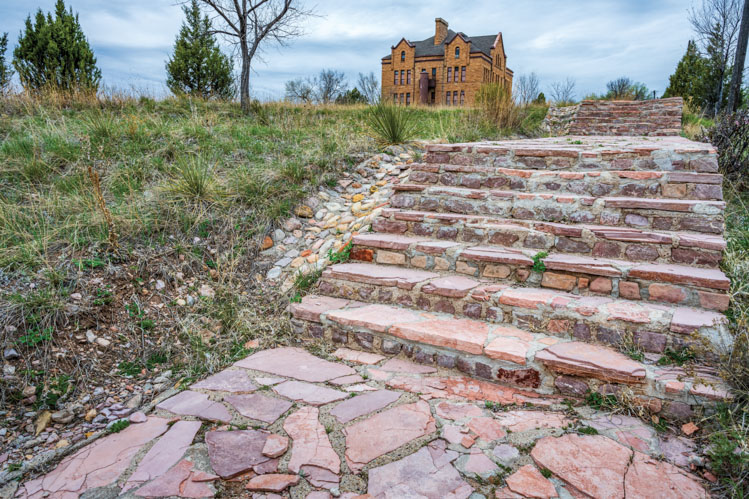
We drove 8 miles west of Yankton on Highway 50 to 431st Avenue, then turned right to the Bruce and Donna Schwarz farm. Drive slowly through the farmyard — the Schwarzes don’t mind — and you come to a small church built of the yellow chalkstone found along stretches of the nearby Missouri. Neighbors keep up the church and mow the cemetery, which features Czech surnames still common in the area. This is Czech country, settled by pioneers from Bohemia and Moravia who began to arrive in 1869. Their first settlement was Lakeport; only the little yellow church, constructed in 1884, has survived.


A wooden church is among the historic buildings preserved at the park in Tabor.

TABOR: CZECH CAPITAL

A few miles further along Highway 50 is the town of Tabor (pop. 405), founded in 1872. Tabor is famous for its annual Czech Days celebration in June. Parking is more plentiful on the other 362 days of the year, so stop on Main Street and stretch your legs by walking through the quaint pioneer village which includes a tiny wood church that was built at Lakeport even before the chalkstone church. Now it is well-kept in the Czech Preservation Society’s heritage park along with several other antiquated structures.


Magazine interns Rose Lane (left) and Ava Brandt at Tyndall’s Eiffel Tower, a fancy flagpole that measures 100 feet.

TYNDALL’S TOWER

One wonders if Gustave Eiffel, engineer and namesake of the tallest structure in Paris, would be flattered to see the imitation in Tyndall.

Tyndall’s”Eiffel” is more than 1,000 feet shorter than Gustave’s, but nearly as old. It was constructed in 1898, just nine years after the original was completed to honor the centennial of the French revolution.

The replica stands on the lawn of the county courthouse, west of downtown on 18th Avenue. But before you visit the tower, stop at the Radack family’s bakery. We dilly-dallied too long, and the cases were nearly empty, so we missed out on the Tyndall Roll, a Bismarck-like pastry filled with white cream and topped with crushed peanuts. No one knows when the legendary roll was created, but the bakery traces its history to 1905.


Carol and Vern Tolsma at their Avon greenhouse.

AVON’S GREENHOUSE

Feeling lonely in southeast South Dakota? Just visit Vern and Carol Tolsma’s Mensch Greenhouse and Flower Shop along Highway 50 in Avon.

Carol’s grandmother, Ada Mensch, started the greenhouse in 1957. Imagine how many flowers have bloomed, thanks to Ada, in 67 years. And how many people have enjoyed the garden bounty that took root here.

The flowers and plants come with free advice. Did you know you should only water tomato plants when absolutely necessary? Vern says a thirsty plant sends roots deep into the soil, making it strong and adding taste to the fruit.

Digger, the greenhouse dog, wags and nuzzles anyone who’ll take the time. Cats and cockatiels also share the space. The cockatiels are orphans who lost their owners and found refuge here.

The Tolsmas tend a 2-acre garden near the shop, and they sell produce, canned goods and amazing pickles. They occasionally set out a table of freebies that need a home.

Some days, Vern wears a blue t-shirt that says it all:”I Love Gardening From My Head to My Tomatoes.”


Richard Langdeaux helps keep Wagner’s park looking beautiful.

A WALK IN THE WAGNER PARK

Follow Highway 50 northwest. South Dakota’s Czech heritage extends into Charles Mix County and the city of Wagner (pop. 1,603), the largest town on this loop tour. Wagner has all the amenities you might want — a coffee shop, restaurants and a grocery store.

On the west side of town, near Highway 50, lies a little lake and park that would be the envy of any city in America. The lake was created when a dam and rock structures were built in the 1930s by WPA workers. Today the park includes two walking bridges, flower gardens, trails and even a small waterfall. This is the best opportunity of the day for a walk.

Richard Langdeaux, a Santa Claus look-alike who was collecting trash in the park, told us that the stone buildings along the lake were once a Scout camp. Artesian springs keep the lake full year-round.

Wagner also offers an impressive museum, operated by the Charles Mix County Historical Society. The collection is known for its Czech exhibits, as well as artifacts from the Yankton Sioux culture that predates the pioneers.


Michael Rouse helps maintain the ground around Marty’s St. Paul Catholic Church.

MARTY’S AMAZING CHURCH

Drive west of Wagner for 6 miles to 388th Avenue and turn south for another 6 miles to Marty. The one and only enterprise is a boarding school started by the Benedictines in 1924 and now operated by the Yankton Sioux Tribe.

Alongside the school is St. Paul Catholic Church, built by volunteers — Indians and non-Indians — in the early 1940s of Indiana sandstone, mined from a quarry near St. Meinrad Archabbey, which founded St. Paul’s.

The steepled church (167 feet!) is surrounded by tall trees and other structures, so it’s hard to appreciate from afar. Exit your car and walk about the churchyard, where there are statues of Kateri Tekakwitha, the first Native American saint, and St. Theresa, patroness of missions. On most days, the church doors are open; inside, St. Paul’s looks like something you might see in a European city except that the murals, stained glass and other art are rich in Native American themes.


The tallest stone in Greenwood Presbyterian Cemetery marks the grave of Struck by the Ree.

STRUCK BY THE REE

Follow the road south of Marty for about 7 miles and a few curves. You’ll come to Greenwood Presbyterian Cemetery, where the tallest stone marks the grave of Struck By The Ree, a maligned and misunderstood leader of the Nakota. He was born in 1804, as Lewis and Clark came through the river valley. Legend says the explorers wrapped the baby in an American flag and proclaimed he’d be a great leader.

Struck By The Ree did grow to be a wise chief — an environmentalist, a feminist and a peacemaker. He urged pioneers to preserve the timber resources of the river valley. He pleaded that both Nakota and white men respect the Native women. And though he first fought the intrusion of the white civilization, he eventually recognized that it could not be stopped (ìthey are like maggots Ö”). He became a lead negotiator in the 1858 Treaty. Decades later, after the treaty was broken and his people found themselves hungry and hopeless, he was often persecuted; his cabin was burned, and his horses were stolen.


A tall memorial near Greenwood commemorates the 1858 Treaty.

Treaty Memorial

Continue south and you’ll soon come to another memorial, erected to honor Struck By The Ree and seven other Native American signers of the 1858 Treaty, which gave the government more than 11 million acres for $1.6 million and established a reservation for the Nakota.

The monument was constructed in 1907, topped with an obelisk. A few decades ago, vandals toppled the obelisk — a posthumous insult to Struck By The Ree, a century after his death in 1888. It has since been restored.


Springfield sits above a growing delta in the Missouri River.

A MISSOURI RIVER DELTA TOWN

Drive south from the treaty marker and you’ll come to the tiny community of Greenwood, once the hub of the Yankton Sioux Tribe. At Greenwood, if you are not in a hurry, turn right and follow the river for a mile or two for scenic views. Then return and continue east along the Missouri.

Eventually you’ll come to 312th Street, and then to Highway 37 which will lead you to Springfield, once South Dakota’s smallest college town. Thirty years ago, the University of South Dakota/Springfield was closed, despite furious opposition, and the campus was converted to a prison.

Townspeople feared that the prison would be the ruin of Springfield, but it has persevered. Norm’s, once a favorite hangout for collegians, still serves burgers and beer. A company known as Mr. Golf Car parks more than 200 golf carts along Main Street. A museum keeps the history of the college alive, and anglers come to fish the river.

Springfield still has a post office, bank and library — plus several eateries. On its eastern edge is a veteran’s memorial with a panoramic view of the river.

The highway sign lists the population at 834. That doesn’t count the 1,200 prisoners who live there.


Six unknown soldiers of Lt. Col. George Custer’s 7th Cavalry are buried in the Bon Homme Cemetery.

APPLE TREE ROAD

For a final treat on your loop, turn east onto Apple Tree Road (a mile north of Springfield).

A few miles down the road is a spot known as Apple Tree (though the state Game, Fish and Parks Department calls it Sand Creek). It consists of a campground and cabins, a boat dock and a little peninsula where you can walk out among the reeds and see where the invasive delta ends and Lewis and Clark Lake’s open water begins.

This was once a delightful place to enjoy the bellowing of giant bullfrogs. They were silent on our stop. Perhaps they dislike the phragmites, an invasive wetland plant that is taking over.

Continue east on Apple Tree Road and you’ll soon pass the tidy Bon Homme Cemetery where a large stone memorial marks the graves of six soldiers who traveled with Lt. Col. George Custer and his 7th Cavalry in 1873.

As Custer’s entourage camped at the nearby town of Bon Homme for four days, six became ill and died. Historians speculate that they contracted typhoid fever. The six were initially entombed at Snatch Creek and then reburied at the cemetery in 1893. In 1922 the large marker was built in the cemetery to give some measure of respect to the nameless six, who might otherwise have perished at the Battle of the Little Bighorn in 1876.


A replica log schoolhouse stands near the Bon Homme townsite.

BON HOMME WAS A TOWN

Continue south on Apple Tree Road and you soon come to a curve near the old community of Bon Homme. At the curve is a monument to the first schoolhouse in the Dakotas. A small replica of the 1860 log schoolhouse was erected in 1910 by pioneers, and it remains there today. Care to skip a rock in the river (or fish or launch a boat)? Just follow the gravel road south at the curve for less than a mile and you’ll drive right up to the water’s edge and a sandy beach.

Back at the curve, head north to Highway 52. It will lead you east to Highway 50, which takes you past the chalkstone church and on to Yankton.

Editor’s Note: This story is revised from the January/February 2025 issue of South Dakota Magazine. To order a copy or to subscribe, call (800) 456-5117.
Posted on Leave a comment

Sweet and Sour in Roslyn

Roslyn alumni parade through town during the annual Vinegar Festival, a tradition since 2001.

When Lawrence Diggs moved from San Francisco to Roslyn, he had already spent years researching the properties of vinegar. He’d visited France, Egypt, Mexico, South America, the Philippines and Italy, all to study the flavored concoction. It led to his first book, entitled Vinegar: The User-Friendly Standard Text Reference and Guide to Appreciating, Making and Enjoying Vinegar.

Diggs was looking for a quiet summer home where he could write when a real estate agent told him about a house in Roslyn, so he came to see it. He liked the town and people so much he never left.

Thanks in part to Diggs, this tiny town in northern Day County is now home to the International Vinegar Museum. The idea came as the community was looking for a unique way to draw visitors. A former opera house, auditorium and community hall provided the space.”We wanted to create something that people hadn’t done before. We weren’t going down without a fight to keep the town open,” Diggs says.

The museum was designed to teach visitors about vinegar and its varied uses. Diggs has turned over the role of museum curator to the community, but he remains connected and supportive. Fran Rougemont, Marnah Woken and Richard Snaza work at the museum and Josh Wagner handles the accounting. Mary Wagner volunteers doing the purchasing and mail orders.

A museum devoted to vinegar was not likely on the radars of Roslyn’s 19th century founders. The town traces back to 1882 when H.H. Russell, the first postmaster, took the name from his native city in Scotland. Roslyn began as Old Roslyn with just a post office and trading post. In 1914, the town was officially surveyed and platted by August W. Hartge after the community of settlers raised $60,000 for the Soo Railroad to be built. Soon businesses began coming into town.

Lawrence Diggs.

Today’s Roslyn looks a little different. Longtime businesses have closed and been replaced by new endeavors. The Roslyn Event Center, housed inside the school that closed in 2010, is rented for weddings, funerals and gatherings. Grade school kids from Webster, 12 miles south, still use the gym for basketball, volleyball and pole vault practices. Becky Lundquist’s city finance offices are inside. The former computer room is the Viking Fitness Center owned by Amber Huggett. Dave Strege lives in the school’s old library and has a business called Roslyn DÈcor.

The Roslyn Creamery Company was in business for 68 years. Nathan Johnson has turned the facility into a furnished rental for hunting and fishing groups. It also hosts the Roslyn Creamery Company Band for jamborees.

Roslyn Meat Market was built in 1914 next to the post office. After a 1964 fire destroyed most of Main Street, it was rebuilt in the same spot. In 1976, Robert Coyne sold the business to Shirley and Norman”Tubby” Schmidt. Their son, Craig Schmidt, bought the business in 1992, but it closed in 2004.

Another son, Paul Schmidt, had been working at Mike’s Jack and Jill in Webster as a meat cutter when he decided to open his own store. Schmidt’s Custom Meats is now part of a mini mall with a small grocery store, auto shop and furnished rentals. Paul still uses recipes handed down from his grandparents and parents.

Roslyn has another claim to fame that South Dakotans of an older generation will recognize. Myron Floren,”The Accordion Man,” attended school in Roslyn through his junior year of high school. He learned to play the accordion while growing up on a small farm outside of town. His 32-year career with the Lawrence Welk Orchestra and numerous television performances began after touring Europe with the United Service Organizations. He returned to Roslyn to play for his hometown’s Diamond Jubilee.

But these days, vinegar is the star. Roslyn’s first Vinegar Festival was held in 2001 in conjunction with the town’s alumni weekend. A parade, vendors, food trucks, vinegar tasting, kids’ activities and music lead up to the annual crowning of the Vinegar Quart, comprised of Princess Pickle, Princess Vinaigrette, Princess Sour and the Vinegar Queen. This year’s honorees are Helen Trautner (Princess Sour), Kimberly Lorensberg (Princess Vinaigrette), Marci Johnson (Vinegar Queen) and Shauna Kjos-Miotke (Princess Pickle).

Sure the vinegar makes things unique and fun in Roslyn, but it still has the small-town qualities that Diggs sought when he left the fast-paced life of northern California.”The best part of living here and to be part of the community are the relationships,” says Diggs, who’s become known as The Vinegar Man.”It feels good to know people and be a part of what is going on. People have opportunities to belong.”

Editor’s Note: This story is revised from the September/October 2024 issue of South Dakota Magazine. To order a copy or to subscribe, call (800) 456-5117.

Posted on Leave a comment

What Makes Hecla?

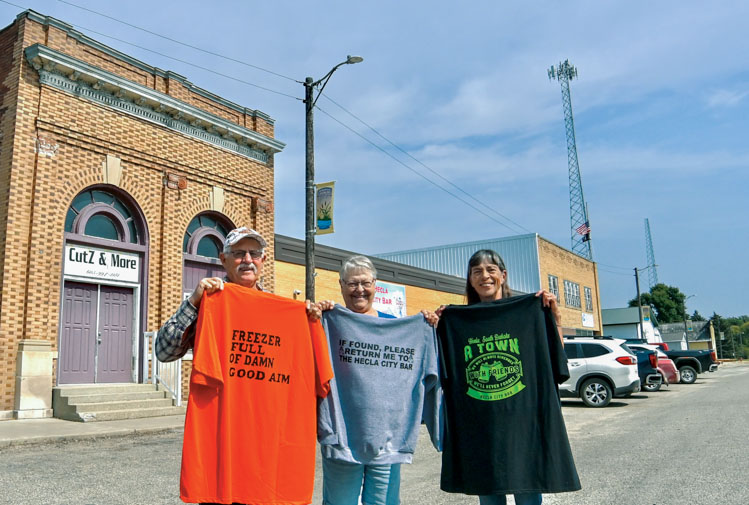
The Hecla City Bar offers a variety of apparel to visitors, as modeled by (from left) Terry and Diana Ulmer and Mary Freudenthal.

Outside influences shape the little town of Hecla, a tradition that dates to the last ice age. These days, a million winged and feathered guests migrate through the lakes and marshes south of town in the spring and fall. Humans follow the ducks and geese, and often find their way to the Hecla City Bar, where they traditionally pin dollar bills to the tiled ceiling and post photos of big fish on a”brag wall” near the door.

Hang around the bar and you eventually get a history lesson of the town. Its name comes from Hekla, Iceland, home to a stratovolcano. January Jones, a Hollywood actress who gained fame as Betty Draper in Mad Men, grew up here in the 1980s. A young couple, the Pioskes, operate an award-winning butcher shop across the street; sometimes on Friday nights they bring over a grill and cook ribs for everyone.

“It’s a pretty friendly town,” says Jess Monsen, who once ran the bar and now serves as the town’s deputy clerk.

Monsen says North Dakota is just 4 miles to the north, which explains the North Dakota State University Bison flags in some yards.”We’re pretty split between the Bison and the SDSU Jackrabbits.”

What about the Coyotes?

“I don’t even know what that is,” she quips. This is north country.

Trailers, tractors and other antique keepsakes decorate the yards of Hecla residents.

Hecla does feel like a town with a culture all its own. Jim Bauer, a woodworker who arrived from North Dakota as a youth in the 1960s, says the town has persevered even as many of its institutions have gone.

“There were 46 in my high school class in 1969,” he says. Today a memorial marker and bell are the only reminders that there was a school, which closed in 2002. Most of the downtown stores have been shuttered (though the butcher shop occupies three connecting buildings) and even some churches have left.

“Our Catholic church has closed,” Bauer says.”If I was rich, I would have bought the building and put up a big screen TV and broadcast the Sunday Mass, but I suppose the bishop wouldn’t have liked that.”

Bauer planned to parlay his woodworking skills into another enterprise for Hecla, but big business blocked him.”I was hoping to become a millionaire making caskets, and I started to build them, but the funeral home industry said I didn’t have enough liability insurance, so I never really got started.”

Weather is also not always friendly. As one of South Dakota’s northernmost communities, Hecla is among our coldest places in winter. Average January lows are barely above zero.

One asset that bishops, business tycoons and even Jack Frost cannot take from Hecla is the 21,498-acre Sand Lake Refuge that stretches for miles south of town. Fed by the James River, which flows down from North Dakota, the marshes and lakes — created when Ice Age glaciers melted 11,000 years ago — are a paradise for migratory birds and wildlife.

Hecla woodworker Jim Bauer keeps a collection of vintage lanterns in his shop at Fourth and Oak, including relics from trains, buckboards, police wagons and military vehicles.

Hunters and anglers, including many from North Dakota and Minnesota, make annual treks to the refuge. Most of the sportsmen stay at local lodges like Ruenz’s Roost or the Flatland Flyways, but others have bought homes and converted them to hunter’s cabins.

Monsen, the deputy clerk, says absentee ownership isn’t as controversial in Hecla as in mountain towns of the Black Hills.”Housing goes in cycles here,” she explains.”At times there isn’t a house to be found, and then a few years later there’ll be lots of homes for sale and not a buyer in sight.”

Refuge officials estimate that more than 75,000 people arrive every year to enjoy the outdoor paradise. They include birdwatchers, hunters and anglers.”There are three or four bridges near town that are the easiest places to fish from,” says Monsen,”and in spring and summer they might all be busy.” Northern and walleye are the prime catches.

Hecla culture today is a blend of farming, fishing and waterfowl. Antique farm machinery and duck/goose signage are common yard dÈcor, along with the Bison signs from that university in nearby North Dakota.

Editor’s Note: This story is revised from the January/February 2025 issue of South Dakota Magazine. To order a copy or to subscribe, call (800) 456-5117.

Posted on Leave a comment

A University Town

Burbank is a town along the old Dakota Southern Railroad about 6 miles from Vermillion and the University of South Dakota. It was named for John Burbank, the governor of Dakota Territory and a railroad director, when the line came through in 1872.

Burbank doesn’t look like a college town when you first arrive. The little village is surrounded by corn that grows 7 feet high in the lush bottomlands of the Missouri River.

Burbank has dirt streets. Chickens outnumber people two to one, and its most prominent architectural features are a railroad track and an old grain elevator.

But nearly every Burbanker has a connection to the University of South Dakota in Vermillion, just 6 miles away.

Jim Slattery runs Whimp’s, Burbank’s only eatery — and its only business — along with his brothers Nick and Tom. He learned to cook at the Silver Dollar in Vermillion while studying political science at USD.

He acknowledges that the town looks more like a traditional farm town. Some of the locals wear Coyote red with their seed corn caps, and they frequent Whimp’s along with professors and students.”The farmers know I’m a city boy,” Slattery grins.”I haven’t been asked to drive a tractor, but I can do that.”

Whimp’s was started in 1967 by Leonard”Whimpy” Girard and it has been a staple ever since, thanks to the Taggarts and Radigans who also spent stints as owners. Now it’s the Slatterys’ turn. All four families are”old names,” both in Clay County and on the USD campus.

The Slattery brothers haven’t changed the menu or decor since buying Whimp’s as well as Toby’s, a popular chicken shack in nearby Meckling — which is like a sister city to Burbank on the west side of Vermillion.

Whimp’s’ menu has six signature burgers (Burbank, Keg, Cornhusker, Mushroom & Swiss, BBQ Bacon Cheddar and the Dark Lord).”We’re one of the few places you can still get liver and onions,” Slattery says.

Popular specials include the $5 cheeseburgers on Tuesdays, chicken wings on Wednesdays and all-you-can-eat spaghetti on Thursdays, with mouth-watering meatballs made from tenderloin trimmings.

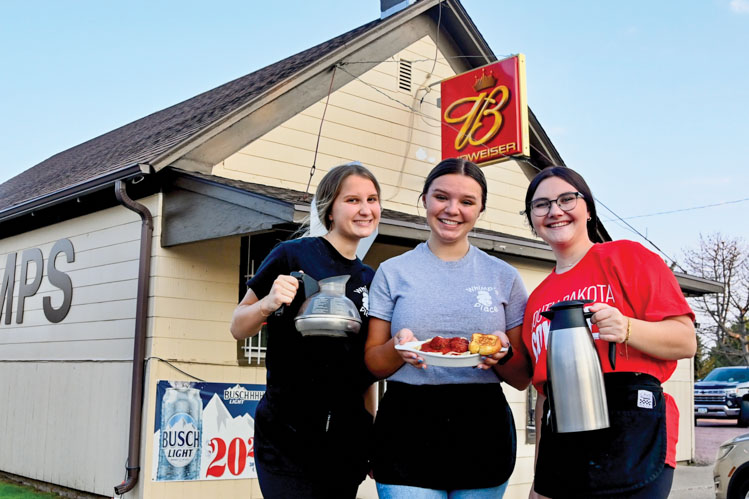
Carley Johnson, Grace Reynolds and Taryn Taggart are students at USD and waitresses at Whimp’s, a popular eatery in Burbank.

“If we can make it, we do it,” Slattery says.

Ted and Karen Muenster — namesakes of USD’s Muenster University Center — were at the bar for a recent spaghetti night.”We drive out here one or two nights a week,” says Ted, who’s now retired from a distinguished career in business, politics and academia. Karen served as a state senator from Sioux Falls and was a leader in historic restoration of downtown Vermillion for many years.

“Whimp’s has always been run by these old families who have been well-connected to the university,” Ted says.”Some people say it’s wicked,” he grins, gazing at the lawyers, teachers and retirees seated at simple tables.

Despite Burbank’s tiny population, Muenster notes that hundreds of thousands of people live within a 40-mile radius encompassing Yankton, Sioux City, Sioux Falls and Vermillion, so Whimp’s is actually a dirt-street oasis in a well-populated region.

The tiny town has a history of attracting outsiders. Frank Verzani, an Italian immigrant, ran a ferry on the Missouri River, just a few miles away. His crossing was called Victors, and then Green Point. When the Dakota Southern Railroad extended into Dakota Territory in 1872, the community was renamed in honor of John Burbank, the fourth governor of the territory and a director of the railroad.

Bob Hudelson is one of the few Burbankers without a connection to the nearby university, but he knows history and his own life story sounds like a Charles Dickens novel.”I was raised on the streets of Sioux Falls,” he says. He escaped from an orphanage and made his own way as a child, thanks to the benevolence of kindly policemen, store owners and others who helped him find a place to sleep and a meal. On some cold nights, he remembers being locked inside stores so he would be safe and warm.”I wish I knew how to say thank you to the people of Sioux Falls who helped me survive as a boy,” he says.

Ted Muenster (left), a longtime champion of USD, is a regular at Whimp’s, now run by Jim Slattery (right) and his brothers.

For 23 years, he and his wife Barbara have lived in Burbank, where he has soaked in the wicked past that Muenster referred to. Hudelson says Burbank was a wild cow town because ranchers brought stock here to be shipped on the railroad. He points to a house that was once a brothel and tells a story of when the notorious outlaw Jesse James nearly got involved in a shootout on main street.

Jerry and Colleen Johnson live across the street from the Hudelsons, along with a dozen ducks, 10 dogs and more than 200 chickens. Colleen takes the eggs with her to Vermillion every day, where she works as a custodian at the university.

“I like it here because at 6 o’clock at night it’s so quiet you could hear a pin dropping,” Johnson says. Or a rooster crowing.

Like any university town, Burbank has an ongoing fundraising project. It involves a historic school building that closed in 1972. Every September, the town holds a barbecue to raise money for repairs to the school, which is now used as a community center.

Nick Slattery, a local contractor and part-owner of Whimp’s, helps with the project. His brother, Jim, assists with the food.

“We’re here to help, whether it’s the schoolhouse or whatever,” Jim says.”This will not be a ghost town. There will always be people here.”

Editor’s Note: This story is revised from the November/December 2024 issue of South Dakota Magazine. To order a copy or to subscribe, call (800) 456-5117.

Posted on Leave a comment

The Fourth in Kranzburg

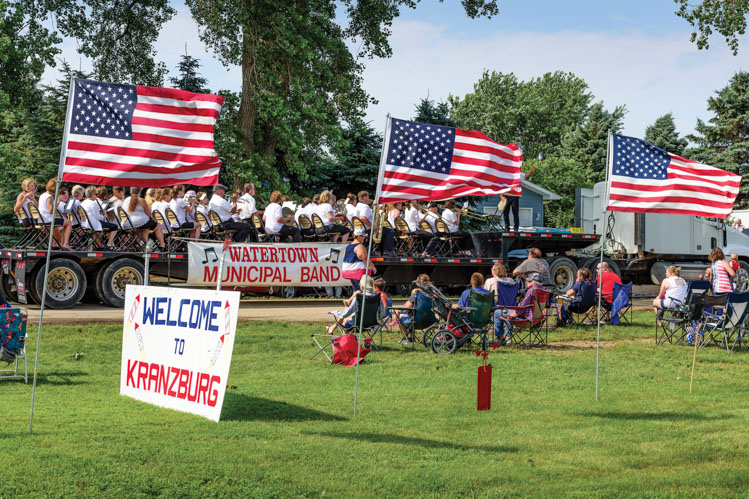
Kranzburg’s Fourth of July parade is one of the state’s largest.

An unorganized celebration keeps Kranzburg hopping each July 4 as anywhere from 4,000 to 10,000 people descend on the tiny town 8 miles east of Watertown.”No one is really in charge,” laughs Dale Plunkett, owner of Kranzburg’s Tip Top Tavern.”If you want to be in the parade, you just line up on the east side of town.”

Over the years it seems that every well-known South Dakota politician has marched in the Kranzburg Fourth of July Parade, community bands have played and plenty of free beer has been handed out. In fact, beer is how the whole thing started in 1958 or’59 when the late Charles Strang and Willie Kranz celebrated the town’s incorporation by driving around with a keg in the back of a pickup truck handing out free beverages.

Now the parade”kind of just happens,” says Carol Rinehart, Strang’s daughter. She and her sister Mary Ann Stahlke spot people they haven’t seen in years and agree it’s a community reunion.

“Three hundred and sixty-four days a year it’s a quiet little town,” Plunkett says.”Then everyone who has a connection comes.”

“It’s wall-to-wall people,” Stahlke adds.”And it hasn’t lost its momentum.”

Dale Plunkett and his mother Marge run Kranzburg’s Tip Top Tavern.

Kranzburg was named for the Kranz family that still lives in the area. It is historically a Catholic town with streets named for saints and the large Holy Rosary Church dominating the skyline. The impressively ornate church was built the same year the town was founded and placed on the National Register of Historic Places in 1986. Its school served the community from 1906 to 2014. At one time so many students attended that they overflowed into the one-room community school in town.

That public school was the first in Codington County and the Strang family sisters have lovingly restored it over the last several years. Carol Rinehart, Mary Ann Stahlke and Eileen Lindner all attended the District 5 Kranzburg school, as did their mother and other siblings. Although their father Charles Strang did not attend the school, he served on the town board that met in the schoolhouse until a town hall was built next door. Before he died in 2015, he made it clear that he wanted the school preserved.

“We promised and a promise is a promise,” Rinehart says.”I really think our dad helped us even though he wasn’t here.”

Carol Rinehart (left), Mary Ann Stahlke and other Strang family members continued their father’s wishes to preserve the Kranzburg public school.

So the sisters devoted one day a week to clearing out junk that had been stored in the building, scrubbing, sanding and painting. They discovered treasures like original books, posters and even artwork students had left in cabinets. They baked 300 rolls to raise funds and the Watertown Area Community Foundation provided a grant that helped put new shingles on the roof. Roofers Mark and Doug Kranz also repaired and painted the belltower.

Fourth of July parade attendees in 2022 got their first look at the restored school.”Everyone who came really appreciated it. Like us, they got a little nostalgic,” Rinehart says. Memories of Kranzburg when it boasted a grocery store, cheese factory, mink farm, the Kranz Hotel, a train depot, three bars and a liquor store are also collected in displays in the school.

Plunkett bought the Tip Top Tavern from his parents; his mother still works with him at the gas station/convenience store/Marge’s Diner/bar. In 1918 the Tip Top was built as a Standard Oil gas station at the corner of Highway 212 and County Road 3. Rebuilt, remodeled and repurposed over the years, it still occupies the original spot.

Community values are at the core of Kranzburg’s survival, according to Marge Plunkett.”It’s just a family community,” she says.”It’s home.”

Editor’s Note: This story is revised from the March/April 2023 issue of South Dakota Magazine. To order a copy or to subscribe, call (800) 456-5117.

Posted on Leave a comment

Double the Fun in Carthage

Cabaret Days is Carthage’s annual summer celebration and includes a kids’ scavenger hunt on Main Street.

The road through Carthage may not be heavily-traveled, but there’s enough happening in the Miner County town to have two of a lot of things — two recreational lakes, two museums, two antique stores, two eateries and two big city-wide festivals.

In the late 1800s, railroads needed at least a maintenance depot and/or water tower every 7 to 10 miles. Carthage was one of those spots. The original location sprouted from the prairie a bit further east and was moved once the tracks were installed. Surveyor Frank Ward named it for his hometown of Carthage, New York.”All the streets were named after Frank’s brothers,” historian Sally Madison says. They include Thomas, James and Frederick.

Shortly after founding Carthage, Ward donated a lot to the Coughlin family, whose son, Carthage James Coughlin, was the first child born in the new town. Their 13-room house was added to the National Register of Historic Places in 2006 and operates today as the Coughlin Inn.

The family’s second son, Charles Coughlin, earned an engineering degree from South Dakota State University in Brookings and served as president of the Briggs and Stratton Corporation from 1935 to 1972. In the 1920s, he donated funds to build the Coughlin Campanile, a 165-foot-tall tower of Indiana white limestone, red brick and concrete that still stands on the SDSU campus along Medary Avenue in Brookings.

Kim and Dave Van Asperen periodically open the former Carthage Opera House as an antique store.

Disaster is a familiar story in South Dakota towns, and Carthage has seen its share. A fire in 1910 destroyed almost the entire north side of Main Street. Longtime resident Lorelee Nelson said people still refer to”before the fire” and”after the fire.” A tornado in 1947 killed one person and destroyed 150 buildings in the area. Although there’s not a traffic light in all of Miner County, Carthage had an airport until around 1948 when the family that operated it was killed in a plane crash.

The Works Progress Administration built a dam and bridge to form”Old Lake Carthage,” but the dam washed out in the early 1960s. A larger dam nearer to town now holds”New Lake Carthage” along with remnants of the old lake. A campground is operated through a partnership between the city and the state Department of Game, Fish and Parks.

Even those with little knowledge of Carthage might recall legendary wanderer Chris McCandless, who spent parts of two years living in town and working at the grain elevator before hitchhiking to Alaska, where he eventually died in an abandoned bus. The story brought Hollywood to town for filming of Into the Wild. Locals fondly remember the wrap-up party that director Sean Penn held in the city park. Memorabilia from the movie is displayed inside The Cabaret bar and at the Straw Bale Built Museum.

More than 1,300 bales insulate the Straw Bale Built Museum and help it maintain a constant temperature year-round. Fundraising for the community museum began in 1999 with volunteers and state penitentiary inmates providing the labor. Norbert and Barbara Moldan operate the museum.”Norbert might be the president, but I run it,” Barbara laughed. The Moldans are proud of the museum’s display of Carthage School class photos from 1923 through 1983.

Barbara and Norbert Moldan operate the Straw Bale Built Museum.

Strawbale Days and Cabaret Days — along with annual events like a haunted house in the basement of the city auditorium, Easter egg hunt and fishing derby — keep the town hopping throughout summer and fall. A community play, parade and cow pie bingo are highlights of Strawbale Days in August. Cabaret Days in June features lawn mower racing, a Main Street scavenger hunt for kids and live music. Pheasant hunting fills area accommodations and a new”Fall Into Carthage” vendor fair aims to send hunters home with local art.

Mayor David Hattervig says the events are important because they attract out-of-town visitors, a big deal in a city of 126 people.”You can only turn over the money within town so many times,” he says.”We need people coming from elsewhere.”

Along with the Lake Carthage campground, the city campground on the opposite end of town has 14 camping spots. The entire park is available for rent to large groups. Since neither campground has shower facilities, the city created a shower hall and laundromat in the former city hall building.

On the south side of Main Street, the Prairie Inn serves as cafe, limited general store and bait shop. Directly across the street is The Cabaret, which serves food inside and in an outdoor beer garden.

When former Carthage News publisher and area businessman Lyle Darnell decided the vacant former grocery store building needed something to keep it alive, he thought back to what founded the town — trains. His friend, artist Alan Windedahl, had experience building model railroad dioramas and the pair began recruiting volunteers for Rails and Relics. A stick-by-stick replica of Carthage’s Main Street in the 1920s got things underway and the project is growing to include a representation of the entire state of South Dakota.

Lyle Darnell, Alan Windedahl and Merlin Moe spend time building at Rails and Relics, a model railroad recreation of Carthage in the town’s former grocery store.

“We are the art kind of model railroad, not an exact replica,” Darnell says. The HO scale layout already includes the Ingalls Homestead at De Smet, the James and Missouri rivers and the Badlands are beginning to rise from the tabletop.”We have no delusions of grandeur,” Darnell laughed.”We know we aren’t going to make Carthage a tourism destination with this, but it gives some old geezers something to really get into.”

Age and health issues have slowed progress on the project, but new volunteers are continually recruited to keep building.”It’s fun to see the people look and find everything,” says Windedahl, who’s family homesteaded on the site that is now Carthage.

Locals are equally delighted when visitors explore the town itself, described by Laura Ingalls Wilder in These Happy Golden Years as the place where she first taught school.”I wouldn’t want to be anywhere else,” Darnell says.”This is a real fine place to be even if you have to drive 25 miles for a loaf of bread.”

Editor’s Note: This story is revised from the September/October 2023 issue of South Dakota Magazine. To order a copy or to subscribe, call (800) 456-5117.

Posted on Leave a comment

The Characters of Isabel

Ryan Maher provides groceries and supplies for a wide area of the state from the Occidental General Store.

The high school closed in 2009, the local newspaper has merged with nearby Timber Lake and the grocery delivery truck doesn’t make it to town anymore. None of that stops the people of Isabel from keeping this tiny Dewey County community alive.

Isabel was a daughter of a railroad executive when the tracks reached here in 1910.”This was the end of the track,” says local entrepreneur Ryan Maher.”They were going to continue on west, but it never happened.” He said the town of Faith in Meade County is named for Isabel’s sister.

Maher still lives on the Cheyenne River Reservation ranch where his family homesteaded in 1910. He recently completed the town’s latest restoration project of the 1914 Occidental General Store. Along with rebuilding a rotting floor and utilities infrastructure, Maher scavenged cabinets from a school in McLaughlin, the nearby abandoned Firesteel Store and freezers from a store in Gettysburg. Now his former co-op store built by area homesteaders supplies groceries for a large area of West River ranchland residents.

Ashley and Braden Fischknecht run The Branding Iron.

The grocery trucks only go as far as Timber Lake, 20 miles east, so Maher makes the trek with a pickup and trailer to stock his store.”That’s when it’s 120 out or 40 below through snow and sleet.” He’s learned to keep milk and other items in the pickup with him to keep them from freezing on winter trips.

“It’s 150 miles to bigger towns and the closest Walmart is Pierre or Bismarck, but still a store like this shouldn’t exist economically,” Maher says.”The big winner in having this store open is the city’s sales tax.” Along with being a state legislator, Maher is also a city councilor, so he knows where the taxes come from and how they are spent.

In the Post Office next door to the grocery store, you’ll find Maher’s mother and postmistress Marcia.”It’s amazing how people survived,” she says of life on the prairie.”Our characters make our little town unique.”

There are plenty of stories about those characters, like Yank Robinson, an alcoholic blacksmith who, when his arm wouldn’t function to raise a glass, would wrap a towel around it and raise it with the other arm.

In the 1960s or ’70s August Shutz welded a nickel on a bolt driven into the concrete sidewalk just to watch people try to pick it up. Coin collector Hans Gugenschlager chiseled it out. Marcia Maher remembers Gugenschlager as an eccentric bachelor who had money buried in his shack.”He would come into church and warm his hands over the candles in the windows and I realized he didn’t have heat in his shack,” she says.

Then there was Jack Reich, a motel owner, insurance salesman, one-time mayor and artist who overcame numerous physical challenges. In addition to being born breech, which caused nerve damage and limited the use of his arms and hands, he was involved in a car accident in 2002 that killed his wife and left him in a wheelchair. Despite those limitations, he studied art at South Dakota State University after finding that he could draw by holding a pen in his mouth. His oil paintings, many of which can still be found around town, are a tribute to the West River countryside that he loved.

Reich’s nephew, Christian Begeman, has become one of the state’s respected photographers. His Prairie Sanctuaries Facebook page, on which he posts beautiful photos of country churches, has more than 15,000 followers. He credits his upbringing on a farm near Isabel with his passion for capturing those rural scenes.

Begeman graduated from Isabel High School in 1991, where his father, Charles, served as superintendent. His mother, Barb, was the longtime publisher of the Isabel Dakotan. He now lives in Sioux Falls and works for Midco, but memories of small-town Isabel are never far.”When I tell people about learning to water ski, I always recount summer Sundays at Isabel Lake, which is a WPA dam on Firesteel Creek about three miles north of town,” he says.”It was just large enough to pull a water skier, provided you stayed in a never-ending figure eight.”

Postmistress Marcia Maher remembers the characters that helped define life in Isabel.

Isabel’s big annual event happens during the first weekend of August and includes a rodeo, parade and all-school reunion. Locals refer to it simply as”the celebration,” Begeman says.”During the centennial, there was a three-day wagon trail ride which I took part of as the photographer. It wasn’t until I was on that adventure that I realized how the town sits on one of the highest hills in the county. Some things you just don’t see until you look at them from a different angle.”

The Lindskov family has been involved with the rodeo for decades. Posters promoting the 1960s events decorate the walls at the family’s Premier Equipment on the south edge of town.

After founding the family ranch in 1934, Bill Lindskov purchased the Isabel Automotive Company in 1951 and four generations of Lindskovs have worked at what is now Premier Equipment, a New Holland agricultural equipment dealership. They also own dealerships in Mobridge, Eureka, Huron, Bowdle and Sturgis.

Lindskov’s LT Ranch is one of West River’s largest, and an annual bull sale attracts buyers from around the world. With around 1,000 Charolais and 600 Angus cattle feeding, the ranch encompasses plenty of prairie habitat for pheasant, sharp-tail grouse and partridge. Lindskov’s Firesteel Creek Lodge provides upland bird hunting on more than a quarter-million acres north of Isabel and has sister lodges in Timber Lake and Utah.

Monte Lindskov, Bill’s son, is proud of the family legacy in Isabel.”You just hope the town is around for a few more generations at least,” he says.

Ninety-four-year-old rancher Paul Stradinger is proud that several generations of his family have made a living in the Isabel area.”My parents homesteaded two miles east of here and I was born there,” he said from his dining room table.”I knew the people that were here, the old cowboys. Now my sons have taken over the ranch.”

Like Maher, Stradinger knows the tiny town is remote.”It’s about 50 miles to the nearest stoplight and if I go to the VA hospital in Sturgis, I’ll only see three stop signs,” he grinned.

Several generations of Paul Stradinger’s family have ranched in the Isabel area.

Stradinger’s grandfather came to the area from what is now Ukraine and homesteaded southeast of Isabel. His mother’s family came from Holland. His parents most likely met at a local barn dance.

“In the ’30s there wasn’t any money,” Stradinger says.”Hamburgers smelled so good, but we didn’t have ten cents to buy one. People are getting sparser, and ranches are getting bigger. But the town is in good hands. They are keeping it alive.”

Ashley and Braden Fischknecht are one of the newest families in Isabel. They purchased the former Sparky’s Bar last fall and renamed it The Branding Iron.”We moved to South Dakota five years ago from Utah,” Braden says.”We just kind of picked a spot on the map.” They owned the cafe in Bison, 60 miles west, before coming to Isabel.

Updates have been made to the cafe and bar, with more planned. The Fischknechts are looking forward to their first summer season, the annual August celebration and the traffic heading to and from the Sturgis Motorcycle Rally. They have already discovered that GPS navigation often routes travelers from Minnesota through Isabel on their way to the Black Hills.”Instead of sending them on the interstates, people are wandering through here and need a place to eat,” Braden says.”It works out pretty well for us.”

Isabel was once the end of the track, and even today lies somewhat off the beaten path. But you can still find a hot meal, buy a sack of groceries and maybe hear a story or two about the colorful characters who give it life.

Editor’s Note: This story is revised from the May/June 2024 issue of South Dakota Magazine. To order a copy or to subscribe, call (800) 456-5117.

Posted on Leave a comment

Nestled in the Badlands

The lights of Interior twinkle against the Badlands wall.

There once was a town called Black on the White River. Black was the name of an area pioneer family when the post office was established in the 1880s. After several floods and a fire that burned much of the town, it was reestablished a mile or two north where the Chicago, Milwaukee and St. Paul Railroad tracks were built in 1907. Postmasters Louis and George Johnson had recently received a letter from the Department of the Interior, which went hand-in-hand with the community’s new location in the”interior” of the Badlands and the town of Interior was born.

The little town’s remoteness has presented challenges. Jerry Johnston, owner of the Wagon Wheel Bar on Main Street, remembers when a dorm next to the school housed some of his classmates from area towns too small to have a high school and from area ranches too remote for daily travel. He also recalls a business called the Peace Pipe, which was a hangout for kids. A jukebox, pinball machines, comic books, burgers and ice cream were offered.”As soon as school was over that was our social grounds,” Johnston says. The owners had the only television in town and let the kids watch it in their home as long as they sat quietly on the floor.

Ansel Wooden Knife operated a cafe famous for authentic Indian tacos in Interior before the fry bread he made overtook the business. So many people asked for it that he began packaging and selling Wooden Knife Fry Bread Mix throughout the region and closed the cafe. He now offers frozen fry bread as well.

Until recently the highway signs at opposite ends of town disagreed about Interior’s population.”They said something like 97 on one end of town and 64 on the other, so it depended on whether you were coming or going,” laughs Johnston. Both signs now read 94.

***

Badlands B&B

Phil and Amy Kruse at the Circle View Guest Ranch.

Before even hearing the term, Phil Kruse had an agritourism bed and breakfast in mind. The third-generation rancher began building his dream lodge on the family place a few miles west of Interior in 1996 with help from his father and family. Circle View Guest Ranch opened in 2000 with eight rooms and a spectacular view of the White River and the Badlands wall.

Four years later his wife Amy came to Badlands National Park with plans of a career in the National Park Service. Instead, she met Phil and,”the B&B became my baby,” she says. Actual babies followed. Their kids are now 14, 12, and 11 and help around the ranch.

A steady stream of visitors enjoys the ranch each summer.”People love seeing the chickens, cattle and burros,” Amy says.”They just eat it up.”

“We do get people who are plum scared after they drive out here, though,” Phil adds.”They ask, ‘How do you live here?’ Covid actually boosted our business. It’s easy to isolate here because that’s what we do.”


Cheaper than Disney

Sue Leach

Located within sight of Badlands National Park, Interior’s economy naturally depends on the visitor industry. Sue Leach, owner of the Cowboy Corner convenience store and cafe for 14 years, says people are traveling differently in the last two years than previously.”As long as you have internet service, they are happy to be outdoors,” Leach says. Her Friday and Saturday night steak specials are well-known around the area, and she expects another good summer season in the Badlands.”We are a lot cheaper than Disney World,” she laughs.


An Eye on Interior

Elsie Fortune

Elsie Fortune grew up on her family’s ranch south of Interior and went to college on a rodeo scholarship. Photography caught her eye and she worked for a wedding photographer, leading to one of Interior’s newer businesses. Now around 90 percent of Fortune’s wedding and portrait customers are friends from the area. That’s just one of many hats she wears. She still helps on the family ranch and is a brand inspector and veterinarian’s assistant at the Philip Sale Barn. Fortune was the 2012 South Dakota High School Rodeo Queen and won the state breakaway roping title that year.


Badlands Guides

Jordan and Casie Donald

Casie Donald’s Hurley Butte Horseback riding adventure business weathered the pandemic fairly well.”In 2020 we didn’t know how it was going to go, but we are at least six feet apart anyway,” she says.”Overall, our business wasn’t hurt at all.”

Donald’s father started the horseback riding business when he offered his teenage children as guides for interested guests at the nearby Circle View Guest Ranch.”We weren’t excited at first, but when our first customer handed us tips, we decided there might be something to it,” laughs Casie. She and husband Jordan now have a full-time gig leading four or five riders at a time across the prairie in addition to ranching.


World champion cowboys frequent Interior’s Wagon Wheel.

See a World Champ

Rodeo has always been important in Interior. In the 1920s Interior hosted the third largest rodeo in the world, Johnston says. Old newspaper accounts and photos hang on the wall in the community center next to the fire hall. The Interior Roundup was so popular that trainloads of tourists would come from Chicago and camp in town. One story describes 100 Native Americans charging through the campsite on horseback, firing guns in the air and leaving stunned visitors in their wake. Pow wow dancing, buffalo and beef feeds, a parade and rodeo events filled out the three-day extravaganzas.

Cowboys still frequent Interior.”Some nights there will be two or three world champion cowboys in here,” Johnston says of the Wagon Wheel.

Editor’s Note: This story is revised from the May/June 2022 issue of South Dakota Magazine. To order a copy or to subscribe, call (800) 456-5117

Posted on Leave a comment

A Border Town

Gary is a true border town. The east end of Main Avenue intersects the South Dakota/Minnesota state line.

It’s been many years since a train rumbled through Gary, but people here believe this was the place where railroad service first crossed into Dakota. Trains also arrived in other border towns like Sioux City and Vermillion in 1872, the year of Gary’s founding, but the local citizenry stands by the claim, more than 150 years later. The east end of Gary’s Main Avenue intersects the Minnesota border, where rails awaited their extension into Dakota Territory, so it’s hard to doubt them.

The town began as Tent City, then Stateline, Headquarters, DeGraf and finally Gary, for rail and postal official H.B. Gary. It’s also known as”The Gate City” for its role in welcoming settlers to the western prairies.

Almost 600 people called this beautiful spot along the west branch of the Lac Qui Parle River home in 1920, but less than half as many remain today.”Maybe we are lucky,” says construction contractor and city councilman Doug Nelson, who calls himself a”move back” because he returned to his hometown after several years of living away.”At one time we were on a trajectory to become a big city, but instead we have a hidden gem.”

Progress is measured differently in tiny towns.”We’ve got stop signs now. We didn’t used to,” Nelson laughed.

Gary Historical Association members (from left) Ellen Schulte, Doug Nelson, Carolynn Webber and Perry Heaton gathered in the city museum to reminisce about the town’s early days.

Perry Heaton and his father before him operated the Gate City General Store at the main intersection in downtown Gary. Jennifer Pederson now manages the former bank building and shop next door, known to locals as”Jen’s Store.” Over the years the buildings have held a drug store, barber shop, grocery store and the Gary Post Office. Today shelves are packed with tools, greeting cards and energy drinks.”We still have hardware from when Perry had the store,” Pederson says.”It’s fun to actually sell something with one of his old price tags on it. We’ve tried to keep the original intent, which was a little of everything.”

Nelson says residents are happy with the products and services available, except for the lack of a gas station. Ideas are being floated to bring a service station and convenience store to property owned by the city.

An adult prom last year brought back memories of dances every Friday and Saturday night in the 1960s and’70s.”Of course they don’t dance anymore, just stand in the middle of the floor and jump up and down,” says Heaton, a former mayor and city councilman.

The town’s newspaper, the Gary Interstate, began in 1878 and ceased traditional publication years ago, but the Gary Historical Association continues a monthly newsletter that carries the Interstate name. Laura Swoboda and her mother, Patricia Haas, produce the new editions.

A picturesque two-story brick courthouse was built in the lower part of town in the 1890s. When the county seat moved to Clear Lake, the community offered the building as the first South Dakota School for the Blind. The school opened in 1900 after the city raised funds and built additional facilities on a 37-acre campus, including a small dam and lake.

Tunnels were built to assist blind students getting between buildings on the School for the Blind campus. Today they are decorated with historic photos of the school and surrounding area.

Longtime Gary residents remember blind students attending churches and joining locals for dinner at their homes. Along with Braille instruction, students learned music, farming, furniture repair and other skills utilizing their hands. A large barn on campus hosted wrestling and boxing matches as well as roller skating.

The School for the Blind moved to Aberdeen in 1959. Decay, deterioration and vandalism took a toll on the buildings until local entrepreneur Joe Kolbach purchased the property in 2008. Kolbach held an idea-generating town meeting, which led to the renovation of the school buildings as a resort, hotel, campground and restaurant.

The Buffalo Ridge Resort and Spa, including the Herrick Hotel and Talking Waters Campground, opened in 2009 for Gary’s Fourth of July celebration, an annual five-day party that includes a rodeo, soap box derby, live bands, children’s events and a rendezvous. By the following summer the Rock Room Bar and Grill was added.

Buildings housing the Gary Historical Association’s museum exhibits, the Gary City Park, the resort and the campground all blend into a beautiful complex somewhat hidden to travelers who only pass through town.”This park is the nucleus of what Gary is,” Nelson said as he walked by the new playground equipment and sports courts, the fruits of fundraisers held through the American Legion, the Alibi Bar and others.

Patricia Fields purchased the Buffalo Ridge Resort in 2023 and is continuing renovations that will add spa and massage facilities. Rick and Jessica Christens operate the Talking Waters Campground next door.

Ghost hunters have visited the resort’s buildings and found some activity, although one said a ghost told her she wasn’t willing to talk that day.”They are friendly,” Fields says. She’s seen some”photo bomb” ghosts appear in pictures taken there.

Maybe someday, one of them will reminisce about the day the railroad came to town, and finally settle that old debate with Sioux City and Vermillion.

Editor’s Note: This story is revised from the January/February 2024 issue of South Dakota Magazine. To order or to subscribe, call (800) 456-5117.

Posted on Leave a comment

The Humor of Rochford

Colleen Langley runs the Rochford Mall, also known as the “Small of America.”

You know there’s a sense of humor in a town that boasts a shopping mall and a university, but no official population.

Rochford is a tiny burg with a couple businesses and a handful of homes at the intersection of some very rural roads in the center of the Black Hills. Its population is not tracked by the U.S. Census Bureau. Locals will think for a minute, mentally counting occupied homes, and tell you the full-time year-round population is five. On a typical summer day many more than that stop in for refreshments.

A relative latecomer amongst mining towns in the Black Hills, Rochford didn’t blossom until prospectors discovered gold near the junction of Irish Gulch, Poverty Gulch and Moonshine Gulch in 1878. Deadwood and Lead had already been roaring for two years. Prospector M.D. Rochford was one of the early residents and his name was bestowed upon the community along Rapid Creek.

Homes used for weekend, vacation and hunting getaways are the predominant structures in the Rochford area now. Bicyclists and hikers on the Mickelson Trail pass through on the former railroad line that served nearby mines. The Standby Mine was the largest and longest standing, but the fondly remembered stamp mill there fell victim to rustic scrap wood thieves and was demolished in the 1980s to prevent adventure seekers from being hurt in the building’s remains. Countless photographs and a painting by artist Jon Crane preserve the memories.

Carol Pitts’ family still enjoys her grandfather’s hunting cabin just across the creek from the former railroad tracks.”Grandfather would wake us up to wave at the train as it went by,” she recalls.

Rochford Mall proprietor Colleen Langley started the store with Jerie Rydstrom as a tent selling paintings during the Sturgis Motorcycle Rally. It soon moved into a small building, and then to a renovated 1940s gas station in 2001. Langley can’t remember who began calling the store a”mall,” but when the Mall of America in Minnesota became famous for its size, the Rochford store became the”Small of America.” The sign out front still gets a chuckle from visitors.

The”small” is one of the largest sellers of Schwan’s ice cream in the Black Hills, along with shirts, camping sundries and Langley’s artwork. It’s also the exclusive supplier of Rochford Gold Dust, a meat seasoning rub.”Once you’ve had it you can’t eat popcorn or eggs without it,” Langley says.

Most traffic through Rochford today is ATVs and UTVs.

Linda Sandness and her husband bought property in the Rochford area in 1993 and built a retirement home.”If I’m going to live someplace, I want to know about it, so I started asking questions,” she says. That led to a partnership with Langley and Lauree Oerlline Buus to author a book called Rochford: The Friendliest Little Ghost Town in the Black Hills. Available, of course, at the”small,” the book includes many historic and contemporary photos.

Sandness enjoyed researching the tiny town.”I just love Rochford,” she says.”There was a time that it rivaled Rapid City.”

Rochford and the surrounding area’s population peaked at around 1,000 in the 1800s. There were hotels, a theater, butcher shop, two restaurants and a drug store. A U.S. Forest Service Station operated here in the early 1900s. Now the”small” and the Moonshine Gulch Saloon are the only functioning businesses, but that’s enough to keep things lively.

The saloon dates back to 1910 and also served as a livery stable, pool hall and barber shop. If you haven’t visited, you may recognize it from musicians Big and Rich’s 2005″Big Time” video. Irish Gulch is emblazoned on a false-fronted building next door. The former dance hall is a private cabin.

Annie Tallent, the first documented white woman in the Black Hills, lived and taught in Rochford. Outside the former school, a Rochford University sign adds another touch of whimsy to the community, but the building is now a private residence, home to just some of the people who unofficially live in this tiniest of towns tucked among the pines.

Editor’s Note: This story is revised from the November/December 2023 issue of South Dakota Magazine. To order a copy or to subscribe, call (800) 456-5117.