Posted on Leave a comment

From Ashes to Art

Randall Blaze lost his home and art studio to fire, but the Pine Ridge Reservation sculptor is rising from the ashes.

Pine Ridge artist Randall Blaze hurried home from a grocery trip to Rapid City on an April evening in 2020 because he was eager to watch a TV documentary on Ernest Hemingway. Blaze lit a candle and set it on the arm of an upholstered chair. The next thing he knew, the chair was a ball of fire and within minutes the entire house was burning.

Flames were surely visible for many miles around because Blaze’s property sits atop Cuny Table, a mesa on the southern edge of the Badlands. However, nobody was watching. Nobody came to his rescue. The nearest fire truck was an hour away in any direction, and within minutes the entire studio was afire.

In the morning, Blaze surveyed the smoldering rubble. Sculpture tools, brushes, bronze artworks, furniture and business records were all lost. Though the fire didn’t spread across the grassy prairie, it did blacken a cottonwood tree that provided shade to the west side of the house. It was the lone tree on his 100 acres.

Cuny Table was settled by the Cunys, who arrived from Wyoming in 1880. Several of the young men married Native women; 50 years later, more than 100 families called it home. Many were Charles Cuny’s descendants. They had a school, church, dance hall and a few stores.

However, most were forced to leave in 1942 when the U.S. Army appropriated 340,000 acres in the Badlands for a bombing range. Families were given two weeks to pack up and go. Many of the young men joined the military.

Cuny Table and the entire region continued to be a practice range for the U.S. Air Force until 1958, and then was used by the South Dakota Air National Guard until 1974 when tribal leaders began to negotiate with the government for a return of the confiscated property.

Though Blaze was born and raised in Montana, his mother was a Cuny.”It turned out that Mom owned 17-and-a-half acres of trust land,” he says.”She and her family were moved out for the bombing range, and nobody came back. Every time a relative died, the executor of the estate would urge us all to sell, but I always objected.”

Myriad art faces are embedded around Blaze’s land on the Pine Ridge Reservation.

Blaze joined the Navy and served on a refrigerated cargo ship during the Vietnam War.”One of the nicest things that ever happened to me was the GI bill, which gave me a month of education for every month I served.” He studied art at the University of Montana and was fascinated to learn about a variety of materials from Rudy Autio, a renowned ceramics professor and artist whose work garnered international acclaim.

Early in his career, Blaze devoted his creative energies to making jewelry, but he grew disillusioned by his customers’ lack of appreciation for the art form.”All they saw was a product, and it became all about the money.” Like Autio, he began to experiment with various materials, including bronze, metal and ceramics.

He also began to explore his Lakota roots at Cuny Table and started to buy his relatives’ small holdings; over the course of several years, he acquired 100 acres. Inspired by the solitude and the natural environment, he dreamed of building a studio and home there in the early 1990s, though he didn’t have the resources. Then came a visitor.

“One day my friend Rich Red Owl stopped over and said, ‘I hear you need a studio.’ I told him that I wished I could build one, but I didn’t have the money,” Blaze said, recalling the conversation.

“Do you have $1,500?” Red Owl asked.

“I have about that much,” Blaze said.

“Then let’s get started,” said Red Owl.

Blaze got a lesson in Indian-genuity. Red Owl showed him how to salvage and scavenge for inexpensive building materials, and before long he was moving into a 3,000-square-foot home that became known as the Oglala Art Center.

His career began to grow. He won fellowships at the Smithsonian and the Heard Museum in Phoenix, and his bronzes were featured at exhibitions in Japan, Germany and Australia. He authored a book, Heartdreams and Legends, on the contributions of indigenous artists of the United States and Australia. Seven Council Fires, a nonprofit that exhibits Native arts and crafts, marketed his sculptures worldwide.

Though he traveled the world, Blaze found that he was happiest when creating art at his humble studio. He rented most of his land to neighboring farmers but maintained a buffer of wild grass between his home and the crops.”After seeing what Agent Orange did to some of my friends in Vietnam, I just wanted some space between me and the chemical sprays,” he explains.

When a neighbor’s cattle trampled his yard and damaged some tipis that he had created as mini studios, he started a fence of driftwood to keep out the cows. Soon he assimilated art into the fence. Often, his pieces show faces of figures, perhaps in a spiritual search. Maybe they represent relatives who were driven from Cuny Table generations ago, or ancestors who were killed at Wounded Knee, which is just 20 miles to the east.

Blaze has gained attention in his home state over the past 20 years as a popular participant in the state arts council’s Artists in the Schools program.”I love working with the kids,” he says.”I am always amazed at what they can do.” He often incorporates his trademark faces into his teaching, and sometimes he takes samples of the students’ works back to Cuny Table and finds a place for them in his fence and wild garden.

When the original studio burned in 2020, he wasn’t sure, at the age of 71, that he had the energy or resources to rebuild. His friend Red Owl is now too elderly to help. But other support has arrived. Someone gave him a camper trailer. He salvaged what he could from the old house and became a regular shopper at Habitat for Humanity’s ReStore in Rapid City.

Blaze built a driftwood fence around his Cuny Table home to keep cattle away from the studio. The fence has become part of the art.

“That place is wonderful. But I was paying whatever they asked for windows and doors until my grandson suggested to me that I could dicker with them,” he grinned.”Guess what I paid for this window? It had been there for months, and I told them it wasn’t selling very fast. I got it for $95.”

In 2023 he was awarded a $5,000 fellowship from the South Dakota Arts Council to help fund the next studio. His adult grandchildren came from Utah to help install windows and start a deck.

He recognizes that his style of architecture and the isolation of living on Cuny Table are acquired tastes. He was married and he’s had several lady friends,”but not a lot of women want to live out here where a toilet is a luxury.” Winters are long, even for the solitary artist; he spent the last few at St. Petersburg, Florida, because he hasn’t yet restored electrical service or plumbing.

“You can get stuck out here for six weeks or more in winter,” he says.”The wind blows all the time, and when it snows it can be incredibly beautiful, like waves on the ocean. St. Petersburg has art galleries and studios and people everywhere, but I get lonely there and by spring I’m happy to get back here.”

He likes being visited by badgers, coyotes, bobcats and deer. A sense of quiet permeates the outdoors; he can hear Canada geese approaching in the sky long before he can see them.

While winterizing the studio in preparation for his trip south, he saw that the cottonwood tree that burned in the 2020 fire had sprouted leaves on its bottom branches.”I thought that was dead after the fire,” he said.

The same might have been said about his studio. Though its reincarnation is primitive by Florida standards ó by just about any standards ó it fits nicely on Cuny Table.

Editor’s Note: This story is revised from the January/February 2024 issue of South Dakota Magazine. To order or to subscribe, call (800) 456-5117.

Posted on Leave a comment

Art-Warming

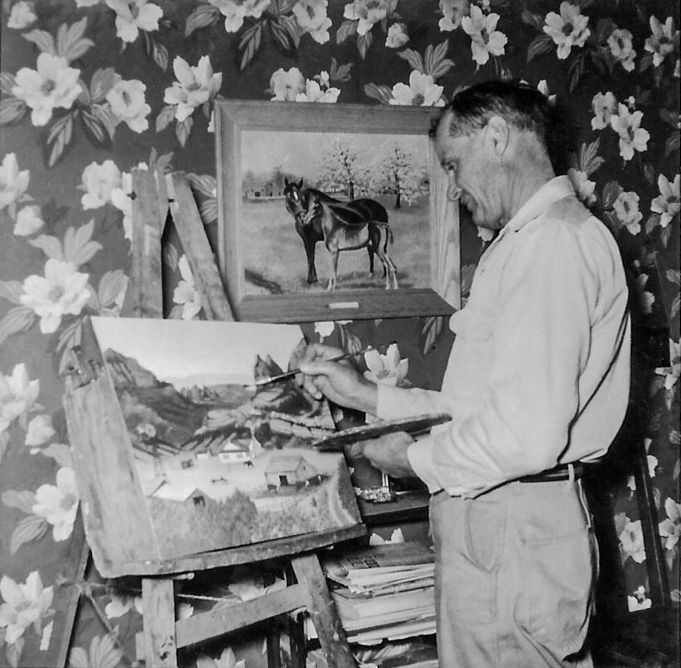
The grandchildren of Fred Mohling, pictured painting in his Aurora County farmhouse in 1957, are rediscovering his artwork and are exploring ways to share it with South Dakotans.

In 1959 Aurora County farmer Fred Mohling traveled to California for the Rose Bowl. Naturally, when he returned to South Dakota, friends and family asked about the game.

Mohling couldn’t tell them much. He hadn’t gone to watch football, he explained, but to see the roses in the famous parade. At home, in addition to selling grain and cattle, Mohling created paintings, including still lifes with flowers. Today, 40 years after his death, his descendants are sorting through his works: Midwestern and Western landscapes, people, waterfowl, horses, hunting dogs and still lifes. The family doesn’t necessarily want to sell the art but would like to exhibit some of it, maybe at libraries as a starting point. The learning curve is steep, exploring exhibition protocol, likely venues, copyright and even framing (when Mohling framed his art he sometimes purchased cheap and rather gaudy hardware store frames).

There’s another holiday season story about Mohling. Seventy years ago this December he skillfully painted a life-sized Christmas Nativity scene and other holiday images on plywood and illuminated them with 100 white and colored lights for his grandchildren. He set it up on his farm, just south of the Aurora-Jerauld County line, where it delighted more than his grandkids. As word spread, hundreds of South Dakotans drove 75 miles or more, on two-lane roads in winter, to see the scene. Memories of the Nativity art are mostly all that remain. The painted figures largely disappeared. Mohling’s farmhouse and ag buildings were razed for corporate farming, and the farmer-artist himself died in 1984.

Harmony Friends Church

His painting of a mountain scene is part of the Center for Western Studies collection at Augustana University in Sioux Falls, and another found a home in the Wessington Springs museum. But most were divided among family.”There are more than we remembered seeing around his house years ago,” says grandson John Swanson of Rapid City. He believes his grandfather completed more than 150 paintings, usually ranging from 8-by-10 inches to 16-by-20 inches in size. Another grandson, Greg Miller, notes that Mohling mostly used oils on board surfaces, and also drew with charcoal as well as colored pencils late in life.”There was something about winter scenes,” Miller says.”He looked at snow much of the year and liked it.” Miller has taken a lead role in documenting Mohling’s life through newspaper clippings and public records.

Great-grandson Ryan Aalbu of Spearfish was young when Mohling died and only vaguely remembers the man, but he treasures his paintings.”Mine are outdoor scenery and animals,” Aalbu says.”I didn’t know until fairly recently that he was a good portrait artist, too, painting people from American presidents to his own family.”

Fredrick Henry Mohling, born in 1894, grew up as the eldest of eight children on a Nebraska farm. At home he spoke German but made the mental switch to English for school. A capable student, Mohling hurried through his in-school lessons so he could draw at the end of classes, and at age 12 he won first prize for a painting he took to an Old Settlers picnic.

He married Tillie Maschman, and they had seven children, which left little time for art. The Mohlings moved to South Dakota to farm in 1920 and weathered bad ag prices that decade and the Dust Bowl and Depression of the 1930s.

The hard times led to President Franklin Roosevelt’s Works Progress Administration. Gov. Tom Berry insisted that art be part of the WPA and Mohling renewed his interest in painting by taking three classes in Mitchell. He was also inspired by a landscape artist he saw at the State Fair.

Blue Jay Wonder

Sadly, his family thinks that Mohling’s main motivation to paint was his deep grief after Tillie died suddenly from an appendix ailment in 1940. Art became his therapy, perhaps, or at least a way to occupy his mind.”When you do something requiring great attention to detail, you can’t think about other things,” Swanson says. A family member recalled coming home from a dance to find Mohling working at his easel in the middle of the night.

Still, Mohling didn’t hit his stride with art, in terms of quality and output, for a few years. There was always work on the farm. He also landscaped his big yard, created a lily pond and outdoor fireplace, and he built swings for his kids and grandkids. When Tillie died, two of his children were young adults who helped to raise the younger five. Mohling enjoyed traveling by car with his family and drove them to the Black Hills to see Josef Meier’s Passion Play, a religious drama performed in Spearfish on what was billed as the world’s”longest outdoor stage,” all of it skillfully lighted. Maybe the biblical production was the inspiration for Mohling’s own outdoor Christmas presentation.

“That could be,” Swanson says.”He liked visuals, obviously, and things built big. He drove to Texas once to see the new Houston Astrodome, which was called the eighth wonder of the world.” The family has no record as to whether Mohling saw a ballgame during that trip or simply admired the big domed stadium.

Swanson describes his grandfather as a type of man most South Dakotans might know. He was accomplished in agriculture, could build anything, and — far from the stereotype some Americans held of rural Midwesterners in that time — wasn’t cocooned in his own locality but interested in the wider world.

Mohling took enough interest in his 20 grandchildren to buy or make each a meaningful gift every Christmas, granddaughter Jane Aalbu remembers. His gifts would only get better: one of his original paintings for high school graduation and another as a wedding present if a grandchild got married.

“He was mild-mannered and soft-spoken, and fairly easy to talk to,” says Swanson, who was in his 20s when Mohling died. The farmer-artist didn’t drink except for perhaps a glass of Mogen David wine on holidays. Knowing his distaste for alcohol, his descendants have had light-hearted discussions about whether it would be appropriate to serve higher quality wines at exhibits of his art.

Through years of raising children, bonding with grandchildren, and adapting to post-World War II ag technologies, Mohling kept improving his art techniques. Swanson recalls seeing the classic Blue Boy (a portrait by 18th century English artist Thomas Gainsborough) among his grandfather’s possessions and assumed Mohling admired it and bought a print. As it turned out, Mohling copied it stroke by stroke — a time-honored method that artists have used to fine-tune their skills.

Buckeye Brown

Mohling didn’t seem interested in selling his works but in 1955 Wessington Springs hosted a horse show. Mohling loaned horse paintings to Rukstadt Hardware Store for a window display during the event. An Indiana man admired a threshing scene and Mohling agreed to sell it to him. In 1956 he won two blue ribbons at the State Fair; he’d previously taken home art ribbons from Huron but never before a first-place honor, let alone two. Those blue-ribbon paintings almost certainly remain in the family’s possession, and they hope to determine which they are.

In the late 1950s and beyond, Mohling took his art to appreciative rural audiences in Clark, Faulkton, Wessington Springs, Mitchell and Fairbury, Nebraska, near his birthplace. Plankinton journalist Adeline VanGenderen reported on a show where a woman rhetorically asked how anyone could choose a Mohling favorite given the wide variety of scenes and subjects.”We got to thinking this over, and how could you?” VanGenderen wrote.”First your eye would be drawn to a moose beside the lake; deer drinking from the stream; an Indian pony and its rider; you could almost smell the dust of the covered wagon as it groaned westward.”

If art scholars had read VanGenderen’s description, they might have concluded that Mohling was part of the Regionalism art movement, especially popular in the rural Midwest in the mid-20th century and best epitomized by Iowa painter Grant Wood. The style became popular nationally as Americans first feared that the Midwest was being blown off the map by Dust Bowl winds, and then again as they celebrated that it wasn’t.

But there’s no evidence Mohling saw his art as part of any movement or school of thought. South Dakotans tend to be skeptical of those who categorize local visual art as Fine, Folk, Regionalism or any other grouping. Most would agree with the late University of South Dakota professor and author Graham Thatcher, who warned against associating with any”sophisticated art nerd who asks you what you think in order to get an opening for his or her well-rehearsed sermonette.” Thatcher stressed, in his book I Know What I Like! Everyone’s Guide to the Arts,“There are no rules in Art Ö there is only taste.”

Mohling met the tastes of South Dakotans half a century ago. In 1974, friends and family turned out in force for his 80th birthday celebration in a Wessington Springs ag building, its interior walls decorated for the day with 80 pieces of his art.

Today, Mohling’s descendants are working to determine whether 21st century South Dakotans find significance in the art, as well. In August the family put digitized images on a video loop and played it at Mitchell’s Corn Palace Festival. They may do the same at the State Fair next year. A professor has suggested the paintings may hold value for students learning about both the techniques Mohling used and the times in which his art took form.

Relatives don’t anticipate a posthumous discovery of Mohling’s talent beyond the borders of South Dakota. They’ll be happy if small groups of observers see something in his art that warms their hearts.

That’s what art did for Fred Mohling, and it was quite enough.

Editor’s Note: This story is revised from the November/December 2024 issue of South Dakota Magazine. To order a copy or to subscribe, call (800) 456-5117.

Posted on Leave a comment

What’s in the Water at Wallace?

Wallace artists Adam and Madison Grimm are both federal duck stamp champions. Adam has won the Federal Duck Stamp Contest three times. Madison has three wins in the junior contest.

THERE AREN’T MANY ducks in Elyria, Ohio. It’s only 6 miles south of Lake Erie, but the second smallest of the five Great Lakes is hardly a South Dakota prairie pothole.

When Adam Grimm began hunting waterfowl, he and his dad drove an hour from their home in that far-western suburb of Cleveland to a public hunting area where the birds were often few and far between. It was no place to live for an outdoorsman, hunter and burgeoning wildlife artist.

Several years later, when he was married and had a daughter named Madison, he suggested moving to South Dakota, a place he’d visited as a child and had never forgotten. He spoke so glowingly of the state that his wife Janet, who’d never stepped foot within its borders, agreed to come check it out. Though it rained for five days straight, the young family was smitten and made the move.

They are now a family of six and firmly settled in Wallace, a town of 91 people in northwestern Codington County famous for being the birthplace of Hubert H. Humphrey, Minneapolis mayor, U.S. Senator and the nation’s vice president from 1965 to 1969. But the town could also rightly claim both Grimm and 17-year-old Madison among its favorite sons and daughters. They are both federal duck stamp champions, achieving success that the national art competition has never seen.

*****

Drawing was Adam Grimm’s first passion. He drew his favorite cartoons and other things he saw on television until one day Bob Ross appeared on the screen. His long-running PBS show The Joy of Painting captivated artists and non-artists alike, and Grimm began imagining life as an artist.”That Christmas I asked for oil paints,” he says.”I ended up not painting the way Bob Ross does, with the putty knife and three-inch brush, but I started to develop my own way. I achieved the look I was trying to get, and it just started to snowball.”

He sold his first drawing at age 11. His grandfather realized Grimm’s potential and Insisted on paying $20 for it.”He always had that confidence that I was going to be able to do this as a living. I remember him telling my sisters, ‘Your brother will probably never have to have a real job.’ He just had such belief in me, and I think that had a lot to do with my own thought process and thinking that I could actually do this. If I won something, he would call everyone he knew and tell them.”

Adam grew up in Ohio, where he worked at the dining room table on his early wildlife paintings.

The next year he was invited to exhibit his work at a local craft show. He sold every item he brought and went home with nearly 40 orders for drawings. He started following other artists and became encouraged that he could make a living drawing and painting.

At the same time, his passion for the outdoors blossomed after a trip to South Dakota. Grimm first became acquainted with the state through his grandfather, an avid collector of Native American artifacts. Then his father began making annual hunting trips, and when Grimm was old enough, he came along. The country was unlike anything he’d ever seen.”I didn’t know anywhere like this even existed. I think people in South Dakota take South Dakota for granted. They don’t realize that it’s not like this everywhere else. The people, the nature, it’s not this way.”

His Interests In wildlife and art finally married when he saw his first federal duck stamp, a pair of canvasbacks by Minnesota artist Bruce Miller that appeared on the 1993-94 stamp. Still a teenager, he began submitting artwork to the junior duck stamp contest, open to students in kindergarten through 12th grade. He never won, but he gained valuable experience.

Grimm enrolled at the Columbus College of Art and Design in Columbus, Ohio, though he struggled to fit in. His professors urged him to experiment in a variety of art genres, but he had a plan.”I was doing realism and wildlife art, and I told them that I would like to win the federal duck stamp one day,” he says.”No one at the college had ever really heard of it. It was like, ‘Who cares if you get a painting on some stamp?’ I remember telling them, ‘Well, it’s kind of a big deal if you win.'”

He began entering the contest as soon as he was eligible. In his first year, he submitted a painting of a mottled duck that took 16th place. The next year, his green-winged teal won eighth place. In 1999, the two species eligible for submissions were the black scoter, an ocean bird typically found in Alaska and along the Atlantic coast, and the mottled duck. He chose the mottled duck and pushed his own creative limits.

He thought back to a scene on a marsh near Timber Lake.”I had snuck up on this little water area and there were blue-winged teal out there,” he says.”The hen is pretty drab in color, but so is a mottled duck. She raised up and flapped her wings on the water, and the sunlight was shining through her feathers. That was so beautiful. If I could paint that, but with this other duck, that could win, because it would be more about the lighting on the bird than the bird itself. But I needed the reference. I was painting this in Ohio.”

Adam’s painting of a mottled duck stretching its wings won the 1999 Federal Duck Stamp Contest. He was 21, making him the youngest winner in the contest’s history.

Grimm contacted a biologist in Texas who was doing a banding project on mottled ducks and requested photos. Then, a friend sent him a mottled duck that he had shot (again, there aren’t many ducks in northern Ohio).”I would thaw the bird out the night before because I wanted that early morning lighting,” he recalls.”First thing in the morning I would run outside with this dead duck and hold it up and stretch the wings out. Then I would run back in and try to capture the colors I had just seen.

“I wonder how many of my parents’ neighbors were watching this crazy kid with a dead duck,” he laughs.”You do what you have to do in life, and there was no other way to do what I was planning on doing.”

Say what you will about his methods, his painting of a mottled duck stretching its wings in the soft sunlight of early morning finished first. At 21, Grimm became the youngest person to ever win the federal duck stamp contest.

What followed were several months of travel and delivering speeches about his artwork, which now appeared on a stamp that would be in hunters’ wallets and collections worldwide.”It’s almost like if you won American Idol,” he says.”You can go from being a nobody to being launched into the limelight. Everyone knows who you are. It’s a crazy thing.”

*****

Such a life-changing competition had humble beginnings that can be traced to legislation that another South Dakotan shepherded through Congress nearly 100 years ago. Waterfowl depletion on the Upper Plains was beginning to be a serious issue in the early 20th century. The federal government issued numerous protections, but it became clear that sustained recovery hinged on habitat protection.

South Dakota Sen. Peter Norbeck, who had already worked to establish wildlife preserves in western South Dakota and was the major force behind creating Custer State Park, became a champion of the Migratory Bird Conservation Act, a piece of legislation that had advanced in fits and starts during the 1920s. By 1929, he had a version that successfully passed through Congress. It created the Migratory Bird Conservation Commission, which approved the purchase or rental of wetlands upon the recommendation of the Secretary of the Interior. The only thing it lacked was a permanent funding source.

That came in 1934 with passage of the Migratory Bird Hunting Stamp Act, which required hunters to purchase a $1 stamp before hunting waterfowl. Ninety-eight percent of the proceeds from their sale go the Migratory Bird Conservation Fund for wetlands preservation.

President Franklin Roosevelt asked Jay”Ding” Darling to design the first stamp, which featured two mallards landing on a pond. Darling was an American cartoonist and two-time Pulitzer Prize winner who was serving as director of the Bureau of Biological Survey, the forerunner to today’s U.S. Fish and Wildlife Service. He had grown up in Sioux City, Iowa, where he developed an appreciation for the outdoors. After a year at Yankton College, he transferred to Beloit College in Wisconsin and had a successful career as an editorial cartoonist. He also founded the National Wildlife Federation in 1936.

Other artists were invited to contribute until 1949, when a contest was opened to the public. Rules, including that year’s eligible species, are released in the spring. Entries are taken from June 1 through August 15 and the winner is announced in September. A panel of five art, waterfowl and stamp experts judge the entries based on their anatomical accuracy, artistic composition and ability to be reproduced on a stamp. The winning design is featured on stamps that are valid from the following July 1 through June 30. Winners receive no compensation, but can sell prints of their work, which are highly collectible.

Today, federal duck stamps sell for $25. They are required for waterfowl hunters, and philatelists around the world are always eager to add them to their collection. The program raises about $40 million annually to conserve waterfowl habitat and, since its inception in 1934, has raised more than $1.2 billion to purchase more than 6 million acres of wetlands.

*****

With the big win under his belt, Grimm left school and became a full-time artist. Other accolades and milestones followed. In 2005, his painting of a wood duck won the competition to illustrate the Ohio Wetland Habitat stamp. Later that year, he and Janet were married.

Not long after the nuptials, the conversation turned to South Dakota.”I didn’t know if she would even want to move someplace like South Dakota,” Grimm says.”For people who enjoy nature, hunting and fishing, this area is so great. And for raising a family, this area offers so much more of the kind of life I want my kids to have. The place where I grew up just isn’t the same as it once was.”

Madison was a little girl when Adam began bringing her into the field to gather reference photographs for future paintings.

The couple and their new daughter Madison found a farm near Burbank in southeastern South Dakota and moved in 2006. Grimm quickly began taking advantage of his new surroundings. Searching for reference material in Ohio had always been a burden, but now he was surrounded by waterfowl aplenty. Donning a full ghillie suit, he began sitting in marshes and sloughs with his camera, spending hours photographing ducks in the early morning light.

They also began to notice Madison’s interest in art. Grimm recalls a particularly realistic drawing she did on a chalkboard at 2 years old.”Is that normal for 2?” he wondered.”She was our first child, and we weren’t around other kids her age, so I didn’t know what was normal for a 2-year-old. My sister is a speech pathologist and works with kids on certain benchmarks, and she said kids don’t normally do what Madison had done until much later.”

When Madison was 5, she asked if she could try to do a painting like Daddy. She found a photo of a canvasback from Grimm’s collection and began working in his studio.”She could enter the junior duck stamp contest,” Grimm said.”It’s a great contest for kids and there are a lot of prizes. I thought that would be a fun thing for her to try.”

The junior duck stamp program was launched in 1989, and the first national contest was held in 1993. Students from kindergarten through 12th grade are divided into four groups. States choose a best of show each year, and the winner is then entered into the national contest.

As Madison spent hours working on the painting, her parents worried she might not make the submission deadline. She was not dawdling. After years of watching her father, she was struggling to achieve the same realism.”I remember her crying, not because we were making her do this painting, but she was striving to reach the level where I was, and she couldn’t get there because she didn’t have the experience. She knew she wasn’t getting there, and it was upsetting her.”

Madison remembers the struggle, too.”I remember being really frustrated that it wasn’t going faster. I wanted it to be done,” she says.”I remember working on it for hours and losing total track of time. I would just get totally absorbed in the painting. Mom would come get me for supper and I’d realize that I had been in the studio the whole day.”

Adam and Madison each painted canvasbacks for their national duck stamp wins in 2013.

With her father’s encouragement, Madison finished the painting. She entered the state contest and won Best in Show.”She’s only 6,” Grimm says, his voice still reflecting the astonishment he felt 11 years ago.”I thought she did a nice job, but she’s only 6. I kept trying to rationalize it in my mind.”

Figuring Madison’s chances were slim in the national contest, the family went about their farm work on the day of judging.”It was being livestreamed, but we weren’t even watching it. I was working out in the garden,” Grimm says.”Then I got a phone call from a friend of ours and she said, ‘Madison’s doing really well. She’s at least fourth place.” So I ran in, and we had dial-up internet, so it was slow. By the time we pulled it up, she said, ‘I think Madison won.'”

With her victory, Madison became the youngest person to ever win the junior duck stamp contest, echoing her father’s achievement 14 years earlier and making them the first parent/child duo to win their respective contests. 2013 got even better for the family when Adam’s painting of a pair of canvasbacks standing on a shoreline that he entitled King’s Realm, won the federal duck stamp contest, giving him his second national win.

Madison won the junior contest again in 2020 as a 13-year-old, with a painting of a wood duck. The rules require junior winners to sit out a year after a victory, so her next entry came in 2022. She won for the third time with a painting of a green-winged teal.

*****

The Grimm family ó which has grown to include Hannah, Jonas and James ó relocated to Wallace six years ago. Adam and Madison’s shared art studio occupies the top floor of a guest house across the street from their home. The first floor accommodates hunters who come from out of state. It’s decorated with Grimm originals, including a painting that appeared on the cover of Ducks Unlimited magazine (he has twice been named the Ducks Unlimited Artist of the Year).

Madison goes photographing with her father to the sloughs and marshes around Wallace, though many of her photos are taken in the aviary that they built after her second junior duck stamp win. It houses 17 species of ducks, some bobwhite quail and a red golden pheasant that spends most of its time trying to impress the hens. In fact, the drake pintail that both of them painted for their most recent duck stamp entries lives in the aviary. Adam and Madison both finished second nationally.”You know what this means,” Grimm joked.”We’re going to have to eat that bird. Clearly, he’s not a first-place bird.”

Grimm says the wonderful people of the tiny town on the Coteau des Prairie welcomed them with open arms. Not long after they arrived, he was helping coach youth baseball and had joined the volunteer fire department. The kids have friends in town that they can see daily. And they are surrounded by ducks.”I used to drive 45 minutes to an hour away just to get to a marsh where I could try to photograph birds,” Grimm says.”Now, I can walk down the street. Even our yard has wood ducks and hooded mergansers flying through and trying to nest in our trees. Sometimes I think maybe it would have been easier to just get a regular job. But I really love what I do, painting these beautiful creatures in their natural habitat and having the inspiration right out our back door. It’s everything I want.”

Editor’s Note: This story is revised from the July/August 2024 issue of South Dakota Magazine. To order a copy or to subscribe, call (800) 456-5117.

Posted on Leave a comment

Finding Frank Ashford

Aberdeen’s Troy McQuillen became fascinated by the work of Frank Ashford at the K.O. Lee Aberdeen Public Library, which owns several oil paintings by the Brown County artist. McQuillen is searching the world for more of Ashford’s work, and hopes to answer at least some of the questions that remain about the quiet painter from Stratford. Photo by Stephanie Staab

There’s a painting in the Dacotah Prairie Museum in Aberdeen of a woman wearing a salmon-colored sleeveless dress, a floral print shawl, her left hand drawn to her chest as she gazes off the canvas directly at the viewer. Twelve years ago, when South Dakota Magazine assembled a list of paintings every South Dakotan should see, the late John Day — a widely respected art scholar and then curator of the Oscar Howe Gallery at the University of South Dakota — included Woman with a Shawl on his list of the 10 best paintings ever produced by a South Dakotan.

We know nothing about the identity of the woman and, for many years, very little about the man who painted her, even though Frank Ashford was considered among the best American artists of his time. Ashford grew up near Stratford and traveled the world, painting portraits of governors, Supreme Court justices, a U.S. president and the First Lady and other members of high society. He painted in New York, Chicago, Philadelphia, Seattle, Paris and the banks of the James River in Brown County.

Ashford likely produced hundreds of paintings, many of which have been lost since his death in 1960, several years before a young Troy McQuillen began noticing the few Ashfords hanging in Aberdeen’s public library. Decades later, those childhood memories sparked a quest to find as many of the old artist’s paintings as he can, and maybe learn something about the man along the way. Among his early discoveries? He’s not the first Aberdonian to go looking for Frank Ashford.

***

Elderkin Potter Ashford was a Civil War veteran, serving with the 23rd Iowa Volunteers at Milliken’s Bend, Vicksburg and Mobile, among other prominent battles. He moved his family to a homestead in Rondell Township, southeast of Aberdeen along the James River near Stratford in 1893. The Ashfords included his wife Cassandra, who suffered from arthritis and spent many years confined to a wheelchair, daughters Grace and Helen, and sons Ward, Fred and Frank, who was born in 1878.

The elder Ashford never lost his sense of patriotism. He hosted a grand celebration at his homestead every Memorial Day. Hundreds of people met to decorate graves at nearby Oakwood Cemetery, then heard speeches delivered from the front porch of the Ashford home. Many locals believed that Frank’s interest in painting portraits of politicians stemmed from those annual gatherings.

Just before he turned 18, Frank left Brown County for the Chicago Art Institute, where he studied drawing under Frederick Frier and John Vanderpoel. After three years in Chicago, he spent a year at the Pennsylvania Art Institute in Philadelphia and another year at the New York School of Art, studying in both places under William Merritt Chase, an Impressionist painter perhaps best known for his portraits.

Ashford’s self-portrait.

Following his studies, Ashford established a studio in Paris, where he painted for seven years. He visited home in April of 1912, sailing on a French ship called the Bretagne, which passed through the same North Atlantic iceberg field that doomed the Titanic later that same day.”We passengers aboard could not grasp the full purport of the tragedy,” Ashford told the Aberdeen Weekly News when he arrived in town in May.”It was so overwhelming, and many did not believe it until we reached New York.”

As World War I embroiled Europe, Ashford returned to the United States permanently in 1914. He spent time painting in New York, Minneapolis and Seattle before settling down in South Dakota sometime in the 1920s. A Sioux Falls Argus Leader story from that decade referred to Ashford as,”such a simple, common, everyday person, friendly and unassuming, and not at all what one would think of an artist who had lived in Paris.”

Ashford was briefly married around that time to a model he’d met in New York named Marjorie Rickel, but they divorced in 1929. Locals around Stratford believed the marriage ended because Rickel could not get accustomed to South Dakota’s rural lifestyle and was bitter about supporting her husband, who excelled in making art but struggled with financial management.

Ashford painted several prominent politicians and judges beginning in the 1920s, including Louis Brandeis, chief justice of the New York Supreme Court. He painted three South Dakota Supreme Court justices, as well as governors Andrew Lee and Charles Herreid. He later painted governors Leslie Jensen, Sigurd Anderson and Joe Foss twice, once as a politician and again as a World War II aviator.

His work was attracting an audience. In the late 1920s, he sold 11 oil paintings to be placed around the campus of the Dakota Hospital for the Insane in Yankton (today the Human Services Center). The purchase was an extension of the efforts of Dr. Leonard Mead, the hospital’s superintendent from 1891 to 1899 and again from 1901 until his death in 1920. Mead believed that creating a more welcoming environment through art and architectural beauty would help patients recover. He began an art collection with several watercolors in 1906, and the Ashford oils added to the campus dÈcor.

Perhaps Ashford’s biggest professional achievement came in 1927 when he learned that President Calvin Coolidge planned to spend the summer in the Black Hills. He asked his friend, state historian Doane Robinson, if it would be possible to have Coolidge and his wife Grace sit for portraits. The two exchanged letters, and eventually Sen. Peter Norbeck — among the architects of the president’s vacation to South Dakota — was added. The flurry of correspondence resulted in a sitting at the Custer State Park Game Lodge in July.

Remarkably, Ashford had the Coolidge paintings nearly finished by mid-August. He often said that he only needed to sit with a subject for three to five hours and could finish a nearly life-size portrait in about 10 days. Ashford produced two paintings each of the president and the First Lady. A portrait of Coolidge seated and wearing a light-colored suit and another of Grace Coolidge in a green dress hang in the lodge’s lobby. Another showing the president wearing a headdress and Grace in a red dress hang in the Calvin Coolidge Presidential Library and Museum at Forbes College in Northampton, Massachusetts.

Frank and his brother Fred (right), pictured in about 1940, were among five siblings who lived on the Ashford family’s Brown County homestead.

Ashford was happy with his Coolidge work.”The portrait of Coolidge, I think, is one of my best and it pleased him very much,” he wrote to a friend in Seattle.”Mr. Coolidge remarked that he thought it was the most satisfactory portrait that had been painted of him, which I considered a high compliment, as he had been painted by several noted artists.”

The following year, Ashford was commissioned to paint a portrait of William Henry Harrison Beadle, known in South Dakota as the savior of school lands because of his foresight to preserve two sections in each township for schools at a time when speculators gobbled up land at tremendously low prices. To commemorate the 90th anniversary of Beadle’s birth, the Young Citizens League and E.C. Clifford, the state superintendent of schools, created a plan to place Beadle’s picture in every South Dakota school. Ashford would paint the oil portrait and hundreds of prints would be made.

Ashford reportedly painted a portrait based on a photograph of Beadle, but the whereabouts of the original art and prints is a mystery.

Painting opportunities were slim during the Depression, World War II and the postwar years. Growing older and feeling lonely, he went to live with his brother and sister-in-law, Ward and Violet Ashford, in Salem, Oregon, in 1948. He became re-energized by the beauty of the Willamette Valley and painted several landscapes around the Ashfords’ farm. He also opened a studio, where he painted until returning to Aberdeen in 1956.

Ashford moved into the Boyd Apartments on the second floor of the Malchow Building downtown and settled into a routine. He met with locals for coffee and meals, and every afternoon stopped at Plymouth Clothing to visit a group of downtown business owners and friends. When he didn’t arrive on Nov. 21, 1960, they went to his apartment where they found him dead of a heart attack. Ashford was 82.

***

This story would be considerably shorter if not for the tireless work of Frances”Peg” Lamont. She spent more than a year researching Ashford for a paper presented at Augustana University’s annual Dakota Conference in 1990 and uncovered many of the aforementioned details about his life and career. Lamont served seven terms in the state senate from Aberdeen and was a longtime advocate for historic preservation, women, senior citizens and mental health. She was a founding member of the Dacotah Prairie Museum and Historic South Dakota, helped launch the Northeastern Mental Health Center and was appointed by President Ronald Reagan to the Federal Council on Aging, where she served three terms. She remained active in several endeavors until her death in 2008 at age 94.

McQuillen discovered Ashford’s Yellow Chrysanthemums at Pomona College in California.

Lamont was visiting the Black Hills with her parents, Fred and Frances Stiles, in the 1930s when she first saw the 1927 Ashford portraits of Calvin and Grace Coolidge hanging at the Custer State Park Game Lodge. It served as her introduction to Ashford, who was never far from her mind, even as she left South Dakota to attend the University of Wisconsin at Madison and found work as a researcher and copy writer for the Ladies’ Home Journal and McCall’s in New York City.

She and her husband William Lamont, a Harvard-educated fellow South Dakotan, made their home in Aberdeen after their marriage in 1937. The Lamonts became entrenched in life in the Hub City while Ashford painted in and around Aberdeen and Oregon. When he died in 1960, Ashford left 23 paintings in his apartment and the family home near Stratford. Local attorneys Hugh Agor and Douglas Bantz became the executors of Ashford’s estate and struggled to sell the art. They bought several paintings themselves and donated others to the Alexander Mitchell Public Library (today the K.O. Lee Aberdeen Public Library) and the Dacotah Prairie Museum. Lamont ensured that the two Coolidge portraits made their way to Massachusetts. Others have simply disappeared.

Nearly 30 years later, with Ashford fading into obscurity, Lamont began to wonder what became of his paintings. She launched a worldwide search and tried to learn as much about Ashford as could be discovered.”For years, bits and pieces of Frank Ashford’s life had delighted me,” Lamont wrote.”Finally came the time to write about him, but libraries, art schools and records were scarce. The search for Ashford paintings has all the elements of untangling a mystery.” Fortunately, there were still several families in and around Stratford who shared their memories of Ashford. Those interviews, along with a smattering of publications and newspaper articles, revealed a prolific and energetic artist.”It seemed that wherever he stopped, even briefly, and found an interesting client, he established a studio and proceeded to paint with vigor and enthusiasm, turning out untold hundreds of artworks.”

Lamont successfully located several of those paintings, and today McQuillen is continuing her work. He is the owner of McQuillen Creative Group, an advertising and marketing business located across the street from the building where Ashford lived his final years. He also publishes Aberdeen Magazine and wrote a story about his Ashford quest in early 2018.”I used to go to the Alexander Mitchell Library a lot when I was a kid, and his paintings were all over,” McQuillen says.”The images were just burned into my brain. Then as an adult, I started a magazine and got on the library board and really started to wonder what these paintings were about. I learned about his national and international reputation for being a pretty good artist.”

The internet makes searching a little easier, with paintings occasionally showing up on online auction sites such as eBay (a seller in Portland, Oregon, is currently offering an Ashford portrait of a boy in a cowboy outfit for $795). But there remains a lot of sifting through historical paperwork. For example, a newspaper article from the 1950s mentioned that a couple donated two Ashford paintings to Pomona College in Claremont, California on behalf of a friend. McQuillen contacted the school, which had no record of it. But staff at the college’s Benton Museum of Art searched the archives and found a still life called Yellow Chrysanthemums, dated 1916 and signed”Ashford.” The second painting remains lost.

Woman with a Shawl, among Ashford’s most famous portraits, hangs at Aberdeen’s Dacotah Prairie Museum.

Another elusive painting is The Three Sisters, a critically acclaimed work that Ashford exhibited in Paris in 1912. Records indicate that he kept the painting, and a photograph from an exhibition in Aberdeen during the late 1950s shows it hanging on the wall. But The Three Sisters was not listed among the paintings in Ashford’s estate when he died.

Other works have disappeared even more recently. During Lamont’s search 30 years ago, she documented only five of the 11 paintings that were sold to the Human Services Center in Yankton. When McQuillen inquired in early 2021, he found just three: Modern Madonna, Lincoln the Lawyer and a portrait of former administrator George Sheldon Adams.

For South Dakotans wishing to see Ashford’s work firsthand, a trip to Aberdeen in the best bet. The Dacotah Prairie Museum owns a winter landscape and six portraits: Marjorie (his wife), Fred Hatterschiedt and Ole Swanson (both local businessmen), Woman with a Green Headband, Woman with Coral Necklace and Woman with a Shawl. The museum also has Ashford’s palette, easel, his lamp for portrait painting and his wooden traveling painting case, still filled with supplies.

The K.O. Lee Aberdeen Public Library has Woman in Pink; Abraham Lincoln (based on a rare ambrotype photograph that he owned taken of Lincoln in 1858 and similar to the Lincoln portrait at the Human Services Center); Governor Joe Foss, The Aviator and War Hero; Woman at Piano; and Ashford’s self-portrait, among other works.

McQuillen has also launched a website, which includes photographs of nearly 40 paintings that he has rediscovered, with more to come.”My goal here is that if people or antique stores have paintings by him, then at least they would know who he is and what they have,” he says.

It’s a modest goal to honor an equally modest man, who should always be remembered in South Dakota’s art world and beyond.

Editor’s Note: This story is revised from the November/December 2021 issue of South Dakota Magazine. To order a copy or to subscribe, call (800) 456-5117.

Posted on Leave a comment

Pine Needle Basketry

Trisha Blair’s baskets continue a centuries-old practice that traces to the Anasazis of the Southwest.

Trisha Blair believes that anyone who appreciates the concept of making something from nothing — and who has a persistent nature — may want to try creating coil baskets from ponderosa pine needles.

Despite droughts, forest fires, pine beetle infestations and civilization, the ponderosa pine remains the dominant tree in the Black Hills. The mountain range’s very name was inspired centuries ago by its peaks and valleys forested with darkish green pine needles. The Lakota called it Paha Sapa, which translates to”dark hills.”

A typical needle grows to 6 inches over three or four years before shedding. Sometimes the mat of needles on the forest floor becomes so thick that it represents a fire hazard in dry conditions. Property owners often rake up the needles, both for aesthetics and to eliminate them as tinder. Some “green thumbers” use them as mulch in their mountain gardens.

Blair has found a higher use. Like Native Americans of centuries past, she uses the needles to create beautiful baskets — not by weaving but by coiling. The former English teacher, an accomplished oil and acrylics painter, says her art career began as a child.”We had an outdoor toilet and the four rough walls were conducive to drawing and painting, which I did. I covered them with pictures of horses and naked ladies. It seems that I liked Lady Godiva with long, flowing hair, and that’s where my art started.”

In the 1970s, Blair was studying in New Hampshire and exploring the East Coast when she toured the Smithsonian Museum in Washington, D.C. A friend was working there, so she got to enter the backrooms and see collections not open to the public, including blankets and baskets made by the Anasazis hundreds of years ago.

She held the baskets, studied the coils and noticed both their perfection and the imperfections.”I remember thinking even then that it’s something I felt I could do.”

Upon returning to South Dakota, Blair worked as a teacher and began painting pictures. Through the years, she developed a problem:”I couldn’t bring myself to sell the paintings. They are too much a part of me. I have a treasure room full of them and every relative has them hanging on their walls.”

When she embarked on basket making, a friend wondered if the baskets would end up in the treasure room with the paintings.”You know what’s going to happen,” warned the friend.”When you die, your son is going to box them all up and sell them for a quarter.”

Thanks to her friend’s honesty, Blair pledged to enter her new art phase with less sentimentality. As soon as she was satisfied with the quality of her baskets, she offered them for sale at a Deadwood art gallery.

Several years ago, she joined the Chautauqua Artisans Market, a group of artists who share a gallery on River Street in Hot Springs. Her baskets are also exhibited at Art Expressions in Custer and ArtForms in Hill City. She has sold them to appreciative buyers throughout the United States, and as far away as Russia and the Middle East.

North American basket making likely began with the Anasazi, a people known as”the ancient ones” who lived in cliff dwellings and stone pueblos in today’s Utah and New Mexico. The Anasazi mysteriously departed the area about 700 years ago, but many of their crafts and traditions were embraced by other tribes.

Blair is entirely self-taught; her encounter with the Anasazi baskets at the Smithsonian was her only tutorial.”That’s where I was inspired, though I never thought then that I would be doing it today.

“Their baskets had no knots, which is a challenge,” she says.”I also noticed that they made tiny mistakes,” which freed her from the burden of trying to perfect each stitch.”Another thing, you couldn’t tell where the coiling ended so that’s always been a goal of mine.”

Blair says coil basket making is slow and tedious.”I can spend a couple of weeks on a basket,” she says.”My son says I make 5 cents an hour.” However, like the”ancient ones,” she doesn’t do it for money. There’s satisfaction in making something beautiful from nature’s bounty. She has developed her own techniques and tricks. She even copyrighted a unique method of using a tooled leather base.

Blair believes almost anyone can learn, though it’s akin to hitting a baseball or riding a bike: you could read about it forever, but you need to see and do.

Fortunately, numerous YouTube videos and tutorials can be found online for visual learning — and Blair generously offered to explain the process as it works for her.

Needle Selection

Never take healthy green needles from a branch unless the branch is already broken and dying, and, conversely, try not to take needles off the forest floor because they may have bark lice or fungi, especially if they appear black.

“The most beautiful needles come from trees that have been stressed out by a fire or from the bug infestation,” she says.”When there is a fire that’s the first place I look.”

It’s easiest to work with longer needles; hopefully you can find some that are 4 to 5 inches long. She says pines in the Northern Hills generally have longer needles than those in the Southern Hills. If you harvest green needles, it takes a year to dry them and even then they don’t have the beauty of a needle that dries on the branch.

Blair tried a shortcut that nearly ended in disaster.”My son found some wonderful green needles, and I thought I would try to dry them in the oven.” She quickly learned why pine needles are such a fire threat.”They caught fire and I could have burned the house down,” she says.”Don’t do what I did.”

Blair washes the needles with soap and water, boils them, lays them on newspapers to dry and then puts them away until she is ready to coil. She also decaps the needles while they are wet, though she notes that some basket makers leave the caps for a more rustic look. Decapping is a laborious job, so she says you can expect friends and relatives to avoid you at that stage.

Gathering the Tools

Basket making requires pine needles, waxed thread (Native Americans used sinew, and some basket makers still prefer it), a base material such as wood or plastic, a sharp scissors, a sharp sewing needle with a large eye and a gauge to hold the coil of needles as you sew them together.

The gauge also maintains a uniformity in the coil size as you circle the basket. Some people use a 2-inch piece of 3/8-inch copper or plastic tubing; Blair simply uses a short piece of a large soda straw (again, about 3/4 of an inch wide and 2 inches long).

The base can be anything — round, square or rectangle. Nature-loving artists use a section of a black walnut shell; the natural holes in the cavity provide a way to sew it to the first coil of needles.

A round bit of plastic, wood or any other material is suitable. Drill or punch holes around the edge so it can be sewed to a coil. A 4-inch coil of needles can also serve as the base, and that’s the method described below by Blair.

Begin to Coil

Blair says the needles must be wet and flexible, so wash them and pull off the caps at the end, but don’t separate them if they don’t separate themselves (often there will be three needles to a nodule or cap).

Put about 3 feet of string on the sewing needle. Fill the tube or straw with pine needles (it will probably hold 4-6). Start wrapping the thread tightly around the needles for three inches or so, moving the tube as you go.

After you have 3 to 4 inches sewn, force the coil into a circle, bending the needles back on themselves; secure the circle by pushing the needle and thread through the circle.

Making the Bottom

Reload the tube and continue with your first coil. Each time you wrap thread around the coil, you also stitch it through the previous coil. For aesthetics, find a method to keep the threading even from coil to coil; Blair uses her thumb to measure the distance. Keep adding needles to the tube as you go, always keeping it full so the coils are an equal thickness.

Whenever you get down to about 4 or 5 inches of thread, filter the thread onto another 3-foot string. If you find it too difficult to weave one length of thread into another, you could tie a knot and then hide the knot between the coils, but remember that the Anasazi never used knots.

Once the bottom is as wide as you wish (and why not begin with a small basket?), start to slant the needle upwards so the basket will naturally go up.

Creating the Walls

You can choose to make a straight wall around the bottom or taper it by gradually sloping each coil outward. As you spiral out, the stitches should get farther apart; again, find a method to space them properly. Keep the coils tight. Once you’ve reached the desired height, stop adding needles to the tube and allow the needles to taper down. Trim the needles with a scissors if they don’t taper properly. In the Anasazi baskets, it is hard to see where the coil ends.

Don’t hurry. Blair says even experienced basket makers can spend an hour per coil.

Finishing the Basket

Blair says”the ancients” used pitch bark to seal and preserve their baskets, but today it’s probably easier to use beeswax or shellac.”I thought I would use pine sap. I burned a tank of gas, driving through the forest. Hours later I had this little wad of pitch, mostly from bark beetle trees. It was just about enough to do an eighth of a basket.” She recommends varnish, beeswax or nothing at all.

Start with a small project, perhaps even a coaster, to avoid frustration. Blair suggests that beginners do small baskets of perhaps 3-4 inches in diameter. Explore opportunities to learn online or in person at a class or workshop. Even inspecting a coil basket in your hands can inspire and educate.

Finally, Blair suggests from experience, don’t hide your pine needle crafts under a bushel basket or in a treasure room; show them off, offer them at a gallery or use them in your home.

Editor’s Note: This story is revised from the May/June 2021 issue of South Dakota Magazine. To order a copy or to subscribe, call (800) 456-5117.

Posted on Leave a comment

Making Dignity

Dignity, a 50-foot-tall stainless-steel tribute to indigenous culture, stands on a Missouri River bluff near Chamberlain. Photo by Chad Coppess

Editor’s Note: This story appeared in the September/October 2016 issue of South Dakota Magazine in conjunction with the unveiling of Dale Lamphere’s grand sculpture Dignity of Earth and Sky along the Missouri River near Chamberlain.

For a year and a half, anticipation built across South Dakota and beyond about Dignity, Dale Lamphere’s 50-foot sculpture that overlooks the Missouri River from a dominant bluff. Millions see it every year as they drive past Chamberlain on Interstate 90.

The stainless-steel statue depicts a Native woman with a star quilt and is both traditional and boldly innovative in design. The traditional: the figure of the woman whose dress, leggings and moccasins are authentic to the mid-1800s, and whose face is an amalgamation of three Lakota women Lamphere used as models. The innovative: motion and changing light in the quilt, with more than 100 blue diamond shapes that move with the wind, fluttering”like an aspen leaf,” Lamphere explains.

Rapid City entrepreneurs Norm and Eunabel McKie put more than a million dollars into the project. They speak of Dignity as”alive” and, Norm says, carrying a burden of responsibility”to inspire all people to maximize their lives, and also to combat suicide,” sadly prevalent on nearby reservations.

South Dakota Artist Laureate Dale Lamphere’s Dignity took shape during the summer of 2016.

The McKies, owners of the McKie Ford/Lincoln car dealership in Rapid City, started talking in 2008 about giving something back to the state that’s been so good to them. Norm went to another Rapid City businessman, architect Pat Wyss, and over time they discussed possible projects. The day came, Norm remembers, when he realized”we could have this iconic sculpture, on the Missouri, in the heart of the state.” Wyss remained with the project from those conceptual discussions to placement at Chamberlain. He is landscape architect for the site, incorporating the hill’s natural slope toward the highway into the pedestal. The McKies and Wyss knew that in Lamphere, they were involving not only an artist of the highest caliber, but someone who shared their deep respect for South Dakota’s Native peoples.

Dignity also contributes to South Dakota tourism, an aspect of the project that excites supporters for reasons beyond revenue. The statue shines a light on the state’s center, too often overlooked by visitors, and makes a powerful statement about modern South Dakotans’ respect for the region’s original residents and cultures.

As South Dakotans know well, these art forms can take a long time to reach fruition. In this case, though, things moved swiftly after a lunch with Gov. Dennis Daugaard where the Dignity concept was explained in detail.”Let’s make this happen,” the governor said to staff who were present. State government quickly committed to having the statue stand on South Dakota-owned land, at the busy I-90 rest area just east of the river and south of Chamberlain, a place offering a sweeping view of the Missouri, bluffs and prairie.

Lamphere gave the project instant credibility. He’s been a professional sculptor for 50 years, with his main studio in the Black Hills foothills near Sturgis. Lamphere has more than 60 major commissions to his credit across the United States, from the Basilica of the National Shrine in Washington, D.C., to art at the Eisenhower Medical Center in southern California. Recent pieces have been installed in Dallas, Kansas City, Chicago and San Antonio. In his home state, Lamphere’s work is prominent at the state capitol building and public venues from Sioux Falls to Spearfish. Human subjects range from spiritual figures to strong and resilient residents of the Great Plains, many of them women.

Over his career, Lamphere has embraced big-scale sculpture (consider his 33-foot tall Sacred Heart of Jesus and Immaculate Heart of Mary, Queen of Peace works at Sioux City, Iowa). That quality draws inevitable comparisons to two historic South Dakota sculptors — Gutzon Borglum (Mount Rushmore) and Korczak Ziolkowski (Crazy Horse Memorial). Lamphere is quick to say he doesn’t consider himself in that league, a self-assessment over which others might squabble. In 2013, the day after he was presented the Governor’s Award in the Arts for his lifetime of distinctive creative achievement, Lamphere was greeted with a long ovation in the state legislature chambers — applause any high-ranking political leader would envy. In 2015 he was named South Dakota Artist Laureate.

More than 100 blue diamond shapes flutter with the wind “like an aspen leaf,” Lamphere says.

Lamphere began creating Dignity by first drawing the form, then sculpting a one eighth-scale model. He communicated regularly with the McKies, who, he notes,”let me pursue my highest vision.”

That vision — including incorporation of light, color and fluttering movement in the quilt — stemmed almost entirely from Lamphere’s imagination.”One of the advantages of living out here in relative isolation is how I have no idea what the rest of the world is doing,” the sculptor says.”So I play around in my imagination.”

The spot where the statue began taking form, where Lamphere multiplied precise measurements from the model and transferred them to steel, is truly isolated. It’s a worksite he’s used before, about 44 miles east of Rapid City on Highway 44, near the Cheyenne River. The location makes it easily accessible to Native people who live in rural southwestern South Dakota, and many stopped by to offer encouragement.”That means a lot,” Lamphere says.

For visitors, the site felt more like a ranch where workers would gather for branding rather than creating art. The Black Hills could be seen off in the distance, with miles of golden prairie in between. About 200 buffalo roam the ranch, and stacked hay bales and tractors decorated the homestead. Dozens of colorful and loud peacocks added flair.

Lamphere fit right in at the Spirited Winds Tatanka Ranch, with his western attire and manner. A shed served as the work base, crammed with tools and home to 30 or 40 kittens and an antler collection. But in front of that shed Dignity rose, surrounded by scaffolding for workers.”They have no idea,” Lamphere quipped,”how tiring it is for me to stand on the ground and yell instructions up to them.”

The ranch is in Tom Trople’s family. Trople has been Lamphere’s chief welder for three decades. Trople had a quip of his own.”These days Dale is pretty understanding that you can’t bend metal every direction — although sometimes he wants to.” Trople has worked on about 20 of Lamphere’s large-scale works, taller than 20 feet.”During that time, Dale’s become more like a brother than employer,” Trople says.

Lamphere transferred measurements from a scale model to the stainless steel sculpture, which took shape on a ranch east of Rapid City.

The involvement of highly regarded sculptors Jim Maher, Andy Roltgen and Grant Standard made the crew something of a dream team. Another important contribution came from Brook Loobey, an automotive paint expert who tackled the challenge of experimenting with colors for the quilt’s diamond-shaped pieces and implied beadwork. He and Lamphere studied color shades in the sun and imagined how those colors might change under different shades of natural light.

Workers dealt with windy conditions along the Cheyenne, which reminded them that the wind is a factor along the Missouri, too. Early on, Lamphere worked with Albertson Engineering of Rapid City to make certain Dignity withstands the most brutal prairie blasts South Dakota can produce. Openings through the quilt, where the diamond shapes hang, help with the wind load.

In considering Dignity‘s full impact, more is at work than the intentions of the artist, benefactors and state of South Dakota. The venue — this exact bluff — witnessed complex history that is intertwined with the art’s statement. Lewis and Clark’s party camped directly across the river in 1804, and traditionally their story has been interpreted as a grand American adventure, with a Native woman playing a key role. But as historians and activists hammered home during the expedition’s bicentennial, those who followed the Lewis and Clark route brought diseases that devastated Native peoples of the Great Plains, Rocky Mountains and Pacific Northwest. Below the bluffs are a rail bed and trestle, reminders of the great political power railroads wielded in opening West River country to immigrants, greatly reducing reservation lands the Lakota people believed would be theirs forever. And the water below the bluff is called Lake Francis Case as often as the Missouri River, because dams completely altered South Dakota’s stretch of the river in the 1950s and ’60s and further stole reservation acreage.

Despite those and other historical indignities, the sculpture boldly proclaims that South Dakota’s Native cultures are alive, standing with dignity.

Posted on Leave a comment

The Modern Storyteller

Downtown Rapid City has been artist Donald Montileaux’s home base for more than 40 years.

A pencil begins to scratch across a blank white sheet of paper. The noise is barely audible, but it’s there. Donald Montileaux is drawing Mickey Mouse.”It’s a stress reliever,” Montileaux says.”My other drawings take a lot of thinking, but Mickey, he just flows out of me.” He pauses for a moment.”You probably better not put that,” he says.”Walt Disney is gone, but his corporation is still around, and I might get in trouble.”

It seems doubtful that the multi-billion-dollar Walt Disney Corporation would kick up a fuss over a guy in South Dakota scrawling out a few Mickey Mouses just to keep his hands busy, especially if they knew the impact that one tiny cartoon character had on Montileaux’s life, and, in turn, the wider world of Native American art.

In his 71 years, Montileaux never earned a dime off a bootlegged Mickey Mouse. They’re drawn simply for the delight of his children and grandchildren, or because, after several decades of making art, his hands simply want to make more, even during an interview. His true passions are Indian warriors, horses and buffalo — not brown buffalo, but painted bright red, yellow or blue. His ledger art is an extension of the tribal tradition of painting or drawing on buffalo hides. Even casual observers can see the influences of his two main mentors: Herman Red Elk and the great Yanktonai artist Oscar Howe.

His paintings hang in homes and galleries around the world — and beyond. Within the last decade, Montileaux brought his art to the pages of children’s books, first as an illustrator and more recently as a storyteller. It was a long journey that required time, patience and ultimately acceptance from tribal elders as he sought to bring a much revered and protected Lakota tradition to a new medium.

And it all started at a kitchen table on the Pine Ridge Indian Reservation, when a father took his son into his lap and began teaching him how to draw Mickey Mouse.

***

Montileaux spent the first five years of his life in a small house in Kyle, the only child of Floyd and Clara Montileaux.”My mother and father only had eighth grade educations, and they had a hard time with life,” he says.”But they knew that the only way to really achieve anything was through education, and they wanted to give me a good education.”

The family moved to Rapid City, where Montileaux’s father took a job in a sawmill and his mother went to work as a dietician at St. John’s Hospital. Montileaux attended Catholic school through eighth grade. The course offerings did not include art, which led him to consider other career paths.”When I was in eighth grade, I wrote a little autobiography and said I wanted to become a priest. My dad was Lutheran, and my mom was Catholic. Dad said, ‘Maybe we need to broaden our son’s horizons a little bit.'”

They enrolled their son in public school, and an artistic fire that had been kindled on the reservation was reignited. Entertainment had been scarce in those days, so after the evening meal, while Montileaux’s mother washed dishes, he and his father grabbed a few comic books and sat at their kitchen table.”‘Let’s draw,’ he would say to me, and he’d help me. Mom was the judge. I drew a lot of Mickey Mouse, Donald Duck and Goofy. That’s how he entertained me, but he also instilled a desire to become an artist.”

That desire blossomed at Rapid City High School.”In ninth grade, I was signing up for classes and one was industrial arts,” he says.”I just saw ‘arts’ and said, ‘Oh, I love that. Art.’ So I signed up. I walked in the door and here are all these nails and hammers and saws. I thought, ‘This is not what I wanted.’ So, I headed to the counselor’s office, and he said, ‘You want fine arts.'”

“Confrontation” features Montileaux’s brightly colored horses that seem to fly off the pages of a century-old ledger book.

Montileaux explored ceramics, sculpture, drawing, painting — every artistic medium he could imagine. He was also drawn to the Sioux Indian Museum and Crafts Center in Halley Park, a facility administered by the Indian Arts and Crafts Board of the U.S. Department of the Interior.”I was too young to be in there alone so I would get kicked out. But I would continue to sneak in because they had this Native American wax figure called Oscar. I loved that guy.”

His precociousness aside, the museum curator, Ella Lebow, appreciated his persistence and, perhaps more importantly, recognized his artistic ability. In 1964, during his sophomore year, she recommended him for acceptance in a new summer art institute held at the University of South Dakota in Vermillion under the guidance of Oscar Howe.

The opportunity allowed Montileaux to learn from the two artists who became his lifelong friends and mentors — Howe and Herman Red Elk. Red Elk was a Yanktonai, born on the Fort Peck Reservation in Montana in 1918. He became interested in art while recovering from tuberculosis at the Sioux Sanitarium in Rapid City. He enrolled in art courses at Black Hills State College in Spearfish and, through a program at the Sioux Indian Museum, studied traditional buffalo hide painting. Red Elk eventually joined the staff at the museum, where he remained until his death in 1986, and became one of the region’s most highly skilled hide painters.

Howe, born on the Crow Creek Reservation in 1915, is perhaps South Dakota’s most influential Native American artist. After studying at the Santa Fe Indian School, Howe abandoned the more traditional style he had learned there in favor of a more abstract method. His new paintings, marked by bright colors and pristine lines, helped push the boundaries of Native American art.

Howe taught at Pierre High School until 1957, when he was named artist in residence and professor of art at the University of South Dakota. He remained there until his retirement in 1980. In the early 1960s, he launched a summer art workshop designed to help students learn more about Native American art. Howe’s program lasted only a few years, but inspired the university’s current Oscar Howe Summer Art Institute, open to high school students in grades 10 through 12.

Red Elk and Montileaux traveled across the state together for Howe’s workshop in 1964 and again in 1965.”Oscar Howe was everything I wanted to be — an artist, a teacher and a family man,” Montileaux says.”He was a taskmaster and a professionalist. Before he even started drawing, he knew where those lines would go. He mentally had it in his head before he put it down on paper. So, for a 10th grader sitting in class — kind of wild and crazy and hard to stay attentive — he really had little time for me. But Herman was a mature adult, and he helped me get through that first two weeks with Oscar because Oscar was so regimented. But the second summer I went down there, I really became friends with Oscar because I had matured a little more and my drawings matured.”

Even though Montileaux had been a rough-around-the-edges sophomore in 1964, Howe could see that the young man had paid attention. Many of the techniques Howe had taught were becoming evident in Montileaux’s drawings. One night, Howe invited Montileaux and Red Elk to his home for dinner, where they met Howe’s wife, Heidi, and daughter, Inge Dawn.

“You don’t have a Lakota name,” Howe told him.”Montileaux is not a very Lakota name. So, Herman and I have been talking through the winter about a name for you. You’re like a little bird. You’re into everything. You fly all over, like a little yellow bird. So we’re going to give you the Lakota name Yellowbird. You’re going in a good direction, but you’re all over the place getting there.”

“I really feel proud of that,” Montileaux says.”Oscar and I developed a friendship. We became an extended family in the two weeks that I was there. After that, I could always call Oscar and talk to him. He was always available. After I became a successful artist and Oscar had passed away, Heidi would come to art shows and visit me. She would catch me up on the previous year. When she came into a show, everybody knew that for an hour don’t even come close to me, because that was Heidi’s and my time to talk.”

His stint in Vermillion helped Montileaux earn a full scholarship to the Institute of American Indian Arts in Santa Fe, New Mexico. After three years there, he earned another full scholarship to the Rhode Island School of Design in Providence, Rhode Island. But he soon discovered that the friendly and relaxed lifestyle to which he had grown accustomed in South Dakota and the Southwest did not exist on the East Coast. He came home and enrolled at Black Hills State College in Spearfish.

In 1970, he moved to the Cheyenne River Indian Reservation to teach elementary and junior high art.”I had wanted to be an art teacher, but I realized a teacher has not only the six or seven hours in the classroom, they devote 24 hours, seven days a week,” he says.”I had no time for my art.”

After three years at Cheyenne River, Montileaux moved back to Rapid City, hoping to find that ever elusive time to paint and draw.

***

That combination proved difficult to find. Montileaux needed a steady income, so he went to work at the Sioux Indian Museum, where he met his wife, Paulette. They were married in 1974.

In 1977, work was just finishing on the new Rushmore Plaza Civic Center. Montileaux took a job as a building foreman and was immediately thrust into preparations to host one of the most influential entertainers of all time.”I got hired two weeks before the building opened, and in less than a month we had Elvis Presley. It was just a buzz. Since I was the building foreman I got to go backstage when Elvis arrived. I was probably 5 feet from him, and I was just thrilled.”

A buffalo hunt scene from “Tasunka: A Lakota Horse Legend.”

Montileaux eventually became the Civic Center’s event coordinator and finally its assistant manager. In the meantime, he’d created an art studio in his home. But the demands of a full-time job meant he still couldn’t give his art the time it needed.”What little time I had I would go down there and try to get inspired. I always thought the pieces I produced during that period were all unfinished. They just didn’t have that quality, that polish, that they could have had if I’d had more time.”

Still, a highlight of Montileaux’s career came in 1995 when one of his paintings was launched into space aboard the shuttle Endeavour. Montileaux was looking for ways to support a program called SKILL (Scientific Knowledge for Indian Learning and Leadership), offered through the South Dakota School of Mines and Technology. Richard Gowen, the school’s president, suggested Montileaux do a painting and sell prints, the proceeds from which would help fund the program.

Montileaux produced a Badlands scene with three young Native Americans gazing into the starry night sky.”I could not think of a title for this piece,” he says.”We were at the printer and he says, ‘I’m going to push the button, we need a title.’ Everyone was talking about what they saw in the painting. I said, ‘I don’t know Ö Looking Beyond One’s Self.’ He said, ‘Man, that’s great!’ and he hit the print button.”

An engineer working on the Endeavour’s upcoming mission offered to include the painting in the shuttle’s payload, in an effort to further publicize the fundraiser. It blasted off from Cape Canaveral, Florida, on the morning of March 2, 1995. Montileaux was not there. Instead, he stepped out into his front yard in Rapid City before sunrise that morning and, at the very minute Endeavour was scheduled to launch, he looked up at the stars — just like the subjects in his painting — knowing that his work was on an unprecedented journey into the universe.

Montileaux’s painting completed 262 orbits aboard Endeavour. Upon its return to earth, it was given to the Smithsonian’s National Museum of the American Indian in Washington, D.C. Montileaux and others from the School of Mines traveled to the nation’s capital and presented President Bill Clinton with the No. 1 print.

Montileaux remained a weekend and evening artist during his 22-year career with the Civic Center.”We’d go to art shows on the weekends, and I’d always come back so inspired. Then we’d have to go to work the next day. I wished that I could be a full-time artist, and just do this.”

Finally, in 1999, at age 51 and with his three children grown, Montileaux and his wife began to consider that very possibility.”If you can make the house payment and put some food on the table, that’s all we really need,” Paulette told him. So Montileaux retired and, for the first time in his professional life, focused solely on art.

***

“I tried it and it just blossomed,” Montileaux says of the transition. One reason for his immediate success was his ledger art, a form in which scenes are drawn or painted on authentic ledger paper used by Indian agents or merchants during the late 1800s and early 1900s.”It had been dormant for so long that everyone was totally excited about it,” he says.”It was just me and about 10 other people doing it, nationwide. It was a very limited number of us.”

“Lakota Horse Nation.”

Ledger art is an extension of the buffalo hide painting tradition at which Herman Red Elk excelled.”In the wintertime, Herman would tell me stories about his drawings and what they meant and their symbols. So I tried to be hide painter for a while, but he was a master. I researched and found that once the buffalo were annihilated from the plains, Indians had no way of holding on to their ceremonies and history because they didn’t have a written language. So they did ledger drawings.

“Hides were so hard to come by, and you had to have bone brushes and rabbit skin glue and earth pigments. It was dirty and hard to do. I picked up a colored pencil and laid it on a piece of ledger paper. All of my drawings that I used to do on those hides came alive on that piece of paper.”

While he collected awards for his ledger drawings, Montileaux’s paintings truly rounded into form, particularly the horses that have become his trademark. Once again, their origin lies with Herman Red Elk, and the stories he told while the two of them worked at the Sioux Indian Museum. Warriors used to survey the land for advantageous points from which to attack enemy tribes, Red Elk said, often a small rise or a hill. As they sprinted down the slope, warriors gave a small tug on their horses’ reins. A pouch of herbs slid into the mouths of their mounts, giving the animals a burst of energy.”He said the horses would just fly off the hill and into that enemy camp. As soon as he said the word ‘fly,’ my horses never galloped or loped again. My horses fly.”

The legs of a Montileaux horse are fully extended, sometimes inches and sometimes feet above the ground. Observers can almost hear them thundering across the prairie, just as Herman Red Elk said they did. It’s a technique that Montileaux has mastered.”Herman always told me that once you put that black paint onto a hide, you can’t make a mistake. You have to know where you are going with that line,” he says.”Herman used to close his eyes and draw his horses. And now today, I can close my eyes and I can draw my horses, too. It’s something that all artists have to do. We practice our craft so much that it becomes an extension of who we are.”

In Montileaux’s case, his art is very nearly an extension of the two great mentors who shaped his career.”The design that I put down is Herman. The brilliance of my color is probably Oscar showing through,” he says.”They’re not in any way close to Oscar’s presentation. But the training, how to mix colors, how to stretch my paper when I do a watercolor, he’s there. Every time I do something, Oscar’s there.”

***

In 2006, Montileaux’s art entered a new realm when he was asked to illustrate a children’s book. Tatanka and the Lakota People told the traditional Lakota story of how the holy man Tatanka turned himself into a buffalo to help the Pte Oyate (buffalo people) survive after their emergence from the underworld through Wind Cave in the Black Hills. The text was written and edited by a group of Lakota elders and scholars. Montileaux’s paintings were done in a two-dimensional style reminiscent of buffalo hide paintings.

Stories such as Tatanka were traditionally kept within the sacred realm of Lakota oral history. Montileaux recalls many evenings as a child on the Pine Ridge Reservation spent at his grandmother’s cabin, a tiny home with no electricity, listening to grandfathers and uncles tell stories. It was often the only form of available entertainment, and they commanded the room.”When my uncle Albert came, it was really kind of a gift,” Montileaux says.”We’d all gather around him and he’d just take us away, telling us about wild horses, and Indians and all these things that had happened. And we never once thought that he was keeping a tradition alive by being a storyteller. We just thought of him as Uncle Albert coming to tell us a story. I never thought of him as a traditional storyteller, but he was.”

Montileaux read stories to youth at the 2019 South Dakota Festival of Books in Deadwood.

In 2014, Montileaux sought to bridge the divide between oral history and written stories once again, this time as both illustrator and storyteller. The idea came while visiting Alex White Plume, a Lakota elder perhaps best known for his battles against the federal government over the legalization of industrial hemp.”One night, Alex told stories. He’s a terrific storyteller,” Montileaux recalls.”He sat down and told this story and I thought, ‘My God, I’ve heard that story from my grandpas, grandmas and uncles throughout my childhood.’ It just struck a chord that I would like to write that story. And I listened to it — really listened to it — for the first time, because Alex was such a great storyteller.”

The story was about tasunka, the horse, and how these new creatures, once tamed, made the Lakota people rich and powerful. Montileaux worked on a few early drafts and shared them with White Plume, who remained unsure.”I really like what you’re doing here, but storytellers traditionally tell the story verbally,” White Plume told him.”We don’t write things down because we want people to listen to us when we tell stories. We want to make an impact on them.”

Montileaux understood White Plume’s concerns but explained that the Lakota people aren’t as centered as they once were. They live around the world and gathering for traditional storytelling sessions is much more difficult in the 21st century. They needed a new way to hear the stories that remain so important to their culture.

He went back to his Rapid City studio and finalized his text and ledger drawings. He asked Agnes Gay, the assistant archivist at Oglala Lakota College in Kyle, to provide the Lakota translation. After a rewrite that more sharply focused the story for children in second through fifth grade, Tasunka: A Lakota Horse Legend was published by the South Dakota Historical Society Press in 2014.

Montileaux brought the finished version to White Plume’s ranch near Manderson, unsure of what the elder would have to say.”His eyes lit up as he paged through it. He was pretty happy with everything. You could tell by his voice. He got done with the book and said, ‘Sit down. You got some time? I want to tell you a story about muskrat and skunk.’ So he told me the story, and then he said, ‘You know, I’ve thought about this and I think maybe you’re the one. Maybe you’re the person who does this for our tribe.’ And that was really an honor, because he accepted the fact that the book was good, and he gave me another story. But he also accepted the fact that we had to write things down to keep them alive.”

That began the latest chapter of Montileaux’s life, that of modern-day storyteller. The state historical society press published Muskrat and Skunk in 2017. This story explains the origins of the Lakota drum, once again with an accompanying translation from Agnes Gay.

Montileaux’s books reached a wider audience in 2019, when the press published all three stories in one volume called Tatanka and Other Legends of the Lakota People. As the South Dakota Humanities Council’s Young Readers One Book author, Montileaux spoke to students across the state leading up to his appearance at the South Dakota Festival of Books in Deadwood. More than 10,000 copies of Tatanka were distributed to second graders statewide.

***

Montileaux has established an artistic routine in retirement. His home studio contains everything he needs to do ledger drawings. He’s always on the lookout for ledger paper, particularly books that date between 1870 and 1930. They’re more plentiful than a person might think. They usually turn up at auction sales, or friends let him know if they see one in an antique store or elsewhere.”Every day I wake up, get my slippers on and come to my room,” he says.”I either pull out a piece that I’ve been working on or I start something new and different. Oscar Howe used to tell me, ‘Do every piece like it’s going to end up in the New York Museum of Fine Art, or even in the Louvre. Always have that attitude when you’re doing a piece, that it’s going to go far and it’s going to be there forever.’ I’ve always had that attitude.”

He keeps his painting supplies at a studio inside Prairie Edge, a store and gallery specializing in Native American arts and crafts in downtown Rapid City. He’s currently at work on another children’s book and a series of murals that will be installed inside South Dakota State University’s new American Indian Student Center sometime in 2020. Still, he wants to push his own artistic boundaries.”I really like to look at nature now. I’m trying to be that type of artist, like Renoir and CÈzanne. You know how the colors of their fields look so bold and beautiful? I want to do that, but I want to incorporate some Lakota feeling into those pieces. Maybe a medicine wheel someplace.”

The pencil scratching begins to grow fainter.”He’s got some great ears, a little nose and his hand is coming up,” Montileaux says as he puts the finishing touches on Mickey Mouse. Donald Montileaux has received worldwide accolades and awards for his books and art, but for maybe just a moment, he’s back at that little kitchen table on the Pine Ridge Reservation where it all began.

Editor’s Note: This story is revised from the January/February 2020 issue of South Dakota Magazine. To order a copy or to subscribe, call (800) 456-5117.

Posted on Leave a comment

The Cowboy’s Artist

Tony Chytka fired his sculpture of saddle bronc champion Clint Johnson in his Belle Fourche foundry.

A BLACK CAT PURRS beside a homemade kiln that would raise the eyebrow of any OSHA inspector, but Tony Chytka doesn’t seem worried.”They would probably have a fit with me, but I’m the only one out here,” he says.

“Out here” is Chytka’s 360-acre ranch, which lies in a zigzag of red dirt roads southeast of Belle Fourche along the Belle Fourche River, part of the historic Redwater Irrigation District. The peak of Bear Butte, some 20 miles away and still snowcapped on an early May morning, is just visible on the southeastern horizon. He bought the place 20 years ago. He keeps a few cows and horses and puts up some hay. Chykta also does some irrigating; piles of irrigation pipe lie near an old tin cattle shed that doubles as a foundry, where Chytka produces some of the best contemporary Western art in North America.

When we spoke, Chytka was laboring on a 3/4 life size sculpture of Spearfish native and four-time PRCA world saddle bronc riding champion Clint Johnson. When it was unveiled in August of 2019 at the Casey Tibbs Rodeo Center in Fort Pierre, it became the third and final piece added to the center’s sculpture garden, which is a tribute to South Dakota’s amazing history of exceptional saddle bronc riders.

Chytka has been on a lifelong path to becoming one of the country’s premier Western artists. He grew up on a farm west of Yankton; his surname (pronounced KIT-ka) is typical of the Bohemian families who settled that country in the late 1860s and 1870s. Growing up, he developed two passions — art and rodeo. The Chytka property also included the local saddle club arena, where South Dakota rodeo greats like Casey Tibbs performed. Chytka became enamored with rodeo at a young age. He remembers that after school at the one-room Longfellow District 11, he held on for dear life to a barrel suspended by ropes while his older brothers tugged the lines, simulating a teeth-chattering bronc ride. That led to competition in Little Britches and the high school rodeo club.

Teachers at Longfellow and the high school also encouraged his artistic endeavors. He took art classes and was introduced to sculpture during his senior year through clay modeling. While the other students were fashioning clay pots, Chytka created some 300 individual fired one-of-a-kind ceramic pieces.

After the Casey Tibbs Rodeo Center opened in 2009, Chytka donated sculptures of Casey Tibbs (left) and trick rider Mattie Goff-Newcombe.

After graduating in 1972, Chytka enrolled at the University of South Dakota in Springfield. He took as many art classes as he could and became a member of the rodeo team, competing in bull riding and bareback bronc riding. He transferred to Black Hills State University in Spearfish in 1974, where he continued studying art and rodeoing. Chytka became a contemporary of Clint Johnson, who was on the rodeo team at South Dakota State University in Brookings.”He was a very strong rider,” Chytka recalls.”Very positive and an easy-going guy. Always had a chuckle to him.”

Drive around Belle Fourche and you’ll see evidence of Chytka’s success in Western art. Sculptures honoring brothers Marvin and Mark Garrett, two of the nation’s best bareback bronc riders, stand at the corner of Sixth and State streets. Another Chytka creation called Legacy, placed along Highway 85, was completed for the South Dakota centennial in 1989. Chytka has also memorialized Jerry Olson, a former rodeo clown and bullfighter from nearby Fruitdale, and his tribute to 1920s trick rider Mattie Goff-Newcombe can be found in Sturgis.

Chytka’s pieces are part of private collections around the world. Several are on display at the ProRodeo Hall of Fame in Colorado Springs, Colorado. So when the Casey Tibbs Rodeo Center was becoming a reality in the mid-2000s, and its directors sought art to place inside, they turned to Chytka, who donated two pieces that greet visitors as they enter: Casey Tibbs in the moments leading up to a bronc ride and Goff-Newcombe performing at the Faith Fair and Rodeo in 1928.

“He’s really a perfect fit,” says Cindy Bahe, longtime director of the center.”He’s a rodeo guy and rode broncs, so he knows exactly the stature of the cowboy and the animal. They are pretty true to life.”

The center sought Chytka’s expertise again when planning began for a sculpture garden overlooking the Missouri River. Johnny Smith, a former board member of the Casey Tibbs Foundation, was particularly proud of South Dakota’s saddle bronc riding champions and wanted to honor the very best. Plans called for three sculptures, all produced in Chytka’s Belle Fourche foundry. The first, placed in 2013, depicts Ree Heights native and five-time world saddle bronc riding champion Billy Etbauer scoring 89 atop Painted Valley at the 2009 Cheyenne Frontier Days. The second, added in 2018, is Casey Tibbs on The Old Gray Mare, honoring his performance at the Cheyenne Frontier Days in 1949, the year he won his first of six world saddle bronc riding championships. Clint Johnson, a four-time world champion, took his place in 2019.

Legacy, completed for the state centennial in 1989, was Chytka’s first large-scale piece. It stands along Highway 85 in Belle Fourche.

For Chytka, the creative process begins with a pose that perfectly encapsulates the subject and the context of the piece.”Then I’ll use other photographs to try to get a three-dimensional draw from it,” Chytka says.”It’s really hard to work off a flat surface when you’re working three dimensionally. That’s what’s unique about it. You can walk around to the other side and see the depth of it.”

Those drawings eventually become a table-size clay model on which Chytka does the brunt of the shaping and sculpting.”That’s where you do all the designing, work out all the detailing and that type of thing. There are certain guides you can use for the length of the horse’s head, the legs. A lot of it is just the view. I like to just stand back and see it all together.”

Over the next four to six months, the project goes through various stages. A rubber layer is applied on the outside of the clay, and then plaster of Paris on top of that. The process yields a wax version of the sculpture, and a ceramic shell is built around it. When the wax is melted, the shell is ready to receive molten bronze from Chytka’s homemade kiln.

Chytka brought his pieces to other foundries until 1984, when he learned the process himself at a foundry in Bozeman, Montana.”The casting process has always intrigued me,” he says.”When you use commercial foundries, pretty soon all the work from that foundry starts to look the same. There’s just as much art in the foundry process as the beginning sculpture.”

His kiln, fueled by propane and powered by a Kirby vacuum motor, heats the bronze to 2,200 degrees. It’s a two man pour, he says, meaning a man at each end of an 8-foot-long metal tong holds the piece as it’s dipped into the furnace (the 10-foot tong was too hard to handle, he explains).”After it cools you can hit the bottom of the shell with a hammer and you aren’t going to hurt it,” he says.”The permanence of it is something I always liked.”

Chytka sculpted Johnson atop Kicking Bear, the horse he rode to win his fourth championship in 1989 (his previous titles came in 1980, 1987 and 1988). Visitors who attended the unveiling surely appreciated its artistic merits, but when old cowboys — and even Chytka himself — glance into the horse’s eyes or see the way Johnson sits in the saddle, they might be transported to their old rodeo days. There will be features that only those who’ve landed on their backside in the arena will notice.

“There are little things. Positioning, the equipment, the action and that kind of thing,” Chykta says.”I’m not hung up too much on detail, just as long as it flows. But when somebody who does know rodeo says, ëHey, you did a good job on that,’ then that means just that much more, coming from people who have been there.”

Editor’s Note: This story is revised from the July/August 2019 issue of South Dakota Magazine. To order a copy or to subscribe, call (800) 456-5117.

Posted on Leave a comment

400 Roses

Kristine Reiner’s art career bloomed with the gift of 400 unwanted roses.

Somewhere there’s a young man who probably feels he wasted his money on 400 roses. His investment didn’t have the intended effect — which, of course, was to impress a particular young lady — but the roses have led to a lot of good in South Dakota.

It all began a half-dozen years ago when Kristine Reiner was studying art at the University of Sioux Falls and politely telling a boy that she wasn’t interested. With a final flourish of hope and desperation, he called a Sioux Falls florist and had 400 roses delivered to her. Four hundred divides into 33-and-a-half dozen; her tiny college apartment was red with flowers.

Reiner wasn’t raised to throw things away. She grew up in Canistota, the youngest of three daughters of a single mom. Even though her dad was in prison for drug use and her mom struggled to pay the bills, she remembers her small-town childhood with a smile.”As the youngest, I spent a lot of time alone,” she says. But that gave her time to think and dream and draw. In high school, art teacher William Cavill encouraged her.”He told me I could make a living by being creative. He was the first person to believe in my art.”

With that confidence, she enrolled at USF in 2012 and there she met Ceca Cooper, an art professor known for challenging students on the boundaries between man and nature.”I realized I was there to learn the rules of art so I could break them,” Kristine says. In her senior year in 2016, she was seeking inspiration for her final art project, while also trying to distance herself from that persistent suitor.

That’s when the roses arrived. They filled her little apartment, both in space and scent.

With her”waste not” mentality, she couldn’t bring herself to throw them in the garbage.”They wouldn’t have fit in the dumpster anyway,” she says. At first, she and a friend went to Wiley’s Bar in downtown Sioux Falls and sold them to guys who didn’t need to buy in bulk because they already had girls at their side. She netted $180, but she still had a lot of roses.

“I just couldn’t throw them away,” she says.”I always loved roses. That’s probably why he sent so many.” She sat at home, surrounded by the flowers while also trying to imagine her final art project. It’s probably not shocking that she eventually brushed a rose against the canvas. She began to experiment with the flowers, not just as brushes but as elements within her paintings. She squished them and squeezed them. She broke boundaries.

Reiner’s work is inspired by, and sometimes made from, roses.

Kristine Reiner is now a burgeoning Sioux Falls artist. She works as a graphic designer by day, teaches evening art classes and just finished a mural commissioned by the city at Eighth and Main. She’s also a community activist.”I love Sioux Falls. It’s my favorite city,” she says, because she feels support, just as she did while growing up in Canistota.”Artists have such an opportunity here because anyone can meet anyone anytime. You don’t have to be someone to have a chance.” The people of Canistota are still helping her as well; Sue Baxa, who runs a restaurant in the historic Ortman Hotel, exhibits Reiner’s paintings on her walls.

While Reiner continues to create — with clay, screen printing and often still painting with roses — she also practices her creativity on social issues. When she learned that some South Dakota school children were”lunch shamed” (refused food because they owed lunch money) she and her sister Brandie started a nonprofit called Cathy’s Place to help families pay school debts.”We didn’t always have enough money for lunches and activities when I was a kid, and there were always people who helped us,” she says, particularly a lady named Cathy Steinmetz. They’ve created a Facebook page, and a website is coming. The nonprofit also helps teachers buy school supplies.

When the pandemic of 2020 forced Reiner to cancel her art classes, she used the free time to sew designer face masks. They became a hit with friends, and now she sells them on her website, kristinereiner.com.

The coronavirus also interrupted the corporate food chain, and she lamented the dilemma of farmers without a market. The crisis crystallized when her boyfriend, Damon Brown, learned that his family in Minnesota had been approached by the federal government for land to bury livestock that couldn’t be marketed. Together, they founded Cash Cow Co-op, an online directory that links farmers with families who want to buy local foods. They’ve already made connections across the Dakotas, Iowa and Minnesota.

All who like happy endings are wondering if Brown is the same guy who gave Reiner the 400 roses. He is not, but he shares her passion for making South Dakota a better place through creativity. What could be happier than that?

Editor’s Note: This story is revised from the January/February 2021 issue of South Dakota Magazine. To order a copy or to subscribe, call (800) 456-5117.

Posted on Leave a comment

Put it on the Board

A few local artists are etching their mark on the Rapid City art scene — in chalk.

Chalk art is an integral part of the mise en sc’ne of today’s American metropolis. At least in certain neighborhoods, chalkboards are one of the many types of space where the interests of local businesses and local artists converge — where artists take something fairly mundane, like the price of a cup of coffee, and make it into something beautiful.

For some residents of Minneapolis or Denver, chalk art may begin to fade — among the crush of symbols — into visual ambience. Not so much in Rapid City where the medium still feels new.

Rapid City native Christie Harris does chalk gigs for local businesses — like Klinkeltown and Essence of Coffee — when she’s not working as the studio manager at Canvas 2 Paint, a community arts workshop and studio.

She free hands drawings with a pencil outline, then emboldens them with chalk. She enjoys creating something unique to a particular place.”It’s a completely custom — to that business — piece of art,” says Harris.”You could order some kind of vinyl sticker or something, but it’s not handmade. You don’t see those little quirks.”

Laurel Antonmarchi is a freelance graphic designer. Chalk art is part of her toolkit for making it as an artist. SDPB recently caught up with her as she was touching up, and making permanent, a chalk mural at Cranky’s Bike Shop. A native of Armour who studied art at Black Hills State, Antonmarchi has also hosted a chalk art workshop for kids in Main Street Square.

“I like chalk because I can get my hands dirty with it,” says Antonmarchi.”It really gives a human element to the atmosphere.”

The quirkiness can be refreshing in a town dominated — outside downtown — by the familiar iconography of big box stores and chain restaurants. Chalk art’s origins can be traced back to the madonnari of 16th century Italy — artists-for-hire who often paid tribute to a famous personage in Christian circles. Sacred motifs are steadily losing ground to the gods of commerce. Today’s apple is symbolic only of Applebee’s. But chalk artists still manage to inject a little humanity into our transactional day-to-day.

“I love all the little imperfections,” says Antonmarchi.”It shows that a real person made it.”

Michael Zimny is the social media engagement specialist for South Dakota Public Broadcasting in Vermillion. He blogs for SDPB and contributes arts columns to the South Dakota Magazine website.