Posted on Leave a comment

Easy Summer Salad

Today I ate lunch at the Open Door in Menno. It’s been years since I’ve visited the tiny, pretty town located near the James River. My dad told me that people used to come from miles around on Sundays to drink a cold beer in Menno’s very popular beer garden, which was more like a back alley than a garden.

These days people still gather on Sundays in Menno, but it’s for the brunch at the Open Door, not a beer party. The restaurant is run by Rita Hoff and is open seven days a week. Rita features German food on Tuesdays so today I tried some fleisch kuechle, knoefla and saurkraut. We’ll have a story on Rita’s German cooking in the September/October 2011 issue.

Besides making German dishes on Tuesdays and the large brunch on Sundays, Rita features homemade kuchen and donuts on Thursdays. All her food is made fresh daily, including the seven or eight salads she had featured when I stopped today. The pea salad was my favorite and I asked for the recipe (below). Rita said it was one of her easier recipes, and most popular.

Pea Salad

2 cups cooked macaroni
1 can peas, drained
Ω cup green sweet pickles
Ω shredded cheddar cheese
1 cup chopped celery
1 cup salad dressing
2 tablespoons sugar

Mix all ingredients and chill before serving.

Posted on Leave a comment

Zucchini Brownies: Hold the Eggs

Bakers have bombarded the South Dakota Magazine office with phone calls after reading the feature in our July/August issue about our office zucchini cook-off. Departments Editor John Andrews submitted a recipe for zucchini brownies, a dish that doesn’t exactly feature the vegetable but may be one of the tastiest ways ever devised to get rid of a cup or two.

Seasoned bakers believe we made an error in printing the recipe because it doesn’t include eggs. He freely admits he’s not an expert in the kitchen, but it’s no mistake. When you combine the ingredients, the mixture will be quite dry, but as it bakes the zucchini releases moisture. The result is a rich, fudge-like brownie.

Some bakers have told us they’ve added eggs anyway, which is fine. The brownies will be lighter, more like a chocolate cake.

For the brownie recipe or the other five cook-off recipes, call the magazine office at 1(800)456-5117 to purchase a copy of the July/August issue or click here.

Posted on Leave a comment

JazzFest Melts Sioux Falls

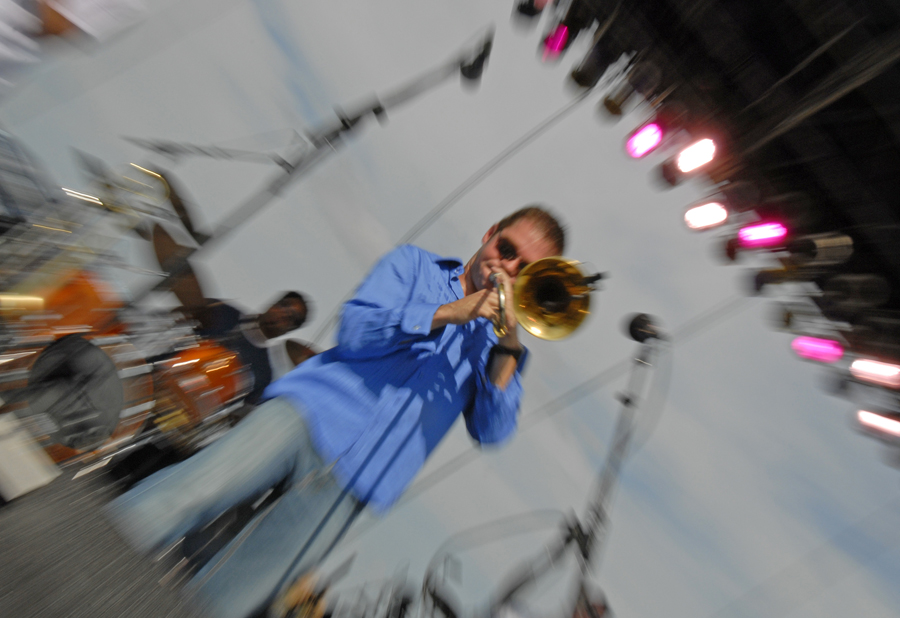
Bonerama, a trombone quartet from New Orleans, performs at JazzFest in 2007. This year’s headliners include Indigenous, Terrance Simien & the Zydeco Experience and Little Feat. Photo by Chad Coppess.

Sioux Falls’ weekend of hot weather and hot music is here! JazzFest kicked off last night in Yankton Trails Park with headliners Indigenous and the Fabulous Thunderbirds. The annual event, organized by the Sioux Falls Jazz and Blues Society, started as a backyard party with 250 fans and musicians. The free festival now draws up to 100,000 people from around the region with two stages, a kids’ area and a 5k run/walk. And it’s a”party with a purpose.” Proceeds from beer, pop and water go towards the educational programs put on by SFJB.

If you’re not into jazz there are a lot of other genres performing — even rap. My husband and I plan to check out our favorite folk/pop band, We All Have Hooks for Hands (below), on Saturday night. Here’s Friday and Saturday’s schedule if you’re going. I’ve tried to classify their sounds, even though it’s getting harder to do these days.

Friday:

Main Stage
6:00 pm — Sharon Little (blues/soul)
8:00 pm — Anders Osborne (blues)
9:30 pm — Little Feat (rock)

Second Stage
6:00 pm — The Union Grove Pickers (folk/bluegrass)
7:30 pm — Wumpus (alternative rock/psychedelic country)
9:00 pm — Pasque (Americana/rock)

Saturday:

Main Stage
12:00 pm — Elisabeth Hunstad (jazz)
1:30 pm — JazzFest Jazz Camp featuring Allen Vizzutti
3:00 pm — Mike Miller Trio (jazz)
4:30 pm — Maraca (jazz fusion)
6:00 pm — Jeff Lorber Fusion (jazz fusion)
8:00 pm — funky METERS (Afro-beat/funk)
10:00 pm — Terrance Simien & the Zydeco Experience (zydeco/cajun)

Second Stage
1:30 pm — Diischer-Pederson Trio (jazz)
3:00 pm — Kepler’s Theory (fusion pop)
4:30 pm — Charles Sanders Quintet (jazz)
6:00 pm — Chris Champion Group (jazz)
7:30 pm — We all Have Hooks for Hands (folk/pop)
9:00 pm — Soulcrate Music (hip hop/rap)

Children’s Area
1:30 pm — Washington Pavilion’s Science of Sound
2:00 pm — Phil Baker
3:00 pm — Creole for Kidz & The History of Zydeco with Terrance Simien
4:30 pm — Phil Baker
5:30 pm — The Coopers/Instrument Petting Zoo
6:30 pm — Washington Pavilion’s Science of Sound

Visit the JazzFest website for information.

Posted on Leave a comment

Hot Springs’ Square Thinker

People believed for centuries that the earth was flat. Hot Springs businessman Orlando Ferguson thought it was”square and stationary,” and believed it so vociferously that he delivered a series of lectures on the topic and printed maps to visualize his idea.

Ferguson has been in the news lately because an original copy of his map, printed in 1893, turned up in the home of Don Homuth, a retired North Dakota lawmaker who now lives in Salem, Ore. The map resembles a bundt cake pan turned upside down. The continents and oceans lie around an indented ring, while the North Pole is raised in the center. The sun and moon are attached to an actual pole rising from that point. Homuth donated the map to the Library of Congress. Now the Internet is abuzz with stories about this relatively unknown West River character.

Ferguson was born in Illinois and moved to Miner County in the early 1880s. The family later relocated to the Black Hills and established themselves in Hot Springs in 1886. There he managed the Catholican bathhouse for several years before he built his own, called the Siloam, which he operated until his death in 1911.

Ferguson referred to himself as both”doctor” and”professor,” but Fall River County historians can’t find any evidence that he was either one.”There’s no indication that he was a professor in any academic sense of the word, other than he professed to know the truth,” says James Bingham, president of the Hot Springs Pioneer Museum’s Board of Directors.”And we’ve found nothing to indicate he went to medical school. He simply claimed to be a healer of some kind with his bathhouses.”

His astronomical principles were based on a very literal interpretation of the Bible, beginning with the reference to angels visiting the four corners of the earth. From there, he developed his”square and stationary” idea, which he detailed for audiences at Hot Springs’ Morris Opera House in 1891. From those lectures, he wrote a 60-page pamphlet, full of other theories. He claimed the sun was 30 miles in diameter and just 3,000 miles from earth. His reasoning? If you stand at the equator on March 21, when the sun is directly overhead, then the distance you can walk north or south without casting a shadow is equal to the diameter of the sun.

He also shunned the idea of gravity. Instead he thought atmospheric pressure held people down and pushed the oceans up the sides of his indented map.

Today people debate the merits of Ferguson’s beliefs. Many are surprised that anyone in the 19th century would contend the earth was anything but a globe. Some wonder if he had ulterior motives.”For a long time, when I looked at that map, I wondered if he was just throwing it out there for entertainment value,” Bingham says.”But now I think he was serious.”

The Pioneer Museum has an original map and a copy of Ferguson’s pamphlet. Visit and judge for yourself.

Posted on Leave a comment

Almost Tomato Time

I’ve never canned vegetables before but I’m determined to start this summer. My motivation is a New York Times review I recently read on the book “Tomatoland” by Barry Estabrook. I’ve always known that store-bought tomatoes aren’t as tasty as garden-grown, but I didn’t know that tomato farmers in Florida (where the majority of supermarket tomatoes are grown) are actually prohibited from growing tasty varieties because their color and shape don’t conform to what you would typically see in a store. Or that the tomatoes don’t dent or splat if they happen to roll off a speeding shipping truck onto a highway. Or that a pink color is gassed into green tomatoes to obtain the color we see in stores. Or that 100 herbicides and pesticides are used to just get them to grow out of Florida’s nutrient-deficient soil. The list goes on… many workers report being sprayed with toxic pesticides and migrant and child labor laws are broken just so we can have a red tomato in the off season.

All this information has me determined to begin canning this summer so I have some healthy tomatoes to for the winter months. I’m lucky to have some tomatoes growing in the backyard, but if you don’t, try visiting one of the farmer’s market’s around the state. Here’s a good directory. Or visit Dakota Rural Action’s online “Local Foods Co-op” page. The co-op is a way for consumers to connect with local farmers and producers so they have an opportunity to buy fresh foods.

Although “Tomatoland” doesn’t seem like a fun summer read, I’m planning on getting a copy to learn more about our tomato supply. In the meantime I hope we have a bumper backyard crop.

Posted on Leave a comment

Gentlemen, Crank Your Engines

Members of the Tri-State Old Iron Association showed their patriotism yesterday at Yankton’s Paddlewheel Park. Photo by Dave Tunge.

Today is the kick-off of the Tri-State Old Iron Association’s annual ride. Yesterday, Yankton aerial photographer Dave Tunge shot this patriotic photo from his Piper Cub.

The annual ride may be the slowest procession on wheels, paling speed-wise to South Dakota’s more famous Harley and Corvette rallies. But antique tractor parades are becoming a summertime tradition in South Dakota, and the granddaddy of them all is the Tri-State Old Iron Associations annual ride on the second weekend of July.

The tractor-lovers gather in Paddlewheel Park near the Missouri River shores in east Yankton. Over the weekend, they embark on two long rides — on in Nebraska and the other in South Dakota. Tractors must be able to cruise at 12 miles per hour to qualify. “Remember, it’s a ride, not a race,” reminds the leader in striped overalls and a seed corn cap.

Many of the tractor owners are current or retired farmers who, as kids, probably grumbled about having to steer the tractor once around the North Forty. Now they ride all day just for fun. Some tractors are equipped with an extra seat for the wife or girlfriend. One enterprising fellow rigged a cushy sofa to his three-point hitch so “the missus” could ride along in style.

A few tractors appear as if they just came from the cornfield, but most look better than the day they left the factory, ablaze with the bright colors used years ago by manufacturers to differentiate their brands. In the evenings everyone is welcome to browse the tractors at Paddlewheel Point, where more than 200 will be parked in neat rows. The public can also see and hear the tractors at 6 o’clock Friday night when they parade through historic downtown Yankton.

To stay abreast of the Tri-State Old Iron Association’s activities, follow the website of WNAX Radio, a pioneering farm radio station that went on the air in Yankton in 1922 after getting a license from President Herbert Hoover. WNAX is a major sponsor of the tractor ride.

Posted on Leave a comment

Finding Crow Peak

The Black Hills of South Dakota are a hiker’s dream — as long as you can find your trailhead. My husband and I learned this lesson on our first visit to Crow Peak last summer. We got up early feeling optimistic about our day. We’d hike the trail near Spearfish in the morning and then have the afternoon to do whatever we wanted, maybe even hike Harney Peak if we felt ambitious.

Google Maps had driving directions, but we found a hiker’s blog that gave the gps coordinates of Crow Peak.”What a great idea,” we thought and entered them into the Garmin. Do not try this! Our navigator took us on a winding trip through gravel logging roads, continually shouting”recalculating.” We soon realized it was trying to get us to the actual peak and not the trail. Even worse — we hadn’t realized we were nearly out of gas.

We reset our destination point as our hotel, but the Garmin insisted we were not even on a road. Resigned to the fact that we had been led astray, we turned it off and used our brains to get us back to Spearfish — placing bets on whether we would run out of gas. Luckily we didn’t.

We found the trailhead three hours later than planned and it was totally worth the hassle. The hike was beautiful and the view at the top was amazing!

Do not let my story discourage you. The Crow Peak trailhead is actually easy to find — take Hillsview Road from Main Street in Spearfish and head west. From there, take Forest Service Road 214 approximately 7 miles southwest of Spearfish. There is a small parking area. No sign is immediately visible but a small green gate opens to the trail. I encourage you to give it a try!

Posted on Leave a comment

The Capital Man

John Sutherland helped Pierre become the capital of South Dakota. Then he did it again. And again.

Between 1889 and 1904, Sutherland served as president of his hometown’s capital committee, and waged three successful campaigns to locate the seat of government in the budding town along the Missouri River. On Saturday, July 9, the state historical society plans to recognize Sutherland’s contributions to South Dakota history by dedicating a marker at his former home on the corner of North Huron and West Capitol avenues.

Not much has been written about Sutherland and his capital crusade, but Marshall Damgaard covers the topic well in The South Dakota State Capitol: The First Century, his book on the history of our capitol that appeared just in time for its centennial.

In the first campaign in 1889, Sutherland boasted of Pierre’s central location (once the Great Sioux Reservation was opened) and its spot along the Missouri River, which still carried numerous boats from Yankton to Bismarck. Supporters of Huron for the capital countered:”Pierre says she is a geographical center. Well, so is the North Pole, but although it is nearly as accessible as Pierre, no one seems to think of calling any public gathering there.”

In October, Pierre won a six-way battle for temporary capital status. But after statehood came in November, voters had to select a permanent site. Damgaard writes that Sutherland placed 40 campaign coordinators around the state and kept them”well-stoked with funds to ply voters with drinks and theater tickets.”

Sutherland earned his living as a well-respected and successful lawyer, so it’s a bit ironic that he was a major player in a 15-year fight that involved so many under the table deals. After Pierre emerged victorious again in the 1890 fight, Sutherland was asked if he thought either side had committed voter fraud. He said no, but also said Pierre was ready. In one empty precinct,”the committee had ballots marked and voting registers filled with names copied from the society page of a Saint Paul newspaper ready to use if necessary.”

Measures to move the capital surfaced in every successive legislative session until 1904, when legislators decided to put the matter to a final vote of the people. This time, lawmakers chose Mitchell to challenge Pierre. Sutherland again sent operatives across the state, but told them only to buy votes unless it negated a similar action by the Mitchell men. Railroads issued thousands of passes for people to visit each town, but Sutherland’s Stand Pat for Pierre campaign emerged victorious for the third and final time.

Posted on Leave a comment

Mt. Moriah is a Must See

I was appalled when we worked on last year’s”25 Very Unusual Man Made Places” article. There was an attraction in Deadwood I’d never visited! Practically every one of my childhood vacations were to the Black Hills. I’ve been to all the major stuff. Heck, I’ve seen poet laureate Badger Clark’s cabin at least three times. But Mt. Moriah, Deadwood’s famous cemetery that opened in 1878? Never heard of it. How embarrassing.

A quick weekend vacation to Deadwood rectified the faux pas. My husband wanted to go hiking, so I convinced him that walking around a graveyard on a mountain was pretty similar. Admission is only $1 for adults and $.50 for kids. You get a handy map with descriptions of the most popular stops. Our first visit was the graves of Wild Bill Hickok and”Calamity Jane.” Rumor has it that Jane’s dying wish was to be buried next to Hickok, though he supposedly didn’t care for her that much.”Have you ever seen a picture of her!?” Jeremy said. I guess she wasn’t much of a looker. Men!

The grandest plot belongs to Seth Bullock. The first sheriff of this old mining town asked to be buried above Mt. Moriah. His grave faces Mt. Roosevelt, named for his friend and our 26th President, Theodore. Bullock is buried 750 feet above the main portion of the cemetery and the guide warns that the walk is quite steep. A little strenuous but I handled it OK in flip-flops. It’s an impressive resting place even if the view is now obscured by Ponderosa pines.

Once down the hill we visited Blanche Colman’s grave. She’s slightly lesser known but no less impressive. The German Jewish immigrant graduated from Deadwood High School in 1902 then worked in Washington, D.C. for a South Dakota congressman. Colman was homesick for the Hills so she returned to take a job in the law office of Chambers Kellar, Seth Bullock’s son-in-law. She never attended college but studied law independently and became the first female lawyer in South Dakota. She was admitted to the South Dakota Bar at age 27. Colman is buried on Hebrew Hill, a special Jewish section, along with about 60 others.

Many more notable characters rest in this unique Black Hills cemetery, but I don’t want to spoil it for you. You should visit for yourself. Oh, and I asked my mom why we’d never visited. It turns out we had and I just forgot … still a bit embarrassing!

Posted on Leave a comment

Bringing Life to Rushmore

Every year, millions of people gaze upon the four faces at Mount Rushmore. Most visitors could tell you that Gutzon Borglum designed them. But almost nobody knows the Italian immigrant who gave them life.

Luigi Del Bianco was Mount Rushmore’s chief carver from 1933 to 1940, but his role in creating the monument was nearly forgotten. When his son Caesar read Rex Alan Smith’s 1994 book The Carving of Mount Rushmore, he was shocked that his father’s name was nowhere to be found.

“That frustrated my uncle and myself so much that we went to the Library of Congress to look through Gutzon Borglum’s papers,” says Lou Del Bianco, Luigi’s grandson and Caesar’s nephew.”We found correspondence from Borglum about my grandfather’s importance, and how he couldn’t find anyone else in America to do this work. Whenever he quit the monument because of problems with wages, all work would have to stop. That’s how important he was. He was really the artist who brought the faces to life. The workers did a wonderful job roughing them out, but you need an artist to bring out the emotion in the faces, and that’s what my grandfather did.”

Lou Del Bianco has been an actor and storyteller for 25 years. He created a one-man show and a website to tell his grandfather’s story, and will present it inside Borglum’s studio at Mount Rushmore on Sunday, July 3.

Lou learned about his grandfather’s work in second grade, when he found a tattered Mount Rushmore brochure.”From then on, it’s been a dream of mine to find out what he did and get him more recognition,” he says.”I feel like my entire career has led me up to this moment.”

Luigi Del Bianco studied stone carving in his native Italy. He settled in Port Chester, N.Y., after World War I, and began working in Borglum’s Connecticut studio. They worked together for the next 20 years, a remarkable stretch considering Borglum’s proclivity for firing people at the drop of a hat.”They argued quite a bit, but it was part of their relationship,” Lou says.”They had great mutual respect for one another, and in the end they loved each other.”

When Borglum made Del Bianco chief carver at Mount Rushmore, he said Luigi was”the only stone carver on the work who understands the language of the sculptor. He is worth any three men I could find in America.”

Del Bianco saved Jefferson’s face by almost seamlessly patching a crack one foot wide in his lip, and made Lincoln’s eyes come alive.”I could only see from this far what I was doing, but the eye of Lincoln had to look just right from many miles distant,” Luigi told an interviewer in 1966.”I know every line and ridge, each small bump and all the details of that head so well.”

After Mount Rushmore’s completion, Del Bianco returned to Port Chester, where he carved tombstones and set statues. He rarely discussed his work in South Dakota, but his craftsmanship on a Black Hills mountain will exist for generations.