Posted on Leave a comment

End of the Deerfield Chapter


Deerfield Store had been shuttered for 10 years we met Tom Sawyer in 2005. He was living in the old building, deep in the Black Hills, with a tabby-colored old tom cat. His wife, Sherrill, had died a few years earlier.

A “Closed For Good” sign hung out front but it didn’t deter old customers and friends from stopping to say hello. Tom’s living room was the main store. Shelves still rose above the old wood floors. A piano, once the center of attention at many impromptu parties, was gathering dust in the corner.

Sherrill, who had studied music in California, was the spark of the tiny community. She would play for anyone, anytime. She could cuss as well as anyone if the situation warranted, but she was clearly the first lady of Deerfield. “She was hell for the first 25 years but she got soft later,” Tom joked.

Tom said the store began its decline in 1972 — 40 years ago. And it wasn’t because of competition from Rapid City or Hill City. It was a stupid, stupid murder.

Tom and Sherrill raised two sons at Deerfield, Mike and Jim. The boys loved the excitement of the store, where good times flourished. “I don’t think the folks ever planned the parties,” said Mike, many years later. “Local people and the visitors, the fishermen and hunters, would just show up and everybody would have a few drinks and have a good time. Mom was good on the piano.”

Mike still raises cattle in the Deerfield community, among other things.

Jim was a Custer policeman who helped the Southern Hills on the night of the tragic flood of 1972. He was so busy that he didn’t sleep in a bed for the next three nights.

On the fourth night after the flood, the young policeman was called to investigate a break-in at a Custer saloon. The suspects were still there, and they took the young officer hostage. On a nearby hillside, he was shot with his own gun. The murderers escaped with $37 and a saddle.

They were later caught and given life without parole. But of course the damage was done. Tom and Sherrill and Mike were grief-stricken. Sherrill closed the piano cover and the store changed.

“That was pretty much the end of her piano playing,” Tom told us in 2005.

A dozen years later, the store closed. The Sawyers had run it for 42 years.

Tom regained his good nature. He held court at the closed store for a few years before moving to Rapid City. He died this week at age 92, ending a chapter in Black Hills history.

Today, visitors get their fuel, bait and beer at the Deerfield Lake Resort, two miles east of the old store. It’s a nice place, run by very friendly folks. But there’s no piano.

Change is inevitable, and it often hurts. But for $37 and a saddle?

Posted on Leave a comment

Celebrating You and Me and South Dakota


President Benjamin Harrison declared South Dakota a state 124 years ago. Boundaries were drawn. Politicians were elected. But not much changed except that the inhabitants now had more in common; they were South Dakotans. They came from a variety of ethnicities and played a multitude of roles in the newly formed state. There were riverboat captains, fur traders, prostitutes, politicians, farmers and businessmen.

With such a diverse population, how would you define a South Dakotan? One answer is, of course, place. The late historian and writer John R. Milton, who taught at the University of South Dakota for many years, wrote in his book, South Dakota: A History, “If people of differing beliefs, nationality backgrounds, and activities gather in a place, it is possible that the place becomes the key to the people. So does the particular time.”

We share a vast grasslands prairie, the Black Hills, nine Indian reservations, dramatic sunsets, a sharp East/West River divide and the wild Missouri. We share badlands, glacial lakes, huge mountain carvings and extreme temperatures and storms.

Milton believed South Dakotans’ cumulative character has been shaped by our closeness to the land. “The earth,” he wrote, “and our working of it, or on it, keeps us basically primitive in spirit. This would mean our values (at least many of them) are fundamental, and are less artificial or faddish than some of those values which are associated with sophistication.” Milton thought that the prairie’s isolation, or privacy, helped to shape Dakotans’ character, making us “independent, occasionally to the point of orneriness, but it also makes us aware of the importance of companionship, of willingness to help neighbors, and so we are a friendly people.”

What is a typical South Dakotan? Can we be categorized so easily? The editor of Yankee Magazine was once asked to describe the typical Yankee and he told a story that goes like this.

A Vermont fellow was sitting on a park bench by a fork in the road when a family drove up and stopped. The father rolled down the car window and asked,”Does it matter which road we take to get to the courthouse?”

The man on the park bench, the typical Yankee, replied,”Not to me.”

The Yankee editor thought the joke illustrated the character of his people. But if you change the story and replace the Yankee with a South Dakotan on the park bench it makes no sense. A South Dakotan wouldn’t respond that way. He would most likely get in his own car and lead the family to the courthouse.

Along with a unique, shared place and similar values, South Dakotans also have 124 years of shared history. My dad, Bernie, started South Dakota Magazine in 1985. Each issue is filled with stories of South Dakota’s people and places. He says he didn’t notice at first (because he was too busy selling ads and writing stories in order to pay the bills) but those stories, as a whole, illustrate who we are as a people. “Reading your magazine should be like seeing your reflection in the lake,” he once wrote. “The man in the water grins and you grin. He squirms and so do you. He grows sad and you know why.”

Our birthday year, which has just begun, will present many opportunities to celebrate our shared history and culture. Visit www.125sd.gov to learn about festivities in your area. And as you attend one, remember it is a celebration of you and me, and of our common reflection in the water.

Posted on Leave a comment

The Last Lakota Code Talker

Clarence Wolf Guts, the last Lakota code talker. Photo by Bernie Hunhoff.


Clarence Wolf Guts was not the sort of hero who capitalized on his exploits; he never wrote any books or ran for office, and you could count his speaking appearances on one hand. When we met him in 2007, he was living almost as simply as he did when he was a boy on the Rosebud Reservation in the 1920s.

Much about Clarence Wolf Guts is confusing, beginning with his name. He didn’t know what he was called when he was born on Feb. 26, 1924 in the Red Leaf community on the Rosebud Reservation of south-central South Dakota. His birth certificate listed him as Eagle Elk, but his father and uncles soon decided to give him a more unusual name — Wolf Guts.

He learned Lakota from his grandfather, Hawk Ghost, and his grandmother, Hazel Medicine Owl.”My grandfather taught me the facts of life and the Lakota language,” he said.”He told me ‘you’ll go to school and stay in school.’ But he also said to speak Indian because ‘you’ll need it later in life.'”

He and a cousin, Iver Crow Eagle, left the boarding school they attended in St. Francis in the eleventh grade to fight in World War II.”I didn’t know if I could make the physical in Omaha,” he said.”I had a perforated ear drum. I guess a bug got in there when I was a little kid. My grandmother took tweezers and pulled the bug out, and hurt my ear drum.”

But it was 1942, and the U.S. Army wasn’t fussy. The cousins were assigned to hand-to-hand combat training in Tennessee, desert exercises in Arizona, and finally to Ranger training at Camp Rucker in Alabama.

Wolf Guts recalled with considerable detail the day he became an important player in the war effort. A captain came to his barracks and asked,”You talk Indian?”

“I am Indian. One hundred percent Indian.”
“Well, the general wants to see you.”
“Me?” wondered Clarence.”What in the world did I do now?”

The captain told him to get a haircut, take a shower and dress in his best clothes. He also offered tips on military etiquette: stand two feet from the general, salute, say your name, rank and serial number. Then he and the captain went to see the general.”Sir, this is Clarence Wolf Guts from South Dakota,” said the captain.”He talks Indian.”

Major General Paul Mueller, commander of the U.S. Army’s 81st Infantry, poured glasses of whiskey for the three of them, and told Clarence he wanted a man-to-man talk –“none of this ‘sir’ or ‘general.’ Just talk to me like a man.”

“Can you speak Indian fluently?” the general asked. Clarence said he could”read, write and speak the Lakota Sioux language.” Satisfied, the general explained that the Japanese were intercepting vital communications, and he intended to confuse them by sending messages in a Native American language.

Clarence told the general,”I don’t want no rank, I don’t want no money. I just want to do what I can to protect America and our way of life.”

“I’ve never seen or met an Indian before,” the general said.”You guys were first in this country?”
“Yes, supposedly we were,” replied Clarence.

Gen. Mueller said he liked his spunk. Then he asked if he knew of any other soldiers who spoke Lakota. Clarence said his cousin, Iver, was also at Camp Rucker, whereupon Gen. Mueller exclaimed,”I hit the jackpot!”

Two other Lakota from South Dakota — Roy Bad Hand and Benny White Bear — were also recruited. The four learned how to operate military radios, and they worked with officials to develop coded messages. They developed a phonetic alphabet and assigned military meanings to common words like turtle, tree or horse. Their communications helped the army to move troops and supplies without tipping off the enemy.

Clarence Wolf Guts, just by the good fortune of staying alive, became one of the most acclaimed WWII vets in South Dakota.

Clarence was Gen. Mueller’s personal code talker and traveled with him and the 81st as the division moved from island to island in the Pacific, headed for Japan. Iver accompanied the general’s chief of staff. Even though they had special protection — two bodyguards were assigned to each code talker — Clarence still shakes when he thinks of the bullets, mortars and bombs.

Frustrated by a language they didn’t know, the Japanese made special efforts to find the code talkers. Some code talkers in other units later said that if their outfit was overrun, the bodyguards were expected to shoot the code talkers to prevent their capture by the enemy. Clarence and Iver never spoke of that, but they had enough to worry about.

“How will we ever survive this?” Iver asked Clarence on a particularly harrowing day.
Clarence replied,”There is a God. He is protecting us.”

Thoughts of the Rosebud Reservation provided some comfort.”I always wondered if they had food on the table, if they’re dancing, if they’re remembering us,” he said.

Clarence started to drink heavily in the army.”We went to war and war is hell,” he said.”All I can say is we went to hell and back.” He and many others found at least temporary relief in the bottle.”It’s easier that way to take another man’s life,” he said.

As radio operators, they had access to another avenue of escape.”We could tune in the radio to the U.S. and get western music from San Francisco,” said the old soldier.”We could hear You Are My Sunshine and Chattanooga Choo Choo.”

They even got some kicks while on duty. Clarence started laughing one day while transmitting a message to Iver.”Are you laughing at me?” asked Iver.”No, I’m laughing at the Japanese who are trying to listen to us,” Clarence said in Lakota.

Decades later, a Japanese general admitted that his country’s top cryptographers couldn’t decipher the code talkers’ language. When told it was Native American he replied,”Thank you. That is a puzzle I thought would never be solved.”

When the war ended, Clarence and about a dozen other Lakota code talkers returned to the reservation. They were not welcomed home with parades or programs, but he and a few soldiers held their own party, dancing and singing a song of thanks that they’d learned from Indian elders. Asked about it many years later, he said the dance of thanks wasn’t for the dancers.”We did it for our people and the people of the United States of America. It was for them, and for the people of the world, because if the Japanese ever took over the world, we would be dead.”

Code talkers from other Indian tribes were asked to not talk about their unique roles in the war, perhaps because the U.S. military thought it was a trick worth saving. All written reports about the code talkers were classified. Clarence didn’t remember being told to keep his service record a secret, but he and his fellow Lakota soldiers, happy to be home on the Rosebud Reservation, told no one. They didn’t think of their services as particularly heroic. Like many veterans, they tried to forget.

“I wanted to be a rodeo man,” he said. I rode three bulls, and then I said ‘I’ll stick to horses.’ Those bulls can kill you.” He was a bronc rider at rodeos in Valentine, Gordon, Rapid City, White River, Fort Pierre and other West River cow towns.

He earned $100 on a good weekend, but spent it on alcohol and gas to get to the next rodeo. In 1949 he broke his ankle at Cody, Neb. and soon retired from the arena. A year later he married Allgenia Brown. They had two daughters and a son before divorcing in 1959.

He worked on farms and ranches, on or near the reservation. Heavy drinking kept him from accomplishing very much; and it also caused his greatest sorrow. He attributes both of his daughter’s deaths to alcohol, and he says many of his other relatives suffer from alcoholism.

But his life took a turn when the silence surrounding the role of the code talkers was lifted. It began when the military declassified official information about its linguistic trickery. Then Max Collins wrote a book, Wind Talkers, about two Navajo code talkers. The book became a hit movie in 2002. The U.S. Congress awarded congressional gold and silver medals to the Navajo soldiers, and the story spread. Over a hundred code talkers were identified from 17 tribes. Unfortunately, by then almost all the other code talkers had died. Clarence Wolf Guts, just by the good fortune of staying alive, became one of the most acclaimed WWII vets in South Dakota.

He received an honorary degree from Oglala Lakota College. He rode in the Rapid City American Legion parade, traveled to Oklahoma City as a special guest at the opening of a traveling exhibit on the code talkers, spoke at the American Indian Veterans Conference in Wisconsin and was honored at a national WWII conference in New Orleans where he was given a red, white and blue”flag” shirt.

South Dakota’s congressional delegation — Senators Tim Johnson and John Thune, and Rep. Stephanie Herseth — introduced a bill to award him and the other forgotten code talkers the Congresional Gold Medal. Clarence traveled to Washington with the South Dakota Indian leaders, including Don Lowdner, the national commander of the American Indian Veterans Association of the United States, to testify for the legislation.

Clarence looked as uncomfortable at the senate committee hearing as the senators would look riding a bucking horse. His dark face was wrinkled and creased. His legs were so cramped that he could hardly stand. His hair was white and scruffy. Still, he spoke simple, heartfelt words to the lawmakers.”I am a full-blood Indian, and we do whatever we can to protect the United States because we love America,” he said.”Nobody can ever take that away from us.”

Editor’s Note: In 2008, the Code Talkers Recognition Act was passed, honoring all Native Americans who used their native language to aid communications in World War II. Clarence Wolf Guts died June 16, 2010, at the age of 86.

This story is revised from the May/June 2007 issue of South Dakota Magazine. To order a copy or to subscribe, call 800-456-5117.

Posted on Leave a comment

McMaster’s Gas War

South Dakota’s tenth governor, William Henry McMaster, took on Standard Oil in the 1920s.


South Dakota’s tenth governor, William McMaster, generated headlines in the 1920s when he fired the first shot in a Midwestern gas pricing war.

McMaster never related exactly what was going through his mind as he watched President Warren G. Harding’s casket carried up the steps of the U.S. Capitol in August 1923. Certainly the governor could be forgiven if his thoughts drifted once or twice from the eulogies of the day to the strategies of coming days. For as soon as Harding’s casket was placed aboard a train bound for Ohio and burial, McMaster would board another bound for Chicago and a fight.

Back home in South Dakota, with harvest approaching, gas was retailing as high as 26.6 cents a gallon. To put that into some perspective, South Dakota’s annual per capita income stood at about $400, and a new Ford Model T touring car cost $295. South Dakotans owned 121,149 cars and 10,554 trucks; while tourism by automobile was just in its infancy, everyone knew that gas prices farmers paid to haul goods to market profoundly affected farm profits and the state’s overall economy.

McMaster, a Republican who was a Yankton banker and financier by profession, knew all about profits. He was for farmers making profits, as well as oil companies, he said. But he had deep concerns about the extent of oil companies’ profits.

The governor checked into Chicago’s Hotel Morrison and told reporters he would meet with Standard Oil officials and say, by his calculations, they could reduce prices by ten cents a gallon and still make a healthy profit.

At the meeting he lowered the boom. If Standard Oil didn’t sell at 16 cents a gallon, the State of South Dakota would begin selling 60,000 gallons at that rate, filling private cars and 50-gallon tanks on farms.

No, he said, the state wasn’t supplying gas at cost, which would be unfair competition. Sixteen cents represented two cents more per gallon than South Dakota was paying for its bulk supply.

“They (Standard Oil) said they will lose money,” McMaster told reporters. “My answer to the Standard Oil is 16 cent gas for South Dakota. 1 am calling upon surrounding states to join in the fight which will be waged to the bitter end.”

What would happen when South Dakota’s initial 160,000 gallons were exhausted? “A new order for half a million gallons will be on the way,” McMaster promised, “provided we don’t get some assurance by that time that a permanent price cut will be made.”

North Dakota was the first state to take McMaster’s challenge and join the fight. Governor R.A. Nestos announced his state, too, would sell gas “until dealers cease their exorbitant charges.”

A day after the McMaster meeting, Standard Oil agreed to drop prices to 16 cents. But it grumbled to the press, issuing a statement: “This company asserts such price is below the cost of manufacture and distribution. However, Standard Oil has always stood upon the principle that the customers who purchased its goods should never be compelled to pay a higher price than that maintained by any competitor… “

The fact that this particular competitor was a state had some legal experts scratching their heads. Nebraska Governor Charles Bryan said he needed time to study legalities before endorsing state sales there. That prompted residents in Omaha to push for an amendment to their city charter, allowing Omaha to sell gas just as it sold coal. In Iowa, Governor N. E. Kendall said he was conferring with his attorney general and added, “1 have requested Governor McMaster to furnish me the basis for his action.”

Regardless of what their governors did or didn’t do, all heartland states saw gas prices plummet. After all, a company like Standard Oil couldn’t expect the public to accept a wide price disparity between, say, Sioux City and Sioux Falls. That fall it was possible to buy 3 cent gas in Des Moines. Oklahoma briefly saw five cent gas.

Nobody watched the situation in South Dakota more closely than leaders of the nation’s 300 automobile clubs. Those clubs claimed enough members to wield real political clout. But members were divided; some said clubs should lobby for more federal regulation of gas pricing, while others argued that action would hurt small independent dealers and ultimately allow big companies to charge still more.

Now it wasn’t the federal government, but South Dakota’s that was doing something about pricing. Was the strategy putting a squeeze on independents?

No, said L. V. Nicholas, speaking for independents as National Petroleum Marketers president. He believed Standard Oil wished to “crush independent dealers” but that McMaster’s plan leveled the playing field by sparking a price war on South Dakota’s terms and timetable, not Standard’s.

“Governor McMaster’s plan is bound to accomplish good, constructive results,” Nicholas said. F. G. Allen, president of South Dakota independent dealers, agreed.

The state stopped selling after major oil companies agreed that 16 cents would be the South Dakota base price. Gas mostly retailed at 15 or 16 cents through harvest, but in early November the price unexpectedly jumped two cents. If prices didn’t fall back to 16 cents by November 19, McMaster said, the state would sell gas again, this time at 14 cents. The prices dropped, but not until state gas had been pumped.

For two years, the state was tested now and then by big oil companies. Each time the state started selling. There were calls for a special legislative session to set a policy, and in 1925 state lawmakers in regular session gave the Highway Department authority to sell petroleum products when the governor or other officials deemed it necessary.

Then in October 1925 the state Supreme Court ruled state sales unconstitutional. By that time McMaster was a U.S. senator. During his single term in Washington McMaster often banded with other rural legislators to fight what they considered abuses by big business.

Unconstitutional or not, McMaster told colleagues he figured he saved midwesterners $150,000 in 1923.


Editor’s Note: This story is revised from the March/April 1995 issue of South Dakota Magazine. To order a copy or to subscribe, call 800-456-5117.

Posted on Leave a comment

Search for the Lost Trail


Crazy Horse died 136 years ago, but he still draws a crowd. Last week, an undertaker from Marysville, Kansas came to Yankton to speak about the legendary Lakota leader and it was standing room only.

Cleve Walstrom, the speaker, inherited his interest in Crazy Horse from his father, a veterinarian who made many Native American friends while working in western Nebraska. The elder Walstrom began to hear many anecdotes about Lakota chiefs. Realizing that many of the stories only existed in oral history — and that even the simple information such as the chiefs’ burial places had not been recorded — he kept a written record that eventually became a book.

The veterinarian died in 1997, but fortunately by then Cleve had taken on the mission of working with the Lakota to put in writing the stories being told in western Nebraska and South Dakota.

Cleve wrote a book about his experiences several years ago called Search for the Lost Trail of Crazy Horse. He’s not only good at listening to stories; he also did an impressive job at writing his own family’s passionate journey. The two generations of Walstroms have met and befriended more Native Americans than most white people in Indian Country. He has been to rural communities we haven’t even heard of, and we’ve prided ourselves in finding every little hamlet in South Dakota.

Cleve has watched the process of brain-tanning a buffalo hide. He has visited the KILI Radio studio, and chuckles that the DJ was listening to hard rock while playing traditional songs (perhaps the two worlds can co-exist). He has been invited to Sun Dances. He has painstakingly traced genealogies that no one else has committed to paper, and he has taken the time to gain respect — listening attentively and learning all the while.

We found Mr. Walstrom to be a fascinating fellow in his own right. We bump into a lot of historians but few have taken to the backroads with the zeal that he’s shown for many years.

We’re working on several stories related to Crazy Horse, and after hearing his presentation we have several more to chase — including brain tanning.

Posted on Leave a comment

Rapid City Reptiles

From the moment you crest the hill on Highway 16 six miles south of Rapid City and glimpse the 60-foot high, black plexiglass dome encased by an aluminum grid in the valley below, you sense the exotic.

It may be the unusual reptiles, birds and plants inside the futuristic dome that entice people off the prairie and into the tropics, but it is excellent customer service, plain and simple, that keeps visitors to Reptile Gardens satisfied.

Earl Brockelsby, the man who built one of South Dakota ‘s best-known businesses, never met Walt Disney, but the two entrepreneurs shared the same philosophy on how to run a successful tourist attraction, according to Earl’s son, John Brockelsby.

Being greeted with a genuine smile from each employee they encounter, finding the spotless restrooms cleaned each and every hour like clockwork, or getting every question answered, no matter how far afield from the subject of reptiles, is not exotic, but it helps explain the success of Reptile Gardens, said Brockelsby, public relations director. He and his cousin, Joe Maierhauser, president and CEO of Reptile Gardens, are two of the second-generation family members active in the business.

“Our whole philosophy parallels what the Disney company uses,” Brockelsby said. “We emphasize, again and again, that the most important asset we have is our employees and how they treat our visitors. We don’t just give good customer service, we want to exceed our customers’ expectations at every turn along the way.” Next to friendliness in the Reptile Gardens bible is cleanliness. “We try to keep the place immaculate,” Brockelsby said. Of course, it is people’s fascination with reptiles, not clean restrooms, which created Reptile Gardens.

That love-hate relationship, an attraction coupled with revulsion, is something Earl Brockelsby always understood, his son said. The elder Brockelsby, who passed away in 1993, knew from the very beginning that people would pay money to see things that terrified them. “People want to see the biggest and the baddest,” Brockelsby said. “And that’s true of reptiles, too.”

In 1935, Kadoka-born Earl Brockelsby was 19 and working at a Rapid City attraction called “Hidden City.” It no longer exists, but it may have been some sort of naturally occurring geological formation that just happened to resemble a man-made brick wall. Whether or not tourists were thrilled with Hidden City, they were invariably impressed when Earl ended the tour by removing his cowboy hat to reveal a rattlesnake coiled on top of his head.

The next year, Earl attracted customers to his rock and mineral souvenir stand by pretending to have his partner photograph him handling a rattlesnake. By 1937, he decided to concentrate on snakes and opened Black Hills Reptile Gardens in an 18-foot by 24-foot building on Skyline Drive.

On opening day, May 19, 1937, Reptile Gardens took in $3.85. Admission was 10 cents for adults and 5 cents for children. In 1938 he grossed $26 during opening week. That’s a far cry from today’s revenues. For the 2013 summer season, adult tickets are $16.00; $14.50 for seniors; children 5-12 are $11.00; four and under are free. The admission fee comes with a free season pass, good April through October. “There are days now when we take in more in one day than we did in a full year back then,” John Brockelsby said. Of those who visit, 50 percent are either repeat customers or came because it was highly recommended by someone they know. “We’re very fortunate that local people are big supporters of Reptile Gardens,” Brockelsby said.

“He did some very, very bizarre things. He did stuff with snakes that one of our employees today would be fired on the spot for doing.”

Success is also based on uniqueness. While Florida is known for several reptile attractions, Reptile Gardens is the only attraction of its kind in the Midwest. “One of the things we have to keep in mind is that we have to be different than zoos. We have to offer things they can’t, which is where our animal shows come in,” he said.

Earl Brockelsby was self-taught on the subject of reptiles, but the staff he assembled has impressive credentials. Reptile Gardens curators are some of the nation’s foremost experts in reptiles, respected within the zoological community, John Brockelsby said. “We’ve been around so long and our reputation is such that we regularly have animals of ours on loan to zoos like Brookfield Zoo in Chicago, maybe the Bronx Zoo, maybe the San Diego Zoo,” he said.

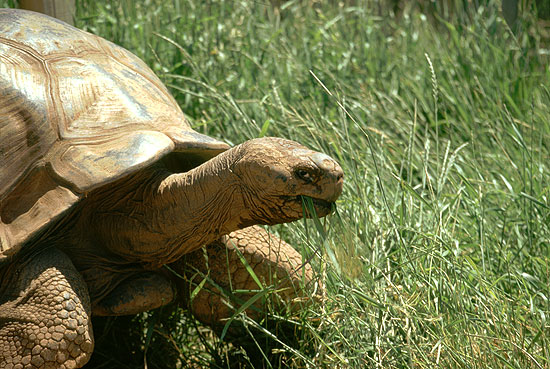
Reptile Gardens has found a unique niche in the tourist industry, falling somewhere between family entertainment and science education. Kids can experience the concept of extinction first-hand by petting Quazi and Tank, a pair of giant Aldabra tortoises, and by a visit to Methuselah’s Playground, an area which honors the Gardens’ most famous denizen with a bronze sculpture of the giant Galapagos tortoise. Bewitched Village, originally a trained animal show, is now a Wild West-style ghost town, with gemstone and arrowhead sluicing, blacklight 3D safari and goofy photo opportunities. An underground viewing bubble gives visitors a close look at the social, playful world of Prairie Dog Town.

Hundreds of orchids, bromeliads, caladiums and other exotic plants adorn the Sky Dome, initially constructed in 1964. Tropical rainforest exhibits are commonplace in zoos today, but back then it was the first of its kind in America. This is also where you’ll find the snakes, amphibians, crocs and bugs. Tortuga Falls is another lush and tranquil spot, graced in summertime by the call of Darwin the kookaburra, an Australian bird.

Then, of course, there are the animal shows, which originated with Earl Brockelsby. An early promotional postcard, entitled “Man Bites Rattlesnake,” pictures Brockelsby holding a rattlesnake next to his open mouth. “He did some very, very bizarre things. He did stuff with snakes that one of our employees today would be fired on the spot for doing,” his son said, shaking his head. “What he always told me is ‘I just always knew that they weren’t going to bite me.’ He felt he had a ‘simpatico’ with them. Whether he did or not I don’t know, but he never did get bitten. He never had a poisonous snake bite.”

In another bit of early-day hucksterism, Brockelsby dipped a common prairie rattlesnake in red dye, billing it as an exotic “Red Rattler.” His son laughs at the memory but is quick to point out that none of the species on display today is anything but genuine — as genuine as the fond memories of 76 years’ worth of visitors, many of whom rank their trip to Reptile Gardens as a highlight of their Black Hills summer vacation.

Editor’s Note: This story is revised from the July/August 1993 issue of South Dakota Magazine. To order a copy or to subscribe, call 800-456-5117.


Posted on Leave a comment

“They Laughed at Me”


It’s impossible to measure the impact of the death of Albert White Hat, who passed away on the Rosebud Indian Reservation last week at age 74. For more than half his life, White Hat worked tirelessly to ensure that his native Lakota language did not disappear, and that traditional Lakota ways of life were passed to the youngest generation.

White Hat learned the old ways from elders living in the tiny Spring Creek community on the outskirts of Saint Francis, where White Hat grew up. There, he was immersed in traditional culture. Every evening he sat at the feet of tribal elders and listened to their stories. He spoke nothing but Lakota until he entered a Jesuit boarding school.”I came from a community where we sang and danced and did everything in our language,” White Hat told us in 2009.”I walked into that institution and my peers were making fun of us, the ones from the country, for being big Indians, savages. And they were all Indian kids. Many years later, I found out they had been in that institution since they were 5. By the time they were teenagers they were conditioned to deny their Indian heritage.”

It caused White Hat to briefly turn against his own culture. Not until the 1960s, when he reconnected with medicine men practicing traditional ceremonies in secret, did he regain pride in his heritage. He especially found comfort in the Lakota language.

But there were overt efforts by the government throughout the 1900s to suppress the language and Lakota culture. Those restrictions weren’t fully lifted until Congress passed the American Indian Religious Freedom Act in 1978. When his children began school in the Todd County district, White Hat discovered there was no Lakota studies program. He thought it important for his children to learn their heritage, so he lobbied to start a Lakota language and history program.”They really gave me a bad time,” he said.”None of them would accept it. They laughed at me. Finally they said, ‘You can have a half an hour during noon hour to play your tape and dance.'”

Soon White Hat was teaching Lakota studies part-time at Saint Francis and Sinte Gleska University, which opened in Mission in 1971. He had no teaching experience; he relied only on his own notes for lectures and upon other teachers for help putting together lesson plans. Nevertheless, he continued until the university hired him full-time in 1983.

He eventually rose to lead the college’s Lakota studies department, striving to save a language that was gradually slipping away. Scholars consider Lakota an endangered language. Its fluent speakers are rapidly aging, and children aren’t learning the language quickly enough to replace them.

Today, organizations like the Lakota Language Consortium are establishing immersion schools, classes and producing books and tapes to help youth on the reservation learn Lakota. But White Hat was ahead of everyone when he wrote his Lakota language textbook in 1999. Jael Kampfe, a Montana native who was attending Yale University, began recording White Hat’s classes in 1992. Then they transcribed and edited them into a 226-page book. Even though the text contained information gleaned from White Hat’s 50 years of personal experience with the language, reviews were mixed when he sent a manuscript to linguists and publishers.”The language developed what they called a subculture,” White Hat said.”Historians and anthropologists use modern translations, and my work contradicted that. They didn’t want that printed.” One publisher told White Hat that,”folk etymology and oral history are fine, but they’re not recorded, so this shouldn’t be printed.”

The University of Utah Press finally published it in 1999, and it’s still used in classrooms around the country. Even though the teacher is gone, his knowledge and his words survive. And the next generation of Lakota speakers is grateful.

Posted on Leave a comment

A Pioneer of Flight

Nellie Willhite posed with her bi-plane Pard at a Wagner air show in 1930.


Nellie repeatedly circled the Renner landing field in her open cockpit plane. She gazed down at the people gathered on the soggy grass. They were frantically waving at her to land, certain she’d lost her nerve. She circled again, then eased the bi-plane into position.

Spraying a fountain of icy water, she made a perfect landing in a puddle. With dark curls peeking from under her aviator’s cap, Nellie climbed from the plane. The instructor and student pilots, all men, surrounded her, shouting and pounding her on the back. She’d done it! Nellie Willhite was the first female pilot in South Dakota.

When I visited with her in 1989, 96-year-old Nellie was sitting on her bed in a Sioux Falls nursing home. Deaf since childhood, she astounded me with her ability to read lips. White hair frothing across her cheeks, she pulled old photos out of neatly stacked albums to show me. She loved to tell her story.

When Willhite was 34, a pilot friend asked, “Nellie, why don’t you take lessons? If you learned to fly, you’d be the first woman pilot in South Dakota.” Willhite was stunned and intrigued by the idea. But lessons cost $200, and she didn’t have the money. She called her dad to tell him. “Before I knew it there was a check for $200 waiting for me,” she said.

She started lessons in November 1927. Although she was excited about learning to fly, she kept it to herself. “I was afraid I might fail,” she said. “I didn’t even tell my landlady.”

Nellie Willhite made a striking picture in her aviator’s cap.

Willhite was the 13th student to sign up for a class taught by Harold Tennant. The weather was so bad that winter it took her two months to complete the instruction. After 13 hours of training, she flew solo on Friday the 13th in January of 1928. Nellie scoffed at superstitions associated with the number 13. “Superstitious? Gracious no!” she laughed.

News of her flight spread quickly. While her dad, brother and most of her friends were proud of her profession, others were shocked. Some criticized her, wondering how she had the audacity to go into such an impossible thing as flying. “I think the women were a little envious, and the men, too, especially after I got so much attention.”

Nellie’s flying career was marked with several unusual incidents. She and Amelia Earhart were instrumental in forming the “99 Club,” an organization for women flyers. Willhite also flew in airshows and goodwill tours across the country, thrilling audiences with her acrobatics and loop the loops.

Willhite recalled one hair-raising flight in Nebraska. She had been flying a good-will tour for businessmen and was en route to the next stop. “I had gotten a late start,” Willhite said. “The others had gone ahead. I could see a storm coming and it looked bad. That part of Nebraska is so hilly. I couldn’t find a place to land, so I figured the best thing to do was to keep flying.”

“An updraft tossed me 8,000 feet higher, and the engine stalled for lack of air. I knew I had to keep the propeller turning,” she said. “I aimed the plane nose down and kept in a tight spiral. It was up to me to save myself.” Willhite found her way back using an automobile map. “In those days we didn’t have charts or anything,” she said.

Another frightening incident occurred in Chicago when a friend talked her into flying a glider. The take-off went fine, but “I couldn’t land the darned thing! I bet I was circling Chicago for an hour and a half before I gradually coaxed it down. I swore I’d never do that again!”

Willhite obtained a transport license and also worked as a flight instructor during her aviation career. After four years, she was forced to sell her plane due to the high cost of maintaining it and the scarcity of jobs during the depression.

Nellie Willhite participated in many unusual activities during her life. She refused to be hindered by her deafness or by the fact she was living in an era before women’s liberation.

Editor’s Note: This story is revised from the May/June 1989 issue of South Dakota Magazine. To subscribe, call 800-456-5117.

Posted on Leave a comment

Buying a Lawyer for Your Town

In our travels around South Dakota, we love to poke around the small towns to see what makes them tick. Sadly, many of them are ticking more slowly than they did a generation ago. The population is graying; there are still some dynamic leaders in the communities, but they are busier and fewer.

That’s why the South Dakota State Legislature voted last winter to fund a program that will subsidize lawyers who start a practice in a rural area. Taxpayers in the Rushmore State already do the same for nurses and doctors. Beginning farmer programs are always popular, though apparently helpless against the waves of rising land costs.

We’ve seen towns go to great lengths to recruit a new publisher for the weekly paper and in Howard, the entrepreneurial epicenter of farm country, they’ll help you start anything short of a gang of thieves.

Lawmakers thought they were skating on thin ice when they voted to subsidize lawyers, but they recognized that it’s silly to have a courthouse in every county when two-thirds of our lawyers live in four of the 66 counties. We like the new program because it reminded us of Fred and Luella Cozad of Martin, a town of 1,000 people that sits between the Rosebud and Pine Ridge reservations.

Several summers ago, we were in Martin to learn about how the community affected the life and work of Vine Deloria Jr., the town’s most famous native son. Deloria, who died in 2005, ranks among the most important Native American authors and philosphers of the 20th century.

While looking for interesting folks in Martin, we knocked on Fred’s law office door. He immediately stopped what he was doing and drove us around town — past the nursing home and the assisted living, around the high school and out to the golf course and swimming pool. We visited the library and drove past the SuAnne Big Crow Boys and Girls Club. We also stopped at the tribal college. What Fred didn’t tell us — and we learned later — is that Fred, as the only lawyer in town, was involved in every community betterment project accomplished in Martin over the last 60 or more years. Most of the afore-mentioned institutions didn’t exist when he was studying the law in Vermillion.

Fred joked that he was already in Martin when Custer came through. “My advice was ‘George, don’t go,'” he told us. Actually, Fred’s father came to Martin in 1909. They ranched until a blizzard nearly wiped out their cow herd. Then they moved to town and ran a cream station. Fred got his law degree from USD in 1949. More importantly, he met a music major from Iowa and together they moved to Martin and hung a shingle. Then there were five other lawyers in town. He has been the lone practitioner for many years, unless you count Luella, who quit teaching music long ago because Fred was overwhelmed with office and community work.

New York Times writer Ethan Bronner had the same good fortune as we did when we went to Martin a month ago to write about South Dakota’s new “subsidize a lawyer” program. Bronner met Fred and Luella. They have a tiny house just behind their humble law office. One of them leaves the office at about 11:30 to prepare lunch — usually soup. They dress alike most days. They can speak for each other (though Fred does most of the talking). They are the best argument for lawyers in small towns — or any neighborhood — that we’ve ever seen.

Then Bronner did a nice job of introducing the Cozads to the world with a front page feature article on April 9. It was a good day for Martin. A good day for South Dakota. A good day for the legal profession. And just another day for the Cozads because, in their late 80s, they are still too busy — as the only legal office for a hundred miles around — to spend much time fussing about having their picture in a magazine or even a newspaper like the Times.

Hopefully your tax dollars will get them some relief. They’ve earned it, and Martin needs another couple like them.

Posted on Leave a comment

Twenty Years Ago

Yea, what good beginnings
To this sad end!
Have we had our innings?
God forfend!

So ends a poem titled Twenty Years Ago by D.H. Lawrence. What a sad end to happy beginnings. Is there a better way to express how we feel about the loss of Governor George Mickelson — twenty years ago?

Most of our readers will remember where they were on the evening of April 19, 1993 when the news came by radio and television that a plane had crashed in Iowa. At first the outcome was inconclusive. But no good news came. And then the worst. All on board were lost to us — the energetic young governor, five business leaders and two pilots — when the state airplane crashed into a brick silo on a farm near Dubuque, Iowa.

Twenty years ago. It hardly seems possible, maybe in part because many of the good deeds inspired by the governor continue to impact the lives of South Dakotans. (We say “inspired” because he would be the first to share credit with his staff, lawmakers, community leaders and the citizens who pay the taxes to make it all possible.) He inspired a resurgence in state pride by presiding over the state’s centennial, spent political capital to start the REDI fund, found a permanent funding source for long-overdue water projects, brought environmental regulations out of the 19th century and — perhaps most importantly — worked tirelessly to rebuild relationships between whites and Native Americans after a contentious decade of strife.

He didn’t succeed in everything. Some will remember his ambitious plan to start a commuter airline system in South Dakota to connect our larger cities. There were hardly any riders. Governor Mickelson just couldn’t imagine why we wouldn’t all want to hop and skip from Yankton to Mitchell to Aberdeen to Huron and back again. But mostly he had successes. He seemed to live a charmed life right to the end, and South Dakota benefitted from his good fortune. And then he was gone.

What if he’d lived longer? Served out his final term as governor? Went onto the U.S. Senate? What would South Dakota look like today? Even better, I promise you. There would have been other reforms: on my first day in the legislature in 1993 he was presiding over a big meeting that he’d called to find a way to provide health insurance to people who couldn’t get it on the open market. He became visibly irritated when several insurance executives balked at his idea of a risk pool. He eventually stood and admonished them. Before he was finished, he was red-faced and he looked eight feet tall. And the room was silent, and we all went to work on a risk pool.

We would be a better state if George Mickeson was 72 years old and alive today. I’m certain of that.

We didn’t have the governor for the full nine innings. As too often happens with the best and brightest, he came and went too soon.

But we had him. He was all South Dakota. And he always will be.