Posted on 1 Comment

Roaming the Tall Grass

By Christian Begeman

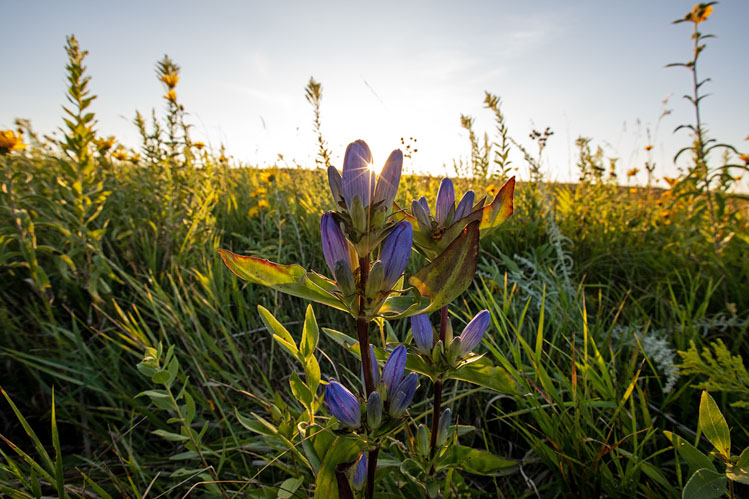
The May/June 2026 issue of South Dakota Magazine features a story on the few tall grass prairie remnants remaining east of the Missouri River. When I was asked to help illustrate the story, I was surprised by how many photos I have taken in and around these places.

I grew up in short and mixed grass country along the Dewey and Ziebach county line west of the Missouri. Only in wet areas or in wet years did the grass get so high that you couldn’t see where your boot fell, which is an important thing in rattlesnake country. When I first began exploring the tall grass preserves with camera in hand, it was unnerving to not be able to see the ground below … and whatever sinister critters may be lurking. Turns out plenty of creatures call the tall grass home. My favorite are the colorful and elusive butterflies. From monarchs to tiny eastern-tailed blues, I have been known to spend hours on the trail seeking that perfect close-up shot.

I also discovered the beauty of the grass itself when peering through my macro lens at blooming sideoats grama florets at the Sioux Prairie Preserve near Colman. Big bluestem, cordgrass and many other tall grass regulars all flower during the summer and photographing them can be nearly impossible due to the wind that we regularly endure on the Northern Plains. To be honest though, a good breeze is welcome in that it keeps the gnats and mosquitos mostly at bay. Yep, it’s not all butterflies and flowers in tall grass country. Myriads of insects live there and a good breeze plus insect repellent is a must when exploring.

After gathering photos for the article, I was asked to gather again for a flyer promoting the new prairie grass area at Good Earth State Park. As I waded back into the archives, I noticed the crescendo of forays into tall grass preserves started slowly about 10 years ago and reached full throat when I was challenged to find and photograph the elusive green orchid. Until that point, I thought wild orchids only grew in exotic tropic locales. Thankfully, I was wrong. South Dakota is home to over 20 orchid species depending on who’s counting. The tall grass preserves are a haven for these beauties and their allies, all of which are a paradise for a camera guy with a macro lens.

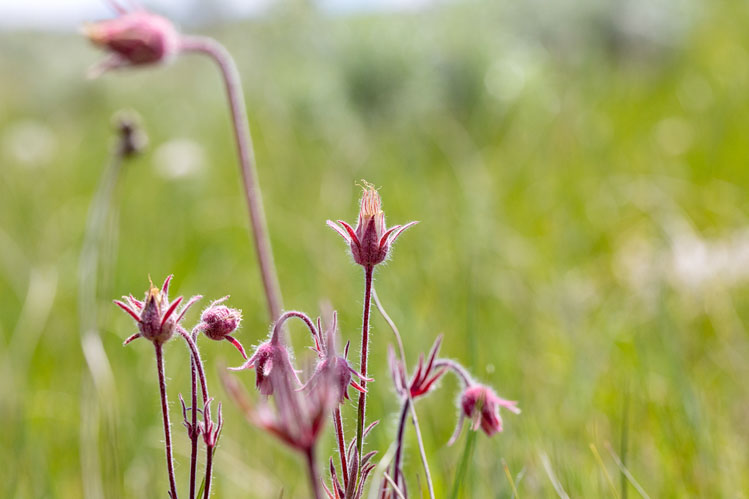
Earlier this month, I was out finding the season’s first pasque flowers in the Coteau Hills overlooking Jacobson Fen in Deuel County. As I got up close to frame a few fuzzy portraits of our state flower, I got the idea to share these new photos along with a few other tall grass favorites I had gathered but did not make the final printed story. I hope they convey the sense of wonder and enjoyment I get while out roaming the tall grass remnants.

Christian Begeman grew up in Isabel and now lives in Sioux Falls. When he’s not working at Midco he is often on the road photographing South Dakota’s prettiest spots. Follow Begeman on his blog.

Posted on Leave a comment

Finding the Wilds of Winter

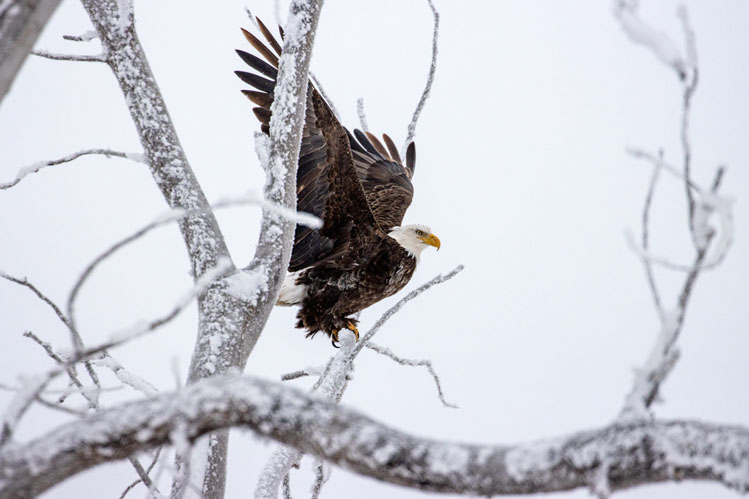
Spotting winter wildlife on the Northern Plains can sometimes seem impossible. Frigid temperatures, relentless wind, snow and ice usually keep critters out of sight during the diminished daylight hours. When I was in junior high, I spent a good chunk of an afternoon sitting in what I thought was a pretty good hiding spot overlooking a stock dam bordered by a chokecherry thicket. A recently deceased cottontail was on the edge of the ice, placed as a lure. I think I hoped a hungry coyote or maybe even a hawk or eagle would arrive. Nothing did. All I heard was the wind though the thicket and all I saw was gray and sullen clouds overhead.

I’m not sure when I figured out that the golden hour was when wildlife is most on the move. Maybe it was deer hunting with my brother or simply noticing more things after I shut the tractor down for the day. This tip generally still holds true when I’m out looking for wildlife with my camera. Not only are there more opportunities to see wildlife, but the golden hour provides beautiful light. Win-win.

It has been my family’s custom to find time to survey the countryside when we get together for the winter holidays. To this day, I keep this tradition alive. Sometimes I’m with my dad, sometimes with brothers and nephews and sometimes it is just me and my camera. This year, I spent three days looking for wildlife in Badlands National Park, Custer State Park and Wind Cave National Park between Christmas and New Year’s Day. And yes, late afternoon and early morning proved to be the most fruitful times.

I arrived in the Badlands around 3 p.m. on December 27. This may seem like mid-afternoon, but winter light is short-lived and angled low and lovely, which is a photographer’s delight. At 3:20 a great-horned owl was out on a ridge waking itself up in the sunlight. About a half hour later I spotted a golden eagle riding updrafts near the Sage Creek Wilderness Road. After photographing a few solitary bison bulls, I headed west and got to Custer State Park with very little light left on the western horizon.

Overnight, a skiff of snow fell in the Southern Hills and there was frost on the grass as I headed to a favorite spot along Highland Ridge Road in northern Wind Cave National Park before sunrise. There were elk below the ridge and bison on the horizon as the sun appeared with warm tones even though the temperatures were well below freezing. As the day lengthened the light brightened, the wind increased and the frost fell to the ground. After driving a few of my favorite routes, I ended up calling it day fairly early. I repeated this routine for the next few days, and it was glorious. Here are some of my favorite photos from that vacation. I’m already counting down the days for another foray or three into South Dakota’s winter wilds.

Christian Begeman grew up in Isabel and now lives in Sioux Falls. When he’s not working at Midco he is often on the road photographing South Dakota’s prettiest spots. Follow Begeman on his blog.
This slideshow requires JavaScript.

Posted on Leave a comment

Grassland Delight

“Here was the endless prairie, so rich in its blessings of fertility, but also full of great loneliness–a form of freedom which curiously affected the minds of strangers, especially those to whom the Lord had given a sad heart.”
―
O.E. R¯lvaag, Giants in the Earth

There aren’t nearly as many places to look out over endless prairies as there were before immigrants arrived. Yet there are still a few places where it can be accomplished right here in South Dakota. From the farmhouse I grew up in, you could drive about 2 miles west over prairie dirt tracks to the rim of the Moreau River breaks and look out over what seemed like a vast wild land of hills, draws, cactus and grass. Thunder Butte hovered in the distance with an unknown number of prairie dogs, rattlesnakes and deer making their living in vastness between. Some years it was green for most of the summer, other years only saw it green for a few weeks in May. Even so, the views affected any and all who laid eyes on it, and especially me.

I saw my first Golden Eagle”out west” as we called it. It made a large wooden fencepost seem tiny as it slowly lifted off to catch the swirling wind. When night rolled in from the east, I heard my first coyotes sing to the evening out west. It wouldn’t be the last I’d hear that lonely song drift in. Rainstorms and thunderclouds seemed to always originate from out west. It wasn’t hard for me to understand why Thunder Butte was so named. This landscape of the open, mixed grass prairie got a hold of me then and I haven’t shaken it since.

From spring to late summer, the magic of the grasslands can often go unseen. The shy wildflowers don’t grow in vast numbers but instead sprinkle the grasslands with decorative color. Butterflies and songbirds are easier to spot in season, but still, you have to be intentional when seeking them.

I have now lived the majority of my life east of the Missouri, and I have come to appreciate the tall grass patches on that side of the state. There is not as much of it to be found since the soil is so conducive to growing corn and other small grains. Even so, when you can find a good patch of tall grass it is worth taking a close look. The hiking is a little harder as the grass is thicker. It took me many years to be comfortable putting my foot down where I could not see the ground. Thankfully prairie rattlers do not abide in tall grass country.

This column is a long look back at the few times I was able to get out and explore our state’s grasslands this past growing season. From Harding to Moody counties and points in between, please enjoy a few postcards from the prairie.

Christian Begeman grew up in Isabel and now lives in Sioux Falls. When he’s not working at Midco he is often on the road photographing South Dakota’s prettiest spots. Follow Begeman on his blog.

Posted on Leave a comment

The Good, the Bad and the Beautiful

Life on the Northern Plains is ever changing. One of my favorite times of the year is thunderstorm season. Generally speaking, it runs from late April through September, but I’ve seen lighting in February and experienced thunder snow in March. The best time, however, to watch a storm build across our Dakota skies is in June and early July.

Our neighbor on the farm lived all his life as a shepherd, rancher and sometimes farmer in both Dewey and Ziebach counties. He swore by what he called the”solstice storm.” Every year on or around the summer solstice we’d get a big thunder boomer. I remember one year it was late and we wondered if he was just pulling our leg about this phenomenon. Then on July 3, as we were in the front yard lighting off firecrackers, a low, menacing cloud raced in from the west. It brought wicked wind, rain and hail. After it had rolled through, the sides of our white house had mud high up on the walls. The storm’s fury had literally stirred up the elements.

Even so, that wasn’t even close to the worst our neighbor had witnessed during storm season. He told me he watched the virgin prairie transform into what looked like a plowed field when a behemoth storm produced large hail that was driven into the ground.

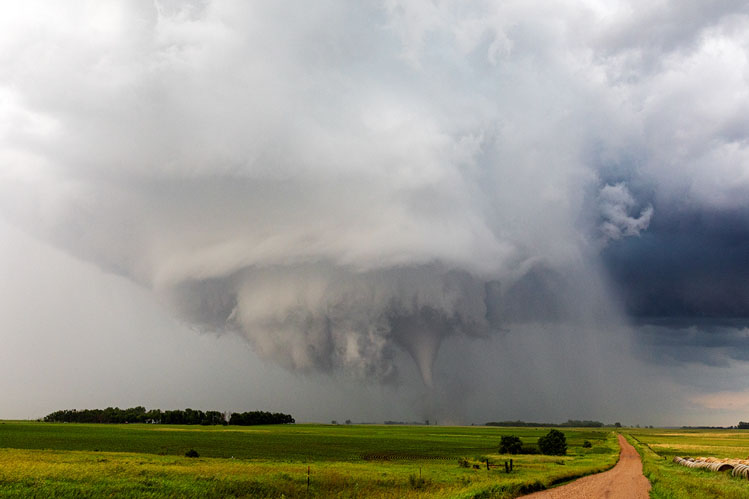
We didn’t get many tornadoes in that part of the country though. I had never seen a twister in real life until May 28, 2025. Not only did I watch my first tornado form and drop in rural Deuel County, but I saw a second one from the same system about an hour later head east toward Gary. That afternoon I was out looking for wildflowers as I slowly made my way north out of Sioux Falls. It was a little after 6 p.m. when I found myself looking up at a massive thunderhead building quickly west of 7-mile Fen Preserve. Not wanting to get hailed on, I checked the storm tracker on my phone and planned to flank the system to the south.

Avoiding the rain and hail shaft found me a few miles west-northwest of Clear Lake, but I had driven into a problem. Directly in front of me I saw a new cell developing with little rain but a lot of rotation in the clouds. It was unnerving and coming right at me. I quickly drove under it and beyond a few miles then turned around and watched the twister form. I don’t consider myself a storm chaser and am happy to watch bad weather from a distance. Therefore, my photos are not real close but feature the immense cloud formations. I do like getting the rainbows after a storm, and ironically enough, a shaft of sunlight hit the forming tornado cell prior to its touching the ground. I witnessed and photographed that unique convergence of wild weather.

Thankfully no lives were lost that day, even though there was some property damage. This column shows you the photos I took from that storm and then subsequent wildflowers and storm scenes into July. It is a beautiful irony that the prime wildflower beauty and delicateness on the prairie exist at the same time when such power and dread can descend from the skies.

Christian Begeman grew up in Isabel and now lives in Sioux Falls. When he’s not working at Midco he is often on the road photographing South Dakota’s prettiest spots. Follow Begeman on his blog.

Posted on Leave a comment

Dakota Kaleidoscope

I remember watching a PBS”American Masters” special on photographer Dorothea Lange and being struck by how she prepared for a retrospective at New York’s Museum of Modern Art (MoMA). Lange’s most famous photo, entitled Migrant Mother, is one of the most recognized and poignant photos of the 20th century. As she looked through her life’s work, she didn’t choose to show just single images but grouped photos into sets of three. She described it as equating sets of three to a visual sentence. It was an idea that stuck with me, and I wondered if I’d ever be able to produce such a thing.

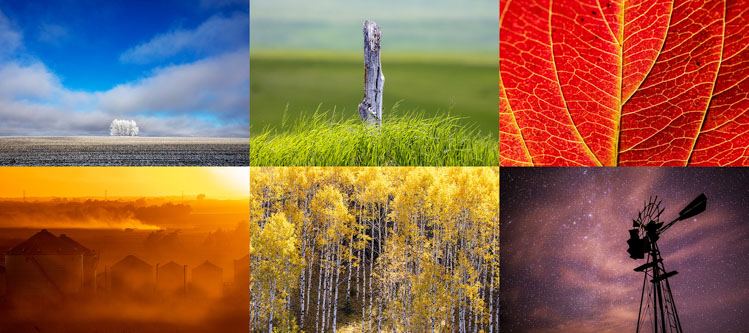
Earlier this year, John Andrews asked for two photos that would be considered for printing in South Dakota Magazine. The first was a winter scene in Moody County with frosted trees under a winter blue sky and the second was harvest haze at sunset in Yankton County. The dust and low light gave the image a very orange overtone. The two images gave me an idea. What if I could find other photos with strong green, red, yellow and purple tones and match them up in a six-photo set? It would be a celebration of Dakota color. It took me a couple of hours, but after a cursory review of photos from the last couple of years, I put together an edit I was happy with.

I posted the new image on my Facebook page and called it a South Dakota kaleidoscope of color. Folks seemed to like it and then John suggested it could be a new column. I agreed and started the process of searching my archives for images that emphasized a strong single color. I reviewed a decade of work from across the state. When the search was over, I had well over a hundred photos separated into blue, green, orange, purple, red and yellow folders. From there I tried to find themes. Since I photograph country churches, that became a set. The last handful of years I’ve been interested in botany (wildflowers) and macro (close-up) photography, so there were two more sets. We Dakotans know that weather and seasonality are huge parts of our lives, so there was another set.

All in all, I came up with eight more sets. The most difficult was the bird set, as there are not many purple birds. Thankfully I had photographed a purple finch at the Dells of the Big Sioux a few winters ago. I also had to choose from a lot of yellow birds. I ended up going with the yellow warbler over the meadowlark, but it was tough decision as I’m a huge fan of both species.

Thanks to John and Dorothea for the inspiration of this look back over a decade of photos. My images are vastly different than the black and white real-life photos of Lange’s, but I do wonder what she’d make of these Dakota kaleidoscope sets. I’ll never know, but it was fun to put together and show here. And really, isn’t that the best part of being a photographer? I bet she’d agree with that.

Christian Begeman grew up in Isabel and now lives in Sioux Falls. When he’s not working at Midco he is often on the road photographing South Dakota’s prettiest spots. Follow Begeman on his blog.

This slideshow requires JavaScript.

Posted on Leave a comment

Gold at Home

The autumn of 2025 has so far found me mostly homebound. The toils of everyday work life coupled with many of my nieces and nephews excelling in fall sports has kept me from my usual Black Hills trip seeking out the fall colors of the high country. The good news is that there is plenty of seasonal splendor to be found right here in Minnehaha County.

One of the perks of the good folks at South Dakota Magazine allowing me to share photos and thoughts in this column over the past decade plus is that I can look back at the seasons and compare and contrast the details. For example, this season has seemed like the green and warmth of summer lingered longer than past years, when in actuality, the peak of color is happening at about the same time. That said, it is a touch greener and the orange, yellow and reds are somewhat muted compared to years past. Even so, you can find the color of fall out and about if you take the time to go look.

I was able to take off work on October 24 to wander the city on a near perfect autumn afternoon. That’s when I noticed how much things have really changed over the years. There aren’t as many trees flanking the main falls at Falls Park, for starters. The views of downtown from Cathedral Hill are not nearly as easy to see because trees from the park land below the church continue to grow. And so it goes. I should remember that the only thing that remains constant is change even when it comes to photographing familiar locales, but I don’t really remember until confronted by visual proof.

Palisades State Park.

In this column, I will keep the words brief. Fall is both a beautiful and bittersweet time as the growing season comes to an end in a final colorful flourish. We all have more than a few months of the long cold winter lined up next. Even so, winter does make one enjoy the spring all the more. In this selection of photographs, the first half are from this year, and the second half are selections from past years that have never been published here before. May they inspire you to get out and enjoy a last autumn stroll or two before old man winter’s long arm reaches down from the north country.

Christian Begeman grew up in Isabel and now lives in Sioux Falls. When he’s not working at Midco he is often on the road photographing South Dakota’s prettiest spots. Follow Begeman on his blog.

Posted on Leave a comment

Seeking Spring Ornaments

Spring in South Dakota is a joy to watch unfold. It is not always the same within the particulars, but the rhythm of new blossoms and migrating birds are always harbingers of the season of life taking hold. This year saw a hot, windy and dry stretch in early May followed by cool, rainy days. It is now after Memorial Day and the landscape is lush and green out my window, even if the clouds are low and gray. Last year’s barn swallow couple is back inspecting my light fixture outside my front door for another nesting season. I’ve been doing a spring journal for over a decade in this space. This year, more than ever, you’ll see images featuring new blossoms and spring birds. I’ve called them”spring ornaments” in the past and that is how I still see them — fleeting glints of color showing off after a long, cold, Dakota winter.

March 28

I photographed my first pasqueflowers of the season in McCook and Hanson counties.


April 4

Snow flurries in rural Deuel County slowed a small flock of flicker woodpeckers arriving from warmer climates.


April 16

The first plum brush blossoms and bumblebees delighted the senses in Union Grove State Park.


April 19

A few trout lilies were in bloom on the hillside along the Union Grove State Park road.


April 26

Bluebells and pasqueflowers were found in the Slim Buttes of Harding County.


April 27

Star lilies in bloom along a trail of the Sage Creek Wilderness in Badlands National Park.


April 29

A black and white warbler was one of the first migrating songbirds I saw and photographed at Palisades State Park.


April 30

I spent an evening after work chasing a small flock of warblers at the Big Sioux Recreation Area near Brandon. Yellow-rumped warblers and a single palm warbler obliged for a quick portrait session.


May 1

These Canadian goslings at Palisades State Park were among the first babies of spring.


May 3

After a work trip to Minnesota, I stopped at Hartford Beach State Park where a pair of red-bellied woodpeckers were prepping their nest. I also spotted my first prairie smoke wildflower in eastern Brookings County later in the afternoon.


May 4

Tulips and decorative trees bloomed on a near perfect spring day in Sioux Falls.


May 10

A yellow warbler posed at Palisades State Park.


May 12

A Baltimore oriole came in close for a quick snapshot.


May 14

Eastern red columbine were in bloom and a few comma butterflies soaked up the spring sun at Palisades State Park.


May 17

One of my favorite warbler species, the magnolia warbler, gave me a good look at Palisades State Park.


May 25

I took a quick trip to see family and check out the landscape in northeastern South Dakota. Highlights included a patchy of small white lady’s slippers and blue-eyed grass in Deuel County, Tabor Lutheran Church in Strandburg flanked by American flags to honor Memorial Day and a superlative sunset beyond Garfield Lutheran Church west of Lake Norden.

Christian Begeman grew up in Isabel and now lives in Sioux Falls. When he’s not working at Midco he is often on the road photographing South Dakota’s prettiest spots. Follow Begeman on his blog.

Posted on Leave a comment

First Signs of Spring

People who live in the Northern Plains tend to be hardy. They can endure hot, dry summers or long, hard winters with the best of them. Even so, the first signs of spring on the open prairie soften the heart of even the hardiest resident. Winter’s snow is scarcely gone when tiny pasqueflowers first appear on well drained hilltops and hillsides.”Very brave little flowers,” the Cree Indians say,”which come while it is still so cold that they must come wearing their fur coats.” This is in allusion to the furry appearance of the pasqueflower. According to Prairie Smoke: A Collection of Lore of the Prairies by Melvin Randolph Gilmore, a Dakota language song composed to inspire the early appearance of the prairie pasqueflower goes something like this in English:

I wish to encourage the children of other flower nations.

Which are now appearing over all the land;

So, while they waken from sleep and rise from the bosom

Of Mother Earth, I stand here old and gray-headed.

I often think of these references when I find my first blooming pasqueflowers of the year. This year it was in a small pasture just west of the eastern fork of the Vermillion River in McCook County on March 28. While admiring the backlit beauty of the blooms just beyond the fence line, I heard my first western meadowlark serenade of the season. It can’t get much more”South Dakota” than that! I typically find the first blooms of the year on a hillside near Lake Hanson just south of Alexandria, so I drove a little further west and sure enough, about 20 diminutive blooms of South Dakota’s state flower had emerged in my favorite patch.

On April 5, I reserved a blind on the Fort Pierre National Grasslands for another early spring spectacle. This one happens to be both a feast for the eyes as well as the ears. Greater prairie chickens and sharp-tailed grouse gather from March through May to dance. Not only do the roosters dance, but they also call, cackle and woo. The prairie chicken’s woo is a unique sound that I’ve not heard anywhere else. The roosters fill colorful air sacs on either side of their neck and the sound pours out as they expel the air, deflating the pouches. It is known as”booming,” and on a clear and crisp prairie morning, it can be heard for miles. During my morning on the lek, the sound started about 50 minutes before sunrise from right to left outside the blind. It is pretty dark that far ahead of sunrise so you can’t see the birds. It is quite an experience to hear the sound as it amplifies and surrounds you, but you are unable to see the creatures creating it.

As the light grew, I realized that my lek also had sharpies dancing. They don’t”boom,” but they stamp their feet amazingly fast and cackle to impress the hens. Instead of orange air sacks, the skin on their necks flares light purple and their eye combs are bright yellow. It was cold with a stout eastern breeze that morning, but numbing fingers and toes were worth one of the best homegrown shows that nature has to offer on our prairie hills. Soon the winds will warm, and the rest of spring will follow. It always does.

Christian Begeman grew up in Isabel and now lives in Sioux Falls. When he’s not working at Midco he is often on the road photographing South Dakota’s prettiest spots. Follow Begeman on his blog.

Posted on Leave a comment

Winter Mornings in West River

Highland Ridge Road in Wind Cave National Park is one of my favorite places to experience the breaking of a new day. Flanked by prairie dog towns and grazing buffalo, an early riser is sure to hear a coyote chorus across the rolling landscape. If you are really lucky, grazing elk, pronghorn and even a glimpse of one of the coyote choristers is possible when the morning light breaks above the distant Boland Ridge to the east.

I spent two mornings in early January getting my fill of morning’s glory in this special place. The first morning was mostly clear and the rising sun revealed pronghorn grazing on the edge of a prairie dog town with a small herd of bison in the distance. Coyotes sang all around me, unseen but close enough to count five distinct voices. Elk grazed on the northern ridge just opposite Custer State Park’s southern fences. It’s no wonder that folks liken this part of South Dakota to the Serengeti in East Africa. I have visited both places in the morning, and the experience does have similarities when it comes to wildlife and natural beauty.

As the morning progressed, I noticed slight hoarfrost in the lower draws of the park. Hoarfrost forms when water vapor in the air condenses on cold surfaces on clear, windless nights. Crystals freeze directly from the vapor state and do not turn into liquid water in the process. This is different than rime ice that is seen accumulating during fog events. Hoarfrost is typically finer and more delicate, but it is just as fun to photograph. With my trusty macro lens and some bright sunlight to help light the minutiae of grass, chokecherry branches and slender yucca blades adorned with ice structures, I spent nearly an hour bent close to the earth trying to record the beauty in detail. During the process, I came across a young buck overseeing a small group of mule deer. The does did not seem concerned, but they moved after the buck decided I was too close.

On the second magical morning, the sky was gray and colorless. There was fog in eastern parts of the park, which left rime ice on the grass and pine trees. Three bull elk weren’t far from the road and allowed me to photograph them before moving on. It was my last day of my West River winter vacation, and it did not disappoint. As is my usual habit, I detoured through Badlands National Park. Strong flurries added snowy drama to the scenery. My favorite sites were a few lone bison moving slowly through the weather and the colorful Yellow Mounds portion of the park framed by white snow. Winter in South Dakota may not get raving reviews, but in this case, my camera says otherwise.

Christian Begeman grew up in Isabel and now lives in Sioux Falls. When he’s not working at Midco he is often on the road photographing South Dakota’s prettiest spots. Follow Begeman on his blog.

Posted on Leave a comment

Postcards from December

As another year comes to an end, I find myself watching the weather closely like most of us in the Upper Midwest. When there is fog and overnight lows below freezing, I really pay attention. I know those conditions mean there is a good chance of frost appearing, which means great opportunities to find and photograph ordinary scenes that become transformed into extraordinary winter works of art.

This year what little snow we had in early December melted on a few relatively warm days, but the cold nights caused the moisture to return again in the form of fog and rime ice. Rime ice is the scientific term for it, but folks around here know the phenomena simply as frost. I particularly enjoy when frost appears like it did this season, with little to no snow to hinder traveling. I have family in the northeastern and north central part of the state, and this winter I’ve found myself on the road more than usual with holiday travel and attending basketball games. For two of those trips Jack Frost was hard at work, so I left early to see what I could find.

On Christmas Eve I was due in Mobridge for supper. That gave me all day to search out frosty art on my way. I started at Terrace Park in Sioux Falls. Ornamental cherry trees still had red fruit attached and few leaves had yet to drop. These provided excellent bases for frost to accumulate. After about an hour, I drove up to the Dells of the Big Sioux, stopping to shoot a favorite red barn and the railroad tracks that go through downtown Baltic. At the Dells, a pair of bald eagles were patrolling the river, and I was lucky enough to watch them fly below me as I was checking out the scenery.

From the Dells, I drove west to Highway 81 and then turned north after detouring through Lake Herman State Park near Madison. I stopped in the city park at Arlington where the rime ice was particularly thick. An old red hydrant that reminded me of watering calves back home on the farm was particularly striking adorned in frost. Later on, I spotted what looked like an elevator building on a ranch in rural Faulk County. By the time I was driving through Potter and Walworth counties, the snow was gone, but the fog still covered the taller grass and trees white with frost. It was hard not to be in good holiday spirits after a trip like that.

December seems to be the time when winter is most beautiful on the Northern Plains. Maybe it’s the holiday season, or because we simply aren’t tired of the cold yet. Either way, I hope you enjoy my collection of December postcards as much as I enjoyed capturing them. Happy New Year and good luck with the camera work the whole year long!

Christian Begeman grew up in Isabel and now lives in Sioux Falls. When he’s not working at Midco he is often on the road photographing South Dakota’s prettiest spots. Follow Begeman on his blog.