Posted on Leave a comment

“Giants” is a South Dakota Classic

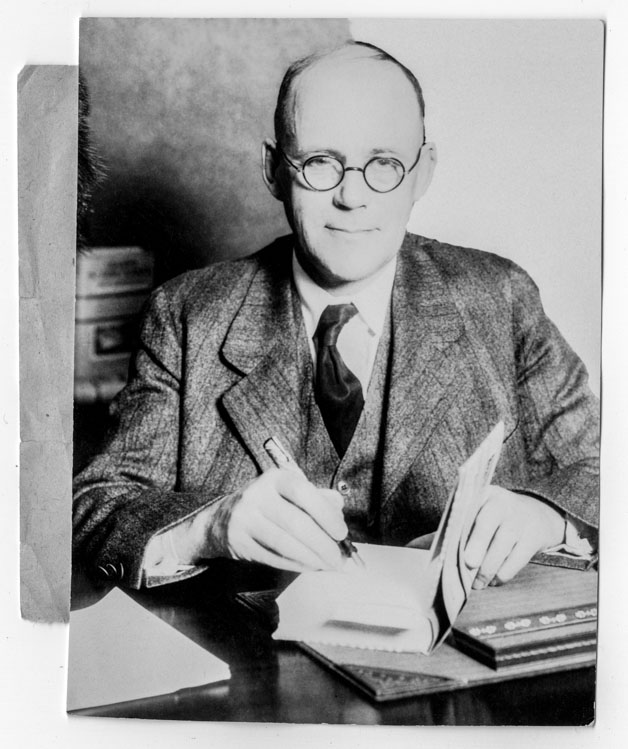
Ole Rolvaag’s Giants in the Earth was inspired in part by the experiences of his father-in-law, a Norwegian immigrant.

Fall always puts me in a literary mood, perhaps because the South Dakota Festival of Books is held in late September or early October. I relish the opportunity to listen to writers discuss their books and always leave inspired to work on new projects.

Last year, as we found ourselves sticking close to home due to the uncertainty of the pandemic unfolding around us, I had time to revisit some of my favorite South Dakota books. I compiled a top 10 list for our November/December 2020 issue, thinking our isolating and socially distancing readers might be searching for ways to occupy their time.

I was reminded of wonderful books like Buffalo for the Broken Heart, the story of Dan O’Brien’s transformation of his West River cattle ranch to buffalo. David Laskin’s The Children’s Blizzard brilliantly retells the tragic story of the 1888 storm that killed more than 200 people, many of them students trying to find their way home through the blinding snow.

My list was not a ranking, but if it had been I wouldn’t think twice about placing Ole R¯lvaag’s Giants in the Earth at the top. A friend told me that several years ago she convinced her brother to read Giants in the Earth.”He was so mad,” she said of his reaction upon finishing.

I completely understood.

I still get a little angry when I think of the conclusion to R¯lvaag’s”saga of the prairie.” I won’t spoil it, but it is heartbreaking.

Giants (1927) tells the story of four Norwegian families who establish a small community along Spring Creek in southeastern Dakota Territory in 1873. They confront hardships that threaten to destroy their livelihoods: blizzards, locusts and the loneliness that comes with leaving your homeland thousands of miles away — knowing you’ll never return — and entering a place completely deserted, where”there isn’t even a thing that one can hide behind,” in the words of Beret, one of the main characters.

I was drawn to Giants because I’ve always been curious to know more about my great-grandparents’ homesteading experience. They arrived in Dakota Territory in 1882 and were among the 800,000 Norwegians who emigrated to North America between 1825 and 1925. Reading the scenes in R¯lvaag’s novel conjured countless questions I wish I could ask: Did you only eat porridge? Did anyone try to jump your claim? How close were your nearest neighbors? What did it feel like to hold your first church service?

Their real-life experiences may not have strayed far from the novel. Many of the stories are based on conversations R¯lvaag had with his father-in-law, Andrew Berdahl, who settled in northeastern Minnehaha County in 1873. His was one of eight families that made the journey in 11 covered wagons from Fillmore County in Minnesota to the spot along Slipup Creek about 8 miles west of Garretson.

The opening pages of Giants depict the scene as Per Hansa, Beret and their three children cross into Dakota Territory, traversing chest high prairie grass that has never seen a plow. R¯lvaag describes the sound of the wind rustling through the tall and spindly stems.”Tish-ah, tish-ah.” During summer, I open the window of my home office. Across the road is a field of corn, nearly 7 feet tall.”Tish-ah” it says, as the breeze trickles through the leaves, and I think of Giants and the shared experiences of thousands of our ancestors.

Posted on Leave a comment

South Dakota Resolutions

Editor Katie Hunhoff and other South Dakota Magazine staffers share resolutions to explore the state in 2021.

We have a New Year’s tradition at South Dakota Magazine to make resolutions on traveling South Dakota. As you can imagine, our staff knows the state pretty well. The resolutions are a fun way to challenge ourselves to try new places and activities.

This year the resolutions are different because of the pandemic; we are all looking for travel opportunities that can be accomplished with safety and health in mind. Maybe our resolutions will give you some ideas.

Hannah Schaefer, our photography and editorial assistant, plans on reading books she collected at the South Dakota Book Festival. On her list is Unfollow by Megan Phelps-Roper (the South Dakota Humanities Council’s One Book South Dakota for 2020), Murder on the Red River and Girl Gone Missing by Marcie Rendon and According to Kate by Chris Enss. (On a side note, our managing editor put together a collection of South Dakota books that are must reads. You’ll find his suggestions in our Nov/Dec 2020).

Departments Editor Laura Johnson Andrews has a couple of day trips planned.”I have been holed up for most of 2020 due to COVID concerns, so at this point, a trip to Toby’s Lounge in Meckling would be a nearly unbearable thrill,” she says. Toby’s is about a 10-minute drive east of Yankton and is known for delicious broasted chicken. Laura also wants to venture a little further to the town of Colome.”I’d love a tour of the Colome area with our food columnist, Fran Hill. I haven’t been there since the South Dakota Outhouse Museum moved to town, so I feel like I’m overdue.”

John Andrews, our managing editor, is planning a trip around some magazine stories he wants to write.”I’m writing a story on Peter Norbeck to coincide with the holiday in his honor, which I don’t think many South Dakotans know about. I think the story of how his house ended up in Geddes and that small town’s own resolve to save it is pretty inspiring.”

Bernie Hunhoff, our editor at large, also wants to visit an historic place.”In all my travels of South Dakota, I have never visited the site of Sitting Bull’s death along the Grand River in Corson County. I hope to get there in 2021. By about any standard, he must rank as the greatest and most influential person to have lived in our region over the last 200 years.”

My resolution is to hike a new peak every time I visit the Black Hills, starting with Black Elk Peak, which I am ashamed to say I have never climbed. But I think all of us probably have a similar destination that we never took the time to experience. That’s part of why we love printing the magazine — to remind people what we have in our own backyard and spark the desire to start exploring.

Posted on Leave a comment

Meet an Accidental Rancher

Accidental Rancher is a collection of poignant stories gleaned from Eliza Blue’s life on a Perkins County ranch.

When Eliza Blue mailed me her manuscript about life on a West River ranch, I admit that I had some skepticism. The document sat unread in my inbox for a few days. Did readers want another perspective on ranching life?

Finally, I opened Eliza’s manuscript and I changed my thinking after reading just a few paragraphs. Her writing, like her songs, pulled me in. Even tales of mundane tasks, such as milking a cow or searching for missing livestock, fascinated me. Somehow, her words transform ordinary life in South Dakota into something enchanting. For days after I read the manuscript, I found myself narrating my life inside my head as if Eliza Blue was writing my story.

To make a long story short, South Dakota Magazine has proudly published Eliza’s book, Accidental Rancher. We worked on it through the winter, knowing South Dakotans would appreciate her storytelling.

Eliza’s fresh perspective comes perhaps from her background of being both a storyteller and singer/songwriter. She is now also a Bison rancher’s wife and mom. Eliza grew up in suburban Minneapolis, but much to our benefit she landed in Perkins County a few years ago and dived into ranch life. Somehow, she also finds time to contemplate and write about life on the high plains.

Too often, rural America’s stories and culture are interpreted by writers who visit for a day or a week, often to write only about the latest catastrophe — most likely a blizzard, a drought or a trade war. Trouble and woe are usually their themes, though there is so much more. A handful of rural West River writers have worked to dispel such myths. Linda Hasselstrom, Kathleen Norris and Elizabeth Cook-Lynn are good examples. Eliza Blue is a new voice, and she brings a musician’s grace. Her stories, like her songs, have a catchy way of grabbing attention.

One of my favorites is titled”Pigeons.” Eliza and her son discover baby pigeons in an abandoned grain bin. The mother had laid the eggs inside a plastic bucket, and her babies became trapped after growing too big to spread their wings. Eliza freed the birds, but noticed something amiss. The birds’ muscles hadn’t developed enough for them to stand, let alone to walk or fly. She and her son visited every day, and employed some therapy techniques to encourage them to move. You can imagine the joy — both of the humans and the birds — when the little wings grew strong enough to fly.

“I often fear I am a foolish woman,” writes Eliza.”Sometimes I know that I am. Like when I am climbing into a stinky, old grain bin to chase sensory-deprived baby pigeons around. But every once in awhile my foolishness pays off. How else would I have gotten to see the look that appears on a small boy’s face when he sees a fledgling bird fly for the first time? The look of surprised delight as he falls a little more in love with the world and all its wonders.

“For my part,” she finishes,”I value the reminder that small kindnesses are rarely small and learning to fly comes in many forms.”

Accidental Rancher is available for $14.95 plus shipping/handling. To order, call (800) 456-5117 or visit our online store.

Posted on Leave a comment

A New Autumn Tradition

We love traditions at South Dakota Magazine, and autumn is full of them — holidays with family, visits to the pumpkin patch, hikes and drives to see the colors change. A few years ago, our magazine staff started our own fall tradition. Every September we all attend the South Dakota Festival of Books.

That event, started 14 years ago by the South Dakota Humanities Council, alternates from East River to West River. This year it was held in Brookings for the first time.

Nerds like us were attracted to the book festival from the start. We realize the words”book festival” may not excite a certain portion of the population, especially during football season. However, we guarantee that there is something for everyone. This year there were beer tastings, honey cooking demonstrations and discussions on a wide range of topics. These were among our favorites:

Bernie Hunhoff, our editor-at-large, was curious about a session debating the true story of Hugh Glass.”Perkins County never gets much attention, so I found it interesting that one of the best-attended sessions of the book festival was about something that happened there along the Grand River in 1823 — the confrontation between Hugh Glass and a grizzly bear,” he says.”I doubt that many of the people in the room have ever seen the Grand River or been to Lemmon, the nearest town. But they were very interested in the places and the people, and I thought that said a lot about the sense of community in South Dakota.”

Andrea Maibaum, our production manager, went to a”cooking with honey” presentation, where they used honey from hives near Brandt.”It was really interesting because there are so many different types of honey out there all based on what type of pollen is collected when the bees make the honey,” she says. Festivalgoers also enjoyed tours of Adee Honey Farm near Bruce.

Publisher Heidi Marsh liked spending time in Brookings’ amazing Children’s Museum.”We enjoyed Chris Browne, illustrator of the popular comic strip Hagar the Horrible, as he sketched his childhood dogs and discussed growing up in a creative household,” she says.”The presentation was great … but it was even better because just next door kids were finger painting and growling at a giant T. rex.”

Rebecca Johnson, our special projects coordinator, was surprised to hear some great music.”I introduced two singer/songwriters — Brian Laidlaw, a poet and folk singer and Barry Louis Polisar, a children’s author and performer whose song was played during the opening credits of the movie Juno. It was a real treat to meet them and see them play in such informal settings.”

Our managing editor, John Andrews, grew up in Lake Norden, home of the South Dakota Amateur Baseball Hall of Fame, so I wasn’t surprised he found a baseball session at the festival.”I enjoyed learning about the only South Dakotan to ever throw a no-hitter in Major League Baseball, and about how it was taken away,” he told me.”I went to see Dirk Lammers, who wrote Baseball’s No-Hit Wonders about all the no-hitters that have been thrown in Major League Baseball. The league officially recognizes 295 no-hitters, but there used to be 50 more.”

In 1991, the Committee for Statistical Accuracy, chaired by then MLB Commissioner Fay Vincent, changed the official definition of a no-hitter, declaring it a game of nine innings or more that ends with no hits. That was bad news for South Dakota’s own Jim”Death Valley” Scott. Lammers said the Deadwood native and pitcher for the Chicago White Sox had long been credited with no-hitting the Washington Senators on May 14, 1914. He threw nine hitless innings, but unfortunately his team couldn’t score any runs. The game went 10 innings, and Scott gave up a leadoff single in the 10th and allowed one more hit before losing 1-0.

And that’s how the book festival goes: those who attend are interested in learning more about our state and its people, either through books or, even better, by the conversations they have in the hallways between sessions. The book festival reminds me of what I like best about the state fair in Huron — but it’s indoors and lacks the cotton candy and corn dogs. We’d love to see you at the book festival in Deadwood next September. Join our autumn tradition. It is the perfect complement to pumpkin pies and apple picking.

Posted on Leave a comment

The Golden Oldies

Donus Roberts, pictured in his Watertown bookstore, coached speech and debate for 39 years at Watertown High School.

Search online for books about South Dakota and Barnes and Noble yields nearly 3,000 results. Amazon returns 30,000. Google produces 30 million. With so many books to read about your favorite state, how do you select the titles that best explain South Dakota and its people?

We’ve narrowed your choices down to about a dozen with help from Watertown bibliophile Donus Roberts. Roberts retired in 1999 from Watertown High School, where he spent 39 years as an English teacher and became one of the most highly decorated debate coaches in the nation. He is a man who loves words and ideas. He’s also an avid book collector, amassing over 15,000 titles in his personal collection and offering another 18,000 for sale at his shop in the East Point Plaza on Highway 81 and online.

Do not feel limited by Roberts’ list. Hundreds of authors have told South Dakota’s story in their own way, and their books are worth reading, but Roberts calls these”the golden oldies.” Some titles are available in bookstores or online, but others are out of print. Check each book’s availability at your local library.


Robert Karolevitz

Challenge: The South Dakota Story

Robert Karolevitz was one of South Dakota’s most prolific authors. He wrote 37 books and thousands of magazine articles and newspapers columns from his home at Mission Hill, northeast of Yankton. He enjoyed poking fun at himself, and was known for his sense of humor (evidenced in books called Everything’s Green But My Thumb, and Toulouse the Goose, a collection of off-the-wall columns). But Karolevitz also wrote histories of Yankton, the Catholic church in South Dakota, newspapering, Douglas County and a biography of Harvey Dunn. Roberts believes Karolevitz’s most lasting contribution is Challenge: The South Dakota Story.

“There are no comprehensive histories of the state that have been written in recent times,” Roberts says.”All of our histories were written some time ago. I think it’s one of the best interpretations of a state because it’s not sequential. It’s more thematic.”

Challenge, published in 1975, is one of the few histories written by a native South Dakotan. Karolevitz was born at Yankton in 1922 and lived all but 15 years of his life in Yankton County. His book describes 10 challenges people faced in settling and living here: conflicting cultures, the Missouri River, gold, Wounded Knee and the Dirty Thirties are among them.

Karolevitz struggled to identify his audience and the book’s organization. Challenge was originally intended for use as a junior high level textbook, but he adapted it for all ages. He also selected a topical rather than chronological approach”to emphasize and expand the why as well as the what of the unfolding saga,” Karolevitz wrote in the book’s introduction.”This labor of love is offered with the hope that it will generate native pride in The Challenge State and provide a realistic textbook for studying the heritage of a bountiful land — where the bounty is seldom attained without a struggle.”


Ole R¯lvaag

Giants in the Earth

Ole R¯lvaag’s classic Giants in the Earth, an enduring tale of Norwegian immigrants trying to conquer the Plains, follows Per Hansa and his wife Beret as they homestead in eastern South Dakota in the 1870s. They encounter drought, grasshoppers and blinding blizzards that bring tragedy.”It’s not only one of the great frontier novels,” Roberts says.”It belongs in the top rank of novels written in America. If you want to be well read about the Upper Midwest, Giants in the Earth is a must read.”

But had R¯lvaag listened to his father, Giants in the Earth, published in 1927, may have remained a seed in his imagination. R¯lvaag was born in 1876 on a small island of the northern coast of Norway. He walked 14 miles round trip over rocks and moors to attend school, but he was forced to stop at age 14.”His father finally told him he was not worth educating,” wrote Lincoln Colcord, R¯lvaag’s colleague who helped translate the novel from Norwegian to English.

R¯lvaag embarked on a life of fishing, but he became a voracious reader. He spent two days traveling by foot to a nearby village just to get a copy of Ivanhoe. He dreamt of writing a novel as early as age 11, but never seriously embarked on a project until he attended school in South Dakota 15 years later.

Rather than spend his life as a fisherman, R¯lvaag asked an uncle living in South Dakota for help getting to America. One day a ticket arrived, and R¯lvaag spent three years farming near Elk Point. Friends urged him to attend school, but his father’s admonition still rang clearly in his head. Still, R¯lvaag wanted a life of farming even less than fishing, so in 1899 he enrolled at Augustana Academy in Canton.

He quickly discovered that he felt most comfortable in school. After graduation he attended St. Olaf College in Northfield, Minn., and eventually became the school’s professor of Norwegian studies. His sequel to Giants in the Earth, called Peder Victorious, appeared in 1929. He died in 1931.


Doane Robinson

Brief History of South Dakota

Plenty of histories have been written since Doane Robinson’s Brief History of South Dakota was published in 1905, but that doesn’t mean you should discount his volume.”It’s still very much worth reading because so much of the history written in that period of time was fairly slanted when it came to the Native Americans and whites,” Roberts says.”But Robinson was more objective than most writing at the time.”

The history of a place grows with each passing day. By modern standards, the majority of our state’s history occurred after Robinson’s book appeared. But that may be the secret to its appeal. Robinson’s book focuses heavily on the region’s early history: Lewis and Clark’s expedition up the Missouri River, the rise of the fur trade, the gold boom in the Black Hills and the quest for statehood. Robinson also devoted full chapters to Sam Brown, who rode 150 miles on horseback through a blizzard to avert a battle with Indians, and the horrid winter of 1880-81.

Robinson was born in Sparta, Wisc., in 1856. He farmed in Minnesota, then moved to Watertown to practice law. He developed a strong interest in state history and became secretary of the state historical society. In addition to his Brief History, Robinson was a poet and also founded the Monthly South Dakotan, the first magazine to explore the history and culture of the state.

If Robinson’s literary legacy lies in his Brief History, his greatest overall contribution was growing the idea of Mount Rushmore. Inspired by Gutzon Borglum’s sculpture of Confederate soldiers at Stone Mountain, Georgia, Robinson originally envisioned figured carved into the Needles, but eventually settled on the heads of four famous leaders chiseled into the granite of Mount Rushmore.

After retiring as secretary of the state historical society, Robinson returned to farming near Pierre. He died in 1946 at age 90.


John Milton

South Dakota: A Bicentennial History

When New York publishing giant W.W. Norton embarked upon its States and the Nation Series commemorating the country’s bicentennial in 1976, editors asked John Milton to write South Dakota’s volume. Milton, an English professor at the University of South Dakota since 1963, was quickly gaining a national following for his short stories and fiction, and for establishing and editing South Dakota Review, the state’s literary journal and”a massive contribution,” Roberts says. Milton expressed reservations about writing a history of South Dakota, but colleagues”gave me a strong nudge when I was reluctant to take on this project,” he writes in the book’s preface. His 200-page volume became one of the state’s classic histories.”I know it was considered to be one of the best in that entire series,” Roberts says.”You don’t find him in it. It’s very factual, though he tends to stay away from the cultural issues that have divided us over the course of time.”

Milton’s background as a storyteller aided his treatment of South Dakota. His book is organized topically and reads like a novel. And his approach differed from other historians.”My concern is with the portrait, with the spirit of the place and of the people, who either visited it or settled down on it, making this particular place their home,” Milton wrote.


Herbert Krause

Wind Without Water, The Thresher and The Oxcart Trail

Herbert Krause penned just three novels during his 32-year career as a teacher and writer in residence at Augustana College, but Roberts includes all of them among his must reads for South Dakotans. Wind Without Water, The Thresher and The Oxcart Trail all describe the trials of farming the Plains 100 years ago.

“There’s no more realistic treatment of the way it was out here in the early 20th century,” Roberts says.”The frustrating part is that Krause just isn’t read today. Nobody reprints the trilogy. He became a more modern version of Hamlin Garland. No one has ever written farming like he did. People from this state are missing something if they don’t search him out.”

Krause was raised north of Fergus Falls, Minn. He developed a love of the written word at a young age, much to the chagrin of his blacksmith father. When young Krause begged for, and finally received, an issue of Cosmopolitan magazine, his father told him,”Well, son, you’d have done better getting a pair of socks.”

Krause’s admiration for Ole Rolvaag led to his enrollment at St. Olaf College in Northfield, Minn., although they never met because Professor Rolvaag died shortly after Krause arrived on campus. Krause longed to write of German homesteaders as Rolvaag had written about Norwegians. When Wind Without Rain appeared in 1939, critics immediately compared Krause to Rolvaag and eventually declared him to have surpassed his idol in Plains literature.

Newspapers in New York and Chicago heralded Wind Without Rain as national bestsellers. The book follows the Vildvogel family struggling to survive on the land of western Minnesota. The Thresher (1946) tells the story of Johnny Black, who hides personal pain behind his dominant steam-threshing rig in North and South Dakota. The Oxcart Trail (1954) is a love story rich with historical detail set along the trails that ran from northern Minnesota across the Dakotas to the Pacific Northwest in the 1850s and 1860s.

Krause was also a prolific poet and wrote articles about the customs of the Upper Midwest and ornithology. In 1970, he founded the Center for Western Studies. Krause died in 1976.


Mary Crow Dog

Lakota Woman

Roberts selected Lakota Woman by Mary Crow Dog because, he says,”It’s got some of the great lines I’ve ever seen in a book.” And you don’t have to read far into the book to find an example.”I am Mary Brave Bird,” she writes in the book’s opening chapter.”After I had my baby during the siege of Wounded Knee they gave me a special name ñ Ohitika Kin, Brave Woman, and fastened an eagle plume in my hair, singing brave-heart songs for me. I am a woman of the Red Nation, a Sioux woman. That is not easy.

“I had my first baby during a firefight, with the bullets crashing through one wall and coming out through the other. When my newborn was only a day old and the marshals really opened up on us, I wrapped him up in a blanket and ran for it. We had to hit the dirt a couple of times, I shielding the baby with my body, praying, ëIt’s all right if I die, but please let him live.'”

“That’s one hell of an opening,” Roberts says.

Lakota Woman was published in 1991 and immediately became a national bestseller. It won the 1991 American Book Award and became a television movie produced by TNT and Jane Fonda in 1994.

The book chronicles Crow Dog’s life until 1977. She was born in 1953 on the Rosebud Indian Reservation. At age 18, impressed by the teachings of medicine man Leonard Crow Dog, she joined the American Indian Movement. Her book is important because it provides a young Indian woman’s perspective on reservation plight, assimilation and racism in western South Dakota. But Crow Dog’s recollection of the Wounded Knee siege is a highlight.”There are no objective reports [of the Wounded Knee occupation],” Roberts says,”but her cry in the wilderness is very good.”

Crow Dog followed Lakota Woman was a sequel entitled Ohitika Woman in 1994. She died in 2013.


Sally Roesch Wagner

Daughters of Dakota

When Will Robinson served as state historian, he recognized that only half of South Dakota’s history was being told.”We have a shelf full of ponderous tomes, 32 inches in length with over 10,000 biographies of male South Dakotans,” Robinson lamented in the 1960s.”When it comes to the women who worked alongside the men and frequently made it possible for them to accomplish things which gave them a place in our history, little recognition has been given.”

But women’s history was being recorded thanks to Marie Drew, chair of the Pioneer Daughters Department of the General Federation of Women’s Clubs. For 40 years she supervised the gathering of pioneer women’s stories in every state. South Dakota’s intimidating collection of 4,000 to 6,000 stories lay virtually untouched in the state archives until a spring day in 1987, when an archivist persuaded Sally Roesch Wagner to take a break from researching women’s suffrage to peruse the papers.

“My researcher’s eye knew that this was the find of a lifetime,” Wagner later wrote.”Represented was the scope and range of the lives of white women settlers when the land was taken for non-Indian settlement: white and black, rich and poor, native-born and immigrant, representing a spectrum of nationalities, ages, lifestyles and religions.”

Wagner strove to publish a book of stories in time for the South Dakota centenial in 1989. The first volume of Daughters of Dakota appeared that year and was followed by five more through 1994.

“In concentrating upon the women, you also concentrate upon the men, because they had to live this land together, even though it emphasizes the difficulties of women,” Roberts says.”The guys could get out. They’d go down to the river and cut wood, or plant corn and try to grow something. The women were stuck in whatever was the house, and it’s very legitimate to talk about the trials being quite different.”


Frederick Manfred

Lord Grizzly

The first time Frederick Manfred heard the legend of Hugh Glass, he knew he would someday write about it.”Hugh’s great wrestle with the grizzly, his desertion by friends, his fabulous crawl, his vengeful chase after the deserters, and its outcome ñ all these things seized hold of my imagination,” Manfred recalled.”I saw Hugh and his agony. I saw his matted grizzled beard, his flashing grieving eyes, his torn bleeding body, his godlike stubborn manner. I saw all this not with the eye of an historian but with the eye of a novelist.”

Glass was a real mountain man, recruited by fur trader William Ashley in 1822 to travel up the Missouri River to its source and collect furs. Glass’ near fatal encounter with a grizzly bear along the Grand River was real, and so was his 200 mile crawl across West River’s short grass prairie to Fort Kiowa. But Manfred’s Lord Grizzly, published in 1954, is a novel, not a historical account.

For nearly 10 years Manfred immersed himself in the story. His daughter Freya Manfred recalled how her father”researched the novel by crawling around on all fours with one leg bound in a makeshift splint, eating grubs and ants to see how they would have tasted to the book’s hero, old Hugh Glass.”

Manfred was a prolific writer, penning nearly two dozen books inside his tiny writing cabin at his home in Luverne, Minn. He taught briefly at the University of South Dakota and Augustana College and coined the term”Siouxland,” describing the region where South Dakota, Minnesota and Iowa meet.

Lord Grizzly is part of Manfred’s Buckskin Tales series that explores life in the Upper Midwest through the 19th century. It is divided into three parts: the wrestle, the crawl and the showdown. They represent the three components of the Glass story that Manfred found to be the most consistent in various interpretations.

“This book reads extremely well today,” Roberts says.”It’s not at all dated. The adventure is incredible. The crawl is incredible. The entire story of revenge is incredible. He probably deserves more recognition for that than he’s ever gotten. He was very frustrated because he felt that he had done a lot of good work for literature of this region, and mostly people just sort of waved him away.”


O.W. Coursey

Pioneering in Dakota

O.W. Coursey may be the most prolific author that no one remembers. The title page of his short autobiography Pioneering in Dakota lists him as the author of”eight volumes of Biography, four of History, three on Biblical Characters, two of fiction, two on Literature, two of Short Stories, two of Winning Orations (Compiled), one on School Law and one on Ethics.”

Coursey, a writer, teacher and lecturer who operated the Educator Supply Company in Mitchell, chronicled the lives of many early South Dakotans, including Senator Alfred Kittredge and General William Henry Harrison Beadle, but it’s his unique first-hand account of homesteading in South Dakota that’s most worth reading, Roberts says.

“It’s not a comprehensive history. It’s a pioneering history, what it’s like to come to this country and settle,” Roberts says.”He wrote about the pioneer experience, including the first really comprehensive story about the Blizzard of 1888. On his total work, he should be remembered, and Pioneering in South Dakota is probably the best of his work.”

Pioneering in Dakota covers 14 years of Coursey’s life, beginning with his family’s train trip from Illinois to Huron in 1883. Along with his first-person account of the Blizzard of 1888, in which he was trapped in school, his chapters on filing and claiming a homestead, building a sod house, the coming of the railroad (and the fate of towns along the track) and his stories of surviving a tornado and a prairie wildfire provide a unique perspective of life in the late 19th century.

Editor’s Note: This story is revised from the September/October 2012 issue of South Dakota Magazine. To order a copy or to subscribe, call (800) 456-5117.

Posted on Leave a comment

Our Statewide Reading Club

At South Dakota Magazine we love telling stories about South Dakota, and we also love to tell about our great storytellers. Good literature brings us together as a people and helps us identify what life on the prairie is all about. C.S. Lewis described it best when he said, “We read to know we are not alone.”

In that spirit, what could be better than having all South Dakotans read and reflect on the same book? For 14 years the South Dakota Center for the Book (a part of the Humanities Council) has been selecting a book for the state to enjoy together. The choice is usually relevant to life in South Dakota.

Jane Smiley, a 1992 Pulitzer Prize winner, is the author of this year’s One Book South Dakota. Some Luck is the first of her trilogy that follows an Iowa family, the Langdons, through several generations.

The book takes the reader from 1920 to 1953, beginning as Rosanna and Walter Langdon welcome their firstborn son, Frank. The novel follows the Langdons through important historical events, the Depression and World War II, and highlights how changes on the farm impact family dynamics.

The Humanities Council encourages libraries and book clubs to host One Book discussions. Copies of Some Luck are available on loan for groups, and Humanities Council approved scholars often attend the gatherings to guide conversation.

The highlight of this year’s One Book discussion will come this fall at the Festival of Books when Jane Smiley discusses her story with festivalgoers. This year the event will be held in Brookings for the first time (Sept. 22-26). Smiley will be one of many writers who attend to connect with readers. The festival focuses on many subjects, including poetry, fiction, non-fiction, history, children and tribal writing. My personal favorites are the writer’s support presentation for writers by writers. Our South Dakota Magazine staffers attend the festival each fall and we’re always entertained and surprised by the speakers.

Until then, One Book is a great way to get involved. The concept of a community reading and discussing the very same book was launched in 1998 by Nancy Pearl, a Seattle librarian who believed that having people within a geographic area reflecting on the same book might create connections and enrich the reading experience. Now there are One Book programs across the United States and the world. I wish our magazine staff would have thought of the idea, but we’re happy Nancy did.

Groups interested in hosting a discussion group on Some Luck can apply through the South Dakota Humanities Council.

Posted on Leave a comment

The West and the Universe

Badger Clark lived and wrote at the Badger Hole, a cabin in Custer State Park.

Badger Clark would be packing his bags for a return home to Deadwood if the old poet were alive today, because that’s where this year’s South Dakota Festival of Books will be celebrated Sept. 24-27.

Our state’s annual book festival combines some of Badger’s favorite things — writers, readers and the fresh Black Hills air. It’s a special weekend in which local writers, readers and thinkers gather together to discuss and reflect from a regional point of view. This is already the 13th annual festival. The event has been alternating between Deadwood and Sioux Falls. Both are wonderful sites, but the northern Black Hills are especially tantalizing as the aspen and birch change color.

Badger Clark, South Dakota’s first poet laureate, had a special connection to Deadwood. He moved there in 1898 with his parents when he was 15 years old. His father, a Methodist minister, hoped the altitude would benefit Mrs. Clark’s tuberculosis. Deadwood was then a wild frontier town. But it was also an exciting place, rich with culture and home to a variety of people with interesting life stories. Clark attended school, loved to read and came to love nature. He was also able to spend time on his uncle’s Wyoming ranch, the beginning of his cowboy career.

Unfortunately the mountain air did not revive his mother’s health and she passed away shortly after they arrived. Three years later, the Rev. Clark remarried Rachel Anna Morris. She was a drama teacher from Iowa, and also a poet and magazine writer. No doubt her presence greatly shaped Clark’s life as a writer and thinker.

Clark graduated from Deadwood High School in 1902 and found himself at a crossroads. He eventually enrolled at Dakota Wesleyan University for one year. Then, either for adventure or money, he signed up to help with a colonizing effort in Cuba following the Spanish-American war. He was employed on a plantation that bred razorback hogs and he worked as a ranch hand and stevedore. He ended up in jail after his boss shot another plantation owner. A scrapbook of Clark’s Cuban adventures can be seen at the DWU library. While in the Cuban prison his imagination was sparked by the personalities of fellow prisoners. You’ll find some of Clark’s earliest poems in that Cuban scrapbook.

He continued his cowboy adventure near the Mexican border, where he took up drawing and started playing guitar. He began to write in earnest; inspired by the many people he met passing through the border country. In 1910 he returned to the Black Hills, first living in Hot Springs to take care of his aging parents. After they died, he moved to Custer State Park where he lived in the Badger Hole, a log cabin, until he died in 1957.

Clark was named South Dakota’s poet laureate in 1939, an honor he held for life. Someone once said that Clark’s talent was his ability to “tie the West to the Universe.” That’s a good way to describe what the book festival attendees and presenters do each year when they gather in September. We hope to see you there.

Posted on Leave a comment

South Dakota’s Best Seller


They say paper is dead. Especially paper books. Anybody who still reads books is buying e-books. So goes conventional wisdom.

But in the age of blogging and Facebook and all the other diversions, book publishing has returned to South Dakota … returned with class and success.

Book publishing, when done correctly, is a difficult mix of creativity and commerce, two things that can be incompatible in rural places. Still, South Dakota has had some good publishing houses.

The Center for Western Studies on the Augustana College campus has produced some timeless and important tomes. There was once a University of South Dakota Press in Vermillion. Aberdeen had a privately owned book publisher, though the name escapes me. There was a Brevet Publishing in Sioux Falls. Pine Hill Printer in Freeman helped several hundred authors self-publish. Linda Hasselstrom has had success with books under a name only rural people would even understand, Windbreak. We’ve published a handful of books here at South Dakota Magazine.

Just as many of our university and private book publishers were winding down, along came the South Dakota Historical Society Press in Pierre. As an arm of the state historical society, it was publishing a half dozen or so books a year and doing it quite nicely under the leadership of Nancy Tystad Koupal.

Book runs in South Dakota are generally under 5,000 — and often 1,000 or 2,000. The SDHSP was sometimes exceeding those numbers, and by all accounts doing an excellent job of publishing important regional manuscripts that deserved to be bound for today and forever.

And then the SDHSP published Pioneer Girl, the brutally honest 1930 autobiography of Laura Ingalls Wilder. Nancy optimistically ordered 15,000 copies. And they sold. She ordered again. And then again. Seventy-five thousand to date, and now Pioneer Girl is showing up on”best seller” lists.

Maybe the internet and e-books will eventually kill book publishing. But you know what Harry Truman proved about conventional wisdom. And the 1987 Minnesota Twins. And so on.

Success is always nice, but it’s especially beautiful when it happens to nice people like Nancy Koupal and her band of book publishers in the little city of Pierre.

Posted on Leave a comment

A Fresh Look at Lakota History

Yes, I can write a short sketch of my life, but there would not be very much, just a continual chain of duties day in and day out, always on a ranch, lonely and far from other habitations… Took care of ten children that came to me. I studied history of our own people to keep my mind occupied.

Josephine Waggoner wrote those words in 1932 to Frank Herriott, a professor who was trying to help her publish her writings of Native American history and life. Despite the work, the”chain of duties” she endured, she never stopped collecting the stories of her people. She wrote at night after her family members were asleep, and the cabin on the Standing Rock Reservation was quiet.

She began writing in the 1920s because she worried the history and culture of the Lakota were being lost as elders passed away without handing down their knowledge in the traditional way. She also wanted to correct untruths written by white journalists and scholars. Waggoner started to interview chiefs, elders, tribal historians and, unlike other white or Indian writers, she also interviewed women.

Although she never saw her work printed during her lifetime, it was finally published in 2013 thanks to Emily Levine, an independent scholar, author and editor in Lincoln, Neb., who took on the messy job of compiling Waggoner’s writings into one book, Witness: A Hunkpapa Historian’s Strong-Heart Song of the Lakotas.

Waggoner was born in 1871 at Grand River Agency, at the confluence of the Grand and Lakota rivers. Her father, Charles McCarthy, owned a trading store on the east side of the Missouri. When she was 10, Waggoner volunteered to be a part of a group of Indian children who went east to finish their education. She attended Hampton Normal and Agricultural Institute in Virginia. She returned home after her schooling to work at St. Elizabeth Mission at Wakpala. Waggoner met her husband while working at another mission a mile south of Fort Yates. She married Frank Waggoner on Thanksgiving Day in 1889. Her husband was in the Army, stationed at Fort Yates. It was during her time at Fort Yates that Waggoner began to document what was happening around her, as well as conducting interviews and recording tribal stories.

Levine organized the documents into two parts. The first part contains stories of Lakota/Dakota history and culture and Josephine’s own story. The second part contains 60 biographies of chiefs and other Indians. The book starts with the oldest of the Sioux legends.”The oldest stories refer back to the stars; then stories of kingdoms; then next in line come stories of the ocean, water, animals, and tropical animals.”

She writes that the North American Indians once lived in Central America, before Aztecs. The Aztecs came from the north and conquered the people in the south.”Stories are told of tropical animals that never existed here in North America. The work with feathers and quills, the pottery and basket weaving were arts that were first learned in the south country, where civilization once reached a high standard,” she wrote.”Whether our people are of Mayan or Toltec descent can still be found out someday, perhaps, by someone who can make a deeper study of customs and languages. In the meantime, every true Indian that dies believes that his spirit will journey to the land of his forefathers by the same route that brought them north, the starry pathway called the Spirit Trail. The Milky Way is called the Spirit Road. The Sioux believe that that trail will take them back to where they came from.”

Unfortunately, she never had a chance to understand her contribution to preserving her people’s history. She once wrote to an editor, George Will:”You know Mr. Will I didn’t do much for my race after receiving an education at their expense. I got married and lived on isolated ranches living only for myself and family.” If only she could see Witness, a new, fresh look at the history of Native Americans during the tumultuous early 1920s and long before.

Witness (824 pp, hardcover) was published by the University of Nebraska Press in Lincoln. To order call (800) 848-6224.