Posted on Leave a comment

Weekend Roundup! Three Ways to Spend Your Weekend in South Dakota

1. Rooted: A Prairie Arts Weekend (July 10–12, Geddes) Head to the Missouri River region for this three-day celebration of art, music and place. Authentic Arts 605 in Geddes is hosting original art, workshops, demonstrations, wellness experiences, heritage stories, live music, food and prairie-inspired gathering spaces. A perfect weekend for slowing down and soaking in the landscape.  Our publisher, Katie, will be heading there tomorrow morning. Say hello if you see her!

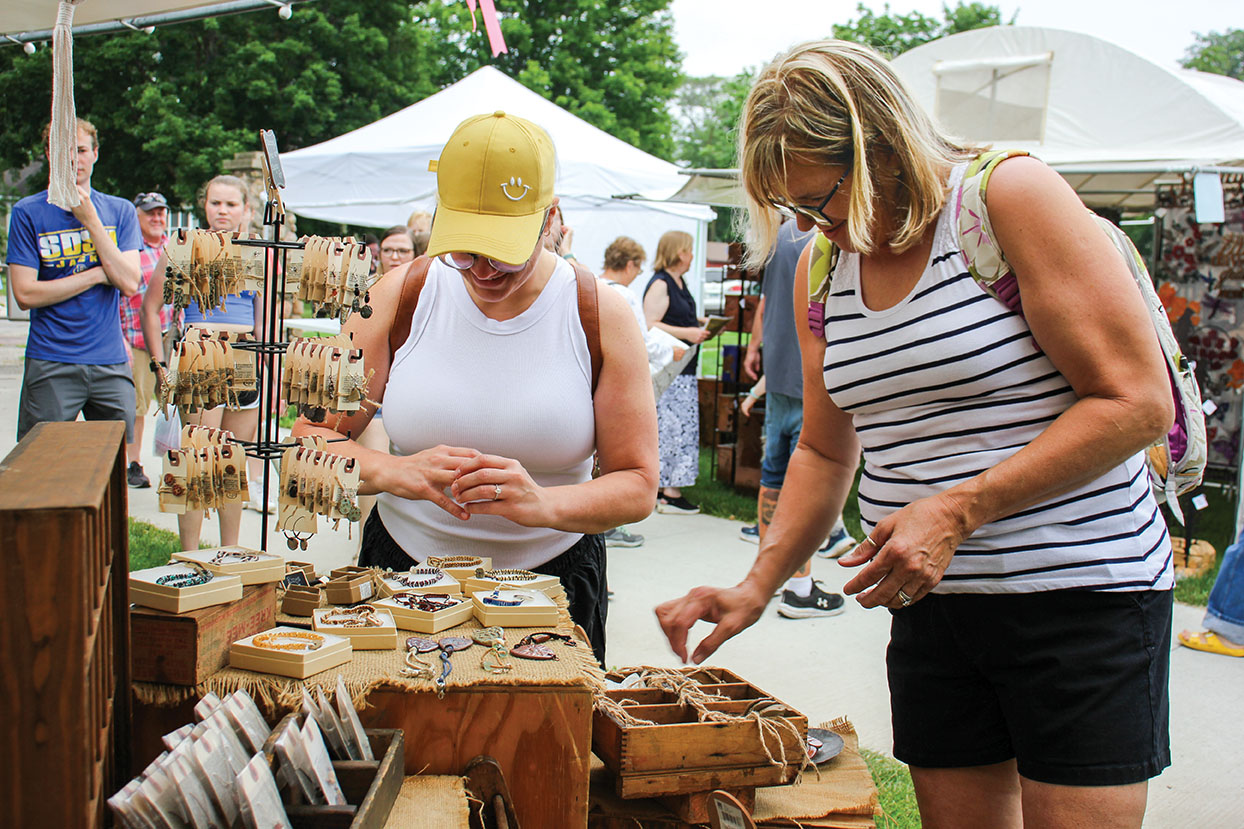
2. Brookings Summer Arts Festival (July 11–12) Pioneer Park in Brookings comes alive with art, food, free entertainment, living history demonstrations, antiques and a dedicated kids’ area. A great family outing if you’re in the area this weekend.

3. Wall Celebration (July 9–11, Wall) The Wall Rodeo Arena is hosting a rodeo, concerts, a parade and kids’ activities for the annual Wall Celebration. It’s an authentic taste of a West River summer.

Check out our calendar of events for more fun festivals and gatherings!

Posted on Leave a comment

South Dakota Resolutions

Editor Katie Hunhoff and other South Dakota Magazine staffers share resolutions to explore the state in 2021.

We have a New Year’s tradition at South Dakota Magazine to make resolutions on traveling South Dakota. As you can imagine, our staff knows the state pretty well. The resolutions are a fun way to challenge ourselves to try new places and activities.

This year the resolutions are different because of the pandemic; we are all looking for travel opportunities that can be accomplished with safety and health in mind. Maybe our resolutions will give you some ideas.

Hannah Schaefer, our photography and editorial assistant, plans on reading books she collected at the South Dakota Book Festival. On her list is Unfollow by Megan Phelps-Roper (the South Dakota Humanities Council’s One Book South Dakota for 2020), Murder on the Red River and Girl Gone Missing by Marcie Rendon and According to Kate by Chris Enss. (On a side note, our managing editor put together a collection of South Dakota books that are must reads. You’ll find his suggestions in our Nov/Dec 2020).

Departments Editor Laura Johnson Andrews has a couple of day trips planned.”I have been holed up for most of 2020 due to COVID concerns, so at this point, a trip to Toby’s Lounge in Meckling would be a nearly unbearable thrill,” she says. Toby’s is about a 10-minute drive east of Yankton and is known for delicious broasted chicken. Laura also wants to venture a little further to the town of Colome.”I’d love a tour of the Colome area with our food columnist, Fran Hill. I haven’t been there since the South Dakota Outhouse Museum moved to town, so I feel like I’m overdue.”

John Andrews, our managing editor, is planning a trip around some magazine stories he wants to write.”I’m writing a story on Peter Norbeck to coincide with the holiday in his honor, which I don’t think many South Dakotans know about. I think the story of how his house ended up in Geddes and that small town’s own resolve to save it is pretty inspiring.”

Bernie Hunhoff, our editor at large, also wants to visit an historic place.”In all my travels of South Dakota, I have never visited the site of Sitting Bull’s death along the Grand River in Corson County. I hope to get there in 2021. By about any standard, he must rank as the greatest and most influential person to have lived in our region over the last 200 years.”

My resolution is to hike a new peak every time I visit the Black Hills, starting with Black Elk Peak, which I am ashamed to say I have never climbed. But I think all of us probably have a similar destination that we never took the time to experience. That’s part of why we love printing the magazine — to remind people what we have in our own backyard and spark the desire to start exploring.

Posted on Leave a comment

Built on Fur

Phil Steckley and the Newhouse No. 6.

I remember clearly walking into a shed on Phil Steckley’s farm south of Geddes. We had traveled into Charles Mix County to do a story on the rich fur trading culture that had grown there over the last two centuries, and to find people still living it out.

Steckley had traps of all shapes and sizes hanging on the walls. The largest was a Newhouse No. 6 that he said he’d used to trap a bear during an excursion north into Canada and Alaska. When I asked what they’d done with it, Steckley looked as though I’d asked if the sky was blue.”Well,” he said, somewhat incredulously,”we ate him!”

The fur trade in Charles Mix County dates back more than 220 years. Jean Baptiste Trudeau became the first European to establish a permanent residence there in 1794 when he built a trading post called the Pawnee House along the Missouri River southwest of Wagner. The French Canadian had been the first schoolteacher in St. Louis when the Missouri Company chose him to lead an expedition up the Missouri River, make contact with Indian tribes and create an agency.

Lewis and Clark mentioned Pawnee House in their journals when they passed by during their 1804 expedition up the river. Fire destroyed the structure in 1817, but by then the fur culture was firmly entrenched in the area.

Some remnants of the fur trading hey day can still be found. The town of Geddes celebrates Fur Traders’ Days every summer, and guests can tour a trading post that Cuthbert Ducharme built in 1857. Ducharme, also known as Old Papineau, came from a fur trading family in Quebec. He worked for the American Fur Company and gained a reputation as a man who was prone to violence. It was said that a small cemetery outside the post was reserved for all the men Ducharme had killed.

Ilo Vanderboom sweeping the streets of Platte.

Old Paps’ roadhouse stands in the Geddes Historical Village, alongside an old WNAX gas station, a replica Lewis and Clark keelboat and the childhood home of former governor and senator Peter Norbeck. The legend of Papineau’s gold survives, as well. Ducharme apparently grew rich and gave his wife $50,000 in gold in case anything happened to him. She buried the money, but when she died in 1900 the location became a mystery. The legend says Ducharme drove himself insane trying to find the money. He suffered a breakdown and died at the state hospital in Yankton in 1903. Did the endless search for lost treasure lead to his demise, or what is simply the result of a hard life on the frontier?

Papineau’s trading post also served as the first post office in the new county of Charles Mix. Organization began in earnest in 1858 when Theophile Brughier, Charles Picotte and John B.S. Todd — a cousin of Mary Todd Lincoln who was stationed with the U.S. Army at Fort Randall, just across the Missouri River — grew the idea of opening the land to settlers. The region was already home to the Yankton Sioux Tribe, so the speculators took a delegation from Yankton to Washington, D.C., hoping to finalize a treaty. They met Charles Mix, a clerk in the Interior Department who had connections within the Bureau of Indian Affairs and in the administration. In return for his help navigating the treaty through Congress, the new county was named in Mix’s honor upon its creation in 1862.

Charles Mix is still home to the Yankton Sioux Reservation, which encompasses 262,000 acres in the southern half of the county. A monument north of Greenwood commemorates the Treaty of 1858, and the famed Yankton chief Struck by the Ree, who died at Greenwood in 1888, is buried just north of that marker. The town of Marty is home to Ihanktonwan Community College and the architecturally impressive St. Paul’s Church. Students built pews and railings for the grand, limestone chapel, completed in 1942. The church’s spire rises 167 feet, while traditional Indian colors and themes are woven throughout the stained glass windows, murals and ceiling artwork.

The gravesite of Struck by the Ree. Photo by Chad Coppess/S.D. Tourism.

Wagner, at just over 1,500 people, is the largest town in Charles Mix County. It’s especially known for its Labor Day celebration, a four-day gathering of fun, games, music and a grand parade down Highway 46. Lake Andes is the county seat, and the 5,600-acre national wildlife refuge east of town is home to a wide variety of wildlife.

Platte, in northern Charles Mix, is home to another 1,300 people. We visited during the summer of 2004 and one of the first faces we saw was Ilo Vanderboom’s. He created the popular Boom’s restaurants found in southeastern South Dakota, but they day we showed up in Platte he was piloting a street sweeper, intent on keeping his town clean. We found busy bakery, a movie theater and a baseball field where the Platte Killer Tomatoes (maybe the best nickname in all of South Dakota Amateur Baseball?) play their summertime games.

The fur trade isn’t as important to Charles Mix County as it once was, but perhaps an even bigger change came with the construction of Fort Randall Dam, one of six mainstem dams built along the Missouri River in the 1950s and 1960s. The town of Pickstown was created solely for the workers who toiled on the project from 1946 to 1956. When the dam was finally closed, it forever altered the Missouri River Valley. Historic towns like Wheeler were flooded, and the once wild river became a reservoir known as Lake Francis Case. That’s a good reminder to anyone planning to seek out Old Paps’ lost fur trading treasure to bring swimming trunks.

Editor’s Note: This is the 30th installment in an ongoing series featuring South Dakota’s 66 counties. Click here for previous articles.

Posted on Leave a comment

The Disappearance of Fred Fyle

Two thousand dollars was a small fortune in 1924. But when Dr. Fred Fyle of Geddes disappeared, his family and friends eagerly offered that sum for his return. After all, what’s a doctor worth to a small town? Thousands of circulars with Fyle’s photograph were sent to every corner of the country and radio stations broadcast news of the search from coast to coast.

Dr. Fyle was a Canadian who graduated from the University of Toronto School of Medicine in 1907 at age 36. He had practiced in Ontario for a year when he met a stranger on a train who encouraged him to start a clinic in South Dakota.

He took the advice seriously and visited several South Dakota towns. Immediately attracted to Geddes and its people, he purchased a home there to convert into a hospital. His new practice opened Oct. 29, 1909 and was an immediate success. Soon he needed more space and converted the Padley Hotel into the Charles Mix County Hospital. Before long even the hotel became too small.

In 1917 Fyle built the hospital he needed, a three-story brick building with a full dining room in the basement, said to be the most beautiful dining room in the state. The new hospital had 24 patient rooms and three operating rooms. He took on a partner named H.E. Allen and together they operated the biggest hospital in the area. Despite the new hospital’s size, they were soon planning a 20-room addition and a new nursing school.

Dr. Fyle settled easily into life in South Dakota. Soon after moving to Geddes, he became a prominent and well-liked citizen. In 1909 he married Emma Belle Gallagher at the Congregation church parsonage. She was the eldest daughter of Dr. Gallagher, the Congregational minister. The doctor was on the city council and belonged to several area organizations.

He earned enough money to buy small parcels of land, including a summer cottage at nearby Lake Andes where he entertained guests who swam and fished in the pristine lake with its white sand bottom. He often would allow youth groups to use the cottage. A sister and brother followed him from Canada, and they both helped him manage his business affairs.

Fyle worked tirelessly for his community and he prided himself on making late night house calls in any weather. He lived in the hospital so he could be on call whenever he was needed. His devotion gained him admirers and made him vital to his community.

Then, one December evening in 1923, Dr. Fyle did not return home. His family wasn’t too concerned. Maybe he’d stopped at the lake cottage. Maybe he was visiting friends. But he didn’t return the following day; and days turned into weeks.

The doctor was last seen in Sioux City on Dec. 11.
 He left for home around 4 p.m. after consulting doctors in Sioux City about an ear case. The weather and
roads were clear when he left in his Model T Ford coupe for the 140-mile trip to Geddes.

Yankton, the largest town between Sioux City and Geddes, would have been a logical place for the doctor to refuel and have supper. Dr. Fyle was large in stature and not easy to forget, but no proprietors recalled the doctor when shown a photo.

Winter ended and the grass turned green. On May 1, 1924, two local farm boys, Joe and Edward Cap, were fishing in Marne Creek about five miles northwest of Yankton. At the junction of Marne Creek and the Sunshine Highway, a major gravel road that led from Yankton to Utica and on to Scotland, the brothers saw something that looked like the roof of an automobile about two feet beneath the water’s surface. They mentioned it to their father, Joe, at supper that night.

The boys’ discovery didn’t impress Joe Cap, Sr. If it was a car, it wouldn’t be the first time an auto sank into Marne Creek. A flash flood the previous September had destroyed the approach. The washout measured 10 feet deep and 15 to 20 feet across.

After Sunday dinner on May 4, Joe Cap called his brother, John.”The boys mentioned what might be a car in the creek. Let’s go have a look.” Upon examination, the adults agreed; a coupe’s roof sat just below the waterline. The men floated a stout log over the roof, and one of them crawled onto it while the other secured it from the bank. After punching a hole through the fabric roof, the man on the log reached in and felt the remains of a human body. He removed a hat from the head of the victim and crawled back to the bank.

Authorities soon pulled the coupe out of the water and found a badly decomposed body, hands clutching the broken steering wheel. The vehicle’s license plate number confirmed that the auto belonged to the doctor from Geddes. The young Cap brothers received a $2,000 reward from Fyle’s family.

Dr. Fyle’s wristwatch had stopped at 9 p.m., recording the exact time that Geddes lost its much-loved physician and friend.

Editor’s Note: This story is revised from the March/April 2009 issue of South Dakota Magazine. To order a copy or to subscribe, call (800) 456-5117.