Posted on Leave a comment

Finding the Wilds of Winter

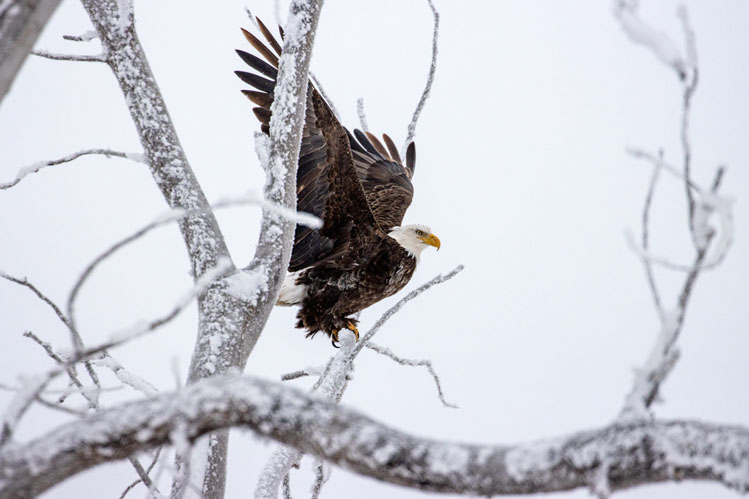
Spotting winter wildlife on the Northern Plains can sometimes seem impossible. Frigid temperatures, relentless wind, snow and ice usually keep critters out of sight during the diminished daylight hours. When I was in junior high, I spent a good chunk of an afternoon sitting in what I thought was a pretty good hiding spot overlooking a stock dam bordered by a chokecherry thicket. A recently deceased cottontail was on the edge of the ice, placed as a lure. I think I hoped a hungry coyote or maybe even a hawk or eagle would arrive. Nothing did. All I heard was the wind though the thicket and all I saw was gray and sullen clouds overhead.

I’m not sure when I figured out that the golden hour was when wildlife is most on the move. Maybe it was deer hunting with my brother or simply noticing more things after I shut the tractor down for the day. This tip generally still holds true when I’m out looking for wildlife with my camera. Not only are there more opportunities to see wildlife, but the golden hour provides beautiful light. Win-win.

It has been my family’s custom to find time to survey the countryside when we get together for the winter holidays. To this day, I keep this tradition alive. Sometimes I’m with my dad, sometimes with brothers and nephews and sometimes it is just me and my camera. This year, I spent three days looking for wildlife in Badlands National Park, Custer State Park and Wind Cave National Park between Christmas and New Year’s Day. And yes, late afternoon and early morning proved to be the most fruitful times.

I arrived in the Badlands around 3 p.m. on December 27. This may seem like mid-afternoon, but winter light is short-lived and angled low and lovely, which is a photographer’s delight. At 3:20 a great-horned owl was out on a ridge waking itself up in the sunlight. About a half hour later I spotted a golden eagle riding updrafts near the Sage Creek Wilderness Road. After photographing a few solitary bison bulls, I headed west and got to Custer State Park with very little light left on the western horizon.

Overnight, a skiff of snow fell in the Southern Hills and there was frost on the grass as I headed to a favorite spot along Highland Ridge Road in northern Wind Cave National Park before sunrise. There were elk below the ridge and bison on the horizon as the sun appeared with warm tones even though the temperatures were well below freezing. As the day lengthened the light brightened, the wind increased and the frost fell to the ground. After driving a few of my favorite routes, I ended up calling it day fairly early. I repeated this routine for the next few days, and it was glorious. Here are some of my favorite photos from that vacation. I’m already counting down the days for another foray or three into South Dakota’s winter wilds.

Christian Begeman grew up in Isabel and now lives in Sioux Falls. When he’s not working at Midco he is often on the road photographing South Dakota’s prettiest spots. Follow Begeman on his blog.

This slideshow requires JavaScript.

Posted on Leave a comment

David Wolff’s Black Hills

David Wolff spent 17 years teaching history at Black Hills State University in Spearfish. His new “Black Hills History Tours” book series blends travel with the region’s most colorful historical stories.

Every mountain range needs a few curious historians. They help the rest of us appreciate the peaks and valleys.

David Wolff of Spearfish fills that role in the Black Hills, and now the former professor is embarking on a six-book project that will not only recount the region’s colorful history but also serve as a guidebook for those who share the author’s itch to explore.

Mountain towns also need pharmacists — and that’s where Wolff got his start. Forty years ago the Denver native who was raised in Wyoming was working the pharmacy counter at a Pamida store in Sturgis. He wrote a history paper as an amateur and took it to a conference organized by university historians.”Pharmacists wear ties and that’s what I wore to the conference, and the history professors moved toward me when I arrived, assuming I was one of them,” Wolff recalls. He sensed they were less enthusiastic in greeting an amateur when they learned his identity.

The pharmacist eventually left the Black Hills, off to greener medicinal pastures, people in Sturgis surmised. In fact, he left to study history, first at the University of Wyoming where he earned bachelor’s and master’s degrees, and then at Arizona State University where he gained a Ph.D. In 1998 he returned to South Dakota to teach at Black Hills State University. He became Dr. David Wolff not as a matter of pursuing a personal goal or for job security (no one will tell you a historian’s position is more secure than a pharmacist’s). Rather, Wolff became a historian because he considers the field vital, especially the multi-layered history of the Black Hills and its mining culture — a significant component to American history overall. And yes, the snub he sensed at that long-ago conference was a motivator in reinventing himself. He didn’t want the lack of academic credentials to limit his ability to reach the public through university offerings, writings and at local history society talks that are free and open to all.

“He comes across as an everyday person,” says photographer and author Paul Horsted, creator of books with photos that compare and contrast historic and modern images.”But he’s got such a depth and command of knowledge at his fingertips, especially gold rush history and what happened afterward. As I was feeling my way in learning that history, David was so kind in being a sounding board.”

When Horsted mentions Wolff’s depth, he could include his friend’s recognition of romance in even the gritty business of mining. Wolff remembers the soft glow of light emanating from windows in Deadwood and Lead’s mining mills, reduction plants and slime plant at night as his family vacationed there –“evidence of workers’ massive efforts, round the clock, in grinding out wealth from the earth,” he says. The Wolffs lived in Cheyenne, Wyoming, when he grew up. His dad was a traveling salesman, mostly supplying drug stores. David sometimes tagged along and that was his introduction to pharmacists — nice people and important members of their communities. Wolff’s parents encouraged him to pursue pharmacy himself. Sure, they knew David’s interest in history and his love for Wyoming’s past as documented throughout the capital city and at nearby Fort Laramie.

“But nobody in the world I grew up in thought you could make a living in history,” Wolff says. Still, the idea briefly crossed his mind in college after reading Watson Parker’s classic Gold in the Black Hills. Wolff wrote to Parker, a history professor at the University of Wisconsin-Oshkosh, and Parker replied. He thought Wolff might be better off using money that would cover tuition for building a personal library of good books delving into history.

If Wolff got a delayed start as a historian, he more than made up for it — and continues to do so with an agreement with the South Dakota Historical Society Press to author six books in the coming years that will combine Black Hills driving with learning history. He taught 17 years at Black Hills State, a period that overlapped 18 years as a member of the South Dakota State Historical Society board of trustees. Still, the term he feels best describes him is simply”a history buff.”

Which is exactly how he comes across sitting in downtown Custer’s Way Park talking to a couple friends about historic cabins. Specifically he mentions this park’s Daniel Flick cabin, long proclaimed as the first built in the Black Hills. And that may be, Wolff says, although it’s unlikely the structure would pass a test by modern historians for such designation. Judge Henry Way pretty much declared the Flick cabin as first while developing the park across the street from the county courthouse in the 1920s.”That was fifty years after the presence of gold in the Black Hills was first confirmed in Custer,” Wolff says,”and the men and women who were here soon after gold discovery were aging and wanted credit for what they built. Almost every town in the Black Hills had its cabin.”

Wolff met with author Paul Higbee (right) in Custer’s Way Park. Despite his long academic career, Wolff says the title that best describes him is “history buff.”

Wolff believes the demand for credit by pioneers is more interesting than whose cabin came first. And while the Black Hills claimed structures more impressive than those humble dwellings — especially its great mines — there was something uniquely American about log cabins. They seemed to assert the Black Hills had become part of America rather than uncharted territory.

“There are a lot of myths and mistakes in history,” Wolff says.”I started out thinking I could correct those things. But misinformation hangs on so tenaciously.” People tend to believe what their families told them as kids, whether they lived in the Black Hills or visited as tourists. Embellished tales survive because they incorporate good storytelling techniques. Deadwood, most South Dakotans understand, has spawned myths since its founding in 1875 and 1876, and the HBO series Deadwood, which ran from 2004 to 2006, took that mythology to new heights. Wolff, frequently asked to comment on the series during its run, understood it as historical fiction and not a history lesson.”Something I looked for in the show, though, was whether or not it remained true to the personal qualities of the historical characters it portrayed,” Wolff says.”And I think it mostly did.”

For example, take Deadwood’s first sheriff, Seth Bullock. The series’ writers and actor Timothy Olyphant created a lawman who was mostly hands-off when it came to little things.”That was authentic to Bullock,” Wolff says.”He didn’t go after the drunk and disorderly and thought that celebrating by shooting into the air was okay.”

Wolff accepted an invitation to discuss Bullock on the Discovery Network’s Gunslingers series. It turned out well although he had to tell producers there’s no evidence that Bullock slung his guns or engaged in shootouts. And the program prompted this question: What does a professional historian facing TV cameras look like? It seems there’s a school of thought that says anybody living in the West and writing its history must be so enmeshed in the culture that they dress in character.”The Discovery Network asked me to show up with my look,” Wolff recalls.”I don’t have a look,” and he didn’t invent one for the appearance.

Wolff accepted another invitation related to Bullock, this one from the state Historical Society Press to write a biography, Seth Bullock — Black Hills Lawman. The book came out in 2009 and addressed aspects of the subject’s life that were not fodder for a TV shoot-em-up: personal friend of Teddy Roosevelt, government official who worked to establish Yellowstone National Park, federal Black Hills Forest Reserve (today’s Forest Service) superintendent, ranching innovator and Belle Fourche founder.

Wolff’s next book for the Historical Society Press profiled a remarkable Deadwood man, James K.P. Miller, strangely forgotten by history. Even Watson Parker told Wolff he never heard of him, although when Miller died at age 45 in 1891 a local paper predicted”his name will always be coupled with the prosperity of Deadwood and the Black Hills.” But it wasn’t, and no one was more instrumental in retrieving it than Wolff 130 years later. Among tools Wolff worked with in exploring Miller’s life and times was newspapers.com, technology that didn’t exist when he wrote the Bullock book. Miller was a native New Yorker, frontier grocery proprietor, builder of Deadwood’s Syndicate Block, and a wheeler-dealer who brought two railroads into Deadwood by setting up something of a competition between the Fremont, Elkhorn and Missouri Valley Railroad and the Burlington and Missouri River Railroad.”Sometimes we forget,” Wolff says,”how competitive railroads were back then. They hated each other.” Miller apparently understood that industrial hatred and made it work for Deadwood, which became one of a select number of South Dakota towns served by two railroads. Very likely that saved Deadwood from deteriorating into something unrecognizable and beyond rehabilitation in the years after the gold rush.

Without Miller, would there have been Days of ’76 celebrations, today’s gaming industry or the Deadwood TV series? Maybe not. The Miller biography, The Savior of Deadwood, James K.P. Miller and the Gold Frontier, was published in 2021.

The Gold Rush and The Gateway to the Hills are the first two installments of Wolff’s “Black Hills History Tours” series.

Wolff’s new book, The Gold Rush, is far from a biography. It resembles the Works Progress Administration’s state guidebooks of the 1930s, with more detail yet retaining a thumbnail listing format. The book identifies driving routes from Custer northward (later volumes in the series will take travelers elsewhere through the Black Hills and surrounding plains), identifying historic locations along the way.”It is a travel book,” Wolff says,”but I don’t recommend places to stay or eat. It’s all history.”

It’s history that is found along roads accessible by regular cars — no ATVs required. Among the author’s favorite sites, most retaining an air of historical mystery, are the Flick cabin and the so-called China walls at Galena (on Galena Road off U.S. Highway 385 south of Deadwood). Galena was best known for its silver mines in the 19th century but in 1909 it was announced that the area held great quantities of copper. Construction began on a copper mill but only stone walls, impressively crafted, were completed.”It has become commonplace,” Wolff says,”to look at old rock work and mistakenly assume Chinese did it.” Indeed, Chinese laborers contributed to much construction during the Black Hills gold rush early on, but by 1909 few remained. Was there really a copper fortune to be mined at Galena? No, says Wolff.

There was no shortage of nefarious mine developers who attracted naÔve investors to sink money into operations that would never yield profits. Three-and-a-half miles below today’s Pactola Dam, about 10 miles west of Rapid City on Highway 44, the Fort Meade Hydraulic Gold Mining Company (perhaps named for Fort Meade army officers who invested) began blasting a tunnel to move water for a sluice box that would work supposedly gold-rich gravel. The company’s very real tunneling, done from 1879 to 1882, probably kept investors engaged, but it closed. Soon, another company picked up the work, also relying on investors, but disappeared in 1889. Not much gold was recovered. What remained was a tunnel moving swiftly flowing water and an underground falls, later illuminated with electricity and named Thunderhead Falls for tourists. The attraction is permanently closed now, but the inspiring natural setting of cliffs and rushing waters makes it easy to see how investors thought something good was bound to take root.

Another site Wolff introduces is one the Forest Service calls the”only gold mining site on the BHNF (Black Hills National Forest) with a standing mill frame.” That’s the Gold Mountain Mine, northwest of Hill City down Burnt Fork Road. Lots of infrastructure work was done there in the 1920s and ’30s.”There is, however, no record of production,” Wolff says. That didn’t stop the Black Hills Historic Preservation and Trust Society from deciding to preserve the mill, rock work and exterior boilers a few years back, with volunteers and students from the Boxelder Job Corps Work Center, joining the effort.

This is a travel book, yes, but it will undoubtedly reach armchair travelers around the world and find use as a well-organized reference. A glance reveals the remarkable range of historic personalities connected to the Black Hills across the years, from giant American industrialist George Hearst (who developed Homestake, the western hemisphere’s biggest gold mine at Lead) to Lakota traditionalists committed to retaining a modern presence. Wolff is certainly describing more authentic Indigenous historical views than the WPA writers and in part credits landing on the faculty of Black Hills State, a university committed to Native course offerings and its Center for American Indian Studies. In particular he appreciated his late colleague Jace DeCory, a widely respected Lakota elder and teacher.”She was invaluable in helping me understand Lakota perspectives, and was always balanced and thoughtful,” Wolff says.

The book was released this summer, and surely readers will want to collect the entire series of six. They won’t wait long. There’s a chance the second will come out later this year, and Wolff and his editor and designers are working at a pace that could see two more published in 2025 and the remaining two in 2026. Upcoming books will address the Lawrence County triumvirate of Deadwood, Lead and Spearfish, Rapid City and the central Hills, the southern Hills, the Belle Fourche River and Wyoming Black Hills, and what Wolff calls”unknown, under-told or under-appreciated stories.”

The Black Hills delight people who sometimes declare they’ve found a pristine natural environment. But travel with David Wolff and you’ll see it’s a rare patch of the Hills that hasn’t been touched profoundly by humans — Lakota defenders, the U.S. Army, railway builders, miners, loggers, engineers who transformed land and water, town builders and, after devastating fires, town rebuilders.

Editor’s Note: This story is revised from the September/October 2024 issue of South Dakota Magazine. To order a copy or to subscribe, call (800) 456-5117.

Posted on Leave a comment

Gator Shows

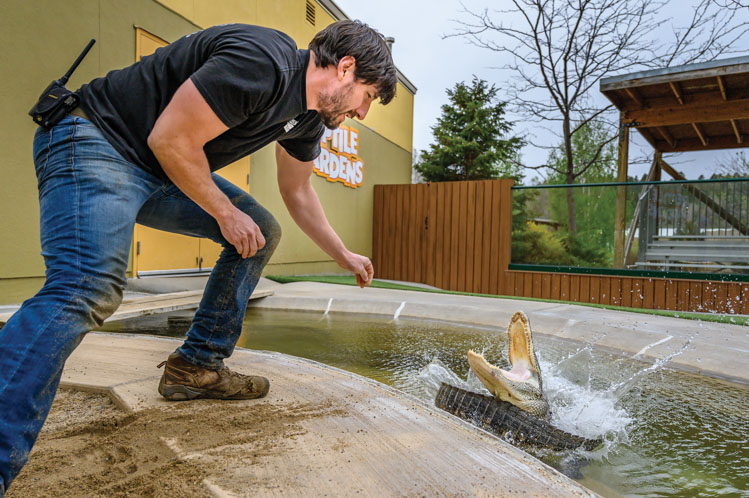
Ryan Comer deals with an ornery gator in the show arena at Reptile Gardens.

Rapid City is a thousand miles from the natural habitats of giant lizards, but Matt Plank’s boyhood dream was to work with alligators and snakes. Fortunately, one of the world’s largest collections was right down the highway.

Reptiles were”always a passion,” Plank says.”I always watched Animal Planet, was always catching garter snakes, frogs and toads. It seems to be luck that I grew up next to this,” he said as he walked through the Sky Dome of Reptile Gardens.

Plank got a job in the cafe at the expansive attraction in 2002, worked there seasonally while earning a biology degree in 2010 from Arizona State University and joined the permanent staff in 2013. He is now assistant curator and show coordinator, overseeing the educational performances for summer visitors.

Now he works alongside Head Curator Terry Phillip, who found his way to Reptile Gardens after managing a pet store in Colorado and focusing on”reptiles, dinosaurs, girls and business, not necessarily in that order,” he says with a smile.”I was not so successful at most of them.”

Phillip moved to the Black Hills, where he had relatives, and started doing alligator shows at Reptile Gardens in 1997. Today he is among the country’s top authorities on crocs, venomous snakes and other reptiles.

American alligators are one of the great success stories of conservation. Once endangered, they could have easily been hunted to extinction when people moved into their habitats. But alligators adapted and responded to preservation efforts; today they are thriving in the southern United States. Most of the gators at Reptile Gardens are captured in places like eastern Texas and South Carolina where they have become a nuisance in populated areas.

Rapid City native Matt Plank found a calling among the large reptiles that live just outside his hometown.

“Gator wrestling” has been a staple at reptile zoos for decades, however the shows at Reptile Gardens do not actually include grappling. At Rapid City, the entertainers seek to demonstrate the agility and strength of their alligators and crocodiles.

The shows took a two-year break due to the COVID-19 pandemic but returned in 2022. Phillip said the revived shows brought together an inexperienced staff and animals that weren’t used to the handling, a hazardous combination. Even though the staff and the animals grow accustomed to each other, there’s reason for caution around them.”We aim for the art of perfection,” Phillip says.”You can’t make mistakes. The biggest problem is complacency. You don’t want that with dangerous animals.”

“You get hit by one of these gators you’ll feel it,” he said. Right on cue, an alligator that was being moved to a different enclosure swung his head and smashed the taillight on a pickup.

Accidents and injuries do occur.”I made it my first year without getting bit,” Plank says, but admitted he has been injured several times.”Now I do everything I can not to get on a gator,” he chuckled.”When it’s exciting it means something’s not going well.”

Showing scars along his arm and fingers, Plank recalled a bite that required 17 stitches.”I remember his mouth right here,” he says, clamping one hand onto the scarred one. Reptile Gardens Public Relations Director Johnny Brockelsby — son of Earl Brockelsby, who founded the popular Black Hills attraction in 1937 — recalls hearing on the staff walkie-talkie that a manager was needed at the alligator arena immediately.

“‘Immediately’ means there is something serious,” Brockelsby says, pointing out that he’s not at his best in emergency situations.”When I got there, Matt was just sitting on the gator like normal and I asked what was wrong.”

“Johnny, my hand is in his mouth,” Plank replied.

Terry Phillip has trained numerous animal wranglers and emergency personnel on handling dangerous reptiles.

“Matt had sweat streaming down the side of his face, so I gave the gator a light tap on the nose, but nothing happened,” Brockelsby says. After another smack on the nose, with Plank pushing down as hard as he could, he got the animal to open his jaws.

“Then he says, ‘Johnny, should I finish the show?'” Brockelsby laughs.”I said, ‘No, I’m taking you to the emergency room.’ Luckily his fingers were between the teeth, or it could have been a lot worse.”

Phillip calls the incident the”most significant in my time here,” and Plank agrees.”It’s the close calls that scare you the most,” he adds.

Recognized as one of the largest collections of reptiles in the world, Reptile Gardens is also a place where other people seek advice.”We get questions from all over the planet,” Plank says. The staff also keep one of the largest and most diverse supplies of antivenom in the world.

Phillip is proud of the training he’s helped provide for area medical technicians, law enforcement officers, EMTs and first responders. He has offered staff training for other zoos and animal parks. He recognizes that his expertise is unique and helpful in certain situations.”Anytime, anywhere, for any reason for law enforcement and emergency personnel,” he says. He has also been part of several confiscations of illegal reptile collections around the country, some of which were added to the displays at Reptile Gardens.

Plank loves his job and wouldn’t want to be anywhere else.”Sometimes I’m jealous of the Florida parks because of the weather,” he says.”But there’s something about this place.”

Not even a gator bite will change his mind.

Editor’s Note: This story is revised from the March/April 2023 issue of South Dakota Magazine. To order a copy or to subscribe, call (800) 456-5117.

Posted on Leave a comment

Fire Bomber

Spearfish pilot Arnold Kolb (far left) and his crew used a fleet of refurbished B-17 bombers to fight forest fires.

A photograph shows a relaxed Arnold Kolb standing near his B-17 bomber the way other men pose with a newly acquired sports car. Yes, Kolb loved flying. But this airplane meant business. He and his crews used it to douse forest fires. Their daring adventures and remarkable record of success earned Kolb and the pilots of Black Hills Aviation a reputation that quickly spread from their base in Spearfish across North America.

Those who witness wildfires may say,”Better to face them from high in the sky than up close.” That’s not how Kolb worked. He swooped in so low that afterwards pine needles were sometimes found in his wing flaps.

“I looked out and saw treetops at eye level,” recalls Rick Plocek, who worked for Kolb on the ground out of high school and memorably flew to a Black Hills fire with him.”Then the load dropped, and it felt like being in an elevator when it starts, like you’re weightless for a second.”

Among fellow pilots, Kolb held a reputation for being able to drop slurry on a dime and for being creative when necessary. One time, firefighters on the ground were trapped on a ridge with flames moving toward them. Pamela Parker recalls how her father made a drop so that slurry backsplash drew a line between the firefighters and the fire, saving their lives. Slurry dropped directly on people would have killed them as surely as flames, but with the steady Kolb at the controls, that would never happen.

Born in 1927 on the Kolb family ranch near Bison, Arnold was the fifth of nine children. Most of the siblings remained closely associated with one another through aviation over the course of their lives. It was a time when airplanes were transforming South Dakota ranching by reducing isolation, moving cattle, rounding up renegade horses, crop dusting and more.

Arnold’s older brother, Raymond, taught him to fly in 1945. Like so many of his generation, Arnold grew up fast. By age 21 he was vice president of a family flight enterprise in Lemmon. He married Florence Dutton, and they had four daughters and two sons.

The Kolbs bought lots of planes.”I know there’s money in aviation because I put a lot of it there,” Arnold once quipped. If he had an instinct for flying, he also possessed one for business. He would make back his investments many times over and survive considerable economic turbulence.

In 1958 Arnold and Florence bought How Kola Flying Service of Spearfish.”The concern,” reported a local paper,”which operates under a lease agreement at the county-owned airport, will be known in the future as Black Hills Aviation. Kolb is a flight instructor, a commercial pilot with instrument rating and an aircraft and engine mechanic …. Black Hills Aviation will sell and service airplanes, offer ambulance and charter service, do flight instruction and crop dusting.”

Spearfish was an airplane town, first intrigued by flight when Kansas City daredevil Crash-‘Em Up Smith thrilled it with stunts in 1912. Homestake Gold Mine’s Ed Curren led efforts to build the airport in 1922. The next decade saw Works Progress Administration (WPA) labor build a distinctive native stone administration building with a tower, and crowds gathered for an annual air show. Spearfish was home to Clyde Ice, a central figure in daring medical emergency flights and advisor to Henry Ford’s aviation production efforts. In short, there was no place in South Dakota better equipped with flight expertise and airplane mechanics. But in many cases Arnold had to look no further than his own brothers, especially Delbert, a pilot and gifted mechanic and fabricator.

Kolb’s first B-17 could carry 2,000 gallons of slurry, though federal regulations limited it to 1,800.

Still, Spearfish’s airport didn’t match amenities pilots take for granted today when Kolb arrived. Lighted runways were a few years away.”So when Dad flew in at night,” remembers his daughter, Theone Oliver,”Mom would take us to wait on the runway, in the car with headlights on. We’d watch for him to go into a landing pattern. He’d pass over the car and land, and she’d race behind with her brights on, lighting the way.” Kim Craig, another Kolb daughter, thinks the landing procedure epitomized Arnold and Florence’s tight partnership in all aspects of life.

In the 1950s Americans gained awareness of forest fires because much of the population was moving west where wildfires were common. In that environment, in 1955, Californian Nick Nolta made headlines by arranging a mission that deployed a single-engine Boeing Stearman 75 Kaydet to dump 170 gallons of fire retardant on a blaze at Mendocino National Forest in California. Nolta expanded to a fleet of seven Kaydets for the 1956 fire season.

Impressive. Yet the Kaydet was a light civilian plane typically put to work for flight instruction and crop dusting. Kolb, although he never served in the military, believed the best way to attack fire would be to use heavy-duty surplus military aircraft. In 1959 he flew a B-17 against the intense Deadwood Fire that forced the town’s evacuation and charred 5,000 forest acres. In 1963 he bought his own B-17 (more would follow), converted it to a tanker, and was ready for the 1964 fire season. The plane could carry 2,000 gallons of slurry although federal regulations limited it to 1,800.

No other World War II era plane was tougher than the B-17, also known as the Flying Fortress, and used extensively and aggressively both in Europe and the Pacific in the 1940s. Western South Dakota felt some ownership. Many B-17 war crews had first assembled at the air base that became Ellsworth and learned to maneuver the mighty, four-engine aircraft over ranch country. Some South Dakotans said they could identify the sound of B-17 engines without looking up.

But they never witnessed a B-17 in action like Kolb’s during fire season. Kolb described slurry as water thick with soils (including bentonite) that coated trees and other vegetation for protection. It was colored pink so firefighters on the ground and above could see its spread. Fertilizer to stimulate post-fire regrowth was often part of the mix. The U.S. Forest Service supplied slurry, part of a contract it established with Black Hills Aviation that paid Kolb a daily stand-by fee, payable whether he flew that particular day or not.

Kolb and his son Nathan traveled to Washington, D.C., where one of Black Hills Aviation’s B-17s was exhibited at the Smithsonian.

For much of Black Hills Aviation’s time in Spearfish, Rick Plocek says, there were two B-17s always available while a third sat in the hangar, undergoing a constant series of improvements that Kolb devised. In his business, Kolb believed, research and development”is where the competitive edge lies.” A significant development that inspired modifications everywhere stemmed from Arnold and son Nathan’s system that allowed slurry to be released in stages rather than one dump.

Black Hills Aviation grew but never ceased being a family business. For several years, the Kolbs lived onsite in the WPA building, upstairs in three small rooms, because”Dad and Mom made the decision to put profit back into the business instead of buying a house to start out,” says daughter Maurita Autrey. Florence ran the office from that building. She prepared meals and insisted Arnold eat them instead of working through dinnertime and was the family pillar of strength and faith.

The company was always prepared for emergency responses. Crews of two had 15 minutes to take off after an alarm came in, and in seasons when fire threat was greatest, they literally lived with tankers. Still, remarkably, there was a laid-back feel to Black Hills Aviation, thanks to Arnold.”He was a prankster, always pulling tricks on someone,” Plocek says. One time, he put worms in worker Bob Lamb’s Copenhagen to hopefully help the young man stop chewing.”Worms were often part of his pranks, but never done with malice,” Lamb laughed.

But then, in an instant, a phone call could shift the mood into intense work mode that might last days or even weeks. Arnold told the Bison Courier he didn’t consider his fire work more dangerous than other aviation, but there were differing opinions about that. Once he doused a burning train and it exploded. The blast rolled his plane over at low altitude, but he maneuvered to safety, flying upside down until he reached enough altitude to right the aircraft.”Anything he flew could become a stunt plane,” Maurita says. Arnold recalled a northern California forest fire when”the visibility was extremely low because of the volumes of smoke. We got trapped in blind canyons because of the visibility problems.” More than recalling fear when recounting that adventure, Kolb seemed to remember the frustration of not seeing where to drop slurry.

“Nothing scared him,” says Gary Coe, who knew Kolb as his flight instructor.”I had learned to fly from my dad in Perkins County but had to go someplace to make it official, and my family knew the Kolbs. In the air Arnold was relaxed because he had thousands and thousands and thousands of hours flying, and I think that helped beginning pilots relax, too.”

Speaking of relaxed, Kolb’s son-in-law, GB Oliver, called Arnold”the best pilot I ever knew at flying a plane at high altitude while taking a nap. When he made an adjustment, he did it without opening his eyes.” Oliver often accompanied Arnold as co-pilot but said,”When you flew with him you were really mostly a passenger. There was no plane he couldn’t fly. In fact, I always said he didn’t just fly a plane. He wore it.”

He recalled flying with Kolb in Mexico, where flames climbed a steep mesa and threatened a resort up top.”He flew right at the mesa wall, and we lost sight of it as he rolled the plane and released slurry,” Oliver says.”I can’t explain how he did that, except to say he had an instinct. Flying, for Arnold, was as natural as walking.”

Arnold and Florence’s worst business turbulence came in the 1970s. Parts for old B-17s became hard to obtain so they decided to switch to Lockheed P2V planes, used mostly by the Navy. The Kolbs were in a position to do that, but there was nothing they could do to alter South Dakota’s routing of Interstate 90. The new highway cut their runways, making them too short for slurry tankers. In 1972, Black Hills Aviation relocated to Alamogordo, New Mexico. The recognized and respected company name was retained even though the Kolbs were now based 900 miles south of the Hills.

The move went well. Arnold and Florence envisioned a long-term future for their company as their youngest, Nathan, born in Spearfish in 1965, demonstrated remarkable piloting aptitude. In short order the young man held single and multi-engine licensing. In 1984 the Smithsonian Institution put Black Hills Aviation’s last B-17 slurry tanker on display and Nathan was at the controls as the plane flew into Washington, D.C. The welcoming committee was visibly surprised to see a teenager descend from the pilot’s hatch.

Kolb was a thorough pilot who did his own inspections, mechanical work and creative renovations.

But three years later Spearfish and Alamogordo were stunned when 21-year-old Nathan died in the crash of a company Lockheed Neptune while fighting fire. Co-pilot Red Miller was also killed. The news got worse. It was revealed that the Neptune was shot down. The U.S. military had summoned Black Hills Aviation to attack a fire on the White Sands Missile Range in southeastern New Mexico. The military had fired a missile that ignited the blaze, and then, after a tragic miscommunication, fired more that brought down the Neptune.

The day Nathan died, September 10, 1987, Florence stood once again as the family pillar of faith.”Oh honey, don’t cry,” she told Theone when her daughter broke the news to her.”We know when these airplanes go out, they may not come back, but when we’re Christians it is not the end.”

Over the decades, a total of nine pilots and co-pilots didn’t come back, none by pilot error or mechanical failure. Five tankers were lost.

Kolb’s daughters believe that Nathan’s death broke their father’s enthusiasm for Black Hills Aviation, but he flew a few years more because he had contracts to fulfill. It’s possible he found some solace in the sky where he always felt at home. Arnold and Florence sold their tankers and the business in 1993. They bought a house in Spearfish and spent much of their retirement there, while also visiting their daughters across the country. Arnold died in 2011 at age 83. Florence followed in 2017.

More than 50 years have passed since Kolb slurry tankers took off from Spearfish. But Black Hills Aviation lives vividly in the minds of longtime Black Hills residents. Last summer, as smoke drifted south from terrible wildfires in Canada, they could almost hear the engines roar and see Kolb slowly ascend into the sky, ready to fly anywhere to put down a fire.

Editor’s Note: This story is revised from the May/June 2024 issue of South Dakota Magazine. To order a copy or to subscribe, call (800) 456-5117.

Posted on Leave a comment

Ramming Through the Mickelson Trail

The Mickelson Trail, a recreational trail built atop an old railroad bed. stretches 109 miles from the northern to the southern Black Hills, passing through forests, meadows, four rock tunnels and several old railroad trestles.

Six hundred avid bicyclists and several dozen trailblazers met at a community hall in Custer last September to celebrate 25 years of happiness, no small feat in today’s anxious world. The gathering included participants in an anniversary ride along with current and former park officials, volunteers, donors, lawmakers and other movers and shakers who helped transform an abandoned rail line into what’s now known as the Mickelson Trail.

The state trail should not be taken for granted. A strange silence had settled over the Black Hills after Burlington Northern’s last train exited the mountains in 1983. The sound of engines echoing down draws was never pervasive, but the understated rumble was always a reminder that railroading helped build high country towns and industries — from Edgemont in the south to Lead and Deadwood in the north — and sustained them for nearly a century. The 109-mile rail corridor was a connection to the outside world that especially helped Homestake become America’s biggest and most technically advanced gold mine.

Three years after the trains departed, a man was walking through the forest when he heard a chain saw. He discovered that someone was cutting down an old wooden railroad trestle. Compared to locomotives, the buzzing of a saw cutting into a trestle in 1986 was more insect-like, but it disturbed the hiker so he contacted Guy Edwards, a young businessman and state lawmaker.

Black Hills activists were already talking about transforming the vacated rail bed into a recreational route under the recently authorized federal Rails to Trails program. Destruction of the rustic trestles seemed like a major step in the wrong direction. Edwards soon learned that the damage was not being done by vandals, but by a salvage contractor hired by Burlington Northern. A few dozen bridges had already been removed. The lawmaker arranged for demolition to cease until matters could be sorted out. Then he convinced state officials to make the trail a priority. So began a complicated, controversial and long-drawn out battle to create a rails-to-trail project.

“Probably 95 percent of property owners along the trail were against us at first,” Edwards told South Dakota Magazine many years later.”I could understand their position. After years of having trains go by their property, it appeared the corridor might meld into the landscape.”

The Mickelson Trail may not exist today if not for the zealous support of its namesake, Gov. George S. Mickelson, who presided over an early dedication ceremony before he died in a 1993 plane crash.

The Interstate Commerce Commission had granted Burlington Northern permission to abandon its business of running trains through the Black Hills, but not the railway. The corridor had been established under federal authority because in the 19th century there had been an economic need, and under Rails to Trails it would remain in place in case another need arose. Meanwhile the public could use it for recreation.

In 1986, Brookings attorney George S. Mickelson ran for governor. He made a $50 donation during the fall campaign to a nonprofit organization set up to advance the trail. At the 25-year anniversary event last fall in Custer, the late governor’s son, Mark, reminisced about his dad’s approach to making things happen.”As governor, my grandfather (George T. Mickelson) was the only state official to show up for the first blast at Crazy Horse Memorial,” Mickelson said.”My father saw a parallel in how his own early support could help make the trail a reality. He loved the Black Hills and being out here.”

After taking office as governor in 1987, George Mickelson said he wanted trail work to commence at”ramming speed.” He used the train term metaphorically, but it did illustrate the work that lay ahead: trestle restoration, culvert development and surfacing the route.

The earliest obstacle was the hundreds of property owners who valued their privacy and were wary of sharing the back country with hikers, bikers and horses. Susan Edwards Johnson, who is Guy Edwards’ sister and was then Mickelson’s tourism secretary, spoke of the governor’s tenacity at the Custer anniversary gathering. She especially recalled a meeting at Mystic, where some cabin owners were personal friends and political supporters of the governor.

After listening patiently to their concerns, Mickelson rose to his feet and told the naysayers to get aboard because,”We are coming through!” Few politicians in South Dakota history ever had the political gravitas to lead so bluntly.

Later, Mickelson spoke of the opponents to Rapid City Journal reporter Jim Holland.”Treasures like the Black Hills are jealously guarded,” he said.”They have different ideas of what the Hills should be used for than we do. We will help to protect the qualities of the lands we both hold so dear. It may be impossible to get them to share our dream, but we promise to be good neighbors.”

“He saw it as a legacy project for South Dakota,” says Kitty Kinsman, who became involved with fundraising for the project in the 1990s. Opponents eventually softened — partly because of their respect for Mickelson, who offered to build private-access gates and fences for property owners to alleviate some of their concerns.

The Mickelson Trail isn’t particularly steep. Grades are generally less than 4 percent.

Kinsman helped organize the anniversary event in Custer. She wonders whether the trail would exist without Mickelson, who was a strong conservationist. Just months before his death, he also persuaded lawmakers to pass his Centennial Environmental Act, a comprehensive program that continues to protect the state’s water and land resources. It’s hard to imagine such a proposal passing the South Dakota legislature today.

Along with the political hurdles came less contentious questions. And there were few models across the country to imitate.”It was an idea ahead of its time,” says Doug Hofer, former director of the state Division of Parks and Recreation, who also celebrated at the Custer event. No one doubted that trail sections close to Edgemont, Pringle, Custer, Hill City, Rochford, Lead and Deadwood would see use. But what about those long stretches far from towns? Would Black Hills weather, famous for rapid changes, scare potential users from venturing on the remote stretches? What about the growing mountain lion population?

Then, seven years into the project, Mickelson died in a 1993 plane crash with seven other men. His family directed memorial donations to the trail effort, but no amount of money could replace the leadership of the popular governor, who did everything in life at ramming speed. Eventually the route was named in his honor.

Hofer says the project seemed to benefit from”divine intervention” after Mickelson’s death. Capable people would appear to tackle aspects of development at just the right times. Among them was Dave Snyder, an ag businessman from Pierre and a member of a national Rails to Trails organization. Snyder contributed significantly to the project when he learned that $1 million was needed to match state and federal money, and he devised a plan based on the route’s trestles for raising the full amount.

More than a hundred trestles had to be rebuilt, decked and improved in other ways, and a value was assigned to each based on length. Private and corporate sponsors could”adopt” bridges for donations that ranged from $1,000 to $25,000. Snyder traveled the state, successfully pitching the bridge builder project.

“We had lots of bridges ranging from $3,500 to $5,000, although donors understood they weren’t buying that bridge, but rather matching dollars for the whole trail system,” Snyder says.

He also believed opposition would fade because that was the history of other trails.”There just aren’t incidents involving trail users,” he noted.”You don’t see trash. I tell people that nobody gets on the trail and then feels worse when they get off.”

With money available for construction supplies, Paul Bosworth of the U.S. Forest Service, among other duties, led National Guard men and women assigned to the work. Many were novices when it came to construction, but enthusiastic about the trail.”They were super fun,” Bosworth says.”Of course, this was part of their military training and sometimes they had to take a break when they were ëattacked,’ grabbing guns and shooting blanks at guys playing the enemy.”

The trail follows several meandering Black Hills creeks.

Kinsman, who had never pedaled a mountain bike before she began working with Snyder and Edwards Johnson on the bridge builder campaign, now rides the Mickelson regularly.”I’m struck by both the scenery and solitude even when you’re not far from roads,” she says.

Today, 15 trailheads make it easy to jump on and off for short rides or hikes. Rest and shade areas and interpretive signs have been created. A 5-mile paved spur was developed by the state Department of Transportation to take users close to (although not into) Custer State Park.

It took governors, state and federal officials, private sector donors, volunteers and the Burlington Northern to complete the project. The full 109-mile trail opened to hikers, cyclists, runners and equestrians in 1998 — 15 years after that last train — and soon gained a reputation as one of the best Rails to Trails routes in the country. It passes through varied landscapes of forest and prairies, four rock tunnels, and, of course, over those trestles.

More than 20,000 people purchase $15 annual passes, and many more buy $4 day passes. Park officials believe more than 70,000 people traverse it throughout the year. The annual Mickelson Trail Trek, which celebrated its 25th year at Custer, is limited to 600 registrants; most years, the registrations are gone within 24 hours. A three-day Summer Trail Trek is now held in June to accommodate more people.

One of the trail’s many charms is the way it pops out of the pines and passes through small towns. Julia Monczunski’s favorite trail memory is running the 2006 Mickelson Trail Marathon.”Actually, I competed in the half-marathon, my first long-distance race, and it was neat to be running in the mountains and then ending in Deadwood,” she says.”I was tired but felt a burst of energy from the crowd cheering us on as we came into town.”

Monczunski, who has also raced on pavement, appreciates the Mickelson’s forgiving crushed limestone surface. Cyclists also like the control they feel with limestone on long downslopes. Trail developers say limestone is aesthetically appropriate to the Black Hills and less vulnerable to water damage during heavy rains.

Trail use continues to evolve. E-bikes are the newest twist.”They’ve made the trail more accessible, especially for people who aren’t adjusted to altitude,” Kinsman says. “They’re here to stay.”

Nineteenth century railroad workers built the train corridor in about one year. Converting the path to a trail required 15 years.

But they pose problems. Collisions with other cyclists happen when inexperienced e-bike riders stick to the center of the trail to maintain a sense of control.”It’s a nonmotorized trail and class one e-bikes have been seen as okay,” Snyder says.”But sometimes there are class two or even class three e-bikes out there, almost small motorcycles, and that has to be watched. And a 50- or 60-pound e-bike is probably okay, but maybe not one that’s a hundred pounds.”

Motorized bikes, mountain lions and even the weather don’t seem to discourage users. Online reviews are dominated by 5-star ratings. The most common complaint is the long ascent that runs south of Deadwood/Lead to Dumont.

The passage of a quarter century and the trail’s place in today’s Black Hills culture doesn’t mean the work is done. The corridor requires constant upkeep. Aging trestle decking will have to be replaced and at least one support beam has been infested by ants. The tunnels are monitored constantly for safety. There’s a spot where Rapid Creek — diverted from its original channel by railroad builders — acts up.

The Custer gathering honored six cyclists who have ridden the autumn Mickelson Trail Trek every year since 1998. Kinsman says it was also an opportunity to relaunch the Friends of the Mickelson Trail group because private donations are needed for the rehabilitation efforts.

Though the trail is part of the state park system, numerous agencies and individuals have always stepped forward to help.”I spent so much time working on the trail, and now when I go there and see people using it, having fun, it makes me happy,” Bosworth says.

Bosworth has been retired from the Forest Service for a few years but returns to the trail to help as a private contractor.”The trail did so much for me in launching my career,” he recalled,”that I’ll do anything for it.”

He’s happy that so many people now enjoy the Black Hills wilderness along the trail, and notes that the major concern of property owners today isn’t the hikers and bikers with whom they share the backwoods, but whether the private gates that give them easy access are in good working order so they can join them.

Editor’s Note: This story is revised from the March/April 2024 issue of South Dakota Magazine. To order or to subscribe, call (800) 456-5117.


Posted on Leave a comment

Why We Fall for Balanced Rocks

Balanced rocks near Sylvan Lake.

Ever since there have been poets, which is roughly the last 5,000 years, they have lauded the permanence of nature, and they might be right because Beecher Rock has stood on a mountaintop between the present-day towns of Custer and Pringle for perhaps 1.6 billion years.

The natural phenomenon of precariously balanced rocks (called PBRs in some scientific circles) not only fascinates poets but anyone who enjoys the natural world. Since the advent of human history, the fragile formations have served as guideposts and curiosities for travelers. They are studied, photographed, climbed, carved and sometimes intentionally toppled or dynamited.

All the above are true in South Dakota, where PBRs are most often found on granite peaks in the Black Hills. To learn more about the geological novelty, we sought out Perry Rahn and Kenny Hargens, two old friends who have been exploring the backcountry for decades. Rahn is professor emeritus of geology at the South Dakota School of Mines and Technology in Rapid City. Hargens has been hiking and studying the Hills ever since he was a boy, growing up across the road from the legendary poet Badger Clark.

We met Rahn and Hargens at the trailhead for the Mickelson Trail in Hill City, where the retired professor spread a large map across a picnic table and explained the geological history that created PBRs.”What we have here,” Rahn said, pointing to the buttes around Mount Rushmore,”is the old basement rock that was intruded by granite, exposing some of the oldest rocks on Earth.”

Kenny Hargens (left) and Perry Rahn, pictured below Black Elk Peak, have studied and explored the Black Hills back country for decades.

Rahn said the uplift was not a sudden eruption but a slow rise that continued for tens of millions of years as the earth’s crust was warmed by volcanic activity far below the surface. It caused strange rock pilings that would not have been visible because today’s canyons and valleys did not exist. However, another 20 million years of erosion by water, wind, snow and bacteria exposed boulders that had been stacked — sometimes precariously — by that ancient upthrust.

John Paul Gries, a predecessor to Professor Rahn at the School of Mines, noted in his 1996 book Roadside Geology of South Dakota that the original uplift happened about 58 to 50 million years ago. He wrote,”By roughly 37 million years ago, the Black Hills had much of their present size and shape. Hard rocks formed the ridges and plateaus, softer rocks became valleys and parks.”

The gradual erosion left so many balanced rocks — especially in the Sylvan Lake and Mount Rushmore range — that sightseers might take them for granted, especially since they share the terrain with a beautiful and dense pine forest.

Boulders, some as large as cars or trucks, are perched on the mountaintops surrounding Sylvan Lake, below Black Elk Peak. Though most are unnamed, one is called Guardian of the Pools due to its face-like appearance. It was popular on travel postcards a century ago. To people with some imagination, others could easily be seen as buffalo, dogs or frogs.

Hargens came across another”geological marvel” while hiking along Grizzly Creek in the Black Elk Wilderness Area, above Horsethief Lake. He found a 10-foot granite boulder stacked above another of similar size, both standing on bedrock. A smaller stone sat atop the two. Altogether, it reminded him of a gigantic snowman. Nearby was an outgrowth of rose quartz.

If the Snow Man, the Guardian and other Black Hills formations stood apart on a vast desert or prairie they might be better appreciated, perhaps enough to end up on a license plate or a postage stamp, like the iconic arches of Utah or Chimney Rock in Nebraska.

Arches are another category altogether, Rahn explains.”There’s lots of situations in nature that catch our attention. There are also leaning rocks and the wrinkled rocks near Mount Rushmore.”

In the Badlands, toadstool formations (also known as hoodoos) are common. While toadstools appear to consist of a rock on a pedestal, they can be a single rock formation with a wide crown. Similar situations are found in the Cave Hills of Harding County. Rahn says he was sitting on a rock in the Badlands many years ago when he heard,”a sound like an earthquake. One of those pillars was falling to the floor.”

Three hundred miles east of the Badlands, in the land of pink quartzite near Garretson, a promontory stretches high above scenic Split Rock Creek in Minnehaha County. Locals call it Balanced Rock, though scientists would likely describe it as a pedestal spire.

A pair of PBRs known as Beecher Rock north of Pringle.

Rahn noted that unusual rock formations are rare in eastern South Dakota because that region was levelled by the Ice Age just 20,000 years ago.”The Black Hills was never glaciated, unlike eastern South Dakota where the continental glacier moved down over the landscape and smoothed it off. Here in the Black Hills this did not happen, so the weathering processes etched out these remarkable balancing and leaning rocks.”

Rahn and Hargens guided us southeast of Hill City to Sylvan Lake and Needles Highway. Rahn, ever the professor, could not walk for more than a minute or two without kneeling to identify a stone or pebble — rose quartz, mica, feldspar or tourmaline.

The shoreline of Sylvan Lake offers two interesting and picturesque examples of wedge rocks, yet another category of precarious formations. The easiest to find is above the far end of the trail which circles the lake. You can identify first-timers from frequent visitors because newcomers will look up, eyeing whether or not it’s safe to pass underneath. An even bigger specimen is near the trail, but harder to reach.

Sylvan’s wedge rocks are not likely to fall on you, but Rahn says PBRs will all topple eventually — tomorrow or 10 million years from now.”Once I was walking with a friend in Spokane Creek when I noticed the sand started to flow and before I realized what was happening the whole cliff came down on me,” he says.”I ended up in the creek with a few broken ribs.”

Rahn says most formations are gradually weakened by fracture joints.”Some of it is weathering and expansion. Maybe water gets in there and it causes an expansion when it freezes. There is also a chemical weathering where the feldspar slowly dissolves into clay and the rock crumbles away.”

However, humans have toppled more PBRs in the last century than Mother Nature. In 2016, pranksters pushed a famous formation known as the Duckbill onto the Oregon coast. Two years later, vandals shoved over the 320-million-year-old Brimham Rock in northeast England. A decade ago, a Boy Scout leader in Utah pushed a hoodoo to the ground in Goblin Valley State Park. He was sentenced to a year of probation for criminal mischief. Defacing natural sites in state or federal parks is a crime.

Fortunately, many of South Dakota’s PBRs are not as fragile as they may appear. Hargens led us to a ledge north of Pringle where twin spires known as Beecher Rock stand high above the forest. They appear precarious, but they aren’t likely to be toppled by man.

A Forest Service Road leads from Highway 385 to the western base of the 5,580-foot Beecher formation. Paul Horsted, an accomplished Black Hills photographer known for researching historical pictures, says Beecher Rock was visited by General George Custer and his expedition in 1874. They called it Turk’s Head, perhaps because from the south the twin rocks resemble faces with turbans.

Hargens says his father, Holland, once told him that he often climbed the ledge up to Beecher Rock with friends.”They would lay on their backs, he said, and when moving clouds passed above them, they got the sensation that the rocks were falling over on them.”

Custer photographer Paul Horsted created a “then and now” scene of a formation called Parapet with Nodule that can be found on the Badlands Loop Road.

Horsted says he has found teetering formations in the Grand Canyon, Yosemite, Acadia, Death Valley, Olympic and Yellowstone parks.”They are not uncommon, but they capture our imagination somehow.

ìI think we like these formations because they defy gravity, and they sometimes look like nature couldn’t have made them. The Needles in the Black Hills might even qualify under that definition. These balanced rocks speak to geologic time as well,” Horsted says.”I think of how much time must have passed since that sandstone slab was resting on a hillside, which gradually eroded away around it, leaving the pedestal.”

While the formations have an aesthetic and poetic appeal, the concept of PBRs is also rooted in science. James Brune, a geophysicist with the California Institute of Technology, was studying earthquakes in Nevada when he recognized that the tenuous boulders provide a unique seismic history, telling a story in the way that tree rings do.

Today, many geologists and other researchers are continuing Brune’s work. They follow an unwritten code: never, ever knock a rock off its pedestal. Poets, photographers and all lovers of natural history share the sentiment.

Life is fragile enough, for people and for PBRs. Why not enjoy them while we can?

Editor’s Note: This story is revised from the January/February 2024 issue of South Dakota Magazine. To order or to subscribe, call (800) 456-5117.

Posted on Leave a comment

Needles Highway in Winter

Needles Highway is also known as Highway 87. It is part of the Peter Norbeck Scenic Byway, a 66-mile circle that also includes Iron Mountain Road. When snow become too deep for vehicles, state officials close it until snowplows are able to reopen the route. During such closures, hikers are welcome.

Rich Zacher and his family happily welcomed a foreign exchange student from the Czech Republic last winter, but they struggled to entertain the worldly teen.

“Of all the places we showed her in South Dakota, the thing that she really enjoyed was hiking the Needles Highway in winter,” Zacher says.”That and a rodeo at the Monument.”

The young European has good taste in hikes. More and more people are discovering that the historic, 14-mile Needles Highway (aka Highway 87) takes on a special ambience when experienced afoot in a landscape of white. Perhaps that’s because the steep and winding route — which ranks among America’s crookedest roads — was designed on foot.

“You are not supposed to drive here at 60 miles an hour,” said Peter Norbeck, a visionary leader who founded Custer State Park in 1913 when he was still a state senator.”To do the scenery half justice, people should drive 20 or under; to do it full justice, they should get out and walk.”

Norbeck, despite his portly 240-pound frame, did literally walk the high country as he personally selected the route.”With C.C. Gideon and Scovel Johnson, state engineer, he tramped the trails on foot because horses could not walk over much of the terrain,” wrote author Gilbert Fite in a Norbeck biography, Prairie Statesman.”Working their way through towering granite cliffs and heavy forest, they finally traversed the entire distance of a road which would take tourists through the Needles. The governor’s trousers were badly torn and his legs were scratched.”

Summer traffic makes it difficult to enjoy the Needles Eye Tunnel, but winter hikers like Michael Belmont and his golden retriever, Salvatore, can dawdle in the unusual passageway.

Fite noted that Norbeck and the road engineers had heated arguments.”His desire was to preserve the natural beauty and to build roads where the public could obtain the best artistic view. This contradicted commonly accepted engineering principles, but his policies usually prevailed.”

Fite wrote of a particular day when Norbeck sat on a log, breathing heavily, and asked Johnson whether he could build the road.

“If you can furnish me enough dynamite,” Johnson answered.

Norbeck was then governor. He found both the money and the dynamite, and Needles Highway opened to traffic in 1922. It became a huge success for South Dakota. Up to 1,700 vehicles now pass through on a busy summer day, maneuvering the dips and dives and hairpin turns, and squeezing through narrow tunnels designed for Model A’s rather than today’s big SUVs. Though 1,700 a day may not sound like a huge number, it’s enough to cause congestion — especially at the two tunnels — because, as Norbeck planned, the drivers crawl along at 10 to 20 miles per hour.

Since the highway is difficult to clean after heavy snows and dangerous to drive when the roadway is icy, the northern half has long been closed to car traffic in winter. Zacher, a 29-year veteran of the State Transportation Department (he now serves as Area Engineer for the Black Hills region), says the state kept it open for a winter about 30 years ago as a test.”We did a count to see if there would be any traffic, but the only people who drove it were Custer State Park employees looking for a shortcut from Sylvan Lake to the park headquarters. Except for them, there was zero use.”

Consequently, the state highway department still blocks the road with steel gates on the day before the first forecasted snowfall. That creates a one-day holiday for Black Hills bicyclists.”We get more calls asking when we are going to close it than we get in the spring about when it’s going to reopen,” Zacher notes.”The bikers want to bike the dry pavement before that first snow, without the car traffic.”

Once closed, a 7-mile stretch beginning at Sylvan Lake stays off-limits to cars and trucks until spring.

*****

We parked by the lake and walked the highway on a January morning. Several inches of snow had fallen overnight. There was one other set of tracks, so we knew we were not the first.

With only a few inches of snow on the pavement, walking was easy. The snow muffled the forest. Soon after passing the winter gate at Sylvan Lake, the only reminders of civilization were road signs, bridges and the tunnels that were blasted with Norbeck’s dynamite.

In summer, the road seems like a busy Main Street carved through a forest. On the frosty, cloudy winter morning we arrived, it was so quiet that you could hear tufts of new snow slipping from the pine branches. A squirrel playing in the banks and a few small birds were the only living creatures to be seen.

You hear no traffic, no livestock and no people — only your own feet loudly crunching in the snow. The silence and the scenery combine for an apocalyptic atmosphere, as if all the world has frozen and you are alone with nature on a good day. Civilization is represented only by the concrete ribbon of highway and yellow road signs that warn of curves and tunnels.

Iron Creek Tunnel, one of two tunnels along the winter hike on the Needles Highway, has an elevation of 5,285 feet, considerably lower than Needles Eye Tunnel, which stands at about 6,000 feet.

The Needles Eye Tunnel is just a mile or so from Sylvan Lake. In July, you wouldn’t dare to walk through the 8-foot tunnel for fear of being hit by a car, but in January you can take all the time and photographs that you desire. You might see bits of red and orange glass along the tunnel’s edges, evidence that a car or truck grazed the granite.

Further along, the jagged and jutting Needles spires inspire your imagination. You discover granite heads, shoulders, fingers, castles and caves. Soon after you pass the Needles Eye Tunnel and the nearby Cathedral Spires formations, the roadway descends nearly a thousand feet as you exit some of the Black Hills’ highest country. Walking is easy. You can either continue another 4 or 5 miles, covering the entire stretch of highway that is closed (if you have a way to return to your vehicle at Sylvan Lake) or you can retrace your steps. We went back to our car.

*****

The next morning, we drove east of Custer into the park on Highway 16 and turned north on Highway 87, which is the southern segment of Needles Highway. That stretch remains open in winter for about 6 miles. Once you reach the winter gate, which is north of the Playhouse Road, you can park and proceed on foot.

Zacher, the DOT engineer, asks that you never block the winter gates with your car.”You never know when an emergency services vehicle may need access, or we may be on our way to open the road and need access.”

The southern hike differs from the northern. Now you are lower in the forest. The pine trees are thicker and you’ll hear the gurgling of running water, though the stream, Iron Creek, is often invisible below ice and snow.

As with the northern route, you arrive at a hole in a mountain — the Iron Creek Tunnel — after less than an hour of walking. The two tunnels are milestones for winter hikers.

Dan Ray, an outdoor enthusiast from Rapid City, says both tunnels can be challenging.”Sometimes you have to break through a drift on one side or another. Sometimes the opening is completely blocked, I’ve heard tell, and that could be a blast to push your way through.”

Ray says some people use cross country skis on the roadway, though drifts and deep snow can make skiing difficult. He says snowshoes are helpful.”Prepare for 3 feet of non-packed snow, and if you are in a group, switch up who’s in front often.”

Ray also advises against blue jeans.”If you sweat or trip and fall in the snow, the jeans will get wet and then freeze. You will be miserable. Wear nylon pants and long johns that are polyester based. In the winter, cotton kills if you get it wet.”

Ray also recommends that hikers carry water, but leave the camelbacks at home.”They do not work well in winter. The water line from the bladder and the mouthpiece will freeze solid if it’s cold. Water bottles work well.”

While thousands of people travel the road on a summer day, park officials say a dozen or less usually do so in winter — partly because many hikers don’t know that the opportunity exists. Michael Belmont and his wife, Amy Hornstra, of St. Anthony, Minnesota, learned about it when they stopped at an art studio in nearby Hill City.”My husband asked the clerk for suggestions, and she told us you can hike Needles Highway.”

Hornstra, a native of Yankton, said the highlight for them was,”having the road to ourselves. The area is gorgeous Ö it was peaceful and beautiful. We have both hiked many parts of the world, and the Needles Highway now ranks near the top of our favorites list.”

She also recommends dressing for winter.”We were very happy that we both had on boots, as there were parts where the snow had drifted and was fairly deep. Other parts of the road were clear.”

In winter, many of the Black Hills’ other popular trails can become treacherous due to buildups of ice and snow. Ironically, the famous Sunday Gulch Trail, which also starts at Sylvan Lake, is closed to hikers in the winter because it is considered so dangerous. That makes the Needles Highway an even nicer find.

Norbeck is now remembered as the father of the highway and Custer State Park. Though he loved the outdoors, he wasn’t a hunter or fisherman. He found joy in the splendor of the natural world, and he would be delighted to know that hikers are following his very footsteps.

We thought of him as we enjoyed his creation. One man or woman can truly make a difference, given enough dynamite.

Editor’s Note: This story is revised from the November/December 2023 issue of South Dakota Magazine. To order a copy or to subscribe, call (800) 456-5117.

Posted on Leave a comment

Blazing Trails

Spiraling pigtail bridges make Iron Mountain Road an unforgettable drive.

BECAUSE THE LANDSCAPES of the Black Hills are so beautiful, motorists don’t often pay attention to the road itself. That is a stirring testimonial to generations of roadbuilders who have bulldozed, dynamited and chopped their way through the mountainous terrain.

Black Hills roads wind through perennial rock (including some of the world’s hardest granite), dramatic elevations, and shape-shifting canyons — all obstacles that have been somewhat alleviated by the steady march of technology, bigger and sturdier equipment and technical schools with programs devoted to blazing trails through South Dakota’s remarkably diverse landscape.

However, the state’s most popular roads were built in eras when horses were powering the equipment, and the planners were mostly people who had little construction training. James O’Neill gets credit for Spearfish Canyon Highway, one of the state’s most loved scenic drives. Motorists climb 1,700 vertical feet over 22 miles through pines and aspens and under soaring rimrock, from Spearfish to Cheyenne Crossing.

O’Neill, born in Iowa in 1880, lived a childhood where poverty forced him to be adopted. His new family migrated west and he first experienced Black Hills stone as a young man, sharpening drills at Homestake Gold Mine. Later he established Spearfish’s first movie house, among other businesses, and won election to the county commission and as Spearfish mayor.

He was an advocate for the canyon road in the late 1910s or early 1920s. The first builders were mostly Spearfish men (sometimes including O’Neill wearing a nearly omnipresent fedora) equipped with picks, shovels and dynamite. When O’Neill was present as a hands-on leader, a tip of the fedora told the crew that a cigarette break was over, and it was time to hit the rocks. Later the Lawrence County Commission endorsed the project and supplied a tractor.

James O’Neill, pictured at far left with his trademark fedora, oversaw this crew grading what would become the Spearfish Canyon Highway. The road eventually shared the narrow canyon with a spur of the Burlington Railroad until a flood in 1933 washed the rails away.

Governor William Bulow spoke at the road’s dedication in August of 1930 and lit a fuse to ceremoniously blast”the last boulder.” In reality, the boulder was anything but the last. A highway built through a living, evolving canyon never escapes rocks, sometimes roiling with raging flood waters or tumbling from the rimrock. Damage from floods brought road builders back to the canyon many times, and to pave the highway in 1950. A destructive 1965 flood drew engineers who determined they could separate the highway from Spearfish Creek in strategic spots by cutting into canyon walls.

O’Neill lived to see many of those improvements. He also advocated for a long north-south federal highway through the Great Plains, from Mexico to Canada, and worked with like-minded representatives from other states in advancing it. The promoters celebrated in 1926 when sections of U.S. Highway 85 opened; South Dakota’s stretch enters the Black Hills between Lead and Newcastle, Wyoming. Not far across the state line from Wyoming, O’Neill Pass honors James, although mapmakers frequently misspell his name. Later, a spur called U.S. 385 took construction workers through many Black Hills geological zones ranging from sandstone and gypsum to ultra-hard granite as they built north from Fall River County to Lawrence County’s gold mining country.

Peter Norbeck — as a state legislator, governor and U.S. senator — worked to gain Americans access to the splendor of the Black Hills. Norbeck is considered the father of Custer State Park where, he believed, much of that splendor could be enjoyed through car windows if drivers moved at 20 miles per hour. After the park of mountains and pines and buffalo opened in 1919, Norbeck walked and rode horseback to see firsthand how automobile passengers might best enjoy the great granite spires of the Needles and the panoramic views.

*****

Always up for adventure, Norbeck in 1905 had become the first to drive from the Missouri River to the Black Hills, following nearly 200 miles of cattle trails and wagon roads. Skeptics mocked his developing Needles Highway, calling it the Needless Highway (after all, farmers wouldn’t use it for hauling produce to market, usually a priority when developing 1920s roads) and some engineers advised Norbeck that the route he liked was impossible due to the volume of granite. Norbeck scoffed, calling those trained engineers”diploma boys.”

Highway 244, part of the Peter Norbeck Scenic Byway, winds along the backside of Mount Rushmore.

Suzanne Julin, author of A Marvelous Hundred Square Miles: Black Hills Tourism 1880-1941, noted that Norbeck’s main interest was aesthetics.”Norbeck used his popularity, his political skills and his policy-making power to promote the construction of roads in Custer State Park that would tempt motoring travelers ….” His supporters noted that as a well-digger by profession, Norbeck knew practical engineering and how to cut into the earth. He soon encountered Scovel Johnson, a state engineer whose vision and spirit of adventure matched his own. Supplied with enough dynamite, Johnson told Norbeck, he believed the 13-and-a-half-mile highway would be completed in a matter of months.

Born in 1877 in Washington, D.C., Johnson was drawn west and to the far northwest by the mining industry. If Custer State Park visitors found the area thoroughly remote, he didn’t see it that way. Johnson had once been lost in the Alaska wilderness for three months.”He did so many things,” says history writer Dillon Haug, noting that in addition to mining and road building Johnson served as Custer County State’s Attorney. “In lots of ways he was mostly self-taught.” Johnson likely gained basic roadway engineering knowledge when he worked with Forest Service crews building early logging roads. That know-how would have included surveying, soils stability, drainage and geometry indicating whether vehicles could navigate curves as designed.

Highway engineers and contractors nationally were among the first to learn of the Needles Highway project because of a trade publication, The Highway Magazine. An unnamed writer visited during construction and was ready to report when the route opened in 1922. A”weird and beautiful road” the magazine called it, and a photographer showcased its hairpin turns. More than anything, the publication seemed impressed with what Johnson called Crevasse Tunnel (known today as Needle’s Eye Tunnel). It was cut, the magazine reported,”sixty-six feet through solid granite and is approached through a rock crevice 180 feet long, four feet wide and 70 feet deep, as left by nature, but now widened at the bottom so that cars may pass with safety.” Compressed air machinery was put to work, the article continued, so that an”average of 140 linear feet of drill hole was driven each ten hour shift.”

Compressed air drilling and dynamiting were standard operations in Black Hills hard rock mining and would shortly be adopted for shaping nearby Mount Rushmore. Along Needles Highway soon after its opening, state historian Doane Robinson studied the Cathedral Spires formation and decided to find a sculptor who could transform it into a giant carving depicting historical characters of the American West. Gutzon Borglum was drawn into the project but preferred U.S. presidents and a granite cap at Mount Rushmore, a few miles away. Long before carving ended in 1941, Mount Rushmore had proven itself a Black Hills attraction like none other.”The number of visitors recorded at Mount Rushmore increased from 108,000 in 1932 to 197,000 in 1935 and to over 300,000 in 1939,” wrote historian John E. Miller in his book, Looking for History on Highway 14.

In 1938 the Federal Writers Project’s Guide to South Dakota advised:”Hard-surfaced road to Memorial; sharp curves require careful driving.” That was U.S. Highway 16 linking Rushmore and Rapid City, a little less than 25 miles. After final sculpting and the end of World War II, annual visitation soared into the millions.”A close connection existed between the monument itself and building roads in South Dakota,” noted Miller.”Good hard-surfaced roads were a prerequisite for substantial tourist traffic.” South Dakotans preferred their tax dollars to be spent on highways, not mountain carvings, he added.

Private sector highway contractors gained the state a reputation for fine roadways. Chuck Lien, and Northwestern Engineering Company co-owned by Morris Adelstein and L.A. Pier, were Rapid City-based. In the Mount Rushmore state, sometimes road elements became art in their own right. An example is Wind Cave National Park’s Beaver Creek arch bridge, engineered by Morris Adelstein.

A dam constructed on Rapid Creek in the 1950s created Pactola Lake, the largest and deepest reservoir in the Black Hills, as well as beautiful views for motorists traveling Highway 385 about 15 miles west of Rapid City.

U.S. 16 saw major rebuilds across the decades because of traffic growth and business development near Rapid City. By contrast, U.S. 16A passes mostly through Forest Service land and its route from Custer State Park to Mount Rushmore is unique, to say the least. This is the Iron Mountain Road, roller-coaster-like in spots. Some drivers love it, some find it intimidating. No one forgets it.

A decade after Needles Highway, Iron Mountain Road was another Norbeck-Johnson project, a stunning route over and through a great granite ridge. Norbeck brought in C.C. Gideon, a Minnesota-born building contractor. Gideon had constructed Custer State Park’s game lodge and several other buildings there, then stepped into park leadership roles. His chief contributions to Iron Mountain Road were three pigtail bridges.

Those wooden structures solved a dilemma. Scovel Johnson, during design, realized Iron Mountain’s west face was so steep that he couldn’t engineer roadway switchbacks, as he had planned for the mountain’s other side. The pigtail design has the road spiraling under itself in tight circles. Meanwhile, three tunnels would be blasted (in recent years the tunnels were named for Johnson, Gideon and Doane Robinson).

Upon completion, Iron Mountain Road became the stuff of legends, some far-fetched. Did the builders complete the first tunnel and express surprise that it perfectly framed Mount Rushmore, and then decide the other two should, as well? That claim makes Gideon’s granddaughter, Marilyn Oakes, laugh.”I’m quite sure they had it all figured out before the tunnel work started,” she says.”They wouldn’t have started such a convoluted road without a very clear idea of what they were doing.”

Boulder Canyon and Vanocker Canyon highways. The Wildlife Loop. Argyle, Nemo and Tinton roads. The maze of Forest Service routes. People lost on foot in the Black Hills National Forest should remember that despite immediate appearances, they’re never far from roads to safety. That’s something Scovel Johnson, the Alaska wilderness survivor, stressed. Most roads serve multiple purposes, but were usually designed with specific tasks in mind, including timber hauls, mine access, firefighting, and bringing visitors within view of buffalo herds.

All drivers traveling on American interstates owe thanks to the Black Hills’ own Francis Case. Serving in the U.S. Senate in the 1950s, Case argued that if the proposed interstate system was to function as the national defense highway (its original purpose) then it had to link rural America to the nation’s urban centers. As a powerful member of the Senate Public Works Committee, Case successfully pushed for a federal gasoline tax so that sparsely populated states like South Dakota could afford their long stretches of highways.

Black Hills roads, like this route through Custer State Park, follow the contours of the landscape, providing scenic views and safe travel.

The Gustafson family’s road crews built 63 percent of the original I-90 between Sioux Falls and Rapid City. That, said David Gustafson, was under his father’s leadership. Today the younger Gustafson is president of Heavy Constructors, Inc. of Rapid City. It’s a modern builder of roads and other facilities that hasn’t forgotten its roots in the days of horse-drawn wagons and road graders. The company’s name hints at one way its road building has evolved. Equipment is massive and heavy indeed, powered by great engines.

ìAnd computers changed everything,” Gustafson says.”With GPS, our dozers can almost do grading by themselves, although we still need people around with the old skills to double-check. Computers can make mistakes.”

Still, one can’t help but wonder whether today’s computer programs would have drawn plans for the roads we enjoy today. South Dakota’s mountain passages required a vision and a political savvy that probably can’t be captured in software.

Mike Vehle of Mitchell, who gained a reputation as an advocate of good roads during his years in the state legislature, believes the Black Hills’ historic roads warrant admiration.”I just got back from a trip to Croatia and their mountain roads make you appreciate ours even more. What they call a two-lane road is usually one lane, and if you move just a bit too far either way you are either over the edge or into the side of the mountain.”

Vehle chaired the State Senate’s transportation committee for eight years and was inducted in the South Dakota Department of Transportation’s Hall of Honor for his advocacy of better roads. He says the more he learned about South Dakota’s road history, the more he has come to appreciate Peter Norbeck and the other visionaries of yesterday.

Norbeck, the politician and self-made roadbuilder, once told his friend Francis Case that he would rather be remembered as an artist than a senator. Perhaps he succeeded. We’ve forgotten many of his other policies and programs, but we never tire of the roads he created.

Editor’s Note: This story is revised from the January/February 2023 issue of South Dakota Magazine. To order a copy or to subscribe, call (800) 456-5117.

Posted on Leave a comment

The Humor of Rochford

Colleen Langley runs the Rochford Mall, also known as the “Small of America.”

You know there’s a sense of humor in a town that boasts a shopping mall and a university, but no official population.

Rochford is a tiny burg with a couple businesses and a handful of homes at the intersection of some very rural roads in the center of the Black Hills. Its population is not tracked by the U.S. Census Bureau. Locals will think for a minute, mentally counting occupied homes, and tell you the full-time year-round population is five. On a typical summer day many more than that stop in for refreshments.

A relative latecomer amongst mining towns in the Black Hills, Rochford didn’t blossom until prospectors discovered gold near the junction of Irish Gulch, Poverty Gulch and Moonshine Gulch in 1878. Deadwood and Lead had already been roaring for two years. Prospector M.D. Rochford was one of the early residents and his name was bestowed upon the community along Rapid Creek.

Homes used for weekend, vacation and hunting getaways are the predominant structures in the Rochford area now. Bicyclists and hikers on the Mickelson Trail pass through on the former railroad line that served nearby mines. The Standby Mine was the largest and longest standing, but the fondly remembered stamp mill there fell victim to rustic scrap wood thieves and was demolished in the 1980s to prevent adventure seekers from being hurt in the building’s remains. Countless photographs and a painting by artist Jon Crane preserve the memories.

Carol Pitts’ family still enjoys her grandfather’s hunting cabin just across the creek from the former railroad tracks.”Grandfather would wake us up to wave at the train as it went by,” she recalls.

Rochford Mall proprietor Colleen Langley started the store with Jerie Rydstrom as a tent selling paintings during the Sturgis Motorcycle Rally. It soon moved into a small building, and then to a renovated 1940s gas station in 2001. Langley can’t remember who began calling the store a”mall,” but when the Mall of America in Minnesota became famous for its size, the Rochford store became the”Small of America.” The sign out front still gets a chuckle from visitors.

The”small” is one of the largest sellers of Schwan’s ice cream in the Black Hills, along with shirts, camping sundries and Langley’s artwork. It’s also the exclusive supplier of Rochford Gold Dust, a meat seasoning rub.”Once you’ve had it you can’t eat popcorn or eggs without it,” Langley says.

Most traffic through Rochford today is ATVs and UTVs.

Linda Sandness and her husband bought property in the Rochford area in 1993 and built a retirement home.”If I’m going to live someplace, I want to know about it, so I started asking questions,” she says. That led to a partnership with Langley and Lauree Oerlline Buus to author a book called Rochford: The Friendliest Little Ghost Town in the Black Hills. Available, of course, at the”small,” the book includes many historic and contemporary photos.

Sandness enjoyed researching the tiny town.”I just love Rochford,” she says.”There was a time that it rivaled Rapid City.”

Rochford and the surrounding area’s population peaked at around 1,000 in the 1800s. There were hotels, a theater, butcher shop, two restaurants and a drug store. A U.S. Forest Service Station operated here in the early 1900s. Now the”small” and the Moonshine Gulch Saloon are the only functioning businesses, but that’s enough to keep things lively.

The saloon dates back to 1910 and also served as a livery stable, pool hall and barber shop. If you haven’t visited, you may recognize it from musicians Big and Rich’s 2005″Big Time” video. Irish Gulch is emblazoned on a false-fronted building next door. The former dance hall is a private cabin.

Annie Tallent, the first documented white woman in the Black Hills, lived and taught in Rochford. Outside the former school, a Rochford University sign adds another touch of whimsy to the community, but the building is now a private residence, home to just some of the people who unofficially live in this tiniest of towns tucked among the pines.

Editor’s Note: This story is revised from the November/December 2023 issue of South Dakota Magazine. To order a copy or to subscribe, call (800) 456-5117.

Posted on Leave a comment

Birder to Birdwatcher

Is George Prisbe a birder or a birdwatcher? Yes, he says, there are differences.

I was introduced to the world of birds when I was 31 and living in Aberdeen. My early mentors were both named Dan. One was a degreed ornithologist and bander who zealously pursued birds, the other was a laid-back amateur who perched in a lawn chair and let birds come to him. Despite their differences, both were influential and supportive as I muddled along, convinced that I would never be able to distinguish one sparrow from another.

Those early years of birding were exciting, and my new interest felt natural. I was curious, enjoyed the outdoors and really liked solitude. I also relished competition, so I took to the idea of checklists as a type of scorekeeping. Each check mark came to represent a victory. This concept was central to my motivation to go out and look for birds. In some ways it became more about the birds I had not seen than about the ones I had.

I became that strange, suspicious character stalking the elm-canopied streets and overly manicured city parks of Aberdeen, binoculars permanently collared around my neck. Soon I was migrating to Sand Lake National Wildlife Refuge northeast of Aberdeen at least once a week and peeping down every back road. My home range expanded quickly as I searched for new habitat and boxes to check. Long daily excursions — Sand Lake to Sica Hollow and Hartford Beach, ending with an evening roost at Waubay National Wildlife Refuge — became routine.

Like most birders, I kept a variety of checklists: yard, patch, year, state, life, and even county by county lists. My desire to amass totals culminated in a turning point in my birding life — a quest to see 300 species within the borders of South Dakota in one year.

Then I moved to the northern Black Hills, and I knew that sojourns to the prairie — particularly east of the Missouri River — would be limited, but necessary, if I was to reach my goal. Differences in bird diversity and distribution, especially during migration, would make reaching 300 difficult without winging my way east several times. By the end of that year, successful as it was, I still felt unfulfilled and disillusioned. Unsuccessful excursions, in pursuit of specific species, were discouraging and felt like wasted time, plus I felt pangs of guilt over my carbon footprint. Even successful sojourns, like a day trip to Hot Springs to spot a lesser goldfinch, began to lose meaning and significance.

The trees around Prisbe’s home in the northern Black Hills teem with wildlife, including this northern saw-whet owl.

My appreciation of simply being in the field and observing whatever nature presented had been parasitized by the pace of my quest, my fixation on target birds and list totals. What I had always described as my passionate obsession had lost some flight feathers. How much had I failed to appreciate, or even notice, along the way? Had I become jaded by my search for”good birds?” Was I guilty of a”just a robin” mentality?

It was time to learn from my lawn chair mentor and just let the birds come to me. I established Hanna Circle — a 3 1/2-mile radius from our home at Hanna in southcentral Lawrence County — as my”patch.”

Limiting my range proved difficult. I found myself verdant with envy when reading reports of migrating warblers and shorebirds and species that I was unlikely to see in the Black Hills. The urge to respond to reports of rare or unusual species was difficult to cage.

My focus shifted from searching to observing — from birding to bird watching. Gradually, I began to recognize the rewards of this new and slower pace. I began to appreciate birds as individuals instead of members of a particular species with a corresponding box to be checked. I stopped using common birder expressions like”good birds” and”trash birds,” coming to regard such terms as disrespectful and inappropriate. I now understood my wife’s displeasure every time I said,”just a robin.” My binoculars became judgment free. So complete became my reformation that I would admonish total strangers when I overheard them using the phrase”kill two birds with one stone.” I suggested a substitute:”fledge two birds with one nest.”

I was happy and enjoying birds more than ever. Daily hikes into the diverse habitat surrounding our home became routine, bordering on obsessive. I grew familiar with the area and the activity of its inhabitants. Soon, I was sure that the local birds were becoming familiar with me, too. I kept a daily journal, recording species in the order in which they presented themselves, noting the number, nesting and behavioral activity, weather conditions, and whatever else seemed relevant, such as wildflower blossom dates, butterfly flight periods, and getting down on my knees to inspect fungi and overlooked downscapes underfoot.

For the past 15 years, I have been able to compare observations day to day, week to week, season to season, year to year and marvel at the serendipity. Not possessing the power of omnipresence — something every birder must desire — I know that many species have escaped my observation, simply because of my many remarkable and unexpected sightings. My Hanna Circle list now totals 210 species, 61 of which are one-time wonders. Another 43 have been observed three or fewer times.

Most birders, at least the ones I know, would be uncomfortable with a year list that is consistently and substantially fewer than 200. I have no qualms with listing or chasing, but it’s not for me. My commitment to observing birds simply cannot be measured by marks on a checklist or miles on an odometer.

Birder or birdwatcher? Is there a difference, or is this a nuanced description of the same thing? To me, they are not the same. I have spent considerable time thinking about my relationship with birds and the natural world. Like birds, we have behavioral traits that define us, and we adapt individually to circumstance. My evolution from avid birder to birdwatcher, or patch observer, is probably a rare morph, but it has brought me to a comfortable place: home.

Editor’s Note: This story is revised from the May/June 2020 issue of South Dakota Magazine. To order a copy or to subscribe, call (800) 456-5117.