Posted on Leave a comment

The Fourth in Kranzburg

Kranzburg’s Fourth of July parade is one of the state’s largest.

An unorganized celebration keeps Kranzburg hopping each July 4 as anywhere from 4,000 to 10,000 people descend on the tiny town 8 miles east of Watertown.”No one is really in charge,” laughs Dale Plunkett, owner of Kranzburg’s Tip Top Tavern.”If you want to be in the parade, you just line up on the east side of town.”

Over the years it seems that every well-known South Dakota politician has marched in the Kranzburg Fourth of July Parade, community bands have played and plenty of free beer has been handed out. In fact, beer is how the whole thing started in 1958 or’59 when the late Charles Strang and Willie Kranz celebrated the town’s incorporation by driving around with a keg in the back of a pickup truck handing out free beverages.

Now the parade”kind of just happens,” says Carol Rinehart, Strang’s daughter. She and her sister Mary Ann Stahlke spot people they haven’t seen in years and agree it’s a community reunion.

“Three hundred and sixty-four days a year it’s a quiet little town,” Plunkett says.”Then everyone who has a connection comes.”

“It’s wall-to-wall people,” Stahlke adds.”And it hasn’t lost its momentum.”

Dale Plunkett and his mother Marge run Kranzburg’s Tip Top Tavern.

Kranzburg was named for the Kranz family that still lives in the area. It is historically a Catholic town with streets named for saints and the large Holy Rosary Church dominating the skyline. The impressively ornate church was built the same year the town was founded and placed on the National Register of Historic Places in 1986. Its school served the community from 1906 to 2014. At one time so many students attended that they overflowed into the one-room community school in town.

That public school was the first in Codington County and the Strang family sisters have lovingly restored it over the last several years. Carol Rinehart, Mary Ann Stahlke and Eileen Lindner all attended the District 5 Kranzburg school, as did their mother and other siblings. Although their father Charles Strang did not attend the school, he served on the town board that met in the schoolhouse until a town hall was built next door. Before he died in 2015, he made it clear that he wanted the school preserved.

“We promised and a promise is a promise,” Rinehart says.”I really think our dad helped us even though he wasn’t here.”

Carol Rinehart (left), Mary Ann Stahlke and other Strang family members continued their father’s wishes to preserve the Kranzburg public school.

So the sisters devoted one day a week to clearing out junk that had been stored in the building, scrubbing, sanding and painting. They discovered treasures like original books, posters and even artwork students had left in cabinets. They baked 300 rolls to raise funds and the Watertown Area Community Foundation provided a grant that helped put new shingles on the roof. Roofers Mark and Doug Kranz also repaired and painted the belltower.

Fourth of July parade attendees in 2022 got their first look at the restored school.”Everyone who came really appreciated it. Like us, they got a little nostalgic,” Rinehart says. Memories of Kranzburg when it boasted a grocery store, cheese factory, mink farm, the Kranz Hotel, a train depot, three bars and a liquor store are also collected in displays in the school.

Plunkett bought the Tip Top Tavern from his parents; his mother still works with him at the gas station/convenience store/Marge’s Diner/bar. In 1918 the Tip Top was built as a Standard Oil gas station at the corner of Highway 212 and County Road 3. Rebuilt, remodeled and repurposed over the years, it still occupies the original spot.

Community values are at the core of Kranzburg’s survival, according to Marge Plunkett.”It’s just a family community,” she says.”It’s home.”

Editor’s Note: This story is revised from the March/April 2023 issue of South Dakota Magazine. To order a copy or to subscribe, call (800) 456-5117.

Posted on Leave a comment

New Times, New Potato Salad

The Fourth of July is just days away. The summer holiday looks a little different this year as our world changes and COVID-19 advances through our rural communities. While many of the usual celebratory events are happening (with and without changes), many more are canceled. Thankfully, food is never canceled. We all have to eat.

Potato salad is staple side for summer grilling, and over the years, I have made several variations. Sometimes, I have meticulously followed a new recipe (hello, bacon and artichokes); other times, I have just winged it with dollups of mayo and plenty of tangy yellow mustard mimicking my favorite deviled eggs.

Vinegar Marinated Potato Salad is a recipe that I discovered more than 20 years ago. At the time, the potatoes were peeled, and the pure white appearance of the salad was described as”an elegant addition to a bridal or baby shower menu.” Striving for a bit more color and texture in my salads, I have chosen to adapt the original recipe by using baby red potatoes, not peeling them, and subbing green onions for the usual white. The vinegar marinade lends the tartness that I come to expect in a good potato salad, even without mustard. Each spoonful is a delicious savory delight.

Vinegar Marinated Potato Salad may just be the side dish for a different world and Fourth of July holiday.


Vinegar provides the tartness in this new twist on a summertime side dish staple.

Vinegar Marinated Potato Salad

5 pounds baby red potatoes, halved or cubed

1 cup water

1 cup white wine vinegar

1⁄4 cup white sugar

1 bunch green onion, sliced

4-5 stalks celery, chopped

5 hard-boiled eggs, diced

salt and pepper

1 tablespoon celery seed

1 cup mayonnaise (can add more, to taste, if you desire a REALLY creamy salad)

In a large pot of salted water, boil potatoes until tender but still firm, about 15 minutes.

Drain and allow to cool.

Arrange cooked potatoes in a large bowl or dish.

In a saucepan combine water, vinegar and sugar.

Bring to a boil and cook for 1 minute.

Remove from heat and pour over potatoes.

Cover and chill potatoes and marinade for at least 12 hours.

Drain marinade from potatoes.

Add onions, celery, eggs, salt, pepper, celery seed and mayonnaise.

Mix well and serve chilled.

Fran Hill has been blogging about food at On My Plate since October of 2006. She, her husband and their three dogs ranch near Colome.

Posted on Leave a comment

Faults of Our Fathers

Note to my dad: don’t have a heart attack. I’m not about to expose your faults and foibles to the world. To do so would be a most deplorable violation of the commandment”Honor thy Father and thy Mother,” but there is another, utterly selfish reason for me not to air your dirty laundry. As Don Quixote observed,

If thy roof be made of glass,

It shows small wit to pick up stones

To pelt the people as they pass

I mean, rather, to find fault with fathers who can’t turn around and expose me as a lout and a bounder because they are safely dead. My targets today are the big”our fathers,” those who sent the Redcoats back to Bristol and brought forth a new nation, dedicated to the proposition that government should, to the greatest degree possible, leave men free to do whatever silly or noble thing pops into their heads. I mean to celebrate the Fourth of July by defaming our nation’s Founding Fathers — in particular my personal favorite, Thomas Jefferson.

Let me commence this character assassination by saying that Jefferson was a brilliant man. Young Thomas mastered Latin, Greek and French before he was 14, at which age I was laboring, without great enthusiasm, to be merely competent in English. Jefferson the man never lost his love of learning, either. He relished experimenting and learning new things all his life, from architecture to horticulture to paleontology.

Jefferson is, I would argue, the most remarkable individual America ever produced: five men, each taking only a share of his accomplishments, would all be noteworthy citizens. Legal scholar. Naturalist. Founder of the University of Virginia. Legislator. Governor. Ambassador. Secretary of State. Vice-president. President. Visionary.

With so much to his credit, I love that Jefferson counted among his most noteworthy contributions to the commonwealth those that others might consider quite ordinary.”There is no greater service a man can perform for his country than to introduce a useful plant into its cultivation,” he wrote. To that end, Jefferson turned his Monticello plantation into a laboratory for experimenting with crops from cotton to tomatoes, enriching the nation for generations to come.

On the Fourth of July we commemorate the signing of Jefferson’s masterpiece, the Declaration of Independence, the document that brought our country into being and defined America’s bedrock principle:”We hold these truths to be self-evident, that all men are created equal, that they are endowed by their Creator with certain unalienable Rights, that among these are Life, Liberty and the pursuit of Happiness. That to secure these rights, Governments are instituted among Men, deriving their just powers from the consent of the governed.”

Most of us know the words, and that familiarity sometimes makes us forget how truly revolutionary those”self-evident” ideas once were. If Jefferson had done nothing else in his life than formulate that principle he would have contributed more than most to the betterment of mankind.

I promised at the outset that this would be about dirt, however, and so it shall be. Thomas Jefferson, one of freedom’s most eloquent spokesmen, was also a slave owner. He had the leisure to study and build and make history because he was a wealthy man, and he grew wealthy on the backbreaking labor of others: more than 600 men, women and children over the course of his lifetime. Jefferson was conscience-stricken over slavery and talked about abolishing it, but he must be judged a hypocrite on this score for he ultimately decided his comfortable life was more important than doing what he knew to be right.

Jefferson’s record in regard to the Indians was equally dismal. He wanted to sever all ties with England, but he never for a moment questioned whether he or any other plantation owner had a right to their land — which the English king had granted to the Virginia Colony’s founders with a swipe of his pen and nary a thought for the people who lived there. Jefferson thought a few Indians could be turned into farmers; the rest would have to be harried from their lands and banished across the Mississippi. If they resisted he feared it might be necessary to exterminate them — a prospect which troubled him, but not greatly.

So what’s my point? Just this. Jefferson’s accomplishments are remarkable, and his failings equally epic. The only difference between him and me is one of degree. On a scale of one to 10, if his life’s achievements set the standard at 10, mine rate about .00045. That’s just an estimate, of course, but you get the idea. My failings and transgressions, while many and varied, likewise don’t rise to the level of enslaving my fellow human beings or casually contemplating genocide.

My wish for our country on its birthday is that we all remember Jefferson and me. Mighty and lowly, left and right, none of us are without fault. We would do well to keep that in mind as we disagree.

Editor’s Note: This column is revised from the July/August 2010 issue of South Dakota Magazine. To order a copy or to subscribe, call (800) 456-5117.

Posted on Leave a comment

Kranzburg is King on the Fourth of July

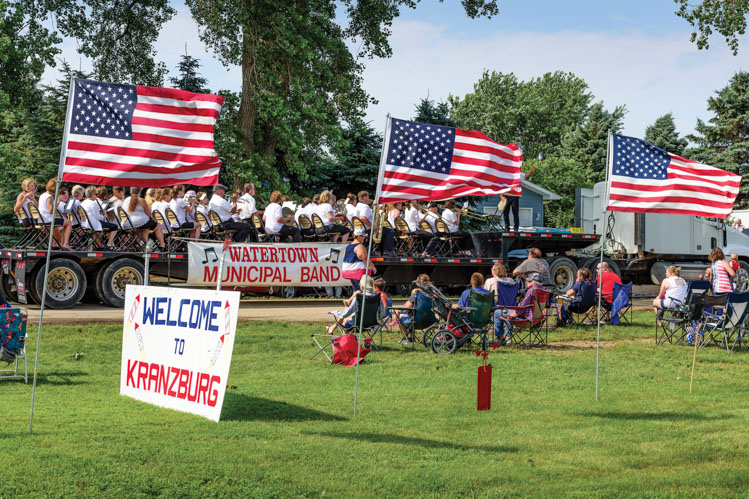
Kranzburg, population 150, is king on the Fourth of July. If Descartes, the great philosopher and mathematician, were called upon to construct a philosophy for the foundation of man and the celebration of independence, and if he were a South Dakotan, it would begin:”I think, therefore I am … at the Kranzburg parade on the Fourth of July.” There are other South Dakota communities that crave this recognition for the day we honor our American independence, but they would have a tough time measuring up. With supporting photos to dispel claims of embellishment, here are 10 reasons why Kranzburg is King on July 4.

10. There are clowns — a lot of them — and not those Shriner guys in little fezzes. These are more like Hobo Day clowns and they entertain young and old alike — and occasionally spray them with water or lipstick-laden kisses!

9. Horses with hoofs painted red, white and blue. Even the non-human participants are into this parade.

8. Copious amounts of candy. Every kid leaves with a bag of goodies picked up off the dirt main street. A smile, a wave and a cheer will inspire just about every entry to throw candy. As the kids run under horses, tanks and flatbeds, it becomes clear why the City Council runs an ad each year in the Watertown Public Opinion disavowing any knowledge or responsibility for the event!

7. Politicians. I once saw U.S. Senate Majority Leader Tom Daschle walking the parade with a very big Secret Service agent right behind him (I’m pretty sure the Secret Service guy had to skip item #3 below). Sen. John Thune was there last year, and in election years every person that stops for a second on the route is stickered with the whole slate from both parties.

6. A band on a flatbed. The Watertown Municipal Band rides through the parade entertaining the crowd with John Philip Sousa march tunes. Young and old swing, smile and cheer to the music that triumphantly celebrates America’s freedom.

5. Thousands of firecrackers rolled out down the middle of the parade route and randomly discharged. Happens every year — great noise, no fatalities. If you want to be the best on the Fourth, you have to sound like it, and little Kranzburg’s random pyrotechnics are a roar for freedom.

4. Festive costumes and red, white and blue everywhere. Three years ago, a local college student in a red, white and blue speedo ran right up the front of a van in the parade and danced on the roof! Not sure if his poor choreography, or the bill for the damage, was more disturbing for the family the next day. But, the spirit of the Fourth moves people in Kranzburg. While famous South Dakota kicker Adam Viniatieri didn’t make it last year, his Sioux Falls City Councilmember sister, and her whole family of in-laws, were there in red, white and blue tights. Fashion assumes a whole new meaning here on Independence Day.

3. Kranzburg’s parade is the only one in South Dakota where spectators can get cold tap beer off floats as the parade goes by. But they serve a balanced menu. The Coteau Cattlemen toss out beef sticks, and other floats have popsicles. My only caution is to avoid the hot dogs cooked on the diesel engine.

2. Patriots. Veterans groups and the American flag are prominent in the Kranzburg festivities. The Vietnam Veterans on motorcycles carry flags and capture the crowd’s respect. They are a vivid reminder of the reason for the celebration.

1. 5,000 South Dakotans, who, for that morning, are your best friends. They pack themselves along a two street parade, singing, cheering and celebrating what makes America — and South Dakota — great.

While the Kranzburg parade is the definition of Marquis of Queensbury rules for a public event, there are actually two rules — mostly science things — that are not suspended and to which you must adhere.

First, the parade starts at 10:30 a.m. There will be 5,000 people driving the 8 miles down Highway 212 from Interstate 29 and trying to get into a town of 150 by then, so get there early. If you arrive an hour early you can avoid a half hour traffic jam on Highway 212, and you can find a place to park that is within a mile walk.

Second, make a friend. You can camp out in just about any yard along the parade route and find many new friends who will likely share adult refreshments with you. Mostly, people tend to go back to the same spot where their family and friends have been squatting for decades. If you make friends with the folks who live along the route, you might get bathroom privileges, and not have to share the four porta-potties with the other 4,999 guests.

We camp in front of”Aunt Barb’s place.” I never knew my mother-in-law’s Aunt Barb, and I now think she maybe never lived there, but some relative of hers did. That’s close enough for our family to have bathroom privileges.

In Kranzburg on the Fourth of July, everybody’s a friend you just haven’t met yet.

Lee Schoenbeck grew up in Webster, practices law in Watertown, and is a freelance writer for the South Dakota Magazine website.