Posted on Leave a comment

The Fourth in Kranzburg

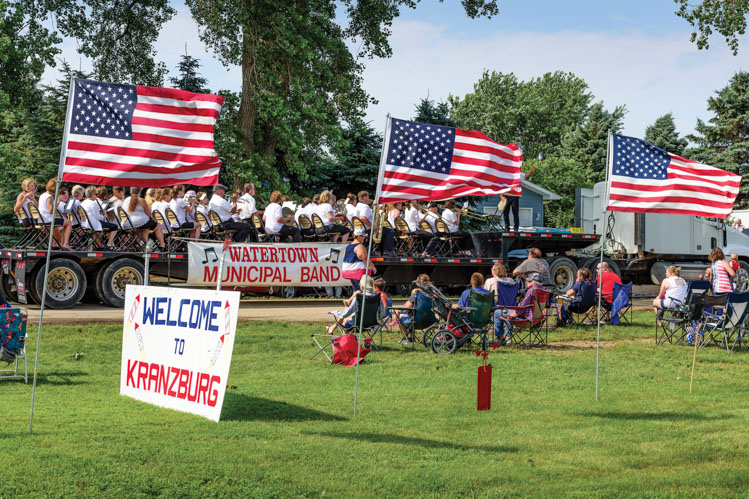
Kranzburg’s Fourth of July parade is one of the state’s largest.

An unorganized celebration keeps Kranzburg hopping each July 4 as anywhere from 4,000 to 10,000 people descend on the tiny town 8 miles east of Watertown.”No one is really in charge,” laughs Dale Plunkett, owner of Kranzburg’s Tip Top Tavern.”If you want to be in the parade, you just line up on the east side of town.”

Over the years it seems that every well-known South Dakota politician has marched in the Kranzburg Fourth of July Parade, community bands have played and plenty of free beer has been handed out. In fact, beer is how the whole thing started in 1958 or’59 when the late Charles Strang and Willie Kranz celebrated the town’s incorporation by driving around with a keg in the back of a pickup truck handing out free beverages.

Now the parade”kind of just happens,” says Carol Rinehart, Strang’s daughter. She and her sister Mary Ann Stahlke spot people they haven’t seen in years and agree it’s a community reunion.

“Three hundred and sixty-four days a year it’s a quiet little town,” Plunkett says.”Then everyone who has a connection comes.”

“It’s wall-to-wall people,” Stahlke adds.”And it hasn’t lost its momentum.”

Dale Plunkett and his mother Marge run Kranzburg’s Tip Top Tavern.

Kranzburg was named for the Kranz family that still lives in the area. It is historically a Catholic town with streets named for saints and the large Holy Rosary Church dominating the skyline. The impressively ornate church was built the same year the town was founded and placed on the National Register of Historic Places in 1986. Its school served the community from 1906 to 2014. At one time so many students attended that they overflowed into the one-room community school in town.

That public school was the first in Codington County and the Strang family sisters have lovingly restored it over the last several years. Carol Rinehart, Mary Ann Stahlke and Eileen Lindner all attended the District 5 Kranzburg school, as did their mother and other siblings. Although their father Charles Strang did not attend the school, he served on the town board that met in the schoolhouse until a town hall was built next door. Before he died in 2015, he made it clear that he wanted the school preserved.

“We promised and a promise is a promise,” Rinehart says.”I really think our dad helped us even though he wasn’t here.”

Carol Rinehart (left), Mary Ann Stahlke and other Strang family members continued their father’s wishes to preserve the Kranzburg public school.

So the sisters devoted one day a week to clearing out junk that had been stored in the building, scrubbing, sanding and painting. They discovered treasures like original books, posters and even artwork students had left in cabinets. They baked 300 rolls to raise funds and the Watertown Area Community Foundation provided a grant that helped put new shingles on the roof. Roofers Mark and Doug Kranz also repaired and painted the belltower.

Fourth of July parade attendees in 2022 got their first look at the restored school.”Everyone who came really appreciated it. Like us, they got a little nostalgic,” Rinehart says. Memories of Kranzburg when it boasted a grocery store, cheese factory, mink farm, the Kranz Hotel, a train depot, three bars and a liquor store are also collected in displays in the school.

Plunkett bought the Tip Top Tavern from his parents; his mother still works with him at the gas station/convenience store/Marge’s Diner/bar. In 1918 the Tip Top was built as a Standard Oil gas station at the corner of Highway 212 and County Road 3. Rebuilt, remodeled and repurposed over the years, it still occupies the original spot.

Community values are at the core of Kranzburg’s survival, according to Marge Plunkett.”It’s just a family community,” she says.”It’s home.”

Editor’s Note: This story is revised from the March/April 2023 issue of South Dakota Magazine. To order a copy or to subscribe, call (800) 456-5117.

Posted on Leave a comment

Last Hunt with John

Time spent outdoors helped soothe Lucas Nogelmeier’s grieving soul after the death of his father-in-law. Photo by Dean Pearson

When we lose someone dear to us, we yearn for one more conversation, one more Christmas or one more smile. When I lost my father-in-law John Wiles in November of 2019, I wanted one more hunt with the man who took me on so many memorable outdoor excursions in South Dakota. Thankfully, we got it.

On my annual West River deer hunting trip, my phone rang with the news. My father-in-law had been in the hospital for several weeks. After many ups and downs, he ultimately suffered a setback and there was nothing keeping him alive beyond the machines. I loaded my gear and came home. I stayed with the kids, and my wife went to be with her mom and family. I could have gone, and maybe I should have, but I remembered my grandfather in the hospital during his final days and selfishly decided that wasn’t the memory I wanted to have of John. A little after 2 a.m., the call came. My father-in-law was at eternal rest.

I spent most of the following morning feeling sorry for myself, thinking of the times John and I shared. As most South Dakotans know, hunting isn’t about the harvest. It’s about the connection we feel when interacting with the outdoors. My hunting trips with John were no exception. I remembered watching the sunrise with him out at the Pass, our local hunting club near Watertown, where he would recall moments from his childhood, his early adulthood and as a new parent. His life was tethered to that spot and it was a gift to be there with him. My memories weren’t of bag limits or trophy animals. They were simply of being together.

Unable to clear my head, I grabbed my gun and loaded up my dog. It was a magnificent mid-November day, the perfect medicine for my soul. I didn’t care about shooting a pheasant. I just wanted to be outside with my yellow lab Sage, to feel the sunshine on my face and the grasses brushing the backs of my hands as I walked through the prairie.

Using the Game, Fish and Parks map, I picked a spot I’d never hunted before. I arrived to find that cattle had grazed the ground so short it would be hard for a mouse to hide. Sage and I walked around the edge toward a slough to see what we could find. The property extended back into more public ground that had served as pasture but was fenced off and probably hadn’t been grazed in years. It was about 75 acres of overgrown feedlot.

It was a nightmare to walk through. The habitat was thick, layered and tall, but I knew it was prime hunting ground. About 10 yards in, Sage pointed and we dropped our first rooster. Another bird took flight. I kept an eye on where he landed, and Sage and I trudged over to the spot. As excited as we were to get to him, I slowed my pace. Soon my dog’s tail and demeanor indicated we were close. Sage moved north and I followed.

Watertown’s John Wiles (far right) loved hunting, and used the outdoor experiences to impart life lessons to his family, including (from left) son-in-law Lucas Nogelmeier and daughters Amber Nogelmeier and Shannon Bahr.

And then it happened. It was one of those moments that people travel from all over the world to South Dakota to experience. Hens exploded from the ground like popcorn. There were roosters in front of me, behind me, next to me. Cackling and beating wings roared in my ears. I shot once, twice three times, and didn’t touch a feather on any of them. I didn’t have time to reload completely, so I threw a shell in the chamber and shot. And missed again. Pheasants kept flushing, so I threw in another shell and still I missed. No less than 75 birds were piled into an area the size of half a basketball court. My dog looked at me quizzically, and all I could hear was my father-in-law’s boisterous laugh. He had a laugh that rose above the crowd. Amidst my tears, I couldn’t help but laugh as well.

Sage and I headed to a spot where the habitat was a little lighter. I was hoping for easier walking, and maybe some water for my dog. Just before we reached the easier stuff, a rooster flushed. This time, I focused and put him on the ground. We made a beeline out of the nastiness and back to the grazed land.

I walked Sage over to the slough and busted a hole through the ice with my heel so she could drink. Naturally, she ignored the water and acted birdy. I imagined that any one of the horde of birds we flushed could have landed anywhere, even out here in the short grass. I wandered behind her as she worked back and forth into the wind. We were close to the truck, but I didn’t want to go home and I didn’t want to keep pressing for my limit. I simply needed to be outdoors. Just as food and water nourish the body, nature nourishes the soul.

I was deep in thought as Sage and I walked the edge of the slough. The shoreline wound its way back into the thick cover, and soon we came to the spot where we first entered the overgrown feedlot. Rather than jump back in, I walked the grazed outside and let Sage work the edge of the prairie wilds.

I strode slowly north, the ancient, overgrown pasture on my right and the setting sun on my left. Geese honked above and two deer ambled out of the trees while I tried to wrap my head around losing someone who held such an exalted place in my life. Then Sage flushed a rooster about 30 yards into the mess, but I just didn’t feel like shooting. The purples, blues and greens radiated from the bird, and the scene was so idyllic that it seemed better just to admire.

Up ahead, the public land cut off and on the other side was an alfalfa field. Our hunt would soon be over. Fifty yards to go, then 20, then 10. And quiet. Sage and I stop. Tears began to pour down my cheeks again. I knew what was coming. My dog knew it too, and I could feel my father-in-law’s hand on my shoulder. My word for Sage to break point is”okay.” I let it out and Sage pounced. I heard the wingbeats before I saw the pheasant rise above the habitat, colors ablaze. Deliberately, I pulled the gun up and made a good shot. I knelt, sobbing, and Sage returned with the bird in her mouth.

For most of the day, I had been grieving, desperately wishing for one more hunt with my father-in-law. It was on my knees on the South Dakota prairie, my dog by my side and a limit of roosters in the vest that I realized this was that hunt. I didn’t want it to end, so we stayed a moment, together in spirit, in prayer and thanksgiving.

The same warm, November sun shone a bit brighter as we headed back to the truck, and my grief had been replaced with gratitude. A small trickle of water ran amidst the pasture, and Sage found the muddiest place to lie down and cool off. I typically try to keep her out of the mud, but if she’s willing to let me do the easy walking while she busts through the hard stuff to flush pheasants, I think it’s fair to let her wallow in the muck. She stepped out looking two-tone with mud covering every square inch from the middle of her belly and down. And I heard John laugh once more.

Editor’s Note: This story is revised from the November/December 2020 issue of South Dakota Magazine. To order a copy or to subscribe, call (800) 456-5117.

Posted on Leave a comment

Riding on Air

Jesse Jurrens leads Legend Suspensions, a Sturgis business specializing in smooth rides.

You could say that Legend Suspensions got its start on the dirt bike trails of Codington County. Jesse Jurrens grew up outside of Watertown, riding and modifying bikes. He continued tinkering after he got his first Harley, but when it came to the suspension system, he looked far and wide for an air spring system similar to what was being used on hot rods.”When I couldn’t find it, I decided to make my own,” Jurrens says.”That sent me down the path of fabricating prototypes, thinking in the back of my mind that maybe there was a market for it.”

The ultimate result was an air suspension system that has become the bedrock product for Legend Suspensions. Made using state-of-the-art rubber, the system provides a smoother ride, increased load capacity and adjustability mid-ride. The systems are now in use around the world, but it took a lot of time, testing and patience.

Jurrens began in the basement of his parents’ house in Watertown in the mid-1990s. He soon met Dan Dolan, now a professor emeritus of mechanical engineering at the South Dakota School of Mines and Technology in Rapid City, who specialized in vehicle dynamics.”I wasn’t a student but he was intrigued by what I was trying to accomplish,” Jurrens says.”He helped me to emulate a million miles of testing on that first product, which took quite a bit of time, but it was important to build that safety if I thought I was going to sell these in the future.”

The key came when the Gates Rubber Company agreed to share its Aramid fiber rubber air spring technology.”Aramid fiber is almost like a bulletproof vest,” he says.”When we run a lot of air pressure into these air springs, they can only grow about a millimeter at most, because it’s such a tight compact area underneath these bikes. The rubber has to stay its size and be able to handle extreme use. This is the only material that holds up. It makes our product work.”

Legend Suspensions now employs around 35 people at its headquarters in Sturgis. Parts are machined at a plant in Watertown and other components come from smaller companies in South Dakota and around the Midwest. In addition to air suspensions, they also produce high-end coil and front-end suspensions.”No matter what the customer is looking to do with that motorcycle, we’ve got an option,” Jurrens says.

Editor’s Note: This story is revised from the September/October 2021 issue of South Dakota Magazine. To order a copy or to subscribe, call (800) 456-5117.

Posted on Leave a comment

Glacial Lakes in Winter


South Dakota’s Glacial Lakes country
is perfect for day trips this winter. More than a hundred lakes — plus sloughs, wetlands, ponds and rivers — combine to create a scenic and unspoiled countryside rich with wildlife and waterfowl, friendly farm towns and numerous opportunities to enjoy nature.

Melting glaciers shaped this prairie pothole country 20,000 years ago. The lakes are so numerous that some remain unnamed. Most have grown in size and depth over the last 25 years. Bitter Lake, once little more than a shallow slough, is now the state’s largest natural lake; it is encroaching on Waubay Lake and other bodies of water to create an ocean-less, inland sea.

In this winter of the pandemic, we are all looking for new outdoor sights and experiences. Winter serenity and solitude has always been a trademark of the unspoiled Glacial Lakes region.

Here are 10 suggestions, organized by county, on how you might explore the Glacial Lakes. Some are auto drives, others offer winter hikes that could be compromised by the amount of snow on the ground. However, this list only scratches the surface so don’t hesitate to roam the lake country. You’ll discover many surprises, and they’ll all be good.

BROOKINGS COUNTY — The 135-acre Dakota Nature Park (at the corner of 22nd Avenue and 32nd Street South) lies in the southeastern corner of Brookings. Gravel mining led to formation of ponds and wetlands, and a restored prairie now grows atop the old landfill mound. A portion of the Allyn Frerichs Trail System — named for the city’s longtime parks and rec director who passed away in 2014 — skirts the north edge of the park, while a network of paths weave around the wetlands, prairies and trees.

BROWN COUNTY — Take a trip to Sand Lake National Wildlife Refuge. Though the classic 15-mile auto tour is closed in winter due to hunting and snow conditions, other roads remain open on the perimeter of the refuge. Explore the gravel roads that lead north and south from Highway 10. The snow geese are gone, but you’ll see other waterfowl, eagles and the Arctic’s snowy owls. Deer, pheasant and coyotes are also common. Sand Lake rose from the dust of the Great Depression to become one of the world’s most important wildlife sanctuaries. It is 30 miles northeast of Aberdeen.

CODINGTON COUNTY — Just southwest of Watertown is Pelican Lake. An observation tower near an inlet on the lake’s south side provides a sweeping view of the water, its namesake birds, the prairie and Watertown’s skyline. The Observation Tower Trail is a three-quarters of a mile hike through the woods and winter grasses. A longer jaunt, the Pelican Prairie Trail, gently meanders 5.2 miles.

DAY COUNTY– Explore the trails of Waubay National Wildlife Refuge, situated in the very heart of the Prairie Pothole landscape. Scientists say the region produces 50 percent of the continent’s waterfowl. Trails range from a few hundred feet to a mile, and jaunt around an island that houses the refuge headquarters. However, the public facilities are closed in winter.

DEUEL COUNTY — Visit 12-acre Ulven Park, which occupies a point on the eastern shore of Clear Lake. The frogs and toads, noisy in summer, are now hibernating so they’ll not interrupt the serenity of the park’s half-mile hiking trail.

EDMUNDS COUNTY — Shake Maza Trail at Mina Lake (between Ipswich and Aberdeen) is a short walk that explores the flora, fauna and other features at one of the first man-made lakes in northeast South Dakota. Shake Maza is a Native term meaning”shaped like a horseshoe,” which describes the 850-acre lake, ringed by picturesque cabins and homes.

GRANT COUNTY — This fascinating region is one of the USA’s five continental divides. Lake Traverse flows west to the Hudson Bay and Big Stone Lake flows south to the Mississippi and the Gulf of Mexico. Some of the best winter trails are at Hartford Beach State Park — a tree-filled, rocky shoreline north of Milbank that is quite unlike anything else in the Glacial Lakes. Signage in the park will direct you to several easy trails.

HAND COUNTY — Hike the Pheasant Run Trail at Lake Louise, 14 miles northwest of Miller. Beginning at the trailhead in the main campground, the dirt and grass trail meanders 3.2 miles around the south side of Lake Louise, which was created by damming the south fork of Wolf Creek in 1932. More than three dozen informational plaques identify trees and plants found along the way, though leaf identification will be challenging in December and January.

LAKE COUNTY — Wander the trails of Lake Herman State Park, which occupies a peninsula on the east side of Lake Herman, just west of Madison. A cabin built by pioneer Herman Luce in about 1870 stands along the 1.25-mile Luce Adventure Trail, which encircles Herman Pond. Connecting trails include the Abbott Trail (1.1 miles) and the Pioneer Nature Trail (.4 miles). All are easy walking.

MOODY COUNTY — Much of the prairie pothole region drains into the Big Sioux River, and the waterway starts to change its personality as it reaches Flandreau and Dell Rapids. Hike Red Rock Trail in Dell Rapids, where you can enjoy a closeup view of the famous rose quartzite that underlies the region.

Posted on Leave a comment

South Dakota’s Sledding Hills

Local youth take to their sleds at Yankton’s Morgen Park. Photo by Bernie Hunhoff.

South Dakota’s reputation for geographic diversity holds true when it comes to snow sledding. Some of our eastern cities are too flat, and the slopes in some of our mountain towns are too rugged, steep and rocky.

In Aberdeen, where the terrain has been described as”flat as a barn door,” city leaders manufactured a 25′ hill so kids could enjoy winter. However, we discovered that most communities have a natural hill that becomes a hot spot when it snows.

Pack your sleds as you travel this winter because there are plenty of hills to explore. Most of the snow hills are unsupervised, so adults should be ready to act if they see something dangerous — a heavy toboggan sled, for example, that could carom out of control and hurt someone, or a motorized vehicle on the slopes. Sledding has long been a favorite winter tradition, even for our flatland friends. Let’s keep it alive.

Here’s our list of city slopes. Tell us what we’re missing. We’d also like to know where to find the closest and richest hot chocolate after a day on the slopes.

ABERDEEN — God created most of South Dakota’s hills and mountains, but man assisted with the modest slope in Baird Park (1715 24th Avenue NE), the most popular sledding spot in the Hub City. City officials created the gentle 25-foot just for kids.

BELLE FOURCHE — Slopes behind the Tri-State Museum (415 5th Avenue) are a favorite, though they may be too fast for younger kids and there is a walking path at the foot of the hill so watch for pedestrians.

CUSTER — Pageant Hill has been touted as one of the finest family sledding spots in the Black Hills. It may be too steep and long for younger kids, but you don’t have to descend from the very top. The hill is the summit of beautiful Big Rock Park, which also includes hiking trails and a disc golf course. It rises above the city’s south side.

HOT SPRINGS — Southern Hills Golf Course (1130 Clubhouse Drive) is fun and scenic.

HURON — Toboggan Hill (6th Street & Lawnridge Avenue), aka Slide Hill, is a bluff above the Jim River valley on Huron’s east side.

LEMMON — The ever-resourceful people of Lemmon discovered years ago that it was less expensive to build a small hill for their new water storage rather than just build a taller tower. Then someone got the great idea or also making it into a sledding slope with a warming shack. Tank Hill is quite easy to spot on the city’s west side. Many years ago, when the water tower developed a leak during a cold spell, kids were able to slide on the ice flow all the way downtown.

PIERRE — The slopes above the soccer fields in Hilger’s Gulch are popular. The gulch is a scenic valley just north of the State Capitol building.

RAPID CITY — Meadowbrook School Hill (3125 W. Flormann Street) is a good spot, as well as the Civic Center hill that rises above the Holiday Inn Rushmore Plaza parking lot downtown.

SIOUX FALLS — Tuthill Park in southeast Sioux Falls is the site of weddings and parties in the summer months, but when the snow falls it becomes the domain of well-bundled children with sleds. Spellerberg Park (2299 W. 22nd Street), closer to the city center, also has a fair slope. Great Bear Ski Valley welcomes snow tubers, who get to ride the ski lifts.

SPEARFISH — Hills behind the Donald E. Young Center on the Black Hills State University campus are fast and fun.

STURGIS — Lions Club Park (off Lazelle Street) is a good place for younger kids, and Strong Field Hill on Ballpark Road is fun for older youth.

WATERTOWN — St. Ann’s Hill, a sledder’s delight, is so named because St. Ann’s was the original name of the nearby Prairie Lakes Hospital. Take Highway 20 to 10th Avenue and turn uphill.

WESSINGTON SPRINGS — It’s worth a drive to experience Ski Hill on the west edge of Wessington Springs. The natural setting in the Wessington Hills is idyllic, but the real attraction is an old, homemade invention with an electric motor that powers a 1,200-foot rope lift. Jokingly called the”Rube Goldberg ski lift,” the simple equipment has been lovingly cared for by handy volunteers, including Lloyd Marken, 85, who helped to build it in 1956.

YANKTON — Morgen Park (1200 Green Street) is the go-to sledding hill in town, however kids also like to slide down the earthen slope of Gavins Point Dam, where it rises above Pierson Ranch Recreation Area west of Yankton.

Posted on Leave a comment

The Winter Deer Hunt

Deer are the most popular big game species hunted in South Dakota. The state earns nearly $4.8 million annually in license revenue. Photo by Jesse Brown Nelson.

We arrived just before the sun crested the eastern horizon. A small propane heater buzzed in the corner of the 4-by-8-foot shack, softening the bite of a 29-degree late November morning.

Our eyes strained through cloudy windows into the thick shelterbelt, watching for any movement. A hen pheasant clucked furiously somewhere inside the tangle of cottonwoods. A squirrel pounced back and forth between tiny branches that barely held his weight.

Our silent vigil was aided by 6 inches of snow that had fallen the week before. The draws and valleys, normally a monotone late autumn brown, were filled with white, making the deer we sought even more visible.

Deer are by far the most popular big game species hunted in South Dakota. Deer license sales, on average, are about three times greater than all other big game licenses, and generate $4.8 million annually in license fee revenue. In 2015, about 61,000 South Dakotans (7.5 percent of the population) and another 6,850 non-residents hunted deer in the state.

For many families, the winter deer hunt is a long held and cherished tradition. That’s what brought us to this deer blind on a farmstead north of Henry, in the far western edge of Codington County — to pass that tradition along to my son Joe, a newly licensed 12-year-old, experiencing his first hunt.

The hunt was a lesson in patience. Not a single deer appeared in the first hour of daylight, although we knew this stand of trees was a favored spot. Just three days earlier, a fine 4-by-4 had been harvested from this very shelterbelt. And two weeks earlier we watched two trophy bucks chase several does up the ridge on the far side of the trees. One of them stopped, alerted by the faintest of sounds coming from our hiding spot, and stared in our direction for what seemed an eternity.

As the sun finally peeked over the tops of low-lying clouds to our backs, the gnarled cottonwoods were bathed in golden light. Stubble in the field off to the south began to lose its coat of frost. A thin layer of fog formed over a small pond just beyond the trees, and slowly burned away as the sun rose higher into the sky. But no deer. More than once, Joe’s attention turned to his iPhone and a rousing game of Brain Dots to stem the boredom.

Just before 9 a.m., we saw three does trotting south to north through the trees. My young hunter quietly opened the hinged window and rested the barrel of his rifle on the ledge.”Shoot the last one,” our guide whispered. Nervous anticipation filled the shack. He had done well shooting at targets in the farmyard, but what would happen now that an actual deer stood in his crosshairs? For some hunters, this is the moment they learn that they simply can’t pull the trigger, despite the desire and preparation.

A shot rang out — but not from us. A hunter somewhere to our south had spied his own prize. The deer froze for an instant, and then ran north into thicker trees. The opportunity was lost.

Once again, we waited. Two young bucks wandered into a clearing from the east, but since Joe’s tag allowed only the harvest of one antlerless deer we watched as they jumped the barbed wire fence with ease and trotted into the trees.

At 9:40, we called it a morning, much to Joe’s disappointment. Deer are most active in the hours immediately around dawn and dusk, bedding down for much of the bright daylight hours. Later, we would have another chance.

Joe Andrews, a newly-licensed 12-year-old, discovered that the winter deer hunt can be a lesson in patience as he waited in the deer shack west of Watertown with uncle Eric Johnson.

The first written record of deer hunting by European explorers came in 1804, when Meriwether Lewis killed two mule deer at the mouth of the White River. Deer were abundant when homesteaders began flooding into Dakota Territory in the 1860s, which meant they were a steady food source for families eking out a sparse existence on the frontier. Deer numbers dropped so drastically that in 1883 the territorial legislature banned hunting from Jan. 1 to Sept. 1, hoping to help herds recover.

The animals rebounded, but slowly. More stringent legislation in the early 1900s and creation of the state Game, Fish and Parks Department in 1909 aided deer populations. A structured deer season was reintroduced in 1929, when 2,000 residents were given licenses to hunt in the Black Hills. An East River season was added in 1947, followed by a West River Prairie season in 1952. Deer hunting in South Dakota reached record levels in 2010, when 81,478 hunters purchased 128,250 licenses to hunt deer, resulting in a harvest of 95,000 animals. Today South Dakota offers separate seasons for archery, muzzleloaders and youth, among others, all under the watchful eye of Game, Fish and Parks, the agency tasked with ensuring South Dakota’s deer herds remain healthy and plentiful. At last count, 426,000 whitetails and 116,500 mule deer roamed the state.

We returned at 4:10 p.m., with 41 minutes of daylight left and 71 minutes to hunt. It was 46 degrees; no need for the heater. Now, as we faced west, we stared into the brightly setting sun. There wasn’t a breath of wind. A squirrel — maybe the same one we saw just hours earlier — leapt from thin branch to thin branch, evoking a sense of dÈj‡ vu.

But this wasn’t a repeat of our morning in the blind. After barely more than 30 minutes, three deer ambled along the fence line. Again, the window quietly opened. We watched as they nosed through the undergrowth, pausing every now and then to sniff the air and listen for sounds that didn’t belong.

Joe trained his attention on the large deer in the rear, waiting for it to emerge from the brush. Silence filled the blind. The deer stepped forward and raised its head.

The loud crack of his rifle shot reverberated throughout the small confines of the shack. Two deer turned and ran, while the third reared up on its back legs. It cleared the barbed wire, stumbled and fell no more than 20 feet into the clearing. It was 4:51. Sunset.

Another November is now upon us; talk of returning to the blind has permeated suppertime conversations for several weeks. Joe was lucky enough to secure an East River buck tag for 2019, in addition to his youth tag. His trophy buck roams this very morning somewhere in the trees of Codington County. Soon, we’ll be back for another season among the squirrels, pheasants and the chill of a late autumn day.

Editor’s Note: This story is revised from the November/December 2017 issue of South Dakota Magazine. To order a copy or to subscribe, call (800) 456-5117.

Posted on Leave a comment

Kranzburg is King on the Fourth of July

Kranzburg, population 150, is king on the Fourth of July. If Descartes, the great philosopher and mathematician, were called upon to construct a philosophy for the foundation of man and the celebration of independence, and if he were a South Dakotan, it would begin:”I think, therefore I am … at the Kranzburg parade on the Fourth of July.” There are other South Dakota communities that crave this recognition for the day we honor our American independence, but they would have a tough time measuring up. With supporting photos to dispel claims of embellishment, here are 10 reasons why Kranzburg is King on July 4.

10. There are clowns — a lot of them — and not those Shriner guys in little fezzes. These are more like Hobo Day clowns and they entertain young and old alike — and occasionally spray them with water or lipstick-laden kisses!

9. Horses with hoofs painted red, white and blue. Even the non-human participants are into this parade.

8. Copious amounts of candy. Every kid leaves with a bag of goodies picked up off the dirt main street. A smile, a wave and a cheer will inspire just about every entry to throw candy. As the kids run under horses, tanks and flatbeds, it becomes clear why the City Council runs an ad each year in the Watertown Public Opinion disavowing any knowledge or responsibility for the event!

7. Politicians. I once saw U.S. Senate Majority Leader Tom Daschle walking the parade with a very big Secret Service agent right behind him (I’m pretty sure the Secret Service guy had to skip item #3 below). Sen. John Thune was there last year, and in election years every person that stops for a second on the route is stickered with the whole slate from both parties.

6. A band on a flatbed. The Watertown Municipal Band rides through the parade entertaining the crowd with John Philip Sousa march tunes. Young and old swing, smile and cheer to the music that triumphantly celebrates America’s freedom.

5. Thousands of firecrackers rolled out down the middle of the parade route and randomly discharged. Happens every year — great noise, no fatalities. If you want to be the best on the Fourth, you have to sound like it, and little Kranzburg’s random pyrotechnics are a roar for freedom.

4. Festive costumes and red, white and blue everywhere. Three years ago, a local college student in a red, white and blue speedo ran right up the front of a van in the parade and danced on the roof! Not sure if his poor choreography, or the bill for the damage, was more disturbing for the family the next day. But, the spirit of the Fourth moves people in Kranzburg. While famous South Dakota kicker Adam Viniatieri didn’t make it last year, his Sioux Falls City Councilmember sister, and her whole family of in-laws, were there in red, white and blue tights. Fashion assumes a whole new meaning here on Independence Day.

3. Kranzburg’s parade is the only one in South Dakota where spectators can get cold tap beer off floats as the parade goes by. But they serve a balanced menu. The Coteau Cattlemen toss out beef sticks, and other floats have popsicles. My only caution is to avoid the hot dogs cooked on the diesel engine.

2. Patriots. Veterans groups and the American flag are prominent in the Kranzburg festivities. The Vietnam Veterans on motorcycles carry flags and capture the crowd’s respect. They are a vivid reminder of the reason for the celebration.

1. 5,000 South Dakotans, who, for that morning, are your best friends. They pack themselves along a two street parade, singing, cheering and celebrating what makes America — and South Dakota — great.

While the Kranzburg parade is the definition of Marquis of Queensbury rules for a public event, there are actually two rules — mostly science things — that are not suspended and to which you must adhere.

First, the parade starts at 10:30 a.m. There will be 5,000 people driving the 8 miles down Highway 212 from Interstate 29 and trying to get into a town of 150 by then, so get there early. If you arrive an hour early you can avoid a half hour traffic jam on Highway 212, and you can find a place to park that is within a mile walk.

Second, make a friend. You can camp out in just about any yard along the parade route and find many new friends who will likely share adult refreshments with you. Mostly, people tend to go back to the same spot where their family and friends have been squatting for decades. If you make friends with the folks who live along the route, you might get bathroom privileges, and not have to share the four porta-potties with the other 4,999 guests.

We camp in front of”Aunt Barb’s place.” I never knew my mother-in-law’s Aunt Barb, and I now think she maybe never lived there, but some relative of hers did. That’s close enough for our family to have bathroom privileges.

In Kranzburg on the Fourth of July, everybody’s a friend you just haven’t met yet.

Lee Schoenbeck grew up in Webster, practices law in Watertown, and is a freelance writer for the South Dakota Magazine website.

Posted on Leave a comment

No Limit to the Fun


The Benedictine sisters of Mother of God Monastery have been embracing life on the prairie in South Dakota for over 100 years — a little longer than South Dakota’s most popular game bird, the Chinese Ringneck Pheasant. Being that steeped in South Dakota history, it should come as no surprise that their activities include hosting an annual pheasant hunt. This year’s September hunt, the sisters’ eleventh foray into the charity ringneck hunting world, was again held at Oak Tree Lodge near Clark, South Dakota. That the local business community and faithful would support the sisters and the good works they do by participating in the event should also come as no surprise.

MOTHER OF GOD

The Benedictine sisters have a rich history, reaching back to Italy in 529 A.D., with a focus on life organized about the Rule of Saint Benedict. The Rule, a guide for organizing a Christian community around the precepts of work and prayer, continues to direct the Benedictines to this day. The sisters made their way to South Dakota, near Zell, in 1874 — a full forty-five years before the first ringneck season. In 1967 the sisters established a convent in Watertown, on a hill overlooking the Sioux River. Today, Mother of God is home to 54 sisters.

Through the years their mission has changed. In the early years their focus was on education and health care. Several of the participants in the Nun Hunt were the beneficiaries of Benedictine religious education. (Full disclosure: this writer was educated by these nuns at St. Otto’s in Webster.) A major focus of the sisters today is the Benedictine Multicultural Center, a facility aimed at encouraging understanding of our area’s many cultures, and providing assistance to those newer South Dakotans that may be in need and find navigating South Dakota a little challenging.

OAK TREE LODGE

The Makens’ family roots at Oak Tree only reach back to 1901, making them the younger South Dakota members of this nun-pheasant-landowner partnership. While the family makeup there has changed through the decades, Bill Makens is the current patriarch. He started making the move back to South Dakota, and Oak Tree Lodge, in 1998. The Makens family are dedicated and faithful Catholics, who host this hunt as one way to participate in their faith. The patriarch, Bill, had a long history of fundraising for Catholic schools in the Twin Cities, so the Nun Hunt was a natural fit.

THE HUNT

The Nun Hunt takes place at the Oak Tree hunting preserve northeast of Clark. Over thirty hunters and a pack of trained hunting dogs partake in the hunt. Oak Tree’s hunting ground is in close proximity to its lodge, and the layout shows a love and attention to hunting and the husbandry potential of the land. Oak Tree’s 8,000 acres are dotted with food plots, sloughs and standing bean and corn fields. It is a hunter’s dream land, because it has been designed to be a pheasant’s dream land.

While challenged this year with winds of over twenty miles per hour, the hardy crew harvested 62 pheasants — and all the fun that was legal to have. While the wind makes the hunting more challenging, no South Dakotan ringneck chaser would allow limits on the fun at a Nun Hunt.

THE SOCIAL

The hunters that come to the Nun Hunt enjoy the hunt, the outdoors and the camaraderie — but they also understand that the event is about raising funds to help the sisters continue their ministries, and the hunters are fully invested in that cause. Like all good charity events, there is an auction. Auctioneers Randy and Chris Owen donate their services, bringing both a humorous and ecumenical flair to the hunt. For example, while raising one’s own bid is frowned upon at most auctions, it may be the norm at the Nun Hunt!

On one occasion, local OB/GYN hunter, Dr. Flaherty, raised his bid after winning in exchange for a hug from the sister assisting with the auction. A successful hunter, at this auction, is likely to come home with a basket of nun-baked bread and sister-pickled preserves. The only rain that falls on this event is the inevitable ability of the Vikings to lose on the Sunday of the Nun Hunt, but there are some things even the Sisters’ good cheer and preserves can’t remedy.

GOOD THINGS HAPPEN FOR A GOOD CAUSE

Outside of South Dakota, it probably seems a little odd for a pacifist group of prayerful ladies to raise money with Mr. Remington’s finest, but here it makes perfect sense. The sisters, the ringnecks, and the landowning Makens have deep roots in our state. A day in the field hunting pheasants is among the finest blessings to bestow upon a South Dakota hunter — well, a hunter from anywhere, for that matter. The sisters caring for our people, birds that inspire our state, and the landowners that create the habitat for those birds all nurture parts of what is best about life in South Dakota. When all these come together for a good cause, many good things happen — and, well, that’s why there’s no limit on a Nun Hunt: because the nuns have never put a limit on the good they would do for those they have touched along their journey here at home in South Dakota.

Lee Schoenbeck grew up in Webster, practices law in Watertown, and is a freelance writer for the South Dakota Magazine website.


Posted on Leave a comment

A Terry Redlin Moment

This past weekend was the in-state opener for pheasant hunters. We now have a preserve opener, a youth opener, an in-state opener and an out-state opener. This is too much red tape for a traditionalist like me, so generally I just wait for the High Holiday of the opener on the third Saturday in October. But I am a traditionalist — not a fool! This year, with all the beans and corn out and the CRP hayed, the in-state opener promised to be an opportunity to hunt virgin birds on public lands in ample numbers, so I was all in.

WHERE TO HUNT

The waterfowl hunters are a good resource. My duck hunting buddies said that all the birds they heard or saw were near water, and one suggested Long Lake. Long Lake is about 4 minutes from the edge of Watertown, the state’s fourth largest city. From my home, it is an equal distance to Long Lake or Wal-Mart! That just didn’t sound like a recipe for a successful hunt. But I checked with another buddy and his advice echoed the first — take the Memorial Park road from town until you hit Long Lake, and then north until you find a place to park. That seemed like odd advice, but I took it.

For the in-state opener you can only hunt public areas, which lends itself to a concentration of hunters. Pick a public spot four miles from the city of Watertown, and you’re asking for something that looks like the Oklahoma Land Rush. As I drove north, there were multiple pickups parked every quarter-mile. This didn’t look promising, but since I mostly just wanted to get a chance to work my three dogs without being shot at, I was flexible. I saw an area with two trucks and room for me to park, so we were in. As I parked, I notice to my right a monument — I was at the Terry Redlin Wetland Area.

TERRY REDLIN — ONE OF THE GREATEST

Terry is a Watertown native that lost one leg as a high schooler in a motorcycle accident. The state agreed to send him to art school as part of a vocational retraining program, and at first blush, the rest is history. He learned to paint wildlife scenes that captured the beauty of the upper Midwest like nobody had previously imagined. He became so popular that more people bought copies of his work than almost any other artist to ever walk the face of the earth –seriously. But Terry Redlin was different. He never forgot what the people of South Dakota did for him, and he was determined to repay the debt he felt. He returned home. The Redlin Art Center, and many other charitable contributions, are monuments to his commitment.

Not surprisingly, Ducks Unlimited and the South Dakota Game, Fish & Parks recognized his support of the outdoors with a monument and the dedication of a public hunting area near his hometown of Watertown.

THIS CAN’T ACTUALLY WORK

So I got out with my three dogs — with two hunters and their sons and dogs to my left and another group a quarter mile to my right. On the first pass towards the water, the only scent the dogs picked up was towards the dads — and no good hunter will crowd a dad taking his kids on a hunt. After a swim for the dogs in Long Lake, three quick flushes yielded two roosters, two shots and a pretty good day. On the swing back to the pickup, about 40 yards from the Terry Redlin marker, one more rooster decided to give it a go, and a quick bark from the over-and-under finished the day. According to the satellite time on the iPhone, my anticipated two-hour walk with my dogs lasted all of 31 minutes!

ASSESSING THE HUNT

My hunting buddy Yseth had to go out later, hunt longer and had less success. When I told him about my hunt, his quick retort was,”You got lucky!”

Personally, I think he missed another obvious answer. Terry Redlin painted the beautiful and multi-colored pheasant like nobody before or since. Maybe, just maybe, the birds hang around his monument because they appreciate his work too?

Lee Schoenbeck grew up in Webster, practices law in Watertown, and is a freelance writer for the South Dakota Magazine website.


Posted on Leave a comment

Meet the Beasts

Labor Day weekend is summer’s last hurrah for many. If you’re traveling around South Dakota to enjoy the holiday, stop and appreciate the inventiveness and creativity of our fellow South Dakotans at one of our unique roadside attractions featuring wild things. There’s Bear Country USA, Dinosaur Park and Reptile Gardens, sure, but here are three you may not know about.

A Lot of Bull

Drivers see South Dakota at 75 miles an hour crossing the state on Interstate 90, but many slow down, gawk and even swerve as they pass the Montrose exit 25 miles west of Sioux Falls. It’s probably the 60-foot tall scrap iron longhorn bull that diverts their attention. The bull is the centerpiece of Wayne Porter’s Sculpture Park, which comprises 10 acres of welded dragons, butterflies and other mythical creatures. Porter spends seven days a week at his park during the summer working on new projects and greeting visitors. It’s an ironic venture for Porter, who told us in 2007 that he studied political science and history at South Dakota State University because he thought an art career would be too time consuming. He even tried sheep ranching in Hand County before turning to sculpture full time.

His creations make people laugh and think. There’s a boy on a sled, a man’s hand reaching out from a brain for ideas and vultures lined up like fence posts. Everyone’s favorite, though, is the longhorn, made from 8-inch square steel plates from abandoned railroad tracks.

South Dakota’s Heaviest Bird

Another hard-to-miss animal resides about two hours north of Porter’s park. Most Chinese ring-necked pheasants measure two or three feet from beak to tail and weigh less than five pounds. They are dwarfed by the Tinkertown Pheasant, easily our state’s heaviest bird. The Walters, proprietors of a country store along U.S. Highway 212 about 12 miles west of Watertown, built the concrete bird in 1950. They later added a concrete donkey they called Depression Nag. Girl Scouts from Clark paint the pair each summer.

Pheasants were introduced to South Dakota over 100 years ago and legislators declared it our state bird. Each fall hunters flock here to bag their limit. Plenty of South Dakota towns claim to be the”Pheasant Capital.” Huron, Gregory and Redfield each boast giant, plastic pheasants to support the claim, but those are lightweights compared to Tinkertown’s everlasting rooster.

A Haven in the Hills

Mike Welchynski, founder of the Spirit of the Hills Wildlife Sanctuary, and friend.

More agile (and dangerous) animals can be seen outside of Spearfish at the Spirit of the Hills Wildlife Sanctuary. Don’t be startled if you hear the roar of an African lion or the deep growl of a black bear. They’re supposed to be there, and Mike Welchynski is taking good care of them. Welchynski founded the sanctuary in 1999 as an escape for exotic animals victimized by illegal breeding farms and abusive carnivals and circuses. Welchynski grew up surrounded by animals in the woods of Manitoba and created an animal sanctuary there. Spearfish residents Johanna Meier and Guido Della Vecchia, who were touring Canada with the Black Hills Passion Play in 1998, convinced Welchynski to establish a sanctuary in South Dakota. Today more than 300 cougars, African lions, tigers, camels, tropical birds and other creatures (including dogs, cats, horses, hamsters and others) live on 200 acres of rocky Ponderosa pine forest on the edge of Spearfish. The playful, harmless critters roam free, but the more dangerous wild animals reside in spacious cages.