Posted on Leave a comment

Art-Warming

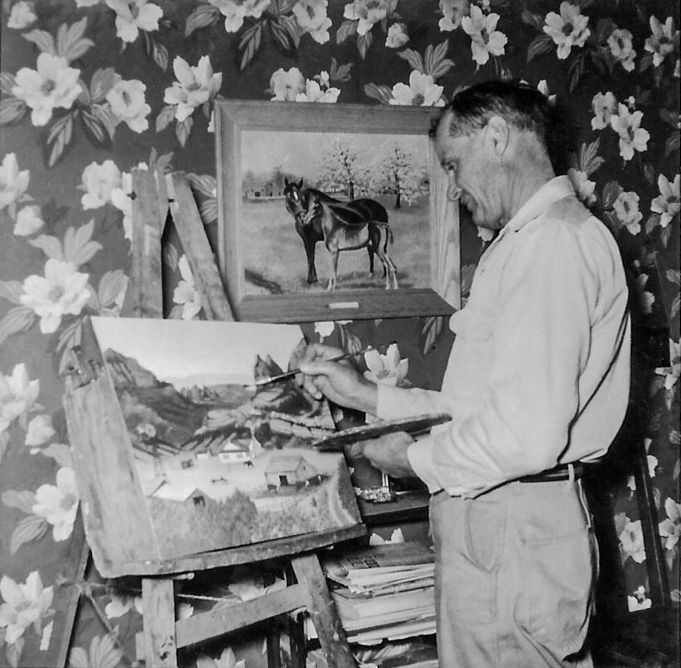
The grandchildren of Fred Mohling, pictured painting in his Aurora County farmhouse in 1957, are rediscovering his artwork and are exploring ways to share it with South Dakotans.

In 1959 Aurora County farmer Fred Mohling traveled to California for the Rose Bowl. Naturally, when he returned to South Dakota, friends and family asked about the game.

Mohling couldn’t tell them much. He hadn’t gone to watch football, he explained, but to see the roses in the famous parade. At home, in addition to selling grain and cattle, Mohling created paintings, including still lifes with flowers. Today, 40 years after his death, his descendants are sorting through his works: Midwestern and Western landscapes, people, waterfowl, horses, hunting dogs and still lifes. The family doesn’t necessarily want to sell the art but would like to exhibit some of it, maybe at libraries as a starting point. The learning curve is steep, exploring exhibition protocol, likely venues, copyright and even framing (when Mohling framed his art he sometimes purchased cheap and rather gaudy hardware store frames).

There’s another holiday season story about Mohling. Seventy years ago this December he skillfully painted a life-sized Christmas Nativity scene and other holiday images on plywood and illuminated them with 100 white and colored lights for his grandchildren. He set it up on his farm, just south of the Aurora-Jerauld County line, where it delighted more than his grandkids. As word spread, hundreds of South Dakotans drove 75 miles or more, on two-lane roads in winter, to see the scene. Memories of the Nativity art are mostly all that remain. The painted figures largely disappeared. Mohling’s farmhouse and ag buildings were razed for corporate farming, and the farmer-artist himself died in 1984.

Harmony Friends Church

His painting of a mountain scene is part of the Center for Western Studies collection at Augustana University in Sioux Falls, and another found a home in the Wessington Springs museum. But most were divided among family.”There are more than we remembered seeing around his house years ago,” says grandson John Swanson of Rapid City. He believes his grandfather completed more than 150 paintings, usually ranging from 8-by-10 inches to 16-by-20 inches in size. Another grandson, Greg Miller, notes that Mohling mostly used oils on board surfaces, and also drew with charcoal as well as colored pencils late in life.”There was something about winter scenes,” Miller says.”He looked at snow much of the year and liked it.” Miller has taken a lead role in documenting Mohling’s life through newspaper clippings and public records.

Great-grandson Ryan Aalbu of Spearfish was young when Mohling died and only vaguely remembers the man, but he treasures his paintings.”Mine are outdoor scenery and animals,” Aalbu says.”I didn’t know until fairly recently that he was a good portrait artist, too, painting people from American presidents to his own family.”

Fredrick Henry Mohling, born in 1894, grew up as the eldest of eight children on a Nebraska farm. At home he spoke German but made the mental switch to English for school. A capable student, Mohling hurried through his in-school lessons so he could draw at the end of classes, and at age 12 he won first prize for a painting he took to an Old Settlers picnic.

He married Tillie Maschman, and they had seven children, which left little time for art. The Mohlings moved to South Dakota to farm in 1920 and weathered bad ag prices that decade and the Dust Bowl and Depression of the 1930s.

The hard times led to President Franklin Roosevelt’s Works Progress Administration. Gov. Tom Berry insisted that art be part of the WPA and Mohling renewed his interest in painting by taking three classes in Mitchell. He was also inspired by a landscape artist he saw at the State Fair.

Blue Jay Wonder

Sadly, his family thinks that Mohling’s main motivation to paint was his deep grief after Tillie died suddenly from an appendix ailment in 1940. Art became his therapy, perhaps, or at least a way to occupy his mind.”When you do something requiring great attention to detail, you can’t think about other things,” Swanson says. A family member recalled coming home from a dance to find Mohling working at his easel in the middle of the night.

Still, Mohling didn’t hit his stride with art, in terms of quality and output, for a few years. There was always work on the farm. He also landscaped his big yard, created a lily pond and outdoor fireplace, and he built swings for his kids and grandkids. When Tillie died, two of his children were young adults who helped to raise the younger five. Mohling enjoyed traveling by car with his family and drove them to the Black Hills to see Josef Meier’s Passion Play, a religious drama performed in Spearfish on what was billed as the world’s”longest outdoor stage,” all of it skillfully lighted. Maybe the biblical production was the inspiration for Mohling’s own outdoor Christmas presentation.

“That could be,” Swanson says.”He liked visuals, obviously, and things built big. He drove to Texas once to see the new Houston Astrodome, which was called the eighth wonder of the world.” The family has no record as to whether Mohling saw a ballgame during that trip or simply admired the big domed stadium.

Swanson describes his grandfather as a type of man most South Dakotans might know. He was accomplished in agriculture, could build anything, and — far from the stereotype some Americans held of rural Midwesterners in that time — wasn’t cocooned in his own locality but interested in the wider world.

Mohling took enough interest in his 20 grandchildren to buy or make each a meaningful gift every Christmas, granddaughter Jane Aalbu remembers. His gifts would only get better: one of his original paintings for high school graduation and another as a wedding present if a grandchild got married.

“He was mild-mannered and soft-spoken, and fairly easy to talk to,” says Swanson, who was in his 20s when Mohling died. The farmer-artist didn’t drink except for perhaps a glass of Mogen David wine on holidays. Knowing his distaste for alcohol, his descendants have had light-hearted discussions about whether it would be appropriate to serve higher quality wines at exhibits of his art.

Through years of raising children, bonding with grandchildren, and adapting to post-World War II ag technologies, Mohling kept improving his art techniques. Swanson recalls seeing the classic Blue Boy (a portrait by 18th century English artist Thomas Gainsborough) among his grandfather’s possessions and assumed Mohling admired it and bought a print. As it turned out, Mohling copied it stroke by stroke — a time-honored method that artists have used to fine-tune their skills.

Buckeye Brown

Mohling didn’t seem interested in selling his works but in 1955 Wessington Springs hosted a horse show. Mohling loaned horse paintings to Rukstadt Hardware Store for a window display during the event. An Indiana man admired a threshing scene and Mohling agreed to sell it to him. In 1956 he won two blue ribbons at the State Fair; he’d previously taken home art ribbons from Huron but never before a first-place honor, let alone two. Those blue-ribbon paintings almost certainly remain in the family’s possession, and they hope to determine which they are.

In the late 1950s and beyond, Mohling took his art to appreciative rural audiences in Clark, Faulkton, Wessington Springs, Mitchell and Fairbury, Nebraska, near his birthplace. Plankinton journalist Adeline VanGenderen reported on a show where a woman rhetorically asked how anyone could choose a Mohling favorite given the wide variety of scenes and subjects.”We got to thinking this over, and how could you?” VanGenderen wrote.”First your eye would be drawn to a moose beside the lake; deer drinking from the stream; an Indian pony and its rider; you could almost smell the dust of the covered wagon as it groaned westward.”

If art scholars had read VanGenderen’s description, they might have concluded that Mohling was part of the Regionalism art movement, especially popular in the rural Midwest in the mid-20th century and best epitomized by Iowa painter Grant Wood. The style became popular nationally as Americans first feared that the Midwest was being blown off the map by Dust Bowl winds, and then again as they celebrated that it wasn’t.

But there’s no evidence Mohling saw his art as part of any movement or school of thought. South Dakotans tend to be skeptical of those who categorize local visual art as Fine, Folk, Regionalism or any other grouping. Most would agree with the late University of South Dakota professor and author Graham Thatcher, who warned against associating with any”sophisticated art nerd who asks you what you think in order to get an opening for his or her well-rehearsed sermonette.” Thatcher stressed, in his book I Know What I Like! Everyone’s Guide to the Arts,“There are no rules in Art Ö there is only taste.”

Mohling met the tastes of South Dakotans half a century ago. In 1974, friends and family turned out in force for his 80th birthday celebration in a Wessington Springs ag building, its interior walls decorated for the day with 80 pieces of his art.

Today, Mohling’s descendants are working to determine whether 21st century South Dakotans find significance in the art, as well. In August the family put digitized images on a video loop and played it at Mitchell’s Corn Palace Festival. They may do the same at the State Fair next year. A professor has suggested the paintings may hold value for students learning about both the techniques Mohling used and the times in which his art took form.

Relatives don’t anticipate a posthumous discovery of Mohling’s talent beyond the borders of South Dakota. They’ll be happy if small groups of observers see something in his art that warms their hearts.

That’s what art did for Fred Mohling, and it was quite enough.

Editor’s Note: This story is revised from the November/December 2024 issue of South Dakota Magazine. To order a copy or to subscribe, call (800) 456-5117.

Posted on Leave a comment

New Days in Aurora County

The people of Aurora County are no strangers to trials and tribulations. They’ve seen droughts, tragic deaths and failed enterprises since the county’s creation in 1879. But there have been, and continue to be, bright spots. If there’s ever any doubt, citizens need to look no further than the very name of their homeland for inspiration.

Aurora County is named for the Roman goddess of the dawn. In mythology, Aurora is renewed each morning and flies across the sky, announcing the coming of the sun and the birth of a new day, a new beginning. In the realm of South Dakota county nomenclature, Aurora certainly stands out as unusual. Of our 66 counties, 43 were named after legislators, governors or other prominent men involved in the creation of Dakota Territory. Another 11 were named for famous national politicians or military leaders. So why would the territorial legislature turn to a female mythological figure when naming this new county?

It turns out they didn’t, because legislators didn’t name it. Aurora came from a group of women gathered in a sod hut, probably one of the first homes in the area. Ruth Page Jones, an Aurora County native and independent historian living in Wisconsin, mentioned the story at the Dakota Conference, held in late April at Augustana University in Sioux Falls. Jones is studying the early settlement of her home county and is seeking more information about who the women were and where the hut was located.

In 1880, the Chicago, Milwaukee, St. Paul and Pacific Railroad arrived in Aurora County, prompting the establishment of Plankinton and White Lake. Shortly thereafter, a grand hotel was built in Plankinton to accommodate travelers. The building still stands and is nearing restoration as a wedding chapel, cultural and arts center and railroad museum.

Volunteers have spent over a decade restoring the Sweep-VanDyke Hotel in Plankinton.

The Sweep-VanDyke Hotel is one of two still standing in South Dakota along the old Chicago and Milwaukee line. As the only hotel for miles, travel-weary passengers viewed the charming two-story structure with its welcoming veranda as an oasis on the prairie, says Gayle Van Genderen, president of the Plankinton Preservation Society and publisher of the South Dakota Mail, Plankinton’s weekly newspaper.”Early accounts say people would push each other over just to get a night’s sleep on one of its feathered pillows,” she says.

The hotel is named for George and Ella Sweep, proprietors in the early 1900s, and Bert and Barbara Van Dyke, who ran it as a boarding house before it closed in the early 1970s. It was slated for demolition, but the preservation society bought it in 2004. It was added to the National Register of Historic Places in 2005. A dedication is set for July 23.

Plankinton’s signature purple water tower stands along Main Street.

The citizens of Plankinton had a knack for grand buildings. Grain palaces in which to house agricultural expositions were all the rage as the town was getting on its feet. From the 1880s to the 1930s, at least 34 grain palaces were built in at least 24 towns around the Midwest, according to Rod Evans’ book Palaces on the Prairie.

Plankinton opened South Dakota’s first such palace in September of 1891. The building was about 80 feet square and stood at the north end of Main Street, but the Aberdeen Weekly News still believed it would be”the greatest display of grain ever shown by any country.” It drew a mighty crowd for its festival, including a band from Lennox and trainloads of spectators from Sioux City and Mitchell.

The next year Mitchell decided to build a grain palace of its own, and the friendly competition between the neighboring cities induced the people of Plankinton to build an even larger palace for the 1892 celebration. But in 1893 the people decided their town couldn’t support a third palace, partially due to the success that Mitchell saw the previous year. The Plankinton palace was torn down and rebuilt as a barn outside of town. Today a painted sign that advertises the 1892 exposition is among the only items to have survived. It hangs in the Aurora County Historical Society’s museum, while the Mitchell Corn Palace has become a world famous tourist destination.

About 10 miles west along the railroad tracks (eventually supplanted by old Highway 16, a popular east-west route across South Dakota) stands White Lake, a town named after the nearby body of water. The first recorded exploration of the area came from the noted artist George Catlin in 1832. Catlin was aboard the steamship Yellowstone, which was making the first ever trip along the entire length of the Missouri River from St. Louis to its headwaters. Perhaps the boat made a regular stop or ran aground on a sandbar, but whatever the reason Catlin departed and walked overland to Fort Pierre, passing White Lake along the way. While in Fort Pierre, Catlin completed several of the Native American and prairie scenes for which he became known.

Bob and Edith Zoon operate the A-Bar-Z Motel in White Lake.

The world’s attention once again turned to White Lake in 1935, when the lighter-than-air balloon Explorer II touched down. The flight had launched in frigid weather from the Stratobowl near Rapid City on Nov. 11, 1935. Explorer II reached a height of 72,395 feet, an altitude record that stood for 21 years. The aeronauts on board collected new information about high-altitude atmospheric conditions. They also provided the first photographs to show the curvature of the earth against the backdrop of space. Explorer II drifted 230 miles east, making a successful soft landing in a pasture about 12 miles south of White Lake. To commemorate the 50th anniversary of the landing in 1985, local volunteers led by Howard Herrick constructed a 5-foot-tall marker made of fieldstone. You can find it on 265th Street near Platte Creek.

A stone marker stands south of White Lake where Explorer II landed in 1935.

Stickney is the third town in Aurora County. While not on the old railroad, or Highway 16 or Interstate 90, it is on Highway 281, a major north-south route through the state. Stickney was founded in 1905 and named for the family that founded Stickney in Great Britain. A descendant of that family visited for the town’s Fourth of July celebration in 1906. Stop at the 281 Diner for a burger and ice cream cone.

There has been sadness in Aurora County. In 1887 Cephas Ainsworth became superintendent of the Dakota Reform School. Ten years later, the school endured tragedy when a fire broke out in a locked dormitory and killed six girls. They lie in a mass grave marked by white chains in the town cemetery. A century later, 14-year-old Gina Score died after running 2.7 miles on a hot and muggy day. Today the State Training School is closed, but the facilities are used as a residential treatment center for youth called Aurora Plains Academy, invoking the namesake of the county that reminds us that a new day — and a fresh beginning — is right around the corner.

Editor’s Note: This is the 23rd installment in an ongoing series featuring South Dakota’s 66 counties. Click here for previous articles.

Posted on Leave a comment

Comet Chasing

My childhood best friend introduced me to science fiction. I remember borrowing every one of his copies of Isaac Asimov’s robot books as well as all of Ray Bradbury’s short stories. He had almost every Edgar Rice Burroughs paperback while I gathered all Frank Herbert’s Dune books as well as any Star Trek and Star Wars books I could find. You may ask what does science fiction have to do with photography. Not that much really, but let me explain where I’m going here.

Collecting sci-fi paperback books back then meant collecting some amazing cover art. Science fiction in particular had spectacular”other-world” art that often persuaded me to buy the book even though I had never heard of the author. These science fiction tales as well as the imagery that it came bundled in really did spark my interest in space and astronomy. So when a co-worker told me about a new comet that would be swinging by Earth this month, I was pretty excited. Up until now, I’d never seen or photographed a comet before.

Another co-worker shared a great website for stargazers (www.spaceweather.com) with me last year. I immediately consulted the site and found out about comet Pan-STARRS and the projected”best” time to view in the Northern Hemisphere. Starting early in March, the comet would make its appearance in the lower western sky just after sunset. On March 12th, I couldn’t resist my curiosity any longer. I was determined to find this comet and try to photograph it. It was cloudy in Sioux Falls, but the internet told me it would start to clear up somewhere west of Mitchell, so I west I went.

Between Plankinton and White Lake the clouds dissipated. I took the White Lake exit and proceeded north through town to find a suitable location to scan the sky. Since it was another scenic South Dakota sunset, I made sure to stop and shoot a few photographs as I drove by White Lake and up into the hills to the north.

I found a nice spot on a hillside northwest of town and although the waxing moon was beautiful, I could not see any sign of a comet. It was supposed to be just a few degrees to the left of the moon, but I couldn’t see it, even with binoculars. Another five to ten minutes went by and the sky grew darker. I was about ready to call the whole thing a bust when I decided I should at least get a shot of the moon over the landscape.

“There it is!” I whispered out loud. I was looking at the back of my camera and to my surprise, the comet showed up on the LCD. I still couldn’t see it in the sky, but the long exposure coupled with a telephoto lens brought it out unmistakably. I was giddy. I snapped a few more photos and then remembered a lone prairie windmill I had passed on the way up the hill. I grabbed my gear and drove as fast as possible to the side of the field with the windmill some 200 yards away. I grabbed my tripod, a flashlight and my camera then half ran, half stumbled though the field in order to line up the windmill, moon and comet.

I didn’t have much time as both the moon and the comet were sinking towards the horizon and the wispy cloud band was starting to obscure them. On my first shot, I missed the comet entirely, but happened to catch an owl on the windmill that I had no idea was even there. I widened out for my second shot and there it was. Comet Pan-Starrs was hanging in the sky just opposite of the moon with my windmill in between. The images my camera produced reminded me of one of those old science fiction covers I used to love as a kid, minus the spaceships and robots of course. On the way back home, I may or may not have cued up the Star Trek theme on my iPod. It’s funny what chasing a comet with a camera can do to a full-grown man.

Christian Begeman grew up in Isabel and now lives in Sioux Falls. When he’s not working at Midcontinent Communications he is often on the road photographing our prettiest spots around the state. Follow Begeman on his blog.


Posted on Leave a comment

The Cadillac Caper

We had a good laugh after reading a story in the March 27 edition of the Wessington Springs True Dakotan. They learned about the incident in the Plankinton South Dakota Mail, and now we’re retelling the tale to you.

It’s said that criminals often return to the scene of their crime. That was true on March 9th, when the Aurora County Courthouse in Plankinton was the scene of a brazen daytime theft. Larry Unruh had parked his red Cadillac out front while he took care of some official business inside. When he left the building, the Cadillac had disappeared.

Luckily, Deputy Preston Crissey was on the scene. He sprang into action, running upstairs to the Sheriff’s Office to issue a stolen car bulletin and alert the Highway Patrol, then back out to patrol the streets of Plankinton and track down the culprit.

Mr. Unruh headed up to the Sheriff’s Office to make a report of his own. When questioned by Sheriff David Fink, Unruh reported that the vehicle was full of gas and his girlfriend’s purse was inside, full of money.

“While the investigation continued, Sheriff Fink looked out the courthouse window to the north and surprisingly saw a vehicle fitting that description traveling east very slowly on Fifth Street,” read the South Dakota Mail report.

Unruh looked out the window. Yes, it was the missing Cadillac…and it was pulling back in to the courthouse parking lot. The two men went into the Clerk of Courts office to get a better view from their window.

Two figures got out of the pilfered Caddy. The getaway driver was a young high school girl. Her passenger was a man with a clipboard — driver’s license examiner Dale Steffen.

“According to Sheriff Fink, the young girl’s parents dropped her off for her driver’s test and drove away. Not knowing this, Mr. Steffen believed that was the family’s vehicle, while the nervous young driver assumed it was the test vehicle.”

“Mr. Unruh told Sheriff Fink, ‘I’m not pressing charges!'” said the Mail.

We hope that the teasing has died down in Plankinton for all parties involved. Thanks to the South Dakota Mail and the Wessington Springs True Dakotan for sharing the story.