Posted on Leave a comment

Dakota’s Doolittle Raiders

Tracing the paths of two South Dakota war heroes

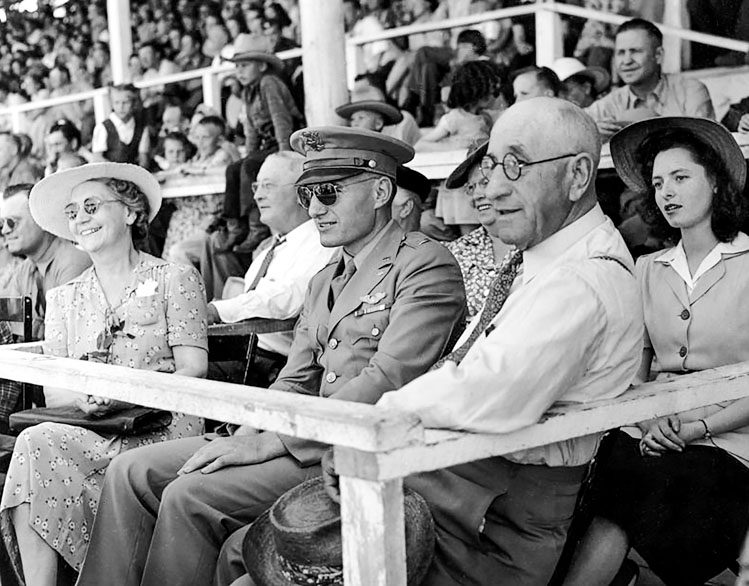
While home on leave in July 1942, Don Smith attended the Black Hills Roundup in Belle Fourche with his parents, Laura and A.W. (Doc) Smith. That November, Smith died in a plane crash in England. His is buried in Belle Fourche’s Pine Slope Cemetery.

By Paul Higbee

In April 1942, South Dakotans Henry (Hank) Potter and Don Smith were key players in one of history’s most daring military feats. Half a century later another South Dakota native, Curt Hills, traveled halfway around the globe to trace their adventure, finding both physical remnants and Chinese citizens who were part of this World War II adventure.

The 1942 operation was the famous Doolittle Raid, where 16 U.S. Army Air Corps B-25 planes struck back at Japan, 134 days after that country’s military bombed Pearl Harbor in the Hawaiian Islands. The American raid has often been cited for providing a tremendous morale boost for the United States, facing a real possibility of losing the war as it engaged strong foes in both the Pacific and Atlantic oceans. But historians note that the Doolittle Raid also stunned Japanese citizens who believed their home island to be immune to air attack because it sat isolated in a wide sea. Japanese leaders were forced to realign their far-flung Imperial Navy fleet to better protect the homeland, which created an advantage for America and its allies later in the war.

The air raid was planned and led by Lt. Col. Jimmy Doolittle, a California-born aviation pioneer who set well-publicized airplane endurance records in the 1920s, experimented constantly in hopes of improving aircraft safety and efficiency, and who, against long odds, in the 1930s convinced the Army to switch to higher octane fuels to increase engine power. As it turned out, Doolittle would use every drop of his high-octane fuel for the raid that bears his name. In fact, he would have been better off with a few more ounces.

Doolittle’s B-25 dropped four bombs on Tokyo industrial targets at about noon on Saturday, April 18, 1942, and then swooped low and sped west to escape Japanese air space. In escaping, he credited his navigator — Hank Potter — for plotting “a perfect course.” Potter grew up in Pierre, and then attended Yankton College.

Potter lived long enough for Hills, part of the group who traced the raid, to meet and travel with him. “He was very honest, sincere and caring,” Hills says. “He had those qualities that made it easy to believe he came from South Dakota.”

Don Smith, the other Doolittle Raider from South Dakota, mirrored those qualities. “A straight arrow,” recalled his flight engineer, Edward Saylor. Smith, a pilot, was born at Oldham in 1918, spent most of his childhood in Belle Fourche and graduated from South Dakota State College (now SDSU) in Brookings after winning football’s Little All-America honors as Jackrabbit center. His B-25, dubbed TNT by its crew of five, dropped bombs on Kobe factories more than an hour after Doolittle hit Tokyo.

Don Smith (number 26) played center for the South Dakota State College Jackrabbit football team

What baffled Japanese leaders (and the general public in the United States) for months was how 16 B-25s got into Japanese skies in the first place. The closely guarded secret was that Doolittle and Army brass decided the attack was worth risking something that had never been attempted: launching fully loaded medium bombers from the deck of a ship, the carrier Hornet. “It was such a bold plan,” recalled George McGovern, South Dakota’s long-serving U.S. senator who was just preparing to enter the Air Corps himself. “I don’t think anyone but Americans would have tried it.”

Taking off from a carrier meant pilots had to use less than 500 feet of deck instead of 1,000 feet of runway, as was typical on land. Smith practiced steep-angled takeoffs on land in Florida. At sea on April 18 he used fewer than 300 feet of deck — the best mark of the day. In fact, it can be said Smith flew a perfect mission: a takeoff that military aviators could only have imagined weeks before, finding and hitting his industrial targets and executing a smooth water landing 13 hours after launch.

Still, nothing went exactly according to plan that day. After a Japanese trawler spotted the Hornet, all planes took off early, adding 600 miles to their flights. That meant they could get to the safety of China after their bombing runs thanks only to a stout east-to-west tailwind and the quality fuel for which Doolittle had argued.

The Raiders soon learned that China wasn’t as safe as they had hoped. No lighted airfield or fuel awaited the planes on April 18, either because of a communications mix-up or because the Nationalist Chinese government grew leery of helping Americans in the face of likely Japanese revenge. Like the United States, China was at war with Japan, and Japanese troops controlled sections of the country. The American pilots had little choice but to parachute out of their planes with their men or make crash landings (although one crew drew Doolittle’s ire by landing in Siberia where the Soviets seized the B-25).

Potter, Doolittle and the rest of the Plane One crew bailed out into the pitch-black night and survived. Smith approached the China coast, sensed his plane didn’t have enough fuel to climb over a coastal mountain range and made a remarkably smooth sea landing a few hundred yards from Tantou Island (also known as Tantouschan, just off the coast of China). He and his crew had eight minutes before the TNT began sinking, which was time enough to climb out while pulling an inflatable raft with them. After two hours in the water they got to the beach with a cold wind piercing their flight uniforms. Eventually they found shelter in a livestock pen before the Ma Liagshui family spotted the men and invited them into their nearby hut.

Of the 75 Americans who attempted to leap or crash into China that night, one died due to a parachute malfunction, two drowned and eight were quickly captured by Japanese soldiers. The two South Dakotans, along with their 62 scattered peers, made their way hundreds of miles cross country to the Nationalist China capital of Chungking with help from Chinese friends — many of whom later died at the hands of vengeful Japanese soldiers. Potter recalled that he, “walked, went in rickshaws, sedan chair, rode a horse, went on a boat in the river, some sort of car, a so-called bus which was a truck we sat on, a train and finally a C-47 airplane at Chung-king.”

All of the Doolittle Raiders experienced crowds such as this one, gathered in Sanmen County, Zhejiang Province, to see Don Smith and his crew, who had ended up in China following their retaliatory airstrike against Japan in April of 1942.

Smith, to his great credit, took a detour on his route to Chungking. Through Chinese guides he learned the crew members of Plane Seven had been badly injured in their crash landing and were in a little hospital at Linhai. The raid’s flight surgeon, Dr. Thomas White, flew aboard Smith’s plane, and Smith decided he had to get White to Linhai over rugged foot trails. There can be absolutely no doubt that White saved Plane Seven pilot Ted Lawson’s life.

Smith returned home on leave in time for Belle Fourche’s Fourth of July rodeo, an event he loved growing up. Sadly, he died later in 1942 in a plane crash in England. Potter went on to a distinguished Air Force career, rose to the rank of colonel, and was commander of Bergstrom Air Force Base in Texas when he retired in 1970. He often made time to attend the famous Doolittle Raiders Reunion each April and took a lead role in organizing the 1978 reunion in Rapid City.

A few years after the reunion in his home state, Potter met Bryan Moon. As a boy growing up in England during World War II, Moon befriended American airmen stationed there, and developed a fascination for their planes. He grew up to become a Northwest Airlines executive based in Minneapolis and an acclaimed artist, specializing in aviation scenes. One of his paintings depicts what he guessed Smith’s TNT might look like beneath the China Sea.

The late Moon was also a true adventurer, willing to spend whatever it took to track down military history and, through an organization he founded called MIA Hunters, the remains of combat casualties interred overseas. In 1990 he led an expedition into China to find Doolittle Raid artifacts and organize ceremonies where brave Chinese people who helped the raiders could be thanked. Curt Hills — born in Chamberlain, raised in Mitchell and by then part of a real estate management group in Rochester, Minnesota — heard Moon speak at a Sertoma Club event. Hills decided he wanted in on the adventures. So did fellow South Dakotan Hank Potter, who represented the Raiders in thank-you ceremonies.

Moon and his fellow travelers met a woman named Zhao Xiaobao who, living on Tantou Island in 1942, helped hide, feed and clothe Smith and his four crewmates. She said her son, a fisherman, knew the exact location of the TNT because he had pulled up small scraps of aircraft metal. Also, islanders had noticed occasional oil slicks there. Moon contacted Smith’s copilot, Griffith Williams, and by Williams’ calculations the crash site matched the fisherman’s description.

But it wouldn’t be easy for Moon’s group to gain access. The island sat near a submarine base in a zone controlled by the Chinese military. Still, Moon wrote to request permission to dive, photograph and videotape. His request gained a boost when Gen. Jimmy Doolittle, in his 90s, wrote to the Chinese government endorsing Moon’s project. Permission was granted in September 1993 — the same month Doolittle died — and Moon dashed to organize an expedition the following April.

The Rochester Post-Bulletin wrote that Smith’s plane, “might be World War II’s most treasured aviation artifact.” Moon told the paper that, “the ideal scenario is we find the airplane in an ideal position,” meaning a wing might extend to within 15 feet or so of the surface. The worst scenario was that nothing would remain beyond a “pile of nuts and bolts.”

Moon’s group of 19 traveled to Tantou Island, 150 miles south of Shanghai, the next spring. Hills noted the island, in some ways, hadn’t changed much since Smith saw it. Its people mostly lived in poverty, eking out livelihoods through fishing and small subsistence farming. Moon’s group learned that a hill up from the beach where the TNT crew climbed to find shelter was actually more of a cliff.

Don Smith, wearing medals received for his role in the Doolittle Raid.

Moon had arranged for a retired military vessel that was positioned over the crash site and used sonar-equipped sensors to create images of what sat beneath. He brought expert divers from the United States, but, Hills says, “diving was quite dangerous. Very strong currents swept divers away. And we learned the plane is submerged much deeper than we expected.”

It is, in fact, about 50 feet beneath the surface. Local islanders had guessed about 30 feet. No part of the TNT extended close to the surface. While the plane is much more than a pile of nuts and bolts, Hills says, “it’s in deep mud and has been beaten by typhoons through the years.”

Raising the TNT was never discussed with the Chinese government in the 1990s, and the 1994 expedition proved that to be unfeasible in the future. Don Smith’s famous warplane will rest underwater until, in coming years, it is indeed a pile of nuts and bolts.

Hank Potter died at age 83 in 2002. His New York Times obituary mentioned a reunion in the 1990s with Zhu Xuesan, an English-speaking man who came to his rescue the morning after he parachuted into China. The reunion happened thanks to Moon’s group. “To be able to meet the man who helped me so much when I was wandering and tired and cold,” said Potter, “it’s just amazing.”

Don Smith didn’t live to attend Doolittle Raiders reunions or to understand how deeply his adventure touched Americans for decades. But 2019 has been a good year for him. The South Dakota Historical Society Press published a new biography called First Strike: Doolittle Raider Don Smith. And in April, Dick Cole — the last surviving Doolittle Raider — accomplished something meaningful just before his death at age 103. Cole kept in his possession one of 80 Congressional Gold Medals, struck for the families of each Raider. No one ever claimed Smith’s, whose widow and only daughter had passed away. Cole wanted the medal to go to South Dakota as a gift from him. With help from Sioux Falls author, filmmaker and aviation artist John Mollison, and others, the medal was delivered to the South Dakota Air and Space Museum, near Rapid City, on the raid’s 77th anniversary. Though Smith’s TNT will forever lie at the bottom of the China Sea, a tangible reminder of South Dakota’s role in one of the world’s most fearless military missions had come home.

Editor’s Note: This story is revised from the November/December 2019 issue of South Dakota Magazine. To order a copy or to subscribe, call (800) 456-5117.

Posted on Leave a comment

Winyan

Elizabeth Winyan (standing) was long associated with the Riggs family, caring for young Thomas in Minnesota and later joining him at Oahe Mission.

On a spring day in 1830 a family, including a 3-year-old girl, was harvesting sweet syrup from maple trees along the banks of the Minnesota River near present-day Mankato. Suddenly and viciously, they were attacked by an unidentified rival tribe.

The girl’s father was one of several Dakota Sioux killed in that attack. The young girl’s mother realized she could not escape the deadly melee while running with two children, so she emptied a pot of boiling water and hid the girl underneath. She then picked up her son and ran to safety.

For two days and one night the little girl stayed silent under the kettle. Then, her mother crept back and retrieved her.

“Even in her old age,” wrote historian Thomas Hughes,”Winyan never forgot that terrible experience and how, when her mother lifted the kettle, the moonlight showed on the bloody faces of the outstretched dead, her father among them.”

Winyan, who would later be given the name Elizabeth while working with Dakota Territory missionary Stephen Return Riggs, spent the rest of her life serving others. In Dakota, Winyan means mother and protector. She lived the name. Winyan was a human bridge over the most difficult waters of Dakota Territory and early statehood, when the federal government sought to force rapid assimilation of Native people, in part by creating reservations. By the time she died six decades later, Winyan was a legend among Native people, white missionaries and settlers on the Dakota frontier of the 1870s and 1880s.

Oahe Mission Chapel, next to the Riggs family home, was built in 1877. When Lake Oahe flooded the site it was moved to the Oahe Dam Visitors Center, where it stands today.

She often traveled the preaching circuit with the Riggs missionaries, blending her mission work with knowledge and practices of her own Dakota people. The Sioux, with a rich oral history tradition, have tried to keep stories like Winyan’s alive, but in the written annals of Dakota Territory her works are sparsely mentioned.

“She was amazing in her time,” says Winyan’s great-great-great granddaughter, Lora Neilan, of Summit.”And it is sad that it got forgotten.” When Winyan died in 1890, the noted Dakota Territory missionary Mary Collins, a good friend, wrote,”She was one of the grandest women I ever knew.”

Even my introduction to Winyan was accidental, a result of research into an entirely different woman on the Dakota frontier. In 1989, I spent a year studying political migration during a journalism graduate fellowship at Stanford University. While there, I did considerable research on the American frontier, which included paging through countless editions of 19th century newspapers in the archives. One advertisement in an 1888 edition of Minnesota’s St. Paul Daily Globe caught my eye. In huge type, I read:”SHE LOVES A SAVAGE!” It was an advertisement for a dime museum appearance of Corabelle Fellows, a young white missionary, and her new husband, Sam Campbell, a mixed-race man of Dakota Sioux and white blood.

I suspected there was a good story behind this headline. I tucked away a copy of the ad and years later, decided to investigate. I have often been surprised by how few female and Native voices are used in the telling of the history of Dakota Territory. I thought Corabelle may have something to say. This hunch — and years of research — resulted in my book Life Painted Red: The True Story of Corabelle Fellows and How Her Life on the Dakota Frontier Became a National Scandal.

The book follows young Corabelle and Sam as they set out on the sideshow circuits and Buffalo Bill’s Wild West show to make ends meet after Corabelle’s family disowned her for marrying a man of mixed blood.

During my research I also discovered Winyan, who had played a role in Corabelle’s early missionary work. In the winter of 1885-1886, she was in her third year of teaching and serving in missions in Nebraska and Dakota Territory. That winter, one of the coldest and harshest on the Plains, she lived and served with Winyan from a rough-hewn cabin at the Oahenoua village on the Cheyenne River, northwest of present-day Pierre. It was one of the most isolated posts on the frontier, serving people who had recently returned from exile in Canada with Sitting Bull. By then, Winyan had gained a reputation as one of the physically strongest women in the territory. She built the log cabin she lived in, hauled water uphill from the river and traveled long distances through harsh conditions to nurse the sick or dying.

Thomas Riggs.

Living with Winyan that winter, Corabelle, whose mother immediately disowned her after the marriage to Campbell, began calling Winyan”Ina,” or mother. Winyan had initially gained notoriety when, as a young woman during the bloody Sioux uprising in Minnesota in 1862, she secretly swam food to an island in the Minnesota River where Riggs and a small band of fellow missionaries and Sioux friends had hidden with their families. After her father died, Winyan had been taken under the tutelage of Riggs and his fellow missionary Thomas Smith Williamson. When the Dakota people in Minnesota were pushed west to reservations, the missionaries went with them, so Elizabeth gave up her life among the lush fauna of the Minnesota River valley to the harsher, starker and more expansive high plains of western South Dakota.

The granddaughter of the legendary Dakota leader Sleepy Eyes, she had grown up with a strong connection to the natural world. Winyan helped raise several generations of Riggs children, nursed the ill with herbs and practices passed on to her from her ancestors and sat with the dying when others were too afraid of evil spirits.

Tales of her physical strength spiced Sioux oral histories. Stories of her quiet mercies were also abundantly shared.”Winyan was a woman of strong character, fine mind and a natural leader,” the historian Hughes wrote.”Her great desire was that her people should hear the Gospel, so as the years went by, her work widened, and she was sent to various fields. She held meetings, discussed the Bible, visited the sick, buried the dead, and occasionally addressed conferences of white people. Even the Indian men held her in the highest esteem.”

Collins, the missionary, was struck by Winyan’s loyalty, her knowledge of her people’s past and her understanding of the natural world, particularly the constellations in expansive prairie night skies.”She is a faithful friend, true to her character as a Dakota,” Collins recalled.”She enjoys camp life with us, and evenings, as we sit by the campfire, she will tell stories of her early life, or fables, or legends of the stars. She is quite an astronomer. She reads the sky like an open book.”

Together, during that rough winter of 1885-86, the broad-shouldered Winyan teased Corabelle — barely 5 feet tall — about being able to keep up with physical work. Hauling water from the river to the cabin, Winyan would balance two large buckets on her shoulders, often while plowing through new fallen snow. Corabelle would follow with one pail, struggling, but rejoicing in Winyan’s eventual approval.”She always looked me over skeptically when we reached the house” after hard work outdoors, Corabelle recalled.”Invariably, when she found me unbroken, she would put her hands on her hips and laugh so hard that I was obliged to join her.”

Thomas Riggs established Oahe Industrial School in the 1870s as a training school for girls.

One night in the middle of that winter, Winyan fell asleep while Corabelle was teaching a group of young Sioux men. One of the men later returned to kidnap the bewildered Corabelle, catching her as she came outside to do a chore before bed. Winyan, awakened by a rush of ice-cold air from an open door, plowed through snowbanks to catch up with the young man, who had wrapped Corabelle in a blanket and was carrying her to his home.

“What bad thing is this!” Winyan shouted, shooing the man away.”Now you stop!” Her unwelcome suitor dropped Corabelle in the snow. Winyan wrapped her in a blanket and escorted her back to the cabin, where she consoled and soothed her with an herbal bath. Winyan scolded Corabelle for carelessly ignoring her warning to never go outside alone.

Corabelle and Winyan talked long into that night, marveling at how this white missionary and the Native missionary ended up together after growing up in such different worlds of culture, customs and religion.”How we talked,” Corabelle remembered.”Really talked, there in that crude cabin, shut away from the rest of the world. She asked and answered, and I asked and answered until that day, with its closeness of spiritual touch, became a highlight of my whole life.”

Missionaries and newspaper reporters alike simply called her Winyan. Eventually, she had a son, Edward Phelps, a minister, who along with his wife, Ellen, became missionaries and served rural South Dakota churches.

In her 50s, Winyan began speaking more frequently to donors and churches, traveling as far as Chicago. Neilan, Winyan’s descendant, has collected photos and articles that highlight her impact. Winyan’s life spanned the great events of the 19th century frontier: the government’s many treaties with the Sioux; the 1862 uprising in Minnesota, in which hundreds of white settlers and Native people were killed, and which ended with the mass hanging of 38 Dakota men; the many battles and massacres between U.S. Army forces and Native people on the Northern Plains in the mid- and late-19th century; the last stand of George Armstrong Custer’s 7th Cavalry on the rolling Montana hills in 1876; and the rapid settlement and statehood of South Dakota in the last quarter of the 19th century.

Louisa Riggs considered Elizabeth Winyan (standing) a colleague. She is pictured with Mary Collins (second from right), another missionary.

“She was a legend,” Neilan says.”What I found out, in the time frame that she lived, with the racism she faced and everything that had happened, I am most proud of how she rose above that, of how she left her mark and how many other ones did as well.”

Even while helping Native people adapt to relocation to the reservations, she often quietly longed for her childhood life along the Minnesota River.”She missed it so much,” Neilan says. Once, when sitting with fellow missionary Collins, Winyan told of something she had just seen that”well represents our present condition as a race.

“A man named Longfeather, dressed in Indian dress paint and feathers, was teaching some boys the Indian dance and song,” Winyan told Collins. There were three boys: One with long hair and painted face and Indian dress, one with shirt and leggings and a white boy’s shoes and stockings on, the third dressed well in entirely white men’s clothes.”One represents the past, the second the present, and the third the future,” Winyan said.”I know it has to be, but to me the one dressed all in the Indian child’s clothing looked the best, but I’m only an Indian.”

Neilan finds inspiration in her ancestor even today. She says she and her daughters (Lauren, Bailee and Falon) have also begun to study native plants, and to learn about the constellations that illuminate our prairie nights.

“She was a beacon,” she says,”a beacon of power in her own self.”

Chuck Raasch is a native of Castlewood and a graduate of South Dakota State University. He has written for the Huron Daily Plainsman, the Sioux Falls Argus Leader, the St. Louis Post-Dispatch and USA Today. Raasch has also authored two books, Imperfect Union: A Father’s Search for His Son in the Aftermath of the Battle of Gettysburg, published in 2016, and Life Painted Red: The True Story of Corabelle Fellows and How Her Life On the Dakota Frontier Became a National Scandal in 2023.

Editor’s Note: This story is revised from the January/February 2025 issue of South Dakota Magazine. To order a copy or to subscribe, call (800) 456-5117.

Posted on Leave a comment

What About Doc?

Doc Middleton was a Nebraska outlaw who gravitated northward to run saloons in southwestern South Dakota. His exploits included running in the 1893 Chadron to Chicago horse race, where he was pictured at the finish line.

TO BE CLEAR, Doc Middleton never earned a doctorate. Sometimes it seems that’s the only thing we know for certain about the outlaw.

Middleton spent considerable time in western South Dakota, first arriving nearly 150 years ago and variously described as horse thief, cattle drover, saloon keeper, murderer, sheriff and wannabe showman. For what it’s worth, he possessed one of the Old West’s best beards. In early photos, his facial adornment — maybe a foot long — could have made him the front man in ZZ Top. After it grayed, Middleton trimmed it; he then bore a resemblance to Buffalo Bill Cody.

In the Black Hills, a place long fascinated by notorious men like Wild Bill Hickok, Lame Johnny, Fly Speck Billy and even George Armstrong Custer, it seems as if Doc Middleton has fallen through the cracks. Not that he’s been completely forgotten. Look up Ardmore, South Dakota, on Wikipedia and you’ll see two people noted as playing roles in local history: President Calvin Coolidge, who visited in 1927, and Doc Middleton,”a former resident who was an infamous outlaw.”

What made Middleton an outlaw? It’s hard to top murder. He was indicted on that charge after shooting an Army private in 1877 during a dance hall brawl in Sidney, Nebraska. The charge never went to trial, says Rapid City writer Scott Lockwood, whose new book Alias: Doc Middleton, attempts to bring the somewhat mysterious Middleton back into the public consciousness. Horse-stealing did put him behind bars on several occasions.

Middleton’s thieving began at age 14 in his native Texas. One theory about his nickname is that he developed skills for”doctoring” horse brands. Or it could have stemmed from a sloppy signature with the initials for David and Charles scribbled together and mistaken for Doc. David and Charles, by the way, were not his actual first and middle names. He stole them. And Middleton, at birth, was a middle name and not his surname. His last name was Riley. Records show Doc was born in the Texas Hill Country, though he sometimes claimed Mississippi as his birthplace.

Rapid City author Scott Lockwood was introduced to Doc Middleton through his fascination with the town of Ardmore. Lockwood’s new biography traces the outlaw’s life as well as his connection to the Fall River County ghost town.

Doc’s life was so full of contradictions and outright lies that writing a book-length biography would challenge any author. But Lockwood embraced the historical detective work. As he was researching, Lockwood was asked if he liked Middleton. No, Lockwood replied. He can’t condone murder and won’t minimize it. He suspects the Sidney incident wasn’t the only time someone died due to Middleton’s violence. On the other hand, there were certainly not dozens of killings, as some exaggerated newspaper stories of the era claimed.

“For a while I didn’t really understand how bad horse stealing was in the 1800s,” Lockwood says. It deprived a person of transportation, perhaps their livelihood, and sometimes their closest companion. Some of Middleton’s early thefts may have been particularly nasty, taking animals from Oklahoma’s Indian Territory because he believed authorities wouldn’t pursue or prosecute. It’s possible he followed the same line of thinking on the Pine Ridge and Rosebud reservations in Dakota.

Lockwood was born in Huron and graduated from Custer County High School. He wasn’t particularly curious about history classes in school but, he says,”I was always interested in the stories about the ‘old days’ my elderly relatives and neighbors told me.” He worked for railroads throughout the country’s midsection, making and supervising track repairs, and eventually managing sections of Burlington Northern Santa Fe’s maintenance from Montana to Texas, and from Alabama to Illinois. When Lockwood retired, he came home to South Dakota and its”rhubarb and lilacs.”

Ardmore interested him in ways similar to the stories his older relatives and neighbors had recounted decades earlier. Virtually a ghost town now on the South Dakota-Nebraska line, south of the Black Hills, Ardmore similarly attracted Middleton in 1900. He bought town lots, served as sheriff for a while and owned a saloon. He may have failed in the liquor business in another town, Lockwood thinks, but by the time he arrived in Ardmore he had learned not to drink his profits.

Lockwood first learned of Middleton by reading the Wikipedia post linking President Coolidge and the horse thief. “I guess I was intrigued with him because he chose to make tiny Ardmore his home,” Lockwood says. And”he was able to steal hundreds of horses and escape vigilante justice.” Vigilantes operated outside the law, often lynching horse thieves and cattle rustlers in the Old West, including Middleton’s Nebraska partner-in-crime, Kid Wade. Middleton may have considered vigilantism more criminal than anything he perpetuated.

“He was such a restless man,” Lockwood says.”He liked to see his name in the newspapers and became a folk hero to many. He was great at promoting things he believed in.”

This is the earliest known photograph of James Middleton Riley, later known as Doc Middleton, taken around 1871 when he was 20.

Middleton obviously believed in Ardmore. But what he really wanted to promote was his own Wild West Show. There are stories claiming he performed briefly in Buffalo Bill’s Wild West. Maybe he did and maybe he didn’t, but Lockwood thinks Buffalo Bill Cody didn’t care for Doc Middleton. In Middleton’s mind, his own show, actually incorporated in 1904 in Rapid City, would be no less an extravaganza than Buffalo Bill’s. But it never happened. If it had, Middleton could have woven in plenty of his own real-life adventures: rounding up wild cattle roaming Texas after the Civil War, then becoming one of America’s original cowboys who drove herds north for public domain grass and less bovine disease. He rode through Kansas and Nebraska (the state that’s done the most to document Middleton’s outlaw history) and in 1877 he made it to the Black Hills, according to Lockwood. Middleton spent time in early Custer and Deadwood and was particular about whom he claimed as a friend or associate. Calamity Jane?”She ain’t my kind of people,” he reportedly said.

There’s an adventure the public would no doubt have demanded be recreated in abbreviated form as part of a Doc Middleton Wild West Show. That was a thousand-mile horse race from western Nebraska to Chicago in 1893. A Chadron, Nebraska, man promoted the idea as a hoax in an era of elaborate hoaxes nationally — ones that newspapers often reported, winning national attention for a community. In part, the news of a super-sized horse race spread because the idea appalled humane societies, and they took action to stop it. Middleton announced he would compete, and the Deadwood Pioneer Times entered into jokey reporting by remarking he should be ineligible because he would surely end up stealing other racers’ mounts.

Then remarkably, driven by the publicity, the race began to be taken seriously. In fact, humane organizations inadvertently boosted the competition when they said they would supply representatives to monitor animal health along the route. Middleton did, indeed, ride the distance on a gelding called Jim Fisk. Some observers predicted a win for Middleton. Strangely, Lockwood says (or maybe not so strangely when you consider the strong-willed contestants), the race didn’t begin until 6:15 one evening because of an argument over eligibility. The date was June 13, 1893. John Berry, riding a horse from Sturgis called Poison, first reached Buffalo Bill’s Wild West grounds near the Chicago World’s Fair on June 27. Berry wasn’t declared the winner, though, because in Chicago the eligibility issue flared again, and Berry had played a role in selecting the route, giving him an unfair advantage. Middleton finished about 27 hours behind Berry. Of eight riders who completed the long course, Middleton came in sixth.

Newspaper accounts of Middleton’s participation in the thousand-mile competition likely surprised some people. Reports of his death had circulated numerous times over the years, usually owing to gunshot wounds but once due to smallpox in Ardmore. It was as if the press was certain that Middleton would meet death at an early age and was ever ready to pounce on the news. While Middleton liked newspaper stories, even those maudlin and false reports, he had no use for anyone proposing a book about his life. He wanted that writing assignment reserved for himself, although he never got around to it.

“He even threatened to come after anyone attempting to write a book,” Lockwood says.

The Middleton family in 1899 included (from left) Doc; children Joseph William, Ruth Irene and David Wesley; and his wife, Irene.

Middleton married three times. In 1911 his third wife, Irene, died at Hot Springs after gallbladder surgery. Funeral services were conducted in Ardmore and then her body was interred about 30 miles south in Crawford, Nebraska. Certainly that’s where Middleton believed he would someday be buried, in prime horse country. Crawford sits a short canter from Fort Robinson, a major base of operations for the U.S. Cavalry during Middleton’s time.

But Middleton never made it to Crawford. He was occasionally involved in unauthorized alcohol sales and that landed him in jail in Wyoming in December of 1913. He died on December 27 at age 62 from a bacterial infection complicated by pneumonia. A burial plot at Douglas, Wyoming, was supposed to be temporary, but it’s where Middleton lies 112 years later. In 1968 a group of Nebraskans petitioned to move the body but didn’t gather many signatures. Lockwood, during his railroad career before he ever heard of Doc Middleton, lived in Douglas just blocks from the gravesite.

Knowing the geography of Middleton’s life was a plus for Lockwood in writing this book. So was newspapers.com, which allowed for electronic access to papers that Middleton knew and admired.”Sometimes I’d be so excited about what I found that I couldn’t stop at dinner time,” Lockwood says.”Other days I’d walk away and not care if I ever looked again.”

Such mixed feelings are to be expected about a man as conflicted as Middleton. Readers who love Western lore and the Black Hills — and are eager to rediscover a man nearly lost to history — will be glad he stuck with it.

Editor’s Note: Contact Scott Lockwood at b735198@gmail.com to purchase a book or to schedule an author talk. This story is revised from the March/April 2025 issue of South Dakota Magazine. To order a copy or to subscribe, call (800) 456-5117.

Posted on Leave a comment

The Christmas Medals

Dean Jorgensen was not my biological father, but he was my dad in the truest sense. That was cemented the first Christmas he shared with my younger brothers and me. We three boys were Mom’s from a first marriage; ultimately there would be seven boys in our new blended family. For Dean, all seven were”his boys.”

Our first Christmas together was in 1955. Dean and my mother Virginia had married after a courtship that seemed to include us boys as much as the two of them.

When he came to our home in Hurley to pick up Mom for dates, he would be greeted by joyous shouts of”Dean! Dean!” We were just as taken with him as was our mother. Often, while waiting for her, he would share stories with us, some about superheroes he named Starkhans and Johhny. Other stories were about his childhood, or his Army days.

After their marriage and our move to Dean’s Spring Valley farm, those Army stories included tales about medals and military insignia that he treasured from his time in service. Each medal had a story. Mom often implored us to”leave poor Dean alone,” especially after a hard day of farm chores or fieldwork. But regardless of how tired he might be, he would share them.

As our first”family” Christmas approached, we also were excited that Mom was having a baby. Our new brother or sister might even be born on Christmas!

Mom went into labor on December 23, and we all raced to the hospital 50 miles away in Yankton where our brother was born. We spent that night and Christmas Eve morning with Mom until our grandparents offered to drive us back to the farm.”We’ll take you home and then come back to get you tomorrow,” Grandma said.”We can all share Christmas with Virgie and the baby at the hospital.” Dean, who was very tired, readily agreed. We piled into Grandpa and Grandma’s car and headed to the farm.

We didn’t have a telephone, so Dean told our grandparents we would see them on Christmas morning and off they went. We boys bounded inside, not at all tired.”Yay!” we shouted.”We’ve got a new brother! And tonight Santa Claus is coming!”

Many years later, Dean told us that he then realized he had forgotten about Santa and that the Christmas gifts planned for our stockings were in the trunk of the car, 50 miles away. So, after dinner and checking the livestock, he quietly tucked us into bed and smiled at our excitement over Santa’s pending arrival. He had a plan.

When we raced from our beds Christmas morning, our stockings were bulging. But before we could look into them, Dean lifted a letter off the table.”Look! A letter from Santa,” he said. He opened it and read:”Hello boys! I know how much your Mom and new brother want to see what you’re getting from me for Christmas, so I’ve taken your presents to the hospital so you can open them there after you go back with your Grandpa and Grandma.”

“Ain’t that nice of him boys?” Dean said.”Your Mom will be so happy.” We all looked a bit skeptical at that but could still see that our stockings seemed pretty full of something.

“What’s in our stockings?” I asked.

“Well, let’s take a look.” Dean stepped aside and we reached in to pull out apples, oranges, nuts, toothbrushes and a shiny piece of cardboard. Affixed to that cardboard in each of our stockings were Army medals and insignia.

“Well, would you look at that,” Dean said.”Just like mine. Santa must’ve heard me telling you about them and knew how much you liked them.”

They were Christmas gifts beyond our wildest dreams, a memory created by our new dad to last a lifetime.

About the Author: Dan Jorgensen began his writing career with the Sioux Falls Argus Leader at age 19. He is also the author of several books, including Killer Blizzard, And the Wind Whispered and Rainbow Rock, all set in South Dakota. He and his wife Susan live in Milliken, Colorado.

Editor’s Note: This story is revised from the November/December 2024 issue of South Dakota Magazine. To order a copy or to subscribe, call (800) 456-5117.

Posted on Leave a comment

Art-Warming

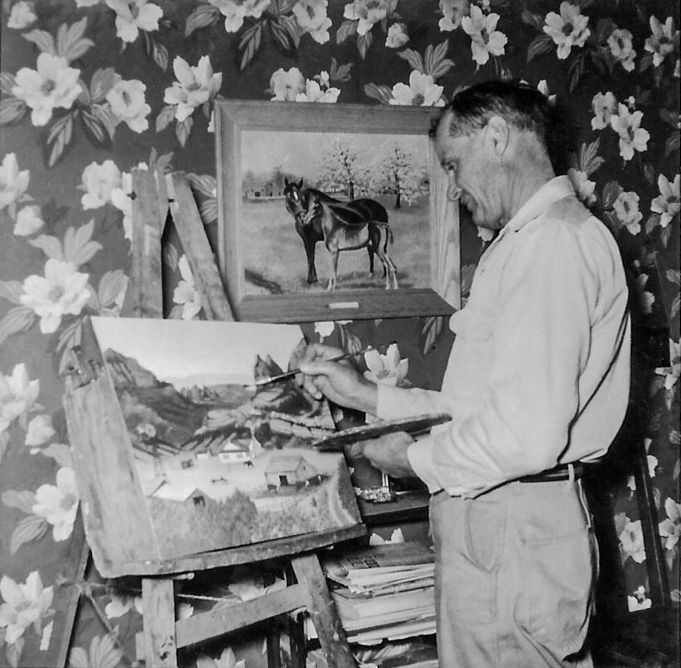
The grandchildren of Fred Mohling, pictured painting in his Aurora County farmhouse in 1957, are rediscovering his artwork and are exploring ways to share it with South Dakotans.

In 1959 Aurora County farmer Fred Mohling traveled to California for the Rose Bowl. Naturally, when he returned to South Dakota, friends and family asked about the game.

Mohling couldn’t tell them much. He hadn’t gone to watch football, he explained, but to see the roses in the famous parade. At home, in addition to selling grain and cattle, Mohling created paintings, including still lifes with flowers. Today, 40 years after his death, his descendants are sorting through his works: Midwestern and Western landscapes, people, waterfowl, horses, hunting dogs and still lifes. The family doesn’t necessarily want to sell the art but would like to exhibit some of it, maybe at libraries as a starting point. The learning curve is steep, exploring exhibition protocol, likely venues, copyright and even framing (when Mohling framed his art he sometimes purchased cheap and rather gaudy hardware store frames).

There’s another holiday season story about Mohling. Seventy years ago this December he skillfully painted a life-sized Christmas Nativity scene and other holiday images on plywood and illuminated them with 100 white and colored lights for his grandchildren. He set it up on his farm, just south of the Aurora-Jerauld County line, where it delighted more than his grandkids. As word spread, hundreds of South Dakotans drove 75 miles or more, on two-lane roads in winter, to see the scene. Memories of the Nativity art are mostly all that remain. The painted figures largely disappeared. Mohling’s farmhouse and ag buildings were razed for corporate farming, and the farmer-artist himself died in 1984.

Harmony Friends Church

His painting of a mountain scene is part of the Center for Western Studies collection at Augustana University in Sioux Falls, and another found a home in the Wessington Springs museum. But most were divided among family.”There are more than we remembered seeing around his house years ago,” says grandson John Swanson of Rapid City. He believes his grandfather completed more than 150 paintings, usually ranging from 8-by-10 inches to 16-by-20 inches in size. Another grandson, Greg Miller, notes that Mohling mostly used oils on board surfaces, and also drew with charcoal as well as colored pencils late in life.”There was something about winter scenes,” Miller says.”He looked at snow much of the year and liked it.” Miller has taken a lead role in documenting Mohling’s life through newspaper clippings and public records.

Great-grandson Ryan Aalbu of Spearfish was young when Mohling died and only vaguely remembers the man, but he treasures his paintings.”Mine are outdoor scenery and animals,” Aalbu says.”I didn’t know until fairly recently that he was a good portrait artist, too, painting people from American presidents to his own family.”

Fredrick Henry Mohling, born in 1894, grew up as the eldest of eight children on a Nebraska farm. At home he spoke German but made the mental switch to English for school. A capable student, Mohling hurried through his in-school lessons so he could draw at the end of classes, and at age 12 he won first prize for a painting he took to an Old Settlers picnic.

He married Tillie Maschman, and they had seven children, which left little time for art. The Mohlings moved to South Dakota to farm in 1920 and weathered bad ag prices that decade and the Dust Bowl and Depression of the 1930s.

The hard times led to President Franklin Roosevelt’s Works Progress Administration. Gov. Tom Berry insisted that art be part of the WPA and Mohling renewed his interest in painting by taking three classes in Mitchell. He was also inspired by a landscape artist he saw at the State Fair.

Blue Jay Wonder

Sadly, his family thinks that Mohling’s main motivation to paint was his deep grief after Tillie died suddenly from an appendix ailment in 1940. Art became his therapy, perhaps, or at least a way to occupy his mind.”When you do something requiring great attention to detail, you can’t think about other things,” Swanson says. A family member recalled coming home from a dance to find Mohling working at his easel in the middle of the night.

Still, Mohling didn’t hit his stride with art, in terms of quality and output, for a few years. There was always work on the farm. He also landscaped his big yard, created a lily pond and outdoor fireplace, and he built swings for his kids and grandkids. When Tillie died, two of his children were young adults who helped to raise the younger five. Mohling enjoyed traveling by car with his family and drove them to the Black Hills to see Josef Meier’s Passion Play, a religious drama performed in Spearfish on what was billed as the world’s”longest outdoor stage,” all of it skillfully lighted. Maybe the biblical production was the inspiration for Mohling’s own outdoor Christmas presentation.

“That could be,” Swanson says.”He liked visuals, obviously, and things built big. He drove to Texas once to see the new Houston Astrodome, which was called the eighth wonder of the world.” The family has no record as to whether Mohling saw a ballgame during that trip or simply admired the big domed stadium.

Swanson describes his grandfather as a type of man most South Dakotans might know. He was accomplished in agriculture, could build anything, and — far from the stereotype some Americans held of rural Midwesterners in that time — wasn’t cocooned in his own locality but interested in the wider world.

Mohling took enough interest in his 20 grandchildren to buy or make each a meaningful gift every Christmas, granddaughter Jane Aalbu remembers. His gifts would only get better: one of his original paintings for high school graduation and another as a wedding present if a grandchild got married.

“He was mild-mannered and soft-spoken, and fairly easy to talk to,” says Swanson, who was in his 20s when Mohling died. The farmer-artist didn’t drink except for perhaps a glass of Mogen David wine on holidays. Knowing his distaste for alcohol, his descendants have had light-hearted discussions about whether it would be appropriate to serve higher quality wines at exhibits of his art.

Through years of raising children, bonding with grandchildren, and adapting to post-World War II ag technologies, Mohling kept improving his art techniques. Swanson recalls seeing the classic Blue Boy (a portrait by 18th century English artist Thomas Gainsborough) among his grandfather’s possessions and assumed Mohling admired it and bought a print. As it turned out, Mohling copied it stroke by stroke — a time-honored method that artists have used to fine-tune their skills.

Buckeye Brown

Mohling didn’t seem interested in selling his works but in 1955 Wessington Springs hosted a horse show. Mohling loaned horse paintings to Rukstadt Hardware Store for a window display during the event. An Indiana man admired a threshing scene and Mohling agreed to sell it to him. In 1956 he won two blue ribbons at the State Fair; he’d previously taken home art ribbons from Huron but never before a first-place honor, let alone two. Those blue-ribbon paintings almost certainly remain in the family’s possession, and they hope to determine which they are.

In the late 1950s and beyond, Mohling took his art to appreciative rural audiences in Clark, Faulkton, Wessington Springs, Mitchell and Fairbury, Nebraska, near his birthplace. Plankinton journalist Adeline VanGenderen reported on a show where a woman rhetorically asked how anyone could choose a Mohling favorite given the wide variety of scenes and subjects.”We got to thinking this over, and how could you?” VanGenderen wrote.”First your eye would be drawn to a moose beside the lake; deer drinking from the stream; an Indian pony and its rider; you could almost smell the dust of the covered wagon as it groaned westward.”

If art scholars had read VanGenderen’s description, they might have concluded that Mohling was part of the Regionalism art movement, especially popular in the rural Midwest in the mid-20th century and best epitomized by Iowa painter Grant Wood. The style became popular nationally as Americans first feared that the Midwest was being blown off the map by Dust Bowl winds, and then again as they celebrated that it wasn’t.

But there’s no evidence Mohling saw his art as part of any movement or school of thought. South Dakotans tend to be skeptical of those who categorize local visual art as Fine, Folk, Regionalism or any other grouping. Most would agree with the late University of South Dakota professor and author Graham Thatcher, who warned against associating with any”sophisticated art nerd who asks you what you think in order to get an opening for his or her well-rehearsed sermonette.” Thatcher stressed, in his book I Know What I Like! Everyone’s Guide to the Arts,“There are no rules in Art Ö there is only taste.”

Mohling met the tastes of South Dakotans half a century ago. In 1974, friends and family turned out in force for his 80th birthday celebration in a Wessington Springs ag building, its interior walls decorated for the day with 80 pieces of his art.

Today, Mohling’s descendants are working to determine whether 21st century South Dakotans find significance in the art, as well. In August the family put digitized images on a video loop and played it at Mitchell’s Corn Palace Festival. They may do the same at the State Fair next year. A professor has suggested the paintings may hold value for students learning about both the techniques Mohling used and the times in which his art took form.

Relatives don’t anticipate a posthumous discovery of Mohling’s talent beyond the borders of South Dakota. They’ll be happy if small groups of observers see something in his art that warms their hearts.

That’s what art did for Fred Mohling, and it was quite enough.

Editor’s Note: This story is revised from the November/December 2024 issue of South Dakota Magazine. To order a copy or to subscribe, call (800) 456-5117.

Posted on Leave a comment

Pedestrian Politics

Yankton’s Meridian Bridge carried traffic across the Missouri River between South Dakota and Nebraska from 1924 until its closure in 2008, which ushered its new life as a pedestrian walkway. Photo by Pat Hansen

Bridges are famously controversial. Yankton’s double-deck Meridian Bridge, which turns 100 years old this year, is a classic example.

In the 1920s, Yankton booster D.B. Gurney and his supporters sought to circumvent the political process by raising private funds, but they still had to navigate approval from both Washington and Pierre before they could drop the first barrel of concrete into the Missouri River channel in 1922.

They also confronted politics within the Yankton community as they cajoled friends and neighbors to make major investments in the bridge. Gurney once donned boxing gloves for a meeting and suggested that the fundraising could require fisticuffs. Though Gurney’s friends thought he was joking, they quickly offered more money.

When the $1.1 million Meridian Bridge opened on Oct. 11, 1924, it became the first highway bridge constructed across the Missouri River in South Dakota. The double-decker design was chosen in anticipation of a railroad line that never materialized, so motorists driving south into Nebraska used the lower deck and northbound traffic took the upper. Drivers paid tolls until the cost was recouped in December of 1953. Gurney’s wife Henrietta paid the final toll.

Seven decades after the first cars rolled across, Meridian Bridge politics re-emerged as local and state leaders debated where to build its replacement. Then, even after the Discovery Bridge was completed, the Meridian was not free of politics. In fact, some of the old bridge’s most highly charged moments came in 2008 and 2009, after it was closed and slated for demolition.

The new Discovery Bridge was opened to traffic on Oct. 11, 2008 — the same date as the Meridian’s official opening 84 years earlier — with a gala ribbon cutting. Dan Specht, then the mayor of Yankton, remarked that the bridge shows the river does not divide South Dakota and Nebraska, but truly brings people closer together.

On that exciting afternoon, busloads of school children were diverted over the Meridian; the very next day, it was deemed unsafe for any use. Entrances were fenced and a sign declared it off-limits to the public.

The late Father John Garvey, then a feisty and good-natured Catholic chaplain at Mount Marty University and Sacred Heart Monastery, was the first to demonstrate the bridge’s future potential.

Garvey was known for challenging authority. He once was arrested for trespassing at Offutt Air Force Base in Omaha to protest nuclear weapons. He found it hilarious that the old bridge was strong enough for 18-wheelers and school buses on one day, and then unsafe for pedestrians the next. True to character, he climbed over the temporary orange fence and strode out over the river in the autumn of 2008. He did it with a twinkle in his eyes, and the Yankton police, with equally good cheer, led the grinning, white-haired priest back to Walnut Street.

Other Yanktonians were resigned to the idea that the old bridge would come down. Fortunately, a few local citizens — particularly Jim Means, a longtime businessman and civic leader who has been involved in nearly all of Yankton’s successful historic preservation projects over the last 50 years — patiently lobbied city commissioners, lawmakers and other officials to explore its potential as a pedestrian bridge.

“I always thought it was Yankton’s signature piece of architecture,” Means says.”I felt it would be short-sighted to let it fall into the river. Ever since it was built, it has set us apart from every other town. You could meet people from all over the country, and if they knew anything about Yankton it was that they’d traveled over the double-decker bridge.”

Opponents to preserving the Meridian included several of Means’ friends.”People thought it would be a waste of money. One of my neighbors said he didn’t think anyone would even want to walk on it.”

The Meridian Bridge was built with a lift span that rose 25 feet to allow steamboat traffic on the Missouri River to pass underneath. Raising and lowering the 220-foot span took about 8 minutes in each direction. It was deactivated in 1984, and the lifting mechanism was removed. Photo courtesy of the Yankton County Historical Association

But Means and others kept alive the notion of preserving the bridge, and eventually they gained support from two strangers south of the border: Bob Puschendorf, a native of nearby Norfolk, Nebraska, was then the state historic preservation officer in Lincoln, Nebraska, and John Kingsbury, a banker in Ponca, Nebraska, was chairman of the Nebraska State Highway Commission.

Puschendorf hoped to preserve the bridge for its historical and recreational possibilities. Kingsbury remembers that he was just looking for the finish line.

“The new Yankton bridge was one of the most controversial and environmentally complicated projects of my time on the commission,” he says.”As people in Yankton will remember, there were two factions. One wanted the bridge downtown as it is today and another group preferred a bypass bridge to the east. Nebraska was neutral, but at the time was generally preferring a bypass around communities.”

As the lead state for planning and construction of the new bridge, Nebraska was responsible for public hearings. Kingsbury felt the primary hearing should be in Yankton because the city had so much at stake.

“After discussion between the two states, it was agreed Nebraska could hold a public hearing in South Dakota,” Kingsbury remembers.”I am sure I was the first state commissioner to hold a large public hearing in another state. I believe [South Dakota transportation officials] felt a neutral Nebraskan would be a good choice to lead a controversial public hearing. There was a huge crowd with signs and buttons supporting their cause. The room was packed along with three television stations. The meeting went unexpectedly well. The speakers remained reasonably calm. In the end, both states agreed to the downtown location based on dozens of factors.”

Left in limbo, however, was the fate of the old bridge. A federal Environmental Impact Study favored preservation over demolition.

“Yankton was also asking Nebraska to make the new bridge more attractive than a flat, basic concrete bridge,” Kingsbury recalls.”Nebraska was opposed to the added cost because the many delays had greatly increased the cost projections. As negotiations continued, I recommended Nebraska beautify the new bridge with the pillars and lighting in exchange for Yankton or South Dakota taking ownership of the old, historical bridge.”

South Dakota authorities liked Kingsbury’s compromise, though they didn’t yet know if Yankton would accept responsibility for the Meridian. For nearly a year after car and truck traffic ceased on the old double-decker bridge, conversations and meetings continued in city hall and other locations.

Kingsbury’s proposal created an opening for Puschendorf and Jay Vogt, his counterpart in Pierre. Vogt was director of South Dakota’s historic preservation office; he was also well-acquainted with the Meridian Bridge. His grandparents had lived in Yankton, and one of his favorite childhood memories was of driving over the Missouri River on the double-deck bridge.

Yankton had yet another important connection: longtime local trucker Ralph Marquardt was then serving on the South Dakota Transportation Commission.

Puschendorf, Vogt and transportation officials from both states offered to work with the City of Yankton if its leaders wished to accept responsibility for the historic bridge.

Yankton attorney Nick Moser was a newly elected state representative in 2009.”It was one of the first things I worked on as a legislator,” he says.”All of the lawmakers from Yankton were in favor of preserving it but there were a number of people who were opposed for a variety of reasons: they thought no one would use it, they thought it might not be safe, some even thought it would be an eyesore.”

Moser and Yankton’s other lawmakers met on several occasions with Department of Transportation officials during the 2009 session, and they also organized meetings with Marquardt and city commissioners back home — often gathering at the publishing offices of South Dakota Magazine.

Demolition of the bridge would have involved liabilities, environmental issues such as lead paint and other unknowns, so preservation of the bridge appealed to some state officials who felt it was the safest decision.

Most city commissioners eventually embraced the view that the historic bridge still had something to offer but they were concerned that the city wouldn’t be able to afford restoration costs in the short-term, and that local taxpayers could be stuck with demolition costs sometime in the future.

Those financial worries were alleviated when state transportation officials agreed to devote $1.8 million from South Dakota’s share of the American Recovery and Reinvestment Act, which had been passed by the U.S. Congress to stimulate the economy after the Great Recession of 2008.

Kingsbury and his Nebraska associates, anxious to close the chapter on the Yankton bridge, offered the remainder of the restoration costs, which totaled $5 million. The two states also agreed to deposit their respective shares of the estimated demolition cost into a trust fund so that monies are available for that purpose if needed. The fund was started at $2.8 million but it has nearly doubled.

Two years later — after rehabilitation and the installation of a railing and lighting — the Meridian Bridge was opened to pedestrians and bicyclists in November of 2011. It’s difficult to find any detractors today, and the officials who were involved see it as a success.

“Every time I drive across the new bridge, I smile at the beautification,” says Kingsbury, who is still a banker in Ponca.

“Today I can walk out the front door of my office and I have a full view of the bridge,” says Moser.”I see people walking it at all times of the day, and all times of the year. On weekends from spring to summer and fall it’s packed.”

Means walks the bridge regularly and enjoys seeing the various ways it’s used by the community — from weddings to fundraisers, lovers’ padlocks, family gatherings and, of course, the constant stream of people who simply want to stroll at treetop-level above the grand Missouri River.

Editor’s Note: This story is revised from the September/October 2024 issue of South Dakota Magazine. To order a copy or to subscribe, call (800) 456-5117.
Posted on Leave a comment

David Wolff’s Black Hills

David Wolff spent 17 years teaching history at Black Hills State University in Spearfish. His new “Black Hills History Tours” book series blends travel with the region’s most colorful historical stories.

Every mountain range needs a few curious historians. They help the rest of us appreciate the peaks and valleys.

David Wolff of Spearfish fills that role in the Black Hills, and now the former professor is embarking on a six-book project that will not only recount the region’s colorful history but also serve as a guidebook for those who share the author’s itch to explore.

Mountain towns also need pharmacists — and that’s where Wolff got his start. Forty years ago the Denver native who was raised in Wyoming was working the pharmacy counter at a Pamida store in Sturgis. He wrote a history paper as an amateur and took it to a conference organized by university historians.”Pharmacists wear ties and that’s what I wore to the conference, and the history professors moved toward me when I arrived, assuming I was one of them,” Wolff recalls. He sensed they were less enthusiastic in greeting an amateur when they learned his identity.

The pharmacist eventually left the Black Hills, off to greener medicinal pastures, people in Sturgis surmised. In fact, he left to study history, first at the University of Wyoming where he earned bachelor’s and master’s degrees, and then at Arizona State University where he gained a Ph.D. In 1998 he returned to South Dakota to teach at Black Hills State University. He became Dr. David Wolff not as a matter of pursuing a personal goal or for job security (no one will tell you a historian’s position is more secure than a pharmacist’s). Rather, Wolff became a historian because he considers the field vital, especially the multi-layered history of the Black Hills and its mining culture — a significant component to American history overall. And yes, the snub he sensed at that long-ago conference was a motivator in reinventing himself. He didn’t want the lack of academic credentials to limit his ability to reach the public through university offerings, writings and at local history society talks that are free and open to all.

“He comes across as an everyday person,” says photographer and author Paul Horsted, creator of books with photos that compare and contrast historic and modern images.”But he’s got such a depth and command of knowledge at his fingertips, especially gold rush history and what happened afterward. As I was feeling my way in learning that history, David was so kind in being a sounding board.”

When Horsted mentions Wolff’s depth, he could include his friend’s recognition of romance in even the gritty business of mining. Wolff remembers the soft glow of light emanating from windows in Deadwood and Lead’s mining mills, reduction plants and slime plant at night as his family vacationed there –“evidence of workers’ massive efforts, round the clock, in grinding out wealth from the earth,” he says. The Wolffs lived in Cheyenne, Wyoming, when he grew up. His dad was a traveling salesman, mostly supplying drug stores. David sometimes tagged along and that was his introduction to pharmacists — nice people and important members of their communities. Wolff’s parents encouraged him to pursue pharmacy himself. Sure, they knew David’s interest in history and his love for Wyoming’s past as documented throughout the capital city and at nearby Fort Laramie.

“But nobody in the world I grew up in thought you could make a living in history,” Wolff says. Still, the idea briefly crossed his mind in college after reading Watson Parker’s classic Gold in the Black Hills. Wolff wrote to Parker, a history professor at the University of Wisconsin-Oshkosh, and Parker replied. He thought Wolff might be better off using money that would cover tuition for building a personal library of good books delving into history.

If Wolff got a delayed start as a historian, he more than made up for it — and continues to do so with an agreement with the South Dakota Historical Society Press to author six books in the coming years that will combine Black Hills driving with learning history. He taught 17 years at Black Hills State, a period that overlapped 18 years as a member of the South Dakota State Historical Society board of trustees. Still, the term he feels best describes him is simply”a history buff.”

Which is exactly how he comes across sitting in downtown Custer’s Way Park talking to a couple friends about historic cabins. Specifically he mentions this park’s Daniel Flick cabin, long proclaimed as the first built in the Black Hills. And that may be, Wolff says, although it’s unlikely the structure would pass a test by modern historians for such designation. Judge Henry Way pretty much declared the Flick cabin as first while developing the park across the street from the county courthouse in the 1920s.”That was fifty years after the presence of gold in the Black Hills was first confirmed in Custer,” Wolff says,”and the men and women who were here soon after gold discovery were aging and wanted credit for what they built. Almost every town in the Black Hills had its cabin.”

Wolff met with author Paul Higbee (right) in Custer’s Way Park. Despite his long academic career, Wolff says the title that best describes him is “history buff.”

Wolff believes the demand for credit by pioneers is more interesting than whose cabin came first. And while the Black Hills claimed structures more impressive than those humble dwellings — especially its great mines — there was something uniquely American about log cabins. They seemed to assert the Black Hills had become part of America rather than uncharted territory.

“There are a lot of myths and mistakes in history,” Wolff says.”I started out thinking I could correct those things. But misinformation hangs on so tenaciously.” People tend to believe what their families told them as kids, whether they lived in the Black Hills or visited as tourists. Embellished tales survive because they incorporate good storytelling techniques. Deadwood, most South Dakotans understand, has spawned myths since its founding in 1875 and 1876, and the HBO series Deadwood, which ran from 2004 to 2006, took that mythology to new heights. Wolff, frequently asked to comment on the series during its run, understood it as historical fiction and not a history lesson.”Something I looked for in the show, though, was whether or not it remained true to the personal qualities of the historical characters it portrayed,” Wolff says.”And I think it mostly did.”

For example, take Deadwood’s first sheriff, Seth Bullock. The series’ writers and actor Timothy Olyphant created a lawman who was mostly hands-off when it came to little things.”That was authentic to Bullock,” Wolff says.”He didn’t go after the drunk and disorderly and thought that celebrating by shooting into the air was okay.”

Wolff accepted an invitation to discuss Bullock on the Discovery Network’s Gunslingers series. It turned out well although he had to tell producers there’s no evidence that Bullock slung his guns or engaged in shootouts. And the program prompted this question: What does a professional historian facing TV cameras look like? It seems there’s a school of thought that says anybody living in the West and writing its history must be so enmeshed in the culture that they dress in character.”The Discovery Network asked me to show up with my look,” Wolff recalls.”I don’t have a look,” and he didn’t invent one for the appearance.

Wolff accepted another invitation related to Bullock, this one from the state Historical Society Press to write a biography, Seth Bullock — Black Hills Lawman. The book came out in 2009 and addressed aspects of the subject’s life that were not fodder for a TV shoot-em-up: personal friend of Teddy Roosevelt, government official who worked to establish Yellowstone National Park, federal Black Hills Forest Reserve (today’s Forest Service) superintendent, ranching innovator and Belle Fourche founder.

Wolff’s next book for the Historical Society Press profiled a remarkable Deadwood man, James K.P. Miller, strangely forgotten by history. Even Watson Parker told Wolff he never heard of him, although when Miller died at age 45 in 1891 a local paper predicted”his name will always be coupled with the prosperity of Deadwood and the Black Hills.” But it wasn’t, and no one was more instrumental in retrieving it than Wolff 130 years later. Among tools Wolff worked with in exploring Miller’s life and times was newspapers.com, technology that didn’t exist when he wrote the Bullock book. Miller was a native New Yorker, frontier grocery proprietor, builder of Deadwood’s Syndicate Block, and a wheeler-dealer who brought two railroads into Deadwood by setting up something of a competition between the Fremont, Elkhorn and Missouri Valley Railroad and the Burlington and Missouri River Railroad.”Sometimes we forget,” Wolff says,”how competitive railroads were back then. They hated each other.” Miller apparently understood that industrial hatred and made it work for Deadwood, which became one of a select number of South Dakota towns served by two railroads. Very likely that saved Deadwood from deteriorating into something unrecognizable and beyond rehabilitation in the years after the gold rush.

Without Miller, would there have been Days of ’76 celebrations, today’s gaming industry or the Deadwood TV series? Maybe not. The Miller biography, The Savior of Deadwood, James K.P. Miller and the Gold Frontier, was published in 2021.

The Gold Rush and The Gateway to the Hills are the first two installments of Wolff’s “Black Hills History Tours” series.

Wolff’s new book, The Gold Rush, is far from a biography. It resembles the Works Progress Administration’s state guidebooks of the 1930s, with more detail yet retaining a thumbnail listing format. The book identifies driving routes from Custer northward (later volumes in the series will take travelers elsewhere through the Black Hills and surrounding plains), identifying historic locations along the way.”It is a travel book,” Wolff says,”but I don’t recommend places to stay or eat. It’s all history.”

It’s history that is found along roads accessible by regular cars — no ATVs required. Among the author’s favorite sites, most retaining an air of historical mystery, are the Flick cabin and the so-called China walls at Galena (on Galena Road off U.S. Highway 385 south of Deadwood). Galena was best known for its silver mines in the 19th century but in 1909 it was announced that the area held great quantities of copper. Construction began on a copper mill but only stone walls, impressively crafted, were completed.”It has become commonplace,” Wolff says,”to look at old rock work and mistakenly assume Chinese did it.” Indeed, Chinese laborers contributed to much construction during the Black Hills gold rush early on, but by 1909 few remained. Was there really a copper fortune to be mined at Galena? No, says Wolff.

There was no shortage of nefarious mine developers who attracted naÔve investors to sink money into operations that would never yield profits. Three-and-a-half miles below today’s Pactola Dam, about 10 miles west of Rapid City on Highway 44, the Fort Meade Hydraulic Gold Mining Company (perhaps named for Fort Meade army officers who invested) began blasting a tunnel to move water for a sluice box that would work supposedly gold-rich gravel. The company’s very real tunneling, done from 1879 to 1882, probably kept investors engaged, but it closed. Soon, another company picked up the work, also relying on investors, but disappeared in 1889. Not much gold was recovered. What remained was a tunnel moving swiftly flowing water and an underground falls, later illuminated with electricity and named Thunderhead Falls for tourists. The attraction is permanently closed now, but the inspiring natural setting of cliffs and rushing waters makes it easy to see how investors thought something good was bound to take root.

Another site Wolff introduces is one the Forest Service calls the”only gold mining site on the BHNF (Black Hills National Forest) with a standing mill frame.” That’s the Gold Mountain Mine, northwest of Hill City down Burnt Fork Road. Lots of infrastructure work was done there in the 1920s and ’30s.”There is, however, no record of production,” Wolff says. That didn’t stop the Black Hills Historic Preservation and Trust Society from deciding to preserve the mill, rock work and exterior boilers a few years back, with volunteers and students from the Boxelder Job Corps Work Center, joining the effort.

This is a travel book, yes, but it will undoubtedly reach armchair travelers around the world and find use as a well-organized reference. A glance reveals the remarkable range of historic personalities connected to the Black Hills across the years, from giant American industrialist George Hearst (who developed Homestake, the western hemisphere’s biggest gold mine at Lead) to Lakota traditionalists committed to retaining a modern presence. Wolff is certainly describing more authentic Indigenous historical views than the WPA writers and in part credits landing on the faculty of Black Hills State, a university committed to Native course offerings and its Center for American Indian Studies. In particular he appreciated his late colleague Jace DeCory, a widely respected Lakota elder and teacher.”She was invaluable in helping me understand Lakota perspectives, and was always balanced and thoughtful,” Wolff says.

The book was released this summer, and surely readers will want to collect the entire series of six. They won’t wait long. There’s a chance the second will come out later this year, and Wolff and his editor and designers are working at a pace that could see two more published in 2025 and the remaining two in 2026. Upcoming books will address the Lawrence County triumvirate of Deadwood, Lead and Spearfish, Rapid City and the central Hills, the southern Hills, the Belle Fourche River and Wyoming Black Hills, and what Wolff calls”unknown, under-told or under-appreciated stories.”

The Black Hills delight people who sometimes declare they’ve found a pristine natural environment. But travel with David Wolff and you’ll see it’s a rare patch of the Hills that hasn’t been touched profoundly by humans — Lakota defenders, the U.S. Army, railway builders, miners, loggers, engineers who transformed land and water, town builders and, after devastating fires, town rebuilders.

Editor’s Note: This story is revised from the September/October 2024 issue of South Dakota Magazine. To order a copy or to subscribe, call (800) 456-5117.

Posted on Leave a comment

A Legacy in Lead

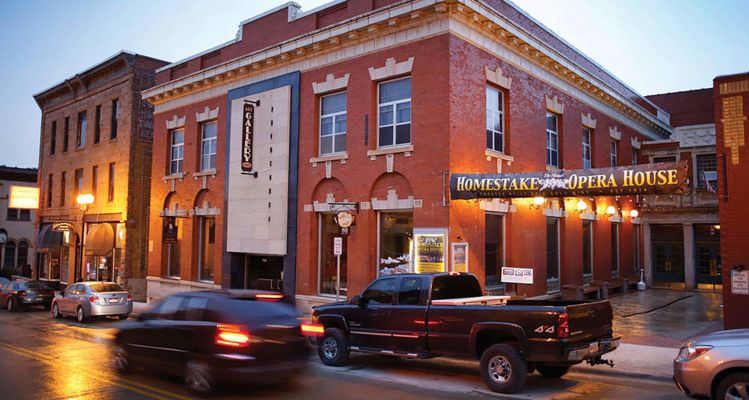
Phoebe Apperson Hearst’s many philanthropic endeavors in Lead included the Homestake Opera House, which opened in 1914.

Phoebe Apperson Hearst died in 1918, several decades before Linda Wiley was born, but their paths crossed in the small Black Hills community of Lead.

Linda studied Phoebe’s writings and accounts of her business and philanthropic ventures and brought her to life through a production on Lead’s Historic Homestake Opera House. Linda believes South Dakotans should know about this remarkable woman who made a big impact in the Black Hills. When Phoebe’s husband George Hearst (mining entrepreneur, U.S. senator from California and fictionalized villain in the HBO TV series Deadwood) died, his 48-year-old widow inherited every penny of his considerable wealth. She gave much of it away.

Her belief in helping those in need could be traced to when she and George lived in San Francisco in 1873, the year an economic depression gripped the country. The couple got by okay,”because of the mines. People in San Francisco fared worse and when I witnessed the impact on the city and families, my philosophy changed towards wanting to help the needy, for I realized I could help,” Phoebe said.

Okay, let me clarify. Phoebe said that in Linda’s script and through Minneapolis actress Kathleen Dodsen Smith’s interpretation. And Jon Steven Wiley, Linda’s actor husband, had a hand in things, too, as script editor. Dramatizing history is a complex matter but a great way to communicate true stories to a mass audience, if the writer, performer and script editor are skilled and conscientious. I can personally vouch for these three. Linda combines a love of the Black Hills with a professional ethic that insists on accuracy. I’ll explain before the end of this column but right now I don’t want to drift too far from Phoebe.

Phoebe Apperson Hearst.

Phoebe considered George’s mining ventures across the West to be immune to the boom-and-bust phenomenon. Homestake grew continually, and after George’s death, Phoebe went to Lead and took a look. She invested in a private railway car she called the Lucania and traveled in comfort. Liking and apparently feeling somewhat maternalistic towards Lead’s people, she began sending $200 (nearly $6,000 in today’s dollars) to all 12 Lead churches every Christmas. She also endowed a fine library and was an advocate for what we now call early childhood education; Phoebe established a free kindergarten in the community. Some critics have looked at her love of Lead and her humanitarian gestures overall and wondered if she couldn’t have done more to prevent community hardship that stemmed from Homestake’s labor lockout over the winter of 1909-10. Whatever the case, Lead didn’t seem to direct anger toward her. Homestake’s board of directors in San Francisco took most of those barbs. Phoebe, meanwhile, rode the Lucania across the United States supporting a wide range of interests, from restoration of George Washington’s Mount Vernon home in Virginia to development of the University of California at Berkeley. She was the first woman to serve as a University of California regent.”I attributed my success in a man’s world of that time to politeness, clear goals, and sheer determination,” Phoebe says in Linda’s script. That style, Linda thinks, likely stunted Phoebe’s effectiveness as a suffragette, although that’s certainly where her sentiments were.

Her last gift to Lead, working with mine superintendent T.J. Grier, was the Homestake recreation building and opera house. In the script Phoebe expresses satisfaction with how Lead responded to an opening night opera in 1914:”I heard that there was standing room only with employees from the mine and their children!”

Historians have mostly overlooked Phoebe’s relationship with South Dakotans. Even Alexandria Nickliss’s fine biography, Phoebe Apperson Hearst: A Life of Power and Politics, only briefly touches on Lead in 664 pages. Thankfully, another California writer, Leta Miller, has written about Phoebe for the South Dakota State Historical Society, and the Homestake Adams Research and Cultural Center has archived South Dakota press accounts about Phoebe’s connections here.

All were resources for Linda, a native South Dakotan and meticulous researcher. She worked as a manager for Caterpillar, Inc., for 30 years across the United States and around the world. All the while, she and Jon knew they would retire to the Black Hills. They found their spot 7 miles outside Lead, and like Phoebe, quickly developed affection for the town. Both volunteered at the opera house that Phoebe made possible, and Linda served for a time on its board and then as president.

And she became a Phoebe Hearst expert. That’s very much a necessity in a town where residents told me the opera house — Phoebe’s final grand gift — is the very heart of the community.

Editor’s Note: This story is revised from the May/June 2022 issue of South Dakota Magazine. To order a copy or to subscribe, call (800) 456-5117.

Posted on Leave a comment

Fire Bomber

Spearfish pilot Arnold Kolb (far left) and his crew used a fleet of refurbished B-17 bombers to fight forest fires.

A photograph shows a relaxed Arnold Kolb standing near his B-17 bomber the way other men pose with a newly acquired sports car. Yes, Kolb loved flying. But this airplane meant business. He and his crews used it to douse forest fires. Their daring adventures and remarkable record of success earned Kolb and the pilots of Black Hills Aviation a reputation that quickly spread from their base in Spearfish across North America.

Those who witness wildfires may say,”Better to face them from high in the sky than up close.” That’s not how Kolb worked. He swooped in so low that afterwards pine needles were sometimes found in his wing flaps.

“I looked out and saw treetops at eye level,” recalls Rick Plocek, who worked for Kolb on the ground out of high school and memorably flew to a Black Hills fire with him.”Then the load dropped, and it felt like being in an elevator when it starts, like you’re weightless for a second.”

Among fellow pilots, Kolb held a reputation for being able to drop slurry on a dime and for being creative when necessary. One time, firefighters on the ground were trapped on a ridge with flames moving toward them. Pamela Parker recalls how her father made a drop so that slurry backsplash drew a line between the firefighters and the fire, saving their lives. Slurry dropped directly on people would have killed them as surely as flames, but with the steady Kolb at the controls, that would never happen.

Born in 1927 on the Kolb family ranch near Bison, Arnold was the fifth of nine children. Most of the siblings remained closely associated with one another through aviation over the course of their lives. It was a time when airplanes were transforming South Dakota ranching by reducing isolation, moving cattle, rounding up renegade horses, crop dusting and more.

Arnold’s older brother, Raymond, taught him to fly in 1945. Like so many of his generation, Arnold grew up fast. By age 21 he was vice president of a family flight enterprise in Lemmon. He married Florence Dutton, and they had four daughters and two sons.

The Kolbs bought lots of planes.”I know there’s money in aviation because I put a lot of it there,” Arnold once quipped. If he had an instinct for flying, he also possessed one for business. He would make back his investments many times over and survive considerable economic turbulence.

In 1958 Arnold and Florence bought How Kola Flying Service of Spearfish.”The concern,” reported a local paper,”which operates under a lease agreement at the county-owned airport, will be known in the future as Black Hills Aviation. Kolb is a flight instructor, a commercial pilot with instrument rating and an aircraft and engine mechanic …. Black Hills Aviation will sell and service airplanes, offer ambulance and charter service, do flight instruction and crop dusting.”

Spearfish was an airplane town, first intrigued by flight when Kansas City daredevil Crash-‘Em Up Smith thrilled it with stunts in 1912. Homestake Gold Mine’s Ed Curren led efforts to build the airport in 1922. The next decade saw Works Progress Administration (WPA) labor build a distinctive native stone administration building with a tower, and crowds gathered for an annual air show. Spearfish was home to Clyde Ice, a central figure in daring medical emergency flights and advisor to Henry Ford’s aviation production efforts. In short, there was no place in South Dakota better equipped with flight expertise and airplane mechanics. But in many cases Arnold had to look no further than his own brothers, especially Delbert, a pilot and gifted mechanic and fabricator.

Kolb’s first B-17 could carry 2,000 gallons of slurry, though federal regulations limited it to 1,800.

Still, Spearfish’s airport didn’t match amenities pilots take for granted today when Kolb arrived. Lighted runways were a few years away.”So when Dad flew in at night,” remembers his daughter, Theone Oliver,”Mom would take us to wait on the runway, in the car with headlights on. We’d watch for him to go into a landing pattern. He’d pass over the car and land, and she’d race behind with her brights on, lighting the way.” Kim Craig, another Kolb daughter, thinks the landing procedure epitomized Arnold and Florence’s tight partnership in all aspects of life.

In the 1950s Americans gained awareness of forest fires because much of the population was moving west where wildfires were common. In that environment, in 1955, Californian Nick Nolta made headlines by arranging a mission that deployed a single-engine Boeing Stearman 75 Kaydet to dump 170 gallons of fire retardant on a blaze at Mendocino National Forest in California. Nolta expanded to a fleet of seven Kaydets for the 1956 fire season.

Impressive. Yet the Kaydet was a light civilian plane typically put to work for flight instruction and crop dusting. Kolb, although he never served in the military, believed the best way to attack fire would be to use heavy-duty surplus military aircraft. In 1959 he flew a B-17 against the intense Deadwood Fire that forced the town’s evacuation and charred 5,000 forest acres. In 1963 he bought his own B-17 (more would follow), converted it to a tanker, and was ready for the 1964 fire season. The plane could carry 2,000 gallons of slurry although federal regulations limited it to 1,800.

No other World War II era plane was tougher than the B-17, also known as the Flying Fortress, and used extensively and aggressively both in Europe and the Pacific in the 1940s. Western South Dakota felt some ownership. Many B-17 war crews had first assembled at the air base that became Ellsworth and learned to maneuver the mighty, four-engine aircraft over ranch country. Some South Dakotans said they could identify the sound of B-17 engines without looking up.

But they never witnessed a B-17 in action like Kolb’s during fire season. Kolb described slurry as water thick with soils (including bentonite) that coated trees and other vegetation for protection. It was colored pink so firefighters on the ground and above could see its spread. Fertilizer to stimulate post-fire regrowth was often part of the mix. The U.S. Forest Service supplied slurry, part of a contract it established with Black Hills Aviation that paid Kolb a daily stand-by fee, payable whether he flew that particular day or not.

Kolb and his son Nathan traveled to Washington, D.C., where one of Black Hills Aviation’s B-17s was exhibited at the Smithsonian.

For much of Black Hills Aviation’s time in Spearfish, Rick Plocek says, there were two B-17s always available while a third sat in the hangar, undergoing a constant series of improvements that Kolb devised. In his business, Kolb believed, research and development”is where the competitive edge lies.” A significant development that inspired modifications everywhere stemmed from Arnold and son Nathan’s system that allowed slurry to be released in stages rather than one dump.

Black Hills Aviation grew but never ceased being a family business. For several years, the Kolbs lived onsite in the WPA building, upstairs in three small rooms, because”Dad and Mom made the decision to put profit back into the business instead of buying a house to start out,” says daughter Maurita Autrey. Florence ran the office from that building. She prepared meals and insisted Arnold eat them instead of working through dinnertime and was the family pillar of strength and faith.

The company was always prepared for emergency responses. Crews of two had 15 minutes to take off after an alarm came in, and in seasons when fire threat was greatest, they literally lived with tankers. Still, remarkably, there was a laid-back feel to Black Hills Aviation, thanks to Arnold.”He was a prankster, always pulling tricks on someone,” Plocek says. One time, he put worms in worker Bob Lamb’s Copenhagen to hopefully help the young man stop chewing.”Worms were often part of his pranks, but never done with malice,” Lamb laughed.

But then, in an instant, a phone call could shift the mood into intense work mode that might last days or even weeks. Arnold told the Bison Courier he didn’t consider his fire work more dangerous than other aviation, but there were differing opinions about that. Once he doused a burning train and it exploded. The blast rolled his plane over at low altitude, but he maneuvered to safety, flying upside down until he reached enough altitude to right the aircraft.”Anything he flew could become a stunt plane,” Maurita says. Arnold recalled a northern California forest fire when”the visibility was extremely low because of the volumes of smoke. We got trapped in blind canyons because of the visibility problems.” More than recalling fear when recounting that adventure, Kolb seemed to remember the frustration of not seeing where to drop slurry.

“Nothing scared him,” says Gary Coe, who knew Kolb as his flight instructor.”I had learned to fly from my dad in Perkins County but had to go someplace to make it official, and my family knew the Kolbs. In the air Arnold was relaxed because he had thousands and thousands and thousands of hours flying, and I think that helped beginning pilots relax, too.”

Speaking of relaxed, Kolb’s son-in-law, GB Oliver, called Arnold”the best pilot I ever knew at flying a plane at high altitude while taking a nap. When he made an adjustment, he did it without opening his eyes.” Oliver often accompanied Arnold as co-pilot but said,”When you flew with him you were really mostly a passenger. There was no plane he couldn’t fly. In fact, I always said he didn’t just fly a plane. He wore it.”

He recalled flying with Kolb in Mexico, where flames climbed a steep mesa and threatened a resort up top.”He flew right at the mesa wall, and we lost sight of it as he rolled the plane and released slurry,” Oliver says.”I can’t explain how he did that, except to say he had an instinct. Flying, for Arnold, was as natural as walking.”

Arnold and Florence’s worst business turbulence came in the 1970s. Parts for old B-17s became hard to obtain so they decided to switch to Lockheed P2V planes, used mostly by the Navy. The Kolbs were in a position to do that, but there was nothing they could do to alter South Dakota’s routing of Interstate 90. The new highway cut their runways, making them too short for slurry tankers. In 1972, Black Hills Aviation relocated to Alamogordo, New Mexico. The recognized and respected company name was retained even though the Kolbs were now based 900 miles south of the Hills.

The move went well. Arnold and Florence envisioned a long-term future for their company as their youngest, Nathan, born in Spearfish in 1965, demonstrated remarkable piloting aptitude. In short order the young man held single and multi-engine licensing. In 1984 the Smithsonian Institution put Black Hills Aviation’s last B-17 slurry tanker on display and Nathan was at the controls as the plane flew into Washington, D.C. The welcoming committee was visibly surprised to see a teenager descend from the pilot’s hatch.

Kolb was a thorough pilot who did his own inspections, mechanical work and creative renovations.

But three years later Spearfish and Alamogordo were stunned when 21-year-old Nathan died in the crash of a company Lockheed Neptune while fighting fire. Co-pilot Red Miller was also killed. The news got worse. It was revealed that the Neptune was shot down. The U.S. military had summoned Black Hills Aviation to attack a fire on the White Sands Missile Range in southeastern New Mexico. The military had fired a missile that ignited the blaze, and then, after a tragic miscommunication, fired more that brought down the Neptune.

The day Nathan died, September 10, 1987, Florence stood once again as the family pillar of faith.”Oh honey, don’t cry,” she told Theone when her daughter broke the news to her.”We know when these airplanes go out, they may not come back, but when we’re Christians it is not the end.”

Over the decades, a total of nine pilots and co-pilots didn’t come back, none by pilot error or mechanical failure. Five tankers were lost.

Kolb’s daughters believe that Nathan’s death broke their father’s enthusiasm for Black Hills Aviation, but he flew a few years more because he had contracts to fulfill. It’s possible he found some solace in the sky where he always felt at home. Arnold and Florence sold their tankers and the business in 1993. They bought a house in Spearfish and spent much of their retirement there, while also visiting their daughters across the country. Arnold died in 2011 at age 83. Florence followed in 2017.

More than 50 years have passed since Kolb slurry tankers took off from Spearfish. But Black Hills Aviation lives vividly in the minds of longtime Black Hills residents. Last summer, as smoke drifted south from terrible wildfires in Canada, they could almost hear the engines roar and see Kolb slowly ascend into the sky, ready to fly anywhere to put down a fire.

Editor’s Note: This story is revised from the May/June 2024 issue of South Dakota Magazine. To order a copy or to subscribe, call (800) 456-5117.

Posted on Leave a comment

Ramming Through the Mickelson Trail

The Mickelson Trail, a recreational trail built atop an old railroad bed. stretches 109 miles from the northern to the southern Black Hills, passing through forests, meadows, four rock tunnels and several old railroad trestles.

Six hundred avid bicyclists and several dozen trailblazers met at a community hall in Custer last September to celebrate 25 years of happiness, no small feat in today’s anxious world. The gathering included participants in an anniversary ride along with current and former park officials, volunteers, donors, lawmakers and other movers and shakers who helped transform an abandoned rail line into what’s now known as the Mickelson Trail.

The state trail should not be taken for granted. A strange silence had settled over the Black Hills after Burlington Northern’s last train exited the mountains in 1983. The sound of engines echoing down draws was never pervasive, but the understated rumble was always a reminder that railroading helped build high country towns and industries — from Edgemont in the south to Lead and Deadwood in the north — and sustained them for nearly a century. The 109-mile rail corridor was a connection to the outside world that especially helped Homestake become America’s biggest and most technically advanced gold mine.

Three years after the trains departed, a man was walking through the forest when he heard a chain saw. He discovered that someone was cutting down an old wooden railroad trestle. Compared to locomotives, the buzzing of a saw cutting into a trestle in 1986 was more insect-like, but it disturbed the hiker so he contacted Guy Edwards, a young businessman and state lawmaker.

Black Hills activists were already talking about transforming the vacated rail bed into a recreational route under the recently authorized federal Rails to Trails program. Destruction of the rustic trestles seemed like a major step in the wrong direction. Edwards soon learned that the damage was not being done by vandals, but by a salvage contractor hired by Burlington Northern. A few dozen bridges had already been removed. The lawmaker arranged for demolition to cease until matters could be sorted out. Then he convinced state officials to make the trail a priority. So began a complicated, controversial and long-drawn out battle to create a rails-to-trail project.

“Probably 95 percent of property owners along the trail were against us at first,” Edwards told South Dakota Magazine many years later.”I could understand their position. After years of having trains go by their property, it appeared the corridor might meld into the landscape.”

The Mickelson Trail may not exist today if not for the zealous support of its namesake, Gov. George S. Mickelson, who presided over an early dedication ceremony before he died in a 1993 plane crash.

The Interstate Commerce Commission had granted Burlington Northern permission to abandon its business of running trains through the Black Hills, but not the railway. The corridor had been established under federal authority because in the 19th century there had been an economic need, and under Rails to Trails it would remain in place in case another need arose. Meanwhile the public could use it for recreation.

In 1986, Brookings attorney George S. Mickelson ran for governor. He made a $50 donation during the fall campaign to a nonprofit organization set up to advance the trail. At the 25-year anniversary event last fall in Custer, the late governor’s son, Mark, reminisced about his dad’s approach to making things happen.”As governor, my grandfather (George T. Mickelson) was the only state official to show up for the first blast at Crazy Horse Memorial,” Mickelson said.”My father saw a parallel in how his own early support could help make the trail a reality. He loved the Black Hills and being out here.”

After taking office as governor in 1987, George Mickelson said he wanted trail work to commence at”ramming speed.” He used the train term metaphorically, but it did illustrate the work that lay ahead: trestle restoration, culvert development and surfacing the route.

The earliest obstacle was the hundreds of property owners who valued their privacy and were wary of sharing the back country with hikers, bikers and horses. Susan Edwards Johnson, who is Guy Edwards’ sister and was then Mickelson’s tourism secretary, spoke of the governor’s tenacity at the Custer anniversary gathering. She especially recalled a meeting at Mystic, where some cabin owners were personal friends and political supporters of the governor.

After listening patiently to their concerns, Mickelson rose to his feet and told the naysayers to get aboard because,”We are coming through!” Few politicians in South Dakota history ever had the political gravitas to lead so bluntly.

Later, Mickelson spoke of the opponents to Rapid City Journal reporter Jim Holland.”Treasures like the Black Hills are jealously guarded,” he said.”They have different ideas of what the Hills should be used for than we do. We will help to protect the qualities of the lands we both hold so dear. It may be impossible to get them to share our dream, but we promise to be good neighbors.”

“He saw it as a legacy project for South Dakota,” says Kitty Kinsman, who became involved with fundraising for the project in the 1990s. Opponents eventually softened — partly because of their respect for Mickelson, who offered to build private-access gates and fences for property owners to alleviate some of their concerns.

The Mickelson Trail isn’t particularly steep. Grades are generally less than 4 percent.

Kinsman helped organize the anniversary event in Custer. She wonders whether the trail would exist without Mickelson, who was a strong conservationist. Just months before his death, he also persuaded lawmakers to pass his Centennial Environmental Act, a comprehensive program that continues to protect the state’s water and land resources. It’s hard to imagine such a proposal passing the South Dakota legislature today.

Along with the political hurdles came less contentious questions. And there were few models across the country to imitate.”It was an idea ahead of its time,” says Doug Hofer, former director of the state Division of Parks and Recreation, who also celebrated at the Custer event. No one doubted that trail sections close to Edgemont, Pringle, Custer, Hill City, Rochford, Lead and Deadwood would see use. But what about those long stretches far from towns? Would Black Hills weather, famous for rapid changes, scare potential users from venturing on the remote stretches? What about the growing mountain lion population?

Then, seven years into the project, Mickelson died in a 1993 plane crash with seven other men. His family directed memorial donations to the trail effort, but no amount of money could replace the leadership of the popular governor, who did everything in life at ramming speed. Eventually the route was named in his honor.

Hofer says the project seemed to benefit from”divine intervention” after Mickelson’s death. Capable people would appear to tackle aspects of development at just the right times. Among them was Dave Snyder, an ag businessman from Pierre and a member of a national Rails to Trails organization. Snyder contributed significantly to the project when he learned that $1 million was needed to match state and federal money, and he devised a plan based on the route’s trestles for raising the full amount.

More than a hundred trestles had to be rebuilt, decked and improved in other ways, and a value was assigned to each based on length. Private and corporate sponsors could”adopt” bridges for donations that ranged from $1,000 to $25,000. Snyder traveled the state, successfully pitching the bridge builder project.

“We had lots of bridges ranging from $3,500 to $5,000, although donors understood they weren’t buying that bridge, but rather matching dollars for the whole trail system,” Snyder says.

He also believed opposition would fade because that was the history of other trails.”There just aren’t incidents involving trail users,” he noted.”You don’t see trash. I tell people that nobody gets on the trail and then feels worse when they get off.”

With money available for construction supplies, Paul Bosworth of the U.S. Forest Service, among other duties, led National Guard men and women assigned to the work. Many were novices when it came to construction, but enthusiastic about the trail.”They were super fun,” Bosworth says.”Of course, this was part of their military training and sometimes they had to take a break when they were ëattacked,’ grabbing guns and shooting blanks at guys playing the enemy.”

The trail follows several meandering Black Hills creeks.

Kinsman, who had never pedaled a mountain bike before she began working with Snyder and Edwards Johnson on the bridge builder campaign, now rides the Mickelson regularly.”I’m struck by both the scenery and solitude even when you’re not far from roads,” she says.

Today, 15 trailheads make it easy to jump on and off for short rides or hikes. Rest and shade areas and interpretive signs have been created. A 5-mile paved spur was developed by the state Department of Transportation to take users close to (although not into) Custer State Park.

It took governors, state and federal officials, private sector donors, volunteers and the Burlington Northern to complete the project. The full 109-mile trail opened to hikers, cyclists, runners and equestrians in 1998 — 15 years after that last train — and soon gained a reputation as one of the best Rails to Trails routes in the country. It passes through varied landscapes of forest and prairies, four rock tunnels, and, of course, over those trestles.

More than 20,000 people purchase $15 annual passes, and many more buy $4 day passes. Park officials believe more than 70,000 people traverse it throughout the year. The annual Mickelson Trail Trek, which celebrated its 25th year at Custer, is limited to 600 registrants; most years, the registrations are gone within 24 hours. A three-day Summer Trail Trek is now held in June to accommodate more people.

One of the trail’s many charms is the way it pops out of the pines and passes through small towns. Julia Monczunski’s favorite trail memory is running the 2006 Mickelson Trail Marathon.”Actually, I competed in the half-marathon, my first long-distance race, and it was neat to be running in the mountains and then ending in Deadwood,” she says.”I was tired but felt a burst of energy from the crowd cheering us on as we came into town.”

Monczunski, who has also raced on pavement, appreciates the Mickelson’s forgiving crushed limestone surface. Cyclists also like the control they feel with limestone on long downslopes. Trail developers say limestone is aesthetically appropriate to the Black Hills and less vulnerable to water damage during heavy rains.

Trail use continues to evolve. E-bikes are the newest twist.”They’ve made the trail more accessible, especially for people who aren’t adjusted to altitude,” Kinsman says. “They’re here to stay.”

Nineteenth century railroad workers built the train corridor in about one year. Converting the path to a trail required 15 years.

But they pose problems. Collisions with other cyclists happen when inexperienced e-bike riders stick to the center of the trail to maintain a sense of control.”It’s a nonmotorized trail and class one e-bikes have been seen as okay,” Snyder says.”But sometimes there are class two or even class three e-bikes out there, almost small motorcycles, and that has to be watched. And a 50- or 60-pound e-bike is probably okay, but maybe not one that’s a hundred pounds.”

Motorized bikes, mountain lions and even the weather don’t seem to discourage users. Online reviews are dominated by 5-star ratings. The most common complaint is the long ascent that runs south of Deadwood/Lead to Dumont.

The passage of a quarter century and the trail’s place in today’s Black Hills culture doesn’t mean the work is done. The corridor requires constant upkeep. Aging trestle decking will have to be replaced and at least one support beam has been infested by ants. The tunnels are monitored constantly for safety. There’s a spot where Rapid Creek — diverted from its original channel by railroad builders — acts up.

The Custer gathering honored six cyclists who have ridden the autumn Mickelson Trail Trek every year since 1998. Kinsman says it was also an opportunity to relaunch the Friends of the Mickelson Trail group because private donations are needed for the rehabilitation efforts.

Though the trail is part of the state park system, numerous agencies and individuals have always stepped forward to help.”I spent so much time working on the trail, and now when I go there and see people using it, having fun, it makes me happy,” Bosworth says.

Bosworth has been retired from the Forest Service for a few years but returns to the trail to help as a private contractor.”The trail did so much for me in launching my career,” he recalled,”that I’ll do anything for it.”

He’s happy that so many people now enjoy the Black Hills wilderness along the trail, and notes that the major concern of property owners today isn’t the hikers and bikers with whom they share the backwoods, but whether the private gates that give them easy access are in good working order so they can join them.

Editor’s Note: This story is revised from the March/April 2024 issue of South Dakota Magazine. To order or to subscribe, call (800) 456-5117.