
Tracing the paths of two South Dakota war heroes

By Paul Higbee
In April 1942, South Dakotans Henry (Hank) Potter and Don Smith were key players in one of history’s most daring military feats. Half a century later another South Dakota native, Curt Hills, traveled halfway around the globe to trace their adventure, finding both physical remnants and Chinese citizens who were part of this World War II adventure.
The 1942 operation was the famous Doolittle Raid, where 16 U.S. Army Air Corps B-25 planes struck back at Japan, 134 days after that country’s military bombed Pearl Harbor in the Hawaiian Islands. The American raid has often been cited for providing a tremendous morale boost for the United States, facing a real possibility of losing the war as it engaged strong foes in both the Pacific and Atlantic oceans. But historians note that the Doolittle Raid also stunned Japanese citizens who believed their home island to be immune to air attack because it sat isolated in a wide sea. Japanese leaders were forced to realign their far-flung Imperial Navy fleet to better protect the homeland, which created an advantage for America and its allies later in the war.
The air raid was planned and led by Lt. Col. Jimmy Doolittle, a California-born aviation pioneer who set well-publicized airplane endurance records in the 1920s, experimented constantly in hopes of improving aircraft safety and efficiency, and who, against long odds, in the 1930s convinced the Army to switch to higher octane fuels to increase engine power. As it turned out, Doolittle would use every drop of his high-octane fuel for the raid that bears his name. In fact, he would have been better off with a few more ounces.
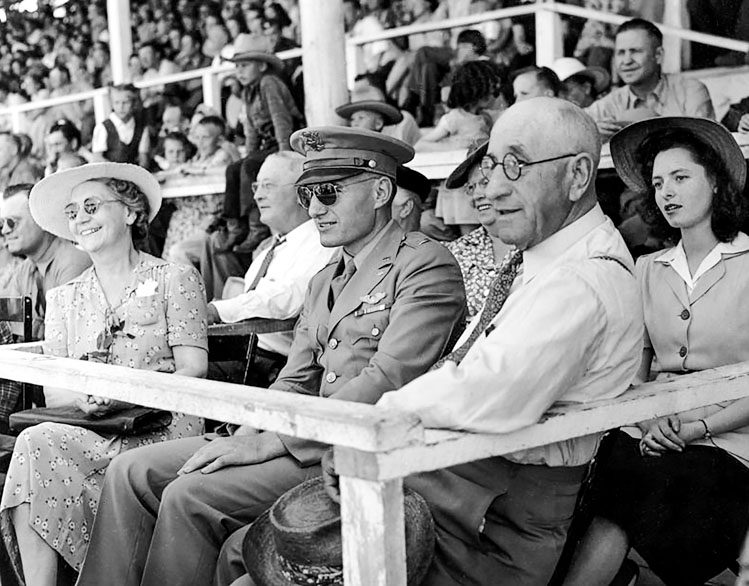
Doolittle’s B-25 dropped four bombs on Tokyo industrial targets at about noon on Saturday, April 18, 1942, and then swooped low and sped west to escape Japanese air space. In escaping, he credited his navigator — Hank Potter — for plotting “a perfect course.” Potter grew up in Pierre, and then attended Yankton College.
Potter lived long enough for Hills, part of the group who traced the raid, to meet and travel with him. “He was very honest, sincere and caring,” Hills says. “He had those qualities that made it easy to believe he came from South Dakota.”
Don Smith, the other Doolittle Raider from South Dakota, mirrored those qualities. “A straight arrow,” recalled his flight engineer, Edward Saylor. Smith, a pilot, was born at Oldham in 1918, spent most of his childhood in Belle Fourche and graduated from South Dakota State College (now SDSU) in Brookings after winning football’s Little All-America honors as Jackrabbit center. His B-25, dubbed TNT by its crew of five, dropped bombs on Kobe factories more than an hour after Doolittle hit Tokyo.

What baffled Japanese leaders (and the general public in the United States) for months was how 16 B-25s got into Japanese skies in the first place. The closely guarded secret was that Doolittle and Army brass decided the attack was worth risking something that had never been attempted: launching fully loaded medium bombers from the deck of a ship, the carrier Hornet. “It was such a bold plan,” recalled George McGovern, South Dakota’s long-serving U.S. senator who was just preparing to enter the Air Corps himself. “I don’t think anyone but Americans would have tried it.”
Taking off from a carrier meant pilots had to use less than 500 feet of deck instead of 1,000 feet of runway, as was typical on land. Smith practiced steep-angled takeoffs on land in Florida. At sea on April 18 he used fewer than 300 feet of deck — the best mark of the day. In fact, it can be said Smith flew a perfect mission: a takeoff that military aviators could only have imagined weeks before, finding and hitting his industrial targets and executing a smooth water landing 13 hours after launch.
Still, nothing went exactly according to plan that day. After a Japanese trawler spotted the Hornet, all planes took off early, adding 600 miles to their flights. That meant they could get to the safety of China after their bombing runs thanks only to a stout east-to-west tailwind and the quality fuel for which Doolittle had argued.
The Raiders soon learned that China wasn’t as safe as they had hoped. No lighted airfield or fuel awaited the planes on April 18, either because of a communications mix-up or because the Nationalist Chinese government grew leery of helping Americans in the face of likely Japanese revenge. Like the United States, China was at war with Japan, and Japanese troops controlled sections of the country. The American pilots had little choice but to parachute out of their planes with their men or make crash landings (although one crew drew Doolittle’s ire by landing in Siberia where the Soviets seized the B-25).
Potter, Doolittle and the rest of the Plane One crew bailed out into the pitch-black night and survived. Smith approached the China coast, sensed his plane didn’t have enough fuel to climb over a coastal mountain range and made a remarkably smooth sea landing a few hundred yards from Tantou Island (also known as Tantouschan, just off the coast of China). He and his crew had eight minutes before the TNT began sinking, which was time enough to climb out while pulling an inflatable raft with them. After two hours in the water they got to the beach with a cold wind piercing their flight uniforms. Eventually they found shelter in a livestock pen before the Ma Liagshui family spotted the men and invited them into their nearby hut.
Of the 75 Americans who attempted to leap or crash into China that night, one died due to a parachute malfunction, two drowned and eight were quickly captured by Japanese soldiers. The two South Dakotans, along with their 62 scattered peers, made their way hundreds of miles cross country to the Nationalist China capital of Chungking with help from Chinese friends — many of whom later died at the hands of vengeful Japanese soldiers. Potter recalled that he, “walked, went in rickshaws, sedan chair, rode a horse, went on a boat in the river, some sort of car, a so-called bus which was a truck we sat on, a train and finally a C-47 airplane at Chung-king.”

Smith, to his great credit, took a detour on his route to Chungking. Through Chinese guides he learned the crew members of Plane Seven had been badly injured in their crash landing and were in a little hospital at Linhai. The raid’s flight surgeon, Dr. Thomas White, flew aboard Smith’s plane, and Smith decided he had to get White to Linhai over rugged foot trails. There can be absolutely no doubt that White saved Plane Seven pilot Ted Lawson’s life.
Smith returned home on leave in time for Belle Fourche’s Fourth of July rodeo, an event he loved growing up. Sadly, he died later in 1942 in a plane crash in England. Potter went on to a distinguished Air Force career, rose to the rank of colonel, and was commander of Bergstrom Air Force Base in Texas when he retired in 1970. He often made time to attend the famous Doolittle Raiders Reunion each April and took a lead role in organizing the 1978 reunion in Rapid City.
A few years after the reunion in his home state, Potter met Bryan Moon. As a boy growing up in England during World War II, Moon befriended American airmen stationed there, and developed a fascination for their planes. He grew up to become a Northwest Airlines executive based in Minneapolis and an acclaimed artist, specializing in aviation scenes. One of his paintings depicts what he guessed Smith’s TNT might look like beneath the China Sea.
The late Moon was also a true adventurer, willing to spend whatever it took to track down military history and, through an organization he founded called MIA Hunters, the remains of combat casualties interred overseas. In 1990 he led an expedition into China to find Doolittle Raid artifacts and organize ceremonies where brave Chinese people who helped the raiders could be thanked. Curt Hills — born in Chamberlain, raised in Mitchell and by then part of a real estate management group in Rochester, Minnesota — heard Moon speak at a Sertoma Club event. Hills decided he wanted in on the adventures. So did fellow South Dakotan Hank Potter, who represented the Raiders in thank-you ceremonies.
Moon and his fellow travelers met a woman named Zhao Xiaobao who, living on Tantou Island in 1942, helped hide, feed and clothe Smith and his four crewmates. She said her son, a fisherman, knew the exact location of the TNT because he had pulled up small scraps of aircraft metal. Also, islanders had noticed occasional oil slicks there. Moon contacted Smith’s copilot, Griffith Williams, and by Williams’ calculations the crash site matched the fisherman’s description.
But it wouldn’t be easy for Moon’s group to gain access. The island sat near a submarine base in a zone controlled by the Chinese military. Still, Moon wrote to request permission to dive, photograph and videotape. His request gained a boost when Gen. Jimmy Doolittle, in his 90s, wrote to the Chinese government endorsing Moon’s project. Permission was granted in September 1993 — the same month Doolittle died — and Moon dashed to organize an expedition the following April.
The Rochester Post-Bulletin wrote that Smith’s plane, “might be World War II’s most treasured aviation artifact.” Moon told the paper that, “the ideal scenario is we find the airplane in an ideal position,” meaning a wing might extend to within 15 feet or so of the surface. The worst scenario was that nothing would remain beyond a “pile of nuts and bolts.”
Moon’s group of 19 traveled to Tantou Island, 150 miles south of Shanghai, the next spring. Hills noted the island, in some ways, hadn’t changed much since Smith saw it. Its people mostly lived in poverty, eking out livelihoods through fishing and small subsistence farming. Moon’s group learned that a hill up from the beach where the TNT crew climbed to find shelter was actually more of a cliff.

Moon had arranged for a retired military vessel that was positioned over the crash site and used sonar-equipped sensors to create images of what sat beneath. He brought expert divers from the United States, but, Hills says, “diving was quite dangerous. Very strong currents swept divers away. And we learned the plane is submerged much deeper than we expected.”
It is, in fact, about 50 feet beneath the surface. Local islanders had guessed about 30 feet. No part of the TNT extended close to the surface. While the plane is much more than a pile of nuts and bolts, Hills says, “it’s in deep mud and has been beaten by typhoons through the years.”
Raising the TNT was never discussed with the Chinese government in the 1990s, and the 1994 expedition proved that to be unfeasible in the future. Don Smith’s famous warplane will rest underwater until, in coming years, it is indeed a pile of nuts and bolts.
Hank Potter died at age 83 in 2002. His New York Times obituary mentioned a reunion in the 1990s with Zhu Xuesan, an English-speaking man who came to his rescue the morning after he parachuted into China. The reunion happened thanks to Moon’s group. “To be able to meet the man who helped me so much when I was wandering and tired and cold,” said Potter, “it’s just amazing.”
Don Smith didn’t live to attend Doolittle Raiders reunions or to understand how deeply his adventure touched Americans for decades. But 2019 has been a good year for him. The South Dakota Historical Society Press published a new biography called First Strike: Doolittle Raider Don Smith. And in April, Dick Cole — the last surviving Doolittle Raider — accomplished something meaningful just before his death at age 103. Cole kept in his possession one of 80 Congressional Gold Medals, struck for the families of each Raider. No one ever claimed Smith’s, whose widow and only daughter had passed away. Cole wanted the medal to go to South Dakota as a gift from him. With help from Sioux Falls author, filmmaker and aviation artist John Mollison, and others, the medal was delivered to the South Dakota Air and Space Museum, near Rapid City, on the raid’s 77th anniversary. Though Smith’s TNT will forever lie at the bottom of the China Sea, a tangible reminder of South Dakota’s role in one of the world’s most fearless military missions had come home.
Editor’s Note: This story is revised from the November/December 2019 issue of South Dakota Magazine. To order a copy or to subscribe, call (800) 456-5117.


