Posted on Leave a comment

Yes, We Pe-Can

Nut trees can flourish in a sliver of South Dakota, but will their growers ever be more than hobbyists?

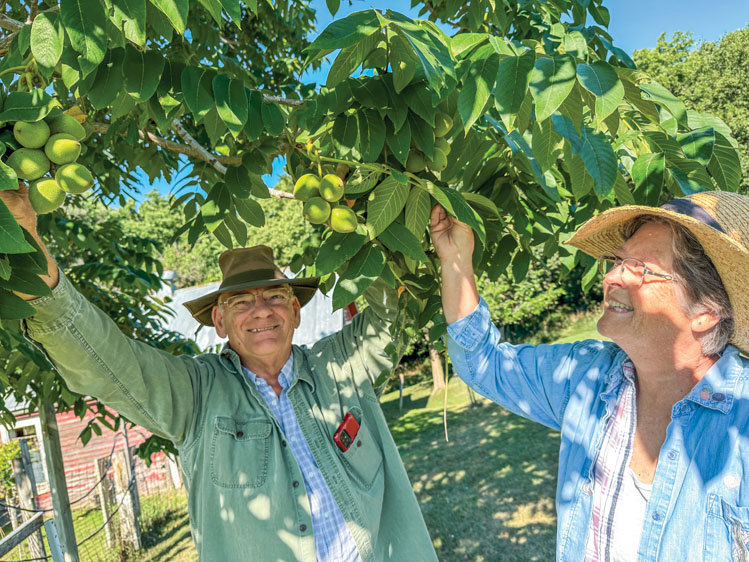
Darrell and Martha Ausborn have experimented with nut trees on their 10-acre farm west of Yankton since 2008.

By John Andrews

Dan DeBuhr was 6 years old in the early 1960s when his grandmother returned from a vacation in Texas with two pecan trees. She planted them in the backyard of her Elk Point home — the same patch of land where DeBuhr lives today — not knowing what to expect. “They told her they couldn’t guarantee that they would make it in South Dakota,” DeBuhr says. “And they would never bear fruit.”

Today, motorists passing by on Interstate 29 can easily spot them because they are the tallest trees in town. In fact, measurements taken last June confirm that they are the two biggest pecan trees in South Dakota, both supplanting a 61-foot pecan in Rapid City.

A severe thunderstorm pelted Elk Point with baseball sized hail early last summer, greatly diminishing the year’s pecan crop. But near the end of most Septembers, DeBuhr wages a daily battle with squirrels to collect the prized nuts. The little critters clearly collect their share, evidenced by the tiny trees that spring up from pecans buried around his yard.

We think of more temperate places when we think of pecans, but they have a history in South Dakota. Pecans — as well as hickory, chestnuts, heartnuts, butternuts, English walnuts and maybe even pine nuts — can indeed grow in certain parts of South Dakota, and experimenters are working to create the best varieties for our environment.

*****

South Dakota is not a robust nut-producing state. Black walnuts are the only nut trees considered native, but John Ball, a professor at South Dakota State University in Brookings, says you can find butternut, American chestnut, English walnut, Manchurian walnut and even pecan, though the growing season is not always long enough to produce nuts. Far southeastern South Dakota, however, is another story.

“It is an unusual part of the state,” says Ball, who is also an SDSU Extension forestry specialist and South Dakota Department of Agriculture and Natural Resources forest health specialist. “We should call it Western Iowa/Northern Nebraska, not South Dakota, and then it would fit. Growing pecans in those states would not be surprising, and southeastern South Dakota is kind of an extension of that. But it’s a rather abrupt line as we move out of there as to where something grows, where something’s a shrub and where something just never makes it at all.”

Our native black walnut provides a good example. “Black walnut is only native to eastern South Dakota, and really the southeast, though there is one population up in Codington County,” Ball says. “But it will even grow in Harding County. I’ve seen some trees out by Union Center and Bison. The difference is the ones down by Yankton and Vermillion can get a couple feet in diameter and 70 feet tall. The ones up in Bison get about 6 inches in diameter and maybe 20 feet tall. So while they can grow there, they grow very slowly. Down in the southeast, you can grow most of the nut trees that can grow out East, though not always as productively and not as quickly. And you have to really work at it. It doesn’t come easily.”

Any discussion of trees and plants and where they might succeed brings to mind the USDA Plant Hardiness Zone Map, the reference that many gardeners consult before planting. The map is based on a region’s annual average extreme minimum temperatures, with lower zone numbers coinciding with colder temperatures. Much of the northern half of South Dakota lies in Zone 4b (-25 degrees Fahrenheit to -20), though some pockets, including Aberdeen, fall in 4a (-30 to -25). The southern half is largely 5a (-20 to -15), with some areas of 5b (-15 to -10) west of Yankton and around the Black Hills, including Rapid City.

But the map may be irrelevant. Ball says the more important factor for nut trees is the number of frost-free days. “I recommend throwing the zone map out when you get to South Dakota,” Ball says. “The zone maps were first developed in Boston. They started drawing the lines back in about 1927, and they did it without ever coming to South Dakota. The real difficulty is it is based upon only one climatic factor: the annual average extreme temperature, or, essentially, how cold it could get in January. That doesn’t do well here, because what really affects our nut production is our early frost in the fall, late frost in the spring, that cold snap that occurs in April after it’s already been warm or a nice mild fall and then suddenly the temperatures fall to freezing.”

The native range of pecan trees stretches from east Texas and Louisiana up through Oklahoma and Arkansas into portions of Missouri, southern Illinois and southern Indiana. They tend to follow river valleys, extending as far north as the Iowa/Illinois line along the Mississippi River. Those areas are most likely to give pecan trees the minimum 140 frost-free days needed for nut production. In South Dakota, those conditions are most likely to be replicated in the southeast.

Perhaps that’s why the DeBuhr pecan trees have flourished in Elk Point. Three more pecans purchased from Gurney’s Seed and Nursery in Yankton in the mid-1940s tower over Rick Gray’s home just north of Dakota Valley High School near McCook Lake. And Ball knows of a few pecan trees in Sioux Falls that produce nuts every few years. “While we do define areas and which trees will grow and perform well there, no tree has ever read a book,” Ball says. “We always get the outlier, the tree that’s growing where it shouldn’t, yet performing better than anyone would ever expect. And that’s the fun of South Dakota. It’s not like trees grow everywhere, and you really appreciate it when they make it.”

*****

John Goeden is an agronomist and self-described “collector of cultivars.” When he’s not consulting on corn and soybean hybrids for Channel Seed, he’s tinkering with trees on his 1.8 acres just west of McCook Lake. “My dad was a carpenter, and he loved hardwood trees, particularly walnut,” Goeden says. “That’s probably where it all started. I helped him take out a grove of about 100 walnut trees that were going to get ripped out of the ground and farmed in the late ‘90s. So in some ways, I’m paying for the sins of my father — and myself.”

John Goeden is a self-described “collector of cultivars.” His grove at McCook Lake includes at 25 pecan varieties.

He is particularly interested in pecan and hickory trees. He believes hickories were a prominent part of the river valley landscape until homesteaders began flooding the Plains in the 1860s. “We had a huge mass migration of people from east to west, and they came in wagon trains made of wood and iron,” he says. “When they were making and repairing things, they were all looking for the straightest, hardest, most durable wood they could find, and hickory was it. That’s probably a reason why we don’t have a lot of hickory remnants left. It’s also the best firewood.”

Historically, the Lakota were familiar with hickory from their time living in eastern Minnesota, before they were pushed west. Similarly, many Great Plains tribes had a word for pecan. “That means that they were either trading in pecan or making trips to where they were plentiful, which would be eastern Iowa, Illinois and Missouri,” he says. “They knew pecan.”

Those species command most of his attention. By the summer of 2024, Goeden’s experiments with tree grafting had resulted in at least 25 different pecan cultivars, along with 15 hickory and four English walnut.

Grafting is a tricky process by which two trees are fused together. Scion wood from a donor tree is cut and attached to rootstock so that their corresponding layers of cambium — the main growth tissue located just beneath the bark — align. The graft is then tightly wrapped and kept moist until the tissues begin to grow together.

“We’re probably not going to extend the harvest to Timber Lake,” Ball says. “But they’re trying to improve the quality of the nut. The rule of thumb I always use is the better the nut, the less chance it has of growing here. You’ve really got to work to develop those qualities, and grafting is how we do it. Thank goodness for the hobbyists that are doing that work to help push the limits and extend the higher quality nuts to our area.”

It was a failed graft that led Goeden to learn about the process. “I had planted some English walnuts,” he says. “I had them in the ground nearly 20 years and they produced nuts. Well, if you look at the leaflets you can tell the difference between an English walnut and black walnut. Somewhere along the line — either before I got those trees or perhaps after — the graft died back, and the black walnut took over. That’s what I actually had.”

His interest in grafting led him to the Nebraska Nut Growers Association, an organization that since the early 1970s has worked on grafting nut trees and placing them in the northern landscape. Grafting is particularly beneficial when working with nut trees, because it can dramatically reduce the time it takes to bear fruit. Self-pollinated pecan, oak and walnut trees might not produce nuts for 15 to 20 years. A hickory might take 40 years. “But if you take wood from a pecan tree and attach it to a two-year seedling and it takes, chances are in eight to 10 years you can have a pecan in your hand,” Goeden says. “It takes the memory of that tree it was on and puts it on top of a seedling. It basically cuts the time in half.”

Grafting and selected cross pollination have resulted in dozens of pecan cultivars, each with different nut sizes, bearing times, percentage of nut meat within the shell and cracking ability. Goeden is growing several of them in his backyard. “My goal is to see what we can effectively grow here and what we can’t,” he says. “Pecans and hickories can grow here, and we’ll find out which ones will survive. I’m trying to get the biggest, best nut possible, and the way to do that is to look at a number of cultivars in your own environment.”

Several of Goeden’s grafted cultivars are growing on Darrell and Martha Ausborn’s 10 acres of land west of Yankton overlooking Lewis and Clark Lake. Ausborn is a retired forester who began in private industry in Florida and Alabama. He later transferred to the Bureau of Indian Affairs where he worked as a forester until retirement. 

 He and Martha, an Alabama native, chose the Yankton County acreage because, Martha says, “he needed a place to play.”

To stay busy in retirement, the couple set their sights on nut trees. In 2008 they planted a batch of grafted seedlings that included English walnut, black walnut, pecan, Chinese chestnut, heartnut and butternut. As they’ve experimented, the Ausborns have added cultivars from various nurseries as well as grafted cultivars from Goeden.

“For pecans, we’re about as far north as you can get,” Darrell says. “The trees do okay, but some years there aren’t enough summer heat days for the nuts to mature. Last year they did mature, and this year they are growing. We’ll see how far they make it into the fall. If we get a cool September or an early frost, the pecans won’t be there. But the rest of the nuts do produce.”

A visit to the Ausborns’ grove in early August found healthy hazelnut trees, the nuts still tightly wrapped within flower-like green husks. “You have to hunt for the hazelnuts,” Martha said as she searched the branches. “I like to pick them because it’s like looking for Easter eggs. They lay up underneath the leaves. The husk has to dry and turn brown, and the nut will be loose. When you can touch it and it will spin, usually the last week in August, that’s when you can harvest.”

Dan DeBuhr enjoys pecan trees his grandmother brought to Elk Point from Texas in the 1960s.

The Ausborns also boasted healthy crops of heartnuts, butternuts, English walnuts and Chinese chestnuts. A Korean pine nut tree looked somewhat out of place but seems to enjoy the Yankton County environment. “That was something out of pure curiosity, just to see if it would grow,” Ausborn says. “In about 30 years you might be able to taste a pine nut, so remember it’s here.”

*****

Nut harvests are modest. The Ausborns spend fall days using homemade equipment to gather, wash and shell their assortment of nuts. Goeden shares his pecans and other nuts with friends and family. They gather every winter with the Nebraska Nut Growers Association for an annual nut evaluation that measures each nut’s size, cracking ability, flavor and quality and quantity of nutmeat. The results help them determine what cultivars are working.

They are also willing to help others. “Without the knowledge and expertise of the Nebraska Nut Growers Association, Darrell and I wouldn’t have had the success that we’ve had,” Goeden says. “Grafting nut trees is an fading art that needs to be passed from one generation to the next in order to push yield potential.”

People like Goeden and the Ausborns will never grow rich from nut production. Ball says a commercial operation in South Dakota is likely not viable. Still, with the right trees, bags of South Dakota-grown hazelnuts or pecans could show up at farmers’ markets and craft fairs. “It’s kind of like farming has gone,” Ball says. “When I was a kid, a family of five could live on a 140-acre mixed farm. Now that’s a hobby farm. Nut production is the same way. It’s hard to get the scale to where you’re actually able to make a living out of it as opposed to supplementing your income. But for a supplement, yes, you can have a hobby that actually pays.”

Dan DeBuhr’s grandmother likely never thought of her tiny pecan trees as a profitable side hustle, but she loved all trees and encouraged her grandson to care for them long after she was gone. “My grandma told me, ‘I’ll never be able to see the pecans, but if you stay here long enough, you probably will,’” DeBuhr recalls. “‘Do me a favor,’ she said. ‘When the trees get big, take a chair on the hottest day, when there’s no wind, and go sit under the trees, because they’ll talk to you.’

“One day in July I was out here working, and it was so hot, no air. So I got a chair and put it right between those trees. All of sudden the leaves were just shaking. That’s what she meant by talking.”

Perhaps they were saying they belong here after all.

Editor’s Note: This story is revised from the November/December 2024 issue of South Dakota Magazine. To order a copy or to subscribe, call (800) 456-5117.

Posted on Leave a comment

The Elevator

A skeleton of the Rauville Grain Company still attracts attention north of Watertown.

Dave Goos recalls walking into Lampert Lumber Company in Sioux Falls and buying 9,000 pounds of 20-penny coated sinker nails.

“We were building a new wood crib elevator in Cavour and that’s what we needed,” says Goos, who designed some of America’s last wood structures before concrete and steel grain facilities became the norm.

He has fond memories of the Cavour project and others like it.”They’d already shipped rail carloads of rough lumber to the job site. We would hire local guys — hopefully some young farm boys — and take our foreman and together we would build something that was a key to the economy and the culture of the area.”

What they built has stood the test of time. Grain elevators — some more than 100 feet high and a century old — continue to tower over Cavour and other towns in America’s grain belt. Many wood elevators are still used for grain storage. A few have been repurposed into lodges or homes. Others, though abandoned, are built so solidly that they’ve thwarted all attempts by nature or man to take them down. They represent farm country’s tallest icons of yesteryear, beloved by photographers and painters and every farmer’s son or daughter who ever unloaded a trailer or truck full of grain and then drove home while carefully clutching a handwritten check from the manager.

Some call them the skyscrapers of the prairie or cathedrals of the plains. To farmers, however, they are just The Elevator.

Dave Goos designed classic crib elevators.

D&W Construction, the company that Goos worked for in the 1980s, still exists on the western outskirts of Sioux Falls. He says he loved the chance to build something that was so vital to a town, and he still relishes the stories that developed from such an unusual and rugged occupation.

Like the day Pete Puterbaugh,”a tough as nails ranch boy from North Dakota,” fell off the elevator at Burke and landed on a lumber pile.”He got busted up pretty badly, but he walked away from the fall,” Goos says. On another occasion, Goos says Puterbaugh saw a badger digging a hole in a pasture.”As Pete told it, he got ahold of the scruff on each side of the badger’s belly and tried to pull it out of the hole, but he said it seemed like the badger ‘turned around inside his own skin’ and came at him, looking like it had two fistfuls of 16-penny nails for claws buzz sawing for his chest. All Pete could do was pick it up and throw it as far away from him as he could and run.”

Goos recalls an occasion when a few of the workers painted a picture of a scantily clad lady atop a new elevator.”It didn’t take long for the phone to ring in the office at D&W,” he says.

At yet another worksite, they were addressing a rat infestation, a common problem for grain facilities.”The manager had read about some powerful sonic device that would drive the rats crazy, so he bought one, wired it to a 2-by-6, plugged it in and shoved it up under the backside of the elevator on a Friday night. On Monday morning he was wondering if it made any difference when the guy who maintained the buses at the local school came and hurriedly asked for every shovel and broom they could spare.”

“My god, do we have rats!” said the bus man.

Goos says elevator projects always drew onlookers, but a job at Jefferson attracted an unexpected crowd.”A tornado had come through and taken down two 36-foot diameter bins. We made a mock foundation in the parking lot and built new bins to go on the old foundations. Then we dropped a cable through the bin top openings so we could hoist them with a crane onto the old foundations. But the day we moved them just happened to be homecoming day and they had a parade going on. People left the parade and brought their lawn chairs to sit along the railroad siding and watch us lift the bins into place. It was the last thing we wanted because we didn’t know if it was going to work.”

Goos studied mechanized agriculture at South Dakota State University and worked for GTA Feeds before joining D&W Construction as a project engineer. His job was to design the elevators.

“One of the first things you’d do is meet with the elevator’s board of directors, which was usually a group of farmers,” he says.”They always farmed and did chores until dark, so you’d be meeting late at night when everybody else was in bed. We would already have the place all measured out and we’d present a design. So often, they didn’t know exactly what they needed, but they trusted us — and we felt the weight of that responsibility because the elevator was such an important part of their community.”

The trust was well-placed. Most of the D&W-built wood elevators still stand. Many still hold grain.

“We still help to repair the old wood elevators,” says Jason Hiemstra, who started with D&W in 1987 when it was transitioning to steel construction.”We’ll still replace the siding or the cribbing. The wood elevators are actually the best way to store grain because the wood absorbs moisture while corrugated metal actually sweats and adds moisture.”

D&W Construction of Sioux Falls built wood crib elevators for decades. Jason Hiemstra, who has blueprints of the jobs and a carpenter’s cribbing hatchet, says crews still repair the sturdy structures.

Hiemstra, now one of the company’s owners, says insurance actuaries are the major threat to wood elevators.”They are starting to kibosh them because they see them as a fire hazard.” Grain dust is explosive; even a spark from an overheated bearing is sometimes enough to create an explosion.

He says old elevators also face problems with everything from mice to worn and frayed electrical wiring. Still, he appreciates Goos’ nostalgia for the elevators.”If I had built them, I’d probably feel the same way.”

An artist’s painting of an old elevator hangs in the entryway at D&W and Hiemstra keeps a cribbing hatchet — the main tool for carpenters who built wood elevators — in his office.

Dale Kelling joined the D&W crew in 1969 and retired as company president in 2011. He says D&W constructed its initial wood elevator in 1955, but the crib-style dates to the late 1800s when grain elevators were first built along the railroad tracks of the Dakotas and neighboring states.”Farmers didn’t want to haul the grain any further than they had to in those days,” he says.

Wood construction required skills that are rare today.”That cribbing hatchet was the weight of a heavy hammer,” Kelling says.”We tried air nailers back in the 1970s, but they wouldn’t pound the nail tight enough to cinch the wood together. That’s where the cribbing hatchet came in.”

He says the main purpose of the hatchet blade was to provide weight for the hammer head.”I don’t know if they actually used it to cut the lumber at one time, but we used hand saws. We bought saws by the dozens before we went to circular saws.”

Cribbed elevators were built by stacking 2-by-4, 2-by-6 and 2-by-8 boards horizontally, like logs in a cabin. The widest boards were used at the bottom, and the narrow 2-by-4s finished off the top. Steel rods were used as corner braces to reinforce the walls by resisting the pressure from the grain inside the bins.

Horses powered the grain-moving systems in the 19th century. Gas engines replaced the horses; electrical motors move the grain today.

In the heyday of small family farms, the grain elevator was the hub of most towns.”That was the gathering place,” Kelling recalls.”Some would come for coffee in the morning or to play cards in the afternoon, especially in the winter.”

Many elevators stocked livestock feeds and medicines, seeds, fertilizer, hardware and other farm supplies. They were also an entry to international grain markets. When farmers sold their grain to the local elevator, they drove away with checks that were hopefully big enough to keep a family on the land for another year.

Family farms are fewer in number, but many have survived even as other institutions deserted rural America. Railroads abandoned most of their tracks. Automobile and farm machinery manufacturers consolidated dealerships. Bishops closed churches. Politicians shuttered schools. Bureaucrats eliminated post offices. Consequently, much rural architecture — church spires, train depots and automotive garages — are disappearing on the Great Plains. Wood grain elevators are also fewer in number, but they are outlasting the other structures.

A few have even been repurposed. The Wik family converted a Faulk County elevator near Wecota into a private home. In the Gregory County town of Herrick, a 1907 elevator serves as a local bar and grill called Run of the Mill.

Jenna Carlson Dietmeier, interim director of South Dakota’s State Historic Preservation Office in Pierre, says grain elevators may not appear historically significant to people unaware of the heritage and unique construction.”They are not often seen as exemplary architecture. They are very utilitarian, and they don’t always stand out to the untrained eye. But they definitely tell the story of South Dakota’s agricultural history, and they are worthy of preservation.”

A wood crib elevator is one of the few remaining structures in Esmond, a Kingsbury County ghost town.

Carlson Dietmeier’s office is doing county-wide surveys of buildings that qualify for the National Register of Historic Places.”There are multiple grain elevators that are eligible,” she says. However, many exist in small towns where it’s difficult to find a new use. Some sit alone on the prairie because, thanks to their sturdy crib-style construction, they are the last structure standing.

Neighboring states’ historians are also eyeing elevators. The Montana Preservation Alliance has embarked on a major study of the issue, hoping to not only frame the problem nationally but to also develop models for repurposing vacant elevators.

Bruce Selyem started the Country Grain Elevator Historical Society in Bozeman, Montana, in 1995. He and his wife Barbara research and photograph old elevators; they hope to someday create a museum-quality interpretive site in an old grain facility.

Last year the Alliance for Historic Wyoming developed a tour of historic agricultural buildings that are typically off-limits to the public. On the outskirts of Cheyenne, Wyoming, entrepreneurs are converting a century-old wood elevator into a bar and entertainment center.

North of the U.S. and Canadian border, preservationists in Saskatchewan were alarmed to discover that 94 percent of their province’s historic grain elevators have disappeared. Government officials counted 2,878 elevators in a 1962 study; today they estimate there are less than 180, though efforts are now underway to save some.

Carlson Dietmeier, the preservation officer in Pierre, says 133 elevator properties have been identified in South Dakota’s recent Cultural Resource Geographic Research Information Display database. She believes there may be additional structures not yet surveyed or recorded. Fifty-five of the 133 were recorded as being eligible for inclusion on the National Register of Historic Places.

Six are already listed. They include the Herrick elevator which has been converted to a lodge; an elevator on the Barber farm near Lily; an elevator on the Lyons property in Lake County; two elevators at the Sexauer Seed Company in Brookings; and Central Dakota Flouring Mill in Arlington.

“The elevator and the local restaurant were the two hubs of activity in a small farm town,” says Dave Goos, the engineer who helped to build them in the 1980s.”If you wanted to know what was going on, that’s where you went.”

Farmers and ranchers often laud the importance of land by noting that”God isn’t making any more of it.” The same might be said of wood cribbed grain elevators.

While the grain elevators outlasted churches and other iconic rural buildings because of their ridiculously strong construction, even 9,000 pounds of nails isn’t enough to ward off fire worries, insurance actuaries and the vagaries of nature and time.

Editor’s Note: This story is revised from the March/April 2024 issue of South Dakota Magazine. To order or to subscribe, call (800) 456-5117.

Posted on Leave a comment

Retracing Roads to Our Round Barns

A barn-like pavilion is the centerpiece of the two-county fairgrounds near Nisland.

South Dakota Magazine staffers crisscrossed South Dakota 25 years ago in search of that rare architectural treasure — the round barn.

With help from the State Historical Society, we eventually found 29. They included livestock sales barns, the Butte-Lawrence county fairgrounds pavilion, two octagonal machine sheds and a charming, vertical-log barn near Sturgis. South Dakota never had many round barns, so forgive us for loosely interpreting the term.

We also learned that circular barn construction dates at least to the Bronze Age (hundreds of years B.C.), when boulders were used not just for castles in Britain but also for barns.

George Washington was among the first American farmers to build a barn in the round. A reconstruction of his original 16-sided barn, based on the first president’s own drawings, is a popular attraction at Mount Vernon.

The Shakers were the first Americans to experiment with round construction. A Shaker stone barn built at Hancock, Massachusetts, in 1824 is among the country’s oldest.

There’s just something about roundness. Eric Sloane, author of An Age of Barns, wrote,”Farmers made circular designs on their barns and their wives sewed circular patterns on quilts. They took delight in round hats, rugs and boxes, and they made round drawer pulls and hand rests for their severely-angled furniture.”

Anton Anfinson, a contractor from Wakonda, promoted the round barn concept in southeast South Dakota. Anfinson believed a round barn was the most efficient way to feed cattle. Many round barns featured a silo or a hole in the hay mow at the center. Livestock stood with their heads to the center at feeding or milking time, making it easier to feed the animals and clean their waste.

Most farmers who constructed round barns must have believed in Anfinson’s economic theory, but it’s likely that they were also intrigued by the thought of having something out of the ordinary.

They got what they bargained for. During our 1990s search, we found that if we got within 10 miles of a round barn and asked for help, somebody would soon have directions. Any well-kept old barn gets people’s attention, but a round barn becomes a neighborhood landmark.

“A man’s barn bespoke his worth as a man,” wrote Bob Lacy in a foreword to his book, Barn.”It expressed his earthly aspirations and symbolized the substance of his legacy to his children.”

Rural historians estimate that fewer than 3,000 round barns existed in North America, and most were built in Canada. South Dakota never had more than three or four dozen.

Twenty-five years ago, it was heartening to learn that someone cared about nearly every round barn we discovered. Over the past year, we retraced our travels and found that most of those barns still stand. Following are stories about the barns and the people who care for them in the 21st century.

Watertown

The Corson Emminger barn south of Watertown along Highway 81.

East River’s most visible round barn stands just south of Watertown along U.S. Highway 81. Corson Emminger came to South Dakota in 1905 from Wisconsin, where round barns were popular with dairy farmers, and built the 50-foot diameter barn with concrete blocks in 1910. He added an attractive cupola for good measure. The barn served as a milking parlor for decades. Today, the Emminger barn is missing a few shingles but it remains in good shape thanks to the Moeller family, its longtime owners.

1880 Town

West River’s most prominent round barn serves as a grand entry to the Hullinger family’s 1880 Town, a pioneer village located 22 miles west of Murdo along Interstate 90. Richard Hullinger remembers the day they moved the 14-sided barn from a ranch near Draper, about 45 miles away.”We came across the country on a ridge, and we had to do a little dirt work on the draws to make the crossings.” Built in 1919, before the invention of power tools, the barn’s symmetrical roof is high art to anyone who ever handled a handsaw or hammer.

Mission Hill

Norman Nelsen would be pleased to see the place he named New Hope Farm more than a century ago. Nelsen was a man who appreciated detail. He kept a journal of the materials and costs when he built an octagonal barn in 1913 as a machinery shed.”He recorded how many nails and how many boards he used, and he kept track of the costs,” says his great-grandson Chris Nelsen, who now lives on the farm, northwest of Mission Hill, with his wife Cindy and their children.”You can still see the hooks in the round barn where he hung the longest ears of corn to dry,” Nelsen says.”It was his method of doing natural seed selection.”

In 1914, Norman built a traditional rectangular barn just a stone’s throw to the west. Today, calves and sheep enjoy the big barn, and the smaller one is still used for storage. Chris and Cindy tend fastidiously to both barns — they plan to re-shingle the round barn and they recently sided and roofed the big barn, where letters atop the main door read NEW HOPE FARM.

Sioux Falls

The Shafer family has tended to a round barn on the northeast edge of Sioux Falls for many years. The barn was built of hollow block in 1919-20 by bankers Art Winters and Ray Stevens, who liked the round concept for cattle feeding. They installed a nearby scale and operated the farm like a stockyard.

However, the feeder cattle created too much moisture in the winter months, causing thick layers of ice to collect on the walls. The bankers eventually abandoned their operation and sold the barn to the Shafer family, which owns it today. For years, they operated a dairy in the barn; today it’s mostly used for storage.

Ron Hodne says Lawrence Welk and his band entertained in the round barn.

Winfred

Lawrence Welk and his band played a few songs at a dance in the Hodne family’s big round barn southwest of Madison near the little town of Winfred. Entertaining seems to fit the Hodne family, which now operates a big hunting lodge affectionately called Hodneville (officially the Bird’s Nest) within shotgun range of the barn.

The 80-foot diameter barn was built for beef cattle in 1918. Ron Hodne’s parents bought the place in 1946 and today he lives nearby with his wife, Ev. They and three sons — Brad, Brian and Brandon — run the lodge, which can accommodate 50 overnight guests.

A few years ago, Hodne asked his sons if they thought the barn was worth preserving because it needed a $40,000 roof.”They said, ‘Do it,'” he says.

The family has used the round barn for just about everything you can raise in South Dakota — cattle, hogs and chickens.”We even tried artichokes,” Hodne jokes. It’s empty today, except for a farm cat, but he and his family may eventually find a way to incorporate it into the lodge.

Draper

The Freier barn near Draper was built from a pre-cut mail order kit, possibly from the Gordon Van Tine Company of Davenport, Iowa. It was used as a sheep barn for decades.

Renner

Blocks for a round barn on the northern outskirts of Renner were made from sand and gravel collected at a nearby pit in 1917. The Sorum family has owned the barn for generations. They used it as a dairy for many years, but in recent decades it has served as a horse stable and a cat paradise.

Gettysburg

South Dakota’s largest round barn is on the Sloat farm north of Gettysburg. Measuring 100 feet in diameter, the wood-frame structure is used for swine, beef and dairy.

Sturgis

A barn of vertical pine logs stands in Bulldog Gulch near Sturgis.

South Dakota’s only round barn made of logs lies in Bulldog Gulch, just south of the Black Hills National Cemetery near Sturgis. It was built of pine logs, stood vertically on a circular concrete footing, in about 1941 by the Blairs, a prominent pioneer ranching family.

Dick and Lonna Morkert removed 2 feet of cattle manure when they bought the barn 30 years ago. Once cleaned, they found the barn was perfect for their four horses. Lonna, who then worked at a clinic in Sturgis, met the man who cut the logs.”He was an old-timer who was known for his mules,” she says.”The Blairs gave him the job of cutting the trees. He said he skidded them down from the mountain just to the west.”

Bulldog Gulch has a rich history. The 1874 Custer Expedition stopped there and watered horses at the same creek that the Morkert horses enjoy. Some think the gulch was named for Madame Bulldog, who ran a saloon there.

The Blairs arrived in 1907. They raised registered Hereford cattle and held bull sales at the log barn in the early 1940s. Dick Morkert says old-timers remembered that bidders sat on long benches.

Weddings are sometimes celebrated at the No Name City campground, which borders the Morkerts’ barn and corrals. On a few occasions, a bride with good taste in architecture will ask to have a picture taken by the very clean log barn.

A round barn is among the collection of 14 old agricultural buildings at the Little Village Farm near Trent.

Trent

When the Big Sioux River threatened a century-old round barn near Trent in the 1990s, the landowners called Jim Lacey and said,”You need that barn!”

Lacey agreed, but moving round barns is not easy because they lack the floor beams of rectangular structures. Still, the Beckers of Marion agreed to move it with Lacey’s help, and together they brought it out of the river valley and onto what’s now known as Little Village Farm, a collection of 14 old agricultural buildings.

The village’s only other round barn is a brooder house.”It was a prefab job, probably sold by Sears or Wards,” Lacey says.”You put it together just like the old redwood water tanks, with steel bands. Tenant farmers could buy one, and then take it with them if they moved from one farm to another.” If the chickens dirtied a spot, the farmer simply pulled the brooder house to an area with fresh grass.

Jim and Joan Lacey welcome guests to their Little Village Farm, located west of Trent in Moody County. The buildings are full of farm and ranch machinery, tools and collectibles, including more than 6,000 farm caps. There is a small admission fee.

Zell

Twin 12-sided round barns sit in a horse pasture on the northeast corner of Zell, a small village west of Redfield on Highway 212. Zell was named by Benedictine sisters who built a wood monastery there in 1886 which is also standing, though showing its age.

Unityville

A big tile barn once stood just west of a little town with the fine name of Unityville in McCook County. The town was christened as Stark when it was founded in 1907, but when officials learned that there was already a Stark in North Dakota they unified around the new name. The landmark round barn was built in 1921. Unfortunately, Unityville is all but gone, the farmstead is now a cornfield and only the barn’s silo is now standing. Life is stark in Unityville.

Potter County

A 20-sided hog house built by John Nold in 1903 may be the first round barn built in South Dakota, according to a 1995 study by the South Dakota State Historical Society.

Nisland

The entire Butte-Lawrence County Fairgrounds is on the National Registry of Historic Places. Its jewel is the round pavilion.

Buried in the cottonwood and oak forest of the Belle Fourche River valley lies one of America’s truly unique county fairgrounds, and its centerpiece is a century-old, octagon pavilion.

The forested 40-acre site is a mile west of Nisland in Butte County, which has shared a county fair with Lawrence County since 1980. And who wouldn’t want to share such fairgrounds?

The white-washed buildings include two long, rectangular barracks that housed German POWs during World War II. The prisoners helped farmers with the sugar beet harvest. Big-branched cottonwoods shade the buildings and grass. The entire fairgrounds are on the National Registry of Historic Places, but the pine jewel is the round pavilion. President Calvin Coolidge attended the fair and was pictured at the pavilion when he vacationed in the Black Hills in 1927.

The sturdy structure survived several calamities, including a 2012 windstorm that damaged the roof and windows. The two counties and their fair board invested nearly $300,000 in repairs and updates. Officials hope to find ways to use the pavilion throughout the year — maybe for weddings and family reunions — to garner income for future expenses.

The fair is held the first weekend of August, a week before the Sturgis Motorcycle Rally. Area 4-Hers exhibit crafts, garden produce and other projects on the main floor and a second story balcony of the pavilion. REA co-ops host a free barbecue. Boys and girls show their livestock and compete in catch-the-sheep and dress-a-rabbit contests. At sunset, animals sleep in the barns as country music wafts to the high ceiling of the pavilion.

Admission is free at the fair, perhaps because the atmosphere is priceless.

Editor’s Note: This story is revised from the January/February 2020 issue of South Dakota Magazine. To order a copy or to subscribe, call (800) 456-5117.

Posted on Leave a comment

Growing Something Special

It’s October, which means the hops have been cut and baled, the aronia berries shaken from their bushes and frozen and the flax swathed. No, agriculture isn’t all corn and beans in South Dakota.

In the September/October issue of South Dakota Magazine, we featured a handful of farmers who grow more unique crops. They include ancient grains, the tiny cones that give beer its flavor and perhaps the healthiest berries on the planet.

Jeff and Jolene Stewart initially thought chokecherries were growing on their farm in Idaho, but after investigating they discovered the tiny fruits were aronia berries. When they moved to a farm near Wagner in Charles Mix County, they planted a row in a windbreak just to see what would happen. The shrubs flourished. The Stewarts learned more about the powerful aronia berries, explored marketing and sales opportunities and now tend about 10 acres.

Aronia berries contain the highest antioxidant levels of any known cultivated berry or fruit. They are rich in anthocyanins, which give them a dark purple color and also promote joint health and improve circulation. A handful of aronia berries a day has also been known to help digestion and protect the liver from chemical damage.

Just a couple counties to the east on the edge of Yankton, Ryan Heine and his wife, Michelle Donner, grow 5 acres of hops on their 6th Meridian Hops Farm. Heine grew hops to use in home brewing when they lived in the Omaha suburbs, but when he and Michelle decided to give their children the rural life they had enjoyed (both grew up in northeastern Nebraska, just across the Missouri River) he greatly expanded his hops crop.

Hops grow as cones that are stripped from the plant, dried, baled and frozen. During late fall or early winter, the hops are milled into a powder and pressed into pellets, which are then sold to brewers throughout the Midwest. Their alpha acids act as bittering agents, used to help balance the sugary sweetness of the wort during brewing. Their natural antibacterial properties help reduce the chance of beer spoilage and contamination. They also impart a wide range of aromatics. More than 250 essential oils are found in hops, which give beers flavors such as citrus, pine, melon or stone fruit. 6th Meridian’s signature hop is the Dakota Challenger, a key ingredient in the West Side Park IPA brewed at Ben’s Brewing Company in Yankton.

In Clark County, Gene and Wanda Bethke were looking for a way to diversify their 1,200-acre corn and soybean farm, so about 15 years ago they tried flax.”Flax used to be grown on a regular basis around here, but it wasn’t grown for the seed,” Wanda told us.”It was grown for the straw. They made cigarette paper and different things out of the flax straw. Now we don’t do anything with the straw anymore.”

Flax is among the world’s oldest crops. It was cultivated as early as 3,000 BC. More modern research has revealed that flaxseed is rich in the plant form of omega-3 fatty acids called alpha-linolenic acid (ALA), which has been shown to be heart-healthy. Flaxseed is also high in fiber and lignans, an antioxidant.

The Bethkes built their own packaging facility and sell flaxseed through their business, Purity Seeds USA.

Our feature also included garlic, flower and mushroom farmers who each add to South Dakota’s agricultural economy in their own colorful way. And there are no doubt many others who are working the soil and making a living by growing something special.

Posted on Leave a comment

The Windmill Man

Mike Moeller has a unique skill set. Those iconic Aermotor windmills that populate the Plains, often in dilapidated, unworking condition? He can fix them. He can disassemble them, repair broken parts or fabricate new ones, and make them spin again.

For centuries, wind has been used for power. In Europe, wind was historically harnessed by grain mills. That tradition continued in America, though the need for water is what drove the proliferation of windmills across the American prairie.

According to T. Lindsay Baker’s A Field Guide to American Windmills, the first commercially successful American windmill was invented by Daniel Halladay of Marlboro, Vermont in 1854.

In 1863, the Halladay Wind Mill Company was bought out and manufacturing operations were moved to Batavia, Illinois. The market was in the Midwest, where fewer farms had access to water. Railroads, which used wind power to pump water for their steam locomotives, were another major customer.

The early commercial windmills were made with wooden blades, at first featuring larger, paddle-shaped blades, but designs quickly trended toward more numerous, thinner, rim-fixed blades. (Some farmers constructed their own windmills by hand, often utilizing designs much different than those commercially available.)

The manufacture of all-metal mills began in the 1870s and accelerated in tandem with the American steel industry. At the turn of the century, there were dozens of major windmill manufacturers in operation, mostly in the Midwest, making machines that many ordinary farmers could afford. Companies invested in beautifully drawn advertisements and traveling salesmen. Others sold their wares through mail order catalogues.

The Aermotor, introduced in 1888, was designed by Thomas Perry, who had experimented extensively with different models while working for the U.S. Wind Engine and Pump Company, the same concern that bought out Daniel Halladay. Aermotor billed its wind machines as more efficient and buyers apparently agreed. The company dominated the industry by the 1890s, and its logo is still recognizable on wind vanes of old mills, working or not, around South Dakota and beyond.

When Mike Moeller started working for Dakota Windmill, based in Hurley, most farm communities had electricity and no longer needed wind power to pump water.

But there are areas in Texas and the Nebraska Sandhills where ranchers are still drilling new wells and installing wind-powered pumps. Dakota Windmill sells components and services to the well drillers who do this work.

Moeller says that in South Dakota, in the 1990s, “People were selling their windmills left and right … cheap too. They couldn’t give them away sometimes. At that time, we’d go and take these down and sell them in Nebraska or Texas.”

When they couldn’t find working parts they needed, they’d rebuild broken parts or machine new ones.

In recent years, some people began to rediscover the aesthetic appeal of a working (spinning) windmill, even if it doesn’t power anything. Now Moeller spends some of his summers outside the shop, repairing or installing Aermotor windmills in the same areas where he used to buy them for scrap.

Moeller recently installed an Aermotor windmill with a 1927 gearbox at a farm near Parker. “These farms couldn’t have survived on the prairie, without windmills,” Moeller says. They supplied precious water where there otherwise would have been none. No longer needed for their original purpose, they have become totemic, decaying symbols of the rural past.

Here and there, though, the reverse happens. An Aermotor — with a shiny coat of red paint on the gear box, and that simple but ubiquitous logo on the tail — appears on the prairie, spinning like it was 1927. When that happens Mike Moeller might have been in town.

Michael Zimny is a content producer for South Dakota Public Broadcasting and is based in Rapid City. He blogs for SDPB and contributes columns to the South Dakota Magazine website.

Posted on Leave a comment

The Art of Growing Grapes

A young picker helps harvest during a grape stomping event at Schade Vineyard and Winery west of Volga.

South Dakota’s climate is too cold for most common wine varieties to flourish. The only grape species that naturally performs well is Vitis riparia, also known as riverbank grape or frost grape. Fermenting quality wine from Vitis riparia is not common, but it is possible.

Eldon Nygaard trademarked the name”Wild Grape” after creating the first commercial wine from Vitis riparia in 1996. He used grapes found naturally along the Missouri River near Vermillion and on the Rosebud Indian Reservation to make what he considers a young Cabernet Sauvignon. Wild Grape has been sold throughout the United States, China and Paris, and served at the White House.

But South Dakota wine growers are no longer limited to the wild variety. University researchers in Minnesota and South Dakota have developed cold-hardy hybrids from Vitis riparia and Vitis vinifera, a species normally cultivated for wine. South Dakota State University Horticulturist Ronald Peterson released a grape variety bred for the plains and prairies called Valiant. The hardy blue grape is a cross between wild grapes he gathered along the Missouri River bottoms in eastern Montana and a hardy New York state variety called Fredonia.

The Valiant grape is less acidic than its wild parent, and its vines have survived temperatures below -40 and prolonged periods below -30 without bud injury. It was the first variety Nygaard and his wife, Sherry, planted for South Dakota’s first winery, Valiant Vineyards. The Nygaards returned to Eldon’s South Dakota roots in late 1992, having left Las Vegas for a prairie home that included a quarter section of farmland near Viborg. They’d seen how valuable vineyard property could be in the western United States and with that vision in mind, planted their first vines in 1993. Once grape production proved successful, they built a $1.5 million facility on the west edge of Vermillion. The rustic Buffalo Run Winery includes a bed and breakfast, tasting room and boardroom.

Sandi Vojta, a fifth generation winemaker, works with local growers to ferment wines at Prairie Berry in Hill City.

Numerous wineries and vineyards followed. The South Dakota Department of Revenue lists 28 operational licensed wineries with 134,972 gallons of wine produced in 2016. Meanwhile, the number of vine growers has grown from six farms in 1992 to over 100 today. Rhoda Burrows, professor and extension horticulturist at SDSU, estimates the current total acreage of vineyards at approximately 200 acres. They’re located mostly in the southern half of the state. A longer growing season and slightly milder winter make the area more suitable for grape production, though vineyards do grow further north.

Jeremiah and Lisa Klein started With the Wind Vineyard & Winery in the northeastern corner of the state in 2012. They both grew up in South Dakota but lived in Summit County, Colorado for nine years after they were married.”We had two of our three kids there, but in 2009 we decided to come back and raise our kids in our home state,” Lisa says.”We had our third child just a few weeks after we moved back, then we began farming.” Jeremiah grew corn and soybeans on rented land for about four years. Then they started looking for a farm of their own.

The Kleins fell in love with a 20-acre farm south of Rosholt.”It had been abandoned for about 12 years and had lots of junk and an old house that needed to go away, but I think we could see the vision of the beauty of the land,” Lisa says. Their homestead consists of rolling prairie with south facing slopes and sandy loam soil, which Jeremiah tested and found excellent for grapes. Though grape vines are adapted to a wide range of soil types, they thrive in land with good aeration, loose texture and good drainage.

Jeremiah says his property is not ideal for growing corn and soybeans.”You’d have to put in pivot irrigation. You’d have to fertilize like crazy. You’d have to do many things in order to get a decent crop off of it,” Jeremiah says.”But we kind of feel like we’re going with the wind in terms of what has already been placed here. We’re not trying to force something.”

Matthew Jackson studied enology at California State University before starting Belle Joli’ Winery in Belle Fourche.

Besides preferred soil type, the Kleins knew little about vineyard production. They started with a half-acre test plot and about 300 plants. When those did well they planted 600 more. Their vineyard includes four varieties: two for red wines (Frontenac and King of the North) and two for white (Frontenac Gris and Brianna). All are cold-hardy hybrids.

Unlike corn, beans and most traditional farm crops, grapes are perennials that take at least three years to establish, so the Kleins purchased from other growers to ferment their first wines. A vineyard’s upfront cost is big, but Jeremiah says the crop is worth more per acre than corn or beans. Instead of needing 1,000 acres to make a traditional farm viable, a farmer could have a profitable vineyard with just 10 acres and the 25-year life span of a grape vine. (The world’s oldest known vines in Maribor, Slovenia are over 400 years old.)

“When they’ve excavated old vines that have eventually died off in places like France or Italy, they’ve found that, if there’s not compaction layers in the soil, their root zones will penetrate to nearly 30 feet. So when we’re talking in terms of the volatility of climate, flooding versus drought, things like that, the vines are set up well in order to go through that,” Jeremiah explains.

Crop failures in a vineyard are rare. The robust plants can survive stress, and growing grapes in an area with varied weather has advantages.”After we harvest in the fall, we can pretty much walk away from the vineyards until probably at least March,” says Matthew Jackson, enologist at Belle Joli’ winery in Belle Fourche.”In most grape growing areas, growers have to be in the vineyard year round because of pests and other issues. There are a few really serious diseases that devastate vineyards, but because it gets so cold here it actually kills off a lot of those things,” Jackson explains.”I’ve never had to spray here in western South Dakota, where in most vineyard regions they do have to spray for mold and mildews.”

Still, there are challenges. Birds can wipe out a ripened crop if vines aren’t secured with netting. Hail can obliterate grapes and a late spring frost may damage buds, reducing production.”They can come back. They don’t come back as productive as they would have been, but they’ll still produce a new set of buds so long as it’s only one freeze,” says Jeff Wilde of Wilde Prairie Winery in Brandon.

Herbicides sprayed on neighboring fields and ditches are a major hazard.”The new danger is with Dicamba resistant soybeans — Dicamba is very damaging to grapes,” says Rhoda Burrows of SDSU. Frontenac grape leaves have slight tolerance of 2,4-D, an active ingredient in many herbicides used to kill broadleaf weeds, but it still damages the fruit and can set the vine back a year or more. And most other cold hardy grapes are very susceptible to its volatile form, which can move quickly with the wind a mile or more.

“We really need to get the word out to farmers and ranchers that it’s one thing to spray grandma’s tomatoes once in a while by mistake, but it’s another thing if you get your neighbor’s grapes,” says Dave Greenlee, who owns Tucker’s Walk Vineyard and Farm Winery with his wife, Sue, near Garretson.”They’re perennials and we’re trying to make a living at this.”

Russ and Laura Bortnem started La Ru Vineyards on Lake Campbell after Russ retired from a career as an airline pilot.

The Greenlees started their vineyard as a hobby in a small area of their horse pasture, but now have 5.8 acres on which they grow LaCrescent, Frontenac Gris, Brianna, St. Pepin, St. Croix and Marquette. Dave posts signs asking neighbors to spray after his vines are dormant.

People usually comply, because the Greenlees are good neighbors. They throw big parties at harvest time, inviting friends to pick and rewarding them with wine. Greenlee also invites the Augustana University wrestling team to work one afternoon each fall.”The wrestlers don’t have a low gear — they’re just wired to be competitive. So they’re in a competition to see who can pick the most grapes or who’s the fastest. Some of the local people come up just to see these wrestlers out there. Usually it’s a warm, sunny day and they’ll take their shirts off and everybody sits on the deck and watches the wrestlers work,” he laughs. Greenlee donates to Augie’s wrestling boosters to thank them for their labor.

Most South Dakota vineyards are picked by hand, but mechanical harvesters are available. Jim Schade, who co-owns SchadÈ Vineyard & Winery with his wife Nancy near Volga, uses a machine on his vines.

Russ Bortnem, one of Schade’s suppliers and a retired airline pilot, founded La Ru Vineyards with his wife Laura on Lake Campbell in 2005. He recalls long hours of planting, installing trellis systems, netting for birds and picking by hand when they started. Like a lot of South Dakota growers, Bortnem feels the pride of growing quality grapes is worth the effort.”I’m an old farm boy and I just love the vines,” Bortnem says.”They’re beautiful to look at. It’s a lot of physical labor, but I don’t mind that at all.”

Editor’s Note: This story is revised from the May/June 2017 issue of South Dakota Magazine. To order a copy or to subscribe, call (800) 456-5117.

Posted on Leave a comment

Firmly Planted in South Dakota

Niels Hansen traveled to Russia, China and other distant nations in search of fruits, flowers and agricultural plants adaptable to the South Dakota climate and soil.

For some South Dakotans, the name Niels Ebbesen Hansen is associated with alfalfa. Others recall that he introduced hardy fruits for their orchards. Some, noting his association with another plant breeder of renown, may remember him as”The Burbank of the Plains.” His contributions to the field of horticulture have been mentioned in magazines and newspapers for over 70 years. Writers delight in recounting his adventurous trips to the steppes of a Russia still ruled by the czar. Others refer to his forays into China, where bandits roved the countryside. To me he was grandpa.

These extraordinary adventures came at the turn of the 20th century, when Niels Hansen became the first plant explorer for the U.S. Department of Agriculture. His mission was to find plants that would grow in South Dakota and surrounding states. Plants brought from the eastern half of the country struggled to find sustenance in a semiarid land with cold winters. Hansen proposed the radical idea that South Dakota could grow virtually any plant if it were crossed with hardy strains of foreign plants. He spent his life as a horticulture professor at South Dakota State University proving that theory.

But there was more to the man than his adventures or his desire to introduce plants that would grow in what he fondly referred to as”my American Siberia.” A man of science, Niels was also a man of quiet Christian faith. He once told a group of students at a chapel meeting,”I felt I was doing the Lord’s work.”

Hansen was also a man of poetry. He once told a visitor that he arrived early to work so he could write a few lines of poetry each morning.”It helps get my thinking started,” he said. He often submitted poems to Pasque Petals, the magazine published by the state Poetry Society. His love of poetry endures in the stanzas of the SDSU song,”The Yellow and Blue,” which he wrote. Students saw him marching across campus with a tall, lanky music professor named Francis Haynes, beating out the rhythm of the song and lyrics. To some, they looked like Ichabod Crane and a shorter friend.

The fine arts were especially dear to Niels Hansen, and he supported them any way he could. Rain or shine, he walked his grandchildren to whatever cultural events were offered at the college. He introduced the Scandinavian tradition of the Maypole, a mainstay of the campus May Day celebration for many years.

An immigrant to America, Hansen was proud of his Danish roots and of the family that contributed so much to his character. He was named for a grandfather who had received the highest civilian award from the king for 50 years of service. Niels’ father served in the army and also received a medal from the king. His cousin was a member of the king’s cabinet during the German occupation. When he traveled abroad, Niels visited aunts, uncles and cousins.

Hansen attributed his love of art to his father, Andreas, a fresco painter and a loving, supportive figure in the son’s life. The fond letters they exchanged over the years showed how important that relationship was to both of them.

As important as foreign travels were to his professional life, his most important trip was taken in 1897 — important not because of the prized alfalfa he discovered, but because it was on this trip that he wrote a letter proposing marriage to the woman he had been courting for six years.

The romance began when he was an assistant professor of horticulture at Iowa Agricultural College, now Iowa State University. While at Ames, Hansen spotted a teenager, Emma Pammel, who had come to attend the college and to live with her brother Louis, head of the botany department. Rules about dating students were strictly enforced, but even if they had been more lenient, Emma wanted nothing to do with the son of an immigrant painter. The family still has Niels’ invitation to Emma to attend a college event. She returned the invitation with the written comment,”No! No! No!”

Hansen built South Dakota State University’s horticulture department, but he also dabbled in poetry and writing. He composed the lyrics to “The Yellow and Blue,” one of SDSU’s school songs.

Niels’ courtship efforts were aided by his friend George Washington Carver, a student at Ames who later gained national renown for his teaching and his work with peanuts and other plants at Tuskegee Institute in Alabama. Louis Pammel had befriended this ambitious son of a former slave, admiring his desire for education.

Being black, Carver was not allowed to live in a dormitory, so Pammel arranged for him to live in the basement of the botany building. As their friendship flourished, Carver spent many evenings with the Pammel family. Also a classmate of Emma, he had access to the family that Hansen could only hope for. Seeing Hansen despondent over the lack of progress in his pursuit of Emma, Carver would ask with a broad smile,”Would you like me to take some roses from the greenhouse to Miss Pammel tonight?”

After he left Ames to become the professor of forestry and horticulture at the college in Brookings, Hansen persisted in this courtship.”Of course I think more of you than of ‘a mere friend’ — a thousand times more,” he wrote to Emma.”How can I help it? You have known that my sentiments are more than friendly for a long time. I know I tried very hard for a long time to forget you but could not make the slightest progress in so doing.”

“When he sees something of value he knows it, and when he goes after a thing, he gets it,” Secretary of Agriculture James Wilson once said about Hansen. Such was his pursuit of Emma, whom he adoringly called”My White Lily.”

After six years and many letters, Emma, who had been pursuing a career in teaching, finally succumbed to Niels’ entreaties. They were married in the fall of 1898. They were considered a handsome couple, she a fashionable, vivacious wife who entered into faculty life with gusto, he proudly escorting her to faculty balls, where they became known for their elegant dancing.

Six years later their idyllic marriage ended. Emma was stricken with appendicitis when she was six months pregnant with their third child. In those days there was no local doctor who would operate on a woman in this condition, so Hansen frantically wired to Mayo Clinic in Rochester, Minnesota. A doctor agreed to come, but was held up in a blizzard, and arrived too late. Emma’s appendix burst, and peritonitis set in. She lingered five days before dying in mid-December, 1904.

Heartsick with grief, Hansen now found himself unable to care for the two small children, Eva, 5, and Carl, not quite 2. The Pammel grandparents took the children into their home in La Crosse, Wisconsin. Hansen was now without wife or children. This sorry state existed for three years, until he married Emma’s sister, Dora, who had been helping to care for the children.

After Emma’s death, Hansen made two more trips to Siberia for the Department of Agriculture, the last in 1908. Then he and the department parted company. He had overspent his budget, and department staff persuaded Secretary Wilson to drop Hansen from the roster of plant explorers.

Hansen may not have been surprised. His relationships within the bureaucracy had been difficult from the start. He had been hired by and reported directly to Wilson, a friend from his Iowa days. Some staff members resented his position as a favored employee. The situation was likely exacerbated when the secretary praised him publicly:”I have 1,200 men under me, but none who knows how to work like Hansen. There is only one Hansen.”

Hansen may have failed in Washington politics, but he could be persuasive with the South Dakota Legislature. He stood before the farmers of the legislature and pleaded his case for more research funds. Three times they granted him money for different projects. They provided funds for the first commercial-size greenhouse on state property. They sent him to Siberia for more alfalfa, and they were persuaded to fund a trip to China to find hardy pears.”You can always appeal to a man’s stomach,” Hansen joked.

Hansen, pictured with his wife Dora, remained active until shortly before his death in 1950.

The State Fair at Huron was also important to Hansen. He would fill the Horticulture Hall with flowers, fruits and agricultural products from the experimental farms and orchards across the state, an opportunity to show farmers the variety of plants they could grow in South Dakota. One year he displayed over 500 kinds of gladioli. He always enjoyed talking to farmers about their problems.

Reporters delighted in interviewing Hansen, because he had a delightful self-deprecating manner. They could count on some witticism or quote. Interviewed in retirement, he told one reporter that he had to keep working to prevent”ossification of the coco.”

One year at the State Fair he showed his impish sense of humor when he set up a small pond in the center of the Horticultural Hall, purporting to contain”invisible fish.” Many an onlooker peered into the pool trying to spot them. Those who knew Hansen were not surprised at this harmless bit of tomfoolery.

He once remarked,”I can recommend overland travel by troika as a sure anti-fat cure. But I can also say that after a 700-mile ride I have never cared about sleigh riding.” Another time he humorously commented,”Riding hundreds of miles in a springless wagon is good for indigestion, if you can stay in the wagon. It settles your food.”

A visitor once suggested,”I suppose you could even breed a square pea that would stay on your knife!”

“As a matter of fact, I found a three-cornered pea once in Asia that might turn the trick,” Hansen shot back.”Some day I may get to work on that.” Praised for a new red-fleshed apple, Hansen remarked,”It’s like a candied apple without the cinnamon. We may be able to breed that into it later.”

After Hansen’s death, the Brookings Register observed in an editorial:”Those who have commented upon his traits of character and temperament have all missed one thing, and that was his sense of humor. He could illuminate his tale with sly and subtle humor which made his discussion of even highly technical matters interesting to the untrained.”

It was on the many foreign trips that Hansen proved his courage. Once, far from civilization on the steppes of Russia, a peasant guide tried to rob him. Hansen quickly showed the guide the special permit he carried with the seal of the czar attached. The guide recognized the seal and realized Hansen was under the protection of the emperor. He crossed himself, knelt in submission, and promised to fulfill his duties.

Another trip took him through a region of northern China where bandits roamed. He later told his family the grisly story of how the road into one village was lined with the heads of bandits impaled on spikes as a warning to would-be marauders.”But I kept on with the pear work,” he commented casually.

Hansen gave lectures on anything from Russian agriculture to the propagation of roses. Sometimes he strayed from his major field and rendered opinions on topics such as”The Sublimation of the Libido,” or the atom bomb. He could easily fill a hall because his speeches, given in a soft voice that retained a slight Danish accent, were amusing and insightful. But those who heard him speak might have been surprised to learn that he had overcome a speech impediment with elocution lessons and diligent practice.

Hansen enjoyed the movies, and rarely missed the offerings of the theaters in downtown Brookings, the Fad and The State. He had a preferred seat in the theaters, which the ushers faithfully set aside for him, sometimes asking people to move if they sat in”Professor Hansen’s seat.” He regularly took his grandchildren to Sunday matinees, then to Fenn’s ice cream store.

Those who sat behind Professor Hansen witnessed his passionate involvement with a movie. In one, the hero was alone in a desert without water, struggling through the sand, obviously dying from thirst. Hansen kept muttering,”Cut the cactus! Cut the cactus!” Not surprisingly, the hero finally found the cactus that contained water and saved his life.

Hansen remained active until a year before he died. In his 84th year, he began to fail. The once sturdy body that had taken him across the windswept steppes of Russia and on many treks across the prairies, now was slowed by inflammation of the heart. In his last few weeks of life, he could recognize only his son Carl. His thoughts wandered back in time. Once he became extremely agitated, shouting,”Where are the keys to the apples? Where are the keys to the apples?”

Carl knew exactly what concerned his father. He was referring to his keys — the research notes on the many cross-pollinations he had made. When Carl reassured him they were safe, his father became calm.

Finally, in 1950, Niels Hansen’s infirmities required hospital care. One evening his grandson, David Gilkerson, and his wife came to visit. They found him curled up asleep on the hospital bed. On the bedside table, a stranger had left a tribute to Hansen’s life — a single pear. It was as though the visitor had said,”See, Professor Hansen. This is what I grew on one of your trees. Thanks for all you have done.”

Editor’s Note: This story is revised from the July/August 2004 issue of South Dakota Magazine. To order a copy or to subscribe, call (800) 456-5117.

Posted on Leave a comment

Cooking with South Dakota’s Sweetest Crop

South Dakota is consistently among the nation’s top honey-producing states. Beekeepers collected 19 million pounds of honey in 2015.

South Dakota is always among the nation’s top honey-producing states. In 2015, beekeepers collected 19 million pounds of honey from 290,000 colonies, second only to North Dakota. Traveling up to 12 miles a day, bees gather nectar and return to the hive, where it’s mixed with enzymes to create honey. The bees deposit the honey into combs and cap it with beeswax. There it stays until the beekeeper scrapes the caps off and spins the combs, letting centrifugal force extract the honey. The lifetime work of 5,000 bees fills a pint jar to its brim with honey.

Contrary to common belief, bees are sweet unless they feel threatened. Then they sting, and ironically, stinging ends a bee’s life.

“It’s the supreme sacrifice,” says beekeeper Bob Smith. Hundreds of school kids toured Smith’s honey farm, Skunk Creek, near Hartford, and suffered nary a sting. Once, Smith accidently got enough bees angry that he suffered 17 stings on his ankle. “It puffed up as big as a football,” he recalls. “I was wearing brown socks and they went for the dark color.”

Bees are drawn to darker colors as a source of nectar and a stinging target. That’s why you see beekeepers in white outfits when they’re working with the hives.

Bees travel up to 12 miles a day to gather nectar before returning to the hive. Photo by Greg Latza.

Smith’s bees dined on pasque flowers in April. As spring turns to summer, bees harvest nectar from dandelions, sweet clover and alfalfa. Bees will also forage sunflowers and wildflowers. Even weeds as awful as Russian thistle can be the start of sweet honey.

West River bees, including those housed by Martin beekeepers Mary and Gary Schmidt in their 1,600 hives, produce some of the mildest honey in the world, thanks to the wide expanses of alfalfa and clover available to the bees. “We could sell it as gourmet honey,” Mary says. Like other pleasures worth savoring, such as diamonds, honey is graded. The type of flowers the nectar is from determines the color of the honey, which in turn determines the grade.

South Dakota cooks can choose water white (the most sought after, it sells for a premium), white, light amber, amber and dark amber grades. The darkest honey produced is called non-table grade; bakeries use it. Light amber is the honey most often found on supermarket shelves.

Light colored honey, delicious on warm toast and crisp English muffins, has a more delicate flavor. Cooks who enjoy baked goods with a distinct honey taste should choose a darker honey.

“Baking with honey is a touchy-feely thing,” Mary explains. “When I taught my girls to bake we used sugar at first because I didn’t want them to get discouraged.” It’s one of the few times that Mary has intentionally used sugar instead of honey.

Richard Adee, whose Adee Honey Farms is headquartered at Bruce, operates the largest honey farm in the world, with more than 80,000 hives and offices in four states. Photo by Greg Latza.

“I used to be gung ho about getting people to switch, and it scared them off,” Mary recalls. “People thought I was going off the deep end.”

She pauses, and then decides to go ahead even though I might also conclude she’s from honey’s lunatic fringe. “But why use a sweetener with no nutritional value? Sugar cane is processed and bleached until nothing is left but the sweetness.”

Maybe I’m nutty (I did experiment with bee pollen in high school so I could run a faster mile) but I agree. In contrast to sugar, there’s nothing fake about honey. It’s a natural sweetener that contains trace amounts of every vitamin except E.

If baking with honey is new to you, it’s best to start with recipes that specifically call for honey. When you want to experiment, start by replacing up to one half of the sugar in a recipe with honey. Because honey has more sweetening power than sugar, replace one cup of sugar with 1/2 cup or less of honey.

If you’re replacing granulated sugar with honey, reduce the liquid in the recipe by 1/4 cup for each cup of honey you use. In baked goods, add 1/2 teaspoon baking soda for each cup of honey used, and reduce the oven temperature by 25 degrees.

Because bacteria and mold can’t grow in honey, a jar keeps indefinitely without refrigeration. Baked goods made with honey, like Mary’s Banana Nut Bread, stay fresh longer than those made without honey.

The good points about honey go on and on. “Honey can take on other flavors,” Smith says, “and that makes it great for spreads and toppings.”

Honey Peanut Butter Hot Fudge, Honey Mint Hot Fudge and Brandy Honey Nut ice cream toppings are just a few of Smith’s creations. In business terms, he’s adding value to honey. By any other definition, Smith is concocting delicious treats. Four gallons of the Brandy Honey Nut topping were once devoured at a Governor’s Hunt. “I’m not a gifted cook, but these ideas just come to me,” he says.”If I don’t like it, I figure no one else will.”

Skunk Creek spun honey is spreadable, like tub margarine, but infinitely more satisfying on a biscuit than any margarine. The honey is pulled over paddles like taffy, and then Bob adds natural flavors such as cinnamon, apple and apricot.

Smith also adds honey to turkey dressing, spaghetti sauce and chili. But don’t bother asking for a recipe. “I don’t measure it out. I just add it to taste.”

It’s that touchy-feely thing again. Using honey isn’t a calculated, measured operation. It seems fitting that South Dakota honey remains an unmeasured reward we receive from living in a wide-open state that’s fragrant with clover and softened with wildflowers.


Skunk Creek Honey Farm’s Honey Popcorn Crunch

1/2 cup honey

1/2 cup melted butter

3 quarts popped popcorn tossed with 1 cup nuts (the nuts are optional)

Blend honey and butter; heat until well blended. Pour over popcorn mixture. Mix well. Spread over cookie sheet in a thin layer. Bake at 350 degrees for 10 to 15 minutes until crisp.


Mary Schmidt’s Banana Nut Bread

1/2 cup butter

3 crushed ripe bananas

1/4 cup nuts, chopped

3 teaspoons baking powder

3/4 cup honey

2 eggs

2 cups flour

Cream the butter and honey. Add the eggs and mix well. Add the bananas; beat well. Sift the flour and baking powder and add to mixture. Add the nuts and beat well. Bake in a greased 9 x 5 bread pan at 350 degrees for one hour.


Mary Schmidt’s Oatmeal Chocolate Drops

1 cup honey

1 stick oleo

1 teaspoon vanilla

3 1/2 cups oatmeal

4 teaspoons cocoa

1/2 cup peanut butter

1/4 cup milk

Combine honey, vanilla, cocoa, milk and oleo in a saucepan. Bring to a full boil, stirring constantly, and boil for three minutes. Remove from heat and stir in oatmeal and peanut butter (chopped peanuts may also be added if desired). Drop by teaspoonfuls on wax paper and let cool. If desired, chill to harden.


Mary Schmidt’s Eier Schmalz (Egg Pancakes)

2 cups flour

1 Tablespoon honey

1/4 teaspoon salt

8 eggs

1 1/2 teaspoons baking powder milk

Beat the above ingredients and add enough milk to make a very thin batter. Pour into a greased, hot skillet and let cook until somewhat set. Cut in half and turn over. While it’s finishing cooking, cut into smaller pieces. Serve with honey or honey maple syrup. To prepare honey maple syrup, stir together one quart honey, 3/4 cup hot water, and one teaspoon maple flavoring until well mixed. Can be served on waffles, pancakes or French toast.

A note from experienced honey users: To keep honey from sticking to measuring cups, spray cups with cooking spray or rinse with hot water. If oil is used in the recipe, measure it before the honey. Stored honey will crystallize eventually; simply place the jar, lid removed, in very warm water until the crystals dissolve.

Editor’s Note: This story is revised from the May/June 1993 issue of South Dakota Magazine. To order a copy or to subscribe, call (800) 456-5117.