Posted on — Leave a comment

“They Laughed at Me”


It’s impossible to measure the impact of the death of Albert White Hat, who passed away on the Rosebud Indian Reservation last week at age 74. For more than half his life, White Hat worked tirelessly to ensure that his native Lakota language did not disappear, and that traditional Lakota ways of life were passed to the youngest generation.

White Hat learned the old ways from elders living in the tiny Spring Creek community on the outskirts of Saint Francis, where White Hat grew up. There, he was immersed in traditional culture. Every evening he sat at the feet of tribal elders and listened to their stories. He spoke nothing but Lakota until he entered a Jesuit boarding school.”I came from a community where we sang and danced and did everything in our language,” White Hat told us in 2009.”I walked into that institution and my peers were making fun of us, the ones from the country, for being big Indians, savages. And they were all Indian kids. Many years later, I found out they had been in that institution since they were 5. By the time they were teenagers they were conditioned to deny their Indian heritage.”

It caused White Hat to briefly turn against his own culture. Not until the 1960s, when he reconnected with medicine men practicing traditional ceremonies in secret, did he regain pride in his heritage. He especially found comfort in the Lakota language.

But there were overt efforts by the government throughout the 1900s to suppress the language and Lakota culture. Those restrictions weren’t fully lifted until Congress passed the American Indian Religious Freedom Act in 1978. When his children began school in the Todd County district, White Hat discovered there was no Lakota studies program. He thought it important for his children to learn their heritage, so he lobbied to start a Lakota language and history program.”They really gave me a bad time,” he said.”None of them would accept it. They laughed at me. Finally they said, ‘You can have a half an hour during noon hour to play your tape and dance.'”

Soon White Hat was teaching Lakota studies part-time at Saint Francis and Sinte Gleska University, which opened in Mission in 1971. He had no teaching experience; he relied only on his own notes for lectures and upon other teachers for help putting together lesson plans. Nevertheless, he continued until the university hired him full-time in 1983.

He eventually rose to lead the college’s Lakota studies department, striving to save a language that was gradually slipping away. Scholars consider Lakota an endangered language. Its fluent speakers are rapidly aging, and children aren’t learning the language quickly enough to replace them.

Today, organizations like the Lakota Language Consortium are establishing immersion schools, classes and producing books and tapes to help youth on the reservation learn Lakota. But White Hat was ahead of everyone when he wrote his Lakota language textbook in 1999. Jael Kampfe, a Montana native who was attending Yale University, began recording White Hat’s classes in 1992. Then they transcribed and edited them into a 226-page book. Even though the text contained information gleaned from White Hat’s 50 years of personal experience with the language, reviews were mixed when he sent a manuscript to linguists and publishers.”The language developed what they called a subculture,” White Hat said.”Historians and anthropologists use modern translations, and my work contradicted that. They didn’t want that printed.” One publisher told White Hat that,”folk etymology and oral history are fine, but they’re not recorded, so this shouldn’t be printed.”

The University of Utah Press finally published it in 1999, and it’s still used in classrooms around the country. Even though the teacher is gone, his knowledge and his words survive. And the next generation of Lakota speakers is grateful.

Posted on — Leave a comment

South Dakota’s Oldest Works of Art

Ancient South Dakotans left their mark on the landscape by pecking, chiseling or carving images into the rocks and cliffs around them. These images, called petroglyphs or pictographs, can be found all over the Black Hills.

Tony Diem, a California native who works for bicycle power meter manufacturers Quarq of Spearfish, recently re-discovered and photographed one petroglyph-rich site near Hermosa.”I had visited the site about 8 years before, but my friend Mike Runge, the City Archivist for Deadwood, forgot the location. My girlfriend and I set out and drove many a road to find them off of Highway 79, including LH Road and Cobb Road, and saw some beautiful country, but we came up empty. I called Mike one more time and out of the blue he gave me the directions that had eluded his memory, verbatim.”

If you’d like to see them for yourself, Tony says,”They’re located just south of Hermosa where French Creek crosses Highway 79. Turn west and follow Downen Road for about a mile and a half.”

Photos by Tony Diem.

Posted on — Leave a comment

Buying a Lawyer for Your Town

In our travels around South Dakota, we love to poke around the small towns to see what makes them tick. Sadly, many of them are ticking more slowly than they did a generation ago. The population is graying; there are still some dynamic leaders in the communities, but they are busier and fewer.

That’s why the South Dakota State Legislature voted last winter to fund a program that will subsidize lawyers who start a practice in a rural area. Taxpayers in the Rushmore State already do the same for nurses and doctors. Beginning farmer programs are always popular, though apparently helpless against the waves of rising land costs.

We’ve seen towns go to great lengths to recruit a new publisher for the weekly paper and in Howard, the entrepreneurial epicenter of farm country, they’ll help you start anything short of a gang of thieves.

Lawmakers thought they were skating on thin ice when they voted to subsidize lawyers, but they recognized that it’s silly to have a courthouse in every county when two-thirds of our lawyers live in four of the 66 counties. We like the new program because it reminded us of Fred and Luella Cozad of Martin, a town of 1,000 people that sits between the Rosebud and Pine Ridge reservations.

Several summers ago, we were in Martin to learn about how the community affected the life and work of Vine Deloria Jr., the town’s most famous native son. Deloria, who died in 2005, ranks among the most important Native American authors and philosphers of the 20th century.

While looking for interesting folks in Martin, we knocked on Fred’s law office door. He immediately stopped what he was doing and drove us around town — past the nursing home and the assisted living, around the high school and out to the golf course and swimming pool. We visited the library and drove past the SuAnne Big Crow Boys and Girls Club. We also stopped at the tribal college. What Fred didn’t tell us — and we learned later — is that Fred, as the only lawyer in town, was involved in every community betterment project accomplished in Martin over the last 60 or more years. Most of the afore-mentioned institutions didn’t exist when he was studying the law in Vermillion.

Fred joked that he was already in Martin when Custer came through. “My advice was ‘George, don’t go,'” he told us. Actually, Fred’s father came to Martin in 1909. They ranched until a blizzard nearly wiped out their cow herd. Then they moved to town and ran a cream station. Fred got his law degree from USD in 1949. More importantly, he met a music major from Iowa and together they moved to Martin and hung a shingle. Then there were five other lawyers in town. He has been the lone practitioner for many years, unless you count Luella, who quit teaching music long ago because Fred was overwhelmed with office and community work.

New York Times writer Ethan Bronner had the same good fortune as we did when we went to Martin a month ago to write about South Dakota’s new “subsidize a lawyer” program. Bronner met Fred and Luella. They have a tiny house just behind their humble law office. One of them leaves the office at about 11:30 to prepare lunch — usually soup. They dress alike most days. They can speak for each other (though Fred does most of the talking). They are the best argument for lawyers in small towns — or any neighborhood — that we’ve ever seen.

Then Bronner did a nice job of introducing the Cozads to the world with a front page feature article on April 9. It was a good day for Martin. A good day for South Dakota. A good day for the legal profession. And just another day for the Cozads because, in their late 80s, they are still too busy — as the only legal office for a hundred miles around — to spend much time fussing about having their picture in a magazine or even a newspaper like the Times.

Hopefully your tax dollars will get them some relief. They’ve earned it, and Martin needs another couple like them.

Posted on — Leave a comment

Eavesdropping On History

A treasure trove for historians lurks in the basement of Dakota Hall at the University of South Dakota. The South Dakota Oral History Center contains thousands of recordings that document bygone ways through conversations with ordinary people.

I spent an afternoon there recently, orange headphones clamped to my head and notebook at the ready, listening to interviews conducted with regular people in their living rooms and at their kitchen tables years before my birth. Clocks long stilled ticked and chimed in my ears; grandchildren now grown raced around making a racket, only to be scolded and sent in the next room.

Between the interruptions, I listened — and learned what life in South Dakota used to be like. Interviewees were from a wide range of ethnicities and represented every county in South Dakota, though the collection is especially rich in Native American history. During my visit, I learned about using horses to excavate the Carthage bank’s basement, hard times in the early days of Miner County and of Powell, a Welsh settlement in Edmunds County that was wiped out by tornado in 1911. Through the headphones, Angelique Pretty Weasel of Marksville described skunk medicine and moccasin making, and Ione Lawrence, a great-great granddaughter of Chief War Eagle, remembered nursing the sick through the influenza epidemic of 1918.

There’s a wealth of information on the center’s bookshelves full of reel-to-reel tapes, but it’s not always easy to hear. Many of the interviews were conducted in the late 1960s and early 1970s, at a time when recording equipment was still somewhat primitive. Transcripts are available for some of the interviews, but not all. Jennifer McIntyre, the Oral History Center’s Collections Digitizer, offered to tweak the audio she’d digitized from the original reel-to-reel tapes to make it more easily understood, but I didn’t find it necessary.

Conducting an oral history interview is much easier now that many cell phones can be used as recording devices. Oral History Center staff members periodically offer a class that gives tips to would-be interviewers. The most recent class was cancelled due to weather, but it’ll be rescheduled for sometime in late April or early May. Contact 605-677-6386 or sdohc@usd.edu to learn more.

The Oral History Center is open from 8-5 Monday through Friday. Currently housed in Room 12 of Dakota Hall at USD, the collection is scheduled to move to the I.D. Weeks Library later this year. To find out more about the South Dakota Oral History Center or to search its online database, visit their website. Highlights from their collection are regularly featured on their blog and Facebook page.

Posted on — Leave a comment

Buffalo: The Salmon of the Prairie

Dr. Kevin Weiland claims grass-fed bison contains more Omega-3 fatty acids, vitamin E and other nutrients than grain-fed meat.

Kevin Weiland was just 16 when he saw the consequences of an unhealthy diet. He was helping his father with the family-run ambulance service in Madison when they were called to a nearby farm. In his book, The Dakota Diet: Health Secrets of the Great Plains, he recalls finding the farmer,”sitting in an enclosed combine with his fist clenched tightly to his chest as he struggled to breathe. His skin was pale and clammy, and his eyes had a blank stare of death. He was in his mid-fifties and extremely overweight and it took several of us to get him on a stretcher and into the back of the ambulance.” An autopsy showed he had died of a heart attack and suffered from diabetes and high blood pressure.

Weiland went on to become an internal medical physician. While he treats many health problems at the Rapid City Medical Center, including diabetes and heart disease, a large part of his practice centers on preventative medicine. Weiland developed the Dakota Diet to encourage people to eat healthy foods and prevent disease. His book includes a food plan, sample menus and, of course, the requisite chapter on exercise. (You didn’t think you’d get away with loafing on the couch, did you?)

The foods Weiland recommends are based on many of the Mediterranean Diet’s guidelines: plenty of fruits and vegetables, healthy fats, small portions of nuts and fish on a regular basis. What makes his diet unique is the many food choices produced on the Dakota plains — including grass-fed buffalo.

“Buffalo is the salmon of the prairie,” Weiland says.”It has fewer calories than grain-fed meat, and contains more Omega-3 fatty acids, vitamin E and other nutrients. A buffalo steak may have 100 fewer calories than a steak from a grain-fed steer. You could lose up to 10 pounds a year just by switching your main source of meat to grass-fed buffalo.”

Can ranchers produce an equally healthy food by grass feeding their cattle?”Yes, absolutely,” Weiland says.”Meat from grass-fed cattle is a great source of protein, a nutrient dense food. All the nutrients get depleted in a feedlot.”

Plains Indians thrived for centuries on a buffalo-centered diet similar to Weiland’s. After being confined on reservations and forced to subsist on commodities like white flour, sugar and lard, the Indians developed the while man’s diseases of obesity, diabetes and heart disease.

With Weiland’s help, Beau LeBeau, an obese and diabetic Lakota man from Pine Ridge, began the Dakota Diet in February of 2007. South Dakota filmmakers Sam Hurst and Larry Pourier recorded his first 200 days on the diet for a documentary, Good Meat: How the Lakota got Fat and Beau LeBeau Changed His Life.

Buffalo is more than food for LeBeau. He told the Rapid City Journal, “The buffalo is considered sacred by our tribe, of course, but before this, I didn’t bring it into my daily life. Now I do. There’s always been a spiritual connection for me, but now there’s even a better connection to it.”

LeBeau went from 333 pounds to 269 pounds after 100 days on Weiland’s diet and exercise plan, and he had significant improvement in the sleep apnea that awakened him as many as 33 times an hour. Blood studies for diabetes and liver function also improved.

Weiland sees the impact of his diet with other patients as well.”We’re getting people off medications for treatment of their diabetes, some of which cause heart disease,” he says.”With nutrient-dense low-calorie foods, their insulin resistance gets better and their blood sugars improve.”

Weiland’s campaign to improve South Dakotans’ health through better diet and exercise still has a long way to go. He offers the following statistics: in 1987 less than 10 percent of South Dakotans were considered obese. By 1995 the numbers reached 14 percent, and in 2001 they jumped again to 15-19 percent. In 2011, a sobering 28 percent of South Dakotans were considered obese.

We need to think about nutrition as a way of life,” Weiland says.”Don’t just diet — live it.”

A number of South Dakota ranchers are now raising grass-fed bison, including Sioux Falls talk show host Rick Knobe. He and his son, Brian, have raised grass-fed buffalo at their Lazy RRse Buffalo Ranch since 2000. Lazy RRse buffalo receive no hormones and they graze natural prairie grasses.

Knobe has interviewed Weiland on his radio show, and found him to be extremely knowledgeable.”A lot of docs say, ‘Don’t eat red meat, don’t eat red meat.’ But Weiland says it’s OK if you do it this way.” Knobe believes the long-term benefits of grass feeding could eventually change the livestock industry.”So many people feed grain now, it’s going to take a long, long time to change that,” he says. In the short term, it’s more likely that small farmers and buffalo ranchers will continue the grass-fed trend.

“If you take a slice of buffalo meat and compare the grain-fed to the grass-fed,” Knobe says,”Grass fed is clearly leaner.” Because the grass-fed lacks marbling, it has a tendency to cook rapidly so he offers this advice to customers:”Just remember, cook it low (as in temperature) and slow.”


Bison Kebabs

From The Dakota Diet by Dr. Kevin Weiland

1 lb. buffalo sirloin
2 medium zucchini or yellow squash
1 large red bell pepper
1 large onion, quartered
8 mushrooms
8 cherry tomatoes

Marinade

1/2 cup low-sodium soy sauce
1/2 cup canola oil
1 cup dry white wine
2 cloves garlic, minced

Mix the marinade. Cut the sirloin into 1 1/2 inch cubes and marinate in the refrigerator for 12-24 hours. Cut squash and bell pepper into 1/2 inch pieces. Skewer the meat and vegetables as desired and grill over medium-hot coals for 8-10 minutes, brushing with marinade occasionally. Serves 4.

Editor’s Note: This story is revised from the January/February 2008 issue of South Dakota Magazine. To order a copy or to subscribe, call 800-456-5117.


Posted on — Leave a comment

Pollock’s Three Stone Idols

On a balmy afternoon I traveled to visit the stone idols mentioned two centuries ago in Captain William Clark’s 1804 journal chronicling his voyage of discovery with Meriwether Lewis up the Missouri River. Clark’s entry for October 13, 1804 reads as follows:

“Passed a creek on the starboard (east) side (of the Missouri) 13 yards (wide) at 18 miles above the (Arikara) town (near the mouth of the Grand River) heading in some ponds a short distance to the northeast we call Stone Idol Creek. Nearly opposite (parallel to) this creek a few miles from the river on the starboard (south) side 2 stones resembling human persons & one resembling a dog is situated in the open prairie. To those stones the Arikara pay great reverence, make offerings &c. whenever they pass. Those people have a curious tradition of (regarding) those stones. One was a man in love, one a girl whose parents would not let her marry. The dog went to mourn with them, all turned to stone gradually, commencing at the feet. Those people fed on grapes until they turned, & the woman has a bunch of grapes yet in her hand. On the river near the places those are said to be situated, we observed a greater quantity of fine grapes than I ever saw at one place.”

From his journal, it seems Clark did not visit the stones and was only repeating a story related to him by an interpreter from Chief Pocasse as the party passed the mouth of the creek. For nearly two centuries, the stone idols remained an enigma in Clark’s journal until a local farmer and former history teacher, Denny Jensen, started putting together clues. While moving some boulders from the previous land owner’s rock pile to nearby West Pollock Resort, he discovered three large chunks of granite that he thought fit the description of the shape and the location of the stones described in Clark’s journal.

The idols are technically boulders that were pushed hundreds of miles from the east during an early glacial advance and deposited on a low hill on the western edge of the Missouri Coteau hundreds of thousands of years ago. Looking at them in the early part of the afternoon, they appeared to be nothing more than two big pink boulders and a smaller black one curiously placed together.

Then I shifted position both mentally and physically, relaxed and backed up a bit. From the southwest, with the sun on their faces in the late afternoon, I could see the female wrapped in a shawl, reclining with the male standing attentively, almost rapturously gazing at his companion. The dog sits quietly on its haunches a step behind the male. It’s actually a lovely tableau — tender and tranquil.

But the idols’ surroundings have changed since the days of Lewis & Clark. Where once a riparian forest with big trees grew entwined”with a great quantity of fine grapes” now stretches the wide, treeless shore of Lake Oahe. Stone Idol Creek, now Spring Creek, is part of Oahe’s backwater called Pollock Bay.

Nudged back together into the 21st century by Jensen and his tractor, the stone idols sit reflectively again on the brow of a low ridge above the creek, but instead of being surrounded by native grass, they are at the edge of a hayfield. Southwest, below the idols, is the bustling recreational complex of West Pollock Resort.

Clay Jenkinson, a prominent Lewis & Clark scholar, examined the stones in 2001 and told the Aberdeen American News,”If these stones prove to be the exact stones, it would not surprise me. They’re in the right place, and with a small amount of imagination, they can be construed as a man, a dog and a woman.”

Michael Fosha, assistant state archaeologist, inspected the rocks at Jensen’s request and noted in the same article,”While we may never know which of the stones were the human and dog effigies, it is my opinion that you have identified the approximate location (where) these objects originally set.”

Apparently, the Arikaras were romantics and appreciated a good, if doomed, love story with a focus on devotion and commitment between two young people. Wild grapes, locally abundant, proved to be the hemlock that would ultimately preserve their fervor and ossify it.

Around 5 p.m., a low-lying deck of storm nimbus blue in from the northwest and slowly occluded the sky. Like a great thunder eagle, the cloud shadow slowly spread its wings across the land and absorbed the stone idols into the flat, even half-light of an early evening that completely enveloped the land. The spell was broken and it was time to go.

When I got up to leave, a thought crossed my mind — if I ever returned, it might be appropriate to leave a votive offering, flowers maybe, or perhaps a purple bunch of grapes and a wish for happiness.


Find the Idols

The stone idols require a certain meditative frame of mind, patience and imagination. Find them by taking Highway 1804 about a mile south of Pollock to the West Pollock Resort sign turnoff. Drive two miles west to the resort and then ask for directions in the resort restaurant.

Editor’s Note: The author, Edward Raventon, is a naturalist, outdoor writer and photographer, focusing on the natural and cultural history of the Northern Great Plains and the Black Hills. This story is revised from the September/October 2007 issue of South Dakota Magazine. To order a copy or to subscribe, call 800-456-5117.

Posted on — Leave a comment

Pe’ Sla Preserved

I send kudos to the Rosebud, Crow Creek and Yankton Sioux Tribes along with the Shakopee Mdewakanton Sioux Community for recently closing the deal on the purchase of several tracts of land in the Black Hills area known as Pe’ Sla. There were many of us who were anxious over how this land acquisition was going to happen. This is a sacred site. There were many people concerned about what type of development would take place if this land wound up in the hands of an individual or a corporation who would only think about profit.

I also appreciate Chase Iron Eyes and all Last Real Indians activists for their tireless efforts in bringing about global awareness on this issue. Those of us who blog or use Facebook, Twitter and You Tube know these sites are an effective way to bring lightning fast attention to issues we are passionate about. Last Real Indians initially kicked off the fund raising efforts and collected a total of $900,000 to contribute toward the land purchase.

A big thank you is sent out to all of you who donated money. Even if you sent one dollar, please know your generosity came at a crucial time. It is not every day that we are provided with an opportunity to secure land in the sacred He Sapa.

And I especially want to acknowledge the Kindergarten students from Rosebud who made national headlines with their cash donation which they presented to the Rosebud Sioux Tribal Council. Obviously, they were also concerned about the purchase of Pe’ Sla.

I went to a few meetings where the topic of this land purchase was discussed. To be honest, I really didn’t think our tribal leaders would unite long enough to secure the money and put this deal together. I appreciate the determination of the leaders who worked it all out. The Black Hills is an area which is very important to many of us.

On the other hand, there were many Lakota people who really didn’t care if the land was purchased at all. I did listen to numerous reasons as to why the tracts should not be bought. $9 million dollars is a lot of money to sacrifice. We are not faced with the best of economic conditions on the rez. There were many tribal members who believed that this money could be better spent by funding social programs, building houses, paying utilities for elders and low income families, establishing youth programs, etc.

I also heard from Lakota naysayers who were against the whole idea. More than one expressed concern about how he or she believed the tribes did not have a concrete plan in place for how the land would be used. Um, excuse me, but hasn’t the plan essentially always been to get the Black Hills back for the Lakota people? Anyway, it was quite enough for me that the people who donated and/or raised money were primarily concerned about the purchase of land which contained a site sacred to our people.

I cannot stress enough how Pe’ Sla is a very sacred area. The Black Hills have an essential place in Lakota Star Knowledge. This area is linked to our creation stories and our spirituality. For me, it is crucial to keep the area free of any development. I appreciate that we now have a say in what will happen there. I am sure there are lots of ideas about how to use the land in a way which will guarantee its return to a pristine condition.

Many of you believe we should not have to buy what is essentially already ours. There is a mountain of money sitting somewhere collecting interest because our people maintain the Black Hills are not for sale. I agree the land was taken from our people illegally in 1877. Still, I do not see any effort by the federal government to correct the theft of land. In their eyes, the money allocated to the Black Hills docket was the end of it. So in reality, the only way we are going to get any land back is to buy it when we have the opportunity.

Arguing over what is the right or wrong way to secure ownership of land in the Black Hills won’t get us anywhere. Holding on to the hope that the federal government will return land to us by refusing the Black Hills settlement money isn’t realistic either. I’m not advocating for an acceptance of the settlement because I realize refusing the money is all about principle, I just don’t believe the federal government will return any stolen land.

I have to also say wopila to Leonard and Margaret Reynolds. They willingly took the land off the auction block last summer in order to allow the interested tribes an opportunity to secure enough money to make the purchase. I thank them for their patience as they waited for the day of the sale. I also want to express my appreciation to the Rosebud Sioux Tribe for presenting a satin star quilt to the Reynolds couple on the day the deal was closed.

Finally, I have to say wopila to Leksi Leonard Crow Dog and all of the other spiritual people continually offer their prayers for the land. It was very appropriate to have spiritual leaders pray at the same sacred site our ancestors did. I appreciate all of our medicine people.

I would love to see the site left undisturbed for a time. It would be great if there was nothing done with the land except to enjoy that we can now have unlimited access to it. Pe’ Sla is a sacred site and should be treated as such.

Our ancestors were the epitome of environmental stewards. Thus, I believe they would view it as disrespectful to graze cattle on a sacred site. They would want many ceremonies to celebrate our reconnection with one of our most important sites in He Sapa.

Vi Waln is Sicangu Lakota and an enrolled member of the Rosebud Sioux Tribe. Her columns were awarded first place in the South Dakota Newspaper Association 2010 contest. She can be reached through email at sicanguscribe@yahoo.com.

Posted on — Leave a comment

Quiet, Beauty and Snow

“How does it feel,” my companion asked as he sipped coffee at dawn, “to be perched on the edge between heaven and earth?”

The assessment seemed right, for several reasons. The most immediate was our sunrise breakfast on a high-pitched ledge of rock on the eastern slopes of the Black Hills. There was fire in the sky that morning as the flaming sun rolled over the dim horizon, as the lower sky broke into a radiant orange, as the last of the morning stars glimmered in the cobalt-blue expanse of the infinite overhead.

We had spent the night on the shelves of this cliff some 6,000 feet up, and there wasn’t much between us and the towering South Dakota sky. Harney Peak, which at 7,242 feet is the highest point east of the Rockies, was an over-the-shoulder glance behind us. We could survey bony outcroppings of granite thousands of feet below. The world had been laid at our feet.

But the sense of being poised between heaven and earth had as much to do with the character of this landscape — the Black Elk Wilderness Area — as it did with our aerie lookout to watch the turning of the celestial orbs. Some say the place is sacred. The Black Elk Wilderness Area is at the heart of the Black Hills which were held in holy trust by the Native Americans who lived for thousands of years on the plains surrounding them. Not only did the area provide an abundance of needed game, plant life and seasonal refuge, but it was also believed to be an especially sacred area.

It was a place for seeking visions — often at the summit of Harney Peak, known in various Plains Indian dialects as the “tall rock mountain at the center of the world.” Now comprising over 13,000 acres of undeveloped national forest land, the area was named in 1980 for the Lakota holy man whose life story is chronicled in John Neihardt’s classic Black Elk Speaks.

The feeling that these woods, these rocks, these meadows are special persists today. Even those who are less romantic, less sentimental about the natural landscape will admit sensing something different here. Others will tell you the preserve (like Bear Butte to the north or the Stone Medicine Wheel in Wyoming’s nearby Big Horns) is among the world’s sacred spots. Those who are inclined toward the mystical may report extraordinary soundings in these woods, and earnest New Agers appreciate the sense of place and point to the glittering mica and quartz crystal found here.

Of course, my companion and I did not hold such lofty views a few mornings prior to that luminous dawn watch. We had awakened to snow. Maybe three inches. Startling our stockinged feet. Draped generously on our tent. Blanketing our metal cook gear.

This was not our first trip to the Black Elk area in late fall or early winter, and each time we had just missed heavy snowfalls. Feeling either lucky or blessed we kept coming back, largely because we like the Hills this time of year. The temperatures are brisk but pleasant and the place is mostly empty.

One of the main advantages of this wilderness area is its accessibility: the highest reaches are but a day’s hike from the car. An elaborate trail system networks the wilderness area with the surrounding forest lands as well as Mount Rushmore, Custer State Park and Wind Cave National Park. It also splices into the Centennial Trail which runs the length of the Black Hills from north to south.

But the accessibility is also one of the area’s biggest drawbacks: backcountry backpacking and solitude can be quickly undercut by trooping vacationers, picnickers and day hikers. Even Harney Peak’s summit, capped with a stone lookout tower built in 1938 but no longer used, is an afternoon’s jaunt from a parking lot. So we come in autumn and take our chances with shifting winds, and waking occasionally to ice in our water bottles.

And there we were now, waking to a snow-laden landscape after star-gazing the night before. So we cooked breakfast in the cold, wet snow and ate in the snow and took our tent down in the snow and hiked all morning in the snow — in a grey and white wonderland of pine, birch and oak, and big, heavy flakes, under a low-hanging sky of slate-grey.

But by early afternoon the beauty and novelty weren’t enough to offset the soggy boots and numbing toes, and a closing-in sense of foreboding. After a chilly lunch, we stood in a bitter wind and looked at the cold, grey day and kicked at the three-inch snow as if it would tell us how long the storm would last.

There are no weather reports in the woods and not much sky when you’re hiking the shoulders and ravines of precipitous forestland. We didn’t know what to do — head for cover or carry on?

But before we had to choose between foolhardy courage and cowardly caution, a patch of white clouds appeared. Then a window of blue sky. Then a puddle of sunlight. And by midafternoon the storm had passed through and the sky was clear and the sunset was brilliant.

We set up camp that evening in a gold grass meadow, laid out our sleeping bags to dry, and scrambled up some rocks for a cocktail hour of Gatorade and trail mix. The vista was stunning — red sun sinking in the west, full white moon rising over rocky peaks in the east. Luminescent.

I like being in a place where I am not confined to campgrounds, but am left to my own allegiance to low-impact camping. I like to get off the trail and explore a bit, whether it’s struggling to the top of Little Devil’s Tower, finding a perch to admire Cathedral Spires, or climbing around on the huge slabs of granite scattered about the area.

One of my favorite features of the Black Elk Wilderness are the rock formations — giant boulders and splintery crags, projectile needles and weathered knobs. They will make you stop and stare. And think. These fingers and fists emerged from a seabed as a great dome of molten rock plunged through and transformed the layers of limestone and sandstone sediments laid down 600 to 700 million years ago. Erosion and weathering have left the granite pegmatite exposed and gnarly and wondrous. But then I favor rocks.

There is also a fair amount of wildlife here — ground mammals, deer, wild turkey, beaver, an occasional elk or bobcat or mountain goat, bald and golden eagles. But the main attraction, it seems to me, is something which comes through the soles of the feet when you have hiked here awhile, or through the pores when you least expect it. It is an awareness that there is more here than might be detected through our meager senses — something luminous, something of the heart of the place, something which puts you in touch with both the earth and sky.

Editor’s Note: Kerry Temple lives in South Bend, Indiana, where he is editor of Notre Dame Magazine. This story originally appeared in the November/December 1992 issue of South Dakota Magazine. To order a copy or to subscribe, call 800-456-5117.


Posted on — Leave a comment

Invisible Citizens

November is designated as Native American Heritage Month. There’s plenty of attention focused on American Indian Heritage Month elsewhere. But there isn’t much hoopla surrounding it all on the Rosebud Reservation. We really shouldn’t have to acknowledge the month as a time to recognize ourselves because we are Lakota every day of our lives, not just during one month of the year; right? It is also up to us as individuals to maintain the genuine Lakota heritage set down for us by our ancestors in our daily walk of life.

Even though there are lots of activities across the nation recognizing American Indians and all the contributions our people have made to mainstream society during this month, I still believe the Lakota people of South Dakota remain largely invisible to mainstream society in many ways.

Our tribes are often referred to as sovereign nations even though as individuals we are also considered American citizens. We are residents of the counties and states in which we reside but many of their economic statistics overlook the conditions our people live in on our reservations. For instance, I do not believe South Dakota’s unemployment statistics include all the people who cannot find work on the rez. On the other hand, our conditions are acknowledged when the counties in which we live are singled out by census statistics as the poorest places in the country. This is one of the few times we are recognized by state officials.

November is the month when we recognize our soldiers on Veterans Day. Countless brave Lakota men and women have served in the United States military. Many of our family members are currently deployed to places far away from their homelands. Grandparents, parents, siblings, children and many other relatives pray for their safe return every day.

November is when many American households will cook a big dinner to feed several family members and friends to acknowledge Thanksgiving Day. This is the annual day set aside in order to celebrate family, abundance and thanks. But there would be no Thanksgiving holiday without the contributions of the Indian tribes in this country. I say Indian tribes for the lack of space to list over 500 tribes that reside in this country. Many of their members are like me: I would much rather be called a Lakota than Sioux or American Indian or Native American.

And here on the rez, Thanksgiving is not much different from any other day of the year because many families living here cook a big meal every day of the year to feed many of their relatives who cannot afford to buy their own food. People all over the country are celebrating abundance while many of our Lakota and other tribal people are lucky to have a daily meal. Abundance of material possessions is not something we can celebrate on a regular basis on the rez.

Still, we give thanks for all that we have. Lakota people do not wait until Sunday to pray nor do we wait until the official Thanksgiving Day to appreciate what we have. Many prayers are said each day by those of us who are grateful for the little things, such as another sun rise or having water to drink in the morning. Daily prayers of appreciation are also given for good health and the love of our families.

Lakota people even pray for those ignorant non-Indians who wish we would all just boil quietly away into the American melting pot. We pray that the open hatred directed at people of color will one day be overcome and be replaced by peace in the shallow hearts of those who judge. We also give daily thanks for Unci Maka (Mother Earth) and all the gifts of sustenance she provides us with.

In closing, I want to offer a public thank you to all of our young Lakota people who struggle to take the proper steps to ensure the survival of our way of life. There are many Lakota teenagers who regularly attend ceremony to pray and sing. They make a point to learn the protocols of ceremony. These young people are our spiritual leaders of tomorrow and we must always encourage them.

Vi Waln is Sicangu Lakota and an enrolled member of the Rosebud Sioux Tribe. Her columns were awarded first place in the South Dakota Newspaper Association 2010 contest. She can be reached through email at sicanguscribe@yahoo.com.

Posted on — Leave a comment

A New Warrior Walks the Milky Way

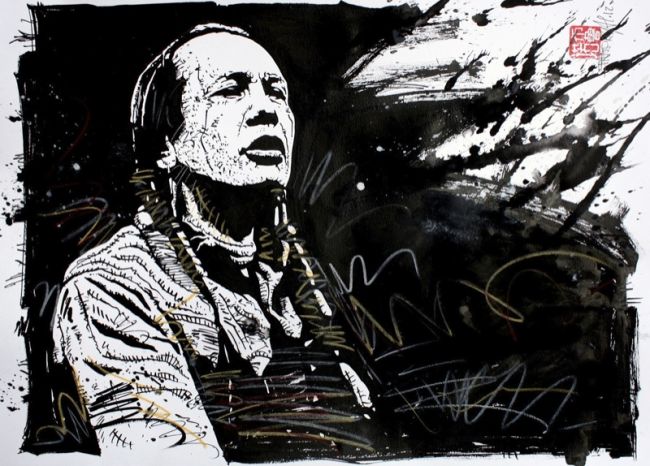
Russell Means, as depicted by visual artist Bruno Leyval. See more of Leyval’s work at www.brunoleyval.com.

“All European tradition, Marxism included, has conspired to defy the natural order of all things. Mother Earth has been abused, the powers have been abused, and this cannot go on forever. No theory can alter that simple fact. Mother Earth will retaliate, the whole environment will retaliate, and the abusers will be eliminated. Things come full circle, back to where they started. That’s revolution. . .

“You see the one thing I’ve always maintained is that I’m an American Indian. I’m not a Native American. I’m not politically correct. Everyone who’s born in the Western Hemisphere is a Native American. We are all Native Americans. And if you notice, I put American before my ethnicity. I’m not a hyphenated African-American or Irish-American or Jewish-American or Mexican-American.” — Russell Means.

The Lakota Oyate lost a very special warrior last week. Death is transformation. Russell Means is now walking the sacred path of the Milky Way. I believe he is ecstatic at the reunion with ancestors who greeted him to help with his spiritual journey. Tasunke Witko is guiding him on the path. Russell will prepare a sacred place for us. He will help our spirit when it is our time to walk the Milky Way.

He will be remembered by many of his Oyate as a patriot of the Lakota Nation. He was a true warrior who feared no challenge. He feared no man. He was Akicita. He was Tokala. He was Itancan. When he believed something needed to happen to improve the lives of all the Lakota people, he was the first warrior to take the steps to make the needed changes.

“Wounded Knee happened because Indian people wanted to survive as Indians and there wasn’t any way to survive, so we made a stand and made a statement, but now Indian people are beginning to rebound, rebound according to their [concept of] “Beauty.” And that’s really what’s necessary to understand: Indian people have to become free again.” — Russell Means

I was a teenager when the 1973 occupation of Wounded Knee took place. I clearly remember some of our own people acted like they were afraid of what was happening on the Pine Ridge Rez. Even though many of the adult members of my family didn’t really have any good things to say about the American Indian Movement (AIM) back then, I’m still very glad all those brave activists stood up for our rights.

Warriors like Russell Means helped my generation to become what we are today. Whether you love it or hate it, AIM is still very influential on all of us. If it wasn’t for AIM, people my age might not have ever found any pride in being Lakota. We might have all melted into that proverbial pot.

And that’s really what’s necessary to understand: Indian people have to become free again.

Russell Means was famous throughout the world. I will always remember him as an activist, an author, an actor and an extremely eloquent orator. He spoke up for all of us. I searched the internet for his quotes and found several. I include some here in the following paragraphs:

“One is expected to know things, to believe things. Knowing and believing are all in your head — there is nothing in your heart. If you cannot feel that the earth is your grandmother, then of course you will find it easy to rape her, to behave as if she is under your dominion. You will find it easy to believe that we humans are the dominant species, and to act as though the earth and everything on it are ours to do with as we please … if all human beings were taken away, life on earth would flourish.

“We Indians do not teach that there is only one God. We know that everything has power, including the most inanimate, inconsequential things. Stones have power. A blade of grass has power. Trees and clouds and all our relatives in the insect and animal world have power. We believe we must respect that power by acknowledging its presence. By honoring the power of the spirits in that way, it becomes our power as well. It protects us.” — from Where White Men Fear To Tread, Means’ 1995 autobiography.

Wopila Russell Means! Many Lakota now realize it’s important to be proud of who we are. The path you created with your courage will be followed by many young Lakota. You inspired us to teach our children there is no need to be ashamed of being Lakota. We will continue to appreciate all the teachings you left behind for us to carry in our lives. Thank you for dedicating your life to the Lakota and other tribal people of Mother Earth.

I was unable to attend the celebration of Russell’s life last week. I send my love and prayers to the Means Tiospaye. I want to express my appreciation to Little Wound School for the live stream of the services. I was grateful to be able to watch and listen to all the people who spoke about Russell’s life. I also appreciated all the songs that were sung in his honor.

“Russell was more than a human being. Russell was a spirit. Russell was a God. He was like the spirit of a tree, or the spirit of the wind or the spirit of the sun. A living God amongst us — that was Russell Means,” Dennis Banks said.

“Once you experience true freedom in your mind and in your heart and you tie the two together, there is no going back — there’s no going back. I’m blessed because, of course, Indigenous people know and understand reincarnation I certainly understand it, I’m coming back as lightning. So I’m free. And when I come back as lightning I’m going to do my job. So, if you live longer than me and you find out that lightning has struck the White House, you know who did it.” — Russell Means.

Oyate Waciyanpi, we pray you have a beautiful journey.

Vi Waln is Sicangu Lakota and an enrolled member of the Rosebud Sioux Tribe. Her columns were awarded first place in the South Dakota Newspaper Association 2010 contest. She can be reached through email at sicanguscribe@yahoo.com.