Posted on Leave a comment

What the Bones Say

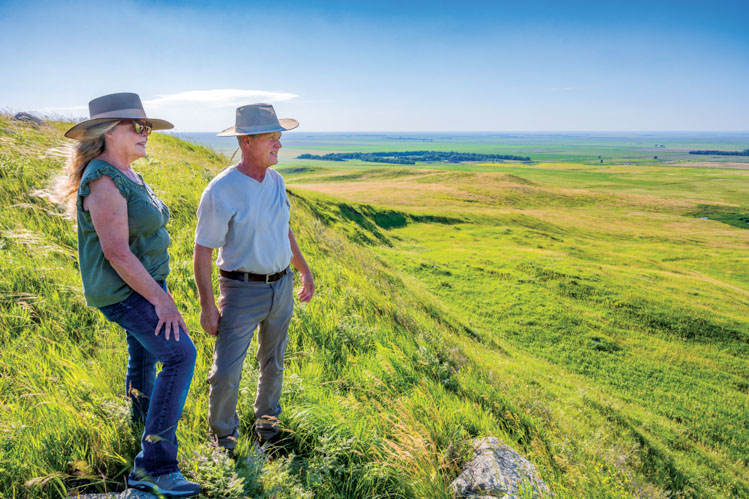
Centuries-old bison kill sites on Candice and Dean Lockner’s ranch near Ree Heights may help us learn more about the Indigenous people who lived and hunted here.

The bison are just where the scouts have said they would be, grazing the warm-season grasses near a natural spring at the west edge of the broken country.

This hunt has been planned for weeks. Once everyone is in place, people wave branches and robes, moving toward the animals, hazing them toward the bluff. The slope is steep enough that one or two animals injure themselves, but others scramble safely into a deep ravine with no outlet. The lower opening of the canyon is blocked with fallen timber.

The animals are confused. They plunge against each other wildly, with no place to go. Hunters move into place at the edge of the ravine above them.

Archaeologists believe a scene like this occurred almost 1,000 years ago in Dean and Candice Lockner’s pasture near Ree Heights in central South Dakota. Dean found a layer of bones covered by about a foot of native sod in 2011 while checking cattle. The Lockners suspected they had found a bison kill site, with good reason. Archaeologists carried out a dig in 1960 at a bison kill site along the ridge 2 1/2 miles east of the Lockners’ discovery, and there is a later find of bison bones and artifacts, though never professionally excavated, just a few hundred yards east.

The Ree Hills — a mesa that gives the town of Ree Heights its name — rises 391 feet and covers about 180 square miles in Hand County.”It’s kind of like an island in the prairie, raised up above everything,” says Augustana University archaeologist Aaron Mayer.”And it’s a vantage point. You could see the bison herds from dozens of miles away. They were definitely using that area for different kill events.”

Dean Lockner found bison bones, estimated to be nearly 1,000 years old, protruding from a ridge of soil in 2011. Each season of erosion and excavation reveals more at the site.

At that first Ree Heights excavation in 1960, archaeologists William Hurt and Robert Gant found a”kitchen” area for processing meat and stone piles on the bluff. Very likely it was a bison jump in the classic sense, where Native hunters drove the animals off a cliff or rim steep enough to kill or injure many of the animals.

When archaeologist Mike Fosha, then of the South Dakota State Historical Society’s Archaeological Research Center, visited the Lockners’ site at their request, he suggested the hunters probably used a different method there: an arroyo trap.

That’s possible because Ree Hills geology consists of shale capped by Ogallala sandstone and covered by glacial material. Because shale near the edges of the landform has slumped over time, there are irregular benches along the steep edge of the ridge where animals could be trapped — either by driving them down from the bluff above or up the slope.

At his initial visit in 2015, Fosha removed a mandible of a young bison for lab work. Zooarchaeologist Danny Walker, a specialist in Wyoming, estimated the age of the young animal at 1.1 years. That indicates that the hunters probably killed it in the month of June or July. Radiocarbon testing on a molar from the animal dated the collagen in the tooth to a time between A.D. 1180 and A.D. 1270.

After exploratory work in 2017 and another excavation in 2022, archaeologists have now found four stone projectile points — either from arrows or perhaps from shafts hurled with an atlatl — as well as a scraper that may have been used for processing hides. They have also found chips of stone that may indicate hunters were sharpening tools on site.

The age of the new site makes it too early to associate it with any of the Native American tribes known to history.”We cannot make any direct connections from Ree Heights to Mandan, Hidatsa, or Arikara, but it does not mean that those people could not have been their ancestors,” Mayer says.”It may be likely the Arikara and Mandan hunted there at some points in time.”

Gardner Deegan of the MHA Interpretive Center in New Town, North Dakota, — an organization that showcases the cultures of the Mandan, Hidatsa and Arikara peoples, or the Three Affiliated Tribes, on the nearby Fort Berthold Reservation — believes the tribes lived in other regions during their history. And elders say the tribes definitely knew how to use landforms in hunting.”I do know that in the culture, they used to do buffalo jumps,” Deegan says.”They would lead the buffalo off a cliff and the buffalo would fall.”

Doyle Crume and Del Compaan, volunteers from Webster, help excavate a bed of bison bones near Ree Heights in 2022.

Candice Lockner said she’s heard other Native Americans talk about their traditional technique for leading bison into a trap, perhaps by having someone pretend to be a bison calf while others push the herd from behind. It’s the same”pushing and pulling” principle that some ranchers instinctively use to move grazing animals today. Lockner says the technique could have worked well in central South Dakota.”Located above the three Ree Hills kill sites are very large boulders, behind which the fake ‘calf’ could hide,” she says.

Whatever the method, there are clues that people living in earth lodges on the James River near present-day Mitchell, about 100 miles east, may have been involved. An arrowhead found at the Lockners’ site is similar to an arrowhead found at the James River villages, which were active between about A.D. 1050 and A.D. 1200.

Interestingly, archaeologists have unearthed a large clay-lined basin at the Mitchell site that they believe was used as a bone grease processing station. Bone grease was obtained by applying heat to crushed bone. The grease may have been used not only in feeding the village, but also as an ingredient in a dried meat product such as pemmican.

Now, with the newly discovered bison kill site at Ree Heights from the same time period, archaeologists are considering the possibility that hunters from the river villages were traveling to the Ree Hills to harvest bison. It’s known from historical records that the area remained a reliable source of bison well into the fur trade era.

Ranchers are confident there are other bison kill sites yet to be discovered in the area. In August 2022, when archaeologists were working on the Lockners’ ranch, Dean and Candice walked along that tumble of hills in their rangeland and found yet another bone bed exposed by weather. Mayer, the Augustana University archaeologist, said Dr. Kristen Carlson, a faunal and bison bone expert, was on location and confirmed the site contains bison bones. Archaeologist Alexander Anton, now in Rapid City at the Archaeological Research Center, found a stone flake that indicates hunters with stone tools were on site at that new location, as well. It’s far enough from the first site on the Lockners’ ranch to be considered a new, separate kill site. That makes four confirmed bison kill sites in the Ree Hills.

As of 2018, there are more than 30 possible bison kill sites recorded in the database of the South Dakota State Historical Society’s Archaeological Research Center, but Fosha notes that many of those have not been confirmed.

In September 2023, the Lockners learned that the bison kill site on their ranch has been approved for listing on the National Register of Historic Places. Though the site won’t be open to the public, the couple says the recognition is an important step toward preserving what is hidden on their ranch and learning more about how early Native Americans hunted bison in the Ree Hills centuries ago.

ìYou may temporarily own land,” Candice Lockner says,”but you do not own the history.”

Editor’s Note: This story is revised from the September/October 2024 issue of South Dakota Magazine. To order a copy or to subscribe, call (800) 456-5117.

Posted on Leave a comment

The Man Who Saved the Buffalo

The buffalo that roam Custer State Park today can trace their lineage to the five calves that Fred Dupree and his ranch hands captured in 1883. Photo by Chad Coppess/S.D. Tourism.

Many people have heard of Scotty Philip’s role in saving the buffalo: how the herd he built up on his central South Dakota ranch provided the seed stock for the majority of the buffalo being raised today. Not so many people know that if it hadn’t been for Frederick Dupree there might not have been any buffalo for Philip to save.

In a sense, I began this article years ago, when I first heard of Fred Dupree. I didn’t get far on my research until the funeral for Evie Nystrom, of Pierre, in 2003. Evie had originally come from Dupree’s country, the Cheyenne River Indian Reservation. At lunch following the funeral, I was telling the folks sitting at my table how I had tried, without success, to locate Fred’s grave.

“That’s easy,” said Kathy Fisher, one of Evie’s young nieces.”He’s buried on our ranch.” She and her husband, Darrin, work her father’s land about 30 miles south of Eagle Butte. The cemetery where Fred and most of his family are buried is a half-mile from their home.

“We have buffalo on our ranch that are probably descendants of the Dupree herd,” chimed in Karen Hump, who with her husband, Dave, raise 300 head of buffalo on their Cheyenne River Reservation ranch. Kathy and Karen are sisters. Dave is a great-grandson of Chief Hump.

With that, this old writer’s curiosity was sparked, and I was off to Grand River country.

Frederick Dupree was born in 1818 in the village of Longueuil, Quebec, on the St. Lawrence River opposite Montreal. (At various times, Frederick’s surname was spelled Dupuis, Dupree, DuPriest, Dupri and Dupree. Dupree is the spelling on his tombstone.)

As a young man he made his way to Kaskaskia, Illinois, on the Mississippi River below St. Louis. Kaskaskia was home to a large number of French-speaking settlers, like Dupree, and many of them were involved with the booming fur trade whose hub was St. Louis. Fred probably signed on as an engagee, a laborer, working on the boats and trading posts that tapped the rich fur resources of the upper Missouri basin.

Fred Dupree.

When Lewis and Clark first passed through this region in 1804 they reported herds of buffalo that stretched across the plains as far as the eye could see. In the 1840s, still, Captain Grant Marsh would tell of having to wait as long as a day while herds crossed the Missouri River in front of his steamboat. This resource, which once seemed limitless, was not. Buffalo fur was in demand back east and in Europe, and buffalo tongues were considered a delicacy. Indian and white hunters harvested animals by the hundreds of thousands, year after year, and the result was predictable.

We can place Fred Dupree at Fort Pierre in 1838, working as an engagee at the trading post owned by Pierre Choteau & Company. Although the trade in buffalo pelts would go on at the post for many years, steadily diminishing numbers of animals meant the peak was past by the time he arrived. A military survey locates Dupree trading buffalo hides at the mouth of the Cheyenne River in 1855, but he was also getting established in the region’s next big business: raising cattle.

Frederick Dupree called many places home during his ranching years, but his main camp was about 35 miles southwest of Eagle Butte, along the Cheyenne River near today’s Carlin Bridge. Frederick and his wife, Mary Ann Good Elk Woman, a Minneconjou, raised 10 children, nine of theirs and a son from her previous marriage. As each of the children married, a small log house with a dirt floor would be built next to the main house.

There were often a dozen or so tipis near the camp, housing the relatives of Mary Ann and others who happened by. Fred was a friendly, sociable sort. Visitors were always welcome at the Dupree camp, and many stayed for several days; they were given food and lodging and friendship.

Dupree spoke French, Lakota and English, sometimes all three in a single sentence. No one is sure if he could read or write, but he managed quite well regardless. At one point the Black Hills Daily Times estimated Fred’s worth at near $1 million, though it allowed this figure could be,”somewhat overstretched.”

Dupree’s generosity and wealth can be gauged from the account of his daughter’s wedding, as reported in a Pierre newspaper:”At age 17, daughter Marcella married Douglas Carlin, a non-Indian who was the issue clerk at the Cheyenne Agency. Their wedding at Cherry Creek on August 27, 1887, was a major social event at the time. The groom was either the grandson or grandnephew of a governor of Illinois Territory and a nephew of a U.S. Army colonel.”

Douglas and Marcella’s wedding was attended by hundreds of Native American and white friends of the family, including members of the Pierre City Council. Both traditional and civic rites were performed. (Marcella’s ceremonial dress can be seen in the Indian Museum of North America, at the Crazy Horse Memorial.) Fred gave the bride and groom 500 head of cattle and 50 ponies to get them started in life, and the celebration was commensurate with such a gift. For most guests the festivities lasted three days. Others lingered for a week or more, consuming two barrels of whiskey and another of wine.

Fred Dupree had been in Dakota nearly 40 years by that time. He had prospered, but Dupree had only to look at Mary Ann’s relatives to see that his affluence came with a price. In years past, the buffalo supported the plains Indians’ very existence, providing them food, clothing and shelter. With the animals fast disappearing, those who depended on them were suffering, and Dupree himself bore some measure of responsibility. His trading company and others had shipped pelts by the million, which encouraged a level of hunting that couldn’t be sustained, and his cattle roamed over the ranges that once were home to vast buffalo herds. Dupree must have realized their extinction was inevitable.

In 1883, Dupree and his ranch hands set out to capture some buffalo on the prairie. Once a small herd was located — reports vary as to the exact location, but it was probably near the Grand River — the party camped nearby. How they managed the capture is unclear. Some accounts say they grabbed the animals as they slept. Others surmise that the hunters built a corral or holding area, drove the animals into it, then cut the ones they wanted away from the rest. However it was done, five buffalo calves were caught. From that modest beginning, the Dupree buffalo”herd” grew to almost 60 head.

Unbeknownst to each other, the man who would carry Dupree’s work forward was already living in the area. James ‘Scotty’ Philip was born in Kansas, one of three brothers, the others being George, a Hays City merchant, and Alex, the foremost cattleman in that state. Scotty left his brothers for Dakota Territory in 1875, drawn by dreams of finding gold in the Black Hills. When that didn’t pan out — Philip was caught by the Army and sent on his way because the Hills were still Indian territory at that time — he started hauling freight and then scouted for General Crook before following his brother into the cattle business. By the turn of the century Philip was a bona fide cattle baron, running 20,000 head on his West River spread.

Philip’s attitude toward the buffalo, like Dupree’s, was influenced by his Lakota wife, Sally. When Frederick Dupree passed away in 1898, Philip bought his buffalo. He placed the animals on a riverside ranch, just north of Fort Pierre, where they thrived. By 1911, when Philip died suddenly, the herd numbered almost 900 animals. No buyer was willing or able to take the whole herd, so it was dispersed. Among the buyers was the state of South Dakota, which placed 36 buffalo in the newly established Custer State Park. That herd, in turn, was used to stock other parks and refuges around the country. When ranchers like Roy Houck got back into the buffalo-raising business during the 1960s, and Ted Turner followed in the 1990s, they did so with animals that descended from Philip’s herd.

Frederick Dupree’s final resting place is much the same as when he arrived. Overhead, the sky goes on forever in every direction; underfoot, the gently rolling hills are covered with a carpet of grass. And thanks to him, there are still buffalo to roam upon it as they did years ago.

Editor’s Note: This story is revised from the January/February 2007 issue of South Dakota Magazine. To order a copy or to subscribe, call (800) 456-5117.

Posted on Leave a comment

Fall Roundup

Around 20,000 spectators were on hand to watch the 52nd annual Custer State Park Buffalo Roundup last Friday. Park employees and volunteers gathered about 1,200 bison into corrals to be branded, vaccinated and checked for pregnancy. Around 400 bison will be auctioned off on November 18 to keep herd numbers manageable. Photos by John Mitchell.

Posted on Leave a comment

Rounding up the Herd

Thousands gathered to watch the 51st annual Buffalo Roundup last weekend at Custer State Park. Employees and volunteers corralled about 1,200 bison for branding, vaccination and pregnancy checks. Between 200 and 500 will be auctioned off on November 19 to help manage the herd size and generate money for park operations. Photos by Joel Schwader.

Posted on Leave a comment

Untamed Harding County

Harding County, in the far northwestern corner of South Dakota, is decidedly rural. Buffalo, the county seat with a population of 330, is the largest town. Camp Crook has 100, and smaller communities like Ralph, Reva, Ludlow, Ladner and Harding might have a few ranch families. The county as a whole is home to 1,255 people, making it the second least populated county in South Dakota. Cattle and sheep outnumber people almost 10 to 1, and the most legendary stories are about a killer wolf with three toes and a rambunctious rodeo bronc that has been memorialized in bronze. Still, Harding County’s unique geography and history have drawn curious travelers and explorers for centuries.

It began even before there was a Harding County. The place was created in 1881 and named for Dr. John A. Harding, a dry goods merchant and postmaster from Deadwood who was also serving as Speaker of the House in the Dakota Territorial Legislature. Harding County merged for a few years with Butte County, its neighbor to the south, then became separate again in 1909.

On his gold exploring expedition to the Black Hills in 1874, Gen. George Custer heard stories from a Lakota guide named Goose about unique drawings etched into canyon walls. Goose brought him to the Cave Hills north of present day Buffalo, which boasts several petroglyphs dating back thousands of years.

There are drawings of bison, antelope, a warrior and spear and others even more difficult to discern because of their age and the effects of weathering. A member of the expedition is thought to have carved his initials into a rock wall that also bears the image of a large body shield and weapon. Names and initials of 20th century visitors can be found, too.

Buffalo is the Harding County seat and features a sculpture of legendary bronc Tipperary in the city park.

The Cave Hills are part of the Custer National Forest, pockets of which are spread throughout the county. The section farther to the east contains the Slim Buttes, a blend of badlands, pine forest and mesas that runs 40 miles north to south and stretches 20 miles wide. Local ranchers have named most of the peaks and buttes. There are the Seals, the Three Sisters, Doc Hodges Draw, Adam and Eve Butte and Battleship Rock. Highway 79 crosses Slim Buttes to the south and Highway 20 runs west of Reva.

One of the more spectacular features of the Slim Buttes is the Castles, one of South Dakota’s 13 National Natural Landmarks. The Castles are an L-shaped ridge of bluffs that stretch 30 miles across eastern Harding County. The twin white buttes looming south of Highway 20 contain exposed rock dating as far back as the Upper Cretaceous period (100 million to 66 million years old) through the Miocene (23 million to 5 million years old). The Castles also contain a variety of fossils, but collection is prohibited because they lie within the Custer National Forest.

Their name comes from John Finerty, an Irish newspaperman who traveled with Gen. George Crook’s Expedition of 1876. As they passed through the rugged country, Finerty compared the formation to”a series of mammoth Norman castles.” They look particularly medieval in the morning or evening light, when the white stone shines like polished granite.

The area is also historically important. A memorial and three graves just east of the Castles mark the scene of the Battle of Slim Buttes, a fight between a few hundred Indians and 2,000 cavalrymen in September 1876, just three months after the Battle of the Little Bighorn. After that defeat, Captain Anson Mills was ordered to the Black Hills to resupply. His march took him through the Slim Buttes, the site of American Horse’s camp. Troops surrounded the village of 37 lodges and opened fire. American Horse was shot through the abdomen, but refused help from Army surgeons. He died within days. Locals say you can still see scars from the bullets on ancient trees along Deer Draw Pass. Headstones mark the burial site of three cavalry soldiers who died in the conflict. The graves are east of the Castles along Highway 20.

The Island is a mesa in the Cave Hills that has attracted people for centuries.

Another gravesite in the Slim Buttes is a reminder of South Dakota’s vicious winters. During the notorious Children’s Blizzard of January 1888, Otis Bye, a scout and trapper, was away from home. His wife ventured outside to save their horses. Her frozen body was found days later, watched over by the family dog. Decades later, neighbors erected a gravestone at the site. Find it by driving east of Buffalo on Highway 20 about 19 miles to North End Road. Take a left and drive a quarter of a mile until you reach an old trail. Hike down the trail to the gravesite.

With its abundance of ranches, it’s no surprise that rodeo has had a strong presence in Harding County. South Dakota’s most famous bucking bronc was was born on a ranch by Long Pines in 1905. He bolted the first time a rider attempted to get on his back, so ranchers deemed him unfit for ranch work. Later they tried him as a rodeo bronc. Ed Marty was the first to try a ride and was immediately thrown clear.”It’s a long, long way to Tipperary!” he said, thus giving the horse his name.

For 15 years, 82 cowboys tried and failed to ride Tipperary. Then came the Belle Fourche Roundup in 1920, where Yakima Canutt became the first — and only — cowboy ever to successfully stay atop Tipperary. Despite his victory, cowboys still debated the merits of the ride because rainfall made the arena muddy. Tipperary slipped to his knees and never gained strong footing.

Members of Custer’s 1874 Black Hills expedition are thought to have scrawled initials into this rock wall in the Cave Hills. It also contains an ancient depiction of a shield.

Tipperary died during a blizzard in 1932, but people in Buffalo and Harding County never forgot their star athlete. In 1955 they erected a monument in Buffalo’s city park, and in 2009 the town dedicated a half-size statue done by cowboy sculptor Tony Chytka of Belle Fourche. There’s also an exhibit dedicated to Tipperary inside the Buffalo Museum.

A wild contemporary of Tipperary’s was Three Toes, a gray wolf that terrorized ranchers and sheepherders for 13 years, killing at least $50,000 worth of stock. Legendary sheepherder and writer Archie Gilfillan described the carnage.”Other wolves might kill one cow or sheep and eat off that and be satisfied. But Three Toes killed for the sheer love of killing. He would kill on a full stomach as well as when hungry. On one occasion he visited three different ranches in one night, killed many sheep and lambs at each one, but ate only the liver of one lamb.”

His reign of terror began in 1912, which was about the time he sustained the injury that gave him his name. One of his toes was pinched off in a trap, and from that day the tracks he left in the dirt and snow were as distinguishing as a human fingerprint.

It was estimated that 150 men tried at one time or another to capture him, but Three Toes always seemed to have speed, intelligence and luck on his side. By 1925, he was killing at a rate of $1,000 worth of stock a month. The Harding County Commission raised the bounty on him to $500. A federal hunter named Clyde Briggs, an experienced hunter of gray wolves, came to Harding County and set an elaborate network of traps that extended 33 miles around Three Toes’ favorite ranch targets. On July 23, Briggs descended into the Little Missouri River valley and discovered Three Toes caught in the snares of two traps. He was muzzled and loaded into Briggs’ car but died before they reached Buffalo.

Three Toes and Tipperary are long gone, but their legends, the cattle and sheep, the rugged buttes and mesas, the stone johnnies and 1,200 hearty souls remain.

Editor’s Note: This is the 22nd installment in an ongoing series featuring South Dakota’s 66 counties. Click here for previous articles.

Posted on Leave a comment

Roundup Record

A record 21,000 visitors from around the world attended Custer State Park’s 50th annual Buffalo Roundup last weekend. Park employees and volunteers gathered about 1,300 buffalo into corrals using horses and all terrain vehicles. Once rounded up, some buffalo were branded, vaccinated and checked for pregnancy. The Custer State Park herd is one of the largest in the state. About 400 buffalo will be auctioned off on November 21 to keep the herd size manageable. Photos by Joel Schwader.
Posted on Leave a comment

Buffalo Buff Cars

Ryan Clayton, Rapid City, shared these recent photos from Custer State Park. The Black Hills received record high temps on February 6 and Clayton says the buffalo were giving free car washes. “It might have been a while since they’d seen traffic,” Clayton says. “They were in a hurry, running to greet me and lick the salt off my car. They all seemed to still have their full winter coats so we might be in for a bit more winter. ”
See more of Clayton’s work at facebook.com/imagesbyryan.

Posted on Leave a comment

Fall at Wind Cave National Park

Joel Schwader shared recent photos from Wind Cave National Park, home to a free-roaming bison herd, pronghorn antelope, deer, 30 miles of hiking trails, camping and the famous cave that spouts air. To see more of this Rapid City photographer’s work and to purchase prints, visit www.joeldphotography.net.

Posted on Leave a comment

Wasna for a New Generation

If you spot Tiger Woods snacking as he walks down a golf course fairway, watch the television closely for a bright yellow and red wrapper. Professional golfers are getting on the Tanka Bar bandwagon. Golf Digest recently named the food one of the best nutrition bars available for golfers, heaping even more adulation on the already popular snack produced on the Pine Ridge Indian Reservation.

Of course when Mark Tilsen and Karlene Hunter created Native American Natural Foods in 2005, neither thought of marketing their products to professional athletes. They simply wanted to help their own people. The Department of Health and Human Services’ Office of Minority Health says nearly 33 percent of all American Indians and Alaska Native are obese, and 16.1 percent suffer from Type II diabetes.”Every one of us are in there fighting and working toward the same purpose,” Hunter says.”We’re looking at creating a healthy environment for our people.”

They believe Tanka Bars can help. The 1-ounce bars of ground bison and tart cranberries contain just 70 calories. They’re healthier than beef and help sustain Lakota culture. Tanka Bars are modeled after a traditional mixture of meat and berries called wasna, meaning”all mixed up.”

Tilsen and Hunter started producing Tanka Bars with four employees at the company’s headquarters in Kyle. Today 16 people work on various Tanka products including Tanka Dogs, Tanka Bites and Tanka Wild, a derivation of the buffalo and cranberry bar that includes wild rice.

Editor’s Note: This story is revised from the September/October 2012 issue of South Dakota Magazine. To order a copy or to subscribe, call (800) 456-5117.