Posted on Leave a comment

A University Town

Burbank is a town along the old Dakota Southern Railroad about 6 miles from Vermillion and the University of South Dakota. It was named for John Burbank, the governor of Dakota Territory and a railroad director, when the line came through in 1872.

Burbank doesn’t look like a college town when you first arrive. The little village is surrounded by corn that grows 7 feet high in the lush bottomlands of the Missouri River.

Burbank has dirt streets. Chickens outnumber people two to one, and its most prominent architectural features are a railroad track and an old grain elevator.

But nearly every Burbanker has a connection to the University of South Dakota in Vermillion, just 6 miles away.

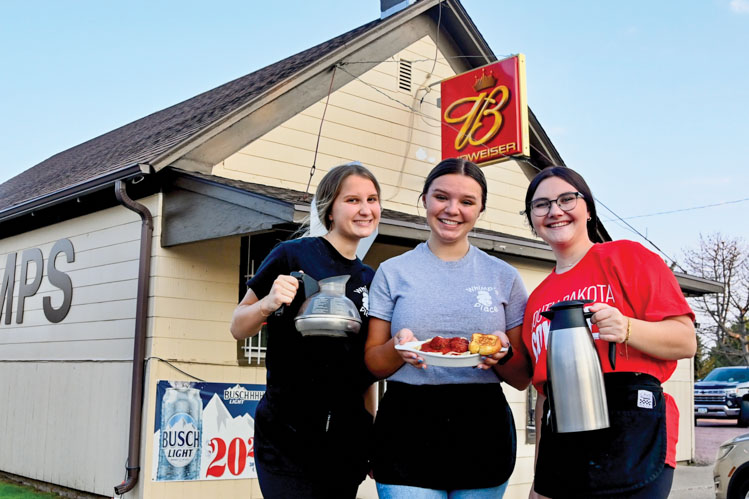
Jim Slattery runs Whimp’s, Burbank’s only eatery — and its only business — along with his brothers Nick and Tom. He learned to cook at the Silver Dollar in Vermillion while studying political science at USD.

He acknowledges that the town looks more like a traditional farm town. Some of the locals wear Coyote red with their seed corn caps, and they frequent Whimp’s along with professors and students.”The farmers know I’m a city boy,” Slattery grins.”I haven’t been asked to drive a tractor, but I can do that.”

Whimp’s was started in 1967 by Leonard”Whimpy” Girard and it has been a staple ever since, thanks to the Taggarts and Radigans who also spent stints as owners. Now it’s the Slatterys’ turn. All four families are”old names,” both in Clay County and on the USD campus.

The Slattery brothers haven’t changed the menu or decor since buying Whimp’s as well as Toby’s, a popular chicken shack in nearby Meckling — which is like a sister city to Burbank on the west side of Vermillion.

Whimp’s’ menu has six signature burgers (Burbank, Keg, Cornhusker, Mushroom & Swiss, BBQ Bacon Cheddar and the Dark Lord).”We’re one of the few places you can still get liver and onions,” Slattery says.

Popular specials include the $5 cheeseburgers on Tuesdays, chicken wings on Wednesdays and all-you-can-eat spaghetti on Thursdays, with mouth-watering meatballs made from tenderloin trimmings.

Carley Johnson, Grace Reynolds and Taryn Taggart are students at USD and waitresses at Whimp’s, a popular eatery in Burbank.

“If we can make it, we do it,” Slattery says.

Ted and Karen Muenster — namesakes of USD’s Muenster University Center — were at the bar for a recent spaghetti night.”We drive out here one or two nights a week,” says Ted, who’s now retired from a distinguished career in business, politics and academia. Karen served as a state senator from Sioux Falls and was a leader in historic restoration of downtown Vermillion for many years.

“Whimp’s has always been run by these old families who have been well-connected to the university,” Ted says.”Some people say it’s wicked,” he grins, gazing at the lawyers, teachers and retirees seated at simple tables.

Despite Burbank’s tiny population, Muenster notes that hundreds of thousands of people live within a 40-mile radius encompassing Yankton, Sioux City, Sioux Falls and Vermillion, so Whimp’s is actually a dirt-street oasis in a well-populated region.

The tiny town has a history of attracting outsiders. Frank Verzani, an Italian immigrant, ran a ferry on the Missouri River, just a few miles away. His crossing was called Victors, and then Green Point. When the Dakota Southern Railroad extended into Dakota Territory in 1872, the community was renamed in honor of John Burbank, the fourth governor of the territory and a director of the railroad.

Bob Hudelson is one of the few Burbankers without a connection to the nearby university, but he knows history and his own life story sounds like a Charles Dickens novel.”I was raised on the streets of Sioux Falls,” he says. He escaped from an orphanage and made his own way as a child, thanks to the benevolence of kindly policemen, store owners and others who helped him find a place to sleep and a meal. On some cold nights, he remembers being locked inside stores so he would be safe and warm.”I wish I knew how to say thank you to the people of Sioux Falls who helped me survive as a boy,” he says.

Ted Muenster (left), a longtime champion of USD, is a regular at Whimp’s, now run by Jim Slattery (right) and his brothers.

For 23 years, he and his wife Barbara have lived in Burbank, where he has soaked in the wicked past that Muenster referred to. Hudelson says Burbank was a wild cow town because ranchers brought stock here to be shipped on the railroad. He points to a house that was once a brothel and tells a story of when the notorious outlaw Jesse James nearly got involved in a shootout on main street.

Jerry and Colleen Johnson live across the street from the Hudelsons, along with a dozen ducks, 10 dogs and more than 200 chickens. Colleen takes the eggs with her to Vermillion every day, where she works as a custodian at the university.

“I like it here because at 6 o’clock at night it’s so quiet you could hear a pin dropping,” Johnson says. Or a rooster crowing.

Like any university town, Burbank has an ongoing fundraising project. It involves a historic school building that closed in 1972. Every September, the town holds a barbecue to raise money for repairs to the school, which is now used as a community center.

Nick Slattery, a local contractor and part-owner of Whimp’s, helps with the project. His brother, Jim, assists with the food.

“We’re here to help, whether it’s the schoolhouse or whatever,” Jim says.”This will not be a ghost town. There will always be people here.”

Editor’s Note: This story is revised from the November/December 2024 issue of South Dakota Magazine. To order a copy or to subscribe, call (800) 456-5117.

Posted on Leave a comment

The Buzz from Prairie Moon Farm

The Freemans of Prairie Moon Farm include (from left) Harry, Willa, Elena, Grace and Harrison (not pictured).

Grace Freeman might be one of the calmest people we’ve ever met. Nothing seems to faze the Clay County beekeeper. When a mouse jumps out of the brome at her, she doesn’t blink. If she’s posing for a picture with a chicken and the bird leaves a deposit on her shirt, it doesn’t erase the friendly smile from her face. Put her next to a hive with thousands of stinging insects, and she’s happy as can be.

A Cincinnati native, Freeman fell in love with beekeeping in 1985 through a work-study job with an entomologist at the University of Montana.”We would go and collect bees and study them to see if they had picked up pollutants,” she says. When she and her husband, Harry, moved to Madison, Wisconsin for grad school, Freeman worked for a large-scale beekeeper, managing up to 1,000 colonies. After Harry took a job in the psychology department of the University of South Dakota, the couple settled in a farmhouse on Frog Creek Road, where they have lived for 21 years with their children, Elena, Willa and Harrison.

The Freemans’ home, Prairie Moon Farm, is a back-to-the-lander’s Eden. Chickens and guinea fowl roam freely, a trio of penned-up rescue llamas provide manure to fertilize her garden and scare away deer, and a friendly dog named Saige welcomes visitors. There’s a shed full of kayaks for paddles on the Missouri, a greenhouse and a small but fragrant structure where Freeman creates tinctures and blends herbs for teas she sells at the Vermillion Farmers’ Market.

Freeman’s hives are in a little glade a short walk away from the buildings, past a pond and a stand of honeysuckle bushes. She puts on her veiled beekeeper’s hat and sets the smoker filled with smoldering brown paper scraps and wood chips on the ground. The smoke fools the bees into letting their guard down, making it less likely they will sting.”They think there’s a fire and they have to travel,” Freeman says.”They fill up on honey, and get so full that their stinger goes down.”

When working with bees, Freeman recommends wearing white or light-colored clothes.”Bees get angry if you wear dark colors,” she says.”It reminds them of bears.” And be sure to tuck in your clothes.”You don’t want them crawling in your shirt,” she tells us. Some beekeepers wear a protective suit and gloves, but after decades of working with bees, Freeman has developed a more casual style — a long-sleeved white shirt over a tank top and shorts.

Freeman uses Langstroth hives, which consist of a stack of wooden boxes, each of which contains hanging wooden frames upon which the bees build their comb, raise young and store honey. The supers, shallower boxes at the top of the hive, will hold harvestable honey. The queen, the brood and the colony’s food storage all go in the deeper, lower boxes. A metal rack called a queen excluder separates the two portions of the hive. The rack’s slats are big enough to allow worker bees to pass between sections, but keep the larger queen down in the brood cells where she belongs. After all, no one wants bee eggs mixed in with their honey.

Freeman inspects a frame from one of the hive’s supers. She harvests honey in late summer.

The hive’s lid is stuck on tightly with propolis, a gluey yellowish-brown substance that bees make from tree resins and beeswax. Freeman uses a mini crowbar called a hive tool to break through the glue and help manipulate frames as she checks on the bees and their activities.

The queen is the only female in the hive that mates and lays the fertilized eggs that develop into worker bees, so Freeman looks for fresh eggs to make sure the queen bee is doing her job.”Eggs change every day,” she says.”If you can see the one-day-old eggs, then you know you have a viable queen. Even if it’s a two-day-old egg, something could’ve happened to her.”

Bee society is fascinatingly complex and overwhelmingly female. The only males are the drones. They have no stingers and do no gathering — their only job is to be available to mate with a virgin queen bee. After mating, they die. The worker bees, all female, cycle through a series of roles — foraging, building, housekeeping, childcare, attending the queen, guarding the hive. There are even mortuary bees, who haul the colony’s dead away from the hive. With so much to do, it’s no surprise that the life of a worker bee is short. During the busy spring and summer seasons, they might live a brief four to six weeks.

Under most conditions, bees manage themselves, but there are critical points during the year when a beekeeper should pay attention. In spring, Freeman helps the bees get ready for the season, making sure that they have food to last them until the flowers really start blooming and that there’s plenty of space to make new honey. In June, when the clover blooms, she watches for signs of swarming.”If you haven’t provided them with enough room, then they’ll divide,” she says. The bees will create a second queen and fly off in search of a new hive, leaving the old queen with a few guards for protection. A divided colony means less honey, so Freeman destroys any potential new queen cells she spots.

Once the fear of swarming is over, Freeman’s bee work slows down a bit. When the bees fill up the existing frames, she adds supers. Honey is harvested in August.”Then they have time in the fall to put on enough winter weight so you don’t have to feed them so much sugar water,” Freeman says. After that, it’s time to winterize the hive.

Winter and early spring are tricky times for beekeepers. Freeman lost one of her two colonies last spring due to uncertain weather.”I can get them through until March and then the temperature warms up and they start moving more — they get excited,” she says.”Moisture builds up, the temperature drops and they freeze. I have really been trying to figure out how to ventilate and still keep them warm enough.”

In a good year, Freeman harvests 50 to 100 pounds of honey per hive, selling it at the Vermillion Farmers’ Market along with garden plants, culinary and medicinal herbs, teas, tinctures, salves and lip balm made from her own beeswax. When she’s not gardening, marketing or beekeeping, she works as a registered nurse. How does she juggle it all?”Oh, I’m not very good at it,” Freeman says.”We’re always busy. My summers are just nuts.”

But no matter how crazy life gets, the bustle of the hive serves as an oasis. Bee stings hold no fear, and the sounds of the hive have a calming, meditative effect.”For me, it’s very relaxing to have that noise going all around you, all the bees flying,” she says.”It’s very loud, but you’re focusing so hard on looking for those eggs that you don’t even hear them, and it gets very peaceful.”


Meloamak·rona (Honey-dipped Cookies)

Honey is a major component of Greek cooking. Freeman’s husband, Harry, who is half-Greek, makes baklava and meloamak·rona, or honey-dipped cookies, using recipes found in a community cookbook from his mother’s hometown, Seattle.

Cookies

1 cup butter, softened

1 cup salad oil

6 tablespoons sugar

1/2 cup plus 1 tablespoon fresh
orange juice (divided)

Grated peel of one orange

2 eggs

1/4 teaspoon baking soda

3 teaspoons baking powder

6 to 6 1/2 cups sifted flour

Nut Topping

1/2 cup very finely chopped nuts

1/4 teaspoon cinnamon

1/8 teaspoon nutmeg

1/8 teaspoon cloves

Honey Syrup

2 cups honey

1/2 cup water

In large bowl of electric mixer, beat butter until light and fluffy. Add oil slowly and continue beating for 10 minutes. Gradually add sugar, 1/2 cup orange juice and peel. Add eggs, one at a time, and beat an additional 5 minutes.

Combine 1 tablespoon orange juice and baking soda; add to butter-oil mixture. Add baking powder and enough flour to make a soft dough. Remove beaters; knead slightly to make a dough that does not stick to hands, adding more flour if necessary.

Roll a heaping teaspoonful of dough into an oval-shaped cookie, tapering the ends slightly. Press the melomak·rona lengthwise with fork tines to make indentations to hold the nut topping. Bake at 375 degrees for 20-25 minutes. Remove cookies from baking sheet and cool on wire racks.

Mix ingredients for nut topping and set aside.

When cookies have cooled, bring honey and water to a boil. Dip melomak·rona into honey syrup, being certain to thoroughly soak the cookies. Sprinkle tops with nut topping.

From Greek Cooking in an American Kitchen (Makes about 5 dozen)

Editor’s Note: This story is revised from the September/October 2018 issue of South Dakota Magazine. To order a copy or to subscribe, call (800) 456-5117.

Posted on Leave a comment

Terry’s Domain

Terry Hill builds domes where his clients live, from wide open pastures to tree-encircled homesteads.

During the Vietnam War, Terry Hill made himself a promise. If he got home, he would do for the rest of his life what he could enjoy. He’s kept that promise.

That doesn’t mean just sitting by the fire with a guitar in his hands, or building boats and floating the Missouri River, though those are among his favorite things. It means that the work he puts his hands to will be creative work, work without a boss, work in which he can take pride.

In Clay County, where he lives when a job or other fun doesn’t take him elsewhere, many have seen an unglamorous room of their home transformed by Terry’s hands. But it is for something more unique that he is known. He is South Dakota’s foremost builder of one-of-a-kind domes.

But don’t call him up and order a new dome for occupation in the spring. Terry isn’t about to hire a crew and advertise for jobs. He works alone most of the time, works his own hours — which may be well over eight — and has other priorities than finishing by a certain date.

The seed of dome building took root in Terry’s mind when he was a student of Dick Termes, the famed creator of Termespheres in Spearfish. If you’ve been to Deadwood’s Saloon No. 10, you’ve seen a spherical double of the historic establishment’s interior rotating above the bar. Termes’ sphere that encapsulates in one continuous scene Lewis and Clark’s voyage up the Missouri hangs in the Cultural Heritage Center in Pierre.

But back to Terry Hill. Two things happened when he was a student at Black Hills State University in the early 1970s. Termes and others brought famed engineer and building designer Buckminster Fuller, the father of the geodesic dome, to Spearfish.

Terry Hill has built dozens of homes, ranging from relatively temporary and primitive structures to large, elaborate homes.

Terry had seen pictures of Fuller’s grandest dome, the United States pavilion at the 1967 Montreal Exhibition. Now he heard Fuller speak, and wandered through the dome that had been temporarily erected on campus. Terry would never be the same.

Then Termes decided to move inside a sphere. He asked Terry to build him a dome.

South Dakota’s most famous dome, USD’s Dakota Dome in Vermillion, is visible from the window of the dome where Terry lives. Terry has a personal connection to the sports arena. In 2001, steel replaced the Dakota Dome’s synthetic fabric roof that had kept football and basketball players dry for over 20 years — except for its second year, when the roof ripped under a load of snow. The fabric was repaired, but many yards of good material was up for grabs, and Terry got a share. He still takes inspiration from floating the Missouri River in the canoe he built and covered with a scrap of Dakota Dome roof.

But from an engineering standpoint, the Dakota Dome is a simple structure compared to Terry’s dome. It’s an icosahedron. Of the many domed homes Terry has built, no two are alike. What would be the fun in repeating a creative act when other challenges lay ahead? But an icosahedron?

“It’s one of the Platonic solids,” Terry explains,”one of the five three-dimensional shapes that have the same angles on all the faces.” He launches into an explanation of variations of the dome, but soon it is apparent that it would be simpler just to build one than try to make me understand. Tetrahedrons, four sides with equilateral triangles, I comprehend, since that sounds something like the more conventional house in which I live. But trying to visualize dodecahedrons, which have 12 sides and every face a pentagon, is another thing.

Terry tries again:”An icosahedron is a 20-sided Platonic solid, one of the natural forms Plato described 2,400 years ago. Lots of life forms, like crystals, are Platonic solids.” The bottom five facets of Terry’s house are missing, of course, replaced by a flat floor. So the walls and roof of his house consist of a mere 15 equal triangular sides.

Yankton native Ed Johnson and his wife, Michelle Martin and their family live in another Clay County dome that Terry built. They were living in Pocatello, Idaho, where Ed worked as a psychiatric nurse, when they saw the chance to move home to South Dakota.”Actually this was 25 years in the works,” Ed said as we lounged in the late afternoon light on his front steps.”When we lived in Pocatello, Terry came out and built a domed sauna for us. Johnny Dome Seed. I was always going to move back, and I knew that when I did, I wanted Terry to build a dome.”

We go inside for a look. This dome is larger than Terry’s, 40 feet in diameter. I marvel at the construction, but still struggle to visualize how such a house is put together.”Here,” Terry says,”I’ll show you.” He digs in his wallet for a well-worn card with three sets of numbers: A: .3486-10%; B: .4035-12%; C: .4124-12%.

The skeletal frame of one of Hill’s creations.

“So that’s all you need to know to build a dome,” says Ed, for whom Terry also built smaller domes for a guesthouse and a sauna. His roaring laugh tells me I’m not the only one in the dark.”I’m good at carrying things,” Ed adds.

“This is for a three-frequency dome,” Terry continues, as if he’s mixing so many eggs with so much milk and flour to make a cake.”There are three struts. This number times the radius in inches will give you the length. The 10 percent is the angle of the bevel at the end of the strut.”

Terry sees that conveying abstractions is hopeless, and like a good teacher, he resorts to show and tell. We step inside Plum Lodge, Ed and Michelle’s guesthouse. The interior of this 24-foot dome is unfinished, which makes construction techniques easier to grasp. In the open space I realize two other marvels of domes: They seem much larger inside than out, and they amplify our voices; we unconsciously adjust them down.

To talk about domes requires setting aside conventional assumptions about buildings, concepts like walls and roof. It’s like asking where a snake’s neck ends and its tail begins. Terry explains that”geodesic” means the shortest line between two points, and that a dome is built by connecting many points to form the many facets of the surface. I observe that every facet in this dome has either five or six sides — pentagons and hexagons — but even with evidence before my eyes, I’m glad I won’t be tested on the information that A struts radiate from the centers of pentagons, B struts are their border, and C struts radiate from the centers of hexagons. I did build my own house, but my mind takes refuge in straight walls, where the ideal corner is 90 degrees. My eyes glaze over and Terry gives it up with a laugh.

Talk about job security. Everybody admires Terry’s work, but few will take the challenge.”But I’m not advertising,” he reminds me.”I’m not looking for work.”

Both Terry and Ed are artists and musicians, and both speak of the calming feeling they gain from living in homes without corners or straight walls.”I don’t really think about it,” Ed says,”but I feel it. I had a good feeling when I first stepped into Dick Termes’ dome a quarter century ago, and I’d wanted one ever since.”

Ed speaks of the naturalness of round structures, the sacredness of the form in Native American cultures, which he thinks grew from reverence for the dome of the Earth. And in fact, Terry’s domes are far from the first in South Dakota. Centuries ago the Arikara lived in domed earth lodges along the Missouri, and Native dwellings from Lakota tipis to Inuit igloos to Navajo hogans are round.

In the more than three decades since he strolled through Buckminster Fuller’s dome, Terry Hill has built and lived in several of his own, once wintering in a dome that consisted of a parachute stretched over a lath frame.”It served well, actually,” he said. Most of his domes are far more substantial; he has built them as far away as Alaska, but most are in South Dakota.

In the winter of 1976, Terry, his wife and their newborn daughter were living in a primitive cabin near Custer.”There was a dome book in the cabin, which I was reading, and there were a bunch of little dead trees on the property, so I cut them down and made a little dome for a sauna,” he recalled.”That gave me the idea that I could actually build a dome to live in, so the next year I built a dome on my mother-in-law’s land west of Custer, and we lived there a couple of years.” Later, when Terry worked as a logger near Rochford, he lived in a primitive 12-foot dome he built near his work site, which he said was more comfortable than the winter he spent in a tipi near Deerfield Lake.

Word of Terry’s domes spread. Dick Termes called his former student and asked if he would build a domed studio next to his dome home near Spearfish. Another friend asked Terry to frame a dome for him near Nemo. He built one at Little Eagle on the Standing Rock Reservation, where in the absence of electricity he used a chain saw to frame the structure. The next he built near Fairbanks, Alaska.

In 2002, he began a large dome near Rochford, for Lucy Gange, an Eagle Butte native who is a professor at the University of North Dakota, but considers the Hills her home. The pair designed the house together, and each summer they built another phase.”Terry is the builder,” Lucy said.”I hold the dumb end.”

Hill built one of his signature domes for Spearfish artist Dick Termes, creator of the Termesphere.

This is the tallest dome Terry has built, four levels from the into-the-hillside ground floor to main floor to loft to reading cupola on top. Light filters through kaleidoscopic triangular stained glass windows, custom made by Carol Ellison of Rapid City. A pitch pine tree stands in the middle, now at the second level with lots of room to grow.”One thing I like about Terry is that he’s willing to incorporate what’s important to me,” Lucy said.

In an era when big crews frame a conventional house in a week, building a dome — especially the way Terry Hill builds them — is a different story. When Ed and Michelle decided to build, they found a long-abandoned farmhouse in a thick grove of trees in Clay County. Ed and Michelle were both working fulltime, so Terry mostly worked alone. But before construction on the 28-foot-tall dome could begin, Terry needed lumber.

Instead of calling the lumberyard, Terry disassembled the old farmhouse, a fine home that, judging by the inscription he found on a structural board, was built by Peter and Edwin Hesla in 1913, but was uninhabited for 50 years. Terry also tore down a deteriorating barn, and even salvaged lumber from the farmhouse where he grew up south of Wessington.”It was a little farm with cows and pigs and chickens, the kind that doesn’t exist now,” Terry said.”My folks moved to town, and the new owner was going to burn the house down. I said, ëGee, I’d like some of that lumber.’ So my old house lives on.”

“There’s even a sink in here from Terry’s family’s house,” Ed said.”And when we were building, we’d look up and there was a section of different-colored wood, like a patchwork quilt, and Terry would say, ëYeah that piece came from so and so.'”

Ed and Michelle’s 40-foot dome sits on a 32-foot, round concrete basement wall; the floor of the dome is cantilevered 4 feet out, giving the dome the appearance of a giant mushroom. Ed and his family moved in when the shell was finished, and the interior work continues. But in the meantime Terry built them a barn, a greenhouse and two more domes — the guesthouse, which Michelle dubbed Plum Lodge for the plum grove by which it stands, and a 12-foot sauna, also of recycled wood.

Most people these days are in too big a hurry to fool with recycling lumber. Once an old building is torn down, there are nails to pull. Some pieces will be damaged, so the lumber will not be uniform. But Terry prefers building with recycled wood. He’s not in a hurry, he likes reusing what would otherwise be burned or thrown away, and the quality of 50-year-old boards is generally superior to what is available today.”Plus I buzzed off about a hundred thousand logs in my lumbering days in the Black Hills,” he said.”I’ve got to atone for that.”

“Is there a downside to domes?” I asked.

“It’s definitely more work,” Terry said.”There are lots of angles. You can build a cube much faster.”

And besides not having big flat walls to hang oversized art on, are there drawbacks to living in a dome?

“I can’t think of anything,” Ed said.”I can even get my exercise in winter, power walking around the perimeter.”

Terry conceded that while domes are easy to heat, they’re harder to cool than conventional homes if exposed to the sun, because they have lots of surface to heat up and no attic to vent heat away. But Ed and Michelle avoided that problem by building amidst big ash trees that surrounded the old farmhouse their dome replaced.

Between domes, Terry still does conventional building and remodeling, but he’s happiest when conceiving and building a dome. He loves the beauty, the strength and the feel of the form, but he also likes knowing that for the material used, no other structure provides as much uplifting living space.

One other potential problem though. Without corners, where do spiders hang out?

“Don’t worry,” Ed said.”They find a place.”

Editor’s Note: This story is revised from the November/December 2004 issue of South Dakota Magazine. To order a copy or to subscribe, call (800) 456-5117.

Posted on Leave a comment

Dunlap Melons

On Dunlap Melon Day, Sept. 12, 1926 in Vermillion, 22,000 melons were piled and sold by 5 p.m. An estimated crowd of 8,000 to 10,000 people attended.

We had five seasons in Clay County: spring, summer, watermelon, fall and winter.

My grandfather, Jim Dunlap, began shipping melons from Vermillion as early as 1912. There have been several other colorful watermelon growers in the area. Grandpa earned his crown as the watermelon king in the 1920s when he cultivated 145 acres on the Missouri River bottoms.

For royalty, he worked very hard. In those early years, he walked two miles to his fields. In later years he rose at the crack of dawn, got in a truck, picked up the field hands, and drove down to the fields.

He came back exhausted. After our evening meal he would walk out on the front sidewalk, with his head raised toward the clouds (if there were any) and pray for rain.

In 1930, it was very hot and dry. His daughter, Lenette, told me, “For six weeks it didn’t rain a drop and each day Dad would say that he didn’t see how the melons could live much longer without rain. He would go down in the morning and the vines were all fresh and perky and looked good. He would go back in the evening and they looked withered and dead.”

James and Abbie Dunlap in 1935.

Finally, rain came on August 18. “Dad had one of his best melon crops,” Lenette recalled. “The roots kept going down for water and everyone thought the melons were sweeter that year than they had ever been.”

Lenette and her sister, Mary, enjoyed their father’s Melon Days promotion and his watermelon feeds. “Of course, the free feed was to entice people to drive down to the grove to buy melons to take home,” Mary said. “We had planks for a big, long table, probably 30 feet long, and behind the table were three or four men with machetes and these men would reach back in the pile of melons, put a melon up on the table, and slash it into slices.”

Grandpa Dunlap also sold rail car loads of melons to area towns for big feeds. The Milwaukee Railroad once paid him $265 in damages for a shipment that was not packed in ice. When that happened and the weather got hot there would be watermelon juice all over the train.

Rail companies eventually learned to use an open stock car so the melons could get air, but there was still a downside: Opportunists carved out pieces of melon along the way.

On Melon Days in the Great Depression, our family sold surplus melons for $2 a carload. Drivers came with the seats removed from their cars so they could squeeze in more melons.

”They would pile melons into their cars until they were practically falling out and then they would try to drive up the hill to get back on the road,” Mary said. “Many of them did not have the power to do this so they would have to stop, unload some melons, put them on the ground, drive their car up to the road, run back and get the melons, stick them back in their car, and then they would go on their way.”

Anna Bruce, a Lesterville farm girl, came to board with the Dunlaps so she could attend classes at the university. She didn’t know our family grew melons.

On her first day in town, she had a date. She and her friend met some other young people and somebody suggested that they swipe a melon.

A neighbor alerted Grandpa by telephone. “Dad walked down (to the patch), and as he approached the youngsters he struck a match to see the face of the person nearest to him,” Mary said. “To his surprise, it was Anna Bruce.”

Rather than embarrass Anna, he told all the young people to meet him back at his house.”I don’t know what he said to them,” Mary said. “But he gave them a watermelon to eat.”

Editor’s Note: This story is revised from the September/October 2000 issue of South Dakota Magazine. To order or to subscribe, call (800) 456-5117.

Posted on Leave a comment

Restaurant Renaissance

Our September/October issue includes a story on Vermillion’s downtown restaurants. The college town’s hungry citizens have historically enjoyed little culinary variety. There have always been burger joints, and University of South Dakota students thrive on the chicken wings from Leo’s. But the scene began to change a decade ago, and Vermillion is now home to some of South Dakota’s most popular locally-owned restaurants. Bernie Hunhoff’s photos accompanied the story of Vermillion’s restaurant renaissance. Here are a few that didn’t make the magazine.

Posted on Leave a comment

Fall Medicine

I had a good day last week. A good medicine day. You know, one of those”good for the soul” kind of days. October is always a bittersweet month for me. The days noticeably grow shorter and it is not hard to feel the whisper of winter on the wind. I don’t mind winter, but the transition to it always seems to get me down. The Saturday before last, however, was one of the rare, late fall days when the sun was shining, the breeze was light and I had nothing to do but go and explore.

I haven’t had a lot of time between my work schedule and overcast weather to seek out fall color here in the southeastern corner of the state this year. Up until that Saturday, the only good East River fall photograph I was able to capture was taken in Brookings County in the last light of evening after the sun broke through departing rain clouds. That Saturday, however, I was on a quest to find more fall color.

I started at Beaver Creek Nature Area south of Brandon. There I found Allen Severtson harvesting corn with tools of yesteryear, including a 1954 SC CASE tractor. Allen spied me on the road with my camera and motioned for me to come join him. We didn’t harvest much corn where I grew up on the border of Ziebach and Dewey County, but riding with Allen a couple times around the small nine-acre corn field reminded me of when I was a kid and loving riding with my dad in the tractor or combine.

After that trip down memory lane, I made my way to Newton Hills State Park, south of Canton. Hiking along the Big Sioux River on the northeast edge of the park, I discovered some beautifully golden leaved trees hanging their limbs over the edge of the water. Squirrels and birds were still quite active on this late fall day and I even spied dragonflies along the banks.

The next stop was Union Grove State Park, south of Beresford, followed by Adams Nature Preserve near McCook, SD. I saw downy woodpeckers and blue jays while there but was unable to get a decent photo. I decided to head back up the Missouri River. When looking eastward from I-29 I thought I could see the afternoon light glinting on golden bands of cottonwoods near Vermillion.

I wasn’t disappointed. Clay County Park provided wonderful views of the Missouri River framed with fall color. As evening approached, I started making my way to an intriguing unused barn east of Wakonda that I remembered from an earlier trip. On the way there, I drove by beautiful, tall stands of colorful trees south of Gayville. The evening light was perfect. There were high, wispy clouds in the sky above the barn when I got there. What I didn’t realize was that the back wall had a significant hole in it. So when the sun set behind the structure, I could see it clearly through the front opening of the barn. By luck and by being at the right place at the right time, I was able to frame up a unique shot of the barn and setting sun through the two openings. It was a perfect ending to my day.

I’ve learned over the years that days like that don’t come as often as I’d like. I guess it makes it that much more enjoyable when they do. Days like that Saturday have a way of renewing my love for the hobby and life in general, and that alone made the day really good medicine.


Christian Begeman grew up in Isabel and now lives in Sioux Falls. When he’s not working at Midcontinent Communications he is often on the road photographing our prettiest spots around the state. Follow Begeman on his blog.

Posted on Leave a comment

Holiday Kitchen Traditions


Marion Kryger of Vermillion makes over 150 pounds of peanut brittle and gives it away every Christmas. His passion began 40 years ago when he came in from morning farm chores. His wife was bustling about making cookies and candy in preparation for Christmas.”You’re not doing anything,” she said.”You can make the peanut brittle this year.”

She helped him muddle through his first batch. After that, he continued to make the crunchy confection and began taking plates to local farm stores like Meckling Fertilizer, Mark’s Machinery and Vermilion Fertilizer.”They give caps away,” he said.”I wanted to give them something.”

Since then, it’s become a holiday hobby.”Some people hunt and fish, I make peanut brittle,” Marion says.”It makes me happy that people get so much enjoyment from it. I’ve never sold a plate of peanut brittle.”

A good peanut brittle is”all in the technique” according to Marion.”First of all, a heavy pan makes all the difference when you’re doing candy,” he says. He also finds the best possible peanuts. He buys from Palmer Candy Company in Sioux City, makers of the Bing bar.

Marion also recommends warming the cookie sheets a little before pouring the hot brittle; then the candy cools and hardens more slowly, giving him time to stretch it on the pan. Thinness is important; his is thick-paper thin, with peanuts bulging out.”Most people make it too thick and then it gets too hard,” he says.”Thinning keeps it light and crunchy. You can eat my brittle with false teeth.”

One hundred fifty pounds of peanut brittle is quite an undertaking. One batch produces two pounds and takes Marion about an hour to make.”The most I’ve ever done in a day is seven or eight batches,” he said.”I usually have the dining room table full then.”

Although Marion has never sold his brittle, he donates it to fundraisers for the museum, senior center, historical society and Catholic church in Vermillion. He also makes plates of brittle for donors to his country church, Bergen Lutheran near Meckling.

He gave us some too, and we agree with Marion when he says,”There’s a lot of good peanut brittle out there, but I’ve never tasted better.” Here’s his recipe:

2 cups sugar
1 cup white syrup
1/2 cup hot water
3/4 teaspoon salt
2 tablespoons butter
2 teaspoons vanilla
2 teaspoons soda
1 pounds raw peanuts

Combine water, syrup, sugar and salt in a heavy pan and bring to full boil. Add peanuts carefully to prevent splatter. Continue cooking on medium heat using a good candy thermometer, stirring occasionally until the mixture reaches 275 degrees. Add butter and vanilla. Stir frequently to prevent burning. Cook to 300 degrees, remove from heat and add soda, stirring quickly and vigorously to distribute evenly and complete foaming action. Pour mixture evenly onto 3 buttered Teflon cookie sheets one at a time using stirring spoon to spread evenly. Use a fork to gently pull the outside edges flat. As brittle begins to cool, lift and gently pull until thin.

Marion recommends wearing gloves when pouring the hot brittle onto the pans to help avoid accidents.”Be very careful with the 300 degree mixture,” he says.”If you get the mixture on your skin, it just continues to burn.”


Preheim Pepper Cookies

Arlene Preheim’s family has gathered for over last 30 years to make Christmas cookies from a cherished family recipe.”I remember my granddaughter being in a playpen when we started,” said Arlene.”Now she has her PhD.”

The spice cookie recipe was given to Arlene by her husband’s mother. She doesn’t know where it originated, but the recipe is more than 100 years old. Both her mother-in-law’s mother and grandmother made the cookies.

On a Saturday in early December, family members bring their favorite cookie cutters to Arlene’s home in Freeman to spend the day baking the much-loved cookies. Dough must be rolled out and cut into shapes. Then, after baking, each cookie is frosted and decorated with colored sugar. An old dining room table in the basement becomes a drying station for the dozens of cookies the recipe produces. For many years, Arlene has kept a cookie count on the back of the recipe card. 2007’s total was 522.

At the end of a long baking day, the tired group enjoys dinner together.”Everyone usually brings something for a potluck after we’ve finished,” said Arlene.”But last year we got really lazy and ordered pizza.”

The frosting must dry overnight, so the cookies are divided the next day. The division is made carefully so that each container holds the same number of Santas, stars, candy canes, bells, etc.

“Even after eating all the other Christmas sweets,” says Arlene,”these cookies will still tempt you.”

2 1/2 cups brown sugar
1 pound butter
1 quart light molasses
1 tablespoon each cinnamon, cloves, allspice, nutmeg, ginger, coriander seed (or ground coriander)
Small pinch of black pepper
1 1/2 teaspoons soda
12 cups flour

Mix and boil brown sugar, butter, spices and molasses for 5 minutes. Cool slightly and stir in soda. (Be sure to use a large enough cooking pot because when the soda is added it will foam.) When cool, stir in flour to make a stiff dough.

Dough can be kept at room temperature for months to bake whenever you wish. In fact, it should age about 2 weeks before baking. (“We have evolved,” says Arlene.”We make the dough a day or two ahead and it seems to work better.”

Roll dough very thin, cut out and bake at 350 degrees for 8 to 10 minutes. Watch closely, as cookies burn easily.

When cool, frost the cookies. Do not use a powdered sugar frosting as the cookies will absorb the moisture and become soft. Try this instead.

Frosting

1 cup sugar
4 tablespoons butter
1 egg white, stiffly beaten

Boil sugar and water until mixture spins a thread (230 degrees), then beat into egg white. Frosts 80-100 cookies.


Tillie’s Plum Dumplings

Edicts from Rome caused one meal to become a holiday favorite in Tillie Varilek’s family.”Growing up we didn’t eat meat on Fridays since we were Catholic,” she said.”Lots of times dumplings were our supper.”

Tillie took her mother’s dumpling recipe with her when she wed, and they were a mandatory dish at family get-togethers and reunions until she passed away in 2012. At one gathering, everyone asked if she’d brought them.”I said, ‘I brought kolaches instead’ and they said”Well, I guess you can stay then,'” Tillie told us in 2008.

3 cups flour
1 teaspoon salt
2 tablespoons sugar
1 egg
Lard or shortening the size of an egg
Milk to moisten, approximately 3/4 cup
6-7 plums (peaches or Italian prunes may also be used)

Work ingredients together with fingers until right consistency. Wrap dough around plums and seal. Place in boiling water. Boil 30 minutes. Before serving, cut in half and remove pit. Sprinkle with sugar. Drizzle with melted butter. Serve warm.

Posted on Leave a comment

Rediscovering the Spirit of Exploration


On a sweltering August day in 1804, Lewis and Clark led a small group of men from their camp near the Missouri River on a nine mile hike northward into the prairie. Their destination was Spirit Mound, the last hill on the extreme end of Turkey Ridge in southeast South Dakota. In the early 1800s, the names Turkey Ridge and South Dakota were yet to be, however, the Spirit Mound was well known among the Plains Indians in the region. Strange stories about the inhabitants of the hill enticed the explorers to make the journey.

Clark’s journal records,”… and by the different nations of Indians in this quarter is suppose to be the residence of Deavels. That they are in human form with remarkable large heads, and about 18 inches high, that they are very watchful and are arm’d with sharp arrows with which they can kill at a great distance; they are said to kill all persons who are so hardy as to attempt to approach the hill; they state that tradition informs them that many Indians have suffered by these little people. So much do the Maha [Omaha], Soues [Sioux], Ottoes [Otoes] and other neighboring nations believe this fable, that no consideration is sufficient to induce them to approach the hill. (DeVoto 1997, 22).

The expedition did not find the little devils of the legends but they did see a vast array of wildlife and beauty as they gazed in all directions from the top of the hill. Today, Spirit Mound is one of the few remaining physical features on the Upper Missouri River that is readily identifiable as a place Lewis and Clark visited and recorded. Nowadays it is surrounded by fertile farmland and bordered by SD Highway 19 to the east. At the southeast corner of the park, there is a trailhead to the summit with interpretive signs along the way describing not only the historical facts surrounding the mound, but also the recent efforts to restore the prairie at the base of the hill to what it once was.

Clark’s journal went on to reason that one of the factors that may have contributed to the stories surrounding Spirit Mound was that there always seemed to be a large assemblage of birds about the hill. That is still true today. From red-wing blackbirds to dickcissels and warblers to meadowlarks, the place is full of birdsong, especially in the evening.

Spirit Mound is located along one of the main highways of migrating Monarch butterflies. Every year as summer wanes, Jody Moats, a biologist with Adams Nature Preserve, conducts butterfly tagging expeditions in the small tree patch located just below the southeast shoulder of the hill. The butterflies gather to roost just before sunset. Those that are caught are gently tagged on the wing in order to study their journey as well as survival rates. Their final destination is Mexico, where it stays just warm enough in the winter for them to survive and start the whole migration over again.

Wildflowers also abound along the hiking trail to the summit. I’ve hiked the mound numerous times in high summer and always find beautiful colors along the way. From maximilian sunflowers to bright orange butterfly milkweed, it is a great place to take out a macro lens and explore. When you think about it, exploration is what places like this are all about. If you are like me, it is hard not to wonder what the landscape really looked like when Lewis and Clark climbed the hill. Time may have changed the view, but as I wander the hiking trail along the hillside, I can’t help but think that the spirit of exploration still lives on at Spirit Mound.

Christian Begeman grew up in Isabel and now lives in Sioux Falls. When he’s not working at Midcontinent Communications he is often on the road photographing our prettiest spots around the state. Follow Begeman on his blog. To view Christian’s columns featuring other unique spots in South Dakota’s landscape, visit his landmarks page.


Posted on Leave a comment

Why Poker Alice?

Editor’s Note: This story is revised from the January/February 2003 issue of South Dakota Magazine. To order a copy or to subscribe, call 800-456-5117.

Poker Alice had been dead for 19 years when Nick Schwebach was born. But when Schwebach and three friends were trolling for a name for their new band in the early 1980s, they resurrected her.

Why Poker Alice?”I’m sorry,” guitarist Schwebach said.”I don’t have a good answer for that. We knew about as much about Alice then as anybody who goes to Deadwood and looks at the postcards — that cigar and that squatty face.”

“The name was Newt’s idea,” Schwebach said.”We were throwing around names, some of them not printable, and not coming up with anything, when all of a sudden Newt said,”Poker Alice!” When Avon’s Brenda Fennema sang with the band in its early days, some people thought she was Alice.

Gary”Newt” Knutson died in the early 1990s, and a couple of other originals, drummer Tom Voss and bass player”Smilin’ Jack” Carlson moved on. Various other well-known musicians played with the band over the years, but in recent memory, the regulars have been Schwebach, fiddler Owen DeJong, bass player Larry Rohrer, drummer Al Remund and guitarist/organist Denny”Crazy Legs” Jensen.

In the beginning, the Clay County group played mostly country; two decades later, the band is known not only for virtuosity, but for its vast range of songs.”The band has been a revolutionary process,” Schwebach said.”It’s a great, eclectic mix. If people want a country band, we can be a country band. If they want blues or rockabilly, we can do that. I think I could safely say that over the years we’ve played more than 300 different songs. Our last gig we played three songs we’d never played together before. You get those songs in your reptilian brain, and every now and then they resurface. I can just look at the boys and say ‘it’s one-four-five with a two somewhere in there,’ and that’s about all it takes. Everybody kind of thinks on the same wave length.”

Poker Alice plays somewhere almost every weekend. Some people plan their weddings to be sure Alice can come. A favorite venue is for the hometown crowd at Carey’s in Vermillion. Owen, Nick and Larry also play classic folk and country as The Public Domain Tune Band.

“Poker Alice was an astute businesswoman, and she liked to have a good time,” Schwebach said.”I think she’d love the Poker Alice band.”

Posted on Leave a comment

The Monarch Mystery

Thousands of monarch butterflies are fluttering through eastern South Dakota on their way to Mexico, where they will spend the winter. Their annual migration has stumped scientists for decades. This generation of monarchs has never been to Mexico, so how do they know where to go?

To better understand the mystery, here’s a brief synopsis of the monarch life cycle. In the spring, when monarchs head north, they fly only a short distance before they lay eggs. That dramatically shortens their life span, and soon they die. The cycle repeats through the spring, so the butterflies that eventually arrive in South Dakota may be the great-grandchildren of the monarchs passing through right now. Theoretically, they shouldn’t know a thing about Mexico.

On Thursday, a group led by Jody Moats of the Adams Homestead and Nature Preserve gathered at Spirit Mound north of Vermillion to tag monarchs. The tiny, sticky dots affixed to a wing help researchers track their flight and provide other data that might someday help solve the monarch mystery. Click the image above to watch a short video of the tagging.