Posted on Leave a comment

Finding the Wilds of Winter

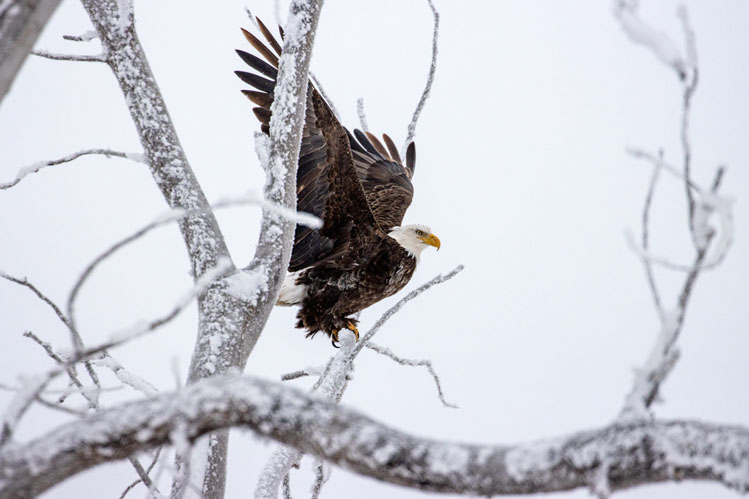
Spotting winter wildlife on the Northern Plains can sometimes seem impossible. Frigid temperatures, relentless wind, snow and ice usually keep critters out of sight during the diminished daylight hours. When I was in junior high, I spent a good chunk of an afternoon sitting in what I thought was a pretty good hiding spot overlooking a stock dam bordered by a chokecherry thicket. A recently deceased cottontail was on the edge of the ice, placed as a lure. I think I hoped a hungry coyote or maybe even a hawk or eagle would arrive. Nothing did. All I heard was the wind though the thicket and all I saw was gray and sullen clouds overhead.

I’m not sure when I figured out that the golden hour was when wildlife is most on the move. Maybe it was deer hunting with my brother or simply noticing more things after I shut the tractor down for the day. This tip generally still holds true when I’m out looking for wildlife with my camera. Not only are there more opportunities to see wildlife, but the golden hour provides beautiful light. Win-win.

It has been my family’s custom to find time to survey the countryside when we get together for the winter holidays. To this day, I keep this tradition alive. Sometimes I’m with my dad, sometimes with brothers and nephews and sometimes it is just me and my camera. This year, I spent three days looking for wildlife in Badlands National Park, Custer State Park and Wind Cave National Park between Christmas and New Year’s Day. And yes, late afternoon and early morning proved to be the most fruitful times.

I arrived in the Badlands around 3 p.m. on December 27. This may seem like mid-afternoon, but winter light is short-lived and angled low and lovely, which is a photographer’s delight. At 3:20 a great-horned owl was out on a ridge waking itself up in the sunlight. About a half hour later I spotted a golden eagle riding updrafts near the Sage Creek Wilderness Road. After photographing a few solitary bison bulls, I headed west and got to Custer State Park with very little light left on the western horizon.

Overnight, a skiff of snow fell in the Southern Hills and there was frost on the grass as I headed to a favorite spot along Highland Ridge Road in northern Wind Cave National Park before sunrise. There were elk below the ridge and bison on the horizon as the sun appeared with warm tones even though the temperatures were well below freezing. As the day lengthened the light brightened, the wind increased and the frost fell to the ground. After driving a few of my favorite routes, I ended up calling it day fairly early. I repeated this routine for the next few days, and it was glorious. Here are some of my favorite photos from that vacation. I’m already counting down the days for another foray or three into South Dakota’s winter wilds.

Christian Begeman grew up in Isabel and now lives in Sioux Falls. When he’s not working at Midco he is often on the road photographing South Dakota’s prettiest spots. Follow Begeman on his blog.

This slideshow requires JavaScript.

Posted on Leave a comment

Living with Lions

Mountain lions, found from Chile to the Yukon Territory, are the most widely distributed wild, terrestrial mammal in the Western Hemisphere. Researchers estimate that between 200 and 300 mountain lions live in the Black Hills, though their secretive nature makes sightings rare in the wild. Photo by Sam Stukel

REPORTS BEGAN COMING into Yankton police at 5:50 on a Monday morning in June of 2004. Two hours later, police and state Game, Fish and Parks Department officials had found a 115-pound mountain lion beneath a camper in a quiet neighborhood just east of the Yankton Middle School. Tranquilizing and relocating the big cat was not an option, so officers shot it in accordance with Game, Fish and Parks policy.

There was still a buzz about the mountain lion when we moved to town a year later. In fact, people talk about it today. Mountain lions live in the Black Hills, 400 miles away. One had never been seen in town. The only previous evidence of a lion nearby was a confirmed footprint found in Yankton County in 2002.

I thought about the excitement of that lion sighting when police congregated in my neighborhood in July of 2020. An officer said a mountain lion had been spotted just a few blocks away — captured on a home security camera sauntering between split-level homes — and was last seen heading east through a cornfield between the airport and my house.

Suddenly alert neighbors stood in driveways, hoping to catch a glimpse of our unusual visitor. I kept watch at the window for a flash of tan moving through the tall green cornstalks. But I think we all knew that the lion had slipped quietly into the country just as quickly as he had appeared.

Mountain lions still show up in Yankton, mostly on game cameras that are monitored by residents living along the forested river bluffs on the south edge of town. None have been shot since the 2004 incident.

Few animals in South Dakota seem to captivate us quite like the mountain lion. Fifteen years ago, Sam Stukel was hunting elk in the Black Hills when he suddenly noticed a young lion about 15 yards away. He captured a shaky video and posted it to YouTube, where the 75-second clip has amassed 232,000 views.”I still get email notifications every time someone comments on it,” says Stukel, who is also a photographer and a fisheries biologist at the Gavins Point National Fish Hatchery west of Yankton.”The variety of critiques is amusing. I’m an idiot for not being more afraid of the cat, or I’m a chicken for being so afraid of the cat. Everyone’s an expert on YouTube.”

Mountain lions are just as divisive offline. People like my Yankton neighbors are eager to someday see one in the wild, while others think one mountain lion is one too many. They are seen as both majestic creatures and vicious predators out to kill pets, livestock and maybe even humans. Reality is somewhere in the middle. Mountain lions lived in South Dakota long before people and have become an important part of our ecosystem. They are our neighbors, so we should get to know them.

*****

Jonathan Jenks and John Kanta are our state’s leading authorities on mountain lions. Jenks, a distinguished professor emeritus of wildlife science at South Dakota State University in Brookings, spent 17 years closely studying mountain lions in the Black Hills. Kanta is a terrestrial section chief for the South Dakota Department of Game, Fish and Parks based in Rapid City who has devoted nearly all of his 27 years with the agency to mountain lions.

Jenks began his research in 1998 when GF&P noticed an uptick in reports of mountain lion attacks. Livestock and horses on West River ranches and two mule deer within the Rapid City city limits were believed to have been killed by mountain lions. A year before, GF&P had estimated only 15 to 25 mountain lions lived in the Black Hills, but officials wanted to learn more. The agency partnered with SDSU and Jenks and his graduate students began capturing and radio collaring lions to establish a population estimate and learn about their lives, which date back millions of years on the continent.

The lions’ earliest ancestors likely migrated across the Bering land bridge into the Americas between 8 million and 8.5 million years ago. Mountain lions became recognizable as a distinct species about 400,000 years ago and roamed the continent alongside giant sloths, mammoths, dire wolves and saber-toothed lions.

Scientists believe the climate grew too cold for mountain lion populations to survive during the Pleistocene ice ages, but they later returned from more southern regions. They can be found from the southern tip of Chile to the Yukon Territory, making them the most widely distributed wild, terrestrial mammal in the Western Hemisphere.

As settlers populated the Upper Midwest in the 1800s, mountain lions became targeted as threats to livestock. The animals were hardly mentioned in the reconnaissance ahead of Lt. Col. George Custer’s 1874 expedition into the Black Hills. But the following year, Richard Irving Dodge, who had been with Custer’s men, accompanied geologist Walter Jenney back into the Hills. He noted mountain lion prints around their campsite.”He thought these lions were investigating the camp at night because they are nocturnal,” Jenks says.”They would approach the camp, probably mostly out of curiosity. As a result, Dodge called them cowards,” implying they wouldn’t come out when they could shoot them.

South Dakota State University professor Jonathan Jenks and Steve Griffin of the state Game, Fish and Parks Department (in the foreground) collect information on the age of a mountain lion.

In 1889 the South Dakota legislature placed a bounty on mountain lions, and by 1906 they were nearly extirpated. Sightings were scant for decades. A man named Earl Bedell killed one near the head of Stockade Creek in Wyoming in 1930. Ted Mann, who ranched near Dewey in southwestern Custer County, shot one in the early 1950s. Four were spotted in Wind Cave National Park in 1964 and 1965, and tracks were found west of Custer in 1965 and near Crow Peak in Lawrence County in 1968. No one could be sure if they lived in South Dakota or were transients. By 1978 all bounties were gone, and mountain lions were declared a state threatened species, which garnered legal protection.

That opened the door to recovery. Jenks and other researchers believe that lions from southeastern Wyoming followed northeasterly draws that effectively funneled them into the Hills.”That’s why when we first started studying them, it was easier to capture mountain lions in the southern Black Hills because there were potentially more of them there than in the northern Hills,” Jenks says.”It was right at the beginning of the recolonization of the Black Hills in the late 1990s.”

After a few years of research, Jenks and his team of graduate students estimated that 100 mountain lions lived in the Black Hills — far surpassing the GF&P estimate of 15 to 25 in the late 1990s. The animals were removed from the threatened species list and reclassified as a big game animal.

In 2005, GF&P announced the first experimental mountain lion hunting season with a limit of 12, no more than half female. It resulted in a lawsuit from the Mountain Lion Foundation of California and the Black Hills Mountain Lion Foundation, which sought an injunction to stop the harvest, arguing that there was still not enough known about the local population and that a hunting season could once again lead to regional extinction. A judge in Pierre ruled in favor of the state a week before the season was to open. A mountain lion season has continued every year beginning the day after Christmas and running through April. The season ends earlier if either 60 total mountain lions or 40 females have been harvested.

So began a delicate balance between those fascinated with the presence of mountain lions and those who want to hunt them. Kanta says between 3,000 and 5,000 licenses are sold for every season.”A lot of our mountain lion hunters are very dedicated and love that opportunity,” Kanta says.”I would also offer that there are a good number of folks who feel like this is a magnificent critter and would love that one-in-a-million chance to see a mountain lion out in the wild. They are intrigued by mountain lion tracks in the snow, or just knowing that they are out there.”

As mountain lions re-established themselves in the Black Hills, Jenks’ SDSU team and GF&P researchers like Kanta learned as much as they could. Adult males can be more than 8 feet long and weigh an average of 150 pounds. Adult females are around 6 Ω feet long and weigh 90 pounds. Adult males are generally solitary, while lions seen traveling together are usually a mother and her kittens, which stay together for 12 to 14 months.

Lions are solitary hunters that stalk their prey. They take advantage of thick vegetation or attack from upslope when they need a quick sprint. Lions have low endurance in chases, so targets that can run fast and long will likely escape. Older lions have better success rates because they learn the traits of other wildlife. Their preferred meal is deer, but Jenks learned that they are opportunistic, capturing whatever might be near, including rabbits and porcupines.

A capture crew including Jenks and SDSU graduate student Brian Jansen determines the weight of a male mountain lion in Custer State Park.

Mountain lions that show up East River and beyond most likely come from the Black Hills. Young males want to leave their home range and their mothers.”We did a lot of work on dispersal, trying to figure out where these cats were going,” Jenks says.”We followed them through North Dakota, northern Minnesota, the Niobrara River in Nebraska. There was one in Howard, one in Brookings. A 3- to 4-year-old male ended up about 8 miles south of Brookings, which was unusual to have a cat that age.”

In most instances — including the animals that wandered into Yankton — the mountain lions were simply passing through. They have no interest in interacting with people.”What they want to do is get away from you,” Jenks says.”It’s exciting to see them, and they are such an amazing animal, but they really just want to get away from you. In order for them to interact with you, there’s got to be some reason. A worst-case scenario might be standing on a hillside, and you slip into a den with kittens. In all the other situations that you can envision, lions are trying to avoid you. They might be climbing up a tree to let you go by, or running away from you, or staying quiet while you pass. That is borne out by looking at the number of negative interactions between people and mountain lions in the Black Hills. They are very few to nonexistent.”

As their familiarity with lions increased, it grew challenging to deal with public perceptions, which seem to be black and white.”There are two sides of the coin with mountain lions, and that’s what makes them interesting,” Jenks says.”You’ve got people who love them to death and people who hate their guts, and you’re trying to weave between the two to make everyone happy.”

That divide has a long history. The Cougar Hunt is a 1920s silent film created by the United States Department of Agriculture in which mountain lions are nature’s scourge slayed by noble hunters.”Predators of the range,” reads the opening slide before showing a lion lounging in a tree.”Uncontrolled predators exact a heavy annual toll of livestock and game,” reads the next slide, before shots of grazing cattle and sheep. Then, a group of men walking through the woods encounter an animal carcass covered with debris,”The work of that prince of predatory cats — the American lion, or cougar.” The film ends with a hunter shooting a treed lion. As it falls, the final slide reads”a ëgood’ lion at last.”

Others have admired the big cats. A mountain lion from Arizona named Josephine became the mascot of Theodore Roosevelt’s Rough Riders during the Spanish-American War. Roosevelt clearly respected lions.”It is itself a more skillful hunter than any human rival,” he said.”Ö It is a beast of stealth and rapine; its great velvet paws never make a sound, and it is always on watch whether for prey or for enemies, while it rarely leaves shelter even when it thinks itself safe.”

A student once asked Jenks if she could raise two cute mountain lion kittens In her home.”What happens when you’ve got a 150-pound mountain lion in your living room with your two small kids?” he asked.

During a GF&P commission meeting, after Jenks testified about the number of lions in the Black Hills, a local resident objected, saying there were many more and their numbers should be reduced. He believed he had seen the same mountain lion three different times near Hill City, and suggested lions were decimating the deer population.”It’s really tough to get by those perceptions, because mountain lions do kill deer,” Jenks says.”If you have a mountain lion, it has to be killing deer, and that’s the real simplistic vision of people with predators and prey. But there are a lot of other things going on in the Black Hills. Harvest, predators and disease make species management difficult, and mountain lions bear perhaps an unfair burden.”

Fear might even lie in the animal’s very name. Because of their wide dispersal and interactions with different subsets of American culture, they have assumed many monikers. In Florida they are panthers, in New England catamounts, for cat-of-the-mountain. Elsewhere, they are cougars or pumas. In South Dakota, they are lions, which conjures a very specific image.”When people hear lion,” Jenks says,”they think African lion.”

*****

Mountain lion numbers in the Black Hills ebb and flow. The GF&P’s current population objective is between 200 and 300, as established in the South Dakota Mountain Lion Action Plan, first written in 2010 and updated every five to 10 years. Kanta recalls one year when numbers surged, and his office fielded multiple reports of mountain lion sightings.”Anything that flashed by was a mountain lion and people would call us,” Kanta says.”Ninety percent of them were not legitimate, so you’d start to get a little complacent.”

One day he responded to a report of a mountain lion living in a garage. When he arrived, he found the garage door open about a foot. The homeowner explained that he had housecats and left food for them in the garage.”I’m standing right in front of this door, and I told him to go inside and push the button and let me take a look. As he opens it, a full-grown mountain lion comes running out and almost bumps into me. It turned out that the lion had been going inside the garage in pursuit of those cats.”

Information collected on radio-collared mountain lions has confirmed dispersal from the Black Hills to Minnesota, Oklahoma, Nebraska, Wyoming and Saskatchewan. DNA from lions captured in the Black Hills has been linked to cats that have traveled to the Chicago area and central Connecticut.

Mountain lions will take domestic animals. It’s one thing Jenks and Kanta want the public to know about living with big cats as neighbors.”If you have small children, you need to keep them close,” Jenks says.”If you have livestock or pets, you need to have them close. You need to watch if deer are spending a lot of time in your yard, because of the potential for drawing a cat in. And you need to know how to act if you encounter a cat. Act big. Don’t run. Yell at them. Show them that you’re not afraid of them and don’t act like prey, because there’s a chance that you might get attacked.

ìWe do need to learn to live with mountain lions, and that means people in South Dakota and the Black Hills have to take an active role in learning how to react when you see a mountain lion or if you’re going to recreate or live in mountain lion habitat.”

That may take time. Jenks is many years removed from actively working with mountain lions, but friends and neighbors in Brookings still call when they find suspicious tracks.”I never say that I don’t want to go out and look at it, because it very well could be a cat, and I’d be really interested if it was,” Jenks says.”People get excited.”

One recent winter, he was called to an area along Western Avenue on the west side of the city to examine tracks in the snow. He quickly realized it was something entirely different.”If you look at dog tracks, eventually you will find one that does not have nails and you can’t see the hind pad, so it looks like a lion print. I didn’t want to say this to the guy, but the reason he thought it was a cat print is because he was afraid of cats. And it was really just a dog that was walking along Western Avenue.”

Mountain lions are not fuzzy like bison (which can still be dangerous, as several visitors to South Dakota have discovered). They don’t have trophy antlers like elk and deer, or the uncanny ability to scale sheer rock faces like mountain goats or bighorn sheep. Yet they are mysterious, charismatic and — no matter if you’ve never seen one or have spent decades studying them — always captivating.

Editor’s Note: This story is revised from the January/February 2025 issue of South Dakota Magazine. To order a copy or to subscribe, call (800) 456-5117.

Posted on Leave a comment

What’s in the Water at Wallace?

Wallace artists Adam and Madison Grimm are both federal duck stamp champions. Adam has won the Federal Duck Stamp Contest three times. Madison has three wins in the junior contest.

THERE AREN’T MANY ducks in Elyria, Ohio. It’s only 6 miles south of Lake Erie, but the second smallest of the five Great Lakes is hardly a South Dakota prairie pothole.

When Adam Grimm began hunting waterfowl, he and his dad drove an hour from their home in that far-western suburb of Cleveland to a public hunting area where the birds were often few and far between. It was no place to live for an outdoorsman, hunter and burgeoning wildlife artist.

Several years later, when he was married and had a daughter named Madison, he suggested moving to South Dakota, a place he’d visited as a child and had never forgotten. He spoke so glowingly of the state that his wife Janet, who’d never stepped foot within its borders, agreed to come check it out. Though it rained for five days straight, the young family was smitten and made the move.

They are now a family of six and firmly settled in Wallace, a town of 91 people in northwestern Codington County famous for being the birthplace of Hubert H. Humphrey, Minneapolis mayor, U.S. Senator and the nation’s vice president from 1965 to 1969. But the town could also rightly claim both Grimm and 17-year-old Madison among its favorite sons and daughters. They are both federal duck stamp champions, achieving success that the national art competition has never seen.

*****

Drawing was Adam Grimm’s first passion. He drew his favorite cartoons and other things he saw on television until one day Bob Ross appeared on the screen. His long-running PBS show The Joy of Painting captivated artists and non-artists alike, and Grimm began imagining life as an artist.”That Christmas I asked for oil paints,” he says.”I ended up not painting the way Bob Ross does, with the putty knife and three-inch brush, but I started to develop my own way. I achieved the look I was trying to get, and it just started to snowball.”

He sold his first drawing at age 11. His grandfather realized Grimm’s potential and Insisted on paying $20 for it.”He always had that confidence that I was going to be able to do this as a living. I remember him telling my sisters, ‘Your brother will probably never have to have a real job.’ He just had such belief in me, and I think that had a lot to do with my own thought process and thinking that I could actually do this. If I won something, he would call everyone he knew and tell them.”

Adam grew up in Ohio, where he worked at the dining room table on his early wildlife paintings.

The next year he was invited to exhibit his work at a local craft show. He sold every item he brought and went home with nearly 40 orders for drawings. He started following other artists and became encouraged that he could make a living drawing and painting.

At the same time, his passion for the outdoors blossomed after a trip to South Dakota. Grimm first became acquainted with the state through his grandfather, an avid collector of Native American artifacts. Then his father began making annual hunting trips, and when Grimm was old enough, he came along. The country was unlike anything he’d ever seen.”I didn’t know anywhere like this even existed. I think people in South Dakota take South Dakota for granted. They don’t realize that it’s not like this everywhere else. The people, the nature, it’s not this way.”

His Interests In wildlife and art finally married when he saw his first federal duck stamp, a pair of canvasbacks by Minnesota artist Bruce Miller that appeared on the 1993-94 stamp. Still a teenager, he began submitting artwork to the junior duck stamp contest, open to students in kindergarten through 12th grade. He never won, but he gained valuable experience.

Grimm enrolled at the Columbus College of Art and Design in Columbus, Ohio, though he struggled to fit in. His professors urged him to experiment in a variety of art genres, but he had a plan.”I was doing realism and wildlife art, and I told them that I would like to win the federal duck stamp one day,” he says.”No one at the college had ever really heard of it. It was like, ‘Who cares if you get a painting on some stamp?’ I remember telling them, ‘Well, it’s kind of a big deal if you win.'”

He began entering the contest as soon as he was eligible. In his first year, he submitted a painting of a mottled duck that took 16th place. The next year, his green-winged teal won eighth place. In 1999, the two species eligible for submissions were the black scoter, an ocean bird typically found in Alaska and along the Atlantic coast, and the mottled duck. He chose the mottled duck and pushed his own creative limits.

He thought back to a scene on a marsh near Timber Lake.”I had snuck up on this little water area and there were blue-winged teal out there,” he says.”The hen is pretty drab in color, but so is a mottled duck. She raised up and flapped her wings on the water, and the sunlight was shining through her feathers. That was so beautiful. If I could paint that, but with this other duck, that could win, because it would be more about the lighting on the bird than the bird itself. But I needed the reference. I was painting this in Ohio.”

Adam’s painting of a mottled duck stretching its wings won the 1999 Federal Duck Stamp Contest. He was 21, making him the youngest winner in the contest’s history.

Grimm contacted a biologist in Texas who was doing a banding project on mottled ducks and requested photos. Then, a friend sent him a mottled duck that he had shot (again, there aren’t many ducks in northern Ohio).”I would thaw the bird out the night before because I wanted that early morning lighting,” he recalls.”First thing in the morning I would run outside with this dead duck and hold it up and stretch the wings out. Then I would run back in and try to capture the colors I had just seen.

“I wonder how many of my parents’ neighbors were watching this crazy kid with a dead duck,” he laughs.”You do what you have to do in life, and there was no other way to do what I was planning on doing.”

Say what you will about his methods, his painting of a mottled duck stretching its wings in the soft sunlight of early morning finished first. At 21, Grimm became the youngest person to ever win the federal duck stamp contest.

What followed were several months of travel and delivering speeches about his artwork, which now appeared on a stamp that would be in hunters’ wallets and collections worldwide.”It’s almost like if you won American Idol,” he says.”You can go from being a nobody to being launched into the limelight. Everyone knows who you are. It’s a crazy thing.”

*****

Such a life-changing competition had humble beginnings that can be traced to legislation that another South Dakotan shepherded through Congress nearly 100 years ago. Waterfowl depletion on the Upper Plains was beginning to be a serious issue in the early 20th century. The federal government issued numerous protections, but it became clear that sustained recovery hinged on habitat protection.

South Dakota Sen. Peter Norbeck, who had already worked to establish wildlife preserves in western South Dakota and was the major force behind creating Custer State Park, became a champion of the Migratory Bird Conservation Act, a piece of legislation that had advanced in fits and starts during the 1920s. By 1929, he had a version that successfully passed through Congress. It created the Migratory Bird Conservation Commission, which approved the purchase or rental of wetlands upon the recommendation of the Secretary of the Interior. The only thing it lacked was a permanent funding source.

That came in 1934 with passage of the Migratory Bird Hunting Stamp Act, which required hunters to purchase a $1 stamp before hunting waterfowl. Ninety-eight percent of the proceeds from their sale go the Migratory Bird Conservation Fund for wetlands preservation.

President Franklin Roosevelt asked Jay”Ding” Darling to design the first stamp, which featured two mallards landing on a pond. Darling was an American cartoonist and two-time Pulitzer Prize winner who was serving as director of the Bureau of Biological Survey, the forerunner to today’s U.S. Fish and Wildlife Service. He had grown up in Sioux City, Iowa, where he developed an appreciation for the outdoors. After a year at Yankton College, he transferred to Beloit College in Wisconsin and had a successful career as an editorial cartoonist. He also founded the National Wildlife Federation in 1936.

Other artists were invited to contribute until 1949, when a contest was opened to the public. Rules, including that year’s eligible species, are released in the spring. Entries are taken from June 1 through August 15 and the winner is announced in September. A panel of five art, waterfowl and stamp experts judge the entries based on their anatomical accuracy, artistic composition and ability to be reproduced on a stamp. The winning design is featured on stamps that are valid from the following July 1 through June 30. Winners receive no compensation, but can sell prints of their work, which are highly collectible.

Today, federal duck stamps sell for $25. They are required for waterfowl hunters, and philatelists around the world are always eager to add them to their collection. The program raises about $40 million annually to conserve waterfowl habitat and, since its inception in 1934, has raised more than $1.2 billion to purchase more than 6 million acres of wetlands.

*****

With the big win under his belt, Grimm left school and became a full-time artist. Other accolades and milestones followed. In 2005, his painting of a wood duck won the competition to illustrate the Ohio Wetland Habitat stamp. Later that year, he and Janet were married.

Not long after the nuptials, the conversation turned to South Dakota.”I didn’t know if she would even want to move someplace like South Dakota,” Grimm says.”For people who enjoy nature, hunting and fishing, this area is so great. And for raising a family, this area offers so much more of the kind of life I want my kids to have. The place where I grew up just isn’t the same as it once was.”

Madison was a little girl when Adam began bringing her into the field to gather reference photographs for future paintings.

The couple and their new daughter Madison found a farm near Burbank in southeastern South Dakota and moved in 2006. Grimm quickly began taking advantage of his new surroundings. Searching for reference material in Ohio had always been a burden, but now he was surrounded by waterfowl aplenty. Donning a full ghillie suit, he began sitting in marshes and sloughs with his camera, spending hours photographing ducks in the early morning light.

They also began to notice Madison’s interest in art. Grimm recalls a particularly realistic drawing she did on a chalkboard at 2 years old.”Is that normal for 2?” he wondered.”She was our first child, and we weren’t around other kids her age, so I didn’t know what was normal for a 2-year-old. My sister is a speech pathologist and works with kids on certain benchmarks, and she said kids don’t normally do what Madison had done until much later.”

When Madison was 5, she asked if she could try to do a painting like Daddy. She found a photo of a canvasback from Grimm’s collection and began working in his studio.”She could enter the junior duck stamp contest,” Grimm said.”It’s a great contest for kids and there are a lot of prizes. I thought that would be a fun thing for her to try.”

The junior duck stamp program was launched in 1989, and the first national contest was held in 1993. Students from kindergarten through 12th grade are divided into four groups. States choose a best of show each year, and the winner is then entered into the national contest.

As Madison spent hours working on the painting, her parents worried she might not make the submission deadline. She was not dawdling. After years of watching her father, she was struggling to achieve the same realism.”I remember her crying, not because we were making her do this painting, but she was striving to reach the level where I was, and she couldn’t get there because she didn’t have the experience. She knew she wasn’t getting there, and it was upsetting her.”

Madison remembers the struggle, too.”I remember being really frustrated that it wasn’t going faster. I wanted it to be done,” she says.”I remember working on it for hours and losing total track of time. I would just get totally absorbed in the painting. Mom would come get me for supper and I’d realize that I had been in the studio the whole day.”

Adam and Madison each painted canvasbacks for their national duck stamp wins in 2013.

With her father’s encouragement, Madison finished the painting. She entered the state contest and won Best in Show.”She’s only 6,” Grimm says, his voice still reflecting the astonishment he felt 11 years ago.”I thought she did a nice job, but she’s only 6. I kept trying to rationalize it in my mind.”

Figuring Madison’s chances were slim in the national contest, the family went about their farm work on the day of judging.”It was being livestreamed, but we weren’t even watching it. I was working out in the garden,” Grimm says.”Then I got a phone call from a friend of ours and she said, ‘Madison’s doing really well. She’s at least fourth place.” So I ran in, and we had dial-up internet, so it was slow. By the time we pulled it up, she said, ‘I think Madison won.'”

With her victory, Madison became the youngest person to ever win the junior duck stamp contest, echoing her father’s achievement 14 years earlier and making them the first parent/child duo to win their respective contests. 2013 got even better for the family when Adam’s painting of a pair of canvasbacks standing on a shoreline that he entitled King’s Realm, won the federal duck stamp contest, giving him his second national win.

Madison won the junior contest again in 2020 as a 13-year-old, with a painting of a wood duck. The rules require junior winners to sit out a year after a victory, so her next entry came in 2022. She won for the third time with a painting of a green-winged teal.

*****

The Grimm family ó which has grown to include Hannah, Jonas and James ó relocated to Wallace six years ago. Adam and Madison’s shared art studio occupies the top floor of a guest house across the street from their home. The first floor accommodates hunters who come from out of state. It’s decorated with Grimm originals, including a painting that appeared on the cover of Ducks Unlimited magazine (he has twice been named the Ducks Unlimited Artist of the Year).

Madison goes photographing with her father to the sloughs and marshes around Wallace, though many of her photos are taken in the aviary that they built after her second junior duck stamp win. It houses 17 species of ducks, some bobwhite quail and a red golden pheasant that spends most of its time trying to impress the hens. In fact, the drake pintail that both of them painted for their most recent duck stamp entries lives in the aviary. Adam and Madison both finished second nationally.”You know what this means,” Grimm joked.”We’re going to have to eat that bird. Clearly, he’s not a first-place bird.”

Grimm says the wonderful people of the tiny town on the Coteau des Prairie welcomed them with open arms. Not long after they arrived, he was helping coach youth baseball and had joined the volunteer fire department. The kids have friends in town that they can see daily. And they are surrounded by ducks.”I used to drive 45 minutes to an hour away just to get to a marsh where I could try to photograph birds,” Grimm says.”Now, I can walk down the street. Even our yard has wood ducks and hooded mergansers flying through and trying to nest in our trees. Sometimes I think maybe it would have been easier to just get a regular job. But I really love what I do, painting these beautiful creatures in their natural habitat and having the inspiration right out our back door. It’s everything I want.”

Editor’s Note: This story is revised from the July/August 2024 issue of South Dakota Magazine. To order a copy or to subscribe, call (800) 456-5117.

Posted on Leave a comment

First Signs of Spring

People who live in the Northern Plains tend to be hardy. They can endure hot, dry summers or long, hard winters with the best of them. Even so, the first signs of spring on the open prairie soften the heart of even the hardiest resident. Winter’s snow is scarcely gone when tiny pasqueflowers first appear on well drained hilltops and hillsides.”Very brave little flowers,” the Cree Indians say,”which come while it is still so cold that they must come wearing their fur coats.” This is in allusion to the furry appearance of the pasqueflower. According to Prairie Smoke: A Collection of Lore of the Prairies by Melvin Randolph Gilmore, a Dakota language song composed to inspire the early appearance of the prairie pasqueflower goes something like this in English:

I wish to encourage the children of other flower nations.

Which are now appearing over all the land;

So, while they waken from sleep and rise from the bosom

Of Mother Earth, I stand here old and gray-headed.

I often think of these references when I find my first blooming pasqueflowers of the year. This year it was in a small pasture just west of the eastern fork of the Vermillion River in McCook County on March 28. While admiring the backlit beauty of the blooms just beyond the fence line, I heard my first western meadowlark serenade of the season. It can’t get much more”South Dakota” than that! I typically find the first blooms of the year on a hillside near Lake Hanson just south of Alexandria, so I drove a little further west and sure enough, about 20 diminutive blooms of South Dakota’s state flower had emerged in my favorite patch.

On April 5, I reserved a blind on the Fort Pierre National Grasslands for another early spring spectacle. This one happens to be both a feast for the eyes as well as the ears. Greater prairie chickens and sharp-tailed grouse gather from March through May to dance. Not only do the roosters dance, but they also call, cackle and woo. The prairie chicken’s woo is a unique sound that I’ve not heard anywhere else. The roosters fill colorful air sacs on either side of their neck and the sound pours out as they expel the air, deflating the pouches. It is known as”booming,” and on a clear and crisp prairie morning, it can be heard for miles. During my morning on the lek, the sound started about 50 minutes before sunrise from right to left outside the blind. It is pretty dark that far ahead of sunrise so you can’t see the birds. It is quite an experience to hear the sound as it amplifies and surrounds you, but you are unable to see the creatures creating it.

As the light grew, I realized that my lek also had sharpies dancing. They don’t”boom,” but they stamp their feet amazingly fast and cackle to impress the hens. Instead of orange air sacks, the skin on their necks flares light purple and their eye combs are bright yellow. It was cold with a stout eastern breeze that morning, but numbing fingers and toes were worth one of the best homegrown shows that nature has to offer on our prairie hills. Soon the winds will warm, and the rest of spring will follow. It always does.

Christian Begeman grew up in Isabel and now lives in Sioux Falls. When he’s not working at Midco he is often on the road photographing South Dakota’s prettiest spots. Follow Begeman on his blog.

Posted on Leave a comment

Dancing with Grebes

Western grebes appear to walk on water during the rush, perhaps the most distinctive element of their spring mating ritual.

My love affair with grebes began when I was a high school biology teacher. During a lesson about birds, I showed my class a movie by Sir David Attenborough, the British broadcaster and wildlife biologist. I was amazed by the beauty and gracefulness of the grebes, with their long slender necks and pointed bills. Their courtship ritual was intricate and complex, unlike any other in the animal kingdom. They repeated each other’s every movement. If there were ever birds that demonstrated love, these grebes put the stereotypical doves to shame.

There are two displays, each including a specific set of steps performed with precision. The first is the rushing ceremony, which begins with advertising as the birds deliver a rolling call. Then comes ratchet-pointing, where they lower themselves into the water and their call becomes more ratchet-like. The next component is dip-shaking, which accurately describes the behavior of dipping their heads underwater and then shaking them from side to side after they resurface. Finally comes the rush, when the grebes run side by side across the surface of the water, necks back and wings up. They are the largest vertebrates on Earth with the ability to walk on water, covering up to 66 feet in 7 seconds through a combination of speed (20 steps per second), splayed feet to help gain traction and an unusual stride.

The weed dance occurs during the mating season. Two grebes arch their backs, stretch their necks and share weeds that they will use to build a nest.

The second display is the weed ceremony. It is equally complex and happens later in the mating season. But it was the rushing that fascinated me. As a part-time wildlife photographer, when I saw the ritual culminate into this beautiful dance across the water, I told myself that someday I would find grebes in the spring and photograph them.

When I retired from teaching, I started going down my bucket list of things I wanted to photograph. Western grebes were high on the list. They do not live in my state of Missouri, so I followed the Central Flyway, a major migration route over the Great Plains that encompasses a large part of the Prairie Pothole Region. Spring rains fill the potholes and they become a stopping point and breeding ground for many species of migratory waterfowl. Ducks, geese, pelicans and grebes take advantage of these pools, which contain a myriad of invertebrates, small fish and aquatic plants for food sources and nesting materials.

I knew about the potholes in South Dakota. Photographers look at each other’s work, and I’m sure I saw a picture of grebes taken in South Dakota. So about six years ago I made my first trip.

I’ll never forget my very first experience. The water was out, like it is in the spring. I had parked and was using a beanbag on the door of my truck. The grebes were coming really close, and that’s when I got my first good pictures. I didn’t get to see any rushing that day, but I went back later and witnessed babies riding on their mothers’ backs. I was hooked.

They usually start in April. I watch for the courtship ritual, which continues throughout the summer. But I keep looking because I’m waiting for the babies, too.

Of the 22 species of grebes, six can be found in South Dakota: Clark’s, western, pied-billed, eared, horned and red-necked. Clark’s grebe is similar to the western grebe; sometimes they are found mingling together. The other species are not as large. The breeding plumage of the pied-billed grebe is not as flamboyant. Its bill is not sharp and pointed and its neck is not long and graceful. The horned grebe has some interesting colors, with gold feathers wrapping around its head and a reddish ring around its neck. The eared grebe is arguably the most stunning of the smaller grebes. It has a golden fan of feathers radiating outward behind its eyes. I love grebes in general, but I think the western grebes are the most graceful and the most beautiful.

Photographers don’t always share their favorite spots, especially when you’re talking about birds. If you let it out where you’re going, then all of a sudden you get a crowd of people, and the birds are gone. I have traveled to South Dakota every spring for six years and have observed five of the six grebes during their migration and/or breeding season. (I have not been able to photograph or view a red-necked grebe yet.) Between the rushing and watching the babies, grebes have so much to offer. For a photographer, they are a dream come true.

Donna Caplinger lives in Fair Play, Missouri.

Editor’s Note: This story is revised from the March/April 2024 issue of South Dakota Magazine. To order or to subscribe, call (800) 456-5117.

Posted on Leave a comment

Winter Mornings in West River

Highland Ridge Road in Wind Cave National Park is one of my favorite places to experience the breaking of a new day. Flanked by prairie dog towns and grazing buffalo, an early riser is sure to hear a coyote chorus across the rolling landscape. If you are really lucky, grazing elk, pronghorn and even a glimpse of one of the coyote choristers is possible when the morning light breaks above the distant Boland Ridge to the east.

I spent two mornings in early January getting my fill of morning’s glory in this special place. The first morning was mostly clear and the rising sun revealed pronghorn grazing on the edge of a prairie dog town with a small herd of bison in the distance. Coyotes sang all around me, unseen but close enough to count five distinct voices. Elk grazed on the northern ridge just opposite Custer State Park’s southern fences. It’s no wonder that folks liken this part of South Dakota to the Serengeti in East Africa. I have visited both places in the morning, and the experience does have similarities when it comes to wildlife and natural beauty.

As the morning progressed, I noticed slight hoarfrost in the lower draws of the park. Hoarfrost forms when water vapor in the air condenses on cold surfaces on clear, windless nights. Crystals freeze directly from the vapor state and do not turn into liquid water in the process. This is different than rime ice that is seen accumulating during fog events. Hoarfrost is typically finer and more delicate, but it is just as fun to photograph. With my trusty macro lens and some bright sunlight to help light the minutiae of grass, chokecherry branches and slender yucca blades adorned with ice structures, I spent nearly an hour bent close to the earth trying to record the beauty in detail. During the process, I came across a young buck overseeing a small group of mule deer. The does did not seem concerned, but they moved after the buck decided I was too close.

On the second magical morning, the sky was gray and colorless. There was fog in eastern parts of the park, which left rime ice on the grass and pine trees. Three bull elk weren’t far from the road and allowed me to photograph them before moving on. It was my last day of my West River winter vacation, and it did not disappoint. As is my usual habit, I detoured through Badlands National Park. Strong flurries added snowy drama to the scenery. My favorite sites were a few lone bison moving slowly through the weather and the colorful Yellow Mounds portion of the park framed by white snow. Winter in South Dakota may not get raving reviews, but in this case, my camera says otherwise.

Christian Begeman grew up in Isabel and now lives in Sioux Falls. When he’s not working at Midco he is often on the road photographing South Dakota’s prettiest spots. Follow Begeman on his blog.

Posted on Leave a comment

Painting the Trophies

The Hatterscheidt trophy room has evolved at the Dacotah Prairie Museum, says curator Marianne Marttila-Klipfel (left). With her are the artists who painted the scenes: Lora Schaunaman (center) and Debra Many Carson.

“This traveling circus of ours lives off the country,” wrote Aberdeen safari hunter Fred Hatterscheidt.”We shoot to eat. We hunt for pleasure. We kill for trophies.”

Few South Dakotans ever hunted the world with the passion of Hatterscheidt, or left the public his guns, journals and taxidermy mounts. However, the staff and board of Dacotah Prairie Museum in Aberdeen soon grew uncomfortable with the collection that they inherited when the hunter bequeathed it to them along with a three-story building that became the museum in 1970.

“The mounts had to be displayed,” says Lora Schaunaman, a retired curator of exhibits. That was part of the agreement Hatterscheidt made with the board even though the lions, tigers and other exotic species hardly fit the museum’s mission of exploring northern South Dakota history.

Perceptions of safaris have also changed since Hatterscheidt died in 1973. When he was circling the globe in the 1950s and 1960s, trophy hunting was accepted as the sport of wealthy adventurers. Ernest Hemingway, one of the most famous American novelists of the 20th century, wrote extensively about his African excursions.

Other celebrities also popularized safari hunts. Teddy Roosevelt, the 26th president who is remembered as a conservationist, embarked on an African safari soon after leaving the White House in 1910. He later bragged that he’d killed 296 animals, including nine lions and 15 zebras. John Wayne roped a 450-pound wildebeest while filming Hatari, a 1962 movie about hunters who captured wild animals for zoos.

Even as those famous hunts were occurring, some game species were nearing extinction. Also, the concept of safari hunting became entangled with the colonialism that exploited native peoples in African countries. The stereotype of the rich American or European flying to an impoverished Third World village to kill for sport was reenforced when a Minnesota dentist shot a beloved lion named Cecil that lived in a national park in Zimbabwe.

However, the staff of the Aberdeen museum had recognized the dilemma long before Cecil’s death in 2015. A 1990 museum report recommended that Hatterscheidt’s gun collection be removed because it gave the appearance of”promotion of big game hunting.” The report, titled”A Man of His Times,” noted that the museum benefactor lived and hunted at a time when sensibilities were quite different.

Even for his own time, Fred Hatterscheidt was unique. He was born in Cologne, Germany in 1893 and came to America as a child with his parents, who were looking for an opportunity to farm. They arrived in Aberdeen when he was 10.

Hatterscheidt was with Frank Scepaniak in Siberia when Scepaniak killed the polar bear, which was mounted in full.

He studied at the Aberdeen Business College and Northern Normal (today’s Northern State University). He joined the South Dakota National Guard in 1914, the same year he went to work for a local real estate firm.

Hatterscheidt married Ruth Kimble in 1922. They did not have children, but they embraced the greater Aberdeen community. Today, their Hatterscheidt Foundation continues to provide scholarships to students in the region. Hatterscheidt immersed himself in business and 30 years later the son of immigrants had the wherewithal to travel the world. Ruth accompanied him on a few of his trips. She collected fans. Her husband collected animal trophies.

Hatterscheidt kept detailed journals as he traveled. Like the taxidermy mounts, his thoughts and writings deserve to be judged in the context of the era. He wrote honestly and bluntly, at times questioning the customs of other cultures and in other instances, seeking understanding.

In September of 1952 he was hunting giraffe in the Tana Forest of Kenya.”We followed the wounded animal for miles and miles over mountain and desert,” he wrote.”We had to quit on account of the darkness and we were still ten or twelve miles from Camp.”

He continued on September 19:”Six boys tracking the animal over mountains and desert, and finally we had to give up spoor. We located four Giraffe feeding. We circled and came in against the wind. Smith designated the kill, and Bob, our gun boys and I, dropped out of the hunting truck which went on the prescribed 200 yards. I got in the first shot with the .416. Bob used his 30.06 immediately after. The heavy impact of the .416 knocked the Giraffe clean off his feet. He jumped up and ran after the herd. Bob shot five times and registered three hits, but the bullets were flattened out under the skin which is nearly one-half inch thick. I got in another shot with the .416 and this slowed up the Giraffe to where Captain Smith headed him off near the road. The animal was about 16 or 18 feet tall and weighed nearly two tons. It was all our truck could do to pull and turn him over.”

On Sept. 29, 1952, he related an elephant kill.”Trailed Elephant for an hour or two (time means nothing in the African jungle). Elephant Camp on the Tana River. This was the highlight of our trip. Killed a six ton or more (7 tons) Elephant over 100 years old and carried 160 pounds of ivory (figuring both tusks). I fired three shots from the .416; the first one to the heart. He ran less than 20 yards and fell dead. Captain Smith stood silent in reverence to the dying giant of the Tana Forest. Tears ran from the Elephant’s eyes and perspiration formed in pools on his head.”

He also observed foreign commerce, noting in England on August 11, 1952,”There are men in charge of business who know nothing about it. They don’t even know what assets they have.”

A few days later he penned,”Sixty-eight colored natives were arrested in Johannesburg today.” It is one of several brief references to native Africans’ rebellions against apartheid and other injustices.

On the 1952 trip, he saw Hollywood movie star Spencer Tracy in a hotel lobby.”He is shorter than I, and his nose and cheeks are pot-marked,” wrote Hatterscheidt.”He is very homely and looked more like a tramp.”

In a 1959 trip to India, he scolded the leaders.”These ‘holier than thou’ politicians are no different than the Caesars of Rome as far as the masses are concerned. They wouldn’t let Bob and I walk on a street leading to the Palace of the President, nor take any pictures of Nehru’s palace. The people of India have never seen pictures of these in any newspapers. Nehru is always shown with (Hindu fashion) folded hands in greeting. Gandhi set an example of poverty but like our priests and ministers, those in power don’t follow Christ or Gandhi.”

He was more impressed with the rural people.”Bob and I have really experienced the life of an Indian Maharaja who used to have the exclusive right to kill a tiger. We have been waited on. We have been blessed and anointed with oil and sprinkled with rice, and a mark was put on my forehead. All good Hindus, especially the women, carry a red or black spot on their forehead. We were honored time and time again for being killers of the tiger, also their god. I can’t understand any of it.”

Aberdeen hunter Fred Hatterscheidt made the cover of a Minneapolis magazine in 1961.

Hatterscheidt welcomed publicity. In 1960, he offered his diaries to Farm Journal but the editor, Carroll Streeter, replied,”we are so terrifically crowded for space right now that I think it quite unlikely that we could.”

Regional newspapers were more receptive. In the museum files are several stories, including a 1959 account in the Aberdeen American News of a tiger hunt.”The Jeep lurched to a stop and as Hatterscheidt stepped down, the tiger was charging down on them,” wrote Sally Ross.”Hatterscheidt fired, but the tiger kept coming. Hatterscheidt fired again and again until the tiger reared on its hind feet and in one last roar, fell over backwards 20 feet away from the hunter.”

He told the Watertown Public Opinion that the 3,000-pound gaur he shot”represents a possible record kill.” He said it measured 6 feet, 1 inch at the shoulders ó 2 inches higher than the previously recognized record.

On March 5, 1961, the Aberdeen hunter was featured on the cover of the Minneapolis Sunday Tribune Magazine with a trophy Bengal tiger shot in India. He said the tiger was,”bagged by means of a beat, where natives form a huge circle and drive the animals forward,” while he waited in a blind, 16 feet above the ground.

His trophy kills were preserved by some of America’s best taxidermists in Chicago, Houston and Seattle. Once mounted, they were shipped to W.H. Over Museum in Vermillion, the oldest museum in South Dakota. Someone there had apparently assisted Hatterscheidt in gaining permission for some of the hunts.

However, in 1970 two of Hatterscheidt’s friends stopped at the Vermillion museum to see the trophies and were chagrined to discover that the heads were in storage and not available to the public. At that very time, historians in Aberdeen were looking for a permanent home for the Dacotah Prairie Museum.

Hatterscheidt and two partners, Herman Pickus and P.A. Bradbury, agreed to donate the historic, three-story Western Union Building on Main Street in 1970. However, the offer included a stipulation that the museum shall exhibit the wildlife collection ó including the aforementioned gaur and elephant.

Hatterscheidt died three years later, long before museumgoers began to balk at the mounted heads. However, by the 1990s, sensibilities were changing and the mounts, some now 40 years old, were aging. To make matters worse, the trophies were only separated from visitors by a rope, so some people were handling the mounts; bratty children were even pulling the whiskers from a leopard.

Schaunaman, an artist and art teacher, was then a curator.”The original exhibit was a trophy room with just the heads hanging on the walls,” she says.”It told the safari story of one Aberdeen businessman, but the reaction wasn’t always great. I didn’t even like to go in the room. People would bring their little kids and they would be afraid. Sometimes they would cry and scream. Our director back then was Sue Gates. She knew I didn’t like the room, yet we all knew the trophies had to be displayed. That’s when we came up with an idea.”

Sherri Rawstern, the museum’s longtime curator of education, urged her fellow staffers to consider two goals: show the animals in their native habitat, and do it in a manner that was more lifelike. That was the genesis of a major undertaking.

Schaunaman immediately reached out to Debra Many Carson, an Aberdeen wildlife artist.”I called her and said, ‘Have you ever painted an animal life-size?'”

Buster the Bison has long been the mascot of the Dacotah Prairie Museum, but he became even more popular when artist Debra Many Carson painted a body to match his fuzzy head.

The two women began by researching habitats and drawing sketches, which were later enlarged to fit the walls. They especially worked on the proportion of the actual heads to the painted bodies. Along with the art scenes, they incorporated real tufts of grass, soils, branches and a massive tree trunk.

Schaunaman tried to contact the original taxidermists, hoping to learn how to clean the mounts. Chris Klineburger of Seattle was deceased, but she was able to reach his son, Kent, who had continued in his father’s footsteps.”I only expected to get some advice, but when he heard what we were doing he insisted on coming to help,” she says.”He was on his honeymoon, actually. He came with his new bride, and she helped as well. They were here for about a week.”

During the 18-month transformation of the trophy room, museum staff also embarked on a major restoration of the handsome 1888 building that Hatterscheidt and his partners had given to them. Replacing the huge windows was an important part of the renovation.

“As they were taking out the big windows on street level, Sue Gates told us, ‘here’s your chance!'” Schaunaman remembers.”The window holes made it possible for us to get the big mounts outdoors for cleaning. Somewhere there’s a picture of me, standing on a step ladder and vacuuming a polar bear on Aberdeen’s Main Street.”

Other repairs were more subtle. Many Carson, the wildlife artist, had pet cats.”When I realized the leopard’s whiskers were missing, I watched for my cats to shed their whiskers and I saved them and glued them on the leopard,” she says.

A golden eagle, mounted on a rock, was especially difficult.”We had a terrible time getting him off the rock without breaking his talons,” says Many Carson.

The elephant head was also challenging.”They didn’t have the foam plastic models in those days, so it is framed with 2-by-4s and other heavy wood,” Schaunaman says.”The tusks are fiberglass, but they are heavy as well. We had to consult a structural engineer to see if the wall would hold it. We drilled through three layers of brick to the outside wall and bolted the mount to a steel plate.”

Using large chunks of material from Benchmark Foam in Watertown, they also sculpted two front legs for the gigantic elephant.

Though the murals span the continents of Earth, they blend together as if you were circling the globe on a jet plane.”It begins with sunrise of the Arctic, and then morning over the Rockies, noonday on the Great Plains, afternoon in Africa, a sunset in India and nighttime in the Himalayas,” says Schaunaman.

Many Carson and Schaunaman have slightly different styles, but their work blended perfectly. A casual observer might think it was all accomplished by a single artist.

Reaction from the public was immediately positive.”It changed by leaps and bounds,” Schaunaman says. And that has continued, even though public perceptions of big-game hunting are still evolving.

Marianne Marttila-Klipfel, who now serves as curator of exhibits at Dacotah Prairie Museum, says the safari murals and mounts have stood the test of time.”Now, with improvements made by Lora and Debra, the room tells a story in an educational context. The animals were placed back into their natural habitats and through artistic magic, life was brought to the exhibit. The rest of us get to benefit from their vision and talent.”†

Editor’s Note: This story is revised from the July/August 2023 issue of South Dakota Magazine. To order a copy or to subscribe, call (800) 456-5117.

Posted on Leave a comment

Starts and Stops

Spring is once again in full swing. The season arrived a bit differently this year. The winter of 2023-24 was very mild with only about two weeks of extreme cold. February was mild and the unseasonably warm temperatures lasted until late March, when the wind and cold slowed things down a bit. Many early bloomers were just getting started when that cold blast returned. It wasn’t until nearly the end of April until things felt”on-time” again. As I write this, the lilacs are in bloom and the spring warbler migration is about to hit full speed. Even with the starts and stops, I’ve noticed the vivid colors more than ever this spring as life is renewed. My goal with this version of my annual spring photo journal is to highlight the beautiful hues of new life returning to our part of the world.

February 13

Unseasonably warm temperatures had melted most of our snow, and warm hued sunsets, like this one over Trinity Lutheran a few miles west of Sioux Falls, ignited spring fever.


February 21

With evening temps in the 50s, I experimented with long exposures on Phillips Avenue in downtown Sioux Falls.


March 15

I found my first wildflowers of spring (snow trillium and pasqueflower) at Newton Hills State Park and Hanson County, respectively.


March 30

Easter weekend was cold and blustery. While traveling to see family in rural McPherson County, I got a nice portrait of a red fox near its den entrance.


April 14

Bloodroot flowers were in bloom at Union Grove State Park, as was the very first plum brush. A large bumblebee was busy taking advantage.


April 21

I took a Sunday afternoon trip that started at Palisades State Park and then up to the prairie hills of Deuel County. A mother raccoon nursing her young, a pheasant, pasqueflowers and the song of the meadowlark were pleasant discoveries along the way.


April 28

The next Sunday was cold and blustery with periods of rain. The pasqueflowers of Deuel County were leaning and covered with raindrops. Prairie smoke was just beginning to emerge.


April 30

A dashing palm warbler stopped at Palisades State Park during its migration journey to Canada.


May 4

A yellow-rumped warbler at Palisades State Park posed nicely among new leaf growth.


May 5

I discovered a wild violet and new leaves along the Trail of Giants at Big Sioux Recreation Area near Brandon.


May 7

I went birding at Palisades State Park and had good luck finding and photographing the colorful yellow warbler and male and female Baltimore orioles. To top off the day, an exquisite sunset sky graced Falls Park in Sioux Falls.


May 10

A major geomagnetic storm caused bright and colorful Northern lights across most of North America. I traveled to one of my favorite structures in the state — the remains of Concordia Pioneer Lutheran Church northeast of Sisseton — to capture the event.

Christian Begeman grew up in Isabel and now lives in Sioux Falls. When he’s not working at Midco he is often on the road photographing South Dakota’s prettiest spots. Follow Begeman on his blog.

Posted on Leave a comment

The Long View

The latter part of November into early December brings deer hunting season to our part of the world. Growing up in rural West River, my family joined the rifle hunting season like many other friends and neighbors. One of my older brothers became our family’s mighty hunter and often I would go along as an extra set of eyes and another pair of hands to help manage the prize of a successful hunt. I wasn’t much of a hunter myself as I didn’t handle the big rifles near as much as my dad and brother, but I always did love a good set of binoculars. Which I think maybe primed me for a love of the long telephoto lens nowadays.

Dad brought home a new pair of binoculars when I was in grade school, and I was transfixed by them. I spent a lot of time looking out our front picture window towards the highway. I remember checking out the craters on a full moon and using them out in the countryside. Whether it was looking for grouse, deer or the random stray cow, binoculars became a huge help and an interesting tool that stayed in the work pickup at almost all times.

Nowadays, I substitute a long telephoto lens for binoculars to get long views across our landscapes. All the photos in this column were taken using a Canon 100-400mm telephoto lens. The majority of them also were shot with the addition of a 1.4 extender, which is a small accessory that gives you even more”zoom.” The engineering that goes into these tools gets better and better. A recent improvement is the ability to get closer focus with the newest telephoto lenses, meaning I no longer have to be up to 6 feet away to get something in focus. The distance has been cut in half, which makes birding with the telephoto lens even more fun –at least when the birds decide to let you get that close.

Late fall and early winter are the best times to look for wildlife with the trusty telephoto lens. Both whitetail and mule deer are in rut. Their usual cautiousness towards humans (and vehicles) is thrown to the wind when they catch the scent of a doe on the breeze. On Black Friday and the following Saturday of this year, I spent most of the daylight hours at Badlands National Park, Custer State Park and Wind Cave National Park looking for prize bucks as well as any other wildlife that caught my eye. Two of the largest mule deer bucks I’ve ever photographed gave me a quite a show, the first as daylight faded on Black Friday in the Yellow Mounds area of the Badlands. He was trailing a doe and didn’t mind me watching as long as I stayed still atop of a nearby mound. The second was slightly smaller but still magnificent, just inside the Wind Cave boundary south of Custer State Park. It was another successful hunt with the long lens, and I can’t wait to go out and try again.

Christian Begeman grew up in Isabel and now lives in Sioux Falls. When he’s not working at Midco he is often on the road photographing South Dakota’s prettiest spots. Follow Begeman on his blog.

Posted on Leave a comment

Goat Watcher

A ragtag herd of mountain goats has chosen to live on the high cliffs of Spearfish Canyon.

Mountain goats have a reputation as escape artists, so it wasn’t a shock when a nanny left Custer State Park in 2016 and showed up about 70 miles away in Spearfish Canyon. The bigger surprise is that there are now 10 goats in the canyon, leaving wildlife officials to wonder what comes next.

Les Heiserman, a retired Spearfish school custodian and inveterate explorer of the canyon, was one of the first persons to observe the nanny.”I first saw her in 2016,” says Heiserman, who visits the canyon daily.”We know she came from Custer State Park because they put a radio collar on her there, but no one had any idea she would travel so far away.”

He has been watching, photographing and advocating for the stray goats ever since. A billy showed up in 2017, and a kid was born the following spring. With so many goats to watch, Heiserman began to name them just so he could keep track. He called the matriarch Granny Nanny. The billy is Bill. Other names include Thimbleberry, Broken Horn, Scooter, Rocky and No. 18 (because he was the first kid, born in 2018).

“I name them for their physical characteristics for the most part,” he says. Thimbleberry was an exception; that name came from seeing the young goat chewing on the fruit of a thimbleberry bush.

The wooly, snow-white creatures are native to the northern Rockies and Canada. Though misidentified as goats by early explorers, they are more closely related to the gazelles and antelopes of Africa.

Despite the namings and his frequent visits, Heiserman keeps a distance from the goats because he worries that too much familiarity with humans could put them at risk.”They don’t mind me, but I know they will shy away from strangers.”

Though the goats generally dwell atop the rocky, rugged limestone cliffs of the 1,000-foot-deep gorge, they sometimes descend to the scenic byway, Highway 14A, that winds 22 miles through the canyon floor.”They love it behind Bridal Veil Falls,” Heiserman says.”They also like to splash in Spearfish Creek and jump over the fallen logs or pose in the stream.”

Tens of thousands of cars, campers and logging trucks travel the byway. Even though the speed limit is 35 miles per hour, Heiserman is concerned that the goats are at risk.”Goats can get salt starved,” he says.”It’s possible that they come down to lick salt off the road, especially in winter. They probably also come down to drink from the creek.”

Because tourists, and even many locals, are not aware that goats are in the vicinity, Heiserman embarked on a campaign to post warning signs. He is adept at climbing the canyon walls, even with a camera around his neck; as it turns out, he’s equally skilled at maneuvering the bureaucracy of government.

Numerous state and federal departments share responsibilities in the canyon, so it was complicated to get everyone to agree on what to do and how to do it. Finally, the state highway department acted on a recommendation from the state Game, Fish and Parks Department — with approval from the U.S. Forest Service — to post the cautionary road signs.

Heiserman says another danger for the goats is inbreeding. Thus far, the entire herd has descended from Granny Nanny and Bill.”They could use a fresh gene pool here,” he says, meaning the introduction of another billy goat.

They face a more immediate threat atop the canyon, not from humans, genetics or vehicles but rather from mountain lions. Chad Lehman, a senior wildlife biologist for the South Dakota Department of Game, Fish and Parks, says lion predation can affect goat populations.

“We just did a survey and we counted 49 mountain goats in the Custer State Park area, which is down quite a bit,” Lehman says.”The last time we did a survey was in 2018 and then we estimated about 130. We never have an exact count, and we don’t have enough collared goats to know for sure, but there are fewer of them, and we will probably recommend closing the mountain goat hunting season next year.”

Mountain goats are not native to the Black Hills. Their original and natural habitat is Alaska, Canada and the northern Rocky Mountains. They are considered an invasive species in other places. Fifty goats were shot last year in Grand Teton National Park, where officials are hoping for a full extermination. Authorities there think they hinder native flora and fauna, including the bighorn sheep.

Few people know Spearfish Canyon like Les Heiserman. Wildlife officials call him a citizen scientist.

“It’s interesting how two national parks deal with the same critter so differently,” Heiserman says.”In Montana’s Glacier National Park, the goats are revered, almost like the sacred cows of India.”

Lehman and other wildlife officials in South Dakota say they are not concerned about the goats’ environmental impact, and they have nearly a century of experience on the matter. The first goats came to South Dakota in 1924 when Custer State Park, then in its infancy, featured a zoo that provided visitors a close-up view of bear, deer, elk and other species.

Six goats were brought to the zoo from Alberta, Canada, but two escaped the fenced enclosure on their first night in the Hills, and within a few years the entire herd was living on the Black Elk Peak range. Their numbers grew to a high of 400 in the 1940s, and occasionally a billy or nanny has ventured away from the park.

“They need precipitous terrain,” Lehman says.”They love places that are really steep. The granite outcroppings in Custer State Park, the Needles Eye and the Black Elk Wilderness Area all have incredibly steep, granite cliffs. We’ve also had a bunch move into Battle Creek Canyon to the east where it’s basically just a sheer cliff. We had one nanny go to the Boy Scout Camp area on a limestone plateau where she lived for eight years all on her own. We had another in the Bethlehem Cave area for a couple of years, so we’ve got these bizarre stories of how they’ve traveled.”

Lehman says it’s difficult for Game, Fish and Parks staff to monitor the well-being of the wide-ranging goats, so he appreciates”citizen scientists” like Heiserman who monitor and advocate for them.

“I know that Les pretty much lives in the canyon, and he does it just right. You want to be there, yet not too close. What can happen if you habituate them is that they might suddenly inflict their dominance — maybe not on you but on another unsuspecting tourist who gets too close.”

Heiserman does get close enough to document the canyon herd throughout the four seasons. Using a Canon camera with a 100/400 lens, the talented, self-taught photographer captures excellent pictures of the goats and other scenery in the canyon. He posts photos and occasional videos almost daily on his Facebook page, which is open to the public and has a big following. He even published a 2023 goat calendar, which is available through his Facebook page.

Visitors to the canyon are attracted to the goats’ playful nature. Though seemingly tame, wildlife officials caution that they are wild animals and can be dangerous.

Heiserman also shares other tips on enjoying Spearfish Canyon. He has photographed and written about the rare American Dipper as well as osprey, eagles and numerous other species.”The more I know about Spearfish Canyon, the more I realize I don’t know,” he says.”There are subtle changes in the flora and fauna. I recently spotted a peregrine falcon, and then while in the canyon I met an experienced falconer who explained some of the sounds they were making. He thought they were fledglings crying out for food.”

He’s intrigued by the mining and logging activity, the pioneer history and the geology of the canyon. However, the mountain goats get most of his attention. In early summer he saw the kids playing a version of”king of the mountain” on a granite promontory. He’s watched as the nannies teach their young how to make the most of the gifts Mother Nature gave them — their cloven hooves and their horns.

The two-toed hooves expand widely to give them greater balance, and the rough pads of each toe give them a firm grip. That allows them to scale and traverse steep cliffs and walls that scare even mountain lions. But there’s also a technique involved. The goats learn to scratch away loose rocks. They learn to look before they leap. They experiment on how to use speed for horizontal jumps.

Those death-defying theatrics and more show up on Heiserman’s Facebook page. It’s also where followers learned, in April of 2022, that Granny Nanny had died.”When I first saw her, she was a strong-looking goat, but when she passed away, she was worn down to nothing and her teeth were gone.”

That same spring brought the birth of two kids, however, so Granny’s little tribe continues to prosper. Watch for them if you drive through the canyon and follow their growth on Heiserman’s social media postings.

Editor’s Note: This story is revised from the January/February 2023 issue of South Dakota Magazine. To order a copy or to subscribe, call (800) 456-5117.