Posted on Leave a comment

The Yankton to Marty Trail

South Dakota Magazine intern Ava Brandt met Digger at Mensch’s Greenhouse in Avon.

A golden dog named Digger met us at the door of Mensch’s Greenhouse, his tail wagging like a windshield wiper. Two cats lolled on a flower worktable and a dozen colorful cockatiels chirped from two cages near the petunias.

Any traveler will crack a smile at Mensch’s Greenhouse in Avon — and that’s fortunate because for the most part this Yankton-to-Marty loop can be a solitary journey, even though it visits seven small towns in South Dakota’s populated southeast corner.

We began the loop early in the morning because of a tip that the Tyndall Bakery has amazing donuts and pastries, and some days they sell out. We had two stops to make before the bakery.


The Lakeport Church in rural Yankton County dates to 1884.

Chalkstone Church

We drove 8 miles west of Yankton on Highway 50 to 431st Avenue, then turned right to the Bruce and Donna Schwarz farm. Drive slowly through the farmyard — the Schwarzes don’t mind — and you come to a small church built of the yellow chalkstone found along stretches of the nearby Missouri. Neighbors keep up the church and mow the cemetery, which features Czech surnames still common in the area. This is Czech country, settled by pioneers from Bohemia and Moravia who began to arrive in 1869. Their first settlement was Lakeport; only the little yellow church, constructed in 1884, has survived.


A wooden church is among the historic buildings preserved at the park in Tabor.

TABOR: CZECH CAPITAL

A few miles further along Highway 50 is the town of Tabor (pop. 405), founded in 1872. Tabor is famous for its annual Czech Days celebration in June. Parking is more plentiful on the other 362 days of the year, so stop on Main Street and stretch your legs by walking through the quaint pioneer village which includes a tiny wood church that was built at Lakeport even before the chalkstone church. Now it is well-kept in the Czech Preservation Society’s heritage park along with several other antiquated structures.


Magazine interns Rose Lane (left) and Ava Brandt at Tyndall’s Eiffel Tower, a fancy flagpole that measures 100 feet.

TYNDALL’S TOWER

One wonders if Gustave Eiffel, engineer and namesake of the tallest structure in Paris, would be flattered to see the imitation in Tyndall.

Tyndall’s”Eiffel” is more than 1,000 feet shorter than Gustave’s, but nearly as old. It was constructed in 1898, just nine years after the original was completed to honor the centennial of the French revolution.

The replica stands on the lawn of the county courthouse, west of downtown on 18th Avenue. But before you visit the tower, stop at the Radack family’s bakery. We dilly-dallied too long, and the cases were nearly empty, so we missed out on the Tyndall Roll, a Bismarck-like pastry filled with white cream and topped with crushed peanuts. No one knows when the legendary roll was created, but the bakery traces its history to 1905.


Carol and Vern Tolsma at their Avon greenhouse.

AVON’S GREENHOUSE

Feeling lonely in southeast South Dakota? Just visit Vern and Carol Tolsma’s Mensch Greenhouse and Flower Shop along Highway 50 in Avon.

Carol’s grandmother, Ada Mensch, started the greenhouse in 1957. Imagine how many flowers have bloomed, thanks to Ada, in 67 years. And how many people have enjoyed the garden bounty that took root here.

The flowers and plants come with free advice. Did you know you should only water tomato plants when absolutely necessary? Vern says a thirsty plant sends roots deep into the soil, making it strong and adding taste to the fruit.

Digger, the greenhouse dog, wags and nuzzles anyone who’ll take the time. Cats and cockatiels also share the space. The cockatiels are orphans who lost their owners and found refuge here.

The Tolsmas tend a 2-acre garden near the shop, and they sell produce, canned goods and amazing pickles. They occasionally set out a table of freebies that need a home.

Some days, Vern wears a blue t-shirt that says it all:”I Love Gardening From My Head to My Tomatoes.”


Richard Langdeaux helps keep Wagner’s park looking beautiful.

A WALK IN THE WAGNER PARK

Follow Highway 50 northwest. South Dakota’s Czech heritage extends into Charles Mix County and the city of Wagner (pop. 1,603), the largest town on this loop tour. Wagner has all the amenities you might want — a coffee shop, restaurants and a grocery store.

On the west side of town, near Highway 50, lies a little lake and park that would be the envy of any city in America. The lake was created when a dam and rock structures were built in the 1930s by WPA workers. Today the park includes two walking bridges, flower gardens, trails and even a small waterfall. This is the best opportunity of the day for a walk.

Richard Langdeaux, a Santa Claus look-alike who was collecting trash in the park, told us that the stone buildings along the lake were once a Scout camp. Artesian springs keep the lake full year-round.

Wagner also offers an impressive museum, operated by the Charles Mix County Historical Society. The collection is known for its Czech exhibits, as well as artifacts from the Yankton Sioux culture that predates the pioneers.


Michael Rouse helps maintain the ground around Marty’s St. Paul Catholic Church.

MARTY’S AMAZING CHURCH

Drive west of Wagner for 6 miles to 388th Avenue and turn south for another 6 miles to Marty. The one and only enterprise is a boarding school started by the Benedictines in 1924 and now operated by the Yankton Sioux Tribe.

Alongside the school is St. Paul Catholic Church, built by volunteers — Indians and non-Indians — in the early 1940s of Indiana sandstone, mined from a quarry near St. Meinrad Archabbey, which founded St. Paul’s.

The steepled church (167 feet!) is surrounded by tall trees and other structures, so it’s hard to appreciate from afar. Exit your car and walk about the churchyard, where there are statues of Kateri Tekakwitha, the first Native American saint, and St. Theresa, patroness of missions. On most days, the church doors are open; inside, St. Paul’s looks like something you might see in a European city except that the murals, stained glass and other art are rich in Native American themes.


The tallest stone in Greenwood Presbyterian Cemetery marks the grave of Struck by the Ree.

STRUCK BY THE REE

Follow the road south of Marty for about 7 miles and a few curves. You’ll come to Greenwood Presbyterian Cemetery, where the tallest stone marks the grave of Struck By The Ree, a maligned and misunderstood leader of the Nakota. He was born in 1804, as Lewis and Clark came through the river valley. Legend says the explorers wrapped the baby in an American flag and proclaimed he’d be a great leader.

Struck By The Ree did grow to be a wise chief — an environmentalist, a feminist and a peacemaker. He urged pioneers to preserve the timber resources of the river valley. He pleaded that both Nakota and white men respect the Native women. And though he first fought the intrusion of the white civilization, he eventually recognized that it could not be stopped (ìthey are like maggots Ö”). He became a lead negotiator in the 1858 Treaty. Decades later, after the treaty was broken and his people found themselves hungry and hopeless, he was often persecuted; his cabin was burned, and his horses were stolen.


A tall memorial near Greenwood commemorates the 1858 Treaty.

Treaty Memorial

Continue south and you’ll soon come to another memorial, erected to honor Struck By The Ree and seven other Native American signers of the 1858 Treaty, which gave the government more than 11 million acres for $1.6 million and established a reservation for the Nakota.

The monument was constructed in 1907, topped with an obelisk. A few decades ago, vandals toppled the obelisk — a posthumous insult to Struck By The Ree, a century after his death in 1888. It has since been restored.


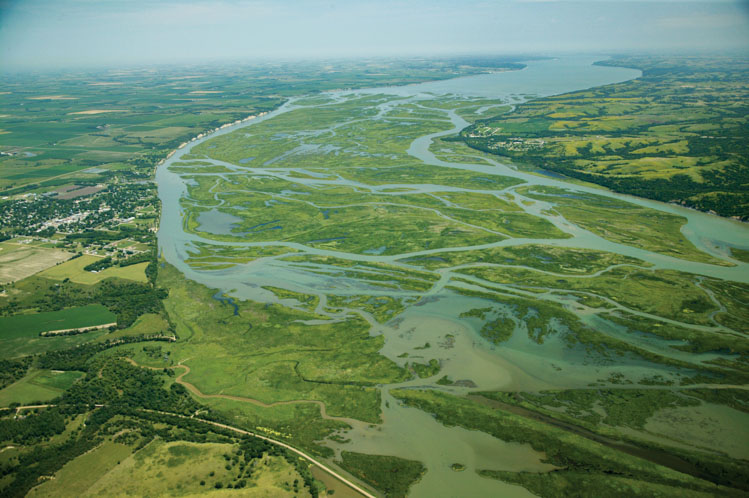
Springfield sits above a growing delta in the Missouri River.

A MISSOURI RIVER DELTA TOWN

Drive south from the treaty marker and you’ll come to the tiny community of Greenwood, once the hub of the Yankton Sioux Tribe. At Greenwood, if you are not in a hurry, turn right and follow the river for a mile or two for scenic views. Then return and continue east along the Missouri.

Eventually you’ll come to 312th Street, and then to Highway 37 which will lead you to Springfield, once South Dakota’s smallest college town. Thirty years ago, the University of South Dakota/Springfield was closed, despite furious opposition, and the campus was converted to a prison.

Townspeople feared that the prison would be the ruin of Springfield, but it has persevered. Norm’s, once a favorite hangout for collegians, still serves burgers and beer. A company known as Mr. Golf Car parks more than 200 golf carts along Main Street. A museum keeps the history of the college alive, and anglers come to fish the river.

Springfield still has a post office, bank and library — plus several eateries. On its eastern edge is a veteran’s memorial with a panoramic view of the river.

The highway sign lists the population at 834. That doesn’t count the 1,200 prisoners who live there.


Six unknown soldiers of Lt. Col. George Custer’s 7th Cavalry are buried in the Bon Homme Cemetery.

APPLE TREE ROAD

For a final treat on your loop, turn east onto Apple Tree Road (a mile north of Springfield).

A few miles down the road is a spot known as Apple Tree (though the state Game, Fish and Parks Department calls it Sand Creek). It consists of a campground and cabins, a boat dock and a little peninsula where you can walk out among the reeds and see where the invasive delta ends and Lewis and Clark Lake’s open water begins.

This was once a delightful place to enjoy the bellowing of giant bullfrogs. They were silent on our stop. Perhaps they dislike the phragmites, an invasive wetland plant that is taking over.

Continue east on Apple Tree Road and you’ll soon pass the tidy Bon Homme Cemetery where a large stone memorial marks the graves of six soldiers who traveled with Lt. Col. George Custer and his 7th Cavalry in 1873.

As Custer’s entourage camped at the nearby town of Bon Homme for four days, six became ill and died. Historians speculate that they contracted typhoid fever. The six were initially entombed at Snatch Creek and then reburied at the cemetery in 1893. In 1922 the large marker was built in the cemetery to give some measure of respect to the nameless six, who might otherwise have perished at the Battle of the Little Bighorn in 1876.


A replica log schoolhouse stands near the Bon Homme townsite.

BON HOMME WAS A TOWN

Continue south on Apple Tree Road and you soon come to a curve near the old community of Bon Homme. At the curve is a monument to the first schoolhouse in the Dakotas. A small replica of the 1860 log schoolhouse was erected in 1910 by pioneers, and it remains there today. Care to skip a rock in the river (or fish or launch a boat)? Just follow the gravel road south at the curve for less than a mile and you’ll drive right up to the water’s edge and a sandy beach.

Back at the curve, head north to Highway 52. It will lead you east to Highway 50, which takes you past the chalkstone church and on to Yankton.

Editor’s Note: This story is revised from the January/February 2025 issue of South Dakota Magazine. To order a copy or to subscribe, call (800) 456-5117.

Posted on Leave a comment

The Mysterious Custer Graves

A stone in the Bon Homme Cemetery marks the graves of six unknown men believed to be members of the Seventh Cavalry. Legend says they died while marching through Dakota Territory in 1873.

There’s a mystery along the Apple Tree Road in Bon Homme County that has stumped local historians for decades: the identities of six soldiers buried in the Bon Homme Cemetery, said to be members of Lt. Col. George Armstrong Custer’s Seventh Cavalry who died while passing through Dakota Territory in 1873.

Custer and his men arrived on the outskirts of Yankton in early April and set up camp west of town near the present-day stockyards. They were embarking on a 400-mile march from Sioux City to Fort Rice in northern Dakota Territory. Fort Rice was to be the launching point for a summer expedition along the Yellowstone River.

The Seventh intended to stay no more than a few days, but even in 1873 the locals knew not to trust the weather in early spring. A severe blizzard that came to be known as the Custer Blizzard blew through town and delayed their departure until early May.

The unexpected layover in Yankton allowed the men to explore the young town and gave us stories that are still told today. One regards the local bandleader who assembled a group of musicians to play at a ball that town leaders hosted for the Seventh. Custer was so impressed with his musical abilities that he invited him to join the cavalry as its chief musician on the journey to Fort Rice. Felix Vinatieri accepted, and led a 16-member band as the cavalry paraded out of town on May 7. Fortunately, the band was left behind as Custer and his men trudged off to the ill-fated Battle of the Little Bighorn in 1876. If they’d gone along, the world may never have known Adam Vinatieri, Felix’s great-great-grandson and one of the greatest kickers the National Football League has ever seen.

Custer and his men didn’t march very far before they were delayed once again. Rapid snowmelt flooded both Emanuel and Chouteau creeks in western Bon Homme County. They encamped along Snatch Creek while a detachment went ahead to bridge the waterways.

The Seventh stayed four days, during which time Custer and several officers took meals at the nearby Cogan House, a hotel in the village of Bon Homme run by Bridget Cole Cogan, an Irish immigrant. It was during this short encampment that legend says six soldiers became ill, perhaps from typhoid fever, and died. Graves were quickly and quietly dug along the western bank of Snatch Creek. The men were buried there until 1893, when they were moved to the Bon Homme Cemetery. In 1922, a local stonemason crafted the large tombstone that marks the graves today.

Local historians have tried for decades with no luck to determine the names of the long-lost men. Regimental records indicate no deaths during May of 1873, and no mention is made of such an occurrence in the many memoirs written by participants in the journey or in contemporary newspaper accounts penned by journalists accompanying the Seventh.

We traveled to the old Bon Homme village site and met Greg McCann, who knows the legends better than most. He is Bridget Cole Cogan’s great-nephew and operates his modern-day Cogan House — a bed and breakfast along the banks of the Missouri River — not far from where the original once stood. He showed us depressions in the ground believed to mark the spot where Custer himself camped, chosen because of its ideal view of the river, the nearby military trail and Bon Homme.

McCann says he believes the widely held theory that the deaths were kept quiet because if word that such a contagious disease was spreading among the Seventh, the cooperation Custer so heavily needed from communities and Indian tribes along the route to Fort Rice would be jeopardized.

We published a story on the Custer graves in the fall of 2016 and made it available on our website several months later. Recently, a reader commented that an ancestor of hers fought with Custer, supposedly at the Little Bighorn, but never returned. She wondered if perhaps he died much earlier and lies in one of the graves.

For decades, paper trails have gone cold. Someday one is bound to warm up.

Posted on Leave a comment

Who Lies in the Custer Graves?

Six members of the Seventh Cavalry, dead since 1873, lie in the Bon Homme Cemetery, though their identities and their exact connection to the Seventh remains a mystery.

On a summer’s evening in 2011, a retired stonemason from Yankton toiled on his hands and knees in the Bon Homme Cemetery. Behind him stood a cracked granite tombstone marking the graves of six men whose brief sojourn through Dakota Territory in the spring of 1873 gave rise to legend and mystery.

The men are said to be soldiers from Lt. Col. George Custer’s Seventh Cavalry, who passed through Dakota on a 400-mile march from Sioux City to Fort Rice, south of present-day Bismarck, North Dakota. An inscription on the stone reads,”In memory of six unknown soldiers,” because the men were apparently hastily buried and left with no indication of who they were.

After the cracks on the gravestone were repaired, we began to think more about the men buried in its shadow. It seems a cruel fate to lie anonymously for nearly 150 years in a prairie cemetery far from your home and family. Because of Custer’s ignominious end at the Battle of the Little Bighorn in 1876, and his regiment’s later presence at the Wounded Knee Massacre in 1890, he and the Seventh are among the most researched and written about soldiers in the United States. Could it be possible to find mention of the six men who died along Snatch Creek and end their century and a half of anonymity? As it happens, we aren’t the first to try.

Our search began at the University of South Dakota’s I.D. Weeks library. The second floor houses microfilmed rolls of the Yankton Daily Press & Dakotan, which began publication in June of 1861, making it the oldest newspaper in the Dakotas. A weekly paper in 1873, its April 16 issue included an announcement of the Seventh Cavalry’s arrival on the outskirts of town beginning April 9.

The Seventh had been created during an Army reorganization after the Civil War and tasked with protecting settlers, travelers and railroads as they filtered into the Great Plains. George Armstrong Custer, still known throughout the country for his heroics at the Battle of Gettysburg in 1863, was chosen to be its lieutenant colonel. The new unit was based at Fort Riley, Kansas, and while it had been designed to be a peacekeeping force, the Seventh became embroiled in more than 40 fights with Indian tribes in the three decades after its inception, including the infamous Battle of the Little Bighorn in June of 1876 that decimated the Seventh and killed Custer.

In 1873, the Seventh was reassigned to the Army’s Department of Dakota, with orders to depart Fort Rice in northern Dakota Territory on an expedition along the Yellowstone River during the summer. The War Department began planning the Seventh’s springtime route from the southern United States to Fort Rice. It included an encampment of several weeks either in Sioux City, Iowa, or Yankton to allow time for prairie grasses to grow enough to feed the livestock.

Yanktonians can thank Walter Burleigh, the town booster and often-unscrupulous politician and businessman, for bringing Custer their way. Burleigh was a Pennsylvania native and a Republican who helped Abraham Lincoln win the state in the election of 1860. As a result of his new connections in Washington, D.C., Lincoln appointed Burleigh to be the Indian agent for the Yankton Sioux Reservation in Dakota Territory.

He used his position to line his pockets whenever possible, and that remained true in 1873. Burleigh had purchased a steamboat, the Miner, several years earlier, and stood to profit nicely if he could convince the War Department to use his boat to carry supplies for the Seventh up the Missouri River from Yankton to Fort Rice. He also owned land east of Yankton near Rhine Creek (today called Marne Creek) that would support a spacious campsite for the regiment’s 800 soldiers, 40 laundresses, 700 horses and 200 mules. Burleigh successfully lobbied military brass all the way up to General Phil Sheridan, commander of the Division of the Missouri. When the final plans were revealed, they included a stay at Yankton.

Yankton’s Third Street, pictured in 1875, appeared much as it had when Lt. Col. George Armstrong Custer’s Seventh Cavalry paraded through two years earlier. The Seventh spent nearly a month encamped east of Yankton on its way to Fort Rice in northern Dakota Territory. Photo courtesy of the Dakota Territorial Museum.

In the days after the Seventh arrived, a city of tents sprang up on the prairie about a mile east of Yankton, just across Rhine Creek. The camp had barely taken shape when a severe spring blizzard (still known as the Custer Blizzard), nearly buried it under several feet of snow.

Several soldiers made it into Yankton before conditions worsened. They sought shelter for their horses, then found their way into the saloons and hotels along Third Street. But there were many other soldiers, wives and laundresses who hunkered down under blankets as the snow slowly weighed down their canvas tents. Custer and his wife endured the storm inside a log cabin, which they had rented from a local upon their arrival.

The storm slowed business to a trickle for several days and pushed the Seventh’s scheduled departure into early May, as they waited for the snow to melt and the grass to turn green. The delay allowed the citizens of Yankton to host a ball for Custer and his officers on the second floor of Stone’s Hall at Third and Capital. Felix Vinatieri, Yankton’s town bandmaster, assembled a group of musicians to provide entertainment. The talented Vinatieri, a graduate of the music school at the University of Naples in Italy, played every instrument except piano. Custer noticed his vivacity, and asked if he would serve as the Seventh’s chief musician on their journey to Fort Rice.

Vinatieri accepted, and when the Seventh finally departed on May 7, he led a 16-member band as the cavalry paraded from their campsite down Third Street and west out of Yankton along the Sioux City to Fort Randall Military Trail. Burleigh’s Miner was loaded with the regiment’s supplies and followed the column upriver.

The Press & Dakotan reported that the first day’s march took them to Lakeport. The second day, the regiment advanced to Owen’s Ranch along Snatch Creek, 19 miles from Yankton. But flooding had swelled both Emanuel Creek and Chouteau Creek farther west. Custer sent soldiers ahead to bridge both waterways, and the Seventh was delayed.

Soldiers tried to make the best of the delay. Local women brought fresh bread and kolaches, a traditional dessert from their native Czechoslovakia. Soldiers and their wives spent time aboard the Miner, which anchored along the riverbank not far from camp each night. Custer and his wife, along with several officers, took meals daily at the Cogan House, a hotel in the village of Bon Homme run by Bridget Cole Cogan, an Irish immigrant.

Finally, after four days, the regiment continued its 400-mile march to Fort Rice. What they left along Snatch Creek became a local legend and a mystery that remains unsolved.

Greg McCann’s Cogan House overlooks the Missouri River not far from where his great-aunt, Bridget Cogan, housed Custer and his officers.

Greg McCann is the great-nephew of Bridget Cogan. Her hotel and restaurant stood just a few hundred yards northeast of the current Cogan House, a bed-and-breakfast and hunting lodge that McCann and his late wife, Diana, built along a Missouri River bluff in 2008.

His riverfront property has seen plenty of history over the last 225 years. Lewis and Clark paddled past in 1804. Private Shannon, a member of their Corps of Discovery, famously became lost a short distance downstream and was reunited with the group near the mouth of the Niobrara River. Several years later, trappers like Jim Bridger and Hugh Glass followed the same path, as the Missouri River became a highway of sorts.

McCann also knows well the story of the Seventh Cavalry’s visit. He says during their delay, Custer and his officers entertained the people of Bon Homme with shooting contests (they were reportedly good shots). According to his family’s oral history, a depression in the earth just a few paces from the modern day Cogan House marks the site where Custer himself camped, chosen because of its ideal views of the river, the military trail and the village of Bon Homme.

As a caretaker of the Bon Homme Cemetery, he also knows the story of the six soldiers who supposedly contracted typhoid fever and died at the regiment’s main encampment along Snatch Creek. According to local legend, two graves were quickly and quietly dug on the creek’s western bank. Six of the men were buried in one and an officer named Abraham Hirsch was supposedly placed in the other. The regiment moved north the next day, and the bodies remained there until 1893, when they were disinterred and moved to the Bon Homme Cemetery. In 1922, William Thomas Harrison crafted the large tombstone that was carefully repaired in 2011 by Yankton brickmason and historian Bob Hanson and his friends.

The identities ó and even the correct number ó of the soldiers interred there have stumped historians for decades. For years, Abraham Hirsch was believed to have been an officer in the Seventh Cavalry. But Mark Chapman, of the Seventh United States Cavalry Association, says no Abraham Hirsch is listed in the regimental records. Similar searches by historians in the National Archives also come up empty.

When South Dakota historian Herbert Hoover wrote his history of Bon Homme County, he found paperwork that showed $6 paid for a coffin for A. Hirsch, but the date was April 17, 1873, nearly a month before the soldiers died at Snatch Creek. Given the evidence, it seems likely that even though Hirsch has long been associated with Custer’s soldiers, he was not part of the Seventh.

As for the other six, the only accounts of their deaths seem to be in the stories that have been passed down through the generations. Chapman says there are no deaths recorded in the May 1873 regimental record (although it does note 46 desertions). Only five fatalities were noted during the months in which the Seventh was transferred from the South and sent to Fort Rice: one in Charlotte, North Carolina; two en route from Memphis to Cairo, Illinois; one between Louisville, Kentucky, and Cairo; and one on May 4, when Private William Donovan of B Troop drowned.

Retired Yankton stonemason Bob Hanson repaired the worn and cracked Custer tombstone in 2011.

Contemporary accounts are equally fruitless. The Press & Dakotan reported on such details as the songs played during the grand ball in downtown Yankton, but after the regiment moved out information grew scarce. The newspaper told readers about the delay along Snatch Creek, but said nothing about the deaths of six soldiers. Its final mention of the Seventh came on June 18, with a report that the regiment had safely reached Fort Rice.

Custer’s wife, Elizabeth, wrote about the trip through Dakota in her memoir called Boots and Saddles. Her chapter describing the march out of Yankton focused on subjects such as the cold weather, wildlife, food preparation and sleeping accommodations. Second Lieutenant Charles Larned wrote regular letters home to his mother during the journey from Sioux City to Fort Rice and provided articles for the Chicago Inter-Ocean. Neither penned a word about any soldiers dying.

So if other deaths were reported in the regimental record, why the secrecy surrounding the men who died along Snatch Creek? McCann was always told Custer wanted the deaths kept quiet because if word leaked that he had lost six men, it would reflect poorly on his leadership. Another argument is that medical records were only sporadically updated while the regiment was on the move. For example, in their new book called Health of the Seventh Cavalry, P. Willey and Douglas Scott note that the number of men who suffered frostbite and endured subsequent amputations during the Custer Blizzard at Yankton was far more than what the record actually reveals. Several soldiers in the early stages of frostbite stumbled into the Custer cabin, where Elizabeth Custer helped treat them, yet those and other cases are absent from the official record.

But the most widely accepted theory is that Custer did indeed want the deaths kept secret, though for a different reason. The regiment relied heavily on cooperation from local settlements throughout the journey to Fort Rice. Custer was concerned that if word of a contagious disease such as typhoid fever within the Seventh became public, friendly relations with both Indians and non-Indians could be compromised. It seems the success of the march took precedence over the memories of six soldiers.

Bon Homme Cemetery lies along the bluffs of the Missouri River, on a county thoroughfare quaintly named Apple Tree Road. It was established in 1859 and is the final resting place of several Czechoslovakian pioneers who began trickling into southeastern Dakota Territory in the 1860s.

Local families keep the grounds and the graves well tended ó including the anonymous Custer six. McCann believes if they can confirm that the men belonged to the Seventh Cavalry, federal funds may be available to help maintain the cemetery, but so far all paper trails have gone cold. And it’s not as though no one has tried. Hazel Belle Abbott, a Bon Homme County native who earned a Ph.D. at Columbia University, spent her last years compiling a history of the county and tried earnestly to uncover more information about the Custer soldiers, but could never identify them. She died in 1971, and her research is housed in the state archives in Pierre, waiting for someone else to build upon it.

Perhaps somewhere a family diary notes a son or brother who marched off with the Seventh and never returned. But for the citizens of Bon Homme County, the six bouquets of flowers and American flags that decorate each grave have always been ó and may continue to be ó”in memory of six unknown soldiers.”

Editor’s Note: This story is revised from the November/December 2016 issue of South Dakota Magazine. To order a copy or to subscribe, call (800) 456-5117.

Posted on Leave a comment

Catfishing With Nata

Nata Jones and her husband Brad enjoy fishing at Apple Tree, a peaceful bay by the Missouri River east of Springfield.

Catfishing is a popular sport for Yankton residents because the wild Missouri River flows just south of town. There are tricks to landing the wily cats, and to cooking them. But it’s nothing you can’t learn. Ask Nata Jones.

Nata is a native of Chernivtsi, a city of some 240,000 people in the Ukraine. She met Brad Jones of Yankton while vacationing in Minneapolis, and within a year she left her chocolate store and was married at the Chapel in the Hills near Rapid City.”It was a beautiful wedding at a wooden church in the mountains,” she recalls warmly.

Nata Jones

She liked South Dakota even before she discovered the Missouri River.”I love small town people. Everybody is so friendly and smiling. You don’t need to worry about nothing,” she says with a charming European accent.”If something happened, everybody would help me.”

She applied for three jobs and was amazed to find herself with not one but three. She tried to balance them all for month, but eventually chose to be a certified nursing assistant at Avera Yankton Care Center, a nursing home on Eighth Street, not far from the river. She loves to visit with the residents, and she likes her co-workers.”I never have a day when I want to stay home,” she says.

Not that she doesn’t like home. She and Brad live in a wooded area near Lewis and Clark Lake.”The first year I am here we see millions of geese come by,” she exclaims, still with wonder in her eyes.”I see by the house deer, turkey, raccoon. I never see this in Ukraine.”

And then there are the catfish and walleye.”I fished in the Ukraine, too, but this is a little bit different here,” Nata says.”In the Ukraine I don’t have time and beautiful place to go. Now I just come home from work and if it’s sunny out (Brad and I will) go.”

Their Chesapeake Bay retriever, Rex, always goes along.”He is very important fisherman,” says Nata.”He likes to jump from the boat ramp and just fly into the water.” Rex is also an environmentalist; he swims below the surface to retrieve discarded plastic bottles and then deposits them on the bank.

As Brad and Nata Jones concentrate on fishing, their dog Rex enjoys chasing bull frogs and retrieving plastic bottles from the Missouri River bottom.

Nata and Brad fish for whatever finned creatures are available but Nata proclaims catfish her favorite, explaining it’s the most expensive fish in the Ukraine. Channel cats seek areas where fast water becomes slow. Brad finds the perfect, clear water channels either by boat or along shore.”He is the real professional. He knows all the secrets,” Nata says. They use stink bait from a local bait shop to lure the bottom feeding fish, because the whiskered swimmers will generally eat anything they can catch in their mouths but their strongest sense is smell.”(The stink bait) smells very, very bad but this is what catfish like,” the angler says with a laugh.

Reeling in food for dinner is the ultimate goal but that is not Nata’s definition of a successful expedition. She doesn’t care if they get a bite. They enjoy the boat ride or the time ashore. She can’t imagine ever moving from this home near all her favorite fishing spots.”When my husband retires, he wants to leave to Montana or Yellowstone,” says Jones.”I said no because we have such a beautiful place here. We cannot leave.”


Baked Catfish with Onions and Tomatoes

Here’s one of Nata’s favorite recipes for catfish, although it can be used with any white fish. Baking times vary according to the thickness of the fish.

2 lbs. catfish

1 medium onion, diced

2 large tomatoes, diced

2 tsp. olive oil

salt and pepper to taste

Remove all skin and cut fillets into 8 pieces. Place into lightly greased baking dish. Saute onions in olive oil until translucent. Add tomatoes and cook until soft, stirring often. Spoon mixture over fish and lightly salt and pepper. Bake for 45 minutes at 375 degrees or until fish flakes easily with a fork. (Sometimes Nata replaces the two large tomatoes with 3 coarsely shredded carrots for a twist on this basic recipe.)

Editor’s Note: This story is revised from the May/June 2012 issue of South Dakota Magazine. To order a copy or to subscribe, call (800) 456-5117.

Posted on Leave a comment

An Original River Town

John McNeill, pictured with his wife Susan, has written many songs about the Missouri River.

The ever-growing delta of the great Missouri borders Springfield on the south, and a state prison housing 1,200 men sits on the north side of town. But you can’t pigeonhole Springfield as a river town or a prison town. It’s more complicated than that. Ask John McNeill, a singer-preacher-teacher who moved there with his wife, Susan, in 1976.

The McNeills settled in Springfield because it had an excellent library on the college campus, good water and not a single stoplight. They’re known to country music fans in southeast South Dakota as regular performers at Gayville Hall, where they do tribute concerts to the likes of Johnny Cash, Willie Nelson and Merle Haggard. John also serves as pastor and resident musician for the Springfield Community Bible Church, and he taught for years at the prison and the college that preceded it.

John also writes music, including more than 100 songs inspired by the life and hard times of the river valley.”We have a unique history that’s different from other farm communities,” he says.”This is an old river town that had many hopes, most of which never materialized quite the way the people wanted. Springfield was promised many things that ended up in places more prominent and politically connected.”

Springfield was established along a chalkstone bluff on the Missouri River in 1870. Town leaders hoped to land the state’s university, but it went to Vermillion. They fought for the prison, but it was built in Sioux Falls.

However, there were victories. A small teacher’s college was established in 1881, and the campus became the pride of Bon Homme County. Construction of Gavins Point Dam, 28 miles downriver, in the 1950s gave the little college town a lakefront and boosted the population over 1,000 in the 1960s. But dark clouds were circling; civic leaders were constantly worried that penny-pinching state officials might close the college, and finally it happened in 1984 when the governor and legislators decided South Dakotans needed less classroom space and more prison cells.

Losing the school was gut wrenching, and about that same time it became obvious that the new lake was becoming shallower due to sediment flowing in from the Nebraska Sandhills via the Niobrara River.

The town lost some families when the college closed, but most stayed and found ways to adapt. A number of today’s 800 un-incarcerated residents — like McNeill — transitioned from jobs at the college to work at the prison. In fact the institution is named for the late Mike Durfee, a heavyweight wrestling champ and football star for Southern State of Springfield in the 1960s and a popular coach and teacher at the college in the 1970s who became a prison administrator.

Greg and Sandy Stockholm at the helm of a big sailboat dry-docked in downtown Springfield.

Midway between the prison and the river, in a small downtown business district that shrank even more when the college closed, Greg Stockholm has been working on a 72-foot sailboat for the last 14 years. In the beginning, the frame of the boat was upside down alongside the body shop and looked like a shiny beached whale.

Stockholm continued to repair automobiles and sold his motorcycle, cars and an airplane to help pay for the project. Even though he found most of the metal at salvage prices, it has still been costly in time and money. The ship, yet to be named, will weigh 30 tons and hoist 3,500 square feet of sails.

Townspeople and visitors often stop by for a look. Stockholm’s wife, Sandy, maintains a website (sailingdakota.com) so interested observers can monitor the ship’s progress.”Doubting Thomases” are slowly converting to believers, especially after Greg turned the boat on its bottom in 2007 and it began to look like a vessel.”People don’t think I’m so crazy anymore,” he says.”I like to remind them that amateurs built the Ark, professionals built the Titanic.” He hopes to finish by 2018.

The boat will sleep 12 in six cabins and feature space for a vegetable garden, solar panels and a 175-horsepower John Deere combine engine. Most importantly, it will be sturdy enough to withstand storms at sea.

The Stockholms might eventually use the boat for a charter business but first they hope to sail around the world, starting somewhere below the dam at Yankton. They may suffer a tinge of homesickness if they sail past the White Cliffs of Dover in England, geographic cousins to the chalkstone bluffs bordering the Missouri River where Greg learned to sail as a youth. Such bluffs, formed over eons by calcified mineral deposits from sea plankton, are found only along the Missouri River in South Dakota, Dover and a few other spots in the entire world.

Pioneers used Dakota chalkstone as a building stone a century ago. Some homes and churches built of the stone are standing today, but it never became popular because it was considered too porous. Still, the soft texture makes it the perfect stone for Ron Livingston, a white-bearded artist in overalls who has a studio not far from the sailboat.

Ron Livingston creates art from the chalkstone of the Missouri River bluffs.

Livingston has lived in Springfield for 28 years. He awakens before sunrise to begin carving images in the chalk. He prefers fish designs but he aims to please, so he also does other prairie wildlife and even entertains requests. The son of a Yankton auto body repairman, he has never taken an art class and is uncomfortable being called an artist — but he’s not the type to argue and there’s no better word for his popular creations.

Livingston quit drinking a year ago and the change has affected his output.”My creative juices don’t work as good anymore but my work sure has gotten better,” he jokes. The bluffs’ chalk rock seems inexhaustible, but the Corps of Engineers forbids him from collecting it along the lake’s 90-mile shoreline. Instead, he salvages material from the ruins of old buildings.

Between Stockholm’s sailboat and Livingston’s studio sits a building with a nondescript exterior that serves as the Schneider family’s private winery. Dallas Schneider stores his grandfather’s 1937 Nash Lafayette hunting car in the front of the building, and in the rear he ferments fruits grown nearby.

Schneider came to Springfield 30 years ago to work at the state prison. He bought land on the east end of town along the river and soon began clearing brush and planting trees. Today his well-tended orchard includes peaches, apples, plums, apricots, gooseberries, rhubarb, raspberries, cherries, pears and grapes. It’s a hobby, but in good years the winery produces enough bottles for family and friends and extra fruit that he shares with Springfield’s popular senior nutrition program.

Schneider, acknowledging the plethora of interesting projects going on around Springfield, thinks that the town,”is off the beaten path and so quiet and peaceful that you can get things done.” That would explain artist Cheryl Halsey’s bursts of creativity. She and her husband, Jim, live and work on the family farm north of Springfield on a gravel road. Giant cottonwoods surround a big farmhouse that became even larger when an old country church was moved to the farm and attached. Now the house has a cathedral ceiling, stained glass and ample room to display Cheryl’s art.

She calls her space Blue Heron Studio, fitting because the heron navigates air, earth and water. Likewise, Halsey works in various mediums and methods that include jewelry, painted cylinders, sculpture, masks and paper. Halsey also enjoys making intricate jewelry from leather with unique designs. She had the opportunity to use leather from the singer Madonna’s world tour when she helped her son, Travis, who is a costume designer in Chicago.

Giant cottonwood trees shade Cheryl Halsey’s farmyard north of Springfield.

Like McNeill, Schneider and many other Springfield area residents, Halsey was employed in the prison for several years, working with inmates to develop their artistic skills. Now she does stints in schools as an artist-in-residence, helping students expand their imaginations.

The town has other unexpected finds. Workers at a factory called Rush-Co design and manufacture fabric buildings, boat canopies and other custom covers. Another small business, Mr. Golf Cart, refurbishes gas and electric carts. And perhaps coolest of all, Dennis DeBoer makes a career of building kits of model submarines and spaceships like the USS Enterprise. He works from an inconspicuous shop in a residential district.

McNeill, the songwriter, thinks the town’s historic”ups and downs” might explain the originality and creative spirit of its citizenry.”Springfield never got anything easy and it didn’t get anything without some sweat and heartbreak,” he says.”Some of that probably provides grist for the artists’ mill. Cheryl Halsey can paint it and Ron Livingston can sculpt it and people like me can put it to poetry and song.”

Editor’s Note: This story is revised from the November/December 2016 issue of South Dakota Magazine. To order a copy or to subscribe, call (800) 456-5117.

Posted on Leave a comment

Bad Roads, Good Roads

Near the town of Kidder, Marshall County.

What a great idea. We’d cross South Dakota on gravel roads to see what we could find off the pavement. Maybe we could offer some tips to readers interested in a similar adventure?

A quick perusal of our Rand McNally Atlas & Gazetteer showed that it would be impossible to make such a trip east and west. West River has lots of dirt roads but it also has more curves and dead ends than a Black Hills cave. Going north and south from Nebraska to North Dakota across East River looked passable, however, with some careful zigzagging to avoid paved roads, lakes and East River dead ends.

The most feasible route, according to the Atlas & Gazetteer, would be from Bon Homme County to Marshall County. So off I went on a spring day with the atlas, a cooler of water, a camera and an 8-year-old grandson, Steven, for company.

We left at 8 a.m. on a glorious spring morning, the air freshened by a heavy rain that had fallen overnight. But what’s a little mud? We had a four-wheel-drive Jeep. Meadowlarks were singing and big black bulls were grazing belly-deep in brome grass. Steven and I could see Nebraska across the Missouri River. North we went on 424th Avenue.

The first official road in Dakota Territory was a dirt trail that ran from Yankton, the territorial capitol, to Smutty Bear’s Camp in Charles Mix County. Smutty Bear was one of the last holdouts on the 1858 treaty that allowed white settlement west of the Big Sioux River. As the story goes, Washington officials threatened to throw the old chief in the Atlantic Ocean if he wouldn’t sign; another version is that he was told he’d have to walk home from Washington.

The thought of walking home didn’t faze Smutty Bear even though there weren’t many roads west of the Mississippi. America was then more interested in rail development. Dakota Territory established a railroad commission in 1885, but a highway commission wasn’t formed for another 28 years.

Tyranny Smart enjoys an evening walk along 424th Avenue, near the North Dakota border.

However, decades before the invention of the automobile, politicians showed some vision for transportation. In 1866, Congress passed a law that allowed states and territories to claim public rights of way on lands in the West that were being opened to homesteading. The 1870 Dakota territorial legislature in Yankton acted on that authorization and declared that 66-foot strips dividing sections (square miles) should be established for the public.

When cars became available in the early 20th century, section line roads became a travel grid. In 1905, 10 years before he became governor and a champion of road building, Peter Norbeck bought a new Cadillac and drove it from Fort Pierre to the Black Hills on dirt roads.

State Representative Joseph Parmley of Ipswich introduced a bill two years later to make road construction the duty of county commissioners. His proposal was ridiculed and then defeated by fellow lawmakers. Undeterred, Parmley returned home and thought even bigger — he spearheaded development of The Yellowstone Trail, a dirt road that guided travelers from Minnesota’s Twin Cities to Yellowstone National Park.

The Yellowstone Trail became today’s Highway 12. Further south, business leaders promoted an east-west trail from Sioux Falls to Rapid City as the Custer Battlefield Highway. State workers smoothed the ruts with horse drawn drags in the 1920s. Gravel was added in 1928 and when concrete was laid in 1931 a”pavement dance” was held at Pumpkin Center near Wall Lake. That road is now Highway 16.

Thanks to the foresight of Norbeck, Parmley and many other pro-road politicians, South Dakota now has 83,609 miles of roads and 70 percent of them — 49,046 miles to be exact — are gravel. That doesn’t even count the 3,195 miles of dirt roads.

Most of South Dakota’s gravel roads never had a fancy name or a hard surface. However, they were numbered as streets and avenues 30 years ago in a statewide rural addressing program that has made life easier for hunters and fishermen exploring the back country, and for 911 dispatchers unacquainted with the red barns and lone trees that acted as landmarks prior to the green signs that now stand at every intersection. Rural streets run east and west in South Dakota while avenues are north and south.

Roger Holtzmann, South Dakota Magazine‘s resident humorist, lives on a gravel intersection west of Yankton. He recently wrote that the addresses make it much easier to give directions to relatives:”If you needed to tell someone how to get to your farm you’d tell them, ‘Go to Wyoming, and when you’re 127 miles away from North Dakota, hang a right. Then go 391 miles east and you can’t miss us, a white house with green trim. If you hit Minnesota, you’ve gone too far.'”

The rural numbering system gave gravel roads very urbane names, but in many cases the street numbers might also be the traffic count for the year. Steven and I only met a dozen vehicles (10 pickups, one car and one big tractor) during our entire trip on gravel. So we were free to enjoy the sights. The first thing we noticed was a proliferation of red-winged blackbirds. Perched on cattails and fence posts, the chattering birds dominate every pond and swamp. Meadowlarks were singing from the street signs and an occasional rooster pheasant peeked his head from the wet grass, perhaps hoping to dry his feathers on the gravel.

Presbyterian Cemetery, Bon Homme County.

We also saw several modern-day reminders of southeast South Dakota’s diverse ethnic heritage. Our starting point was 312th Street and Colony Road, which leads to the Bon Homme Colony that was organized in 1874 and became the mother of all Hutterite colonies in North America. A few miles north of the colony, we came upon a Presbyterian Cemetery established by Czech settlers in 1878. A church they built of chalk rock was moved to nearby Tyndall in 1953, but a waist-high stone border surrounding the large cemetery is well preserved, as are its few hundred gravestones.

Our first challenge, I thought, might be to find a gravel crossing on the James River, but that’s not a problem. We approached the river on 423rd Avenue, and did have to detour east on a mile of”oil” on State Highway 44 (we knew we’d need to make a few east-west hard-surface corrections). We resumed the trip north on 424th Avenue and soon dipped into the river valley, where a concrete bridge provides a sturdy crossing. A large flock of swallows performed acrobatics over the muddy river. Steven had a fishing pole, so he made a few casts with a spinner. But the muddy water didn’t look like a northern fishery, so he quickly agreed to reel it in and we headed north.

At the intersection of 424th Avenue and 269th Street, we saw one tall gravestone in the corner of a cornfield. What a lonely place to be buried, especially compared to the well-tended Bohemian cemetery we’d just seen. The gray stone belongs to Abraham Bechthold and it includes this notation: Geboren 1880, Gestorben 1903. He was just 23 when he died.

“Why was he buried all alone?” wondered Steven.

History is everywhere along South Dakota’s gravel roads, but much of it is buried by graves and grass. Very visible, however is the changing face of agriculture. In the eight counties we traversed — Bon Homme, Hutchinson, Hanson, Miner, Kingsbury, Clark, Day and Marshall — the human exodus is harder to ignore than the chattering blackbirds.

All that remains of many family homesteads are a few rows of cedars or elms that served as a shelterbelt. Churches and schools are shuttered or gone. Even entire small towns have disappeared. Still, every acre of the land is tilled and seeded unless it’s too steep, wet or rocky for a tractor and planter. South Dakota farmers have remained true to Ralph Waldo Emerson’s definition of a good man,”that though the wide universe is full of good, no kernel of nourishing corn can come to him but through his toil bestowed on that plot of ground which is given to him to till.” Nary an acre is wasted whether it’s along gravel or a concrete thoroughfare.

Lone grave, Hanson County.

Ironically, as the population dwindled the need for good roads increased. East River South Dakota is the western edge of America’s grain belt. The surviving farmers feed the world, and their machinery is bigger than some of the houses in which their grandparents lived.

County officials thought they were modernizing when they asphalted more than 13,000 miles of gravel roads in the 1950s and 1960s during the heyday of family farming. But today’s tractors can weigh up to 30 or 40 tons, and a semi-truck loaded with corn might be nearly as much. At that size, vehicles can wreak havoc on hard surface asphalt roads. It’s cheaper to maintain gravel, so many counties are grinding up asphalt roads and returning them to gravel. In some cases, they just let the asphalt crumble and go to weeds, giving some old roadways an apocalyptic appearance.

Dick Howard, a longtime road guru in Pierre, says there are differing attitudes about roads even within South Dakota.”The country roads still serve an important function in farming country, especially in those areas where we have ag development, dairies, grain transfer facilities and the big feedlots,” Howard says.”They need roads to move the products in and out. But when you go west of the river, where there are mainly cattle ranches, they don’t necessarily want roads every mile where people are running around in their pastures and have too much access.”

Howard’s theory is plainly illustrated in the Atlas & Gazetteer. Roadways in counties west of the river look like the crooked crease lines on your palm, while east of the Missouri the road system is a perfect grid, straight as a checkerboard.

Howard, now a mustached and affable lobbyist, has advocated for roads all his life. He served as the Secretary of Transportation for three governors and worked for the Association of County Commissioners and the Association of Towns and Townships. As Yogi Berra might have said, local government in South Dakota is 90 percent roads and 50 percent taxes. Howard has been on the front line of that paradox.

Everybody wants to live on a hard-surface road, quips Howard, but most of us want to pay for gravel.

A long trip on gravel demonstrates why rural residents — and their once-happy-to-oblige county officials — preferred asphalt or concrete over gravel. We started our journey slipping and sliding on muddy roads. After a few hours of sloshing our way, one could hardly tell that the Jeep was red. Despite the scarcity of vehicles, there are ruts on some of the poorer roads reminiscent of the wagon wheel tracks still visible in some native pastures. Ruts can outlast people and farms.

By afternoon, the hot sun dried the gravel and soon we were kicking up a trail of dust that seeped in the rear door of the Jeep. We zipped up the camera bag and covered it with a jacket to keep dust off the lenses.

A man could starve on gravel, so we diverted onto an oil road to eat at Carthage, a little town that gained attention for the welcome it gave to another traveler of the back roads. Chris McCandless abandoned his comfortable Virginia roots to hoof and hitchhike his way across the American West before stumbling onto Carthage, where he temporarily found work, friends and perhaps even a home. However, he soon resumed his wanderings and came to a bad end in Alaska. Moose hunters found his body in the Denali wilderness in August of 1992. McCandless’ story, including his brief respite in Carthage, was documented in the book Into the Wild. Denali’s rugged, remote and unforgiving nature seems further-than-the-moon away from Carthage, where a teenaged waitress laughed at Steven’s antics as he played hide-and-seek by the cash register.

Carthage also has a second link to literary history; it’s located at a place once known as the Bouchie Settlement, where author Laura Ingalls Wilder first taught school. She wrote about the experiences in her book Those Happy Golden Years. Heading north, it’s easy to imagine Wilder’s love for the region; even today the landscape is rich with tiny lakes and grassy fields. This is now lake country, a lowlands geography shaped 10,000 years ago by the last of the glaciers.

North of Carthage, 5 miles into Kingsbury County, we came upon Esmond, possibly the best-marked ghost town in the West. The town was platted on a treeless prairie of grass. Early residents debated whether to call it Sana or Esmond but the latter won. They constructed dozens of impressive buildings, but only a few remain standing. Small green signs with brief histories of the site mark the others.

Esmond, Kingsbury County.

Esmond is no longer treeless. The lots and yards where men and women gardened and painted and gossiped in the hot sun are now a shady forest. Lawns that had been mowed for generations have grown wild except at the United Methodist Church, a pretty white-frame chapel that still hosts Sunday services.

The church door was unlocked so Steven and I took a peek. He played a few reverent notes on the piano and signed the guest book. Can it be a ghost town if people still go to church there, he asked?

The glacial lakes have been a blessing to South Dakotans. They are rife with walleye and northerns. Beautiful homes circle the waters, and an important recreation industry has developed that includes not just hunting and fishing but boating, bird watching, hiking, camping and countless other activities.

The gravel roads of northeast South Dakota are vital for visitors who come to enjoy the outdoors, and there are some excellent routes. Driving on 425th Avenue west of Willow Lake on a dry, sunny summer afternoon is paradise. You wouldn’t mind if the road stretched all the way to Alaska.

But once you’re west of Willow Lake you might just as well throw away your Atlas & Gazetteer. Even a cell phone with Mapquest and Google apps will be of little help. The atlas shows that 428th Avenue should be passable, but within a mile we ran into water and a dead end. We reversed course and tried 427th Avenue, but the Froke/Waldo Waterfowl Production Area (WPA) shown in the atlas has grown. Another dead end.

And so we tried 425th Avenue and made some progress. But the road grid is now a maze. Soon you long for a road that will just take you a few miles and then provide an east or west outlet to another. Is that so much to ask?

423rd Avenue brought us to the western outskirts of Clark, but as soon as we passed the manicured country club we encountered more prairie potholes. We found our way to Crocker, pop. 18, saw water on two sides, and took 422nd, but it ended at another swelled lake.

The glacial lakes put South Dakota”on the atlas” so to speak for geese, mallards and numerous other winged creatures — even the dainty whooping cranes — who migrate across North America every spring and autumn. But the lakes and potholes expanded during a wet period in the 1990s, and that has made it nigh impossible to go any distance on the excellent gravel roads of Clark and Day counties, where the transportation budgets must have a line item for yellow”Dead End” and”No Travel Advised” signs.

North Dakota border, Marshall County.

Our predicament improved somewhat in Marshall County. We made tracks on 421st Avenue before it was interrupted, so we circled to the east because Steven had spotted a town name in the atlas called Spain, south of Britton. He was imagining bullfighters and taco chips, but all we found was a railroad track and a few dilapidated buildings. The ghosts of Esmond should erect some green signs in Spain.

As the sun began to set on our 12-hour trip, we came to an end on 422nd Avenue. We drove through Newark, another tiny hamlet, and came to 100th Street on the North Dakota border where a dirt path and a row of cottonwoods separate the twin states.

Google Maps estimates that the trip from Tyndall to Britton should take four hours. But who would want to drive straight through without stopping to dine, fish, worship, bird watch and enjoy the sights and history of South Dakota’s gravel roads?

Would we recommend such a trip to readers? Steven pointed to a cloud formation in the Marshall County sky as we were closing in on North Dakota. Clearly the clouds formed the letters NO.

Like a lot of things that are less than perfect, our gravel and dirt roads are best enjoyed in smaller doses. Get off the paved roads. But don’t try 212 miles (plus another 100 or so of zigzags) in a day.

Editor’s Note: This story is revised from the September/October 2016 issue of South Dakota Magazine. To order a copy or to subscribe, call (800) 456-5117.

Posted on Leave a comment

Bon Homme County’s Oldest Mystery

Our November/December issue includes a story on six members of Custer’s Seventh Cavalry interred in the Bon Homme Cemetery. An inscription on their tombstone reads,”In memory of six unknown soldiers.” John Andrews visited the area to see if he could reveal their identities. Here are some of the photos we gathered that didn’t make the magazine.

Posted on Leave a comment

A River Town with Spirit

Our November/December issue includes a story on the clever characters in Springfield. The Missouri River town has been through more highs and lows than most South Dakota communities, but the overall effect has not squelched the town’s spirit or creativity. South Dakota Magazine sent intern Chloe Kenzy, editor-at-large Bernie Hunhoff and his grandson, Steven, to visit the folks who help give Springfield its unique personality. Here are some of Hunhoff’s photos that didn’t make the magazine.

Posted on Leave a comment

The Rusty Shovel

Editor’s Note: The indefatigable Frank Kloucek, a longtime Scotland farmer, state lawmaker and champion of rural life, reflects on the legacy of a simple farm tool that has passed through many hands.
Last fall a decision had to be made concerning an old rusty brown iron scoop shovel. Should a new handle be put on the shovel or should it go to the recyclers? As one pondered what to do, a reflection on the shovel’s history came to mind. The shovel was new sometime in the 1950s so Grandpa Frank used it. Bob and Clem Kloucek, Carol, Ann, Darla, Frank, Joanie, Richard and Allen all had the opportunity to enjoy its sturdy construction, strength and reliability that did not give, crack or wear out like modern aluminum shovels. And oh did it seem heavy for a shovel at the time! As cement feed bunks and hog barns, wooden feed bunks and chicken barns were cleaned out one by one it seemed to be the shovel chosen last to be used. The aluminum ones needed repair and seemed to wear out very fast compared to the old shovel. All shovels were usually washed after their use to prevent the strong acid in the manure from eating the metal and aluminum and to prevent contamination.
Notable people who also used the old brown shovel included Jarvis Winckler, Jim Ded, Allen Crane, LaVerne Dangel, Bob Green, Rick Van Winkle, Kevin and Mike Van Winkle, Larry Chester, Eugene Peska, Greg Faller, Roman Steffen, Ron Hamberger, Roger Berndt, Dan Haase and others. Saturday mornings were”clean the hog barns” mornings. After shoveling bunks for cattle we started on the hog barns. The old shovel stood the test, time and time again.
Often we had a mid-morning”coffee break” which consisted of poppy seed coffee cake, kolaches, kuchen, caramel rolls or another great pastry, served with coffee and hot chocolate in the winter and with ice tea and cold milk served in the summer. These were made by my mother Rose or Aunt Mary Ann and really hit the spot!
After the break it was back to the grind, shoveling the manure into the loader bucket of the F-11 Farmall loader mounted on an IHC 560 diesel tractor. We loaded it to the brim and once in a while snapped one of the bolts that held the loader to the rear axle. The replacement of the bolt would give us some down time to pile up more for”manure fertilizer” loading and take a short breather. A pitchfork was often used to tear the straw and manure apart and load into the old brown shovel and aluminum shovels for easier loading. We then bedded every building with fresh straw or corn cobs. The shovel did get a coating of waste oil after all shovels were washed at the end of the day. I remember that the handle was replaced at least three times from the 1970s to the 1990s. With the invention of strong air-powered wind guns, feed bunks are cleaned without the use of much manual labor. With the use of skid steer loaders such as the”Bobcat” the need for manual labor and the old brown shovel was less and less.
During the”free for all” to see who got what shovel, usually the person who got there first got the choice. Bob Green, the former fire chief from Scotland, was one of the few who chose the old iron shovel. He was in training for football and thought it improved his muscles. He was right, but for many others it usually meant a trip to the chiropractor sometime during the next week.
My daughters Jennifer, Michelle, Kimberlee and son Jared all got the opportunity to use the old iron scoop shovel. They did not use the shovel to the degree of previous generations, thanks to modern technology. Their father said”the use of the old iron shovel built character and muscles and was a family tradition.” This comment usually was not well received by the younger generation.
Now back to the decision on whether or not to put one more handle on the old iron shovel. It was an easy one. The new handle is on and it was used this winter to shovel snow and distillers dried grain from the grain wagon into the grinder. Maybe not as heavy a work load as it had the last 60 years, but still the old brown iron shovel is a productive piece of family farm history with a story that needed to be told.