
Autumn has arrived in Spearfish Canyon. According to Kimberly Talcott’s Spearfish Canyon Reports, the fall colors are nearing their peak. Photographer John Mitchell spent a few days immersed in the beautiful valley south of Spearfish.


Autumn has arrived in Spearfish Canyon. According to Kimberly Talcott’s Spearfish Canyon Reports, the fall colors are nearing their peak. Photographer John Mitchell spent a few days immersed in the beautiful valley south of Spearfish.
 |
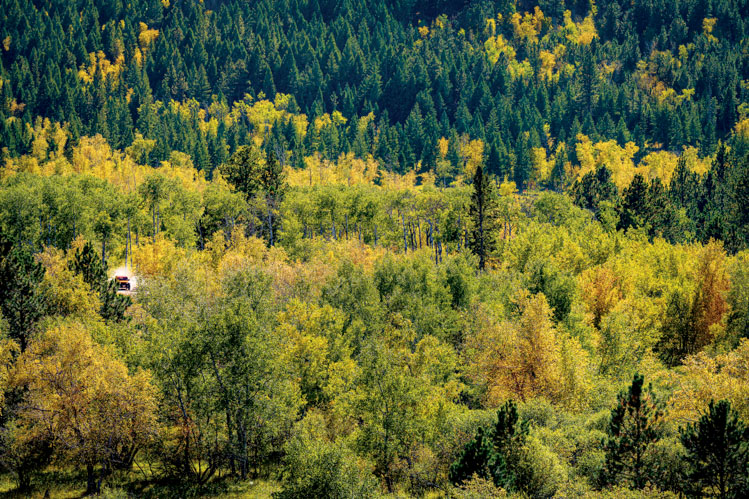
| Drivers experience an autumn smorgasbord along Palmer Creek Road, which winds through thick aspen forests and broad meadows. |
A SOLITARY COTTONWOOD tree on the lonesome prairie, when bejeweled with golden yellow leaves, emanates as much beauty as the human eye can absorb — especially when the sun slips southward, leaving the September sky bluer than blue.
Yet, who looks for a single tree in autumn? We tell ourselves we must see mountains and hillsides and river valleys with their forests full of leaves, each one hanging precariously by a stem, fluttering unworriedly as if winter was a thousand years away.
So yes, of course, go forth this autumn and fool yourself into believing that this glittering season is not just a cruel trick of chlorophyll. Life will always be so good. Calamity can never follow such serenity. South Dakota is paradise eternal.
Certain places in our big state are especially guilty of contributing to the delusions of autumn, beautiful though they may be. Traffic jams can occur on Highway 14 in Spearfish Canyon during peak leaf-peeking days. Sica Hollow’s oaks are almost as beguiling for people who live in the northeast. Our urban forests are resplendent in different ways because city parks and boulevards feature a gloriously unnatural mix of planned and planted trees. The McKennan Park neighborhood in Sioux Falls is an exceptional example.
We asked our chief photographer, Chad Coppess, if he knew of some lesser-known fall foliage tours. He suggested the three that follow. Interestingly, one that he chose is at South Dakota’s very lowest elevation while another is near the highest. Chad’s diplomatic third choice lies in between, along the Missouri River.
These routes won’t have bumper-to-bumper traffic in September and October when our leaves change color, but that is part of their allure. Autumn is even more striking when you escape the crowds.
 |
The graveled Palmer Creek Road is less than 4 miles long yet offers more than its weight in gold leaves between two spectacularly located campground resorts. Horse Thief Campground and Resort lies on the southwest end of the road and the Mount Rushmore KOA at Palmer Gulch Resort on the northeast. Both campgrounds have funky little stores that offer snacks and refreshments.
Midway along the road, an engineer had some fun by designing a double crisscrossing section with an over-under bridge and a cut through a rock that delivers a jaw-dropping view of Black Elk Peak no matter which way you are traveling. The road winds through beautiful aspen groves and, at times, offers a panoramic view of the entire gulch.
Little-known fact: Along the road is a parking area for Palmer Creek Trailhead, where you can trek to the top of Black Elk Peak (South Dakota’s highest point) and beyond.
 |
Those who prefer to venture off the interstates know that Highway 44, a main artery across the southern third of South Dakota, crosses the Missouri River via the Platte-Winner Bridge.
The stretch between Platte and Winner is 53 miles. The most scenic area features bluffs that drop into the river valley where you’ll discover two state recreation areas — Snake Creek on the east side and Buryanek on the west.
Lewis and Clark traveled here in 1804 and 1806, at one point losing a member of their party for several days. The Shannon Hiking Trail in Snake Creek Recreation Area commemorates the lost explorer and gives expansive views of the river and autumn colors.
Little-known fact: Unless you live in the neighborhood, you may not have heard that the mile-long Platte-Winner Bridge is about to be replaced. Construction on a new bridge may begin in 2025.
 |
State Highway 109 runs up the South Dakota side of Big Stone Lake in the northeast corner of the state with a view across the lake into Minnesota. We recommend the 15-mile stretch from Big Stone City to Hartford Beach State Park with frequent stops at access points to the water. The route offers a variety of vegetation and colors for leaf peepers. Hartford Beach is one of the oldest South Dakota state parks and is popular with campers, boaters and fishermen. The log cabin trading post of Solomon Robar, along with Native American burial mounds and pioneer graves, are found along the hiking trails in the park.
Little-known fact: The shoreline of Big Stone Lake (elevation 965 feet) is the lowest spot in South Dakota.
Editor’s Note: This story is revised from the September/October 2023 issue of South Dakota Magazine. To order a copy or to subscribe, call (800) 456-5117.

October on the Northern Plains can be fickle. One day might bring perfect autumn hues and warm sunsets, and the next may bring bone chilling wind that carries the autumn leaves to parts unknown, replacing them with snowflakes and frost. Every so often, the seasons combine without the soul sucking wind and a brief period of visual magic descends on our landscapes. That’s exactly what happened this fall in southeastern South Dakota.
On October 21, I broke away from the usual and took a drive. Yankton County was my eventual endpoint, but I didn’t really know that when I left. As many of you know, country churches are a favorite subject of mine. With one of those nearly perfect fall evenings developing, I headed toward a cluster of churches, hoping to find some autumn magic. St. Columba, Faith United and historic Vangen churches made their way into my viewfinder. The late afternoon and early evening light accentuated the fall colors, and all was well with the world.
The winds held back for another week, so when the first snow of the season arrived, the color of autumn and white crispness of winter merged. I noticed a couple of birds hanging out in the trees of our courtyard, staying out of the snow presumably. One was a robin, which is part of the robin family that nests in said courtyard, but the other was a rare-to-me fox sparrow. This bird has pronounced rusty tones and is one of the prettier sparrow species.
After photographing the birds, I decided to see what else was happening around Sioux Falls as the snow fell. Sherman Park had many trees still in full autumn splendor, and I discovered large flocks of winter birds and migrating sparrows there, as well. Dark-eyed juncos and Harris’s sparrows were the most abundant.
I finished the afternoon taking a walk along Split Rock Creek in the upper portion of Palisades State Park. The temperature hovered right around freezing, so the rocks were slick, and the going was slow. Even so, the walk did my soul good, as it usually does in our scenic areas. The drive home, on the other hand, was a bit dangerous. I’ve always noted the signs warning drivers that the stretches of highway atop bridges often freeze first. On this day I witnessed it and saw a couple near accidents happen just in front of me on Interstate 90 between Brandon and Sioux Falls. Winter weather, for all its potential beauty, can still wreak havoc. Sioux Falls received just a skiff of snow, and we have had none since. And that is okay with me.
Christian Begeman grew up in Isabel and now lives in Sioux Falls. When he’s not working at Midco he is often on the road photographing South Dakota’s prettiest spots. Follow Begeman on his blog.


Fall has arrived in South Dakota, although in some places a few winter blasts have already tried to push autumn out. These same locations that have seen snow are some of my favorite early autumn haunts. The high country of the Black Hills is always a treat in late September. The last week of the month is typically the most colorful time to cruise the backroads and do some leaf peeping.
That said, Badlands National Park lies between my home and the Black Hills, and I cannot resist getting off the interstate to spend time there. This West River spectacle sparkles in early autumn with wildlife active around dawn and dusk. The golden light accentuated by the season’s dry and dusty air makes great photography opportunities.
After staying the night in Wall and driving to Sage Creek Wilderness on a crisp morning with temperatures in the low 40s, a low fog hung in the bottomlands as the first light of day struck the tops of the formations. The resulting scenes were otherworldly. I’m not a morning person, but a view like that will get me up well before sunrise any day.
After saying farewell to the Badlands, I arrived in Custer State Park about four days before the Buffalo Roundup. The trees in the draws were just starting to turn and the mountain bluebirds were flocking along the southern reaches of the park. I spent a good hour watching at least a dozen juveniles and adults prowl a prairie dog town on the hunt for insects. Occasionally two or three would squabble and take flight to show off their airborne acrobatics, the blue wings flashing like azure electricity in the early autumn air. The afternoon was quite warm, which made the insect activity abundant and the small stream where I parked a favorite pit stop.
It was cold again the next morning. Mist and low fog hung over the small lakes. Bismark Lake was particularly beautiful as dawn approached. Just enough frost clung to the small bushes and brush on the back side of the water that each leaf looked sugar coated.

Later in the day, I ventured to the Spearfish Canyon Scenic Byway. It was the middle of the week, but as busy as I’ve ever seen. Wanting a little more solitude, I traveled into the high country to discover some quieter autumn scenes. There is a place where the Tinton Road converges with both Wagon Canyon Road and Schoolhouse Gulch Road that offers an exquisite view of aspen and birch, and I had arrived in peak fall color. Later, as I returned to my cabin near Legion Lake, I saw three white-tailed bucks near the Badger Hole. The largest, a four-by-four, was just starting to gain girth in the shoulders and neck for the upcoming rut. For now, it simply grazed in the tall grass just north of the road and paid me little mind. I wonder if it understands how lucky it is to call this little corner of South Dakota home.
Christian Begeman grew up in Isabel and now lives in Sioux Falls. When he’s not working at Midco he is often on the road photographing South Dakota’s prettiest spots. Follow Begeman on his blog.


The final leaves have fallen. The songbird migration has long ended, and the waterfowl migration is now in full force. The seasons of life have given way to the cold north wind and snowflakes that have danced once or twice across our windshields already. The harvest is wrapped, and our traditional season of thanks is beginning. It is November. And really, the month of November marks the end of autumn in our part of the world rather than the official first day of winter, December 21.
Rather than succumb to the dreary days of lessening light, I think it is a good time to reflect upon nature’s last flourish of color. Late August through mid-October provides vivid colors on the prairie and surrounding hills and this year was no exception. It seems that late summer and early autumn prefer vivid blues when it comes to wildflowers. From bottle gentians to great blue lobelia, the colors of the petals seem to be drawn straight from the hues of an early evening eastern blue sky.
Butterfly season is also on full display. Monarchs from South Dakota and points north gather and then fly south to Mexico. Other beautiful species are easily spotted if you have patience. I’m a fan of the regal fritillary that rivals the monarch in vivid orange and black beauty. The regal is a tall grass specialist so keeping our remnant tall grass prairie intact and healthy is key to keeping this butterfly around. A favorite place to spot them is the Nature Conservancy’s Aurora Prairie east of Brookings.
After the late summer blues diminish, brilliant oranges, reds and yellow begin to paint the landscape. The color usually begins to turn in the higher elevations first, and then it makes its way down to the valleys and towns. These colors of autumn grace the Black Hills and Badlands in late September and can go well into October along the Missouri River hills and eastward. Besides the well-known autumn vistas of Spearfish Canyon or Sica Hollow, Palisades State Park near Garretson is a favorite place to visit. The drama of Sioux quartzite rock and canyons are beautifully accentuated by autumn hues, particularly in the late afternoon light.
November marks the end to most of nature’s colorful beauty described above, but I also find that fall sunsets seem to be the most exquisite of the year. So, I can’t really say the season of color has left us for good. It can still be found way out there on the horizon, somewhere just beyond our reach, like the promise of new life coming next spring. The cycles of the seasons are felt maybe more acutely on the Northern Plains than anywhere else on the continent, but I wouldn’t trade that for anything. Winter has subtle and harsh beauties of its own, but more importantly, the cold reminds me not to take for granted the loveliness of the seasons of warmth and life.
Christian Begeman grew up in Isabel and now lives in Sioux Falls. When he’s not working at Midco he is often on the road photographing South Dakota’s prettiest spots. Follow Begeman on his blog.


Fall color is at its peak in Spearfish Canyon and other locales around the Black Hills. John Mitchell has been exploring the mountains and valleys and shared these photos with us.


Autumn always comes early to the high country. While late summer lingers across the rest of the land, the high coulees and upper draws seem to consistently show the first real signs of the season. The last week of September is normally the peak of fall color in places like Spearfish Canyon, the Slim Buttes and even Sica Hollow in the northeast corner of the state. For this reason, I regularly find myself wandering the back roads and trails of the high country every year about this time. It’s not that I welcome the end of summer, but it’s hard not to love autumn around here.
The beauty is fleeting, admittedly. When the weather patterns switch in this season of change, it brings strong winds that rob the trees of their dying leaves. That’s a lesson unto itself. There is beauty in endings. Sad though it is, it helps that there is promise of new life returning after the long winter.
This year I started around Sica Hollow during the golden hour on September 26. I was a bit early for fall color peak, but the color that was showing in the late afternoon and evening light seemed to accent the autumn beginnings quite wonderfully. A couple of days later I hit Badlands National Park, where the upper draws of Sage Creek were brilliant. One thing I learned is that yellow-leaved trees make for interesting visuals in a black and white image. They look nearly white.
After spending a day and half wandering around the Badlands, I made my way for Custer State Park. Needles Highway offers unique autumn color combined with winding roads and sweeping vistas. The fall foliage along the park’s creeks also offers colorful hues. From Custer State Park, I headed to the high country of Lawrence County by way of the Mystic and Rochford roads, finally ending up in Spearfish Canyon by late afternoon. This scenic byway is a must-drive in autumn. One extra perk this year was a small herd of mountain goats grazing near Bridal Veil Falls.
I finished up my tour of the high country in the first days of October by traveling north to the Slim Buttes and Cave Hills of Harding County. These areas are part of the Custer National Forest primarily for their stands of evergreens atop the buttes and hills, but they both offer great stands of deciduous trees along the draws and valleys. These places have become an autumn favorite for me. This year I missed the peak at the Slim Buttes as the color was nearly gone when I passed through, but the Cave Hills were nearly perfect. It goes to show just how fleeting fall’s beauty can be here on the high plains, even within a single county. Even so, the drive and views were worth every minute. The good news is that now the rest of the lower country as well as city and towns should be starting their autumn transformations. So, if you couldn’t make it to the high country, you still have a chance to get out and enjoy the rest of the season.
Christian Begeman grew up in Isabel and now lives in Sioux Falls. When he’s not working at Midco he is often on the road photographing South Dakota’s prettiest spots. Follow Begeman on his blog.


Spearfish Canyon is one of South Dakota’s prime destinations to view fall foliage. John Mitchell drove through the canyon as September turned to October and was greeted with eye-popping yellows, oranges and reds.


The fall of 2019 was moody and somewhat mysterious. It arrived late and left early. The abundant rains of this year’s warmer months kept the landscape green long into October. When the leaves finally decided to give in to the season’s turning, the winds that ripped them from their branches weren’t far behind. An old photography adage says that bad weather makes for good photographs, so even though autumn barely touched down this time around, there were still good opportunities for photos.
Around the first of October, I was in the western portion of our great state. In Custer State Park, prairie coneflowers were still in bloom and there was plenty of lush, green grass. But up in the high country, the wet weather hovered between cold rain and freezing mist. This made for extraordinary macro visions of colored leaves holding hands with newly forming ice droplets.
A few days later, I ventured into the rugged country of Harding County only to see that the Slim Buttes had a cloak of snow at the base of its annual autumn splendor. A little further south at Castle Butte, I caught an interesting vision of hay bales smoking in the early morning sun. At least that’s what it looked like. What was really happening was that the warm sun was striking the snow directly, and instead of melting, the water in the snow went right into the gas stage, vaporizing into the morning air.
The following week, the early snow seemed to follow me back across the state. The foliage had begun to blush by then, and with the thick snowflakes the scene at the Outdoor Campus in Sioux Falls soon resembled an impressionistic masterpiece.
The Big Sioux River was in flood stage for most of this year. Oddly enough, because of this I found my greatest visions of fall beauty all year. At the Big Sioux Recreation Area near Brandon, the forested flats near the riverbanks have walking paths and a disc golf course. Unfortunately, the majority of this area was under water all year. By the time fall colors peaked along the riverside, the waters had receded into the banks but left behind mud flats and still pools of water. This phenomenon presented a unique way to enjoy the fall beauty, as mirror-like pools essentially doubled the fall color. It was quite an enchanting scene, even though I nearly ruined a pair of hiking shoes with mud and water on three different trips to try to capture this new-found beauty. Although I could see the loveliness of the season through the mess, there is still quite a mess to clean up before that area of the park returns to normal. It reminded me of all the other resulting troubles our state has endured in 2019.
So, like the season itself, the scenes I captured are a bit bittersweet. Yes, they are beautiful, but the beauty came at a cost. Likewise, autumn in its fleeting beauty means the hardships of winter on the high plains is nigh. It is a cost we must pay every year. Even so, I can’t help but love fall in this part of the world. I just hope it sticks around a bit longer next year.
Christian Begeman grew up in Isabel and now lives in Sioux Falls. When he’s not working at Midco he is often on the road photographing South Dakota’s prettiest spots. Follow Begeman on his blog.


A cold and steady rain pelts the north windows as I write this month’s column. It reminds me of my first day out chasing fall colors in northwest South Dakota just two weeks ago. Autumn color comes to the high country earlier than the valleys and towns of southeastern South Dakota, so when I left Sioux Falls, with its green-leaved trees and barely-brown lawns, after work on September 26, it hardly seemed like summer was ending. When I arrived at the Slim Buttes of Harding County around lunchtime the following day, the draws where adorned with the gold, yellow and orange dress of a high plains autumn. The problem, however, was that the sky was dull and overcast. Then for good measure, a determined string of raindrops began to fall. I don’t usually mind the rain, but I have seen the Slim Buttes catch the golden sunlight of an autumn evening. That’s why I came back.
There are several other places to find autumn beauty in this state. Sica Hollow State Park and the surrounding Coteau des Prairies hills and lakes in northeast South Dakota offer stunning patches of red sumac in the underbrush of yellow, green and orange foliage during late September. Goldenrods can still be in bloom along with aster if the rains hit just right. The northern Black Hills is well known for the bright yellows of birch and aspen that adorn Spearfish Canyon’s scenic byway. Custer State Park also has patches of color along its winding roads to the high country and lower creek valleys where the Southern Hills meet the open plains. It has become an annual journey for me to drive through this last hurrah of color before the wind blows it all away and snow covers the land.
I will always believe the Slim Buttes of Harding County is the best place to welcome autumn. The unique landform — a 300 to 400 foot rise in a giant L-shape from the high prairies — is majestic enough at any time of year, but it just doesn’t get any better than when the color of fall accents the hills and ridges against the deep greens and pine browns of Custer National Forest’s evergreens. And that is why I returned the day after it rained as the sun and clouds played tug-of-war in the sky. There was very little wind and the air was cool and fresh. It was light jacket weather with hardly any insects. High plains perfection. I stood for an hour in one spot along the JB Pass Road waiting for the sunlight to hit a patch of trees just right. A coyote called and I saw it move down a far ridge into the trees. A lone pickup passed along the road behind me and then it was quiet. Just me, the sky and trees as far as I could see. Food for the soul.
Later that evening, the sun broke free from the clouds just before sunset to bathe the castle formations in golden hour light. I was on my way east through the Reva Gap as the scene before me was transformed into a work of art. I stopped along the highway and shot photos until the sun was hidden behind the buttes again. This is why I lingered into the evening at one of South Dakota’s most remote but exceedingly breathtaking places. This is what I came to see.
Christian Begeman grew up in Isabel and now lives in Sioux Falls. When he’s not working at Midcontinent Communications he is often on the road photographing South Dakota’s prettiest spots. Follow Begeman on his blog.


