Posted on Leave a comment

Pine Needle Basketry

Trisha Blair’s baskets continue a centuries-old practice that traces to the Anasazis of the Southwest.

Trisha Blair believes that anyone who appreciates the concept of making something from nothing — and who has a persistent nature — may want to try creating coil baskets from ponderosa pine needles.

Despite droughts, forest fires, pine beetle infestations and civilization, the ponderosa pine remains the dominant tree in the Black Hills. The mountain range’s very name was inspired centuries ago by its peaks and valleys forested with darkish green pine needles. The Lakota called it Paha Sapa, which translates to”dark hills.”

A typical needle grows to 6 inches over three or four years before shedding. Sometimes the mat of needles on the forest floor becomes so thick that it represents a fire hazard in dry conditions. Property owners often rake up the needles, both for aesthetics and to eliminate them as tinder. Some “green thumbers” use them as mulch in their mountain gardens.

Blair has found a higher use. Like Native Americans of centuries past, she uses the needles to create beautiful baskets — not by weaving but by coiling. The former English teacher, an accomplished oil and acrylics painter, says her art career began as a child.”We had an outdoor toilet and the four rough walls were conducive to drawing and painting, which I did. I covered them with pictures of horses and naked ladies. It seems that I liked Lady Godiva with long, flowing hair, and that’s where my art started.”

In the 1970s, Blair was studying in New Hampshire and exploring the East Coast when she toured the Smithsonian Museum in Washington, D.C. A friend was working there, so she got to enter the backrooms and see collections not open to the public, including blankets and baskets made by the Anasazis hundreds of years ago.

She held the baskets, studied the coils and noticed both their perfection and the imperfections.”I remember thinking even then that it’s something I felt I could do.”

Upon returning to South Dakota, Blair worked as a teacher and began painting pictures. Through the years, she developed a problem:”I couldn’t bring myself to sell the paintings. They are too much a part of me. I have a treasure room full of them and every relative has them hanging on their walls.”

When she embarked on basket making, a friend wondered if the baskets would end up in the treasure room with the paintings.”You know what’s going to happen,” warned the friend.”When you die, your son is going to box them all up and sell them for a quarter.”

Thanks to her friend’s honesty, Blair pledged to enter her new art phase with less sentimentality. As soon as she was satisfied with the quality of her baskets, she offered them for sale at a Deadwood art gallery.

Several years ago, she joined the Chautauqua Artisans Market, a group of artists who share a gallery on River Street in Hot Springs. Her baskets are also exhibited at Art Expressions in Custer and ArtForms in Hill City. She has sold them to appreciative buyers throughout the United States, and as far away as Russia and the Middle East.

North American basket making likely began with the Anasazi, a people known as”the ancient ones” who lived in cliff dwellings and stone pueblos in today’s Utah and New Mexico. The Anasazi mysteriously departed the area about 700 years ago, but many of their crafts and traditions were embraced by other tribes.

Blair is entirely self-taught; her encounter with the Anasazi baskets at the Smithsonian was her only tutorial.”That’s where I was inspired, though I never thought then that I would be doing it today.

“Their baskets had no knots, which is a challenge,” she says.”I also noticed that they made tiny mistakes,” which freed her from the burden of trying to perfect each stitch.”Another thing, you couldn’t tell where the coiling ended so that’s always been a goal of mine.”

Blair says coil basket making is slow and tedious.”I can spend a couple of weeks on a basket,” she says.”My son says I make 5 cents an hour.” However, like the”ancient ones,” she doesn’t do it for money. There’s satisfaction in making something beautiful from nature’s bounty. She has developed her own techniques and tricks. She even copyrighted a unique method of using a tooled leather base.

Blair believes almost anyone can learn, though it’s akin to hitting a baseball or riding a bike: you could read about it forever, but you need to see and do.

Fortunately, numerous YouTube videos and tutorials can be found online for visual learning — and Blair generously offered to explain the process as it works for her.

Needle Selection

Never take healthy green needles from a branch unless the branch is already broken and dying, and, conversely, try not to take needles off the forest floor because they may have bark lice or fungi, especially if they appear black.

“The most beautiful needles come from trees that have been stressed out by a fire or from the bug infestation,” she says.”When there is a fire that’s the first place I look.”

It’s easiest to work with longer needles; hopefully you can find some that are 4 to 5 inches long. She says pines in the Northern Hills generally have longer needles than those in the Southern Hills. If you harvest green needles, it takes a year to dry them and even then they don’t have the beauty of a needle that dries on the branch.

Blair tried a shortcut that nearly ended in disaster.”My son found some wonderful green needles, and I thought I would try to dry them in the oven.” She quickly learned why pine needles are such a fire threat.”They caught fire and I could have burned the house down,” she says.”Don’t do what I did.”

Blair washes the needles with soap and water, boils them, lays them on newspapers to dry and then puts them away until she is ready to coil. She also decaps the needles while they are wet, though she notes that some basket makers leave the caps for a more rustic look. Decapping is a laborious job, so she says you can expect friends and relatives to avoid you at that stage.

Gathering the Tools

Basket making requires pine needles, waxed thread (Native Americans used sinew, and some basket makers still prefer it), a base material such as wood or plastic, a sharp scissors, a sharp sewing needle with a large eye and a gauge to hold the coil of needles as you sew them together.

The gauge also maintains a uniformity in the coil size as you circle the basket. Some people use a 2-inch piece of 3/8-inch copper or plastic tubing; Blair simply uses a short piece of a large soda straw (again, about 3/4 of an inch wide and 2 inches long).

The base can be anything — round, square or rectangle. Nature-loving artists use a section of a black walnut shell; the natural holes in the cavity provide a way to sew it to the first coil of needles.

A round bit of plastic, wood or any other material is suitable. Drill or punch holes around the edge so it can be sewed to a coil. A 4-inch coil of needles can also serve as the base, and that’s the method described below by Blair.

Begin to Coil

Blair says the needles must be wet and flexible, so wash them and pull off the caps at the end, but don’t separate them if they don’t separate themselves (often there will be three needles to a nodule or cap).

Put about 3 feet of string on the sewing needle. Fill the tube or straw with pine needles (it will probably hold 4-6). Start wrapping the thread tightly around the needles for three inches or so, moving the tube as you go.

After you have 3 to 4 inches sewn, force the coil into a circle, bending the needles back on themselves; secure the circle by pushing the needle and thread through the circle.

Making the Bottom

Reload the tube and continue with your first coil. Each time you wrap thread around the coil, you also stitch it through the previous coil. For aesthetics, find a method to keep the threading even from coil to coil; Blair uses her thumb to measure the distance. Keep adding needles to the tube as you go, always keeping it full so the coils are an equal thickness.

Whenever you get down to about 4 or 5 inches of thread, filter the thread onto another 3-foot string. If you find it too difficult to weave one length of thread into another, you could tie a knot and then hide the knot between the coils, but remember that the Anasazi never used knots.

Once the bottom is as wide as you wish (and why not begin with a small basket?), start to slant the needle upwards so the basket will naturally go up.

Creating the Walls

You can choose to make a straight wall around the bottom or taper it by gradually sloping each coil outward. As you spiral out, the stitches should get farther apart; again, find a method to space them properly. Keep the coils tight. Once you’ve reached the desired height, stop adding needles to the tube and allow the needles to taper down. Trim the needles with a scissors if they don’t taper properly. In the Anasazi baskets, it is hard to see where the coil ends.

Don’t hurry. Blair says even experienced basket makers can spend an hour per coil.

Finishing the Basket

Blair says”the ancients” used pitch bark to seal and preserve their baskets, but today it’s probably easier to use beeswax or shellac.”I thought I would use pine sap. I burned a tank of gas, driving through the forest. Hours later I had this little wad of pitch, mostly from bark beetle trees. It was just about enough to do an eighth of a basket.” She recommends varnish, beeswax or nothing at all.

Start with a small project, perhaps even a coaster, to avoid frustration. Blair suggests that beginners do small baskets of perhaps 3-4 inches in diameter. Explore opportunities to learn online or in person at a class or workshop. Even inspecting a coil basket in your hands can inspire and educate.

Finally, Blair suggests from experience, don’t hide your pine needle crafts under a bushel basket or in a treasure room; show them off, offer them at a gallery or use them in your home.

Editor’s Note: This story is revised from the May/June 2021 issue of South Dakota Magazine. To order a copy or to subscribe, call (800) 456-5117.

Posted on Leave a comment

Wild Horses in Winter

Editor’s Note: The Black Hills Wild Horse Sanctuary is no longer open to visitors. This story is revised from the January/February 2019 issue of South Dakota Magazine. To order a copy or to subscribe, call (800) 456-5117.

The mustangs of Fall River County wander steep cliffs that descend to the Cheyenne River Valley, the highlands of Hell Canyon and other Black Hills geological wonders.

We arrived at the Wild Horse Sanctuary on a cold and sunny winter afternoon. The mustangs, shaggy with winter hair, didn’t even glance up as we drove down a good gravel road toward what looks like many other West River ranches.

Two old houses and several modest barns sat at the end of the road. Wild turkeys were roosting on the hitch of an old horse-drawn wagon and deer — several with massive antlers — grazed near some haystacks. A smattering of snow lay around the corrals; deeper drifts could be seen in the hills above.

An aura of peacefulness blankets many South Dakota farms and ranches, especially in winter when the pace slows for man and beast. Still, you’ll find few places with more tranquility than this spacious, 14,000-acre sanctuary in Fall River County, a 10-minute drive south of Hot Springs on Highway 71.

Writer and naturalist Dayton Hyde founded the sanctuary in 1988 and helped to oversee its operations until his death in December 2018, but its wild mustangs have always been the stars. They are descendants from horses brought to Mexico and Central America 500 years ago by Spanish explorers. Despite their southern roots, they’ve acclimated well to the northern plains.”If you took them from California in the winter they might not be ready,” Hyde told us,”but if they come in the summer they’ll grow hair in the fall. They also know instinctively to maintain a closeness to the other horses; they’ll bunch up and warm each other. It’s the way they battle the flies in the summer and the snow and cold of winter.”

“The horses seem to like winter better than the heat of summer,” adds Susan Watt, executive director of the sanctuary for the past 20 years. But too much confinement makes them uncomfortable.”If someone wants to keep them in a barn, they’ll think, ‘oh no, that’s not what I like to do.'”

The horses do appreciate some human intervention.”We park the tour busses near the corrals so they break the north wind, and the horses don’t seem to mind that,” says Watt.

A full belly is the best defense against a South Dakota winter, and once again the humans of the sanctuary play a hand; they feed a half million dollars worth of hay every winter, along with a molasses supplement called”cake.”

Sanctuary staff have names like Painted Lady, Medicine Hattie and Magnificent Mary, for many of the wild mares. The horses may nick and bite one another to establish herd hierarchy.

As the sun disappeared behind the Cheyenne River bluffs, we retired to a cabin. After dark, it’s eerily quiet. You might hear a coyote’s howl, or the hoot of an owl. Walk outdoors, and you’ll believe those astronomers who speculate that there may be 100 billion stars in our Milky Way Galaxy; their brightness illuminates the sky, the chalky river bluffs and the snow-covered grassland.

Horses corralled near the sanctuary headquarters were already feeling frisky as the sun showed itself in the morning. Perhaps they were anticipating the molasses cake; some were frolicking, nipping at one another’s necks, establishing their pecking order. Their steaming breath floated in the 10-degree air.

A sanctuary staffer offered to give us a pickup tour. We rattled across frozen ruts and rocks, heading for high ground. Elevation at the sanctuary headquarters is 3,500 feet; we reached an overlook that measures 4,500 feet.

There the snow was a foot high in spots, deeper yet in the ravines, and the ponderosa pine forest was a glistening winter wonderland. Mule deer with racks like Santa’s reindeer grazed on winter grasses in the meadows. A coyote sauntered ahead of us.

As we neared several small herds of wild horses, we parked the pickup. Soon we were surrounded by a dozen or more of the most curious. The mustangs can be jealous and may even bite with their big teeth. Our guide says they never nicked a visitor, though she was once lightly bitten on the thigh. The safest place to stand is along the shoulder or flank.

On summer outings, the guide carries a stick and a bucket in the truck box in case she spots a rattlesnake. That’s not a worry in winter –flies or snakes are nowhere to be found.

This land marks the convergence of the great northern prairie and the deciduous Black Hills ponderosa pine forest, so the views are unique to the world. Pelicans fish on the Cheyenne River, which twists through the very heart of the sanctuary. Cascade Creek, fed by the ever-warm spring waters that gave name to the nearby city of Hot Springs, steams on a winter’s day. In summer, sunbathers and swimmers congregate at Cascade Falls, a historic swimming hole just north of the sanctuary along Highway 71. In winter, the little falls — bordered by foliage frosted from the mist — are an ethereal sight.

We drove past a Sun Dance lodge where Lakota men and women gather in the summers for vision quests, sun dances and other spiritual and cultural activities. In winter, cedar branches that shade the Native Americans in July are now brown and dry. Buffalo skulls, bleached as white as the snow, are lined on a slope. Hyde welcomed the sun dancers 20 years ago and they have been coming back ever since.

The sanctuary also includes ancient Lakota hunting grounds where people came to collect medicinal plants and herbs along the river. Hell Canyon, Wildcat Canyon and a dozen other scenic and historic crevices spill out of the southern Black Hills onto the rough hill country.

The sanctuary staff know the names of the families who homesteaded there, and even the history of the roads that pass through the five-square-mile sanctuary. Yes, roads have histories here. They’re not taken for granted. Ranchers depend on roads that cross each others’ pastures for access to the main roads.

Fences also have histories, even gates; an automatic gate was installed to ease the aging Hyde’s comings and goings. Unfortunately, the mustangs quickly figured it out. They learned that if enough of them stand and squeeze against it, that it will open. Basically, they know they have to simulate a vehicle.

Even in winter snow, yucca, prickly pear cactus, buffalo grass and other vegetation peeks through on the windswept hilltops. As we returned to the ranch headquarters, we noticed a newer variety of plant — a tidy vineyard of Concord grapes, now dormant and leafless.

Quiet and solitude are year-round virtues of the sanctuary. Winter simply adds an extra hush.

Posted on Leave a comment

Warm Water, Warm Hearts


One of the most beautiful evenings of the South Dakota holiday season comes Tuesday (Dec. 8) at Hot Springs, a city with a 131-year legacy of caring for the veterans of South Dakota. That’s when the local Stillwater Hospice (112 S. Chicago) welcomes family and friends of deceased veterans for its annual Holiday Tree to Remember program, beginning at 5 pm.

Dawn Hurney, Stillwater’s director of clinical services, says attendees are welcomed at the door and offered an ornament to hang on a tree in honor of their loved one.”We have a signup sheet at the front where they can write the names of their veteran. This can be someone who died in the past year, or who died many years ago. As the program gets underway we will read the names, and if they wish they can talk a little about the loved one they lost. It’s a beautiful time. It never ceases to amaze me how touching it is.” Hurney says the program is not limited to families of hospice patients.

Hot Springs has a rich history of caring for soldiers and veterans. In 1889, the very year that South Dakota gained statehood, the legislature established a Soldier’s Home there, partly because the city’s natural warm-water springs had already gained a reputation for health and rejuvenation. A few years later, the National Home for Disabled Volunteer Soldiers began to send Civil War veterans to Hot Springs. The care was so well-received — both the waters and the people there — that President Teddy Roosevelt signed a bill to establish a federal veteran’s hospital that was originally called Battle Mountain Sanatorium.

Today the state’s nursing home is thriving. It’s now called the Michael J. Fitzmaurice South Dakota Veterans Home. The federal sanitarium grew to become the Veterans Administration Black Hills Health Care System. Hot Springs’ healing history has won it a nickname as”The Veterans’ Town,” and now attracts tourists who appreciate the patriotic mission of the community’s citizenry.

In recent years, federal officials were making plans to close the federal hospital. A”Save the VA” group organized to prevent the closure, and last September the Veterans Administration announced that it would remain open.

Warm spring waters was the first attraction for state and federal leaders who established health facilities in the Southern Hills city of 3,500. A warm-hearted culture has kept the nursing home and hospital open. Tuesday’s holiday tree service at the Stillwater Hospice is a holiday example of how the people of Hot Springs care for our veterans and their families.

Posted on Leave a comment

Major or Not?

When writing about Hot Springs for South Dakota Magazine several years ago, I flashed back to fifth grade, green mimeograph paper and talking my way out of an academic jam.

As I’ve mentioned before in this column, in elementary school I lived in another state but was a fervent wannabe South Dakotan. To my thinking, at age 11, Hot Springs seemed like South Dakota’s most impressive city. And yes, by that point in my life I’d visited acknowledged major U.S. cities, namely Denver, Des Moines and Minneapolis. The notion that Hot Springs perhaps didn’t fit that category never crossed my mind. To my knowledge those other places had no vast, glowing hotel made of sandstone like the Evans. For sure they didn’t claim the world’s largest indoor naturally heated swimming pool.

Still Hot Springs didn’t make the list of suggested cities my teacher shared for our writing assignment. She did say, however, that there were certainly good candidates in addition to her examples. As I recall New York, Washington and Los Angeles were listed, and most definitely Baltimore. This teacher loved Baltimore. After my class pondered major U.S. cities for a couple days (not that I recall anyone pondering too strenuously) we announced our places of choice aloud. New York and Washington went fast. Los Angeles wasn’t far behind. When I said Hot Springs, my teacher nodded OK. Nobody chose Baltimore, which seemed to perplex her.

We had to write three pages and cite two sources. One source, we were told, would be easy: a set of encyclopedias on shelves at the back of the classroom. This being decades before the Internet, we’d access our other source by mailing letters. In this way we learned about chambers of commerce, travel bureaus and historical associations. We were instructed to enclose a SASE (self-addressed stamped envelope) with our information requests, but we were skeptical anyone would write back to a kid, SASE or no SASE. To our surprise, though, everyone got a reply, and in pretty short order.

In fact I got two responses, one from the South Dakota Highway Department and the other from the Hot Springs chamber of commerce or commercial club. I didn’t tell anyone but I wrote two letters in order to have two sources because Hot Springs wasn’t included in the school’s encyclopedia. Now it was my turn to be perplexed because my friend Matt found six full pages in the encyclopedia about Detroit, plus several more describing the city’s car industry.

All these years later I recall several things about the letters I received. It was an era of great letterhead art. My friends got letterheads featuring skylines, bridges, and complex municipal seals. But from the South Dakota Highway Department came my letter depicting Tootsie the Coyote howling at the moon.”Oh yeah,” I thought,”that’s the South Dakota I know.” One of my sources sent me a brief history of Hot Springs mimeographed on green paper, and as I wrote the article in this issue I found myself wishing I’d kept that historical overview. The folks in Hot Springs enclosed a picture postcard of Evans Plunge, and I knew for a fact that the postcard cost more than the postage stamp I sent them. But what truly amazed me was how someone in Pierre penned a little note at the bottom of a form letter, addressing me by name and wishing me the very best as I composed my theme. Incomprehensible! Someone in a government office in a state capital took time to tell me good luck!

As it turned out I needed good luck. The letters came to us at school, intercepted by our teacher, who noticed mine came from South Dakota.”I thought you meant Hot Springs, Arkansas, which isn’t real big,” she said.”But at least I’ve heard of it. I haven’t heard of this little place in South Dakota.”

I started sweating because I knew what would happen within two minutes if I didn’t think fast. I’d be handed the address of the Baltimore chamber of commerce and told to write for information.

“I think my Hot Springs is major because people from all over the country know about it and visit,” I blurted.”It has the biggest indoor swimming pool in the world where water comes out of the ground already heated.”

I could tell by my teacher’s eyes I had her interest.

“If you look at cars parked outside the pool,” I continued,”you’ll see license plates from every state you can think of.”

She”allowed” my town as major on the condition I mention all those visitors from all those states in my theme. I did. When we shared papers aloud a couple weeks later, Hot Springs was a hit. Everyone thought Tootsie made the coolest letterhead and my classmates were impressed by the cave that blows wind, and the town where water bubbles out of the ground warm enough for a comfortable shower.

I learned I could smooth-talk my way out of misinterpretations of school assignments, a valuable skill later in high school and college. I also discovered that in terms of character, history and unique natural features, small towns could be as major as New York, Los Angeles and Baltimore.

Editor’s Note: This column is revised from the September/October 2013 issue of South Dakota Magazine. To order a copy or to subscribe, call (800) 456-5117.

Posted on Leave a comment

Cultivating a Listening Culture

Mike Linderman and Jami Lynn record the third installment of Dakota Duets.

Mike Linderman was growing up in Greybull, Wyoming when he and his friends — soon to be seniors in high school — ordered instruments from a Montgomery Ward catalog and started a band.”We learned ‘Proud Mary’ and ‘House of the Rising Sun’ and played those two songs like a hundred times,” Linderman says.

It’s safe to say Linderman’s songbook has grown substantially since then. He’s established himself as one of the Southern Hills’ most recognizable musicians, and is featured in the third installment of Dakota Duets, a statewide tour featuring folk singer Jami Lynn and an assortment of South Dakota singers and songwriters.

Linderman fell in love with the landscape around Wind Cave National Park following a stay at a friend’s cabin and hiking adventures around Custer and Fall River counties. That led to his move to Hot Springs. He used his musical talents by performing and booking other artists at venues like The Songbird Cafe in Custer. The bi-weekly concerts and open mic nights were modeled after similar events at The Bluebird Cafe, a 90-seat music club in Nashville that features acoustic performances by nationally known artists and receives more than 70,000 visitors annually.

“Cultivating a listening culture as a music organizer is no small feat,” Jami Lynn says.”It doesn’t surprise me, however, that such a driven and focused individual as Mike could accomplish this.

“One of the first things I learned about Mike is that not only does he keep his guitar in a high quality hard case, but that case then goes inside a guitar cooler, or thermal case. I imagined someone who valued their instrument so much must also have mastery of it. I was not disappointed. His melodic finger-style accompaniment to carefully chosen or written songs not only thrills me, but brings me to a more focused listening space than usual.”

Linderman chose”One Lone Rowan Tree,” for this installment of Dakota Duets. The song by Kim McKee tells of the Celtic tradition of the burial of lost souls.”During a certain period of time in Ireland, if an individual was cast out of the church for any reason, a churchyard burial was also forbidden,” Jami Lynn says.”People started burying these loved ones under lone standing trees, believing the trees would watch over them. The story and song have a haunting quality that highlights Mike’s delicate finger-style arrangement and unadorned vocals. It was a pleasure to lend my voice to a carefully crafted arrangement of this beautiful song.”


Click below for previous Dakota Duets

Paul Larson

Thomas Hentges aka The Burlap Wolf King

Posted on Leave a comment

Hot Water and Old Bones

Last summer our family spent an afternoon at Evans Plunge in Hot Springs. Its warm-water pools have attracted people for decades, but it was the first time we had ever been there. I wasn’t prepared for the rocky bottom in the main pool, but the kids enjoyed the water slides, games and watching other swimmers try to cross the width of the pool Tarzan-style by swinging from ring to ring (neither of them were tall enough to try on their own).

Hot Springs is the seat of Fall River County, which encompasses 1,749 square miles in the far southwestern corner of South Dakota. As is the case with much of arid West River, rain is tough to come by. The county averages 20 inches or less of rain a year, which is why it seems so remarkable that water played such a tremendous impact on life in that part of the state.

We can say it began 26,000 years ago, when an enormous sinkhole formed on what would eventually become the southern edge of Hot Springs. The prehistoric creatures that roamed the continent — mammoths, giant short-faced bears, camels — ventured to the oasis to drink, only to discover its banks were too slippery to ascend. They died and were buried there, lost for millennia.

Visitors file past mammoth bones that lay buried for thousands of years. Photo by Chad Coppess/S.D. Tourism.

Then in 1974, Philip and Elenora Anderson began to develop that land for a housing project. Dirt work stopped immediately when a bulldozer unearthed a huge tusk. The Andersons donated the land to a nonprofit organization that built an enclosure over the site. Dr. Larry Agenbroad of Chadron State University in Nebraska oversaw the initial paleontological work there and stayed until his death in 2014. Today, visitors can stroll through the 23,000-square-foot Mammoth Site on walkways that provide views of volunteers working to expose fossils. The most recent count says that scientists and volunteers have discovered 61 mammoths, plus fossils from other land and sea creatures.

Fred Evans capitalized on water when he arrived in the Black Hills in about 1875 and heard about Minnekahta, or the warm water springs where Native Americans sought healing. The springs that eventually became Evans Plunge had a relatively inauspicious beginning. One early settler who owned the land on which the main spring is found reportedly sold it for a horse valued at $35. Evans built a grand sandstone hotel and enclosed the spring in 1890. He advertised its mineral waters, flowing from the earth at a steady 87 degrees, as a cure-all.

Hot Springs’ Freedom Trail follows the Fall River through town.

People came from throughout the country to test the springs’ medicinal qualities. The wife of a Nebraska senator visited and returned home feeling like a new woman.”Mrs. Paddock has fully recovered after many years of suffering, a result wholly due to the mineral properties of the Hot Springs water,” reported the Hot Springs Star. I don’t recall feeling particularly rejuvenated after our visit last summer, but the fun we had surely did something for our spirits.

If water could make a Fall River County town, it could also break it. A few years ago, a freelance photographer submitted a batch of photos he’d taken on a trip through Ardmore in the far southern reaches of the county. He thought at the time that maybe a couple of people still lived there, but it seems to be considered a ghost town today. Old cars, buildings and even the town’s water tower still stand, but there’s no life to be seen. Ardmore sprang up as a railroad town in 1889, but water was scarce. Hat Creek proved an unreliable source. A train car brought the last load of water into town more than 40 years ago. Still, Ardmore holds a special place for the people who grew up there. They still comment on the photo gallery we created from that batch of photos, almost four years after we originally posted it.

Old cars and a water tower are among the remains of Ardmore. Photo by Joel Schwader.

Fall River County is also the source of some historical oddities. The community of Igloo was created in the early 1940s when the U.S. Department of Defense located the Black Hills Ordnance Depot in rural Fall River County. Hundreds of dome-shaped structures resembling igloos began to rise across the prairie. Thousands of people lived at Igloo until the government cut the depot’s funding in 1967. Look closely when you pass on Highway 471; the strange ruins are still visible.

The canyons around Edgemont are home to mysterious petroglyphs that are thousands of years old. Several years ago, I talked to John Koller, who grew up on a 2.500-acre ranch along the Cheyenne River east of Edgemont.”I was told they were there, but as a kid out here, you work,” he said.”So when you pick up a rock and throw it at a cow to get it out of a box canyon, you don’t have time to stop and look at these wonderful finds. I crawled around these petroglyphs all the time, but didn’t pay attention.”

Later in life he began to appreciate the ancient art that surrounded him. He estimated one drawing to be at least 8,000 years old, while others were between 2,500 and 3,000 years old.

Hundreds of dome-shaped structures were constructed when the Black Hills Ordnance Depot located in rural Fall River County in the 1940s.

Perhaps the most interesting oddity I discovered while poking around Fall River County is a map that Hot Springs businessman Orlando Ferguson used to support his theory that the earth was square and stationary. Ferguson had the map printed in 1893. It resembles a bundt cake pan turned upside down. The continents and oceans lie around an indented ring, while the North Pole is raised in the center. The sun and moon are attached to an actual pole rising from that point.

His astronomical principles were based on a very literal interpretation of the Bible, beginning with the reference to angels visiting the four corners of the earth. From there, he developed his square and stationary idea. He claimed the sun was 30 miles in diameter and just 3,000 miles from earth. His reasoning? If you stand at the equator on March 21, when the sun is directly overhead, then the distance you can walk north or south without casting a shadow is equal to the diameter of the sun.

He also shunned the idea of gravity. Instead he thought atmospheric pressure held people down and pushed the oceans up the sides of his indented map. Stop by the Pioneer Museum and take a look at the map and a pamphlet he had printed. Chances are you won’t buy what Ferguson was selling, but there are plenty of other natural and historical wonders to be found in Fall River County.

Editor’s Note: This is the 34th installment in an ongoing series featuring South Dakota’s 66 counties. Click here for previous articles.

Posted on Leave a comment

Dinosaurs and Big Art

Bison roam freely inside Wind Cave National Park.

Just after dawn I hit the Nebraska-South Dakota line, moving north on U.S. Highway 385. I had a hundred bucks in my pocket and lots to see and do along this incredible road, leading 122 miles from the state line to Deadwood. It would be a good day.

For the next 25 miles I drove through southwestern South Dakota’s beautiful grasslands. Most people, though, think of Highway 385 in this state as a way to experience the heart of the Black Hills, and the Hills were my destination. First I wanted to visit a favorite place that bills itself as a”transition zone between ponderosa pine woodlands of the Black Hills and the mixed grass prairie of the northern plains.” I spotted my turn-off at Wallygator’s Bait and Tackle and in five minutes sat sipping coffee from a Thermos, watching the full morning break over big Angostura Reservoir — a damming of the Cheyenne River. While the Black Hills stand within view of Angostura, the lake feels more attuned to the prairie. Pronghorns bounded through lush grass just yards from the water.

Twelve miles later I arrived in Hot Springs and felt fully enveloped by the Hills. The town is home to plenty of attractions: Evans Plunge, the Mammoth Site, lodging and dining in historic sandstone structures. But this morning I sought the Black Hills’ heartiest breakfast. That’s the liver and onion breakfast served on two platters, with eggs and potatoes and toast, at the All Star Bar and Grill right on 385. Usually I’m not much for big breakfasts, but something about spending a full day in the Hills suggested that one was in order.

Janell Andis (center) has been serving Spudburgers for 20 years at Custer Crossing, a Highway 385 pit stop enjoyed by locals and tourists.

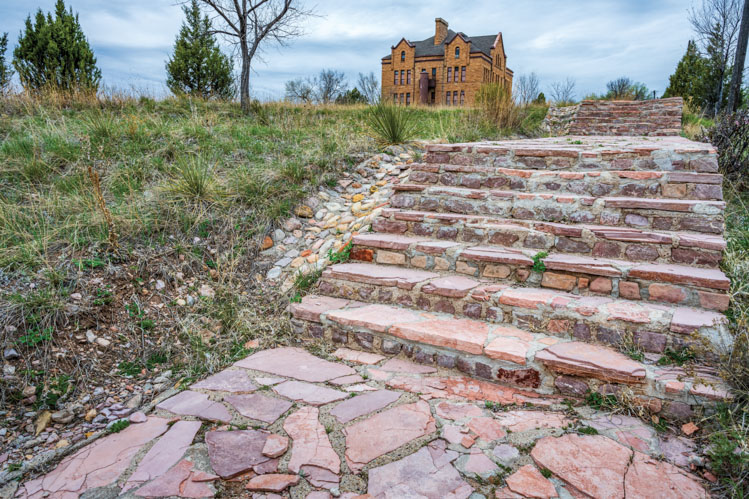
After devouring the liver and onion specialty, a traveler may feel a walk is needed before climbing back into the car. There’s an excellent urban hike through downtown and up old slab stone steps to the hilltop 1893 schoolhouse. These days the four-story sandstone school, now the Pioneer Museum, puts every square foot to work interpreting the history of the Southern Hills. The grounds offer a pretty view of the town below. This is the first of many museums along the state’s stretch of 385.

Ten miles beyond Hot Springs I entered Wind Cave National Park, established in 1903 by President Theodore Roosevelt. Immediately inside the park a sign read, BUFFALO ARE DANGEROUS, DO NOT APPROACH.

“It’s a deal,” I thought.”I won’t.”

But moments later a buffalo bull approached me. I pulled off the road and sat in my car, lost in notes for this article, writing about the view at the park’s south entrance: a mountain prairie dotted here and there by pines, with the Central Hills’ high peaks serving as a backdrop. Suddenly a great shadow darkened my paper and there the bull stood, right up against my car. I was glad I had been too lazy to follow through on my original plan of getting out of the car, sitting on the hood, and incorporating the scent of the summer morning in my notes.

Wind Cave National Park is home to this free-roaming bison herd, 30 miles of hiking trails, camping and the famous cave that spouts air. Park staff lead tours through the cave, officially the world’s fifth longest. But people in Hot Springs and Custer scoff at that designation. Most believe Wind Cave and nearby Jewel Cave, a national monument ranked as the world’s third largest cave, are one and the same. If passages connecting Wind Cave and Jewel Cave are ever mapped, the cave is the biggest on the planet.

North of the park the highway ran through a section of forest devastated by a 2012 fire, and beyond that point I saw increasing evidence of mountain pine beetle disease. As beetles kill trees, pine needles turn the color of dried blood. Those trees are widespread throughout areas of the Central Hills especially.

Approaching the town of Pringle, outcrops of granite began to appear as the highway entered a rocky zone beloved by climbers and sculptors. Pringle boasts two pieces of roadside art that by no means are the most famous along this highway. But I like them and always keep an eye peeled for them: the sculpted mountain lion slinking atop the Pringle Mercantile bar, and an unusual bicycle creation right next to 385 (left side when traveling north). Dozens of bicycles — some rusted, some gleaming and all with histories — cling together to make a curious geometric formation that glitters in the sun. This is serious bicycle country. The 109-mile Mickelson cycling and hiking trail runs close, and sometimes immediately adjacent to, Highway 385 for many miles toward Custer and Hill City.

Hill City is home to Prairie Berry winery, where travelers are welcome to stop for a tasting.

The outcrops towered taller and the great granite peaks loomed closer as I put Pringle behind me. The land is a mix of forest and clearings with homes, barns and horses, along with evidence of sawmilling and other entrepreneurial endeavors. The town of Custer announced itself boldly with billboards, and the community definitely has a whimsical side. Where else would I find a shrine to Fred and Wilma Flintstone, complete with a full-size replica of Bedrock City? The town has preserved the handiwork and legend of Wilber Todd, builder of Custer’s first stone jail. He used the money paid him for the construction to get drunk and rowdy and became his jail’s first occupant. Like Hot Springs, Custer turned a big public building, the 1881 Custer County Courthouse, into a history museum. Some visitors know the courthouse made significant history itself in 1973, when law enforcement and the American Indian Movement clashed there — a precursor to the Wounded Knee occupation.

My reason for stopping in Custer today, however, was to experience one of Claude and Christie Smith’s burgers. It seems that by consensus two years ago the Black Hills decided their just-opened Black Hills Burger and Bun Co. served the region’s best hamburgers. That’s high praise in beef country. Friends had told me that the little diner on 385 would be packed regardless of when I visited. It was. Two bites into the Hot Granny burger (with bacon, cream cheese, fresh jalapeÒos and sweet jalapeÒo sauce) I decided I would join the chorus of Smith burger boosters. Christie told me she and Claude formerly ran an Iowa grocery store, then moved west with their kids after several Black Hills vacations, looking for a better lifestyle.

“We found a lot of local support here,” she said. They stay busy. Claude starts with whole chuck roasts and grinds the meat daily. Buns, potato salad, coleslaw, baked beans and a range of desserts are also prepared fresh every day.

As the Smiths get up every morning and grind beef, just up 385 to the north the Ziolkowskis prepare to blast granite. They’re creating Highway 385’s most famous piece of roadside art, the world’s largest mountain sculpture, recognized worldwide. The great carving of Crazy Horse is clearly visible from the highway, but turning into the grounds is well worth the admission fee. Mary Bordeaux, from Pine Ridge, is the new curator of the huge Indian Museum of North America below the sculpture, and she’s the site’s cultural coordinator, organizing artists-in-residence, performers, and lecturers.”We hope people will view the sculpture and then also interact with the museum collection,” she said.”For those hoping to buy art, here’s a chance to meet the artist, to have a connection with the artist.”

Paleontologist Pete Larson and his brother, Neal, founded the Black Hills Institute of Geology at Hill City.

As a kid I knew Hill City as a place of hard working loggers, a summer excursion train and mysterious Goodhaven,”the house of many doors.” It’s hard to think that any small town in America has transformed itself more completely than Hill City. The development of fine art galleries, including Jon Crane’s, has been well publicized, as has the arrival of wineries. The old city auditorium became a museum that never ceases to amaze, reminding visitors that South Dakota is prime dinosaur country. In addition to running this museum, the Black Hills Institute of Geological Research continues to dig for fossils and is a resource for science centers around the world. Probably this Hill City museum’s star attraction, although he has considerable competition, is Stan, a T-rex excavated by the institute in Harding County in 1992.

I visited Stan and his prehistoric peers, then went up the road to see a new museum in the back of the chamber of commerce building that documents the Civilian Conservation Corps’ work in South Dakota during the 1930s. The steam powered excursion train of my youth, the 1880 Train, still makes its scenic runs, and for the past five years it has shared a parking lot with the fine South Dakota State Railroad Museum. As I talked to museum director Rick Mills, author of several books about railroading, it struck me that there’s tremendous expertise along 385 in many fields. And every expert I’d talked to on this trip seemed to have all the time in the world for me.

I’m happy to say Goodhaven still stands, although it goes by another name now. In 1894 husband and wife John and Kit Good built a one-story house in the Black Hills town of Sheridan. Kit had survived a terrifying house fire and wanted a home with doors leading directly outside from every room. The”house of many doors” — 11 to be exact — won Black Hills fame because of its unusual look. It drew even more attention when it was moved to Hill City in 1944, right next to the highway. In 2003 David and Dawna Kruse bought Goodhaven and turned it into a unique bed and breakfast. They renamed it Holly House because of Dawna’s love of Christmas and flair for decorating for the holidays.”We still have seven of the 11 doors leading out,” she told me. But I had been told earlier that when visitors speak of Holly House these days, the doors rank second to another asset: Dawna’s breakfasts.”When I say I serve a full breakfast, I mean a full breakfast where everything’s homemade,” she said.”We offer a Mexican breakfast, and breads and casseroles, and biscuits and gravy and lots more.”

It’s an increasingly rare Highway 385 traveler who makes it out of Hill City to the north without being lured into Prairie Berry Winery for free wine sampling. I joined in and got personal instruction from my server about which foods go well with the wines I selected. She suggested asparagus with my dry Phat Hogg, and roast duck with my sweet Calamity Jane. Actually Prairie Berry is becoming a wine and beer campus, with a new events center next to the main building, and Black Hills Miner Brewing Co., the winery’s beer making arm, right across the parking lot. Sandi Vojta is the company’s award-winning winemaker, and she brews the beer, too.

Black Hills Burger and Bun’s crew includes (from left) Jessica Smith, Lindsay Percival and owners Christie and Claude Smith.

North of Hill City a sign told me to watch out for bighorn sheep, and immediately I spotted three. It appeared that they saw me, too, and watched me pass from a safe distance off the road. I thought they demonstrated more sophistication about traffic than lots of domestic animals I’ve known. Then Sheridan Lake came into view. A man fishing from shore reported trout were shy this afternoon but crappies were hitting his bait in a frenzy. I got back in the car and in no time came to spectacular Pactola Lake, the Black Hills’ biggest. Sheridan and Pactola are actually manmade reservoirs, products of 1940s era reclamation (as is Angostura). It surprises visitors who regularly bring boats, water skis and lake fishing gear to the Black Hills to learn the region was shortchanged when it came to natural lakes. Both Sheridan and Pactola are named for towns that surrendered the ghost to rising waters. It’s why Goodhaven ended up in Hill City.

Beyond the lakes the highway made a final 25-mile sprint to Deadwood. It’s the home stretch not only for South Dakota’s 122-mile section of the highway, but for all of U.S. 385, which begins at Big Bend National Park in Texas and extends north through Oklahoma, Colorado, Nebraska, and of course South Dakota, for 1,206 miles. Old-timers sometimes called the route the Potash Highway, after a form of fertilizer that transformed big sections of the Great Plains. The road is one of South Dakota’s Blue Star Memorial Highways, honoring the Armed Forces, and it has also been called the George Hearst Memorial Highway, recognizing the man whose investment brought Homestake Gold Mine to full production.

The road climbed and dropped over several ridges. Pines closed in at points, then opened up to reveal draws, meadows with grazing cattle, and Custer Peak with a summit so pointed it resembled an upside down V. And then, amid pastoral scenery, things almost surreal popped into view, like a Ferris wheel in the middle of the Hills, and the World’s Largest Log Chair. How large? About 34 feet high with a seat so big that a family and several friends could picnic up there. Why? That’s a harder question to answer. I stopped by the Sugar Shack, within view of the chair, and the best answer I got was,”Well, there are lots of logs out here.” Plus, of course, no one does anything small along 385. The Sugar Shack, incidentally, is a cozy old diner with a long wooden lunch counter, behind which are prepared huge and excellent burgers. It should be noted plenty of Northern Hills partisans consider these the best Black Hills hamburgers. Evidence that the Sugar Shack has topped public polls to that effect is posted in the diner.

Twelve miles north, the Ferris wheel stood at Brownsville, long ago a busy logging and sawmilling town and now sometimes called”50s Town.” That’s because of Boondocks, a roadside business that celebrates all things 1950s — Elvis, cars, food. The centerpiece is an authentic Valentine diner shipped in more than 60 years ago and still serving up sandwiches, milkshakes, apple pie and more.

I knew I was nearing Deadwood when I spotted the Tomahawk golf course. Then I made a steep climb and descent over Strawberry Hill, coasting past a runaway truck ramp and under hills left bare by a great 2002 forest fire. I breezed through the little town of Pluma and then … well, Highway 385 just ended. Abruptly and without ceremony.

I could turn left and drive on to Lead, Terry Peak, and Spearfish Canyon. Or I could go right, into the heart of Deadwood with its entertainment, casinos and dining. It wasn’t a bad place to be, stared in the face by attractive options the northern Black Hills offer. But I wished for a sign saying, CONGRATULATIONS! YOU’VE COMPLETED A TRULY CLASSIC AMERICAN DRIVE.

Editor’s Note: This story is revised from the July/August 2014 issue of South Dakota Magazine. To order a copy or to subscribe, call (800) 456-5117.

Posted on Leave a comment

A Hero In All But His Own Eyes

Editor’s Note: In 1998, the South Dakota State Veterans Home in Hot Springs was renamed the Michael J. Fitzmaurice State Veterans Home, to honor our state’s only living recipient of the Congressional Medal of Honor. When the home recently dedicated a new, state-of-the-art, 100-bed facility they invited Fitzmaurice back for the ceremony. If he’s the same man we wrote about 17 years ago, we can’t imagine they got many war stories out of him.

State dignitaries recently cut the ribbon on the new Michael J. Fitzmaurice State Veterans Home in Hot Springs.

Call it a difference of opinion, or a matter of interpretation. Call it whatever you wish, but the plain fact is that the United States Army and Michael J. Fitzmaurice do not seem to be of one mind when it comes to the events of March 23, 1971.

For its part, the Army uses phrases like,”conspicuous gallantry,” and,”above and beyond the call of duty,” to describe what Fitzmaurice did when North Vietnamese soldiers attacked his unit’s position at Khesanh, Vietnam. They awarded him the Congressional Medal of Honor, our nation’s highest military decoration, for his actions.

Fitzmaurice does not dispute the Army’s account of that night, but the self-effacing Hartford man does not seem convinced that his actions rose to the level of gallantry, either. He was just being a good soldier. Fighting as he had been trained, defending his post and helping the rest of his outfit live to see another day. He is quietly proud of that. As for earning the medal itself, there’s a very simple explanation for that.

“I just got lucky,” he said.

General William Westmoreland once compared the country of Vietnam to a don ganh — the pole that is carried across a man’s shoulders, with baskets suspended from either end — which has been used to carry burdens in Asia for thousands of years. Vietnam’s two most important regions, the Mekong River delta in the south and the Red River basin of the north, comprise the baskets; a slender strip of land hugging the South China Sea, the pole, connects these two. Near the center of that pole is the 17th Parallel, chosen as the dividing line between North and South Vietnam when the country was partitioned in 1954. Just south of that line, in the mountainous jungle near Laos, lies the village of Khesanh.

Early in 1968, Khesanh was added to the roll of battle names that will resonate down through American military history when North Vietnamese troops attacked and surrounded the U.S. base there. What had been a relatively quiet, obscure outpost suddenly loomed large when it became the focal point of a 77-day siege that reduced the defending Marines’ existence to a hellish struggle for survival.

A world away from Khesanh, in Iroquois, South Dakota, Michael Fitzmaurice was a junior in high school. By his own account, he did not pay much attention to the war back then. Following graduation in 1969 he and several classmates enlisted in the Army — he was the only one who ended up serving in Vietnam — and he left for boot camp on Halloween.

By the following May, Fitzmaurice was in the war zone, assigned to the Second Squadron, 17th Cavalry, 101st Airborne Division. As a helicopter borne unit, the Second was a reactionary force: they were deployed to places where combat was already going on and another outfit needed help, or to help rescue the crews of downed aircraft who were under attack. At other times they were assigned to,”fly in and look things over,” as Fitzmaurice laconically described it, searching bunker complexes and other suspect areas.

Fitzmaurice was in Vietnam for two months prior to the action at Khesanh.”I don’t know what a lot is,” said Fitzmaurice when asked how extensive his combat experience was during that time.”But we got shot at quite a few times. Nothing as serious as that night, though.”

Fitzmaurice as a soldier.

Shortly after the battle of Khesanh in 1968, American forces had abandoned the base. When the decision was made to go into Laos three years later, however, the airstrip was again needed to support raids against the Ho Chi Minh trail, just across the border. Fitzmaurice’s unit was assigned to guard the airstrip.

“We thought it was going to be good duty,” he said, grinning, but reality was quite different.”We were getting rocketed every night … there were ground assaults.” On the night of March 23, the North Vietnamese attacked once again. A company-sized force broke through the perimeter to where the helicopters were parked,”and things kind of went downhill from there,” said Fitzmaurice.

“I had just gotten off guard duty when they started coming in. I was wide awake,” he recalls. Fitzmaurice was in a bunker with three buddies when three hand grenades landed in their trench.”I threw two of them out, and covered the third with a flak jacket. It blew me up out of the hole, and that’s about it. I just stayed out there and finished up the fighting.”

Fitzmaurice’s account is remarkable for its brevity, but the Army’s version of events is more illuminating.”Specialist Fourth Class Fitzmaurice and three fellow soldiers were occupying a bunker when a company of North Vietnamese sappers infiltrated the area. At the onset of the attack Fitzmaurice observed three explosive charges which had been thrown into the bunker by the enemy. Realizing the imminent danger to his comrades, and with complete disregard for his personal safety, he hurled two of the charges out of the bunker. He then threw his flak vest and himself over the remaining charge. By this courageous act he absorbed the blast and shielded his fellow soldiers.

“Although suffering from serious multiple wounds and partial loss of sight, he charged out of the bunker and engaged the enemy until his rifle was damaged by the blast of an enemy hand grenade. While in search of another weapon, Specialist Fourth Class Fitzmaurice encountered and overcame an enemy sapper in hand-to-hand combat. Having obtained another weapon, he returned to his original fighting position and inflicted additional casualties on the attacking enemy. Although seriously wounded, Specialist Fourth Class Fitzmaurice refused to be medically evacuated, preferring to remain at his post. Specialist Fourth Class Fitzmaurice’s extraordinary heroism in action at the risk of his life contributed significantly to the successful defense of his position and resulted in saving the lives of a number of his fellow soldiers. These acts of heroism go above and beyond the call of duty, are in keeping with the highest traditions of the military service, and reflect great credit on Specialist Fourth Class Fitzmaurice and the U.S. Army.”

One of the three other soldiers in the bunker that night was Billy Fowler, from Georgia, Fitzmaurice’s closest friend in the whole outfit.”[Michael] was the first guy I met when I got over there,” Fowler remembered.”We just hit it off. But everybody liked him. He was just a good soldier.”

The explosion that tossed Fitzmaurice out of the bunker partially buried another soldier and Fowler,”but all I got was one little piece of shrapnel in my back, never even had to go to the hospital,” he said. In the confusion of the firefight they lost contact, but he and the others were pretty sure what had happened to Fitzmaurice.”We all thought he was dead.”

When the fighting ended that morning about sunrise, Fitzmaurice finally consented to be evacuated, and spent the next 14 months in and out of hospitals. He had numerous shrapnel wounds, one eye got dislocated, and the force of the explosion had raised havoc with his eardrums; doctors could not get the right side to heal properly for a long time. Fitzmaurice wears hearing aids in both ears today, which remarkably are his only ailments attributable to that night.

Fitzmaurice does not know who initiated the Medal of Honor process. He was back in South Dakota, working at a packing plant in Huron, when he received notification. He was married by that time, so he and his wife, Patty, plus two brothers and his parents, were invited to the White House on October 15, 1973. There he received his medal from President Richard Nixon.

“That was pretty interesting,” said Fitzmaurice.

As the only Medal of Honor winner living in the state, Fitzmaurice is a somewhat reluctant celebrity. South Dakota Public Broadcasting did a segment on him for its Dakota Stories program, and he frequently gets requests for souvenirs or mementos from all over. He has been honored by the state twice. In 1996, 25 years to the day after the action at Khesanh, Gov. Bill Janklow presented Fitzmaurice with a special license plate, CMH1, in recognition of his accomplishment, and in October of 1998 the state Veterans Home in Hot Springs was renamed in his honor.

Fitzmaurice works at the Royal C. Johnson Veterans Administration Hospital in Sioux Falls as a plumber these days. Seeing him walk the halls with a problem faucet in hand leads you to wonder: there were four men in the bunker the night those grenades landed. Michael Fitzmaurice acted, saving the others. Why him? Was it instinct? Exceptional courage? Something indefinable?

Because of his genuinely humble nature, Michael Fitzmaurice is of little help in answering that question.”We were just trained to do what we had to do. We were all in this little hole. We weren’t going any place,” he said simply. If pressed, he will venture a little farther.”I was closest to [the charges]. I didn’t think about it. There are lots of things we wouldn’t do if we stopped to think about it.”

Perhaps it is best for us all to leave his story there. Then we can believe that someday, if we find ourselves in a difficult situation, we might find within our hearts the capacity to be heroes, too.

Posted on Leave a comment

Why The Bottums Belong In South Dakota

When Joseph”Jody” Bottum awoke on Dec. 3, 2011, his wife greeted him with an early Christmas present. Lorena had been tracking the climb up the charts of his Kindle ebook, Dakota Christmas, and that morning it ranked third among non-fiction books on Amazon.com.

But that December morning was also significant to Bottum and his family for another reason: it was being spent in their Hot Springs home. Following many years as a magazine editor and writer on the East Coast — and frequent vacationer to Hot Springs — Bottum had packed up and moved back to his home state.

The grandnephew and namesake of the late U.S. Senator Joseph H. Bottum believes the homecoming reinvigorated his writing. Living in South Dakota”has given me a calmness to write and to think more deeply than I was able to in New York. For the last ten years, I’ve been working 60-70 hours a week, mostly as an editor of other people’s work.” In South Dakota, he found time to pursue ideas he had put on hold over the past decade.

Ironically, it was a reprise of something quite familiar that led to his Amazon success. For years, Bottum had been writing about politics and religion for publications like the Wall Street Journal and the Weekly Standard. He thinks he had the best job in Washington.”I got to write about politics but I didn’t have to do it myself,” he says.

Still, when an acquaintance at Amazon asked if he wanted to edit some personal essays he’d written about his childhood Christmases into a Kindle Single, Bottum welcomed the challenge. He says he took the collection”like a carpet and shook it out.”

The result was Dakota Christmas, a compilation of humorous and engaging childhood reminiscences from his childhood in Pierre, where he was raised in the 1960s and 1970s. His family roots include not only the Bottums, but also the Hydes, a prominent family in Hughes County for generations.

The stories are diverse — corralling escaped horses on the snowy plains, reading Christmas books, the peculiar language of Christmas, South Dakota’s Christmas cuisine — but the threads that bind them are the place and the holy season.

The combination struck a chord with Kindle readers, and elicited an advance from Random House to write another book called The Christmas Plains. While it tells some of the same stories, Bottum utilizes two themes from his first book — the language of Christmas and spiritual geography — to explore how the experiences shaped his life.

“When I was young — no, even today — all my life, Christmas has begun with the words.” That sentence opens the second chapter of The Christmas Plains, in which Bottum writes about the language at the heart of our lives and our understanding of Christmas. Much of it focuses on the”peculiar … grammar and syntax of Christmas carols.” Along the way, he employs stories to demonstrate how we use language to grasp the world, and especially to make sense of Christmas.

But Christmas Plains really shines as it explores spiritual geography. Early in the book, Bottum talks about his family’s decision to take up permanent residence in South Dakota:

About a decade ago, [my wife] Lorena and I began to worry that we were letting too much of our time slip away — living homeless, in a funny kind of way: chasing from east-coast city to east-coast city, one new job after another, and providing for our daughter no clear geography in which she could center herself as she grew. Giving her no sense of place like the one I was given as a child, for good and for ill, out on those western plains. We needed a foothold, we decided, and what we found, at last, was a sprawling old Victorian monstrosity going cheap in the town of Hot Springs, down in the southern Black Hills.

Bottum’s personal attempt to secure a concrete foothold for his family mirrors his literary attempt to awaken readers to their own spiritual geography.”We used to have a spiritual geography,” he says,”where landscapes provided ways of seeing the theological meaning of the world. We’ve let our landscapes become very bleak. What I want to do with my writing is reinvest the world with richness, with meaning. Every tree we see ought to be speaking to us from God. Everything is screaming at us about God.”

But Bottum, a conservative Catholic, isn’t preaching. He’s inviting people to follow the personal path of rediscovery that he recounts in The Christmas Plains.”I think I knew this [spiritual geography] when I was young and I let it slip away,” he says. At home in South Dakota, he’s finding it again.”I’m native to the soil, and that’s a feeling whose importance our culture has increasingly denied. When I wake up, I sense the omnipresence of God.”

Many readers may not share his connection to South Dakota, but nearly all can connect with the holiday. And in that way, Christmas serves as a compass, directing readers to rediscover the spiritual geography of their roots. In The Christmas Plains, Bottum writes,”There’s something geographical deep down at the greeny heart of the holiday.” Bottum wants to use those annual, year-end tugs at our heart strings to remind us of something we lost, but aren’t as predisposed to think about during less festive times.

The Bottums originally purchased their Hot Springs home in 2007 to occupy during the summer months. The tall, green Victorian house was the childhood home of Leslie Jensen, who became governor of South Dakota in 1936. It sits high above the Fall River on the west side of the Hot Springs, which is famous for its sandstone architecture, warm springs water and the Veterans Administration Hospital.

The spacious house has ample room for Bottum’s massive collection of books and smaller compilations, such as his treasury of South Dakota political buttons (which includes his great-uncle’s button and several representing the man who beat him in 1962, George McGovern). Bottum worked and socialized with Fred Barnes, David Brooks, William Kristol and other high profile intellectuals in his East Coast career, but there’s little evidence of that life in the Hot Springs house.

Outdoors, three gnarled cedar trees — possibly as old as the house itself — greet guests at the front porch. A red and white striped hammock hangs from the porch ceiling. In the backyard, weeds are crowding out the family’s plucky attempt to establish a garden of native grasses and flowers.

The Bottums’ daughter, Faith, graduated from Hot Springs High School last spring. Lorena, a native of Brazil, says they feel very much at home in the city of 3,700.”If what South Dakota has allowed thus far continues and my prose continues to sell, then we’ll stay until the end,” he says. He has recently published essays that blend sports and religion — one on the Tim Tebow phenomenon and another on baseball pitcher R.A. Dickey’s redemption from the steroid era. His most recent books include a collection of poetry called The Second Spring and An Anxious Age, an examination of American culture through the lens of religion.

But writing is a tenuous profession in any rural state. Perhaps the choice to locate in Hot Springs carries an inadvertent geographical clue. Sitting at the very southern tip of the Black Hills, rather than nestled in the center, one could quietly slip out, almost unnoticed.

However, if the decision to stay hinges on continued success for his prose and Dakota Christmas is an indication, the Bottums could be in Hot Springs for many merry seasons.

Editor’s Note: This story is revised from the November/December 2012 issue of South Dakota Magazine. To order a copy or to subscribe, call (800) 456-5117.