Posted on Leave a comment

Pilgrimage for the Soul

Lex Talamo became immersed in Lakota culture as she spent several years teaching writing to middle schoolers on the Pine Ridge Indian Reservation.

I was 22 when I struck out from my home in Greensburg, Pennsylvania, for the Pine Ridge Indian Reservation, teaching license in hand. My assignment seemed simple: teach 80 Lakota middle school students how to love writing, and to write well.

Pine Ridge, among the poorest places in the United States, soon assailed me with unanticipated problems. Many of my students’ home lives were marred by violence, poverty and abuse, which often resulted in unruly classroom behavior. My isolation, two hours from Rapid City, led to many”dark nights of the soul” that threatened to swallow me. I had fallen into a slump of dreading the mornings, the days, the rest of my life, and I didn’t know how to refocus my energy.

One afternoon, the Lakota Studies teacher wheeled his squeaky cart, complete with feathered rod and buffalo skull, into my classroom. His lesson was about the seven sites he said were sacred to the Lakota. “There is still power for our people in those places,” he told the students.”That is why our people still make pilgrimages, to this very day, to reconnect with the Great Spirit and pray for healing.”

I copied the list: Wind Cave, Sylvan Lake, Black Elk Peak, Bear Butte, the Badlands, the Black Hills and Devil’s Tower. I promised myself I would visit them all.

***

I decided that Wind Cave — the origin place of the Buffalo People, according to Lakota legend — would be the perfect place to start. The 115-mile trip would take me about two hours from the village where I taught. I spotted only a handful of cars as I followed Highway 18 west through a land of windswept beauty that left me dazed. Tawny prairie dogs barked and bustled around their colonies and several majestic buffalo grazed nearby as I arrived in Wind Cave National Park.

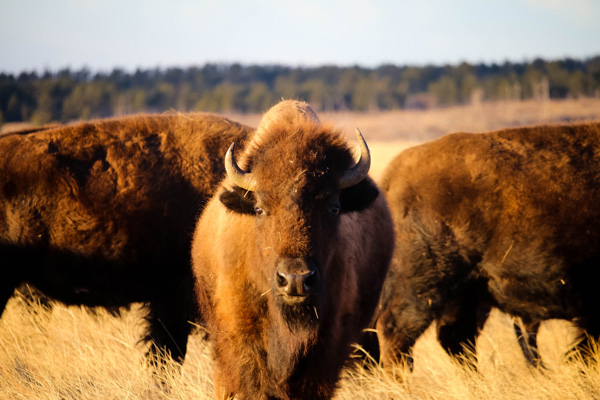
Bison, the noble beasts at the core of Lakota culture and once on the verge of extinction, still dot the West River landscape.

I signed up for a cave tour, which our guide began by recounting the story of Alvin McDonald, an eccentric teenager who moved with his family to the area in 1890. He had trouble making friends, so he sought sanctuary within the cave’s uncharted depths. Our guide flipped a switch in the large room, plunging the space into absolute darkness.”Think about that,” she said.”Think about exploring this cave, with its sudden drop offs, by yourself, and with only a candle for light.” She flipped the switch again, illuminating the water dripping off cave formations and cratered walls.

McDonald rolled out string as he explored so he could find his way around the cave, she continued. He left little puzzles — strings of letters — along the cave’s walls with the candle’s flame. Our guide showed us sooty markings on the cave ceiling, and then beamed her light into a crevice in the rock wall.”But my favorite story about Alvin involves this room and this passage,” she said.”If you’ll look toward my light, you’ll see a rare and beautiful crystal formation. Alvin knew there was a passage behind this, but to get there, he would have to destroy the crystal. He chose to leave the passage unknown, and the crystal intact, out of his respect for his cave.”

After the tour, I found McDonald’s grave, marked by a bronze plaque, near the natural entrance to Wind Cave. A Native American proverb popped into my mind:”Give thanks for unexpected blessings on their way.” McDonald’s story had sparked something in me, made me feel alive and reminded me that every day could hold unexpected blessings, as long as I showed up.

***

My next pilgrimage took me to Black Elk Peak, the sacred mountain where the Lakota welcomed the Thunder Beings each spring. KILI radio, the single station my car picked up, blared from my stereo as I tore down Highway 44. The road to Sylvan Lake, from which I could access the mountain trailhead, meandered through such tight turns above sheer rock precipices that my palms were sweaty and white. I reminded myself of what Reagan, my teacher friend on the Rosebud Reservation, had written to me once:”The hard stuff is always the good stuff. The hard stuff is what makes the story.”

Prayer flags adorn tree branches near the summit of Black Elk Peak. Photo by Paul Horsted

Halfway around the lake (really a manmade dam), I found a trailhead leading to Black Elk Peak and veered off the paved path. The way was steep and rocky, with giant metal handrails posted in one haphazard section of boulders. Jumping from craggy rock faces to the trail below, I felt like a child. I felt free. Unhindered. The sunlight on my face, which I missed so often due to the long hours I put in at school, invigorated my spirit. The solitude of the trail also strengthened me; I passed only a few people on my ascent.

I reached a point where the dirt path led to a wash of tangled woods; when I retraced my steps, I could not find the trail. I was still lost when the sun set and the temperature dropped. I found a cave-like crawlspace under an outcropping of rock. It was at least 10 degrees warmer inside than out, so I crawled in. I listened to the wind shriek past my sanctuary. I resolved to sleep if I could.

The sun’s rays peeked into my cave at dawn the next morning. I crawled from the space and tried to find the trail. Hours passed. Miles passed. When the sun shone directly overhead, hot and heavy in the sky, I abandoned all efforts to find a path. I picked a direction and ran. I did not stop until I heard the sound of a highway. I burst from the woods and found myself on an endless stretch of asphalt that gave no clue as to my location. No signs. No cars. No people. Then, a red sedan. I stayed by the side of the road, waving my arms above my head in distress. The car sped up and rushed past me.

I had no watch, no phone and I was out of water. I am going to die out here, I thought. Then a white minivan appeared on the horizon, making slow but steady progress down the hill. I prayed there were nice people inside. Then I stepped into the center of the road, waving my arms wildly. This time, the vehicle slowed and stopped.

I knew I must look crazy. My arms were scratched and bleeding from my crazed run through the woods. I had bits of leaf litter and twigs in my hair. I kept my hands loose and visible by my sides as I approached the minivan.

“Hello,” I tried, when the driver’s side window rolled down an inch. My voice came out choked and scratchy. I tried again.”I was hiking and I got lost …” My voice cracked. I took a step back, wanting to show that I was harmless, terrified he or she would leave me.”I was hoping you could point me in the right direction,” I said.”I’ve been wandering for the last 14 hours. I had to spend the night on the mountain.”

The window rolled down to reveal a pale-skinned couple in the upper bounds of middle age.”You poor thing,” the woman said. She sounded British.”You must be frozen. It was 34 degrees last night.”

Arriving at Sylvan Lake proved to be a turning point in Talamo’s pilgrimage.

I waited while the British gentleman searched for Sylvan Lake in his phone’s GPS.”It’s that way,” he said, pointing down the hill. I asked how far. He said,”Thirteen miles.” I started crying. The woman twisted in her seat and started clearing out the back of the minivan.”Get in,” she said.”We’ll give you a ride.”

The man got out of the driver’s seat and opened the door for me. I slipped inside, babbling my thanks.”I promise I’m not a serial killer,” I said. They laughed; the man assured me they were not serial killers, either,”just an old British couple eager to see the great United States of America.”

They seemed at ease with me. They were also chatty. They asked what I did for a living. I told them I worked as a teacher in a reservation school. They showed genuine interest.”How is that?” the man asked.

“It’s hard,” I said. The woman asked how I coped, if I believed in God. I told the woman I did not know.”God is my answer to just about everything,” she said.”I trust that the people He puts in my way will be the ones I am supposed to meet and learn from.”

About 5 miles later, the Silver Bullet came into view.”There!” I shouted, way too loud.”That’s my car!” The man pulled into a parking spot near mine. They refused money when I offered. The man thanked me for”adding some excitement” to their lives. The woman said, softly,”I can’t wait to tell our friends that we picked up a hitchhiker.”

I waved as they drove off and thought, too late, that I had not asked for their names. I turned and looked out over Sylvan Lake.

The pilgrimage’s mission was accomplished. I had never been so glad to be alive.

***

In November, temperatures plunged. I knew I had only a short amount of time left to explore before blizzards, with their shrieking winds and bone-chilling cold, ravaged the state. After Sylvan Lake, I was terrified of getting lost while hiking by myself. But I wanted to continue my journey.

I took my scathed soul to the Badlands. The sky was a wet, watercolor blue, in sharp contrast to the sand-colored rocks and white cliffs I passed on the way into a parking lot by an overlook. The rest of the parking spots were empty.

I chose Notch Trail, the shortest of three trails detailed on a brown sign. The trail led to a breathtaking vista — layers upon layers of striated rock, sharp angles, peaks like steeples stretching out to specks on the horizon. I found a rock crevice that cradled my body perfectly. I sat down. I put my palms flat against the rock. I closed my eyes. I felt the increased pulse of my heart, and through my hands, the heartbeat of the earth. I felt the strength of the land lace up my palms, through my body. When I opened my eyes, the world seemed three shades brighter.

The Badlands hold significance for the Lakota and several other indigenous tribes. Photo by Paul Horsted

“Thank you,” I told the winds, the earth, and whatever might be listening.

I walked back to my car, believing I had completed a successful hike. Then the wind blew, so fiercely that it turned me around toward an exhibit sign that declared,”The Baddest of the Badlands.” I spotted the first trail marker, a stubby yellow pole about a foot high just beyond the sign, and I felt a hunger so sharp and fierce it surprised me. I wanted the challenge. I started forward.

Mushroom-like formations sprouted from a sea of craggy rock. I felt alive, following this trail across the beautiful land of extremes. My walk became a symbolic act of spirit. I was not sure where I was going or how much farther I had to go, but I was willing to take the journey. Going one step at a time, I reached the final yellow marker, identifiable by a corresponding red stripe at the top. Another canyon vista stretched out to the horizon. Below, the rock dropped steeply away, leaving me dizzy from the height.

I stood on the precipice, lost in the savage beauty surrounding me, until the wind buffeted me away from the edge. The sun was sinking, and I beat a reflective retreat to my car. Blown by the wind, now caught under one of my car’s tires was a crumpled Badlands brochure.

While my GPS calculated my route back to the reservation, I flipped through the brochure, with its colorful photographs of narrow-leaf yucca, prairie dogs and black-footed ferrets. My eyes settled on a quote, attributed to author Kathleen Norris:

“The prairie is not forgiving. Anything that is shallow — the easy optimism of the homesteader… the trees whose roots don’t reach ground water — will dry up and blow away.”

The trip left me feeling empowered, eager and unafraid for what might come. That night, safely ensconced in my school-issued housing, I emailed my principal.”I feel very grateful and blessed to have this job,” I wrote.”I would like to stay for a third year as the middle school writing teacher, if you think I am doing a satisfactory job.”

I looked at what I had written, felt a trill of fear in my heart, and hit”Send.”

Editor’s Note: This story is revised from the May/June 2019 issue of South Dakota Magazine. To order a copy or to subscribe, call (800) 456-5117.

Posted on Leave a comment

Elk Magic

Elk bugle during the fall as part of the mating season ritual.

We sat in the truck and waited for the October sun to set over the gentle hills of Wind Cave National Park. A giant buffalo sauntered just a few yards away. Through the windshield we saw coyotes hunting in the distance. We heard geese calling and coyotes howling. Not a bad opening act, I thought, for what we had come to hear — the distinct and haunting bugling of elk.

I had never heard an elk bugle, and I had avoided the temptation to search for the sound on the internet before our outing. But I knew those were the words often used to describe the sound: distinct and haunting and also ethereal, eerie, powerful.

We waited for sunset because the first rule for hearing elk is that timing is everything. Elk only bugle during their mating season, primarily in September and October, and most often from sunset to sunrise.

I learned this from my guide that evening — Dan Tribby, a lifelong elk and nature lover. Tribby’s day job is the manager of Prairie Edge and Trading Post, a Native American goods and art store in downtown Rapid City.

Tribby said Wind Cave is a good place to start for beginners because there is no hunting in the park. Consequently, the elk are less likely to be wary of the sounds of people and vehicles. We met at the visitor’s center and drove a short distance to the parking lot near Cold Brook Canyon Trail on Highway 385.

Along the way, Tribby educated me on elk behavior. Bull elks, he said, build harems of 15 to 20 cows, and then fight off other bulls. That’s mostly what the bugling is about every fall. They are signaling to other bulls in the area that they are with their cows; be scarce or beware. However bulls without a harem may also be bugling. They are assessing the lay of the land, and probably hoping to steal some cows.

Elk once roamed as far east as mountains in Pennsylvania and West Virginia. Their original name is wapiti, a Shawnee word meaning”white rump.” English settlers called them elk, the term for a European moose. Hunters greatly diminished American elk numbers from 10 million to under 100,000, and by 1900 South Dakota’s elk population was near extinction. Rocky Mountain elk were captured and used to repopulate herds in South Dakota between 1911 and 1916, and by 1928 herd numbers had grown to around 1,000. Today, 6,000 to 8,000 elk inhabit the Black Hills National Forest, Custer State Park and surrounding prairies. They can also be found on grasslands in Butte, Bennett and Gregory counties and on the Lower Brule Indian Reservation.

As we waited for the sun to go down, Tribby reminisced on his first experience with elk.”They are just so magnificent,” he said.”I was in high school when I saw my first wild elk in the Black Hills and I have loved them ever since. They were such a rarity, like mountain lions back in those days. And the more you saw them the more you fell in love with them.”

Tribby had an archery license to hunt elk in 1997 and a rifle license in 2007. He describes the time of hunting elk with his bow tag as among the most joyful 30 days of his life.”They are so big, the size of a horse. I can’t understand how a horse with antlers can sneak up on you but they do. I was hunting outside of Sturgis one day and I turned around and there was a monstrous bull just 50 feet away. It was magical. I could look through the spruce tree and could see his eyes and he was looking at me through the spruce tree.”

I saw a pattern. People who have heard the bugling use the same words; majestic, magnificent, charismatic and magical. While I don’t think you can become addicted to a sound, they all want to repeat the experience.

The sun was setting, so Tribby and I began to walk to the top of the nearest ridge because the bugling carries farther at higher elevations. Meanwhile, Tribby continued to tell me of his elk adventures.”There have been so many good times calling them in for people,” he said.”It changes their life, you know. I still love going for rides with my mom, whether we see them or not. We call them from the car. She’s 90 now and won’t go trudging through the woods looking for them, but she sure likes to hear them bugle.”

Dan Tribby, manager of Prairie Edge Trading Post in Rapid City, has been enamored with elk since he first saw one in the Black Hills as a teenager. He still enjoys trips into the wild each fall to hear them bugle.

That night we listened atop the ridge in Wind Cave for about an hour. Coyotes continued to call. It did feel magical — merely being in the mountains after dark was a thrill. But we didn’t hear any elk. Instead of being disappointed, I was intrigued and promised myself more opportunities.

A few months later I called Chad Lehman, senior wildlife biologist at Custer State Park to ask about bugling in the park. Lehman, too, it turns out, is an elk enthusiast. He has hunted elk for 22 years throughout the West. He had some additional tips for first timers hoping to hear bugling.

“Bulls will start bugling at the end of August but it is rare to hear,” Lehman said. The rut picks up around Sept. 20-25, but the best bet is Sept. 20-30.”That’s when cows are being bred. So you could hear a bugle every minute during that time, but in early September maybe only one or two bugles an hour.”

Lehman recommends keeping a safe distance from elk, but he doesn’t see a problem with elk safety in South Dakota.”In Estes Park some elk have lost the element of being scared because they aren’t hunted. They have attacked cars and people. But fortunately we don’t have a population habituated to people,” he said.

I asked him why people are so intrigued by elk. He chuckled and understood the question.”I look at it as people in general love being outdoors and studying the behavior of animals. That’s anyone from someone who grew up in the country or someone from the city. There’s an innate characteristic in people who love being outside. And with elk, when you’re talking about the peak of rutting season, you can see and hear things in nature that are unmatched.”

Ralph Waldo Emerson philosophized in his essay”Nature” that experiencing the outdoors is the closest one can get to God, and to truly be at one with nature and God is to not only observe it but also be absorbed by it.”Standing on the bare ground — my head bathed by the blithe air — and uplifted into infinite spaces — all mean egotism vanishes,” he wrote.”I become a transparent eye-ball; I am nothing; I see all; the currents of the Universal Being circulate through me; I am part or particle of God.”

Tribby, Lehman and other elk-lovers I’ve met all seem to share an appreciation for the wonder and majesty as described by Emerson. At the end of our night at Wind Cave, Tribby told me about a time when he was walking in the forest and happened to see an elk tooth out of the corner of his eye.”Just to walk around and see an elk ivory is unheard of,” he said.”Every elk only has two ivories.” Tribby picked it up and resumed his hike.

When he returned to Prairie Edge, he overheard two co-workers who were making an elk tooth dress for their daughter. They needed one more elk ivory to complete it, and they wondered where they might find one. Tribby happily gave his to them.”The spirits were working for us that day,” he said.

Magical.

Editor’s Note: This story is revised from the September/October 2022 issue of South Dakota Magazine. To order a copy or to subscribe, call (800) 456-5117.

Posted on Leave a comment

West River Odyssey

My immediate family gathered this month in Mobridge. It was the first time we’d all been together in several years. From a family of six on the farm to a family of more than 20 scattered from Sioux Falls to California seems pretty amazing, but probably not that uncommon. I grew up roughly 60 miles west and 10 miles south of Mobridge near the Moreau River breaks. I don’t get back in that country near enough, but this was a good year to go. The rain has been abundant and the wildflowers profuse. Last season was dry, and it seems all that stunted life from a year ago has burst into its fullest measure this time around.

Before heading home, I took a notable detour to the beautiful Matthews Opera House in Spearfish to take in my friend Eliza Blue’s new album release concert. From there I wandered down through Custer State Park, where I reveled in a summer thunderstorm (until a few large hailstones caused me to flee south into Wind Cave National Park). Then I spent a day and a half in the Badlands, where I had good luck watching burrowing owls take care of their young. After that, I made my way north to the rolling hills of Perkins and Corson counties.

The real surprise of the journey was an impromptu photo tour just northwest of Bison. Sion Hanson is a friend of a friend who asked if I’d be willing to take some photos of him and some of the landmarks on his land for his grandkids. Hanson turned 60 this year and wants to pass along a little bit of the family history and legacy in images as well as stories. I didn’t quite know what to expect as we pulled out of the yard and headed north along a wheat field through the tall grass. Then we crested the hill.

As I mentioned, I grew up near the rugged and rolling hills of the Moreau River breaks along the Dewey and Ziebach county line, so I have a near-and-dear appreciation for the long draws and short grass hills topped with gravel, yucca and Black Samson flowers (also known as wild purple coneflower). What now opened before us was the south edge of the Grand River breaks, and it was breathtaking. The short grass prairie had taller than normal grass waving in the wind, and it was ablaze with wildflowers, particularly Black Samson. One of the long draws before us was where Hanson’s grandfather and grandmother had a sod house built back when the land opened for settlement in the early 1900s. Hanson’s granddad was a freight wagon driver who hauled goods to Bison from the nearest train depot to the north. Each trip was a two-day journey. We saw parts of the old road from Bison to Hettinger that survived as a fire trail, at least into the 1970s. It is mostly overgrown now.

It was an unexpected and enjoyable trip to some of our state’s truly wide-open and rugged country. To hear the history of it as well as help a new friend keep the stories and places alive for his family was quite an honor. Those couple hours of looking over the land, reminiscing and simply enjoying the view was a good reminder of how strong the family unit was and still is in these open prairies of our great state. It was only fitting that my next few days of vacation were spent making new memories with my own family at the end of this summer’s West River odyssey.

Christian Begeman grew up in Isabel and now lives in Sioux Falls. When he’s not working at Midcontinent Communications he is often on the road photographing South Dakota’s prettiest spots. Follow Begeman on his blog.

Posted on Leave a comment

Winter Wonderland

A couple weeks ago I wasn’t sure this column was going to happen. Since October I had planned on taking the full week off before Christmas to spend some time in the Black Hills, camera in hand. Early winter in the Hills is a magical time. Fresh snow, active wildlife and very few people make great reasons to wander places like Spearfish Canyon, Wind Cave National Park and Custer State Park. This year, however, things were looking grim for a peaceful vacation in mid-December when little to no snow was on the ground and the massive Legion Lake Fire was tearing through Custer State Park and portions of Wind Cave National Park.

Thankfully, through great work by local and regional firefighting teams and some much-needed snowfall, the fire abated and the parks re-opened just days before my scheduled arrival. I was nervous about what I might see as I arrived on the evening of Dec. 21. I had spent the majority of the day in the Northern Hills waiting for the snow to end, and then cruising Spearfish Canyon as the sunlight broke free of the clouds and danced along the high ridgeline. The play of light and shadow through one of our state’s most scenic byways was worth the trip by itself. By the time I arrived in Custer State Park it was nearly dark, and I could smell the faint odor of burned grass and timber, but otherwise all was quiet and peaceful.

The next morning, I accidently turned off my alarm when attempting to hit the snooze button, so I missed my planned rendezvous with the sunrise. But the morning was not lost. Just outside the window of my room at the Creekside Inn a flock of nearly 30 blue jays were calling, flying and digging in the snow. Beyond the creek a lone deer crossed the road. On the flanks of the far ridge, a flock of wild turkeys slowly made its way eastward and at the top of the same ridge, the early morning sunshine began to kiss the tops of the snow-covered ponderosa pine. It slowly enveloped the entire ridge as it chased away the blue-tinted shadows with warm, yellow-hued light. The scene before me was truly a winter wonderland. It was a special kind of peace and quiet that I think only the Black Hills can provide.

Later that morning, I made the rounds on my favorite park roads looking for wildlife and trying to measure the extent of the fire damage. Enough snow had fallen to cover the blackened ground and singed trees, so I had to look closely to spot fire damage. About mid-afternoon, snow-laden clouds rolled in from the north and west. I found a group of old bison bulls along the southern curves of the Wildlife Loop road, and those same clouds let loose. While taking bison portraits, my camera and I both had a hard time finding true focus through the snowflakes. Even so, the out-of-focus shots were cool too, showing the extent of the snowfall with the bison silhouetted in the background.

As I was leaving the park on Dec. 23, I stopped at the Game Lodge chapel to snap a photo. Just a week before, I had seen an image on social media showing the fire line behind the chapel and cabins. Now the whole valley and park lay under a peaceful blanket of snow. The fires were out and the beauty and peace of winter in the Black Hills had once again fallen over the landscape. All seemed right again — at least for now.

Christian Begeman grew up in Isabel and now lives in Sioux Falls. When he’s not working at Midcontinent Communications he is often on the road photographing South Dakota’s prettiest spots. Follow Begeman on his blog.

Posted on Leave a comment

Dinosaurs and Big Art

Bison roam freely inside Wind Cave National Park.

Just after dawn I hit the Nebraska-South Dakota line, moving north on U.S. Highway 385. I had a hundred bucks in my pocket and lots to see and do along this incredible road, leading 122 miles from the state line to Deadwood. It would be a good day.

For the next 25 miles I drove through southwestern South Dakota’s beautiful grasslands. Most people, though, think of Highway 385 in this state as a way to experience the heart of the Black Hills, and the Hills were my destination. First I wanted to visit a favorite place that bills itself as a”transition zone between ponderosa pine woodlands of the Black Hills and the mixed grass prairie of the northern plains.” I spotted my turn-off at Wallygator’s Bait and Tackle and in five minutes sat sipping coffee from a Thermos, watching the full morning break over big Angostura Reservoir — a damming of the Cheyenne River. While the Black Hills stand within view of Angostura, the lake feels more attuned to the prairie. Pronghorns bounded through lush grass just yards from the water.

Twelve miles later I arrived in Hot Springs and felt fully enveloped by the Hills. The town is home to plenty of attractions: Evans Plunge, the Mammoth Site, lodging and dining in historic sandstone structures. But this morning I sought the Black Hills’ heartiest breakfast. That’s the liver and onion breakfast served on two platters, with eggs and potatoes and toast, at the All Star Bar and Grill right on 385. Usually I’m not much for big breakfasts, but something about spending a full day in the Hills suggested that one was in order.

Janell Andis (center) has been serving Spudburgers for 20 years at Custer Crossing, a Highway 385 pit stop enjoyed by locals and tourists.

After devouring the liver and onion specialty, a traveler may feel a walk is needed before climbing back into the car. There’s an excellent urban hike through downtown and up old slab stone steps to the hilltop 1893 schoolhouse. These days the four-story sandstone school, now the Pioneer Museum, puts every square foot to work interpreting the history of the Southern Hills. The grounds offer a pretty view of the town below. This is the first of many museums along the state’s stretch of 385.

Ten miles beyond Hot Springs I entered Wind Cave National Park, established in 1903 by President Theodore Roosevelt. Immediately inside the park a sign read, BUFFALO ARE DANGEROUS, DO NOT APPROACH.

“It’s a deal,” I thought.”I won’t.”

But moments later a buffalo bull approached me. I pulled off the road and sat in my car, lost in notes for this article, writing about the view at the park’s south entrance: a mountain prairie dotted here and there by pines, with the Central Hills’ high peaks serving as a backdrop. Suddenly a great shadow darkened my paper and there the bull stood, right up against my car. I was glad I had been too lazy to follow through on my original plan of getting out of the car, sitting on the hood, and incorporating the scent of the summer morning in my notes.

Wind Cave National Park is home to this free-roaming bison herd, 30 miles of hiking trails, camping and the famous cave that spouts air. Park staff lead tours through the cave, officially the world’s fifth longest. But people in Hot Springs and Custer scoff at that designation. Most believe Wind Cave and nearby Jewel Cave, a national monument ranked as the world’s third largest cave, are one and the same. If passages connecting Wind Cave and Jewel Cave are ever mapped, the cave is the biggest on the planet.

North of the park the highway ran through a section of forest devastated by a 2012 fire, and beyond that point I saw increasing evidence of mountain pine beetle disease. As beetles kill trees, pine needles turn the color of dried blood. Those trees are widespread throughout areas of the Central Hills especially.

Approaching the town of Pringle, outcrops of granite began to appear as the highway entered a rocky zone beloved by climbers and sculptors. Pringle boasts two pieces of roadside art that by no means are the most famous along this highway. But I like them and always keep an eye peeled for them: the sculpted mountain lion slinking atop the Pringle Mercantile bar, and an unusual bicycle creation right next to 385 (left side when traveling north). Dozens of bicycles — some rusted, some gleaming and all with histories — cling together to make a curious geometric formation that glitters in the sun. This is serious bicycle country. The 109-mile Mickelson cycling and hiking trail runs close, and sometimes immediately adjacent to, Highway 385 for many miles toward Custer and Hill City.

Hill City is home to Prairie Berry winery, where travelers are welcome to stop for a tasting.

The outcrops towered taller and the great granite peaks loomed closer as I put Pringle behind me. The land is a mix of forest and clearings with homes, barns and horses, along with evidence of sawmilling and other entrepreneurial endeavors. The town of Custer announced itself boldly with billboards, and the community definitely has a whimsical side. Where else would I find a shrine to Fred and Wilma Flintstone, complete with a full-size replica of Bedrock City? The town has preserved the handiwork and legend of Wilber Todd, builder of Custer’s first stone jail. He used the money paid him for the construction to get drunk and rowdy and became his jail’s first occupant. Like Hot Springs, Custer turned a big public building, the 1881 Custer County Courthouse, into a history museum. Some visitors know the courthouse made significant history itself in 1973, when law enforcement and the American Indian Movement clashed there — a precursor to the Wounded Knee occupation.

My reason for stopping in Custer today, however, was to experience one of Claude and Christie Smith’s burgers. It seems that by consensus two years ago the Black Hills decided their just-opened Black Hills Burger and Bun Co. served the region’s best hamburgers. That’s high praise in beef country. Friends had told me that the little diner on 385 would be packed regardless of when I visited. It was. Two bites into the Hot Granny burger (with bacon, cream cheese, fresh jalapeÒos and sweet jalapeÒo sauce) I decided I would join the chorus of Smith burger boosters. Christie told me she and Claude formerly ran an Iowa grocery store, then moved west with their kids after several Black Hills vacations, looking for a better lifestyle.

“We found a lot of local support here,” she said. They stay busy. Claude starts with whole chuck roasts and grinds the meat daily. Buns, potato salad, coleslaw, baked beans and a range of desserts are also prepared fresh every day.

As the Smiths get up every morning and grind beef, just up 385 to the north the Ziolkowskis prepare to blast granite. They’re creating Highway 385’s most famous piece of roadside art, the world’s largest mountain sculpture, recognized worldwide. The great carving of Crazy Horse is clearly visible from the highway, but turning into the grounds is well worth the admission fee. Mary Bordeaux, from Pine Ridge, is the new curator of the huge Indian Museum of North America below the sculpture, and she’s the site’s cultural coordinator, organizing artists-in-residence, performers, and lecturers.”We hope people will view the sculpture and then also interact with the museum collection,” she said.”For those hoping to buy art, here’s a chance to meet the artist, to have a connection with the artist.”

Paleontologist Pete Larson and his brother, Neal, founded the Black Hills Institute of Geology at Hill City.

As a kid I knew Hill City as a place of hard working loggers, a summer excursion train and mysterious Goodhaven,”the house of many doors.” It’s hard to think that any small town in America has transformed itself more completely than Hill City. The development of fine art galleries, including Jon Crane’s, has been well publicized, as has the arrival of wineries. The old city auditorium became a museum that never ceases to amaze, reminding visitors that South Dakota is prime dinosaur country. In addition to running this museum, the Black Hills Institute of Geological Research continues to dig for fossils and is a resource for science centers around the world. Probably this Hill City museum’s star attraction, although he has considerable competition, is Stan, a T-rex excavated by the institute in Harding County in 1992.

I visited Stan and his prehistoric peers, then went up the road to see a new museum in the back of the chamber of commerce building that documents the Civilian Conservation Corps’ work in South Dakota during the 1930s. The steam powered excursion train of my youth, the 1880 Train, still makes its scenic runs, and for the past five years it has shared a parking lot with the fine South Dakota State Railroad Museum. As I talked to museum director Rick Mills, author of several books about railroading, it struck me that there’s tremendous expertise along 385 in many fields. And every expert I’d talked to on this trip seemed to have all the time in the world for me.

I’m happy to say Goodhaven still stands, although it goes by another name now. In 1894 husband and wife John and Kit Good built a one-story house in the Black Hills town of Sheridan. Kit had survived a terrifying house fire and wanted a home with doors leading directly outside from every room. The”house of many doors” — 11 to be exact — won Black Hills fame because of its unusual look. It drew even more attention when it was moved to Hill City in 1944, right next to the highway. In 2003 David and Dawna Kruse bought Goodhaven and turned it into a unique bed and breakfast. They renamed it Holly House because of Dawna’s love of Christmas and flair for decorating for the holidays.”We still have seven of the 11 doors leading out,” she told me. But I had been told earlier that when visitors speak of Holly House these days, the doors rank second to another asset: Dawna’s breakfasts.”When I say I serve a full breakfast, I mean a full breakfast where everything’s homemade,” she said.”We offer a Mexican breakfast, and breads and casseroles, and biscuits and gravy and lots more.”

It’s an increasingly rare Highway 385 traveler who makes it out of Hill City to the north without being lured into Prairie Berry Winery for free wine sampling. I joined in and got personal instruction from my server about which foods go well with the wines I selected. She suggested asparagus with my dry Phat Hogg, and roast duck with my sweet Calamity Jane. Actually Prairie Berry is becoming a wine and beer campus, with a new events center next to the main building, and Black Hills Miner Brewing Co., the winery’s beer making arm, right across the parking lot. Sandi Vojta is the company’s award-winning winemaker, and she brews the beer, too.

Black Hills Burger and Bun’s crew includes (from left) Jessica Smith, Lindsay Percival and owners Christie and Claude Smith.

North of Hill City a sign told me to watch out for bighorn sheep, and immediately I spotted three. It appeared that they saw me, too, and watched me pass from a safe distance off the road. I thought they demonstrated more sophistication about traffic than lots of domestic animals I’ve known. Then Sheridan Lake came into view. A man fishing from shore reported trout were shy this afternoon but crappies were hitting his bait in a frenzy. I got back in the car and in no time came to spectacular Pactola Lake, the Black Hills’ biggest. Sheridan and Pactola are actually manmade reservoirs, products of 1940s era reclamation (as is Angostura). It surprises visitors who regularly bring boats, water skis and lake fishing gear to the Black Hills to learn the region was shortchanged when it came to natural lakes. Both Sheridan and Pactola are named for towns that surrendered the ghost to rising waters. It’s why Goodhaven ended up in Hill City.

Beyond the lakes the highway made a final 25-mile sprint to Deadwood. It’s the home stretch not only for South Dakota’s 122-mile section of the highway, but for all of U.S. 385, which begins at Big Bend National Park in Texas and extends north through Oklahoma, Colorado, Nebraska, and of course South Dakota, for 1,206 miles. Old-timers sometimes called the route the Potash Highway, after a form of fertilizer that transformed big sections of the Great Plains. The road is one of South Dakota’s Blue Star Memorial Highways, honoring the Armed Forces, and it has also been called the George Hearst Memorial Highway, recognizing the man whose investment brought Homestake Gold Mine to full production.

The road climbed and dropped over several ridges. Pines closed in at points, then opened up to reveal draws, meadows with grazing cattle, and Custer Peak with a summit so pointed it resembled an upside down V. And then, amid pastoral scenery, things almost surreal popped into view, like a Ferris wheel in the middle of the Hills, and the World’s Largest Log Chair. How large? About 34 feet high with a seat so big that a family and several friends could picnic up there. Why? That’s a harder question to answer. I stopped by the Sugar Shack, within view of the chair, and the best answer I got was,”Well, there are lots of logs out here.” Plus, of course, no one does anything small along 385. The Sugar Shack, incidentally, is a cozy old diner with a long wooden lunch counter, behind which are prepared huge and excellent burgers. It should be noted plenty of Northern Hills partisans consider these the best Black Hills hamburgers. Evidence that the Sugar Shack has topped public polls to that effect is posted in the diner.

Twelve miles north, the Ferris wheel stood at Brownsville, long ago a busy logging and sawmilling town and now sometimes called”50s Town.” That’s because of Boondocks, a roadside business that celebrates all things 1950s — Elvis, cars, food. The centerpiece is an authentic Valentine diner shipped in more than 60 years ago and still serving up sandwiches, milkshakes, apple pie and more.

I knew I was nearing Deadwood when I spotted the Tomahawk golf course. Then I made a steep climb and descent over Strawberry Hill, coasting past a runaway truck ramp and under hills left bare by a great 2002 forest fire. I breezed through the little town of Pluma and then … well, Highway 385 just ended. Abruptly and without ceremony.

I could turn left and drive on to Lead, Terry Peak, and Spearfish Canyon. Or I could go right, into the heart of Deadwood with its entertainment, casinos and dining. It wasn’t a bad place to be, stared in the face by attractive options the northern Black Hills offer. But I wished for a sign saying, CONGRATULATIONS! YOU’VE COMPLETED A TRULY CLASSIC AMERICAN DRIVE.

Editor’s Note: This story is revised from the July/August 2014 issue of South Dakota Magazine. To order a copy or to subscribe, call (800) 456-5117.

Posted on Leave a comment

Crawling a Cave

Hair thin gypsum strings, a rare formation, wave slightly in a gentle breeze deep within Jewel Cave.

My friend Ken Gartzke and I were on our way to do some exploring inside one of the earth’s greatest caves — Jewel Cave. With more than 160 miles of mapped cave it ranks as the second longest in the world, and it is thought that less than 3 percent has been discovered.

It was a great day to go caving; on the ground it was windy and cold, about 15 degrees. But most caves in the Black hills remain a constant 51 degrees year-round, and the humid air feels warm — unless, of course, you sit around for very long.

Gartzke and I were experienced cavers; not only did we explore wild caves in the Black Hills, we also mapped them, thousands of feet of uncharted passageways and chimneys of various lengths and dimensions. During the early to mid 1970s, Gartzke and I explored Wind Cave. At that time the known cave contained about 50 miles of multi-dimensional passageways, chimneys and vertical descents. Wind Cave is not necessarily a pretty cave with a lot of beautiful formations like Jewel.

Rangers lead regular tours through Jewel Cave, where the temperature remains a constant 49 degrees.

Today Wind Cave is recognized as the fifth-longest cave in the world, with more than 130 miles of known passageways. It is also known as the densest (most passage volume per cubic mile) cave system in the world. I describe crawling around in Wind Cave as being inside a huge sponge made of limestone, definitely not a place where you want to get lost.

Jewel and Wind are barometric caves, meaning they exhale air when the outside air pressure decreases and they inhale when the outside air pressure increases. Total cave volume is estimated by measuring the amount of air the cave exhales when the outside air pressure drops, and inhales when the outside air pressure rises. Thus, 97 percent of all the air moving out of, or into the cave represents areas yet to be explored, since we know how much air volume is contained in the mapped cave area.

Gartzke and I would be exploring with world-renowned cave explorers Herb and Jan Conn. We had been working with”Herby,” as Jan always called him, for several months in Jewel Cave, but were especially excited to be accompanying them on a crawl into Metrecal Cavern, named by Herb because of the four long arduous hours of crawling just to get into Metrecal, a huge beautiful cavern decorated with aragonite crystal. Beyond Metrecal were miles of unexplored cave.

Before starting out for Metrecal, one must first be able to successfully wiggle through test blocks outside the cave. This is to make sure a caver isn’t too big to make the four-hour belly crawl through the infamous”Miseries,” 500 yards of squirming and squeezing through a tiny passageway with an average ceiling height of only 9 inches.

Herb and Jan Conn spent decades exploring Jewel Cave and eventually wrote a book about their discoveries.

The trip from the cave entrance (known as the target room) to where the Miseries starts takes about an hour of scrambling up and over huge masses of breakdown which, over the centuries, came from large portions of the cave ceiling and walls that have collapsed onto the cave floor. Most of this breakdown occurred when water was still actively coursing through the cave passageways. Some of these piles are so large that climbing gear is needed to either climb over or rappel down.

As we climbed up and over, or around and under the never-ending piles of breakdown, we passed through rooms with names like the Delicate Arch Room, and the Humdinger, finally ending up at the Whistle Stop. Because of the huge amounts of air moving into, or out of the cave, places like the Humdinger would make an eerie humming sound, while the Whistle Stop, a small hole coming into the main passageway, would occasionally produce a low sounding whistle. Winds blowing through the Whistle Stop have measured as high as 35 mph.

The easy part of the trip was now over. There would be no more walking or crawling on our knees. We had arrived at the entrance to the Miseries. For the next four hours we crawled on our bellies with the ceiling scraping our backs.

Herb finally announced,”Around this corner and we are out of the Miseries.” With anticipation I wiggled around the corner only to find the tiny crawlway getting smaller and tighter. It dropped down at a steep angle with a very tight turn at the bottom. In order to negotiate the turn, one had to lie on as much of his side as he could so he could make the bend. This was no easy task since the ceiling was just barely high enough to accommodate part of your shoulder. Gartzke was a little bigger than me and I had to push him, while Herby pulled him from the other side until he popped through.

Rescue packs are left at the entrance to Metrecal Cavern in the event of a deep underground emergency.

After taking about 10 minutes to wiggle through, sweat pouring down my dirty face, I said to Herb,”I thought we were out of the Miseries.” He smiled and replied,”Yup, we are now in the Mini-Miseries and that place you just wiggled through is called the Calorie Counter.” It was aptly named since the ceiling height at the counter has been measured at 7 1/2 inches.

We finally emerged from the Mini-Miseries into Metrecal cavern. Metrecal, as I remember, is an average size room about 300 feet from end to end and filled with amazing decorations, some of which are found in no other cave in the world. Some of the more exciting sights in Metrecal are spectacular displays of gypsum and needle crystals. Beards of angel hair drape the walls and ceiling, gently flowing with the air coursing through the room. In a nearby passageway called Wildflower Walk, gypsum flowers grow so profusely from the floor that one has to step carefully to keep from crushing them. Sadly enough, only a handful of cavers a year experience Metrecal because of the difficulty getting there and then, of course, there is only one way to go back.

Dan Austin wriggles through the Funny Little Hole en route to Metrecal Cavern.

Jewel Cave is filled with wondrous decorations, from gypsum beards to bottlebrushes, rare hydromagnesite balloons and huge onyx flukes. And someone who is musically inclined, as Jan Conn is, could actually play a tune on the many flow stone riblets coming off the ceiling and walls. Stalactites, stalagmites, helictites, dogtooth spar and copious amounts of popcorn crystal adorn the walls, ceiling and floor of Jewel. There are ponds of water so crystal clear and still that you will walk right into them if you aren’t paying attention. One room known as King Kong’s Cage is more than 120 feet high, while Shady Acres covers an area of several acres in size. And as Jan said,”It’s always shady there.”

Jewel Cave, besides having regular tours, also offers an”off the path spelunkers tour” for the adventuresome. There is also a candlelight tour that starts from the original cave opening and follows along the first explored portions of the cave. Only physically fit and highly experienced cavers are allowed, for obvious reasons, to venture into the beautiful, surreal world of Metrecal Cavern.

I never returned to Metrecal. My climbing experiences inside Black Hills caves led me to rock climbing in the sunshine. However, my first and only journey into Metrecal is a trip I will forever cherish in my caving memories.

Editor’s Note: This story is revised from the March/April 2013 issue of South Dakota Magazine. To order a copy or to subscribe, call (800) 456-5117.

Posted on Leave a comment

Winter in Wind Cave National Park

Joel Schwader shared recent photos from Wind Cave National Park. In addition to being one of our country’s longest and most complex cave systems, the park includes over 33,000 acres of mixed-grass prairies, ponderosa pine forests and wildlife such as bison, elk and prairie dogs. See more of this Rapid City photographer’s work on his Facebook page.

This slideshow requires JavaScript.

Posted on Leave a comment

Fall at Wind Cave National Park

Joel Schwader shared recent photos from Wind Cave National Park, home to a free-roaming bison herd, pronghorn antelope, deer, 30 miles of hiking trails, camping and the famous cave that spouts air. To see more of this Rapid City photographer’s work and to purchase prints, visit www.joeldphotography.net.

Posted on Leave a comment

Buffalo at Wind Cave National Park

It was 9 degrees below zero and snowing sideways when Joel Schwader photographed these buffalo at Wind Cave National Park near Hot Springs. “Most people thought I was crazy,” Schwader says. “I pushed snow with the front bumper of my van to get to a place that has no cell phone service. For hours I sat on the edge of a gravel road near Boland Ridge and tried my best to capture the raw courage and simple beauty of the North American bison.” Visit joeldphotography.net to view more of the Rapid City photographer’s photos or order prints.

Posted on Leave a comment

Winter Elk

American elk were once the most widely populated member of the deer family in North America. Hunting took its toll as pioneers moved west and elk began to disappear until only small herds were left in the Rocky Mountains, the Pacific Northwest and Canada. Rocky Mountain elk from Jackson Hole, Wyoming, were introduced to Wind Cave National Park in 1914. Wildlife photographer Dan Alfson shared these photos of elk in the National Park. View more of his photos on the Alfson Photography Facebook page.