Posted on Leave a comment

An Original River Town

John McNeill, pictured with his wife Susan, has written many songs about the Missouri River.

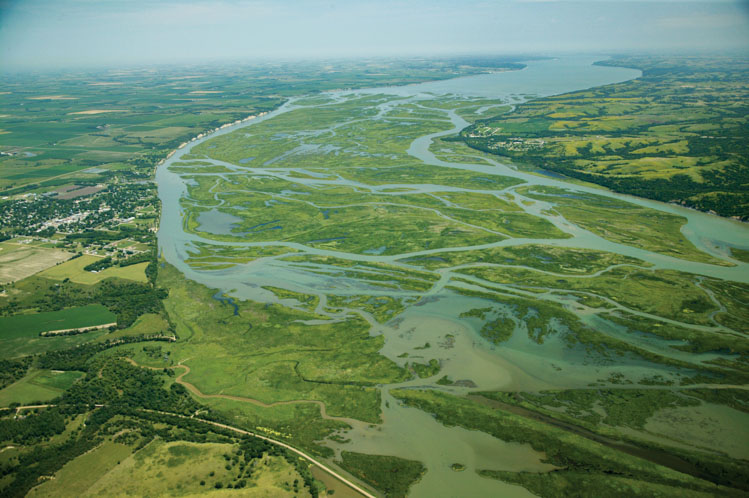
The ever-growing delta of the great Missouri borders Springfield on the south, and a state prison housing 1,200 men sits on the north side of town. But you can’t pigeonhole Springfield as a river town or a prison town. It’s more complicated than that. Ask John McNeill, a singer-preacher-teacher who moved there with his wife, Susan, in 1976.

The McNeills settled in Springfield because it had an excellent library on the college campus, good water and not a single stoplight. They’re known to country music fans in southeast South Dakota as regular performers at Gayville Hall, where they do tribute concerts to the likes of Johnny Cash, Willie Nelson and Merle Haggard. John also serves as pastor and resident musician for the Springfield Community Bible Church, and he taught for years at the prison and the college that preceded it.

John also writes music, including more than 100 songs inspired by the life and hard times of the river valley.”We have a unique history that’s different from other farm communities,” he says.”This is an old river town that had many hopes, most of which never materialized quite the way the people wanted. Springfield was promised many things that ended up in places more prominent and politically connected.”

Springfield was established along a chalkstone bluff on the Missouri River in 1870. Town leaders hoped to land the state’s university, but it went to Vermillion. They fought for the prison, but it was built in Sioux Falls.

However, there were victories. A small teacher’s college was established in 1881, and the campus became the pride of Bon Homme County. Construction of Gavins Point Dam, 28 miles downriver, in the 1950s gave the little college town a lakefront and boosted the population over 1,000 in the 1960s. But dark clouds were circling; civic leaders were constantly worried that penny-pinching state officials might close the college, and finally it happened in 1984 when the governor and legislators decided South Dakotans needed less classroom space and more prison cells.

Losing the school was gut wrenching, and about that same time it became obvious that the new lake was becoming shallower due to sediment flowing in from the Nebraska Sandhills via the Niobrara River.

The town lost some families when the college closed, but most stayed and found ways to adapt. A number of today’s 800 un-incarcerated residents — like McNeill — transitioned from jobs at the college to work at the prison. In fact the institution is named for the late Mike Durfee, a heavyweight wrestling champ and football star for Southern State of Springfield in the 1960s and a popular coach and teacher at the college in the 1970s who became a prison administrator.

Greg and Sandy Stockholm at the helm of a big sailboat dry-docked in downtown Springfield.

Midway between the prison and the river, in a small downtown business district that shrank even more when the college closed, Greg Stockholm has been working on a 72-foot sailboat for the last 14 years. In the beginning, the frame of the boat was upside down alongside the body shop and looked like a shiny beached whale.

Stockholm continued to repair automobiles and sold his motorcycle, cars and an airplane to help pay for the project. Even though he found most of the metal at salvage prices, it has still been costly in time and money. The ship, yet to be named, will weigh 30 tons and hoist 3,500 square feet of sails.

Townspeople and visitors often stop by for a look. Stockholm’s wife, Sandy, maintains a website (sailingdakota.com) so interested observers can monitor the ship’s progress.”Doubting Thomases” are slowly converting to believers, especially after Greg turned the boat on its bottom in 2007 and it began to look like a vessel.”People don’t think I’m so crazy anymore,” he says.”I like to remind them that amateurs built the Ark, professionals built the Titanic.” He hopes to finish by 2018.

The boat will sleep 12 in six cabins and feature space for a vegetable garden, solar panels and a 175-horsepower John Deere combine engine. Most importantly, it will be sturdy enough to withstand storms at sea.

The Stockholms might eventually use the boat for a charter business but first they hope to sail around the world, starting somewhere below the dam at Yankton. They may suffer a tinge of homesickness if they sail past the White Cliffs of Dover in England, geographic cousins to the chalkstone bluffs bordering the Missouri River where Greg learned to sail as a youth. Such bluffs, formed over eons by calcified mineral deposits from sea plankton, are found only along the Missouri River in South Dakota, Dover and a few other spots in the entire world.

Pioneers used Dakota chalkstone as a building stone a century ago. Some homes and churches built of the stone are standing today, but it never became popular because it was considered too porous. Still, the soft texture makes it the perfect stone for Ron Livingston, a white-bearded artist in overalls who has a studio not far from the sailboat.

Ron Livingston creates art from the chalkstone of the Missouri River bluffs.

Livingston has lived in Springfield for 28 years. He awakens before sunrise to begin carving images in the chalk. He prefers fish designs but he aims to please, so he also does other prairie wildlife and even entertains requests. The son of a Yankton auto body repairman, he has never taken an art class and is uncomfortable being called an artist — but he’s not the type to argue and there’s no better word for his popular creations.

Livingston quit drinking a year ago and the change has affected his output.”My creative juices don’t work as good anymore but my work sure has gotten better,” he jokes. The bluffs’ chalk rock seems inexhaustible, but the Corps of Engineers forbids him from collecting it along the lake’s 90-mile shoreline. Instead, he salvages material from the ruins of old buildings.

Between Stockholm’s sailboat and Livingston’s studio sits a building with a nondescript exterior that serves as the Schneider family’s private winery. Dallas Schneider stores his grandfather’s 1937 Nash Lafayette hunting car in the front of the building, and in the rear he ferments fruits grown nearby.

Schneider came to Springfield 30 years ago to work at the state prison. He bought land on the east end of town along the river and soon began clearing brush and planting trees. Today his well-tended orchard includes peaches, apples, plums, apricots, gooseberries, rhubarb, raspberries, cherries, pears and grapes. It’s a hobby, but in good years the winery produces enough bottles for family and friends and extra fruit that he shares with Springfield’s popular senior nutrition program.

Schneider, acknowledging the plethora of interesting projects going on around Springfield, thinks that the town,”is off the beaten path and so quiet and peaceful that you can get things done.” That would explain artist Cheryl Halsey’s bursts of creativity. She and her husband, Jim, live and work on the family farm north of Springfield on a gravel road. Giant cottonwoods surround a big farmhouse that became even larger when an old country church was moved to the farm and attached. Now the house has a cathedral ceiling, stained glass and ample room to display Cheryl’s art.

She calls her space Blue Heron Studio, fitting because the heron navigates air, earth and water. Likewise, Halsey works in various mediums and methods that include jewelry, painted cylinders, sculpture, masks and paper. Halsey also enjoys making intricate jewelry from leather with unique designs. She had the opportunity to use leather from the singer Madonna’s world tour when she helped her son, Travis, who is a costume designer in Chicago.

Giant cottonwood trees shade Cheryl Halsey’s farmyard north of Springfield.

Like McNeill, Schneider and many other Springfield area residents, Halsey was employed in the prison for several years, working with inmates to develop their artistic skills. Now she does stints in schools as an artist-in-residence, helping students expand their imaginations.

The town has other unexpected finds. Workers at a factory called Rush-Co design and manufacture fabric buildings, boat canopies and other custom covers. Another small business, Mr. Golf Cart, refurbishes gas and electric carts. And perhaps coolest of all, Dennis DeBoer makes a career of building kits of model submarines and spaceships like the USS Enterprise. He works from an inconspicuous shop in a residential district.

McNeill, the songwriter, thinks the town’s historic”ups and downs” might explain the originality and creative spirit of its citizenry.”Springfield never got anything easy and it didn’t get anything without some sweat and heartbreak,” he says.”Some of that probably provides grist for the artists’ mill. Cheryl Halsey can paint it and Ron Livingston can sculpt it and people like me can put it to poetry and song.”

Editor’s Note: This story is revised from the November/December 2016 issue of South Dakota Magazine. To order a copy or to subscribe, call (800) 456-5117.

Posted on Leave a comment

A River Town with Spirit

Our November/December issue includes a story on the clever characters in Springfield. The Missouri River town has been through more highs and lows than most South Dakota communities, but the overall effect has not squelched the town’s spirit or creativity. South Dakota Magazine sent intern Chloe Kenzy, editor-at-large Bernie Hunhoff and his grandson, Steven, to visit the folks who help give Springfield its unique personality. Here are some of Hunhoff’s photos that didn’t make the magazine.

Posted on Leave a comment

Too Many Counties?

South Dakota’s 66 counties have been arranged like this since 1983.

Does South Dakota have too many counties? It’s a long-discussed topic that resurfaced at Augustana College’s annual Dakota Conference in April. Bill Peterson, a former legislator from Sioux Falls, discussed the county consolidation proposal he brought to the legislature in 1998. It would have required South Dakota reorganize into no fewer than 15 counties and no more than 30 by 2005. Despite touting its cost savings — something that generally catches the attention of frugal South Dakotans — the plan got very little traction.

Neither did a joint resolution that appeared before the legislature in 2009. It would have placed a constitutional amendment on 2010 general election ballot to limit counties to 25,000 people or 5,000 square miles, whichever was less.

Peterson and his co-presenter, Joe Kirby, cited the dramatic population shift from rural to urban areas of South Dakota. It’s been happening for decades and it’s very likely to continue, meaning some form of reorganization is probably inevitable. Yet here we are in 2015 with the same patchwork of 66 counties that we’ve known since 1983, when Washabaugh County was absorbed into Jackson County and became South Dakota’s last county to be eliminated.

A few years ago, we embarked on a search to find one interesting spot in every county that we thought people might like to see. After our”66 counties tour” feature appeared in the magazine, several readers wrote to tell us that they had set out on their own South Dakota road trips, magazine in hand, to see the places we’d written about.

There are fun and interesting things to be found in each county, so while we still have all 66, let’s celebrate them. Beginning today, and continuing every two weeks, we’ll pick one South Dakota county and write about the unique facts and places that we’ve discovered in our travels there. As always, we encourage additions to our reports. Please leave a comment if you’re a resident, a South Dakota native reading from afar or anyone with an interest in the featured county.

Our first installment features Bon Homme County, officially organized in 1862. Its recorded history reaches back to the Lewis and Clark Expedition, which floated into the area in the late summer of 1804. The explorers noted in their journals passing a large island in the Missouri River called Bon Homme Island. The exact origins of the name are unclear, but some speculate that a Frenchman lived on the island and was considered a good man (“bon homme” in French) to local Indians, who bestowed that title upon the land.

The area’s earliest settlers relied on the fur trade for their livelihoods. The first trading post in the county was opened by Emanuel Disaul in 1815 at the mouth of Emanuel Creek west of Springfield. Zephyr Rencontre built a station on Bon Homme Island in 1828.

The county was effectively opened to non-Indian settlement after an 1858 treaty that required the Yankton Sioux Indians to relocate west of Chouteau Creek, just beyond the present county’s western boundary. John Shober and several families from Minnesota arrived in 1858, just before the treaty was signed. Soldiers from nearby Fort Randall, charged with keeping trespassers off Indian lands, disassembled their log homes and threw them into the river. They returned in 1859 and began a more permanent settlement.

Shober and his party are credited with establishing the first schoolhouse in what would be Dakota Territory. Ten students enrolled in the spring of 1860 under the tutelage of Emma Bradford. The original school building has disappeared, but a replica still stands a few miles east of Springfield.

A replica of the first schoolhouse in Dakota Territory stands near the Missouri River in Bon Homme County.

Bon Homme County’s land appealed to settlers from across the ocean, as well. Hutterites, long oppressed in Europe, sent scouts to Dakota Territory in the early 1870s, looking for a place to establish a colony. They liked what they saw along the banks of the Missouri River and bought 2,500 acres of land in 1874 from notorious Indian agent Walter Burleigh. Bon Homme Colony became the first Hutterite colony in North America, and has been continuously occupied ever since.

Bon Homme County is the resting place of six unknown soldiers belonging to George Custer’s Seventh Cavalry. The men were camped along Snatch Creek in May of 1873 when several soldiers contracted typhoid fever. Seven men — six unknown and one identified — were buried along the banks of the creek. Later they were moved to the Bon Homme Cemetery, where a large stone marks their burial place.

Veronica Sanders helps prepare kolaches at the Tyndall Bakery.

Every county most likely has a skeleton in its closet, and Bon Homme is no different. The first tumbleweed ever reported in North America was found near Scotland in 1877. Its origins were probably in a shipment of flax seed from Ukraine.

Today just over 7,000 people live on farms and in Bon Homme County’s five towns — Avon, Scotland, Tyndall, Springfield and Tabor. Immigrants from Czechoslovakia settled around Tabor beginning in 1869, and their culture is still evident at Czech Days, the town’s annual June festival. If you don’t make it to Czech Days, you can still buy kolaches — a traditional fruit-filled Czech dessert — at bakeries in Tabor and Tyndall.

Tyndall, the county seat, boasts a miniature replica of the Eiffel Tower on the courthouse lawn. County commissioners voted to erect the tower as a memorial to South Dakotans who fought during the Spanish-American War.

Tyndall’s miniature Eiffel Tower.

On our most recent trip through Scotland, we met Victor Settje, who is carefully dismantling St. Andrew’s Episcopal Church, built in 1886. He’s hoping to find new uses for every board, including the old wooden cross.

The town’s VFW Hall boasts a new 5-by-10-foot painting by Menno airbrush artist Mickey Harris that honors a local World War II veteran. Leon Woehl was aboard a B-17 that crashed in Germany in 1944. Harris’ painting depicts the crash and the Nazi soldiers looking for Woehl and the eight other crewmembers who hid in the woods until their capture.

Springfield sits right on the Missouri River, so it makes sense that Greg Stockholm is in the midst of crafting a 68-foot boat. You can see the work in progress outside his shop at 811 College St.

Avon is the hometown of Sen. George McGovern, whose father served the Methodist church in town before moving his family to Mitchell. The museum includes memorabilia from the McGoverns.

The history, the river and the ethnic traditions all make Bon Homme County fun to explore, especially if you enjoy the kolaches and ignore the tumbleweeds.

Editor’s Note: This is the first in a series of articles featuring South Dakota’s 66 counties. Click here to read other installments.