Posted on — Leave a comment

End of the Deerfield Chapter


Deerfield Store had been shuttered for 10 years we met Tom Sawyer in 2005. He was living in the old building, deep in the Black Hills, with a tabby-colored old tom cat. His wife, Sherrill, had died a few years earlier.

A “Closed For Good” sign hung out front but it didn’t deter old customers and friends from stopping to say hello. Tom’s living room was the main store. Shelves still rose above the old wood floors. A piano, once the center of attention at many impromptu parties, was gathering dust in the corner.

Sherrill, who had studied music in California, was the spark of the tiny community. She would play for anyone, anytime. She could cuss as well as anyone if the situation warranted, but she was clearly the first lady of Deerfield. “She was hell for the first 25 years but she got soft later,” Tom joked.

Tom said the store began its decline in 1972 — 40 years ago. And it wasn’t because of competition from Rapid City or Hill City. It was a stupid, stupid murder.

Tom and Sherrill raised two sons at Deerfield, Mike and Jim. The boys loved the excitement of the store, where good times flourished. “I don’t think the folks ever planned the parties,” said Mike, many years later. “Local people and the visitors, the fishermen and hunters, would just show up and everybody would have a few drinks and have a good time. Mom was good on the piano.”

Mike still raises cattle in the Deerfield community, among other things.

Jim was a Custer policeman who helped the Southern Hills on the night of the tragic flood of 1972. He was so busy that he didn’t sleep in a bed for the next three nights.

On the fourth night after the flood, the young policeman was called to investigate a break-in at a Custer saloon. The suspects were still there, and they took the young officer hostage. On a nearby hillside, he was shot with his own gun. The murderers escaped with $37 and a saddle.

They were later caught and given life without parole. But of course the damage was done. Tom and Sherrill and Mike were grief-stricken. Sherrill closed the piano cover and the store changed.

“That was pretty much the end of her piano playing,” Tom told us in 2005.

A dozen years later, the store closed. The Sawyers had run it for 42 years.

Tom regained his good nature. He held court at the closed store for a few years before moving to Rapid City. He died this week at age 92, ending a chapter in Black Hills history.

Today, visitors get their fuel, bait and beer at the Deerfield Lake Resort, two miles east of the old store. It’s a nice place, run by very friendly folks. But there’s no piano.

Change is inevitable, and it often hurts. But for $37 and a saddle?

Posted on — Leave a comment

Wherewazzit Winner

Think you know where this fun scene was photographed? Tell us in our January Wherewazzit contest. To participate, leave a comment with your guess. On Feb. 3, we’ll select a winner from the correct guesses. The winner will receive a collection of South Dakota Magazine products.

We have a winner!

Congratulations Greg Dean of Pierre. He was one of many who correctly responded to our January Wherewazzit contest. The location was indeed Stony Point at Lake Kampeska. Look for our next Wherewazzit contest in our March/April issue.

Posted on — Leave a comment

South Dakota Returns To Its Roots

Saturday (Nov. 2) is a big day for the Mother City of the Dakotas. Governor Dennis Daugaard and a number of other elected officials, past and present, will gather with the public at large to kick off South Dakota’s 125th birthday party in Yankton.

Geographically, Yankton’s role was established long before anyone was writing and reporting on such matters. Native Americans had a permanent camp, possibly going back several centuries. The city’s very name comes from the Dakota word”Ihanktonwan” which was known as the end village along the Missouri.

Lewis and Clark camped there in 1804, and visited with the Native American residents. A baby boy was born while they were there; the famous explorers wrapped him in an American flag and celebrated his birth. Later, the child grew to be a Dakota leader, Struck-by-the-Ree — an amazing chief who promoted women’s rights, environmentalism in the river valley, religious freedom and education.

White settlers built a trading post there in 1857, and the city became prominent when President James Buchanan declared it capitol of Dakota Territory in 1861. Of course, the”Yankton gang” lost the capitol 22 years later but the city has grown to become a political, educational, medical, manufacturing, recreational and media powerhouse, playing a role that has always exceeded its modest population.

Few communities throughout the West have such a reputation, past and present. Saturday is a golden opportunity for Yankton to show once again why it’s the Mother City of the Dakotas. The local business community has worked with the governor’s office to celebrate with style. Curt and Cena Bernard have opened their beautiful Riverfront Event Center as the quasquicentennial headquarters for the day.

The activities begin at 3:30 downtown with re-enactors who will speak for some of our most colorful and important historical characters. Festivities move to the Riverfront Event Center at 6 p.m. for a social hour, followed by a 7 p.m. program with the governor and then a 7:30 p.m. dance with a 10-piece orchestra.

It’s all free, thanks to the generosity of local businesses. And you can wear anything from a tux and top hat to pioneer garb or your usual blue jeans.

Bring your children and grandchildren. This is an opportunity to instill a sense of the history that their community represents. And encourage the seniors in your life to attend, for without their stewardship through the decades we wouldn’t continue to be vibrant community.

Yanktonians hope you’ll join them Saturday afternoon and evening to celebrate life in South Dakota. Yes, there’ll be a big birthday cake.

Posted on — Leave a comment

South Dakotans Will Survive

The statewide concern for South Dakota’s West River stockgrowers warms the heart. Despite that big river, we are one state and that is especially obvious in times like this.

Most of us who live in East River have friends, relatives, customers or associates of some sort out West. As Lt. Governor Matt Michels often jokes, South Dakota is big enough to qualify as America’s 15th largest city — if we were all crowded into one big city from Buffalo to Dakota Dunes.

You might think that we would lose the camaraderie of a city, with our 820,000 people spread out over 77,000 square miles. But attend a Jackrabbit or Coyote football game (or better yet a Jackrabbit vs. Coyote game) and you’ll soon know that we have a lot in common. You can get the same lesson during deer season, or the legislative session, or countless other occasions.

We learned it again last week when cold rains doused the sheep and cattle on the West River rangeland, followed by a blizzard now called Atlas that buried the already-freezing and weakened livestock in as much as three feet of wind-driven snow.

Nothing tightens the chest of a rancher more than the sight of an animal lying dead, and it’s far less about money than the simple fact that he or she feels like the guardian of the herd. When adversity hits — even something as impossible to fight as a blizzard called Atlas — the cattleman or sheepherder feels responsible and wonders what might have been done differently.

Catastrophes are always that way.

The October 2013 blizzard was exceptional in its fury, and because it arrived when calves are usually still warming themselves in the autumn sun. But South Dakotans are blizzard survivors.

Exactly 100 years ago, a horrible blizzard blanketed all of South Dakota. The Perry family, new homesteaders, were traveling to their ranch about 10 miles east of Rapid City when the storm hit.

Mr. and Mrs. Perry and four of their nine children were in a wagon. The older children went ahead on horseback. They became separated in the blinding snow.

The bodies of the parents and the four younger chldren were found by the wagon the next day, a quarter-mile from the farmhouse. The other children survived and they made burial plans for a funeral that attracted much attention.

One visiting journalist attended and upon seeing the six coffins in the snow he wrote,”In a little cemetery out on the edge of the Black Hills, where men hunt gold, they have just dug the longest, widest, deepest grave in the great West. In that one grave lie a father, mother and four children — the most touching sacrifice offered up to the great blizzard which has just swept this bleak waste of the Middle West.”

The journalist meant well but he hardly understood this land, and its appeal. We are one community, tied together by pheasants and deer, by a 35-day legislature, a web of wild rivers, mountains and flatlands and hills in between — and by cows and sheep. And tied together mostly by a people who like the freedom of space under a big sky.

For 124 years, the citizens before us have come together to overcome floods, droughts, tornadoes, fires, depressions and blizzards.

Fortunately, in this latest challenge, we didn’t lose any human life to the storm. But some of our friends from the western side might very well lose their livelihoods.

A number of organizations are raising funds to help the ranchers hardest hit. If you have a few dollars, one of the best places to send a check would be the Black Hills Community Foundation, Box 231, Rapid City, S.D. 57701. Make it out to the Ranchers’ Relief Fund.

Updated 10/17: We’ve now learned that four South Dakotans did lose their lives in accidents or misfortunes related to the storm in western South Dakota. The four families have our heartfelt sympathy for their losses.

Posted on — Leave a comment

Fishing for Answers


Biting the friendly hand of Washington wouldn’t be wise, considering that Uncle Sam has been feeding us lots of goodies in South Dakota for a long, long time.

South Dakotans get about $1.50 back for every dollar sent to Washington — far more than most states — and what do we have to show for it? A family farm economy, an Air Force Base and National Guard, national forests and grasslands, veterans hospitals, interstate highways, Mount Rushmore, airports, rural water systems and many other staples of South Dakota life.

Then let’s not forget the D.C. Booth Fish Hatchery in Spearfish. The pastoral little hatchery in the center of Spearfish has been raising trout since 1892. Next to the cavalry and homesteading, it may be the oldest federal program in the state. And it may be one of the first to go.

We heard rumors last week that the hatchery on Spearfish Creek is on a closure list. There’s no confirmation from Washington; neither is there a denial. If it’s true, that’s a sad way for the feds to say goodbye to a 117-year-old fisheries partner.

Government spending as a percentage of our nation’s GDP is too high. We can all agree on that. But the closure of the Booth hatchery seems to be a knee jerk reaction. Shouldn’t someone stand up and explain the reasoning? Shouldn’t someone from Washington show up and say here’s what it costs, here is the cost/benefit analysis and here are the options?

Shouldn’t the community of Spearfish — which has contributed many thousands of volunteer man-hours to the hatchery through the years — and the state of South Dakota be given some time to respond?

This is no way to run a government. Maybe the D.C. Booth Fish Hatchery is the most wasteful federal program in America. We suspect that it is not. But shouldn’t we know that before we net the trout and drain the ponds? Every dollar spent by Washington should be similarly analyzed. Sadly, the programs that seem safest are those with a wealthy constituency. The little hatchery in Spearfish doesn’t have a lobbyist so it’s fair game.

We’re all at fault for this debacle. Dysfunctional politics have forced the hands of those who feed us federal dollars. Because elected officials are unwilling or unable to make sound analytical decisions — apparently because they can’t face the consequences of standing up to powerful special interests on all sides of the political spectrum — we must deal with bureaucratic rumors of back-office decisions that nobody wants to own. Our congressional delegation should be sharpening their hooks. At the very least, South Dakotans deserve an explanation and a chance to make our case for the hatchery.

Posted on — Leave a comment

Winner! Whereizzit in South Dakota?

We have a winner in our September Whereizzit in South Dakota contest! We drew Dale Schaffer’s name at random from the list of correct guesses. Many of you knew that this old water wheel could be found on Nemo Road and Waterwheel Lane in the Black Hills. Ken Mattheis even sent us additional photos of the spot so you could see it from a few different vantage points.

Thanks to everyone who guessed. Watch for another Whereizzit contest in our Nov/Dec 2013 issue!

Posted on — Leave a comment

Search for the Lost Trail


Crazy Horse died 136 years ago, but he still draws a crowd. Last week, an undertaker from Marysville, Kansas came to Yankton to speak about the legendary Lakota leader and it was standing room only.

Cleve Walstrom, the speaker, inherited his interest in Crazy Horse from his father, a veterinarian who made many Native American friends while working in western Nebraska. The elder Walstrom began to hear many anecdotes about Lakota chiefs. Realizing that many of the stories only existed in oral history — and that even the simple information such as the chiefs’ burial places had not been recorded — he kept a written record that eventually became a book.

The veterinarian died in 1997, but fortunately by then Cleve had taken on the mission of working with the Lakota to put in writing the stories being told in western Nebraska and South Dakota.

Cleve wrote a book about his experiences several years ago called Search for the Lost Trail of Crazy Horse. He’s not only good at listening to stories; he also did an impressive job at writing his own family’s passionate journey. The two generations of Walstroms have met and befriended more Native Americans than most white people in Indian Country. He has been to rural communities we haven’t even heard of, and we’ve prided ourselves in finding every little hamlet in South Dakota.

Cleve has watched the process of brain-tanning a buffalo hide. He has visited the KILI Radio studio, and chuckles that the DJ was listening to hard rock while playing traditional songs (perhaps the two worlds can co-exist). He has been invited to Sun Dances. He has painstakingly traced genealogies that no one else has committed to paper, and he has taken the time to gain respect — listening attentively and learning all the while.

We found Mr. Walstrom to be a fascinating fellow in his own right. We bump into a lot of historians but few have taken to the backroads with the zeal that he’s shown for many years.

We’re working on several stories related to Crazy Horse, and after hearing his presentation we have several more to chase — including brain tanning.

Posted on — Leave a comment

To the Green Thumbers

Heading for Huron, we motored through the small towns of Hutchinson, Hanson and Miner counties this week and one fact became colorfully obvious: small towns have more green thumbers per capita than larger towns.

And that really becomes obvious when you turn onto the Main Street of Howard this summer and see four blocks of lush purple petunias hanging from the street lights. It’s quite a sight, even to those of us who think it’s a waste of time to grow anything not edible.

To all the flower planters of South Dakota’s towns large and small, we tip our hats. Your efforts to make South Dakota a little prettier in summer do not go unnoticed. Here are some photos from Howard’s purple boulevard.

Posted on — Leave a comment

England’s Lone Bull Rider


London, England’s only bull rider did all right at this month’s Burke Stampede Rodeo. He won a special award and did about as well as anyone when it came to staying on a bull for eight seconds.

England’s cowboy is Jamie McDonald, and truth be told he’s more actor than bull rider. He and a friend from New York are making a movie for the Sundance Film Festival, and for some unexplainable reason they decided it might be interesting to film a Londoner’s attempt to ride a bull.

The filmmakers set their sights on the Burke Stampede, and it was a lucky draw. The cowboys and cowgals in Gregory County welcomed them with open arms. Sure you can come film us! Sure you can ride a bull! Sure, we’ll show you how! Sure, you can enter the talent contest! Sure! Sure! Sure! You know how life is in a small town; you can hardly take a walk because everyone wants to give you a ride.

Burke is the epitome of a small town. All 600 people here are busy, because there are barely enough of them — even with a few hundred rural neighbors who help quite a lot — to run the churches, the schools, the picture-perfect Hillcrest Motel, the farmer’s market on Thursdays, the bank and the other essentials of life. Most of the 600 drive pickup trucks because when you live in the Rosebud Country you never know what you might have to haul home (a calf, a dog, a lawn chair made by the shop students at nearby Bonesteel High School, or maybe five bushels of sweet corn).

Bill and Renee Sutton are as busy as any of the 600. They are longtime promoters of the amateur rodeo, and they happily took the film-making blokes under their wings. First, they saddled McDonald on a horse so he could help drive a herd of longhorn cattle down Burke’s main street on Thursday afternoon. It was blistering hot for the cattle drive, but all went well with that.

The Englishman met the rest of the Burke community on Thursday night when he competed in the talent contest along with 18 other contestants for the privilege of singing at the Friday, Saturday and Sunday night rodeos.

Nobody expected McDonald to be a world-class bull rider but we didn’t know if he could sing. He can’t. Still, the crowd still loved his version of a country song tailored to Burke, and though they didn’t want to hear it three more times the judges did give him a special”Entertainer of the Year” award, hand-scribbled on white paper but an honor nevertheless.

So Thursday was a success, but Friday must have been a long day for our English friend. That morning the Suttons invited him to their ranch to practice bull riding. They tried to teach him the basics — how to use the bullrope, where to grip and even how to fall safely.

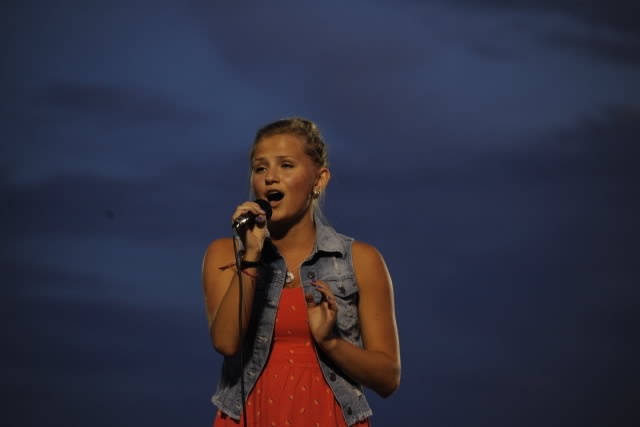
I don’t know if the minutes pass quickly or slowly on a day when you’re awaiting your first bull. Jamie McDonald looked fairly relaxed as the rodeo got underway with bronc riding and calf roping. Pretty young Katie Eliason, the teenaged winner of the previous night’s talent contest, came out on the catwalk to sing a country song.

Before we knew it, the time had come for bull riding, and readying himself in the first chute was McDonald, looking rather western in a black hat and black shirt. Without hesitation, he sat himself down on the one-ton white bull, gripped the bullrope like he’d done it a thousand times before, and gave a nod that he was ready. With that the cowboys opened the chute.

Perhaps never before did a Burke rodeo crowd watch with so much nervous apprehension. We all saw the menacing white bull leave the chute with the black-dressed cowboy sitting tall, awaiting the worst.

The bull came out of the chute, took four confident steps into the area and then froze. Yes, he stopped, dead in his tracks. He stood there silently, just switching his tail.

Remember, the biggest challenge for a bull rider isn’t style or form but just not getting bucked off for eight seconds. A second passed. Another second. Maybe even another second. Might the Englishman make eight seconds?

Of course not. Somebody in the arena moved. It might have been the clown, or one of the bull fighters there to save the rider from being kicked and gored. Somebody got the bull’s attention and he reacted as bullies always react; he kicked his hind legs high in the air and Jamie McDonald, England’s best bull rider, came thudding down into the thick soft concoction of dirt and sand in the Burke rodeo arena.

The bull fighters sprang into action and diverted the bull’s attention while Jamie scampered to his feet, a big smile on his face and his friend’s camera catching it all, and ran for the white steel fence and safety.

It was a good show and we figure the movie will be even better. Hopefully the busy people of Burke can find time to watch it.