Posted on Leave a comment

Beautiful Delusions of Autumn

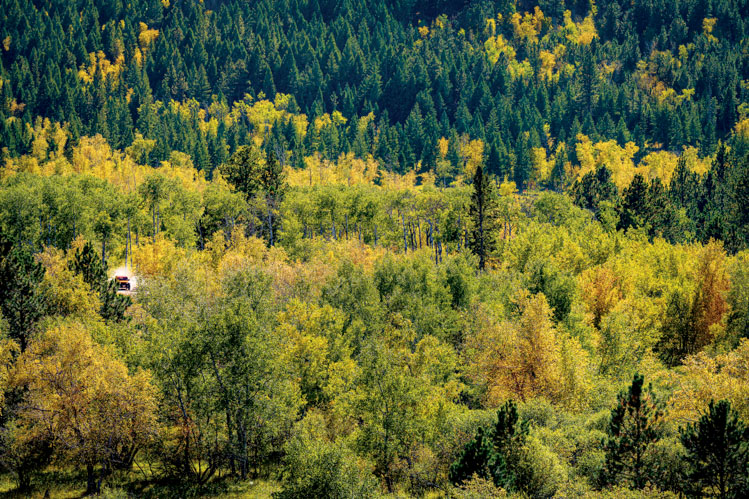
Drivers experience an autumn smorgasbord along Palmer Creek Road, which winds through thick aspen forests and broad meadows.

A SOLITARY COTTONWOOD tree on the lonesome prairie, when bejeweled with golden yellow leaves, emanates as much beauty as the human eye can absorb — especially when the sun slips southward, leaving the September sky bluer than blue.

Yet, who looks for a single tree in autumn? We tell ourselves we must see mountains and hillsides and river valleys with their forests full of leaves, each one hanging precariously by a stem, fluttering unworriedly as if winter was a thousand years away.

So yes, of course, go forth this autumn and fool yourself into believing that this glittering season is not just a cruel trick of chlorophyll. Life will always be so good. Calamity can never follow such serenity. South Dakota is paradise eternal.

Certain places in our big state are especially guilty of contributing to the delusions of autumn, beautiful though they may be. Traffic jams can occur on Highway 14 in Spearfish Canyon during peak leaf-peeking days. Sica Hollow’s oaks are almost as beguiling for people who live in the northeast. Our urban forests are resplendent in different ways because city parks and boulevards feature a gloriously unnatural mix of planned and planted trees. The McKennan Park neighborhood in Sioux Falls is an exceptional example.

We asked our chief photographer, Chad Coppess, if he knew of some lesser-known fall foliage tours. He suggested the three that follow. Interestingly, one that he chose is at South Dakota’s very lowest elevation while another is near the highest. Chad’s diplomatic third choice lies in between, along the Missouri River.

These routes won’t have bumper-to-bumper traffic in September and October when our leaves change color, but that is part of their allure. Autumn is even more striking when you escape the crowds.


PALMER CREEK

Pennington County

The graveled Palmer Creek Road is less than 4 miles long yet offers more than its weight in gold leaves between two spectacularly located campground resorts. Horse Thief Campground and Resort lies on the southwest end of the road and the Mount Rushmore KOA at Palmer Gulch Resort on the northeast. Both campgrounds have funky little stores that offer snacks and refreshments.

Midway along the road, an engineer had some fun by designing a double crisscrossing section with an over-under bridge and a cut through a rock that delivers a jaw-dropping view of Black Elk Peak no matter which way you are traveling. The road winds through beautiful aspen groves and, at times, offers a panoramic view of the entire gulch.

Little-known fact: Along the road is a parking area for Palmer Creek Trailhead, where you can trek to the top of Black Elk Peak (South Dakota’s highest point) and beyond.


PLATTE-WINNER BRIDGE

Gregory and Charles Mix counties

Those who prefer to venture off the interstates know that Highway 44, a main artery across the southern third of South Dakota, crosses the Missouri River via the Platte-Winner Bridge.

The stretch between Platte and Winner is 53 miles. The most scenic area features bluffs that drop into the river valley where you’ll discover two state recreation areas — Snake Creek on the east side and Buryanek on the west.

Lewis and Clark traveled here in 1804 and 1806, at one point losing a member of their party for several days. The Shannon Hiking Trail in Snake Creek Recreation Area commemorates the lost explorer and gives expansive views of the river and autumn colors.

Little-known fact: Unless you live in the neighborhood, you may not have heard that the mile-long Platte-Winner Bridge is about to be replaced. Construction on a new bridge may begin in 2025.


BIG STONE LAKE

Grant and Roberts counties

State Highway 109 runs up the South Dakota side of Big Stone Lake in the northeast corner of the state with a view across the lake into Minnesota. We recommend the 15-mile stretch from Big Stone City to Hartford Beach State Park with frequent stops at access points to the water. The route offers a variety of vegetation and colors for leaf peepers. Hartford Beach is one of the oldest South Dakota state parks and is popular with campers, boaters and fishermen. The log cabin trading post of Solomon Robar, along with Native American burial mounds and pioneer graves, are found along the hiking trails in the park.

Little-known fact: The shoreline of Big Stone Lake (elevation 965 feet) is the lowest spot in South Dakota.

Editor’s Note: This story is revised from the September/October 2023 issue of South Dakota Magazine. To order a copy or to subscribe, call (800) 456-5117.

Posted on Leave a comment

Keystone’s Bigfoot

Bigfoot followers are watching the little Black Hills town of Keystone, where a Sasquatch-related announcement is coming Saturday, Dec. 19.

This isn’t the first time Bigfoot made news in South Dakota.

The Bigfoot Field Research Organization (BFRO) reports 19 official sightings of the hairy creatures through the years, including one as recently as June of 2019 when there was a report of howling near Rochford, which is only about 20 miles northwest of Keystone (as the crow flies).

South Dakota’s most publicized Bigfoot brouhaha happened in the late 1990s when numerous strange and curious reportings occurred in Corson County on South Dakota’s northern border. Merle Lofgren, then the editor of the weekly McLaughlin Messenger, began to write stories about the rumors and sightings.

Lofgren was well-respected by fellow journalists. He was also beloved for his wit and irreverence. His weekly column,”From the Top of the Hill,” became a running commentary on how a rural community responds to a worldwide mystery like Big Foot.

The McLaughlin editor’s reports got the attention of other media. In September of 1997, Larry Fuller, the publisher of the Sioux Falls Argus Leader, chartered a plane and sent a team of photographers and writers to investigate. Tom Hasner, a veteran reporter, was aboard.

Fuller told Hasner, “We are uncertain at this point what is actually happening in the McLaughlin area. We are, however, convinced that there is sufficient evidence of a monster-like creature to merit a further investigation.”

Hasner learned that most of the sightings came after dark.”The descriptions match those of the elusive fact-or-fiction Bigfoot creature whose unusual habitat is the mountainous forests of the northwestern United States.” One local man said the descriptions were always the same: a seven-to-eight foot hairy creature with long arms and an offensive odor. According to the BFRO website, that description matches numerous sightings from throughout the USA.

Another man told Hasner that he went on a horseback search with friends and found tracks east of Little Eagle.”One of the guys wears a size 13 boot,” he said.”He stepped beside the footprint and hardly made an imprint at all. I guess he weighs about 240 pounds.” The Bigfoot prints left an impression 2 1/2 inches deep.

Lofgren died in 2008 and the beleaguered daily newspapers of today probably couldn’t charter a flight to Corson County for the Second Coming, so another Bigfoot sighting there could go unreported.

However, in Keystone there are rumors and rumblings — even confirmed sightings by unimpeachable sources — of a very large Bigfoot, something much bigger than eight feet. South Dakota Magazine has sent a correspondent to the vicinity of Horsethief Lake to keep watch.

All we know for certain is that the public is invited to Keystone on Saturday, Dec. 19 (11 am to 2 pm) for what’s billed as a Bigfoot Bash. Unlike most Sasquatch sightings, this seems well organized. It will be hosted in the big parking lot of Dahl’s Chainsaw Art, with games for kids, food trucks, hot chocolate, live music and door prizes.

Wear boots and bring a tape measure.

Posted on Leave a comment

Bison, Anyone?

Bison meat is gaining popularity at restaurants in the Black Hills and western South Dakota. Sandi McLain, longtime proprietor of Big Thunder Gold Mine in Keystone, says visitors from around the globe are eager to try the legendary food staple of the western prairies.

“We run more of a quick-food-style place,” says McLain. After panning for gold in the actual 1890s Big Thunder mine, parents and kids develop quite an appetite so hearty buffalo burgers are often a hit. Some hungry and adventurous”miners” even try McLain’s Rattlesnake & Pheasant Sausage.

McLain believes buffalo and wild game of all types are gaining popularity in the Hills. Just in Keystone, she says her fellow restaurateurs the Front Porch, Ruby House and Powder House Lodge all now have wild game on the menu.

Unfortunately, most of Keystone’s eateries are closed for the winter but McLain shared a buffalo meatloaf recipe that may someday end up on her Big Thunder menu.

Big Thunder Buffalo Meatloaf

(Makes approximately 6 servings)

2 pounds ground bison
1 carrot, cubed
1 red bell pepper, chopped
4 button mushrooms chopped
3 cloves garlic
1/4 teaspoon dried rosemary
2 tablespoons butter
1/2 yellow onion, chopped
2 cups fresh breadcrumbs
1/4 cup milk
1 egg
2 teaspoons salt
1 teaspoon steak sauce
1 teaspoon black pepper
1 pinch cayenne pepper

Use food processor to pulse onion, carrot, celery, bell pepper, mushrooms and garlic until finely chopped. Add vegetable mixture and rosemary in skillet and cook and stir for about 5 minutes until vegetables soften. Mix vegetable mixture, bread crumbs and milk in bowl, then cool to room temperature. Stir egg, salt, steak sauce and peppers into vegetable mixture. Add buffalo meat and mix with your hands until blended.

Lay in baking dish. Preheat oven to 375 degrees. Bake for about 30 minutes. Glaze if you wish (perhaps brown sugar with ketchup or mustard). Then bake another 30 minutes. Cool for 10 minutes, slice and serve.

Posted on Leave a comment

South Dakota’s Sledding Hills

Local youth take to their sleds at Yankton’s Morgen Park. Photo by Bernie Hunhoff.

South Dakota’s reputation for geographic diversity holds true when it comes to snow sledding. Some of our eastern cities are too flat, and the slopes in some of our mountain towns are too rugged, steep and rocky.

In Aberdeen, where the terrain has been described as”flat as a barn door,” city leaders manufactured a 25′ hill so kids could enjoy winter. However, we discovered that most communities have a natural hill that becomes a hot spot when it snows.

Pack your sleds as you travel this winter because there are plenty of hills to explore. Most of the snow hills are unsupervised, so adults should be ready to act if they see something dangerous — a heavy toboggan sled, for example, that could carom out of control and hurt someone, or a motorized vehicle on the slopes. Sledding has long been a favorite winter tradition, even for our flatland friends. Let’s keep it alive.

Here’s our list of city slopes. Tell us what we’re missing. We’d also like to know where to find the closest and richest hot chocolate after a day on the slopes.

ABERDEEN — God created most of South Dakota’s hills and mountains, but man assisted with the modest slope in Baird Park (1715 24th Avenue NE), the most popular sledding spot in the Hub City. City officials created the gentle 25-foot just for kids.

BELLE FOURCHE — Slopes behind the Tri-State Museum (415 5th Avenue) are a favorite, though they may be too fast for younger kids and there is a walking path at the foot of the hill so watch for pedestrians.

CUSTER — Pageant Hill has been touted as one of the finest family sledding spots in the Black Hills. It may be too steep and long for younger kids, but you don’t have to descend from the very top. The hill is the summit of beautiful Big Rock Park, which also includes hiking trails and a disc golf course. It rises above the city’s south side.

HOT SPRINGS — Southern Hills Golf Course (1130 Clubhouse Drive) is fun and scenic.

HURON — Toboggan Hill (6th Street & Lawnridge Avenue), aka Slide Hill, is a bluff above the Jim River valley on Huron’s east side.

LEMMON — The ever-resourceful people of Lemmon discovered years ago that it was less expensive to build a small hill for their new water storage rather than just build a taller tower. Then someone got the great idea or also making it into a sledding slope with a warming shack. Tank Hill is quite easy to spot on the city’s west side. Many years ago, when the water tower developed a leak during a cold spell, kids were able to slide on the ice flow all the way downtown.

PIERRE — The slopes above the soccer fields in Hilger’s Gulch are popular. The gulch is a scenic valley just north of the State Capitol building.

RAPID CITY — Meadowbrook School Hill (3125 W. Flormann Street) is a good spot, as well as the Civic Center hill that rises above the Holiday Inn Rushmore Plaza parking lot downtown.

SIOUX FALLS — Tuthill Park in southeast Sioux Falls is the site of weddings and parties in the summer months, but when the snow falls it becomes the domain of well-bundled children with sleds. Spellerberg Park (2299 W. 22nd Street), closer to the city center, also has a fair slope. Great Bear Ski Valley welcomes snow tubers, who get to ride the ski lifts.

SPEARFISH — Hills behind the Donald E. Young Center on the Black Hills State University campus are fast and fun.

STURGIS — Lions Club Park (off Lazelle Street) is a good place for younger kids, and Strong Field Hill on Ballpark Road is fun for older youth.

WATERTOWN — St. Ann’s Hill, a sledder’s delight, is so named because St. Ann’s was the original name of the nearby Prairie Lakes Hospital. Take Highway 20 to 10th Avenue and turn uphill.

WESSINGTON SPRINGS — It’s worth a drive to experience Ski Hill on the west edge of Wessington Springs. The natural setting in the Wessington Hills is idyllic, but the real attraction is an old, homemade invention with an electric motor that powers a 1,200-foot rope lift. Jokingly called the”Rube Goldberg ski lift,” the simple equipment has been lovingly cared for by handy volunteers, including Lloyd Marken, 85, who helped to build it in 1956.

YANKTON — Morgen Park (1200 Green Street) is the go-to sledding hill in town, however kids also like to slide down the earthen slope of Gavins Point Dam, where it rises above Pierson Ranch Recreation Area west of Yankton.

Posted on Leave a comment

Howes Corner

Bob Hansen (left) has run the till at Howes Corner for 38 years.

“I’ve never worked a day in my life,” claims Bob Hansen, proprietor along with his wife, Lavonne, of Howes Corner Store for the past 38 years.”I like everything about this store. I love the ranch life and all my customers. I like everything I do.”

Still, all good things end. The Hansens sold the Meade County store this summer to Dawn Simons, a longtime employee, and her husband, Russell. Hansen says he’ll miss the customers, morning cribbage games with neighbors over coffee and the camaraderie that goes with running the only public establishment for many miles in any direction.

Hansen’s good humor has survived intact.”He never forgets a story,” complains Lavonne with a good-natured grin. For example, he likes to tell about the only time he was rude. He says a lady customer abhorred the idea of visiting his store’s modern, clean outhouse on a particularly warm summer’s day. She was traveling north on Highway 73 to Highway 212. While cooling her ample self by opening the beverage cooler doors, she asked Hansen what it would take for her to get to 212.

“Go on a diet,” he quipped.

Such has been the atmosphere at Howes Corner. Everyone was welcome, and at risk of some good-natured ribbing.

Interesting characters come and go at the intersection. The Longbrake family, famous in rodeo circles, lives nearby along the Cheyenne River. Native American residents of the little town of Bridger also stop for supplies, including folks like Wally Little Moon, a middle-aged long distance runner who just returned from a marathon on the East Coast. State Representative Dean Wink ranches just north of the store. Currently the Speaker of the House of Representatives, Wink’s one of the state’s most powerful lawmakers but he’s been as vulnerable to Hansen’s joking as the stranger who was looking for 212.

The store was built near the juncture of Meade, Ziebach, Haakon and Pennington counties in 1931 by Ed McQuirk. According to local legend, he won federal approval for a post office in 1940 after suggesting it might be named after W.W. Howes, a South Dakota politician who was serving as First Assistant Postmaster General under President Franklin Roosevelt.

A series of people ran the store until 1977, when the Hansens moved there and stayed — swelling the population to four thanks to their small children, Angela and Todd. Lavonne sold stamps for 13 cents that first year, and she’s been postmistress of zip code 57798 ever since, filling 50 post office boxes in the store and almost as many for rural delivery.

Though Howes’ post office was one of the last to be established in South Dakota, it has outlasted many in larger places because of a regulation that post offices cannot be closed if they are more than 25 miles from the next facility. Howes Corner is barely that far east of White Owl and south of Faith, which is located along Highway 212. But don’t ask how to get there if you can’t take a joke.

Editor’s Note: This story is revised from the September/October 2015 issue of South Dakota Magazine. To order a copy or to subscribe, call (800) 456-5117.

Posted on Leave a comment

Why”Johnson Siding?”

Johnson Siding lies just west of Rapid City along Highway 44.

Have you ever driven west from Rapid City on Highway 44 and thought,”Gee, I wish there was a remote vinyl siding outlet around while I’m out here exploring the beautiful Black Hills?” Then you round a corner and there’s Johnson Siding?

If you did, you soon realized that Johnson Siding is the name of a town, not an out-of-the way home improvement center. Hopefully you weren’t too disappointed. So, why “Johnson Siding?”

The answer — like the answer to so many town etymologies — has to do with the railroad, and a sawmill built on Rapid Creek in the 1890s by a Swedish immigrant named John Johnson. You might have guessed correctly that Mr. Johnson is the namesake of the Johnson in “Johnson Siding.”

A “siding” in railroad lingo is a short section of track where trains can pull off to load or unload, and allow others to pass. In 1906, the last spike was driven on the Crouch Line — the rail spur that conveyed passengers and freight through the heart of the Black Hills from Rapid City to Mystic until 1948. The Johnson mill provided much of the lumber used in constructing the many bridges and trestles the Crouch needed to cross the rocky terrain. The siding also allowed the Johnson mill to fulfill lumber orders from Rapid City or anywhere else on the line. Over time, “Johnson Siding” evolved from an informal to a formal town name.

The Big Bend Powerhouse in 1920.

The Johnson family provided lumber to the Dakota Power Company when it bought the flume built by the Dakota-Placerville Mining Company — delivering water from Pactola to the Placerville mine — and extended it to the Big Bend Powerhouse, near Thunderhead Falls.

The line dropped more than 300 feet along its course to generate enough pressure to turn the turbines of a generator that helped supply power to Rapid City. The Flume Trail is built along the old flume bed. Hikers can still see remnants of the flume, and the adjacent catwalk used by maintenance workers, along the trail.

Johnson Siding isn’t the only town with “siding” in the name. Tie Siding, Wyoming is so named because in the late nineteenth century “tie hacks” — lumberjacks who felled trees and hewed them into vast numbers of ties for western railroad expansion — would float logs harvested in the Colorado Rockies down the Cache la Poudre River to Laporte, where they were hauled in ox-drawn wagons to the siding.

Tie hacks felled trees through summer and winter, stripping and hewing them with a broadax. Their river shipments sometimes created enormous logjams that had to be cleared with dynamite.

The Tie Hack Memorial near Dubois, Wyoming commemorates the efforts of the tie hacks. There are no worker-hero monuments in either Johnson or Tie Siding. Johnson Siding has a church, gas station, community center and bar. Tie Siding has an antique/fireworks store and a post office.

Building railways from sea-to-sea was temporary work, so there may have been more “Sidings” that have faded into unmapped memories with a faint scent of sawdust and steel.

Michael Zimny is the social media engagement specialist for South Dakota Public Broadcasting in Vermillion. He blogs for SDPB and contributes arts columns to the South Dakota Magazine website.

Posted on Leave a comment

Pennington Revisited

Ten years ago, Jerry Wilson, the former managing editor of South Dakota Magazine, wrote an article about the incredible geographic diversity found in Pennington County. Its western edge begins in the heart of the Black Hills. As you travel east, the second largest city in South Dakota — Rapid City — sprawls along the eastern foothills. The landscape gradually gives way to ranch country, the Badlands, the Buffalo Gap National Grassland and the Lakota culture of the Pine Ridge Indian Reservation, which sits directly across Pennington’s southeastern boundary.

We last visited Pennington County several months ago for a family vacation, and you’ll not be surprised to learn that all of those characteristics remain true. The Badlands haven’t disappeared and the Black Hills are still there, though there have been some monumental changes since the county was created in 1875. In its 142 years, Pennington County has become South Dakota’s prime tourist destination, with millions of travelers making plans to visit every year.

Badlands National Park protects over 240,000 acres of rugged landscape that spills into Pennington County.

Tourism likely wasn’t on the minds of territorial legislators when they created Pennington, Lawrence and Custer counties in one fell swoop, but current governor and county namesake John Pennington saw the move as way to help his friends and line his pockets. The governor named several of his closest allies in Yankton to lead offices in the new county rather than fill those positions with people who lived in the area. The slight became worse when the new officials chose to stay in Yankton instead of moving west. Rumors of corruption escalated even further when Pennington selected Sheridan over Rapid City as the new county seat. It was believed that Pennington held real estate near Sheridan, and its value was sure to increase with the town’s elevated status.

Locally elected officials soon replaced Pennington’s appointments, and the county seat was eventually relocated to Rapid City. But the governor remained unpopular in the Black Hills until William Howard succeeded him in 1878. Shady as his dealings may have been, we do hold a soft spot for Pennington since we publish South Dakota Magazine in his home, an 1875 brick Italianate building on the east end of Yankton’s Third Street. It’s the only territorial governor’s home remaining in South Dakota. Readers are welcome to stop by for a tour when they’re in town.

Our trip into Pennington County began on the Badlands Loop Road, a 31-mile detour off Interstate 90 that provides several scenic overviews of a landscape millions of years in the making. The kids enjoyed venturing out onto short trails, taking note of the”Watch for Rattlesnake” signs. Every now and then they would head off-trail, skipping over narrow chasms and climbing precarious points.

Mount Rushmore draws nearly 3 million visitors every year.

The Badlands Loop Road met Interstate 90 again at Wall, which meant a stop at Wall Drug. We spent a couple of hours perusing the many shops. I don’t think the kids believed that it all began with signs for free ice water, enticing motorists to stop at the town’s tiny drug store. I was impressed by the huge collection of original Western paintings that hang throughout the complex.

Our first morning in Rapid City began with coffee at the historic Fairmont Creamery building. Constructed in 1929, the space has undergone extensive renovations and now hosts several businesses, including Pure Bean.

Fully caffeinated, we made our way to Mount Rushmore, the grand jewel of tourism for Pennington County. Roughly 3 million people visit the national memorial every year. I’ve written a few stories covering different angles of Mount Rushmore, but it was nice to simply view the granite heads from the observation deck and to stroll along the Presidential Trail through the pines and see the sculpture from new perspectives.

Ellie Andrews served time in Presidential Pawn’s fictitious jail.

Back in Rapid City for the afternoon, we explored the lively downtown district, anchored by the new Main Street Square. Children laughed and splashed in the fountain while families lounged in the green space. We strolled the vibrant and ever-changing Art Alley, where business-owners gladly allow the drab back halves of their buildings to become colorful street paintings. We saw the world’s smallest taxidermied dog inside Presidential Pawn and enjoyed a meal at the Firehouse, Rapid City’s original fire station converted into a restaurant and brewpub.

For part of our trip, we stayed at Newton Fork Ranch, a former working ranch that has been converted in a series of cabins set about a mile outside of Hill City. From here, we had easy access to Prairie Berry Winery, the Miner Brewing Company and the 1880 Train, which travels round trip from Hill City to Keystone along the old Chicago, Burlington and Quincy line.

We took advantage of other popular stops in Pennington County. We traveled through Bear Country and saw mountain lions, timber wolves in captivity, and bears as they sauntered past our car. There were doubts about whether or not some in our party would be able to successfully navigate the crooked cabins of the Cosmos Mystery Area, but once the surroundings stopped spinning and the nausea became tolerable, everyone completed the tour. The Cosmos is a very weird place where tennis balls appear to roll uphill, and uneven ground proves to be completely level. Two college students discovered the peculiar place in 1952 as they searched for land on which to build a summer cabin. They immediately noticed the unusual forces and created demonstrations that have confused visitors ever since. But it really isn’t for everyone. Several people on our tour seriously struggled with balance and a few even mentioned headaches.

Joe Andrews enjoys a leisurely ride on the 1880 Train.

That sounds like a busy trip, but we truly only scratched the surface of things to do in Pennington County. We missed the amazing museum at the South Dakota School of Mines and Technology, and Reptile Gardens just south of Rapid City. We could have spent a day at Pactola or Deerfield lakes or made the pilgrimage to the top of Black Elk Peak, the highest point in South Dakota and the tallest peak in the United States east of the Rocky Mountains. When we were there, the promontory was still known as Harney Peak, in honor of Gen. William Harney, a 19th century military commander stationed in the area. But in August 2016, the U.S. Board on Geographic Names changed the moniker to Black Elk Peak for the legendary Lakota holy man whose vision quest atop the mountain was immortalized in John Neihardt’s classic book Black Elk Speaks.

Missing out on all of those other activities simply means another trip is in order, perhaps in the summer of 2017. And I bet the ponderosa pines, the rugged Badlands, doughnuts and coffee at Wall Drug and the four granite faces of Mount Rushmore will still be there, waiting for us.

Editor’s Note: This is the 32nd installment in an ongoing series featuring South Dakota’s 66 counties. Click here for previous articles.

Posted on Leave a comment

Second Chances

Seldom in life do we get second chances. And the prospect of it happening 161 years after a calamity? Very rare. But our Nov/Dec 2016 issue has just such a story. It happened when Paul Stover Soderman of Colorado discovered he was a descendant of General Harney, the man responsible for a massacre of Lakota men, women and children in 1855 at Blue Water Creek in Nebraska. The killings happened after Harney rebuffed Chief Little Thunder’s extended hand. A few years ago, Soderman befriended the chief’s descendants.

Posted on Leave a comment

Reaching for New Heights

Mark Rafferty is a young rock climber, photographer and artist from Rapid City. Last November, serious injuries from a 40-foot fall near Tucson sidelined the teen, but he returned to climbing this spring. Here are some recent photos from his climbs in the Black Hills. See more of his work and follow his blog at www.markcrafferty.com.