Posted on Leave a comment

Scoping the Missouri

Members of the South Dakota Ornithologists Union look for birds at Union Grove State Park between Beresford and Elk Point.

Roger Dietrich was scoping along the shore of Lake Yankton when a Rapid City woman approached him with a question about the tiny Ross’s gull, which had been sighted in the area.

“I’ve gone to Alaska twice and I didn’t see the bird there,” she said.”Is it still around?”

Dietrich pointed to a gull, sitting on ice in the middle of the lake.

The Missouri River is a bird-watching paradise. Hundreds of species of ducks, geese, gulls, loons and other birds congregate in parks, woodlands and farm fields that border its 443-mile corridor. But it still helps to know for what you’re looking.

Every habitat attracts different birds, says David Swanson, professor of biology at the University of South Dakota and author of Birder’s Guide to South Dakota, and habitats vary dramatically along the Missouri as it winds from Nebraska to North Dakota.

Following is a guide, from south to north, of habitat patches and the surprises that await birdwatchers, both the serious birders looking for the rarest”lifer” bird and those who are happy spotting sparrows and swallows.


The Adams Nature Preserve attracts wading birds such as blue herons.

Adams Nature Preserve

Southeastern South Dakota

The Adams Homestead and Nature Preserve near North Sioux City includes many trails.”It has a variety of habitats,” Swanson says.”It has an extensive cottonwood forest that borders the river, and there’s also a little lake called Mud Lake that’s attractive to waterfowl. The ring of trees surrounding Mud Lake can be good for woodland birds, too.”

Mud Lake is approximately a quarter mile from the Adams Homestead parking lot, so a brief hike is required to access it. Wooden observation blinds lie along the trail with a view of the lake.

“The other habitat at the park is a restored open prairie,” he says.”It’s one of the few sites in the southeastern part of the state where you can find Eastern meadowlarks. The common meadowlark in South Dakota is the Western meadowlark, but the Eastern meadowlark is expanding its range in the southeastern part of the state and Adams Homestead is one of the places where you can find those.”

Since first being sighted in 2017 by Swanson and his ornithology students, the Eastern meadowlark has made regular appearances in the open-prairie habitat, often with multiple birds singing among the scattered trees.

“I wasn’t aware at the time that Eastern meadowlarks had started to expand their range, and I heard these Eastern meadowlarks calling,” Swanson says.”I go, ‘That is very unusual.’ We kept walking and saw them and everybody in the ornithology class got to see me geek out over it.”

Though birdwatching at the Adams Homestead is enjoyable year-round, it’s best in spring, summer and fall.”Mostly, it’s hiking the trails during migration and seeing a variety of birds at that time,” Swanson says.”It’s lots of warblers and sparrows, so the migration periods are late April to mid-May. Then in the fall, from mid-to-late August into about mid-September is probably the peak for warblers and vireos, some of which migrate all the way down to Central and South America.”

Sparrows that migrate to the southern U.S. and Mexico slightly later in the year can typically be seen at the Adams Homestead from mid-September to mid-October. Along the river and at the lake, birdwatchers encounter ducks and geese, as well as wading birds like herons and egrets.

“In the cottonwood forest, there are Eastern whippoorwills,” Swanson says.”Those are birds that don’t really get too much out of the southeastern part of the state. Of course, they’re nocturnal, so they don’t start calling until it starts to get dark.”


Least terns can be found on sandbars below Gavins Point Dam.

Gavins Point Dam

West of Yankton

Gavins Point Dam, the southernmost project on the Missouri’s system of six dams, is surrounded by unique bird habitats.

During the summer, hundreds of American white pelicans can sometimes be seen near the dam, while on the river itself, there are piping plovers, still considered a threatened species in most of the U.S., and the least tern, North America’s tiniest tern, often seen flying low over the river and hovering before plunging for prey.

“One of the reasons I like birding is the idea that it would be so cool to fly, and least terns are just the best flyers,” says Roger Dietrich, a local authority on ornithology.”They’ll fly and they’ll see a minnow, and then they dive straight down in the water — and splash!”

In winter, the 2-mile-long earthen dam creates an unusual condition for birds and birders.”Some years, when it doesn’t freeze, like lately, there’s been lots of open water above the dam,” Dietrich says.”Some years, we get lucky and even the Lewis and Clark Marina doesn’t freeze over real early. So, that’s a popular spot where some grebes and loons will stop.”

Black scoters, surf scoters, white-winged scoters and long-tail ducks, which are mainly ocean birds, are known to visit the lake and river in winter.

“I tell people from other places that we have those birds here and they’re just not believing it, because they don’t think of the center of the United States as a place where these birds would show up,” Dietrich says.”And when I say they show up every year, usually, for a fairly long period of time, they just can’t believe that we’re so lucky.”

The common loon migrates through the area, as well as a number of gulls — including Sabine’s gulls, kittiwakes, black-legged kittiwakes and even the Ross’s gull, which is associated with the remote arctic. Crest Road, which passes over the dam, is a good place to observe such birds. It requires no special pass or permit.

“Scan for the birds with binoculars or a spotting scope and chances are, you’ll find something different,” Dietrich says.”Sometimes there are huge flocks, and you can spend hours just scoping the birds there,” he says.”So, if you see somebody there with their scope out or binoculars, stop and ask them what they’re seeing. I’d say 99 percent of the people will be glad to point things out to you, and maybe even let you look through their scope to see what they’re seeing.”

Several snowy owls hung out along the dam road a few years ago.”They were feeding on the flocks of coots that were there.” Wintertime also brings large flocks of lesser scaup, which birdwatchers will scan for specimens of greater scaup, a polar bird that tends to prefer saltwater and is rarely seen inland, Dietrich says.

“It’s the same with the big flocks of common goldeneye,” he says.”People try to scope out the Barrow’s goldeneye, which is another species. It’s more of a West Coast bird, but once in a while, we’ll get one here — always a highlight.”

Bald eagles frequent Gavins Point Dam and some now nest year-round in the tall cottonwoods that border the Missouri.”They’re used to a lot of people around and some of the trees they perch in are right along the local roads,” Dietrich says.”You can see them in action, swooping down and picking up fish. I’ve seen eight or nine at a time on the ice up above the dam, eating the dead snow geese they’ve picked off.”


A pair of Barrow’s Goldeneyes at Fort Randall.

Fort Randall

Pickstown

Fort Randall Dam also hosts a large congregation of bald eagles. Below the dam is the Karl E. Mundt National Wildlife Refuge, which provides habitat for the eagles.

Kelly Preheim, a kindergarten teacher in Armour and a well-known local birding enthusiast, especially likes the wooded area around the Fort Randall Dam.”We’re mostly on agricultural grassland in southeastern South Dakota,” she says.”But the dams have a lot of woodland, forested areas, and I enjoy walking on the trails.”

She found 71 bird species on a recent camping trip to Pickstown.”In the morning, oh my goodness, the singing,” she recalls.”My husband’s like, ‘I can’t get any sleep. It’s so loud here!'”

A hike to the tailrace, the channel below the dam that carries water away, will often be rewarded.”Fish that go through the dam come out somewhat stunned in the tailrace,” Preheim says.”Then, all these birds, like gulls and eagles and certain ducks, eat those fish.”

Like nearby Gavins Point, Fort Randall Dam is also home to many types of waterfowl in autumn and winter.”There are a lot of different ducks on the scene, hundreds and hundreds, if not thousands, of different ducks there at a time,” Preheim says.”I saw a brown pelican one time. That’s actually an ocean bird.”

Other surprise visitors at Fort Randall include a yellow-billed loon, typically associated with Alaska and America’s western coast, and a great black-backed gull, which is an Atlantic coastal bird, Preheim says.

Scarlet tanagers are often found in South Dakota but summer tanagers, a rare visitor, might also be seen around Fort Randall.


Pelicans near Big Bend.

Big Bend Dam

Fort Thompson

The best birdwatching at South Dakota’s northernmost dams — Big Bend and Oahe — occurs from April through May and from September to November, according to lifelong birdwatcher Ricky Olson, who lives at Fort Pierre.

Big Bend has fewer access roads and trail amenities than Oahe and the other dams, but it has its own charms. Ospreys nest below the dam and brown pelicans have been spotted.

“Once in a while, in the wintertime, you get a Brant goose at Big Bend,” a seacoast bird.”I run down to Big Bend at least every two weeks in the winter to see what’s there,” Olson says.

Big Bend also attracts smaller goose species, including snow geese and white-fronted geese, both of which are common to the area.”In the fall, it’s neater to go to Big Bend,” Olson says.”Also, the shad and minnow species will be in the shallows then, and you’ll get all kinds of cormorants and pelicans and hundreds of gulls in these frenzies where they’re all feeding, and the gulls are trying to steal from everybody.”


Canada geese along the Missouri River.

Oahe Dam

Central South Dakota

Ring-billed gulls, herring gulls and California gulls may be sighted at Oahe, as well as the arctic tern, a mega-find for birders.

A spectacle occurs during flooding when Oahe Dam’s hydraulic turbines are running.”It’s a feeding frenzy. You get thousands of gulls, maybe 20,000, below the tailrace in a half-mile stretch,” Olson says.”It’s like a snowstorm. Thousands of people come to watch the ‘gull snowfall.'”

Oahe also has cliff-dwellers.”In the sand layers in the cliffs, in the holes, there are barn owls nesting,” Olson says.”They dig their own holes, and often, they’re near where colonies of bank swallows have dug holes.”

In autumn, Sabine’s gull may be spotted.”It’s very pretty. It’s black and white with half a diamond on the wing,” Olson says.”We also get Bonapartes and Little gulls, which is a little gull, and we get some of the big ones. Once in a great while we get the great black-back, which is the biggest gull.”

Gulls breed on a few islands along Oahe, Olson says.”There are only a few places in South Dakota where that happens.”

Another rare visitor to Oahe, among the sea ducks like the scoters and the long tail duck, is the occasional coastal harlequin duck in the tailrace.

“We get loons,” Olson says.”Sometimes we get the Pacific or the yellow-billed or red-throated loon, which are rare for our state.”

Further north on Oahe, retired biology teacher Stan Mack says opportunities are available even in Mobridge’s city limits.”There’s a walking trail along the south side of town. Just follow Main Street to the river and walk west and you’ll see the ducks and geese and gulls that sit on the water.”

Mack says Indian Creek (east of Mobridge) and Indian Memorial (across the river to the west) offer trails and habitat.

Mack doesn’t walk well enough to explore like he once did, but the birds will come to him.”I’m doing a feeder watch for Cornell University. Right now, I’m looking at a collared dove — we never saw them before — and I see about 16 more picking up seeds on the ground.”

Editor’s Note: This story is revised from the March/April 2025 issue of South Dakota Magazine. To order a copy or to subscribe, call (800) 456-5117.

Posted on Leave a comment

The Yankton to Marty Trail

South Dakota Magazine intern Ava Brandt met Digger at Mensch’s Greenhouse in Avon.

A golden dog named Digger met us at the door of Mensch’s Greenhouse, his tail wagging like a windshield wiper. Two cats lolled on a flower worktable and a dozen colorful cockatiels chirped from two cages near the petunias.

Any traveler will crack a smile at Mensch’s Greenhouse in Avon — and that’s fortunate because for the most part this Yankton-to-Marty loop can be a solitary journey, even though it visits seven small towns in South Dakota’s populated southeast corner.

We began the loop early in the morning because of a tip that the Tyndall Bakery has amazing donuts and pastries, and some days they sell out. We had two stops to make before the bakery.


The Lakeport Church in rural Yankton County dates to 1884.

Chalkstone Church

We drove 8 miles west of Yankton on Highway 50 to 431st Avenue, then turned right to the Bruce and Donna Schwarz farm. Drive slowly through the farmyard — the Schwarzes don’t mind — and you come to a small church built of the yellow chalkstone found along stretches of the nearby Missouri. Neighbors keep up the church and mow the cemetery, which features Czech surnames still common in the area. This is Czech country, settled by pioneers from Bohemia and Moravia who began to arrive in 1869. Their first settlement was Lakeport; only the little yellow church, constructed in 1884, has survived.


A wooden church is among the historic buildings preserved at the park in Tabor.

TABOR: CZECH CAPITAL

A few miles further along Highway 50 is the town of Tabor (pop. 405), founded in 1872. Tabor is famous for its annual Czech Days celebration in June. Parking is more plentiful on the other 362 days of the year, so stop on Main Street and stretch your legs by walking through the quaint pioneer village which includes a tiny wood church that was built at Lakeport even before the chalkstone church. Now it is well-kept in the Czech Preservation Society’s heritage park along with several other antiquated structures.


Magazine interns Rose Lane (left) and Ava Brandt at Tyndall’s Eiffel Tower, a fancy flagpole that measures 100 feet.

TYNDALL’S TOWER

One wonders if Gustave Eiffel, engineer and namesake of the tallest structure in Paris, would be flattered to see the imitation in Tyndall.

Tyndall’s”Eiffel” is more than 1,000 feet shorter than Gustave’s, but nearly as old. It was constructed in 1898, just nine years after the original was completed to honor the centennial of the French revolution.

The replica stands on the lawn of the county courthouse, west of downtown on 18th Avenue. But before you visit the tower, stop at the Radack family’s bakery. We dilly-dallied too long, and the cases were nearly empty, so we missed out on the Tyndall Roll, a Bismarck-like pastry filled with white cream and topped with crushed peanuts. No one knows when the legendary roll was created, but the bakery traces its history to 1905.


Carol and Vern Tolsma at their Avon greenhouse.

AVON’S GREENHOUSE

Feeling lonely in southeast South Dakota? Just visit Vern and Carol Tolsma’s Mensch Greenhouse and Flower Shop along Highway 50 in Avon.

Carol’s grandmother, Ada Mensch, started the greenhouse in 1957. Imagine how many flowers have bloomed, thanks to Ada, in 67 years. And how many people have enjoyed the garden bounty that took root here.

The flowers and plants come with free advice. Did you know you should only water tomato plants when absolutely necessary? Vern says a thirsty plant sends roots deep into the soil, making it strong and adding taste to the fruit.

Digger, the greenhouse dog, wags and nuzzles anyone who’ll take the time. Cats and cockatiels also share the space. The cockatiels are orphans who lost their owners and found refuge here.

The Tolsmas tend a 2-acre garden near the shop, and they sell produce, canned goods and amazing pickles. They occasionally set out a table of freebies that need a home.

Some days, Vern wears a blue t-shirt that says it all:”I Love Gardening From My Head to My Tomatoes.”


Richard Langdeaux helps keep Wagner’s park looking beautiful.

A WALK IN THE WAGNER PARK

Follow Highway 50 northwest. South Dakota’s Czech heritage extends into Charles Mix County and the city of Wagner (pop. 1,603), the largest town on this loop tour. Wagner has all the amenities you might want — a coffee shop, restaurants and a grocery store.

On the west side of town, near Highway 50, lies a little lake and park that would be the envy of any city in America. The lake was created when a dam and rock structures were built in the 1930s by WPA workers. Today the park includes two walking bridges, flower gardens, trails and even a small waterfall. This is the best opportunity of the day for a walk.

Richard Langdeaux, a Santa Claus look-alike who was collecting trash in the park, told us that the stone buildings along the lake were once a Scout camp. Artesian springs keep the lake full year-round.

Wagner also offers an impressive museum, operated by the Charles Mix County Historical Society. The collection is known for its Czech exhibits, as well as artifacts from the Yankton Sioux culture that predates the pioneers.


Michael Rouse helps maintain the ground around Marty’s St. Paul Catholic Church.

MARTY’S AMAZING CHURCH

Drive west of Wagner for 6 miles to 388th Avenue and turn south for another 6 miles to Marty. The one and only enterprise is a boarding school started by the Benedictines in 1924 and now operated by the Yankton Sioux Tribe.

Alongside the school is St. Paul Catholic Church, built by volunteers — Indians and non-Indians — in the early 1940s of Indiana sandstone, mined from a quarry near St. Meinrad Archabbey, which founded St. Paul’s.

The steepled church (167 feet!) is surrounded by tall trees and other structures, so it’s hard to appreciate from afar. Exit your car and walk about the churchyard, where there are statues of Kateri Tekakwitha, the first Native American saint, and St. Theresa, patroness of missions. On most days, the church doors are open; inside, St. Paul’s looks like something you might see in a European city except that the murals, stained glass and other art are rich in Native American themes.


The tallest stone in Greenwood Presbyterian Cemetery marks the grave of Struck by the Ree.

STRUCK BY THE REE

Follow the road south of Marty for about 7 miles and a few curves. You’ll come to Greenwood Presbyterian Cemetery, where the tallest stone marks the grave of Struck By The Ree, a maligned and misunderstood leader of the Nakota. He was born in 1804, as Lewis and Clark came through the river valley. Legend says the explorers wrapped the baby in an American flag and proclaimed he’d be a great leader.

Struck By The Ree did grow to be a wise chief — an environmentalist, a feminist and a peacemaker. He urged pioneers to preserve the timber resources of the river valley. He pleaded that both Nakota and white men respect the Native women. And though he first fought the intrusion of the white civilization, he eventually recognized that it could not be stopped (ìthey are like maggots Ö”). He became a lead negotiator in the 1858 Treaty. Decades later, after the treaty was broken and his people found themselves hungry and hopeless, he was often persecuted; his cabin was burned, and his horses were stolen.


A tall memorial near Greenwood commemorates the 1858 Treaty.

Treaty Memorial

Continue south and you’ll soon come to another memorial, erected to honor Struck By The Ree and seven other Native American signers of the 1858 Treaty, which gave the government more than 11 million acres for $1.6 million and established a reservation for the Nakota.

The monument was constructed in 1907, topped with an obelisk. A few decades ago, vandals toppled the obelisk — a posthumous insult to Struck By The Ree, a century after his death in 1888. It has since been restored.


Springfield sits above a growing delta in the Missouri River.

A MISSOURI RIVER DELTA TOWN

Drive south from the treaty marker and you’ll come to the tiny community of Greenwood, once the hub of the Yankton Sioux Tribe. At Greenwood, if you are not in a hurry, turn right and follow the river for a mile or two for scenic views. Then return and continue east along the Missouri.

Eventually you’ll come to 312th Street, and then to Highway 37 which will lead you to Springfield, once South Dakota’s smallest college town. Thirty years ago, the University of South Dakota/Springfield was closed, despite furious opposition, and the campus was converted to a prison.

Townspeople feared that the prison would be the ruin of Springfield, but it has persevered. Norm’s, once a favorite hangout for collegians, still serves burgers and beer. A company known as Mr. Golf Car parks more than 200 golf carts along Main Street. A museum keeps the history of the college alive, and anglers come to fish the river.

Springfield still has a post office, bank and library — plus several eateries. On its eastern edge is a veteran’s memorial with a panoramic view of the river.

The highway sign lists the population at 834. That doesn’t count the 1,200 prisoners who live there.


Six unknown soldiers of Lt. Col. George Custer’s 7th Cavalry are buried in the Bon Homme Cemetery.

APPLE TREE ROAD

For a final treat on your loop, turn east onto Apple Tree Road (a mile north of Springfield).

A few miles down the road is a spot known as Apple Tree (though the state Game, Fish and Parks Department calls it Sand Creek). It consists of a campground and cabins, a boat dock and a little peninsula where you can walk out among the reeds and see where the invasive delta ends and Lewis and Clark Lake’s open water begins.

This was once a delightful place to enjoy the bellowing of giant bullfrogs. They were silent on our stop. Perhaps they dislike the phragmites, an invasive wetland plant that is taking over.

Continue east on Apple Tree Road and you’ll soon pass the tidy Bon Homme Cemetery where a large stone memorial marks the graves of six soldiers who traveled with Lt. Col. George Custer and his 7th Cavalry in 1873.

As Custer’s entourage camped at the nearby town of Bon Homme for four days, six became ill and died. Historians speculate that they contracted typhoid fever. The six were initially entombed at Snatch Creek and then reburied at the cemetery in 1893. In 1922 the large marker was built in the cemetery to give some measure of respect to the nameless six, who might otherwise have perished at the Battle of the Little Bighorn in 1876.


A replica log schoolhouse stands near the Bon Homme townsite.

BON HOMME WAS A TOWN

Continue south on Apple Tree Road and you soon come to a curve near the old community of Bon Homme. At the curve is a monument to the first schoolhouse in the Dakotas. A small replica of the 1860 log schoolhouse was erected in 1910 by pioneers, and it remains there today. Care to skip a rock in the river (or fish or launch a boat)? Just follow the gravel road south at the curve for less than a mile and you’ll drive right up to the water’s edge and a sandy beach.

Back at the curve, head north to Highway 52. It will lead you east to Highway 50, which takes you past the chalkstone church and on to Yankton.

Editor’s Note: This story is revised from the January/February 2025 issue of South Dakota Magazine. To order a copy or to subscribe, call (800) 456-5117.

Posted on Leave a comment

The Modern Rewards of Quilting

Mary Kirschenman (left) and Sally Schroeder guide quilters at Sassy Cat Quilting, headquartered in a former horse barn north of Yankton.

April Flying Hawk began quilting after her son, Ethan, died at the age of 3.

“I wanted to do a giveaway when my son passed,” Flying Hawk says.”And, I wanted to do the quilts myself, not buy them from anyone.”

Flying Hawk, a Wagner native and a member of the Yankton Sioux Tribe, reached out to the women in her community who create star quilts. Each of those women quilted differently. She took what she could from each quilter and began sewing, developing a process that worked for her. Now, Flying Hawk hand-stitches all her quilts to finish them. She only uses a sewing machine for the initial work of piecing them together.

Quilting feels like second nature for Flying Hawk.”The intention and goal of starting this was to find healing. It’s now become my second job.”

Quilting is growing across South Dakota. Shops catering to the quilters are especially showing up on main streets in rural communities. The reasons for the resurgence are as many as the stitches in a square.

Sally Schroeder’s shop, Sassy Cat Quilting, is located in a spacious, remodeled horse barn north of Yankton. She believes quilting is rooted in joy and passion. She also learned that it seams friendships.

Sally Schroeder’s Sassy Cat Quilting north of Yankton is one of nearly three dozen shops that cater to quilters in the state.

When Schroeder’s husband, John, was diagnosed with cancer a few years ago, she did not know how she would keep the business going.”My posse pitched in and helped me keep the doors open,” she says. The posse consists of family, friends and customers who share her love of quality. Fortunately, the fledgling business and her husband both survived the ordeal. Today, carloads of quilters make daytrips to Sassy Cat to learn the latest techniques or shop for fabrics.

When you hear the stories of quilting communities, the question of why people stitch and stitch and stitch is less mysterious. This is not a solitary craft.

Susan Sanders is the chair of marketing and advertising for the popular Hill City Quilt Show.”My sister has told me that quilting is like breadmaking,” Sanders says.”You take perfectly good ingredients and tear them up to make something new.”

Quilting is a thriving pastime in Hill City. The mountain town of less than 1,000 people has five stores dedicated to fabrics, notions and quilting. Hill City has also hosted an annual quilt show for the past 25 years.

“There’s definitely demand,” Sanders says.”If one business closes, another quickly opens up.”

Craft Industry Alliance data lends support to Sanders’ statement. This national community for craft professionals predicts that the nationwide quilting industry, which currently stands at $4.2 billion, will become a $5 billion industry by 2027. Though no one has an exact count, there are at least three dozen quilt shops in all regions of South Dakota.

Enthusiasm and love for quilting can span generations. Grandmothers and mothers pass down their knowledge and skills and foster important family relationships.

“I was born into quilting,” says Yvonne Hollenbeck, whose family ranches west of Winner in Tripp County.”I’m a fifth-generation quilter, starting with my great-great-grandmother.”

Hollenbeck is also a quilt historian. Traveling the Plains and Upper Midwest, she conducts educational programs on the history of quilting and teaches would-be quilters the basics. A writer and cowgirl poet, she has an entertaining style and a love for rural America’s arts and crafts.

Mariah Baumberger cuts fabric in her mother’s store, Always Your Design, an anchor of the business district in Dell Rapids.

“Amazon wasn’t available 150 years ago,” Hollenbeck says.”Quilts were made out of old clothing and scraps to keep the family warm. People lived in sod houses or shacks and houses were cold. Quilts were a necessity to everyone.”

Hollenbeck starts her education programs with a history of the Civil War and her own family’s roots in Franklin County, Iowa.

“Every soldier leaving Franklin County for the war had a quilt in their issue made by the local women’s guild,” Hollenbeck says.”Men were also issued a ‘housewife,’ which was a sewing kit, and the men learned to sew — uniforms and even wounds. Lint was used to repair wounds.”

While economic data suggests that quilting might be an expensive endeavor, Hollenbeck disagrees. She tells would-be quilters that the hobby doesn’t have to be spendy. Hollenbeck frequents second-hand stores to purchase goods that have quilting potential. She recycles worn-out clothing into quilts. And, she does not use a sewing machine. Every stitch is fingered.

“I find sewing by hand relaxing,” Hollenbeck says.”I keep a quilting kit in my purse. While I’m waiting at a doctor’s appointment or the airport, I take out the kit and piece. Once I get the quilt made, it becomes a member of the family.”

Lake Andes librarian Mary Jo Parker is working to broaden the appeal of quilting in her community. Parker launched a quilt-making project in the fall. It began with an inquiry to the library from the Public Library Innovation Exchange (PLIX), sponsored by the Massachusetts Institute of Technology.

“Our local school has no FACS [Family and Consumer Science]. The art teacher does a little bit with quilting, but it’s limited,” Parker says.”And, math is more than adding and subtracting.”

Parker believes that all youth — Native American, white and others — can benefit from understanding the symbolism of the Lakota star quilt, which has become a powerful cultural art piece in South Dakota.

Through the Lake Andes project, people of all ages will learn to construct star wall hangings or pillow tops. Community members will also be invited to work together to construct a 58-by-58-inch star quilt wall hanging for the library, using the colors of the Lakota Medicine Wheel (black, red, yellow and white).

Quilting has an emotional appeal, but it’s also good for rural main streets. Earleene Kellogg of Edgemont saw quilting as a way to go into business with family members. Kellogg, her husband Jerry and daughter Natalie, started Nuts and Bolts in Edgemont in 2005. Located in an old bank building, half of the business was devoted to quilting and the other half to motorcycle repair.

Earleene Kellogg and her husband Jerry started Nuts and Bolts as a quilt shop and motorcycle repair business in Edgemont, but the quilting half eventually took over.

“We started in the old bank building because it really lent itself to the quilting side of the business,” Kellogg says.”We’re on the edge of nowhere, so we draw people from Wyoming and Nebraska and southern South Dakota.”

The business has evolved in 19 years. Quilting is strong, but the motorcycle department never grew.

“We both rode motorcycles and we thought there would be a bigger market for that,” Kellogg says. When Jerry retired from the railroad, he began to do sewing machine cleaning and repair. He cleans and repairs long-arm quilting machines and treadle sewing machines. Business is booming without a Harley or a Honda in the shop.

Quilting can also be a lesson in mindfulness. Kathy Grovenburg, sales associate with Always Your Design Quilt Shop in Dell Rapids, says she quilts for mental clarity.”It’s my god time. I like the creativity, the art and challenge of making something work and come out right. It’s great for keeping your mind alert.”

Grovenburg has been quilting for 20 years.”I do one thing at a time and only focus on that step. When I’m squaring out my fabric, that’s what I focus on. When I’m cutting, I make sure everything is exact. I can’t think of anything else in those moments. People are hesitant to try quilting for a variety of reasons. If they tell me they’d like to but they’ve never tried it, I say just try it. If they say they don’t know how to quilt, I say we’ve got classes for that. If they say they’re not good at color, I tell them we have people who can help them with that. If they don’t have a sewing machine, we can fix that.”

Our ancestors sewed out of necessity. They wanted warm blankets. Today, quilting attracts people for myriad other reasons — passion, healing, mathematics, business and art. Grovenburg recommends that newcomers to the craft consider their goals.

Blankets are now a side benefit; the other rewards are just as heart-warming.

Editor’s Note: This story is revised from the November/December 2024 issue of South Dakota Magazine. To order a copy or to subscribe, call (800) 456-5117.

Posted on Leave a comment

Pedestrian Politics

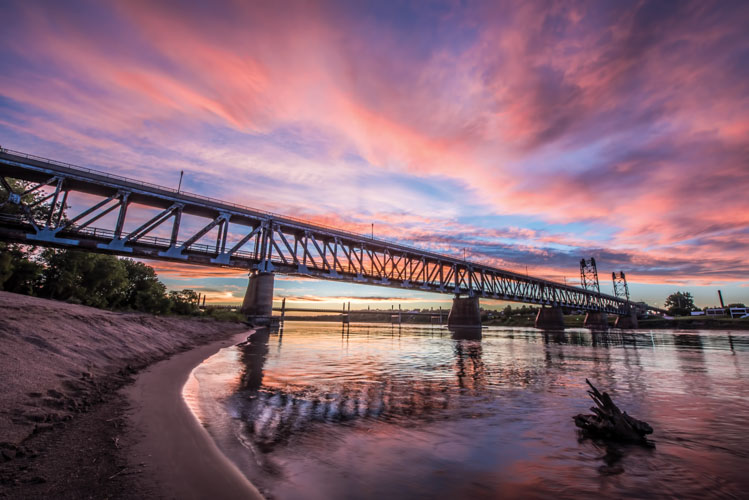
Yankton’s Meridian Bridge carried traffic across the Missouri River between South Dakota and Nebraska from 1924 until its closure in 2008, which ushered its new life as a pedestrian walkway. Photo by Pat Hansen

Bridges are famously controversial. Yankton’s double-deck Meridian Bridge, which turns 100 years old this year, is a classic example.

In the 1920s, Yankton booster D.B. Gurney and his supporters sought to circumvent the political process by raising private funds, but they still had to navigate approval from both Washington and Pierre before they could drop the first barrel of concrete into the Missouri River channel in 1922.

They also confronted politics within the Yankton community as they cajoled friends and neighbors to make major investments in the bridge. Gurney once donned boxing gloves for a meeting and suggested that the fundraising could require fisticuffs. Though Gurney’s friends thought he was joking, they quickly offered more money.

When the $1.1 million Meridian Bridge opened on Oct. 11, 1924, it became the first highway bridge constructed across the Missouri River in South Dakota. The double-decker design was chosen in anticipation of a railroad line that never materialized, so motorists driving south into Nebraska used the lower deck and northbound traffic took the upper. Drivers paid tolls until the cost was recouped in December of 1953. Gurney’s wife Henrietta paid the final toll.

Seven decades after the first cars rolled across, Meridian Bridge politics re-emerged as local and state leaders debated where to build its replacement. Then, even after the Discovery Bridge was completed, the Meridian was not free of politics. In fact, some of the old bridge’s most highly charged moments came in 2008 and 2009, after it was closed and slated for demolition.

The new Discovery Bridge was opened to traffic on Oct. 11, 2008 — the same date as the Meridian’s official opening 84 years earlier — with a gala ribbon cutting. Dan Specht, then the mayor of Yankton, remarked that the bridge shows the river does not divide South Dakota and Nebraska, but truly brings people closer together.

On that exciting afternoon, busloads of school children were diverted over the Meridian; the very next day, it was deemed unsafe for any use. Entrances were fenced and a sign declared it off-limits to the public.

The late Father John Garvey, then a feisty and good-natured Catholic chaplain at Mount Marty University and Sacred Heart Monastery, was the first to demonstrate the bridge’s future potential.

Garvey was known for challenging authority. He once was arrested for trespassing at Offutt Air Force Base in Omaha to protest nuclear weapons. He found it hilarious that the old bridge was strong enough for 18-wheelers and school buses on one day, and then unsafe for pedestrians the next. True to character, he climbed over the temporary orange fence and strode out over the river in the autumn of 2008. He did it with a twinkle in his eyes, and the Yankton police, with equally good cheer, led the grinning, white-haired priest back to Walnut Street.

Other Yanktonians were resigned to the idea that the old bridge would come down. Fortunately, a few local citizens — particularly Jim Means, a longtime businessman and civic leader who has been involved in nearly all of Yankton’s successful historic preservation projects over the last 50 years — patiently lobbied city commissioners, lawmakers and other officials to explore its potential as a pedestrian bridge.

“I always thought it was Yankton’s signature piece of architecture,” Means says.”I felt it would be short-sighted to let it fall into the river. Ever since it was built, it has set us apart from every other town. You could meet people from all over the country, and if they knew anything about Yankton it was that they’d traveled over the double-decker bridge.”

Opponents to preserving the Meridian included several of Means’ friends.”People thought it would be a waste of money. One of my neighbors said he didn’t think anyone would even want to walk on it.”

The Meridian Bridge was built with a lift span that rose 25 feet to allow steamboat traffic on the Missouri River to pass underneath. Raising and lowering the 220-foot span took about 8 minutes in each direction. It was deactivated in 1984, and the lifting mechanism was removed. Photo courtesy of the Yankton County Historical Association

But Means and others kept alive the notion of preserving the bridge, and eventually they gained support from two strangers south of the border: Bob Puschendorf, a native of nearby Norfolk, Nebraska, was then the state historic preservation officer in Lincoln, Nebraska, and John Kingsbury, a banker in Ponca, Nebraska, was chairman of the Nebraska State Highway Commission.

Puschendorf hoped to preserve the bridge for its historical and recreational possibilities. Kingsbury remembers that he was just looking for the finish line.

“The new Yankton bridge was one of the most controversial and environmentally complicated projects of my time on the commission,” he says.”As people in Yankton will remember, there were two factions. One wanted the bridge downtown as it is today and another group preferred a bypass bridge to the east. Nebraska was neutral, but at the time was generally preferring a bypass around communities.”

As the lead state for planning and construction of the new bridge, Nebraska was responsible for public hearings. Kingsbury felt the primary hearing should be in Yankton because the city had so much at stake.

“After discussion between the two states, it was agreed Nebraska could hold a public hearing in South Dakota,” Kingsbury remembers.”I am sure I was the first state commissioner to hold a large public hearing in another state. I believe [South Dakota transportation officials] felt a neutral Nebraskan would be a good choice to lead a controversial public hearing. There was a huge crowd with signs and buttons supporting their cause. The room was packed along with three television stations. The meeting went unexpectedly well. The speakers remained reasonably calm. In the end, both states agreed to the downtown location based on dozens of factors.”

Left in limbo, however, was the fate of the old bridge. A federal Environmental Impact Study favored preservation over demolition.

“Yankton was also asking Nebraska to make the new bridge more attractive than a flat, basic concrete bridge,” Kingsbury recalls.”Nebraska was opposed to the added cost because the many delays had greatly increased the cost projections. As negotiations continued, I recommended Nebraska beautify the new bridge with the pillars and lighting in exchange for Yankton or South Dakota taking ownership of the old, historical bridge.”

South Dakota authorities liked Kingsbury’s compromise, though they didn’t yet know if Yankton would accept responsibility for the Meridian. For nearly a year after car and truck traffic ceased on the old double-decker bridge, conversations and meetings continued in city hall and other locations.

Kingsbury’s proposal created an opening for Puschendorf and Jay Vogt, his counterpart in Pierre. Vogt was director of South Dakota’s historic preservation office; he was also well-acquainted with the Meridian Bridge. His grandparents had lived in Yankton, and one of his favorite childhood memories was of driving over the Missouri River on the double-deck bridge.

Yankton had yet another important connection: longtime local trucker Ralph Marquardt was then serving on the South Dakota Transportation Commission.

Puschendorf, Vogt and transportation officials from both states offered to work with the City of Yankton if its leaders wished to accept responsibility for the historic bridge.

Yankton attorney Nick Moser was a newly elected state representative in 2009.”It was one of the first things I worked on as a legislator,” he says.”All of the lawmakers from Yankton were in favor of preserving it but there were a number of people who were opposed for a variety of reasons: they thought no one would use it, they thought it might not be safe, some even thought it would be an eyesore.”

Moser and Yankton’s other lawmakers met on several occasions with Department of Transportation officials during the 2009 session, and they also organized meetings with Marquardt and city commissioners back home — often gathering at the publishing offices of South Dakota Magazine.

Demolition of the bridge would have involved liabilities, environmental issues such as lead paint and other unknowns, so preservation of the bridge appealed to some state officials who felt it was the safest decision.

Most city commissioners eventually embraced the view that the historic bridge still had something to offer but they were concerned that the city wouldn’t be able to afford restoration costs in the short-term, and that local taxpayers could be stuck with demolition costs sometime in the future.

Those financial worries were alleviated when state transportation officials agreed to devote $1.8 million from South Dakota’s share of the American Recovery and Reinvestment Act, which had been passed by the U.S. Congress to stimulate the economy after the Great Recession of 2008.

Kingsbury and his Nebraska associates, anxious to close the chapter on the Yankton bridge, offered the remainder of the restoration costs, which totaled $5 million. The two states also agreed to deposit their respective shares of the estimated demolition cost into a trust fund so that monies are available for that purpose if needed. The fund was started at $2.8 million but it has nearly doubled.

Two years later — after rehabilitation and the installation of a railing and lighting — the Meridian Bridge was opened to pedestrians and bicyclists in November of 2011. It’s difficult to find any detractors today, and the officials who were involved see it as a success.

“Every time I drive across the new bridge, I smile at the beautification,” says Kingsbury, who is still a banker in Ponca.

“Today I can walk out the front door of my office and I have a full view of the bridge,” says Moser.”I see people walking it at all times of the day, and all times of the year. On weekends from spring to summer and fall it’s packed.”

Means walks the bridge regularly and enjoys seeing the various ways it’s used by the community — from weddings to fundraisers, lovers’ padlocks, family gatherings and, of course, the constant stream of people who simply want to stroll at treetop-level above the grand Missouri River.

Editor’s Note: This story is revised from the September/October 2024 issue of South Dakota Magazine. To order a copy or to subscribe, call (800) 456-5117.

Posted on Leave a comment

George Kingsbury: Eyewitness to History

George Kingsbury is considered the Father of Journalism in South Dakota. He published the Yankton Press and Dakotan for 40 years and authored the impressive History of Dakota Territory.

George Washington Kingsbury stepped off the Marsh & Rustin stagecoach at Yankton, Dakota Territory, on March 17, 1862. The muddy little river town was then only three years old. Kingsbury, a journeyman printer, planned to work there for a few months, then return home to Kansas and get on with his life.

Things didn’t work out quite that way.

Kingsbury arrived at a historic moment. Gov. William Jayne had that very day convened Dakota’s first legislature in the rude settlement’s log-walled Episcopal church; its members were charged to lay the foundation of,”a government that would endure for all time,” Kingsbury wrote in his History of Dakota Territory.”[Their] duty was a sacred one.”

Which the delegates put off until they’d done a lot of logrolling and selected a permanent capital city. Vermillion and Yankton were the main contenders, but the latter’s supporters thought they had things buttoned up thanks to a back-channel bargain. They supported John Shober and George Pinney for council president and Speaker of the House; in return, the pair from Bon Homme was supposed to back Yankton’s bid.

Pinney was a man of no small ability,”the peer of any other member,” wrote Kingsbury, but he was also an inveterate schemer and”inclined to be erratic.” His fellow legislators watched him,”with constant apprehension of mischief … a harmless motion to adjourn from him would be accepted by half the members as portending a plot.” Pinney was elected Speaker, then promptly reneged on his deal with the Yankton delegation; he didn’t stay bought, as historian Doane Robinson put it, which set off days of parliamentary wrangling.

Excitement was”at a fever-heat” and spectators thronged the lobby when the capital bill came up for consideration, wrote Kingsbury. Suddenly, troops of the Dakota Cavalry, with bayonets fixed, marched into the legislative chamber and surrounded the Speaker’s podium. Pinney had secretly asked Gov. Jayne to dispatch the soldiers, either to quash a rumored conspiracy to have him replaced as Speaker or as part of a convoluted intrigue to embarrass the governor, but all the maneuver did was”arouse great indignation” among the membership. They demanded an explanation and Pinney’s scheme”went to pieces in an hour.”

Pinney was forced to resign and Yankton won the prize, but settling the matter didn’t calm the waters. John Boyle of Vermillion and Enos Stutsman of Yankton”had some hot words” over dinner at the Ash Hotel, wrote Kingsbury, and matters soon escalated.”Boyle seized the ketchup bottle and flung it at Stutsman’s head, narrowly missing him. ‘Stuts’ retaliated with a fusillade of tumblers, cups and the skeleton of a fowl that had contributed to the feast. The combatants then flung themselves … across the table for a finish fight,” that might have resulted in serious injuries had not friends of the two men intervened.

Lawmaking on the frontier was proving to be a less than genteel affair, which did not come as a surprise to the delegates. Jim Somers, the House of Representatives’ Sergeant-at-Arms, was a burly ex-lumberjack with a violent streak; he later shot a sheriff and was himself killed in a shootout near Chamberlain. This preference for solving problems with his fists or worse was common knowledge before he was appointed; the legislators apparently considered this a recommendation for the job of keeping order in the House.

Somers and a group of lawmakers were drinking one evening in Antoine Robeare’s saloon, the legislature’s second home, when Pinney came in the front door.”Suddenly the window … flew up and Speaker Pinney popped out,” wrote Kingsbury. Somers appeared at the window, grinning, as another legislator and Robeare took after the fleeing Pinney — a chase that ended when the ex-speaker drew a pistol and his pursuers'”belligerent ardor moderated.”

By the time the legislative session ended in May the members had managed to discharge their sacred duty despite all the side shows. Kingsbury, meanwhile, reconsidered his plans. Like many a young man in those years, he had headed west in search of adventure and opportunity. He found both in Yankton. There was no need to look any farther.

*****

George W. Kingsbury was born in 1837, on a farm in upstate New York. He learned the printing trade as an apprentice at the Utica Daily Evening Telegraph, but at age 18,”[he] removed to Wisconsin to work with civil engineers on the Watertown & Madison Railroad,” wrote Kingsbury in an autobiographical sketch he penned for History of Dakota Territory. When the Panic of 1857 brought construction on that line to a halt he drifted west, from newspaper to newspaper, eventually reaching Leavenworth, Kansas Territory.

The Territorial Capitol at Yankton, photographed in the early 1860s.

Fort Leavenworth was a staging point for army supply trains on the Santa Fe Trail in the late 1850s. Kingsbury decided this made for an opportunity,”to see the western country at government expense by signing on as a driver,” a plan he soon laid aside after he saw how much grueling work it took to yoke a dozen oxen to each wagon, never mind manhandle it across the prairie. He returned to town and found a position with the Leavenworth Daily Ledger.

Kansas entered the Union in 1861, and opportunity drew Kingsbury to Topeka, the new state’s capital. There he met Josiah Trask, who had parlayed his political connections into a contract as the official public printer for both Kansas and Dakota Territory, which came into being in March of that year. Trask hired Kingsbury to do the actual printing work in Dakota while he stayed in Kansas, a decision that had tragic consequences for him. Trask, a man of strong abolitionist beliefs, was among those killed when the infamous Confederate raider William Quantrill attacked Lawrence, Kansas, a hotbed of the anti-slavery cause.

Kingsbury had been in Dakota barely two months before he went from itinerant printer to publisher and co-owner of the Weekly Dakotian. Frank Ziebach and William Freney had started the paper in 1861 to help a third partner, Capt. John Todd, become the first territorial delegate; once Todd was elected, the Dakotian faded away. By the time Ziebach and Kingsbury revived what had been a Democratic paper the territory’s political winds had shifted, wrote Kingsbury,”and prudence suggested the formation of the partnership [in the name of Kingsbury], a Republican.”

Thus began what historian Bob Karolevitz called”a game of journalistic musical chairs” that went on for years. Newspapers in Yankton combined and split, opened and folded and opened again with different owners; opponents in one election cycle might be partners in the next. Kingsbury’s tenure at the Weekly Dakotian lasted until he fell out with Dr. Walter Burleigh, who had purchased a piece of the paper to promote his campaign for territorial delegate. Kingsbury and Moses K. Armstrong then started a new publication, the Dakota Union, and”fought a glorious fight” against the good doctor, as an admirer put it. Burleigh, the resident Indian agent who set a standard for corruption that was never bettered in Dakota, triumphed despite their opposition, and in the election’s wake the two warring newspapers merged to form the Union and Dakotaian.

Toward the end of his first decade in Dakota, Kingsbury purchased a state-of-the-art steam-powered press, the first in Dakota Territory, and used it to churn out the news under various banners. In 1875 he founded the Black Hiller, aimed at the gold seekers flooding into town. It proved so financially successful that it enabled Kingsbury and Wheeler Bowen to begin publishing the Press & Dakotaian, a daily newspaper that first appeared on April 26 of that year and is still publishing five editions a week in an era when many small daily papers have turned off their presses and closed their doors.

*****

George Kingsbury wrote hundreds of thousands of words in his career, but next to nothing about his personal life. His autobiographical sketch in History of Dakota Territory is sparse and devoid of any sense of the man.”On the 20th of September, 1864,” he wrote,”George W. Kingsbury, of Yankton, and Lydia Maria Stone, daughter of Nathan and Laura Stone, of Lawrence, Kansas, were married at the home of the bride’s mother.”

Lydia and George returned to Yankton and settled down to raise three sons, George, Theodore and Charles. Lydia’s passing evoked the only morsel of emotion in the essay, and that sounded oddly stilted:”Lydia, the wife and mother, died February 1, 1898, and after a few years the little family was broken up, the home practically abandoned.”

George Kingsbury (back row, left) was honored as a pioneer of Dakota Territory during its 50th anniversary in 1911. Other honorees included C.J. Holman (back right) and (front row, from left) Horace Bailey, John Shober, William Jayne and Joseph Hanson.

Kingsbury spent 40 years as a newspaperman in Yankton, which afforded him a front row seat as the territory’s history unfolded, but he was more than an observer. When the territorial legislature convened for its second session in 1863 Kingsbury took a seat in the upper house as a delegate from Yankton, one of many public and private offices he held through the years. He sat on Yankton’s first city commission, was secretary of the corporation that launched the Dakota Southern Railroad and served as the territory’s assessor of internal revenue; he also captained one of Yankton’s two polo teams and produced a traveling play,”The Chaperones.”

When statehood arrived in 1889 Kingsbury served a term in the new legislature and was later appointed to the State Board of Charities and Corrections by Gov. Andrew Lee. On the journalism front, he found himself covering a familiar story. South Dakota’s voters were to select a new capital in the first statewide election of 1890, and the contending cities’ tactics often landed”within the boundaries of criminality,” the old-timer wrote.”[Their] unbecoming and disgraceful conduct cast a shadow upon the fair name and fame of the young state.”

Kingsbury sold his publishing interests in 1902 and began work on History of Dakota Territory, a project he was uniquely qualified to undertake. Modern readers may find fault with some of Kingsbury’s attitudes, his absolute belief in the superiority of white culture over that of the indigenous”savages” among them, but none can say he didn’t do a thorough job. History’s five ponderous volumes, bursting with original documents and encyclopedic detail, dealing with every major and many minor matters of the era, constitute an invaluable resource. Scholars and students of history alike are in his debt.

*****

Yankton’s business community had dreamed of a bridge across the Missouri River since the settlement’s earliest days, the better to draw trade from Nebraska. Financial and technical problems sidelined various schemes through the years; in the meantime, a ferry launched in 1870, and a pontoon bridge followed 20 years after that. This had to be dismantled and reassembled twice a year, however, so it was clearly only a stopgap measure.

Kingsbury had seen a number of bridge schemes up close over the years, and he was on hand when one finally succeeded in spanning the Missouri. E.J. Dowling and an informal group of Yankton’s leading citizens known as the Monday Evening Club resolved that the only way to ensure a bridge was built was to build it themselves.”Their spirit served as midwife to the project,” wrote Kingsbury in a special edition of his newspaper published when steel reached Nebraska.

When the Meridian Highway Bridge formally opened on October 11, 1924, the 87-year-old George Kingsbury rode across as an honored pioneer. It was one of his last public appearances. He grew more and more feeble and slipped away on January 28, 1925, leaving a legacy in South Dakota history and journalism that few scribes will ever match.

Editor’s Note: This story is revised from the September/October 2023 issue of South Dakota Magazine. To order a copy or to subscribe, call (800) 456-5117.

Posted on Leave a comment

The Paddlefish Opener

Boats dot the Missouri River near Yankton for the annual paddlefish season opener on October 1.

Fishing is often a solitary sport in South Dakota, where anglers drift and cast on massive reservoirs, or on prairie rivers that flow for hundreds of miles. That changes every Oct. 1, however, when hundreds of people gather along a very short stretch of the Missouri River for the opening of the month-long paddlefish season.

Paddlefish are filter-feeders, meaning they won’t bite traditional bait, so they are caught by snagging hooks that are cast into the tailwaters of Gavins Point Dam, just a few miles west of Yankton. Men and women cast and drag, again and again, somewhat like fly fishing but less ballet and more muscle. They fish from boats or the rock-strewn shore. Some stand atop a tall concrete wall on the north side of the dam. When a fish is caught, all the anglers and spectators watch.

Paddlefish is a primitive species that swam eons ago with the dinosaurs. Due to its size and shark-like appearance, it seems like a creature more fit for the world’s oceans rather than the lakes and rivers of middle America.

The largest ever caught was speared by an Iowa fisherman in 1916. It weighed 198 pounds. The South Dakota record is a 127-pounder landed by Bill Harmon in 2014 at Lake Francis Case. Hundred-pound fish measuring 4 to 5 feet are not uncommon.

Bryan Mendlik, Scott Mendlik and Kellen McClure caught and released a “slot” paddlefish below Gavins Point Dam that measured just under 45 inches.

Landing such a large fish is no easy matter. On some occasions, it takes many minutes and several men. As soon as a fish is brought out of the water, the angler and his friends grab a tape measure, but they don’t stretch the tape along the paddle-like snout, which can be one-third of its overall length; the scientific measurement is from the eye to the fork in the tail.

The sport of paddlefishing is heavily regulated in South Dakota, and one of the rules states that fish between 35 and 45 inches must be immediately released because they are in their breeding prime. The six Missouri River dams greatly interrupted the natural spawning of the great fish. Much of the slack has been replaced by artificial breeding programs in hatcheries, but paddlefish do still breed in the wild.

Biologists want to give them every chance to do so, and the anglers obviously agree because there’s always an urgency to get every fish measured and then released when it’s within the range.

The snagging season at Yankton runs the month of October. There was a time when it began on Oct. 1 and then concluded after a certain quota of fish were harvested. That created a bedlam of action, as everyone rushed to snag a fish before the season ended. The river and shoreline became so congested that authorities deemed it unsafe.

Naturally, such mayhem created more regulations. Today only 1,600 licenses are made available in a June drawing. (A May season is held at Lake Francis Case, where just 350 licenses are allowed.)

License winners at Yankton now have the entire month of October to bag a fish, but opening morning is still a sight to behold — especially when it turns out to be a classic autumn morning with blue skies and gold leaves on the cottonwoods that shade the river.

Anglers and spectators alike mark Oct. 1 on their calendars.

Editor’s Note: This story is revised from the September/October 2022 issue of South Dakota Magazine. To order a copy or to subscribe, call (800) 456-5117.

Posted on Leave a comment

Ship in a Bottle

German prisoners of war were put to work harvesting beets on Jack Rathbun’s farm near Nisland.

The war hit home for the Lungrens on a Sunday in December.

“I can remember the Sunday when the Japanese bombed Pearl Harbor,” says Don Lungren of Pierre, who grew up in a German-speaking home near Vale.”We went to church. We came home, and on Sunday, Dad always turned on the radio to hear what the markets were going to be on Monday morning in Sioux City. Most of the time we didn’t have anything to sell, but he had to know what the markets were.”

On that Sunday in 1941, his father tuned in the set, as always; but he might have let it stay on longer than usual.”They were making a lot of noise on that radio, I can remember that — yelling and stuff,” Lungren recalls.”Dad shut it off and he told Mom he was going to see Grandpa.”

Lungren’s father returned with a strict order:”Henceforth, we don’t speak German anymore.”

The attack on Pearl Harbor brought the United States into the war against Japan and its ally, Germany. Perhaps because of the mistreatment of ethnic Germans in the U.S. during World War I, and perhaps because of fears that Japanese and German speakers might be suspected of harboring sympathies with the enemy, the family stopped speaking German then and there.

That Sunday the Lungren children also realized Germans were on the other side of the war. And if they had any doubts that Germans were the adversaries, there was more proof. South Dakota would be one of the places where German prisoners of war were stationed as World War II dragged on.

The first prisoners of war arrived in America in May 1942. Historian Arnold Krammer, who has written extensively about the era, notes that not only Germans but also Italian and Japanese soldiers would spend time in American internment camps before the effort ended in July 1946.

“It is remarkable how many people don’t realize that we held nearly 425,000 German POWs (as well as 53,000 Italian and 5,000 military Japanese prisoners) in some 550 camps across the country. They worked in factories, hospitals and brought in the crops since our boys were overseas fighting in the war,” Krammer told us.

In South Dakota, German POWs ended up in parts of Meade and Butte counties doing fieldwork; in Yankton doing bank stabilization work on the Missouri River; in northeastern South Dakota; and in the Sioux Falls area.

“Every farmer in the valley here used German prisoners for a couple years,” says David Rathbun of Nisland, who was about 9 and 10 at the time his family benefited from POW labor in the fields. His brother Grove, four years older, would drive the truck when they went to fetch prisoners from the Civilian Conservation Corps camp at Orman Dam.

The Rathbuns transported prisoners in their 1937 Ford beet truck. An American guard followed in the family’s Model A pickup.

“It was an old CCC camp in the’30s, and the government turned it into a POW camp. It had machine gun towers and barracks and the whole works, big fence,” Rathbun says.”We’d go up in a truck, get a load of German prisoners, maybe 20 at a time, and haul them back to the farm and they’d work. They had to do so much in a day. I’ll give them credit, they were hard workers.”

During threshing, the German soldiers gathered bundles of barley, oats or wheat into wagons. In that era before combines were common, they also pitched bundles into the threshing machine.

With the sugar beets, the POWs took on many tasks: thinning the beets, hoeing them when they were bigger, pulling them and taking the tops off, loading them on trucks for transport to the railroad, where they were loaded on cars and taken to the factory for processing.

There were also prisoners stationed at nearby Fort Meade. The prisoners came from different sectors of the war, Rathbun recalls.”North Africa was the first ones we got. They came in’43. That’s when we got Rommel’s Afrika Korps prisoners, and they were ornery bastards,” he remembers, referring to the German expeditionary force that fought in Africa under Erwin Rommel, one of Hitler’s favorite generals.”They were the old Nazi type. They stabbed one of their own prisoners, killed him with a butcher knife, up at Orman Dam at the prison camp because he was too friendly with American guards.”

Krammer says such incidents weren’t uncommon, though often concealed by the prisoners.”Almost every camp held a minority of die-hard Nazis who often terrorized the others and sometimes murdered one or two, listing the deaths as suicides.”

The prisoners stayed for growing season, and after harvest were moved to other parts of the country.”They shipped them all out, I don’t know what they did with them,” Rathbun says.”And then in’44, we got prisoners from Normandy. They were just run-of-the-mill German soldiers. They were different. They were damn glad to be out of that war. They didn’t mind working in the beet fields.”

Krammer cites studies saying about 40 percent of German POWs were pro-Nazi. Eight to 10 percent were considered fanatics in their devotion to the Nazi cause, while another 30 percent were”deeply sympathetic.” But just as Rathbun suggested, many of the German POWs were not Nazis.

The prisoners were given small breaks to split up the hours of labor.”Our place had the Belle Fourche River running through it. If they got done early in their work, the guard would let them go swim in the river, and they really liked that,” Rathbun says.

There were even stories that the guard would take a dip with the prisoners now and then.”He did, actually,” Rathbun confirms.”I saw that happen. The guard went swimming and left a sergeant, German sergeant, sitting on the hillside looking for the colonel.”

Locals would often practice German with the prisoners.”There’s a lot of German around here. Our neighbors were Low German, I think, and the prisoners were High German, but they could understand each other. They’d talk all the time.”

Another mode of communication was the universal language of food and drink. Don Lungren recalls that his parents and grandparents, Germans themselves, coaxed extra labor out of the POWs.

“They would make a big 2- or 3-gallon pail of chicken noodle soup, and man, I’ll tell you, they could pick cucumbers twice as fast. And Grandpa, he made better than that. His bribe was that if they would look at the end of the trees, by the hog house, there would be some beer there if they would get those cucumbers picked today. They had them done by noon, I think.”

After long days in the Butte County beet fields, prisoners sometimes enjoyed a swim in the Belle Fourche River.

Lungren said other locals would do favors for the POWs.”My family and most of the German families always gave them a treat — chicken noodle soup from the old roosters and that sort of thing and beer at the end of the grove in the trees. The guard would come. Grandpa would loan the guard his shotgun and the guard could go shoot pheasants. And because the guard couldn’t get the pheasants home, I suppose Grandma cooked the pheasants and fed them to the prisoners.”

Sometimes the farmers got more than they asked.”Grandma told one of the prisoners she wanted some little cucumbers because she wanted to make baby dills,” Lungren said. His grandmother had business to tend to, but when she got back to the field, the Germans had picked two bushels of tiny cucumbers — far more than she needed.”We had baby dills for years.”

Marian Ruff added that for German-speaking families, even though many of them had immigrated to America from German communities in Russia, it was awkward having German POWs work in the fields.

“My family, like the other German families, was looked down on because of the war — because they were Germans,” she said.”With the POWs, I think we felt sorry for them because of the way they were treated. They would bring this truckload of guys out to the Vale area and they would have two armed soldiers with them with rifles in case they tried to escape. They were supposed to shoot them.”

The guards weren’t just for show, Krammer says.

“There were escapes aplenty, but most were caught within three days,” he notes. But, he adds that many prisoners quickly figured out they would be treated decently in America.

“Those assigned to American farms were well-treated and modern flea markets still have POW-made handicrafts which they gave to the children of farm families,” Krammer said.

That was the case in South Dakota, too, Marian Ruff said.”They were just really happy to get out of the prison situation and do something. Several of them put together some ships inside of wine bottles. We have one of those. One was given to my grandpa. Several of the families that these prisoners worked for ended up with one of these ships inside of a bottle. It always fascinated me because I had no idea how they did it. Someone said to me recently, ëWell, they sawed the bottom of the bottle and put the ship in and sealed the bottom back on again,’ but I don’t know if that’s what they really did or not.”

And no one knows what it meant to a German soldier, either — building a ship inside a bottle in a prison camp to give to a German farmer in landlocked South Dakota.

David Ruff of Spearfish, Marian’s husband, grew up near Nisland during the war. He spoke German well enough to understand the German POWs who worked for his father and some of the neighbors.

The Rathbun family dog often provided canine companionship for Germans working the fields.

“I often wondered if they didn’t have feelings knowing that they were in a country so far from their homeland and had people there that could speak their language. I think many of the prisoners were quite pleased to find that there were German-speaking people here. They were appreciative of the extra food that was given them and the friendliness of the farmers that they worked for.

“I don’t know if I personally asked one of them or what, but somehow or another in conversation, I learned from them that they were quite pleased with the treatment they were receiving here. I’m not sure exactly where they became prisoners of war, but they mentioned that when they were in France, they were required to drink out of the troughs that the livestock drank out of.”

POWs also made an impact on the other side of the state. Yankton-area historians Lois Varvel and Kathy K. Grow reflected on the German POWs stationed in Yankton in their 2001 book, The Bridge We Built: The Story of Yankton’s Meridian Bridge. They noted that the Yankton Press & Dakotan reported on April 3, 1945, the arrival of the first contingent of German POWs from the Afrika Korps to take part in Missouri River bank protection work. Officials wouldn’t tell the newspaper how many German POWs would come to Yankton, citing policy on POWs, but the newspaper understood they would make up”a sizable force.”

The POWs worked on a project to make sure the main flow of the Missouri River steered clear of the city of Yankton’s water intake. The work had side benefits for the Meridian Bridge.”We had prisoners of war trucked in from Algona, Iowa, and they did revetment work on the Nebraska shoreline. That was their contribution to protecting the Meridian Bridge,” Varvel says.

After the war ended, most of the 375,000 German POWs went back to Germany — but not all stayed there. Some liked what they had seen of life in America. The United States didn’t track the number of former German POWs who ended up immigrating to the land of their captivity; but it was substantial. Krammer notes that John Schroer, a former POW who immigrated to America after being held as a POW in Alabama, estimated about 5,000 POWs made a similar move. Some reportedly returned to South Dakota, too, where the enemy they had fought showed them decency and kindness in victory.

Editor’s Note: The tally of German prisoners of war in South Dakota at any one time during World War II was a floating figure because they rotated in and out of different states depending on the local harvest and other demands. Curt Nickisch, a South Dakota Public Broadcasting journalist at the time, wrote a story for South Dakota Magazine in 2001 in which he reported the number at more than 1,200 POWs through 1944 and 1945. There are also several books available, including Nazi Prisoners of War in America by Arnold Krammer. This story is revised from the March/April 2018 issue of South Dakota Magazine. To order a copy or to subscribe, call (800) 456-5117.

Posted on Leave a comment

Always on Our Minds

A marker to Jack McCall stands in Yankton’s Sacred Heart Cemetery, but does not mark his actual grave. That remains one of many mysteries that still surrounds the man who famously killed Wild Bill Hickok in 1876.

A LEDGER BOOK is tucked away in the archives of the Mead Cultural Education Center, headquarters of the Yankton County Historical Society. Local historians have requested it often enough that museum staff have marked four pages with thin strips of white paper.”JAIL” is written in bold pencil across the top of one.

The book measures maybe 12 by 18 inches, contains some 600 pages and weighs about as much as a cinder block. Its first entry is dated Oct. 23, 1862 and is signed by George Pinney, the second United States Marshal in Dakota Territory. What follows are entries from each succeeding marshal — ranging from correspondence to reporting day-to-day activities of the office — ending on May 10, 1877.

Much of the reading is mundane, unless you’re captivated by expense reports, requests for 2-cent stamps, expense reports, applications for vacation time and expense reports. But there are a few needle-in-a-haystack nuggets that have consistently caught the attention of Yankton historians.

We first learned of the book’s existence from Bob Hanson, a tireless preserver of Yankton history until his death in 2018 and the man responsible for those bookmarks. Hanson was intensely interested in the story of Jack McCall, the man who killed Wild Bill Hickok in a Deadwood saloon, stood trial in Yankton and was executed just north of town. That sad and final chapter of McCall’s life spanned just seven months in 1876 and 1877, but its details have spawned nearly a century and a half of conjecture and speculation. What was McCall’s true motive? Was the crime a power play by territorial and federal politicians seeking a way to finally and firmly assert authority over the Black Hills? And where are Jack McCall’s remains today?

Hanson believed answers — or clues, at the very least — might be found in this book, hence his repeated visits to the Mead. But there’s another twist: two pages that would have contained official correspondence between Marshal J.H. Burdick and officials in Washington, D.C., between April 3 and 9, 1877 — just a month after McCall was hanged — are missing. To Hanson, they were akin to the 18 minutes of missing tape in the Watergate era.

Did the pages simply break free of their brittle binding and become lost among countless other documents? Or were they intentionally removed to forever obscure an incriminating piece of information? Most likely we’ll never know, but it hasn’t stopped people from asking questions. Nearly 150 years after his death, Jack McCall remains very much on many people’s minds.

***

WE KNOW VERY little about Jack McCall’s life prior to Aug. 2, 1876. Historians believe he was born in 1852 or 1853 in Louisville, Kentucky. He arrived in the Black Hills during the gold rush. One story contends that he entered the Hills as a wagon train driver for”Colorado Charlie” Utter, whose party also included the famed lawman Wild Bill Hickok, drawing the two figures of Western lore together for the first time.

Jack McCall.

Whether that actually happened is its own mystery, but we know McCall and Hickok were in Nuttall and Mann’s Saloon No. 10 in Deadwood on Aug. 2, 1876. Hickok was in the midst of a poker game when McCall approached him from behind, leveled a revolver at his head and pulled the trigger. Hickok died instantly and McCall fled down an alley, only to be apprehended later by a crowd of townspeople.

Since no established court had yet asserted jurisdiction over the Black Hills, crimes were often settled in miners’ courts in which a hastily assembled jury of locals convened to determine the fate of the accused. Such was the scene that awaited McCall the following afternoon in James McDaniels’ Deadwood Theatre. McCall claimed his deadly deed was vengeance because Wild Bill had murdered his brother in Kansas. The jury sympathized (or was swayed by a bribe of gold dust, as prosecutor George May surmised) and found McCall not guilty after a two-hour deliberation.

Believing he’d gotten away with murder, McCall fled for Laramie, Wyoming, where he seemed to relish in telling others that he was the man who had killed Wild Bill. Territorial authorities knew about the notorious crime and believed that McCall’s Deadwood trial held no legal standing. One day May, who had followed McCall to Laramie with Deputy U.S. Marshal Saint Andre Durand Balcombe, overheard McCall’s boasting. Balcombe arrested McCall on August 29 and escorted him to Yankton, Dakota Territory’s capital city.

As he awaited trial, McCall spent the next three months in jail. His cell mate was Jerry McCarty, who had been arrested for the murder of John Hinch in the Black Hills the day before the Hickok killing. The two hatched a daring and almost successful escape in early November. J.B. Robinson, the jailer, was preparing to lock them in their cells for the night when McCarty overpowered him and held him by the throat. McCall then beat him until he was nearly unconscious. They stole his keys, broke their shackles and were stepping out the door when they came face to face with Marshal Burdick and James Bennett, one of his assistants. As Yankton’s Daily Press and Dakotaian reported, in the wonderful language of 19th century journalism,”Marshal Burdick immediately comprehended the situation and placed the business end of his revolver in unpleasant proximity to the heads of the escaping murderers,” who were escorted without incident back to their cells.

McCall’s trial began on December 5, with Judge Peter Shannon presiding. Appointed to defend McCall were Oliver Shannon and William Henry Harrison Beadle, the man perhaps best known in Dakota history for his passionate defense of school lands. When Marshal Burdick escorted McCall into the courtroom, the Press and Dakotaian correspondent described him as”an evil looking man young in years but apparently old in sin.”

Townspeople filled the courtroom to hear testimony and closing arguments, which concluded after noon on December 6. George Shingle, Carl Mann and William Massie — all of whom were inside the No. 10 Saloon when Hickok was killed — identified McCall as the lone gunman. (According to legend, Massie still held the bullet that killed Hickok. After passing through Wild Bill’s head, it tore into Massie’s wrist where it remained until he died and was buried with it in 1910.)

The defense’s main argument was that Dakota Territory didn’t have jurisdiction over the Black Hills because it was still part of the Great Sioux Reservation, the boundaries of which had been established under the Fort Laramie Treaty of 1868. The jury of 12 men disagreed and found McCall guilty. He was sentenced to hang on March 1. (Curiously, six months after the trial, the Press and Dakotaian reported on a new map drawn of the Black Hills region which placed Deadwood squarely in Dakota Territory. The map caused controversy among those who attempted to claim that Deadwood was actually part of Wyoming. Territorial leaders sought advice from Beadle, the defense lawyer who at one time was also a surveyor in Dakota. He said he was convinced that Deadwood was part of Dakota Territory.)

Longtime Yankton historian Bob Hanson was a tireless researcher of the McCall case.

McCall languished in jail for another two months. During his time in Yankton, his story kept changing. At one point he claimed he’d been drunk. Later, he said a man named John Varnes paid him to kill Hickok. Varnes held a grudge over a disputed poker game, he said.

A few days before the scheduled execution, the marshal’s office received a letter from a Mary McCall in Kentucky asking if the prisoner was her brother.”There was a young man of the name John McCall left here about six years ago, who has not been heard from for the last three years,” she wrote.”He has a father, mother, and three sisters living here in Louisville, who are very uneasy about him since they heard about the murder of Wild Bill.”

The letter seemed to unnerve McCall and may have prompted him to get rid of a document that could have shed more light on the Hickok murder. McCall had been preparing a written statement and asked the Press and Dakotaian to publish it after his death. But the night before the execution he destroyed it.

March 1 was a cold and drizzly day in Yankton. By 9:30 in the morning, a large crowd had gathered outside the jail at Fifth and Douglas. They watched as McCall climbed into a carriage with Father John Daxacher, a Catholic priest, and Phil Faulk, a Press and Dakotaian correspondent.”This mournful train, bearing its living victim to the grave, was preceded and followed by a long line of vehicles of every description, with hundreds on horseback and on foot, all leading north, out through Broadway,” Faulk wrote.”The rain which was falling had moistened the earth and deadened the sound of the carriage wheels. Not a word was spoken during the ride two miles to the school section north of the Catholic cemetery. McCall still continued to bear up bravely, even after the gallows loomed in full view.”

The wooden gallows had been constructed so that the throngs of people who attended could watch as McCall ascended the steps and Burdick placed the noose around his neck. But when the floor beneath his feet disappeared, McCall plunged into a boarded-up enclosure that prevented witnesses from watching the condemned man struggle to his final breath.

Twelve minutes later, two doctors pronounced McCall dead. His body was placed in a walnut coffin and buried very nearly on the spot. Jack McCall’s life ended, but his legend in Yankton was only beginning.

***

A WEEK BEFORE we examined the U.S. marshal’s ledger book, Jim Lane visited the Mead museum to do the same thing. Lane is a local historian who has doggedly researched the Hickok killing and McCall’s time in Yankton.”I’ve got a book written,” he says.”But it’s all in my head.”

A sign proclaiming Yankton’s role in the saga of Jack McCall stood along Highway 81 before finding a home with the Yankton County Historical Society, headquartered at the Mead Cultural Heritage Center, where local historian Jim Lane researches McCall’s time in Yankton.

Lane’s interest in the ledger book centers more on the scruples of Marshal Burdick, the man in charge of the McCall execution, than any nefarious actions on the part of territorial politicians.”We don’t have a really good accounting on the McCall thing,” Lane says.”Burdick was a real reluctant guy. U.S. marshals weren’t Matt Dillon. They were political guys who took these jobs because it was a good way to make money on the frontier. He came under some fire and there was an investigation into his spending, right around that time frame.”

Hanson’s suspicions ran deeper. He believed there may have been a plan to kill Wild Bill Hickok so that federal marshals could swoop into the Hills, arrest the murderer and conduct the trial in territorial court, firmly establishing influence over the Black Hills. He turned to the book hoping to find clues.”Bob loved a good story, and he had a lot of fun with it. He kind of pushed the conspiracy theory,” Lane says.”When they hauled McCall back to Yankton, the territorial capital established legal authority over the Black Hills. That’s the case that does it. That’s when they say that if there’s going to be a trial out here, it’s going to be decided by Dakota Territory. Bob was a little bit right with the theory that they wanted this to happen. But I don’t think anyone assassinated Wild Bill Hickok for political means.”

There’s no smoking gun in the ledger book, either, though two of the bookmarked pages show that discussion of authority over the Black Hills was lively during the summer of 1876. On July 10, Marshal Burdick wrote to Attorney General Alphonso Taft regarding warrants that had been issued for the arrest of miners who brought whiskey into the Black Hills, still regarded as Indian Territory. Burdick’s position seems quite clear:”The Black Hills region as you are perhaps aware is located upon what is known as the Sioux Indian Reservation, within the limits of the Second Judicial District of this Territory, the Court being held at Yankton.”

Burdick said he had dispatched two deputies to arrest seven or eight men accused of bringing whiskey into the Hills, but that only one could be located. The others had escaped and probably could not be apprehended”by peaceable means.” He had requested military help from General Philip Sheridan, commander of the Military Division of the Missouri, but given the obliteration of Lt. Col. George Custer and his 7th Cavalry at the Battle of the Little Bighorn just two weeks earlier, he suspected no help would come.

ìAny doubts which may have been raised in regard to the legality of the treaty under which the present Reservation was set apart I imagine has nothing to do with these cases. The United States Court here has never held that it is Indian Country,” Burdick wrote.”The people in the mining regions are firm in their belief that the Indians have no longer the right to prevent them through the action of the Government from occupying that section and working the mines. I state the fact without any reference to its correct basis.”

Still, he sought guidance.”The warrants in my hands are in proper shape for an offence clearly punishable under the Section referred to and are forced upon the indictments found by a qualified Grand Jury. I desire therefore in view of the peculiar circumstances which I have detailed to have your advice as to whether or not I shall proceed to execute them at all.”

The signature of U.S. Marshal J.H. Burdick, which appears many times in the historic ledger.

Two weeks later, in another letter to the attorney general, Burdick reported that his request for military assistance had indeed been denied, but he also provided more details about his interest in the Black Hills. In February, he dispatched a deputy and a posse to the Black Hills to apprehend several men, one of whom was accused of a murder at the Standing Rock Indian Agency. The lawmen captured only one, who was tried, convicted and punished in the Yankton court.”The expenses of this posse were included in my accounts for the Spring Term of Court at this place and upon my accounts being presented to the Court for approval by law the Judge struck out all that portion of the account relating to the expense of the posse and refused to approve them. I referred the matter to the Hon. the 1st Comptroller and he refused to audit the account although he virtually admitted its legality saying he would not look into an account which the Judge refused to approve.” Clearly, questions remained regarding what the marshal could and couldn’t do in the Black Hills.

Another marked page helps us to find the tangible reminders of McCall’s brief existence in Yankton. In September of 1865, Marshal L.H. Litchfield wrote to Secretary of the Interior James Harlan to ask again for a jail. He referenced a previous letter in which the secretary claimed that no request for jail space had ever been received. But Litchfield was insistent.”At the time I made the request I stated distinctly that the United States had no rooms suitable for the confinement of prisoners. There never has been in this Territory any rooms used for this purpose,” Litchfield said.”The Judges and myself could not complain of the unsuitableness of rooms, but we did complain that there were no rooms, and that prisoners had to be confined at a military post or in a county jail of Iowa, either of which is more than sixty five miles distant from here.

ìI wish the Department to distinctly understand that no rooms of any description have ever been provided or rented in this Territory for the safe keeping of prisoners. But there is great necessity for such rooms.”

Perhaps Litchfield’s entreaties resulted in construction of the federal jail on Linn Street, the facility in which McCall spent at least some time in custody. A tidy brown house sits on the lot today, just a block west of Broadway Avenue, the main north/south thoroughfare through Yankton.

McCall was also held in the relatively new county courthouse and jail, a large brick structure at the corner of Fifth and Douglas. Later, it was a lodge for the Independent Order of Odd Fellows but has since been converted into apartments. Its owner reported that before renovations, sections of bars could still be seen in the basement.

The building where McCall stood trial was part of the St. Charles Hotel, built in 1870 at Third and Capital. A portion of the building at the very corner of the intersection was rebuilt in 1891, but wings to the west and north — which included a courtroom where the trial occurred — remain. It also has been converted into apartments. A historic marker was placed on the east exterior wall along Capital Street in 1960. Its language, describing the courtroom’s location”directly back of this marker,” is to be interpreted literally.

Jack McCall stood trial on the second floor of the brick building at Third and Capital in downtown Yankton. The location is prominently marked.

A second marker stands at the intersection of 31st and Broadway near Yankton’s soccer fields. In 1877 this was the place where hundreds of people watched Jack McCall hang. The area has been graded and built upon several times through the years as Yankton gradually expanded to the north, but Lane believes the gallows were built somewhere in today’s Highway 81 right of way near the southbound lanes.

Perhaps the most intriguing mystery surrounding McCall is the location of his gravesite. Four years after the hanging, construction began on the Dakota Hospital for the Insane. McCall’s body, along with several others that had been buried in the pioneer cemetery, had to be relocated. When they opened McCall’s coffin, onlookers were surprised to discover that he’d been buried with the noose still tied around his neck.

McCall was moved to the Catholic cemetery, adjacent to the city cemetery. Over the years, his gravesite became a tourist attraction, much to the chagrin of the city’s Catholic leaders. Local historians say that in the 1930s, Father Lawrence Link, who served Yankton’s Sacred Heart Church from 1895 until his death in 1946, supervised a third relocation of McCall’s remains. This time, he was buried in an unmarked grave in Sacred Heart Cemetery along Douglas Avenue, where he lies today.

A headstone claims to mark McCall’s grave, but in fact it threatens to eventually muddy the historical waters. It was placed in 2017 when the Amazon television show Fireball Run passed through Yankton. The premise involved teams of people traveling through communities on missions or adventures that allowed them to see and experience unique aspects of each city. When the city’s Catholic priests balked at placing a headstone at the actual gravesite, a marker was set inside the adjacent city cemetery instead. The inscription on the stone reads,”Here lies Jack McCall,” but it was placed on a spot where the legendary outlaw definitely does not lie.

The real location of the gravesite is a closely guarded secret. Local legend says that no more than a few people at a time know exactly where it is. Bob Hanson was one of those people, and he remained coy about it, even among his closest family members.”Before he died, he told me where McCall is buried, but I think it was to throw me off the trail,” says Sarah Hanson-Pareek, Hanson’s daughter and a library archivist at the University of South Dakota in Vermillion.”I’m not sure if I got the true account.”

A true accounting of anything surrounding Jack McCall would be difficult to put together.”There are so many trails that lead off this story that just haven’t been followed,” Lane says.”Everyone’s done Hickok and Calamity Jane to death. Nobody really looks at McCall because there hasn’t been much there. But we should be hopeful that the current interest in genealogy and clues such as the Mary McCall letter might lead to new discoveries.” Easier access to materials online, such as digitized newspapers and ancestry websites, could help further investigations.

Then there’s the ledger book. Is the paucity of information simply due to the time that has passed, or is it at least partly intentional? What of missing pages 509 and 510? Lane is convinced.”I don’t see any evidence of anyone cutting pages out,” he says.”It just ended before it got to any of the stuff that we were interested in.”

With Jack McCall, it seems there will always be more questions than answers.

Editor’s Note: This story is revised from the March/April 2021 issue of South Dakota Magazine. To order a copy or to subscribe, call (800) 456-5117.

Posted on Leave a comment

Our Goat Renaissance

Humans and goats share a deep bond, one that’s rich with fun and laughter. Photo by Mark Smither

When I was growing up in eastern Yankton County, we only knew one person who raised goats — an eccentric bachelor named Ernie Stortvedt, who lived across the road from my grandparents and was famous for his lackadaisical approach to cleanliness. Even in our fun-loving neighborhood, Ernie didn’t set an example anyone was apt to emulate. Goats and Ernie remained linked in my mind for decades.

That changed five years ago, when my niece blew her birthday money on a goat. My family quickly learned that goats are kind of like potato chips — nobody has just one. Soon, my brother and sister-in-law started going to livestock sales in search of goat bargains. Friends offer them goats. Bucks and does regularly escape their sex-segregated pastures and five months later, baby goats arrive. It’s not unusual to find a diapered kid or two in their house, confined in a playpen as they await their next bottle feeding. Now my family describes themselves as goat hoarders. They even have a sweet brown Boer named Honey earmarked for my daughter to work with when she starts 4-H.

Goats will probably never supplant cattle in South Dakota, but ownership is rising. According to the USDA’s National Agricultural Statistics Service, South Dakota’s goat population consisted of 17,868 animals in 2017, an increase of about 7,000 over the previous 10 years. That number will undoubtedly be higher when the next goat census is released in 2022. I asked Katie Freng Doty, Yankton County 4-H’s Youth Development Assistant, if she’d noticed the change. Doty, who raises 30 Boer goats with her husband, Tyler, and daughter, Avery, on their farm north of Mission Hill, said that she and her sister were among the first to show meat goats in our area in 2011.”In my younger years of 4-H I don’t recall there being a Market Meat Goat show at the state fair,” Doty says.”It is now just as big of a show as any of the other species.”

I turned to a few other goat-loving South Dakotans to find out what makes the animals so popular. Most people agreed that goats are livestock on a human scale, which makes sense — archeological evidence indicates that humans first tamed the goat around 10,000 years ago, making it one of the earliest species to become domesticated. Goats also require less space, feed and money than other, larger creatures. But the animals are also intelligent and full of personality, so it’s easy for human and goat to create a deep bond, one that’s often full of laughter. Doty remembers her sister’s first goat, a runt named Bambi.”Any time we would take our goats for walks, her goat would only make it so far and he would just flop over. My sister, who was only 9 at the time, would pick him up and carry him home,” she says.”He caught on to that pretty quick. It didn’t take long and we would only make it a couple steps before he was done walking.”


Four-Legged Hospitality

Visitors of all ages enjoy getting to know the livestock at Pleasant Valley Farm and Cabins of Custer. Photo by Ardent Photography.

In a quiet valley in the southern Black Hills, a guard llama named Batman watches over his herd of goats with a sharp eye and deadly feet, ever on the lookout for mountain lions, coyotes and other threats.”He is not a pet,” says Susan Barnes of Pleasant Valley Farm and Cabins.”We’ve seen him kill coyotes. He stomped them to death.”

Susan worked at the University of Wyoming for decades, while her husband, Tom, was an environmental engineer. But when they retired in 2004, they knew they wanted to return to the 120-acre farm near Custer that Susan’s family had called home for generations. They divided the land into 17 pastures, leaving 40 acres for growing winter feed, and began to raise Boer show goats, but their interests quickly morphed into creating a herd of crossbred Boer, Spanish and Savannah goats for meat purposes. In 2019, the couple opened three vacation cabins and started giving farm tours to Black Hills visitors curious about the goats, Batman, and the rest of the menagerie: two herd dogs, Lily and Monte, a flock of free-range chickens and a few pigs.”A lot of these people are from Chicago and places like that and have never really seen animals,” Susan says. And while the guests may giggle at a goat’s antics and get a kick out of feeding the livestock, Susan makes it clear that farm life is not all fun and games.”You have to be here all the time. It’s dirty. It’s heavy. It can be sad if you have a goat that gets hurt. This kind of work isn’t for everybody.”

Tom, who passed away in August 2020, was a driving force in the promotion of goats as livestock and as food animals in South Dakota — not always an easy task in cattle country. He served as vice president of the South Dakota Specialty Producers for two years, teamed with area chefs to introduce goat meat, also known as chevon, to local palates and was willing to talk goats any time he had a willing listener.”Tom was a good promoter. He really liked people and loved his goats,” Susan says.”He set a pretty good standard for me to keep up. Tom was crazy to get people to buy goats.”

Luckily, Susan has ample support from their two children, who have been heavily involved in business decisions from the beginning. Daughter Molly Schultz and her husband Clayton manage the farm’s social media, Airbnb listing and website, PleasantValleyFarmandCabins.com. Son Tony and his wife Heather live in Alaska, but they helped Tom build the cabins and come home to handle maintenance jobs.”It’s a real family deal,” Susan says.

Susan describes goat meat as healthy, lean and mild.”It’s just kind of unique and it’s not something that overpowers you. I use goat hamburger for everything that I would use regular hamburger for,” she says. The farm supplies meat to A&D Jamaican Restaurant in Rapid City, Wild Spruce Market, Skogen Kitchen and Black Hills Burger & Bun of Custer, which sometimes serves a goatburger special. But their best customers are a group of Pakistani doctors at Monument Health, who use the meat in dishes from their homeland.

Having a local market for meat ensures that the Barnes’ goats are all more or less friendly — a bad attitude is a death sentence at Pleasant Valley Farm.”If you’re mean, you turn into goatburger,” Susan says.

***

New Mexico-Style Green Chili

by Suzanne Stemme of The Goat Rancher

1 pound goat meat, cubed

1 sweet onion, chopped

1 tablespoon oil

1 can black beans

1 can cream-style corn

1/2 cup Hatch green chiles

2 tablespoons ground cumin

1 tablespoon chili powder

SautÈ goat and chopped onion in oil until onion is soft (about 5 to 7 minutes). Add black beans, corn, green chiles and spices. Cover pan and simmer on low heat for 1 1/2 hours, stirring frequently. Top with grated cheese and serve with tortilla chips or corn bread.


Soap Making in Smithwick

Connie Koski snuggles with Zoey, a small-eared Alpine-LaMancha cross from the High Prairie Dairy Goats herd near Smithwick.

Anita Mason and Connie Koski, Smithwick’s goat herding soap makers, came to South Dakota for the climate. Mason ran a raw milk cow share program and kept Alpine goats in her native Virginia for decades before she was diagnosed with lupus. Southern humidity exacerbated the inflammatory disease, so the pair moved someplace more arid.”We’re both getting older and we said, ëIf we’re going to do this farming thing, we need to be able to walk,'” Mason says. In 2019, Koski took a job teaching social science at Oglala Lakota College. The two settled in Fall River County and started High Prairie Dairy Goats and the Grubby Goat Soap Company.

Their South Dakota herd primarily consists of LaManchas, a breed with a sweet disposition, high-butterfat milk and nubby, barely-there”gopher ears.””Everybody always asks about the LaManchas: ëWhat happened to their ears?’ They think it’s like docking tails on dogs. You can make lots of jokes,” Koski says. There’s also a rescue Toggenburg who suffered ear loss due to frostbite, but the queen of the herd is a sassy Alpine doe named Lucy.”Lucy’s the boss around here. She’s the only goat with ears,” Koski says.

There are several ways to make soap, but the basic process involves milk, fat and lye, which creates a chemical reaction called saponification. Goggles and heavy-duty gloves are worn to avoid lye burns.”It’s pretty much a cross between a chemistry experiment and a math venture,” Mason says.”Everything has to work out in relation to how much lye you use or you’ll melt your house.” She is not exaggerating — she and her father once tried to wing their way through a batch of soap, with disastrous results.”It ate through an aluminum stockpot we were using, ate through the linoleum, burned through the floor and burned through a rug,” she says.

Mason and Koski make a cold-process soap. First, frozen milk is mixed with lye in an ice-cold bowl. Then coconut oil, safflower oil, shea butter or other fats are gently heated to about 110 to 125 degrees. The milk/lye mixture is slowly combined with the warm oil until it becomes thick. The mixture is then poured into bread loaf pans, allowed to rest for 48 hours, then sliced, wrapped and placed on a shelf. The soap blocks cure for five weeks, which allows excess water to evaporate and eliminates any residual harshness from the lye.

Some soap makers would stop there, but Mason and Koski take an additional step called remilling, in which the blocks of soap are melted in the microwave, along with a small amount of additional milk, fragrance and other additives as desired. The soap is then repoured into molds and allowed to dry for about 24 hours. The remilling creates a soft, smooth soap that is gentle enough for Mason’s sensitive skin.”I like the softer bar,” she says.”If I’m comfortable, then everybody else should be comfortable.”

The pandemic halted craft shows, so goat’s milk soap production has slowed accordingly. Instead, the pair focuses on raising milk-fed pork.”It really makes a difference in the meat. It’s a super moist pork,” Mason says.”It tends to be very flavorful, like somebody slow-cooked it for two days.”

Once the pandemic ends, Koski hopes to introduce South Dakotans to their docile LaManchas.”Our plan was to bring some of these awesome East Coast lines out this way. It’s hard to go meet the kids at 4-H because COVID put the kibosh on that. Maybe we aren’t super awesome yet, but we’d really like to start showing,” she says. Mason wants to educate people about the value of dairy goats as part of a self-sustaining lifestyle.”There’s just no better animal than a dairy goat for that. You can make your own dairy products. You can raise bum lambs and calves off of their milk. Most people could have one in their backyard.” But perhaps their greatest challenge is finding a trusted neighbor so they can take a vacation.”We’re trying to sucker somebody into looking after the goats so we can get away for a while. It’s not working out very well for us. As soon as we say ëdairy goats’ they run,” Mason says.


Raised by Goats in Groton

Tessa Erdmann of Groton had learned patience and adaptability through her work in the show ring. Photo by Jacee J Photography.

After his family sold off their herd of registered Angus cattle, third-generation farmer Darrin Erdmann of Groton vowed to stick to corn and soybeans. Then his daughter, Tessa, joined 4-H. Erdmann bought her three goats, two does and a wether, and it all went downhill from there.”You can’t keep a waterer open for just three, so I got about 15 more. Then you can’t pay for the water with just 15 so I got about 20 more. Then we bought some more. At one point we had about 150,” Darrin says.”A project like this is hard to run as a business. It turns into a hobby, so you’re not really watching your balance sheet on it.”

The Erdmann family, which includes wife Julie and son Jarrett, raises predominantly Boer-based show goats, supplying animals to 4-H kids and to the local population of Karen and Somali immigrants. Darrin also owns Texkota Panel and Gate, distributing durable American-made steel pens to livestock producers.

Darrin remembers the public’s puzzlement when his daughter first showed goats at the South Dakota State Fair.”These old farmers would walk through and they were just amazed. ëWhy do we have goats here? This is South Dakota.'” But as a member of the state’s 4-H meat goat committee, Darrin has seen firsthand the goat explosion, which he credits in part to the bond that children develop with their animals.”Every one of them has almost a pet quality. Other livestock do not get that bond with a kid,” he says.

Tessa, a senior at Groton High School, has had the opportunity to bond with many goats since she first started showing in 2013 — some more successfully than others. Her first year, she wrangled a 100-pound hellion named Thunderbolt.”He had the worst personality. He was just absolutely wild. Holding that goat was never easy,” Tessa says. But she didn’t give up.”It drove me to try new things, different coolers, different feed, sit in their pen a little bit more. The next year, all the changes that I made paid off.”

That adaptability has served Tessa well, both when it comes to bonding with goats and when dealing with surprises in the show ring. One of her most harrowing experiences happened when her goat got diarrhea in front of a first-time judge in the middle of the 2018 Senior Showmanship competition.”I didn’t know what to do because obviously that’s not good looking for a show animal,” she says.”I wiped it off on my hand and wiped it on the side of my leg and kept going. That was probably the most disgusting thing I’ve ever done.” The judge never mentioned the mishap, and Tessa and her goat won the competition.

But whether Tessa won or lost, perhaps one of the greatest gifts Tessa has gotten from the goat world is friendship.”When I would go to these shows, all the kids there were just like me. They worked with their livestock day in and day out. They’ve become like a second family,” she says. Tessa is deciding whether to attend South Dakota State University or Oklahoma State University, but wherever she goes, she knows that friendly faces will make college feel like home.”4-H and FFA have given me the opportunity to branch out and meet so many different people,” she says.”My friends always joke if they meet a new person I probably know them first.”

Tessa gives 4-H a lot of credit in shaping her into the confident young woman she is today, but her father puts it more bluntly.”People always say, ëTessa’s such a good kid. Who raised her? It wasn’t you.’ It was the goats.”


From Finance to Fromage

Rapid City cheesemaker Spencer Crawford believes dairy goats are a good addition to a self-sufficient homestead.

Spencer Crawford went overseas to study finance and came home a goat farmer. After attending graduate school in Paris, he found himself drawn to socially and environmentally responsible entrepreneurship. During the course of his 10-year stay in France, he raised bees outside of Paris, dabbled in permaculture and was considering a move to West Africa to raise goats when a phone call from his mother changed everything.”My mom says, ëNo, no, no. I can visit you in Paris, but I don’t think I can make it to West Africa. Why don’t you come home? Why are you going to be a farmer in Africa? You can be a farmer in Pennington County,'” Crawford remembers.”Listen to Mom. Usually she’s right.”

Crawford returned to his native Rapid City three years ago, where he teaches French and Spanish at St. Thomas More Middle School and practices small-scale agriculture on his parents’ acreage north of town. His father, Tony, watches the farm during the day.”He helps out, but he and his friends are still scratching their heads. He never thought that his horse barn would be filled with a bunch of goats. I think the horses might be a little confused too,” Crawford says.

Some cowboys mock goats as”the poor man’s cow,” but Crawford appreciates the animal.”In terms of what they eat and what they produce, it’s just a lot more human scale,” he says.”You don’t need a ton of land, a ton of infrastructure. To milk the goats, you need a bucket with a lid, and the home kitchen is enough to have your family totally self-sufficient with milk and cheese and soap.”

With his herd of 10 Alpine dairy goats, plus chickens, honeybees and a number of cats, Crawford engages in permaculture, an interconnected style of farming in which all of the elements work together holistically.”Every plant that you plant, you can eat it or the goats can eat it,” he says.”No loafers. Everyone has a job.” One of the goats’ jobs is to provide rich milk, which Crawford uses to create tomme, an aged, washed-rind cheese.

The origins of cheesemaking are lost to time, but it is believed that the first cheeses were made when fresh milk was stored in pouches made from animal stomachs. Rennet, a mixture of enzymes found in the stomach’s lining, coagulated the milk and caused curds and whey to form. Crawford’s method is a bit more sophisticated. First, goat milk is heated in a sterilized pot. Next, bacteria is added to help the cheese develop flavor, followed by the curd-forming rennet. The curds are separated from the whey, placed in a mold or cheesecloth, weighted down and salted. This helps remove moisture from the cheese and encourages a crust to form.”It’s going to look a little spooky sometimes, but what’s inside is the good stuff,” Crawford says. His cheeses are left to age in a spare refrigerator in his basement. Cheese ages best in a humid environment at a temperature of about 50 degrees, so Crawford stores the cheeses in Tupperware containers with the lids cracked open and periodically washes each cheese with salt water. This helps kill bad bacteria or mold, develops the cheese’s protective crust and draws out additional moisture.

Unlike a commercial operation, there are many variables involved in Crawford’s cheese, so every wheel is a surprise.”The cheese is kind of a living, changing entity of its own,” he says.”You cut into a cheese that you’ve been saving for 10 months and then the wheel of cheese next to it that you made three days later and you think, ëWhat the heck? Why is this one so delicious?'”

Crawford would like to build a commercial kitchen, but due to government regulations, a health department-compliant cheesemaking facility is an expensive proposition. For now, he’s content to watch the comic interactions between his animals, share his best cheeses at potlucks and enjoy his after-school farm venture.”Some people go to the bar after work. I go milk some goats,” he says.

Editor’s Note: This story is revised from the March/April 2021 issue of South Dakota Magazine. To order a copy or to subscribe, call (800) 456-5117.

Posted on Leave a comment

Bob’s Last Story about Jack McCall

Bob Hanson knew all about Yankton’s history. Fortunately, he was also a mason, so whenever he came to inspect the nearly 150-year-old bricks of the Pennington House — the home of Dakota Territory Gov. John Pennington and today the publishing headquarters for South Dakota Magazine — he always had a story.

Jack McCall, the man who murdered Wild Bill Hickok at Saloon No. 10 in Deadwood in August of 1876, was one of his favorite subjects. After being acquitted at a hastily assembled miners’ court in Deadwood, U.S. marshals arrested McCall and brought him to Yankton, where he stood trial again, was convicted and was hanged just north of town.

There’s a theory among historians that government officials set out to arrest McCall and retry him in order to establish Dakota Territory’s jurisdiction over the Black Hills, an area still on the fringes of the legal frontier in the 1870s. Bob believed in more sinister motives: that federal officials could have orchestrated Hickok’s killing to assert such authority. He became even more convinced when he discovered a mystery at the Mead Cultural Education Center, which houses the Yankton County Historical Society.

Among the society’s treasured pieces of local history is a ledger book from the U.S. marshal’s office. It’s mostly a record of correspondence between the marshal in Yankton and Washington officials. Entries begin in 1862 and conclude in May of 1877, just two months after McCall’s execution. Bob’s interest was piqued by two missing pages that would have contained entries between April 3 and 9, 1877. For someone who believed a much larger conspiracy existed, those two pages were the equivalent of the missing 18 minutes of Watergate tape from the Nixon scandal.

I visited the Mead building to examine the ledger book. It measures about 12 by 18 inches, contains more than 600 pages and weighs about as much as a cinder block. The pages are filled with the beautiful script handwriting common on documents from the 19th century, although much of the reading is mundane unless you’re captivated by expense reports, requests for 2-cent stamps, expense reports, applications for vacation time and expense reports.

Four pages are bookmarked with thin white strips of paper. A curator told me Bob requested the book so often — right up until his death in 2018 — and read those pages so religiously that they marked them for him. One strip with the word JAIL written across the top marked a passage that explained the origins of Yankton’s first jail on Linn Street. Other pages include correspondence between Marshal J.H. Burdick and Attorney General Alphonso Taft that clearly show the subject of jurisdiction over the Black Hills was an issue.

After several hours of reading, I concluded there was likely no smoking gun — either in the book or the missing pages. Local historian Jim Lane, who has also extensively researched McCall’s time in Yankton, agreed.”Bob loved a good story, and he had a lot of fun with it. He kind of pushed the conspiracy theory,” Lane says.”When they hauled McCall back to Yankton, the territorial capital established legal authority over the Black Hills. That’s when they say that if there’s going to be a trial out here, it’s going to be decided by Dakota Territory. Bob was a little bit right with the theory that they wanted this to happen. But I don’t think anyone assassinated Wild Bill Hickok for political means.”

Jack McCall spent just seven months in Yankton, and he’s been dead for 144 years, but he’s never far from the minds of people in Yankton, as we discovered for a story in our March/April 2021 issue. The courthouse in which he stood trial at Third and Capital still stands. A plaque on the side of the building notes the courtroom’s location”directly back of this marker.” It is to be taken literally given the sign’s placement well above eye level.

The jail where McCall was held is now an apartment building at Fifth and Douglas. Its owner told us that before renovations there were still bars in the basement. Another marker stands at the corner of 31st and Broadway where the gallows stood, and a memorial headstone was placed in Sacred Heart Cemetery in 2017, though it does not mark McCall’s actual grave, the location of which within the cemetery is another local mystery.

I bet Bob would have had a lot to say about that.