Posted on Leave a comment

Aberdeen’s Graveyard Girl

Tasha Tietz, like all nurses, has a caring soul. She believes people should be remembered even after they’re gone.

Walk through a cemetery with Tasha Westby Tietz and you soon learn that tombstones represent life.

The same happens when you visit Tietz’s Facebook page. Watch her YouTube channel. Catch one of her talks or peruse her research on websites like Find a Grave and Ancestry.com. Tietz considers herself”a loner,” but the vivacious Aberdeen nurse is quickly becoming recognized as an authority on cemeteries. She even has an online persona,”Graveyard Girl,” though she shares the moniker with a rap musician and a fashion and beauty YouTuber — interesting company for the introverted daughter of an Aberdeen bricklayer and a beautician.

“I couldn’t even speak at my own wedding,” she laughs,”but I just spoke at the genealogy society and at the Aberdeen library. I can’t believe all that is happening.”

Tietz’s interest in the deceased began when she was working as a nurse’s aide at Mother Joseph Manor, an Aberdeen nursing home. She soon grew to love the Presentation sisters, and she worried that they might be forgotten when they die because they don’t have children and spouses. Even to this day, one of her favorite cemetery walks is a section of Sacred Heart Cemetery in Aberdeen devoted to deceased Presentations.

But it wasn’t long before she took an interest in more grave sites: those of other patients at the nursing home, her own ancestors and eventually perfect strangers.

“There is a quote that says a person is truly forgotten when their name is spoken for the last time,” she says.”That makes me believe that every person should be remembered and one way to do that is to be sure they have a tombstone.”

And in today’s online world, every tombstone should be searchable. Seven years ago, she began to enter tombstone photos on Find a Grave; today she is among its busiest contributors. She has posted more than 2,400 memorials and obituaries and 5,000 photos.

Aberdeen’s four cemeteries are her favorite places. She has documented many of their markers on Find a Grave.

Her paternal ancestors are buried at Claire City and Sisseton, so she has also visited them for years.”I try to take a bouquet to all my direct grandparents on Memorial Day,” she says.”I like to go to Claire City in September and visit the graves at Sica Hollow.”

In 2021, she found three tombstones of the Roy family, some of the first white settlers, among the autumn foliage of Sica Hollow. Most of her explorations have been in northeast South Dakota, but she has also roamed cemeteries as far away as Washington, D.C., Canada, Arizona and Texas.

She includes”graving trips” on family vacations when her husband, John, and their three daughters — Chloe, Claire and Charlotte — are willing.”The girls are not super-impressed yet,” she says.”John is also not a fan, but he’ll take me. We went to the Black Hills last summer and we explored Mountain View Cemetery at Keystone. I picked it because some of the Mount Rushmore carvers are buried there, and the actor Bobby Buntrock died and was buried there. There is also a Native leader, a medicine man, an artist and some kind of a wild Old West guy. It’s the only cemetery with a view of Mount Rushmore.”

She recently visited the De Smet cemetery where Charles and Caroline Ingalls are buried, along with their daughters Mary, Grace and Carrie.

Her social media posts also include information she gathers from other sources, including a recent bit about the Jewish custom of placing stones rather than flowers on tombstones. She also spotlighted a report of an Iowa cemetery that features three pyramids, built by the local newspaper editor who planned to be buried in one of them.

Graveyard Girl’s Facebook page now has more than 6,000 followers. Her sites have grown so much that they earn her small amounts of money, some of which she has used to help pay for gravestones on unmarked graves. If the revenues continue to grow, she plans to also invest in camera equipment and research materials for the ever-growing avocation.

She finds genealogy research the most rewarding aspect of being Graveyard Girl. People from across the nation have sent her notes of appreciation for her assistance in finding the graves of their ancestors.

Still, her favorite part of being Graveyard Girl is the time spent in cemeteries.”I like to be out in nature, and I am pretty much a loner. I think I’m also an old soul. I’m happiest when I’m with my family, outdoors in a beautiful cemetery.”

Editor’s Note: This story is revised from the March/April 2025 issue of South Dakota Magazine. To order a copy or to subscribe, call (800) 456-5117.

Posted on Leave a comment

From Ashes to Art

Randall Blaze lost his home and art studio to fire, but the Pine Ridge Reservation sculptor is rising from the ashes.

Pine Ridge artist Randall Blaze hurried home from a grocery trip to Rapid City on an April evening in 2020 because he was eager to watch a TV documentary on Ernest Hemingway. Blaze lit a candle and set it on the arm of an upholstered chair. The next thing he knew, the chair was a ball of fire and within minutes the entire house was burning.

Flames were surely visible for many miles around because Blaze’s property sits atop Cuny Table, a mesa on the southern edge of the Badlands. However, nobody was watching. Nobody came to his rescue. The nearest fire truck was an hour away in any direction, and within minutes the entire studio was afire.

In the morning, Blaze surveyed the smoldering rubble. Sculpture tools, brushes, bronze artworks, furniture and business records were all lost. Though the fire didn’t spread across the grassy prairie, it did blacken a cottonwood tree that provided shade to the west side of the house. It was the lone tree on his 100 acres.

Cuny Table was settled by the Cunys, who arrived from Wyoming in 1880. Several of the young men married Native women; 50 years later, more than 100 families called it home. Many were Charles Cuny’s descendants. They had a school, church, dance hall and a few stores.

However, most were forced to leave in 1942 when the U.S. Army appropriated 340,000 acres in the Badlands for a bombing range. Families were given two weeks to pack up and go. Many of the young men joined the military.

Cuny Table and the entire region continued to be a practice range for the U.S. Air Force until 1958, and then was used by the South Dakota Air National Guard until 1974 when tribal leaders began to negotiate with the government for a return of the confiscated property.

Though Blaze was born and raised in Montana, his mother was a Cuny.”It turned out that Mom owned 17-and-a-half acres of trust land,” he says.”She and her family were moved out for the bombing range, and nobody came back. Every time a relative died, the executor of the estate would urge us all to sell, but I always objected.”

Myriad art faces are embedded around Blaze’s land on the Pine Ridge Reservation.

Blaze joined the Navy and served on a refrigerated cargo ship during the Vietnam War.”One of the nicest things that ever happened to me was the GI bill, which gave me a month of education for every month I served.” He studied art at the University of Montana and was fascinated to learn about a variety of materials from Rudy Autio, a renowned ceramics professor and artist whose work garnered international acclaim.

Early in his career, Blaze devoted his creative energies to making jewelry, but he grew disillusioned by his customers’ lack of appreciation for the art form.”All they saw was a product, and it became all about the money.” Like Autio, he began to experiment with various materials, including bronze, metal and ceramics.

He also began to explore his Lakota roots at Cuny Table and started to buy his relatives’ small holdings; over the course of several years, he acquired 100 acres. Inspired by the solitude and the natural environment, he dreamed of building a studio and home there in the early 1990s, though he didn’t have the resources. Then came a visitor.

“One day my friend Rich Red Owl stopped over and said, ‘I hear you need a studio.’ I told him that I wished I could build one, but I didn’t have the money,” Blaze said, recalling the conversation.

“Do you have $1,500?” Red Owl asked.

“I have about that much,” Blaze said.

“Then let’s get started,” said Red Owl.

Blaze got a lesson in Indian-genuity. Red Owl showed him how to salvage and scavenge for inexpensive building materials, and before long he was moving into a 3,000-square-foot home that became known as the Oglala Art Center.

His career began to grow. He won fellowships at the Smithsonian and the Heard Museum in Phoenix, and his bronzes were featured at exhibitions in Japan, Germany and Australia. He authored a book, Heartdreams and Legends, on the contributions of indigenous artists of the United States and Australia. Seven Council Fires, a nonprofit that exhibits Native arts and crafts, marketed his sculptures worldwide.

Though he traveled the world, Blaze found that he was happiest when creating art at his humble studio. He rented most of his land to neighboring farmers but maintained a buffer of wild grass between his home and the crops.”After seeing what Agent Orange did to some of my friends in Vietnam, I just wanted some space between me and the chemical sprays,” he explains.

When a neighbor’s cattle trampled his yard and damaged some tipis that he had created as mini studios, he started a fence of driftwood to keep out the cows. Soon he assimilated art into the fence. Often, his pieces show faces of figures, perhaps in a spiritual search. Maybe they represent relatives who were driven from Cuny Table generations ago, or ancestors who were killed at Wounded Knee, which is just 20 miles to the east.

Blaze has gained attention in his home state over the past 20 years as a popular participant in the state arts council’s Artists in the Schools program.”I love working with the kids,” he says.”I am always amazed at what they can do.” He often incorporates his trademark faces into his teaching, and sometimes he takes samples of the students’ works back to Cuny Table and finds a place for them in his fence and wild garden.

When the original studio burned in 2020, he wasn’t sure, at the age of 71, that he had the energy or resources to rebuild. His friend Red Owl is now too elderly to help. But other support has arrived. Someone gave him a camper trailer. He salvaged what he could from the old house and became a regular shopper at Habitat for Humanity’s ReStore in Rapid City.

Blaze built a driftwood fence around his Cuny Table home to keep cattle away from the studio. The fence has become part of the art.

“That place is wonderful. But I was paying whatever they asked for windows and doors until my grandson suggested to me that I could dicker with them,” he grinned.”Guess what I paid for this window? It had been there for months, and I told them it wasn’t selling very fast. I got it for $95.”

In 2023 he was awarded a $5,000 fellowship from the South Dakota Arts Council to help fund the next studio. His adult grandchildren came from Utah to help install windows and start a deck.

He recognizes that his style of architecture and the isolation of living on Cuny Table are acquired tastes. He was married and he’s had several lady friends,”but not a lot of women want to live out here where a toilet is a luxury.” Winters are long, even for the solitary artist; he spent the last few at St. Petersburg, Florida, because he hasn’t yet restored electrical service or plumbing.

“You can get stuck out here for six weeks or more in winter,” he says.”The wind blows all the time, and when it snows it can be incredibly beautiful, like waves on the ocean. St. Petersburg has art galleries and studios and people everywhere, but I get lonely there and by spring I’m happy to get back here.”

He likes being visited by badgers, coyotes, bobcats and deer. A sense of quiet permeates the outdoors; he can hear Canada geese approaching in the sky long before he can see them.

While winterizing the studio in preparation for his trip south, he saw that the cottonwood tree that burned in the 2020 fire had sprouted leaves on its bottom branches.”I thought that was dead after the fire,” he said.

The same might have been said about his studio. Though its reincarnation is primitive by Florida standards ó by just about any standards ó it fits nicely on Cuny Table.

Editor’s Note: This story is revised from the January/February 2024 issue of South Dakota Magazine. To order or to subscribe, call (800) 456-5117.

Posted on Leave a comment

The Modern Rewards of Quilting

Mary Kirschenman (left) and Sally Schroeder guide quilters at Sassy Cat Quilting, headquartered in a former horse barn north of Yankton.

April Flying Hawk began quilting after her son, Ethan, died at the age of 3.

“I wanted to do a giveaway when my son passed,” Flying Hawk says.”And, I wanted to do the quilts myself, not buy them from anyone.”

Flying Hawk, a Wagner native and a member of the Yankton Sioux Tribe, reached out to the women in her community who create star quilts. Each of those women quilted differently. She took what she could from each quilter and began sewing, developing a process that worked for her. Now, Flying Hawk hand-stitches all her quilts to finish them. She only uses a sewing machine for the initial work of piecing them together.

Quilting feels like second nature for Flying Hawk.”The intention and goal of starting this was to find healing. It’s now become my second job.”

Quilting is growing across South Dakota. Shops catering to the quilters are especially showing up on main streets in rural communities. The reasons for the resurgence are as many as the stitches in a square.

Sally Schroeder’s shop, Sassy Cat Quilting, is located in a spacious, remodeled horse barn north of Yankton. She believes quilting is rooted in joy and passion. She also learned that it seams friendships.

Sally Schroeder’s Sassy Cat Quilting north of Yankton is one of nearly three dozen shops that cater to quilters in the state.

When Schroeder’s husband, John, was diagnosed with cancer a few years ago, she did not know how she would keep the business going.”My posse pitched in and helped me keep the doors open,” she says. The posse consists of family, friends and customers who share her love of quality. Fortunately, the fledgling business and her husband both survived the ordeal. Today, carloads of quilters make daytrips to Sassy Cat to learn the latest techniques or shop for fabrics.

When you hear the stories of quilting communities, the question of why people stitch and stitch and stitch is less mysterious. This is not a solitary craft.

Susan Sanders is the chair of marketing and advertising for the popular Hill City Quilt Show.”My sister has told me that quilting is like breadmaking,” Sanders says.”You take perfectly good ingredients and tear them up to make something new.”

Quilting is a thriving pastime in Hill City. The mountain town of less than 1,000 people has five stores dedicated to fabrics, notions and quilting. Hill City has also hosted an annual quilt show for the past 25 years.

“There’s definitely demand,” Sanders says.”If one business closes, another quickly opens up.”

Craft Industry Alliance data lends support to Sanders’ statement. This national community for craft professionals predicts that the nationwide quilting industry, which currently stands at $4.2 billion, will become a $5 billion industry by 2027. Though no one has an exact count, there are at least three dozen quilt shops in all regions of South Dakota.

Enthusiasm and love for quilting can span generations. Grandmothers and mothers pass down their knowledge and skills and foster important family relationships.

“I was born into quilting,” says Yvonne Hollenbeck, whose family ranches west of Winner in Tripp County.”I’m a fifth-generation quilter, starting with my great-great-grandmother.”

Hollenbeck is also a quilt historian. Traveling the Plains and Upper Midwest, she conducts educational programs on the history of quilting and teaches would-be quilters the basics. A writer and cowgirl poet, she has an entertaining style and a love for rural America’s arts and crafts.

Mariah Baumberger cuts fabric in her mother’s store, Always Your Design, an anchor of the business district in Dell Rapids.

“Amazon wasn’t available 150 years ago,” Hollenbeck says.”Quilts were made out of old clothing and scraps to keep the family warm. People lived in sod houses or shacks and houses were cold. Quilts were a necessity to everyone.”

Hollenbeck starts her education programs with a history of the Civil War and her own family’s roots in Franklin County, Iowa.

“Every soldier leaving Franklin County for the war had a quilt in their issue made by the local women’s guild,” Hollenbeck says.”Men were also issued a ‘housewife,’ which was a sewing kit, and the men learned to sew — uniforms and even wounds. Lint was used to repair wounds.”

While economic data suggests that quilting might be an expensive endeavor, Hollenbeck disagrees. She tells would-be quilters that the hobby doesn’t have to be spendy. Hollenbeck frequents second-hand stores to purchase goods that have quilting potential. She recycles worn-out clothing into quilts. And, she does not use a sewing machine. Every stitch is fingered.

“I find sewing by hand relaxing,” Hollenbeck says.”I keep a quilting kit in my purse. While I’m waiting at a doctor’s appointment or the airport, I take out the kit and piece. Once I get the quilt made, it becomes a member of the family.”

Lake Andes librarian Mary Jo Parker is working to broaden the appeal of quilting in her community. Parker launched a quilt-making project in the fall. It began with an inquiry to the library from the Public Library Innovation Exchange (PLIX), sponsored by the Massachusetts Institute of Technology.

“Our local school has no FACS [Family and Consumer Science]. The art teacher does a little bit with quilting, but it’s limited,” Parker says.”And, math is more than adding and subtracting.”

Parker believes that all youth — Native American, white and others — can benefit from understanding the symbolism of the Lakota star quilt, which has become a powerful cultural art piece in South Dakota.

Through the Lake Andes project, people of all ages will learn to construct star wall hangings or pillow tops. Community members will also be invited to work together to construct a 58-by-58-inch star quilt wall hanging for the library, using the colors of the Lakota Medicine Wheel (black, red, yellow and white).

Quilting has an emotional appeal, but it’s also good for rural main streets. Earleene Kellogg of Edgemont saw quilting as a way to go into business with family members. Kellogg, her husband Jerry and daughter Natalie, started Nuts and Bolts in Edgemont in 2005. Located in an old bank building, half of the business was devoted to quilting and the other half to motorcycle repair.

Earleene Kellogg and her husband Jerry started Nuts and Bolts as a quilt shop and motorcycle repair business in Edgemont, but the quilting half eventually took over.

“We started in the old bank building because it really lent itself to the quilting side of the business,” Kellogg says.”We’re on the edge of nowhere, so we draw people from Wyoming and Nebraska and southern South Dakota.”

The business has evolved in 19 years. Quilting is strong, but the motorcycle department never grew.

“We both rode motorcycles and we thought there would be a bigger market for that,” Kellogg says. When Jerry retired from the railroad, he began to do sewing machine cleaning and repair. He cleans and repairs long-arm quilting machines and treadle sewing machines. Business is booming without a Harley or a Honda in the shop.

Quilting can also be a lesson in mindfulness. Kathy Grovenburg, sales associate with Always Your Design Quilt Shop in Dell Rapids, says she quilts for mental clarity.”It’s my god time. I like the creativity, the art and challenge of making something work and come out right. It’s great for keeping your mind alert.”

Grovenburg has been quilting for 20 years.”I do one thing at a time and only focus on that step. When I’m squaring out my fabric, that’s what I focus on. When I’m cutting, I make sure everything is exact. I can’t think of anything else in those moments. People are hesitant to try quilting for a variety of reasons. If they tell me they’d like to but they’ve never tried it, I say just try it. If they say they don’t know how to quilt, I say we’ve got classes for that. If they say they’re not good at color, I tell them we have people who can help them with that. If they don’t have a sewing machine, we can fix that.”

Our ancestors sewed out of necessity. They wanted warm blankets. Today, quilting attracts people for myriad other reasons — passion, healing, mathematics, business and art. Grovenburg recommends that newcomers to the craft consider their goals.

Blankets are now a side benefit; the other rewards are just as heart-warming.

Editor’s Note: This story is revised from the November/December 2024 issue of South Dakota Magazine. To order a copy or to subscribe, call (800) 456-5117.

Posted on Leave a comment

Joyful Noise

Mike Pedersen treasures opportunities to entertain visitors at his vintage general store in tiny Nora. His annual Christmas season sing-alongs have become a tradition in southeastern South Dakota.

For 34 years, Mike Pedersen has opened the doors of the historic Nora Store and beautiful music has flowed out onto the cold and wintry prairie. His Christmas season singalongs have become a tradition for people of all ages who enjoy the melodies, fellowship and the sense of stepping into the past.

With a current population of two at the intersection of Union County Roads 25 and 15, Nora never was much of a town, but it did have a creamery and blacksmith shop at one time, along with the store. Pedersen describes it as”the Walmart of its era. It had a lot of things, but only one of each.” The store opened in 1907 and included gas pumps for a while but closed in 1962. Pedersen moved into the store in 1973 and lived there for 15 years before building a home next door.

Walking into the store is a bit like stepping into The Waltons or Little House on the Prairie; the store’s shelves and walls hold antiques, many with Christmas flair, and carolers gather around a vintage wood stove on chilly winter evenings. The centerpiece is the large, 1907 pipe organ, originally housed inside the Lake Preston Lutheran Church. Pedersen first saw the organ after it had been donated to the National Music Museum in Vermillion, but it was in pieces scattered in a storage room.

Seven years later the museum decided it didn’t need the organ and offered it to Pedersen if he would reassemble it and play it. Friends helped him complete the installation in the Nora Store; the first song played on it was a tearful version of”Jesus Loves Me.”

Guests at the Nora Store sing-alongs are greeted at the door as friends and thanked as they leave.

From there Pedersen’s childhood love of Christmas songs took over and he ran an ad in a local newspaper asking people to join him for singalongs. Around 3,000 people attend each year over several weekends between Thanksgiving and Christmas. He invites school and nursing home groups in mid-week. Guests are welcome to play the organ or piano, or ring sleigh bells passed throughout the crowd.

Pedersen has never missed an open house.”There’s never been a person that’s come that I haven’t greeted,” he said proudly. One 2023 evening saw visitors from South Dakota, Nebraska, Iowa and Ohio. He has hinted for several years that the singalongs might be nearing an end, but he hasn’t stopped yet.”I don’t take any day for granted,” he says.”For the future, I don’t know. I live in the moment. The building is kind of like me. It’s starting to wear out.”

For now the event seems in good hands, with several longtime friends taking turns on the organ and piano. Free will offerings are accepted, but there isn’t much of a budget. Friends and neighbors bring cookies and other treats to hand out along with hot cider and coffee. In the last few years friends have organized fundraisers to help purchase new siding and roofing.

“Where else in America will you find an event like this?” Pedersen asks.”There’s no real good way to describe it other than something you don’t forget. It’s been called a living Norman Rockwell painting. If I can bring a smile to a face, it makes my day. I think an hour or two here cures a lot of lonely.”

Editor’s Note: This story is revised from the November/December 2024 issue of South Dakota Magazine. To order a copy or to subscribe, call (800) 456-5117.

Posted on Leave a comment

What the Bones Say

Centuries-old bison kill sites on Candice and Dean Lockner’s ranch near Ree Heights may help us learn more about the Indigenous people who lived and hunted here.

The bison are just where the scouts have said they would be, grazing the warm-season grasses near a natural spring at the west edge of the broken country.

This hunt has been planned for weeks. Once everyone is in place, people wave branches and robes, moving toward the animals, hazing them toward the bluff. The slope is steep enough that one or two animals injure themselves, but others scramble safely into a deep ravine with no outlet. The lower opening of the canyon is blocked with fallen timber.

The animals are confused. They plunge against each other wildly, with no place to go. Hunters move into place at the edge of the ravine above them.

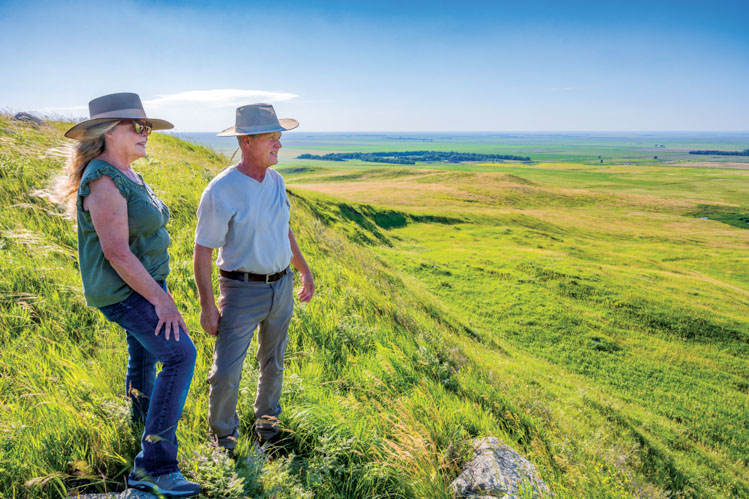
Archaeologists believe a scene like this occurred almost 1,000 years ago in Dean and Candice Lockner’s pasture near Ree Heights in central South Dakota. Dean found a layer of bones covered by about a foot of native sod in 2011 while checking cattle. The Lockners suspected they had found a bison kill site, with good reason. Archaeologists carried out a dig in 1960 at a bison kill site along the ridge 2 1/2 miles east of the Lockners’ discovery, and there is a later find of bison bones and artifacts, though never professionally excavated, just a few hundred yards east.

The Ree Hills — a mesa that gives the town of Ree Heights its name — rises 391 feet and covers about 180 square miles in Hand County.”It’s kind of like an island in the prairie, raised up above everything,” says Augustana University archaeologist Aaron Mayer.”And it’s a vantage point. You could see the bison herds from dozens of miles away. They were definitely using that area for different kill events.”

Dean Lockner found bison bones, estimated to be nearly 1,000 years old, protruding from a ridge of soil in 2011. Each season of erosion and excavation reveals more at the site.

At that first Ree Heights excavation in 1960, archaeologists William Hurt and Robert Gant found a”kitchen” area for processing meat and stone piles on the bluff. Very likely it was a bison jump in the classic sense, where Native hunters drove the animals off a cliff or rim steep enough to kill or injure many of the animals.

When archaeologist Mike Fosha, then of the South Dakota State Historical Society’s Archaeological Research Center, visited the Lockners’ site at their request, he suggested the hunters probably used a different method there: an arroyo trap.

That’s possible because Ree Hills geology consists of shale capped by Ogallala sandstone and covered by glacial material. Because shale near the edges of the landform has slumped over time, there are irregular benches along the steep edge of the ridge where animals could be trapped — either by driving them down from the bluff above or up the slope.

At his initial visit in 2015, Fosha removed a mandible of a young bison for lab work. Zooarchaeologist Danny Walker, a specialist in Wyoming, estimated the age of the young animal at 1.1 years. That indicates that the hunters probably killed it in the month of June or July. Radiocarbon testing on a molar from the animal dated the collagen in the tooth to a time between A.D. 1180 and A.D. 1270.

After exploratory work in 2017 and another excavation in 2022, archaeologists have now found four stone projectile points — either from arrows or perhaps from shafts hurled with an atlatl — as well as a scraper that may have been used for processing hides. They have also found chips of stone that may indicate hunters were sharpening tools on site.

The age of the new site makes it too early to associate it with any of the Native American tribes known to history.”We cannot make any direct connections from Ree Heights to Mandan, Hidatsa, or Arikara, but it does not mean that those people could not have been their ancestors,” Mayer says.”It may be likely the Arikara and Mandan hunted there at some points in time.”

Gardner Deegan of the MHA Interpretive Center in New Town, North Dakota, — an organization that showcases the cultures of the Mandan, Hidatsa and Arikara peoples, or the Three Affiliated Tribes, on the nearby Fort Berthold Reservation — believes the tribes lived in other regions during their history. And elders say the tribes definitely knew how to use landforms in hunting.”I do know that in the culture, they used to do buffalo jumps,” Deegan says.”They would lead the buffalo off a cliff and the buffalo would fall.”

Doyle Crume and Del Compaan, volunteers from Webster, help excavate a bed of bison bones near Ree Heights in 2022.

Candice Lockner said she’s heard other Native Americans talk about their traditional technique for leading bison into a trap, perhaps by having someone pretend to be a bison calf while others push the herd from behind. It’s the same”pushing and pulling” principle that some ranchers instinctively use to move grazing animals today. Lockner says the technique could have worked well in central South Dakota.”Located above the three Ree Hills kill sites are very large boulders, behind which the fake ‘calf’ could hide,” she says.

Whatever the method, there are clues that people living in earth lodges on the James River near present-day Mitchell, about 100 miles east, may have been involved. An arrowhead found at the Lockners’ site is similar to an arrowhead found at the James River villages, which were active between about A.D. 1050 and A.D. 1200.

Interestingly, archaeologists have unearthed a large clay-lined basin at the Mitchell site that they believe was used as a bone grease processing station. Bone grease was obtained by applying heat to crushed bone. The grease may have been used not only in feeding the village, but also as an ingredient in a dried meat product such as pemmican.

Now, with the newly discovered bison kill site at Ree Heights from the same time period, archaeologists are considering the possibility that hunters from the river villages were traveling to the Ree Hills to harvest bison. It’s known from historical records that the area remained a reliable source of bison well into the fur trade era.

Ranchers are confident there are other bison kill sites yet to be discovered in the area. In August 2022, when archaeologists were working on the Lockners’ ranch, Dean and Candice walked along that tumble of hills in their rangeland and found yet another bone bed exposed by weather. Mayer, the Augustana University archaeologist, said Dr. Kristen Carlson, a faunal and bison bone expert, was on location and confirmed the site contains bison bones. Archaeologist Alexander Anton, now in Rapid City at the Archaeological Research Center, found a stone flake that indicates hunters with stone tools were on site at that new location, as well. It’s far enough from the first site on the Lockners’ ranch to be considered a new, separate kill site. That makes four confirmed bison kill sites in the Ree Hills.

As of 2018, there are more than 30 possible bison kill sites recorded in the database of the South Dakota State Historical Society’s Archaeological Research Center, but Fosha notes that many of those have not been confirmed.

In September 2023, the Lockners learned that the bison kill site on their ranch has been approved for listing on the National Register of Historic Places. Though the site won’t be open to the public, the couple says the recognition is an important step toward preserving what is hidden on their ranch and learning more about how early Native Americans hunted bison in the Ree Hills centuries ago.

ìYou may temporarily own land,” Candice Lockner says,”but you do not own the history.”

Editor’s Note: This story is revised from the September/October 2024 issue of South Dakota Magazine. To order a copy or to subscribe, call (800) 456-5117.

Posted on Leave a comment

What’s in the Water at Wallace?

Wallace artists Adam and Madison Grimm are both federal duck stamp champions. Adam has won the Federal Duck Stamp Contest three times. Madison has three wins in the junior contest.

THERE AREN’T MANY ducks in Elyria, Ohio. It’s only 6 miles south of Lake Erie, but the second smallest of the five Great Lakes is hardly a South Dakota prairie pothole.

When Adam Grimm began hunting waterfowl, he and his dad drove an hour from their home in that far-western suburb of Cleveland to a public hunting area where the birds were often few and far between. It was no place to live for an outdoorsman, hunter and burgeoning wildlife artist.

Several years later, when he was married and had a daughter named Madison, he suggested moving to South Dakota, a place he’d visited as a child and had never forgotten. He spoke so glowingly of the state that his wife Janet, who’d never stepped foot within its borders, agreed to come check it out. Though it rained for five days straight, the young family was smitten and made the move.

They are now a family of six and firmly settled in Wallace, a town of 91 people in northwestern Codington County famous for being the birthplace of Hubert H. Humphrey, Minneapolis mayor, U.S. Senator and the nation’s vice president from 1965 to 1969. But the town could also rightly claim both Grimm and 17-year-old Madison among its favorite sons and daughters. They are both federal duck stamp champions, achieving success that the national art competition has never seen.

*****

Drawing was Adam Grimm’s first passion. He drew his favorite cartoons and other things he saw on television until one day Bob Ross appeared on the screen. His long-running PBS show The Joy of Painting captivated artists and non-artists alike, and Grimm began imagining life as an artist.”That Christmas I asked for oil paints,” he says.”I ended up not painting the way Bob Ross does, with the putty knife and three-inch brush, but I started to develop my own way. I achieved the look I was trying to get, and it just started to snowball.”

He sold his first drawing at age 11. His grandfather realized Grimm’s potential and Insisted on paying $20 for it.”He always had that confidence that I was going to be able to do this as a living. I remember him telling my sisters, ‘Your brother will probably never have to have a real job.’ He just had such belief in me, and I think that had a lot to do with my own thought process and thinking that I could actually do this. If I won something, he would call everyone he knew and tell them.”

Adam grew up in Ohio, where he worked at the dining room table on his early wildlife paintings.

The next year he was invited to exhibit his work at a local craft show. He sold every item he brought and went home with nearly 40 orders for drawings. He started following other artists and became encouraged that he could make a living drawing and painting.

At the same time, his passion for the outdoors blossomed after a trip to South Dakota. Grimm first became acquainted with the state through his grandfather, an avid collector of Native American artifacts. Then his father began making annual hunting trips, and when Grimm was old enough, he came along. The country was unlike anything he’d ever seen.”I didn’t know anywhere like this even existed. I think people in South Dakota take South Dakota for granted. They don’t realize that it’s not like this everywhere else. The people, the nature, it’s not this way.”

His Interests In wildlife and art finally married when he saw his first federal duck stamp, a pair of canvasbacks by Minnesota artist Bruce Miller that appeared on the 1993-94 stamp. Still a teenager, he began submitting artwork to the junior duck stamp contest, open to students in kindergarten through 12th grade. He never won, but he gained valuable experience.

Grimm enrolled at the Columbus College of Art and Design in Columbus, Ohio, though he struggled to fit in. His professors urged him to experiment in a variety of art genres, but he had a plan.”I was doing realism and wildlife art, and I told them that I would like to win the federal duck stamp one day,” he says.”No one at the college had ever really heard of it. It was like, ‘Who cares if you get a painting on some stamp?’ I remember telling them, ‘Well, it’s kind of a big deal if you win.'”

He began entering the contest as soon as he was eligible. In his first year, he submitted a painting of a mottled duck that took 16th place. The next year, his green-winged teal won eighth place. In 1999, the two species eligible for submissions were the black scoter, an ocean bird typically found in Alaska and along the Atlantic coast, and the mottled duck. He chose the mottled duck and pushed his own creative limits.

He thought back to a scene on a marsh near Timber Lake.”I had snuck up on this little water area and there were blue-winged teal out there,” he says.”The hen is pretty drab in color, but so is a mottled duck. She raised up and flapped her wings on the water, and the sunlight was shining through her feathers. That was so beautiful. If I could paint that, but with this other duck, that could win, because it would be more about the lighting on the bird than the bird itself. But I needed the reference. I was painting this in Ohio.”

Adam’s painting of a mottled duck stretching its wings won the 1999 Federal Duck Stamp Contest. He was 21, making him the youngest winner in the contest’s history.

Grimm contacted a biologist in Texas who was doing a banding project on mottled ducks and requested photos. Then, a friend sent him a mottled duck that he had shot (again, there aren’t many ducks in northern Ohio).”I would thaw the bird out the night before because I wanted that early morning lighting,” he recalls.”First thing in the morning I would run outside with this dead duck and hold it up and stretch the wings out. Then I would run back in and try to capture the colors I had just seen.

“I wonder how many of my parents’ neighbors were watching this crazy kid with a dead duck,” he laughs.”You do what you have to do in life, and there was no other way to do what I was planning on doing.”

Say what you will about his methods, his painting of a mottled duck stretching its wings in the soft sunlight of early morning finished first. At 21, Grimm became the youngest person to ever win the federal duck stamp contest.

What followed were several months of travel and delivering speeches about his artwork, which now appeared on a stamp that would be in hunters’ wallets and collections worldwide.”It’s almost like if you won American Idol,” he says.”You can go from being a nobody to being launched into the limelight. Everyone knows who you are. It’s a crazy thing.”

*****

Such a life-changing competition had humble beginnings that can be traced to legislation that another South Dakotan shepherded through Congress nearly 100 years ago. Waterfowl depletion on the Upper Plains was beginning to be a serious issue in the early 20th century. The federal government issued numerous protections, but it became clear that sustained recovery hinged on habitat protection.

South Dakota Sen. Peter Norbeck, who had already worked to establish wildlife preserves in western South Dakota and was the major force behind creating Custer State Park, became a champion of the Migratory Bird Conservation Act, a piece of legislation that had advanced in fits and starts during the 1920s. By 1929, he had a version that successfully passed through Congress. It created the Migratory Bird Conservation Commission, which approved the purchase or rental of wetlands upon the recommendation of the Secretary of the Interior. The only thing it lacked was a permanent funding source.

That came in 1934 with passage of the Migratory Bird Hunting Stamp Act, which required hunters to purchase a $1 stamp before hunting waterfowl. Ninety-eight percent of the proceeds from their sale go the Migratory Bird Conservation Fund for wetlands preservation.

President Franklin Roosevelt asked Jay”Ding” Darling to design the first stamp, which featured two mallards landing on a pond. Darling was an American cartoonist and two-time Pulitzer Prize winner who was serving as director of the Bureau of Biological Survey, the forerunner to today’s U.S. Fish and Wildlife Service. He had grown up in Sioux City, Iowa, where he developed an appreciation for the outdoors. After a year at Yankton College, he transferred to Beloit College in Wisconsin and had a successful career as an editorial cartoonist. He also founded the National Wildlife Federation in 1936.

Other artists were invited to contribute until 1949, when a contest was opened to the public. Rules, including that year’s eligible species, are released in the spring. Entries are taken from June 1 through August 15 and the winner is announced in September. A panel of five art, waterfowl and stamp experts judge the entries based on their anatomical accuracy, artistic composition and ability to be reproduced on a stamp. The winning design is featured on stamps that are valid from the following July 1 through June 30. Winners receive no compensation, but can sell prints of their work, which are highly collectible.

Today, federal duck stamps sell for $25. They are required for waterfowl hunters, and philatelists around the world are always eager to add them to their collection. The program raises about $40 million annually to conserve waterfowl habitat and, since its inception in 1934, has raised more than $1.2 billion to purchase more than 6 million acres of wetlands.

*****

With the big win under his belt, Grimm left school and became a full-time artist. Other accolades and milestones followed. In 2005, his painting of a wood duck won the competition to illustrate the Ohio Wetland Habitat stamp. Later that year, he and Janet were married.

Not long after the nuptials, the conversation turned to South Dakota.”I didn’t know if she would even want to move someplace like South Dakota,” Grimm says.”For people who enjoy nature, hunting and fishing, this area is so great. And for raising a family, this area offers so much more of the kind of life I want my kids to have. The place where I grew up just isn’t the same as it once was.”

Madison was a little girl when Adam began bringing her into the field to gather reference photographs for future paintings.

The couple and their new daughter Madison found a farm near Burbank in southeastern South Dakota and moved in 2006. Grimm quickly began taking advantage of his new surroundings. Searching for reference material in Ohio had always been a burden, but now he was surrounded by waterfowl aplenty. Donning a full ghillie suit, he began sitting in marshes and sloughs with his camera, spending hours photographing ducks in the early morning light.

They also began to notice Madison’s interest in art. Grimm recalls a particularly realistic drawing she did on a chalkboard at 2 years old.”Is that normal for 2?” he wondered.”She was our first child, and we weren’t around other kids her age, so I didn’t know what was normal for a 2-year-old. My sister is a speech pathologist and works with kids on certain benchmarks, and she said kids don’t normally do what Madison had done until much later.”

When Madison was 5, she asked if she could try to do a painting like Daddy. She found a photo of a canvasback from Grimm’s collection and began working in his studio.”She could enter the junior duck stamp contest,” Grimm said.”It’s a great contest for kids and there are a lot of prizes. I thought that would be a fun thing for her to try.”

The junior duck stamp program was launched in 1989, and the first national contest was held in 1993. Students from kindergarten through 12th grade are divided into four groups. States choose a best of show each year, and the winner is then entered into the national contest.

As Madison spent hours working on the painting, her parents worried she might not make the submission deadline. She was not dawdling. After years of watching her father, she was struggling to achieve the same realism.”I remember her crying, not because we were making her do this painting, but she was striving to reach the level where I was, and she couldn’t get there because she didn’t have the experience. She knew she wasn’t getting there, and it was upsetting her.”

Madison remembers the struggle, too.”I remember being really frustrated that it wasn’t going faster. I wanted it to be done,” she says.”I remember working on it for hours and losing total track of time. I would just get totally absorbed in the painting. Mom would come get me for supper and I’d realize that I had been in the studio the whole day.”

Adam and Madison each painted canvasbacks for their national duck stamp wins in 2013.

With her father’s encouragement, Madison finished the painting. She entered the state contest and won Best in Show.”She’s only 6,” Grimm says, his voice still reflecting the astonishment he felt 11 years ago.”I thought she did a nice job, but she’s only 6. I kept trying to rationalize it in my mind.”

Figuring Madison’s chances were slim in the national contest, the family went about their farm work on the day of judging.”It was being livestreamed, but we weren’t even watching it. I was working out in the garden,” Grimm says.”Then I got a phone call from a friend of ours and she said, ‘Madison’s doing really well. She’s at least fourth place.” So I ran in, and we had dial-up internet, so it was slow. By the time we pulled it up, she said, ‘I think Madison won.'”

With her victory, Madison became the youngest person to ever win the junior duck stamp contest, echoing her father’s achievement 14 years earlier and making them the first parent/child duo to win their respective contests. 2013 got even better for the family when Adam’s painting of a pair of canvasbacks standing on a shoreline that he entitled King’s Realm, won the federal duck stamp contest, giving him his second national win.

Madison won the junior contest again in 2020 as a 13-year-old, with a painting of a wood duck. The rules require junior winners to sit out a year after a victory, so her next entry came in 2022. She won for the third time with a painting of a green-winged teal.

*****

The Grimm family ó which has grown to include Hannah, Jonas and James ó relocated to Wallace six years ago. Adam and Madison’s shared art studio occupies the top floor of a guest house across the street from their home. The first floor accommodates hunters who come from out of state. It’s decorated with Grimm originals, including a painting that appeared on the cover of Ducks Unlimited magazine (he has twice been named the Ducks Unlimited Artist of the Year).

Madison goes photographing with her father to the sloughs and marshes around Wallace, though many of her photos are taken in the aviary that they built after her second junior duck stamp win. It houses 17 species of ducks, some bobwhite quail and a red golden pheasant that spends most of its time trying to impress the hens. In fact, the drake pintail that both of them painted for their most recent duck stamp entries lives in the aviary. Adam and Madison both finished second nationally.”You know what this means,” Grimm joked.”We’re going to have to eat that bird. Clearly, he’s not a first-place bird.”

Grimm says the wonderful people of the tiny town on the Coteau des Prairie welcomed them with open arms. Not long after they arrived, he was helping coach youth baseball and had joined the volunteer fire department. The kids have friends in town that they can see daily. And they are surrounded by ducks.”I used to drive 45 minutes to an hour away just to get to a marsh where I could try to photograph birds,” Grimm says.”Now, I can walk down the street. Even our yard has wood ducks and hooded mergansers flying through and trying to nest in our trees. Sometimes I think maybe it would have been easier to just get a regular job. But I really love what I do, painting these beautiful creatures in their natural habitat and having the inspiration right out our back door. It’s everything I want.”

Editor’s Note: This story is revised from the July/August 2024 issue of South Dakota Magazine. To order a copy or to subscribe, call (800) 456-5117.