Posted on Leave a comment

Fifty Years in South Dakota

Light streams in on South Dakota poet Badger Clark at his home, the Badger Hole, in 1937. Dakota Discovery Museum photo.

Editor’s Note: In honor of National Poetry Month, here are a few stanzas by Badger Clark, South Dakota’s first poet laureate, on life in our fair state.


Fifty Years in South Dakota

We lack sophistication; our lives are all frustration,
We South Dakotans, so some writers say
According to those novels we mostly live in hovels
And all our days are dun and gray.
We flounder in futility, punch-drunk to imbecility
From dust and debt and drought and dying kine,
Aridity, frigidity — yet I, in my stupidity
Have lived here fifty years and like it fine.

I nearly froze my gizzard in one riproaring blizzard,
But that was in the year of Eighty-eight.
Thought I was never wealthy I’ve been absurdly healthy
Like nearly all people in the state.
If skies went dry and coppery, if fields got all grasshoppery,
That made the good years better when ’twas done,
And though my weak humanity slipped sometimes to profanity
I’ve lived here fifty years and think it’s fun.

I wonder if the fellows who paint us all in yellows
Have heard the meadowlarks among the grass
Or seen the corn in tassel or climbed a granite castle
That stands on guard above a Black Hills pass.
We like a fat prosperity but there’s a tougher verity
That roots us to the prairies and the Hills.
It’s HOME to us, our motherland, dearer than any other land,
I’ve lived here fifty years, but yet that thrills.

It never is”verboten” for any South Dakotan
To laugh and talk as freely as he votes,
And if they haven’t riches to carry in their breeches
They always carry laughter in their throats.
Our maidens sweet and willowy, our matrons good and pillowy,
Our boys and men look you in the eye
Make up a grand fraternity to do me till eternity.
I’ve lived here fifty years, and here I’ll die.


Posted on Leave a comment

Nobody Yelled ‘Kill the Umpire!’

An impressive sight on the baseball diamond, umpire Amanda Clement commanded respect from the players.

One of the most fascinating sports figures ever to cross the South Dakota scene … or for that matter, the American scene, was Amanda Clement, a lady baseball umpire at the turn of the 20th century. It was not a time when women were encouraged into sports, so the sensationalist newspapermen of the early 1900s had a field day with her exploits. She became a legend in her own time.

The Amanda Clement story began in Hudson, South Dakota, a small town on the Big Sioux River near the Iowa border. She was born March 20, 1888. Her father died at an early age, leaving her and brother Hank to be raised by their mother, Harriet Clement. Harriet was no softy, having been one of the first female settlers in the town of Eden in Dakota Territory a few years earlier.

The Clement house was next to the Hudson ballpark, and it was natural for the children to spend idle time with a baseball. Amanda was attracted to the game but, because of her gender, was relegated mostly to umpire duty. While she never advanced in ability enough to play first base on the town’s semi-pro team (as some writers reported), Amanda did possess enough skill as not to embarrass herself when a shortage of players forced the boys to let her play.

Amanda, or Mandy as she was called, got her first taste of umpiring for pay at the age of 16. She and her mother had traveled across the Big Sioux River to watch her brother, Hank, pitch for Renville against Hawarden. Two local lodge teams were scheduled for a preliminary game and when the umpire failed to show on time, Mandy was drafted from the crowd. Time for the main event arrived and still there was no umpire. The players had been significantly impressed by Amanda’s work in the first game and begged her to umpire their game — with pay, of course. It took more persuading of mother than daughter, but finally Mrs. Clement relented and allowed Amanda to take to the field. That Renville-Hawarden game of 1904 is the first record of a woman umpiring a baseball game for money.

A couple of interjections seem appropriate at this time so readers might appreciate the magnitude of Amanda Clement’s feats. First, in those days just one umpire was used. He (or she) stood behind the pitcher, not only calling all the balls and strikes but also the plays at all four bases. Second, in the early 1900s there were no radios, no movies, few cars and little entertainment of any type. Baseball was the game of the day. You either played or watched. It was a time when the only thing ERA meant was Earned Run Average.

“She is death on balls and strikes,” one reporter wrote.

Every town and hamlet had a team. Games were played between neighboring towns and spectator interest ran high. From April to October, Saturday and Sunday afternoon was set aside for baseball. As the action heated up and local pride grew, the need arose for better players. Thus was born semi-professionalism. Better players from larger towns like Sioux Falls and Sioux City were hired. Money was needed to pay the players, money was obtained from paying spectators, and thus a good attraction was needed to get more spectators.

Amanda Clement as a baseball umpire was an immediate hit. Not only was she good, but baseball promoters quickly realized that a good looking young lady calling balls and strikes might enhance the paying public. Soon every baseball team in the area was vying for her services. She was billed as the “World Champion Woman Umpire,” a fact that was somewhat true since she was surely the only one.

The next few years found Amanda Clement umpiring throughout the five-state area of North and South Dakota, Minnesota, Iowa and Nebraska in the summer and going to school the remainder of the year. She attended Yankton Academy for two years, Yankton College for two years and graduated from the University of Nebraska in 1909 with a degree in physical education. Baseball earnings paid her way through school. Amanda would work 50 or so baseball games a summer, with fees ranging from $15 to $25. She was the first person contacted to umpire a game of any importance.

Amanda Clement was an impressive sight on the baseball diamond. Standing 5′ 10″ with her full-length blue skirt, black necktie, white blouse with UMPS stenciled across the front and peaked cap, she was described as an “inspiring sight” and ”more than just a pretty face” by local newspapers. “She is death on balls and strikes,” one reporter wrote.

Amanda was dubbed “the heartless arbitrator…”

A no-nonsense Congregationalist, she often lodged with local ministers when working away from home. She refused to umpire on Sundays and once left a game after two innings because a player swore. But that kind of confrontation was rare.

A longtime friend, Janet Mills, recalled that Amanda always marveled at the players’ politeness. Instead of saying “Kill the Umpire” they said, “Beg your pardon, Miss Umpire, but wasn’t that one a bit high?”

Her fame as a baseball umpiress spread far and wide. Newspapermen from the East championed her. She was said to have umpired professional ball, even the big leagues were said to be seeking her. Part of the myth! One writer for the Boston Post claimed in a story that she had turned down over 60 proposals for marriage, received while umpiring baseball games. Amanda was dubbed the “heartless arbitrator” by that writer.

Adding to the Amanda Clement legend was her own athletic ability. At Yankton College, she was the star athlete of her day in such sports as basketball, track and field, and tennis. Various news reports had her setting world records in the shot put, the hurdles and the dashes in addition to being the best tennis player in America. All more of the myth! Amanda was also credited with the world record for a female throwing a baseball — 279 feet. This is fact.

Following graduation from college, Amanda gave up the life of an umpire. Once in awhile she was coaxed out of retirement for a special game of sorts. However, she did not give up her love for athletics. While teaching at Yankton College, the University of Wyoming and Jamestown, N.D., Amanda remained a strong sports supporter. She helped coach, she organized sports teams and she continued to referee high school basketball, something she started while attending Yankton College. Perhaps she was the first lady basketball referee, too!

As Amanda Clement advanced in years, her amazing story didn’t diminish. Following her years in education, Amanda managed YWCAs in LaCrosse, Wis., and Keokuk, Iowa. While living in LaCrosse, she pulled a drowning man from the Mississippi River.

After Amanda returned to Hudson to care for her sick mother in 1929, she still found time to be city assessor, justice of the peace, police matron, drug store clerk and typesetter for the local newspaper. Also, she worked to get a swimming pool built and she coached kids’ teams of all types. Following the death of her mother, Amanda moved to Sioux Falls in 1934. She was involved in social work and welfare until her retirement in 1966.

Amanda Clement never married. Instead, she devoted her live to enriching the lives of others and bringing enjoyment to them. She never lost her love of baseball, and rarely missed a game on the radio or television. Amanda became a follower of the Minnesota Twins, rooting for them and, no doubt, for the umps, until her death in 1971.

Amanda has been recognized in the Baseball Hall of Fame at Cooperstown, N. Y., as well as the Women’s Sports Hall of Fame and the Women’s Sports Foundation in San Francisco. Her exploits were also chronicled in Sports Illustrated. She was inducted into the S.D. Sports Hall of Fame in 1982, only the second female so honored and the first baseball umpire. Children can learn about Clement’s accomplishments in Umpire in a Skirt: The Amanda Clement Story, a book by Yankton author Marilyn Kratz.

Editor’s Note: Author Colin Kapitan is a well-known South Dakota sports official and a veteran freelance sportswriter. This story is revised from the July 1985 issue of South Dakota Magazine. To subscribe, call 800-456-5117.


Posted on Leave a comment

Celebrating South Dakota’s Favorite Shutterbug

One of our favorite photographers, Chad Coppess, received a real honor last week at the State Tourism Conference. Chad was given the 2013 A.H. Pankow Award, which honors those who have made a contribution to South Dakota’s tourist indusry.

Coppess is the senior photographer for South Dakota Tourism. He’s traveled all over our state with his camera, taking shots that capture our state’s beauty and fun. He co-founded the Black Hills Photo Shootout with Scott Howard, created South Dakota-themed backdrops for an online racing game, and writes three blogs celebrating South Dakota in music, film and photography. You’ve seen his photos in the pages of South Dakota Magazine and on this website many times.

Let’s celebrate this honor with a few of our favorite Coppess photos. Congratulations, Chad, and keep up the great work!

Posted on Leave a comment

Thanks, Red

Last winter, the Hunhoffs all gathered for a family weekend in Pierre with kids and grandkids. The little tykes splashed in the pool and raced around the capitol on a quiet Saturday afternoon when there was no one there. But we had the most fun at the South Dakota Discovery Center, a children’s activity center located in an old city water plant on the west side of town, near the river.
The grandkids made sand art, constructed a wood dinosaur puzzle, spoke in a whispering dish, crawled through a tree house and had all sorts of other fun. Most of the exhibits were simple and sturdy. I wondered who made them.
Today I was reading the Pierre Capital Journal and came across the picture of a kindly fellow named Albert “Red” Zarecky. It accompanied his obituary.
Red was a retired pharmacist, age 93 when he died Jan. 5, “at his home, surrounded by family.” He grew up at Flandreau, served with the Marines in the South Sea Islands during WWII and then studied pharmacy at SDSU. He ran the Corner Drug in Pierre, and later, the city’s first Walgreens.
Red retired in 1976, some 37 years ago. And that was just a beginning. He started working with wood. He built two homes and remodeled his own. Then he started making toys and gifts for children, friends and neighbors. Every Christmas, he made a special gift for grandchildren. And he made handcrafted gifts of wood for every grandchild’s high school graduation — keepsakes that will be passed down through the generations.
Finally, a paragraph near the end of the obituary noted that Red made many of the children’s exhibits at the Discovery Center.
It’s pretty amazing how one person’s talents can spread to so many — even a talent developed after retirement. Thanks Red, on behalf of my grandkids. Wish I’d had the chance to meet you.
Posted on Leave a comment

A Village Begun by Old Papineau

Editor’s Note: This story is revised from the May/June 2008 issue of South Dakota Magazine. To order a copy or to subscribe, call 800-456-5117.


Every town has someone who knows its history. In Geddes, it’s Ron Dufek. By day he runs Duf’s Amoco, but he’s also the town historian and caretaker of the Geddes Historical Village.

The village started in 1971 when Dufek, Vern Burnham and others decided to move the old Papineau Trading Post into town.”The city fathers were against it,” Dufek recalled.”We had to promise an arm and a leg to get it in here. We had one year to get it looking good.”

They succeeded, and other items followed, including part of the quaint WNAX gas station. Yankton businessman D. B. Gurney created”fair price” gas stations in the 1930s and sold gas for as little as 17 cents per gallon.

Students in Jackson Township, southwest of Geddes, attended the red, white and blue schoolhouse from 1901 to 1948.”Patriotic immigrants who loved their country” built the school and give it its unique color scheme, Dufek said. In 1960 Jackson Township bought the school and gave it to the Charles Mix County Historical Restoration Society. It was moved into the village in 1975.

A collection of small, white tombstones from the DuCharme Cemetery sits next to the trading post. One legend says the cemetery, which sat near the post’s original location, was where colorful fur trader Cuthbert DuCharme, also known as Old Papineau, buried all the people he killed. It held 27 men, women and children who died between 1869 and 1895. After Fort Randall Dam was built in the 1950s, the Missouri River’s new flow washed the cemetery away. The Army Corps of Engineers removed the remains and interred them at different locations. In many cases the original grave markers were left. They were added to the village in 1984.

When the childhood home of popular governor Peter Norbeck was deteriorating and about to be demolished, Dufek and Burnham intervened.”I just jumped right on it. One thing led to another and they gave it to us,” Dufek recalled. The home was moved into the village shortly before the South Dakota centennial in 1989.

The newest additions to the village include part of a replica Lewis & Clark keelboat and a claim shanty. The boat was built in Omaha for the bicentennial celebration of Lewis & Clark’s expedition in 2004.

Homesteader Charles Phillips moved to Dakota Territory from Kansas in 1883 and built the claim shanty around 1900. His nephew, William Phillips, donated the building to the historical society and it became part of the village in 2007.

Dufek plans to keep growing the village.”Maybe we’ll get it done if I last long enough,” he chuckled.

To learn more about the village, or to arrange a tour, visit the Geddes Historic Village website or call Duf’s Amoco at 605-337-2501.

Posted on Leave a comment

A New Warrior Walks the Milky Way

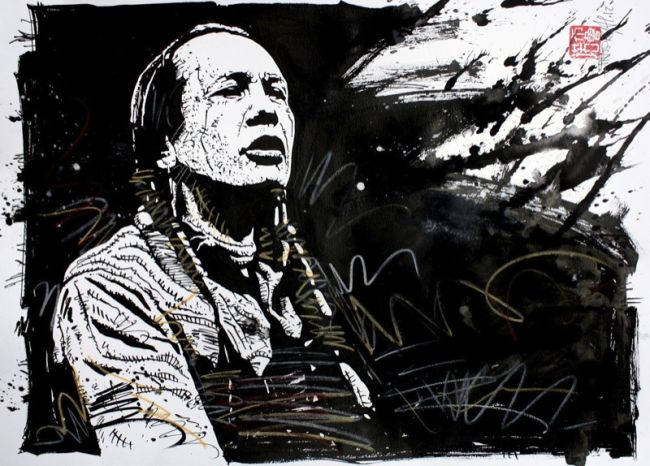
Russell Means, as depicted by visual artist Bruno Leyval. See more of Leyval’s work at www.brunoleyval.com.

“All European tradition, Marxism included, has conspired to defy the natural order of all things. Mother Earth has been abused, the powers have been abused, and this cannot go on forever. No theory can alter that simple fact. Mother Earth will retaliate, the whole environment will retaliate, and the abusers will be eliminated. Things come full circle, back to where they started. That’s revolution. . .

“You see the one thing I’ve always maintained is that I’m an American Indian. I’m not a Native American. I’m not politically correct. Everyone who’s born in the Western Hemisphere is a Native American. We are all Native Americans. And if you notice, I put American before my ethnicity. I’m not a hyphenated African-American or Irish-American or Jewish-American or Mexican-American.” — Russell Means.

The Lakota Oyate lost a very special warrior last week. Death is transformation. Russell Means is now walking the sacred path of the Milky Way. I believe he is ecstatic at the reunion with ancestors who greeted him to help with his spiritual journey. Tasunke Witko is guiding him on the path. Russell will prepare a sacred place for us. He will help our spirit when it is our time to walk the Milky Way.

He will be remembered by many of his Oyate as a patriot of the Lakota Nation. He was a true warrior who feared no challenge. He feared no man. He was Akicita. He was Tokala. He was Itancan. When he believed something needed to happen to improve the lives of all the Lakota people, he was the first warrior to take the steps to make the needed changes.

“Wounded Knee happened because Indian people wanted to survive as Indians and there wasn’t any way to survive, so we made a stand and made a statement, but now Indian people are beginning to rebound, rebound according to their [concept of] “Beauty.” And that’s really what’s necessary to understand: Indian people have to become free again.” — Russell Means

I was a teenager when the 1973 occupation of Wounded Knee took place. I clearly remember some of our own people acted like they were afraid of what was happening on the Pine Ridge Rez. Even though many of the adult members of my family didn’t really have any good things to say about the American Indian Movement (AIM) back then, I’m still very glad all those brave activists stood up for our rights.

Warriors like Russell Means helped my generation to become what we are today. Whether you love it or hate it, AIM is still very influential on all of us. If it wasn’t for AIM, people my age might not have ever found any pride in being Lakota. We might have all melted into that proverbial pot.

And that’s really what’s necessary to understand: Indian people have to become free again.

Russell Means was famous throughout the world. I will always remember him as an activist, an author, an actor and an extremely eloquent orator. He spoke up for all of us. I searched the internet for his quotes and found several. I include some here in the following paragraphs:

“One is expected to know things, to believe things. Knowing and believing are all in your head — there is nothing in your heart. If you cannot feel that the earth is your grandmother, then of course you will find it easy to rape her, to behave as if she is under your dominion. You will find it easy to believe that we humans are the dominant species, and to act as though the earth and everything on it are ours to do with as we please … if all human beings were taken away, life on earth would flourish.

“We Indians do not teach that there is only one God. We know that everything has power, including the most inanimate, inconsequential things. Stones have power. A blade of grass has power. Trees and clouds and all our relatives in the insect and animal world have power. We believe we must respect that power by acknowledging its presence. By honoring the power of the spirits in that way, it becomes our power as well. It protects us.” — from Where White Men Fear To Tread, Means’ 1995 autobiography.

Wopila Russell Means! Many Lakota now realize it’s important to be proud of who we are. The path you created with your courage will be followed by many young Lakota. You inspired us to teach our children there is no need to be ashamed of being Lakota. We will continue to appreciate all the teachings you left behind for us to carry in our lives. Thank you for dedicating your life to the Lakota and other tribal people of Mother Earth.

I was unable to attend the celebration of Russell’s life last week. I send my love and prayers to the Means Tiospaye. I want to express my appreciation to Little Wound School for the live stream of the services. I was grateful to be able to watch and listen to all the people who spoke about Russell’s life. I also appreciated all the songs that were sung in his honor.

“Russell was more than a human being. Russell was a spirit. Russell was a God. He was like the spirit of a tree, or the spirit of the wind or the spirit of the sun. A living God amongst us — that was Russell Means,” Dennis Banks said.

“Once you experience true freedom in your mind and in your heart and you tie the two together, there is no going back — there’s no going back. I’m blessed because, of course, Indigenous people know and understand reincarnation I certainly understand it, I’m coming back as lightning. So I’m free. And when I come back as lightning I’m going to do my job. So, if you live longer than me and you find out that lightning has struck the White House, you know who did it.” — Russell Means.

Oyate Waciyanpi, we pray you have a beautiful journey.

Vi Waln is Sicangu Lakota and an enrolled member of the Rosebud Sioux Tribe. Her columns were awarded first place in the South Dakota Newspaper Association 2010 contest. She can be reached through email at sicanguscribe@yahoo.com.

Posted on Leave a comment

Remembering the Preacher Politician

You know what we say about preachers’ sons: they like to live life on the edge. George McGovern was born at Avon in 1922, the son of a Methodist pastor. He volunteered for the Army Air Force after Pearl Harbor and flew 35 missions in the plane he called Dakota Queen.

His plane, named for his young bride back home, was hit by enemy fire on a bombing mission in 1944. One engine quit and another caught fire, but he somehow kept it in the air and brought his crew home. He was awarded the Distinguished Flying Cross.
When the fighting stopped, he could have come home. But he volunteered to stay overseas and fly food into the European communities that he’d been bombing.
“The streets (of Italy) were full of young women selling themselves, not because they were immoral but because that was the only way they could scrape together enough to take care of their children,” he remembered in an interview with South Dakota Magazine in 2001.
Those young women made a lasting impression on the young preacher’s son, who came back to South Dakota and went wild.

He actually tried to revive the two-party system in South Dakota, going town-to-town and door-to-door to organize the Democratic Party. There were but a handful of Democratic lawmakers in Pierre and no statewide officials from the party. The young McGovern spoke to Rotary Clubs and Chambers of Commerce, selling the idea that one-party government was hurting their communities and state.

He won a U.S. House seat in 1956, became a friend of the Kennedy family and lost a bid for Senate in 1960. JFK asked him to head his Food for Peace agency, and he leaped at the opportunity. Two years later he was elected to the U.S. Senate in 1962, edging Sen. Joe Bottum by less than 600 votes.
The rest is American history. McGovern rose to national stature in 1968 as an early and vocal opponent of the Vietnam War. It was the same year that Dusty Springfield had the hit song, “The Son of a Preacher Man.”
I got to know him in 1974 while working as a legislative aide to U.S. Rep. Frank Denholm in Washington, D.C. McGovern had just lost the presidential race, and was a national figure. His opponent, Richard Nixon, was about to resign from office and if the election had been held that summer it would’ve been a landslide in the other direction.
One of my jobs as the youngest staffer in the office that Watergate summer was to escort people across the Capitol complex to find George McGovern’s office. They were teenagers, farmers, seniors, mayors and lobbyists. He treated everyone the same — with a gracious smile and all the time his staff would allow. After about a dozen such visits, he finally realized that I wasn’t part of the visiting entourage but he still welcomed me just as warmly.
We had occasion to keep in contact through the years. He lost the U.S. Senate seat in 1980 but he stayed involved in South Dakota life. I was a journalist, and became a state legislator in 1993 so our paths continued to cross.

Our last serious conversation happened about two years ago when my daughter, Katie, and I interviewed the aging senator in his Mitchell library. He seemed satisfied with his life, as we looked back. But at age 88, he still had a strong sense of purpose.

He was excited that he could still feed massive numbers of people — far more than he ever imagined when he flew back into Europe with a cargo of food rather than bombs. He was also wild about the idea of educating girls in poor countries. He said it might do more than almost anything else to end poverty and conflict.

He was a preacher’s son — wild with compassion for the disenfranchised and forgotten among us.
Posted on Leave a comment

Reminders of Our Outlaw Days

Every region has favorite outlaws and villains but few have the outlaw-rich history of Dakota Territory and South Dakota.

Those who came to Dakota Territory were either bravely adventurous or very desperate. The faint of heart did not leave family, friends and comforts of home for a dangerous and uncertain existence. South Dakota remains the center of the American frontier, and we are surrounded by remnants and reminders of territorial history.

Furthermore, descendants of some of our most colorful characters still live here. Last year I helped write a South Dakota Magazine article on outlaws. We featured a man who had lured investors to the Hills by switching mineral samples. The suckers realized they had been duped when miners processed 3,000 tons of ore and extracted only $5 in gold. It’s a good story, but one of our readers took offense. “My grandfather was not a crook!” wrote a nice lady from West River. It turns out her ancestor was also a pillar of the Rapid City community.

Other reminders of our outlaw past remain in every corner of the state. In Geddes the cabin of fur trader Cuthbert DuCharme sits in the city park. DuCharme, called “Old Paps” because of a talent for whiskey-making (Papineau is French for whiskey), lived along the banks of the Missouri River. His roadhouse boomed when Fort Randall was established, and wild parties were held every night.

On the other side of the state, a tree used for hanging three accused horse thieves still stands on Skyline Drive in Rapid City. The tree died long ago, but the trunk is now embedded in concrete, a grey reminder of an era when hangings were punishment for a crime that might not merit a prison sentence today.

One of those killed that night was a teenager. His two traveling companions admitted their guilt, but declared to the very end that the boy was innocent. Some Rapid Citians felt there was a curse on their city because of the boy’s hanging.

Yes, our past is hard to escape. A new gravestone now marks the Gregory County burial site of Jack Sully, the famous Robin Hood of the Rosebud country. The shackles worn by Lame Johnny on his last stagecoach ride (vigilantes stopped the coach and hanged him) are now split between the State Historical Society in Pierre and the 1881 Custer Courthouse Museum. Potato Creek Johnny’s 7.75 ounce gold nugget can be seen at the Adams Museum in Deadwood. And you can still sleep at Poker Alice’s house in Sturgis.


Reminders of our outlaw history are all around. South Dakota Magazine recently published a book, South Dakota Outlaws and Scofflaws, about the colorful characters who settled Dakota Territory. The book also points readers to historical places that can still be visited today — like Old Pap’s cabin and the hanging tree. For more information, call us at 1-800- 456-5117.


Posted on Leave a comment

Chance Encounters of a Rural Kind

Editor’s Note: This story is revised from the September/October 1998 issue of South Dakota Magazine. To order a copy or to subscribe, call 800-456-5117.


There’s Mount Rushmore. There’s Crazy Horse. There’s the Corn Palace. Nationally known monumental projects, involving renowned artists, years of effort and enormous expenditures of money.

And then there are the simpler pleasures. Take rural mailboxes. Simpler perhaps, but every bit as delightful. Particularly delightful because they are unexpected, they are stumbled upon, they jump out at you like a jack-in-the-box with a grin on his face.

But are they really so simple? Look again. Consider the expert mortaring involved in persuading a pile of bricks to turn a rounded corner. Consider the effort involved in welding a collection of horseshoes so that they, too, turn a corner. And consider the skill involved in forging a piece of metal into a whimsical sculpture of a mother kangaroo and her baby.

Although no tourist guide describes them and no map pinpoints their location, finding a unique rural mailbox is not at all difficult. All you have to do is pick a country road — any country road — and point yourself in whichever direction suits your fancy. This is best accomplished on a long, leisurely, absolutely aimless day. Just keep going: sooner or later you will find your mailbox. And there it will be: a giggle, a surprise, a delight.

But what’s the creative spirit behind all of this? Best not to ask. Try asking a South Dakotan to explain his”artistic motivation” and be prepared to be laughed out of the state. South Dakotas are not inclined toward self-important pronouncements.

But if their owners refuse to talk, their creations are more than willing to speak on their behalf. Listen to what they have to say:”Look at me. I’m here. Out in this vast and overwhelming space, I exist. And, in case you haven’t noticed, I’m a very clever fellow.”


Posted on Leave a comment

Deadwood Dick vs the Whitewood Skunk

He never sat with his back to a door, that grim old-timer who claimed to be the hero of the Deadwood Dick dime novels. He assumed the stance of an alert shotgun guard at all times, in spite of the fact that no stagecoach robber had been observed in our little town for many a decade.

His weather-beaten face was flecked with powder burns and his piercing, squinched eyes were ever on the lookout for trouble. He seemed to stand tall, due to his lean build, and the peaked crown of his black Stetson added to the deception. His name was Richard Clarke, but he preferred to be called Deadwood Dick, and most of the townspeople humored him.

Dick lived in obscurity for a number of years and his oft-told tales of vanquished Indians and outwitted holdup men were discounted by local listeners. His prosaic job as a railroad section hand did much to diminish belief in his stories of previous adventures. Some of his neighbors regarded him as a pathetic and deluded old man.

It was in 1927, when he was in his early seventies, that Deadwood Dick was born again. Bert Bell, an energetic and imaginative press agent for Deadwood’s Days of 76, acted as midwife in the rebirth of the fictional hero, and Dick Clarke became the character that he had impersonated for many years. Dick was given a buckskin suit, the use of a cabin in Pine Crest Park for his lifetime, a place of honor in every parade, and he was lionized with proper respect by the cult buffs of the Pioneer.

Robert Casey, in his book, The Black Hills, said that some of Dick’s disbelievers claimed he “didn’t know which end of the gun to hold away from him when he pulled the trigger.” Our family could prove this was not the case.

It was our privilege, when we moved to Whitewood in 1920, to live in the house next door to Deadwood Dick. Before his sudden rise to fame removed him from our town, we considered him a satisfactory neighbor, except for one alarming trait. He was much too quick on the trigger of his trusty rifle. The fact that the index finger on his right hand was missing did not slow his fast draw.

I was a senior in high school when I experienced the humbling result of Deadwood Dick’s fast draw. Mother had mentioned on one of Dick’s visits that a skunk had taken up residence under our screened porch. Dick assured her that he knew just how to take care of the problem.

Why he chose 8:30 the following morning to exterminate the animal, I shall never know, but just as I was leaving for school, a shot shattered the early morning stillness and my life was changed for many weeks thereafter. The skunk returned Dick’s fire with an odor that contaminated our neighborhood for blocks.

By the time I reached the Lemaster home, I knew that I would not be welcome in class, and I decided upon what I foolishly considered a quick fix. I had tied a 25-cent piece in my handkerchief for some notebook paper, so I dashed down to Gustin’s Drug Store for a quarter’s worth of perfume. Earl, in his haste to get rid of me, handed me a half pint of the cheapest, smelliest kind in stock, and held the door open for my departure.

I drenched myself with the malodorous liquid, and in my rush to reach class on time, I failed to realize the full horror of combining the essence of skunk with the overpowering scent of magnolia and musk. I tried to slip into the room without being noticed, but my odor preceded me and as I came through the door, all eyes in class were upon me. I raced to my seat amidst a concert of gagging and retching sounds, and Lorene Jay, who sat in front of me, promptly fainted. Professor Munson quickly appraised the situation and suggested that I leave the room immediately.

As I slunk away, totally disgraced, I noticed that Lorene had returned to consciousness, with many solicitous classmates in attendance. Tearfully, I stumbled home with anger eventually replacing my humiliation. I deplored the fact that no early-day combatants had sent a well-placed bullet or arrow to the heart of our hero, Deadwood Dick, and I plotted ways that I might accomplish the job they had left undone.

At home, I found my exasperated mother trying to air out the house that smelled worse even than I, before I added the putrid perfume. The unfortunate skunk left his imprint on our household for several weeks, but Deadwood Dick has lingered in my memory as he appeared that ill-fated morning so many years ago. Only my futile anger has faded, dissolved by laughter and nostalgia for those “good old days.”

Editor’s Note: Ruth McPherson, a Black Hills native who lived in Santa Fe, New Mexico, wrote this true tale of Deadwood Dick’s exploits for our July/August 1991 issue.