Posted on Leave a comment

The Yankton to Marty Trail

South Dakota Magazine intern Ava Brandt met Digger at Mensch’s Greenhouse in Avon.

A golden dog named Digger met us at the door of Mensch’s Greenhouse, his tail wagging like a windshield wiper. Two cats lolled on a flower worktable and a dozen colorful cockatiels chirped from two cages near the petunias.

Any traveler will crack a smile at Mensch’s Greenhouse in Avon — and that’s fortunate because for the most part this Yankton-to-Marty loop can be a solitary journey, even though it visits seven small towns in South Dakota’s populated southeast corner.

We began the loop early in the morning because of a tip that the Tyndall Bakery has amazing donuts and pastries, and some days they sell out. We had two stops to make before the bakery.


The Lakeport Church in rural Yankton County dates to 1884.

Chalkstone Church

We drove 8 miles west of Yankton on Highway 50 to 431st Avenue, then turned right to the Bruce and Donna Schwarz farm. Drive slowly through the farmyard — the Schwarzes don’t mind — and you come to a small church built of the yellow chalkstone found along stretches of the nearby Missouri. Neighbors keep up the church and mow the cemetery, which features Czech surnames still common in the area. This is Czech country, settled by pioneers from Bohemia and Moravia who began to arrive in 1869. Their first settlement was Lakeport; only the little yellow church, constructed in 1884, has survived.


A wooden church is among the historic buildings preserved at the park in Tabor.

TABOR: CZECH CAPITAL

A few miles further along Highway 50 is the town of Tabor (pop. 405), founded in 1872. Tabor is famous for its annual Czech Days celebration in June. Parking is more plentiful on the other 362 days of the year, so stop on Main Street and stretch your legs by walking through the quaint pioneer village which includes a tiny wood church that was built at Lakeport even before the chalkstone church. Now it is well-kept in the Czech Preservation Society’s heritage park along with several other antiquated structures.


Magazine interns Rose Lane (left) and Ava Brandt at Tyndall’s Eiffel Tower, a fancy flagpole that measures 100 feet.

TYNDALL’S TOWER

One wonders if Gustave Eiffel, engineer and namesake of the tallest structure in Paris, would be flattered to see the imitation in Tyndall.

Tyndall’s”Eiffel” is more than 1,000 feet shorter than Gustave’s, but nearly as old. It was constructed in 1898, just nine years after the original was completed to honor the centennial of the French revolution.

The replica stands on the lawn of the county courthouse, west of downtown on 18th Avenue. But before you visit the tower, stop at the Radack family’s bakery. We dilly-dallied too long, and the cases were nearly empty, so we missed out on the Tyndall Roll, a Bismarck-like pastry filled with white cream and topped with crushed peanuts. No one knows when the legendary roll was created, but the bakery traces its history to 1905.


Carol and Vern Tolsma at their Avon greenhouse.

AVON’S GREENHOUSE

Feeling lonely in southeast South Dakota? Just visit Vern and Carol Tolsma’s Mensch Greenhouse and Flower Shop along Highway 50 in Avon.

Carol’s grandmother, Ada Mensch, started the greenhouse in 1957. Imagine how many flowers have bloomed, thanks to Ada, in 67 years. And how many people have enjoyed the garden bounty that took root here.

The flowers and plants come with free advice. Did you know you should only water tomato plants when absolutely necessary? Vern says a thirsty plant sends roots deep into the soil, making it strong and adding taste to the fruit.

Digger, the greenhouse dog, wags and nuzzles anyone who’ll take the time. Cats and cockatiels also share the space. The cockatiels are orphans who lost their owners and found refuge here.

The Tolsmas tend a 2-acre garden near the shop, and they sell produce, canned goods and amazing pickles. They occasionally set out a table of freebies that need a home.

Some days, Vern wears a blue t-shirt that says it all:”I Love Gardening From My Head to My Tomatoes.”


Richard Langdeaux helps keep Wagner’s park looking beautiful.

A WALK IN THE WAGNER PARK

Follow Highway 50 northwest. South Dakota’s Czech heritage extends into Charles Mix County and the city of Wagner (pop. 1,603), the largest town on this loop tour. Wagner has all the amenities you might want — a coffee shop, restaurants and a grocery store.

On the west side of town, near Highway 50, lies a little lake and park that would be the envy of any city in America. The lake was created when a dam and rock structures were built in the 1930s by WPA workers. Today the park includes two walking bridges, flower gardens, trails and even a small waterfall. This is the best opportunity of the day for a walk.

Richard Langdeaux, a Santa Claus look-alike who was collecting trash in the park, told us that the stone buildings along the lake were once a Scout camp. Artesian springs keep the lake full year-round.

Wagner also offers an impressive museum, operated by the Charles Mix County Historical Society. The collection is known for its Czech exhibits, as well as artifacts from the Yankton Sioux culture that predates the pioneers.


Michael Rouse helps maintain the ground around Marty’s St. Paul Catholic Church.

MARTY’S AMAZING CHURCH

Drive west of Wagner for 6 miles to 388th Avenue and turn south for another 6 miles to Marty. The one and only enterprise is a boarding school started by the Benedictines in 1924 and now operated by the Yankton Sioux Tribe.

Alongside the school is St. Paul Catholic Church, built by volunteers — Indians and non-Indians — in the early 1940s of Indiana sandstone, mined from a quarry near St. Meinrad Archabbey, which founded St. Paul’s.

The steepled church (167 feet!) is surrounded by tall trees and other structures, so it’s hard to appreciate from afar. Exit your car and walk about the churchyard, where there are statues of Kateri Tekakwitha, the first Native American saint, and St. Theresa, patroness of missions. On most days, the church doors are open; inside, St. Paul’s looks like something you might see in a European city except that the murals, stained glass and other art are rich in Native American themes.


The tallest stone in Greenwood Presbyterian Cemetery marks the grave of Struck by the Ree.

STRUCK BY THE REE

Follow the road south of Marty for about 7 miles and a few curves. You’ll come to Greenwood Presbyterian Cemetery, where the tallest stone marks the grave of Struck By The Ree, a maligned and misunderstood leader of the Nakota. He was born in 1804, as Lewis and Clark came through the river valley. Legend says the explorers wrapped the baby in an American flag and proclaimed he’d be a great leader.

Struck By The Ree did grow to be a wise chief — an environmentalist, a feminist and a peacemaker. He urged pioneers to preserve the timber resources of the river valley. He pleaded that both Nakota and white men respect the Native women. And though he first fought the intrusion of the white civilization, he eventually recognized that it could not be stopped (ìthey are like maggots Ö”). He became a lead negotiator in the 1858 Treaty. Decades later, after the treaty was broken and his people found themselves hungry and hopeless, he was often persecuted; his cabin was burned, and his horses were stolen.


A tall memorial near Greenwood commemorates the 1858 Treaty.

Treaty Memorial

Continue south and you’ll soon come to another memorial, erected to honor Struck By The Ree and seven other Native American signers of the 1858 Treaty, which gave the government more than 11 million acres for $1.6 million and established a reservation for the Nakota.

The monument was constructed in 1907, topped with an obelisk. A few decades ago, vandals toppled the obelisk — a posthumous insult to Struck By The Ree, a century after his death in 1888. It has since been restored.


Springfield sits above a growing delta in the Missouri River.

A MISSOURI RIVER DELTA TOWN

Drive south from the treaty marker and you’ll come to the tiny community of Greenwood, once the hub of the Yankton Sioux Tribe. At Greenwood, if you are not in a hurry, turn right and follow the river for a mile or two for scenic views. Then return and continue east along the Missouri.

Eventually you’ll come to 312th Street, and then to Highway 37 which will lead you to Springfield, once South Dakota’s smallest college town. Thirty years ago, the University of South Dakota/Springfield was closed, despite furious opposition, and the campus was converted to a prison.

Townspeople feared that the prison would be the ruin of Springfield, but it has persevered. Norm’s, once a favorite hangout for collegians, still serves burgers and beer. A company known as Mr. Golf Car parks more than 200 golf carts along Main Street. A museum keeps the history of the college alive, and anglers come to fish the river.

Springfield still has a post office, bank and library — plus several eateries. On its eastern edge is a veteran’s memorial with a panoramic view of the river.

The highway sign lists the population at 834. That doesn’t count the 1,200 prisoners who live there.


Six unknown soldiers of Lt. Col. George Custer’s 7th Cavalry are buried in the Bon Homme Cemetery.

APPLE TREE ROAD

For a final treat on your loop, turn east onto Apple Tree Road (a mile north of Springfield).

A few miles down the road is a spot known as Apple Tree (though the state Game, Fish and Parks Department calls it Sand Creek). It consists of a campground and cabins, a boat dock and a little peninsula where you can walk out among the reeds and see where the invasive delta ends and Lewis and Clark Lake’s open water begins.

This was once a delightful place to enjoy the bellowing of giant bullfrogs. They were silent on our stop. Perhaps they dislike the phragmites, an invasive wetland plant that is taking over.

Continue east on Apple Tree Road and you’ll soon pass the tidy Bon Homme Cemetery where a large stone memorial marks the graves of six soldiers who traveled with Lt. Col. George Custer and his 7th Cavalry in 1873.

As Custer’s entourage camped at the nearby town of Bon Homme for four days, six became ill and died. Historians speculate that they contracted typhoid fever. The six were initially entombed at Snatch Creek and then reburied at the cemetery in 1893. In 1922 the large marker was built in the cemetery to give some measure of respect to the nameless six, who might otherwise have perished at the Battle of the Little Bighorn in 1876.


A replica log schoolhouse stands near the Bon Homme townsite.

BON HOMME WAS A TOWN

Continue south on Apple Tree Road and you soon come to a curve near the old community of Bon Homme. At the curve is a monument to the first schoolhouse in the Dakotas. A small replica of the 1860 log schoolhouse was erected in 1910 by pioneers, and it remains there today. Care to skip a rock in the river (or fish or launch a boat)? Just follow the gravel road south at the curve for less than a mile and you’ll drive right up to the water’s edge and a sandy beach.

Back at the curve, head north to Highway 52. It will lead you east to Highway 50, which takes you past the chalkstone church and on to Yankton.

Editor’s Note: This story is revised from the January/February 2025 issue of South Dakota Magazine. To order a copy or to subscribe, call (800) 456-5117.
Posted on Leave a comment

Beautiful Delusions of Autumn

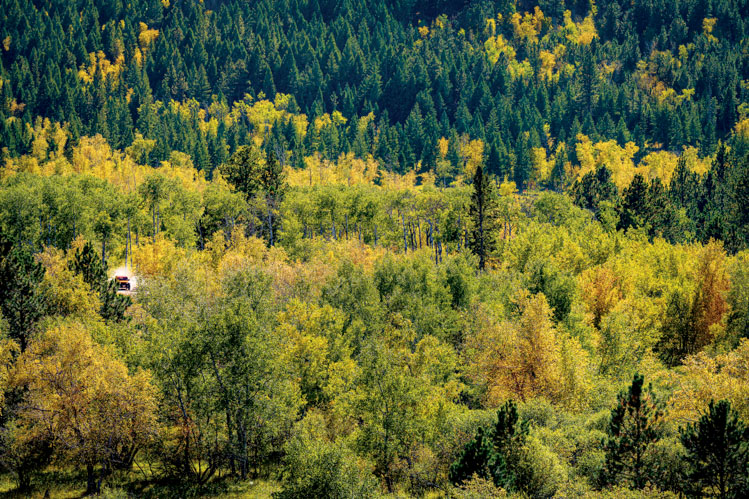
Drivers experience an autumn smorgasbord along Palmer Creek Road, which winds through thick aspen forests and broad meadows.

A SOLITARY COTTONWOOD tree on the lonesome prairie, when bejeweled with golden yellow leaves, emanates as much beauty as the human eye can absorb — especially when the sun slips southward, leaving the September sky bluer than blue.

Yet, who looks for a single tree in autumn? We tell ourselves we must see mountains and hillsides and river valleys with their forests full of leaves, each one hanging precariously by a stem, fluttering unworriedly as if winter was a thousand years away.

So yes, of course, go forth this autumn and fool yourself into believing that this glittering season is not just a cruel trick of chlorophyll. Life will always be so good. Calamity can never follow such serenity. South Dakota is paradise eternal.

Certain places in our big state are especially guilty of contributing to the delusions of autumn, beautiful though they may be. Traffic jams can occur on Highway 14 in Spearfish Canyon during peak leaf-peeking days. Sica Hollow’s oaks are almost as beguiling for people who live in the northeast. Our urban forests are resplendent in different ways because city parks and boulevards feature a gloriously unnatural mix of planned and planted trees. The McKennan Park neighborhood in Sioux Falls is an exceptional example.

We asked our chief photographer, Chad Coppess, if he knew of some lesser-known fall foliage tours. He suggested the three that follow. Interestingly, one that he chose is at South Dakota’s very lowest elevation while another is near the highest. Chad’s diplomatic third choice lies in between, along the Missouri River.

These routes won’t have bumper-to-bumper traffic in September and October when our leaves change color, but that is part of their allure. Autumn is even more striking when you escape the crowds.


PALMER CREEK

Pennington County

The graveled Palmer Creek Road is less than 4 miles long yet offers more than its weight in gold leaves between two spectacularly located campground resorts. Horse Thief Campground and Resort lies on the southwest end of the road and the Mount Rushmore KOA at Palmer Gulch Resort on the northeast. Both campgrounds have funky little stores that offer snacks and refreshments.

Midway along the road, an engineer had some fun by designing a double crisscrossing section with an over-under bridge and a cut through a rock that delivers a jaw-dropping view of Black Elk Peak no matter which way you are traveling. The road winds through beautiful aspen groves and, at times, offers a panoramic view of the entire gulch.

Little-known fact: Along the road is a parking area for Palmer Creek Trailhead, where you can trek to the top of Black Elk Peak (South Dakota’s highest point) and beyond.


PLATTE-WINNER BRIDGE

Gregory and Charles Mix counties

Those who prefer to venture off the interstates know that Highway 44, a main artery across the southern third of South Dakota, crosses the Missouri River via the Platte-Winner Bridge.

The stretch between Platte and Winner is 53 miles. The most scenic area features bluffs that drop into the river valley where you’ll discover two state recreation areas — Snake Creek on the east side and Buryanek on the west.

Lewis and Clark traveled here in 1804 and 1806, at one point losing a member of their party for several days. The Shannon Hiking Trail in Snake Creek Recreation Area commemorates the lost explorer and gives expansive views of the river and autumn colors.

Little-known fact: Unless you live in the neighborhood, you may not have heard that the mile-long Platte-Winner Bridge is about to be replaced. Construction on a new bridge may begin in 2025.


BIG STONE LAKE

Grant and Roberts counties

State Highway 109 runs up the South Dakota side of Big Stone Lake in the northeast corner of the state with a view across the lake into Minnesota. We recommend the 15-mile stretch from Big Stone City to Hartford Beach State Park with frequent stops at access points to the water. The route offers a variety of vegetation and colors for leaf peepers. Hartford Beach is one of the oldest South Dakota state parks and is popular with campers, boaters and fishermen. The log cabin trading post of Solomon Robar, along with Native American burial mounds and pioneer graves, are found along the hiking trails in the park.

Little-known fact: The shoreline of Big Stone Lake (elevation 965 feet) is the lowest spot in South Dakota.

Editor’s Note: This story is revised from the September/October 2023 issue of South Dakota Magazine. To order a copy or to subscribe, call (800) 456-5117.

Posted on Leave a comment

Stopping the Green Glacier

Cedar tree encroachment is becoming a problem in the Missouri River valley, choking out native species and reducing available forage for cattle.

WE STOOD HIGH ATOP a ridge on Rich and Sara Grim’s ranch in Gregory County. The Missouri River below looked like a wide blue ribbon stretching from horizon to horizon. A gentle northwest breeze made the afternoon’s 91 degrees feel like 75. Cattle stood on a point along the river munching prairie grass, surrounded by the remnants of a thick grove of cedar trees.

“My nemesis,” Sara Grim said as she grabbed the soft branch of a cedar and began picking at its prickly needles.

She’s not the only rancher who’s grown to despise these hardy trees. Landowners along the Missouri River — especially in the four south central counties of Gregory, Charles Mix, Lyman and Brule — have slowly watched valuable pastureland succumb to eastern redcedars, which have fruitfully multiplied for decades, marching steadily north from Texas, through Oklahoma, Kansas and Nebraska, and now South Dakota. Farmers and ranchers in those southern states have long fought a losing battle against cedars, but many experts see South Dakota as the cedar frontier, the place where maybe the encroachment can finally be stopped. But to do so, landowners are having to get out of their comfort zones and reclaim acres through a force we’ve all been taught to fear — fire.

*****

HOMESTEADERS WHO POPULATED the central Plains in the 1800s were awestruck by the lack of trees. But in ravines and other protected areas stood eastern redcedars. A member of the juniper family, eastern redcedars are native to much of the eastern United States. In poor soil, they may never grow larger than a bush, but under ideal conditions they can reach 30 or 40 feet.

Sara Grim has become a staunch supporter of prescribed burning to control cedar tree encroachment.

They are drought tolerant and among the most important windbreak species on the Plains, qualities that eventually made cedars ideal for planting in shelterbelts. They can also reproduce prolifically, thanks to the birds and other small animals that ingest the tiny blue berries that sprout from a cedar’s branches. Studies have shown that the seeds pass through a bird’s digestive tract in 30 minutes, leading trees to sprout near their parent trees or along fence lines where birds might perch. Years of unchecked reproduction have led to cedar groves with canopies so thick that no vegetation can grow beneath. That decrease in forage worries cattle ranchers.

Sean Kelly, a South Dakota State University Extension Range Management Field Specialist based in Winner, says that every 1 percent increase in tree cover leads to a 1 percent loss in forage production.”It’s just a slow green glacier moving north,” Kelly says.”You see one or two out there in your pasture, and then five years later it’s 15 or 20. Before you know it, you’re trying to catch up and stay ahead of the curve. It’s hard for a rancher to stay in business very long if all they have is cedar forest and no grazing opportunities. And it can really start to snowball. If you’re not adjusting your stocking rates accordingly, it starts to spiral.”

Landowners began to act in 2011 when Doug Feltman asked the Natural Resources Conservation Service to survey his ranch south of Chamberlain to determine the impact of cedar trees. Using a series of five photographs of a north facing slope taken between 1981 and 2011, researchers determined that an area that once supported 10 cows could now barely support three. Feltman’s productive potential had decreased 70 percent due to cedar encroachment.

The NRCS then looked at neighboring Gregory County. Through aerial photography, maps, GPS and field work, researchers confirmed that 30 percent of the county was covered with a heavy to medium encroachment of cedar trees, judging by average trunk diameters.

A survey of 109 Gregory County landowners revealed that 80 percent were concerned about cedar encroachment. It also indicated that they were interested in learning more about prescribed burning.”Fire is the most economical way of controlling cedars, especially if you don’t have thick encroachment yet,” Kelly says.”When it was Native Americans and buffalo out here, natural wildfires kept invasive species like this at bay. Without that element of fire, they’ve been able to take over and keep spreading. That’s why we’re trying to reintroduce prescribed fire.”

Members of the Mid-Missouri River Prescribed Burn Association create a fire line to help keep a burn under control.

After a series of meetings that began in the spring of 2012, the Mid-Missouri River Prescribed Burn Association (MMRPBA) was officially incorporated in 2016. The organization is landowner-driven and governed by a seven-member board, all of whom own land within its four-county coverage area. Integrating guidelines from several government agencies and university experts, the association established a lengthy and detailed protocol that dictates precisely when and how they will initiate a burn.

“It’s a 15-page burn plan,” says Kelly, who also serves as vice president of the MMRPBA.”On a new burn unit, it’s easily a yearlong process.”

Every burn begins with an initial meeting between one or two board members and the landowner, who also must join the association and attend a prescribed burn on another member’s property before receiving burn services on his or her ranch. The group conducts four or five field visits throughout the year to determine the severity of cedar encroachment and identify other factors that will affect a potential burn: Where can they create fire breaks? Is any shearing needed? Are there hazards, such as power lines? Can safe escape routes be planned?

Once those questions are answered, work begins on the ignition plan. They determine how large the crew should be and what equipment will be needed. If possible, they try to incorporate one or two other landowners to utilize natural fire breaks. If a burn is planned all the way to the river, they work with the Department of Game, Fish and Parks and the U.S. Army Corps of Engineers.

Then it’s a matter of waiting for the right weather. Kelly says they generally follow the 80-20-20 rule, which calls for temperatures no hotter than 80 degrees, at least 20 percent humidity and wind under 20 miles an hour. Those parameters mean that March, April and May are prime burning months, followed by a few opportunities in the fall.

After years of preparing, perfect weather arrived in April of 2016. The association was ready for its first prescribed burn on the Grim ranch.

*****

SARA GRIM WAS A girl on horseback, helping her father move cattle through the river breaks of the family ranch. When they came to a grove of cedars, she got off and led the horse through. That’s when a cedar branch caught on the saddle horn and broke the latigo.

“Now that’s a memory,” she laughs.”I haven’t thought about that in years. I don’t remember how he dealt with that. We had bad cedar trees back then and the cattle would get in them. It was hard to get them out; we had to crawl or lead the horse through. My father was noticing a problem with cedar trees, but nobody knew what to do. We all hoped it would just go away on its own, but it didn’t.”

An aerial photograph shows the darkened patches of the Grim ranch treated by prescribed burn in May of 2023.

Grim’s grandfather, William Sutton, arrived on this patch of land in 1929. He was working for the Yeoman Mutual Life Insurance Company, which had ended up with the ranch after its original owners, the Jackson brothers (also owners of the vast Mulehead Ranch), went under. Sutton came from Iowa and within a couple years purchased the ranch from the insurance company. His ranch brand became the Y-S, for Yeoman and Sutton.

When Grim’s father Billie Sutton, a popular local politician, died in a farm accident in 1982, Grim and her brother came home to help their mother manage the ranch. Eventually they decided to split it in half. Grim and her husband work about 3,600 acres of rough river break country mostly dedicated to cattle that have slowly seen their grass get choked out by cedars.

About 10 years ago, the Grims began working with David Steffen, a retired NRCS employee living in Burke, on a Conservation Stewardship Program that focused on grassland management. The program included the idea of cedar control through burning.

Grim was still working in the county treasurer’s office, where she spent 27 years.”One day, Dave came into the courthouse and said, ëSara, what are we going to do about this green glacier?'” she recalls. He had brought an overlay showing the cedar encroachment in Gregory County. The Grims had helped develop the county landowner survey along with Steffen and were interested in prescribed burning, so they got involved.

They quickly learned that education is paramount.”I’ve talked to so many people who are just unaware. They look at those trees growing in the river hills, and they think it’s beautiful, but there’s nothing growing underneath. There’s no grass, no feed, and we’re losing ground.”

The association identified a section of the Grim ranch and formulated a burn plan. The Grims participated in a few controlled burns with local fire departments to prepare.”They were small experimental burns, and we were scared out of our minds,” she says.”I didn’t sleep for a week. It was very scary. For years if anyone saw a fire you put it out.”

But when they dropped the match on that April day, the association was in complete control. Flames roared and smoke billowed high into the sky. When it was all over, 340 acres of thick cedar forest had burned. Just as importantly, the blaze sparked confidence in the volunteers who were learning to manage such a destructive force.”You have to respect it, but you don’t have to fear it like you used to,” Grim says.

*****

PETE BAUMAN HAS been helping people get comfortable with fire for nearly 25 years. When he began, the focus was on using fire to help manage land enrolled in the Conservation Reserve Program. After he started working for SDSU in 2012, his efforts shifted to working with multiple organizations on creating classes where landowners could be introduced to fire.

Cedars produce thousands of berries that are dispersed by birds and other animals.

“There was just this general idea that South Dakotans had a fear of fire,” Bauman says.”But over the years, it became very clear that people didn’t have a fear of fire, they had a disconnect with fire. There was no innate fear. It was more like we forgot how to understand it.”

Bauman says the prairie evolved with three things: fire, grazing and climate. Indigenous people recognized the value of fires and ignited them to stimulate the regrowth of native grasses that would, in turn, attract the great bison herds.”It’s nature’s wonderful reset button,” Bauman says.”Healthy prairies really are not damaged by fire at any time of the year because native plants come back. Fire stimulates native plant growth, it recycles nutrients, it definitely stimulates total production, seed production and seed viability. Pollinator plants thrive post-fire, which then creates insect habitat. They utilize that smorgasbord of nectar that’s been created. When that all functions well, you’ve got the foraging animals. Those benefits just build up the line. It’s when we throw exotic species into the mix that makes the timing of fire so much more important.”

He says the goals of fire today are to control, reduce or eliminate exotic species like brome, bluegrass, Canada thistle and sweet clover.”Now we have to look at fire as a specific tool that has to do with timing, intensity and duration, very much like grazing. We have to apply fire not as a hammer but sometimes as a scalpel and understand what the objective is of each individual fire, and that’s different than it would have been 250 years ago.”

For the past three years, landowners have received hands-on training at fire schools that Bauman has supervised throughout eastern South Dakota. Bauman serves as the”burn boss” while attendees assume other leadership roles that a prescribed burn would require.”The coolest thing about prescribed fire is we’re in control,” he says.”We don’t ever have to drop the match. From the moment we start to the moment we stop, it’s about control, control, control, which makes the fire the tool. The tail doesn’t wag the dog. Our mantra is that we want you to be bored on your fire. If you’re bored, your fire is doing exactly what it should do. We don’t want the amped up, excited chaos associated with fire response. We want clear thinking, well planned, well executed, boring fires.”

However, Bauman says a boring fire isn’t enough for cedar infestations.”What those folks need to do to save their ranches requires a higher level of risk and coordination and fire intensity,” Bauman says.”The schools that we do help lay the foundation for those folks to build their skills, because it’s a different kind of fire. If you have a boring fire trying to kill cedar trees, you’re probably not going to kill many trees.”

*****

WE SPENT TWO HOURS traversing the vast Grim ranch by UTV. The gray skeletons of cedars burned in that first fire in 2016 are finally beginning to fall. Charred trunks and trees that sport splashes of brown amongst the green branches show evidence of the 530-acre burn they held on their West River pasture in May of 2023.

Native plants such as snow-on-the-mountain have begun to re-emerge on patches of land treated by prescribed fire.

“Oh, look at that switchgrass,” Sara Grim said, stopping the side-by-side so we could examine the new shoots already emerging, just three months after their most recent burn. Big bluestem waved in the breeze. The white flowers of snow-on-the-mountain contrasted against the blackened trunks of cedars that will eventually topple over.

That spring burn had been planned for seven years. In the meantime, the MMRPBA has kept busy with other fires. The group burned 688 acres in 2017, 271 acres in 2018 and 314 acres in 2020. Covid, drought and other hiccups put a hold on burning for a few years, but in 2023 they rebounded by burning roughly 6,000 acres. There are 10,940 acres on the books for prescribed burning in 2024.

Grim’s ranch is very near the heart of South Dakota’s cedar encroachment, but Kelly says the spread is evident, especially along the Little White River in Todd and Mellette counties and the Cheyenne and James River valleys. Its leading edge seems to be along Interstate 90, where groups are already experimenting with prescribed burns and working to form burn associations.

Sheldon Fletcher, with the Lower Brule Sioux Tribe’s Environmental Protection Office, has begun holding meetings and oversaw a 30-acre prescribed burn after traveling to watch the MMRPBA in action. Rod Voss, a Rangeland Management Specialist for NRCS based out of Mitchell, has helped with two prescribed burns along the James River.”We’re at a stage here where it would be fairly easy to stop if we can just get our people educated,” Voss says.”A lot of people are recognizing the production impacts, but it’s a hard thing to educate people that a tree can be a bad thing. Out here on the prairie, people like their trees, but a tree in the wrong place is simply a weed.”

That’s something the ranchers of south central South Dakota know all too well. Kelly hopes people in other parts of the state begin to see the benefits of fighting with fire.”It’s not an easy sell, especially in some of these areas where the encroachment is just starting and they’re not really sure if it’s a problem that’s worth spending any time on yet,” he says.”I can understand that, but if you don’t believe me come down and take a look at Gregory County, because this is what you might look like in 40 or 50 years. We’ve got a real opportunity to stop it.”

If they succeed, then South Dakota can be something that Texas, Oklahoma, Kansas and Nebraska could not: the cedar’s final frontier.

Editor’s Note: This story is revised from the November/December 2023 issue of South Dakota Magazine. To order a copy or to subscribe, call (800) 456-5117.

Posted on Leave a comment

Christmas for White Swan

Chris and Shelly Saunsoci and their daughter, Chloe, stand by a dike that was built to hold back floodwaters at White Swan.

Lake Andes has receded slightly, but it is still at record levels and the surrounding land is soggy.”High water” marks are visible on many of White Swan’s structures, including an old stone shed near the pow wow grounds. Many homes, though still inhabited, are black with mold. Children and adults are suffering respiratory diseases, ringworm, impetigo and other infections and ailments associated with moldy conditions.

The original White Swan community was flooded when the U.S. Corps of Engineers finished Fort Randall Dam in 1952. It was in the bottomland forest on the east side of the Missouri River, just a few miles above old Fort Randall. Named after a Yankton chief who lived there in the 1860s, the community had a dance hall, stores, two churches, two cemeteries, a cannery, post office and ferry in the first half of the 20th century. The residents gardened, hunted, fished, raised livestock and generally lived off the land. They were not consulted on plans for the dam, and then forced from their homes by the BIA and Corps of Engineers.

Today’s White Swan community was rebuilt on the southern tip of Lake Andes. This year, Lake Andes suffered major flooding and White Swan was flooded once again. The water woes continued all summer and fall, and even today groundwater continues to plague the homes and buildings. “Our community is literally drowning,” said tribal leaders in August.

Shelly Saunsoci, a local woman, took on the responsibility of running a food kitchen so the White Swan people would at least have a hot meal and a safe, healthy place to eat and socialize. She was feeding about 100 people a day until mid-December, when children came home from boarding schools. Suddenly, she and three other volunteers were feeding more than 200.

Members of the YHS Humanitarian Club who helped at White Swan on Saturday included (from left) Kelsie Faulk, Cecilia Kouri, Aly Fedde, Josie Krajewski, Krystabelle Kosters and (center) Jon Syla.

“YOU SAVED OUR CHRISTMAS”

How Yankton came to the aid of White Swan

When Aly Fedde started the Humanitarian Club at Yankton High School, she could not have imagined how it would end up changing the holidays for families at White Swan, a flood-ravaged community near Lake Andes on the Yankton Sioux Reservation.

The club began to help the people of White Swan in November when they delivered 48 cases of drinking water and other supplies. They followed that up with a project to make bookmarks and collect books as gifts for the children. Several adult members of Yankton’s United Methodist Church got involved to help the teens, including retired physician Tom Gilmore of Utica, who provided OB/GYN services on the Yankton Sioux and Rosebud reservations for decades.

Gilmore and his wife Jane became acquainted with Shelly Saunsoci, a native of the reservation who has been running a food kitchen to provide nutrition for the families at White Swan.

“You delivered me,” grinned Saunsoci. It turns out, the retired doctor delivered many of the young adults in the area.

“You looked different then!” laughed Dr. Gilmore.

“So did you!” Saunsoci retorted.

Tom Gilmore (far left), a retired doctor, delivered Shelly Saunsoci (front, center) 43 years ago. They met again this month as the Gilmores and other Yankton area peoples rallied to help Saunsoci, who leads a food kitchen at flood-ravaged White Swan.

Laughter has resumed at White Swan, in part because of the connections that the community has made with the people of Yankton, many of whom were oblivious to the tiny community’s situation until the YHS Humanitarian Club began its outreach.

In mid-December, Saunsoci was worried what the Christmas season might bring for the children — especially those who would be coming home from boarding schools at Chamberlain and Flandreau. Would she have enough groceries for the food kitchen? Would there be any gifts for the young children?

When the Yankton teens, the Gilmores and others brought those concerns back to Yankton, the entrepreneurial nonprofit Onward Yankton volunteered to start a fund drive for food supplies. An online Go Fund Me page was created on Onward’s Facebook page. Local media spread the word, and within days people from near and far had donated over $7,000. Donations are still coming.

Lisa Ryken, chief volunteer at Yankton’s Toys for Tots, heard about the efforts and called to say that her organization had some surplus toys. She packed dolls, footballs, trucks and games for White Swan even as she and her team were still wrapping gifts for Yankton families.

Last Saturday, the Humanitarian Club members and other Yankton residents traveled to White Swan with the toys, other donated supplies and grocery funds. Then they spent the morning helping Saunsoci and others sack candy and peanuts as gifts for area families. After completing nearly a thousand sacks, the teens took a break and shot baskets in the White Swan community center gym, where Sansoci has been running a food kitchen for weeks.

Saunsoci, wearing a Santa Claus apron, watched the Yankton youth playing basketball and smiled.

“You saved our Christmas,” she said quietly.

No one knows what the New Year holds for White Swan. The houses are flood-damaged and moldy. Roads and other infrastructure are deteriorating from the flood waters and high ground water. Another wet spring would be a devastating blow.

But this week, the children are enjoying gifts and hearty meals and their parents and grandparents many find some peace in knowing that — thanks to a sequence of events that began with students in Yankton — they are not forgotten.

Eunice Penton and other White Swan residents have been busy sorting and wrapping toys delivered for the children of the community.

Posted on Leave a comment

Hunting Charles Mix Plums

Janine Kern’s family plum-making heritage is a sweet respite from her professional service on the South Dakota Supreme Court. She became the 49th justice in state history in November 2014.

As a 16-year-old living in Lake Andes I was only mildly interested in the conversations between my grandmother and my great aunts about the status of ripening plums on the river bottom in late August. There was much discussion about sending out my father to look for plum patches and whether various relatives should help in the hunt. In my teenage view this level of excitement wasn’t warranted for plum jam or any canning project for that matter.

Many years later I married a man named Greg and one of his many interests was canning. Once he traced a recipe for a jar of pickles he purchased at a roadside stand to the cook who was residing in a nursing home in western South Dakota. She was delighted to share the recipe.

Greg’s zest for canning turned my thoughts back to the beautiful plums available in shelterbelts, ditches, ravines and on the Missouri River bottom in Charles Mix County. So just as my grandmother had done 40 years earlier, I asked my father, Paul Kern, an avid outdoorsman, to scout for plum patches for future harvests.

Several years later talk turned to action, and we harvested a number of plum bushes in a shelterbelt on my parents’ land. We also scoured the ditches and river bottom looking for ripened plums while being mindful of the sharp branches on the bushes and keeping an eye out for rattlesnakes. I know several industrious souls who have no qualms about picking and canning a pickup-full, but we settled for two 5-gallon pails of the biggest, juiciest plums we could find.

Over the years I discovered that conditions must be perfect for a plentiful plum harvest — namely a gentle spring without hard frosts and rain throughout the summer. These conditions are hard to come by in southeastern South Dakota, which causes me to ration plum jam throughout the year, never knowing if there will be another crop of plums. Fortunately, my father noted, it is easier to find plums now than it was when he was growing up because fewer people are harvesting them.

I took the two 5-gallon buckets of plums back to our home in Rapid City to prepare the fruit. Although there are other methods, such as boiling the whole plum and removing the pits after, I enjoy pitting the plums one at a time with a paring knife then putting them on to boil. We wear cloth garden gloves to protect our hands and arms from the splattering plum sauce. The aroma of the boiling plums is almost intoxicating.

Depending on individual preferences one can make jelly, syrup or jam with the desired consistency. We prefer jam over jelly because we like to see pieces of the plum when spread on hot buttered toast on a cold winter morning.

I am a novice canner and greatly admire those who fill their pantries with the bounty of their gardens. The colorful glass jars provide not only nutrition but also the fond memory of summer. Canning recipes passed down through generations are part of our heritage as South Dakotans. Hopefully the younger generations can be drawn into the wonderful world of canning without a 30-year delay like my own.


Janine’s Family Jam

Pick large beautiful plums if you can find them. Pit one at a time. Refrigerate fruit if it won’t be immediately canned. Sprinkle stored fruit with lemon juice and stir. Can last three days in the refrigerator until you are ready to tackle the project.

When ready to can use a food processor to chop plums to desired consistency. Place 13 cups of plums in a large canning pot. Mix 1/2 cup sugar and 2 boxes of low sugar pectin in a separate bowl and then add to plums. Bring to a full boil. Add 8 1/2 cups sugar a few cups at a time while stirring. Return to a full rolling boil for exactly 1 minute. Remove plum mixture from heat.

In a large processing pot have your jars preheating. In a small saucepan simmer jar lids and rings in water. Fill jars to 1/8 inch from top with plum mixture. Return to processing pot and boil 10 minutes. Remove the jam and place on the counter to cool. Listen to the jar lids pop, assuring you have a good seal. Serves as a powerful pick me up on a cold winter day. Makes 8 pints.

Editor’s Note: This story is revised from the September/October 2015 issue of South Dakota Magazine. To order a copy or to subscribe, call (800) 456-5117.

Posted on Leave a comment

A South Dakota Christmas Story

In the 1930s, down-on-their-luck families sometimes lodged in county poor farms. Herschel and Hilda McKnight ran the Charles Mix County Home for the Poor in those years. It was housed in a four-story building that was once the Ward Academy in Academy, S.D., south of Mitchell. Before her death, Hilda shared her experiences with Marian Cramer, a Bryant farmwife and teacher who has written several articles for South Dakota Magazine.

Through our 30 years of publishing, we’ve often related Hilda’s story of a 14-year-old girl’s Christmas at the Home for the Poor. Here’s an abbreviated version.

Hilda said she always remembered the day that Carol arrived with her mother.”It was never easy to welcome people to a poor house. Herschel moved quickly to the door and opened it. He had a special way of putting people at ease.”

The McKnights strived to provide clothing so the kids wouldn’t look out-of-place at school. The mothers and two WPA seamstresses sewed and repaired donated clothing. Carol befriended the McKnights and offered to help in the laundry and sewing room as well. But one day in the fall she told Hilda,”I know how hard you and Mr. Mac worked to get us nice clothes. It really doesn’t matter, I guess. I have this lovely skirt and they still call us ‘poor house kids’ at school.”

Hilda gave Carol a hug, and to hide her tears she fussed with a missionary barrel that had just been delivered from a church in the East.”Let’s see what treasures we can find,” she said. Together, they laughed as they pulled out wool pants with the seat worn thin, a pair of long underwear with holes in the knees and elbows and other useless things. But way at the bottom, Carol pulled out a chiffon scarf. Though threadbare, it seemed lovely to her eyes.

“Would you like to keep it?” asked Hilda. Carol’s answer was to hold it closely and nod. The scarf was her doorway to dreams. She would sit on her bed and finger the soft chiffon. She was not in the Charles Mix County Home for the Poor. She was far away. She always neatly folded her scarf and put it away.

The holidays came in 1933 despite the dust. Hilda and the women baked cookies and decorated the poor house with paper chains. The county allowed one clothing gift for each resident, so the McKnights shopped carefully to make it worthwhile.

A few days before Christmas, Carol tapped on the McKnights’ door.”You have been so busy for all of us, but you won’t have any Christmas presents, any Christmas,” she said.

Hilda assured the girl that they would celebrate Christmas together as one big family.”You are all our family, Carol. We are happy.”

On Christmas morning, Carol hesitantly returned to the McKnights’ room. First, she approached Herschel.”I don’t have a present for you,” she said.”Just a hug.” Herschel was a big man, and he enfolded the slim girl in his arms.

Then Carol said,”Mrs. Mac, I have something for you.” She handed Hilda a box wrapped in paper, and watched like a hawk as she untied the string. Beneath the crackling paper was the girl’s chiffon scarf.

Hilda fought back tears as she fingered its softness.

“It’s all I have, Mrs. Mac,” Carol said.

Hilda told our writer that she treasured it forever:”The frayed chiffon scarf is forever my symbol of Christmas and a true gift of love.”

Posted on Leave a comment

Built on Fur

Phil Steckley and the Newhouse No. 6.

I remember clearly walking into a shed on Phil Steckley’s farm south of Geddes. We had traveled into Charles Mix County to do a story on the rich fur trading culture that had grown there over the last two centuries, and to find people still living it out.

Steckley had traps of all shapes and sizes hanging on the walls. The largest was a Newhouse No. 6 that he said he’d used to trap a bear during an excursion north into Canada and Alaska. When I asked what they’d done with it, Steckley looked as though I’d asked if the sky was blue.”Well,” he said, somewhat incredulously,”we ate him!”

The fur trade in Charles Mix County dates back more than 220 years. Jean Baptiste Trudeau became the first European to establish a permanent residence there in 1794 when he built a trading post called the Pawnee House along the Missouri River southwest of Wagner. The French Canadian had been the first schoolteacher in St. Louis when the Missouri Company chose him to lead an expedition up the Missouri River, make contact with Indian tribes and create an agency.

Lewis and Clark mentioned Pawnee House in their journals when they passed by during their 1804 expedition up the river. Fire destroyed the structure in 1817, but by then the fur culture was firmly entrenched in the area.

Some remnants of the fur trading hey day can still be found. The town of Geddes celebrates Fur Traders’ Days every summer, and guests can tour a trading post that Cuthbert Ducharme built in 1857. Ducharme, also known as Old Papineau, came from a fur trading family in Quebec. He worked for the American Fur Company and gained a reputation as a man who was prone to violence. It was said that a small cemetery outside the post was reserved for all the men Ducharme had killed.

Ilo Vanderboom sweeping the streets of Platte.

Old Paps’ roadhouse stands in the Geddes Historical Village, alongside an old WNAX gas station, a replica Lewis and Clark keelboat and the childhood home of former governor and senator Peter Norbeck. The legend of Papineau’s gold survives, as well. Ducharme apparently grew rich and gave his wife $50,000 in gold in case anything happened to him. She buried the money, but when she died in 1900 the location became a mystery. The legend says Ducharme drove himself insane trying to find the money. He suffered a breakdown and died at the state hospital in Yankton in 1903. Did the endless search for lost treasure lead to his demise, or what is simply the result of a hard life on the frontier?

Papineau’s trading post also served as the first post office in the new county of Charles Mix. Organization began in earnest in 1858 when Theophile Brughier, Charles Picotte and John B.S. Todd — a cousin of Mary Todd Lincoln who was stationed with the U.S. Army at Fort Randall, just across the Missouri River — grew the idea of opening the land to settlers. The region was already home to the Yankton Sioux Tribe, so the speculators took a delegation from Yankton to Washington, D.C., hoping to finalize a treaty. They met Charles Mix, a clerk in the Interior Department who had connections within the Bureau of Indian Affairs and in the administration. In return for his help navigating the treaty through Congress, the new county was named in Mix’s honor upon its creation in 1862.

Charles Mix is still home to the Yankton Sioux Reservation, which encompasses 262,000 acres in the southern half of the county. A monument north of Greenwood commemorates the Treaty of 1858, and the famed Yankton chief Struck by the Ree, who died at Greenwood in 1888, is buried just north of that marker. The town of Marty is home to Ihanktonwan Community College and the architecturally impressive St. Paul’s Church. Students built pews and railings for the grand, limestone chapel, completed in 1942. The church’s spire rises 167 feet, while traditional Indian colors and themes are woven throughout the stained glass windows, murals and ceiling artwork.

The gravesite of Struck by the Ree. Photo by Chad Coppess/S.D. Tourism.

Wagner, at just over 1,500 people, is the largest town in Charles Mix County. It’s especially known for its Labor Day celebration, a four-day gathering of fun, games, music and a grand parade down Highway 46. Lake Andes is the county seat, and the 5,600-acre national wildlife refuge east of town is home to a wide variety of wildlife.

Platte, in northern Charles Mix, is home to another 1,300 people. We visited during the summer of 2004 and one of the first faces we saw was Ilo Vanderboom’s. He created the popular Boom’s restaurants found in southeastern South Dakota, but they day we showed up in Platte he was piloting a street sweeper, intent on keeping his town clean. We found busy bakery, a movie theater and a baseball field where the Platte Killer Tomatoes (maybe the best nickname in all of South Dakota Amateur Baseball?) play their summertime games.

The fur trade isn’t as important to Charles Mix County as it once was, but perhaps an even bigger change came with the construction of Fort Randall Dam, one of six mainstem dams built along the Missouri River in the 1950s and 1960s. The town of Pickstown was created solely for the workers who toiled on the project from 1946 to 1956. When the dam was finally closed, it forever altered the Missouri River Valley. Historic towns like Wheeler were flooded, and the once wild river became a reservoir known as Lake Francis Case. That’s a good reminder to anyone planning to seek out Old Paps’ lost fur trading treasure to bring swimming trunks.

Editor’s Note: This is the 30th installment in an ongoing series featuring South Dakota’s 66 counties. Click here for previous articles.

Posted on Leave a comment

Eating Wild Cactus

Wild plants like the prickly pear cactus have served many purposes

Prickly pear cactus thrive in dry conditions on slopes and hills, like these yellow flowered cacti found along Highway 1804 near Fort Pierre. Photo by Chad Coppess/S.D. Tourism.

As a young boy Joe Delvaux spent school years with his mother in Yankton and summers with his father in Pickstown, a government town built in the 1950s to house the families of construction workers at Fort Randall Dam. But by the 1970s, Pickstown had dwindled from a high of 5,000 people to less than 100. It could be a solitary setting for a kid who was a”big city” implant.

Delvaux spent hot South Dakota summer afternoons roaming the sun-baked hills surrounding the Missouri River with two older brothers who pointed out plants and insects.”It became natural for me to notice vegetation and to look under rocks,” he says.”It was what we were about and who we were.”

Plants held less interest for Delvaux when he entered high school and later college. But in the summer of 2001, when the National Parks Service opened an office in Yankton, he took a position as a Seasonal Park Ranger.”We were given the freedom to connect an interest to the public and plants were my interest,” Delvaux says.”I got a small library of books to read and took them into the field with me to collect specimens.” He drove back roads and hiked meadows looking for buffaloberry, sumac, sage and chokecherry.

Photo by Stephen Gassman.

His research evolved into a park program called Cultural, Medicinal and Edible Plants along the Missouri River. Delvaux often tells his classes about how Meriwether Lewis was introduced to the benefits of chokecherry. During the 1804 expedition, Lewis became very ill with fever and diarrhea. He’d tried the medical treatments of his time, including bleeding, with no alleviation of the symptoms. But then he made some tea from the bark of the chokecherry. He felt so much better that he hiked several miles the next morning.

Prickly pear is among the edible plants that Delvaux brings for the class to sample. It can be found throughout South Dakota and most Western states. He harvests the cactus pads from plants in ditches by Pickstown, near places he wandered as a youth.

Kay Young says in her book Wild Seasons: Gathering and Cooking Wild Plants of the Great Plains that prickly pear cactus pads and ripe fruits are not poisonous — it’s the spines and glochids (barbed hairs) that pose a danger. She recommends handling the pads with tongs or pliers when washing and preparing them. She singes older pads over a flame to remove spines and glochids before cooking, but cooks young pads just as they are, removing the stickers once the pads have cooled.

Delvaux prepares the prickly cactus for his class by filleting the outer skin off the pads, rinsing away the gelatinous juice, patting the pads dry and then cutting them into bite-size pieces.”I’ve cooked it a couple of times — battered it and fried it, but I really prefer it raw and chilled,” Delvaux says.”Fried it tastes a little like fried green tomatoes.”


Cactus Salad

6 cups prickly pear cactus pads, cut into 1/2 inch squares
3 bunches green onion
7 tablespoons salt
1 jalapeno pepper, diced
2 medium plum tomatoes, diced
1/4 cup white onion, finely chopped
1/2 bunch cilantro, chopped
Juice of two Key limes
1/2 teaspoon Mexican oregano

In a medium stockpot, cover the pads with at least three inches of water. Add a bunch of green onions and two tablespoons salt and bring to a rolling boil. Let boil for 10 minutes. Remove from heat and pour into colander. Discard onions and rinse pads in cold water until cool. Repeat the boiling twice using the remaining green onions and four tablespoons salt. This will remove the slimy stuff from the cactus pads. You will now have half the amount you started with.

Mix diced pads, jalapeno, white onion, tomatoes, cilantro, lime juice, oregano and remaining teaspoon salt. Let stand 45 minutes for flavors to blend.

Recipe From I.M. Cowgirl Magazine

EDITOR’S NOTE — This story is revised from the July/Aug 2010 issue of South Dakota Magazine. To order this back issue or to subscribe, call 800-456-5117.

Posted on Leave a comment

Close Encounter at Choteau Creek


When I fell through thin ice into Choteau Creek, I thought deer hunting was over for the day. My only hope was to escape the icy water alive and retreat to home and hearth.

As I settled into the water, I instinctively raised the rifle over my head. Maybe I did it because I had read about outdoorsmen who were saved from drowning when their rifle or shotgun straddled a hole they had made in the ice.

My stupidity bothered me almost as much as the cold water. Any fool should know a creek with moving water might have thin ice. By good fortune, my accident occurred in a creek less than 15 feet wide and shallow enough that my feet hit bottom while my head was still above water, which I am sure is more pleasant than a full bath.

Still, hypothermia didn’t feel far away so I wasted no time in wading toward shore. The depth didn’t change much with the first step, but I was pleased that it became more shallow with the second and the third. I broke ice with the butt of my gun as I proceeded to shore … or should I say, to the icy wall.

The creek bank was so steep and slippery that repeated attempts to climb onto solid ground seemed futile. A rope would have been good. I looked at my rifle sling and decided it wouldn’t be much help to a cowboy catching a steer but it might be enough of a rope for me.

I took the sling off my Ruger and threw the rifle onto the bank. To add some length to my rope I took the belt off my pants. (You probably don’t know this, but it’s not easy taking a belt off wet trousers with cold fingers.) Finally, I connected the belt to the sling and my first cast at a close-by tree branch was successful. I pulled my frozen self onto the snow-covered bank.

I had propped myself up on my elbows and was wondering whether I could make it to the farmhouse a half-mile away when I heard a crash in the brush and looked up to see a big whitetail buck charging my way. He was less than 30 yards away and it seemed he was intent on running right over the top of me.

Maybe all this reads like a scene from an Indiana Jones adventure but I was a high school principal in Wagner at the time, and went hunting and fishing to get away from the routine stresses and strains of small town life. I had been looking forward to the East River deer season for weeks and my father and I spent opening day together, hunting Missouri River bottomland. We held out for bucks but all I saw were does, a two-pointer and coyotes.

The temperature dropped with the sun on that November Saturday afternoon and the stirring winds and ashen-grey sky suggested snow. Sure enough, I awoke Sunday to a foot of snow and a raging blizzard. Only a fanatical hunter would consider venturing out in such conditions. I pulled on my boots and stepped outdoors.

I knew of an abandoned farmstead northeast of town where a four-point buck often bedded down. Certainly he would seek shelter there in this storm. I didn’t plan to drag the deer back home in the minus 50 degree wind chills. I’d just field-dress him and hang him in one of the vacant buildings.

The half-mile hike into the wind was brutal but I knew it would ensure that I arrived ahead of my scent. There must have been 100 pheasants in the jungle of cedar, lilac, mulberry, honey-suckle and Russian olive that formed a perimeter on three sides of the farm place. The birds were reluctant to fly and they dodged behind or under the boughs. I’d never seen pheasants act like that.

After a thorough search, I realized the buck was not there so I returned home, with the wind. The storm howled all night and continued Monday. No school for this principal. The house across the road was nothing more than a fleeting mirage. The Dakota winds played eerie notes into the night on our home’s north rain gutter.

But, as with all prairie storms, it stopped as quickly as it had begun. The dead stillness was accented by bitter cold and starlit skies. County and township snowplows would start their rounds at daybreak but school was called off for Tuesday.

Thus it was that opening weekend of the deer season stretched into a fourth day for me.”What luck,” I thought to myself as I filled the pickup box with snow so that the added weight would keep my back wheels gripping as we headed for Choteau Creek. There was not the faintest whisper of a wind and the 15-degree temperature felt unseasonably warm. Against the white background of fresh snow, I expected to see deer everywhere. But after three hours of checking favorite whitetail haunts I hadn’t seen any.

A South Dakota blizzard will leave 10 feet of snow in protected areas while open areas will be relatively free, so I was able to walk over open prairie that separated the wooded bottoms from the giant bluffs that overlook the Missouri River.

I wondered whether ducks or geese were sitting on the river, and how much of the water was still free of ice, so I hiked to the bluff’s top, momentarily forgetting about my search for deer. From my high vantage point I soon discovered why I hadn’t found deer earlier. They were all gathered together in a cattail slough about 40 yards below me — maybe 50 in all.

Taking a shot was out of the question. There would be no practical way to retrieve the deer. More important, my license was for Charles Mix County and I was standing on the wrong side of Choteau Creek, in Bon Homme County. However, I figured the deer might work their way to the mouth of the creek and into fields of alfalfa stacks and corn piles where I had permission to hunt so I took a stand along the most likely route.

I waited for two hours … more than enough time to wonder whether I knew anything about deer and their habits. Finally, I begrudgingly worked my way back to my pickup in the yard of the Soukup family farm. I half-heartedly worked at slipping my rifle into its case when I caught some movement on a hill above the creek — a half-mile to the south. My naked eye told me it was a deer and reflected sunlight off an antler indicated it might be a big buck.

Fresh excitement came over me and I decided to walk down the Choteau Creek so I could hide as I advanced. Yes, I checked the firmness of the ice with my first few steps, but my worries were forgotten as I neared the spot where I thought the deer might have been.

I was looking for a place where I could climb onto solid ground when the ice broke. I thought my problems were over for the day as I finally crawled out of the cold water and prepared to rise up and hustle, as quickly as frozen legs would allow, toward the pickup.

That’s when the deer charged. I grabbed for my rifle when I realized he was going to run over the top of me. Much of the rifle was covered with snow. Would snow in the barrel cause the gun to rupture if I fired it? It’s funny how many questions enter your mind when you’re in a hurry.

I raised the rifle and held it at arm’s length with my right hand while supporting myself with my left elbow. The buck was close enough to detect his bad breath when I squeezed the trigger and a four-pointer tumbled, literally, at my feet. Soaked as I was, a warm feeling swept through my body. At the farmhouse, dry clothes and a warmed-over Thanksgiving dinner offered still more relief.

Was the buck the same one I had seen earlier? I don’t know. I didn’t retrace his steps. Did he see me lying in the snow? Was he going to intentionally run over the top of me? I don’t know that, either. I’m guessing he just happened to be running full-out. Perhaps he felt like running after being huddled down so long in the storm. Deer are like kids in that respect.

Editor’s Note: This story is revised from the Nov/Dec 1991 issue of South Dakota Magazine. To order a copy or to subscribe, call 800-456-5117.

Posted on Leave a comment

Better Living Through Berries

“Berries make better bodies,” according to Jeff & Jolene Stewart. Since 2008, they’ve been growing the aronia berry, a tart, dark purple superfruit loaded with antioxidants, on their ranch near Wagner.

Their healthy journey began in the bermed flower beds of their home in Idaho, where Jeff was employed with the Department of Agriculture.”Jeff noticed that on the top there were all these bushes that had these dark, deep purple berries,” Jolene said. A tag on one bush identified the fruits.”As we moved to South Dakota and Jeff worked more with specialty crops, we got interested in them. The more we learned about the health benefits, the more we decided that this was something we wanted to raise,” Jolene said.

Aronia berries are also called chokeberries — a name that can generate some confusion. Though they’re similar to chokecherries in taste, the two plants are only distantly related within the Rosaceae (rose) family. The scientific name for chokeberries is Aronia melanocarpa; the chokecherry is Prunus virginiana. Aronia leaves and seeds lack chokecherries’ cyanide content. For laypeople, it’s easy to tell the difference if you check the berries’ insides. Chokecherries have large pits in their centers, but aronia berries contain tiny seeds.

The Stewarts grow three varieties of pesticide and herbicide-free aronia berries at their ranch: Viking, McKenzie and Galicjanka, a new Polish cultivar, as well as Boer/Spanish cross goats. Harvest time usually falls over a three-week period in late August and early September. At first, they tried to harvest by hand, but with over 11 acres of berry bushes, that proved impractical. This year, a new berry harvester should make the task easier.

The Stewarts’ aronia berries are available at the farmers market in Wagner, Co-Op Natural Foods in Sioux Falls, and at the Stewarts’ home. It only takes 15 berries a day to see aronia’s health benefits. Though the astringent, mouth-puckering flavor can be off-putting at first, Jolene recommends giving them a try.”Experiment and you can find a way you like it. My favorite way is in smoothies. Jeff’s favorite is stir fry.” They also go well in salads, with yogurt or on cereal.”I put them in things that wouldn’t be considered quite as healthy,” Jolene says. She’s made aronia wine, brownies, apple crisp, jelly, cream puffs, French toast, cookies and more.”The one thing you have to get used to is a little purple color in things,” she says.

The health benefits of aronia berries make this experimentation worthwhile.”Aronia berries are packed with antioxidants, and studies indicated they promote colon health,” Jolene says. The Stewarts have noticed a drop in in their cholesterol levels since going on the berry. Others experience more dramatic results.”We have one friend who took an ounce of aronia juice every day for 2 or 3 months,” Jolene says.”When he went to see the doctor, his blood pressure was lower, PSA was down, cholesterol was down and he lost weight.” Those are powerful results from one little berry.

If you’d like to visit Stewart’s Aronia Acres, call 605-384-4443 or visit their Facebook page.


Jolene’s Aronia Smoothie

From Dakota Rural Action’s South Dakota Local Foods Directory, 2013-2014

Jolene encourages smoothie creativity. When her two sons were growing up, the daily family breakfast game was”What’s in the smoothie today?” She’s tried dates, pecans, walnut milk, zucchini and carrots with this basic recipe, with good results.

1 cup aronia berries
1 banana
1 apple, chopped
1/2 cup vanilla yogurt
1 cup peaches (canned or fresh)
1/2 cup juice (apple, peach, orange, etc.)
3/4 cup water with ice cubes

Place ingredients into a blender and blend until smooth. Adjust liquid/ice amounts to your personal preference and enjoy.