Posted on Leave a comment

The Good, the Bad and the Beautiful

Life on the Northern Plains is ever changing. One of my favorite times of the year is thunderstorm season. Generally speaking, it runs from late April through September, but I’ve seen lighting in February and experienced thunder snow in March. The best time, however, to watch a storm build across our Dakota skies is in June and early July.

Our neighbor on the farm lived all his life as a shepherd, rancher and sometimes farmer in both Dewey and Ziebach counties. He swore by what he called the”solstice storm.” Every year on or around the summer solstice we’d get a big thunder boomer. I remember one year it was late and we wondered if he was just pulling our leg about this phenomenon. Then on July 3, as we were in the front yard lighting off firecrackers, a low, menacing cloud raced in from the west. It brought wicked wind, rain and hail. After it had rolled through, the sides of our white house had mud high up on the walls. The storm’s fury had literally stirred up the elements.

Even so, that wasn’t even close to the worst our neighbor had witnessed during storm season. He told me he watched the virgin prairie transform into what looked like a plowed field when a behemoth storm produced large hail that was driven into the ground.

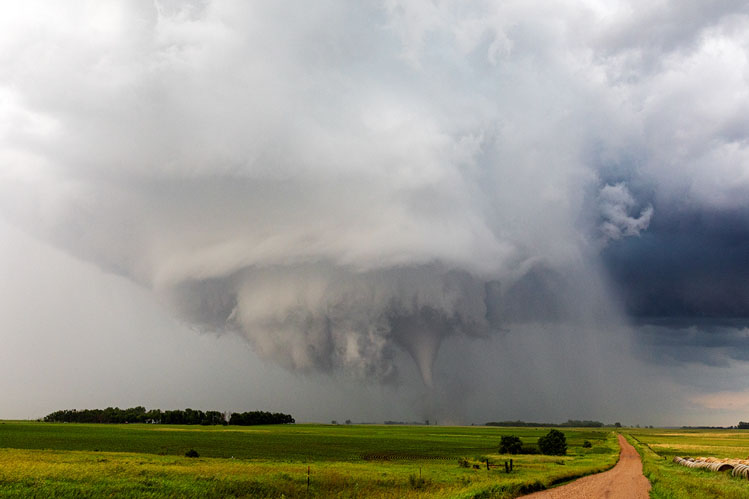
We didn’t get many tornadoes in that part of the country though. I had never seen a twister in real life until May 28, 2025. Not only did I watch my first tornado form and drop in rural Deuel County, but I saw a second one from the same system about an hour later head east toward Gary. That afternoon I was out looking for wildflowers as I slowly made my way north out of Sioux Falls. It was a little after 6 p.m. when I found myself looking up at a massive thunderhead building quickly west of 7-mile Fen Preserve. Not wanting to get hailed on, I checked the storm tracker on my phone and planned to flank the system to the south.

Avoiding the rain and hail shaft found me a few miles west-northwest of Clear Lake, but I had driven into a problem. Directly in front of me I saw a new cell developing with little rain but a lot of rotation in the clouds. It was unnerving and coming right at me. I quickly drove under it and beyond a few miles then turned around and watched the twister form. I don’t consider myself a storm chaser and am happy to watch bad weather from a distance. Therefore, my photos are not real close but feature the immense cloud formations. I do like getting the rainbows after a storm, and ironically enough, a shaft of sunlight hit the forming tornado cell prior to its touching the ground. I witnessed and photographed that unique convergence of wild weather.

Thankfully no lives were lost that day, even though there was some property damage. This column shows you the photos I took from that storm and then subsequent wildflowers and storm scenes into July. It is a beautiful irony that the prime wildflower beauty and delicateness on the prairie exist at the same time when such power and dread can descend from the skies.

Christian Begeman grew up in Isabel and now lives in Sioux Falls. When he’s not working at Midco he is often on the road photographing South Dakota’s prettiest spots. Follow Begeman on his blog.

Posted on Leave a comment

Getting to Know Deuel

Back in my newspapering days, a colleague and I used to rib each other about our home counties. I grew up in Hamlin and he was from Deuel. The phrase”God’s country” got thrown around a lot, and we both enjoyed bragging up our hometowns and sports teams. We don’t see each other as often these days, but when we do the subject still comes up — and we’re still equally as proud of our counties as we were then.

Now I concede nothing, but after nearly a decade of working at South Dakota Magazine, I’ve learned a lot more about Deuel County. And I have to give him credit. His home county has some pretty interesting stories.

One of his favorite summer pastimes is to camp out at the Crystal Springs rodeo, held every June northeast of Clear Lake. I’d always known about Crystal Springs, but I had no idea until I came to the magazine that one of the most popular rodeos in the Upper Midwest began as a farmer’s dream.

It goes all the way back to 1936, when E.W. Weisel bought the Crystal Springs Ranch in 1936. His property included a hill that formed a circular valley where he used to imagine what it might be like to hold a rodeo there. “I dreamed it,” he told us a few decades ago.”I dreamed it was all there, with horses and cattle and the people all laughing and having a good time.”

Hundreds of people showed up the first year, so he tore down the corn cribbing and put up a permanent corral. A Clear Lake banker gave him a loan and he put on a bigger show in 1946, and he installed lights the following year.

But he never built bleacher seats, and for good reason. The surrounding hillside makes a natural outdoor amphitheater. Weisel advertised it as “America’s Most Natural Rodeo Bowl.”

The Crystal Springs Rodeo is held in America’s most natural rodeo bowl northeast of Clear Lake. Photo by Christian Begeman

Today the Crystal Springs Rodeo spans three days with rodeo performances every night. The whole city of Clear Lake gets involved, staging a parade, car show, trail ride and pancake feed.

Another dream has come true in Gary, a small town that straddles the South Dakota-Minnesota line in southern Deuel County. After Gary lost county seat status to Clear Lake in 1895, Doane Robinson, publisher of the Gary Interstate and future state historian, began advocating for the state to build the South Dakota School for the Blind on property just north of the town’s business district. Ground was broken in 1899 and students were on campus in 1900.

The School for the Blind operated until 1961, when it was moved to Aberdeen. After 1980, the campus’ buildings were mostly abandoned. But then in 2009, wind energy entrepreneur Joe Kolbach transformed the campus into the Buffalo Ridge Resort and Business Center.

The buildings of the old School for the Blind in Gary have been transformed into a resort and business center.

Satisfied guests like the quiet setting, an atmosphere that feels like a bed and breakfast, a large patio set up for barbeques and 50 pretty acres. Kolbach resuscitated Lake Elsie, which is a damming of Lac Qui Parle Creek. Guests can feel the history in the stately buildings, especially in the web of tunnels that visually impaired students once walked daily between buildings.

On a given day, the campus could see vacationers checked into some of the resort’s 19 guest rooms, along with students training across the yard (or through the tunnels) at the administration/classroom building. Meanwhile a meeting could be underway in the former school auditorium, now called the ballroom, and an outdoor wedding could be happening alongside Lake Elsie.

Guests interested in history can hike a mile west of town to place locals call Indian Lookout. A giant compass made of rocks sits on a grassy hillside. Dakota elder Elden Lawrence believed the rocks were placed there in the 1860s to guide Indians traveling from the Sisseton area to Pipestone, where they quarried native stone to make sacred pipes.

Lake Elsie, formed by damming Lac Qui Parle Creek, was restored along with the School for the Blind campus.

Deuel County is home to other legends as well, such as the blue flags that grow each spring in a region called the Hidewood. Floyd Haug discovered the flowers when he rented the land, and later discovered that they mark the graves of two pioneers.

A Norwegian settler named Per Gustav Erikson and his wife, Ida Mary originally homesteaded the land. In the early 1880s they had a baby daughter. But during the winter of 1885-86, a diphtheria outbreak struck the territory and both Ida Mary and the daughter died. Because the snow was so deep and the ground frozen, their bodies were placed in two wooden boxes built by a neighbor.

The grieving young settler kept the rough-hewn coffins in a shed until spring, when he dug two graves just to the south of his house and buried them above the Hidewood Valley. He probably had no money for a permanent marker, and instead planted blue flag flowers. That same year, he sold his claim for $300 to Peter Dahl and left Dakota Territory.

Now, almost 130 years later, the flowers still mark the simple graves. Prairie grasses have infiltrated the flowers, but the blue flags still grow thick and in the obvious rectangular shape of a grave.

Other stories aren’t as sad. Several years ago, Lowell Anderson wrote an article for us about Herman Raschke, a man he called the Goodwin Giant.

Born in 1896, Raschke lived with his brother and a sister in a clapboard house overlooking Round Lake in northern Deuel County.”I was always told that Herman stood 6 feet, 10 inches tall, and weighed 425 pounds,” he wrote.”My father claimed he weighed himself on the grain elevator’s truck scale.

One of Anderson’s favorite stories about the giant involved a traveling salesman who was driving along the Grant-Deuel county line one spring, not far from the Raschke house. His car became stuck in the soft road, and he walked to the Raschke house for help. When he knocked on the door and saw Raschke, a good 14 or 15 inches taller than he was, the salesman was taken aback.

A natural spring near Astoria has been gushing fresh water for decades.

“I’m stuck out on the road. I need help,” he said.”Would you possibly have a team of horses to pull me out?”

“Let’s go take a look,” said Herman.

“You don’t need to look. I’m stuck. For sure. The wheels don’t even touch the ground!”

“Let’s go check it out.”

The salesman didn’t argue. He followed as Herman walked directly across a plowed field, through an accumulation of spring mud, towards the road and the car.

“See, I’m really stuck,” said the salesman.

“Oh, it doesn’t look so bad,” said Herman.

And then, Raschke put his hands under the front bumper, lifted the front end of the car out of the ruts, and gently lowered it onto solid ground. He did the same to the rear of the car. The salesman was speechless.

I’ve also learned about unique traditions, including stopping your car along Highway 28 to fill jugs with water gushing from Jorstad Spring, 2 miles northwest of Astoria. Decades ago, someone stuck a pipe into the creek, and ever since — even through the dry years of the Depression — pure water gushed out from a shallow aquifer.

Another tradition is only recently discovered is the annual oyster stew feed at the Bemis Holland Presbyterian Church. The feed is featured in our September/October 2016 issue, and is coming up this Saturday, October 15. It’s been a harvest tradition for nearly 130 years, and even though numbers at the rural church continue to dwindle, oyster stew night is one of the busiest of the year.

Despite our history of good-natured banter, I’ve always enjoyed my trips to Deuel County (even though I still haven’t completely figured out that outrageously downhill par 3 at the Clear Lake Golf Course). Maybe”God’s country” knows no county lines.

Editor’s Note: This is the 29th installment in an ongoing series featuring South Dakota’s 66 counties. Click here for previous articles.

Posted on Leave a comment

A Cowboy’s Dream

Editor’s Note: We attended the Crystal Springs Ranch Rodeo in Clear Lake in the summer of 1988 and met E.W. Weisel, the cowboy who made his rodeo dream come true. This year’s rodeo takes place June 23-26, so we thought we’d share the story of how it all began.

No sport attracts more fun-loving folks in South Dakota than rodeo, and one of the granddaddies of them all, the Crystal Springs Ranch Rodeo, is among the best.

Clowns and trick ropers. Flag bearers and guitar players. Fans wearing 10-gallon hats and hawkers of pink cotton candy. Young cowboys wrapping last week’s bruises and old cowboys watching wistfully. Barrel-racing girls and wranglers herding stock.

That’s what we saw at Crystal Springs this summer — an Old West tradition that continues to capture the fancy of people everywhere.

Rodeo is a romantic reminder of the “rawhide and ride-hard” days of the Old West. Although nobody knows the identity of the dupe who first climbed aboard a Brahma bull, all the other rodeo competition grew out of routine chores on Western ranches. Cowhands balanced atop bucking broncs because they needed transportation. They roped and wrestled calves because it was their job.

Boys being boys, it was only a matter of time before they began to pit their skills against one another. Friendly competitions to see who could ride the ranch’s wildest critter were often accompanied by wagers and a smattering of onlookers.

Before long, the big ranches held rodeos as a uniquely Western festivity. Food, dancing and music were usually included. By the 1920s, the Rodeo Association of America was formed and today the Professional Rodeo Cowboys Association (PRCA) rides herd on a professional sport that in 2012 paid almost $40 million in prize money on several circuits and tours.

PRCA was organized in 1945 as the Cowboy’s Turtle Association to protect the interests of cowboys and ensure fair prize money. That was the same year that a South Dakota rancher drained a duck pond in his hilly and rocky pasture near Clear Lake, put up a corn-cribbing fence, and held a rodeo on a Sunday afternoon.

“I’m just a cowboy who had a dream,” says E.W. Weisel, “And I made that dream come true.”

Weisel bought the Crystal Springs Ranch in 1936 and more than once he sat on horseback atop a hill that formed a circular valley and imagined what it might be like to hold a rodeo there. “I dreamed it,” he said.”I dreamed it was all there, with horses and cattle and the people all laughing and having a good time.”

Hundreds of people showed up on that first Sunday, so he tore down the corn cribbing and put up a permanent corral. A Clear Lake banker gave him a loan and he put on a bigger show in 1946. By 1947, he had lights in the natural arena.

But he never built bleacher seats, and for good reason. The surrounding hillside makes a natural outdoor amphitheater. Every clump of grass provides a great view of the action below.

A promoter from the old school, Weisel advertised it as “America’s Most Natural Rodeo Bowl.” He never apologized for the bumpy gravel and dirt roads that still lead to the site. Instead, he turned it to an advantage, calling it “Where the Pavement Ends and the West Begins.”

For 25 years, Weisel and his wife, Josephine, ran the rodeo along with the help of their daughter, Cleo, and veteran ranch hands like Two Gun Kelly and Little Joe the Wrangler.

“Everybody said I was crazy when we started,” recalls Weisel, who at age 90 has never missed a performance. At the last event, he sat high on the hill in a lawn chair, joshing with friends and watching each bronc bolt from the chutes.

He laughs at the doubters who thought he’d better stick to raising Herefords and horses. “It worked. We ran it 25 years and never went in the red once.” Not one to fiddle with balance sheets, Weisel can look over the hillside during the performance and determine success or failure. “See that over there,” he says, “there’s too much grass showing over there. There’s not enough people. That should be solid people.”

The Weisels entertained as many as 20,000 fans during the three-day competition in their best years. However, when they sold the ranch and rodeo operation and retired it slipped in attendance. There have been four owners since him, but now the rodeo is back in local control.

Realizing the importance of the event to the town, a group of 10 Clear Lake businessmen and ranchers assumed responsibility for the event four years ago and it is coming back faster than a coughing calf on penicillin.

“The guy that bought the ranch several years ago was no longer interested in running the rodeo,” explains newspaper publisher Gary Dejong, one of the 10. “It has been such a fine tradition for the community that we really hated to see it stop, so a group of us got together to keep it going.”

Dejong says more than 5,000 people attend the three-day rodeo in an average year, coming from as far away as Minnesota’s Twin Cities. Although the rodeo grounds are a few miles out of town, the community buzzes with activity during rodeo week, culminating with a gala parade through main street on Saturday.

The newspaperman says there’s more to putting on a rodeo than most people think. Though the duck pond has already been drained, it’s a big job to attend to the details of publicity, grounds keeping, ticket sales and concessions. The biggest challenge — and the task at which E.W. Weisel excelled — is putting together an entertaining show.

The community of Clear Lake has gotten involved. The weekend now features a carnival, car show and parade down Main Street on Saturday afternoon. Bullfighters, clowns, guitar-pickers, a mellow-voiced announcer, and hillsides full of people complete the cast.

A cowboy’s dream lives on.

Editor’s Note: This story is revised from the September/October 1988 issue of South Dakota Magazine. To order a copy or to subscribe, call (800) 456-5117.