Posted on Leave a comment

The Good, the Bad and the Beautiful

Life on the Northern Plains is ever changing. One of my favorite times of the year is thunderstorm season. Generally speaking, it runs from late April through September, but I’ve seen lighting in February and experienced thunder snow in March. The best time, however, to watch a storm build across our Dakota skies is in June and early July.

Our neighbor on the farm lived all his life as a shepherd, rancher and sometimes farmer in both Dewey and Ziebach counties. He swore by what he called the”solstice storm.” Every year on or around the summer solstice we’d get a big thunder boomer. I remember one year it was late and we wondered if he was just pulling our leg about this phenomenon. Then on July 3, as we were in the front yard lighting off firecrackers, a low, menacing cloud raced in from the west. It brought wicked wind, rain and hail. After it had rolled through, the sides of our white house had mud high up on the walls. The storm’s fury had literally stirred up the elements.

Even so, that wasn’t even close to the worst our neighbor had witnessed during storm season. He told me he watched the virgin prairie transform into what looked like a plowed field when a behemoth storm produced large hail that was driven into the ground.

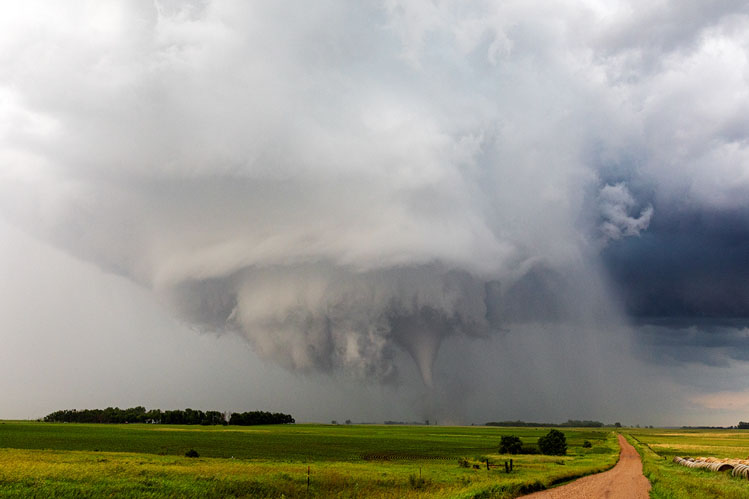
We didn’t get many tornadoes in that part of the country though. I had never seen a twister in real life until May 28, 2025. Not only did I watch my first tornado form and drop in rural Deuel County, but I saw a second one from the same system about an hour later head east toward Gary. That afternoon I was out looking for wildflowers as I slowly made my way north out of Sioux Falls. It was a little after 6 p.m. when I found myself looking up at a massive thunderhead building quickly west of 7-mile Fen Preserve. Not wanting to get hailed on, I checked the storm tracker on my phone and planned to flank the system to the south.

Avoiding the rain and hail shaft found me a few miles west-northwest of Clear Lake, but I had driven into a problem. Directly in front of me I saw a new cell developing with little rain but a lot of rotation in the clouds. It was unnerving and coming right at me. I quickly drove under it and beyond a few miles then turned around and watched the twister form. I don’t consider myself a storm chaser and am happy to watch bad weather from a distance. Therefore, my photos are not real close but feature the immense cloud formations. I do like getting the rainbows after a storm, and ironically enough, a shaft of sunlight hit the forming tornado cell prior to its touching the ground. I witnessed and photographed that unique convergence of wild weather.

Thankfully no lives were lost that day, even though there was some property damage. This column shows you the photos I took from that storm and then subsequent wildflowers and storm scenes into July. It is a beautiful irony that the prime wildflower beauty and delicateness on the prairie exist at the same time when such power and dread can descend from the skies.

Christian Begeman grew up in Isabel and now lives in Sioux Falls. When he’s not working at Midco he is often on the road photographing South Dakota’s prettiest spots. Follow Begeman on his blog.

Posted on Leave a comment

The Thrill of the Chase

Watertown’s Alex Resel is happiest chasing storms across South Dakota.

Alex Resel’s passions are photography and severe weather, and they intertwine perfectly from late spring to early fall. Though he is only three years out of college, the Watertown storm chaser has already driven tens of thousands of miles in pursuit of thunderstorms, tornadoes, derechos and all manner of nasty weather, returning with beautiful photographs that often belie the dangers.

He’s quickly learned the ins and outs of chasing, such as what to look for on radar and where to safely position himself, but it wasn’t that long ago that his interests in storms and photography were just blossoming. On a humid Father’s Day in 2012, storms rolled into Watertown, bringing heavy hail and setting off the city’s tornado sirens.”Until that point, I had no interest in weather, but something clicked after that storm,” says Resel, who was 12 at the time.”From there, I would draw maps of South Dakota and look at the local weather forecast and do my own weather map forecasting.”

His first”chase” came three years later, when his dad drove him 30 miles north to Summit after seeing a forecast from the National Weather Service’s Aberdeen bureau. Storms were set to fire northwest of the little Roberts County town.”We sat there for probably an hour, just watching them move in. Eventually they merged into a line and drifted toward Watertown.”

Any photos taken that day were captured with a smartphone, but in 2016 he got his first digital camera. He spent the next few years practicing landscape and storm photography and earned a business degree with an emphasis in photography and media from Lake Area Technical College in 2021.

A supercell over Clark.

Resel launched Outer Shots Photography, where he offers prints of landscapes, the Northern lights and the severe weather that he’s been chasing in earnest since the summer of 2020. The makings for strong storms were present west of the Missouri River on June 6, so he headed to the Badlands on his first solo chase.

“It looked like a couple cells could fire, but it didn’t happen because of an ingredient called cap, which prevents storms from growing,” he says.”It’s like putting a lid on a boiling pot of water. I thought the day was over, so I went to the Badlands to hike around for a couple hours and then head home. But I noticed dark clouds were coming in from the south and west, so I decided to wait and see what was going on. A big line of storms started moving in from Nebraska and Wyoming. It developed a beautiful shelf cloud and packed a lot of winds. I watched it move in from one of the overlooks. I was looking south, and as the line was moving overhead a tornado formed right in front of me in the Badlands. That was my first tornado, and it was a really cool thing to see.”

Resel plans his routes based on weather models and utilizes a weather app on his phone, which stays mounted to his windshield.”I’m looking for moisture, instability, lift and shear,” he says.”If all of those ingredients are in place, it’s usually a good sign that you’re going to get some organized severe storms. If multiple storm cells are firing at the same time, I look at which one is the tallest. Usually that’s going to be the dominant storm. Hopefully I’ve picked the right storm so I can get the shots I need.”

A lightning storm over Watertown.

That doesn’t always happen. South Dakotans likely remember where they were on May 12, 2022, the day an unusual and violent derecho raced across the state at 50 to 70 mph, packing straight line winds of 60 to 100 mph, the equivalent of a Category 1 hurricane. Resel noticed a localized enhanced tornado risk forming near Redfield, so he headed to Spink County.”Big cumulus clouds started to form, which is a good sign that storm activity is brewing, but as soon as they bloomed the derecho moved through and they disappeared. We didn’t get any storms to mature.” At the same time, he heard concerning reports closer to Watertown, including the tornado that caused extensive damage in Castlewood.”It’s a scary feeling being away from home and not knowing what’s going on.”

To help assuage those same feelings in others, he regularly reports what he sees to the National Weather Service, either by calling an office directly or through social media. Chasing severe weather can provide an adrenaline rush unequalled in other endeavors, but chasers are generally not simply reckless thrill seekers. There’s an important public service component to their work.

Peter Rogers, the warning coordination meteorologist with the National Weather Service’s Sioux Falls bureau, says information received from storm chasers and spotters can be crucial.”We have a lot of complex technology at our fingertips that helps us determine what’s going on, the radar probably being the most important,” Rogers says.”But there are still limitations to that, and there’s nothing better than having eyes and ears on ground watching what’s happening. From the Weather Service perspective, it’s all about the protection of life and property, and all the information that comes from chasers and other spotters is critical information to accomplish that mission.”

Storms that moved from Huron into northwest Iowa in the summer of 2022 turned the skies near Sioux Falls an eerie green. “It was the meanest looking storm I’ve ever seen,” Resel said.

Resel attends the NWS’s yearly severe weather awareness classes, which are offered in the spring. Meteorologists begin with basic terminology, such as the differences between watches and warnings, and then discuss weather in more detail, including how to identify supercell thunderstorms that could produce tornadoes and multicell storms that can cause other hazards. The classes emphasize safety, but Resel also uses the information to help identify the best position for photographing storms.”You’ve got to be on the southeast side of a storm. That’s where you get updraft and it’s where the photogenic parts of the storm are. That also keeps you safe from a tornado or large hail.”

Dangerous situations can still arise. Resel was in a caravan of storm chasers following severe weather in Colorado in August of 2023 when a tornado developed.”It wasn’t on the ground yet, so I felt comfortable, and I knew where to go to get out of its path. As the backside of those tornadic winds wrapped around it picked up rocks and broke out my back windshield. That ended my chase. I did get to see the tornado develop in front of me, but I got out of there as soon as I could to prevent any further damage. That was my first mistake in storm chasing, but luckily it only cost me a back windshield.”

Moments like that are learning opportunities, and not likely to quell the excitement that comes from storm chasing.”Watching the atmosphere work its magic and to have that unfold right in front of you is an amazing experience,” Resel says.”It’s not one that many people know. Each time is different, but you get those same feelings.”

Looking at his photos, you can almost feel it, too.

Editor’s Note: This story is revised from the May/June 2024 issue of South Dakota Magazine. To order a copy or to subscribe, call (800) 456-5117.

Posted on Leave a comment

Scars from the Sky

A lightning strike beyond the Badlands. Photo by Greg Latza.

As a little girl, my great-grandmother found lightning terrifying. She saw plenty of it growing up in the Mississippi River Valley, but not the bolt that seemingly came from nowhere and slammed her to the ground.

She was 12 then and survived, obviously. I wouldn’t be here to tell her story if she hadn’t. Strangely, this girl with a lightning phobia never feared it again after that day and was, in fact, somewhat lackadaisical about it.

On second thought, maybe that isn’t so strange, because encounters with lightning often change people. I heard my great-grandmother’s descendants speculate that perhaps she had a near-death experience that changed her view of life. Or maybe she took the old adage about lightning never striking twice literally. A psychologist friend of mine theorized that before being struck, she considered lightning certain death. Understanding that it wasn’t necessarily so was enough to dissolve her phobia.

Between 75 and 80 percent of people struck by lightning survive, as does the majority of livestock, though that’s harder to measure. An examination of our forests proves that thousands of trees live through

lightning, too — some multiple times across decades. Gary Say, a retired Forest Service forester who fought wildfires across the west for 30 years, says the percentage of trees struck by lightning that burst into flame is only about 1 percent.

The lightning I’ve known in South Dakota is every bit as intimidating (or impressive, depending on your point of view) as the strikes my great-grandmother saw generated by Mississippi Valley summer storms. Florida is the number one state for lightning strikes, but next are the states comprising Tornado Alley, right up the center of the nation. On open South Dakota prairies, you can watch as a lightning storm brews miles away. You can monitor whether it’s coming toward you or moving a different direction and calculate its distance by counting seconds between a flash and the sound of thunder reaching your ears.

One night in Stanley County, I watched two big storms collide. Wind forced me to pull my car off the road far from any shelter, and I sat in awe watching lightning hit the ground 360 degrees around me, more strikes per minute than I could count. How close? The storm wasn’t exactly on top of me, but it proved pointless to count the seconds whenever a big bolt hit. After half an hour the show was suddenly over and a calm, cool night followed.

It’s no wonder, I thought, that Crazy Horse — who knew these prairies and their seasonal moods well — saw lightning as symbolizing his own mighty power.

Long vertical splits are telltale signs that a tree has been struck by lightning.

The most terrifying South Dakota lightning is experienced in a boat on the Missouri River or a big lake in the northeast. The most consistently spectacular, it can be argued, is found in the Black Hills. Thunderstorm researcher Tom Warner, a native Californian who made Rapid City his observation base after Air Force service, says that the Hills see more positive cloud-to-ground lightning than most places, typically producing strikes of longer duration and carrying greater charge. Thunder that reverberates down canyons may sound as if lightning is bouncing off granite pinnacles and limestone cliffs, but Warner notes that those geological features are only rarely hit. Man-made targets like fire lookouts, tall buildings and cell phone and wind turbine towers trigger more lightning than rocky peaks.

The Black Hills can offer a false sense of security. If you’re in a canyon and the sky above is blue, you’ll never guess it’s black and menacing just beyond the rim and moving your way. And when lightning develops in a canyon, it’s easy to think,”How could it possibly find me under the cliffs and hidden among trees?”

That’s what Black Hills people asked about Gage McSpadden, struck and killed while playing disc golf on a course tucked into the mouth of Spearfish Canyon in July of 2015. A well-known cross-country and track athlete at Black Hills State University, his death generated lots of press and was listed as one of 28 lightning fatalities in the United States that year. Press accounts reminded readers that not all lightning strikes are direct. It seemed the bolt that killed McSpadden (and seriously injured a companion) first hit a metal disc cage and expanded outward as the men approached.

Ken Sargent, originally from Martin and now living in Denver, doesn’t know whether he took a direct or indirect hit near Mount Rushmore on July 20, 1985. He can’t recall the strike itself and has relied on the account of a friend who was present in recreating the scene. She waited in a car as Sargent completed a non-technical rock climb. He descended the granite and was cooling off before getting into the car. The day was overcast but there had been no thunder or lightning.

“I was fooling around and I picked up a pine cone, pretended it was a grenade and that I was pulling the pin,” Sargent says.”Then I threw it at the car.”

Boom!

Lightning hit,”but my friend thought I was still fooling,” Sargent continues.”I got to the car and was saying, ‘My bones ache! My God, they ache so much!'”

He climbed into the driver’s seat, started the engine, and promptly drove into the ditch. At that point the friend took over; there’s no doubt she saved his life. She drove Sargent to medical assistance in the days before 911, and then he was loaded into an ambulance and rushed to Rapid City Regional Hospital. On the way, his heart and breathing ceased three times.

Sargent survived, but the adventure sapped his strength.”I was a young guy, early 20s, fit, always riding a mountain bike up Spearfish Canyon,” he says.”Then, all of a sudden, I’m turning into an old man.”

A neurologist advised Sargent that coming back would be a long road.”It took me months,” Sargent says. Cycling and therapy in a pool helped his body return to normal, but what happened to him emotionally and spiritually is permanent.

“After you die, like I did in the ambulance, you’re always aware of how fast everything in life can change,” Sargent explains.”And it was more than that. I thought about what’s beyond this life, about the eternal. I began to reconcile my life as I had lived it with how I should live it. I’ve been a good person ever since.”

Tom Kuck has never been struck by lightning, but he came close enough to understand how the experience changes survivors. He owns land in the Black Hills at Moon — one of the best spots on the continent to observe lightning.”We’re on top of the western edge of the Black Hills, 2,000 feet above Newcastle, Wyoming,” says Kuck, a retired wildlife biologist who lives most of the year in Aberdeen.”We can see storms develop and move across the Wyoming plains and it seems like they intensify when they hit the edge of the Hills.”

Ton Kuck’s cabin on the western edge of the Black Hills lies within a lightning hot spot.

“He’s right,” confirms Bob Riggio, who has monitored South Dakota weather for almost 50 years, many of those as a meteorologist at Rapid City television station KNBN.”The Black Hills provide extra updraft as storms move in, coming usually from the west. Updrafts are how thunderstorms get their energy. Often, although not always, these storms start dying as they go into a downdraft on the eastern side of the Hills.”

One day in early summer 2009, Kuck drove six and a half hours from Aberdeen to his cabin at Moon. He decided to mow, knowing rainy weather was approaching. But it didn’t seem imminent.

“I was on the lawn mower and there was a flash and a kaboom at the same time,” he recalls.”It was like a bomb going off above me and it took my breath away. I could taste and smell something like sulphur, and my hair stood straight out.”

The next day he found the pine that had been hit, about 50 yards from where he had been mowing. That’s a long pass in football, but too close for comfort in a lightning storm. Kuck hadn’t given much thought to lightning in all his years in the field as a biologist, but that changed after he witnessed the incredible power up close.

“I’m much more aware,” Kuck says.”Now, when it starts to rumble, I take cover.”

The tree that was hit didn’t burn and wasn’t split open. But Kuck quickly knew it was dead, apparently killed instantly. Needles dropped and no parts of the tree showed signs of life again.

Three years after his close call on the mower, Kuck was asked by the state forester if he would like trees on his property inspected for pine beetles so that afflicted ones could be sprayed to slow the bugs’ spread. Kuck said yes, and during the inspection noticed far more evidence of past lightning strikes than beetle infestations.

“If you count all the trees on my property, most are lightning survivors,” Kuck says. The most common scarring is a telltale vertical split in the bark, often blackened, and sometimes extending to the ground.

Thirty-five years ago, one of Kuck’s trees was split far deeper than the bark.”It was opened up but has been healing and is closed again now,” he says.”Thirty-five years and lightning still hasn’t killed it.”

Lightning isn’t going anywhere. There’s never been a”warp speed” plan for eradicating it, and if we could, would we want to? In some remote areas of the world, fires caused by lightning every few years are the only way certain forests can regenerate. In America, lightning is deeply ingrained in our culture — from tales of Crazy Horse and Benjamin Franklin to mood-setting presences in horror films, classic rock ‘n’ roll lyrics and similes we’ve all uttered:”The answer came to me like a lightning bolt!”

Still, living in a world full of lightning requires some thought. Not to disparage my great-grandmother, but being phobic about this natural force, as she was for her first 12 years, isn’t good. Nor is being lackadaisical, as she was for her last 70. There has to be a middle ground.

Warner believes more and more people are taking rational actions these days, citing fewer injuries and fatalities nationally over the past few years.”They’ve learned, I think, that if you hear thunder, you’re close enough to be struck,” he says.”And actually, you don’t have to be struck to be injured by ground current. When you’re touching metal or standing under a tree during lightning, you’re at risk of becoming part of the conduit channel.”

Indoors is the best place to be when conditions develop, Warner says. Inside a vehicle offers good protection, too. But the pines have to stand tall and steadfastly weather the storm, just as they have for centuries.

Editor’s Note: This story is revised from the November/December 2020 issue of South Dakota Magazine. To order a copy or to subscribe, call (800) 456-5117.

Posted on Leave a comment

After-Storm Chasing

“Sometimes I do get to places just when God’s ready to have somebody click the shutter.”

– Ansel Adams

I’ve always loved a good summer thunderstorm. As a younger man, it meant a much needed drink for the wheat fields and pastures and a day off work for us (provided we got two-tenths of an inch or more). Not much has changed over the years. The scent of rain on the prairie wind remains one of my favorite things, but I’ve also come to love photographing the drama that can unfold in the sky. Storm chasing has become a well-known phenomena during my lifetime, from scientists learning more about severe weather to thrill seekers trying to spot their first tornado. I understand both lines of thinking. I also know that really bad storms cause damage, devastation and possible loss of life, so I hesitate to call myself a thrill seeker when I get the chance to chase a rumbler (below).

Still, I do find an almost unbelievable beauty and wonder in the sheer power and strength of summer storms. The real beauty I’m after is the first light after the storm. Somehow it is cleaner and shines stronger. If circumstances are right, sky filling rainbows can appear to add another layer of grandeur. My favorite post storm scene happens when you get behind the storms just before sunset and watch the golden hour illuminate and color the backside of the massive storm system. There is something mysterious and a little scary about the day’s last light catching and coloring mammatus clouds.

I found a couple such scenes this spring and summer and wanted to share the photos with you in this final column of the summer. In late May, I was driving out to Rapid City for the state track meet as a giant storm moved along the South Dakota/Nebraska border. From Interstate 90 around Presho, I started to see the beauty forming as evening drew on. I was compelled to pull over and drive south. By the time I reached the White River breaks the southern sky was ablaze.

In early June, I drove out to meet a storm heading east from Charles Mix County. Somewhere in Douglas County, I thought I might see my first tornado. The winds were picking up newly tilled dirt and raising it skyward and some eddies twisted and turned forming huge whirlwinds along the straight line wind front. Later in the evening, I arrived at Trinity Lutheran just a few miles west of Platte as the first light of evening broke free from the storm. The result was a sky of rare beauty accompanied by a quiet and peaceful scene only experienced after a major storm passes. In that moment I found what I was looking for — the rare vision of perfect light on a perfect South Dakota scene.

Christian Begeman grew up in Isabel and now lives in Sioux Falls. When he’s not working at Midcontinent Communications he is often on the road photographing South Dakota’s prettiest spots. Follow Begeman on his blog.

Posted on Leave a comment

The Truck Stop-Titanic Connection

It’s recorded that as the Titanic began slipping beneath the Atlantic waves, a passenger confronted a crewman.

“I was assured,” said the passenger, “that this could not possibly happen.”

The crewman replied that, all human assurances aside, the ship indeed was going down and that the matter was entirely in God’s hands.

Flash forward 80 years to Kennebec, South Dakota, where an eerily parallel conversation played out at Moore’s truck stop during a fierce October blizzard a few years back.

“I was assured,” said a man from Atlanta who was delivering a friend’s car to Washington state, “that no way, no way, could this happen in October.”

“It’s happening,” said an elderly gentlemen whose demeanor suggested he’d lived through South Dakota blizzards beyond count. “It’s happening, and only God can stop it now.”

I was among those waiting out the squall, and I chatted briefly with the man from Atlanta — briefly, because he wasn’t exactly in a chatty mood. He had visions of the car, like the Titanic, disappearing entirely, retrievable in theory only by casting cables into the cold depths. As it happened, though, the storm broke up after a couple hours and the man sped off down Interstate 90. And I do mean sped.

It’s unlikely, but maybe someday he’ll realize what a fine slice of Americana he experienced in Kennebec: South Dakotans stranded in a truck stop analyzing blizzards, exaggerating about blizzards past and creating clever and often obscene blizzard metaphors. I’ve waited out winter storms not only in Kennebec, but also at Rapid City, Sturgis, Pierre and Murdo truck stops, sometimes for as long as 48 hours.

Mostly I’m quiet during truck stop blizzard conversations, because I admire these storms for their strength that transcends human affairs. Expressing that sentiment in a roomful of people blown hours or days off schedule by snow is never wise.

So I keep quiet, but once I almost spoke up to endorse an Oregon truck driver at Rapid City’s Windmill Truck Stop. Just an hour earlier he ‘d totaled his rig on fresh snow, and now he waxed reflective.

“Sometimes I don’t take South Dakota blizzards seriously, because they’re pretty,” he said.

“No such thing as a pretty blizzard,” growled another long distance hauler.

“The way snow starts out here as snow, not rain, and swirls across the dry highway is pretty,” insisted the first man. “An ugly blizzard would be in Texas, where it starts as freezing rain that turns into a foot of ice, with a little snow sprinkled on top.”

That raised a choral response. I’m not sure any of the driver’s fellow truckers agreed that South Dakota blizzards are pretty, but they were unanimous in their hatred of Texas storms. The gentlest word I heard used to describe a Texas blizzard was monster, and the adjectives attached to the word that afternoon made it far from gentle.

But back to South Dakota blizzards. I could have supported the Oregon driver by saying something like, “There are other ways South Dakota blizzards are pretty, apart from their swirling. How about the way the Black Hills are absolute black just as the first flakes fly, and how they turn grey as flakes fill the air? Then the Hills slowly fade away as the storm intensifies, like Brigadoon or something.”

I could have said that, but of course I didn’t. I might say it to the man from Atlanta if I ever see him again, which I won’t. I’m pretty sure he’s south of the Mason-Dixon line this winter, maybe recounting his South Dakota adventure like a Titanic survivor.

Editor’s Note: This story is revised from the January/February 1997 issue of South Dakota Magazine. To order a copy or to subscribe, call (800) 456-5117.

Posted on Leave a comment

Surviving Wind Chill

Chores need doing, even at 40 below.

“Wind chill is 70 to 90 below zero.” I shrugged as I snapped off the radio. I moved cattle on horseback one day when the wind chill was 60 below. Once it’s that cold, what difference can a few degrees make?

I found out. Exposed flesh freezes in well under a minute. In the time I took to open a gate, the naked skin behind my glasses began to sting. I think my nose is shorter — frozen off when my scarf slipped down as I hacked at six inches of ice on the cattle tank. When I stepped out of the pickup my often-frostbitten hands began to ache at once, and didn’t stop until hours later. My eyes burned for several days. My face felt sandpapered. My lungs ached, in spite of the scarf.

I followed all the well-known rules for living through cold weather. I kept a little water running, flushed the toilet frequently, checked the sewer vent pipe for frost, hauled in an armload of wood every time I went outside, plugged in the truck heaters. I called a neighbor before I went out to do chores, and called her when I got back safely.

But I survived. And that amazed me. I went outside often, though the radio was advising people not to, because I had work to do. I carried 50-pound sacks of cake to the cows, chopped ice, ducked behind a windbreak when I could, put my free hand inside my shirt when it hurt too much, and drove back to the house more often to warm up. I walked slowly, so I wouldn’t gasp for deep, dangerous breaths.

Once I went out when I had nothing to do, really — just to look at everything with new eyes: to see how the animals were staying alive. Grouse clucked at me from bushy branches of a cedar, an owl dropped silently out of a broken barn window. The cows had gone over a hill to a gully on a south slope and didn’t reappear until two days later. Their eyelashes were frosty, but their month-old calves were fine. I resisted hunting for them in the deadliest weather, remembering my father’s rule:”A cow can stand more cold than you can.”

That’s what amazes me: that humans survive at all. We are so dependent on our machinery and our miracle fabrics, so overconfident about our often-wrong interpretations of nature, that I don’t understand how we’ve lasted this long. A freight train barrels into a town, out of control and speeding because the air brakes didn’t work. Anyone who has heard her own footsteps on a 30-below morning knows cold air is thinner. Misguided folks feed starving deer and chase them away from hunters, thinking to help. They fail to see that starving deer mean too many deer for available grass. They should thank hunters for killing them mercifully instead of letting them be smashed on the highway. Our lives are so nearly automated that a problem requiring thought can kill us — because we are not used to thinking.

And if you’re not thinking when the wind chill is 90 below zero, you can be dead. I reached above my head to pull a bale of hay into the pickup. Two dropped, knocking me backward. I was quick enough to roll over the side of the pickup. But heavier bales might have knocked the wind out of me, broken a bone, made me fall on my head. Later I could think of a half-dozen ways I might have been badly hurt. Ten minutes of lying in the snow would have killed me. Next time I didn’t stand below the bales. Another of my father’s rules flashed through my head:”When you’re handling cows, it helps to be smarter than the cow.” Or a bale of hay.

Editor’s Note: This story is revised from the January/February 2005 issue of South Dakota Magazine. To order a copy or to subscribe, call (800) 456-5117.

Posted on Leave a comment

Highway to Zell

I hadn’t planned on going anywhere. It was supposed to be a quiet Saturday. I had traveled the weekend before and was scheduled to travel the next two weekends to Wyoming and Nebraska. A quiet Saturday with nothing much to do seemed like a good idea. So how did I find myself under a stormy sky in Zell just after sunset on August 12? It’s complicated.

About mid-morning, I had my errands done. I suppose I could have vacuumed or dusted or even read a book. But the call of the great outdoors had other plans. It was the weekend, for goodness sake. I have a perfectly good camera in my bag and a truck full of gas … wasn’t it a bit of a waste not to take a short drive out of town and see what was out there? That line of thinking was all it took. Soon afterwards, I was following this most recent case of wanderlust and heading north. My destination wasn’t far, just up to southern Deuel County to check a known spot for Monarch butterflies and wildflowers. Then if the clouds were doing anything interesting, maybe a little storm chasing.

After I’d spent some time chasing a few butterflies the clouds starting building as predicted. I checked the maps and it looked like maybe I could get behind the storm system if I headed west. Soon I was just outside of Waverly in Codington County. Rays of sunlight broke through heavy clouds to shine golden on a recently baled wheat field.

The clouds kept building. I kept driving west. Next was Clark County, then northeastern Spink, where somewhere south of Turton I spotted a pair of Great Horned Owls in a couple of dead trees. The miles were adding up, and I still couldn’t get to edge of the storm system.

On the edge of Spink and Faulk County, along Highway 212 is the tiny community of Zell. St. Mary’s Catholic Church is right along the highway and I had wanted to get a photo of it for quite a while. With the ominous sky, I figured I might as well zip to Zell to get that photo.

It was now early evening. The skies seemed to be parting westward, so I headed out to Rockham. One of my co-workers is from Rockham, and I thought she might get a kick out of me standing in front of the town sign. After that, I took a gravel road north of town and headed farther west. A beautifully taken care of country school soon appeared on the horizon … another photo opportunity. Later the sun broke through the heavy clouds above a pasture full of grazing cattle. Then the clouds to the east began doing mysterious things. The storm was back building to the west. I headed back to Zell, to frame up the little town under the amazing sky, stopping at a sunflower field along the way.

I found myself standing in the middle of Highway 212 with no traffic, taking photos of massive clouds slowly revolving above the little town. The moment was so South Dakota. Where else can you do that kind of thing? What a great place to be a wandering photographer! On my way home, just north of Wolsey, my truck’s odometer turned over to 100,000. So I stopped at the C-store and filled it with the highest quality and most expensive gas available. Seemed like the right thing to do, sort of a little thank you to the trusty wheels that kept me going on this picturesque and totally unexpected road trip.

Christian Begeman grew up in Isabel and now lives in Sioux Falls. When he’s not working at Midcontinent Communications he is often on the road photographing South Dakota’s prettiest spots. Follow Begeman on his blog.

Posted on Leave a comment

Dramatic Summer Skies

This month marks four years that I’ve been writing photography columns for the South Dakota Magazine website. I’m grateful for the chance to share what I’m doing and what I’ve seen while appeasing my South Dakota wanderlust. So far, no one has asked me to stop sending photos, so here is to year number five!

While picking topics, I’ve tried to find new things to shoot or different angles on familiar topics so the photos don’t get stale. This month, however, I’m going to revisit a favorite photography theme. This summer, I have chased more storms than any other year. It could be that there have been more storms to chase, but the main reason is that I believe there isn’t much better light to see and capture than the light produced by a thunderstorm rolling across the northern plains, particularly around sunset. Not only is the light dramatic, but the sky itself is often a wonder to behold.

Most folks who chase storms want to witness the power and danger that severe weather can bring. Many are also interested in the science. And some do it as a service to warn residents that may be in harm’s way. I am awestruck when the sky darkens and the clouds boil. However, the best part of the storm is after it has passed. That is when the re-emerging sunlight paints the sky with rainbows, or casts the whole thundercloud into amazing shades of yellow, orange, pink and red. The beauty is fleeting, and no two storm clouds are the same. That’s another reason why chasing is so special.

I have a personal project that involves finding and photographing country churches. An unforeseen but very useful outcome of this project is knowing where the churches are. Then I compare their locations to the radar maps our news stations so generously provide. When chasing the storm, I try to find a prairie steeple to place in the foreground of oncoming or retreating clouds. Having something in the foreground or on the horizon that denotes scale can transform an impressive storm image to an outstanding image. I like to use windmills and barns where possible, as well. I’ve also learned that an open road will do the same thing. Just be mindful of traffic and courteous to local residents.

My favorite windmill to photograph in any interesting weather is just east of Hartford, and I can get there in about 10 minutes. Earlier this month, a squall line on the south edge of a pretty major storm formed northwest of Sioux Falls about a half hour before sunset. I high-tailed it for the windmill in hopes of capturing something amazing. I set up my tripod on the edge of the county road just minutes before shafts of the setting sun broke through the western clouds to paint the southeast sky in colors and detail I had only seen in paintings. It lasted for about two minutes, and then it was gone. Witnessing that is why I chase storms. I am usually amazed and humbled at the same time. Sometimes I get wet too, but that is a small price to pay to take in the beauty after the storm in South Dakota.

Christian Begeman grew up in Isabel and now lives in Sioux Falls. When he’s not working at Midcontinent Communications he is often on the road photographing South Dakota’s prettiest spots. Follow Begeman on his blog.