Posted on 1 Comment

Roaming the Tall Grass

By Christian Begeman

The May/June 2026 issue of South Dakota Magazine features a story on the few tall grass prairie remnants remaining east of the Missouri River. When I was asked to help illustrate the story, I was surprised by how many photos I have taken in and around these places.

I grew up in short and mixed grass country along the Dewey and Ziebach county line west of the Missouri. Only in wet areas or in wet years did the grass get so high that you couldn’t see where your boot fell, which is an important thing in rattlesnake country. When I first began exploring the tall grass preserves with camera in hand, it was unnerving to not be able to see the ground below … and whatever sinister critters may be lurking. Turns out plenty of creatures call the tall grass home. My favorite are the colorful and elusive butterflies. From monarchs to tiny eastern-tailed blues, I have been known to spend hours on the trail seeking that perfect close-up shot.

I also discovered the beauty of the grass itself when peering through my macro lens at blooming sideoats grama florets at the Sioux Prairie Preserve near Colman. Big bluestem, cordgrass and many other tall grass regulars all flower during the summer and photographing them can be nearly impossible due to the wind that we regularly endure on the Northern Plains. To be honest though, a good breeze is welcome in that it keeps the gnats and mosquitos mostly at bay. Yep, it’s not all butterflies and flowers in tall grass country. Myriads of insects live there and a good breeze plus insect repellent is a must when exploring.

After gathering photos for the article, I was asked to gather again for a flyer promoting the new prairie grass area at Good Earth State Park. As I waded back into the archives, I noticed the crescendo of forays into tall grass preserves started slowly about 10 years ago and reached full throat when I was challenged to find and photograph the elusive green orchid. Until that point, I thought wild orchids only grew in exotic tropic locales. Thankfully, I was wrong. South Dakota is home to over 20 orchid species depending on who’s counting. The tall grass preserves are a haven for these beauties and their allies, all of which are a paradise for a camera guy with a macro lens.

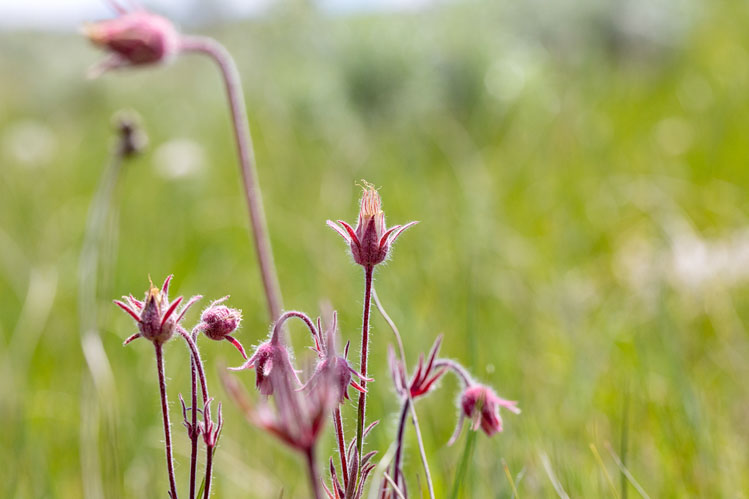
Earlier this month, I was out finding the season’s first pasque flowers in the Coteau Hills overlooking Jacobson Fen in Deuel County. As I got up close to frame a few fuzzy portraits of our state flower, I got the idea to share these new photos along with a few other tall grass favorites I had gathered but did not make the final printed story. I hope they convey the sense of wonder and enjoyment I get while out roaming the tall grass remnants.

Christian Begeman grew up in Isabel and now lives in Sioux Falls. When he’s not working at Midco he is often on the road photographing South Dakota’s prettiest spots. Follow Begeman on his blog.

Posted on Leave a comment

Finding the Wilds of Winter

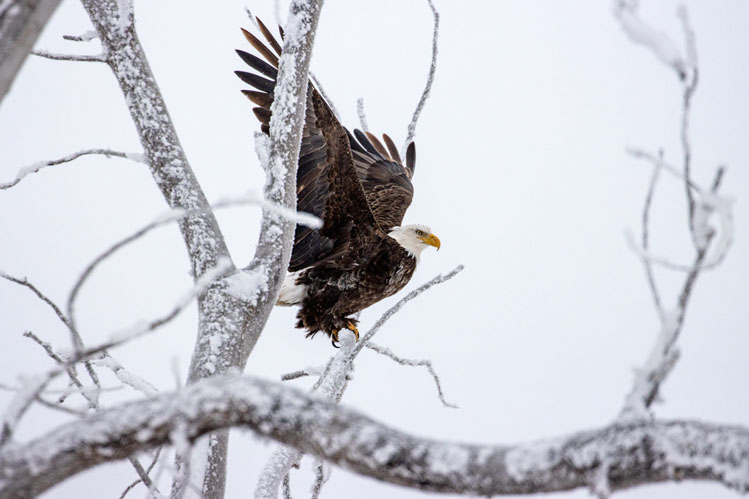
Spotting winter wildlife on the Northern Plains can sometimes seem impossible. Frigid temperatures, relentless wind, snow and ice usually keep critters out of sight during the diminished daylight hours. When I was in junior high, I spent a good chunk of an afternoon sitting in what I thought was a pretty good hiding spot overlooking a stock dam bordered by a chokecherry thicket. A recently deceased cottontail was on the edge of the ice, placed as a lure. I think I hoped a hungry coyote or maybe even a hawk or eagle would arrive. Nothing did. All I heard was the wind though the thicket and all I saw was gray and sullen clouds overhead.

I’m not sure when I figured out that the golden hour was when wildlife is most on the move. Maybe it was deer hunting with my brother or simply noticing more things after I shut the tractor down for the day. This tip generally still holds true when I’m out looking for wildlife with my camera. Not only are there more opportunities to see wildlife, but the golden hour provides beautiful light. Win-win.

It has been my family’s custom to find time to survey the countryside when we get together for the winter holidays. To this day, I keep this tradition alive. Sometimes I’m with my dad, sometimes with brothers and nephews and sometimes it is just me and my camera. This year, I spent three days looking for wildlife in Badlands National Park, Custer State Park and Wind Cave National Park between Christmas and New Year’s Day. And yes, late afternoon and early morning proved to be the most fruitful times.

I arrived in the Badlands around 3 p.m. on December 27. This may seem like mid-afternoon, but winter light is short-lived and angled low and lovely, which is a photographer’s delight. At 3:20 a great-horned owl was out on a ridge waking itself up in the sunlight. About a half hour later I spotted a golden eagle riding updrafts near the Sage Creek Wilderness Road. After photographing a few solitary bison bulls, I headed west and got to Custer State Park with very little light left on the western horizon.

Overnight, a skiff of snow fell in the Southern Hills and there was frost on the grass as I headed to a favorite spot along Highland Ridge Road in northern Wind Cave National Park before sunrise. There were elk below the ridge and bison on the horizon as the sun appeared with warm tones even though the temperatures were well below freezing. As the day lengthened the light brightened, the wind increased and the frost fell to the ground. After driving a few of my favorite routes, I ended up calling it day fairly early. I repeated this routine for the next few days, and it was glorious. Here are some of my favorite photos from that vacation. I’m already counting down the days for another foray or three into South Dakota’s winter wilds.

Christian Begeman grew up in Isabel and now lives in Sioux Falls. When he’s not working at Midco he is often on the road photographing South Dakota’s prettiest spots. Follow Begeman on his blog.

This slideshow requires JavaScript.

Posted on Leave a comment

Grassland Delight

“Here was the endless prairie, so rich in its blessings of fertility, but also full of great loneliness–a form of freedom which curiously affected the minds of strangers, especially those to whom the Lord had given a sad heart.”
―
O.E. R¯lvaag, Giants in the Earth

There aren’t nearly as many places to look out over endless prairies as there were before immigrants arrived. Yet there are still a few places where it can be accomplished right here in South Dakota. From the farmhouse I grew up in, you could drive about 2 miles west over prairie dirt tracks to the rim of the Moreau River breaks and look out over what seemed like a vast wild land of hills, draws, cactus and grass. Thunder Butte hovered in the distance with an unknown number of prairie dogs, rattlesnakes and deer making their living in vastness between. Some years it was green for most of the summer, other years only saw it green for a few weeks in May. Even so, the views affected any and all who laid eyes on it, and especially me.

I saw my first Golden Eagle”out west” as we called it. It made a large wooden fencepost seem tiny as it slowly lifted off to catch the swirling wind. When night rolled in from the east, I heard my first coyotes sing to the evening out west. It wouldn’t be the last I’d hear that lonely song drift in. Rainstorms and thunderclouds seemed to always originate from out west. It wasn’t hard for me to understand why Thunder Butte was so named. This landscape of the open, mixed grass prairie got a hold of me then and I haven’t shaken it since.

From spring to late summer, the magic of the grasslands can often go unseen. The shy wildflowers don’t grow in vast numbers but instead sprinkle the grasslands with decorative color. Butterflies and songbirds are easier to spot in season, but still, you have to be intentional when seeking them.

I have now lived the majority of my life east of the Missouri, and I have come to appreciate the tall grass patches on that side of the state. There is not as much of it to be found since the soil is so conducive to growing corn and other small grains. Even so, when you can find a good patch of tall grass it is worth taking a close look. The hiking is a little harder as the grass is thicker. It took me many years to be comfortable putting my foot down where I could not see the ground. Thankfully prairie rattlers do not abide in tall grass country.

This column is a long look back at the few times I was able to get out and explore our state’s grasslands this past growing season. From Harding to Moody counties and points in between, please enjoy a few postcards from the prairie.

Christian Begeman grew up in Isabel and now lives in Sioux Falls. When he’s not working at Midco he is often on the road photographing South Dakota’s prettiest spots. Follow Begeman on his blog.

Posted on Leave a comment

The Good, the Bad and the Beautiful

Life on the Northern Plains is ever changing. One of my favorite times of the year is thunderstorm season. Generally speaking, it runs from late April through September, but I’ve seen lighting in February and experienced thunder snow in March. The best time, however, to watch a storm build across our Dakota skies is in June and early July.

Our neighbor on the farm lived all his life as a shepherd, rancher and sometimes farmer in both Dewey and Ziebach counties. He swore by what he called the”solstice storm.” Every year on or around the summer solstice we’d get a big thunder boomer. I remember one year it was late and we wondered if he was just pulling our leg about this phenomenon. Then on July 3, as we were in the front yard lighting off firecrackers, a low, menacing cloud raced in from the west. It brought wicked wind, rain and hail. After it had rolled through, the sides of our white house had mud high up on the walls. The storm’s fury had literally stirred up the elements.

Even so, that wasn’t even close to the worst our neighbor had witnessed during storm season. He told me he watched the virgin prairie transform into what looked like a plowed field when a behemoth storm produced large hail that was driven into the ground.

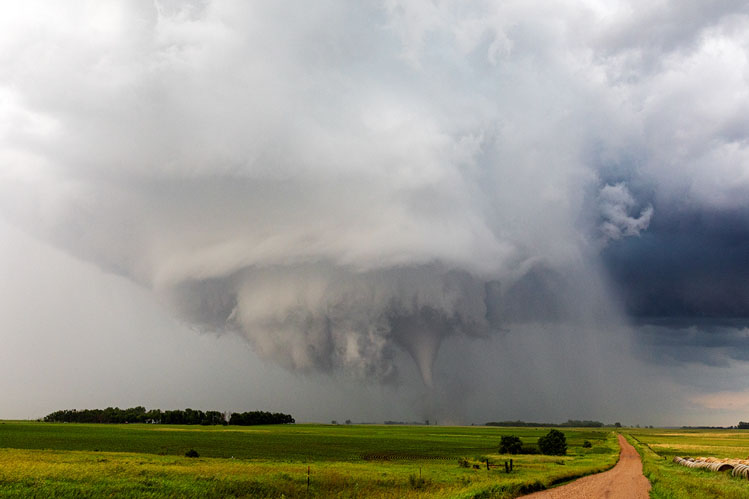
We didn’t get many tornadoes in that part of the country though. I had never seen a twister in real life until May 28, 2025. Not only did I watch my first tornado form and drop in rural Deuel County, but I saw a second one from the same system about an hour later head east toward Gary. That afternoon I was out looking for wildflowers as I slowly made my way north out of Sioux Falls. It was a little after 6 p.m. when I found myself looking up at a massive thunderhead building quickly west of 7-mile Fen Preserve. Not wanting to get hailed on, I checked the storm tracker on my phone and planned to flank the system to the south.

Avoiding the rain and hail shaft found me a few miles west-northwest of Clear Lake, but I had driven into a problem. Directly in front of me I saw a new cell developing with little rain but a lot of rotation in the clouds. It was unnerving and coming right at me. I quickly drove under it and beyond a few miles then turned around and watched the twister form. I don’t consider myself a storm chaser and am happy to watch bad weather from a distance. Therefore, my photos are not real close but feature the immense cloud formations. I do like getting the rainbows after a storm, and ironically enough, a shaft of sunlight hit the forming tornado cell prior to its touching the ground. I witnessed and photographed that unique convergence of wild weather.

Thankfully no lives were lost that day, even though there was some property damage. This column shows you the photos I took from that storm and then subsequent wildflowers and storm scenes into July. It is a beautiful irony that the prime wildflower beauty and delicateness on the prairie exist at the same time when such power and dread can descend from the skies.

Christian Begeman grew up in Isabel and now lives in Sioux Falls. When he’s not working at Midco he is often on the road photographing South Dakota’s prettiest spots. Follow Begeman on his blog.

Posted on Leave a comment

Dakota Kaleidoscope

I remember watching a PBS”American Masters” special on photographer Dorothea Lange and being struck by how she prepared for a retrospective at New York’s Museum of Modern Art (MoMA). Lange’s most famous photo, entitled Migrant Mother, is one of the most recognized and poignant photos of the 20th century. As she looked through her life’s work, she didn’t choose to show just single images but grouped photos into sets of three. She described it as equating sets of three to a visual sentence. It was an idea that stuck with me, and I wondered if I’d ever be able to produce such a thing.

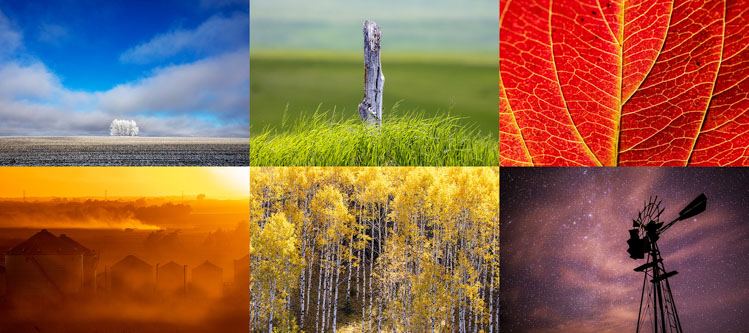
Earlier this year, John Andrews asked for two photos that would be considered for printing in South Dakota Magazine. The first was a winter scene in Moody County with frosted trees under a winter blue sky and the second was harvest haze at sunset in Yankton County. The dust and low light gave the image a very orange overtone. The two images gave me an idea. What if I could find other photos with strong green, red, yellow and purple tones and match them up in a six-photo set? It would be a celebration of Dakota color. It took me a couple of hours, but after a cursory review of photos from the last couple of years, I put together an edit I was happy with.

I posted the new image on my Facebook page and called it a South Dakota kaleidoscope of color. Folks seemed to like it and then John suggested it could be a new column. I agreed and started the process of searching my archives for images that emphasized a strong single color. I reviewed a decade of work from across the state. When the search was over, I had well over a hundred photos separated into blue, green, orange, purple, red and yellow folders. From there I tried to find themes. Since I photograph country churches, that became a set. The last handful of years I’ve been interested in botany (wildflowers) and macro (close-up) photography, so there were two more sets. We Dakotans know that weather and seasonality are huge parts of our lives, so there was another set.

All in all, I came up with eight more sets. The most difficult was the bird set, as there are not many purple birds. Thankfully I had photographed a purple finch at the Dells of the Big Sioux a few winters ago. I also had to choose from a lot of yellow birds. I ended up going with the yellow warbler over the meadowlark, but it was tough decision as I’m a huge fan of both species.

Thanks to John and Dorothea for the inspiration of this look back over a decade of photos. My images are vastly different than the black and white real-life photos of Lange’s, but I do wonder what she’d make of these Dakota kaleidoscope sets. I’ll never know, but it was fun to put together and show here. And really, isn’t that the best part of being a photographer? I bet she’d agree with that.

Christian Begeman grew up in Isabel and now lives in Sioux Falls. When he’s not working at Midco he is often on the road photographing South Dakota’s prettiest spots. Follow Begeman on his blog.

This slideshow requires JavaScript.

Posted on Leave a comment

Gold at Home

The autumn of 2025 has so far found me mostly homebound. The toils of everyday work life coupled with many of my nieces and nephews excelling in fall sports has kept me from my usual Black Hills trip seeking out the fall colors of the high country. The good news is that there is plenty of seasonal splendor to be found right here in Minnehaha County.

One of the perks of the good folks at South Dakota Magazine allowing me to share photos and thoughts in this column over the past decade plus is that I can look back at the seasons and compare and contrast the details. For example, this season has seemed like the green and warmth of summer lingered longer than past years, when in actuality, the peak of color is happening at about the same time. That said, it is a touch greener and the orange, yellow and reds are somewhat muted compared to years past. Even so, you can find the color of fall out and about if you take the time to go look.

I was able to take off work on October 24 to wander the city on a near perfect autumn afternoon. That’s when I noticed how much things have really changed over the years. There aren’t as many trees flanking the main falls at Falls Park, for starters. The views of downtown from Cathedral Hill are not nearly as easy to see because trees from the park land below the church continue to grow. And so it goes. I should remember that the only thing that remains constant is change even when it comes to photographing familiar locales, but I don’t really remember until confronted by visual proof.

Palisades State Park.

In this column, I will keep the words brief. Fall is both a beautiful and bittersweet time as the growing season comes to an end in a final colorful flourish. We all have more than a few months of the long cold winter lined up next. Even so, winter does make one enjoy the spring all the more. In this selection of photographs, the first half are from this year, and the second half are selections from past years that have never been published here before. May they inspire you to get out and enjoy a last autumn stroll or two before old man winter’s long arm reaches down from the north country.

Christian Begeman grew up in Isabel and now lives in Sioux Falls. When he’s not working at Midco he is often on the road photographing South Dakota’s prettiest spots. Follow Begeman on his blog.

Posted on Leave a comment

Night Walking South Dakota

John Banasiak in his office at the University of South Dakota, where he has taught since 1980.

John Banasiak is a passionate experimenter. As we sit in his office at the University of South Dakota — filled with prints, cameras and other ephemera collected over nearly 50 years of teaching — he talks about something that’s been on his mind at least that long.”Over the summer I tried to tweak this process that I did years ago, and I stopped because I almost burned my house down doing it,” he says.”But I thought there had to be some way to do it.”

Back when he attended the School at The Art Institute of Chicago, a professor told him,”You know photography exists, but there are lots of ways to get to it. You invent photography.” That led to an interesting mash up of photography and biology in which he purloined several of his mother’s begonias and put them in the closet, hoping the darkness would manipulate the starches. Later, he taped negatives to the leaves and replaced them in sunlight. He expected the combination of light and starch would produce an image. It kind of worked, but more than 50 years later he thought he’d revisit it by boiling leaves in ethyl alcohol to remove the green caused by the plant’s chlorophyll.”But at a certain temperature it catches fire,” he says with a laugh.”So that was the problem. I threw the pan out the window and there were all these flames. It was crazy.”

Digital photography has captured the 21st century — even in Banasiak’s classes — but there’s still a bit of mad scientist in him that enjoys tinkering with solutions and creating photographs that bring him and his students to places they’ve never been.”There are so many things you can do in a darkroom. There are all these magic tricks you can do that help invent some language, and it’s shocking to people. Then they go on and do it for years. They’re looking for some language, and when they see it happen, they want to do it.”

Thousands of students have found inspiration in Banasiak’s methods, but a career in art was never something the people in his neighborhood on the south side of Chicago envisioned for him. His grandparents from Poland and Ukraine settled there during World War I, finding comfort in the steady work provided by the factories that had popped up along the southern shores of Lake Michigan. Banasiak, born in 1950, was destined to follow his father and uncles into a lifetime of factory work until a teacher at his Catholic grade school noted his artistic ability. In high school, his art teacher pushed him to apply to the Art Institute of Chicago, eventually landing him a full scholarship to attend classes there in the fall of 1968.

A television set peeks out of a repair shop window in Kadoka.

He was admitted based on his talents in drawing and painting, but then he took a class in photography.”The only time I would have ever taken any photos would be for family gatherings, birthdays, graduations,” he says.”Sometimes my mother would hand me the Kodak twin lens reflex and I’d take a shot. I was just nervous I would shake or jiggle the camera because film was expensive, so I didn’t really relate to it at all.”

He loved the poetry of photography, especially in late-night photos that he captured while much of Chicago slept. Banasiak worked as a night watchman at the Art Institute. When his shift was over at 2 a.m., sometimes he stayed.”I slept under Seurat’s A Sunday on La Grande Jatte. I’d wake up to that,” he says.”There was Toulouse-Lautrec’s At the Moulin Rouge down that way and The Old Guitarist by Picasso. There was a Rousseau jungle painting and van Gogh’s bedroom in Arles. It was my favorite gallery, and I’d just sleep there on one of the cots because I had to get up early for my art history class that was right downstairs.

“On occasion, I didn’t feel like going to sleep and I’d just walk around Chicago with my camera. I like walking around at night. It was like a stage set waiting for the actors to show up. During the day, the sun would move, there would be light and shadows and it would all change. At night, there would be streetlights and it would stay like that for six hours. I could move around and get what I wanted.”

The results included poignant images of alleys, storefronts and other urban settings seen in a different way. It was the beginning of his”Night Walks” series, a constantly growing collection of photographs that continued after he moved to Vermillion in 1980. Though he was 500 miles from urban Chicago, Banasiak found commonalities as he explored his new, more rural home at night.”The atmosphere of the environment is all you need to make up stories. I think they’re part of my wanderings in my memory bank. When I see something, I’m drawn to it because it’s a familiar place. It resembles something of an environment that I have in my mind. They’re kind of archetypal, in my own head. Maybe other people don’t see anything in them. But I see something because they just look so familiar, even though they’re taken in different places.”

A UFO merry-go-round at a playground near Lewis and Clark Lake.

After graduating from the School of the Art Institute, Banasiak received a grant to attend the University of Krakow in Poland. He returned to earn an M.F.A. at the Art Institute in 1975. He served as artist in residence at Light Work and Syracuse University and spent a year teaching at the State University of New York in Oswego. He’d always wanted to explore the South Pacific, so he moved to New Zealand in 1979 and spent a year conducting photo workshops and teaching.

He seriously considered staying, but his mother called to tell him he’d won a sizable grant from the Illinois Arts Council. When he got home, he discovered they’d awarded the grant to someone else because he had been so difficult to reach in New Zealand. He was organizing notes and photos from his travels when someone from the Art Institute told him the University of South Dakota needed a full-time photography teacher.

“It looks just like New Zealand out there,” they told him.”And it did kind of look like central New Zealand. There was the river. I looked it up. And they showed a picture in this encyclopedia of East Hall, and I thought it looked like the Harvard of the West.”

His brother drove him to South Dakota for an interview. When John Day, the longtime chair of the art department and dean of the College of Fine Arts, called to tell him he had the job, he figured he’d stay for a year or two.”But I met all these great people, and the faculty, we’d meet for dinner almost every other night. I loved it out here, and it was peaceful. I applied to a couple of other schools, but I just couldn’t see myself leaving Vermillion.”

One or two years has turned into 44. Sabbaticals took him to Morocco, Jordan, Ecuador, Poland, Spain, Turkey, Nicaragua, Panama, Cuba and China. Back home, his teaching brought numerous faculty awards as well as the 2021 Governor’s Award in the Arts for Outstanding Service in Arts Education.

A collection of tree shadows on the outfield fence at Riverside Park in Yankton.

Those honors are wonderful, but it’s clear that Banasiak’s passion will always be the photographic process.”I bought some beet powder not long ago,” he says, and sure enough, a package of beet powder rests on a counter beside some turmeric and other chemicals. He’s exploring how emulsions made from different plant juices produce images.

“The past couple years I’ve been kind of exploring, tweaking and rearranging†possible processes,” he says.”When I do something, I like doing the whole process. When I get done, I’m done with it. I don’t care if I exhibit or sell them. It’s really in the meditative process of doing it. Whatever I learn doing my own art is what I end up teaching. Classes are always different. I’m coming up with new ideas. I’m excited by them, and when I share them with the students they go nuts.”

The idea of retirement is a non-starter. He’ll invent and teach as long as he’s able. He knows infirmities come to all who live long enough, but he’s thought about that.”Sometimes, now that my eyes are having some issues, I might experiment with photographic braille,” he says.”I don’t think that’s out of the realm of possibility. I might try printing some photos on wood or plastic with the laser cutter that we have in the graphics department. To see with the touch of fingertips can be something worth exploring photographically.†I don’t really believe people see†with†their eyes anyway, they see†through†their eyes, and it makes me think, ëWhat else might I be able to see with?'”

If there’s a way, John Banasiak the experimenter will find it.

Editor’s Note: This story is revised from the November/December 2023 issue of South Dakota Magazine. To order a copy or to subscribe, call (800) 456-5117.

Posted on Leave a comment

Seeking Spring Ornaments

Spring in South Dakota is a joy to watch unfold. It is not always the same within the particulars, but the rhythm of new blossoms and migrating birds are always harbingers of the season of life taking hold. This year saw a hot, windy and dry stretch in early May followed by cool, rainy days. It is now after Memorial Day and the landscape is lush and green out my window, even if the clouds are low and gray. Last year’s barn swallow couple is back inspecting my light fixture outside my front door for another nesting season. I’ve been doing a spring journal for over a decade in this space. This year, more than ever, you’ll see images featuring new blossoms and spring birds. I’ve called them”spring ornaments” in the past and that is how I still see them — fleeting glints of color showing off after a long, cold, Dakota winter.

March 28

I photographed my first pasqueflowers of the season in McCook and Hanson counties.


April 4

Snow flurries in rural Deuel County slowed a small flock of flicker woodpeckers arriving from warmer climates.


April 16

The first plum brush blossoms and bumblebees delighted the senses in Union Grove State Park.


April 19

A few trout lilies were in bloom on the hillside along the Union Grove State Park road.


April 26

Bluebells and pasqueflowers were found in the Slim Buttes of Harding County.


April 27

Star lilies in bloom along a trail of the Sage Creek Wilderness in Badlands National Park.


April 29

A black and white warbler was one of the first migrating songbirds I saw and photographed at Palisades State Park.


April 30

I spent an evening after work chasing a small flock of warblers at the Big Sioux Recreation Area near Brandon. Yellow-rumped warblers and a single palm warbler obliged for a quick portrait session.


May 1

These Canadian goslings at Palisades State Park were among the first babies of spring.


May 3

After a work trip to Minnesota, I stopped at Hartford Beach State Park where a pair of red-bellied woodpeckers were prepping their nest. I also spotted my first prairie smoke wildflower in eastern Brookings County later in the afternoon.


May 4

Tulips and decorative trees bloomed on a near perfect spring day in Sioux Falls.


May 10

A yellow warbler posed at Palisades State Park.


May 12

A Baltimore oriole came in close for a quick snapshot.


May 14

Eastern red columbine were in bloom and a few comma butterflies soaked up the spring sun at Palisades State Park.


May 17

One of my favorite warbler species, the magnolia warbler, gave me a good look at Palisades State Park.


May 25

I took a quick trip to see family and check out the landscape in northeastern South Dakota. Highlights included a patchy of small white lady’s slippers and blue-eyed grass in Deuel County, Tabor Lutheran Church in Strandburg flanked by American flags to honor Memorial Day and a superlative sunset beyond Garfield Lutheran Church west of Lake Norden.

Christian Begeman grew up in Isabel and now lives in Sioux Falls. When he’s not working at Midco he is often on the road photographing South Dakota’s prettiest spots. Follow Begeman on his blog.

Posted on Leave a comment

The Thrill of the Chase

Watertown’s Alex Resel is happiest chasing storms across South Dakota.

Alex Resel’s passions are photography and severe weather, and they intertwine perfectly from late spring to early fall. Though he is only three years out of college, the Watertown storm chaser has already driven tens of thousands of miles in pursuit of thunderstorms, tornadoes, derechos and all manner of nasty weather, returning with beautiful photographs that often belie the dangers.

He’s quickly learned the ins and outs of chasing, such as what to look for on radar and where to safely position himself, but it wasn’t that long ago that his interests in storms and photography were just blossoming. On a humid Father’s Day in 2012, storms rolled into Watertown, bringing heavy hail and setting off the city’s tornado sirens.”Until that point, I had no interest in weather, but something clicked after that storm,” says Resel, who was 12 at the time.”From there, I would draw maps of South Dakota and look at the local weather forecast and do my own weather map forecasting.”

His first”chase” came three years later, when his dad drove him 30 miles north to Summit after seeing a forecast from the National Weather Service’s Aberdeen bureau. Storms were set to fire northwest of the little Roberts County town.”We sat there for probably an hour, just watching them move in. Eventually they merged into a line and drifted toward Watertown.”

Any photos taken that day were captured with a smartphone, but in 2016 he got his first digital camera. He spent the next few years practicing landscape and storm photography and earned a business degree with an emphasis in photography and media from Lake Area Technical College in 2021.

A supercell over Clark.

Resel launched Outer Shots Photography, where he offers prints of landscapes, the Northern lights and the severe weather that he’s been chasing in earnest since the summer of 2020. The makings for strong storms were present west of the Missouri River on June 6, so he headed to the Badlands on his first solo chase.

“It looked like a couple cells could fire, but it didn’t happen because of an ingredient called cap, which prevents storms from growing,” he says.”It’s like putting a lid on a boiling pot of water. I thought the day was over, so I went to the Badlands to hike around for a couple hours and then head home. But I noticed dark clouds were coming in from the south and west, so I decided to wait and see what was going on. A big line of storms started moving in from Nebraska and Wyoming. It developed a beautiful shelf cloud and packed a lot of winds. I watched it move in from one of the overlooks. I was looking south, and as the line was moving overhead a tornado formed right in front of me in the Badlands. That was my first tornado, and it was a really cool thing to see.”

Resel plans his routes based on weather models and utilizes a weather app on his phone, which stays mounted to his windshield.”I’m looking for moisture, instability, lift and shear,” he says.”If all of those ingredients are in place, it’s usually a good sign that you’re going to get some organized severe storms. If multiple storm cells are firing at the same time, I look at which one is the tallest. Usually that’s going to be the dominant storm. Hopefully I’ve picked the right storm so I can get the shots I need.”

A lightning storm over Watertown.

That doesn’t always happen. South Dakotans likely remember where they were on May 12, 2022, the day an unusual and violent derecho raced across the state at 50 to 70 mph, packing straight line winds of 60 to 100 mph, the equivalent of a Category 1 hurricane. Resel noticed a localized enhanced tornado risk forming near Redfield, so he headed to Spink County.”Big cumulus clouds started to form, which is a good sign that storm activity is brewing, but as soon as they bloomed the derecho moved through and they disappeared. We didn’t get any storms to mature.” At the same time, he heard concerning reports closer to Watertown, including the tornado that caused extensive damage in Castlewood.”It’s a scary feeling being away from home and not knowing what’s going on.”

To help assuage those same feelings in others, he regularly reports what he sees to the National Weather Service, either by calling an office directly or through social media. Chasing severe weather can provide an adrenaline rush unequalled in other endeavors, but chasers are generally not simply reckless thrill seekers. There’s an important public service component to their work.

Peter Rogers, the warning coordination meteorologist with the National Weather Service’s Sioux Falls bureau, says information received from storm chasers and spotters can be crucial.”We have a lot of complex technology at our fingertips that helps us determine what’s going on, the radar probably being the most important,” Rogers says.”But there are still limitations to that, and there’s nothing better than having eyes and ears on ground watching what’s happening. From the Weather Service perspective, it’s all about the protection of life and property, and all the information that comes from chasers and other spotters is critical information to accomplish that mission.”

Storms that moved from Huron into northwest Iowa in the summer of 2022 turned the skies near Sioux Falls an eerie green. “It was the meanest looking storm I’ve ever seen,” Resel said.

Resel attends the NWS’s yearly severe weather awareness classes, which are offered in the spring. Meteorologists begin with basic terminology, such as the differences between watches and warnings, and then discuss weather in more detail, including how to identify supercell thunderstorms that could produce tornadoes and multicell storms that can cause other hazards. The classes emphasize safety, but Resel also uses the information to help identify the best position for photographing storms.”You’ve got to be on the southeast side of a storm. That’s where you get updraft and it’s where the photogenic parts of the storm are. That also keeps you safe from a tornado or large hail.”

Dangerous situations can still arise. Resel was in a caravan of storm chasers following severe weather in Colorado in August of 2023 when a tornado developed.”It wasn’t on the ground yet, so I felt comfortable, and I knew where to go to get out of its path. As the backside of those tornadic winds wrapped around it picked up rocks and broke out my back windshield. That ended my chase. I did get to see the tornado develop in front of me, but I got out of there as soon as I could to prevent any further damage. That was my first mistake in storm chasing, but luckily it only cost me a back windshield.”

Moments like that are learning opportunities, and not likely to quell the excitement that comes from storm chasing.”Watching the atmosphere work its magic and to have that unfold right in front of you is an amazing experience,” Resel says.”It’s not one that many people know. Each time is different, but you get those same feelings.”

Looking at his photos, you can almost feel it, too.

Editor’s Note: This story is revised from the May/June 2024 issue of South Dakota Magazine. To order a copy or to subscribe, call (800) 456-5117.

Posted on Leave a comment

Dancing with Grebes

Western grebes appear to walk on water during the rush, perhaps the most distinctive element of their spring mating ritual.
My love affair with grebes began when I was a high school biology teacher. During a lesson about birds, I showed my class a movie by Sir David Attenborough, the British broadcaster and wildlife biologist. I was amazed by the beauty and gracefulness of the grebes, with their long slender necks and pointed bills. Their courtship ritual was intricate and complex, unlike any other in the animal kingdom. They repeated each other’s every movement. If there were ever birds that demonstrated love, these grebes put the stereotypical doves to shame.

There are two displays, each including a specific set of steps performed with precision. The first is the rushing ceremony, which begins with advertising as the birds deliver a rolling call. Then comes ratchet-pointing, where they lower themselves into the water and their call becomes more ratchet-like. The next component is dip-shaking, which accurately describes the behavior of dipping their heads underwater and then shaking them from side to side after they resurface. Finally comes the rush, when the grebes run side by side across the surface of the water, necks back and wings up. They are the largest vertebrates on Earth with the ability to walk on water, covering up to 66 feet in 7 seconds through a combination of speed (20 steps per second), splayed feet to help gain traction and an unusual stride.

The weed dance occurs during the mating season. Two grebes arch their backs, stretch their necks and share weeds that they will use to build a nest.

The second display is the weed ceremony. It is equally complex and happens later in the mating season. But it was the rushing that fascinated me. As a part-time wildlife photographer, when I saw the ritual culminate into this beautiful dance across the water, I told myself that someday I would find grebes in the spring and photograph them.

When I retired from teaching, I started going down my bucket list of things I wanted to photograph. Western grebes were high on the list. They do not live in my state of Missouri, so I followed the Central Flyway, a major migration route over the Great Plains that encompasses a large part of the Prairie Pothole Region. Spring rains fill the potholes and they become a stopping point and breeding ground for many species of migratory waterfowl. Ducks, geese, pelicans and grebes take advantage of these pools, which contain a myriad of invertebrates, small fish and aquatic plants for food sources and nesting materials.

I knew about the potholes in South Dakota. Photographers look at each other’s work, and I’m sure I saw a picture of grebes taken in South Dakota. So about six years ago I made my first trip.

I’ll never forget my very first experience. The water was out, like it is in the spring. I had parked and was using a beanbag on the door of my truck. The grebes were coming really close, and that’s when I got my first good pictures. I didn’t get to see any rushing that day, but I went back later and witnessed babies riding on their mothers’ backs. I was hooked.

They usually start in April. I watch for the courtship ritual, which continues throughout the summer. But I keep looking because I’m waiting for the babies, too.

Of the 22 species of grebes, six can be found in South Dakota: Clark’s, western, pied-billed, eared, horned and red-necked. Clark’s grebe is similar to the western grebe; sometimes they are found mingling together. The other species are not as large. The breeding plumage of the pied-billed grebe is not as flamboyant. Its bill is not sharp and pointed and its neck is not long and graceful. The horned grebe has some interesting colors, with gold feathers wrapping around its head and a reddish ring around its neck. The eared grebe is arguably the most stunning of the smaller grebes. It has a golden fan of feathers radiating outward behind its eyes. I love grebes in general, but I think the western grebes are the most graceful and the most beautiful.

Photographers don’t always share their favorite spots, especially when you’re talking about birds. If you let it out where you’re going, then all of a sudden you get a crowd of people, and the birds are gone. I have traveled to South Dakota every spring for six years and have observed five of the six grebes during their migration and/or breeding season. (I have not been able to photograph or view a red-necked grebe yet.) Between the rushing and watching the babies, grebes have so much to offer. For a photographer, they are a dream come true.

Donna Caplinger lives in Fair Play, Missouri.

Editor’s Note: This story is revised from the March/April 2024 issue of South Dakota Magazine. To order or to subscribe, call (800) 456-5117.