Posted on Leave a comment

The Good, the Bad and the Beautiful

Life on the Northern Plains is ever changing. One of my favorite times of the year is thunderstorm season. Generally speaking, it runs from late April through September, but I’ve seen lighting in February and experienced thunder snow in March. The best time, however, to watch a storm build across our Dakota skies is in June and early July.

Our neighbor on the farm lived all his life as a shepherd, rancher and sometimes farmer in both Dewey and Ziebach counties. He swore by what he called the”solstice storm.” Every year on or around the summer solstice we’d get a big thunder boomer. I remember one year it was late and we wondered if he was just pulling our leg about this phenomenon. Then on July 3, as we were in the front yard lighting off firecrackers, a low, menacing cloud raced in from the west. It brought wicked wind, rain and hail. After it had rolled through, the sides of our white house had mud high up on the walls. The storm’s fury had literally stirred up the elements.

Even so, that wasn’t even close to the worst our neighbor had witnessed during storm season. He told me he watched the virgin prairie transform into what looked like a plowed field when a behemoth storm produced large hail that was driven into the ground.

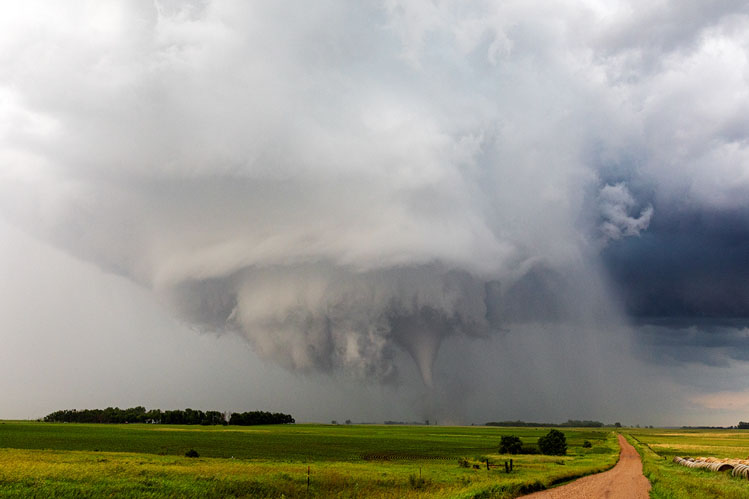
We didn’t get many tornadoes in that part of the country though. I had never seen a twister in real life until May 28, 2025. Not only did I watch my first tornado form and drop in rural Deuel County, but I saw a second one from the same system about an hour later head east toward Gary. That afternoon I was out looking for wildflowers as I slowly made my way north out of Sioux Falls. It was a little after 6 p.m. when I found myself looking up at a massive thunderhead building quickly west of 7-mile Fen Preserve. Not wanting to get hailed on, I checked the storm tracker on my phone and planned to flank the system to the south.

Avoiding the rain and hail shaft found me a few miles west-northwest of Clear Lake, but I had driven into a problem. Directly in front of me I saw a new cell developing with little rain but a lot of rotation in the clouds. It was unnerving and coming right at me. I quickly drove under it and beyond a few miles then turned around and watched the twister form. I don’t consider myself a storm chaser and am happy to watch bad weather from a distance. Therefore, my photos are not real close but feature the immense cloud formations. I do like getting the rainbows after a storm, and ironically enough, a shaft of sunlight hit the forming tornado cell prior to its touching the ground. I witnessed and photographed that unique convergence of wild weather.

Thankfully no lives were lost that day, even though there was some property damage. This column shows you the photos I took from that storm and then subsequent wildflowers and storm scenes into July. It is a beautiful irony that the prime wildflower beauty and delicateness on the prairie exist at the same time when such power and dread can descend from the skies.

Christian Begeman grew up in Isabel and now lives in Sioux Falls. When he’s not working at Midco he is often on the road photographing South Dakota’s prettiest spots. Follow Begeman on his blog.

Posted on Leave a comment

A Border Town

Gary is a true border town. The east end of Main Avenue intersects the South Dakota/Minnesota state line.

It’s been many years since a train rumbled through Gary, but people here believe this was the place where railroad service first crossed into Dakota. Trains also arrived in other border towns like Sioux City and Vermillion in 1872, the year of Gary’s founding, but the local citizenry stands by the claim, more than 150 years later. The east end of Gary’s Main Avenue intersects the Minnesota border, where rails awaited their extension into Dakota Territory, so it’s hard to doubt them.

The town began as Tent City, then Stateline, Headquarters, DeGraf and finally Gary, for rail and postal official H.B. Gary. It’s also known as”The Gate City” for its role in welcoming settlers to the western prairies.

Almost 600 people called this beautiful spot along the west branch of the Lac Qui Parle River home in 1920, but less than half as many remain today.”Maybe we are lucky,” says construction contractor and city councilman Doug Nelson, who calls himself a”move back” because he returned to his hometown after several years of living away.”At one time we were on a trajectory to become a big city, but instead we have a hidden gem.”

Progress is measured differently in tiny towns.”We’ve got stop signs now. We didn’t used to,” Nelson laughed.

Gary Historical Association members (from left) Ellen Schulte, Doug Nelson, Carolynn Webber and Perry Heaton gathered in the city museum to reminisce about the town’s early days.

Perry Heaton and his father before him operated the Gate City General Store at the main intersection in downtown Gary. Jennifer Pederson now manages the former bank building and shop next door, known to locals as”Jen’s Store.” Over the years the buildings have held a drug store, barber shop, grocery store and the Gary Post Office. Today shelves are packed with tools, greeting cards and energy drinks.”We still have hardware from when Perry had the store,” Pederson says.”It’s fun to actually sell something with one of his old price tags on it. We’ve tried to keep the original intent, which was a little of everything.”

Nelson says residents are happy with the products and services available, except for the lack of a gas station. Ideas are being floated to bring a service station and convenience store to property owned by the city.

An adult prom last year brought back memories of dances every Friday and Saturday night in the 1960s and’70s.”Of course they don’t dance anymore, just stand in the middle of the floor and jump up and down,” says Heaton, a former mayor and city councilman.

The town’s newspaper, the Gary Interstate, began in 1878 and ceased traditional publication years ago, but the Gary Historical Association continues a monthly newsletter that carries the Interstate name. Laura Swoboda and her mother, Patricia Haas, produce the new editions.

A picturesque two-story brick courthouse was built in the lower part of town in the 1890s. When the county seat moved to Clear Lake, the community offered the building as the first South Dakota School for the Blind. The school opened in 1900 after the city raised funds and built additional facilities on a 37-acre campus, including a small dam and lake.

Tunnels were built to assist blind students getting between buildings on the School for the Blind campus. Today they are decorated with historic photos of the school and surrounding area.

Longtime Gary residents remember blind students attending churches and joining locals for dinner at their homes. Along with Braille instruction, students learned music, farming, furniture repair and other skills utilizing their hands. A large barn on campus hosted wrestling and boxing matches as well as roller skating.

The School for the Blind moved to Aberdeen in 1959. Decay, deterioration and vandalism took a toll on the buildings until local entrepreneur Joe Kolbach purchased the property in 2008. Kolbach held an idea-generating town meeting, which led to the renovation of the school buildings as a resort, hotel, campground and restaurant.

The Buffalo Ridge Resort and Spa, including the Herrick Hotel and Talking Waters Campground, opened in 2009 for Gary’s Fourth of July celebration, an annual five-day party that includes a rodeo, soap box derby, live bands, children’s events and a rendezvous. By the following summer the Rock Room Bar and Grill was added.

Buildings housing the Gary Historical Association’s museum exhibits, the Gary City Park, the resort and the campground all blend into a beautiful complex somewhat hidden to travelers who only pass through town.”This park is the nucleus of what Gary is,” Nelson said as he walked by the new playground equipment and sports courts, the fruits of fundraisers held through the American Legion, the Alibi Bar and others.

Patricia Fields purchased the Buffalo Ridge Resort in 2023 and is continuing renovations that will add spa and massage facilities. Rick and Jessica Christens operate the Talking Waters Campground next door.

Ghost hunters have visited the resort’s buildings and found some activity, although one said a ghost told her she wasn’t willing to talk that day.”They are friendly,” Fields says. She’s seen some”photo bomb” ghosts appear in pictures taken there.

Maybe someday, one of them will reminisce about the day the railroad came to town, and finally settle that old debate with Sioux City and Vermillion.

Editor’s Note: This story is revised from the January/February 2024 issue of South Dakota Magazine. To order or to subscribe, call (800) 456-5117.

Posted on Leave a comment

Doane’s Favorite Places

Doane Robinson began his career in law, but eventually he became a poet, writer, publisher and state historian.

It’s an eight-minute walk in Pierre from Doane Robinson’s former home on Wynoka Street to the state capitol building, where he once had an office. Eight minutes, that is, if you walk with a sense of purpose.

And it is impossible to think of Doane Robinson ever moving without a sense of purpose. In the early days of South Dakota statehood he was South Dakota’s idea man, and he ranks among our most prolific writers. Usually men of letters leave behind books, and men with big ideas leave thinking that spurs others into action over time. Certainly Robinson’s legacy includes books and inspiration, but he also left South Dakota beautiful buildings at Gary, Pierre and Hisega, as well as a solid foundation for a department of state government. Oh yes … there’s also that sculpture of four presidential heads blasted from mountain granite near Keystone.

Robinson’s grandson, Will Doane Robinson, a retired teacher in Rapid City, remembers long walks along Wynoka and beyond with his grandfather in the 1930s.”A very, very nice man,” he describes him, and other neighborhood children concurred, often tagging along on walks. At the time they had no real idea of who their older friend was. Professionally Doane Robinson was a homesteader, teacher, lawyer, poet, editor and South Dakota’s first state historian. In his personal life he was a devoted family man who was widowed young. In his spare time he sometimes tinkered trying to invent a perpetual motion machine.

Born into a farm family near Sparta, Wisconsin in 1856, he was christened Jonah LeRoy Robinson. Two childhood incidents impacted the rest of his life. First, younger sister Sadie couldn’t pronounce Jonah and called him Donah, later shortened to Doane. He answered to the name the rest of his life. The second event, says great-granddaughter Vicki McLain, was much darker. Typhoid fever hit his family. No one died, but the family struggled for years to pay medical bills, keeping them in poverty for most of Doane’s childhood. Forever after, Robinson believed debt had to be avoided if at all possible.

He possessed an amazing memory, claiming he could recall incidents that happened before age 2, and maybe even before age 1. Robinson seemed strangely attuned to history-in-the-making. He remembered his parents discussing news that Abraham Lincoln had been elected president the month after Robinson turned 4. His parents were Democrats and he recalled they were unimpressed with the Republican Lincoln. Later he heard talk of distant fighting as the Civil War played out, and Robinson remembered news of Lincoln’s assassination — his mother worried Democrats would take the blame. Much later Robinson decided”in some ways the truth about Lincoln had been withheld from me,” and he committed himself to reading political theory. He became a Republican but, he wrote,”will give my support to another party any minute I am convinced that the sum of happiness will be enhanced by it.”

During his teens he worked hard on the farm, was able to run the place on his own in the event of family emergencies, and he worked equally hard in school where he honed his love of words. In his early 20s he taught school, homesteaded near his brother’s place in Minnesota, and began studying law at the University of Wisconsin. All the while he fretted about Jennie Austin, a Wisconsin girl he greatly admired and found beautiful, but who was a teenager too young for him.

Robinson fell in love with a spot he saw while traveling on the Crouch railroad line. He named it Hisega, and soon build a lodge there featuring a wraparound porch. Photo by Paul Horsted

Of course, Jennie matured. She became a teacher herself. The two decided their affection was mutual in 1883, the same year Robinson got serious about finding legal work in western Minnesota or across the border in Dakota Territory. He hadn’t earned a law degree but had learned enough to feel confident he could offer quality legal services — not an unusual course of action at the time. He considered setting himself up in Ortonville, Minnesota, but didn’t like the town. Then he visited Watertown”and made up my mind I had found the place I was looking for.” He opened a Watertown law office in September of 1883.

Months later he bought one-third interest in the Watertown Daily Courier.”The law is a jealous mistress and must come before anything else in your life,” Robinson would one day counsel his son Will, an attorney. By buying into the newspaper and, in fact, becoming its editor, Robinson demonstrated an unwillingness to focus on the law alone. The result, he decided later, was failing to be”much shucks” as a lawyer.

In December of 1884, Watertown’s young lawyer and editor rode the rails to Wisconsin to marry Jennie. Then the couple came home to Dakota Territory. Son Harry was born in 1888, and Will came along in 1893. In those years Robinson learned he could supplement his family’s income nicely by selling poetry to magazines across the country. He actually attracted a national following. The Boston Herald noted that”perhaps no one of the younger poets of America has so quickly established himself in the hearts of the common people.” Robinson came to know South Dakota in part because of requests to travel from town to town and recite his verse. His dialect poetry, recreating the speech patterns of the state’s immigrants, often for humorous effect, was well received. He also toured other Midwestern states. Even after he became state historian, Robinson remained a poet, and found he could sometimes combine verse and historical interpretation. An example is this poem about W.H.H. Beadle, Civil War veteran and pioneering educator who championed South Dakota School and Public Lands for generating public education funds:

Man of vision! Man of mission,

Patriot, soldier, scholar, seer.

Man of action! Man of purpose! Duty led

in thy career.

Forward looking; self forgetting; unwaged

drudge for learning’s gain;

South Dakota reaps the harvest planted by

thy care and pain.

In 1894 he moved his young family to Gary, a railroad town in Deuel County, close to the Minnesota border. He bought the Gary Interstate newspaper.”Getting out an edition of the eight page newspaper was frequently a family affair,” son Will recalled in an excellent little biography of his father.”The press was an old Washington hand press.” Jennie positioned the newsprint in the press and Doane swung a big lever to apply pressure and make the imprint. At age 6 Harry removed the finished newspapers from the press and stacked them.

After the town of Gary lost its status as the seat of Deuel County, Robinson urged the state to locate the School for the Blind there. Today the campus is the Buffalo Ridge Resort and Business Center.

The year after the Robinsons moved to town, Gary lost county seat status to Clear Lake. But the new newspaper publisher had an idea: Why not lobby the state to build a School for the Blind on the former courthouse grounds? Robinson did some research and determined it cost South Dakota $2,000 per student, every year, to send children with visual impairments to out-of-state institutions, in the era when it was assumed students with disabilities learned best in segregated environments. Robinson’s idea won statewide support and ground was broken in 1899. Students arrived in 1900. Vicki McLain thinks perhaps there was more to her great-grandfather’s passion for the school than commerce for Gary.”When he was studying law in Wisconsin,” she says,”he temporarily lost sight, apparently because of severe eye strain. He recovered but never took eyesight for granted.”

Over the next several years the school evolved into a pretty campus a couple blocks north of Gary’s business district. Services moved to Aberdeen in 1961 and the campus fell into disrepair, but more than 40 years later Joe Kolbach completed a beautiful restoration, creating Buffalo Ridge Resort.

Even as he was publishing the Interstate and advocating for the school, Robinson nursed a pet project, one he believed in so much that he was willing to sometimes serve as an”unpaid drudge,” to borrow a phrase from his Beadle poem. The idea was a magazine, the Monthly South Dakotan, that would heavily emphasize the young state’s history. Issues were produced over a period of several years and wherever Robinson moved, the magazine went with him. The Robinsons moved to Yankton where he bought controlling interest in a morning paper, The Gazette, and then it was on to Sioux Falls where Robinson hoped to find more ad revenue for the Monthly South Dakotan. Next the family made Aberdeen its home, and Robinson published the Brown County Review.

ìHe had a thousand irons in the fire,” Will wrote. As for the Monthly South Dakotan, he added, it claimed a loyal readership willing to pay for subscriptions, but ad revenue constantly fell short. The publication folded in 1904, and by that time Robinson’s life had changed drastically. In 1901 he was selected Secretary of the new South Dakota State Historical Society, a branch of state government. Now he had the opportunity to publish articles of the sort he prepared for the Monthly South Dakotan, but at state expense. After a few years in the position his income would allow for a very comfortable lifestyle. It should have been a happy time, but in 1902 Jennie died of acute bronchitis. Who else but Robinson, with his head for historical dates, would note that Jennie died 19 years to the day after she and Doane decided they were in love?

Robinson advocated for the stately Soldiers and Sailors Memorial in Pierre after World War I. It once housed the state’s history museum. Photo by Chad Coppess/S.D. Tourism

ìOh, my dear boys,” Robinson later wrote his sons,”I can never tell you how dearly I loved your Mama, not only those nineteen years, but long before, and every moment since.” He was 45 and never remarried.

Sadie, the sister who gave him his name, moved in to help run the household. The family relocated to Pierre and Robinson arranged for construction of the home on Wynoka Street. Future governor and U.S. senator Peter Norbeck would be a neighbor on Wynoka, and became Robinson’s good friend and ally.

Robinson perhaps occasionally lost himself in work as he grieved Jennie. He helped plan the state capitol building and wrote 1905’s Brief History of South Dakota, more commonly called”the little red history book,” which for decades was the standard volume schools used to teach about South Dakota’s past. Most important, though, Robinson got the State Historical Society off to a strong start, publishing the first volumes of South Dakota Historical Collections, the biennial series of papers that most every South Dakota historian has referenced.

ìHis was the foundation we’ve built on ever since,” says Jay Vogt, current State Historical Society director.”In his time, he was much more hands-on than we’re able to be, doing most of the research and writing himself.”

Indeed, when something big developed, such as the discovery of the Verendrye plate that proved French trappers passed through the state in 1743, Robinson jumped into action and researched, wrote and edited until he had 300 pages for Historical Collections. He also gathered South Dakota newspapers and indexed them, along with government documents, and he took special interest in seeking out American Indian historical perspectives. He considered it a great honor, before his state historian years, to have interviewed Hunkpapa leader Gall, one of the victors at the Battle of Little Big Horn.

While no one ever questioned Robinson’s work ethic, he has sometimes been criticized for not being an academically trained historian.

ìBut you have to put that criticism in context,” says Vogt.”At that time, in all states, history organizations were kind of amateur clubs, made up of people who had interest and maybe connections to historical sources. Doane Robinson brought a wide range of professional experiences to his work, and he possessed great curiosity.”

For many years his office was on the capitol building’s ground floor, along with a little museum. When the legislature was in session, lawmakers knew the state’s best writer was close at hand if they struggled with a bill’s wording.

After railroad tracks spanned the Missouri River and were extended west to Rapid City in 1907, Robinson had easy access to the Black Hills for the first time. The region offered intriguing history, and it was a perfect place to relax. In 1908 Robinson arranged a camping adventure for 17 friends, relatives and Pierre colleagues. The party stepped off the Crouch Line train in a beautiful canyon west of Rapid City and pitched tents. Robinson loved making up words and announced he would call the spot Hisega, a name derived from the initials of six women in the group: Helen, Ida, Sadie, Ethel, Grace and Ada. Everyone loved the place, talked it up back in Pierre, and Robinson devised a time-share scheme. If enough people contributed $100, he would build a mountain lodge for them at Hisega. The big structure with wrap-around porches awaited visitors the next summer, and it still greets guests today.

A building of an entirely different style that stands as a Doane Robinson legacy is the Soldiers and Sailors Memorial, down the front steps and immediately across the street from the state capitol. Robinson pushed for the building after World War I, and it took more than a decade to raise funds and get the stately memorial finished. In addition to honoring South Dakotans who served and died in military service, the building housed the state’s history museum for many years and was usually referred to as the Robinson Museum.

Robinson dreamed of carving into Black Hills mountains. Newspapermen called the idea ridiculous, but Robinson partnered with Gutzon Borglum and history was made. Photo by S.D. Tourism

Of course, when it comes to tangible legacies, nothing tops Mount Rushmore Memorial.”My grandfather thought the Black Hills were beautiful, but that not enough people would visit just because of that,” says Will D. Robinson.”There had to be some other reason. I can show you the spot on the Needles Highway where his Model T Ford touring sedan got hot one day, and he sent my dad to bring water from a spring. When my dad got back to the car, my grandfather was looking at the Needles, thinking how they could be carved by a sculptor.”

That was 1923. Robinson talked to people who might help, especially Senator Norbeck, and sometimes took heat from South Dakota newspaper editors who considered the scheme ridiculous. But in short order internationally renowned sculptor Gutzon Borglum was on board and in 1927, as Robinson looked on, President Calvin Coolidge was present for a ceremony launching the project. Only the location wasn’t the Needles but nearby Mount Rushmore because, Robinson’s grandson understood, the Needles spires contained too much feldspar and Borglum didn’t want to alter that stunning piece of God’s handiwork.

Borglum also didn’t want to carve figures related to the American West, as Robinson proposed, but instead presidents. In Borglum, Robinson met a man whose vast vision matched his own. In another way, though, the men were polar opposites. Borglum liked to move ahead without much thought about costs, while Robinson insisted on budgetary constraint. As an executive of the original association formed to oversee Mount Rushmore’s creation, it fell to Robinson to confront the sculptor at times about spending. He was happy to pretty much leave the project in 1929, content in knowing his role as instigator had been successful. Robinson was back at the mountain on July 4, 1930, as a speaker when the Washington head was dedicated. He was 73 and had retired as State Historical Society Secretary six years earlier.

In the 1930s Robinson had more time for his walks and young friends on Wynoka Street, and he kept writing. Unlike Borglum and Norbeck, he lived long enough to see Mount Rushmore in its final form. He also saw his son Will become head of the State Historical Society in 1946. Doane Robinson lived a few weeks past his 90th birthday and his grandson recalls his mind and memories were as sharp as ever toward the end. He had witnessed America’s evolution from Abraham Lincoln to the atomic age. No one observed South Dakota’s first half century more intently.

Editor’s Note: This story is revised from the November/December 2013 issue of South Dakota Magazine. To order a copy or to subscribe, call (800) 456-5117.

Posted on Leave a comment

Getting to Know Deuel

Back in my newspapering days, a colleague and I used to rib each other about our home counties. I grew up in Hamlin and he was from Deuel. The phrase”God’s country” got thrown around a lot, and we both enjoyed bragging up our hometowns and sports teams. We don’t see each other as often these days, but when we do the subject still comes up — and we’re still equally as proud of our counties as we were then.

Now I concede nothing, but after nearly a decade of working at South Dakota Magazine, I’ve learned a lot more about Deuel County. And I have to give him credit. His home county has some pretty interesting stories.

One of his favorite summer pastimes is to camp out at the Crystal Springs rodeo, held every June northeast of Clear Lake. I’d always known about Crystal Springs, but I had no idea until I came to the magazine that one of the most popular rodeos in the Upper Midwest began as a farmer’s dream.

It goes all the way back to 1936, when E.W. Weisel bought the Crystal Springs Ranch in 1936. His property included a hill that formed a circular valley where he used to imagine what it might be like to hold a rodeo there. “I dreamed it,” he told us a few decades ago.”I dreamed it was all there, with horses and cattle and the people all laughing and having a good time.”

Hundreds of people showed up the first year, so he tore down the corn cribbing and put up a permanent corral. A Clear Lake banker gave him a loan and he put on a bigger show in 1946, and he installed lights the following year.

But he never built bleacher seats, and for good reason. The surrounding hillside makes a natural outdoor amphitheater. Weisel advertised it as “America’s Most Natural Rodeo Bowl.”

The Crystal Springs Rodeo is held in America’s most natural rodeo bowl northeast of Clear Lake. Photo by Christian Begeman

Today the Crystal Springs Rodeo spans three days with rodeo performances every night. The whole city of Clear Lake gets involved, staging a parade, car show, trail ride and pancake feed.

Another dream has come true in Gary, a small town that straddles the South Dakota-Minnesota line in southern Deuel County. After Gary lost county seat status to Clear Lake in 1895, Doane Robinson, publisher of the Gary Interstate and future state historian, began advocating for the state to build the South Dakota School for the Blind on property just north of the town’s business district. Ground was broken in 1899 and students were on campus in 1900.

The School for the Blind operated until 1961, when it was moved to Aberdeen. After 1980, the campus’ buildings were mostly abandoned. But then in 2009, wind energy entrepreneur Joe Kolbach transformed the campus into the Buffalo Ridge Resort and Business Center.

The buildings of the old School for the Blind in Gary have been transformed into a resort and business center.

Satisfied guests like the quiet setting, an atmosphere that feels like a bed and breakfast, a large patio set up for barbeques and 50 pretty acres. Kolbach resuscitated Lake Elsie, which is a damming of Lac Qui Parle Creek. Guests can feel the history in the stately buildings, especially in the web of tunnels that visually impaired students once walked daily between buildings.

On a given day, the campus could see vacationers checked into some of the resort’s 19 guest rooms, along with students training across the yard (or through the tunnels) at the administration/classroom building. Meanwhile a meeting could be underway in the former school auditorium, now called the ballroom, and an outdoor wedding could be happening alongside Lake Elsie.

Guests interested in history can hike a mile west of town to place locals call Indian Lookout. A giant compass made of rocks sits on a grassy hillside. Dakota elder Elden Lawrence believed the rocks were placed there in the 1860s to guide Indians traveling from the Sisseton area to Pipestone, where they quarried native stone to make sacred pipes.

Lake Elsie, formed by damming Lac Qui Parle Creek, was restored along with the School for the Blind campus.

Deuel County is home to other legends as well, such as the blue flags that grow each spring in a region called the Hidewood. Floyd Haug discovered the flowers when he rented the land, and later discovered that they mark the graves of two pioneers.

A Norwegian settler named Per Gustav Erikson and his wife, Ida Mary originally homesteaded the land. In the early 1880s they had a baby daughter. But during the winter of 1885-86, a diphtheria outbreak struck the territory and both Ida Mary and the daughter died. Because the snow was so deep and the ground frozen, their bodies were placed in two wooden boxes built by a neighbor.

The grieving young settler kept the rough-hewn coffins in a shed until spring, when he dug two graves just to the south of his house and buried them above the Hidewood Valley. He probably had no money for a permanent marker, and instead planted blue flag flowers. That same year, he sold his claim for $300 to Peter Dahl and left Dakota Territory.

Now, almost 130 years later, the flowers still mark the simple graves. Prairie grasses have infiltrated the flowers, but the blue flags still grow thick and in the obvious rectangular shape of a grave.

Other stories aren’t as sad. Several years ago, Lowell Anderson wrote an article for us about Herman Raschke, a man he called the Goodwin Giant.

Born in 1896, Raschke lived with his brother and a sister in a clapboard house overlooking Round Lake in northern Deuel County.”I was always told that Herman stood 6 feet, 10 inches tall, and weighed 425 pounds,” he wrote.”My father claimed he weighed himself on the grain elevator’s truck scale.

One of Anderson’s favorite stories about the giant involved a traveling salesman who was driving along the Grant-Deuel county line one spring, not far from the Raschke house. His car became stuck in the soft road, and he walked to the Raschke house for help. When he knocked on the door and saw Raschke, a good 14 or 15 inches taller than he was, the salesman was taken aback.

A natural spring near Astoria has been gushing fresh water for decades.

“I’m stuck out on the road. I need help,” he said.”Would you possibly have a team of horses to pull me out?”

“Let’s go take a look,” said Herman.

“You don’t need to look. I’m stuck. For sure. The wheels don’t even touch the ground!”

“Let’s go check it out.”

The salesman didn’t argue. He followed as Herman walked directly across a plowed field, through an accumulation of spring mud, towards the road and the car.

“See, I’m really stuck,” said the salesman.

“Oh, it doesn’t look so bad,” said Herman.

And then, Raschke put his hands under the front bumper, lifted the front end of the car out of the ruts, and gently lowered it onto solid ground. He did the same to the rear of the car. The salesman was speechless.

I’ve also learned about unique traditions, including stopping your car along Highway 28 to fill jugs with water gushing from Jorstad Spring, 2 miles northwest of Astoria. Decades ago, someone stuck a pipe into the creek, and ever since — even through the dry years of the Depression — pure water gushed out from a shallow aquifer.

Another tradition is only recently discovered is the annual oyster stew feed at the Bemis Holland Presbyterian Church. The feed is featured in our September/October 2016 issue, and is coming up this Saturday, October 15. It’s been a harvest tradition for nearly 130 years, and even though numbers at the rural church continue to dwindle, oyster stew night is one of the busiest of the year.

Despite our history of good-natured banter, I’ve always enjoyed my trips to Deuel County (even though I still haven’t completely figured out that outrageously downhill par 3 at the Clear Lake Golf Course). Maybe”God’s country” knows no county lines.

Editor’s Note: This is the 29th installment in an ongoing series featuring South Dakota’s 66 counties. Click here for previous articles.