Posted on Leave a comment

The Good, the Bad and the Beautiful

Life on the Northern Plains is ever changing. One of my favorite times of the year is thunderstorm season. Generally speaking, it runs from late April through September, but I’ve seen lighting in February and experienced thunder snow in March. The best time, however, to watch a storm build across our Dakota skies is in June and early July.

Our neighbor on the farm lived all his life as a shepherd, rancher and sometimes farmer in both Dewey and Ziebach counties. He swore by what he called the”solstice storm.” Every year on or around the summer solstice we’d get a big thunder boomer. I remember one year it was late and we wondered if he was just pulling our leg about this phenomenon. Then on July 3, as we were in the front yard lighting off firecrackers, a low, menacing cloud raced in from the west. It brought wicked wind, rain and hail. After it had rolled through, the sides of our white house had mud high up on the walls. The storm’s fury had literally stirred up the elements.

Even so, that wasn’t even close to the worst our neighbor had witnessed during storm season. He told me he watched the virgin prairie transform into what looked like a plowed field when a behemoth storm produced large hail that was driven into the ground.

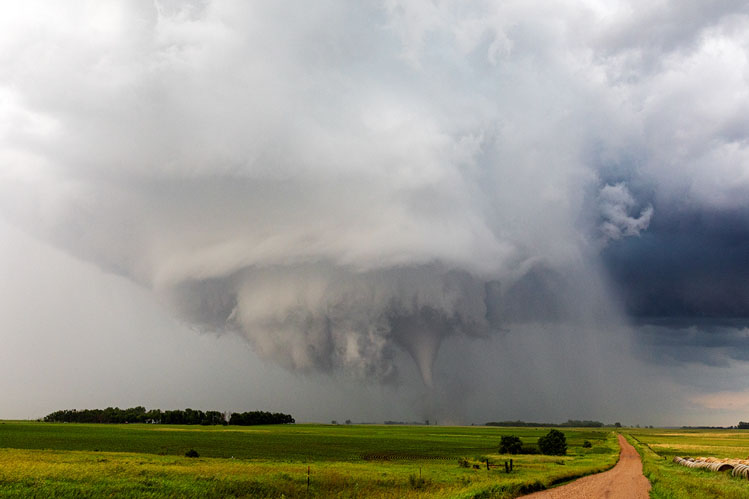
We didn’t get many tornadoes in that part of the country though. I had never seen a twister in real life until May 28, 2025. Not only did I watch my first tornado form and drop in rural Deuel County, but I saw a second one from the same system about an hour later head east toward Gary. That afternoon I was out looking for wildflowers as I slowly made my way north out of Sioux Falls. It was a little after 6 p.m. when I found myself looking up at a massive thunderhead building quickly west of 7-mile Fen Preserve. Not wanting to get hailed on, I checked the storm tracker on my phone and planned to flank the system to the south.

Avoiding the rain and hail shaft found me a few miles west-northwest of Clear Lake, but I had driven into a problem. Directly in front of me I saw a new cell developing with little rain but a lot of rotation in the clouds. It was unnerving and coming right at me. I quickly drove under it and beyond a few miles then turned around and watched the twister form. I don’t consider myself a storm chaser and am happy to watch bad weather from a distance. Therefore, my photos are not real close but feature the immense cloud formations. I do like getting the rainbows after a storm, and ironically enough, a shaft of sunlight hit the forming tornado cell prior to its touching the ground. I witnessed and photographed that unique convergence of wild weather.

Thankfully no lives were lost that day, even though there was some property damage. This column shows you the photos I took from that storm and then subsequent wildflowers and storm scenes into July. It is a beautiful irony that the prime wildflower beauty and delicateness on the prairie exist at the same time when such power and dread can descend from the skies.

Christian Begeman grew up in Isabel and now lives in Sioux Falls. When he’s not working at Midco he is often on the road photographing South Dakota’s prettiest spots. Follow Begeman on his blog.

Posted on Leave a comment

A Border Town

Gary is a true border town. The east end of Main Avenue intersects the South Dakota/Minnesota state line.

It’s been many years since a train rumbled through Gary, but people here believe this was the place where railroad service first crossed into Dakota. Trains also arrived in other border towns like Sioux City and Vermillion in 1872, the year of Gary’s founding, but the local citizenry stands by the claim, more than 150 years later. The east end of Gary’s Main Avenue intersects the Minnesota border, where rails awaited their extension into Dakota Territory, so it’s hard to doubt them.

The town began as Tent City, then Stateline, Headquarters, DeGraf and finally Gary, for rail and postal official H.B. Gary. It’s also known as”The Gate City” for its role in welcoming settlers to the western prairies.

Almost 600 people called this beautiful spot along the west branch of the Lac Qui Parle River home in 1920, but less than half as many remain today.”Maybe we are lucky,” says construction contractor and city councilman Doug Nelson, who calls himself a”move back” because he returned to his hometown after several years of living away.”At one time we were on a trajectory to become a big city, but instead we have a hidden gem.”

Progress is measured differently in tiny towns.”We’ve got stop signs now. We didn’t used to,” Nelson laughed.

Gary Historical Association members (from left) Ellen Schulte, Doug Nelson, Carolynn Webber and Perry Heaton gathered in the city museum to reminisce about the town’s early days.

Perry Heaton and his father before him operated the Gate City General Store at the main intersection in downtown Gary. Jennifer Pederson now manages the former bank building and shop next door, known to locals as”Jen’s Store.” Over the years the buildings have held a drug store, barber shop, grocery store and the Gary Post Office. Today shelves are packed with tools, greeting cards and energy drinks.”We still have hardware from when Perry had the store,” Pederson says.”It’s fun to actually sell something with one of his old price tags on it. We’ve tried to keep the original intent, which was a little of everything.”

Nelson says residents are happy with the products and services available, except for the lack of a gas station. Ideas are being floated to bring a service station and convenience store to property owned by the city.

An adult prom last year brought back memories of dances every Friday and Saturday night in the 1960s and’70s.”Of course they don’t dance anymore, just stand in the middle of the floor and jump up and down,” says Heaton, a former mayor and city councilman.

The town’s newspaper, the Gary Interstate, began in 1878 and ceased traditional publication years ago, but the Gary Historical Association continues a monthly newsletter that carries the Interstate name. Laura Swoboda and her mother, Patricia Haas, produce the new editions.

A picturesque two-story brick courthouse was built in the lower part of town in the 1890s. When the county seat moved to Clear Lake, the community offered the building as the first South Dakota School for the Blind. The school opened in 1900 after the city raised funds and built additional facilities on a 37-acre campus, including a small dam and lake.

Tunnels were built to assist blind students getting between buildings on the School for the Blind campus. Today they are decorated with historic photos of the school and surrounding area.

Longtime Gary residents remember blind students attending churches and joining locals for dinner at their homes. Along with Braille instruction, students learned music, farming, furniture repair and other skills utilizing their hands. A large barn on campus hosted wrestling and boxing matches as well as roller skating.

The School for the Blind moved to Aberdeen in 1959. Decay, deterioration and vandalism took a toll on the buildings until local entrepreneur Joe Kolbach purchased the property in 2008. Kolbach held an idea-generating town meeting, which led to the renovation of the school buildings as a resort, hotel, campground and restaurant.

The Buffalo Ridge Resort and Spa, including the Herrick Hotel and Talking Waters Campground, opened in 2009 for Gary’s Fourth of July celebration, an annual five-day party that includes a rodeo, soap box derby, live bands, children’s events and a rendezvous. By the following summer the Rock Room Bar and Grill was added.

Buildings housing the Gary Historical Association’s museum exhibits, the Gary City Park, the resort and the campground all blend into a beautiful complex somewhat hidden to travelers who only pass through town.”This park is the nucleus of what Gary is,” Nelson said as he walked by the new playground equipment and sports courts, the fruits of fundraisers held through the American Legion, the Alibi Bar and others.

Patricia Fields purchased the Buffalo Ridge Resort in 2023 and is continuing renovations that will add spa and massage facilities. Rick and Jessica Christens operate the Talking Waters Campground next door.

Ghost hunters have visited the resort’s buildings and found some activity, although one said a ghost told her she wasn’t willing to talk that day.”They are friendly,” Fields says. She’s seen some”photo bomb” ghosts appear in pictures taken there.

Maybe someday, one of them will reminisce about the day the railroad came to town, and finally settle that old debate with Sioux City and Vermillion.

Editor’s Note: This story is revised from the January/February 2024 issue of South Dakota Magazine. To order or to subscribe, call (800) 456-5117.

Posted on Leave a comment

Pearls on the Prairie

Prairie Smoke at Jacobson Fen in Deuel County.

Christian Begeman was driving the backroads of Deuel County near the Crystal Springs Rodeo grounds when he stumbled upon Jacobsen Fen Preserve, 160 acres managed by the Nature Conservancy that includes 10 calcareous fens. Unique wetlands such as these, which often support plants that cannot be found anywhere else in South Dakota, are sprinkled primarily throughout the Glacial Lakes on the eastern slope of the Prairie Coteau. They can be part of large complexes like Jacobsen Fen or the nearby 7-Mile Fen (also managed by the Nature Conservancy), or small enough that a farmer may walk past for years and not realize the treasures blossoming on his land.

“It’s not something you’re going to see from 100 yards away. You usually have to be standing on it to be able to see these plants,” says Dave Ode, a retired Game, Fish and Parks Department botanist.”The prairie is a place where you have to look closely, because there’s more there than might meet the eye.”

Fens are distinguishable from other wetlands because they contain large amounts of peat. Fed by underground springs, the cold, oxygen-poor water preserves organic material — usually grasses, sedges, rushes and root material — and creates spongy peat deposits. Those saturated pools of peat sit atop a cone made from a material called tufa, a hard, calcium-rich layer that forms over years of groundwater discharge.”Often times you’ll have a floating mat of vegetation that you can walk on,” Ode says.”It’s like a waterbed.”

Great Plains Ladies’ Tresses, 7-Mile Fen, Deuel County.

Thanks to the work of glaciers thousands of years ago, the Prairie Coteau is the perfect environment for fens and their rare plant and animal life. De Alton Saunders, a botany professor at the State Agricultural College in Brookings, was among the first scientists to document the flora in what he called”cold spring bogs” in the summers of 1896 and 1897. Among the plants he recorded were Northern stitchwort, slender cotton grass, necklace sedge and the small fringed gentian, a biennial that produces tiny blue flowers in late August and September.

The fringed gentian wasn’t documented again for another 80 years, when Ode and his colleagues began to revisit the fens in search of those rare plants. A Natural Areas Registry was created, and in 1985 the first site to be included was Hamann’s Fen, about 900 square feet in the middle of Alvin Hamann’s pasture west of Clear Lake.”He was just fascinated by the plants that occurred on that fen,” Ode said of Hamann, who died at age 102 in 2019.”He’d lived on that land all of his life. He’d ridden by it and driven above it, but never stopped to look at the plants on that little particular spot.”

Today there are around 30 documented fens in South Dakota, although Joe Blastick, Prairie Coteau Land Steward with the Nature Conservancy, believes there are surely others on private land that have not yet been discovered.”These are among the most rare and fragile wetlands we have in the world, and we still don’t know where all of them are,” Blastick says.”It’s really challenging because generally landowners know they have something special, they just don’t know it’s a fen because they’ve never really learned about them.”

While South Dakota’s fens are predominantly in the northeast, there are two notable sites in other parts of the state. The Minnechaduza Fen straddles the South Dakota/Nebraska border where the Nebraska Sandhills creep onto the Rosebud Reservation along Minnechaduza Creek, a tributary of the Niobrara River. In the 1960s, scientists attempted to date the fen by taking core samples through nearly 4 meters of accumulated peat. The preserved seeds, pollen and other organic matter that they recovered were more than 12,000 years old.”That fen predates the return of the grasslands to the Great Plains,” Ode says.”Western South Dakota had all of these patches of boreal forest. They found spruce cones, aspen seeds and pollen, and lots of rushes from the tail end of the glaciers in the bottom zone of this peat.”

Another interesting place is McIntosh Fen in the Castle Creek Valley northwest of Deerfield in the Black Hills. Its namesake, Arthur McIntosh, was a professor at the South Dakota School of Mines and Technology in Rapid City and the first person to fully document the plants of the Black Hills. (Minor documentation had been done in the past, including by a botanist on Lt. Col. George Custer’s 1874 expedition to the Black Hills. His soldiers camped in Castle Creek Valley, and in one of William Illingworth’s iconic photos of the expedition, McIntosh Fen is visible in the background.)

Lesser Fringed Gentian, Roberts County.

Among the plants that McIntosh discovered in 1924 were several species of willow that grow hardly anywhere else in South Dakota. Two decades later Sven Froiland, longtime biology professor at Augustana University in Sioux Falls and the namesake of its Froiland Science Complex, was studying willows of the Black Hills. He found McIntosh’s notes and attempted to relocate the fen. He followed the professor’s written directions exactly — 3 miles upstream from Deerfield — but never found McIntosh Fen.

In the 1980s, as Ode and others worked on their fen redocumentation, they encountered the same problem. Then Ode discovered that when the government dammed Castle Creek to create Deerfield Lake, the townsite was moved in 1946.”So you basically have to subtract the distance they moved Deerfield,” he says.”If you go half a mile upstream, voila, there’s McIntosh Fen, the same site he had described.”

Fens are magical places for botanists, nature lovers and photographers like Begeman, who was already enamored with the beauty of the northeast.”The rolling hills and unplowed pastures remind me of my childhood home in rural Dewey and Ziebach counties,” Begeman says.”This landscape is a haven for natural beauty tucked away amongst the hills. When I learned that there were small fens sprinkled throughout that offered even more diversity and rarities, the area became even more of a treasure.”

He’s returned for several summers to photograph the small white lady’s slipper, fiery orange wood lilies, threatened Monarch butterflies and regal fritillaries.”The elegant blue of the lesser fringed gentian and delicate white petals of the grass of parnassus are tiny, but gorgeous late summer residents of our calcareous fens. For a photographer with a macro lens, this kind of delicate beauty is worth getting my feet and knees wet,” he says.”In a world where true wilderness and unique beauty in natural habitat is hard to find, it’s great to know that areas of nearly untouched prairie and wetland abundance still exist.”

You can find them, too — if you know where to look.

Editor’s Note: This story is revised from the July/August 2021 issue of South Dakota Magazine. To order a copy or to subscribe, call (800) 456-5117.

Posted on Leave a comment

Mysteries Revealed

In the July/August 2021 issue of South Dakota Magazine, John Andrews and I collaborated on an article about the unique fens of the Glacial Lakes. This photo essay was a highlight for me, as I helped pitch it as well as provided the photographs. The last few years I have found myself drawn more and more to botany photography, primarily because of the wildflowers, but I’ve also learned how long, slow walks in the tall grass can be good for the soul. And not just walks in the tall grass, either. I’ve found amazing blooms in hillside springs of the Northern Black Hills as well as the warm waters of Cascade Creek in Fall River County. But the fens continue to be a favorite place to take my macro and telephoto lenses on a walk.

The article mentioned a”fen walk” organized by The Nature Conservancy in late August. I marked that weekend on my calendar as a great opportunity to learn more about these areas from folks who’ve studied and/or managed them over the years. I figured the tour would also make for a great follow-up column here, as well.

It was a foggy morning when just over a dozen fen walkers met at Jacobson Fen Preserve in rural Deuel County. The weather seemed fitting since many of my notions and ideas about fens came from English literature that often describe fens as foggy, misty and mysterious. Before the morning was over, there would be wind gusts, mist and then sunshine. The inconsistent weather did not stop us, however. Soon we were striding through cattails and bull rushes well over 6 feet tall into the heart of a calcareous fen and all its treasures just below one of the northern slopes of the preserve. Blooms of note included lesser-fringed gentian, Kalm’s lobelia and American Grass of Parnassus.

Just below the fen, Owen McElroy, who accompanied from the Game, Fish and Parks Department, discovered what was likely the find of the day. From a muddy side bank, he pulled out a bison horn. It has been more than 150 years since the last wild bison roamed the area. Other finds of interest included Riddell’s Goldenrod, arrow grass, jewelweed and tiny fringed willowherb blooms that I’d never noticed before. And that is the beauty of taking the time to do such walks — meeting and learning from like-minded folks as well as spending time in a small piece of wild nature, right here in our own backyard.

Once the sun emerged, I left the group to return to the Grass of Parnassus blooms to get macro photos in good light. From there I wandered south to 7-Mile Fen, nearly due east of Clear Lake. Just beginning to bloom were wild orchids that I’d never seen in my life before the previous summer. Great Plains lady’s tresses were waving in the breeze, just beginning to show their lovely white blooms. It was a wonderful way to end my time in fen country, and great motivation to come back.

Christian Begeman grew up in Isabel and now lives in Sioux Falls. When he’s not working at Midco he is often on the road photographing South Dakota’s prettiest spots. Follow Begeman on his blog.

Posted on Leave a comment

Glacial Lakes in Winter


South Dakota’s Glacial Lakes country
is perfect for day trips this winter. More than a hundred lakes — plus sloughs, wetlands, ponds and rivers — combine to create a scenic and unspoiled countryside rich with wildlife and waterfowl, friendly farm towns and numerous opportunities to enjoy nature.

Melting glaciers shaped this prairie pothole country 20,000 years ago. The lakes are so numerous that some remain unnamed. Most have grown in size and depth over the last 25 years. Bitter Lake, once little more than a shallow slough, is now the state’s largest natural lake; it is encroaching on Waubay Lake and other bodies of water to create an ocean-less, inland sea.

In this winter of the pandemic, we are all looking for new outdoor sights and experiences. Winter serenity and solitude has always been a trademark of the unspoiled Glacial Lakes region.

Here are 10 suggestions, organized by county, on how you might explore the Glacial Lakes. Some are auto drives, others offer winter hikes that could be compromised by the amount of snow on the ground. However, this list only scratches the surface so don’t hesitate to roam the lake country. You’ll discover many surprises, and they’ll all be good.

BROOKINGS COUNTY — The 135-acre Dakota Nature Park (at the corner of 22nd Avenue and 32nd Street South) lies in the southeastern corner of Brookings. Gravel mining led to formation of ponds and wetlands, and a restored prairie now grows atop the old landfill mound. A portion of the Allyn Frerichs Trail System — named for the city’s longtime parks and rec director who passed away in 2014 — skirts the north edge of the park, while a network of paths weave around the wetlands, prairies and trees.

BROWN COUNTY — Take a trip to Sand Lake National Wildlife Refuge. Though the classic 15-mile auto tour is closed in winter due to hunting and snow conditions, other roads remain open on the perimeter of the refuge. Explore the gravel roads that lead north and south from Highway 10. The snow geese are gone, but you’ll see other waterfowl, eagles and the Arctic’s snowy owls. Deer, pheasant and coyotes are also common. Sand Lake rose from the dust of the Great Depression to become one of the world’s most important wildlife sanctuaries. It is 30 miles northeast of Aberdeen.

CODINGTON COUNTY — Just southwest of Watertown is Pelican Lake. An observation tower near an inlet on the lake’s south side provides a sweeping view of the water, its namesake birds, the prairie and Watertown’s skyline. The Observation Tower Trail is a three-quarters of a mile hike through the woods and winter grasses. A longer jaunt, the Pelican Prairie Trail, gently meanders 5.2 miles.

DAY COUNTY– Explore the trails of Waubay National Wildlife Refuge, situated in the very heart of the Prairie Pothole landscape. Scientists say the region produces 50 percent of the continent’s waterfowl. Trails range from a few hundred feet to a mile, and jaunt around an island that houses the refuge headquarters. However, the public facilities are closed in winter.

DEUEL COUNTY — Visit 12-acre Ulven Park, which occupies a point on the eastern shore of Clear Lake. The frogs and toads, noisy in summer, are now hibernating so they’ll not interrupt the serenity of the park’s half-mile hiking trail.

EDMUNDS COUNTY — Shake Maza Trail at Mina Lake (between Ipswich and Aberdeen) is a short walk that explores the flora, fauna and other features at one of the first man-made lakes in northeast South Dakota. Shake Maza is a Native term meaning”shaped like a horseshoe,” which describes the 850-acre lake, ringed by picturesque cabins and homes.

GRANT COUNTY — This fascinating region is one of the USA’s five continental divides. Lake Traverse flows west to the Hudson Bay and Big Stone Lake flows south to the Mississippi and the Gulf of Mexico. Some of the best winter trails are at Hartford Beach State Park — a tree-filled, rocky shoreline north of Milbank that is quite unlike anything else in the Glacial Lakes. Signage in the park will direct you to several easy trails.

HAND COUNTY — Hike the Pheasant Run Trail at Lake Louise, 14 miles northwest of Miller. Beginning at the trailhead in the main campground, the dirt and grass trail meanders 3.2 miles around the south side of Lake Louise, which was created by damming the south fork of Wolf Creek in 1932. More than three dozen informational plaques identify trees and plants found along the way, though leaf identification will be challenging in December and January.

LAKE COUNTY — Wander the trails of Lake Herman State Park, which occupies a peninsula on the east side of Lake Herman, just west of Madison. A cabin built by pioneer Herman Luce in about 1870 stands along the 1.25-mile Luce Adventure Trail, which encircles Herman Pond. Connecting trails include the Abbott Trail (1.1 miles) and the Pioneer Nature Trail (.4 miles). All are easy walking.

MOODY COUNTY — Much of the prairie pothole region drains into the Big Sioux River, and the waterway starts to change its personality as it reaches Flandreau and Dell Rapids. Hike Red Rock Trail in Dell Rapids, where you can enjoy a closeup view of the famous rose quartzite that underlies the region.

Posted on Leave a comment

Deuel County Oyster Tradition

Jaci Stofferahn of Watertown handles oyster stew like a pro.

In the gathering twilight of a Deuel County evening, lights wink in the fields. Rows of corn and soybeans have already been reduced to stubble, but farmers toil in their huge machines, bringing in the harvest. Trucks hug the edge of the dusty gravel roads, waiting for their next load.

On one cool Saturday night in October, traffic on the gravel lane leading to Bemis Holland Presbyterian Church is a little heavier than usual, as hungry folks file in for the church’s annual oyster stew harvest supper. Entering the tiny vestibule, we’re greeted by a pair of men manning the moneybox, one with a harmonica in his hand.

Bud Ruesink carries his mouth organ everywhere — it gives him something to do with bits of free time. If you catch him at a quiet moment and ask politely, maybe he’ll favor you with a rendition of”Sweet Hour of Prayer” or another old hymn.

The narrow room is lined with baked goods — extra treats to bring home if you’re somehow not full by the end of the night. At the far end, watch for Bemis Holland’s pastor, Terry Drew. He’ll spend the evening bounding up and down the narrow stairs, shepherding groups of diners into the basement to clusters of empty seats at long tables. It’s a workout for the minister, who has served the small congregation for 17 years.”I feel it for several days afterward,” he admits. Drew doubles as greeter and performer on oyster stew night; when the dining area is full, he plays guitar for people waiting their turn upstairs in the church.

Harvest dinner night is busy, but Bud Ruesink of Castlewood finds time to play a song.

Back in the packed basement, our group is seated. Waitresses navigate through the tables to the kitchen, where they fetch large, piping-hot bowls full of oyster stew or chili while platters of ham sandwiches, scalloped potatoes, pickles, Jell-O and cake circulate among the diners. If you’re an ornery member of the congregation, eat carefully — your oysters might be accompanied by a friendly prank.”Certain individuals get a rock or a shell in their bowl of soup. All the waitresses have to do is say, ‘So and so is here,’ and in it goes,” the busy soup servers told us.”I think they’d be disappointed if we didn’t do it.”

The meal has been a bright spot on the Deuel County social calendar for more than 130 years. Many of the church’s early records are lost, but it is believed that the harvest dinner was first served in 1883, just a few years after Dutch families from Wisconsin founded the church in William TeGantvoort’s dugout. Chicken was the main item at the church’s earliest dinners, but after about five years, the menu changed to oyster stew.

At first blush, oyster stew seems like an odd choice for landlocked Dakota, and, although oysters are raised on the southwest coast of the Netherlands, oyster stew is not a Dutch tradition.”Oysters were one of these early luxuries made possible by railroad,” says Catherine Lambrecht, president of the Greater Midwest Foodways Alliance.”People would order them by the barrel for the holidays.” Oysters couldn’t be shipped to Dakota in the hottest months without spoiling, so they became a cold weather treat, often served up in milky, sea-kissed broth and paired with fat, crunchy little crackers.

“It’s been kind of a life sentence for any and all related,” says LuAnn Strait (left), pictured with Kolt Ruesink.

At current prices, oyster stew is indeed a luxury. Sixteen gallons of oysters go into one Bemis-sized batch of oyster stew, and in 2015, a gallon of oysters cost $95. Ardy’s Bakery in Clear Lake supplies the buns, while the nearby Sunrise Dairy donates milk and butter. Other supplies come from Castlewood. Even with the donated items, it’s an expensive celebration. In some years, the church doesn’t quite break even, but tradition is tradition … and it tastes good, too.

Like many country congregations, the future of Bemis Holland Presbyterian Church and its October celebration is uncertain. Just nine people attended service on the Sunday before the harvest dinner. But anyone with ties to the church is recruited to help serve.”It’s been kind of a life sentence for any and all related,” says LuAnn Strait of Watertown, which is 17 miles northwest of Bemis. Many credit LuAnn’s mother, Tommie Greenfield, and aunts Phyllis Hoitsema and Joyce Ruesink as being driving forces behind the dinner’s survival. The strength of those family ties shows on oyster stew night, in the warm smiles and easy laughter of servers and attendees alike.

“I had three things to go to today — a wedding, a zombie walk and this. Mom said, ‘You choose what you go to.’ Here I am,” Renee Ruesink says.”You don’t say no to Mom.”

If you go: The 2018 harvest supper is Saturday, Oct. 20. The meal starts at 4 p.m. and continues until the last customer is full. Tickets are sold at the door. Take the Castlewood/Clear Lake exit off Interstate 29, heading east. Take the first left, following the curved gravel road north for 2 miles, then turn right and go about another mile. The church will be on your right. For GPS users, the church’s address is 46648 180th St., Clear Lake, S.D.


Oyster Stew

1 gallon fresh oysters

3 gallons milk

1/2 pound butter

1 tablespoon black pepper

2 tablespoons salt

Heat a heavy container a little and rub a small amount of butter over bottom and sides. Add milk and heat to boiling point, then add oysters. Heat to boiling again or until oysters float, then add salt, pepper and butter. Remove from heat and stir frequently to cool. Reheat and serve. Feeds approximately 30 people. Note: Never cover hot stew when cooling in refrigerator.

Editor’s Note: This story is revised from the September/October 2016 issue of South Dakota Magazine. To order a copy or to subscribe, call (800) 456-5117.

Posted on Leave a comment

A Harvest Celebration

Our September/October issue includes a story on Bemis Holland Presbyterian Church. Members and friends of the Deuel County parish have been celebrating fall harvest with an oyster stew supper for more than 130 years. This year’s is this Saturday (October 15). The meal starts at 4 p.m. and continues until the last customer is full. Tickets are sold at the door.

Laura Johnson Andrews photographed last year’s event, and tried the stew, too. Here are some of her shots that didn’t make the magazine.

Posted on Leave a comment

Getting to Know Deuel

Back in my newspapering days, a colleague and I used to rib each other about our home counties. I grew up in Hamlin and he was from Deuel. The phrase”God’s country” got thrown around a lot, and we both enjoyed bragging up our hometowns and sports teams. We don’t see each other as often these days, but when we do the subject still comes up — and we’re still equally as proud of our counties as we were then.

Now I concede nothing, but after nearly a decade of working at South Dakota Magazine, I’ve learned a lot more about Deuel County. And I have to give him credit. His home county has some pretty interesting stories.

One of his favorite summer pastimes is to camp out at the Crystal Springs rodeo, held every June northeast of Clear Lake. I’d always known about Crystal Springs, but I had no idea until I came to the magazine that one of the most popular rodeos in the Upper Midwest began as a farmer’s dream.

It goes all the way back to 1936, when E.W. Weisel bought the Crystal Springs Ranch in 1936. His property included a hill that formed a circular valley where he used to imagine what it might be like to hold a rodeo there. “I dreamed it,” he told us a few decades ago.”I dreamed it was all there, with horses and cattle and the people all laughing and having a good time.”

Hundreds of people showed up the first year, so he tore down the corn cribbing and put up a permanent corral. A Clear Lake banker gave him a loan and he put on a bigger show in 1946, and he installed lights the following year.

But he never built bleacher seats, and for good reason. The surrounding hillside makes a natural outdoor amphitheater. Weisel advertised it as “America’s Most Natural Rodeo Bowl.”

The Crystal Springs Rodeo is held in America’s most natural rodeo bowl northeast of Clear Lake. Photo by Christian Begeman

Today the Crystal Springs Rodeo spans three days with rodeo performances every night. The whole city of Clear Lake gets involved, staging a parade, car show, trail ride and pancake feed.

Another dream has come true in Gary, a small town that straddles the South Dakota-Minnesota line in southern Deuel County. After Gary lost county seat status to Clear Lake in 1895, Doane Robinson, publisher of the Gary Interstate and future state historian, began advocating for the state to build the South Dakota School for the Blind on property just north of the town’s business district. Ground was broken in 1899 and students were on campus in 1900.

The School for the Blind operated until 1961, when it was moved to Aberdeen. After 1980, the campus’ buildings were mostly abandoned. But then in 2009, wind energy entrepreneur Joe Kolbach transformed the campus into the Buffalo Ridge Resort and Business Center.

The buildings of the old School for the Blind in Gary have been transformed into a resort and business center.

Satisfied guests like the quiet setting, an atmosphere that feels like a bed and breakfast, a large patio set up for barbeques and 50 pretty acres. Kolbach resuscitated Lake Elsie, which is a damming of Lac Qui Parle Creek. Guests can feel the history in the stately buildings, especially in the web of tunnels that visually impaired students once walked daily between buildings.

On a given day, the campus could see vacationers checked into some of the resort’s 19 guest rooms, along with students training across the yard (or through the tunnels) at the administration/classroom building. Meanwhile a meeting could be underway in the former school auditorium, now called the ballroom, and an outdoor wedding could be happening alongside Lake Elsie.

Guests interested in history can hike a mile west of town to place locals call Indian Lookout. A giant compass made of rocks sits on a grassy hillside. Dakota elder Elden Lawrence believed the rocks were placed there in the 1860s to guide Indians traveling from the Sisseton area to Pipestone, where they quarried native stone to make sacred pipes.

Lake Elsie, formed by damming Lac Qui Parle Creek, was restored along with the School for the Blind campus.

Deuel County is home to other legends as well, such as the blue flags that grow each spring in a region called the Hidewood. Floyd Haug discovered the flowers when he rented the land, and later discovered that they mark the graves of two pioneers.

A Norwegian settler named Per Gustav Erikson and his wife, Ida Mary originally homesteaded the land. In the early 1880s they had a baby daughter. But during the winter of 1885-86, a diphtheria outbreak struck the territory and both Ida Mary and the daughter died. Because the snow was so deep and the ground frozen, their bodies were placed in two wooden boxes built by a neighbor.

The grieving young settler kept the rough-hewn coffins in a shed until spring, when he dug two graves just to the south of his house and buried them above the Hidewood Valley. He probably had no money for a permanent marker, and instead planted blue flag flowers. That same year, he sold his claim for $300 to Peter Dahl and left Dakota Territory.

Now, almost 130 years later, the flowers still mark the simple graves. Prairie grasses have infiltrated the flowers, but the blue flags still grow thick and in the obvious rectangular shape of a grave.

Other stories aren’t as sad. Several years ago, Lowell Anderson wrote an article for us about Herman Raschke, a man he called the Goodwin Giant.

Born in 1896, Raschke lived with his brother and a sister in a clapboard house overlooking Round Lake in northern Deuel County.”I was always told that Herman stood 6 feet, 10 inches tall, and weighed 425 pounds,” he wrote.”My father claimed he weighed himself on the grain elevator’s truck scale.

One of Anderson’s favorite stories about the giant involved a traveling salesman who was driving along the Grant-Deuel county line one spring, not far from the Raschke house. His car became stuck in the soft road, and he walked to the Raschke house for help. When he knocked on the door and saw Raschke, a good 14 or 15 inches taller than he was, the salesman was taken aback.

A natural spring near Astoria has been gushing fresh water for decades.

“I’m stuck out on the road. I need help,” he said.”Would you possibly have a team of horses to pull me out?”

“Let’s go take a look,” said Herman.

“You don’t need to look. I’m stuck. For sure. The wheels don’t even touch the ground!”

“Let’s go check it out.”

The salesman didn’t argue. He followed as Herman walked directly across a plowed field, through an accumulation of spring mud, towards the road and the car.

“See, I’m really stuck,” said the salesman.

“Oh, it doesn’t look so bad,” said Herman.

And then, Raschke put his hands under the front bumper, lifted the front end of the car out of the ruts, and gently lowered it onto solid ground. He did the same to the rear of the car. The salesman was speechless.

I’ve also learned about unique traditions, including stopping your car along Highway 28 to fill jugs with water gushing from Jorstad Spring, 2 miles northwest of Astoria. Decades ago, someone stuck a pipe into the creek, and ever since — even through the dry years of the Depression — pure water gushed out from a shallow aquifer.

Another tradition is only recently discovered is the annual oyster stew feed at the Bemis Holland Presbyterian Church. The feed is featured in our September/October 2016 issue, and is coming up this Saturday, October 15. It’s been a harvest tradition for nearly 130 years, and even though numbers at the rural church continue to dwindle, oyster stew night is one of the busiest of the year.

Despite our history of good-natured banter, I’ve always enjoyed my trips to Deuel County (even though I still haven’t completely figured out that outrageously downhill par 3 at the Clear Lake Golf Course). Maybe”God’s country” knows no county lines.

Editor’s Note: This is the 29th installment in an ongoing series featuring South Dakota’s 66 counties. Click here for previous articles.

Posted on Leave a comment

A Goodwin Institution

Kliegle’s Garage stands a few blocks south of US Highway 212 — a spartan, white cast stone building on Chicago Avenue, in Goodwin. For nearly 100 years, its open bay has been where tractors, cars and people from around Deuel County pull in for a tune-up, tire change, engine overhaul or the occasional moonshine-assisted attitude adjustment.

Founder Ben Kliegle bought an old blacksmith shop in 1916, tore it down and built a sturdy, concrete block garage. A three-step false front still reads”B. Kliegle Garage” in hand-painted letters.

Ben Kliegle was born in rural Deuel County to German immigrants in 1889. When he was 20, the Kliegles moved to Goodwin where they ran a draying operation. A couple years later, he moved to Racine, Wisconsin, where he learned how to work on heavy machinery and vehicles for the J.I. Case Threshing Machine Company.

He picked a fortuitous time to bring his acquired skills back to Goodwin, just as Henry Ford had streamlined the assembly process for the Model T. But in April of 1917, President Woodrow Wilson declared war against Germany. The draft was on, and Ben was sent to serve as a truck driver and mechanic in the Army. While he was stationed at Aberdeen Proving Ground, the”Spanish flu” pandemic raged through the Chesapeake Bay area of Maryland, infecting thousands of soldiers at Camp Meade, Fort McHenry and APG.

According to family history, he was one of only three soldiers in his barracks of 32 to beat the fever. Ben and the American war effort survived, and the former returned to Goodwin and the garage in 1919. He and Ottilia Raml, another Goodwin child of German immigrants, married that year.

In the early years, Kliegle’s did a brisk business in sales of Model T’s. At the time, T’s were shipped to rural markets by rail — with some assembly required on site — and often modified by owners and mechanics who sometimes converted them with kits or through innovative genius into tractors or other work vehicles. Kliegle’s catered (and still does) to agricultural machinery as well as automobiles. The shop also did some trade in Indian Motorcycles when its cruiser models, the Scout and Chief, were still competitive with the Harley.

Ben Kliegle became one of the first welders in eastern South Dakota, and his skills became well known throughout the region. Farmers came from many miles around to get a cracked engine block or implement repaired. A renowned innovator, Ben devised a method for outfitting old steel-wheel tractors with rubber tires, and once welded a truck cab onto a Case tractor to make what may have been the first enclosed tractor cab.

When Prohibition tried to force sobriety on Goodwin — according to Kliegle family lore — local moonshiners mixed bottles of their product among jars of sulfuric acid and distilled water Ben stored in his battery room.”When the Revenuers came,” says Pete Kliegle,”Dad opened a jug of sulfuric acid and invited them to taste. They never came back.”

The Garage lost everything during the Depression, but held on. For farmers who stayed, there was hardly an implement that Ben Kliegle couldn’t fix, and you could pay him in milk or eggs. Meat was hard to find. Pete recalls his sister Helen was a crack shot at hunting gophers and pheasant.”We were so damn broke, we had company coming and we didn’t have any meat, and my mother sent my sister out to get a pheasant. So she shot a pheasant. We had pheasant for dinner. When those people came for dinner, my poor sister knew it was a sin because she shot the pheasant out of season. She told the priest all about it at confession.”

The rain finally came and fortunes changed, then rationing, then war again. Help was hard to find when the draft began. In the eighth grade, Bob Kliegle started helping out, missing two to three months of school per year. Aside from a stint in the Air Force — serving as an aircraft mechanic, then B-29 bombardier — he became the central Kliegle at the Garage until he died in 1999.

The 1950s were good times — good help and good business. Pete helped for a couple years while Bob was gone, then left for the Air Force and eventually the Merchant Marine. Bob came back and took over the business side while Ben continued to do the welding. By the 1970s, Ben was getting older and had to give up welding, but still came by in his wheelchair every day to visit with the gang. After Ben died in 1977, Bob shifted away from car sales and focused on tires, small repairs and services like oil changes and tune-ups. The Garage became known regionally as the go-to place for tires. Elois Shackelford wrote in the newsmagazine The Best of Times, published in Gary, that,”If you come across more tires on Main Street than the town’s population ever had cars on the Fourth of July and you think you are in ‘Tire City’… if you walk into Kliegle’s Garage in the morning and you hear a customer say, ‘Good morning, ‘ole Buddy, got in those eight plies?’… you know you’re in Goodwin, SD.”

As agriculture changed and populations shifted away from the small towns of the Plains, Goodwin’s business district downsized. Bob Kliegle, with his city of tires, suspenders and signature cigars, kept one of the oldest family-owned businesses in South Dakota going through the decades. It was said that he was married to the shop and that the only vacations he ever took were his travels with the Air Force.

Over the years, the stalwart Bob — and a crew of mechanical geniuses like Raymond Raybine, Leonard”Slivers” Hjermstad, Splinter, Speedy, Pat Heyn and Tim Mack — made Kliegle’s a hub for social interaction. Every April, Bob held a party for the city.”That’s when the school kids would come down on field trips — they’d have peanuts and candy,” remembers Kliegle’s shop foreman Gary Ehlebracht,”and then the adults — they’d have a keg of beer.”

After Bob passed away in 1999, Father O’Dell at Holy Rosary Church in Kranzburg remembered him as a person who”understood the idea of the harvest being abundant, but the workers being few.” Shop management was taken over by a succession of Kliegle’s alumni. Ehlebracht runs the business now. Pete Kliegle is still the owner. Every year the Garage holds a customer appreciation day. Pete usually makes Raschke Burgers — a style of patty slow-simmered in onions that originated at the legendary Raschke’s Saloon in Watertown. This year, the Kliegle’s Garage 100 Year Celebration on July 2 will include a parade, a tire toss and street dance.

Ironically, the machines Ben Kliegle started his garage to assemble, modify and repair would help put towns like Goodwin (and their garages) in an increasingly urban America’s rear view. Perhaps he was a prescient mechanic who sensed that — more than his welder’s torch, work ethic and fix-anything attitude — the stories swapped over a jar of bootlegged hooch or peanuts and beer would be the alloy that kept the engine block of Chicago Avenue intact.

Michael Zimny is the social media engagement specialist for South Dakota Public Broadcasting in Vermillion. He blogs for SDPB and contributes arts columns to the South Dakota Magazine website.

Posted on Leave a comment

Welcome, Young & All

All our readers are special, but Colton Trooien is really high on our list this Christmas. Here’s the deal.

We get thousands of new readers every year at holiday time. Most are parents and grandparents, people rooted in their communities. We work really hard to get the magazine in front of high schoolers and college students. And we appreciate every one of the above.

So why is Colton so special? Well, when asked what he wanted for Christmas he didn’t say an X-box or an electric train or a new bicycle. He’s eight years old. A third grader at Deubrook Elementary School in Toronto.

And what does he want for Christmas? A gift subscription to SOUTH DAKOTA MAGAZINE.

Colton’s grandma Marie Trooien and Santa Claus alerted us to his Christmas wish. Marie says he’s a special kid who loves geography and discovered South Dakota Magazine at a book sale.

He and his folks are related to Trygve Trooien, the Astoria farmer who collects farm overalls and occasionally stages an Overalls Fashion Show. So Colton’s roots run deep in South Dakota.

We are privileged to have him join the ranks of our illustrious readers.

Welcome to Colton, and to all of you who are receiving South Dakota Magazine as a Christmas gift this week.