Posted on Leave a comment

Down and Dirty

This June, I’ve reacquainted myself with my macro lens. In doing so, I experienced a brief stare down with a badger and I discovered flowers that I’d never knew existed with names like Nodding Trillium and Smooth Solomon’s Seal. Whoever came up with those flower names must have had poetic sensibilities.

Personally, I struggle to write sound poetry, but I do try from time to time. Often the muse is the simple beauty found in the prairies and hills we call home. While I may labor to describe the pleasures of spring with words, the camera lens has no such dilemma. So, as the days lengthen and the earth turns green, it’s hard for me to stay indoors and not explore what is out beyond the next hill.

An old photography adage says that the worst in weather produces the best photos. We’ve had a lot of rain here in southeastern South Dakota this spring and one evening after work, I couldn’t resist the rain-induced cabin fever that had grown for most of the week. So I grabbed the macro lens, a powerful handheld LED flashlight and headed for Lake Vermillion Recreation Area near Canistota. The walking trail there has always produced wildflowers in June. It is easy to find and photograph prairie coneflowers, Black-eyed Susan as well as prairie rose and common milkweed. Since it was raining steadily, I took a second jacket to cover my camera when not in use and I took the flashlight to add some artificial light to the raindrops adorning the tall grass and flower petals. An hour later and drenched, I happily tumbled back into my truck. The cabin fever was gone, and I discovered the prairie was as beautiful as ever adorned and accented with raindrops.

Macro photography isn’t always easy. I have the grass stains and ripped jeans to prove it. Even a gentle breeze can cause the roses and clover to dance and sway, often away from the perfect focus or composition. Ants, spiders, beetles and bugs abound in the undergrowth, too. A photographer must put away any insect squeamishness to get down and dirty in the macro world. Actually, these tiny creatures turn out to be surprisingly interesting to look at through the macro lens. Some are quite beautiful to photograph.

My favorite time this June was sitting quietly for over an hour on a small hillside in Oakwood Lakes State Park in a patch of white petaled Canada anemones. Small orange butterflies (who were quite skilled at avoiding the camera) fluttered about, and bright blue damselflies perched on tall stems riding out the strongest of breezes. I can’t remember the last time I sat down in a patch of prairie like that, just taking in all of nature’s bounty, looking for beauty in the details and finding it everywhere I turned.

Christian Begeman grew up in Isabel and now lives in Sioux Falls. When he’s not working at Midcontinent Communications he is often on the road photographing South Dakota’s prettiest spots. Follow Begeman on his blog.

Posted on Leave a comment

Night in Black and White

I have an affinity for black and white photography. I learned how to develop and print black and white photos in my college days at the University of Sioux Falls. Monochrome is simple, yet evocative. It can convey a sense of timelessness and elegance. It can also be poetic. Ansel Adams, an American master at photography, has both inspired and taught countless photo enthusiasts like me. I’m especially a fan of his use of color filters in the field to get his photos to look a certain way when printed. For example, on a blue sky, sunny day, he would often use a red filter. The result turned the azure sky into nearly black when printing. This technique allows for clouds as well as flora and fauna, with their contrasting lighter tones, to stand out.

The digital age has dramatically changed photography since the days of Adams. One of the beautiful things about modern editing programs is that many of them allow an editor to dial into the individual color channels of a photo and manipulate the image by sliders and dials instead of filters and chemicals. Photoshop even has presets to mimic the red, orange and yellow filters that Adams so often used. I try to post a black and white country church photo every Wednesday on the Prairie Sanctuaries Facebook page. Many of them are shot on blue sky days with white clouds. I use the red filter technique as a starting point in editing to give the darker skies a more eye-catching contrast against the often-white churches.

Last summer, it dawned on me to actually shoot a church at night to get a naturally dark sky instead of using the red filter. I actually stumbled upon the idea. I was chasing some Northern lights in Butte and Harding County and by the time I got to South Cave Hills Church, northwest of Buffalo, clouds had begun to roll in from the north and the aurora was quickly fading. Since I was already there, I took a photo. Once I had it back in editing mode, I couldn’t get the green cast from nearby yard lights out of the image. On a whim, I converted it to black and white. It was a revelation. The stars and clouds above the church suddenly grabbed my attention in a whole new way.

On my way home to Isabel over Christmas, I drove through Trail City on Highway 20 and noticed that all the lights were on in the Holy Rosary Catholic Church. I stopped to shoot the image and, once again, the black and white version seemed to pop more than the color image. Because of these two instances, I made it my mission to try more black and white night photography this winter. I even re-edited a few of last summer’s photos of a lightnting storm and the Milky Way with a prairie windmill to see how they would look in monochrome.

So here are 16 black and white night images for your viewing pleasure. Most were made within the last month as I tried new scenes like the city lights of Sioux Falls and dark sky areas like Palasades State Park or abandoned farmsteads. I realize others may not be as enthusiastic about black and white, but I had a lot of fun. I always learn something when I try something new. And with our unusually mild February, what better way to spend those long winter nights than outside under the stars?

Christian Begeman grew up in Isabel and now lives in Sioux Falls. When he’s not working at Midcontinent Communications he is often on the road photographing South Dakota’s prettiest spots. Follow Begeman on his blog.

Posted on Leave a comment

For the Birds

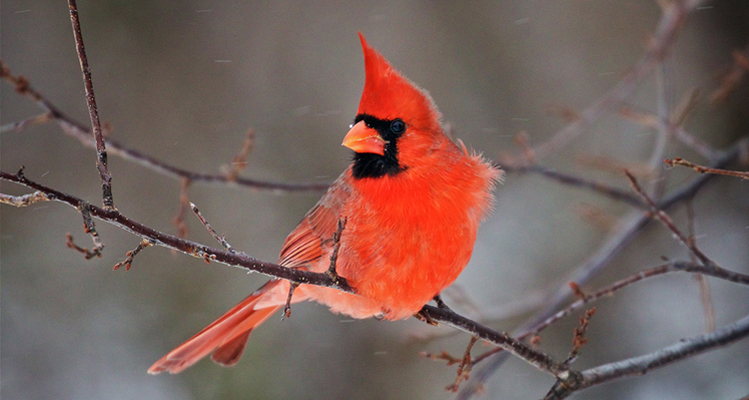
You might think that freezing temperatures and wind-driven snow pelting your face would make for poor photography. Normally I’d agree. However, there are certain places I like to go on a snowy day. One of them is the Sioux Falls Outdoor Campus near the feeders. If you are patient, there is a very good chance of spotting one of a few resident cardinals coming in for lunch or hanging around the nearby branches. The brilliant red of the male is always a joy to see, but seems to stand out even more beautifully amidst the snowflakes.

Friends and co-workers often tease me about how I’m becoming a birder, as if there’s something bad about that. I’m not a true birder, but I’ve taken more steps in that direction the last few years. True birders are interested in every bird they see or hear. I’m partial to the ones I think look cool in a photograph. True birders can tell you where migrating birds come from and about how long they’ll stay. I have to go to the internet for that kind of knowledge. True birders do this thing called”pishing” to get birds to show themselves and take good long looks at you. I try it sometimes, but I think the birds that show up are doing it more out of humorous curiosity than anything else.

Something that has really interested and awed me about birds is how much most of them travel. In the spring, we can get birds from as far away as South America. There is a similar story in the winter. Birds like Lapland longspurs from the arctic come down and hang out in open fields with flocks of horned larks. Bohemian waxwings, the northern cousin of our resident cedar waxwings, are a treat to see. But the most popular and exciting traveller from the north is the snowy owl. I’ve been lucky to see one in almost every winter over the last five years except this one, though it’s not for a lack of trying. I headed northwest of Aberdeen in mid-January, where one had been reported. I didn’t see it, but did I found flocks of snowy buntings, thousands of pheasants and a lone meadowlark, which is interesting because the closest they usually winter is Nebraska

A few Februarys ago, a local birder spent a lot of time looking for the little Northern Saw-whet owl in parks around southeast South Dakota. He reported three of them at Newton Hills State Park. Although these owls can be found along the Missouri River, particularly in the Pierre area at Farm Island and a few other hot spots, I did not know they would come this far south and east. So I went looking too. I failed miserably. On the third visit, I found dead field mice hanging on branches, which is good owl sign, but could not for the life of me spot the owl itself. Finally on my fourth or fifth try, I nearly walked headlong into the owl resting on a young cedar branch in the midst of a tangled thicket. I froze. Usually wild birds flush when discovered at close range. The owl looked at me for about 30 seconds then slowly closed its eyes and went back to sleep. It was an amazing, breathtaking encounter with a winter bird that I’ll never forget. Do seeking out and enjoying thrills like that make me a true birder? Not yet, but I’m getting there.

Christian Begeman grew up in Isabel and now lives in Sioux Falls. When he’s not working at Midcontinent Communications he is often on the road photographing South Dakota’s prettiest spots. Follow Begeman on his blog.

This slideshow requires JavaScript.

Posted on Leave a comment

Seeking Simplicity

The simplicity of a single leaf yet to fall, blazing orange in the early evening light. A long, straight road heading into the heart of evening. A lone bison against fiery clouds. Winter’s first blast against the straight walls of a country church. Visual eloquence. Nature being itself. Time churning, seasons turning. Each vision an echo of the reminder we all see this time of year. The seasons of growing, of life, have come to an end and winter has begun to reign on the high plains.

What if a photograph, or a series of photographs could capture that mood of transition? Recently a co-worker loaned me a DVD of longtime National Geographic photographer DeWitt Jones talking about his experience. One of his tips was simple, yet profound. Ask yourself,”What in the scene in front of you is good?” Once you’ve pinpointed that, then work to eliminate all the things that would distract from that one good thing you want to capture.

This isn’t easy to accomplish. Our world tends to be very complicated and full of things to see and do, and we are tempted to capture it all in one fell swoop. I’m as guilty as the next person. That is one of the reasons I wanted to try the simplicity idea. My tool of choice became the telephoto lens. Most photographers tend to think of the long lens as a sport or wildlife lens. However, it can also work wonders in isolating the detail of a leaf against an abstract background. Keeping your aperture low also helps the blur, or”bokah,” of the background stay pleasantly out of focus and less distracting.

I use a 100-400mm lens whenever I can. Sometimes I’ll even add a 1.4 extender, which gets me even closer to the subject. This set-up is also great for capturing birds. By November, most of the summer species have fled for warmer weather, but colorful and lively birds can still be found. While walking the trails of the Sioux Falls Outdoor Campus the day after our first snow, I was intrigued to watch a flock of finches, field sparrows and dark-eyed juncos expertly pick and eat the seeds out of the tall grass and dried out sunflower heads. A small, downy woodpecker flew out to a nearby tree while I stood there trying capture the simple beauty of these busy little bursts of life liven up a cold November day. Simple beauty sometimes happens where you least expect it. That’s the fun of trying new techniques and attempting to take images in a new way.

On Thanksgiving Day, after our feast, Dad and I went for a drive to catch the sunset. It had been cloudy and generally dreary for a few days, and the break on the western horizon gave evidence that the sun might make an appearance. The day was as still as you can get in the vast expanse of rural Dewey County. We drove to an abandoned church north and east of Firesteel and waited. When the sun burst out and the colors came alive, coyotes howled to the north and the sky began to make magic. The sun proceeded to paint the clouds various shades for 20 minutes until the light was gone. That simple beauty may have been brief but it will remain with me for a long time to come.

Christian Begeman grew up in Isabel and now lives in Sioux Falls. When he’s not working at Midcontinent Communications he is often on the road photographing South Dakota’s prettiest spots. Follow Begeman on his blog.

Posted on Leave a comment

The Early Bird Finds the Beauty

I was up before the sun on October 1. That in itself is a rare occurrence. I just can’t seem to get excited about super early mornings. I blame my younger years on the farm and countless pre-dawn milking sessions for that. I learned the luxury of sleeping in at an early age. But I digress. I was up early on October 1 to find and photograph fall colors along the eastern edge of the Coteau des Prairie, and I was not disappointed. Squinting into the rising sun while driving east along a winding road through the Big Coulee area north of Summit, I was greeted with a classic South Dakota scene complete with fall colors and a small white church in the distance. Later, I spent a few hours at Sica Hollow, one of South Dakota’s most colorful fall destinations. It was a good day searching for and finding autumn color.

About mid-month I found myself in Pierre late on a Saturday afternoon. I was pleasantly surprised that most of the cottonwoods below Oahe Dam were blazing yellow and orange, and the day was calm enough to attempt reflection photos in the marina at Oahe Downstream Recreation Area. And Capital Lake was almost still enough to be a mirror. You couldn’t have asked for a more perfect fall day. The next day I got up early again to check out Palisades State Park. Although the trees weren’t quite as far along, I found colorful leaf detail near King and Queen Rock.

When photographing fall foliage, I usually recommend using a telephoto lens and shooting from a distance to pull as much color into frame as possible. This year, I tried the same technique but with leaf detail. If I found a leaf I liked, I tried to put a colorful background of other foilage behind it and then shot it with a long lens. It made for a different way to enjoy and record autumn. Another trick when shooting in the woods is to include a sunburst with a wide angle lens. Find a scene you like and position your camera relative to the sun so it is just past a distant branch or leaf. It helps to have your aperture set high (f16 or so) to get more rays from the burst.

Just last weekend, I helped some old college friends take family photos at Union Grove State Park. I don’t usually photograph people, but in all honesty, the best fall photos usually include humans. Whether it is kids jumping in a leaf pile or a couple walking hand in hand under a canopy of colorful leaves, human interaction simply adds so much more to a happy autumn scene. Even though October is almost over, there are still leaves on the trees or piles on the ground, so it’s not too late to get out there and get some memorable photos. Another good thing about this time of year is that beautiful, early morning light doesn’t happen quite so early, so getting out of bed to get those photos is definetely doable. At least that’s what I tell myself when setting the alarm the night before.

Christian Begeman grew up in Isabel and now lives in Sioux Falls. When he’s not working at Midcontinent Communications he is often on the road photographing South Dakota’s prettiest spots. Follow Begeman on his blog.

Posted on Leave a comment

The Color of September

A passion for nature photography has accompanied me for many years, and I’ve learned a few things along the way. One of the most important is that nature is medicine. Good medicine. A perfect example was what happened to me just days ago. The previous workweek had been tough, with a lot to do and not a lot of time in which to actually do it. Admittedly, part of the problem involved me taking off the last week of September to chase fall colors in the Black Hills. As much as I wanted to head west as soon as I checked out late on Friday, I wasn’t able to hit the road until Monday, which made me anxious, irritable and simply a big old grouch. By the end of the day as I stood quietly on a hillside in the Sage Creek Wilderness of Badlands National Park, things were completely different. The late light accented fall foliage in the high draws, and the evening shadows played along the rugged landscape in the distance. All the angst from the week before melted away. I felt like a new man. That’s the kind of medicine I’m talking about.

So I thought this time I would share a few other things I’ve learned along the way, especially about shooting photos in September:

  1. Ever since I can remember, the colors of Spearfish Canyon peak during the last week of September. If you can be there on or around September 25-27, then you should see the good stuff.
  2. Fall colors typically start in the high country first. Spearfish Canyon, the upper parts of Slim Buttes and Cave Hills are good examples. Then the color seems to spread to creek and river bottoms. The last trees to turn are often the non-wild trees in town. So don’t worry if you miss autumn in Spearfish Canyon. There are still opportunities to enjoy the color.
  3. Early September is a great time to watch for migrating butterflies and songbirds. From hummingbirds to Monarchs, the small flying ones are on the move to warmer climates.
  4. It is easiest to get up close to Monarchs during the migration south. The butterflies are in heavy feeding mode, and will often tolerate a nearby camera lens as long as you approach slowly and don’t block the sun (try not to put your shadow on them).
  5. Aurora like the equinox. For whatever reason, even a relatively small solar wind causes northern lights around the first day of fall (and spring), so hope for clear skies and free nights to get out and photograph them.
  6. September is also a good time to go looking for the big animals. Bison are coming out of their rut in early September, and then elk start harem building and bugling. Finally, whitetail and mule bucks start gaining weight as their rut approaches later in the year.
  7. Rabbits can be scary. I know that seems odd to say, but those rascals like to sit still and out of sight until you are almost on top of them. Then, out of nowhere, they explode from the tall grass and bound away as you fight to get your heart back out of your throat.

You know, the more I think about number 7, it could just be me. Day-old fawns and pheasants have done the same thing to me. It’s not that the animals are scary; it’s the unexpectedness that gets me every time. But I’ll take a rabbit, fawn or pheasant any day — and twice on Sundays — over the dreaded rattler.

Christian Begeman grew up in Isabel and now lives in Sioux Falls. When he’s not working at Midcontinent Communications he is often on the road photographing South Dakota’s prettiest spots. Follow Begeman on his blog.

Posted on Leave a comment

Painting with a Lens

I was buzzed by a ruby-throated hummingbird as I walked along Sargent Creek in Newton Hills State Park this spring. I soon found its perch in some nearby bushes. It was early evening and the valley was in shadows, so I had my aperture wide open to let in as much light as I could. The resulting photo was a pleasant surprise, as the wider aperture caused the background leaves to blur. This effect, plus the flowing lines of the bending branches, almost made the photo appear to be some sort of Impressionist painting.

Nature certainly has influenced the world of art — from the very first pictographs on cave walls to Vincent Van Gogh’s Starry Night. In the last few years, printing photos on canvas has become popular, and every so often photographs can get mistaken for paintings using this medium. Since I’ve only taken a few art classes in my life, most of what I think of as”artistic” is gut feeling. I don’t want to discount technique, like using leading lines and the rule of thirds, but for me, artistic photos are about the subject matter first and editing technique second.

South Dakota can bless us with amazing clouds. For me, the storm cloud is the best. I like to shoot wide scenes, then render out the photo as contrasty black and white to give the scene a more timeless and dramatic feel. Flowers, on the other hand, are small and intense points of color dotted along the prairie. I love to shoot their detail and artistry with a macro lens. However, this summer I also tried to seek out wildflowers growing together with other species. These natural bouquets are worth looking for, as the color combinations can be quite eyecatching. Another fun technique is to open up the aperature and let the background go completely out of focus. I shot a growth of wild flax in Custer State Park this spring using this method. I loved how the blurry flowers in the background looked like paint daubs of color against the grasses.

A technique to consider for artistic photography is using HDR, or High Dynamic Range. You take multiple images of the same scene at different exposures. Then you combine all the sensor information from these files into one image in post processing software to get as much detail and color information as possible in the shadows and highlights. Recently, a huge storm in northwest Iowa and southwestern Minnesota provided jaw-dropping mammatus clouds above Falls Park in Sioux Falls. I photographed this with HDR in mind by taking three exposures at every scene: one image two stops high, one exposed correctly and one two stops low. The resulting files gave me all the detail I needed to render the scene as I saw it when photographing it. The clouds were some of the more dramatic I’ve ever seen, which didn’t hurt, but because of this technique and the rarity of the clouds, I received many comments wondering if the images were real, paintings or total photoshop fabrications.

All that said, every once in a while something happens in front of your lens that cannot be planned or edited. Like my hummingbird at Newton Hills, or a chance encounter with a doe on a snowy country road, or my favorite, the absolute beauty and grace of a snowy owl upon take off. Those unexpected moments of artistic beauty simply happen, and only by being out there in nature with the camera ready will we ever have a chance to see, let alone capture them.

Christian Begeman grew up in Isabel and now lives in Sioux Falls. When he’s not working at Midcontinent Communications he is often on the road photographing South Dakota’s prettiest spots. Follow Begeman on his blog.

Posted on Leave a comment

Fire and Ice

It hasn’t exactly been a long, cold winter, but for a photographer who likes summer thunderstorms and night skies filled with the Milky Way and the call of nighthawks, it has been at least been a long winter. The short days are finally lengthening again, and it seems that spring is making an early push. I’m not complaining, but there is one thing about winter that I tend to miss during the high heat of summer. Sunsets come early in the evening, and the warm, fiery colors in the southwest sky contrasted with the cold, blue-toned snow and ice is one of the visually exquisite gifts of winter.

I haven’t been able to get out and shoot as much as I’d like this winter, but because the sunsets tend to happen around”quitting time,” I do occasionally chase a sunset if the mood strikes and the sky looks promising. The first few photos of this collection show the evolving colors of a sunset on a January evening in Sioux Falls.

The last few photos happened just last week as one of the most spectacular and unexpected sunset skies blazed for a few minutes over Sioux Falls. Earlier in the afternoon, the clouds looked promising for a colorful sunset. However by the time I broke free of my daily duties at around 5:45 p.m., it looked as if the sky would totally cloud over. There was still a slim opening to the sky in the southwest, so I took a chance. I gathered my gear and headed to Falls Park. As I was driving there, the sky began to bloom with color and I realized it was going to be good. But that’s when the stoplights and traffic on Cliff Avenue slowed to an agonizing crawl. I was sure that I waited too long, and now the busy Sioux Falls traffic was going to keep me from capturing anything worthwhile.

When I arrived on the east side of the park the parking lot was full. I grumbled under my breath, realizing I would have to park as far away as possible from the spot where I wanted to set up. Meanwhile the sky was turning more beautiful by the second. Once the engine was off, I grabbed my camera bag and tripod and began to half run, half slip and slide my way down the sidewalks to the overlook. Like an unknown Marvel superhero, my hands were a blur as I ripped open the bag and assembled the camera to the lens and then to the tripod. Snap! I got the first photo. Whew! Relief and joy descended down my spine, and the tension of possibly missing the shot began to melt. The sky turned orange, and then pink and purple. I shot video clips and multiple bracket shots of the falls, and it was all glorious.

The recent warm weather had caused the ice on the lower part of the falls to disappear, yet there was ice cover over the top. The resulting view and relatively warm weather (for February) along with the fiery colors in the sky really made the scene before me look like spring was breaking through Old Man Winter’s grip right before my eyes. Maybe a beginning of the end of another long, cold winter in South Dakota? I hope so.

Christian Begeman grew up in Isabel and now lives in Sioux Falls. When he’s not working at Midcontinent Communications he is often on the road photographing South Dakota’s prettiest spots. Follow Begeman on his blog.

Posted on Leave a comment

In Search of Frost

Frost is a beautifully peculiar thing. The first frost of autumn often comes too early, when green tomatoes still dangle from the vines. The first hard frost on my windshield is an annoying reminder that winter is coming (along with morning scraping). In literature and poetry, frost is often equated with something mischievous (Jack Frost) or with death. Frost is also an enemy of our power companies. When accompanied by a strong wind, heavy frost can wreak havoc with power lines and power poles. And yet, I still like the phenomenon that is frost. I can’t help it. What other weather event can transform a mundane scene to a dramatic vista straight out of a fantasy novel or movie?

Frost is not particularly easy to photograph. First, the conditions have to be just right for frost to cover the landscape. There are two kinds of frost that typically do the trick. White frost forms when there is a relative humidity above 90 percent and a temperature below 18 degrees Fahrenheit (like the foggy nights in early winter we’ve experienced this year). It grows against the wind direction, since air arriving from windward has a higher humidity than leeward air. Hoar frost forms on cold, clear nights when heat radiates out to the open sky faster than it can be replaced from nearby sources, such as wind or warm objects. The name “hoar” comes from an Old English adjective meaning,”showing signs of old age,” so think of the frost as adding white hair to objects.

Since frost is white and your camera’s metering is basically trying to find the correct exposure for medium gray (not too bright or not too dark), photos of frost are often underexposed. In other words, your camera wants to make sure nothing is overexposed in the image, so it tells you to expose white frost closer to gray than white. Because of this I try to shoot around one full stop brighter than my camera’s meter suggests when shooting frost or snow.

Finally, frosty weather means it is likely very cold outside. Winter temperatures are often accompanied by bone-chilling north winds, and that means frost usually does not stick around very long. I like to shoot frost against a clear blue winter sky, but oftentimes have to settle for fog and mist because once the sky clears, Jack Frost has been chased away by winter’s winds. Fog and mist can, however, add another mystical element to your winter photos, so all is not lost. I like to find an element of color to use in frost photos if possible. Including a red barn, for example, can add a much-needed punch of color to an otherwise coldly beautiful scene. That’s the thing about winter in our great state — as dangerous and deadly as it can be, it can also be beautiful. There is probably some life lesson in there somewhere. If I were a smarter man, I might be able to work it out, but for now, I’ll just take my camera out into the elements and enjoy the beauty.

Christian Begeman grew up in Isabel and now lives in Sioux Falls. When he’s not working at Midcontinent Communications he is often on the road photographing South Dakota’s prettiest spots. Follow Begeman on his blog.

Posted on Leave a comment

The Spooky Side

I’ve spent a lot of time alone wandering the back roads of South Dakota. Like many photographers, I’ve been attracted to ghost towns and abandoned structures. I’ve also spent hours in church yards next to tombstones, shooting the stars as they wheel around church steeples. There are times when I have to truly focus on what I’m doing and not let my imagination wander. If I don’t, random ghost stories float like faint apparations into my mind. And I’ve heard some good ones.

Over the last few years, I’ve been truly terrified a total of three times while shooting photos. Each instance was more about unexpected situations than anything unexplained, but as any good horror film director knows, the unexpected is what frightens the best. In my case, the unexpected was South Dakota’s wildlife.

I unknowingly stepped on a slumbering hen pheasant in tall grass along the Grand River one foggy spring morning. I don’t know whose noise was worse, the pheasant’s or mine. Later that summer, I was walking the hills above Lake Hiddenwood when I nearly stepped on a white-tail fawn hidden in the grass. When it jumped up and bounded away, I admit to letting out a sound that resembled more of a squeal than a warrior’s battle cry. The last instance happened while shooting an abandoned church in Mellette County. I walked up to the steps, slowly scanning all around for anything that might jump out. I didn’t see anything until my first step up the concrete steps. One of the largest rattlesnakes I’d seen in some time buzzed as loud as I’ve ever heard, and my heart was instantly in my throat as I fell back hollering in fear and surprise.

Because of these experiences, I’ve learned to make plenty of noise while approaching structures or places that could hide wildlife. In September, this tactic actually worked. I was stomping and talking out loud to myself while approaching an abandoned building when I started to hear scratching inside. I froze. The last thing I wanted was a rabid skunk or something worse coming out. Strangely, the scratching ascended the inside walls and soon a ghostly face was staring at me through the broken window. I had awoken three barn owls, and two them were climbing the walls to see what all the ruckus was about. I went to get my long lens from my vehicle, and the climbing owls took the opportunity to vacate the building.

It was my first time seeing barn owls. These guys are spooky. They hiss and scratch and have a very odd defensive response that I witnessed when I came back with my telephoto lens. The big female had remained inside. It bowed in my direction with its wings out, as if opening a cape, and then slowly shook its head back and forth. Then she slowly raised her head again, gave me a long look and then started bowing again. It was one of the strangest and creepiest things I’ve ever seen a wild animal do. I later read that Native Americans called them ghost owls, and I can understand why.

One doesn’t have to seek out owls to shoot photographs that fit the Halloween season. South Dakota has many abandoned structures across the countryside. I wouldn’t enter any without first getting the landowner’s permission. Shooting from the road is often all you need to capture the lonesome buildings against an expansive sky.

Capturing photos of uncommon weather phenonoma like fog or even the northern lights can also evoke strange and beautiful images. The moon in its various phases is another good subject. I like to shoot it framed with things like gnarled tree branches if possible. Another trick is to shoot in the early evening while there are still blue skies. Then, using the black and white filters in your editing software, you can turn that blue to black for a more stark rendering.

Whether you are shooting the moon, seeking owls or simply keeping your little ones safe as they empty the neighbor’s candy buckets, here’s to a safe and fun Halloween. And if you want a creepy, true Halloween story, read this from Mike Crowley’s blog about Thunder Butte. I have to stop myself from thinking about it when I’m out and alone in the South Dakota night.

Christian Begeman grew up in Isabel and now lives in Sioux Falls. When he’s not working at Midcontinent Communications he is often on the road photographing South Dakota’s prettiest spots. Follow Begeman on his blog.