Posted on Leave a comment

Finding the Wilds of Winter

Spotting winter wildlife on the Northern Plains can sometimes seem impossible. Frigid temperatures, relentless wind, snow and ice usually keep critters out of sight during the diminished daylight hours. When I was in junior high, I spent a good chunk of an afternoon sitting in what I thought was a pretty good hiding spot overlooking a stock dam bordered by a chokecherry thicket. A recently deceased cottontail was on the edge of the ice, placed as a lure. I think I hoped a hungry coyote or maybe even a hawk or eagle would arrive. Nothing did. All I heard was the wind though the thicket and all I saw was gray and sullen clouds overhead.

I’m not sure when I figured out that the golden hour was when wildlife is most on the move. Maybe it was deer hunting with my brother or simply noticing more things after I shut the tractor down for the day. This tip generally still holds true when I’m out looking for wildlife with my camera. Not only are there more opportunities to see wildlife, but the golden hour provides beautiful light. Win-win.

It has been my family’s custom to find time to survey the countryside when we get together for the winter holidays. To this day, I keep this tradition alive. Sometimes I’m with my dad, sometimes with brothers and nephews and sometimes it is just me and my camera. This year, I spent three days looking for wildlife in Badlands National Park, Custer State Park and Wind Cave National Park between Christmas and New Year’s Day. And yes, late afternoon and early morning proved to be the most fruitful times.

I arrived in the Badlands around 3 p.m. on December 27. This may seem like mid-afternoon, but winter light is short-lived and angled low and lovely, which is a photographer’s delight. At 3:20 a great-horned owl was out on a ridge waking itself up in the sunlight. About a half hour later I spotted a golden eagle riding updrafts near the Sage Creek Wilderness Road. After photographing a few solitary bison bulls, I headed west and got to Custer State Park with very little light left on the western horizon.

Overnight, a skiff of snow fell in the Southern Hills and there was frost on the grass as I headed to a favorite spot along Highland Ridge Road in northern Wind Cave National Park before sunrise. There were elk below the ridge and bison on the horizon as the sun appeared with warm tones even though the temperatures were well below freezing. As the day lengthened the light brightened, the wind increased and the frost fell to the ground. After driving a few of my favorite routes, I ended up calling it day fairly early. I repeated this routine for the next few days, and it was glorious. Here are some of my favorite photos from that vacation. I’m already counting down the days for another foray or three into South Dakota’s winter wilds.

Christian Begeman grew up in Isabel and now lives in Sioux Falls. When he’s not working at Midco he is often on the road photographing South Dakota’s prettiest spots. Follow Begeman on his blog.

This slideshow requires JavaScript.

Posted on Leave a comment

Mulled Wine, South Dakota Style

The warmth and spiciness of mulled wine makes it a favorite winter drink.

Our South Dakota Magazine crew started a coffee house called Muddy Mo’s in downtown Yankton a few years ago. On a frigid Saturday last winter, we decided to make mulled wine, both to warm our customers as they came in from the cold and also to try something new, which was the very inspiration for the shop.

Mulled wine is warmed wine with spices added, but a quick Google search shows recipes from across the world using varied ingredients and techniques. Not one to overthink, I quickly decided to mix an affordable red wine with some mulling spices from my local supermarket. Soon after pouring the simple concoction into a crockpot, a delicious cinnamon and orange aroma wafted through Muddy Mo’s — and it quickly drew customers who were happy to weigh in on my makeshift recipe.

“This is strong, too strong for mulled wine,” observed one kindly woman, who nevertheless drank several $2 glasses. Another visitor suggested that we add honey and offered to share his recipe. Someone asked if we could mix in a little apple cider next time. I don’t remember when something on our menu inspired so much conversation and interaction among customers.

Humans have been warming wine and adding spices since the dawn of the Roman Empire. The spice worked wonders to hide the taste of inferior wine, but it was also believed to strengthen immune systems during winter. Early recipes included saffron, pepper, laurel, dates, cinnamon, cloves, nutmeg, marjoram and cardamom.

Part of the fun of mulled wine is taking the ingredients and creating your own recipe. But, to ensure better success at the coffee shop this winter, I spoke to wine experts from across South Dakota. They were happy to share their recipes, along with ideas on what makes mulled wine the perfect winter drink.

SchadÈ Vineyard & Winery

VOLGA

Similar to our experience at Muddy Mo’s, Nancy Schade enjoys the community that mulled wine creates.”When you make it, it just brings people together. And there are opportunities to share recipes, because everyone has a different recipe,” she laughs. Jim and Nancy Schade founded the winery in 2000, and recently passed it on to new owners Dillon and Shelby Ringling.

Nancy recommends using SchadÈ’s Raspberry Apple Wine for mulling. The raspberries and apples are grown in South Dakota, giving a local taste to an internationally enjoyed drink. Nancy’s recipe is simple. She uses a 1:1 ratio of the Raspberry Apple wine and apple cider.”The cider gives the finished product a fuller flavor,” she says. Next, add mulling spice packets and warm the wine and cider in a crockpot (not to a boil). The winery sells its own mulling packets, but in a pinch, you can also find them at many supermarkets.

Prairie Berry

HILL CITY

Laura Schluckebier

Laura Schluckebier, the sales and hospitality manager at Prairie Berry, grew to love mulled wine during her time at the Hill City winery.”It’s made to share with other people,” she says.”As soon as the leaves change, people come in to have mulled wine next to our fireplace. The guests expect it.”

Mulling wine has also evolved into a family tradition for Schluckebier.”We go skiing at Terry Peak, then go home to drink mulled wine. Or we will split wood and then make mulled wine. It’s a tradition to do things outside in winter, then to share the drink. When you make it, it smells wonderful and it’s warming all around.”

Sandi Vojta, owner of Prairie Berry, became a fifth-generation winemaker at the age of 4 when she experimented with yeast and fermentation, she told us in a 2011 story for South Dakota Magazine. Her dad would take her out to pick chokecherries for wine, tying a piece of twine with a pail attached to her waist so she could pick berries with both hands.

Schluckebier recommends using Prairie Berry’s Pumpkin Bog for mulling. Made with South Dakota grown pumpkins, it’s slightly sweet with”undertones of cranberry and lemon zest.” Pour one bottle of Pumpkin Bog into a slow cooker on low heat. Add two tablespoons of light brown sugar, two tablespoons of mulling spice and orange slices. Leave on low for 45 minutes, making sure it does not boil.

After 25 years of producing internationally-award-winning wines, Prairie Berry will be closing soon. Sandi and her husband, Matt Keck, will continue selling as long as they have inventory. Pumpkin Bog was still available for purchase as this magazine went to print.

With the Wind Vineyard & Winery

ROSHOLT

Lisa Klein

Lisa Klein, who owns With The Wind along with her husband, Jeremiah, uses their Sacred Solitude wine for mulling. Made with locally grown Frontenac grapes, this dry red is complemented by Lisa’s recipe that includes orange juice and brown sugar.

Klein says mulled wine helps her embrace winter and everything that comes with it.”I’ve spent evenings wrapping presents while having mulled wine simmering on the stove,” Klein says.”We drink it while gathering with friends. During a frigid winter, it’s such a warm thing to serve your guests. You can’t get away from winter, so you have to embrace it.”

The Kleins have operated With the Wind for over 10 years. They hold wine tastings and events at their vineyard, where they tend to over 5,000 vines.


Sacred Solitude Mulled Wine

2 bottles of With the Wind Sacred Solitude wine

2 cups orange juice

3/4 cup (or to taste) brown sugar (or substitute maple syrup or agave)

2 oranges, sliced

1/2 cup fresh cranberries (optional)

10 whole cloves

6 cinnamon sticks

  1. Place a medium saucepan over medium-high heat on the stove.
  2. Add the orange juice and granulated sugar and stir until the sugar is dissolved.
  3. Add the red wine and all of the spices and fruits. The spices will be whole, not ground in a container, so their flavors will infuse into the liquid.
  4. Reduce the heat to low and simmer the mulled wine for 30 minutes. At this point, taste and adjust the flavor as necessary. You can simmer for up to a couple hours. Garnish with cinnamon sticks, orange peel or cranberries.

Mulled Wine can be paired with many foods. In Europe, it is often served at festivals with roasted chestnuts, and it’s also common to serve with roasted meats during the holidays. We asked Prairie Berry and SchadÈ wineries to share their favorite recipes to make with mulled wine.

Nancy Schade’s Never Fail Apple Dessert

Mix and put in a 9×9 inch pan:

4 cups sliced apples

1 teaspoon cinnamon

1 tablespoon flour

pinch of nutmeg

3/4 cup sugar

Mix together and spread over apples:

3/4 cup oatmeal

1/4 teaspoon baking soda

3/4 cup flour

1/2 cup melted butter

3/4 cup brown sugar

1/2 teaspoon salt

Bake at 350 degrees for 30 to 40 minutes. Cool and serve with ice cream or whipped cream.

Prairie Berry Kitchen’s Classic Cheese Fondue

1/2 pound imported Swiss cheese, shredded

1/2 pound Gruyere cheese, shredded

2 tablespoons cornstarch

1 garlic clove peeled

1 cup dry white wine

1 tablespoon lemon juice

1 tablespoon cherry brandy

1/2 teaspoon dry mustard

Pinch of nutmeg

Coat cheese in cornstarch. Rub fondue pot with garlic, then discard. Over medium heat, add wine and lemon juice. Bring to a simmer. Gradually stir in cheese, melting slowly to encourage a smooth texture. Stir in brandy, mustard and nutmeg. Serve with French bread, Granny Smith apples or blanched veggies.

Editor’s Note: This story is revised from the January/February 2025 issue of South Dakota Magazine. To order a copy or to subscribe, call (800) 456-5117.

Posted on Leave a comment

Winter Mornings in West River

Highland Ridge Road in Wind Cave National Park is one of my favorite places to experience the breaking of a new day. Flanked by prairie dog towns and grazing buffalo, an early riser is sure to hear a coyote chorus across the rolling landscape. If you are really lucky, grazing elk, pronghorn and even a glimpse of one of the coyote choristers is possible when the morning light breaks above the distant Boland Ridge to the east.

I spent two mornings in early January getting my fill of morning’s glory in this special place. The first morning was mostly clear and the rising sun revealed pronghorn grazing on the edge of a prairie dog town with a small herd of bison in the distance. Coyotes sang all around me, unseen but close enough to count five distinct voices. Elk grazed on the northern ridge just opposite Custer State Park’s southern fences. It’s no wonder that folks liken this part of South Dakota to the Serengeti in East Africa. I have visited both places in the morning, and the experience does have similarities when it comes to wildlife and natural beauty.

As the morning progressed, I noticed slight hoarfrost in the lower draws of the park. Hoarfrost forms when water vapor in the air condenses on cold surfaces on clear, windless nights. Crystals freeze directly from the vapor state and do not turn into liquid water in the process. This is different than rime ice that is seen accumulating during fog events. Hoarfrost is typically finer and more delicate, but it is just as fun to photograph. With my trusty macro lens and some bright sunlight to help light the minutiae of grass, chokecherry branches and slender yucca blades adorned with ice structures, I spent nearly an hour bent close to the earth trying to record the beauty in detail. During the process, I came across a young buck overseeing a small group of mule deer. The does did not seem concerned, but they moved after the buck decided I was too close.

On the second magical morning, the sky was gray and colorless. There was fog in eastern parts of the park, which left rime ice on the grass and pine trees. Three bull elk weren’t far from the road and allowed me to photograph them before moving on. It was my last day of my West River winter vacation, and it did not disappoint. As is my usual habit, I detoured through Badlands National Park. Strong flurries added snowy drama to the scenery. My favorite sites were a few lone bison moving slowly through the weather and the colorful Yellow Mounds portion of the park framed by white snow. Winter in South Dakota may not get raving reviews, but in this case, my camera says otherwise.

Christian Begeman grew up in Isabel and now lives in Sioux Falls. When he’s not working at Midco he is often on the road photographing South Dakota’s prettiest spots. Follow Begeman on his blog.

Posted on Leave a comment

Needles Highway in Winter

Needles Highway is also known as Highway 87. It is part of the Peter Norbeck Scenic Byway, a 66-mile circle that also includes Iron Mountain Road. When snow become too deep for vehicles, state officials close it until snowplows are able to reopen the route. During such closures, hikers are welcome.

Rich Zacher and his family happily welcomed a foreign exchange student from the Czech Republic last winter, but they struggled to entertain the worldly teen.

“Of all the places we showed her in South Dakota, the thing that she really enjoyed was hiking the Needles Highway in winter,” Zacher says.”That and a rodeo at the Monument.”

The young European has good taste in hikes. More and more people are discovering that the historic, 14-mile Needles Highway (aka Highway 87) takes on a special ambience when experienced afoot in a landscape of white. Perhaps that’s because the steep and winding route — which ranks among America’s crookedest roads — was designed on foot.

“You are not supposed to drive here at 60 miles an hour,” said Peter Norbeck, a visionary leader who founded Custer State Park in 1913 when he was still a state senator.”To do the scenery half justice, people should drive 20 or under; to do it full justice, they should get out and walk.”

Norbeck, despite his portly 240-pound frame, did literally walk the high country as he personally selected the route.”With C.C. Gideon and Scovel Johnson, state engineer, he tramped the trails on foot because horses could not walk over much of the terrain,” wrote author Gilbert Fite in a Norbeck biography, Prairie Statesman.”Working their way through towering granite cliffs and heavy forest, they finally traversed the entire distance of a road which would take tourists through the Needles. The governor’s trousers were badly torn and his legs were scratched.”

Summer traffic makes it difficult to enjoy the Needles Eye Tunnel, but winter hikers like Michael Belmont and his golden retriever, Salvatore, can dawdle in the unusual passageway.

Fite noted that Norbeck and the road engineers had heated arguments.”His desire was to preserve the natural beauty and to build roads where the public could obtain the best artistic view. This contradicted commonly accepted engineering principles, but his policies usually prevailed.”

Fite wrote of a particular day when Norbeck sat on a log, breathing heavily, and asked Johnson whether he could build the road.

“If you can furnish me enough dynamite,” Johnson answered.

Norbeck was then governor. He found both the money and the dynamite, and Needles Highway opened to traffic in 1922. It became a huge success for South Dakota. Up to 1,700 vehicles now pass through on a busy summer day, maneuvering the dips and dives and hairpin turns, and squeezing through narrow tunnels designed for Model A’s rather than today’s big SUVs. Though 1,700 a day may not sound like a huge number, it’s enough to cause congestion — especially at the two tunnels — because, as Norbeck planned, the drivers crawl along at 10 to 20 miles per hour.

Since the highway is difficult to clean after heavy snows and dangerous to drive when the roadway is icy, the northern half has long been closed to car traffic in winter. Zacher, a 29-year veteran of the State Transportation Department (he now serves as Area Engineer for the Black Hills region), says the state kept it open for a winter about 30 years ago as a test.”We did a count to see if there would be any traffic, but the only people who drove it were Custer State Park employees looking for a shortcut from Sylvan Lake to the park headquarters. Except for them, there was zero use.”

Consequently, the state highway department still blocks the road with steel gates on the day before the first forecasted snowfall. That creates a one-day holiday for Black Hills bicyclists.”We get more calls asking when we are going to close it than we get in the spring about when it’s going to reopen,” Zacher notes.”The bikers want to bike the dry pavement before that first snow, without the car traffic.”

Once closed, a 7-mile stretch beginning at Sylvan Lake stays off-limits to cars and trucks until spring.

*****

We parked by the lake and walked the highway on a January morning. Several inches of snow had fallen overnight. There was one other set of tracks, so we knew we were not the first.

With only a few inches of snow on the pavement, walking was easy. The snow muffled the forest. Soon after passing the winter gate at Sylvan Lake, the only reminders of civilization were road signs, bridges and the tunnels that were blasted with Norbeck’s dynamite.

In summer, the road seems like a busy Main Street carved through a forest. On the frosty, cloudy winter morning we arrived, it was so quiet that you could hear tufts of new snow slipping from the pine branches. A squirrel playing in the banks and a few small birds were the only living creatures to be seen.

You hear no traffic, no livestock and no people — only your own feet loudly crunching in the snow. The silence and the scenery combine for an apocalyptic atmosphere, as if all the world has frozen and you are alone with nature on a good day. Civilization is represented only by the concrete ribbon of highway and yellow road signs that warn of curves and tunnels.

Iron Creek Tunnel, one of two tunnels along the winter hike on the Needles Highway, has an elevation of 5,285 feet, considerably lower than Needles Eye Tunnel, which stands at about 6,000 feet.

The Needles Eye Tunnel is just a mile or so from Sylvan Lake. In July, you wouldn’t dare to walk through the 8-foot tunnel for fear of being hit by a car, but in January you can take all the time and photographs that you desire. You might see bits of red and orange glass along the tunnel’s edges, evidence that a car or truck grazed the granite.

Further along, the jagged and jutting Needles spires inspire your imagination. You discover granite heads, shoulders, fingers, castles and caves. Soon after you pass the Needles Eye Tunnel and the nearby Cathedral Spires formations, the roadway descends nearly a thousand feet as you exit some of the Black Hills’ highest country. Walking is easy. You can either continue another 4 or 5 miles, covering the entire stretch of highway that is closed (if you have a way to return to your vehicle at Sylvan Lake) or you can retrace your steps. We went back to our car.

*****

The next morning, we drove east of Custer into the park on Highway 16 and turned north on Highway 87, which is the southern segment of Needles Highway. That stretch remains open in winter for about 6 miles. Once you reach the winter gate, which is north of the Playhouse Road, you can park and proceed on foot.

Zacher, the DOT engineer, asks that you never block the winter gates with your car.”You never know when an emergency services vehicle may need access, or we may be on our way to open the road and need access.”

The southern hike differs from the northern. Now you are lower in the forest. The pine trees are thicker and you’ll hear the gurgling of running water, though the stream, Iron Creek, is often invisible below ice and snow.

As with the northern route, you arrive at a hole in a mountain — the Iron Creek Tunnel — after less than an hour of walking. The two tunnels are milestones for winter hikers.

Dan Ray, an outdoor enthusiast from Rapid City, says both tunnels can be challenging.”Sometimes you have to break through a drift on one side or another. Sometimes the opening is completely blocked, I’ve heard tell, and that could be a blast to push your way through.”

Ray says some people use cross country skis on the roadway, though drifts and deep snow can make skiing difficult. He says snowshoes are helpful.”Prepare for 3 feet of non-packed snow, and if you are in a group, switch up who’s in front often.”

Ray also advises against blue jeans.”If you sweat or trip and fall in the snow, the jeans will get wet and then freeze. You will be miserable. Wear nylon pants and long johns that are polyester based. In the winter, cotton kills if you get it wet.”

Ray also recommends that hikers carry water, but leave the camelbacks at home.”They do not work well in winter. The water line from the bladder and the mouthpiece will freeze solid if it’s cold. Water bottles work well.”

While thousands of people travel the road on a summer day, park officials say a dozen or less usually do so in winter — partly because many hikers don’t know that the opportunity exists. Michael Belmont and his wife, Amy Hornstra, of St. Anthony, Minnesota, learned about it when they stopped at an art studio in nearby Hill City.”My husband asked the clerk for suggestions, and she told us you can hike Needles Highway.”

Hornstra, a native of Yankton, said the highlight for them was,”having the road to ourselves. The area is gorgeous Ö it was peaceful and beautiful. We have both hiked many parts of the world, and the Needles Highway now ranks near the top of our favorites list.”

She also recommends dressing for winter.”We were very happy that we both had on boots, as there were parts where the snow had drifted and was fairly deep. Other parts of the road were clear.”

In winter, many of the Black Hills’ other popular trails can become treacherous due to buildups of ice and snow. Ironically, the famous Sunday Gulch Trail, which also starts at Sylvan Lake, is closed to hikers in the winter because it is considered so dangerous. That makes the Needles Highway an even nicer find.

Norbeck is now remembered as the father of the highway and Custer State Park. Though he loved the outdoors, he wasn’t a hunter or fisherman. He found joy in the splendor of the natural world, and he would be delighted to know that hikers are following his very footsteps.

We thought of him as we enjoyed his creation. One man or woman can truly make a difference, given enough dynamite.

Editor’s Note: This story is revised from the November/December 2023 issue of South Dakota Magazine. To order a copy or to subscribe, call (800) 456-5117.

Posted on Leave a comment

Postcards from December

As another year comes to an end, I find myself watching the weather closely like most of us in the Upper Midwest. When there is fog and overnight lows below freezing, I really pay attention. I know those conditions mean there is a good chance of frost appearing, which means great opportunities to find and photograph ordinary scenes that become transformed into extraordinary winter works of art.

This year what little snow we had in early December melted on a few relatively warm days, but the cold nights caused the moisture to return again in the form of fog and rime ice. Rime ice is the scientific term for it, but folks around here know the phenomena simply as frost. I particularly enjoy when frost appears like it did this season, with little to no snow to hinder traveling. I have family in the northeastern and north central part of the state, and this winter I’ve found myself on the road more than usual with holiday travel and attending basketball games. For two of those trips Jack Frost was hard at work, so I left early to see what I could find.

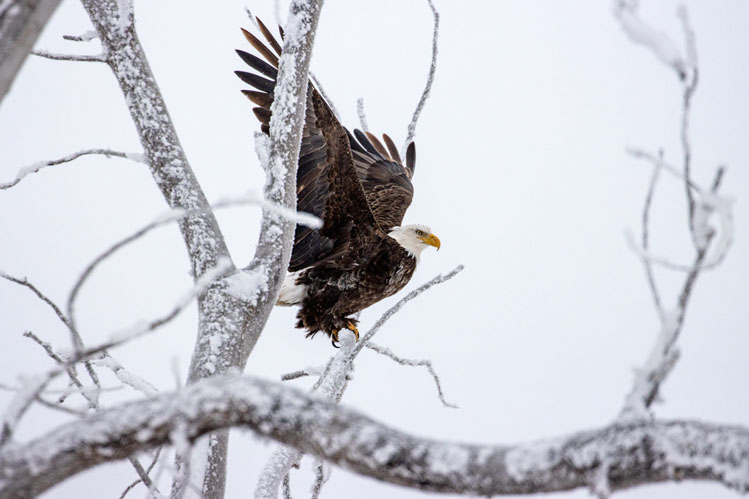
On Christmas Eve I was due in Mobridge for supper. That gave me all day to search out frosty art on my way. I started at Terrace Park in Sioux Falls. Ornamental cherry trees still had red fruit attached and few leaves had yet to drop. These provided excellent bases for frost to accumulate. After about an hour, I drove up to the Dells of the Big Sioux, stopping to shoot a favorite red barn and the railroad tracks that go through downtown Baltic. At the Dells, a pair of bald eagles were patrolling the river, and I was lucky enough to watch them fly below me as I was checking out the scenery.

From the Dells, I drove west to Highway 81 and then turned north after detouring through Lake Herman State Park near Madison. I stopped in the city park at Arlington where the rime ice was particularly thick. An old red hydrant that reminded me of watering calves back home on the farm was particularly striking adorned in frost. Later on, I spotted what looked like an elevator building on a ranch in rural Faulk County. By the time I was driving through Potter and Walworth counties, the snow was gone, but the fog still covered the taller grass and trees white with frost. It was hard not to be in good holiday spirits after a trip like that.

December seems to be the time when winter is most beautiful on the Northern Plains. Maybe it’s the holiday season, or because we simply aren’t tired of the cold yet. Either way, I hope you enjoy my collection of December postcards as much as I enjoyed capturing them. Happy New Year and good luck with the camera work the whole year long!

Christian Begeman grew up in Isabel and now lives in Sioux Falls. When he’s not working at Midco he is often on the road photographing South Dakota’s prettiest spots. Follow Begeman on his blog.

Posted on Leave a comment

Winter Dreams

When winter descends upon the Northern Plains, slumber seems to come easy. The busy-ness of life that abounded in the warmer seasons has either fled south or is hibernating under a blanket of frost and snow. Likewise, for me the temptation to rest under the warmth of a blanket while old man winter toils out of doors is strong. The short daylight and frigid temperatures don’t really offer much incentive for activity, either. Even so, we hardy Dakotans trudge on. Farmers and ranchers continue to care for livestock. Town folks keep the business doors open, the mail going and schools running. Not to mention attending the basketball games and wrestling matches as best we can.

Occasionally, with the right weather conditions, the season of sleep and slumber can provide dreamlike scenes of immense beauty. These winter dreams are something a part-time photographer like me pursues as much as possible. A foggy night can produce frosted landscapes straight from a fairy tale. Frigid cold and wind coupled with an open sky conjure sun dogs that are as breathtaking as the wind biting into your bones.

In this column, I have collected photos from three such days this winter. They are photos of frost and light, or winter dreams, if you will. Starting on December 23, as I began my journey to north central South Dakota for the holidays, I strayed from the main highways after a heavy fog to capture Jack Frost’s handiwork. New Year’s Day dawned frosty and since I had the day off, I took advantage. Finally, January 3 was foggy west of town, so I took another trip to see what I could find.

I won’t try to convince anyone that winter in these parts is always beautiful. Nor is it a particularly easy time of year. But there is beauty to be found and experienced. Seeking out these winter dreams does more than just get off the couch. They are a reminder that even though this season of slumber is strong, it won’t be long until the winter breaks and all will awaken once again. The perfect June evening is made that much more perfect because we have experienced these winter days and nights. And I haven’t seen a fly or mosquito for months. Which is kind of nice.

Christian Begeman grew up in Isabel and now lives in Sioux Falls. When he’s not working at Midco he is often on the road photographing South Dakota’s prettiest spots. Follow Begeman on his blog.

Posted on Leave a comment

When Seasons Collide

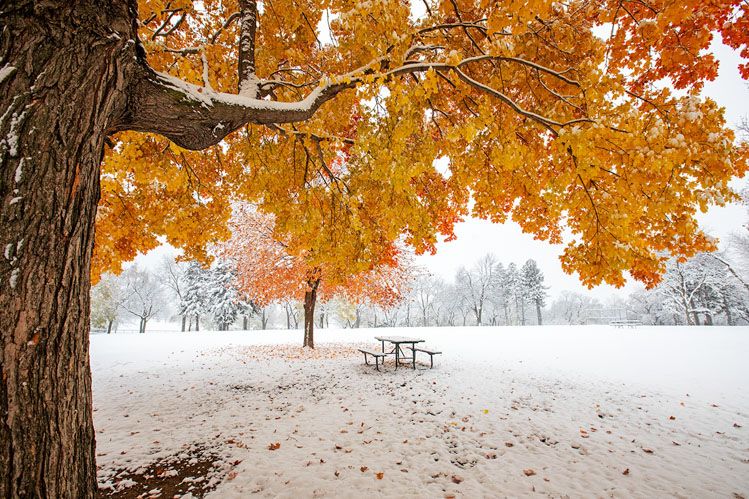
October on the Northern Plains can be fickle. One day might bring perfect autumn hues and warm sunsets, and the next may bring bone chilling wind that carries the autumn leaves to parts unknown, replacing them with snowflakes and frost. Every so often, the seasons combine without the soul sucking wind and a brief period of visual magic descends on our landscapes. That’s exactly what happened this fall in southeastern South Dakota.

On October 21, I broke away from the usual and took a drive. Yankton County was my eventual endpoint, but I didn’t really know that when I left. As many of you know, country churches are a favorite subject of mine. With one of those nearly perfect fall evenings developing, I headed toward a cluster of churches, hoping to find some autumn magic. St. Columba, Faith United and historic Vangen churches made their way into my viewfinder. The late afternoon and early evening light accentuated the fall colors, and all was well with the world.

The winds held back for another week, so when the first snow of the season arrived, the color of autumn and white crispness of winter merged. I noticed a couple of birds hanging out in the trees of our courtyard, staying out of the snow presumably. One was a robin, which is part of the robin family that nests in said courtyard, but the other was a rare-to-me fox sparrow. This bird has pronounced rusty tones and is one of the prettier sparrow species.

After photographing the birds, I decided to see what else was happening around Sioux Falls as the snow fell. Sherman Park had many trees still in full autumn splendor, and I discovered large flocks of winter birds and migrating sparrows there, as well. Dark-eyed juncos and Harris’s sparrows were the most abundant.

I finished the afternoon taking a walk along Split Rock Creek in the upper portion of Palisades State Park. The temperature hovered right around freezing, so the rocks were slick, and the going was slow. Even so, the walk did my soul good, as it usually does in our scenic areas. The drive home, on the other hand, was a bit dangerous. I’ve always noted the signs warning drivers that the stretches of highway atop bridges often freeze first. On this day I witnessed it and saw a couple near accidents happen just in front of me on Interstate 90 between Brandon and Sioux Falls. Winter weather, for all its potential beauty, can still wreak havoc. Sioux Falls received just a skiff of snow, and we have had none since. And that is okay with me.

Christian Begeman grew up in Isabel and now lives in Sioux Falls. When he’s not working at Midco he is often on the road photographing South Dakota’s prettiest spots. Follow Begeman on his blog.

Posted on Leave a comment

The Badlands in Winter

Thousands of visitors pass through Badlands National Park during the summer months, but swing through during winter and you see a different side. Sioux Falls photographer Scott Korsten drove the Badlands Loop Road in early February, a day of constantly changing weather and scenery.”It was a quiet day, and I was nearly alone in the park,” he says.”With its colored layers slightly frosted in snow, every turn in the road provided a new perspective to appreciate. These were just the type of scenes I’d hoped to see and as usual, the park did not disappoint.” Here are a few photos from that day.