Posted on 1 Comment

Roaming the Tall Grass

By Christian Begeman

The May/June 2026 issue of South Dakota Magazine features a story on the few tall grass prairie remnants remaining east of the Missouri River. When I was asked to help illustrate the story, I was surprised by how many photos I have taken in and around these places.

I grew up in short and mixed grass country along the Dewey and Ziebach county line west of the Missouri. Only in wet areas or in wet years did the grass get so high that you couldn’t see where your boot fell, which is an important thing in rattlesnake country. When I first began exploring the tall grass preserves with camera in hand, it was unnerving to not be able to see the ground below … and whatever sinister critters may be lurking. Turns out plenty of creatures call the tall grass home. My favorite are the colorful and elusive butterflies. From monarchs to tiny eastern-tailed blues, I have been known to spend hours on the trail seeking that perfect close-up shot.

I also discovered the beauty of the grass itself when peering through my macro lens at blooming sideoats grama florets at the Sioux Prairie Preserve near Colman. Big bluestem, cordgrass and many other tall grass regulars all flower during the summer and photographing them can be nearly impossible due to the wind that we regularly endure on the Northern Plains. To be honest though, a good breeze is welcome in that it keeps the gnats and mosquitos mostly at bay. Yep, it’s not all butterflies and flowers in tall grass country. Myriads of insects live there and a good breeze plus insect repellent is a must when exploring.

After gathering photos for the article, I was asked to gather again for a flyer promoting the new prairie grass area at Good Earth State Park. As I waded back into the archives, I noticed the crescendo of forays into tall grass preserves started slowly about 10 years ago and reached full throat when I was challenged to find and photograph the elusive green orchid. Until that point, I thought wild orchids only grew in exotic tropic locales. Thankfully, I was wrong. South Dakota is home to over 20 orchid species depending on who’s counting. The tall grass preserves are a haven for these beauties and their allies, all of which are a paradise for a camera guy with a macro lens.

Earlier this month, I was out finding the season’s first pasque flowers in the Coteau Hills overlooking Jacobson Fen in Deuel County. As I got up close to frame a few fuzzy portraits of our state flower, I got the idea to share these new photos along with a few other tall grass favorites I had gathered but did not make the final printed story. I hope they convey the sense of wonder and enjoyment I get while out roaming the tall grass remnants.

Christian Begeman grew up in Isabel and now lives in Sioux Falls. When he’s not working at Midco he is often on the road photographing South Dakota’s prettiest spots. Follow Begeman on his blog.

Posted on Leave a comment

Seeking Spring Ornaments

Spring in South Dakota is a joy to watch unfold. It is not always the same within the particulars, but the rhythm of new blossoms and migrating birds are always harbingers of the season of life taking hold. This year saw a hot, windy and dry stretch in early May followed by cool, rainy days. It is now after Memorial Day and the landscape is lush and green out my window, even if the clouds are low and gray. Last year’s barn swallow couple is back inspecting my light fixture outside my front door for another nesting season. I’ve been doing a spring journal for over a decade in this space. This year, more than ever, you’ll see images featuring new blossoms and spring birds. I’ve called them”spring ornaments” in the past and that is how I still see them — fleeting glints of color showing off after a long, cold, Dakota winter.

March 28

I photographed my first pasqueflowers of the season in McCook and Hanson counties.


April 4

Snow flurries in rural Deuel County slowed a small flock of flicker woodpeckers arriving from warmer climates.


April 16

The first plum brush blossoms and bumblebees delighted the senses in Union Grove State Park.


April 19

A few trout lilies were in bloom on the hillside along the Union Grove State Park road.


April 26

Bluebells and pasqueflowers were found in the Slim Buttes of Harding County.


April 27

Star lilies in bloom along a trail of the Sage Creek Wilderness in Badlands National Park.


April 29

A black and white warbler was one of the first migrating songbirds I saw and photographed at Palisades State Park.


April 30

I spent an evening after work chasing a small flock of warblers at the Big Sioux Recreation Area near Brandon. Yellow-rumped warblers and a single palm warbler obliged for a quick portrait session.


May 1

These Canadian goslings at Palisades State Park were among the first babies of spring.


May 3

After a work trip to Minnesota, I stopped at Hartford Beach State Park where a pair of red-bellied woodpeckers were prepping their nest. I also spotted my first prairie smoke wildflower in eastern Brookings County later in the afternoon.


May 4

Tulips and decorative trees bloomed on a near perfect spring day in Sioux Falls.


May 10

A yellow warbler posed at Palisades State Park.


May 12

A Baltimore oriole came in close for a quick snapshot.


May 14

Eastern red columbine were in bloom and a few comma butterflies soaked up the spring sun at Palisades State Park.


May 17

One of my favorite warbler species, the magnolia warbler, gave me a good look at Palisades State Park.


May 25

I took a quick trip to see family and check out the landscape in northeastern South Dakota. Highlights included a patchy of small white lady’s slippers and blue-eyed grass in Deuel County, Tabor Lutheran Church in Strandburg flanked by American flags to honor Memorial Day and a superlative sunset beyond Garfield Lutheran Church west of Lake Norden.

Christian Begeman grew up in Isabel and now lives in Sioux Falls. When he’s not working at Midco he is often on the road photographing South Dakota’s prettiest spots. Follow Begeman on his blog.

Posted on Leave a comment

First Signs of Spring

People who live in the Northern Plains tend to be hardy. They can endure hot, dry summers or long, hard winters with the best of them. Even so, the first signs of spring on the open prairie soften the heart of even the hardiest resident. Winter’s snow is scarcely gone when tiny pasqueflowers first appear on well drained hilltops and hillsides.”Very brave little flowers,” the Cree Indians say,”which come while it is still so cold that they must come wearing their fur coats.” This is in allusion to the furry appearance of the pasqueflower. According to Prairie Smoke: A Collection of Lore of the Prairies by Melvin Randolph Gilmore, a Dakota language song composed to inspire the early appearance of the prairie pasqueflower goes something like this in English:

I wish to encourage the children of other flower nations.

Which are now appearing over all the land;

So, while they waken from sleep and rise from the bosom

Of Mother Earth, I stand here old and gray-headed.

I often think of these references when I find my first blooming pasqueflowers of the year. This year it was in a small pasture just west of the eastern fork of the Vermillion River in McCook County on March 28. While admiring the backlit beauty of the blooms just beyond the fence line, I heard my first western meadowlark serenade of the season. It can’t get much more”South Dakota” than that! I typically find the first blooms of the year on a hillside near Lake Hanson just south of Alexandria, so I drove a little further west and sure enough, about 20 diminutive blooms of South Dakota’s state flower had emerged in my favorite patch.

On April 5, I reserved a blind on the Fort Pierre National Grasslands for another early spring spectacle. This one happens to be both a feast for the eyes as well as the ears. Greater prairie chickens and sharp-tailed grouse gather from March through May to dance. Not only do the roosters dance, but they also call, cackle and woo. The prairie chicken’s woo is a unique sound that I’ve not heard anywhere else. The roosters fill colorful air sacs on either side of their neck and the sound pours out as they expel the air, deflating the pouches. It is known as”booming,” and on a clear and crisp prairie morning, it can be heard for miles. During my morning on the lek, the sound started about 50 minutes before sunrise from right to left outside the blind. It is pretty dark that far ahead of sunrise so you can’t see the birds. It is quite an experience to hear the sound as it amplifies and surrounds you, but you are unable to see the creatures creating it.

As the light grew, I realized that my lek also had sharpies dancing. They don’t”boom,” but they stamp their feet amazingly fast and cackle to impress the hens. Instead of orange air sacks, the skin on their necks flares light purple and their eye combs are bright yellow. It was cold with a stout eastern breeze that morning, but numbing fingers and toes were worth one of the best homegrown shows that nature has to offer on our prairie hills. Soon the winds will warm, and the rest of spring will follow. It always does.

Christian Begeman grew up in Isabel and now lives in Sioux Falls. When he’s not working at Midco he is often on the road photographing South Dakota’s prettiest spots. Follow Begeman on his blog.

Posted on 1 Comment

Ten Outdoor Adventures in South Dakota

Where do your outdoor skills and experiences rank in the wild woods, waters and prairies of South Dakota? Do you know the lay of the land? Can you find wild mushrooms? Have you ever seen a gray kneebobber, or the holey rocks of Roberts County? Here are 10 popular activities to help you break the cabin fever of a long winter and enjoy the South Dakota outdoors.

1. BEFRIEND THE MONARCH

Monarch butterflies rank among South Dakota’s most interesting creatures. A butterfly typically hatches here in August, and then as autumn arrives it flies 2,500 miles southward to the Oyamel fir forests where it will hibernate through the winter, often in the same trees as its ancestors. When it reawakens and flies north in the spring it lays eggs, which dramatically shortens its lifespan. Soon it dies. The process repeats itself as the butterflies travel northward. Monarchs that arrive in South Dakota around Mother’s Day are the fourth-generation descendants of those that departed the previous fall.

2. PONDER THE HOLEY ROCKS

One of South Dakota’s great and unresolved mysteries is the”holey rocks” of Roberts County. All of northeast South Dakota is rocky, thanks to glaciers that brought the rocks here 10,000-plus years ago. Some of the biggest boulders have holes about as wide as a quarter. A geologic detective documented 57 such stones in the early years of the 21st century, though there are probably many more. They are not limited to Roberts County. Some have also been discovered in Minnesota and other northern states. One theory is that the stone holes were chiseled as guideposts by Viking explorers who traveled here from Hudson Bay in medieval times, although it requires a rewrite of immigration history.

3. HIKE BUFFALO TRAILS

First, let’s be very clear. We are not suggesting that any of our paying readers should ever intentionally walk near a wild buffalo — unless they can run faster than a horse (because a buffalo can). The big brown galoots have been clocked at 40 mph. Still, it’s a fact that some very cool outdoor trails exist on popular buffalo reserves. Samuel G. Ordway Nature Preserve in northern South Dakota has hiking trails and a buffalo herd, but there’s a fence in between. Wind Cave in the southern Black Hills has 30 miles of hiking trails, and you share the terrain with a herd of 400 bison. Badlands National Park has an”open hike” policy, and that goes for humans and the park’s buffalo so it’s up to the former to be smart. They say if the buffalo notices you then you’re too close … and it may be too late.

4. MUSHROOM HUNTING

South Dakota has many edible mushrooms, but the morel is king. Though the season changes throughout the state, morels are usually found from early April to early May. The best habitat is a moist forest floor, especially near rivers, lakes and swamps. Morels, which only grow in the wild, are difficult to find because they blend into spring’s grassy-brown environment. Look for yellow or tan mushrooms with spongy caps but beware of the false”brain” mushroom. It is toxic. True morels have a honeycomb cap and hollow stems, while false morels are solid. Don’t pull a morel from the ground because it is connected by a hypha to other mushrooms that may soon emerge. Just snip or pinch.

5. STARGAZING

South Dakota has less light pollution than most states, so we should all be amateur stargazers. Badlands National Park is the most enchanting place to watch the stars; park officials offer a Night Sky Program on weekend evenings through the summer. However, rural areas across the state — even in more populated East River — are conducive to seeing the Milky Way and other mysteries of the heavens.

6. GROW A TREE

Statistically-speaking, South Dakota is 4 percent forested. The trouble with statistics is that 99 percent of our approximately 601 million trees are in the Black Hills. Much of our prairie country looks like the aftermath of an immensely successful deforestation program. It’s not that South Dakotans aren’t trying. We once visited a West River ranch and saw a spindly elm tree trying to grow from a crack along the concrete foundation of small barn.”Shouldn’t we pull that out before it widens the crack?” asked our writer. The rancher was horrified.”I’d move the barn before I’d kill that tree!” he exclaimed. Want to do something good for South Dakota’s outdoors? Go plant a tree (or at least leave them alone).

7. PASQUE WATCH

South Dakota’s state flower is the prairie pasque, Pulsatilla patens, a tough and dainty flower that blooms briefly at the first sign of spring. Though it grows throughout the state, many South Dakotans have not seen one in the wild because it blooms so briefly and because it survives best in rugged, natural terrain. The best habitat is north-facing slopes, and the ideal time is just as the snow melts in early April. Finding a patch is a visual treat. For a real challenge, try transplanting a pasque to your garden. Its long roots, developed to survive drought, make it nigh impossible. You’ll have better luck harvesting its seeds, though even that is difficult. It is truly a wild flower, a fitting symbol of springtime in South Dakota.

8. SPOT THE DIPPER

Thirty years ago, a Minnesota birdwatcher alerted South Dakota Magazine that while fishing on Little Spearfish Creek he witnessed a slate-colored bird that could walk under water. He said he reported it at the nearest pool hall, where everyone laughed at his story. They called it a gray kneebobber.”Probably huntin’ for mountain oysters,” laughed one of the locals. Our Minnesota reader later discovered that it was the endangered American dipper, and fortunately the aquatic songbird can still be found in Spearfish and Whitewood creeks in the Northern Hills. Have you seen a dipper and been reluctant to tell anyone for fear of ridicule?

9. TRY SPELUNKING

Even though the Black Hills is home to more than 100 known caves, including several of the world’s longest, spelunking hasn’t caught on like downhill skiing, pheasant hunting or even watching paint dry. Something about the fear of crawling on your belly in the dark through tight canyons shared by bats doesn’t resonate with the outdoors crowd. But add the experience to your bucket list. Wind Cave and Jewel Cave are run by the National Park Service and offer fascinating guided tours, as do several private caves. The names of the passages in Jewel Cave suggest what you’re missing: the Promised Land, the Mind Blower, Boondocks, Wildflower Walk and Spooky Hollow.

10. FIND A FAIRBURN AGATE

South Dakota is heaven for rockhounds, and the Fairburn agate is prized. The state’s official gemstone was first hunted in the moon-like Kern agate beds east of Fairburn in Custer County, but it can also be found in Teepee Canyon west of Custer and elsewhere West River. People have even discovered them mixed with landscape rock and fill material taken from pits near the Cheyenne River. Serious rock hunters have spent days and even weeks searching for Fairburns with no luck, so consider yourself fortunate if you spot even one.

Editor’s Note: This story is revised from the”South Dakota Outdoor Challenge,” which appeared in the March/April 2023 issue of South Dakota Magazine. To order a copy or to subscribe, call (800) 456-5117.

Posted on Leave a comment

Getting Lost in the Woods

There weren’t many trees in the landscapes of my youth. Looking out our living room window, a thin line of cottonwoods and other smaller trees lined the banks of a western arm of Corn Crick. After our family purchased a wood stove when I was quite young, chopping wood became one of those hard, but mostly enjoyable chores. The hard part was stacking wood and not annoying my older brothers while doing so. The fun part was exploring the creek and being under the branches and leaves as opposed to out in the open prairie breeze.

As a youngster, I was fascinated by nature programs and stories of forests and jungles. Being in a place dominated by trees was not normal. Not being able to see a mile away was a bit disconcerting, but also a cause for curiosity and wonder. I remember some of my first trips to see relatives in Sturgis and being in awe of the Black Hills forests. It felt different, it smelled different. It just was different. But in a good way.

As I grew older, I started paying more attention to local geography. The draws of the Moreau River just south of our farm offered a variety of small, wooded coulees and canyons. Some of these our family named, like”Cedar Canyon” where we would hunt for Christmas trees in early December. Sometimes these draws would turn into (relatively) heavily wooded valleys, like the one that you can see from the hilltops of the Little Moreau River State Recreation Area. Church picnics including softball games and hikes through the trees to one of the three dams are all memories of that park.

It wasn’t until a few years ago that I started looking at the wooded areas of the Northern Plains with different intent. Photography has a way of doing that. Newton Hills State Park has an early blooming wildflower called snow trillium that blooms at roughly the same time as our beloved prairie pasqueflower. It is one of only two places I’ve seen them in our state. They are the farthest west population of this otherwise fairly common eastern woodland wildflower. On the other side of the state, places like Botany Canyon and Englewood Springs Botanical Area in the northern Black Hills showcase wild orchids and alpine wildflowers that are rare in South Dakota.

This spring and late summer, I took two trips to Sica Hollow near Sisseton to find other interesting wildflowers along the heavily wooded Trail of the Spirits. I was not disappointed. From unique wild ginger blooms to pale orange jewelweed being visited by migrating hummingbirds, the woodland gems on display were a joy to discover and photograph, especially for a plainsman like me. I now very much look forward to getting lost in the woods.

Christian Begeman grew up in Isabel and now lives in Sioux Falls. When he’s not working at Midco he is often on the road photographing South Dakota’s prettiest spots. Follow Begeman on his blog.

Posted on Leave a comment

Late Summer Blues

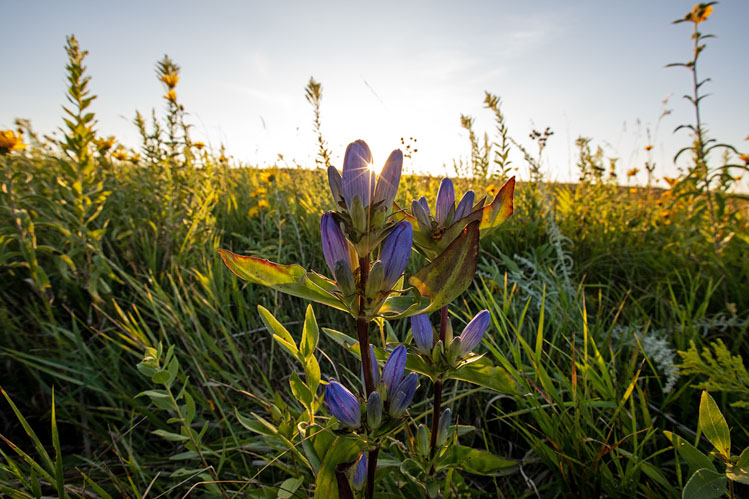
I recently went through a spot of late summer blues. You might think I’m referring to the upcoming end of summer, and that is a bit disconcerting, but that isn’t exactly it. Late summer blue colored wildflowers inspired this column. In certain remnant tallgrass prairies and fens of eastern South Dakota, wild blue gentians and other blue and purple shaded allies start their blooms this time of year. These wildflowers seem like they’ve borrowed their hues from a late summer evening sky. Dotted amongst the green and yellow found in the August grass-scapes, it’s almost as if the summer sky has rained a little drop of its own color down onto the swaying prairie.

Growing up in the mixed grass prairies of rural Ziebach and Dewey counties in the 1980s, I thought August was one of the worst months of the year. It was often unbearably hot and usually dry. Tumbleweeds, grasshoppers, dust and wind seem to stick in my memory. Plus, August meant it was nearly time to go back to school. That in itself was enough for me to dislike the month in general. It wasn’t until I started searching out native wildflowers on the northern plains that I realized August was actually full of color and delights.

This August, I found myself in rural Stanley County gazing over vast sunflower fields with fresh blooms to start the month. Later, I roamed the hills of Foster Bay Recreation Area finding wild four-o’clocks, purple gayfeather with plenty of pollinators and even ripe plums in the thickets at the top of the draws between the hillsides. Mid-month, I discovered a few more nature areas in Grant and Moody counties. It was there that the blues really kicked in. I found and photographed bottle gentian, lesser-fringed gentian and blue lobelia.

I recently took a final August trip through rural Brookings and Deuel counties. The Aurora Prairie Nature Preserve, Jacobsen Fen and 7-Mile Fen Preserves provided more blues as well as late season white wildflowers, including a favorite orchid called Great Plains ladies-tresses.

These late summer blooms arrive just in time for the monarch butterfly migration that is about to get into full swing. Other pollinators like bees, flower flies and various beetles will accompany you if you choose to go out and experience the blues yet this season. There is a lot that goes on in those stretches of grassland and wetlands that often gets overlooked. I will admit that the ticks, deer flies and mosquitos can be a deterrent, but strong repellent and a nice summer breeze will mitigate the annoyance and hopefully allow you to really enjoy those late summer blues.

Christian Begeman grew up in Isabel and now lives in Sioux Falls. When he’s not working at Midco he is often on the road photographing South Dakota’s prettiest spots. Follow Begeman on his blog.

Posted on Leave a comment

A Grand Entrance

For the second year in a row, spring came late to the Northern Plains. Winter lingered through March and early April. In southeastern South Dakota, we had two days of almost 80 degrees, or”false spring” as we like to call it, then the cold winds began to blow again. When spring did break through in early May, it burst on the scene with flowers budding, trees leaving out and the cheerful sounds of returning songbirds.

Every spring, I like to chronicle the change of seasons in a journal style. It’s fun to look back over the years and compare the dates of finding the first pasqueflowers and smelling the first plum brush blossoms on the breeze. It is also a great reminder of how spring is a truly wondrous time here in South Dakota.


April 8

While visiting relatives in Walworth County for Easter, I spotted many western meadowlarks in the countryside. A heavy snow had fallen a few days before, making the background of this photo white.


April 9

Returning to Sioux Falls, I drove out of the snow line between Tulare and Wolsey along Highway 281 and saw thousands of sandhill cranes in the fields near Virgil in Beadle County.


April 10

Spring is a great time to spot bald eagles because they often follow the early waves of the waterfowl migration, picking off the weak and injured. I found this eagle in rural McCook County.


April 14

The first small songbirds to appear included this male ruby-crowned kinglet found at Lake Herman State Park near Madison.


April 17

The first pasqueflower of the season for me was found near Lake Hanson south of Alexandria.


April 24

My first butterfly of the season was soaking up the sun at Big Sioux Recreation Area near Brandon.


April 30

Multiple days of strong wind buffeted the Plains states. Even though you can’t see the wind, you can see its effects on this weeping willow in eastern Sioux Falls.


May 1

One of the first magnolia blooms at Terrace Park in Sioux Falls.


May 2

A pasqueflower at sunset in rural Deuel County.


May 3

The first blooming plum brush at Union Grove State Park attracted many pollinators, like this red admiral butterfly drinking early spring nectar.


May 6

Mist and light rain bedazzled this pasqueflower in the Coteau des Prairies of Grant County near Marvin.


May 7

A close-up of a Brooklyn magnolia flower bud found in central Sioux Falls.


May 9

Baltimore orioles (and allies) started appearing in numbers on this day. This one serenaded all who would listen at Palisades State Park near Garretson.


May 10

A yellow warbler shows off his brilliant color in a thicket of blooming plum brush at the Big Sioux Recreation Area near Brandon.


May 11

While looking for more warblers at Palisades State Park, this rose-breasted grosbeak flew in and gave me”the look.”


May 12

Eastern red columbine was just beginning to bloom along the Sioux quartzite rock canyons of Palisades State Park.


May 13

This magnolia warbler, one of my very favorite warbler species, allowed me to take his portrait in a thick tree patch at Palisades State Park.


May 17

Mallard ducklings under their mother’s watchful eye found at Covell Lake in Sioux Falls are a sure sign that spring is here to stay.

Christian Begeman grew up in Isabel and now lives in Sioux Falls. When he’s not working at Midco he is often on the road photographing South Dakota’s prettiest spots. Follow Begeman on his blog.

Posted on Leave a comment

Fall’s Final Flourish

The final leaves have fallen. The songbird migration has long ended, and the waterfowl migration is now in full force. The seasons of life have given way to the cold north wind and snowflakes that have danced once or twice across our windshields already. The harvest is wrapped, and our traditional season of thanks is beginning. It is November. And really, the month of November marks the end of autumn in our part of the world rather than the official first day of winter, December 21.

Rather than succumb to the dreary days of lessening light, I think it is a good time to reflect upon nature’s last flourish of color. Late August through mid-October provides vivid colors on the prairie and surrounding hills and this year was no exception. It seems that late summer and early autumn prefer vivid blues when it comes to wildflowers. From bottle gentians to great blue lobelia, the colors of the petals seem to be drawn straight from the hues of an early evening eastern blue sky.

Butterfly season is also on full display. Monarchs from South Dakota and points north gather and then fly south to Mexico. Other beautiful species are easily spotted if you have patience. I’m a fan of the regal fritillary that rivals the monarch in vivid orange and black beauty. The regal is a tall grass specialist so keeping our remnant tall grass prairie intact and healthy is key to keeping this butterfly around. A favorite place to spot them is the Nature Conservancy’s Aurora Prairie east of Brookings.

After the late summer blues diminish, brilliant oranges, reds and yellow begin to paint the landscape. The color usually begins to turn in the higher elevations first, and then it makes its way down to the valleys and towns. These colors of autumn grace the Black Hills and Badlands in late September and can go well into October along the Missouri River hills and eastward. Besides the well-known autumn vistas of Spearfish Canyon or Sica Hollow, Palisades State Park near Garretson is a favorite place to visit. The drama of Sioux quartzite rock and canyons are beautifully accentuated by autumn hues, particularly in the late afternoon light.

November marks the end to most of nature’s colorful beauty described above, but I also find that fall sunsets seem to be the most exquisite of the year. So, I can’t really say the season of color has left us for good. It can still be found way out there on the horizon, somewhere just beyond our reach, like the promise of new life coming next spring. The cycles of the seasons are felt maybe more acutely on the Northern Plains than anywhere else on the continent, but I wouldn’t trade that for anything. Winter has subtle and harsh beauties of its own, but more importantly, the cold reminds me not to take for granted the loveliness of the seasons of warmth and life.

Christian Begeman grew up in Isabel and now lives in Sioux Falls. When he’s not working at Midco he is often on the road photographing South Dakota’s prettiest spots. Follow Begeman on his blog.

Posted on Leave a comment

Discoveries at Englewood Springs

South Dakota is a special place, partly because of its sheer variety. Everyone has heard or shared a joke about the constant change of weather, but I wonder how often people stop to think about the ecological variety that exists within our borders? Last year, I was tasked with finding and photographing a”green orchid” in the Coteau des Prairies of northeastern South Dakota. Before that request, I was unaware that orchids even grew in our region. I was quite wrong, and thankfully so. Depending on who is counting, there are up to two dozen different orchid species found in South Dakota. What does knowledge like this do to a photographer who loves a macro lens and beautifully colored wildflowers? It starts a self-motivated project that if not careful, borders on obsession.

While researching local orchids, I”discovered” Englewood Springs Botanical Area near Lead. It’s been a place of botanical interest since the late 1960s, but I first read about this little corner of the Black Hills in a 2011 National Forest Management Strategy document found online. I had learned about the fairy slipper orchid from David J. Ode’s Dakota Flora: A Seasonal Sampler, and while using the internet to learn where these amazing plants can be found, I noticed the above-mentioned report and learned the fairy slipper had been documented at Englewood Springs along with at least a dozen other orchids. That was all it took to ensure I visited with camera in hand.

My first trip there was in late June of 2021. I battled a downed white spruce, steep hillsides and shortness of breath being the flatlander that I am. I was also unable to find a fairy slipper. Most likely I was too late in the season, but I did see three”new to me” orchids as well as a variety of other amazing flowers I had never photographed before. Along the way, I suffered a torn pair of jeans thanks to an unseen branch on a downed log. Even so, the excursion was well worth it.

This spring, I was determined to go earlier to find the elusive fairy slipper. However, spring was late this time around and my first trip, over Memorial Day weekend, found Englewood Springs just waking up from winter and not many new buds could be seen. Even so, new to me flowers included bearberry blooms and drops of gold.

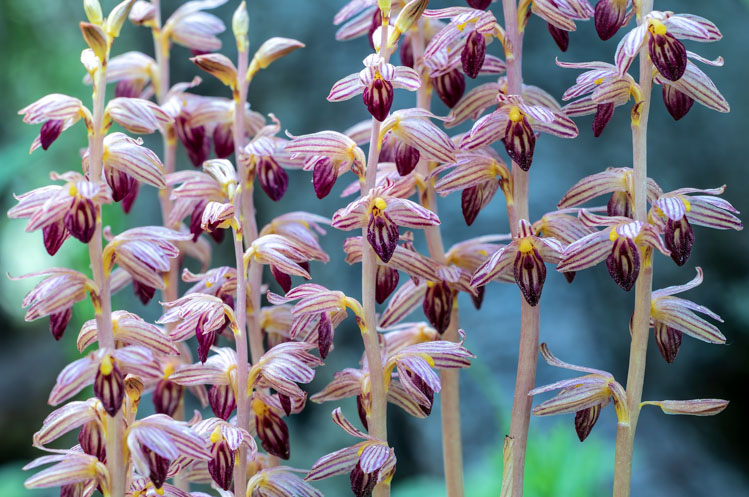
Undaunted, I came back a mere two weeks later. Again, I was stymied in the fairy slipper search, but I did photograph my first alpine milkvetch, as well as the uniquely diminutive wister coralroot orchid. My searching was cut short on that trip after a log unexpectedly gave way, resulting in an awkward lurch into thick mud and one of the worst hamstring pulls I’ve ever experienced. Chalk another one up to Englewood Springs.

I was back a few weeks later, only to discover that I was again too late to find a fairy slipper, but just in time to find a rare broad-lipped twayblade orchid. I also saw and photographed an orchid not on the Englewood Springs list, a frog orchid. So, I’ll take that as a win and will visit again next spring in search of that yet unseen, but very well named, fairly slipper orchid.

Christian Begeman grew up in Isabel and now lives in Sioux Falls. When he’s not working at Midco he is often on the road photographing South Dakota’s prettiest spots. Follow Begeman on his blog.