Posted on Leave a comment

Scoping the Missouri

Members of the South Dakota Ornithologists Union look for birds at Union Grove State Park between Beresford and Elk Point.

Roger Dietrich was scoping along the shore of Lake Yankton when a Rapid City woman approached him with a question about the tiny Ross’s gull, which had been sighted in the area.

“I’ve gone to Alaska twice and I didn’t see the bird there,” she said.”Is it still around?”

Dietrich pointed to a gull, sitting on ice in the middle of the lake.

The Missouri River is a bird-watching paradise. Hundreds of species of ducks, geese, gulls, loons and other birds congregate in parks, woodlands and farm fields that border its 443-mile corridor. But it still helps to know for what you’re looking.

Every habitat attracts different birds, says David Swanson, professor of biology at the University of South Dakota and author of Birder’s Guide to South Dakota, and habitats vary dramatically along the Missouri as it winds from Nebraska to North Dakota.

Following is a guide, from south to north, of habitat patches and the surprises that await birdwatchers, both the serious birders looking for the rarest”lifer” bird and those who are happy spotting sparrows and swallows.


The Adams Nature Preserve attracts wading birds such as blue herons.

Adams Nature Preserve

Southeastern South Dakota

The Adams Homestead and Nature Preserve near North Sioux City includes many trails.”It has a variety of habitats,” Swanson says.”It has an extensive cottonwood forest that borders the river, and there’s also a little lake called Mud Lake that’s attractive to waterfowl. The ring of trees surrounding Mud Lake can be good for woodland birds, too.”

Mud Lake is approximately a quarter mile from the Adams Homestead parking lot, so a brief hike is required to access it. Wooden observation blinds lie along the trail with a view of the lake.

“The other habitat at the park is a restored open prairie,” he says.”It’s one of the few sites in the southeastern part of the state where you can find Eastern meadowlarks. The common meadowlark in South Dakota is the Western meadowlark, but the Eastern meadowlark is expanding its range in the southeastern part of the state and Adams Homestead is one of the places where you can find those.”

Since first being sighted in 2017 by Swanson and his ornithology students, the Eastern meadowlark has made regular appearances in the open-prairie habitat, often with multiple birds singing among the scattered trees.

“I wasn’t aware at the time that Eastern meadowlarks had started to expand their range, and I heard these Eastern meadowlarks calling,” Swanson says.”I go, ‘That is very unusual.’ We kept walking and saw them and everybody in the ornithology class got to see me geek out over it.”

Though birdwatching at the Adams Homestead is enjoyable year-round, it’s best in spring, summer and fall.”Mostly, it’s hiking the trails during migration and seeing a variety of birds at that time,” Swanson says.”It’s lots of warblers and sparrows, so the migration periods are late April to mid-May. Then in the fall, from mid-to-late August into about mid-September is probably the peak for warblers and vireos, some of which migrate all the way down to Central and South America.”

Sparrows that migrate to the southern U.S. and Mexico slightly later in the year can typically be seen at the Adams Homestead from mid-September to mid-October. Along the river and at the lake, birdwatchers encounter ducks and geese, as well as wading birds like herons and egrets.

“In the cottonwood forest, there are Eastern whippoorwills,” Swanson says.”Those are birds that don’t really get too much out of the southeastern part of the state. Of course, they’re nocturnal, so they don’t start calling until it starts to get dark.”


Least terns can be found on sandbars below Gavins Point Dam.

Gavins Point Dam

West of Yankton

Gavins Point Dam, the southernmost project on the Missouri’s system of six dams, is surrounded by unique bird habitats.

During the summer, hundreds of American white pelicans can sometimes be seen near the dam, while on the river itself, there are piping plovers, still considered a threatened species in most of the U.S., and the least tern, North America’s tiniest tern, often seen flying low over the river and hovering before plunging for prey.

“One of the reasons I like birding is the idea that it would be so cool to fly, and least terns are just the best flyers,” says Roger Dietrich, a local authority on ornithology.”They’ll fly and they’ll see a minnow, and then they dive straight down in the water — and splash!”

In winter, the 2-mile-long earthen dam creates an unusual condition for birds and birders.”Some years, when it doesn’t freeze, like lately, there’s been lots of open water above the dam,” Dietrich says.”Some years, we get lucky and even the Lewis and Clark Marina doesn’t freeze over real early. So, that’s a popular spot where some grebes and loons will stop.”

Black scoters, surf scoters, white-winged scoters and long-tail ducks, which are mainly ocean birds, are known to visit the lake and river in winter.

“I tell people from other places that we have those birds here and they’re just not believing it, because they don’t think of the center of the United States as a place where these birds would show up,” Dietrich says.”And when I say they show up every year, usually, for a fairly long period of time, they just can’t believe that we’re so lucky.”

The common loon migrates through the area, as well as a number of gulls — including Sabine’s gulls, kittiwakes, black-legged kittiwakes and even the Ross’s gull, which is associated with the remote arctic. Crest Road, which passes over the dam, is a good place to observe such birds. It requires no special pass or permit.

“Scan for the birds with binoculars or a spotting scope and chances are, you’ll find something different,” Dietrich says.”Sometimes there are huge flocks, and you can spend hours just scoping the birds there,” he says.”So, if you see somebody there with their scope out or binoculars, stop and ask them what they’re seeing. I’d say 99 percent of the people will be glad to point things out to you, and maybe even let you look through their scope to see what they’re seeing.”

Several snowy owls hung out along the dam road a few years ago.”They were feeding on the flocks of coots that were there.” Wintertime also brings large flocks of lesser scaup, which birdwatchers will scan for specimens of greater scaup, a polar bird that tends to prefer saltwater and is rarely seen inland, Dietrich says.

“It’s the same with the big flocks of common goldeneye,” he says.”People try to scope out the Barrow’s goldeneye, which is another species. It’s more of a West Coast bird, but once in a while, we’ll get one here — always a highlight.”

Bald eagles frequent Gavins Point Dam and some now nest year-round in the tall cottonwoods that border the Missouri.”They’re used to a lot of people around and some of the trees they perch in are right along the local roads,” Dietrich says.”You can see them in action, swooping down and picking up fish. I’ve seen eight or nine at a time on the ice up above the dam, eating the dead snow geese they’ve picked off.”


A pair of Barrow’s Goldeneyes at Fort Randall.

Fort Randall

Pickstown

Fort Randall Dam also hosts a large congregation of bald eagles. Below the dam is the Karl E. Mundt National Wildlife Refuge, which provides habitat for the eagles.

Kelly Preheim, a kindergarten teacher in Armour and a well-known local birding enthusiast, especially likes the wooded area around the Fort Randall Dam.”We’re mostly on agricultural grassland in southeastern South Dakota,” she says.”But the dams have a lot of woodland, forested areas, and I enjoy walking on the trails.”

She found 71 bird species on a recent camping trip to Pickstown.”In the morning, oh my goodness, the singing,” she recalls.”My husband’s like, ‘I can’t get any sleep. It’s so loud here!'”

A hike to the tailrace, the channel below the dam that carries water away, will often be rewarded.”Fish that go through the dam come out somewhat stunned in the tailrace,” Preheim says.”Then, all these birds, like gulls and eagles and certain ducks, eat those fish.”

Like nearby Gavins Point, Fort Randall Dam is also home to many types of waterfowl in autumn and winter.”There are a lot of different ducks on the scene, hundreds and hundreds, if not thousands, of different ducks there at a time,” Preheim says.”I saw a brown pelican one time. That’s actually an ocean bird.”

Other surprise visitors at Fort Randall include a yellow-billed loon, typically associated with Alaska and America’s western coast, and a great black-backed gull, which is an Atlantic coastal bird, Preheim says.

Scarlet tanagers are often found in South Dakota but summer tanagers, a rare visitor, might also be seen around Fort Randall.


Pelicans near Big Bend.

Big Bend Dam

Fort Thompson

The best birdwatching at South Dakota’s northernmost dams — Big Bend and Oahe — occurs from April through May and from September to November, according to lifelong birdwatcher Ricky Olson, who lives at Fort Pierre.

Big Bend has fewer access roads and trail amenities than Oahe and the other dams, but it has its own charms. Ospreys nest below the dam and brown pelicans have been spotted.

“Once in a while, in the wintertime, you get a Brant goose at Big Bend,” a seacoast bird.”I run down to Big Bend at least every two weeks in the winter to see what’s there,” Olson says.

Big Bend also attracts smaller goose species, including snow geese and white-fronted geese, both of which are common to the area.”In the fall, it’s neater to go to Big Bend,” Olson says.”Also, the shad and minnow species will be in the shallows then, and you’ll get all kinds of cormorants and pelicans and hundreds of gulls in these frenzies where they’re all feeding, and the gulls are trying to steal from everybody.”


Canada geese along the Missouri River.

Oahe Dam

Central South Dakota

Ring-billed gulls, herring gulls and California gulls may be sighted at Oahe, as well as the arctic tern, a mega-find for birders.

A spectacle occurs during flooding when Oahe Dam’s hydraulic turbines are running.”It’s a feeding frenzy. You get thousands of gulls, maybe 20,000, below the tailrace in a half-mile stretch,” Olson says.”It’s like a snowstorm. Thousands of people come to watch the ‘gull snowfall.'”

Oahe also has cliff-dwellers.”In the sand layers in the cliffs, in the holes, there are barn owls nesting,” Olson says.”They dig their own holes, and often, they’re near where colonies of bank swallows have dug holes.”

In autumn, Sabine’s gull may be spotted.”It’s very pretty. It’s black and white with half a diamond on the wing,” Olson says.”We also get Bonapartes and Little gulls, which is a little gull, and we get some of the big ones. Once in a great while we get the great black-back, which is the biggest gull.”

Gulls breed on a few islands along Oahe, Olson says.”There are only a few places in South Dakota where that happens.”

Another rare visitor to Oahe, among the sea ducks like the scoters and the long tail duck, is the occasional coastal harlequin duck in the tailrace.

“We get loons,” Olson says.”Sometimes we get the Pacific or the yellow-billed or red-throated loon, which are rare for our state.”

Further north on Oahe, retired biology teacher Stan Mack says opportunities are available even in Mobridge’s city limits.”There’s a walking trail along the south side of town. Just follow Main Street to the river and walk west and you’ll see the ducks and geese and gulls that sit on the water.”

Mack says Indian Creek (east of Mobridge) and Indian Memorial (across the river to the west) offer trails and habitat.

Mack doesn’t walk well enough to explore like he once did, but the birds will come to him.”I’m doing a feeder watch for Cornell University. Right now, I’m looking at a collared dove — we never saw them before — and I see about 16 more picking up seeds on the ground.”

Editor’s Note: This story is revised from the March/April 2025 issue of South Dakota Magazine. To order a copy or to subscribe, call (800) 456-5117.

Posted on Leave a comment

Seeking Spring Ornaments

Spring in South Dakota is a joy to watch unfold. It is not always the same within the particulars, but the rhythm of new blossoms and migrating birds are always harbingers of the season of life taking hold. This year saw a hot, windy and dry stretch in early May followed by cool, rainy days. It is now after Memorial Day and the landscape is lush and green out my window, even if the clouds are low and gray. Last year’s barn swallow couple is back inspecting my light fixture outside my front door for another nesting season. I’ve been doing a spring journal for over a decade in this space. This year, more than ever, you’ll see images featuring new blossoms and spring birds. I’ve called them”spring ornaments” in the past and that is how I still see them — fleeting glints of color showing off after a long, cold, Dakota winter.

March 28

I photographed my first pasqueflowers of the season in McCook and Hanson counties.


April 4

Snow flurries in rural Deuel County slowed a small flock of flicker woodpeckers arriving from warmer climates.


April 16

The first plum brush blossoms and bumblebees delighted the senses in Union Grove State Park.


April 19

A few trout lilies were in bloom on the hillside along the Union Grove State Park road.


April 26

Bluebells and pasqueflowers were found in the Slim Buttes of Harding County.


April 27

Star lilies in bloom along a trail of the Sage Creek Wilderness in Badlands National Park.


April 29

A black and white warbler was one of the first migrating songbirds I saw and photographed at Palisades State Park.


April 30

I spent an evening after work chasing a small flock of warblers at the Big Sioux Recreation Area near Brandon. Yellow-rumped warblers and a single palm warbler obliged for a quick portrait session.


May 1

These Canadian goslings at Palisades State Park were among the first babies of spring.


May 3

After a work trip to Minnesota, I stopped at Hartford Beach State Park where a pair of red-bellied woodpeckers were prepping their nest. I also spotted my first prairie smoke wildflower in eastern Brookings County later in the afternoon.


May 4

Tulips and decorative trees bloomed on a near perfect spring day in Sioux Falls.


May 10

A yellow warbler posed at Palisades State Park.


May 12

A Baltimore oriole came in close for a quick snapshot.


May 14

Eastern red columbine were in bloom and a few comma butterflies soaked up the spring sun at Palisades State Park.


May 17

One of my favorite warbler species, the magnolia warbler, gave me a good look at Palisades State Park.


May 25

I took a quick trip to see family and check out the landscape in northeastern South Dakota. Highlights included a patchy of small white lady’s slippers and blue-eyed grass in Deuel County, Tabor Lutheran Church in Strandburg flanked by American flags to honor Memorial Day and a superlative sunset beyond Garfield Lutheran Church west of Lake Norden.

Christian Begeman grew up in Isabel and now lives in Sioux Falls. When he’s not working at Midco he is often on the road photographing South Dakota’s prettiest spots. Follow Begeman on his blog.

Posted on Leave a comment

Dancing with Grebes

Western grebes appear to walk on water during the rush, perhaps the most distinctive element of their spring mating ritual.

My love affair with grebes began when I was a high school biology teacher. During a lesson about birds, I showed my class a movie by Sir David Attenborough, the British broadcaster and wildlife biologist. I was amazed by the beauty and gracefulness of the grebes, with their long slender necks and pointed bills. Their courtship ritual was intricate and complex, unlike any other in the animal kingdom. They repeated each other’s every movement. If there were ever birds that demonstrated love, these grebes put the stereotypical doves to shame.

There are two displays, each including a specific set of steps performed with precision. The first is the rushing ceremony, which begins with advertising as the birds deliver a rolling call. Then comes ratchet-pointing, where they lower themselves into the water and their call becomes more ratchet-like. The next component is dip-shaking, which accurately describes the behavior of dipping their heads underwater and then shaking them from side to side after they resurface. Finally comes the rush, when the grebes run side by side across the surface of the water, necks back and wings up. They are the largest vertebrates on Earth with the ability to walk on water, covering up to 66 feet in 7 seconds through a combination of speed (20 steps per second), splayed feet to help gain traction and an unusual stride.

The weed dance occurs during the mating season. Two grebes arch their backs, stretch their necks and share weeds that they will use to build a nest.

The second display is the weed ceremony. It is equally complex and happens later in the mating season. But it was the rushing that fascinated me. As a part-time wildlife photographer, when I saw the ritual culminate into this beautiful dance across the water, I told myself that someday I would find grebes in the spring and photograph them.

When I retired from teaching, I started going down my bucket list of things I wanted to photograph. Western grebes were high on the list. They do not live in my state of Missouri, so I followed the Central Flyway, a major migration route over the Great Plains that encompasses a large part of the Prairie Pothole Region. Spring rains fill the potholes and they become a stopping point and breeding ground for many species of migratory waterfowl. Ducks, geese, pelicans and grebes take advantage of these pools, which contain a myriad of invertebrates, small fish and aquatic plants for food sources and nesting materials.

I knew about the potholes in South Dakota. Photographers look at each other’s work, and I’m sure I saw a picture of grebes taken in South Dakota. So about six years ago I made my first trip.

I’ll never forget my very first experience. The water was out, like it is in the spring. I had parked and was using a beanbag on the door of my truck. The grebes were coming really close, and that’s when I got my first good pictures. I didn’t get to see any rushing that day, but I went back later and witnessed babies riding on their mothers’ backs. I was hooked.

They usually start in April. I watch for the courtship ritual, which continues throughout the summer. But I keep looking because I’m waiting for the babies, too.

Of the 22 species of grebes, six can be found in South Dakota: Clark’s, western, pied-billed, eared, horned and red-necked. Clark’s grebe is similar to the western grebe; sometimes they are found mingling together. The other species are not as large. The breeding plumage of the pied-billed grebe is not as flamboyant. Its bill is not sharp and pointed and its neck is not long and graceful. The horned grebe has some interesting colors, with gold feathers wrapping around its head and a reddish ring around its neck. The eared grebe is arguably the most stunning of the smaller grebes. It has a golden fan of feathers radiating outward behind its eyes. I love grebes in general, but I think the western grebes are the most graceful and the most beautiful.

Photographers don’t always share their favorite spots, especially when you’re talking about birds. If you let it out where you’re going, then all of a sudden you get a crowd of people, and the birds are gone. I have traveled to South Dakota every spring for six years and have observed five of the six grebes during their migration and/or breeding season. (I have not been able to photograph or view a red-necked grebe yet.) Between the rushing and watching the babies, grebes have so much to offer. For a photographer, they are a dream come true.

Donna Caplinger lives in Fair Play, Missouri.

Editor’s Note: This story is revised from the March/April 2024 issue of South Dakota Magazine. To order or to subscribe, call (800) 456-5117.

Posted on Leave a comment

Birder to Birdwatcher

Is George Prisbe a birder or a birdwatcher? Yes, he says, there are differences.

I was introduced to the world of birds when I was 31 and living in Aberdeen. My early mentors were both named Dan. One was a degreed ornithologist and bander who zealously pursued birds, the other was a laid-back amateur who perched in a lawn chair and let birds come to him. Despite their differences, both were influential and supportive as I muddled along, convinced that I would never be able to distinguish one sparrow from another.

Those early years of birding were exciting, and my new interest felt natural. I was curious, enjoyed the outdoors and really liked solitude. I also relished competition, so I took to the idea of checklists as a type of scorekeeping. Each check mark came to represent a victory. This concept was central to my motivation to go out and look for birds. In some ways it became more about the birds I had not seen than about the ones I had.

I became that strange, suspicious character stalking the elm-canopied streets and overly manicured city parks of Aberdeen, binoculars permanently collared around my neck. Soon I was migrating to Sand Lake National Wildlife Refuge northeast of Aberdeen at least once a week and peeping down every back road. My home range expanded quickly as I searched for new habitat and boxes to check. Long daily excursions — Sand Lake to Sica Hollow and Hartford Beach, ending with an evening roost at Waubay National Wildlife Refuge — became routine.

Like most birders, I kept a variety of checklists: yard, patch, year, state, life, and even county by county lists. My desire to amass totals culminated in a turning point in my birding life — a quest to see 300 species within the borders of South Dakota in one year.

Then I moved to the northern Black Hills, and I knew that sojourns to the prairie — particularly east of the Missouri River — would be limited, but necessary, if I was to reach my goal. Differences in bird diversity and distribution, especially during migration, would make reaching 300 difficult without winging my way east several times. By the end of that year, successful as it was, I still felt unfulfilled and disillusioned. Unsuccessful excursions, in pursuit of specific species, were discouraging and felt like wasted time, plus I felt pangs of guilt over my carbon footprint. Even successful sojourns, like a day trip to Hot Springs to spot a lesser goldfinch, began to lose meaning and significance.

The trees around Prisbe’s home in the northern Black Hills teem with wildlife, including this northern saw-whet owl.

My appreciation of simply being in the field and observing whatever nature presented had been parasitized by the pace of my quest, my fixation on target birds and list totals. What I had always described as my passionate obsession had lost some flight feathers. How much had I failed to appreciate, or even notice, along the way? Had I become jaded by my search for”good birds?” Was I guilty of a”just a robin” mentality?

It was time to learn from my lawn chair mentor and just let the birds come to me. I established Hanna Circle — a 3 1/2-mile radius from our home at Hanna in southcentral Lawrence County — as my”patch.”

Limiting my range proved difficult. I found myself verdant with envy when reading reports of migrating warblers and shorebirds and species that I was unlikely to see in the Black Hills. The urge to respond to reports of rare or unusual species was difficult to cage.

My focus shifted from searching to observing — from birding to bird watching. Gradually, I began to recognize the rewards of this new and slower pace. I began to appreciate birds as individuals instead of members of a particular species with a corresponding box to be checked. I stopped using common birder expressions like”good birds” and”trash birds,” coming to regard such terms as disrespectful and inappropriate. I now understood my wife’s displeasure every time I said,”just a robin.” My binoculars became judgment free. So complete became my reformation that I would admonish total strangers when I overheard them using the phrase”kill two birds with one stone.” I suggested a substitute:”fledge two birds with one nest.”

I was happy and enjoying birds more than ever. Daily hikes into the diverse habitat surrounding our home became routine, bordering on obsessive. I grew familiar with the area and the activity of its inhabitants. Soon, I was sure that the local birds were becoming familiar with me, too. I kept a daily journal, recording species in the order in which they presented themselves, noting the number, nesting and behavioral activity, weather conditions, and whatever else seemed relevant, such as wildflower blossom dates, butterfly flight periods, and getting down on my knees to inspect fungi and overlooked downscapes underfoot.

For the past 15 years, I have been able to compare observations day to day, week to week, season to season, year to year and marvel at the serendipity. Not possessing the power of omnipresence — something every birder must desire — I know that many species have escaped my observation, simply because of my many remarkable and unexpected sightings. My Hanna Circle list now totals 210 species, 61 of which are one-time wonders. Another 43 have been observed three or fewer times.

Most birders, at least the ones I know, would be uncomfortable with a year list that is consistently and substantially fewer than 200. I have no qualms with listing or chasing, but it’s not for me. My commitment to observing birds simply cannot be measured by marks on a checklist or miles on an odometer.

Birder or birdwatcher? Is there a difference, or is this a nuanced description of the same thing? To me, they are not the same. I have spent considerable time thinking about my relationship with birds and the natural world. Like birds, we have behavioral traits that define us, and we adapt individually to circumstance. My evolution from avid birder to birdwatcher, or patch observer, is probably a rare morph, but it has brought me to a comfortable place: home.

Editor’s Note: This story is revised from the May/June 2020 issue of South Dakota Magazine. To order a copy or to subscribe, call (800) 456-5117.

Posted on Leave a comment

When Seasons Collide

October on the Northern Plains can be fickle. One day might bring perfect autumn hues and warm sunsets, and the next may bring bone chilling wind that carries the autumn leaves to parts unknown, replacing them with snowflakes and frost. Every so often, the seasons combine without the soul sucking wind and a brief period of visual magic descends on our landscapes. That’s exactly what happened this fall in southeastern South Dakota.

On October 21, I broke away from the usual and took a drive. Yankton County was my eventual endpoint, but I didn’t really know that when I left. As many of you know, country churches are a favorite subject of mine. With one of those nearly perfect fall evenings developing, I headed toward a cluster of churches, hoping to find some autumn magic. St. Columba, Faith United and historic Vangen churches made their way into my viewfinder. The late afternoon and early evening light accentuated the fall colors, and all was well with the world.

The winds held back for another week, so when the first snow of the season arrived, the color of autumn and white crispness of winter merged. I noticed a couple of birds hanging out in the trees of our courtyard, staying out of the snow presumably. One was a robin, which is part of the robin family that nests in said courtyard, but the other was a rare-to-me fox sparrow. This bird has pronounced rusty tones and is one of the prettier sparrow species.

After photographing the birds, I decided to see what else was happening around Sioux Falls as the snow fell. Sherman Park had many trees still in full autumn splendor, and I discovered large flocks of winter birds and migrating sparrows there, as well. Dark-eyed juncos and Harris’s sparrows were the most abundant.

I finished the afternoon taking a walk along Split Rock Creek in the upper portion of Palisades State Park. The temperature hovered right around freezing, so the rocks were slick, and the going was slow. Even so, the walk did my soul good, as it usually does in our scenic areas. The drive home, on the other hand, was a bit dangerous. I’ve always noted the signs warning drivers that the stretches of highway atop bridges often freeze first. On this day I witnessed it and saw a couple near accidents happen just in front of me on Interstate 90 between Brandon and Sioux Falls. Winter weather, for all its potential beauty, can still wreak havoc. Sioux Falls received just a skiff of snow, and we have had none since. And that is okay with me.

Christian Begeman grew up in Isabel and now lives in Sioux Falls. When he’s not working at Midco he is often on the road photographing South Dakota’s prettiest spots. Follow Begeman on his blog.

Posted on Leave a comment

A Grand Entrance

For the second year in a row, spring came late to the Northern Plains. Winter lingered through March and early April. In southeastern South Dakota, we had two days of almost 80 degrees, or”false spring” as we like to call it, then the cold winds began to blow again. When spring did break through in early May, it burst on the scene with flowers budding, trees leaving out and the cheerful sounds of returning songbirds.

Every spring, I like to chronicle the change of seasons in a journal style. It’s fun to look back over the years and compare the dates of finding the first pasqueflowers and smelling the first plum brush blossoms on the breeze. It is also a great reminder of how spring is a truly wondrous time here in South Dakota.


April 8

While visiting relatives in Walworth County for Easter, I spotted many western meadowlarks in the countryside. A heavy snow had fallen a few days before, making the background of this photo white.


April 9

Returning to Sioux Falls, I drove out of the snow line between Tulare and Wolsey along Highway 281 and saw thousands of sandhill cranes in the fields near Virgil in Beadle County.


April 10

Spring is a great time to spot bald eagles because they often follow the early waves of the waterfowl migration, picking off the weak and injured. I found this eagle in rural McCook County.


April 14

The first small songbirds to appear included this male ruby-crowned kinglet found at Lake Herman State Park near Madison.


April 17

The first pasqueflower of the season for me was found near Lake Hanson south of Alexandria.


April 24

My first butterfly of the season was soaking up the sun at Big Sioux Recreation Area near Brandon.


April 30

Multiple days of strong wind buffeted the Plains states. Even though you can’t see the wind, you can see its effects on this weeping willow in eastern Sioux Falls.


May 1

One of the first magnolia blooms at Terrace Park in Sioux Falls.


May 2

A pasqueflower at sunset in rural Deuel County.


May 3

The first blooming plum brush at Union Grove State Park attracted many pollinators, like this red admiral butterfly drinking early spring nectar.


May 6

Mist and light rain bedazzled this pasqueflower in the Coteau des Prairies of Grant County near Marvin.


May 7

A close-up of a Brooklyn magnolia flower bud found in central Sioux Falls.


May 9

Baltimore orioles (and allies) started appearing in numbers on this day. This one serenaded all who would listen at Palisades State Park near Garretson.


May 10

A yellow warbler shows off his brilliant color in a thicket of blooming plum brush at the Big Sioux Recreation Area near Brandon.


May 11

While looking for more warblers at Palisades State Park, this rose-breasted grosbeak flew in and gave me”the look.”


May 12

Eastern red columbine was just beginning to bloom along the Sioux quartzite rock canyons of Palisades State Park.


May 13

This magnolia warbler, one of my very favorite warbler species, allowed me to take his portrait in a thick tree patch at Palisades State Park.


May 17

Mallard ducklings under their mother’s watchful eye found at Covell Lake in Sioux Falls are a sure sign that spring is here to stay.

Christian Begeman grew up in Isabel and now lives in Sioux Falls. When he’s not working at Midco he is often on the road photographing South Dakota’s prettiest spots. Follow Begeman on his blog.

Posted on Leave a comment

For the Birds

The Sand Lake National Wildlife Refuge in Brown County is among the world’s most important waterfowl habitats.

On a calm summer’s morning at the Sand Lake National Wildlife Refuge, visitors are immersed in the sights and sounds of nature. The sun’s rays peek through early clouds and reflect brightly off the water’s shimmering surface. A light breeze rustles the waist-high grasses. The water moves, but so slowly that it can’t even be heard lapping against the shore. Ducks float among the cattails. A single white gull glides into a cornfield.

This outdoors heaven was in jeopardy a century ago. Wildlife was disappearing as water slowly vanished from the marshland. But thanks to the labor of a future governor, the political skills of a former governor and about 200 men who were glad for any job they could find during the Depression, Sand Lake rejuvenated into one of the most important havens in the world for waterfowl.

The refuge encompasses both Sand and Mud Lake — created by dams built along the James River north of Columbia and northwest of Houghton in Brown County — and the surrounding wetlands. Its 21,498 acres are home to more than 260 bird species, 40 mammal species and a variety of fish, reptiles and amphibians.

Perhaps the best way to observe them is a slow journey along the refuge’s auto tour route, a 15-mile gravel path open generally from April 1 through mid-October, that begins at the visitors center and follows nearly the entire perimeter of Sand Lake. A brochure indicates 12 stops along the way, but traffic was light on the day of our visit so we could stop and go as we pleased.

Almost immediately, we spotted a whitetail deer ambling through the grass. A little farther down the road a white egret stood out against the deep, blue water and tall, green reeds. As the path crossed Houghton Dam, pelicans bobbed near the bridge, sporadically dipping their heads under water in search of fish.

Sand Lake attracts nearly 75,000 visitors each year. Most of them spend just a few hours marveling at its natural wonders. Maybe they imagine what it might be like to live in such a beautiful place, surrounded by diverse flora and fauna. Stephanie Herseth Sandlin doesn’t have to imagine. South Dakota’s former congresswoman and current president of Augustana University in Sioux Falls grew up with Sand Lake in her backyard.

Sand Lake is home to more than 200 species of waterfowl, including a white egret standing among the rushes.

Her great-grandparents, Lars and Oline Herseth, homesteaded on land about 3 miles southwest of Houghton on the east side of Sand Lake in 1886. The home in which Herseth Sandlin grew up was built in 1909 and features a large picture window facing west toward the water. She remembers watching thunderheads build on the horizon and millions of snow geese blanketing the water in white during the spring migration.”The refuge was a very special part of my upbringing,” Herseth Sandlin says.”We usually had Easter at our house because it’s the family homestead. After the Easter meal, everyone would load up in their cars and take a drive through the refuge so we could spot different birds. My grandmother in particular was a bit of a birder, and that was passed along to all of her kids. I think those of us who grew up on the farm took it for granted. Our cousins who came from Pierre and Northfield, Minnesota, maybe didn’t take it for granted quite so much.”

The Sand Lake area that Lars and Oline Herseth knew changed dramatically thanks to their son Ralph, who was born in 1909 — right about the time that people began to take waterfowl depletion on the Northern Plains seriously. The federal government had issued wildlife protections as early as 1864. Fish, sea birds, bison and elk all benefited through the creation of reserves. Migratory birds became the focus with the Migratory Bird Act of 1913 and subsequent Migratory Bird Treaty of 1916, an agreement between the United States and Great Britain (on behalf of Canada) designed to protect birds that crossed the international boundary.

Numbers did recover, but it soon became evident that sustained success could only be achieved through habitat protection. Those efforts occupied Congress for much of the 1920s, beginning with a bill introduced in 1921 that sought to create refuges funded through sales of a $1 migratory bird hunting license. That measure was defeated. Another bill surfaced in 1924 and appeared destined for a similar fate when its primary sponsor lost his bid for re-election.

That’s when Peter Norbeck got involved. South Dakota’s senator and former governor was a noted conservationist who worked to grow Custer State Park. He became the Migratory Bird Conservation Act’s new champion and immediately encountered resistance, primarily from Sen. James Reed of Missouri. Reed objected to the license fee, opposed the bill’s provision to hire additional federal game wardens to enforce its provisions, and sarcastically said that it would make just as much sense to create sanctuaries for jackrabbits.”To Congress, the whole bird conservation matter is a joke,” Norbeck lamented.

Pelicans float in a cove near the Houghton Dam, the earthwork that separates Sand Lake from Mud Lake.

Norbeck lost that round, but he returned with another bill in 1927. It retained the $1 federal hunting license, which Norbeck believed would generate $1 million annually for land purchases and law enforcement, and the creation of public hunting grounds adjacent to the refuges. Senators fought, but Norbeck ultimately succeeded in passing a somewhat weakened version of the bill. The steady revenue source had been replaced by an annual congressional appropriation, which came in fits and starts. Lawmakers approved just half the money Norbeck sought over the next four years. Still, the Migratory Bird Conservation Act led to the creation of 22 refuges encompassing more than 1 million acres by 1933.

In South Dakota, experts pointed to marshy Sand Lake as an ideal location. Families, including the Herseths, donated land to help make the refuge a reality. And who better to lead the effort than the young man who grew up on its eastern shore?

Ralph Herseth was the 26-year-old supervisor of the Sand Lake Civilian Conservation Corps camp. When Sand Lake was officially added to the national refuge system in 1935, he and his 200 men got to work building dams, digging ditches and planting the uplands to provide food and cover. They moved 120,000 cubic yards of dirt to build eight islands and planted thousands of trees and shrubs. The men also constructed a 108-foot-tall steel observation tower that visitors can still climb. It provides a beautiful, panoramic view of the refuge, though the ascent is not for everyone.”You look around and it’s a nice view, but if it’s a windy day there’s something about being up there and feeling it sway,” Herseth Sandlin says.”We took my husband out there when we were dating, the first time he came to visit the farm. I don’t know that he wanted to stay up there too long, and he hasn’t asked to go back up.”

South Dakota ultimately became home to six national wildlife refuges, all managed by the U.S. Fish and Wildlife Service: Sand Lake, Waubay, Karl Mundt, Lake Andes, Lacreek and Bear Butte (managed as part of Lacreek). Each refuge boasts its own claim to wildlife fame. Bald eagles draw visitors to the Mundt Refuge along the Missouri River, trumpeter swans spend part of the year at Lacreek near Martin, and Sand Lake is home to the world’s largest breeding colony of Franklin’s gulls. Sand Lake has been designated a Globally Important Birding Area and was recognized by the American Bird Conservancy as one of the top 15 birding sites in North America.

After Sand Lake’s completion, the Herseth family enjoyed its benefits. Ralph and his wife, Lorna, hosted family and friends for hunting excursions on their land adjoining the refuge. A lifelong advocate of natural resources, Ralph Herseth brought those principles to Pierre when he served as governor from 1959 to 1961. Among his achievements was passage of the South Dakota Conservancy Law, the first step in the proposed Oahe Irrigation Project, because, he noted,”water was more precious than oil.”

Hands-on exhibits inside the Sand Lake visitors center help children learn about its variety of wildlife.

Meanwhile, Sand Lake became a playground for Herseth children. Herseth Sandlin and her brother often explored the refuge on foot or by three-wheeler. One winter, her father, Lars, bought a contraption that resembled a sailboat on ice skates that the family used to glide across the frozen pond.

It also offered early lessons in profits and losses. When Herseth Sandlin was 9, her father suggested she raise pheasants. The refuge offered $1 for every chick raised to maturity, banded and released within its borders. She began with 100 chicks, but barn cats took around 30 of them.

She tried again the next year, this time with 200 chicks. She built sturdy chicken wire fencing and eventually had nearly 200 fully healthy ringneck pheasants.”I banded them, put them out in the refuge and two days later we had the 1981 hail storm, and I’m not sure any of them survived,” she says.”But I still got my payment.”

If you’re traveling Highway 10, consider veering off at Sand Lake and spending an hour or two among the solitude. Let the grasses sway around you. Listen for the distinct song of meadowlarks. Look for the bright blue bills of ruddy ducks or the red faces and white rings of pheasants (maybe the Augie president’s birds weren’t doomed). All in all, Sand Lake provides a welcome respite for man and bird alike.

Editor’s Note: This story is revised from the May/June 2019 issue of South Dakota Magazine. To order a copy or to subscribe, call (800) 456-5117.

Posted on Leave a comment

Finding White in a Brown Winter

Winter has been mild in southeastern South Dakota. There hasn’t been much snow and temperatures have been above normal. I seem to remember far more brown winters happening when I lived West River than in the Sioux Falls area. Even though no snow means fewer travel headaches, I do miss the snow. As a photographer, the way the light can strike fresh snow early or late in the day is breathtaking. That is, if the subzero wind doesn’t take away your breath first.

The paragraph above is a poor attempt at complaining about how I haven’t felt motivated to get outside the last month to make photographs. Realizing this is a”me problem” and not the weatherman’s doing, I decided to do something about it. Where can you find snow, frost and ice even during a”brown” winter? Around here, it is our parks and public land along the Big Sioux River. So, I made it a point to get off my warm couch and get out there.

On three different occasions, I found myself wandering along the banks of the Big Sioux and seeing things that made the bundled-up journey worth the energy and effort. It was a gray day with occasional light flurries on my first trip to the hiking trails of the Big Sioux Recreation Area near Brandon. I saw a red fox scoot along the river bottom for a brief second but could not locate it again. A few woodpeckers and nuthatches entertained me for a bit after that. Once I started looking at the little things, however, things got fun. The light flurries left lone snowflakes on leaves, bark and my favorite … resting on the trail’s wooden bridges. I spent half an hour with my macro lens attempting to find the perfect snowflake.

My next excursion found me along the river near Newton Hills State Park. There is a bend that rarely freezes because of shallow rapids. I’ve seen bald eagles there, so I decided to walk down the edge of the bank and settle in to see if any birds or other wildlife would appear. On the way to my perch, I became distracted by large pieces of ice on the river’s edge that were showing due to recently dropping river levels. Then I got the scare of the afternoon as I stumbled on a well-hidden Canada goose slumbering against an old cottonwood stump. No eagles ever landed after all the ruckus, but I saw nearly a half dozen fly overhead. They likely spotted me far sooner than I saw them. Regardless, it was a nice hour spent along the river taking it all in.

Speaking of birds, winter offers all sorts of opportunities to see and photograph birds along the river. Eagles and owls as well as chickadees and finches can be spotted (or heard) quite regularly. A favorite find recently along the Dells of the Big Sioux near Dell Rapids was a pair of uniquely raspberry colored purple finches. On Super Bowl Sunday, I also spotted a Barred Owl at the Big Sioux Recreation Area, which allowed me to post a Superb Owl photo that day as well. (Groan. I know, I know, but I didn’t make that up. It is a real thing, and I will admit, I was happy to participate in the Superb Owl fun.)

Christian Begeman grew up in Isabel and now lives in Sioux Falls. When he’s not working at Midco he is often on the road photographing South Dakota’s prettiest spots. Follow Begeman on his blog.

Posted on Leave a comment

Wise and Wonderful

Late last year I was asked to edit a video for Perkins County author and musician Eliza Blue to celebrate the new PBS Masterpiece series”All Creatures Great and Small.” I remember the original series played often on our TV back in the day. SDPB was the only channel we could tune in clearly, so whether I found it interesting or not my only option was such programming. I’m not complaining. My love for nature, history and geography owes a great deal to public broadcasting. This particular television show (and book from which it is based) derives its name from an Anglican hymn called”All Things Bright and Beautiful.” This hymn wasn’t one that was sung frequently in my home church, but even so, when I heard Eliza’s meditative version, I was more than happy to help with the video.

A small problem emerged. What would I use to cover the lyric,”All things wise and wonderful?” I remember joking with Eliza that video of an owl, which I didn’t have, would work perfectly. Fast forward to a winter’s walk in a heavy snowfall at Big Sioux Recreation Area on the edge of Brandon. Out of the corner of my eye I caught a glimpse of something I’d never seen before: a barred owl, relaxed as it sat out the weather. I took a few photos and then remembered my video assignment. I switched the camera to video mode, propped myself against the nearest tree trunk for steadiness and got my”wise” owl footage.

Why are owls portrayed as wise? Their rounded face is probably the most compelling reason. With a shortened beak and large eyes, an owl’s face seems more humanlike than other birds. Not all cultures see owls as wise and benevolent, however. The Lakota sometimes interpret them as bad omens, messengers between the world of life and death. Since the owl is a skilled hunter of the night, silent on the wing but sometimes quite spooky when making sounds, I can understand.

Throughout the year, up to nine owl species can be found in South Dakota. I have seen and photographed all but one. The Eastern screech owl has avoided me quite successfully over the years. I find this ironic as screechers often live closer to humans than other owls and are quite abundant, according to the experts. This year, I noticed a large number of short-eared owls in the spring and summer West River. This winter the numbers seem to be quite high East River; a troop has entertained birders in the Big Sioux River flats southwest of Brookings since Christmas.

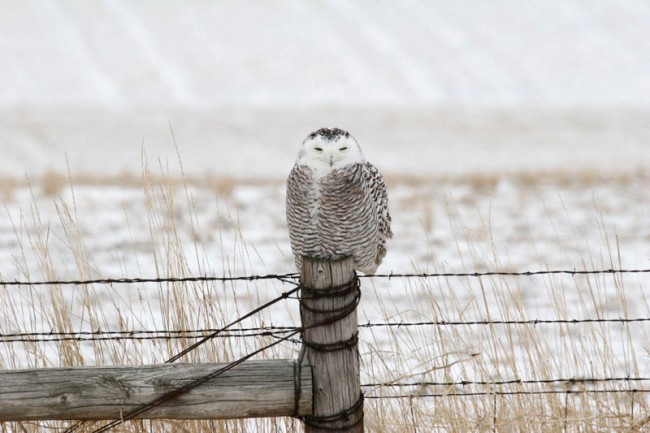
One of the most unique owl species that sometimes graces us is the snowy owl. This large white owl lives and breeds in the arctic tundra, but every few years large numbers of them descend southward in what is called an irruption. I first saw a snowy in 2011 near Okobojo, north of Pierre. In 2018, northwest Sioux Falls had three snowy owls that hung around for at least two weeks. One crisp Saturday, I watched nearly all morning as a snowy sat preening, stretching and snoozing atop a light pole just outside of work. This winter, I heard there were four in Spink County near Redfield. Last Saturday I set out to find them. I wasn’t disappointed. I located three of the four, including one very white and regal male. I’ve gathered those new photos for this column and have included some other favorites from over the years. Owls species not pictured here but found in other columns of mine in the past include the Northern saw-whet owl, long-eared owl and barn owl.

Posted on Leave a comment

Spring Warbler Roundup

Spring is a great time for birding. Dozens of species make appearances in South Dakota during their northern migration, including warblers. These tiny songbirds are sometimes called the jewels of the spring migration because they don’t typically show up at backyard feeders. You have to seek them out. Christian Begeman hit the warbler jackpot while strolling through Palisades State Park May 16 and 17. He found several varieties, along with plenty of other more commonly seen birds.