Posted on — Leave a comment

A Walk Along the Wintry River

Sickness has kept me indoors for the last two weekends. I guess it is that time of year. Even though we are in the heart of winter, it doesn’t always mean that folks like to stay cooped up during their free time. I’m no different, and sick or not, as crazy as it may sound, I’ve come to enjoy the variety of winter weather we experience along the Big Sioux River around Sioux Falls. A quiet walk along one of the local river trails helps clear away a lot of the anxieties and stress of the work week. On a recent trek along bottom trails of the Big Sioux Recreation Area, I was accompanied by a straight down, steady snowfall. It was like silent words of a poem falling on and around me.

With winter weather making travel difficult, I’ve started getting to know a few of the local”river parks” as I like to call them. Good Earth State Park, Newton Hills State Park and the Big Sioux Recreation Area are all close enough to get there and back in most winter conditions. Each offers a great deal of winter birding opportunities, long trails to hike, solitude and interesting photographic opportunities that can be a bit of a challenge to tease out.

Be warned, it’s not usually normal hiking conditions. The trails can easily ice over with winter thaws and re-freezing. The Big Sioux was still high and running with open water when I hiked in the snowfall in mid-January. It didn’t take long to realize that navigating the steep trails alongside the riverbank with gear in hand was a bit more dangerous than I anticipated. One awkward footfall or lean to get the right angle for a photo could easily result in a slip down into the water. Thankfully that did not happen, but it did make for a couple dicey minutes. I learned once again that I’m not near as young and nimble as I want to be anymore.

While walking trails at the Newton Hills horse camp area a couple weeks later, I discovered a new language — or, at least, new to me — written on the snow. The day was quiet with very little bird sound or living activity (besides me). It wasn’t for lack of wildlife; I saw various animal tracks in the snow. Birds, deer, raccoon, rabbit, even mice tracks were everywhere in the recently fallen snow once I started looking. I realize that hunters have learned this language of tracks in the snow for thousands of years, but I hadn’t really paid much attention until that day. I guess I never really had to, knowing my next hunt consisted of reaching into the freezer for the next frozen pizza to throw in the oven. Even so, just taking a half hour to study the variety of tracks and try to figure out an interesting way to make a photograph or two became a bright spot to that particular winter walk.

Don’t get me wrong, I’m not pining for winter to be long and drawn out. I’m not hoping for snow to last through April. But I do appreciate the less-than-obvious beauty found in a winter walk. So, here’s to a few more healthy, feel-good, carefree treks into the winter wonderland this season. Then let’s have a nice slow thaw and enjoy that glorious springtime weather, which I know is on the way. It always is.

Christian Begeman grew up in Isabel and now lives in Sioux Falls. When he’s not working at Midco he is often on the road photographing South Dakota’s prettiest spots. Follow Begeman on his blog.

Posted on — Leave a comment

Winter Safari

As the years have gone along, a new holiday tradition has emerged — the drive. When you work 8 to 5 in the winter months in South Dakota, it becomes difficult to get out and enjoy the landscapes in the sunlight. So, when I finally get a few days off for the holidays, I’ve made it a point to schedule extra travel days — a full day to make what normally would be a four-and-a-half-hour drive on the way out and a couple more days to take an even wider loop on the way back. It’s my way to enjoy the scenery under the winter sky, to watch the vistas slip by beyond the windshield and get lost in vastness.

This year, I cut across the bulk of the state on Christmas Eve using Highways 10 and 12. There was significant fog, so once it became light enough to see, the landscape was a frosted winter wonderland. Near Houghton, I spied pheasants and deer and stopped to get a photo or two. The frost continued all the way through Walworth County, where I stopped at a favorite country church just outside of Selby to capture the frosted trees framing the rural steeple.

After the Christmas festivities, I began the long and completely out of the way journey back by heading towards the southern Black Hills. It is raptor season along the highways and byways of West River country. The number of hawks and eagles perched along the roads were too many to count. In Dewey County, somewhere between Timber Lake and Eagle Butte on Highway 63, I saw a huge Golden Eagle perched on a power pole. Further down the road, I took a detour from the detour and turned into the Foster Bay Recreation Area along the southern arm of where the Cheyenne River meets Lake Oahe. This little drive always seems to be full of wildlife and grand views across the open prairie. On an earlier winter trip to Foster Bay, I watched an eagle drive a yearling dear over a hilltop, trying to get his talons into the deer’s back and have some venison for a meal. No such drama this time around, but there were plenty of deer, as well as a couple juvenile bald eagles perched on a high hill.

My time in the Black Hills was cut short a day by incoming weather, but I still saw the sun rise over Wind Cave National Park with a small herd of bison and cruised the backroads of eastern Custer County on my way to another detour through the Badlands. The sun set on my last day of the winter safari as I drove through the White River breaks near an old, forgotten spot on the map called Stamford. Only a foundation and a crossroads remain. I was tempted to drive south into the White River Valley, prolonging the trip, but clouds were rolling in as the light faded. I reluctantly made my way back to Interstate 90 and headed east. Another holiday had come and gone. Another epic winter drive across South Dakota ended at 80 miles an hour on a four-lane ribbon of road leading home.

Christian Begeman grew up in Isabel and now lives in Sioux Falls. When he’s not working at Midco he is often on the road photographing South Dakota’s prettiest spots. Follow Begeman on his blog.

Posted on — Leave a comment

Black and White Review

November tends to put me in a black and white mood. The end of the year has begun. No more green. No more leaves. Brown on brown. Bleak on bleak. Stark though it may be, there is beauty in simplicity. And the lack of color can sometimes help to see a scene better, particularly in scenes of black and white.

I should confess that I’ve always been interested and intrigued by black and white images. When they are well done, they tend to evoke feelings of nostalgia and maybe even loneliness. They also can bring certain details to the forefront that might otherwise go unnoticed in color images. I first learned how to develop black and white images in an old-fashioned darkroom. The smell of the chemicals, the red light and the fascination of watching an image emerge from a seemingly blank piece of paper floating in the bath was both amazing and somewhat addicting.

For this column, I revisit my fascination with black and white. Folks have asked me over the years about technique and process, so I wanted to share some images from this most recent season of black and white moods. I’ll also share a few of the same scenes in full color. Then you can decide which one you prefer.

I never take black and white photos in the field. I believe some (if not many) cameras allow you to take photos in monochrome when you trip the shutter. This is akin to using black and white rolls of film instead of color film in the days before digital cameras. I used to do it myself, but not anymore.

Pretty much all digital photo editors nowadays allow you to desaturate images in one way or another. The more advanced versions even allow you to adjust the levels of reds, greens, yellows, blues and magentas when editing monochrome. This may seem counterintuitive at first blush. Why would the amount of red make any difference if the final image will have no color in it? Well, that’s a great question. The best answer goes back to photography techniques that the great Ansel Adams taught us. He would shoot scenes using red, orange and yellow filters. This technique altered that particular wavelength of light before it exposed on the film. A red filter would render blue skies black, and green grass would become lighter, for example. Adams taught us that the best black and white images had a true black and a true white somewhere within the composition. Adding filter allowed him to better find those tones. Nowadays we can simulate that technique with digital sliders and adjustments.

One of my first photography professors told me something that I remember to this day and with which I still agree. He said there is nothing quite as beautiful as grass in black and white photography. Add South Dakota’s famous blue skies accented with white clouds and you have a recipe for very interesting black and white scenes.

So maybe this season of early winter isn’t so bad for photography after all. I guess the bleak is what you make of it. This hobby of photography has taught me something that I never knew I needed to learn: there is beauty in almost every vista we find before us each day. It all depends on how you look at it.

Christian Begeman grew up in Isabel and now lives in Sioux Falls. When he’s not working at Midco he is often on the road photographing South Dakota’s prettiest spots. Follow Begeman on his blog.

Posted on — Leave a comment

Blizzard Buster

It started on the afternoon of Saturday, February 23. I was hiking through shin-deep snow at the Big Sioux Recreation Area near Brandon when the first wind gust arrived. It wasn’t much. A rustle of branches at the top of the cottonwoods, a shiver in the tall grass still above the snow, then quiet again. Even so, it didn’t take long for another gust to arrive, just a bit stronger and more ominous. That was my cue to head home. I’ve been caught in South Dakota ground blizzards before, and I have no stomach to drive in one again.

Later that night, the wind rattled my bedroom window, waking me up a couple times. By Sunday morning, new drifts and travel advisories covered much of eastern South Dakota. I stayed in, cooked bacon with my eggs and happily sat it out. At least, that was the plan. By mid-afternoon I was tired of being cooped up. The wind still howled, but it was waning. The sun was out, accompanied by bright sun dogs. That was all it took for me to find my coveralls, my camera and head out the door.

I visited a few country churches within a 10-mile radius and accessible by paved county roads. I only got to one. In many places, the roads had only a single lane plowed and even that was quickly drifting shut. I was first stymied south of Benton Lutheran near Crooks. I could see the church, but I couldn’t see a clear path beyond a long stretch of drifting to the south. The gravel going west from town was impassable, as were most gravel roads in the area, so I headed north to West Nidaros Lutheran.

After re-acquainting my face with the joys of subzero wind-chills and getting a few shots of the church and the Old Nidaros replica, I tried for Willow Creek Lutheran just up the road. Nope. It wasn’t going to happen. I only made it a few miles north when I had to turn back and seek more plowed roads. From there I got on the interstate and headed for Brandon. Just south of town is an old, curiously shaped tree on top of the Eminija Mounds, an ancient Native American burial site that has always fascinated me. With drifting snow, sun dogs and a setting sun, I thought it would make a unique photograph. The snow was knee deep, and after nearly going face first into the white abyss I quickly realized that shorter strides work better in deep snow, no matter how appealing the scene is before you.

After the sun went down and I had a belly full of slow-cooked roast beef, carrots, onions and potatoes, I looked out the window and saw light pillars in the air above town. This winter is the first time that I’ve photographed this cold-weather phenomenon. Tiny ice crystals get blown aloft on high wind, subzero days with recent snow. These crystals catch the man-made light and turn it into magnificent light pillars that stretch high into the night sky.

My first good shoots were taken on the north side of Sioux Falls looking south into the city’s bright lights. Then I headed downtown to get shots over Main Avenue. I encountered drifts nearly as tall as me along the stairs of Tower Park. I don’t think I have ever worked so hard just to get down a stairway. After catching my breath, I drove up to the bluff beyond the Big Sioux spillway for my last set of photos for the day. And what a day it was. I don’t want to make a habit of battling blizzards for interesting photography, but I can’t say it wasn’t fun. I can’t say I’m not whole-heartedly ready for spring either.

Christian Begeman grew up in Isabel and now lives in Sioux Falls. When he’s not working at Midco he is often on the road photographing South Dakota’s prettiest spots. Follow Begeman on his blog.

Posted on — Leave a comment

Frozen in Time

Winter around these parts isn’t for the faint of heart. I don’t know about my fellow South Dakotans, but the last month and a half has been a struggle for me. The cold feels colder than it should. I think my truck’s heater is on the fritz, and it’s not especially great timing for that. Personally, the old internal gas gauge feels like it is constantly hovering around a quarter tank and leaking. Work has been, well, a lot of work, and when I’m not earning my bread I want to sit or hibernate. I never thought I’d be jealous of a wild grizzly, but you have to admit, that long winter’s nap has some upside. To fight off the winter doldrums, I forced myself to layer up and go for a couple of winter hikes. The challenge of finding beauty while your eyebrows feel as if they are about to freeze and fall to the ground can be exhilarating … among other things.

Sundogs have been out quite a bit this winter. One of the best displays I saw was at dawn during the polar vortex event we had in late January. I’ve never been to Falls Park in Sioux Falls when there wasn’t another soul there, but that isn’t true anymore. I guess a guy must be some kind of nut to take in the park’s rugged beauty in 35-below wind chill. The sunrise sundog display was worth it, until that brutal winter cold hit me the next day. In the midst of an all-day sneezing fit and into my second box of Kleenex, I wondered if I maybe I should have skipped that photo shoot. Oh well.

On one gray weekend there was a pretty good snowfall happening, so I donned long johns and coveralls and headed to Palisades State Park to catch some winter beauty amongst the Sioux Quartzite cliffs. Again, I was alone in the cold park. I read somewhere that a walk in the woods is therapeutic, both physically and mentally. Trudging through the snowfall and hunkering down by a sliver of water running along the icy edge was just that — soothing, calming and good for the soul.

Later in the week, the weather warmed enough to rain — and was immediately followed by another cold spell. Ice formed on grass, fence lines and fence posts. I caught a faint sundog sunset with the ice after work. It was a lovely 10 below zero with a pleasant 15 mph breeze from the northwest. My face felt the brunt of the 30-below wind chill. Soon the sun was gone beyond the horizon. I re-gloved my hand, hoping the feeling would return to my fingers as I made my way back to the truck and out of the wind. The heater struggled to keep up, but home and a hot bowl of soup were a mere 10 minutes away, so I had nothing to truly complain about. Winter has a way of bringing out the grouch in me, but if I try hard enough there is always some beauty to be found out in this weather. Even so, the most beautiful thing to me is that it won’t last forever. Those perfect June evenings will feel all the more wonderful after this frigid winter.

Christian Begeman grew up in Isabel and now lives in Sioux Falls. When he’s not working at Midco he is often on the road photographing South Dakota’s prettiest spots. Follow Begeman on his blog.

Posted on — Leave a comment

Warmth from Inside Out

When I looked ahead at my South Dakota Magazine submission schedule for January, I made a mental note that this week leads up to that really big football game that everyone seems to watch, even just for the commercials. While football isn’t my thing, I do really enjoy the food that goes with those kinds of events, and tentatively planned to share a new dip recipe. Every football party needs a dip, right?

But then the polar vortex happened. Brrr. Subzero temperatures and mind-numbing wind chills covered South Dakota and several other states. Schools and businesses closed as a precaution to the life-threatening cold. The United States Postal Service even disrupted service. Those who had to brave the weather needed layers and layers of clothing and warm, filling meals.

I am putting a pause on that dip recipe and leaning hard into the clichÈ of soup. Soup always warms us from the inside out. Everyone needs a few simple, tried-and-true soup recipes in their arsenal of menus, and I am here to add another that is perfect for this cold weather.

White Turkey Chili starts with a base of onion, garlic, celery and carrot and omits the tomato of traditional beef chili. Ground turkey is super lean and yields to the flavorful green chilies, cumin and cayenne. A pinch of cinnamon provides a depth for the soup, while firm cannellini beans increase the heartiness. I topped my bowl with a squeeze of lime, some crumbled queso and chopped cilantro. Cornbread makes a great side dish to round out a meal that can counter even the coldest polar vortex days.


White turkey chili lacks the tomato of traditional chili, but retains the spice and warmth.

White Turkey Chili

(adapted from AllRecipes)

olive oil

1/2 of a medium onion, chopped

1 medium carrot, finely chopped

2 ribs celery, finely chopped

2 cloves garlic, minced

1 pound ground turkey

2 (4 ounce) cans green chilies, chopped

2-3 teaspoons ground cumin

1 teaspoon steak seasoning

1/2 teaspoon cinnamon

1/2 teaspoon cayenne pepper

1 tablespoon flour

4 cups chicken broth

3 cans (15 ounces) cannellini beans

In a heavy pot, heat olive oil and sautÈ onion, carrot and celery. Cook and stir until onion is translucent and carrot and celery are tender. Add the garlic and ground turkey. Break up the turkey into crumbles and cook until browned. Stir in the green chilies, seasonings and flour. Cook a few minutes until seasonings are fragrant and flour has coated meat mixture. Add broth and cannellini beans to the pot and bring to a boil. Reduce heat and simmer for 10 minutes to meld flavors. Taste and season with salt and pepper, if needed. (Serves 4-6)

Fran Hill has been blogging about food at On My Plate since October of 2006. She, her husband and their three dogs ranch near Colome.

Posted on — Leave a comment

Snowy Mountain Winter

Photographer John Mitchell shared these photos of the snowy season in Spearfish and the surrounding Black Hills. See more of his work at SoDakMoments.com.

Posted on — Leave a comment

Frosty Wonderland

Winter weather is not usually described in complimentary terms. Subzero temps, the threat of blizzards along with long nights and short days make it difficult to stay on the sunny side of life during a long, South Dakota winter. But there is a certain phenomenon that occurs during our cold months that defies negativity. You could even say that what happens is magical, or maybe miraculous. How else would you describe an event that has the power to turn a dreary, near colorless landscape into a whole new vision of white sparkling scenery? Granted, I may be a little more enthusiastic than most about frost because it is so fun to photograph. Even so, from the smallest ice-spiked detail to a vast winter white vista, frost has the ability to create an actual winter wonderland.

This year, we’ve had snowfall followed by warm spells. The snowmelt puts moisture in the air, and then freezing temps overnight bring fog. This is the perfect recipe for frost. For years, I called the frost from fog”hoarfrost,” but I’ve recently learned that what I shoot is more likely a type of rime frost or ice. Rime ice is similar to what sailors deal with on the sea in cold weather. It happens when super cooled water droplets freeze and attach to an exposed surface that is below freezing. The two kinds of rime are”hard rime” and”soft rime.” I would never have known the difference until this year’s frost quests in late November and late December.

On my way to visit family for Thanksgiving, I ran into thick fog in Edmunds and Walworth counties. There was a steady wind and plenty of moisture in the air, so I knew it would be optimal frost-making weather. On Thanksgiving morning, Dad and I drove out to see Jack Frost’s handiwork and were not disappointed. A thick, hard rime had formed on windward fence lines, trees and tall grass. A couple more frost events took place in southeastern South Dakota in December. One of those had frost designs that I don’t remember seeing before. Long, thick needles of ice formed on the corners of certain leaves and grasses and left tiny designs similar to jumping jacks hanging on the edges. It turns out this kind of frost is soft rime, and the leaves on which I found it — at Big Sioux Recreation Area near Brandon — couldn’t have been more beautiful.

I had the morning off during another frost event in late December, so I took a drive to see if I could find new scenes of beauty a little farther afield. In Lake County, the sun came out for a few minutes east of Ramona, just as I spotted an old barn with a red brick silo standing sentinel. The red-orange color contrasted with the sun-brightened, white landscape in a remarkable way. That same morning, I happened upon a happy Northern Cardinal couple foraging along the trail at Lake Herman State Park. The male would fly up from the ground intermittently in order to scan the area for intruders. During one of those look out sessions, I happened to catch a photo of his exquisite red feathers against the white of the frosted morning. It was another magical moment brought by the cold beauty of a South Dakota frosted morning, and another reason why it wouldn’t take much to convince me that there is a little bit of magic at play on a frosty day.

Christian Begeman grew up in Isabel and now lives in Sioux Falls. When he’s not working at Midcontinent Communications he is often on the road photographing South Dakota’s prettiest spots. Follow Begeman on his blog.

Posted on — Leave a comment

The Resourceful Chef

In South Dakota, you plan a Halloween costume that fits over your snowsuit … just in case. We all know that autumn often means at least one short-lived snowstorm, and most people are prepared. As the forecasters warn of the fronts moving in, farmers hustle to harvest crops and ranchers bed livestock. We make sure winter coats still fit and find matching gloves. If the storm is severe, there is a run to the store for milk, bread and toilet paper. Some years, the storms rage and there is devastation. Most often, an inch or so of white covers our world and melts quickly in the 50- to 60-degree days that follow. This is a South Dakota autumn.

Earlier this month when our first snows fell, I wasn’t concerned. Hubs and I had been out of town for a couple of days, and my introvert side wanted some downtime. I needed to be home to tend to neglected chores and a few work-from-home items. In our driveway, my car sat through the rains that turned to snow and while I wouldn’t call it buried, it was thoroughly blanketed in white. Even though the following days were warmer, there wasn’t much melting with the car parked in the shade. However, digging into my to-do lists, I didn’t even think about it.

I was running late for an appointment a day or so later when I walked out and discovered my snow- and ice-covered mess. I was even later when I realized I didn’t have an ice scraper. I wasn’t prepared, but I was resourceful as I dashed back into the house and grabbed a wooden spatula from the crock of utensils beside my range. I carefully chiseled ice from the windows and managed to only be slightly late that morning.

I have said it before, and I will say it again: Round wooden spoons are useless. Go for the flat wooden spatula. Round spoons don’t get into the edges of a pot and don’t connect with enough surface area to scrape foods from the bottom. They also won’t work as a stand in for an ice scraper. Wooden spatulas are where it’s at.

When you aren’t scraping ice with your spatula, it works perfectly to stir up a pot of Kielbasa and Cabbage. This is a simple dish that really doesn’t need a recipe. Onions and garlic are softened and fragrant before kielbasa (or other link sausage, or even crumbled bulk sausage) is browned. Toss some chopped cabbage and shredded carrots to the pan and steam with just a bit of stock until wilted. My family likes to stir in buttered egg noodles before serving (often with steamed green beans and a loaf of crusty bread to complete the meal), but the dish is just as delicious without.

No fancy equipment is needed to prepare for Kielbasa and Cabbage, just a cutting board, a knife, a large skillet with a lid and something to stir it all up. I recommend a wooden spatula.


Kielbasa and Cabbage hardly needs a recipe, but a wooden spatula sure is handy.

Kielbasa and Cabbage

1 small onion, diced

1 clove garlic, minced

1 tablespoon butter

2 tablespoons olive oil

1 ring kielbasa sausage, sliced

1 small head cabbage, coarsely chopped

1 medium carrot, sliced into ribbons with a vegetable peeler

1/4 cup chicken broth

1 tablespoon parsley, chopped

salt and pepper, to taste

Heat butter and oil in a large skillet. SautÈ onion until tender. Add the garlic and heat until fragrant. Add the sliced kielbasa and cook until browned and heated through. Stir in the cabbage and carrot. Add the broth and season with salt and pepper. Cover and cook until cabbage is tender. Taste for seasoning and garnish with parsley. (Serves 4)

Fran Hill has been blogging about food at On My Plate since October of 2006. She, her husband and their three dogs ranch near Colome.

Posted on — Leave a comment

The Colors of Winter

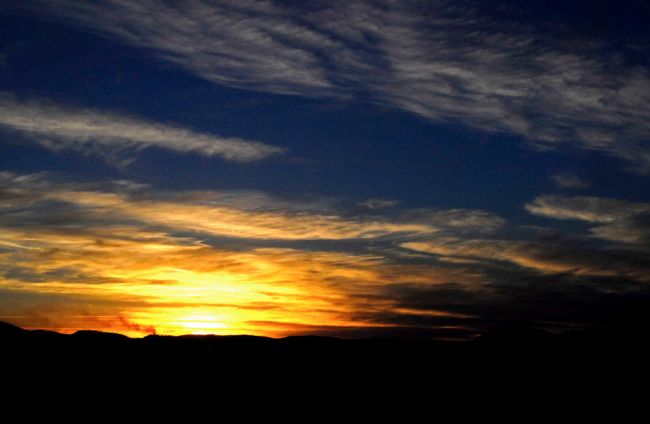
Last month I shared a selection of black and white photos inspired by winter weather. This time, I’d like to explore the color of winter. It may sound oxymoronic to call winter”colorful.” After all, nothing seems to grow but icicles and snowdrifts. Even though there is undeniable beauty in a snow-white landscape, I would be hard pressed to call it”colorful,” wouldn’t I? Maybe not. Even though the green of spring and the many hues of summer are months away, color can still be found. Blues, browns and gold abound this time of year across our landscapes. Elegant sunset skies and even a form of rainbow can also grace the coldest of wintry days in South Dakota.

One of my favorite winter colors is blue. On a sunny day after heavy snow, the sky seems bluer than other days. Low humidity and a lack of dust and other particles in the air make the scene especially bright and crisp. The shades of blue found in shadows also fascinate me, particularly in the late afternoon and early evening when the sun’s rays give off warmer hues. I recently spent a half hour or so trying to capture the beauty of blowing snow in a Union County ditch. I know that is an odd thing to say or do, since blowing snow is not usually our friend, but there I was, frozen fingers and all, enthralled by the play of light, shadow, motion and color in this simple scene.

Southeastern South Dakota had a nice January thaw this year. I took advantage of warmer than average temperatures to hike along Sergeant Creek at Newton Hills State Park south of Canton. I found sumac berries particularly colorful when backlit by the late afternoon sun. Higher up the hills, the tall grass gleamed golden against the backdrop of undergrowth that had kept its leaves throughout the winter.

Other gems to be found in winter are man-made. Ice on dams is a great reflector of sunsets, and red barns stand out in greater beauty against the whites and blues of winter. There is spectacular color to be found in the wild things around us, too. The red of a male northern cardinal is prettiest in a snowfall, and the brown fur and eyes of a rabbit hiding in a briar patch have their own kind of beauty when struck by the winter sun.

One of the most interesting wintertime scenes usually occurs on the coldest and most unpleasant days. A strong wind whipping up fine ice particles in the lower atmosphere produces sundogs, which are essentially light diffractions on either side of the sun, or small, faint rainbows to our eyes.

And let’s talk about the whiteness of snow itself. Scientifically, white is all colors of the visible spectrum being seen at once. Metaphorically, white is associated with purity and holiness as demonstrated by one of my favorite passages from the ancient prophet Isaiah:”Come now, let us reason together, saith the Lord: though your sins be as scarlet, they shall be as pure snow; though they be red as crimson, they shall be as wool.”

However you feel about the white blanket of snow covering the ground, it is almost over for another season, and that is also a good thing. If we didn’t have winter, how would we know just how special spring and summer truly are?

Christian Begeman grew up in Isabel and now lives in Sioux Falls. When he’s not working at Midcontinent Communications he is often on the road photographing South Dakota’s prettiest spots. Follow Begeman on his blog.