Posted on 1 Comment

Roaming the Tall Grass

By Christian Begeman

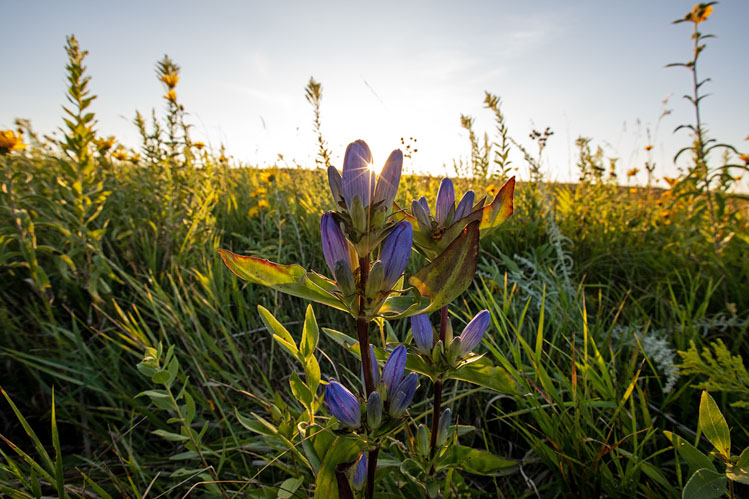
The May/June 2026 issue of South Dakota Magazine features a story on the few tall grass prairie remnants remaining east of the Missouri River. When I was asked to help illustrate the story, I was surprised by how many photos I have taken in and around these places.

I grew up in short and mixed grass country along the Dewey and Ziebach county line west of the Missouri. Only in wet areas or in wet years did the grass get so high that you couldn’t see where your boot fell, which is an important thing in rattlesnake country. When I first began exploring the tall grass preserves with camera in hand, it was unnerving to not be able to see the ground below … and whatever sinister critters may be lurking. Turns out plenty of creatures call the tall grass home. My favorite are the colorful and elusive butterflies. From monarchs to tiny eastern-tailed blues, I have been known to spend hours on the trail seeking that perfect close-up shot.

I also discovered the beauty of the grass itself when peering through my macro lens at blooming sideoats grama florets at the Sioux Prairie Preserve near Colman. Big bluestem, cordgrass and many other tall grass regulars all flower during the summer and photographing them can be nearly impossible due to the wind that we regularly endure on the Northern Plains. To be honest though, a good breeze is welcome in that it keeps the gnats and mosquitos mostly at bay. Yep, it’s not all butterflies and flowers in tall grass country. Myriads of insects live there and a good breeze plus insect repellent is a must when exploring.

After gathering photos for the article, I was asked to gather again for a flyer promoting the new prairie grass area at Good Earth State Park. As I waded back into the archives, I noticed the crescendo of forays into tall grass preserves started slowly about 10 years ago and reached full throat when I was challenged to find and photograph the elusive green orchid. Until that point, I thought wild orchids only grew in exotic tropic locales. Thankfully, I was wrong. South Dakota is home to over 20 orchid species depending on who’s counting. The tall grass preserves are a haven for these beauties and their allies, all of which are a paradise for a camera guy with a macro lens.

Earlier this month, I was out finding the season’s first pasque flowers in the Coteau Hills overlooking Jacobson Fen in Deuel County. As I got up close to frame a few fuzzy portraits of our state flower, I got the idea to share these new photos along with a few other tall grass favorites I had gathered but did not make the final printed story. I hope they convey the sense of wonder and enjoyment I get while out roaming the tall grass remnants.

Christian Begeman grew up in Isabel and now lives in Sioux Falls. When he’s not working at Midco he is often on the road photographing South Dakota’s prettiest spots. Follow Begeman on his blog.

Posted on Leave a comment

Aberdeen’s Graveyard Girl

Tasha Tietz, like all nurses, has a caring soul. She believes people should be remembered even after they’re gone.

Walk through a cemetery with Tasha Westby Tietz and you soon learn that tombstones represent life.

The same happens when you visit Tietz’s Facebook page. Watch her YouTube channel. Catch one of her talks or peruse her research on websites like Find a Grave and Ancestry.com. Tietz considers herself”a loner,” but the vivacious Aberdeen nurse is quickly becoming recognized as an authority on cemeteries. She even has an online persona,”Graveyard Girl,” though she shares the moniker with a rap musician and a fashion and beauty YouTuber — interesting company for the introverted daughter of an Aberdeen bricklayer and a beautician.

“I couldn’t even speak at my own wedding,” she laughs,”but I just spoke at the genealogy society and at the Aberdeen library. I can’t believe all that is happening.”

Tietz’s interest in the deceased began when she was working as a nurse’s aide at Mother Joseph Manor, an Aberdeen nursing home. She soon grew to love the Presentation sisters, and she worried that they might be forgotten when they die because they don’t have children and spouses. Even to this day, one of her favorite cemetery walks is a section of Sacred Heart Cemetery in Aberdeen devoted to deceased Presentations.

But it wasn’t long before she took an interest in more grave sites: those of other patients at the nursing home, her own ancestors and eventually perfect strangers.

“There is a quote that says a person is truly forgotten when their name is spoken for the last time,” she says.”That makes me believe that every person should be remembered and one way to do that is to be sure they have a tombstone.”

And in today’s online world, every tombstone should be searchable. Seven years ago, she began to enter tombstone photos on Find a Grave; today she is among its busiest contributors. She has posted more than 2,400 memorials and obituaries and 5,000 photos.

Aberdeen’s four cemeteries are her favorite places. She has documented many of their markers on Find a Grave.

Her paternal ancestors are buried at Claire City and Sisseton, so she has also visited them for years.”I try to take a bouquet to all my direct grandparents on Memorial Day,” she says.”I like to go to Claire City in September and visit the graves at Sica Hollow.”

In 2021, she found three tombstones of the Roy family, some of the first white settlers, among the autumn foliage of Sica Hollow. Most of her explorations have been in northeast South Dakota, but she has also roamed cemeteries as far away as Washington, D.C., Canada, Arizona and Texas.

She includes”graving trips” on family vacations when her husband, John, and their three daughters — Chloe, Claire and Charlotte — are willing.”The girls are not super-impressed yet,” she says.”John is also not a fan, but he’ll take me. We went to the Black Hills last summer and we explored Mountain View Cemetery at Keystone. I picked it because some of the Mount Rushmore carvers are buried there, and the actor Bobby Buntrock died and was buried there. There is also a Native leader, a medicine man, an artist and some kind of a wild Old West guy. It’s the only cemetery with a view of Mount Rushmore.”

She recently visited the De Smet cemetery where Charles and Caroline Ingalls are buried, along with their daughters Mary, Grace and Carrie.

Her social media posts also include information she gathers from other sources, including a recent bit about the Jewish custom of placing stones rather than flowers on tombstones. She also spotlighted a report of an Iowa cemetery that features three pyramids, built by the local newspaper editor who planned to be buried in one of them.

Graveyard Girl’s Facebook page now has more than 6,000 followers. Her sites have grown so much that they earn her small amounts of money, some of which she has used to help pay for gravestones on unmarked graves. If the revenues continue to grow, she plans to also invest in camera equipment and research materials for the ever-growing avocation.

She finds genealogy research the most rewarding aspect of being Graveyard Girl. People from across the nation have sent her notes of appreciation for her assistance in finding the graves of their ancestors.

Still, her favorite part of being Graveyard Girl is the time spent in cemeteries.”I like to be out in nature, and I am pretty much a loner. I think I’m also an old soul. I’m happiest when I’m with my family, outdoors in a beautiful cemetery.”

Editor’s Note: This story is revised from the March/April 2025 issue of South Dakota Magazine. To order a copy or to subscribe, call (800) 456-5117.
Posted on Leave a comment

Scoping the Missouri

Members of the South Dakota Ornithologists Union look for birds at Union Grove State Park between Beresford and Elk Point.

Roger Dietrich was scoping along the shore of Lake Yankton when a Rapid City woman approached him with a question about the tiny Ross’s gull, which had been sighted in the area.

“I’ve gone to Alaska twice and I didn’t see the bird there,” she said.”Is it still around?”

Dietrich pointed to a gull, sitting on ice in the middle of the lake.

The Missouri River is a bird-watching paradise. Hundreds of species of ducks, geese, gulls, loons and other birds congregate in parks, woodlands and farm fields that border its 443-mile corridor. But it still helps to know for what you’re looking.

Every habitat attracts different birds, says David Swanson, professor of biology at the University of South Dakota and author of Birder’s Guide to South Dakota, and habitats vary dramatically along the Missouri as it winds from Nebraska to North Dakota.

Following is a guide, from south to north, of habitat patches and the surprises that await birdwatchers, both the serious birders looking for the rarest”lifer” bird and those who are happy spotting sparrows and swallows.


The Adams Nature Preserve attracts wading birds such as blue herons.

Adams Nature Preserve

Southeastern South Dakota

The Adams Homestead and Nature Preserve near North Sioux City includes many trails.”It has a variety of habitats,” Swanson says.”It has an extensive cottonwood forest that borders the river, and there’s also a little lake called Mud Lake that’s attractive to waterfowl. The ring of trees surrounding Mud Lake can be good for woodland birds, too.”

Mud Lake is approximately a quarter mile from the Adams Homestead parking lot, so a brief hike is required to access it. Wooden observation blinds lie along the trail with a view of the lake.

“The other habitat at the park is a restored open prairie,” he says.”It’s one of the few sites in the southeastern part of the state where you can find Eastern meadowlarks. The common meadowlark in South Dakota is the Western meadowlark, but the Eastern meadowlark is expanding its range in the southeastern part of the state and Adams Homestead is one of the places where you can find those.”

Since first being sighted in 2017 by Swanson and his ornithology students, the Eastern meadowlark has made regular appearances in the open-prairie habitat, often with multiple birds singing among the scattered trees.

“I wasn’t aware at the time that Eastern meadowlarks had started to expand their range, and I heard these Eastern meadowlarks calling,” Swanson says.”I go, ‘That is very unusual.’ We kept walking and saw them and everybody in the ornithology class got to see me geek out over it.”

Though birdwatching at the Adams Homestead is enjoyable year-round, it’s best in spring, summer and fall.”Mostly, it’s hiking the trails during migration and seeing a variety of birds at that time,” Swanson says.”It’s lots of warblers and sparrows, so the migration periods are late April to mid-May. Then in the fall, from mid-to-late August into about mid-September is probably the peak for warblers and vireos, some of which migrate all the way down to Central and South America.”

Sparrows that migrate to the southern U.S. and Mexico slightly later in the year can typically be seen at the Adams Homestead from mid-September to mid-October. Along the river and at the lake, birdwatchers encounter ducks and geese, as well as wading birds like herons and egrets.

“In the cottonwood forest, there are Eastern whippoorwills,” Swanson says.”Those are birds that don’t really get too much out of the southeastern part of the state. Of course, they’re nocturnal, so they don’t start calling until it starts to get dark.”


Least terns can be found on sandbars below Gavins Point Dam.

Gavins Point Dam

West of Yankton

Gavins Point Dam, the southernmost project on the Missouri’s system of six dams, is surrounded by unique bird habitats.

During the summer, hundreds of American white pelicans can sometimes be seen near the dam, while on the river itself, there are piping plovers, still considered a threatened species in most of the U.S., and the least tern, North America’s tiniest tern, often seen flying low over the river and hovering before plunging for prey.

“One of the reasons I like birding is the idea that it would be so cool to fly, and least terns are just the best flyers,” says Roger Dietrich, a local authority on ornithology.”They’ll fly and they’ll see a minnow, and then they dive straight down in the water — and splash!”

In winter, the 2-mile-long earthen dam creates an unusual condition for birds and birders.”Some years, when it doesn’t freeze, like lately, there’s been lots of open water above the dam,” Dietrich says.”Some years, we get lucky and even the Lewis and Clark Marina doesn’t freeze over real early. So, that’s a popular spot where some grebes and loons will stop.”

Black scoters, surf scoters, white-winged scoters and long-tail ducks, which are mainly ocean birds, are known to visit the lake and river in winter.

“I tell people from other places that we have those birds here and they’re just not believing it, because they don’t think of the center of the United States as a place where these birds would show up,” Dietrich says.”And when I say they show up every year, usually, for a fairly long period of time, they just can’t believe that we’re so lucky.”

The common loon migrates through the area, as well as a number of gulls — including Sabine’s gulls, kittiwakes, black-legged kittiwakes and even the Ross’s gull, which is associated with the remote arctic. Crest Road, which passes over the dam, is a good place to observe such birds. It requires no special pass or permit.

“Scan for the birds with binoculars or a spotting scope and chances are, you’ll find something different,” Dietrich says.”Sometimes there are huge flocks, and you can spend hours just scoping the birds there,” he says.”So, if you see somebody there with their scope out or binoculars, stop and ask them what they’re seeing. I’d say 99 percent of the people will be glad to point things out to you, and maybe even let you look through their scope to see what they’re seeing.”

Several snowy owls hung out along the dam road a few years ago.”They were feeding on the flocks of coots that were there.” Wintertime also brings large flocks of lesser scaup, which birdwatchers will scan for specimens of greater scaup, a polar bird that tends to prefer saltwater and is rarely seen inland, Dietrich says.

“It’s the same with the big flocks of common goldeneye,” he says.”People try to scope out the Barrow’s goldeneye, which is another species. It’s more of a West Coast bird, but once in a while, we’ll get one here — always a highlight.”

Bald eagles frequent Gavins Point Dam and some now nest year-round in the tall cottonwoods that border the Missouri.”They’re used to a lot of people around and some of the trees they perch in are right along the local roads,” Dietrich says.”You can see them in action, swooping down and picking up fish. I’ve seen eight or nine at a time on the ice up above the dam, eating the dead snow geese they’ve picked off.”


A pair of Barrow’s Goldeneyes at Fort Randall.

Fort Randall

Pickstown

Fort Randall Dam also hosts a large congregation of bald eagles. Below the dam is the Karl E. Mundt National Wildlife Refuge, which provides habitat for the eagles.

Kelly Preheim, a kindergarten teacher in Armour and a well-known local birding enthusiast, especially likes the wooded area around the Fort Randall Dam.”We’re mostly on agricultural grassland in southeastern South Dakota,” she says.”But the dams have a lot of woodland, forested areas, and I enjoy walking on the trails.”

She found 71 bird species on a recent camping trip to Pickstown.”In the morning, oh my goodness, the singing,” she recalls.”My husband’s like, ‘I can’t get any sleep. It’s so loud here!'”

A hike to the tailrace, the channel below the dam that carries water away, will often be rewarded.”Fish that go through the dam come out somewhat stunned in the tailrace,” Preheim says.”Then, all these birds, like gulls and eagles and certain ducks, eat those fish.”

Like nearby Gavins Point, Fort Randall Dam is also home to many types of waterfowl in autumn and winter.”There are a lot of different ducks on the scene, hundreds and hundreds, if not thousands, of different ducks there at a time,” Preheim says.”I saw a brown pelican one time. That’s actually an ocean bird.”

Other surprise visitors at Fort Randall include a yellow-billed loon, typically associated with Alaska and America’s western coast, and a great black-backed gull, which is an Atlantic coastal bird, Preheim says.

Scarlet tanagers are often found in South Dakota but summer tanagers, a rare visitor, might also be seen around Fort Randall.


Pelicans near Big Bend.

Big Bend Dam

Fort Thompson

The best birdwatching at South Dakota’s northernmost dams — Big Bend and Oahe — occurs from April through May and from September to November, according to lifelong birdwatcher Ricky Olson, who lives at Fort Pierre.

Big Bend has fewer access roads and trail amenities than Oahe and the other dams, but it has its own charms. Ospreys nest below the dam and brown pelicans have been spotted.

“Once in a while, in the wintertime, you get a Brant goose at Big Bend,” a seacoast bird.”I run down to Big Bend at least every two weeks in the winter to see what’s there,” Olson says.

Big Bend also attracts smaller goose species, including snow geese and white-fronted geese, both of which are common to the area.”In the fall, it’s neater to go to Big Bend,” Olson says.”Also, the shad and minnow species will be in the shallows then, and you’ll get all kinds of cormorants and pelicans and hundreds of gulls in these frenzies where they’re all feeding, and the gulls are trying to steal from everybody.”


Canada geese along the Missouri River.

Oahe Dam

Central South Dakota

Ring-billed gulls, herring gulls and California gulls may be sighted at Oahe, as well as the arctic tern, a mega-find for birders.

A spectacle occurs during flooding when Oahe Dam’s hydraulic turbines are running.”It’s a feeding frenzy. You get thousands of gulls, maybe 20,000, below the tailrace in a half-mile stretch,” Olson says.”It’s like a snowstorm. Thousands of people come to watch the ‘gull snowfall.'”

Oahe also has cliff-dwellers.”In the sand layers in the cliffs, in the holes, there are barn owls nesting,” Olson says.”They dig their own holes, and often, they’re near where colonies of bank swallows have dug holes.”

In autumn, Sabine’s gull may be spotted.”It’s very pretty. It’s black and white with half a diamond on the wing,” Olson says.”We also get Bonapartes and Little gulls, which is a little gull, and we get some of the big ones. Once in a great while we get the great black-back, which is the biggest gull.”

Gulls breed on a few islands along Oahe, Olson says.”There are only a few places in South Dakota where that happens.”

Another rare visitor to Oahe, among the sea ducks like the scoters and the long tail duck, is the occasional coastal harlequin duck in the tailrace.

“We get loons,” Olson says.”Sometimes we get the Pacific or the yellow-billed or red-throated loon, which are rare for our state.”

Further north on Oahe, retired biology teacher Stan Mack says opportunities are available even in Mobridge’s city limits.”There’s a walking trail along the south side of town. Just follow Main Street to the river and walk west and you’ll see the ducks and geese and gulls that sit on the water.”

Mack says Indian Creek (east of Mobridge) and Indian Memorial (across the river to the west) offer trails and habitat.

Mack doesn’t walk well enough to explore like he once did, but the birds will come to him.”I’m doing a feeder watch for Cornell University. Right now, I’m looking at a collared dove — we never saw them before — and I see about 16 more picking up seeds on the ground.”

Editor’s Note: This story is revised from the March/April 2025 issue of South Dakota Magazine. To order a copy or to subscribe, call (800) 456-5117.

Posted on Leave a comment

Winyan

Elizabeth Winyan (standing) was long associated with the Riggs family, caring for young Thomas in Minnesota and later joining him at Oahe Mission.

On a spring day in 1830 a family, including a 3-year-old girl, was harvesting sweet syrup from maple trees along the banks of the Minnesota River near present-day Mankato. Suddenly and viciously, they were attacked by an unidentified rival tribe.

The girl’s father was one of several Dakota Sioux killed in that attack. The young girl’s mother realized she could not escape the deadly melee while running with two children, so she emptied a pot of boiling water and hid the girl underneath. She then picked up her son and ran to safety.

For two days and one night the little girl stayed silent under the kettle. Then, her mother crept back and retrieved her.

“Even in her old age,” wrote historian Thomas Hughes,”Winyan never forgot that terrible experience and how, when her mother lifted the kettle, the moonlight showed on the bloody faces of the outstretched dead, her father among them.”

Winyan, who would later be given the name Elizabeth while working with Dakota Territory missionary Stephen Return Riggs, spent the rest of her life serving others. In Dakota, Winyan means mother and protector. She lived the name. Winyan was a human bridge over the most difficult waters of Dakota Territory and early statehood, when the federal government sought to force rapid assimilation of Native people, in part by creating reservations. By the time she died six decades later, Winyan was a legend among Native people, white missionaries and settlers on the Dakota frontier of the 1870s and 1880s.

Oahe Mission Chapel, next to the Riggs family home, was built in 1877. When Lake Oahe flooded the site it was moved to the Oahe Dam Visitors Center, where it stands today.

She often traveled the preaching circuit with the Riggs missionaries, blending her mission work with knowledge and practices of her own Dakota people. The Sioux, with a rich oral history tradition, have tried to keep stories like Winyan’s alive, but in the written annals of Dakota Territory her works are sparsely mentioned.

“She was amazing in her time,” says Winyan’s great-great-great granddaughter, Lora Neilan, of Summit.”And it is sad that it got forgotten.” When Winyan died in 1890, the noted Dakota Territory missionary Mary Collins, a good friend, wrote,”She was one of the grandest women I ever knew.”

Even my introduction to Winyan was accidental, a result of research into an entirely different woman on the Dakota frontier. In 1989, I spent a year studying political migration during a journalism graduate fellowship at Stanford University. While there, I did considerable research on the American frontier, which included paging through countless editions of 19th century newspapers in the archives. One advertisement in an 1888 edition of Minnesota’s St. Paul Daily Globe caught my eye. In huge type, I read:”SHE LOVES A SAVAGE!” It was an advertisement for a dime museum appearance of Corabelle Fellows, a young white missionary, and her new husband, Sam Campbell, a mixed-race man of Dakota Sioux and white blood.

I suspected there was a good story behind this headline. I tucked away a copy of the ad and years later, decided to investigate. I have often been surprised by how few female and Native voices are used in the telling of the history of Dakota Territory. I thought Corabelle may have something to say. This hunch — and years of research — resulted in my book Life Painted Red: The True Story of Corabelle Fellows and How Her Life on the Dakota Frontier Became a National Scandal.

The book follows young Corabelle and Sam as they set out on the sideshow circuits and Buffalo Bill’s Wild West show to make ends meet after Corabelle’s family disowned her for marrying a man of mixed blood.

During my research I also discovered Winyan, who had played a role in Corabelle’s early missionary work. In the winter of 1885-1886, she was in her third year of teaching and serving in missions in Nebraska and Dakota Territory. That winter, one of the coldest and harshest on the Plains, she lived and served with Winyan from a rough-hewn cabin at the Oahenoua village on the Cheyenne River, northwest of present-day Pierre. It was one of the most isolated posts on the frontier, serving people who had recently returned from exile in Canada with Sitting Bull. By then, Winyan had gained a reputation as one of the physically strongest women in the territory. She built the log cabin she lived in, hauled water uphill from the river and traveled long distances through harsh conditions to nurse the sick or dying.

Thomas Riggs.

Living with Winyan that winter, Corabelle, whose mother immediately disowned her after the marriage to Campbell, began calling Winyan”Ina,” or mother. Winyan had initially gained notoriety when, as a young woman during the bloody Sioux uprising in Minnesota in 1862, she secretly swam food to an island in the Minnesota River where Riggs and a small band of fellow missionaries and Sioux friends had hidden with their families. After her father died, Winyan had been taken under the tutelage of Riggs and his fellow missionary Thomas Smith Williamson. When the Dakota people in Minnesota were pushed west to reservations, the missionaries went with them, so Elizabeth gave up her life among the lush fauna of the Minnesota River valley to the harsher, starker and more expansive high plains of western South Dakota.

The granddaughter of the legendary Dakota leader Sleepy Eyes, she had grown up with a strong connection to the natural world. Winyan helped raise several generations of Riggs children, nursed the ill with herbs and practices passed on to her from her ancestors and sat with the dying when others were too afraid of evil spirits.

Tales of her physical strength spiced Sioux oral histories. Stories of her quiet mercies were also abundantly shared.”Winyan was a woman of strong character, fine mind and a natural leader,” the historian Hughes wrote.”Her great desire was that her people should hear the Gospel, so as the years went by, her work widened, and she was sent to various fields. She held meetings, discussed the Bible, visited the sick, buried the dead, and occasionally addressed conferences of white people. Even the Indian men held her in the highest esteem.”

Collins, the missionary, was struck by Winyan’s loyalty, her knowledge of her people’s past and her understanding of the natural world, particularly the constellations in expansive prairie night skies.”She is a faithful friend, true to her character as a Dakota,” Collins recalled.”She enjoys camp life with us, and evenings, as we sit by the campfire, she will tell stories of her early life, or fables, or legends of the stars. She is quite an astronomer. She reads the sky like an open book.”

Together, during that rough winter of 1885-86, the broad-shouldered Winyan teased Corabelle — barely 5 feet tall — about being able to keep up with physical work. Hauling water from the river to the cabin, Winyan would balance two large buckets on her shoulders, often while plowing through new fallen snow. Corabelle would follow with one pail, struggling, but rejoicing in Winyan’s eventual approval.”She always looked me over skeptically when we reached the house” after hard work outdoors, Corabelle recalled.”Invariably, when she found me unbroken, she would put her hands on her hips and laugh so hard that I was obliged to join her.”

Thomas Riggs established Oahe Industrial School in the 1870s as a training school for girls.

One night in the middle of that winter, Winyan fell asleep while Corabelle was teaching a group of young Sioux men. One of the men later returned to kidnap the bewildered Corabelle, catching her as she came outside to do a chore before bed. Winyan, awakened by a rush of ice-cold air from an open door, plowed through snowbanks to catch up with the young man, who had wrapped Corabelle in a blanket and was carrying her to his home.

“What bad thing is this!” Winyan shouted, shooing the man away.”Now you stop!” Her unwelcome suitor dropped Corabelle in the snow. Winyan wrapped her in a blanket and escorted her back to the cabin, where she consoled and soothed her with an herbal bath. Winyan scolded Corabelle for carelessly ignoring her warning to never go outside alone.

Corabelle and Winyan talked long into that night, marveling at how this white missionary and the Native missionary ended up together after growing up in such different worlds of culture, customs and religion.”How we talked,” Corabelle remembered.”Really talked, there in that crude cabin, shut away from the rest of the world. She asked and answered, and I asked and answered until that day, with its closeness of spiritual touch, became a highlight of my whole life.”

Missionaries and newspaper reporters alike simply called her Winyan. Eventually, she had a son, Edward Phelps, a minister, who along with his wife, Ellen, became missionaries and served rural South Dakota churches.

In her 50s, Winyan began speaking more frequently to donors and churches, traveling as far as Chicago. Neilan, Winyan’s descendant, has collected photos and articles that highlight her impact. Winyan’s life spanned the great events of the 19th century frontier: the government’s many treaties with the Sioux; the 1862 uprising in Minnesota, in which hundreds of white settlers and Native people were killed, and which ended with the mass hanging of 38 Dakota men; the many battles and massacres between U.S. Army forces and Native people on the Northern Plains in the mid- and late-19th century; the last stand of George Armstrong Custer’s 7th Cavalry on the rolling Montana hills in 1876; and the rapid settlement and statehood of South Dakota in the last quarter of the 19th century.

Louisa Riggs considered Elizabeth Winyan (standing) a colleague. She is pictured with Mary Collins (second from right), another missionary.

“She was a legend,” Neilan says.”What I found out, in the time frame that she lived, with the racism she faced and everything that had happened, I am most proud of how she rose above that, of how she left her mark and how many other ones did as well.”

Even while helping Native people adapt to relocation to the reservations, she often quietly longed for her childhood life along the Minnesota River.”She missed it so much,” Neilan says. Once, when sitting with fellow missionary Collins, Winyan told of something she had just seen that”well represents our present condition as a race.

“A man named Longfeather, dressed in Indian dress paint and feathers, was teaching some boys the Indian dance and song,” Winyan told Collins. There were three boys: One with long hair and painted face and Indian dress, one with shirt and leggings and a white boy’s shoes and stockings on, the third dressed well in entirely white men’s clothes.”One represents the past, the second the present, and the third the future,” Winyan said.”I know it has to be, but to me the one dressed all in the Indian child’s clothing looked the best, but I’m only an Indian.”

Neilan finds inspiration in her ancestor even today. She says she and her daughters (Lauren, Bailee and Falon) have also begun to study native plants, and to learn about the constellations that illuminate our prairie nights.

“She was a beacon,” she says,”a beacon of power in her own self.”

Chuck Raasch is a native of Castlewood and a graduate of South Dakota State University. He has written for the Huron Daily Plainsman, the Sioux Falls Argus Leader, the St. Louis Post-Dispatch and USA Today. Raasch has also authored two books, Imperfect Union: A Father’s Search for His Son in the Aftermath of the Battle of Gettysburg, published in 2016, and Life Painted Red: The True Story of Corabelle Fellows and How Her Life On the Dakota Frontier Became a National Scandal in 2023.

Editor’s Note: This story is revised from the January/February 2025 issue of South Dakota Magazine. To order a copy or to subscribe, call (800) 456-5117.

Posted on Leave a comment

Finding the Wilds of Winter

Spotting winter wildlife on the Northern Plains can sometimes seem impossible. Frigid temperatures, relentless wind, snow and ice usually keep critters out of sight during the diminished daylight hours. When I was in junior high, I spent a good chunk of an afternoon sitting in what I thought was a pretty good hiding spot overlooking a stock dam bordered by a chokecherry thicket. A recently deceased cottontail was on the edge of the ice, placed as a lure. I think I hoped a hungry coyote or maybe even a hawk or eagle would arrive. Nothing did. All I heard was the wind though the thicket and all I saw was gray and sullen clouds overhead.

I’m not sure when I figured out that the golden hour was when wildlife is most on the move. Maybe it was deer hunting with my brother or simply noticing more things after I shut the tractor down for the day. This tip generally still holds true when I’m out looking for wildlife with my camera. Not only are there more opportunities to see wildlife, but the golden hour provides beautiful light. Win-win.

It has been my family’s custom to find time to survey the countryside when we get together for the winter holidays. To this day, I keep this tradition alive. Sometimes I’m with my dad, sometimes with brothers and nephews and sometimes it is just me and my camera. This year, I spent three days looking for wildlife in Badlands National Park, Custer State Park and Wind Cave National Park between Christmas and New Year’s Day. And yes, late afternoon and early morning proved to be the most fruitful times.

I arrived in the Badlands around 3 p.m. on December 27. This may seem like mid-afternoon, but winter light is short-lived and angled low and lovely, which is a photographer’s delight. At 3:20 a great-horned owl was out on a ridge waking itself up in the sunlight. About a half hour later I spotted a golden eagle riding updrafts near the Sage Creek Wilderness Road. After photographing a few solitary bison bulls, I headed west and got to Custer State Park with very little light left on the western horizon.

Overnight, a skiff of snow fell in the Southern Hills and there was frost on the grass as I headed to a favorite spot along Highland Ridge Road in northern Wind Cave National Park before sunrise. There were elk below the ridge and bison on the horizon as the sun appeared with warm tones even though the temperatures were well below freezing. As the day lengthened the light brightened, the wind increased and the frost fell to the ground. After driving a few of my favorite routes, I ended up calling it day fairly early. I repeated this routine for the next few days, and it was glorious. Here are some of my favorite photos from that vacation. I’m already counting down the days for another foray or three into South Dakota’s winter wilds.

Christian Begeman grew up in Isabel and now lives in Sioux Falls. When he’s not working at Midco he is often on the road photographing South Dakota’s prettiest spots. Follow Begeman on his blog.

This slideshow requires JavaScript.

Posted on Leave a comment

If Our Trees Could Talk

A pair of oak trees known as the Twin Oaks are among the trees chronicled in Paul DeJong’s book on the Sioux Falls urban forest.

“Have you been here before?” asks Paul DeJong as we sit around a small conference table inside Touchmark at All Saints, a senior living community in one of Sioux Falls’ most historic buildings — the former All Saints School. The massive, four-story granite building in the heart of the city was finished in 1884 under the direction of William Hobart Hare, the first Episcopal bishop of South Dakota. The all-girls boarding school was designed to serve the daughters of missionaries who were serving the sparsely populated Dakota prairies.

But that’s not where this conversation is heading.”Some of the most majestic trees in the city are right outside,” DeJong says.”There’s a catalpa and a ginkgo tree on this property that were probably planted in the late 1800s or early 1900s.”

It stands to reason that the trees would be at least as old as the building itself, and of course DeJong would notice them. He worked at Landscape Garden Centers for more than 30 years, first as an employee and then its owner. He’s had a hand in selecting trees for nearly every neighborhood in Sioux Falls, an accomplishment made even more impressive considering the city’s rapid growth.

He seems to know every inch of soil beneath South Dakota’s sprawling metropolis. His quick and encyclopedic knowledge of trees allows him to tell you exactly why an American sycamore would thrive in one neighborhood but not another.

The book publishing team includes (from left) Jeremy Brown, Paul Schiller, Paul DeJong, Heather Kittelson and Mike Cooper.

The urban forest of Sioux Falls became his passion, and now, with help from friends, he’s finishing a book that he hopes will inspire future generations to appreciate the diversity of the city’s arbor culture. If Our Trees Could Talk: Discovering the Urban Forest of Sioux Falls is a 172-page coffee table book, completed in collaboration with the Mary Jo Wegner Arboretum, that traces the development of several historic Sioux Falls neighborhoods and the trees that give them life and character.

The idea for a book has been in the back of DeJong’s mind for at least 10 years, but it’s coming to fruition at perhaps the perfect moment. He was diagnosed with Parkinson’s Disease at age 53. He retired from ownership at Landscape Garden Centers in 2018, though he continued to work part-time until 2022. Eventually, he sold his home and moved to Touchmark.

The urgency of such a diagnosis led to the creation of a team to help make the book a reality. Heather Kittelson is the self-described”connector” of the team. She met DeJong in March of 2023, while both served on the board of directors for the Mary Jo Wegner Arboretum, a 155-acre greenspace tucked next to the Big Sioux River just off Highway 42 on the east side of the city. As she learned about DeJong’s health challenges (which included a serious car accident and a bite from a brown recluse spider earlier in life), she was inspired by his drive to persevere.

DeJong was equally impressed by Kittelson’s energy and positive attitude. She subsequently invited him to be a guest on her podcast called”Fortitude,” in which she interviews people who have overcome adversity. DeJong’s is among the most listened-to episodes.

After the podcast, Kittelson asked DeJong if he had any dreams he would like to see fulfilled. The answer was a book about the trees of Sioux Falls.”It really was a dream,” she says.”He just needed someone to help execute it. I love being resourceful and a connector, and I wanted to see Paul’s dream come to fruition.”

The rest of the team quickly formed. They include Mike Cooper, the arboretum’s executive director and a retired city planner for Sioux Falls; Jeremy Brown, the head of Throne Publishing; and well-known regional photographer Paul Schiller. Cooper and DeJong drove many miles around Sioux Falls, identifying neighborhoods and trees, and Schiller captured them throughout the year.

McKennan Park in spring.

DeJong wants the book to be an educational tool and hopes it will direct more attention to the arboretum. It could also be the culmination of a life devoted to the outdoors.

DeJong grew up on a farm between Sheldon and Hospers, Iowa. He got an associate degree in business and marketing from Northwest Iowa Community College and then headed to Sioux Falls, looking for opportunity. He stopped by Lakeland Nursery and noticed they were hiring.”Having grown up on the farm, I had a general knowledge of trees,” DeJong says.”They were taking applications and I needed money fast, so they said I could start working there the next day. I had no idea what I wanted to do, and in a couple weeks’ time I had found my passion working with trees, landscaping and outdoor living areas. You’re enhancing everybody’s opportunity to spend more time outdoors with their families as opposed to sitting in the house.”

He threw himself into the work, getting to know our native and non-native species and talking with both residential and commercial customers about the trees they wanted and the trees they needed — which were not always the same thing. DeJong is a huge advocate for tree diversity, and that can be challenging in South Dakota.”We can beat up on ourselves for not diversifying, but we are a prairie state with a mix of prairie grasses, so we’re limited in what species thrive here,” he says.”Trees weren’t necessarily by God’s hand meant to grow in South Dakota.”

An American larch in McKennan Park.

When settlers first arrived in Dakota, they would have seen a nearly treeless landscape, other than the occasional willow, elm, ash, box elder and the cottonwoods growing in the river valleys.”Cottonwoods are so towering and large, and they’ll grow in wet, boggy areas,” DeJong says.”They could be several miles away and see these stands of cottonwood trees in the distance and know that there was likely water nearby.”

As railroads moved into Dakota, it became easier for those settlers from Europe or bigger eastern cities to order the trees they knew and loved. Maybe that’s how the catalpa and ginkgo trees ended up in DeJong’s new backyard.”Ginkgos are a very slow growing tree, but this one’s probably 80 feet tall,” he says.”They originated in China and are disease and pest resistant. They’re actually prehistoric trees. They’ve got fan-shaped leaves, very distinctive. The catalpa has a large plate sized leaf. It largely remains silent except one week in June when it gets a hydrangea-like flower. That’s its one week of glory for the year.”

One of DeJong’s favorite neighborhoods is McKennan Park, which is filled with historic homes and majestic trees. Among them is a big bur oak planted after World War I to honor the returning soldiers. It’s also home to the largest silver maple in the state and a stand of American larch.”When I was a kid, they quite often planted windbreaks with American larch,” DeJong says.”I didn’t realize what they were at the time. In the winter all the needles were gone, so I thought they were dead. But they come back in the spring and turn a brilliant golden color in the fall. Then in the winter they go dormant again. They’re mysterious or haunted looking trees.”

The American sycamore in McKennan Park is an example of being in the right place.”There are microclimates in Sioux Falls, like McKennan Park and the Cathedral District,” he says.”There’s good soil; it’s not only cold hardiness. You get on the edge of town where the winds are more abrasive, you’ve got about two inches of black dirt and the rest is excavation clay, and you’re more limited in what species you can use. I would never recommend an American sycamore anywhere other than the core area of the city.”

Other trees stand out for different reasons, such as a concolor fir in the Riverview Heights district north of the Veterans Administration hospital.”I would say it’s 100 feet tall. The first time I viewed that tree, a deer and a turkey came running out at the same time. I bet the bottom branches spread 40 to 50 feet across.”

A stately cottonwood at 57th and Minnesota.

A cottonwood tree near Covell Lake is notable because its lowest branch is probably 50 feet off the ground. Another at the corner of 57th Street and Minnesota Avenue has been growing for more than 100 years and towers over other neighborhood trees. Black locusts in the Cathedral District shine in spring, when they blossom with droopy, lilac-colored flowers.

A stand of hackberries along South Cliff Avenue accents a neighborhood that began as a place for the city’s more affluent citizens to build second homes. A blue beech in the Maplewood District is rare for South Dakota.”It has very smooth bark and looks like an elephant’s leg because it flares out at the bottom. The smooth bark prevents insect infestation. If a tree has rough bark, it’s easier for insects to burrow into it, but the blue beech evolved over time. Trees are constantly under evolution. They’re just like human beings; they have to adapt.”

Everyone involved sees the book as a starting point that can lead to continuing education in K-12 classrooms and at the arboretum. DeJong envisions an”urban forest university” that encourages young people to get outdoors and learn about the trees surrounding them — not just because they might be pleasant to look at but because of their benefits for the environment and our health.”I spent a fair amount of time recovering from surgical procedures at the Mayo Clinic. I remember going through the gardens once I was able to get outside. The trees seemed to soothe my physical pain. It is true that trees reduce stress and promote physical and mental healing.”

Working with DeJong on the book has been rewarding for Cooper and Kittelson.”We’re all so busy going through life that we tend to forget how beautiful our surroundings are,” Kittelson says.”Paul has helped me to stop and be present and take in what’s around me.”

May we all slow down and learn to appreciate both the forest and the trees.

Editor’s Note: DeJong’s book is available from the Mary Jo Wegner Arboretum in Sioux Falls. This story is revised from the March/April 2024 issue of South Dakota Magazine. To order or to subscribe, call (800) 456-5117.

Posted on Leave a comment

The Humor of Rochford

Colleen Langley runs the Rochford Mall, also known as the “Small of America.”

You know there’s a sense of humor in a town that boasts a shopping mall and a university, but no official population.

Rochford is a tiny burg with a couple businesses and a handful of homes at the intersection of some very rural roads in the center of the Black Hills. Its population is not tracked by the U.S. Census Bureau. Locals will think for a minute, mentally counting occupied homes, and tell you the full-time year-round population is five. On a typical summer day many more than that stop in for refreshments.

A relative latecomer amongst mining towns in the Black Hills, Rochford didn’t blossom until prospectors discovered gold near the junction of Irish Gulch, Poverty Gulch and Moonshine Gulch in 1878. Deadwood and Lead had already been roaring for two years. Prospector M.D. Rochford was one of the early residents and his name was bestowed upon the community along Rapid Creek.

Homes used for weekend, vacation and hunting getaways are the predominant structures in the Rochford area now. Bicyclists and hikers on the Mickelson Trail pass through on the former railroad line that served nearby mines. The Standby Mine was the largest and longest standing, but the fondly remembered stamp mill there fell victim to rustic scrap wood thieves and was demolished in the 1980s to prevent adventure seekers from being hurt in the building’s remains. Countless photographs and a painting by artist Jon Crane preserve the memories.

Carol Pitts’ family still enjoys her grandfather’s hunting cabin just across the creek from the former railroad tracks.”Grandfather would wake us up to wave at the train as it went by,” she recalls.

Rochford Mall proprietor Colleen Langley started the store with Jerie Rydstrom as a tent selling paintings during the Sturgis Motorcycle Rally. It soon moved into a small building, and then to a renovated 1940s gas station in 2001. Langley can’t remember who began calling the store a”mall,” but when the Mall of America in Minnesota became famous for its size, the Rochford store became the”Small of America.” The sign out front still gets a chuckle from visitors.

The”small” is one of the largest sellers of Schwan’s ice cream in the Black Hills, along with shirts, camping sundries and Langley’s artwork. It’s also the exclusive supplier of Rochford Gold Dust, a meat seasoning rub.”Once you’ve had it you can’t eat popcorn or eggs without it,” Langley says.

Most traffic through Rochford today is ATVs and UTVs.

Linda Sandness and her husband bought property in the Rochford area in 1993 and built a retirement home.”If I’m going to live someplace, I want to know about it, so I started asking questions,” she says. That led to a partnership with Langley and Lauree Oerlline Buus to author a book called Rochford: The Friendliest Little Ghost Town in the Black Hills. Available, of course, at the”small,” the book includes many historic and contemporary photos.

Sandness enjoyed researching the tiny town.”I just love Rochford,” she says.”There was a time that it rivaled Rapid City.”

Rochford and the surrounding area’s population peaked at around 1,000 in the 1800s. There were hotels, a theater, butcher shop, two restaurants and a drug store. A U.S. Forest Service Station operated here in the early 1900s. Now the”small” and the Moonshine Gulch Saloon are the only functioning businesses, but that’s enough to keep things lively.

The saloon dates back to 1910 and also served as a livery stable, pool hall and barber shop. If you haven’t visited, you may recognize it from musicians Big and Rich’s 2005″Big Time” video. Irish Gulch is emblazoned on a false-fronted building next door. The former dance hall is a private cabin.

Annie Tallent, the first documented white woman in the Black Hills, lived and taught in Rochford. Outside the former school, a Rochford University sign adds another touch of whimsy to the community, but the building is now a private residence, home to just some of the people who unofficially live in this tiniest of towns tucked among the pines.

Editor’s Note: This story is revised from the November/December 2023 issue of South Dakota Magazine. To order a copy or to subscribe, call (800) 456-5117.

Posted on Leave a comment

Welcome to Agar

Ted Asmussen and Lew Robbenholt enjoy reminisching about Agar and Ted’s great-grandfather W.J. Asmussen.

Agar is small, even by South Dakota standards, but the Sully County town in the middle of wheat country thrives. Insurance adjuster Lew Robbennolt, who works inside a former grocery store on Ash Street/Agar Road — the town’s de facto main street — thinks he knows why.”Number one is the soils are really good for growing,” he says.”Number two is transportation, which was the railroad and is now Highway 83. Number three is stubborn, tenacious people.”

Agar was established in 1910 by Charles H. Agar, who also founded Onida, the Sully County seat 10 miles to the south on Highway 83. Although Agar’s population peaked at around 200 people in the 1920s and 1930s, agricultural roots and a love for sports have kept the town viable.”Basketball wasn’t a sport in Agar, it was a religion,” Robbennolt laughs, even though it’s a legendary softball tournament that still comes up in conversation.

Fernando Valenzuela lent his name to the annual invitational”Fernando” tournament in Agar, unbeknownst to the Los Angeles Dodgers pitching phenom of the early 1980s. The Fernando was Agar’s biggest summer event from 1980 to 2000, according to Jay Mikkelsen. The weekend included a pig roast, car raffle and a”wild and wooly” street dance. As many as 14 teams would play in the tournament with spectators parked around the field.”Lots of windshields got broken,” Mikkelsen admitted. Eventually the players and organizers got older, and the tournament faded into legend.

Visitors to Agar today will find two restaurants in a town that once boasted two implement dealerships, two lumberyards and a motel.

Connie and Jay Mikkelsen serve comfort food at Millie’s Diner on Connie’s grandfather Mike Smith’s homestead.

The Bunkhouse Bar came into being when a cafe that was across the street burned down during harvest season. Farmer Stan Asmussen had a bunkhouse for harvest hands that needed feeding, so he quickly converted it into a cafe and bar, which has survived ever since. Laynee Brandt is the current owner, but she wasn’t even born when the Brandt family bought the Bunkhouse in 1982. Her mother Tamie does most of the cooking. Saturday night Mexican food specials bring customers from as far away as Pierre.

Newer to Agar is Millie’s Diner, opened in 2020 by Connie and Jay Mikkelsen just six weeks before COVID shut them down for a stretch. A rural post office known as Milford, which existed before Agar’s founding, inspired the diner’s name. The dining rooms and backyard are filled with antiques the Mikkelsens pick up wherever they travel. Between browsing the historical items and enjoying comfort foods like chislic, hot beef combos and homemade pies, Jay says people always seem to leave with a smile.

Ted Asmussen’s great-grandfather W.J. was known as”Potato Pete” for his large garden; his name is still painted on the last bank in Agar. W.J. was a farmer, rancher and well-known for finding a place that would grow grass even in the Dust Bowl days of the 1930s. Much of his money was made selling grass seed to the federal government for reseeding decimated areas of the Great Plains when the drought ended.

Yes, Agar may owe its livelihood to good soil and good roads as Robbennolt believes, but Potato Pete’s great-grandson would add one more reason:”Optimistic people.”

Editor’s Note: This story is revised from the January/February 2022 issue of South Dakota Magazine. To order a copy or to subscribe, call (800) 456-5117.

Posted on Leave a comment

Bombs Over the Badlands

Once in a while, in or near the Badlands, a hiker will chance upon a gleaming, fully exposed, big caliber shell casing on the white hardpan ground. Sometimes the discoverer guesses it to be a remnant of the frontier wars, maybe from a great Gatling gun.

In fact, it’s a remnant of 20th century military exercises. More than 300,000 acres in southwestern South Dakota were designated by the federal government as a gunnery and bombing range, active from the 1940s into the 1970s.”The Badlands were littered with .30 caliber and .50 caliber shell casings,” says historian Phil Hall, author of Reflections of the Badlands.”And I’ve found some unexploded shells.”

He’s also come across scattered pieces of tin that, brought together, form the shape of World War II era bombs, a couple feet long with fins.

“Dummy bombs,” Hall says.”They looked and flew like real bombs, and they were filled with sand so they had the weight of real bombs.” It was possible, he adds, for dummy bombs to incur real damage, like one that slammed through a church roof in Interior.

Much of this debris was cleared away in recent years, but not all. What remains is easier to find than first-hand accounts of gunnery and bombing action during World War II. The range was cleared of people and livestock in 1942, although some ranchers didn’t hesitate to briefly sneak cattle back when grass conditions were good. There were no reports of civilian ground deaths, and only rumors of animal fatalities.

With a world war looking likely in the late 1930s, South Dakota’s congressional delegation pushed for developing an Army air base within the state. Preliminary plans took form in 1941, and moved into implementation phase after Japanese bombers hit Hawaii that December. By the fall of 1942, Army Air Corps pilots were flying B-17 bombers out of spanking new Rapid City Army Air Base — today’s Ellsworth Air Force Base. Much touted empty land immediately to the southeast helped South Dakota win the base and bomber mission, because airmen-in-training could pelt the rugged terrain with bombs and smaller ammunition.

Only the land wasn’t empty. The Rapid City Daily Journal in 1942 assured readers the range sat south of Badlands National Monument so that tourist travel wouldn’t be impacted. A curious reader could glance at a map and see south of the national monument meant the Pine Ridge Indian Reservation. More than 100 families across the reservation’s north side lost homes and ag land when the federal government declared eminent domain.

“My grandfather had an allotment from the time the reservation was started, and in 1942 he and my grandmother had six kids and had just built a new house,” says Clifford Whiting of Kyle.”He had about 400 acres and was given 15 days to get out, and got very little money for the land.”

Unless they were able to enlist, many of those forced out had great difficulty finding work. In the case of Whiting’s grandparents, who had created a sophisticated irrigation system and spring cellar, the reservation lost a key dairy supplier.

None of which, of course, diminished the courage and commitment airmen demonstrated in the skies over the Badlands and reservation. They learned the functions of big four-motor B-17s, manned by crews of 10. Additionally pilots, typically 21 or 22 years old, were expected to develop qualities so they could effectively lead their crews into combat. Full crews included a pilot and copilot, navigator, radioman, engineer, bombardier and gunners. All jobs were tough to master; failing and”washing out” was a universal worry. What’s more, crew members learned as much as they could about one another’s jobs so they could step in when in-flight emergencies struck. Crews who demonstrated top proficiency departed Rapid City for eventual combat stations around the world, including England to become part of the Eighth Air Force as it destroyed the German oil industry and supported the Normandy invasion. Late in the war B-29 bomber crews also trained in Rapid City.

The public always grasped what bombardiers did but sometimes forgot that B-17s and other bombers were also armed with machine guns. Quality machine gunners were essential, and the Army was surprised by how difficult it was to train them. Even country boys who bragged they could dispatch a rabbit at 300 yards found aircraft gunnery — firing at aerial or ground targets from a moving plane — a whole different challenge. Lots of .50 caliber machine gun bullets were spent fixing the deficiency. Hall thinks flaring tracer bullets that accompanied volleys of machine gun fire largely accounted for grassfires that occasionally ignited during maneuvers. Sometimes incidents happened far off the designated range, in surrounding counties and on the Rosebud Reservation. Crews found the vast prairies a navigational challenge.

Whether it was a bomb that wasn’t a dummy, or a tracer bullet, something from a plane triggered a fire half a mile from Sand Hill School east of Wanblee, recalls Joe Stratton. He was a student there, 12 or 13 years old, and he heard no explosion.”It was a grass fire,” he remembers,”but it was early spring or late winter and it didn’t amount to much.” Another time an entire plane dropped from the sky near Wanblee, making a safe landing after an apparent malfunction. Stratton says it was able to fly away off frozen ground after mechanics arrived to make repairs.

Airborne, the B-17 was an impressive sight.”Some of them were quite low, maybe 500 feet or lower,” Stratton says. Future U.S. Senator Jim Abourezk recalled the novelty of seeing a bomber fly over his hometown of Wood when he was a boy. In December of 1943, a B-17 crashed at Soldier Creek west of Mission, killing the crew.”I was awed by the stories of the kids from Mission who had hurried out to pick up pieces of the airplane as souvenirs,” Abourezk wrote in his autobiography. That set up a dilemma for him. He found himself hoping for a bomber crash near Wood, but couldn’t imagine how it could happen”without killing one of our service men.”

Or many more than one. A B-17 accident never rocked Wood, but planes did crash at Rapid City, Kadoka, Soldier Creek and other South Dakota locations, typically resulting in the deaths of all 10 airmen aboard.

After the war ended, the bombing land wasn’t offered to those who previously owned it. The matter of cleanup had to be considered, the federal government said. In the 1960s the South Dakota National Guard gained permission to train there. That was the era, Hall believes, when the use of live ordnance peaked, more so than during World War II. By the 1970s something else explosive played out across Pine Ridge. As more and more residents embraced the idea of tribal sovereignty, questions were raised. What were the feds thinking, repurposing reservation land after the national emergency that justified eminent domain passed? How was it the federal government’s prerogative to invite the state National Guard in, and to eventually transfer part of the bombing range to the Interior Department for creating the Badlands National Park’s south unit? Memories of the government’s assertive presence decades ago still colors discussions about land use today, with issues ranging from grazing leases to a proposed tribal national park.

Eventually some families, including Clifford Whiting’s, were able to repurchase land — at much higher prices than what their parents and grandparents received in 1942, of course.

Ansel Wooden Knife, who ran a cafe at Interior for many years, became a go-to guy for stories about the bombing range. He recalled his mother-in-law’s description of shells hitting her house along Highway 44 during World War II. Wooden Knife found artifacts, sought out abandoned installations and could guide curious people to historically significant sites. A lonely site some consider the epicenter of bombing range history sits north and west of Potato Creek. A hilltop is ringed with 80 or 100 old cars, forming a circle a couple hundred feet across. It was an aerial target.

Wooden Knife directed photographer Mike Heintz to the cars several years ago. Heintz recalls”driving and driving across probably 15 or 16 miles of raw prairie. When I got there it was windy so the grass was lying down, and the cars were creaking.”

Heintz thought of the spot as an isolated, metallic memorial to airmen who once passed overhead. It’s appropriate that there’s somewhat of a mystery to this eerie place. Some histories and press reports say the cars were hauled here for National Guard exercises in the 1960s, but most local people interviewed for this article believe the big target dates back to World War II. Car bodies from the 1930s are dominant, but Heintz photographed at least one post-war model. Is it possible an original group of cars took hits from World War II airmen, and that the site was expanded with more cars brought in years later?

Either way, Wooden Knife thinks, this place that feels like a memorial should be considered an actual one.”I think everything should be preserved,” he says.”They’re reminders that there’s a price for freedom.”

During both World War II and the Cold War, South Dakotans enlisted at high rates. That was especially true for the Lakota people. And even on the home front, their loved ones experienced the sights and sounds of warfare, literally in their back yards.

Editor’s Note: This story is revised from the March/April 2016 issue of South Dakota Magazine. To order a copy or to subscribe, call (800) 456-5117.