Posted on Leave a comment

Beautiful Delusions of Autumn

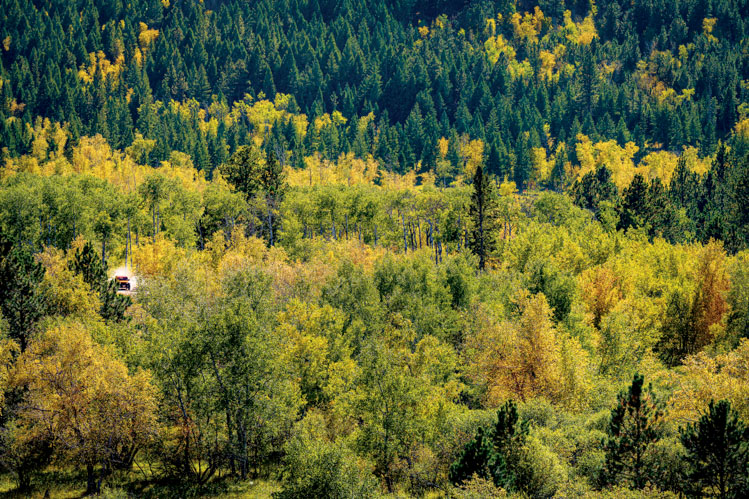
Drivers experience an autumn smorgasbord along Palmer Creek Road, which winds through thick aspen forests and broad meadows.

A SOLITARY COTTONWOOD tree on the lonesome prairie, when bejeweled with golden yellow leaves, emanates as much beauty as the human eye can absorb — especially when the sun slips southward, leaving the September sky bluer than blue.

Yet, who looks for a single tree in autumn? We tell ourselves we must see mountains and hillsides and river valleys with their forests full of leaves, each one hanging precariously by a stem, fluttering unworriedly as if winter was a thousand years away.

So yes, of course, go forth this autumn and fool yourself into believing that this glittering season is not just a cruel trick of chlorophyll. Life will always be so good. Calamity can never follow such serenity. South Dakota is paradise eternal.

Certain places in our big state are especially guilty of contributing to the delusions of autumn, beautiful though they may be. Traffic jams can occur on Highway 14 in Spearfish Canyon during peak leaf-peeking days. Sica Hollow’s oaks are almost as beguiling for people who live in the northeast. Our urban forests are resplendent in different ways because city parks and boulevards feature a gloriously unnatural mix of planned and planted trees. The McKennan Park neighborhood in Sioux Falls is an exceptional example.

We asked our chief photographer, Chad Coppess, if he knew of some lesser-known fall foliage tours. He suggested the three that follow. Interestingly, one that he chose is at South Dakota’s very lowest elevation while another is near the highest. Chad’s diplomatic third choice lies in between, along the Missouri River.

These routes won’t have bumper-to-bumper traffic in September and October when our leaves change color, but that is part of their allure. Autumn is even more striking when you escape the crowds.


PALMER CREEK

Pennington County

The graveled Palmer Creek Road is less than 4 miles long yet offers more than its weight in gold leaves between two spectacularly located campground resorts. Horse Thief Campground and Resort lies on the southwest end of the road and the Mount Rushmore KOA at Palmer Gulch Resort on the northeast. Both campgrounds have funky little stores that offer snacks and refreshments.

Midway along the road, an engineer had some fun by designing a double crisscrossing section with an over-under bridge and a cut through a rock that delivers a jaw-dropping view of Black Elk Peak no matter which way you are traveling. The road winds through beautiful aspen groves and, at times, offers a panoramic view of the entire gulch.

Little-known fact: Along the road is a parking area for Palmer Creek Trailhead, where you can trek to the top of Black Elk Peak (South Dakota’s highest point) and beyond.


PLATTE-WINNER BRIDGE

Gregory and Charles Mix counties

Those who prefer to venture off the interstates know that Highway 44, a main artery across the southern third of South Dakota, crosses the Missouri River via the Platte-Winner Bridge.

The stretch between Platte and Winner is 53 miles. The most scenic area features bluffs that drop into the river valley where you’ll discover two state recreation areas — Snake Creek on the east side and Buryanek on the west.

Lewis and Clark traveled here in 1804 and 1806, at one point losing a member of their party for several days. The Shannon Hiking Trail in Snake Creek Recreation Area commemorates the lost explorer and gives expansive views of the river and autumn colors.

Little-known fact: Unless you live in the neighborhood, you may not have heard that the mile-long Platte-Winner Bridge is about to be replaced. Construction on a new bridge may begin in 2025.


BIG STONE LAKE

Grant and Roberts counties

State Highway 109 runs up the South Dakota side of Big Stone Lake in the northeast corner of the state with a view across the lake into Minnesota. We recommend the 15-mile stretch from Big Stone City to Hartford Beach State Park with frequent stops at access points to the water. The route offers a variety of vegetation and colors for leaf peepers. Hartford Beach is one of the oldest South Dakota state parks and is popular with campers, boaters and fishermen. The log cabin trading post of Solomon Robar, along with Native American burial mounds and pioneer graves, are found along the hiking trails in the park.

Little-known fact: The shoreline of Big Stone Lake (elevation 965 feet) is the lowest spot in South Dakota.

Editor’s Note: This story is revised from the September/October 2023 issue of South Dakota Magazine. To order a copy or to subscribe, call (800) 456-5117.

Posted on Leave a comment

Built on Fur

Phil Steckley and the Newhouse No. 6.

I remember clearly walking into a shed on Phil Steckley’s farm south of Geddes. We had traveled into Charles Mix County to do a story on the rich fur trading culture that had grown there over the last two centuries, and to find people still living it out.

Steckley had traps of all shapes and sizes hanging on the walls. The largest was a Newhouse No. 6 that he said he’d used to trap a bear during an excursion north into Canada and Alaska. When I asked what they’d done with it, Steckley looked as though I’d asked if the sky was blue.”Well,” he said, somewhat incredulously,”we ate him!”

The fur trade in Charles Mix County dates back more than 220 years. Jean Baptiste Trudeau became the first European to establish a permanent residence there in 1794 when he built a trading post called the Pawnee House along the Missouri River southwest of Wagner. The French Canadian had been the first schoolteacher in St. Louis when the Missouri Company chose him to lead an expedition up the Missouri River, make contact with Indian tribes and create an agency.

Lewis and Clark mentioned Pawnee House in their journals when they passed by during their 1804 expedition up the river. Fire destroyed the structure in 1817, but by then the fur culture was firmly entrenched in the area.

Some remnants of the fur trading hey day can still be found. The town of Geddes celebrates Fur Traders’ Days every summer, and guests can tour a trading post that Cuthbert Ducharme built in 1857. Ducharme, also known as Old Papineau, came from a fur trading family in Quebec. He worked for the American Fur Company and gained a reputation as a man who was prone to violence. It was said that a small cemetery outside the post was reserved for all the men Ducharme had killed.

Ilo Vanderboom sweeping the streets of Platte.

Old Paps’ roadhouse stands in the Geddes Historical Village, alongside an old WNAX gas station, a replica Lewis and Clark keelboat and the childhood home of former governor and senator Peter Norbeck. The legend of Papineau’s gold survives, as well. Ducharme apparently grew rich and gave his wife $50,000 in gold in case anything happened to him. She buried the money, but when she died in 1900 the location became a mystery. The legend says Ducharme drove himself insane trying to find the money. He suffered a breakdown and died at the state hospital in Yankton in 1903. Did the endless search for lost treasure lead to his demise, or what is simply the result of a hard life on the frontier?

Papineau’s trading post also served as the first post office in the new county of Charles Mix. Organization began in earnest in 1858 when Theophile Brughier, Charles Picotte and John B.S. Todd — a cousin of Mary Todd Lincoln who was stationed with the U.S. Army at Fort Randall, just across the Missouri River — grew the idea of opening the land to settlers. The region was already home to the Yankton Sioux Tribe, so the speculators took a delegation from Yankton to Washington, D.C., hoping to finalize a treaty. They met Charles Mix, a clerk in the Interior Department who had connections within the Bureau of Indian Affairs and in the administration. In return for his help navigating the treaty through Congress, the new county was named in Mix’s honor upon its creation in 1862.

Charles Mix is still home to the Yankton Sioux Reservation, which encompasses 262,000 acres in the southern half of the county. A monument north of Greenwood commemorates the Treaty of 1858, and the famed Yankton chief Struck by the Ree, who died at Greenwood in 1888, is buried just north of that marker. The town of Marty is home to Ihanktonwan Community College and the architecturally impressive St. Paul’s Church. Students built pews and railings for the grand, limestone chapel, completed in 1942. The church’s spire rises 167 feet, while traditional Indian colors and themes are woven throughout the stained glass windows, murals and ceiling artwork.

The gravesite of Struck by the Ree. Photo by Chad Coppess/S.D. Tourism.

Wagner, at just over 1,500 people, is the largest town in Charles Mix County. It’s especially known for its Labor Day celebration, a four-day gathering of fun, games, music and a grand parade down Highway 46. Lake Andes is the county seat, and the 5,600-acre national wildlife refuge east of town is home to a wide variety of wildlife.

Platte, in northern Charles Mix, is home to another 1,300 people. We visited during the summer of 2004 and one of the first faces we saw was Ilo Vanderboom’s. He created the popular Boom’s restaurants found in southeastern South Dakota, but they day we showed up in Platte he was piloting a street sweeper, intent on keeping his town clean. We found busy bakery, a movie theater and a baseball field where the Platte Killer Tomatoes (maybe the best nickname in all of South Dakota Amateur Baseball?) play their summertime games.

The fur trade isn’t as important to Charles Mix County as it once was, but perhaps an even bigger change came with the construction of Fort Randall Dam, one of six mainstem dams built along the Missouri River in the 1950s and 1960s. The town of Pickstown was created solely for the workers who toiled on the project from 1946 to 1956. When the dam was finally closed, it forever altered the Missouri River Valley. Historic towns like Wheeler were flooded, and the once wild river became a reservoir known as Lake Francis Case. That’s a good reminder to anyone planning to seek out Old Paps’ lost fur trading treasure to bring swimming trunks.

Editor’s Note: This is the 30th installment in an ongoing series featuring South Dakota’s 66 counties. Click here for previous articles.

Posted on Leave a comment

Making ‘Scents’

The flowery fragrance of Jennifer Gilbertz’s first bottle of perfume faded years ago, but its memory remains strong. She thought of that bottle, which her mother gave her at age 3 on their farm near White Lake, while she studied speech and theater at South Dakota State University, tourism at National American University and while she worked as a travel agent in Sioux Falls.”I was always sort of ho-humming what I did,” Gilbertz recalls.”So finally I decided to look for schools that teach olfaction, perfume creation and chemistry.”

Jennifer Gilbertz studied in France for nearly a year before opening her Prairie Perfumery in Platte.

She found the International Superior Institute of Perfume, cosmetics and food aromas in Versailles, France, where she spent 11 months learning how to create perfumes and colognes. Today she puts her nose to the test at her business called The Prairie Perfumery and Boutique in Platte.

Creating perfume requires patience and persistence.”I start with two ingredients,” she says.”I balance them and write everything down, because it’s trial and error. I slowly add ingredients until I have a good base.”

The possibilities are endless. Gilbertz chooses notes from several fragrance families and fine-tunes each perfume until it’s finished about two weeks later.

Chemicals are delicately balanced to create each fragrance.

In 2011, Gilbertz debuted a line of 53 fragrances developed over six years, many inspired by local places or aromas. She recruits Platte teenagers to sample each perfume and suggest names, which is a serious task.”A name can honestly break the fragrance,” she says.”It could be the best fragrance in the world, but if it doesn’t have the right name or the right packaging, it won’t sell. Over 1,000 new fragrances roll out every year around the world, so it’s critical. I’ve got a lot of competition.”

Editor’s Note: This story is revised from the September/October 2011 issue of South Dakota Magazine. To order a copy or to subscribe, call (800) 456-5117.

Posted on Leave a comment

A Depression Christmas

It was Christmas time on the farm during the Depression in South Dakota. The harsh wind swept across the plains and entered the cracks around the windows and doors in our house. The hot days of summer were a faded memory. Our crops were meager at best, but we always produced a bumper crop of children. The number of kids in the small house grew with each passing year until it hovered at 10, by far the best crop during those bleak years.

The week before Christmas held lots of excitement in our household and local community. There was the annual program put on by children at the small country school. As with most child-headed projects, the results were often mixed and surprising each year — anything could happen and generally did. We sang traditional carols while our mother played the old pump organ, which had been home to mice during the summer. In its old age not every key produced sound — and the sounds it did happen to produce were of questionable quality — but it served the school well and was a wonderful way to drown out off-key interpretations of “Jingle Bells” from the children. My mother played the organ with gusto, but it often required my brother lying on the floor and pushing the pedals when she became tired.

A second program followed at the country church, again with questionable talent. Everyone learned the speaking parts in case Joseph or the wise men came down with the flu or the measles, a common occurrence in that day. Santa was always played by one of the local men, no doubt chosen by drawing straws due to the moth-eaten dusty suit they were required to wear. Santa always came bearing candy for the children, which was greatly anticipated.

Memories of Christmas Eve at home began with a huge kettle of oyster stew sitting on the back of the wood stove. This was an extra extravagance that we could ill afford, but a beloved uncle in Washington, D.C., provided the feast by sending $5 for the oysters. How we savored the taste.

The tree had definitely seen better days, as every other branch was missing. It seemed to plead to be put out of its misery. Our rings of green and red paper chains covered the bare parts. One year we attempted to string popcorn but failed miserably because the popcorn was consumed before it had even the notion of being put onto a string. Trees at that time were simpler. No tangled lights were visible because electricity had yet to arrive. Still, the tree stood as a symbol of the joy and merriment of the season.

What presents could be found under the dilapidated tree? Warm clothing was high on the list: a pair of long brown stockings, warm mittens, heavy plaid shirts and long scarves. One child received a photograph album in which she cut and pasted pictures from the Montgomery Ward catalogue because the camera did not work. A local grocer provided a small rubber doll that two girls shared. A Tom Sawyer book and an oversized book of Bible stories were read and reread during the long winter months. But the last and always the best gift was a game to be shared by all. Monopoly was one of our favorites. Eventually the board was in two pieces from overuse, the houses and hotels were in short supply, and you had to know where Park Place was located. No stockings were hung by the fireplace — probably because we were wearing them, and there was no fireplace on which to hang them.

Yes, we were poor. There was not an abundance of gifts under the tree, but we had two loving, hard-working parents, lots of playmates, enough food, good health and kind neighbors. What more does one need at Christmas?

Florence Nachtigal Lang grew up on a farm near Platte. She attended South Dakota State University and taught school in Bristol and Parkston. She and her husband have homes in Byron, Minnesota, and Fort Myers, Florida.