Posted on Leave a comment

A Legacy in Lead

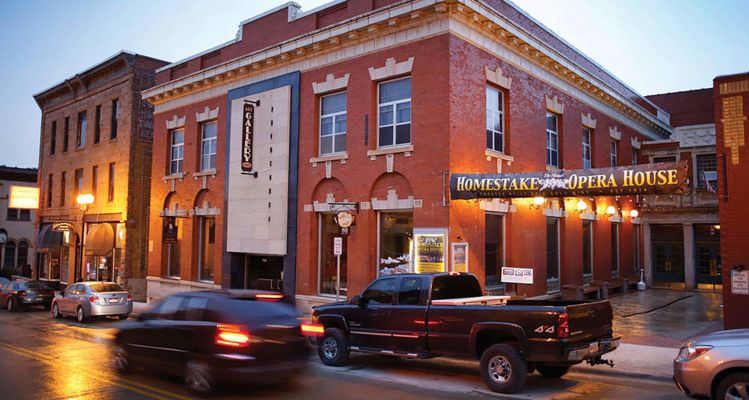
Phoebe Apperson Hearst’s many philanthropic endeavors in Lead included the Homestake Opera House, which opened in 1914.

Phoebe Apperson Hearst died in 1918, several decades before Linda Wiley was born, but their paths crossed in the small Black Hills community of Lead.

Linda studied Phoebe’s writings and accounts of her business and philanthropic ventures and brought her to life through a production on Lead’s Historic Homestake Opera House. Linda believes South Dakotans should know about this remarkable woman who made a big impact in the Black Hills. When Phoebe’s husband George Hearst (mining entrepreneur, U.S. senator from California and fictionalized villain in the HBO TV series Deadwood) died, his 48-year-old widow inherited every penny of his considerable wealth. She gave much of it away.

Her belief in helping those in need could be traced to when she and George lived in San Francisco in 1873, the year an economic depression gripped the country. The couple got by okay,”because of the mines. People in San Francisco fared worse and when I witnessed the impact on the city and families, my philosophy changed towards wanting to help the needy, for I realized I could help,” Phoebe said.

Okay, let me clarify. Phoebe said that in Linda’s script and through Minneapolis actress Kathleen Dodsen Smith’s interpretation. And Jon Steven Wiley, Linda’s actor husband, had a hand in things, too, as script editor. Dramatizing history is a complex matter but a great way to communicate true stories to a mass audience, if the writer, performer and script editor are skilled and conscientious. I can personally vouch for these three. Linda combines a love of the Black Hills with a professional ethic that insists on accuracy. I’ll explain before the end of this column but right now I don’t want to drift too far from Phoebe.

Phoebe Apperson Hearst.

Phoebe considered George’s mining ventures across the West to be immune to the boom-and-bust phenomenon. Homestake grew continually, and after George’s death, Phoebe went to Lead and took a look. She invested in a private railway car she called the Lucania and traveled in comfort. Liking and apparently feeling somewhat maternalistic towards Lead’s people, she began sending $200 (nearly $6,000 in today’s dollars) to all 12 Lead churches every Christmas. She also endowed a fine library and was an advocate for what we now call early childhood education; Phoebe established a free kindergarten in the community. Some critics have looked at her love of Lead and her humanitarian gestures overall and wondered if she couldn’t have done more to prevent community hardship that stemmed from Homestake’s labor lockout over the winter of 1909-10. Whatever the case, Lead didn’t seem to direct anger toward her. Homestake’s board of directors in San Francisco took most of those barbs. Phoebe, meanwhile, rode the Lucania across the United States supporting a wide range of interests, from restoration of George Washington’s Mount Vernon home in Virginia to development of the University of California at Berkeley. She was the first woman to serve as a University of California regent.”I attributed my success in a man’s world of that time to politeness, clear goals, and sheer determination,” Phoebe says in Linda’s script. That style, Linda thinks, likely stunted Phoebe’s effectiveness as a suffragette, although that’s certainly where her sentiments were.

Her last gift to Lead, working with mine superintendent T.J. Grier, was the Homestake recreation building and opera house. In the script Phoebe expresses satisfaction with how Lead responded to an opening night opera in 1914:”I heard that there was standing room only with employees from the mine and their children!”

Historians have mostly overlooked Phoebe’s relationship with South Dakotans. Even Alexandria Nickliss’s fine biography, Phoebe Apperson Hearst: A Life of Power and Politics, only briefly touches on Lead in 664 pages. Thankfully, another California writer, Leta Miller, has written about Phoebe for the South Dakota State Historical Society, and the Homestake Adams Research and Cultural Center has archived South Dakota press accounts about Phoebe’s connections here.

All were resources for Linda, a native South Dakotan and meticulous researcher. She worked as a manager for Caterpillar, Inc., for 30 years across the United States and around the world. All the while, she and Jon knew they would retire to the Black Hills. They found their spot 7 miles outside Lead, and like Phoebe, quickly developed affection for the town. Both volunteered at the opera house that Phoebe made possible, and Linda served for a time on its board and then as president.

And she became a Phoebe Hearst expert. That’s very much a necessity in a town where residents told me the opera house — Phoebe’s final grand gift — is the very heart of the community.

Editor’s Note: This story is revised from the May/June 2022 issue of South Dakota Magazine. To order a copy or to subscribe, call (800) 456-5117.

Posted on Leave a comment

Lead’s International Flavor

Lead has always been home to many cultures, from the hard rock miners who toiled at the Homestake Gold Mine to today’s scientists making groundbreaking discoveries at the Sanford Underground Research Facility.

Spring comes late to Lead due to its mile-high elevation. Then, almost overnight, flowers bloom gloriously in Manuel Brothers Park on Main Street and out-of-town vehicles no longer have snowmobile trailers and ski racks.

Lead is less harried in summer than Deadwood, its”twin city” just a few miles down the hill, but the old mining town still has plenty to offer. There are good restaurants (the Stampmill, Sled Haus, Lewie’s Burgers and Brews, El Jefe’s Fresh-Mex Cantina, and Cheyenne Crossing a few miles out of town in the pines), fine arts at the historic opera house, breweries, museums and the Open Cut, a dramatic remnant of the town’s gold mining era.

Kelly Kirk, director of the architecturally stunning Sanford Homestake Visitor Center that is perched above the Open Cut, interprets”how the past and present collided in Lead” when the storied Homestake Gold Mine segued into the Sanford Underground Research Facility (physics, medical and industrial science) 20 years ago. She sees evolving science and the future of science eventually being examined at the center. Today’s researchers, Kirk says, come to Lead from around the world, but international arrivals are nothing new here; in fact, South Dakota never knew a more cosmopolitan community than Lead. Immigrants flowed into town especially between the 1890s and 1920s, and residents today can still point out old ethnic neighborhoods: Italian, Finnish, Cornish, Irish, Slovak and many others.

Kelly Kirk is director of the Sanford Homestake Visitor Center.

A hundred years ago Gwinn Avenue, running a couple blocks south of Main Street, was known as Slavonian Alley (meaning residents with roots in Austria, Hungary, Slovakia and Yugoslavia) and it was a welcoming place for those from other neighborhoods wanting to experience eastern European traditions. Many of those customs stemmed from Catholic feast days. During the week between Christmas and New Year, homes along Gwinn were open house destinations serving cured ham, fresh breads, apple strudel and wine — always wine.”It was quite a challenge to make a trip through Slavonian Alley,” wrote the neighborhood’s Pearl Krilanovich.”To emerge sober was another thing, as the hospitality of the residents knew no bounds.” Wine was made in eastern European fashion, with great quantities of grapes shipped to town in ice-packed railway cars and then mashed by feet. Not bare feet, Krilanovich stressed; rubber boots were worn.

South Dakota also never knew a more tech-savvy little community than Lead. Homestake Gold Mine, in operation for 125 years and the reason South Dakota ranked first among states in gold production for much of the 20th century, drew most of those immigrants. Sometimes outsiders looked at the mine’s productivity and assumed the founders discovered the richest deposit of precious metal on earth. In fact, ore hoisted from Homestake’s depths wasn’t particularly dense with gold. Rather, Homestake’s international workforce perfected technologies not seen before for extracting quantities of gold, and the company became an American leader in developing hydroelectricity for heavy industrial applications. Lead was rightfully proud of its educated and inventive mining personnel, which numbered nearly 2,000 for decades. They engineered vertical shafts that took miners nearly 2 miles into the earth directly below Lead, and through a network of layered, horizontal passages called drifts that extended 400 miles. What’s more, the workforce applied technology that ventilated the vast subterranean world — in fact, air conditioned it in the deepest regions where temperatures approached 100 degrees Fahrenheit.

Twenty years after Homestake’s closure, there are still hard feelings over the way some outsiders discussed a conversion of the mine to a science lab. Lead residents supported the transition — that wasn’t the issue. But they resented the implication that Lead was being introduced to technology for the first time.

Children peer into the Open Cut from the Sanford Homestake Visitor Center.

Some observers also compared Lead to unlucky northeastern Rust Belt towns, and predicted that with high industrial wages gone, some residents might just walk away from homes and mortgages. Abandon Black Hills real estate? In the 21st century? Not likely. It’s true that some unemployed miners left the area, but their homes sold, often to people who always hoped to own a piece of the Black Hills before they died. Today there’s some controversy over owners of classic, older Lead homes who are tempted to break them into apartments for much-needed workforce housing. Should local government enforce single-family home zoning in some neighborhoods? The concept violates the libertarian spirit that seems to reign supreme among liberals and conservatives alike in the Black Hills.

Controversy is nothing new to Lead. Homestake’s public relations department in the 20th century (perhaps the best ongoing PR campaign ever in South Dakota) was masterful in communicating how well various ethnicities got along in Lead. Usually that was true, but it would be a mistake to think of life here as one blissful stroll down Slavonian Alley, to employ a local metaphor. The darkest time was 1909-1910, when the mine caught wind of employees hoping to unionize. Homestake locked its crews out until everyone signed papers stating that they belonged to no union and would never join one. Homestake, actually a San Francisco corporation, won. Some Lead families were hungry before the mine reopened and paychecks came again, and there were resentments between families that ran deep and sometimes along ethnic lines. It was easy to believe certain nationalities were not astute in American contractual dealings. Not until 1966 did Homestake miners unionize, and sometimes family splits surfaced again when the time to renegotiate collective bargaining agreements rolled around.

Still, it was possible to grow up without much awareness of those matters. Lead was a lively town, full of diversions — youth sports leagues, arguably the best recreation building in South Dakota the first half of the 20th century, nearby hunting and the Midwest’s longest and most challenging ski slope just up the road at Terry Peak.

Bob Phillips was not only a member of the Homestake Mining Company Band, he pulled this bass drum through parades while a bandmate played it from behind. It’s among many artifacts at the Black Hills Mining Museum.

Bob Phillips, a retired Lead teacher, coach and school administrator, has witnessed more than half of Lead’s history. He spent his early childhood living in Slavonian Alley and remembers the open houses.”Our family name didn’t end v-i-c-h,” he notes.”But if you lived in the Alley, neighbors made sure you were part of it.” Phillips remembers some of the 16 or 17 grocery stores Lead once supported (many with ethnic specialties), Cornish pasties (a full meal of meat and vegetables baked in a pastry shell), long hours spent in the Homestake Recreation Building and the knowledge he was guaranteed a summer job as a teenager because his dad worked for Homestake. After college Bob and his wife, Cara Pat, traveled to Africa with the Peace Corps and then taught in Minnesota for a year. But then they were drawn back to Lead,”a culture totally distinct from other South Dakota towns,” Phillips says, and they built careers here.

A turning point for Lead came in April 1984 when fire gutted much of the Homestake Recreation Building, built 70 years earlier by the mine as a lifestyle amenity for employees (and, as it turned out, for pretty much everyone else who lived in Lead). The mammoth structure featured a thousand-seat theater, heated swimming pool, bowling alley, library and billiards hall. After the blaze it was determined that insurance alone couldn’t cover a full rebuild and there were people in town ready to write the building off as a lost relic. But others committed themselves to fundraising and rebuilding through a nonprofit corporation. The”rebuild” sentiment became Lead’s majority view and today the nearly lost structure is known as The Historic Homestake Opera House, focusing on a wide range of performing arts. Recent shows, drawing a Black Hills-wide audience, have included touring performers in An Irish Rambling House, stand-up comedian Jason Salmon, as well as a performance series by pianist Kathryn Farruggia. This summer a children’s theater program will put local kids on the big stage. The Opera House is also a popular wedding venue.

Yet 38 years after the fire, the rebuild is not yet complete. The building has a new roof (the original caved in) but marks where flames licked the walls remain visible in the auditorium. For some in the community the scars communicate there’s still work to be done and dollars to be raised.”We have set our sights on the completion of the entire project, raising funds for this massive project,” says opera house Executive Director Thomas Golden. The organization received a National Endowment for the Humanities Challenge Grant and, Golden adds, money”raised as a part of this matching grant will allow us to complete many of the infrastructure related projects such as fire suppression and HVAC.”

Development Director Christine Allen, President Linda Wiley and Executive Director Thomas Golden (left to right) oversee restoration and events at the Homestake Opera House.

Opera House President Linda Wiley says the nonprofit has brought together a community within the community, people”who enjoy the work and also one another.” There can be little doubt, she adds, that the evolving success led to action in preserving other aspects of Lead’s history. Wiley didn’t mention it but people from other Black Hills communities did: long gone is an unfair image that Lead fought for generations about being a company town incapable of tackling initiatives without Homestake’s guidance.

Rapid City actors Kurt and Tina Bauer sometimes lend their talents to the opera house for locally produced shows. Kurt understands what Wiley means about a community within a community.”They treat their actors right,” he says,”and they understand Lead. The opera house is the centerpiece of the community.”

Of Lead overall, Tina adds,”it’s a tight little community,” and one that the couple has explored well, especially after discovering the Town Hall Inn bed-and-breakfast, just steps away from the opera house on Main Street. The Bauers sometimes stay there during runs of their shows. It’s another example of Lead taking care of its past. The little hotel was Lead’s 1912 city hall and jail, with rooms bearing their original names: Mayor’s Office, Judge’s Chamber, and so on.

ìIt was the city hall until the 1930s, when it was replaced by the present one that was built as a WPA project,” says Mark McGrane, the owner along with his wife Jade and his brother Paul. The trio found a perfect use for the old town jail, turning it into a cozy pub called Jailhouse Taps. They brew their own Belgian-style beers.

Blond Alibi and Dungeon Drunkard are locally popular Jailhouse Taps brews. Being a tight-knit community, Lead people are quick to point out another beer producer just up the street — Dakota Shivers Brewing. The affection Lead demonstrates for its beers makes you wonder if they will still be recalled a century from now, much like those legendary Slavonian Alley wines.

Editor’s Note: This story is revised from the May/June 2022 issue of South Dakota Magazine. To order a copy or to subscribe, call (800) 456-5117.

Posted on Leave a comment

Discoveries at Englewood Springs

South Dakota is a special place, partly because of its sheer variety. Everyone has heard or shared a joke about the constant change of weather, but I wonder how often people stop to think about the ecological variety that exists within our borders? Last year, I was tasked with finding and photographing a”green orchid” in the Coteau des Prairies of northeastern South Dakota. Before that request, I was unaware that orchids even grew in our region. I was quite wrong, and thankfully so. Depending on who is counting, there are up to two dozen different orchid species found in South Dakota. What does knowledge like this do to a photographer who loves a macro lens and beautifully colored wildflowers? It starts a self-motivated project that if not careful, borders on obsession.

While researching local orchids, I”discovered” Englewood Springs Botanical Area near Lead. It’s been a place of botanical interest since the late 1960s, but I first read about this little corner of the Black Hills in a 2011 National Forest Management Strategy document found online. I had learned about the fairy slipper orchid from David J. Ode’s Dakota Flora: A Seasonal Sampler, and while using the internet to learn where these amazing plants can be found, I noticed the above-mentioned report and learned the fairy slipper had been documented at Englewood Springs along with at least a dozen other orchids. That was all it took to ensure I visited with camera in hand.

My first trip there was in late June of 2021. I battled a downed white spruce, steep hillsides and shortness of breath being the flatlander that I am. I was also unable to find a fairy slipper. Most likely I was too late in the season, but I did see three”new to me” orchids as well as a variety of other amazing flowers I had never photographed before. Along the way, I suffered a torn pair of jeans thanks to an unseen branch on a downed log. Even so, the excursion was well worth it.

This spring, I was determined to go earlier to find the elusive fairy slipper. However, spring was late this time around and my first trip, over Memorial Day weekend, found Englewood Springs just waking up from winter and not many new buds could be seen. Even so, new to me flowers included bearberry blooms and drops of gold.

Undaunted, I came back a mere two weeks later. Again, I was stymied in the fairy slipper search, but I did photograph my first alpine milkvetch, as well as the uniquely diminutive wister coralroot orchid. My searching was cut short on that trip after a log unexpectedly gave way, resulting in an awkward lurch into thick mud and one of the worst hamstring pulls I’ve ever experienced. Chalk another one up to Englewood Springs.

I was back a few weeks later, only to discover that I was again too late to find a fairy slipper, but just in time to find a rare broad-lipped twayblade orchid. I also saw and photographed an orchid not on the Englewood Springs list, a frog orchid. So, I’ll take that as a win and will visit again next spring in search of that yet unseen, but very well named, fairly slipper orchid.

Christian Begeman grew up in Isabel and now lives in Sioux Falls. When he’s not working at Midco he is often on the road photographing South Dakota’s prettiest spots. Follow Begeman on his blog.

Posted on Leave a comment

Gold in the Hills

Our March/April issue includes a story on prospecting in the Black Hills, where hobby gold miners still carry pans and pickaxes deep into our mountain valleys. Our founder Bernie Hunhoff, editor Katie Hunhoff and her son Steven visited a claim to sift for gold and take some photos. Here are some photos that didn’t make the magazine.

Posted on Leave a comment

The Victim’s Daughter

Musty smelling and crumbling, Black Hills newspapers of April 1917 report names that confirm their age. President Woodrow Wilson calls for an all-out American effort to win the World War. Former President Teddy Roosevelt suggests sending gung-ho, mature veterans into combat. Closer to home Robert Tallent, credited by the papers as”the first white boy in the Black Hills,” dies.

Only a few Black Hills residents knew the names Martin Conheeney and Eimel Joukkuri before April 25, 1917–the date the Lead Daily Call reported a deadly encounter between the two. The night before at about 9:30, just inside the Terraville tunnel, Joukkuri shot Conheeney. Then he walked to a police station at Mill and Main in Lead, turned himself in, and was placed under arrest.

The tunnel, long gone, once ran nearly a mile through a mountain ridge and connected Lead and Terraville. It was Homestake Gold Mine property and pedestrians regularly used it. But the mine built the tunnel so a train — a little air powered tram — could haul ore into Lead. If a pedestrian met the train in the tunnel, says Lead historian Wayne Paananen, he would have to back against the wall and watch the engine and ore cars pass within a foot. So guards were instructed to keep people out of the tunnel when the train was due, especially if they appeared intoxicated.

Joukkuri was one of those Homestake guards and Conheeney an off-duty Homestake explosives expert.

“Shortly after his arrest and before being advised to remain silent regarding the circumstances of the killing,” reported the Call,”Joukkuri made a statement to Chief of Police Keffler, in which he said that immediately before the trouble, he was on duty in the entrance of the tunnel and probably 60 feet away from the roundhouse where the concrete work of the tunnel begins, when Conheeney came through from the Lead end of the tramway, on his way into the tunnel. Conheeney was under the influence of liquor…”

Conheeney’s family and friends would later fight the notion that he was drunk. But in the hours after the shooting, Joukkuri’s statement looked like a fact in the Lead Daily Call.

Joukkuri said he told Conheeney to stop, the Call continued. Conheeney”paid no attention to Joukkuri’s admonition, but proceeded on his way, and the guard followed him. They exchanged blows and grappled, both going to the ground. Joukkuri stated that Conheeney had the better of him in the encounter, and attempted to choke him; that they got to their feet and Conheeney struck him with a bottle of liquor which he carried, landing a blow on the side of the guard’s head.”

In Joukkuri’s trial it would emerge that the liquor was for Conheeney’s wife, Mary, intended for medicinal use.

Joukkuri told police he ran for help after the struggle. George Hart, watchman and boiler engineer, added that Joukkuri bolted into his boiler room off the tunnel with a bloodied head and torn clothing. Hart couldn’t make out what Joukkuri told him, he explained, because working close to Homestake’s stamp mill left him a bit deaf. But Joukkuri’s condition certainly communicated trouble. Hart and Joukkuri stepped into the tunnel, Hart going first, and they spotted Conheeney. Hart said Conheeney threw a rock their direction, then charged toward Joukkuri. Hart claimed he tried grabbing Conheeney but missed.

Joukkuri, revolver in hand, fired two shots. One, Lead police determined, missed. The other hit Conheeney in the left temple and he fell against the tunnel wall and into a sitting position, dead.

The newspaper reported all this in great detail within hours, but there was more that the public didn’t learn for a while. Conheeney was 33, married with a young son and daughter, and had another baby on the way. At Joukkuri’s trial it was established that Conheeney was taking liquor to his wife, and witnesses from the Lead saloon where he bought the spirits said he left sober. Joukkuri’s shooting of an unarmed man didn’t sit well with the jury. It convicted the guard of manslaughter and sentenced him to hard labor at the state penitentiary.

Court records and press reports referred to Joukkuri as Finnish and Conheeney as Irish (both, in fact, were immigrants) and there’s been speculation that the references implied ethnic tension between those groups. But historian Paananen says identifying residents in remarkably cosmopolitan Lead by nationality was common practice during those years, even in Homestake employee records, and in this case probably implied nothing. It’s worth noting the family that first came to Conheeney’s widow’s aid that tragic night was Finnish (the Macki family).

Jim Dunn, former Homestake employee and state legislator, has taken interest in the case for reasons revealed later in this article. He thinks the tragedy resulted simply because of”an overzealous guard and a man who stubbornly insisted he was going home as quickly as possible to his sick wife.”

The widow, Mary Conheeney, took her three children (including a daughter her husband never met) home to Ireland in 1919. She had to wait for the war’s end before it was safe to cross Atlantic waters. Her middle child, Nora, was six in 1919 and would recall a rough crossing and terrible seasickness.

Seventy-five years passed. The tram system for hauling ore through the mountain ceased operation and pedestrians had the Terraville tunnel all to themselves for several years. Eventually sections of the tunnel were filled in, or lost to the expanding Homestake open cut mine. The open cut wiped away Terraville, too.

Then in 1994 Deadwood Mayor Bruce Oberlander received a strange letter. It came addressed to the”Lord Mayor, Deadwood City,” definitely a first. It bore an Athlone, Ireland postmark, and asked about”Lead City.” The letter-writer’s last name, written in pen, was hard to make out. It appeared perhaps to be Ryan. The first name, though, was unmistakable: Nora.

Nora Conheeney Ryan was in good spirits when she returned to the Black Hills, 77 years after her father’s murder.

That’s where Jim Dunn and his wife, Betty, entered the story. The mayor’s wife, Mary Ann, knew the Dunns had traveled in Ireland. Perhaps, she thought, they’d know Athlone’s location. As it turned out Jim and Betty had stayed in an Athlone bed and breakfast and knew the owner. In a plot development that would be laughed out of any fiction piece, the Dunns called their Athlone friend. She told them Nora Ryan lived less than a mile up the road. This was Nora Conheeney Ryan, Martin and Mary’s middle child. At age 81 she had decided it was time to return to the Black Hills, and maybe arrange for a new headstone for her father’s grave.

The Dunns promised to help any way they could. It was, says Betty, the beginning of a friendship that would shortly feel like a family relationship — and would continue feeling that way over the years. On Aug. 22, 1994, Nora landed at Rapid City Regional Airport and raised her hands in triumph. Two daughters, a son-in-law, and a friend from California accompanied her.

“I shall never forget my trip to South Dakota,” Nora later wrote.”It was the most challenging and wonderful thing I ever did. With Jim’s help, finding my father’s grave was the greatest moment of my life.”

Former state legislator Jim Dunn (pictured with his wife, Betty, at Martin Conheeney’s grave) believes the tragedy resulted from “an overzealous guard and a man who stubbornly insisted he was going home to his sick wife.”

They found it in South Lead Cemetery. Nora didn’t have to arrange for a headstone. The original stood in beautiful condition.

That wasn’t all Nora found. The Dunns made phone calls and the past 75 years melted away. Hubert McGrath stopped by with a photo of his parents, John and Margaret McGrath, who were Nora’s godparents when she was baptized at Lead’s St. Patrick Catholic Church. Nora recognized the faces in the photo immediately. She brought some pictures of her own, including that of a house between Deadwood and Spearfish. It once belonged to her father’s cousin and Nora recalled spending pleasant summer days there. Jim called Spearfish historian Linfred Schuttler, who in turn pulled Jim Riggs into the search.”Jim knew right away where the house was, north and east of the Spearfish airport,” Linfred recalls.”It had been a stagecoach stop on the old Spearfish to Whitewood line.” Nora visited the home and recognized it right away as she approached–right down to the trees in the yard.

“She sure had a memory,” Betty Dunn says.”What do I remember from when I was four years old? She remembered everything — sights, smells, sounds.”

And tastes. Betty was able to fulfill a menu request that Nora associated with her Black Hills childhood: corn on the cob and watermelon.

Joukkuri’s trial records surfaced easily. The Lawrence County courthouse had just been refurbished and the city of Deadwood took possession of its historical documents. The records held a surprise. Joukkuri appealed his manslaughter conviction, claiming self-defense, and won.

“He walked away from that sentence,” says Jim Dunn.”Nora didn’t know that and it was the only sour note on her whole trip, finding out he’d been released. But she wasn’t bitter. She said, ëWhat is done is done.'”

Of course, just as Black Hills life moved along with twists and turns for 75 years, so did Nora’s life across the sea. Her mother actually planned to return and raise her children in South Dakota after the 1919 trip home. But Mary Conheeney ended up staying in Ireland where she was embraced by a loving, supportive extended family. Nora became a teacher, married fellow teacher Martin Ryan, and raised a family of six. Late in life, after her husband’s death, Nora hoped to see the Black Hills again. She no longer knew anyone there, however. Deeply religious, she told God the trip would be possible only if he designated South Dakota friends and guides. That’s what happened, and she later reflected that the trip helped her understand a sadness she carried her entire life.

Nora returned to Ireland after a week, lived another 12 years, and took special delight in Jim and Betty’s visits to Athlone. From afar she kept an eye on the Black Hills.”Everyone appreciates an honest man,” she observed when Jim won another term in the state senate. In 2001, after the mine that employed her father closed, she wrote,”Farewell Homestake — it gave us lots of headaches.” Read into that what you will, but she probably referred to the same pounding stamp mill noise that hurt George Hart’s hearing.

What most impressed Nora’s South Dakota friends was that she didn’t want to forget the Black Hills after the family tragedy, but hoped to embrace her childhood home. And it wasn’t just a gravestone, house, and corn-on-the-cob she sought, but people.

“She could imagine making those kinds of connections in Ireland, but not in the United States, because America is so very vast,” says Tina Burke, one of Nora’s daughters who flew with her to South Dakota.”When she first thought about the trip, she believed it was unlikely she could even find the grave.”

Adds Jim Dunn,”There are very few strong ties these days, even among families. People are always moving around, cutting ties. Who could ever have guessed that looking for that grave would result in the close tie we have with Nora’s family?”

It’s an ending to the tragedy that reporters couldn’t have imagined as they studied grim police and coroner reports in 1917.

Editor’s Note: This story is revised from the November/December 2008 issue of South Dakota Magazine. To order a copy or to subscribe, call (800) 456-5117.

Posted on Leave a comment

Winter on Mickelson Trail

John Mitchell shared these photos from a section of the Mickelson Trail near Kirk Trailhead south of Lead. Trains thundered along this north-south route through the heart of the Black Hills for nearly a century. They stopped in 1983 and the abandoned line from Deadwood to Edgemont was converted to a 109-mile recreational trail. The first segment opened in 1991 with the entire route completed in 1998. It’s named after Gov. George S. Mickelson, one of the project’s first supporters. See more of Mitchell’s photos on Facebook and at sodakmoments.com.

Posted on Leave a comment

Governor’s Snowmobile Ride

I spoke to Diane Hiles of De Smet yesterday while she and her husband, Greg, headed to the Hills for the 32nd annual Governor’s Snowmobile Ride. Hiles is the secretary of the Town and Country Snowdrifters Snowmobile Club, hosts of this year’s ride. The event takes place at Hardy Camp, a Forest Service station in Lead. Winter weather has been unseasonably warm but Hiles says the trails are in excellent condition for the 200 people expected to attend. She and Greg were able to snowmobile the Black Hills trails last week to test them.

The ride starts at 9:00 a.m. on Saturday with brunch, registration and introduction of special guests. Hiles says Governor Dennis Daugaard and his advisory council are expected to attend, as well as U.S. House Representative Kristi Noem. Invitations are extended to all state legislators and at least 12 plan to participate from Sioux Falls, Baltic, Mitchell, Big Stone City, Rapid City, Spearfish and Lead. SDSA provides snowmobiles for the invited guests with help from Yamaha Motor Corporation and Arctic Cat.

The large crew of snowmobilers will split up with experienced riders designated as group leaders through the Black Hills trails maintained by Hardy Camp. The day culminates with a meal and social gathering for riders to visit about their experiences of the day. “The ride was started by the South Dakota Snowmobile Association (SDSA) as a way to showcase the trail system in the Black Hills,” says Hiles. “SDSA works for the good of the snowmobiling sport, trying to make sure the trail system continues to operate both East River and West River.”

Posted on Leave a comment

Wild Bill and Calamity Jane: A Love Story?

We’ve all heard the stories about Wild Bill Hickok and Calamity Jane being more than just friends. But of course we know better. James McLaird, a longtime history professor at Dakota Wesleyan University in Mitchell, debunked the myth pretty forcefully in his book Wild Bill and Calamity Jane: Deadwood Legends. He proved the two knew each other for only a brief period in Deadwood, and were certainly nothing more than casual acquaintances.

But that’s not what The Days of’75-’76 would have you believe. The 1915 silent film was the first movie to link the two romantically. Audiences haven’t seen the film in decades, but it reappears this weekend, the opening of the Historical Film Series at the Black Hills Roundhouse in Lead.

Scholars at the University of Nebraska discovered the film in their archives over a decade ago. They were unable to identify the locations or characters portrayed, so they contacted Wayne Paananen in Lead. Paananen owns the largest private collection of historical films in the state, and was able to piece the story together.

The Hart brothers, filmmakers from Omaha, shot the picture in the Black Hills, Badlands and Fort Robinson in Nebraska. Its run time is about 70 minutes, much longer than other films produced 100 years ago. And it’s clear the directors did not strive for historical accuracy.”It takes tremendous liberties,” Paananen says.”For example, Jack McCall vies with Wild Bill for the affection of Calamity Jane early in the film.”

It includes typical Western scenes depicting Indian uprisings and stagecoach robberies. One of the final scenes shows Jack McCall on trial in Yankton for the murder of Wild Bill.”It is truly a real piece of Americana, not only portraying the true Western format of filming, but it was done at a time when movies were the rage,” he says.”It was a totally new form of entertainment.”

Paananen says the film is exciting for two reasons. First, you get a feel for the filming techniques of the day.”When they had an indoor shot, they only built a three sided set with no roof, and they used all natural light and shot from the open side,” he says.”That was really a great technique, except in this film when they are supposed to be indoors the tablecloth and papers on table are blowing around because of the wind.”

Audiences also get to see the Deadwood of a century ago. A scene at Mount Moriah Cemetery shows the second of two statues that once stood over Wild Bill’s gravesite. Souvenir hunters regularly chipped pieces from the monuments.”You can see it’s already been attacked by tourists and starting to look ugly,” he says. It was eventually removed and is now displayed at the Adams Museum in Deadwood.

The Days of’75-’76 screens at 7 p.m., tonight through Saturday. Future films include Homestake: The Legend and Legacy (Feb. 15-18), World War II films (March 14-17, and a film festival and competition open to amateur filmmakers in April and May. Information on each film and the upcoming festival can be found at www.bhroundhouse.com.